Freedom and the Law

Freedom is something we almost universally value, but which is often hijacked by various groups, particularly on the extreme right to support particular causes which have little real connection with our undamental rights. Freedom is certainly not the freedom to do what we like regardless of the effect it has on others.

Freedom is not the right to own and carry guns or other weapons. It isn’t the right to spread disease we may have by not taking sensible precautions such as wearing a face mask in crowded places. It isn’t the right to increase the risk of others getting lung cancer or to drive after consuming alcohol or drugs.

Arguably the most important of our freedoms is the right to hold and express political and religious ideas and to express these. But that is not absolute, and rightly there are laws against hate speech and incitement to others to commit criminal actions or threaten the lives of others.

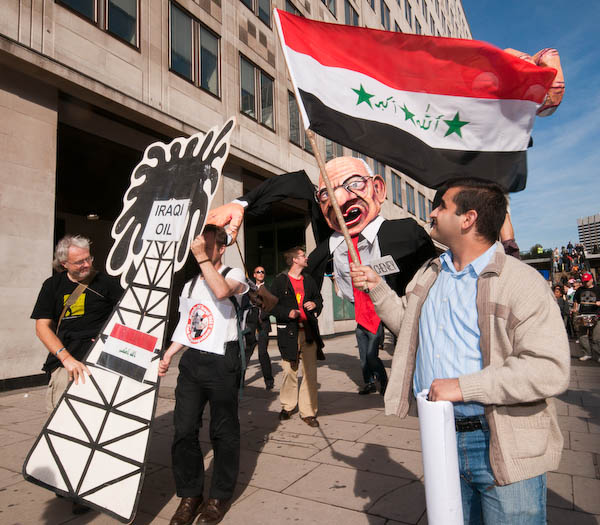
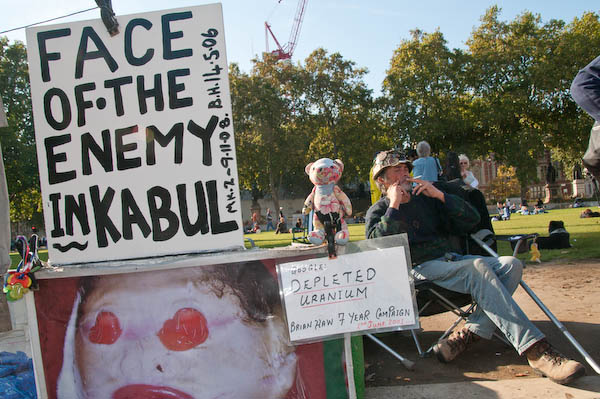
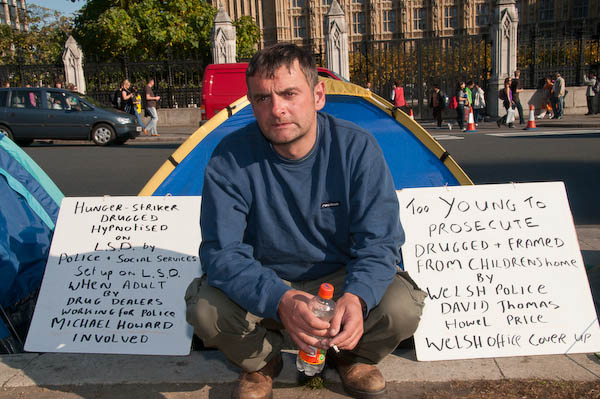
Back in 2005, the Labour government brought in a law to criminalise protest in Parliament Square. It was clearly a law which imposed unnecessary restrictions on our freedom and one which was brought in for a trivial reason, to end the embarrassment to the Labour ministers of one man, Brian Haw, continuing to protest, particularly over Iraq war and its disastrous consequences. That Tony Blair was annoyed by a regular reminder of his lies was not a suitable basis for legislation.

A regular series of harassment by police and others – almost certainly at the urging of the Home Secretary – had failed to shift this persistent protester, and civil servants were ordered to add a section to the bill which became the Serious Organised Crime and Police Act 2005 to make his protest illegal. In the event the act failed to apply to his protest and I wondered if this was a little deliberate subversion by at least one of those responsible for its drafting rather than simple incompetence. Because his protest had begun well before the SOCA law came in on 7th April 2005, it was apparently not covered by it. As I commented, “rather a lot of egg on government faces there.” This initial ruling by the High Court of Justice was eventually overturned by the Court of Appeal and these sections of the law were replace by other restictive laws in 2011.

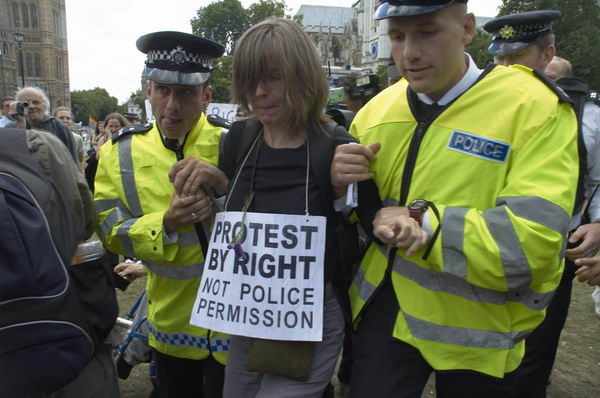
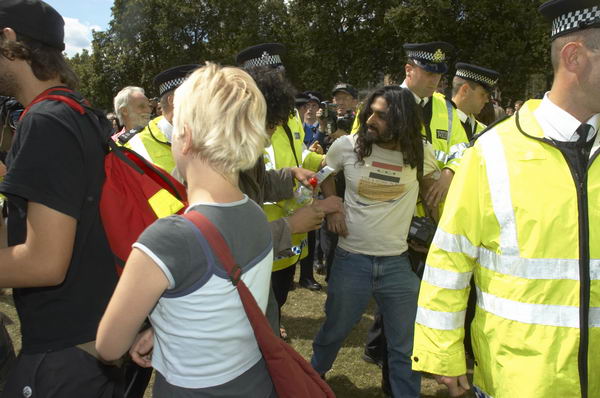
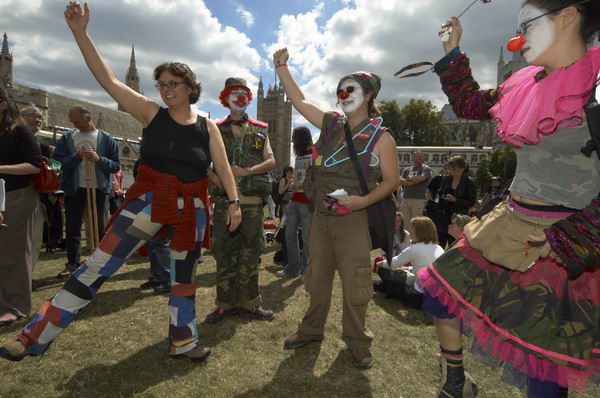
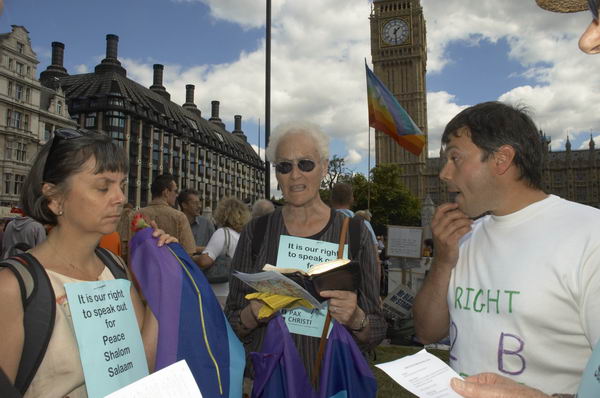
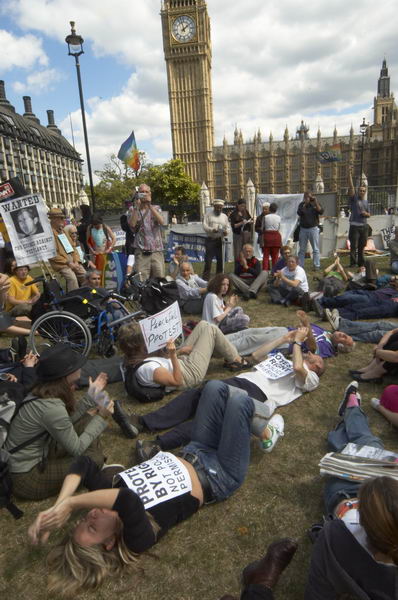
On Sunday 7th August 2005, protesters came to Parliament Square to deliberately disobey the law, and the police came, some rather reluctantly, under orders to arrest them. The protestors argued that protest is a human right and cannot be restricted by law in a free society.

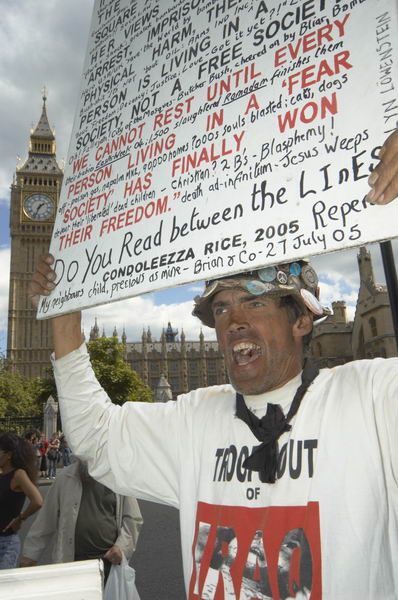
Brian Haw was there, but protesting legally as it appeared that the act didn’t include him. He held up a placard with the words from a speech in Boston by US Scretary of State Condoleezza Rice:
if a person cannot walk into the middle of the town square and express his or her views without fear of arrest, imprisonment, or physical harm, then that person is living in a fear society, not a free society. We cannot rest until every person living in a ‘fear society’ has finally won their freedom.”
interleaved with his own comments on Guantanamo, Abu Ghraib, Belmarsh and the Iraq war and more.

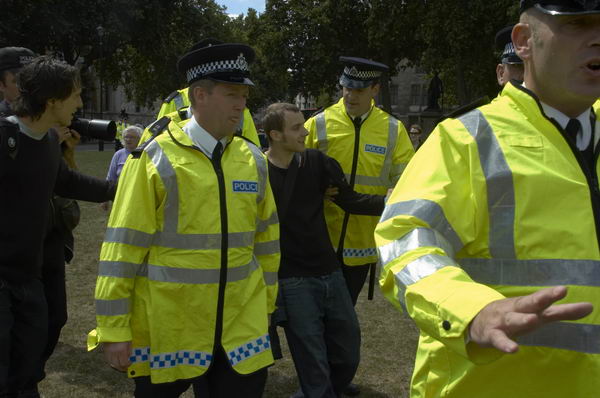
The police swooped on a few of those with posters or placards and arrested them, leading them away but their heart was clearly not in it and the great majority of the protesters were untouched, though
they were warned that their protest was illegal. As I commented: ” I saw five people arrested for simply peacefully holding banners supporting the right to protest. It happened on the square opposite our Houses of Parliament, and it made me feel ashamed to be British.”

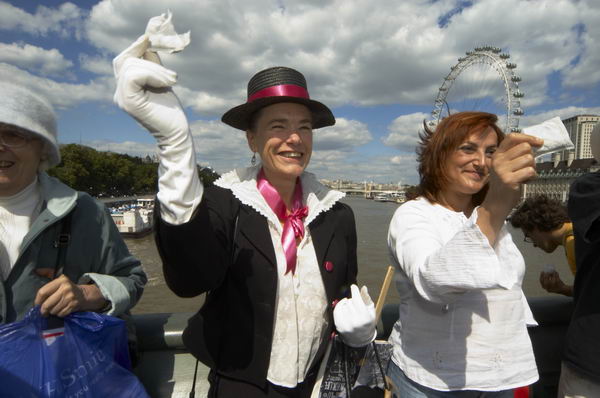
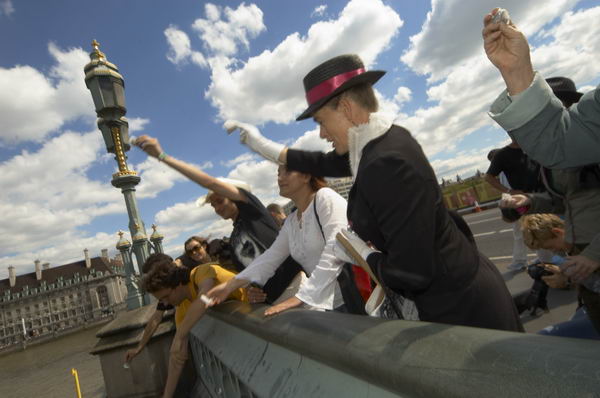
When the protest in Parliament Square ended, protesters were invited to take part in another illegal protest inside the one km restricted zone around Parliament, but on Westminster Bridge. Again taking their lead from Boston, though this time from 1773, and tipping tea into the water, campaigners calling for a low-level tax on foreign currency exchange transactions, as proposed by Nobel prize-winning economist James Tobin in 1978. This would deter speculation on currency movements, giving governments greater control over their fiscal and monetary policies, and reducing the power of speculators to affect the markets.

The connection between the tea bags torn to tip tea into the Thames, produced by large multi-national companies who are among the currency speculators, and the Tobin Tax, seemed a little weak – as doubtless was the brew in the river – though it did all alliterate nicely for the Westminster Tea Party – Time for Tobin Tax.

We are now seeing a law going through Parliament which will even further restrict our right to protest, increasing discriminatory policing, criminalising some traditional ways of life and seriously restricting and controlling protests in a huge shift further towards a police state. Unfortunately a large Conservative majority makes it seem inevitable that our freedoms will be significantly reduced.

More on My London Diary for August 2005.


All photographs on this and my other sites, unless otherwise stated, are taken by and copyright of Peter Marshall, and are available for reproduction or can be bought as prints.


A Busy Monday

Kashmiris call for independence

Monday 11th of February 2019 was an unusually busy day for me covering protests in London, with several unrelated events taking place across Central London.

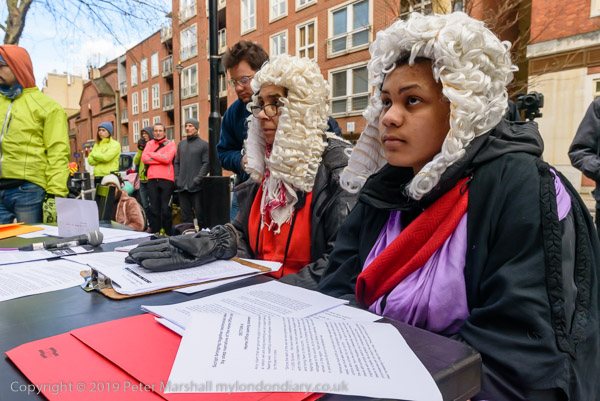
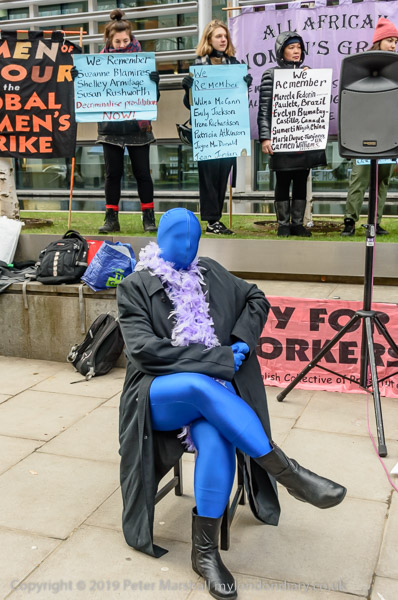
My day began outside in Marsham St, where groups outraged at the callous hostile environment introduced by Theresa May as Home Secretary from 2010 to 2016 and carried on by her successors Amber Rudd and Sajid Javid (and of course from later in 2019 by the despicable Priti Patel) held a mock trial of the the Home Office.

The Home Office were represented by a figure in Tory blue

The Home Office runs a violent, racist, colonial, and broken asylum, detention and deportation regime which treats refugees and asylum seekers as criminals, judged guilty without trial and often faced with impossible hurdles as they attempt to prove their innocence and claim their rights. It puts pressure on police and the CPS to launch false prosecutions – such as that of the Stanstead 15 who peacefully resisted an asylum flight and were charged and convicted under quite clearly ludicrous and inapplicable terrorism laws – and whose conviction was recently quashed on appeal.

Two years ago I wrote:

There were testimonies from individuals, groups and campaigns about suffering under the vicious system of rigged justice, indefinite detention, ill-treatment and arbitrary arrest and deportation. Two judges watched from their bench and those attending were members of the jury; I left before the verdict, but it was never in doubt.

People’s Trial of the Home Office

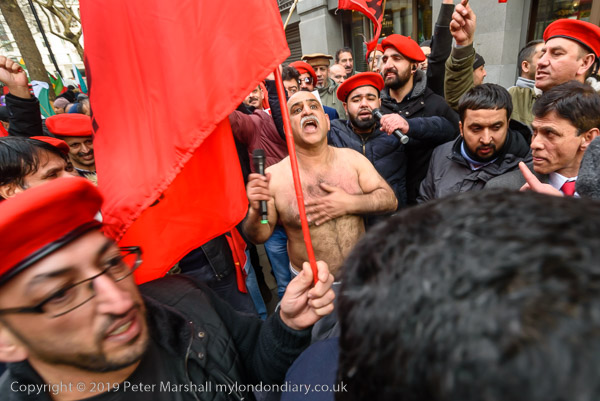
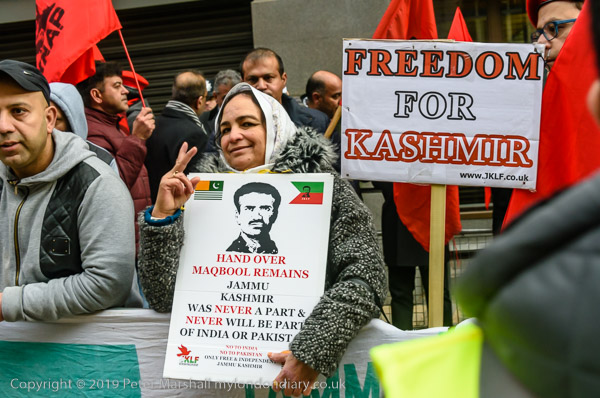
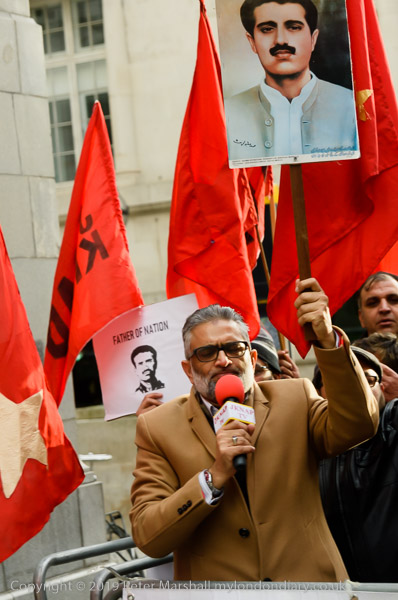
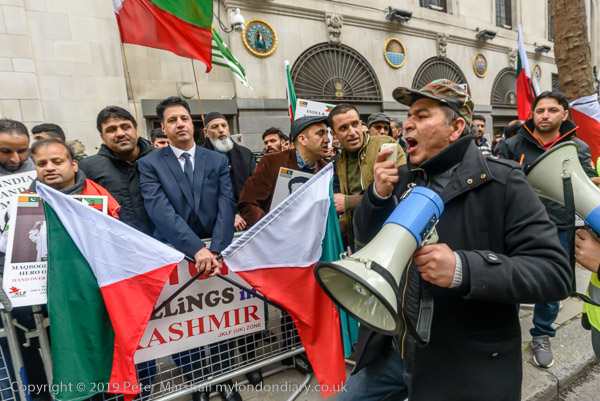
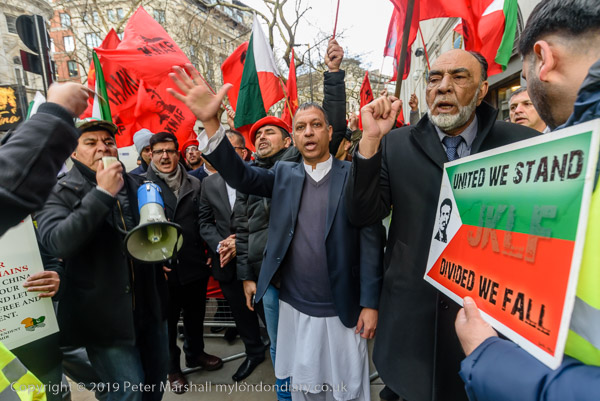
I left early to cover a protest at India House in Aldwych by the Jammu Kashmir Liberation Front calling for freedom, there on this day as it was the 35th anniversary of the hanging by India of Maqbool Bhat Shaheed in 1984. The population of Jammu and Kashmir is around 12.5 million, and India has over 800,000 troops in Kashmir, who shoot to kill, torture, rape and burn homes with impunity, killing over 100,000 Kashmiris since 1988. More recently India has even tightened its control over Kashmir, getting rid of the constitutional limited autonomy of the area, politically integrating it with India although this seems unlikely to lessen the continuing fight of the Kashmiri people for independence.

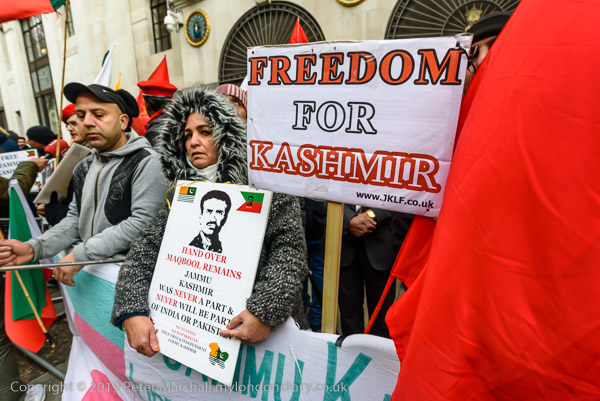
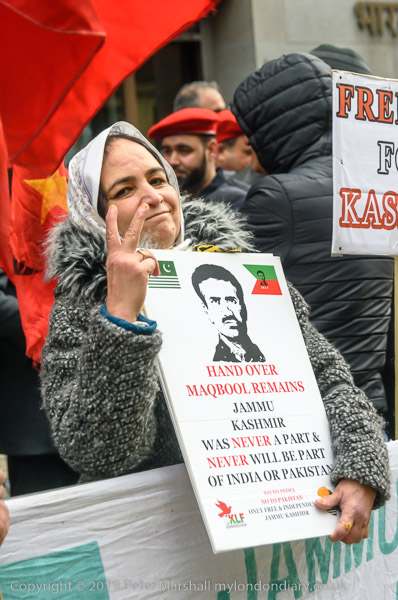
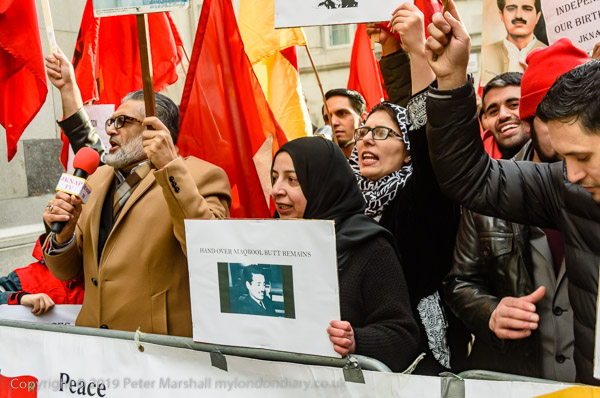
Later I photographed a protest by a second group of Kashmiris, the Jammu Kashmir National Awami Party UK, calling for the remains of Maqbool Bhat Shaheed to be released and for independence for Kashmir.

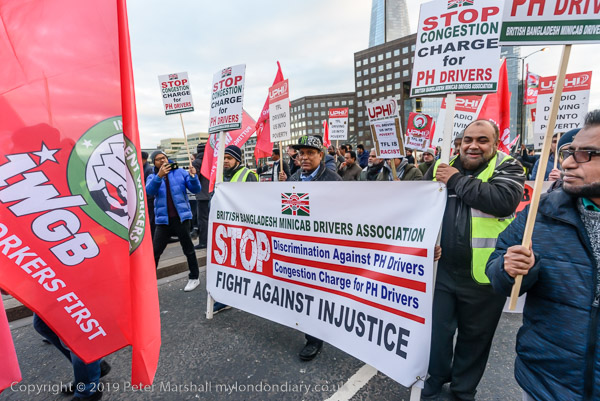
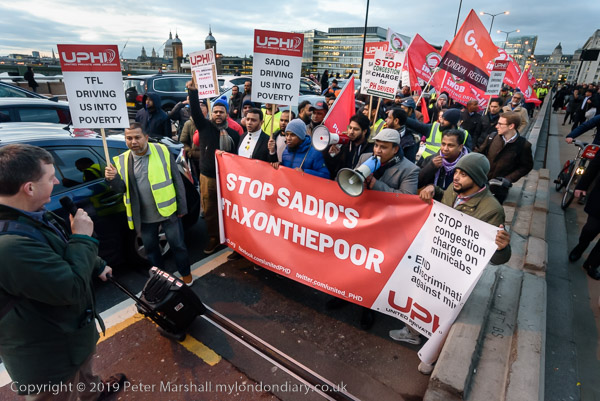
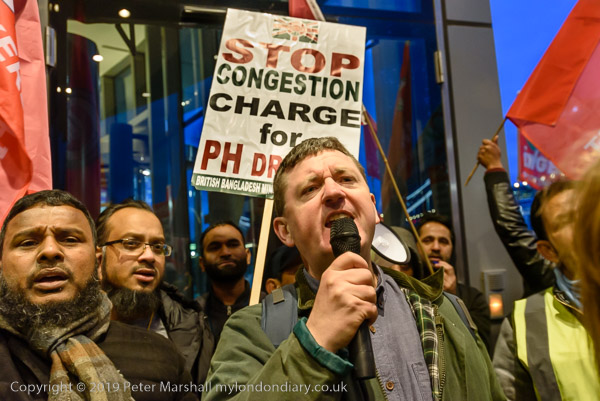
In late afternoon, private hire drivers came to London Bridge in their cars to protest against the decision by Transport for London (TfL) to make them pay the London congestion charge. London’s traditional Licenced Taxis – ‘black cabs’ – will remain exempt in what clearly seems unfair discrimination.

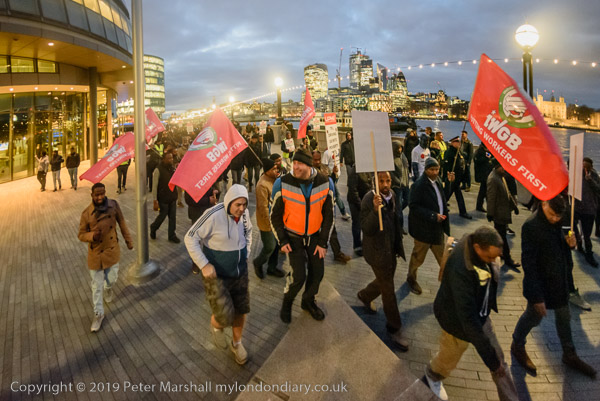
Minicab drivers have been organised by the International Workers Union of Great Britain (IWGB) into the United Private Hire Drivers (UPHD) which includes the British Bangladesh Minicab Drivers Association, the Minicab Drivers Association and the Somali All Private Hire Drivers, SAPHD. Most private hire drivers are from Black, Asian and minority ethnic groups while black cab drivers are almost entirely white and the UPHD claim that TfL’s decision is a case of race discrimination.

London’s Licensed Taxi system dates back to the era of horse-drawn vehicles (Hackney Carriages) and seems largely inappropriate now in the age of smart phones and sat navs. ‘Plying for hire’ creates both congestion and pollution on our overcrowded city streets, and is now unnecessary when cars can be summoned by phone, and good route-planning software with real-time traffic information out-performs the archaic ‘knowledge’ routes.

The drivers parked on London Bridge and blocked both carriageways, then locked their vehicles to march along the bridge and hold a rally, then marched to hold a noisy protest outside City Hall. From there some went to Tower Bridge to block that, but were persuaded by the UPHD stewards to leave and return to their vehicles.

UPHD drivers protest unfair congestion charge
Kashmir Awami Party call for Freedom
Kashmiris call for freedom
People’s Trial of the Home Office


All photographs on this and my other sites, unless otherwise stated, are taken by and copyright of Peter Marshall, and are available for reproduction or can be bought as prints.


Sudanese celebrate 6th April revolution

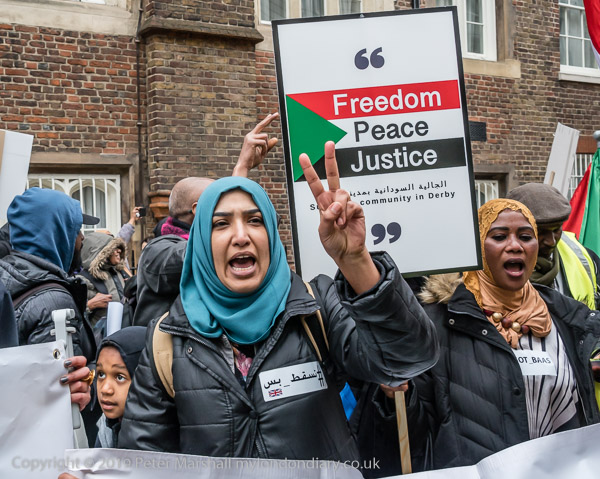
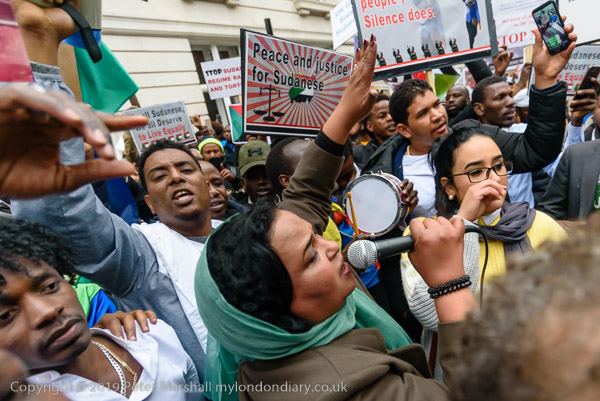
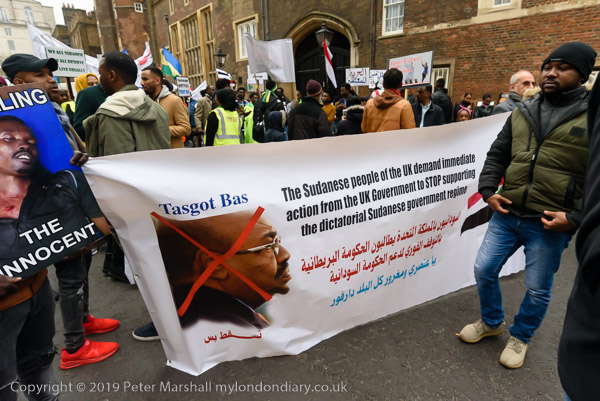
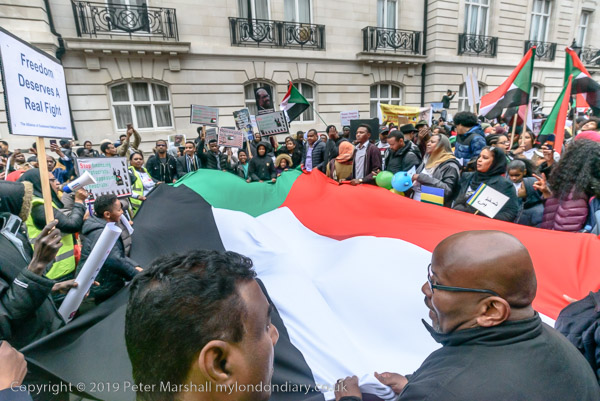
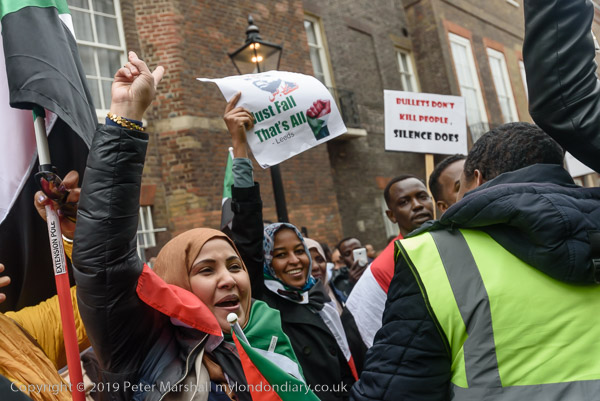
On 6th April 1985, a revolution in Sudan overthrew dictator Jaafar Nimeiri, and on the 34th anniversary of that event, Sudanese came to the London embassy to support the new revolutionary movement in Sudan that had then been protesting for 17 weeks demanding freedom, peace and justice in their country.

Back in 1985 it had been a group of military officers who had taken power, forcing Nimeir to flee to Egypt and setting up a Transitional Military Council (TMC) to rule Sudan. Rather a lot has happened in Sudan since then, including both the seizing of power by Omar al-Bashir in 1989 and the secession of South Sudan in 2011, with the loss of its oil revenues.

It was rises in the price of basic goods including bread and a hugely increasing cost of living that began the protests, which quickly turned into demands for al-Bashir to go and for an end to military rule and for freedom and democracy. Attempts by al-Bashir to use force to end the protests failed, despite the declaration of a state of national emergency.

The protest in London in these pictures took place as there were also large protests in Sudan, particularly in the capital Khartoum, where it became clear that while the security forces were still trying to subdue the protests, the military were moving to back the protesters demands to remove the president. Within five days, al-Bashir was deposed and arrested.

The protests continued – and there was further violent repression by the security forces with well over a hundred deaths on June 3 which led to a 3-day general strike and nationwide civil disobedience campaign. But on 5th July an agreement was reached between the TMC and Forces of Freedom and Change alliance negotiators representing the protesters, and the future for Sudan appears more hopeful.

More pictures at Sudanese for Freedom, Peace and Justice.


There are no adverts on this site and it receives no sponsorship, and I like to keep it that way. But it does take a considerable amount of my time and thought, and if you enjoy reading it, please share on social media.
And small donations via Paypal – perhaps the cost of a beer – would be appreciated.

All photographs on this and my other sites, unless otherwise stated, are taken by and copyright of Peter Marshall, and are available for reproduction or can be bought as prints.

To order prints or reproduce images


Kashmiris call for freedom

A YouGov survey back in 2016 found that 43% of UK respondents still felt that the British Empire was a good thing, over twice as many as those who felt it was bad, with a similar figures for those who think we should be proud of colonialism as part of our history or regret it.

I wasn’t one of those asked for my opinion (the chances of that were small, as the sample was only 1733 out of the UK population of around 65.65 million) and would probably have refused to give an answer as there wasn’t a category that expressed my feelings. Clearly the British Empire was a good thing for Britain, as the opulent architecture of our major cities from the 19th and early 20th centuries demonstrates. And while the disastrous effects on other civilisations and many brutal and immoral acts in the building and maintenance of our Empire are clear, there are also more positive instances. And in some countries we took over from earlier invaders or rulers who were even less principled and more harsh and brutal, though for Kashmir this was less clear.

The history of Kashmir is complex but certainly at the start of the ‘Common Era’ (still AD to most of us) it was a considerably more developed and ancient civilisation than anything in Britain. Originally an important centre of Hinduism and Buddhism it largely converted to Islam in the 13th and 14th centuries and around 1580 was conquered and became part of the Mughal empire. Around 1820, it was conquered again by Sikhs, who imposed harsh anti-Muslim laws and exorbitant taxes. The First Anglo-Sikh war waged by the East India Company between 1845 and 1846 resulted in Jammu and Kashmir becoming a princely state under British suzerainty. The persecution of Muslims, now by Hindus, continued under what was a tyrannical feudal system.

Logically, Kashmir, over three-quarters Muslim should have become a part of Pakistan, but after popular protests and a guerrilla campaign supporting this, the country’s ruler appealed to Lord Mountbatten, Governor General of India, for help – and Mountbatten only granted this on condition that Kashmir became a part of India. Pakistan disputed this and the countries went to war over Kashmir, ending with a truce and a UN resolution that the people of the country should have a referendum. This never happened and there were further wars in 1965, 1971 and 1999. Pakistan now controls around a third of the country, India about half and a smaller area is held by China.

The country is still a ‘disputed territory’ and the is a huge presence of Indian military and para-military forces in the area under their control, estimated at around 1 for every 17 Kashmiris. At the 1948 ceasefire Kashmir was promised special status with a substantial autonomy by India, but increasingly this has been abandoned. Recent years have seen greater activity by movements calling for the restoration of autonomy and for freedom and independence.

Maqbool Bhat Shaheed was the pioneer of the Kashmiri Freedom Struggle and in 1968 was captured in Kashmir and sentenced to death following the murder of an Indian CID officer. With others also sentenced he escaped from prison through a tunnel and made his way to the Pakistan administered area – were he was arrested and tortured for several months. In 1971 masterminded the hijacking of an Indian Airlines plane which was forced to land in Lahore, Pakistan. The hijackers demanded the release of over 20 members of the Jammu Kashmir Nationalist Liberation Front (JKNLF) in Indian prisons, asked for political asylum in Pakistan and wanted a guarantee from the Indian government that their relatives in Kashmir would not be persecuted.

Although the hijackers were first welcomed in Pakistan, when it was realised that the JKNLF wanted the Pakistan occupied area of Kashmir also to be liberated they were tried in a special court charged with collaboration with the Indian intelligence services. Released after 2 years he returned to Indian administered Kashmir where he was captured in 1976. Bhat appealed for clemency stating that the original trial had been unfair, but after the murder of an Indian diplomat kidnapped in Birmingham demanding his release, his appeal was dismissed and he was executed on 11th February 1984.

Kashmiris call for freedom

Kashmir Awami Party call for Freedom


There are no adverts on this site and it receives no sponsorship, and I like to keep it that way. But it does take a considerable amount of my time and thought, and if you enjoy reading it, please share on social media.
And small donations via Paypal – perhaps the cost of a beer – would be appreciated.

All photographs on this and my other sites, unless otherwise stated, are taken by and copyright of Peter Marshall, and are available for reproduction or can be bought as prints.

To order prints or reproduce images