Past Time To Act On Climate Change?

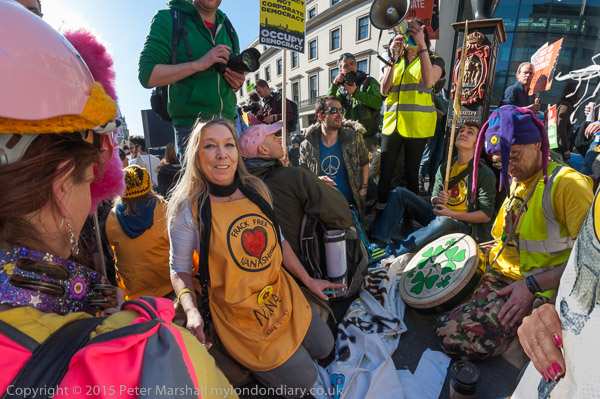
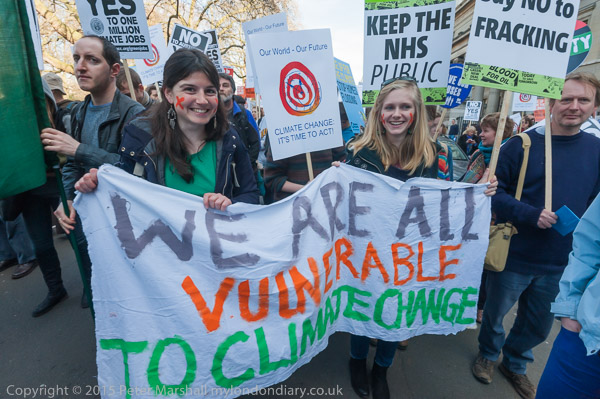
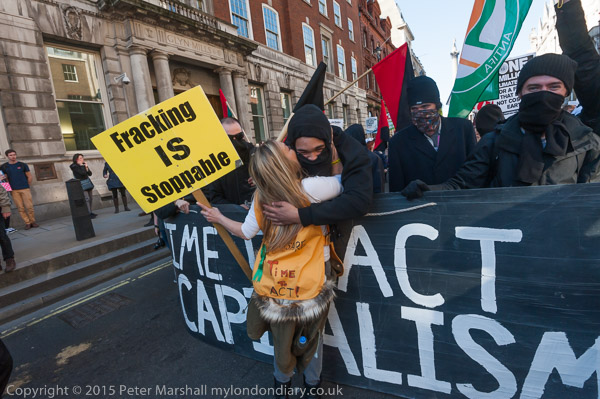
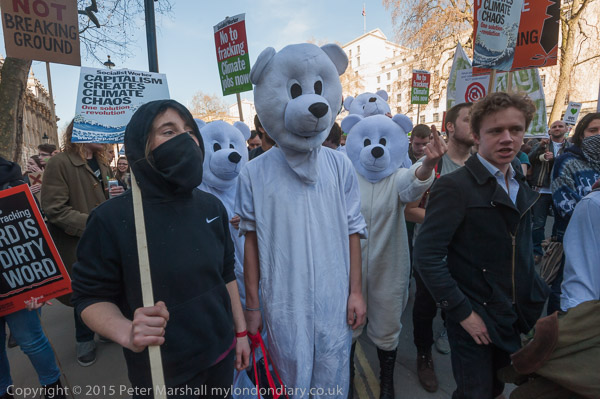
Past Time To Act On Climate Change? Seven years ago on Saturday 7th March 2015, 20,000 or so protesters marched through London to remind government and the nation it was Time to Act on Climate Change. Seven years on, the IPCC Sixth Assessment Report released a week ago warns “that climate breakdown is happening faster than expected and that the window to take action is closing fast. The report is a call to governments and private sector players to take drastic action against climate change.”
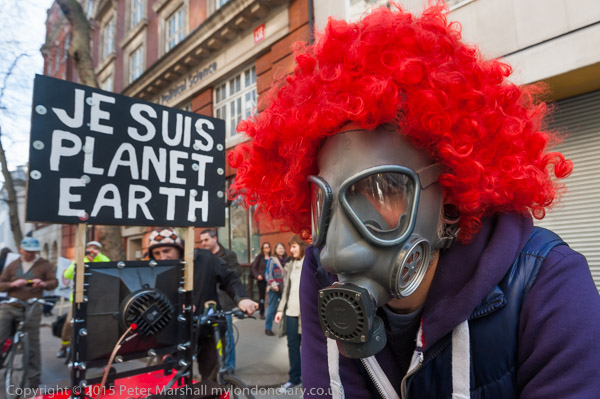
It’s a report that has largely been lost to public sight, pushed together with the stories about Tory sleaze and lies out of the news by the Russian invasion of Ukraine, though it has even more far-reaching implications. Not that I want to in any way minimise Putin’s criminal action and its terrible consequences for the people of Ukraine, largely innocents caught up in a situation of others’ making.
Of course the invasion of Ukraine has now raised the spectre of a nuclear war, which would almost certainly lead to mass extinction rather more rapidly than climate change, but the very dramatic prospect fortunately makes this almost unthinkable. Were it to happen it would almost certainly be by accident, something we have come close to several times in the past. Even our maddest politicians realise there is nothing to be gained by mutually assured destruction, and there would be no profits in it for the oligarchs or billionaires.
Climate change doesn’t happen in a massive flash, but is relatively slow and insidious. Even in the richer countries we are just beginning to feel its effects, and some in the Global South have long been suffering extreme hardship. But unless we heed the report and take drastic action without delay it will be too late to stop; many systems are coming close to their tipping points, past which there is no chance of recovery.

Scientists have been warning about the dangers for many years. Even 50 years ago when I was a student I spoke about the need to change the way we used the Earth’s resources and move to renewable systems of energy and agriculture, as many aspects of our current way of life were unsustainable.
Over 50 years ago it was clear to me that we needed to cut our dependence on fossil fuels, not just because of the carbon emissions and other pollutants, but also because thinking in the longer term it seemed a waste to burn what was a limited resource and an important chemical resource for plastics and other materials. I sold the only car I’d owned in 1967 or 8, because we needed to move away from a society based around private cars. It was clear too that we needed to farm in ways that conserved the soil and that many modern agricultural practices destroyed it – my father had joined the Soil Association which was established in 1946.
But of course there were huge profits to be made from fossil fuels and other industries that were driving up global emissions – and huge campaigns of obfuscation and lobbying. Most politicians in most countries were doing very nicely out of exploiting our natural resources – and the workers, who needed to be kept happy by more and more consumer goods as well as a huge and almost universal media promoting consumerism. Bread and circuses is of course nothing new.
Countries around the world, whatever their politics, are almost entirely run by politicians who have prospered from ‘business as usual’, and usually business corruption which they have colluded in by allowing money laundering, allowing huge tax avoidance and evasion and more. They have now learnt to talk the talk about climate change, but, as Greta Thunberg pointed out, it has been all “blah, blah, blah”, promises but little or no action.
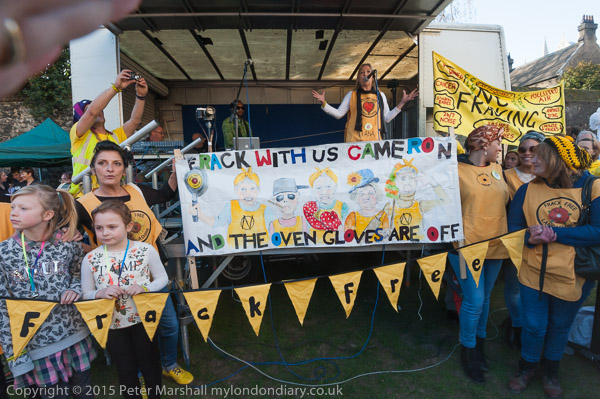
There were many different groups taking part in ‘Time To Act on Climate Change’, including the Campaign Against Climate Change who have organised regular protests in London since 2002, Friends of the Earth who I’ve supported since the 1970s, the Green Party, anti-fracking protesters including the fabulous ‘Nanas’ of Frack Free Lancashire, campaigners against Heathrow expansion – and I list a few more in Climate Change Rally, which also has pictures of some of the speakers.
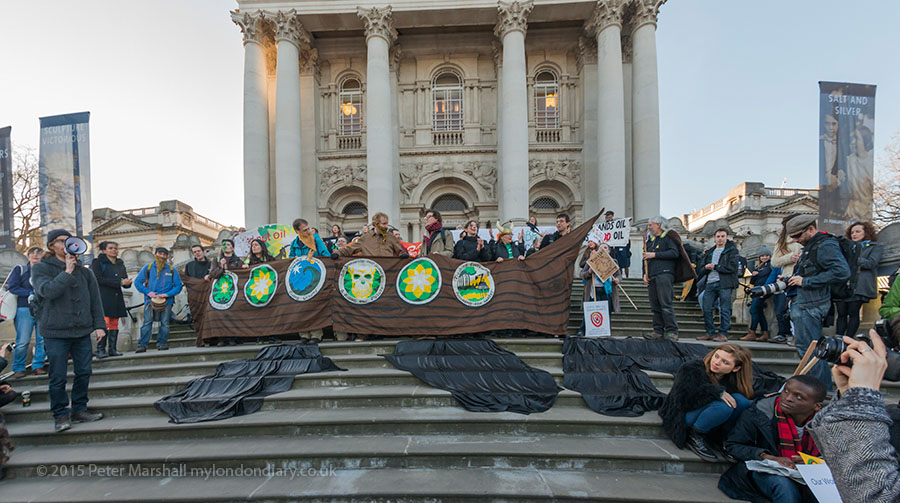
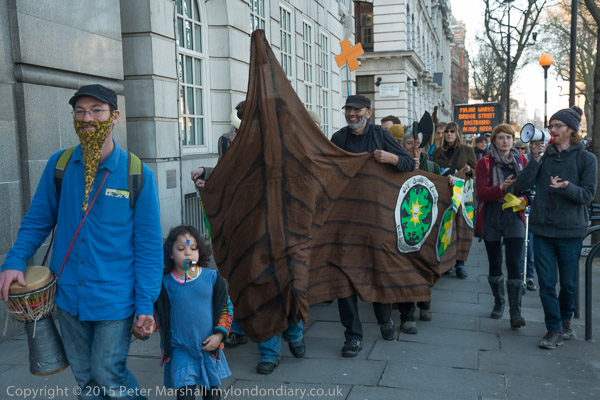
At the end of the rally I went on to photograph a protest by ‘Art Not Oil’ who invaded the steps of Tate Britain with their ‘longship’ and ‘oil spills’ in a protest demanding the Tate give up taking sponsorship from BP, who used their support of the arts to give themselves a positive public image despite the pollution and climate change their activites cause. It’s time to end this ‘greenwashing’.

Viking longship invades Tate steps has a few pictures of the event. The Longship first sailed to the British Museum where BP had sponsored a show on the Vikings. As I commented, the plastic oil spills used by the protesters “are a lot easier to clean up than the real ones BP has created such as Deepwater Horizon in the Gulf of Mexico, and which could be truly catastrophic in the Arctic.”

More on all these on My London Diary:
Viking longship invades Tate steps
Climate Change Rally
Time to Act on Climate Change
British Museum and BP

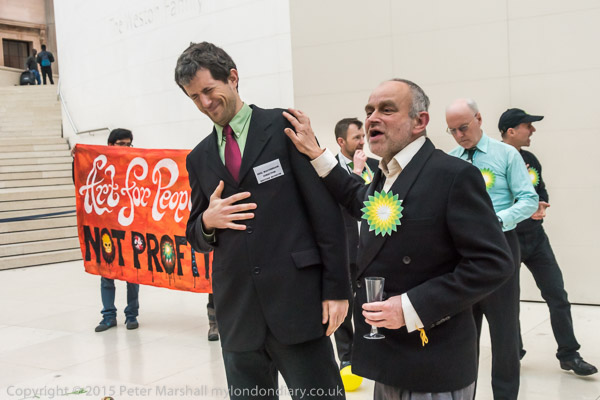
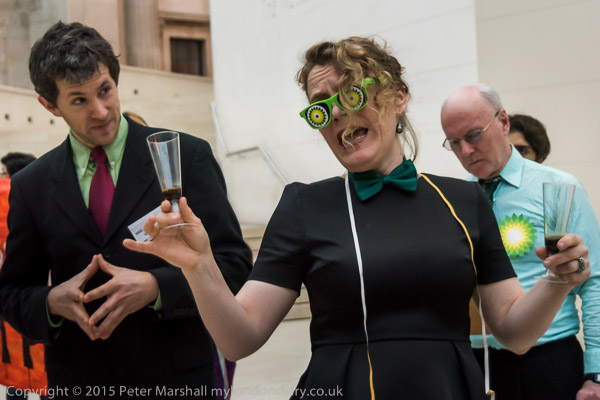
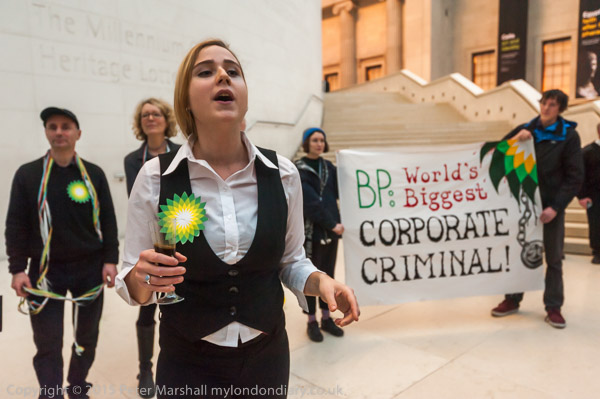
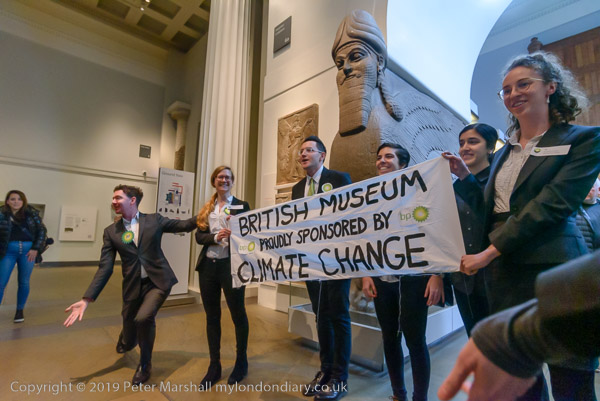
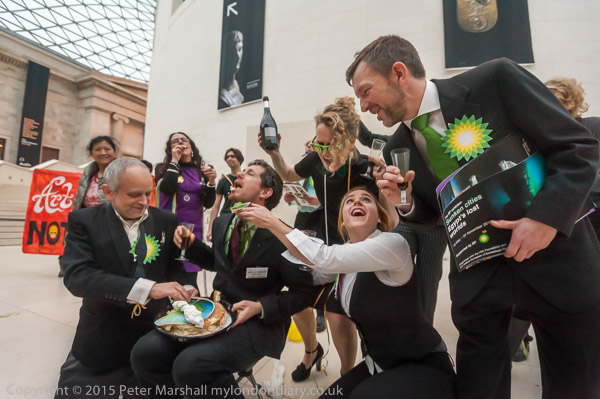
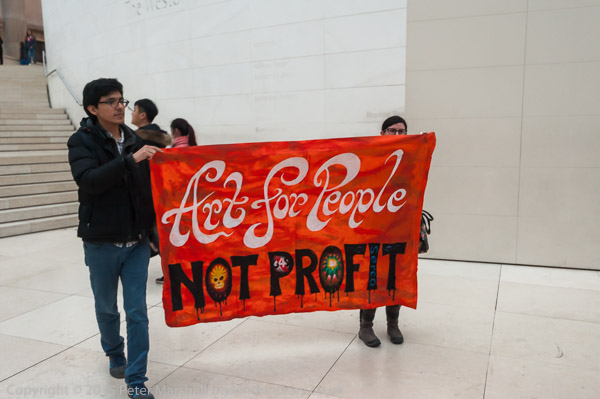
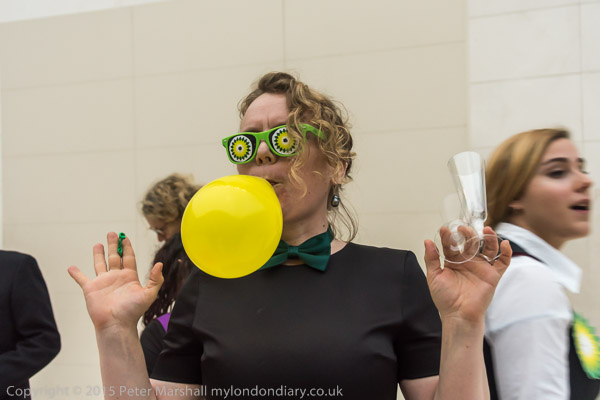
Five years ago today on 20th December 2015 I went into the British Museum with “actor-vists” from ‘BP or not BP‘ to photograph their ‘A Farewell to Neil MacGregor – Director of the British Museum‘ who had enjoyed a “cosy relationship” with the museum’s sponsor, BP.

Fossil-fuel companies make their profits largely through the combustion of the hydrocarbons they produce in the engines of cars, lorries and aeroplanes and the boilers used to generate electricity and heat buildings and other processes which turn the carbon in these fuels into the greenhouse gas carbon dioxide, the main cause of the global warming which is currently threatening the future of human life.

As well as that, the prospecting and exploitation of oil resources, now more and more taking place in environmentally fragile areas such as the Arctic, together with spillages, some inevitable but others demonstrating a remarkable lack of care are causing terrible damage to our environment. And of course most of what doesn’t get burned is made into plastics and we are now becoming aware of the huge amounts of this that ends up in the marine environment with disastrous consequences.

While continuing to fuel the global crisis, companies such as BP have invested heavily in promoting themselves as good guys, publicising the relatively small investments they have been making in renewable energies and other green areas. It’s a short-sighted policy as their long-term future – and ours – depends on a complete move away from carbon fuels, but one which keeps current investors rich at the cost of the rest of us.

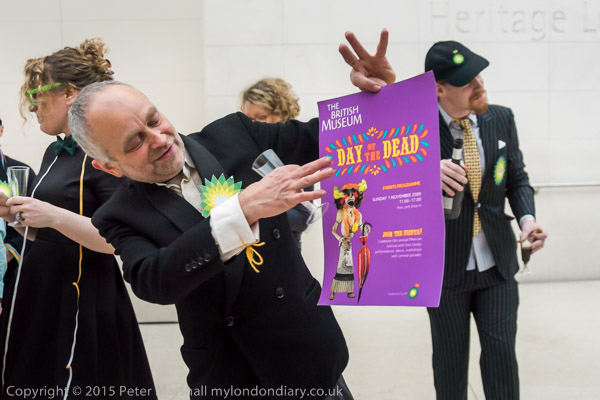
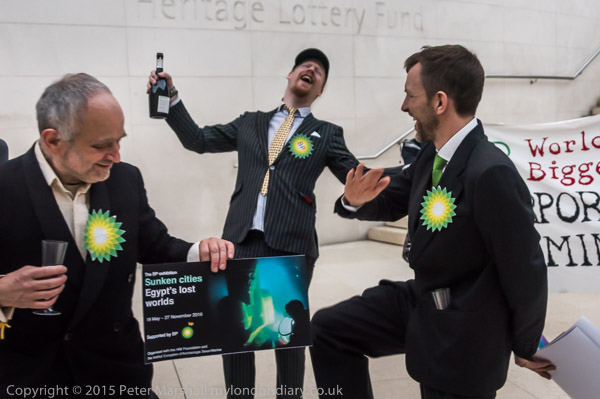
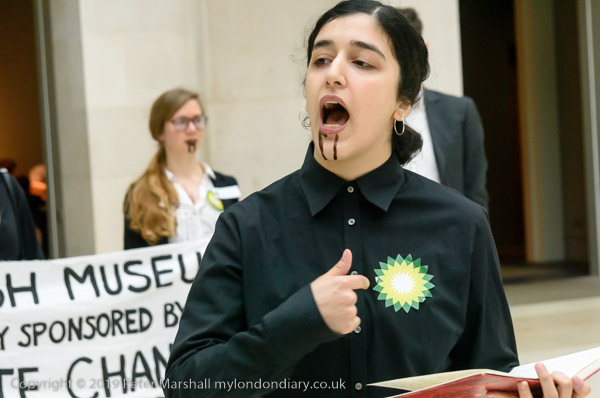
Almost certainly the most cost-effective part of the ‘green-washing’ of BP’s ecologically disastrous activities has been their sponsorship of many of our major cultural institutions including the British Museum, something which the cultural activists of ‘BP or not BP’ have highlighted in a number of artistic interventions. I was pleased to be able to photograph their play depicting ‘BP executives’ giving a farewell party to departing Museum director ‘Neil MacGregor’ inside the British Museum’s Great Court.

Although BP’s contribution is only a fraction of the museum’s budget, they get an engraved message on the wall of the rotunda in the Great Court and their logo prominently on the publicity for the museum’s major exhibitions which have included Vikings, Ming, Indigenous Australia: Enduring Civilisation, the Mexican Day of the Dead and Sunken Cities. As BP or Not BP point out, the last two are particularly unfortunate as BP has been given the largest corporate criminal fine in history of $18.7 billion for the underwater Deepwater Horizon oil spill which caused huge pollution of the ocean around the coast of Mexico.

My write-up on My London Diary gives a fairly full account of what happened with a lot more pictures. Many museum staff are unhappy about taking cash from BP and welcome the publicity protests like this give. The protesters assured the museum security that they would cause no damage and leave without any trouble after the relatively short performance which continued without any interruption and entertained a number of the visitors to the museum.

You can also read a fuller account, with some of my pictures and including the full text of the play on the on the BP or not BP website.


All photographs on this and my other sites, unless otherwise stated, are taken by and copyright of Peter Marshall, and are available for reproduction or can be bought as prints.


XR Carmen says cut Carbon

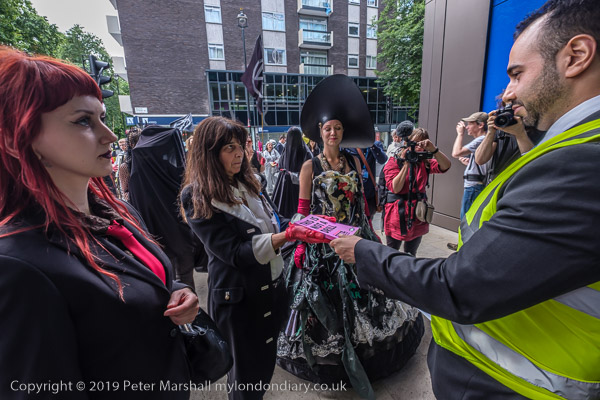
On the day that BP were sponsoring a Royal Opera House performance of Carmen to be relayed to 13 BP big screens in UK cities, including Trafalgar Square in London, Extinction Rebellion put on their ‘Carbon Procession’.

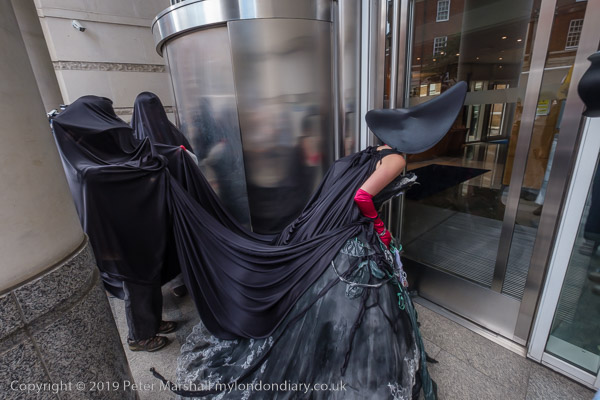
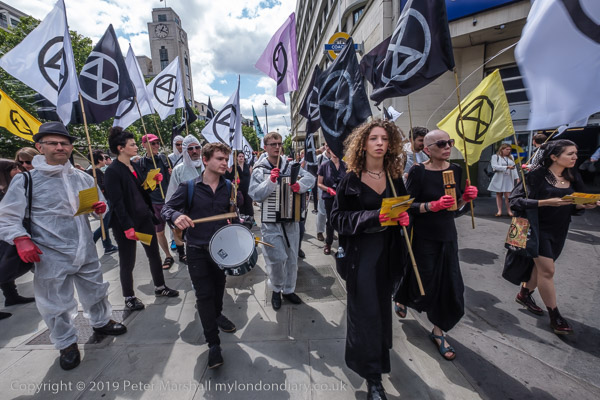
This procession, led by a woman dressed as carbon with a long black train to resemble an oil slick and followed by people with XR flags and a samba band made its way around the London offices of oil companies in the Oil and Gas Climate Initiative (OGCI) urging them to abandon the pretence they can combat global warming without a huge cut in oil production.

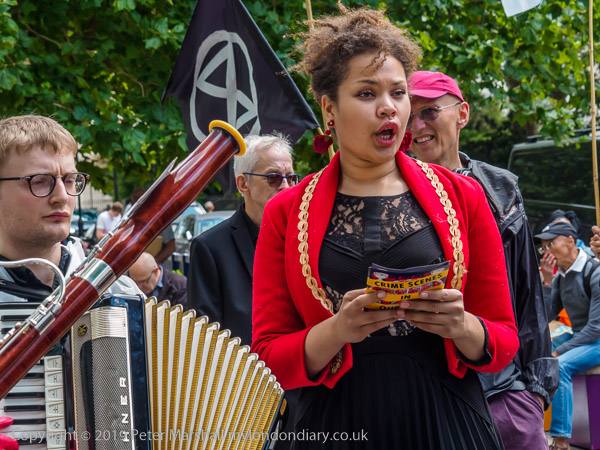
Although the Carmen leading the procession only spoke rather than sang, the protesters were joined by a woman with an incredible voice who performed some of the arias, accompanied by an unusual but effective orchestra of bassoon and piano accordian at the stops in front of the company offices.

The protesters also delivered copies of the XR handbook published by Penguin, ‘This Is Not A Drill’ to the offices, although they were not allowed to go inside to present it. Some of the activists also used bright yellow ‘Crime Tape’ with the message ‘Crime Scene – Do Not Cross’ to make the hour-glass X from the middle of the XR symbol on the pavement outside each of the offices.

The procession had obviously taken a great deal of preparation and attracted some attention. The lengthy walk was soon well behind schedule and after performances outside multinational oil and gas company ENI, on a street corner near Victoria and the China National Petroleum Corporation took a long rest in Hyde Park, which though necessary for some, didn’t help. It missed the next planned stop, I think walking past by accident, and by the time it had protested outside Saudi Aramco it was time for me to leave. The protesters still had two more oil companies to visit and were ending the procession at BP head office in St James’s Square before going on to protest at the screening in Trafalgar Square.

More at XR Carmen’s Carbon Procession


All photographs on this and my other sites, unless otherwise stated, are taken by and copyright of Peter Marshall, and are available for reproduction or can be bought as prints.

There are no adverts on this site and it receives no sponsorship, and I like to keep it that way. But it does take a considerable amount of my time and thought, and if you enjoy reading it, please share on social media.
And small donations via Paypal – perhaps the cost of a beer – would be appreciated.


BP out of the BM

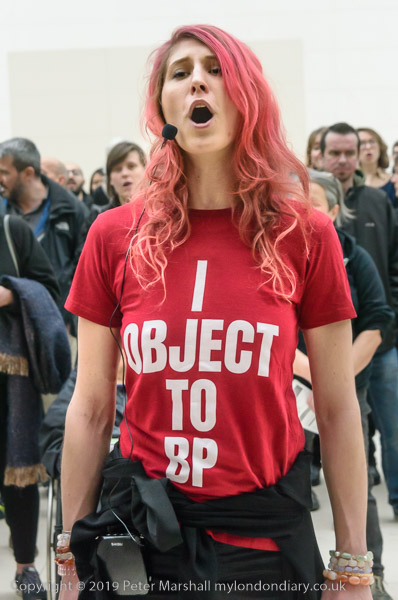
‘BP or not BP’ is a bunch of activists who stage performances of one sort or another at various cultural institutions and events to protest at the way the arts are being used to promote and sanitise companies guitly of destroying the planet and other crimes, ‘greenwashing’ to hide their mucky stains.

BP are a prime example of such a company, responsible for many murky political dealings in countries around the world in search of oil, Extracting oil has destroyed valuable ecosystems though pollution, with huge oil spills threatening large areas of ocean life. Its oil feeds the plastics and artificial fabrics industries, while the use of oil products in heating, air conditioning and transport etc is the cause of the huge increase in grrenhouse gases which is causing disastrous global warming.

BP gives a relatively small financial contribution to the British Museum, for which it gets a incredible return in good publicity, its logo on posters and on labels in the museum.

The protest took place on the 16th anniversary of the invasion of Iraq, conducted as is now clear from documents from many sources largely to ensure access by US companies to Iraqi oil resources rather than anything to do with the WMDs which all knew did not exist. It also took place while the BP-sponsored show I am Ashurbanipal: King of the World, King of Assyria‘ was nearing the end of its run. It’s a show which includes a number of looted objects from the area (which stretched from Egypt to the Persian Gulf), both from historical times when the BM was itself sending archealogists to the area and apparently some more recent acquisitions sold to dealers after Iraq was left in chaos and during the current conflict in Syria, bought with the aid of BP money.

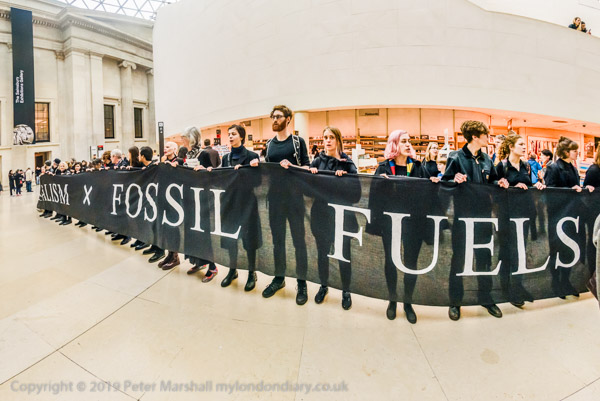
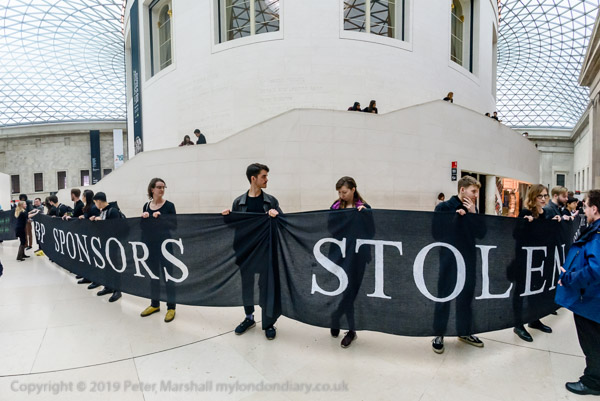
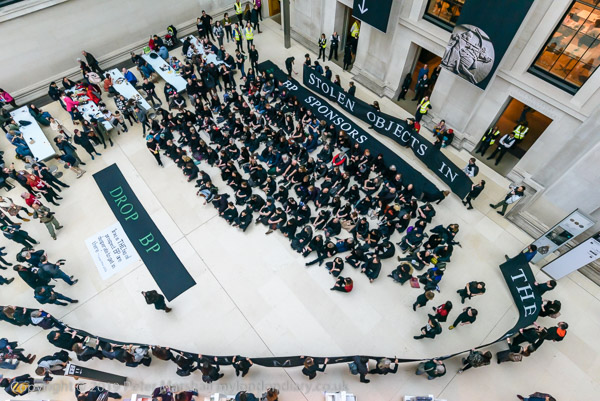
While several hundred protesters gathered at the front of the Great Court, a small performance took place in the Assyrian galleries, and was then repeated in front of the entrance to the Assyrian exhibition. Meanwhile the main protest got under way, amd after an introductory rally people were lead to from a ring all around the Great Court, with posters all round.

The Great Court is a large area around the old former BM Reading Room (where my wife once worked) and is said to be the largest covered public square in Euripe, with an area of 3,692.5 square metres. I think the chain around it holding the banners must have been around 600 feet long, though only relatively small sections were visible from any one point.

This was something of a challenge to still photographers, and I walked around it several times taking pictures. Long banners are always a challenge in terms of the aspect ratio. Even if you frame the people holdina banner from head to toe working in landscape format, this only results in a horizontal field of view of around ten foot. To frame longer banners results in the people and the banner shrinking to a narrower strip across the image.

You can improve matters by photographing the banner from one side, filling the frame height with the nearest person or going in even closer, and this is often my approach. But as the make the viewpoint more oblique, the banner text becomes less and less legible. And legible text is important with banners.

My friend taking video had a simpler task and did it well, filming as he walked around the whole circle. A similar approach using still photography would have resulted in a print with a roughly 100:1 aspect ratio, and while it might have been possible to join up the banner, as you moved from exposure to exposure the backgrounds would change.

I did take a series of pictures from the top of the stairs overlooking the area in front of the Assyrian exhibition, where the banners were brought and people sat on the ground. Possibly taken together they would show the whole string of banners (though I think some were folded before they reached the display), but more than the two on My London Diary make rather tedious viewing.

End BP sponsorship at British Museum

There are no adverts on this site and it receives no sponsorship, and I like to keep it that way. But it does take a considerable amount of my time and thought, and if you enjoy reading it, please share on social media.
And small donations via Paypal – perhaps the cost of a beer – would be appreciated.

All photographs on this and my other sites, unless otherwise stated, are taken by and copyright of Peter Marshall, and are available for reproduction or can be bought as prints.

To order prints or reproduce images