WeWork doesn’t pay

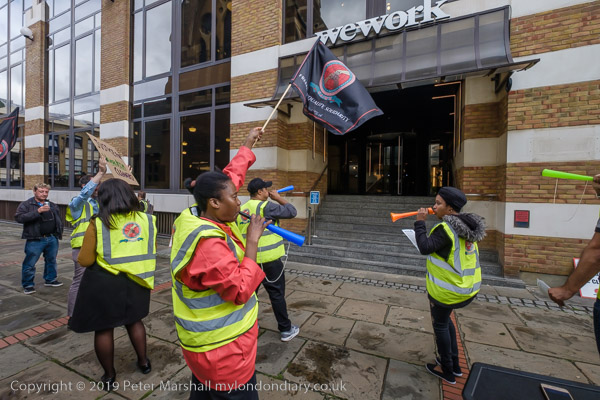
I’d never heard of WeWork before I received an Facebook post inviting me to photograph a protest outside one of their London premises in Shoreditch. The company began in 2010, has its HQ in New York and provides flexible working spaces for companies from 1 to 500 people, equipped, serviced and ready to move in. In London alone it has 49 locations providing shared facilities.

When we started WeWork in 2010, we wanted to build more than beautiful, shared office spaces. We wanted to build a community. A place you join as an individual, ‘me’, but where you become part of a greater ‘we’. A place where we’re redefining success measured by personal fulfillment, not just the bottom line. Community is our catalyst.
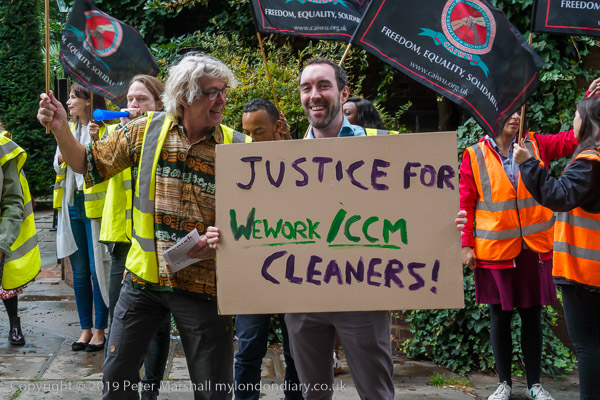
But community doesn’t extend to all that work there, and in particular not to the cleaners who keep these shared office and community spaces beautiful. WeWork outsource their cleaning to cleaning company CCM.
Outsourcing is always a bad deal for workers. The companies bid for contracts almost entirely on price, and they pare down prices by screwing the workers. Low pay, high workloads, the legal minimum terms and conditions and often a lack of equipment and concern over safety combined with bullying management enable outsourcing companies to keep costs to the bone and profits to the company owners.
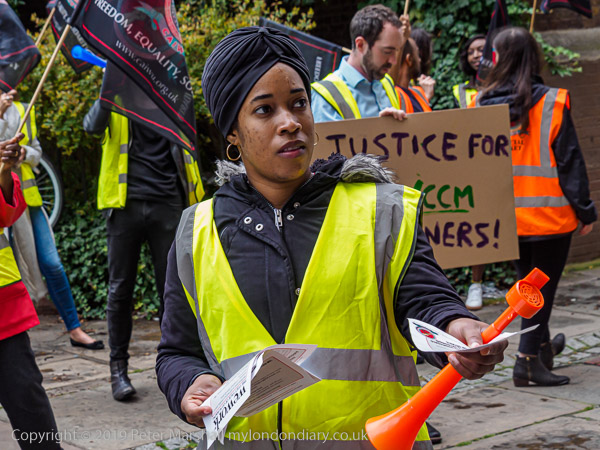
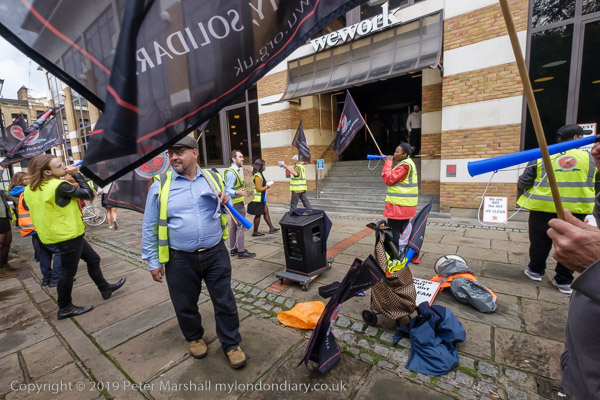
Trade unions are anathema to such companies, and also to many US based firms, and grass roots unions such as CAIWU who manage the difficult job of unionising marginal and often immigrant workers find it hard to get basic rights for their members. Workers who stand up for their rights get victimised, and CAIWU were protesting here as five CAIWU members have been dismissed here in the past few months, with Wework staff members involved in getting CCM to dismiss them.
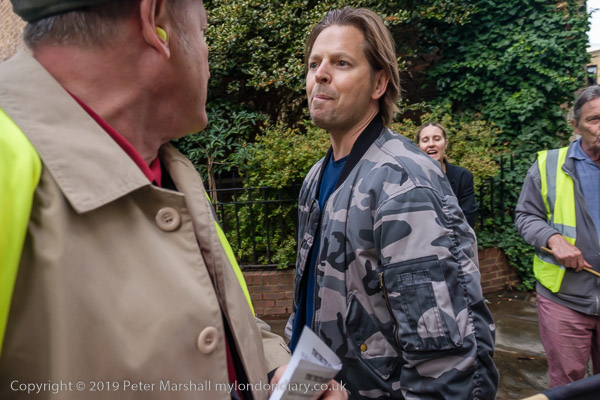
The loud protest outside the offices attracted a great deal of attention, with one local business owner coming to ask them to keep quiet and one man stopping to argue with the protesters, getting quite angry and pushing some of them. But these were the exceptions and many others read the fliers that the protesters were handing out and expressed support, including one team of workers who came out from the building and join the protest.

More at: Wework stop victimising cleaners


All photographs on this and my other sites, unless otherwise stated, are taken by and copyright of Peter Marshall, and are available for reproduction or can be bought as prints.
XR Youth International

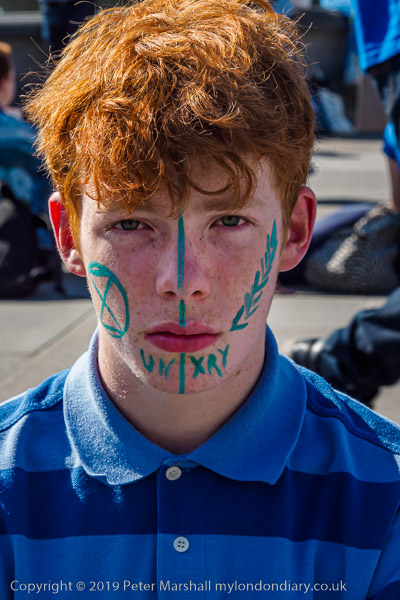
I had hurried back to central London to photograph an event in Trafalgar Square by Extinction Rebellion Youth International  but I had no idea what they intended to do, and I walked a couple of times around the square and saw no sign of them.

It isn’t unusual to find an event that has been posted on the Internet but doesn’t actually take place. People sometimes have an idea, set up an event on Facebook or some other listing site, then either forget about it or give up when they have failed to persuade anyone else to join them and don’t bother to post that it isn’t happening. And sometimes dates or times or locations are changed and unless you check you will be at the wrong place or at the wrong time. And some organisations can be relied on almost always to turn up late.

So I’d more or less given up on XR Youth and was thinking about photographing a couple of other things I’d seen on my way to the square when I saw a group walking into the middle of the square, some of them holding posters and I walked across and began taking pictures

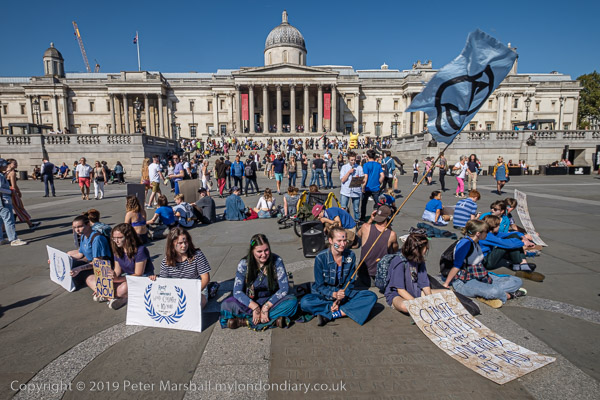
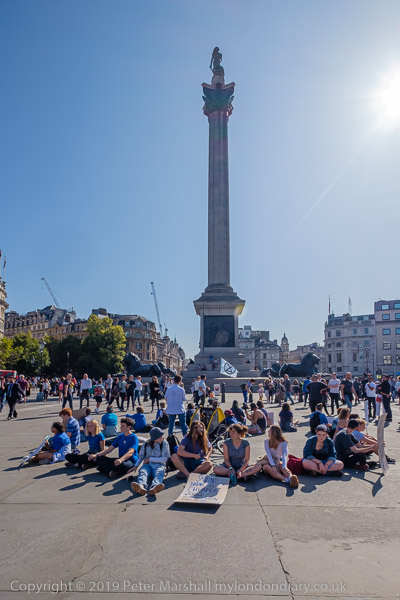
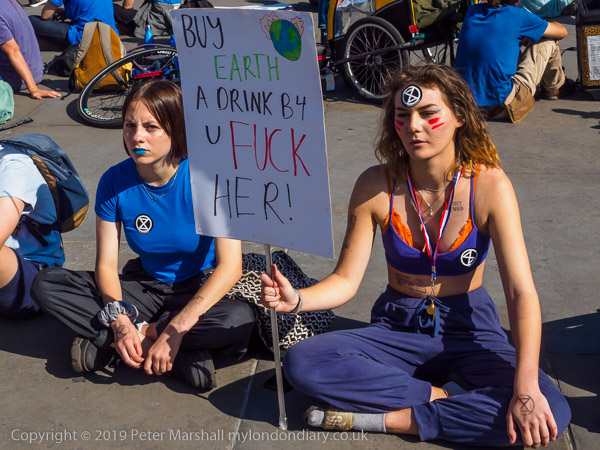
They formed a large circle in the centre of the square and then sat down in silence facing outwards. And that appeared to be it, though someone did at some point make a short statement. I walked around the circle and took pictures. Some had face paint, quite a few had small XR symbols on their clothes or faces and one held up an XR flag. It seemed a very low-key protest and certainly attracted relatively little attention from the tourists who were wandering around.

There was a certain element of defiance in it. The bylaws actually prohibit protests in Trafalgar Square unless they have prior permission, but this one apparently went unnoticed by the ‘Heritage Wardens’ whose role is to enforce the regulations. They probably thought it was just another group of tourists sitting down to eat their sandwiches. Perhaps their photographs and mine, published on the web, are more important in gaining attention than the event itself.

As a static protest it would not have been illegal on the North Terrace up the steps in front of the National Gallery, which is still legally a part of the public highway, though a part that has now been pedestrianised for some years.

But rather curiously the rest of the square is the property of the Greater London authority, with bylaws set by the Mayor of London. It’s actually an offence to take photographs there, though tourists are seldom if ever prevented from doing so. And an outcry by my union and other bodies representing news photographers means that those of us with Press cards are allowed to use our cameras.

More at XR Youth International.


All photographs on this and my other sites, unless otherwise stated, are taken by and copyright of Peter Marshall, and are available for reproduction or can be bought as prints.

Boycott Puma

Back in 1924 the two Dassler brothers founded a shoe factory in Herzogenaurach, Bavaria, Germany, the first company in the world to specialise in sports footwear, working together until 1948 when they decided to split the company into two, forming Adidas and Puma, becoming bitter rivals, both still based in Herzogenaurach and producing sports and leisure footwear and clothing. Adidas is now the second largest sportswear manufacturer in the world, and Puma is number three.

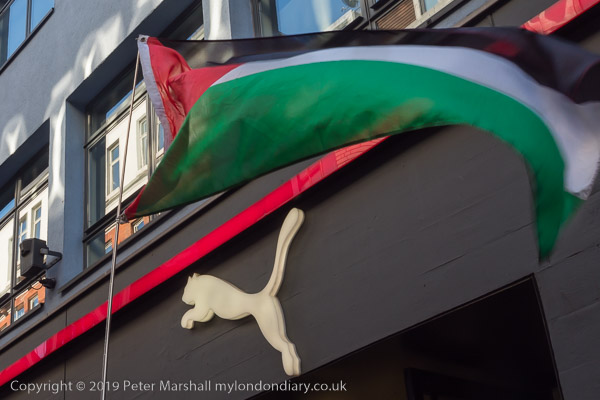
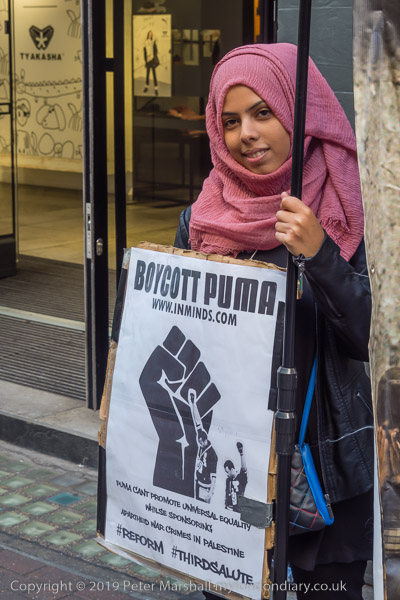
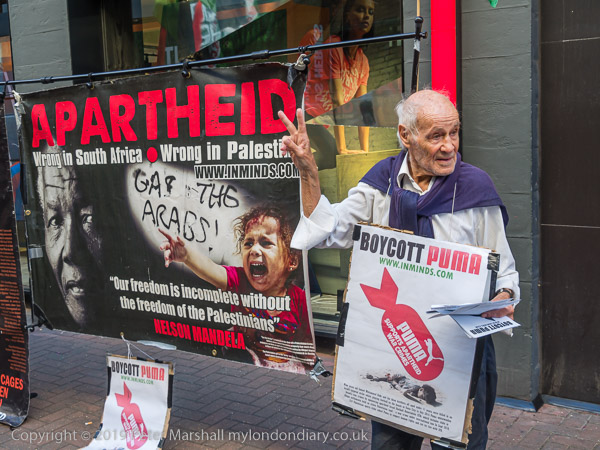
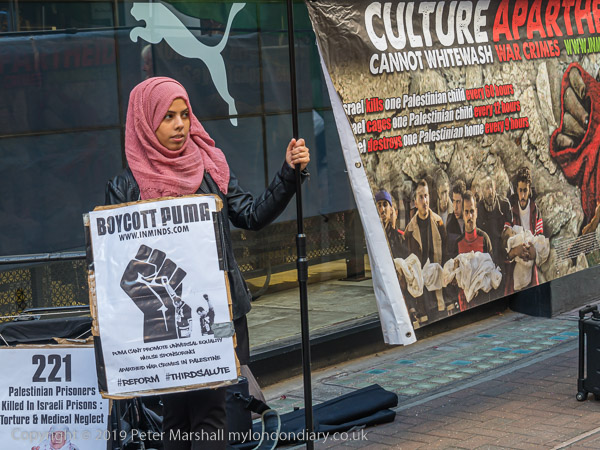
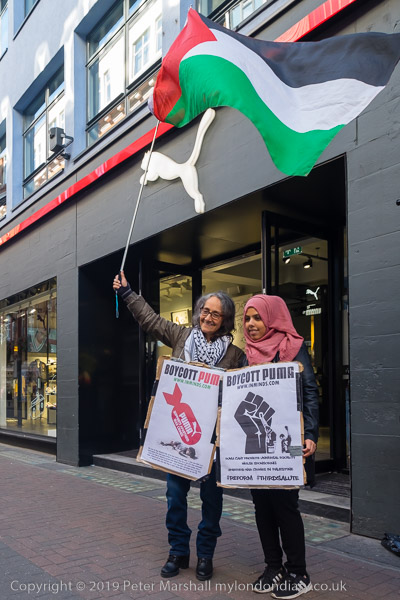
Puma sponsors many athletes and clubs in different sports around the world, including Manchester City. InMinds Islamic human rights group protest outside the Puma Carnaby Street store because they say Puma whitewashes Israel’s war crimes by sponsoring the apartheid Israel Football Association which includes clubs from illegal settlements built on stolen Palestinian land.

The protesters say these settlements constitute a war crime under international law and 215 Palestinian sports clubs have asked Puma to respect human rights and cut its ties with the IFA. Puma has failed to do so.

Inminds supports the human and civil rights of the Palestinian people and campaigns for people to oppose the cruel treatment of Palestinians by the Israeli state and by some Israeli citizens, particularly those from some of the settlements who attack Palestinians. It points out the different treatment of Palestinians which amount to an Apartheid system. One of the banners reminds people that on average Israel imprisons a Palestinian child every 12 hours and kills one every 60 hours, and it destroys a Palestinian home every 9 hours. Another poster points to the 221 Palestinian prisoners who have been killed in Israeli jails, either by torture or medical neglect.

Many of those passing the protest were shocked to hear these statistics and others on the leaflets that were handed out, and some stopped to take photographs with the protesters. One man stopped briefly to shout insults at the protesters, and similar protests have often been opposed by Zionist protesters, at times violently as video taken by the group and posted online shows.

A similar protest here in October 2018 came under attack by two well-known anti-Palestinian activists, who in June 2019 pleaded guilty to charges of harassment and threatening behaviour after the prosecution agreed to drop more serious charges of assault. As well as fining one and imposing a community curfew on the other, Hendon Magistrates Court imposed an “indefinite” restraining order on both, barring them from coming within ten metres of three of the pro-Palestinian activists.  

Inminds take pains to avoid anti-Semitic attitudes and comments in their posters and literature and their protests often include Jewish supporters, but they robustly support the human rights of Palestinians and oppose the oppressive restraints of the Israeli state against the Palestinian people.

A few more pictures at Carnaby St Puma Boycott.


All photographs on this and my other sites, unless otherwise stated, are taken by and copyright of Peter Marshall, and are available for reproduction or can be bought as prints.

Earth Day

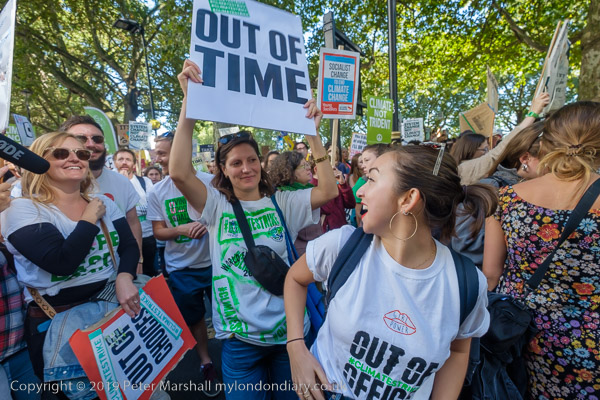
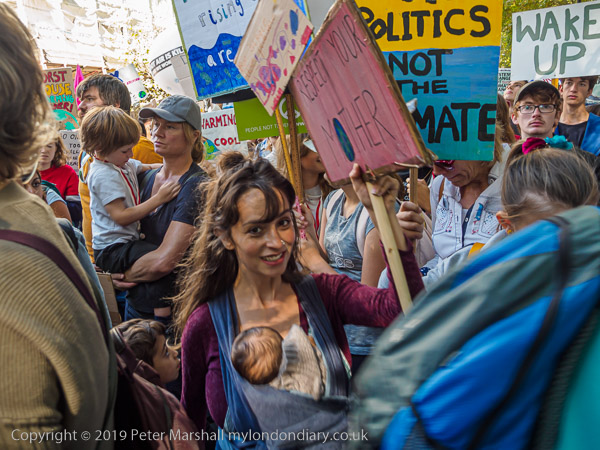
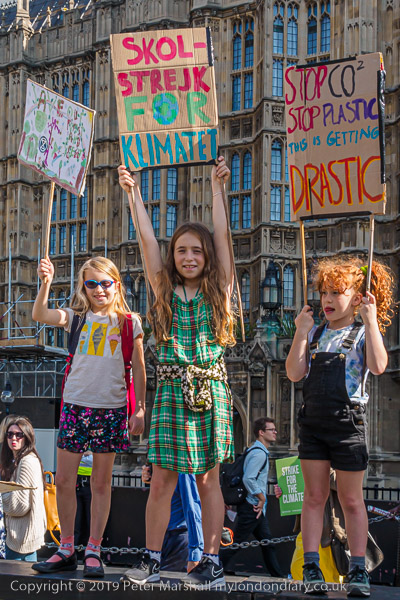
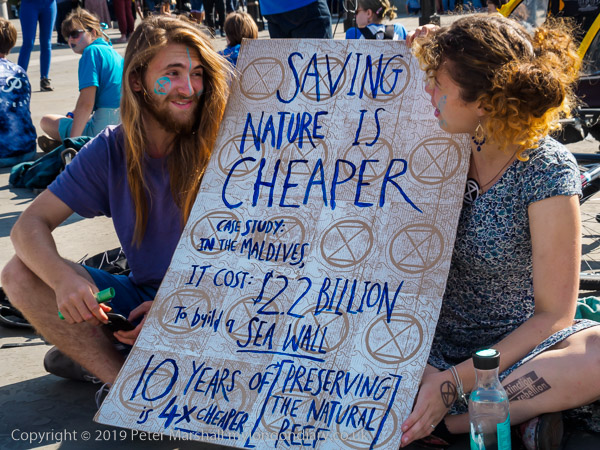
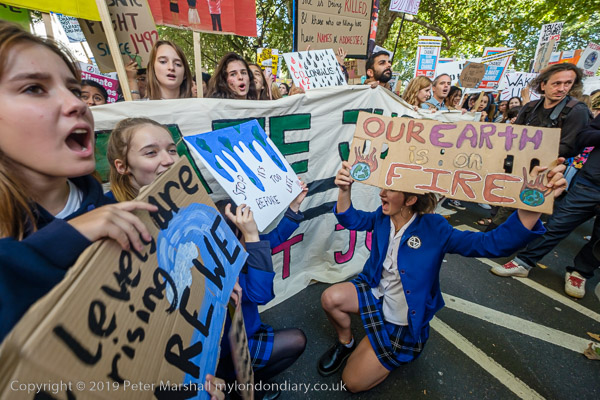
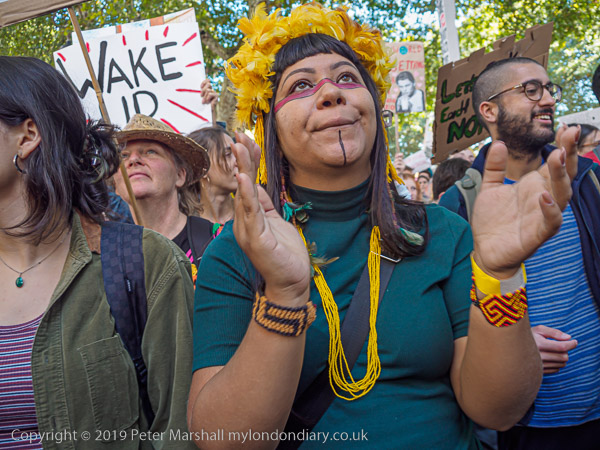
There was a huge turnout for the Global Climate Strike on Earth Day, with many organised groups from schools attending, and an incredible range of hand-made posters.

Way down Millbank there was a lorry where speakers and groups were performing, but the street was so crowded it was hard to get through to it. At one point I went down a side street and made my way forward a block to reach the front.

Once I’d photographed the people at the front of the crowd I slowly made my way back through the crowd, photographing groups of people with placards. The crowd was tightly packed and I often had to squeeze through, but people moved to let me through, sometimes even before I had asked. Getting enough space between me and those I wanted to photograph was however often difficult. Most of these pictures were made with the Fuji XT1 and the Fuji 10-24mm zoom, mainly at or close to its widest setting, equivalent to 15mm on full-frame.

Eventually I was free of the close-packed crowd, but there were still a large number of protesters in front of Parliament and in Parliament Square.

Although the main rally was in the morning, other groups were also meeting in London, some coming to Westminster later, and I left to photograph some of these.

Global Climate Strike Rally


All photographs on this and my other sites, unless otherwise stated, are taken by and copyright of Peter Marshall, and are available for reproduction or can be bought as prints.
There are no adverts on this site and it receives no sponsorship, and I like to keep it that way. But it does take a considerable amount of my time and thought, and if you enjoy reading it, please share on social media.
And small donations via Paypal – perhaps the cost of a beer – would be appreciated.


Hackney Housing

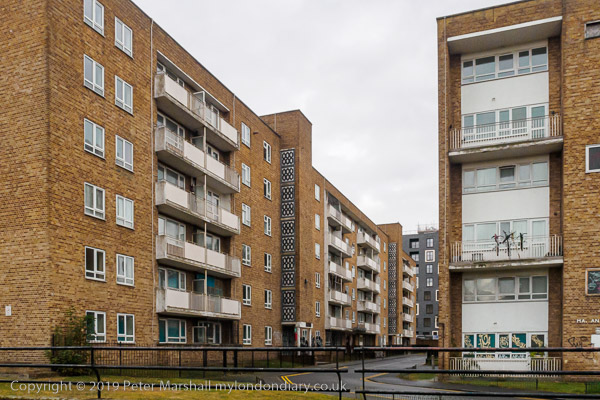
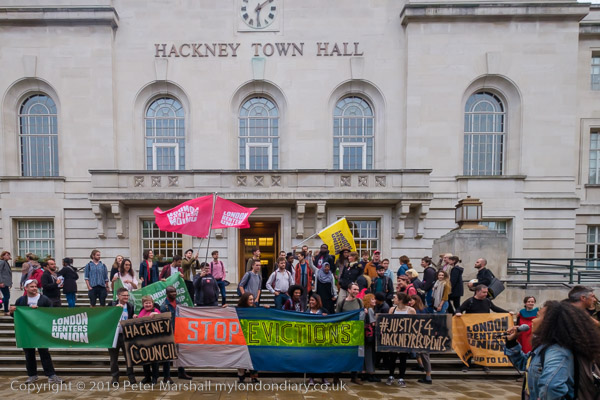
I took a short walk in Hackney before the protest outside the town hall to remind me exactly where Marian Court was, just behind the rather empty ‘fashion village’, an implant into the area with government money, £1.5m of Boris Johnson’s regeneration funding after the 2011 riots. It seems if anything to have been an expensive way to prove that gentrification isn’t an effective way to combat racist policing with a shoot to kill policy, and has failed to generate the promised jobs.

Marian Court appears to have been a well-designed small estate built for the Metropolitan Borough of Hackney in the late 1950s. It was built to the standards of the time and was in need of modernisation, and had been allowed to deteroriate. But as on many other council estates, rather than investing in the relatively modest cost of the necessary refurbishment, the council decided on an expensive scheme involving total demolition and the building of roughly twice as many housing units on the site by private developers, with a large proportion for sale at high market prices and others also at high prices as ‘affordable’ or shared ownership properties. Reports say that despite the roughly doubling of the number of units there will be 40% less social housing than at present.

The replacement flats in such schemes are almost always built to lower space standards than the existing properties, and demolition and rebuild involves an enormous environmental impact. Given our current problems with global warming and the impending threat of human extinction unless we take urgent actions to avoid this, demolition of existing buildings such as this should now be a rare last resort.

The human impact is of course also huge, with the estate being emptied. Those in social housing will have been offered rehousing, but usually in far less convenient places than this, targeted in part because of its central location and close transport links, and also probably with less security of tenure and higher rents. Leaseholders typically get compensation at far less than the cost of a similar property in the same area – or the new properties.

Schemes such as this effectively lead to social cleansing, despite the promises often made (but seldom kept) by local councils about residents being able to stay in the area or move back into the redeveloped properties. Those on low incomes are forced to move to the peripheries of the borough, to outlying borough or sometimes well outside London, away from jobs, schools, friends and other links in the community.

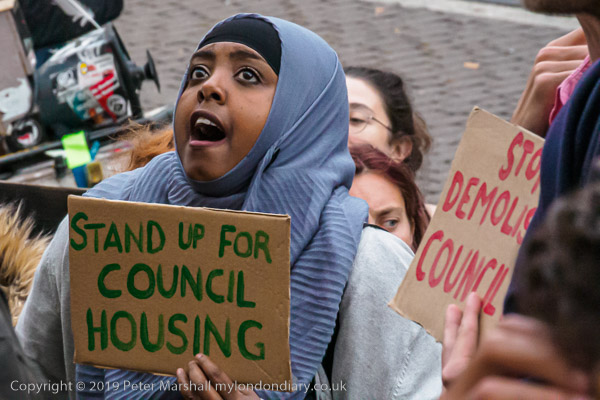
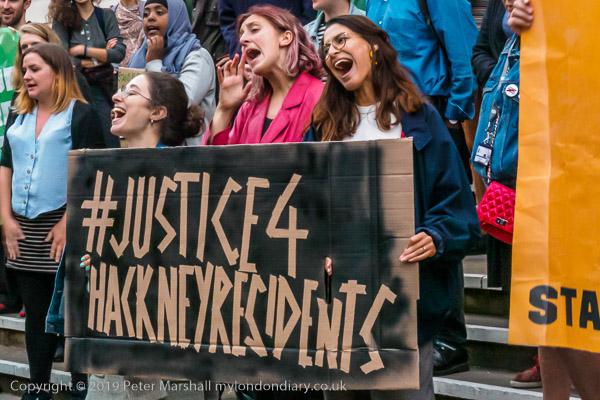
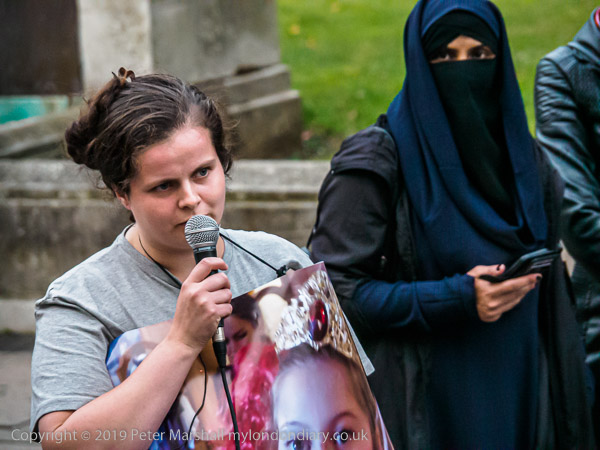
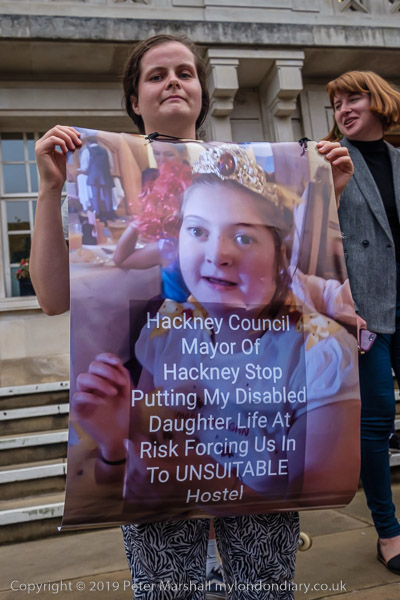
The protest at Hackney Town Hall, organised by East End Sisters Uncut and London Renters Union was over the failure by Hackney Council to provide suitable rehousing for two families remaining in Marian Court, both of whom attended and spoke at the event, and who seem to have been victimised because they particular housing needs and have stood up for their rights. You can see more about both of them and their issues with the council at Hackney don’t victimise housing activists.

And a few pictures of the area including Marian Court in Hackney


There are no adverts on this site and it receives no sponsorship, and I like to keep it that way. But it does take a considerable amount of my time and thought, and if you enjoy reading it, please share on social media.
And small donations via Paypal – perhaps the cost of a beer – would be appreciated.

All photographs on this and my other sites, unless otherwise stated, are taken by and copyright of Peter Marshall, and are available for reproduction or can be bought as prints.

Students for democracy

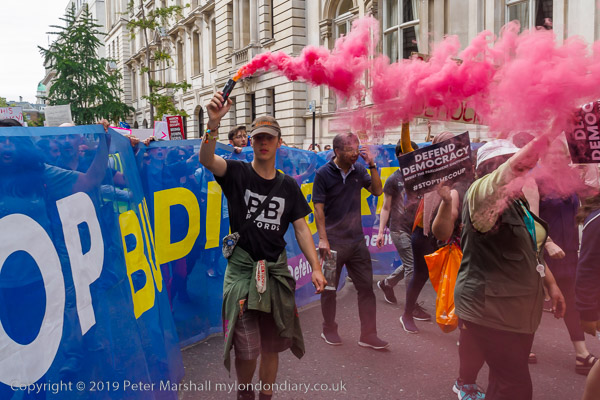
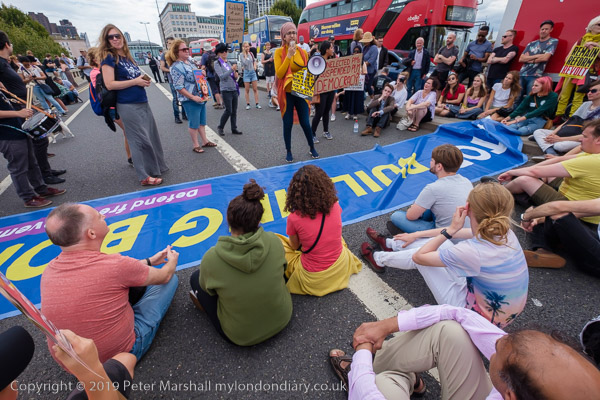
After a lengthy rally in a packed Whitehall, so full that police asked the organisers to tell people at the end only to move out in the direction of Trafalgar Square to avoid the danger of people being crushed as the Parliament Street end was so packed, Youth Strike for Climate and other mainly young protesters decided it was time for some more direct action.

It had been a long rally, with speaker after speaker, and the crowd in front of the stage was so packed that I was unable to move through it as I usually do during the more tedious of the speeches. There were some good speeches, and some well-known speakers, but I now find standing in one place for a long time makes my legs start to itch and throb, inflaming my varicose eczema.

So when the Youth Strike moved off, I was more than happy to follow them, though I did hope they would not move too far. There were other groups that marched as well as those I was with, some going into the West End, but fortunately these marchers went to a rather more convenient place for my journey home.

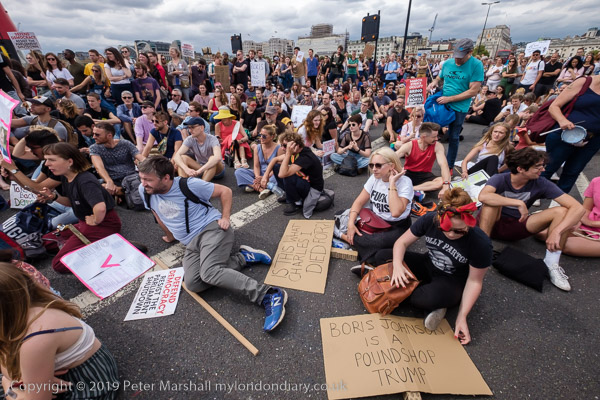
As they marched up Whitehall, police appeared to be forming a cordon across the top of the street, and they turned right down Whitehall Place, then continuing up Craven Street to The Strand. Police made no further effort to stop them, with just a few officers marching with them as they made their way onto Waterloo Bridge and sat down, blocking the south-bound carriageway.

They began their own rally there, and there were several short speeches, but the lure of Waterloo Station just a short distance further on soon proved too great, and I left to go home. As I walked off the bridge, several vans full of police arrived and were doubtless about to attempt to re-open the bridge to traffic, but I’d had enough.

More pictures Students March to Defend Democracy.


All photographs on this and my other sites, unless otherwise stated, are taken by and copyright of Peter Marshall, and are available for reproduction or can be bought as prints.
There are no adverts on this site and it receives no sponsorship, and I like to keep it that way. But it does take a considerable amount of my time and thought, and if you enjoy reading it, please share on social media.
And small donations via Paypal – perhaps the cost of a beer – would be appreciated.


Democracy under threat

Democracy in this country is certainly not perfect, but what we have is the result of hundreds of years of history, of the fight for power between the monarchy and a parliament which has long represented the interests of the rich and powerful. An early victory along the road came with Magna Carta, when the barons who had spent the night just a few hundred yards from where I now live, forced King John to sign a document that outlined some basic freedoms and the principle that the monarch was subject to the laws of the land.

It wasn’t a document that did a great deal for the peasants or the serfs, though two years later another charter by Henry III did restore some of the rights of free men which had been appropriated following the Norman invasion.

Despite the rise in the twentieth century of the Labour movement, our democracy remains one that largely protects and serves the interests of the rich and powerful. And although theoretically we are all equal under the law, in practice this has never been the case. And although the constraints and enforcements are generally more subtle than in most countries we are still a feudal country in many ways, with power still residing in the ownership of land, including huge areas by the descendants of those Runnymede barons, as well as the ownership of media. And occasionally the monarchy and its agents still bites – as Dr David Kelly’s staged suicide shows.

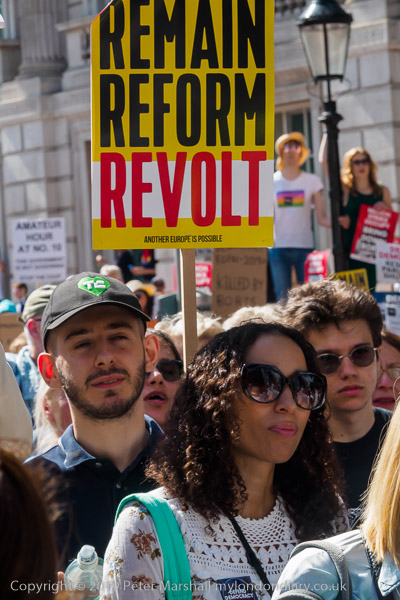
Much of the more recent amelioration in areas such as worker’s rights has of course come from our membership of Europe, driven by countries which had the sense to behead their royalty or lost them in wars. There is a huge irony in the continual parroting by some working class Brexiteers that Brexit is “taking our country back“. It is – but giving it back to the rich.

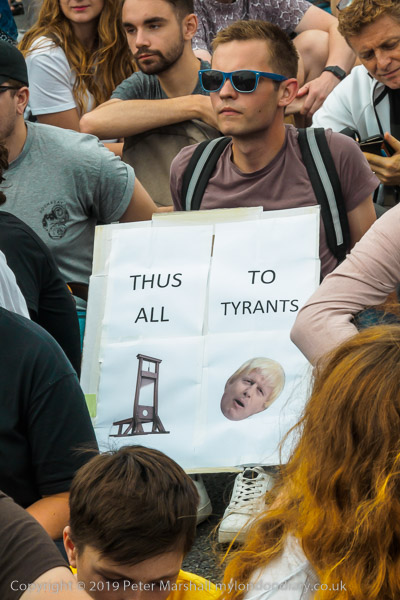
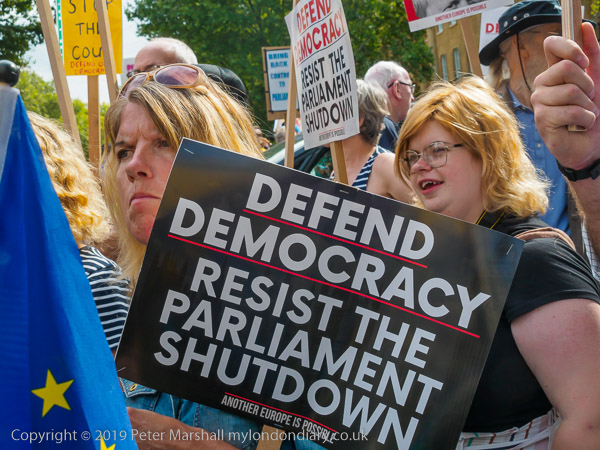
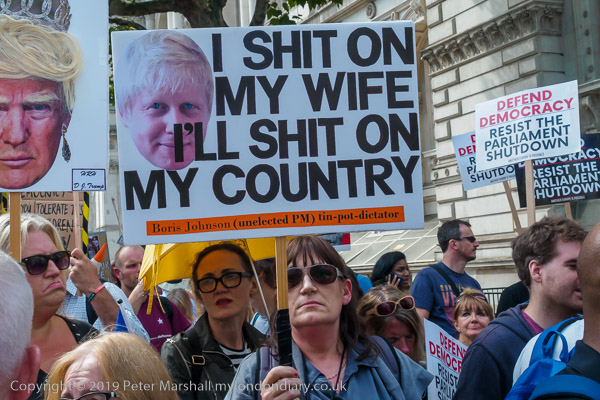
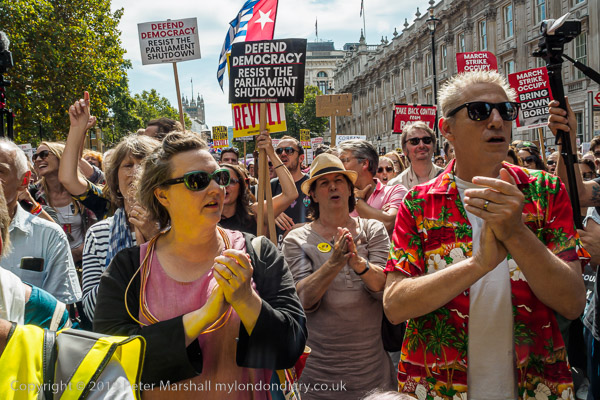
Boris Johnson’s government is a part of this process of restoring control to wealthy elites, taking power away from Parliament. The government tried to close down debate on leaving Europe without a deal by simply shutting down Parliament. Eventually the Supreme Court decided that the move was illegal. Now that the Tories have a large majority it seems certain that the powers of the court will be limited to prevent such legal scrutiny occuring again. And already parliament is having its powers to debate any new trade agreements removed.

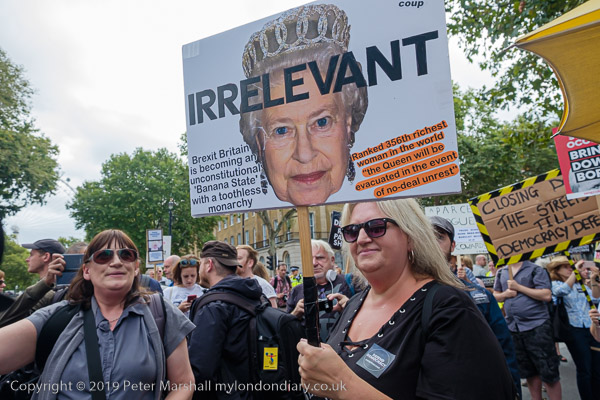
Although ‘Boris’ cultivates the image of a clown, it’s wrong to think he is one, or indeed that he is really in charge, rather than just a figure-head being allowed to perform by others with far more serous designs. And while some posters featuring the monarchy were amusing, the suggest that they carry that we would somehow be better off if the monarchy was more powerful is misguided. We may well be heading to become an unconstitutional ‘Banana State’ but we would be better fighting for a people’s republic.

More pictures: Defend democracy, Stop the Coup.


All photographs on this and my other sites, unless otherwise stated, are taken by and copyright of Peter Marshall, and are available for reproduction or can be bought as prints.
There are no adverts on this site and it receives no sponsorship, and I like to keep it that way. But it does take a considerable amount of my time and thought, and if you enjoy reading it, please share on social media.
And small donations via Paypal – perhaps the cost of a beer – would be appreciated.


Brexit

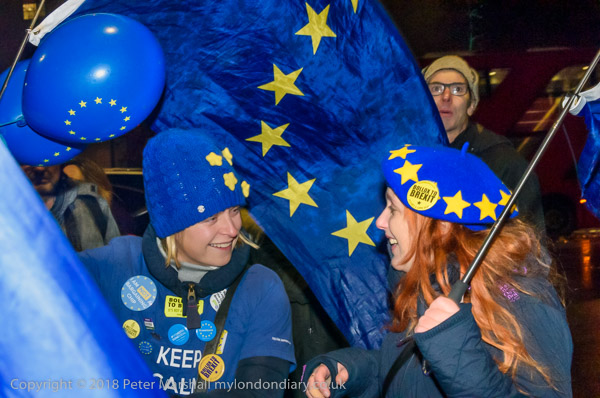
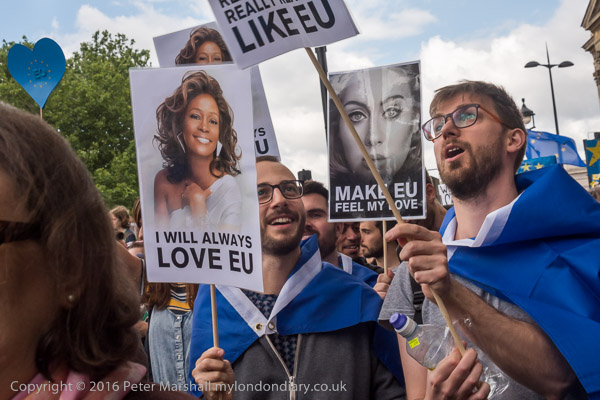
June 2016

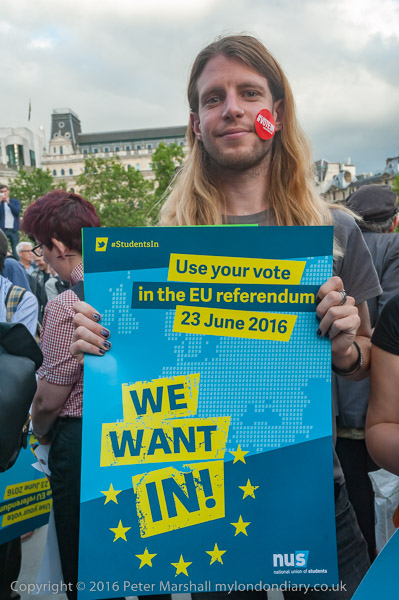
I suppose I should say something about Brexit. It’s a topic I’ve tried hard to avoid since the referendum. It’s a disaster we’ll just have to live with, at least until the nation comes to its senses and demands we rejoin Europe. Or perhaps that the whole world situation changes in ways that make the whole debate irrelevant.

Not that I’m a big fan of the European institutions, but we have gained enormously from our membership of the EU in so many ways, while managing to negotiate extremely favourable terms – which we won’t be able to regain when we re-apply. And the EU will have changed in many different ways during our absence without us having been able to have our say.

Nov 2018

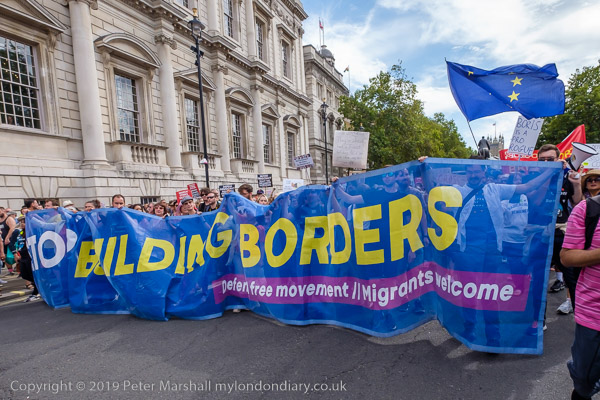
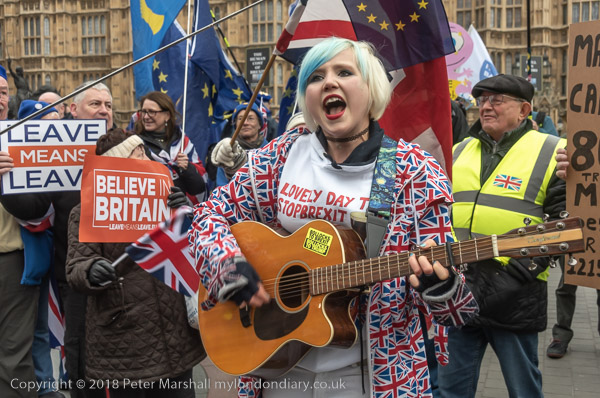
According to the Free-Find search on My London Diary there are 31 references to Brexit on the site, between June 2016 and Jan 2020. It probably isn’t entirely accurate and may ‘double count’ some occurrences, but it gives a fairly good idea of how much I’ve photographed related stories. The pictures here are a fairly random selection of the many I’ve taken in that three and a half years.

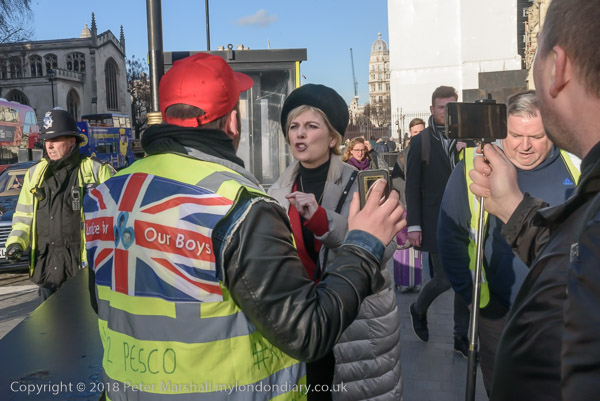
I did cover the large anti-Brexit protests that took place in London, but many times as I’ve wandered through Westminster to other events I’ve come across Steven Bray and his SODEM protests, just occasionally stopping to take photographs.

July 2016

Rather less frequently I’ve met Brexiteers, and taken photographs. At times they have been rowdy and obnoxious and I occasionally felt personally threatened. I also photographed them behaving in extremely threatening ways towards Bray and also to Anna Soubry – which resulted in probably the only sales to newspapers of my Brexit-related pictures.

Dec 2018

Brexit of course was not really about Brexit. For many of those who voted leave it was a protest vote about feeling neglected by government and powerless. Fears about immigration obviously played a part – though more so in areas with relatively few immigrants than in cosmopolitan London. A feeling that those in Westminster didn’t understand what was happening outside and didn’t much care – which remains undoubtedly true. A disillusion with the state of politics, enlarged by the war on Iraq and the 2008 crash. For those who drove the leave campaign a desire to keep their tax havens and weaken human rights and laws which protect workers and thus restrict profits.

Jan 2019

Since it’s largely this latter group who will be leading our negotiations with Europe and with the rest of the world I think we who aren’t in the top percent or so of the most wealthy are in for a pretty raw deal over the next few years. I’m fortunate enough, though certainly not rich to be reasonably financially insulated against their worst, but I fear for the poor, the disabled, the sick, the homeless, refugees, asylum seekers…

Of course leaving is now a done deal, and there is little that can be done other than hope that our negotiations are carried on rather more sensibly than seems likely. The arguments over Brexit have been a tremendous distraction over the past three years from so many other important issues which perhaps can now be fought.


All photographs on this and my other sites, unless otherwise stated, are taken by and copyright of Peter Marshall, and are available for reproduction or can be bought as prints.
More on Kashmir

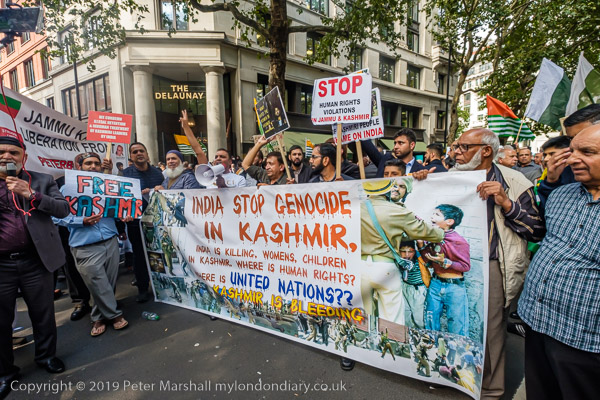
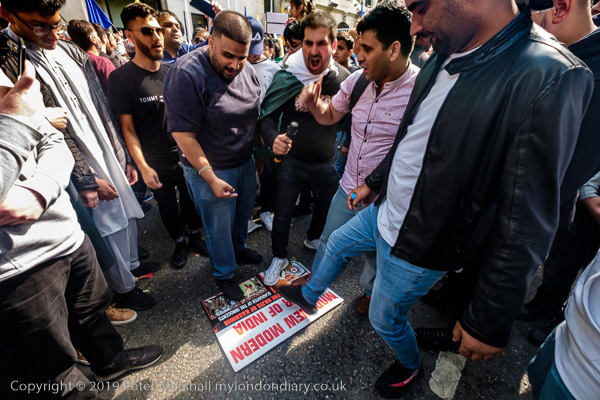
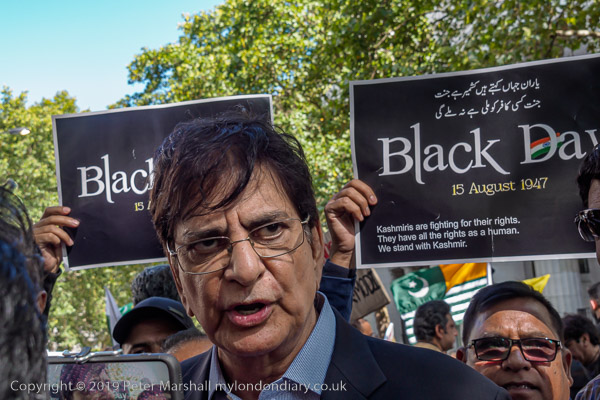
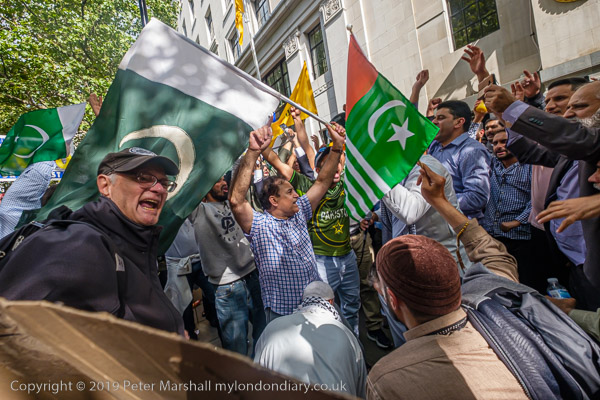
Indian Independence Day, August 15th, saw a much larger protest at the Indian High Commission against Prime Minister Modi’s revocation of Article 370 of the Indian Constitution and calling for freedom for Kashmir. The protesters call the 15th August 1947 ‘Black Day’ .

The size of the protest became evident long before I reached the protest as Waterloo Bridge was closed to traffic and I had to walk across. Aldwych was packed with people and it was difficult to get close to the High Commission, where police and police horses faced the crowd behind barriers.

A lot of noise was coming from India Place at the west side of the building, but it was impossible to get there for the crush of protesters and a solid wall of police blocking the way. Later I heard from a colleague who had been there and who had got sprayed with fake blood which protesters threw at the building and I was pleased to have missed this.

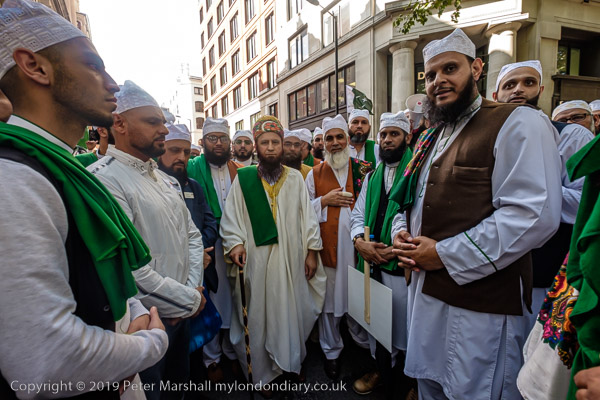
On Aldwych the protest was made up of a number of clearly separate groups, some rather noisier than others. As well as those representing the Indian occupied Jammu and Kashmir, there were also Pakistanis, including some from Azad Kashmir, the Pakistan administered region of Kashmir. Among them I met Sahibzada A Jahangir, spokesman to the Prime Minister of Pakistan. 

Later after the protest in Aldwych there was another protest in Trafalgar Square where differences between the various groups emerged more clearly. While the Kashmiris from the Indian occupied area are calling for an independent Kashmir, the position of Pakistan is a little unclear, with some from the Pakistan administered area supporting independence and other calling for the integration of the whole country into mainland Pakistan, with possibly the small area long under Chinese occupation being officially ceded to China.

More about both protests:
Kashmir Indian Independence Day Protest
Stand with Kashmir


All photographs on this and my other sites, unless otherwise stated, are taken by and copyright of Peter Marshall, and are available for reproduction or can be bought as prints.
There are no adverts on this site and it receives no sponsorship, and I like to keep it that way. But it does take a considerable amount of my time and thought, and if you enjoy reading it, please share on social media.
And small donations via Paypal – perhaps the cost of a beer – would be appreciated.


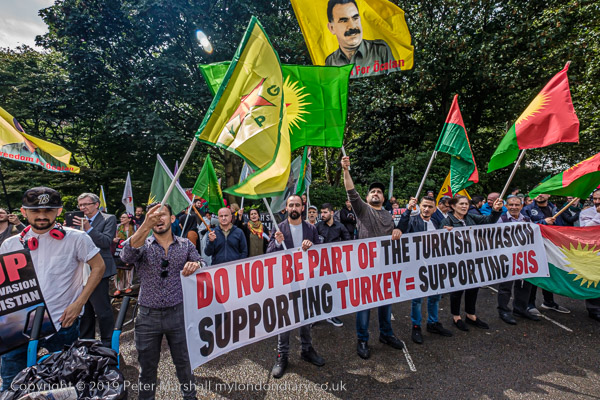
Kurds protest against Turkish invasion

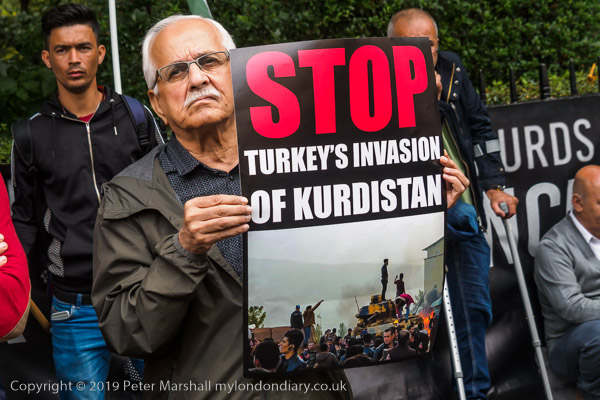
Kurds have lived in the area around what is now southern and western Turkey and northern Syria and Iraq and north-western Iran at least since the time of Alexander the Great, and in more modern times were a part of the Ottoman Empire until the end of the First World War. At the end of the war their region was split between several countries, including Armenia and a rather smaller area called Kurdistan, but soon after this was occupied by Turkish forces under Kemal Atatürk  and by 1923 the whole area was incorporated into modern Turkey.

There were various uprisings by the Kurds against Turkish rule, and Turkey tried to eliminate Kurdish culture, banning the language and even the use of the terms  “Kurds”, “Kurdistan”, or “Kurdish”, re-christening the Kurds as “Mountain Turks”. Many Kurds were jailed.

In the 1980s and 90s there was a guerilla war led by the Kurdistan Workers’ Party (PKK) with the Turks destroying thousands of villages and killing over 20,000 Kurds. In 1999 Kurdish leader Abdullah Öcalan (“Apo”) was captured by the CIA in Nairobi and handed over to the Turks. He was tried in Turkey and sentenced to death, but this was later commuted to life imprisonment. He was held in solitary confinement in an island prison until 2009, when a few more PKK prisoners were moved with him to a new jail on the island, and he remains in prison, but still acts as a highly regarded leader of his people.

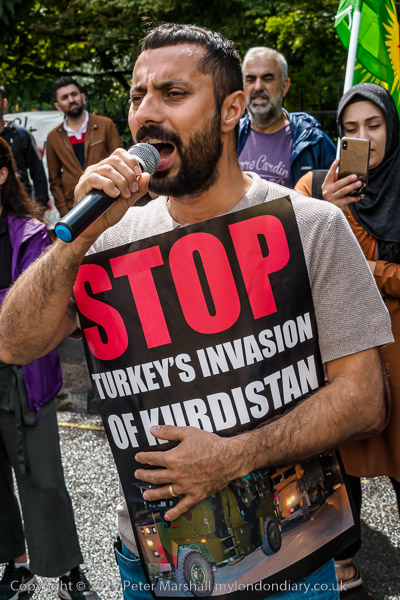
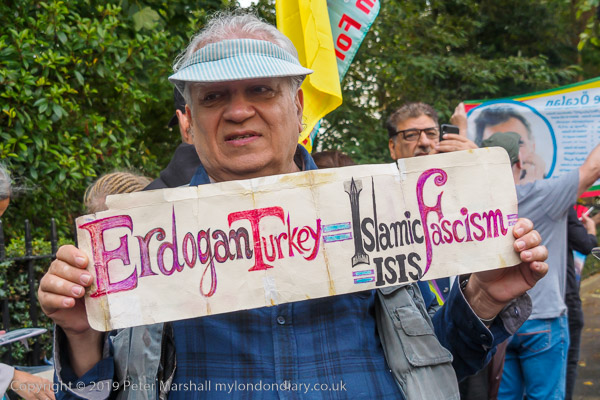
The protest at the Turkish embassy followed further threats by Turkish President Recep Tayyip Erdoğan to invade more Kurdish areas of Northern Syria, where the Kurdish state of Rojava has been set up with a  “democratic confederalism” constitution based on the ideas of Murray Bookchin which enshrines the values of environmentalism, self-defense, gender equality, and a pluralistic tolerance for religion, politics, and culture.

The call out for the protest states:

Through invasion, destruction & annihilation the fascist Turkish State, with its media, secret intelligence services and the Kurds he has pulled to his side is now trying to destroy the hard works of the Kurdish people in Northern Syria.

Its aim is to annihilate the Kurds and their existence. To protest this, the kurdish community and their friends will stand honourably against the atrocities being committed by the Turkish state and strengthen the struggle for freedom.

On this basis, Kurds and all the people who believe in democracy and peace are invited to protest against this fascist regime.

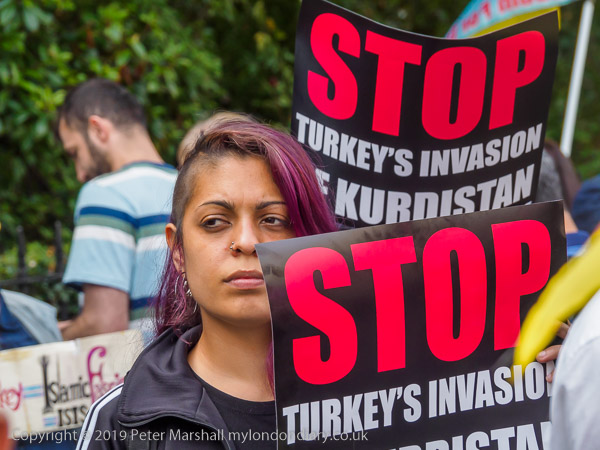
Stop Turkey’s Invasion of Kurdistan


All photographs on this and my other sites, unless otherwise stated, are taken by and copyright of Peter Marshall, and are available for reproduction or can be bought as prints.
There are no adverts on this site and it receives no sponsorship, and I like to keep it that way. But it does take a considerable amount of my time and thought, and if you enjoy reading it, please share on social media.
And small donations via Paypal – perhaps the cost of a beer – would be appreciated.