Parliament Square

While I used to think of Trafalgar Square as being the centre of protests in London, and it still is a place where protests take place, over the years there does seem to have been a shift towards Parliament Square (and the nearby Old Palace Yard), largely I think after the years of vigil there by Brian Haw and supporters. And often when I’m in the area for one or two events I’ll come across others that I’d not known about it advance.
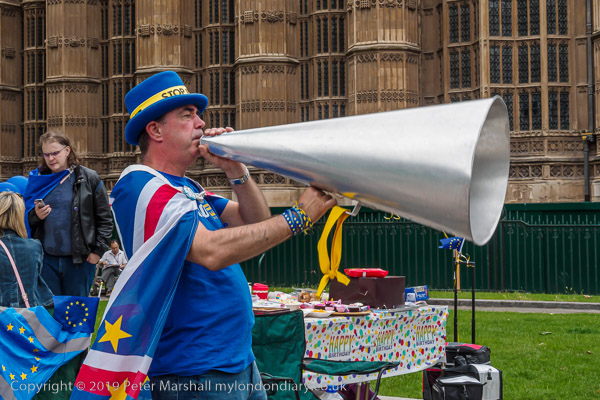
Of course Steve Bray and his SODEM campaigners against Brexit are always around when Parliament is sitting, day in day out – and even during the recent recess they only moved as far as the Cabinet Office. But today was a special day for them, marking the number 50. Not the number of years they have been protesting, but the fiftieth birthday of their founder.

There was so much else going on that I managed to miss the peak of the celebrations, arriving back just as they were finishing. But though I try, you just can’t be everywhere all of the time. I should have asked them when I walked past earlier about their plans, but I was in a hurry to get elsewhere.
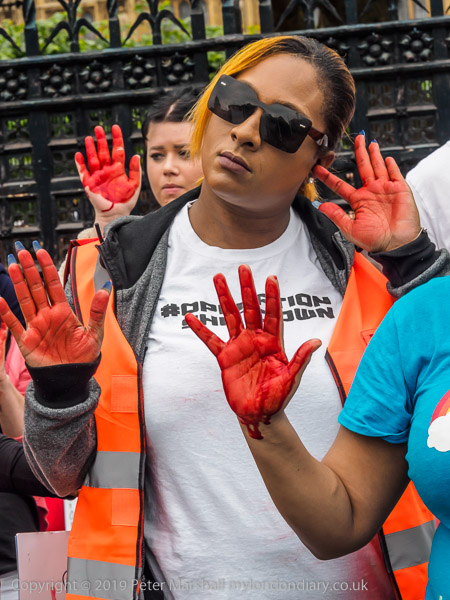
And that elsewhere was in front of the gates to Parliament, where Operation Shutdown , a group of families and friends bereaved by knife crimes were calling for urgent action by government over knife crimes. I don’t share their faith that a meeting of the government’s emergency  response committee COBRA would do much to help – or that tougher sentences for carrying and using knives and guns would have any real impact on knife crime, but there is clearly a need for action.
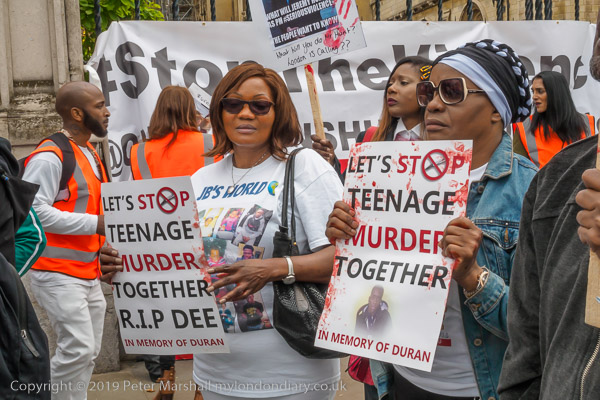
Clearly a starting point should be to reverse the government cuts to youth services and family support and to look at programmes to work with young people. London Mayor Sadiq Khan has come in for a great deal of criticism, but has set some reasonable policies in this area, but it really needs a reversal of the harmful policies imposed on local councils by the Coalition and Tory governments. So Operation Shutdown were clearly demonstrating in the right place, and of course their pain and grief is only too clear. Though they were I’m afraid talking to a government with little idea of how most people live and close to zero concern so long as they and their friends are getting richer.
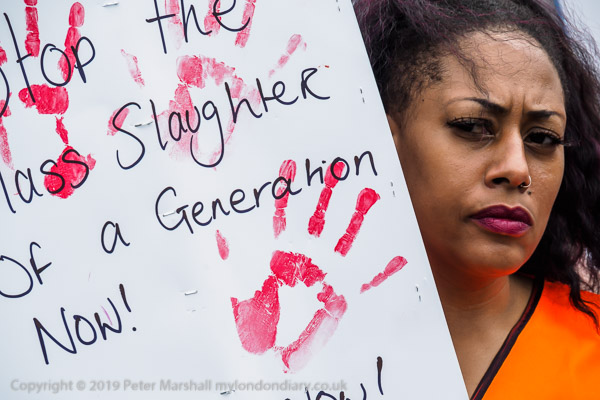
Sometimes I have a problem with cropping. Often there is a tension between making an image visually strong and the text which locates and explains what the picture is about, and perhaps this image is a good example, where I think I have cropped just slightly too tightly. It’s often a good idea to give the reader some slight puzzle, but it’s hard to know if most people on seeing this will actually decipher ‘Stop the Mass Slaughter Of a Generation Now!’ Another inch or two at the left would have helped.

On the Olympus camera which has now become a part of my standard outfit, I work with the camera set on RAW and the aspect ratio as 3:2. But when working with raw images, the camera actually always records the whole sensor, with a roughly 4:3 ratio, which includes a small strip on top and below the 3:2 frame. When editing the pictures I do sometimes find that including some or all of this improves the images. Just a pity that there isn’t any similar leeway at the picture edges!
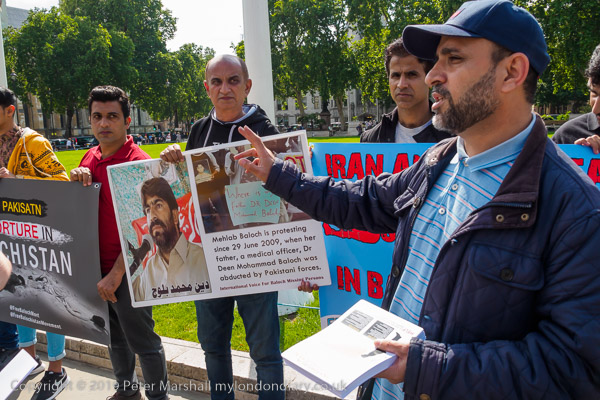
Just across the street, on the pavement in front of the grassed centre area, there was another protest, by the UK Chapter of the Free Balochistan Movement. It was the United Nations International Day in Support of Victims of Torture, and they were calling for an end to the large-scale disappearances, arrests and torture of anyone suspected of having links to the Baloch nationalist movement by Pakistan military forces and the Iranian Revolutionary Guards.

My day which had begun with the mass lobby, hadn’t ended, and I returned just a little too late to SODEM, before going on to photograph two other protests, to which I’ll refer in a later post.

More pictures from these three protests at:

SODEM Steve’s 50th Birthday
Operation Shutdown against Knife Crime
End torture in Balochistan


All photographs on this and my other sites, unless otherwise stated, are taken by and copyright of Peter Marshall, and are available for reproduction or can be bought as prints.

There are no adverts on this site and it receives no sponsorship, and I like to keep it that way. But it does take a considerable amount of my time and thought, and if you enjoy reading it, please share on social media.
And small donations via Paypal – perhaps the cost of a beer – would be appreciated.
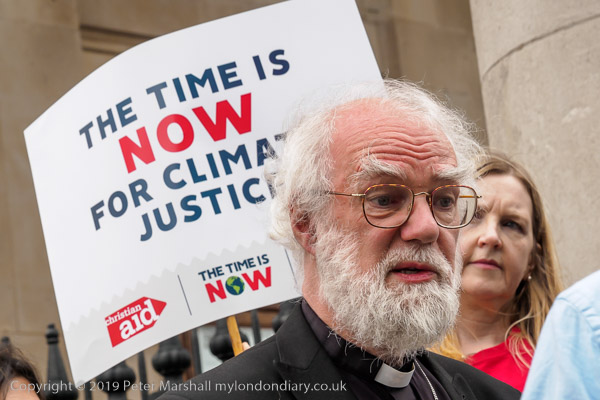
The Time Is Now

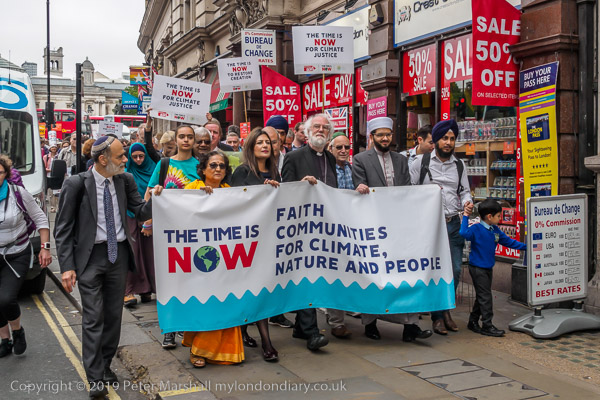
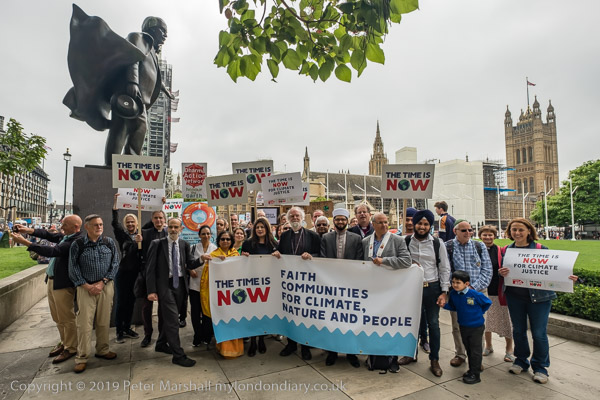
Lobbies of Parliament are generally not the most exciting things to photograph, but at least ‘The Time is NOW for Climate Justice‘ began with a kind of march, and had at least one very recognisable face in ROwan Williams.

I’m sure some of the other faith leaders holding the banner as they march along the pavement in Whitehall will be recognisable to some, and we can probably work out which faith most of them are representing. It was a rather timid march, moving quietly and sticking to the pavement, which isn’t very wide here and has quite a few obstacles as well as tourists to get in the way of both photographers and marchers.

The front of the march halted briefly for photographs in Parliament Square, though the place just isn’t so interesting with Big Ben (and the rest of the Clock Tower) under wraps. As well as to photographers, this is a disappointment to the tourists who I think should get a discount on their trips to London until the covers are lifted. I’ve managed to partly hide the rather ugly sight behind Lloyd George in his Superman costume about to leap off his plinth, though I have to say his is one of my least favourite statures, looking like some nasty plastic toy that might come free in your cornflakes.

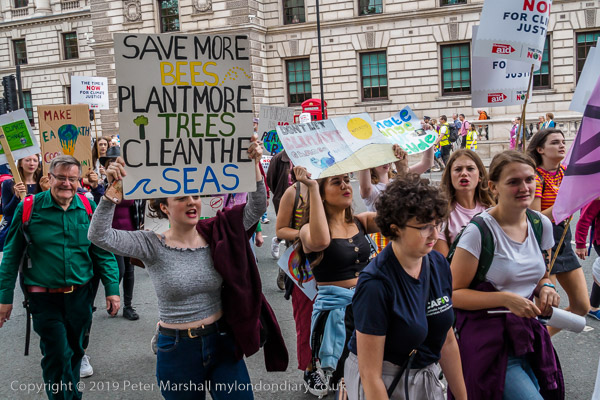
I let the leaders move on and walked back to photograph the other walkers straggling along behind, eventually finding some who were enjoying themselves and making a considerably more lively protest.

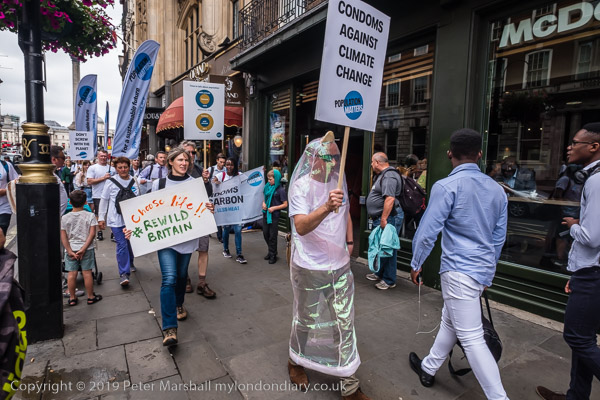
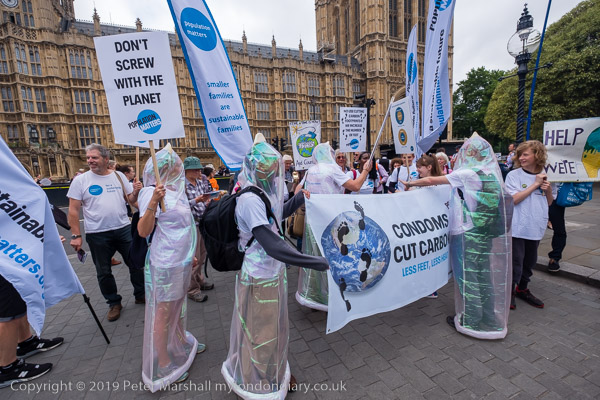
A few minutes later I met yet more people marching down Whitehall, this time with some dressed in giant condoms, with the message “Don’t Screw With The Planet” and that it’s no use us cutting carbon footprints if we keep increasing the number of feet. 

‘Population Matters’, of course it does, and it’s a message that is far more important for the richest nations, where people typically have ten times the carbon footprint per capita than in poorer countries with high birth rates. The most effective way to curb population growth in poor countries is to increase people’s wealth and security. While it’s good to make effective contraception cheap and widely available, people also have to want to use it.

More pictures at:
Time Is Now Walk of Witness
Condoms Cut Carbon

Underground Photography

Like many photographers who work in London I spend too much of my time underground, travelling around from place to place. Taking the Underground is usually the fastest way to get around London other than riding a bike as traffic congestion so often holds up buses and taxis (which are prohibitive unless you work in advertising or fashion.)

Taking my bike to London is possible, but adds complications like finding a safe place to lock it up (and nowhere in London is really safe from bicycle theives) and, particularly with marches where I may end up taking pictures a mile or more from where I started, having to walk back and find it. So usually I rely on buses when I’m not in any hurry or the tube when I am and the journey is too long to walk.

I decided to photograph on buses.

Back around 1990 I first saw the pictures taken on the Underground by Paul Baldesare, who became a friend and one I’ve shown work together with on numerous occasions. The first was a show at the Museum of London and as Paul already had some fine work on the tube, I decided to make a set of images for it of people on London’s buses. Paul’s early work was in black and white, but later he went on to photograph the tube in colour.

Another photographer who has photographed underground for a long period of time is Bob Mazzer, and you can find several features on his work on Spitalfields Life (there are links at the bottom of that page to the others.) His pictures are more varied than Baldesare’s and are the pictures of a regular daily traveller recording odd moments and unusual scenes.

Published now by Hoxton Mini Press. is a book of the work of photographer Mike Goldwater, London Underground 1970-1980, and you can see a fine selection of pictures on the BBC web site feature Candid moments on the London Underground.

And for a final mention, Stefan Rousseau, whose more recent pictures appeared in a Metro feature, Photographer secretly documents people’s sleepy commutes on London’s underground in April 2019.

Of course there are many other photographers who have photographed on the London Underground, including some well-known names, and several photographers I know whose projects I haven’t mentioned, along with the many thousands who have posted their phone images to Instagram and elsewhere. And of course there are other cities and underground networks. But the examples I’ve linked to are some that have particularly interested me and that I hope readers of this post will enjoy. Apologies to all those not mentioned!


All photographs on this and my other sites, unless otherwise stated, are taken by and copyright of Peter Marshall, and are available for reproduction or can be bought as prints.

There are no adverts on this site and it receives no sponsorship, and I like to keep it that way. But it does take a considerable amount of my time and thought, and if you enjoy reading it, please share on social media.
And small donations via Paypal – perhaps the cost of a beer – would be appreciated.

Dinner of HOPE

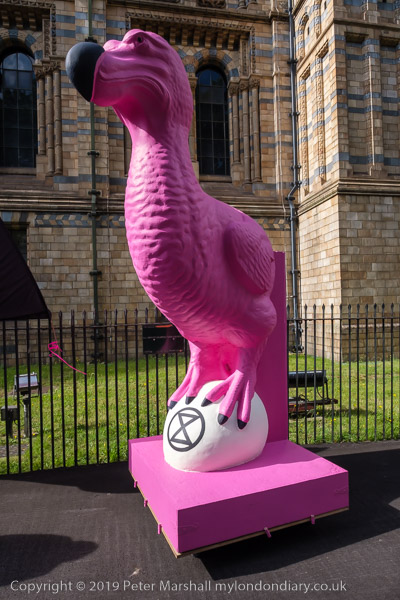
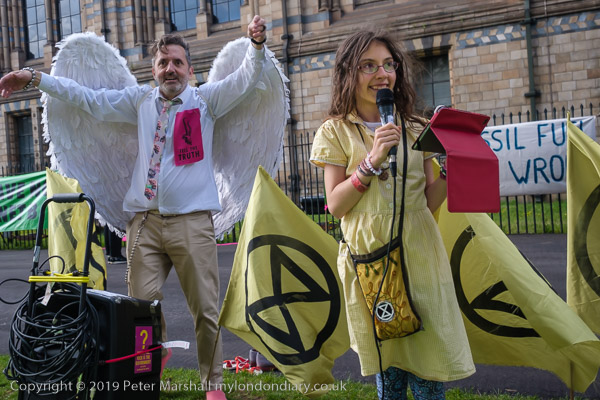
One of Extinction Rebellion’s slightly odder events was a picnic billed as the ‘Extinction Rebellion Dinner of HOPE‘ outside the Natural History Museum in South Kensington, which preceded a protest as guests arrived for the annual dinner of the Petroleum Group of the Geological Society.

As XR pointed out, there was a “grotesque irony of this cosy industry dinner taking place surrounded by extinct species” under the blue whale skeleton in the main hall, celebrating an industry that more than any other is contributing to the continuing extinction of species, possibly including our own.

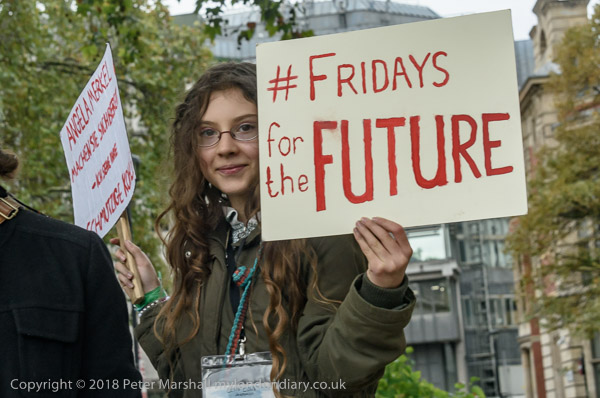
I’d met Elsie Luna back in October 2018, at a #Fridays For the Future protest in Parliament Square, the first in London as a part of #FridaysForFuture taking place in many cities and towns across the world, inspired by the action of the then 15-year old Greta Thunberg, who instead of going back to school at the end of the Summer break in August protested outside the Swedish Parliament, breaking the law to start the School Strike For Climate.

Elsie Luna stood out at that small protest, not just as one of two or three school age children taking part, but also because of the card hanging in a plastic holder around her neck with a picture of the Houses of Parliament and the message “Elsie Luna – Journalist – Hear! Hear! – The political podcast for young people in the UK”. The 8 podcasts are still on line.

Elsie Luna, now 10, opened the party. She had tried to get the museum to cancel the event, calling on the museum to take positive action over the climate and ecological emergency rather than hosting those who are most responsible for creating global extinction. But the Museum failed to listen and the event was taking place.

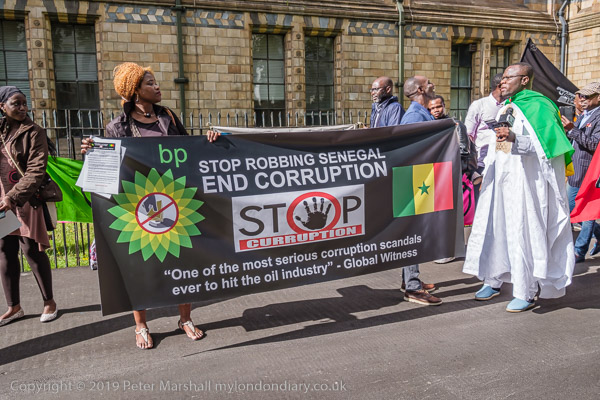
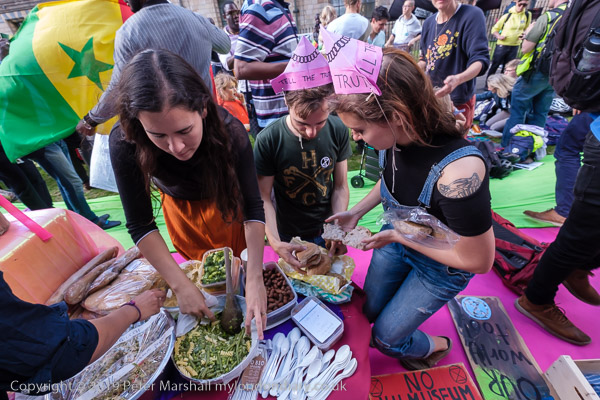
Extinction Rebellion were not the only group to have issues with the dinner and the oil companies who are the main groups taking part and sponsoring the event. They were joined by protesters against BP’s exploitation of Senegal who came with banners and drums, and whose drummers joined together with XR’s.

More pictures at Extinction Rebellion Dinner of HOPE.

Student Friday

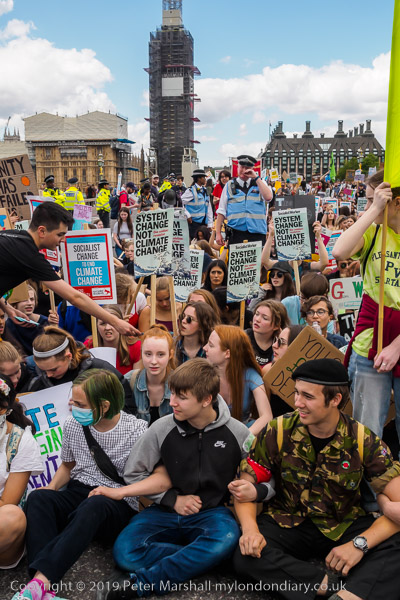
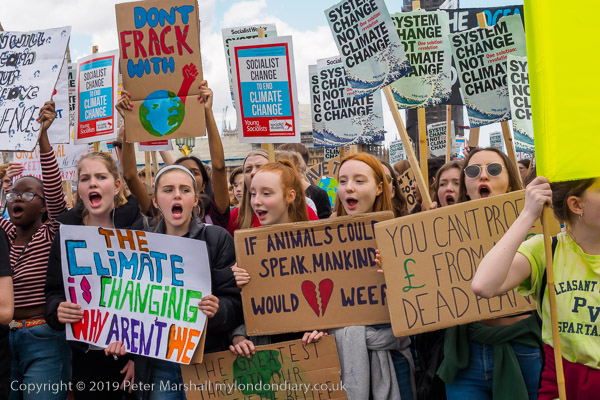
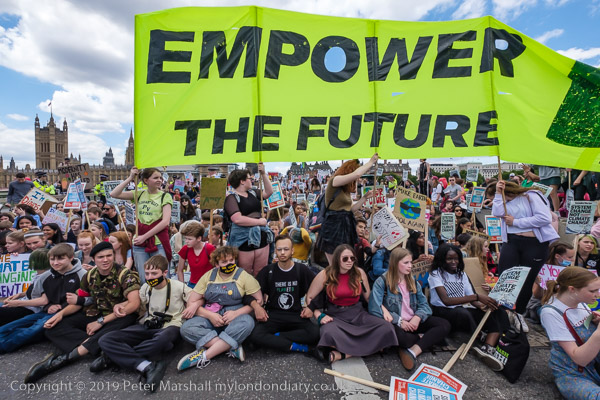
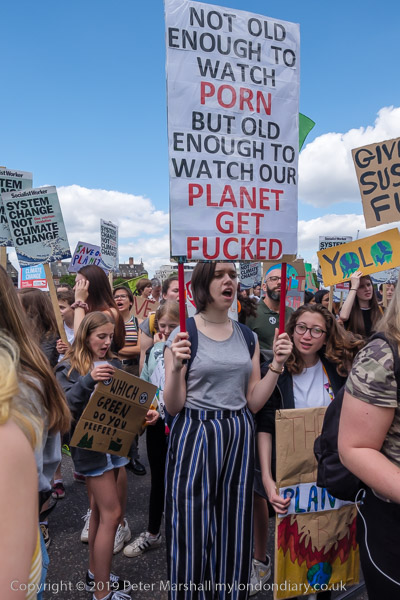
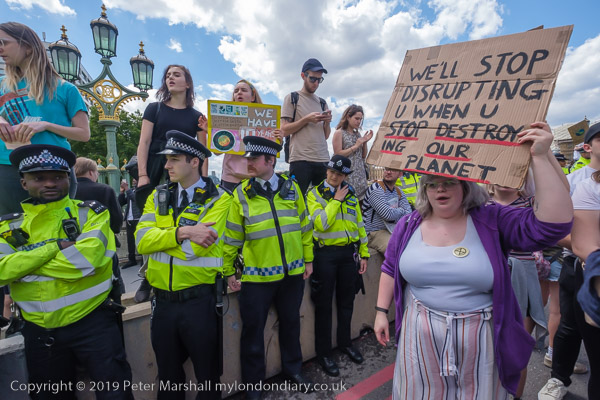
Big Ben (for pedants the Elizabeth Tower or Clock Tower) and the Houses of Parliament are both under wraps, and Portcullis House playing dead with its chimneys like legs up in the air and a police ‘Liasion Officer’ spy in his pale blue waistcoat rubs his eyes as young students link arms sitting and blocking Westminster Bridge call for ‘System Change Not Climate Change’.

There is an infectious energy from these young protesters that gives me hope while our government seems to lack any real appreciation of the urgency of our situation – as well as any concern for those struggling to get by in an increasingly unequal society. Perhaps things will change at least a little if we get a change of government in the coming election. At least Labour sometimes seems to be saying the right things even if some Labour councils are seriously failing, pursuing policies of social cleansing rather than social justice.

You can see more pictures on My London Diary, along with this short text:

Students marched in London again over the climate crisis, blocking Westminster Bridge. They are inspired by Swedish schoolgirl Greta Thunberg.

They ask again where the government is, as it fritters away its time over Brexit and internal party squabbles while failing to take the urgent action needed to give life on this planet a future.

Police attempted to clear the roadway, but had little success as students simply moved around.

The students who use the hashtags #YouthStrike4Climate, #GlobalClimateStrike, #ClimateJustice, #FridaysForFuture and SchoolStrike4Climate were still sitting on the bridge when I left to go to an appointment elsewhere. I think at some point they decided to get up and march around London some more.


All photographs on this and my other sites, unless otherwise stated, are taken by and copyright of Peter Marshall, and are available for reproduction or can be bought as prints.

There are no adverts on this site and it receives no sponsorship, and I like to keep it that way. But it does take a considerable amount of my time and thought, and if you enjoy reading it, please share on social media.
And small donations via Paypal – perhaps the cost of a beer – would be appreciated.


Stuart Heydinger dies

A few days ago I wrote a post linking to Brian Harris’s blog post about an epic scoop by Stuart Heydinger, then photographing for The Times who apparently not only managed to stage a handshake between Vivian Fuchs and Edmund Hillary at the South Pole in 1958 but get his pictures back days before the other photographers present.

The post by Harris included extensive written comments from Heydinger, who Harris managed to find living in Germany, age 92.

On Saturday evening the Guardian online published a gallery of pictures, The photojournalism of Stuart Heydinger, edited by Greg Whitmore under the text :

The Observer’s chief photographer from 1960-66, has died aged 92. Here we look back at his outstanding photography that captured some of the key moments of 20th century history.

But perhaps the most interesting pictures in the set are not those of great events or famous men or women, but two of French men in Pyrénées-Atlantiques in the 1970s and a girl collecting water in Algeria. It’s also interesting that the set also includes an image of a lonely flooded pylon, one of a set of “eerily beautiful, quiet images which were never published” taken in 1960 during flooding around Lewes in East Sussex.

Along with the photographs is a page from Heydinger’s travel diary for May 1963- August 1964 detailing around 55 journeys by air, sea, rail and road, an exhausting schedule that took him around Europe, to the USA and Borneo as well as to Antartica and the Middle East.

Like others, I’ve long questioned the role of the heavyweight news photographers travelling internationally around the globe, jumping from country to country and story to story, often actually manufacturing rather than simply recording the news. And there are elements in his work that support those criticisms, not of him but of the industry which employed him. There is certainly no doubting that Heydinger was a heavyweight who took up that role and made and reported history.

Hands off Sudan

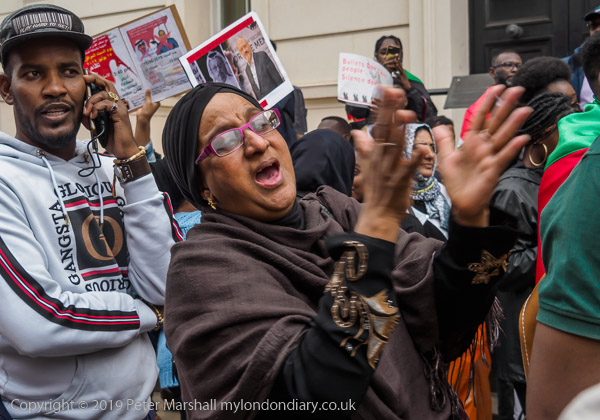
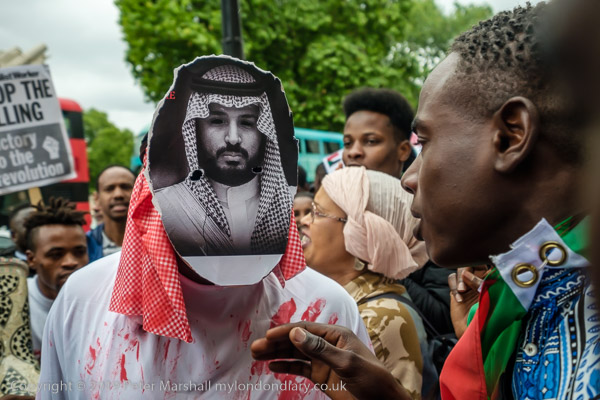
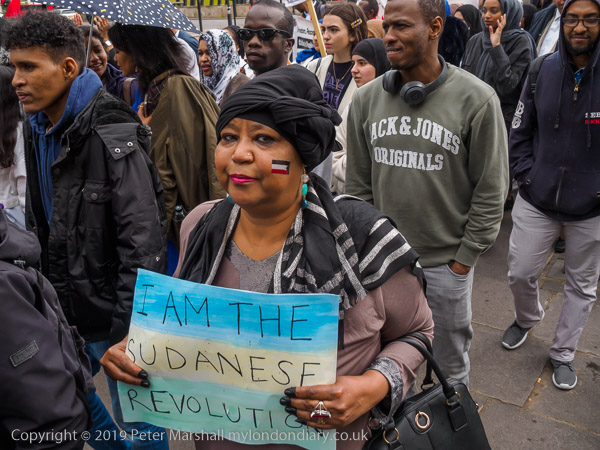
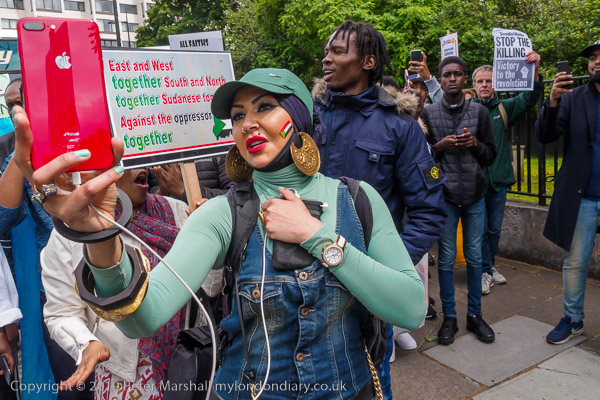
The protest in London on 15th June was a response to the massacre of 124 peaceful protesters by Janjaweed militias (Rapid Support Forces) in Khartoum on 3rd June and the 3-day general strike prompted by this the following week. Protests began in Sudan in December 2018, calling for an end to the military regime headed by President Omar al-Bashir and calling for a return to civilian rule.

The protests continued and military coup in April removed al-Bashir from power and the country was under control of a Transitional Military Council, which the protesters demanded transfer power to a civilian-led government. Negotiations continued between the two sides until interrupted by the Khartoum massacre, and were resumed following the three-day general strike.

The massacre was thought to have been prompted by demands from Egypt, Saudi Arabia and the United Arab Emirates that the miltary and police take a tougher line against the protests, and so the London demonstration began at the UAE embassy in Belgrave Square before marching to Mayfair and the Egyptian embassy in South Street and finally the Saudi embassy nearby.

My only real problem in photographing the protest was in finding it, as although I knew the starting time I hadn’t been able to find any timings for the other two embassies. It wasn’t clear how long they would be in Belgrave Square or when they might arrive elsewhere.

Because of covering other events I was unable to get to the start in Belgrave Square and thought by the time I could get to the protest it might be at the Egyptian Embassy. I took the tube to Green Park and walked there – passing the back of the Saudi Embassy on route. There were only a handful of protesters at the Egyptian Embassy and it was clear the protest had not yet arrived, so I continued on the likely route towards the starting point.

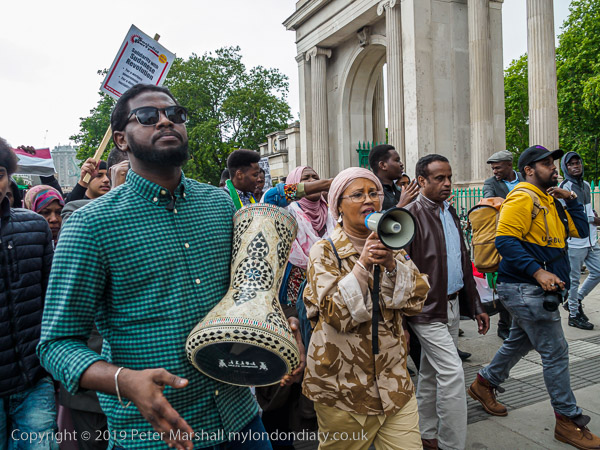
As I crossed Hyde Park Corner I saw and heard the protest emerging from Grosvenor Crescent and hurried to meet it. They stopped for some time on Grosvenor Place where I took the first few pictures on a fairly narrow and very crowded pavement; heavy traffic there made it unsafe to photograph from the road.

After a while the protesters moved across to the wider pavement in front of the monumental gateway to Hyde Park, where again it halted for some loud singing, chanting and dancing before moving off around into Park Lane. By the time I’d photographed the end of the procession crossing South Carriage Drive at the Queen Elizabeth Gate I decided I’d probably taken enough pictures and could make my way home. One of the noticeable aspects of the protest was the large proportion of women among those most active in it.

In Sudan negotiations continued with an agreement being reached between the TXC and the Forces of Freedom and Change representing the protesters agreeing there would be a judicial investigation into the Khartoum massacre and other events and that they would share power for a transitional period until elections in mid-2022 led to a civilian government. Street protests have also continued, but it looks as if they have acheived their goal.

More at: Hands off Sudan march


All photographs on this and my other sites, unless otherwise stated, are taken by and copyright of Peter Marshall, and are available for reproduction or can be bought as prints.

There are no adverts on this site and it receives no sponsorship, and I like to keep it that way. But it does take a considerable amount of my time and thought, and if you enjoy reading it, please share on social media.
And small donations via Paypal – perhaps the cost of a beer – would be appreciated.

Grenfell Solidarity March

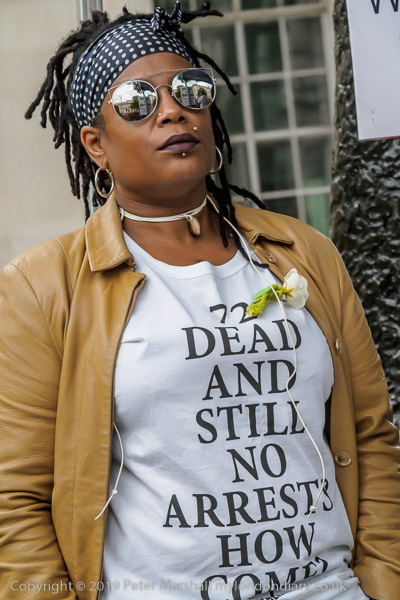
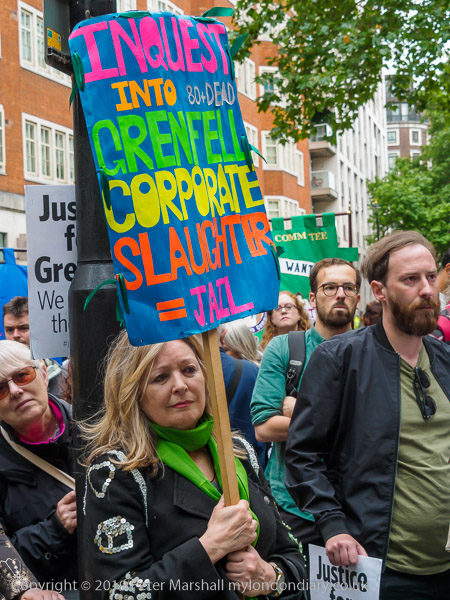
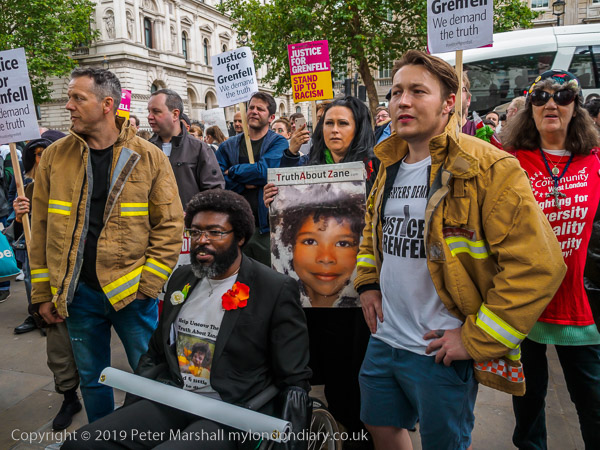
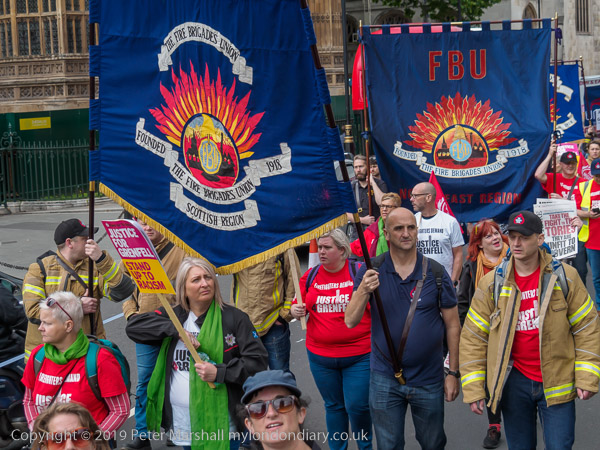
Grenfell was very much on our minds in the middle of June, around the second anniversary of the fire in which at least 72 people died, as it is now with the publication of the first part of the Grenfell Inquiry report. As well as the monthly silent march close to the tower on the actual anniversary, there was also a solidarity march the following day in Westminster.

Grenfell tower was built to resist the spread of fire. A fire in any single flat should have been confined to that flat for two hours, with a door designed to resist fire for at least an hour and a half. It had a single staircase that should have remained smoke free for two hours, allowing the safe exit of residents and for firefighters to climb up to fight the fire and rescue those living there.

Had Grenfell been properly maintained and kept as designed there would have been no deaths. The tower was designed so that the ‘Stay Put’ policy was safe, but the building had been altered in various ways – including but not only the addition of highly flammable and incorrectly installed cladding – which made it a death trap. Residents had pointed this out to before the fire, but their complaints had been ignored and those making them threatened.

Had the building been properly inspected these faults would almost certainly have become clear. But we had a government that considered safety regulations as “red tape” and saw inspections as an opportunity for private enterprise rather than public good. And the owners and managers of the building were interested in cutting costs and making it look more attractive to people on the outside rather than any concern about the safety of the residents.

The fire at Grenfell should have been a minor incident, quickly dealt with and causing no injuries of death, rather than the inferno we saw which killed so many. The inquiry suggestion that more could have been saved had the ‘stay put’ policy been abandoned earlier appears unsound. Had there been no such policy in place at the start of the fire more might well have escaped, but it is a general policy in place across all high rise residential buildings designed and built to the same standards as Grenfell and for good reason.

It’s failure at Grenfell was not the fault of the fire brigade, and by the time it was clear to firefighters that the building had failed the staircase, the only means of escape was filled with dense toxic smoke. Firefighters needed breathing apparatus and risked their lives to try and rescue those trapped inside. The inquiry report seems to deliberately contradict the evidence of experts including those who were actually there fighting the fire.

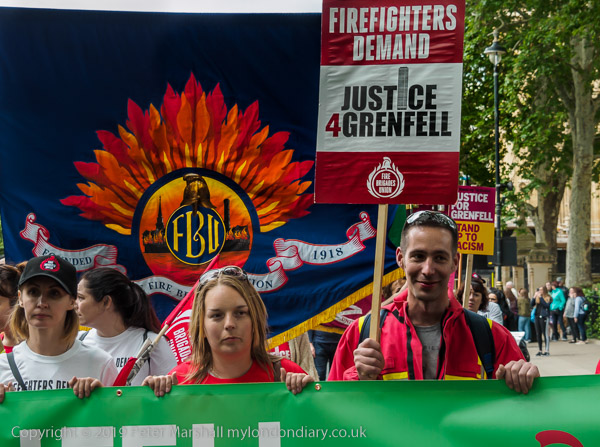
Many firefighters were at this march, including some who had risked their lives to save those inside Grenfell, but many more from around Britain. There are legitimate criticisms in the report about the equipment they had, though these are largely down to cuts made by the government and London Mayor Boris Johnson rather than the fire chiefs. The FBU had certainly warned that the cuts would mean more people dying and this event proved them right. Firefighters going into the building knew they were risking their lives – and as they went in were instructed to write their names on their helmets to make their dead or unconscious bodies recognisable. Thanks to their skill and training – and luck – no firefighters died and they rescued many.


All photographs on this and my other sites, unless otherwise stated, are taken by and copyright of Peter Marshall, and are available for reproduction or can be bought as prints.

There are no adverts on this site and it receives no sponsorship, and I like to keep it that way. But it does take a considerable amount of my time and thought, and if you enjoy reading it, please share on social media.
And small donations via Paypal – perhaps the cost of a beer – would be appreciated.

September 2019: My London Diary

I just managed to finish posting my pictures and comments to My London Diary for September 2019 before the end of October, though I am finding it more and more difficult to keep up.

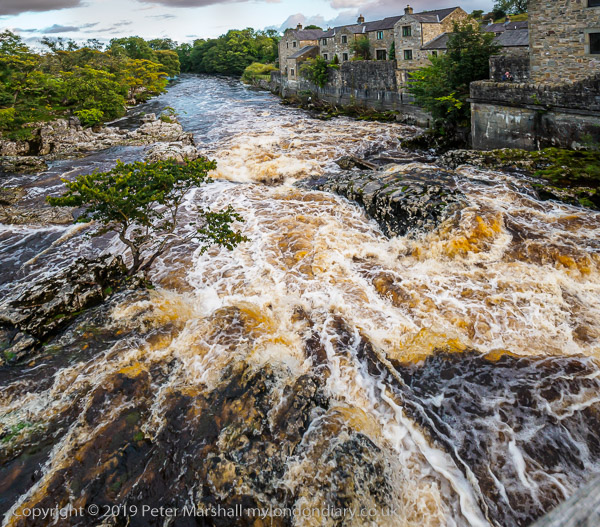
I began September with a rather active week with friends in the Yorkshire Dales, mainly in Wharfedale. It was an area I’d hardly visited before and certainly worth a trip.

September 2019

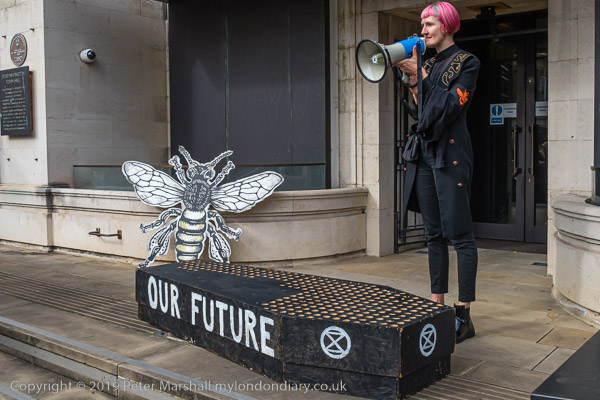
Requiem for a Bee
HS2 threatens ancient Woodland
Veterans Moon for Soldier F

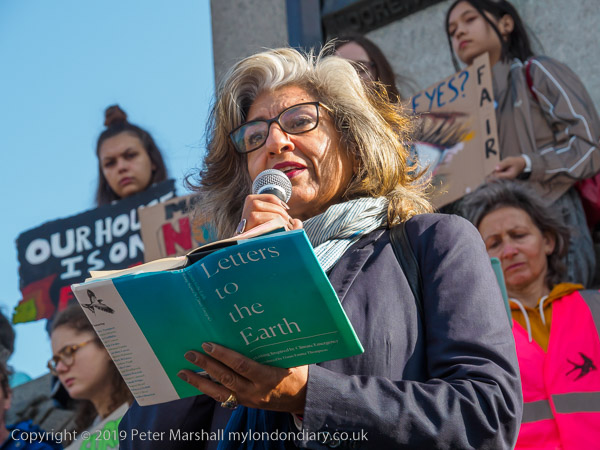
Climate Rally for the Imagination
Hong Kong must be free
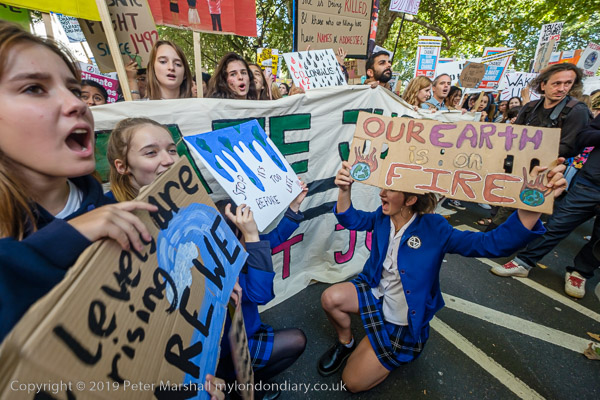
Students Strike for climate justice
XR Doctors Climate Protest

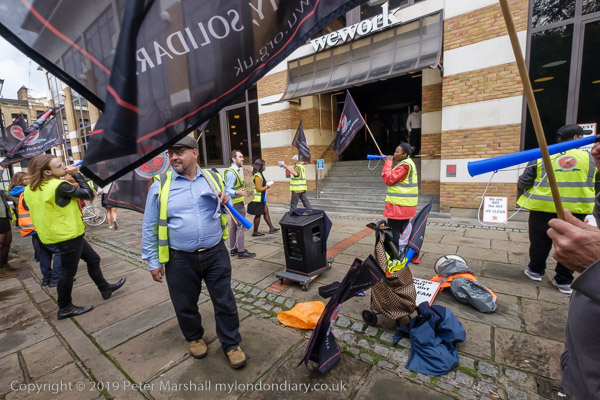
Wework stop victimising cleaners
Clerkenwell Road & Old St
Clean Air for Catford Children
Zimbabwe protests continue
XR Youth International
Cody Dock Duck Race
Bromley-by-Bow to Star Lane
Carnaby St Puma Boycott
Global Climate Strike Protest continues
Elephant & Brixton Global Climate Strike

Global Climate Strike Rally
Hackney don’t victimise housing activists
Hackney
Brixton anti-racist march
London’s First Trans+ Pride March
Stop Arming Israel HSBC Protest

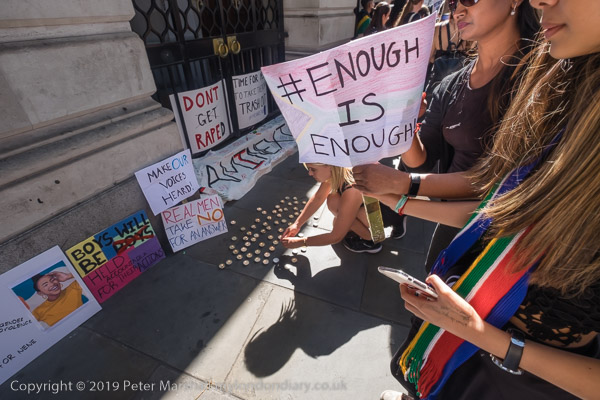
Criminal Abuse of Women in South Africa
Against LGBTQ Hate Crime
Stop the suicide crisis

Yorkshire Dales holiday

Kettlewell and Starbotton
Skipton
Bolton Castle
Wensleydale waterfalls
Kettlewell & Arncliffe circular
More Kettlewell

Skipton Castle
Litton Church & Falls
Buckden circular
Kettlewell final
Linton
Conistone walk

London Images


All photographs on this and my other sites, unless otherwise stated, are taken by and copyright of Peter Marshall, and are available for reproduction or can be bought as prints.

There are no adverts on this site and it receives no sponsorship, and I like to keep it that way. But it does take a considerable amount of my time and thought, and if you enjoy reading it, please share on social media.
And small donations via Paypal – perhaps the cost of a beer – would be appreciated.