The Pope & Apprentice Boys of Derry – 2010

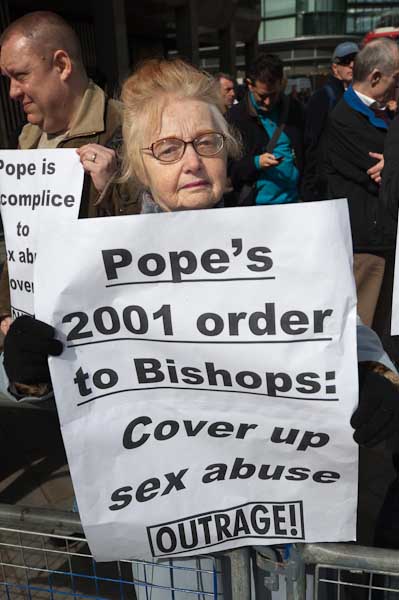
The Pope & Apprentice Boys of Derry: Pope Benedict XVI was in the UK on a State Visit from 16-19th Septemnber 2010, the first ever official papal state visit to the UK. There was a large protest in London on Saturday 18th September 2010 against his visit because of his hiding of evidence of child abuse and more widely against religious bigotry. By coincidence the day was also the day of the annual Carson Day parade by the City of London branch of the Apprentice Boys of Derry, also no friends of the Pope.


Apprentice Boys London Parade

Whitehall
The Pope & Apprentice Boys of Derry - 2010
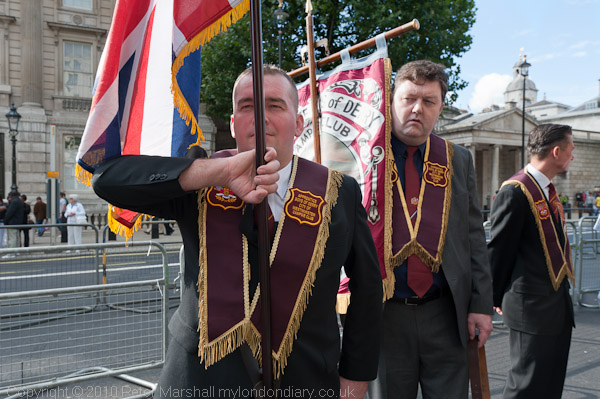
City of Westminster Apprentice Boys of Derry Campsie Club

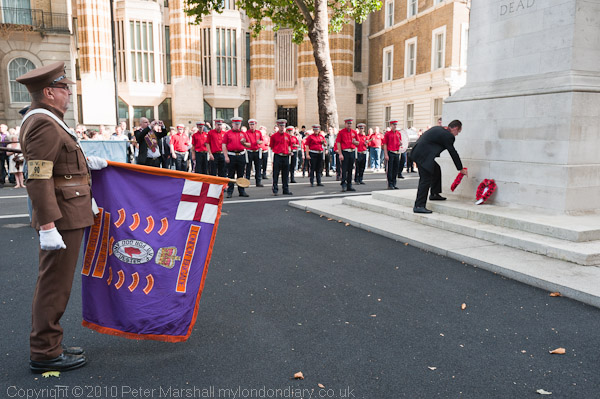
Because of the large protest against the Pope, police made the Apprentice Boys make an earlier than usual start so that they could lay their wreaths at the Cenotaph before the large march arrived.
The Pope & Apprentice Boys of Derry - 2010

I was unaware of this and arrived at the published departure time oon the Embankment I found no one there, and had to rush to Whitehall, arriving just in time to photograph them laying wreaths at the Cenotaph, and after to photograph them marching away.

The Pope & Apprentice Boys of Derry - 2010

As I wrote in 2010:

“The Apprentice Boys, along with the other organisations taking part in the march are Ulster Protestants, dedicated to upholding the Protestant faith. Several standards were for the London Somme Association, celebrating the part played by Ulster regiments in the First World War, listing some ofthe battles in which they suffered heavy losses – Ypres, Arras, Cambrai, Thiepcal, Fricourt and more. But one of the flags was for the Protestant Action Force, a name used for the Ulster Volunteer Force, formed in 1966 and actively involved in the ‘troubles’ until it declared a ceasefire in 1994 – it only officially ending its armed campaign in 2007.

The Pope & Apprentice Boys of Derry - 2010

The Orange institutions in London, though presumably providing support of various kinds for allied groups in Ulster, have always been more about the social and cultural aspects of Unionism, and their marchers through London have never attracted the kind of controversy that exists in Northern Ireland.”

Apprentice Boys London Parade


London Protests Against Papal State Visit

Piccadilly and Whitehall
The Pope & Apprentice Boys of Derry - 2010
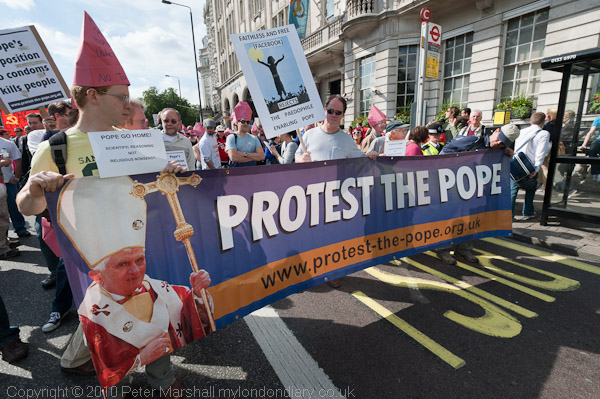
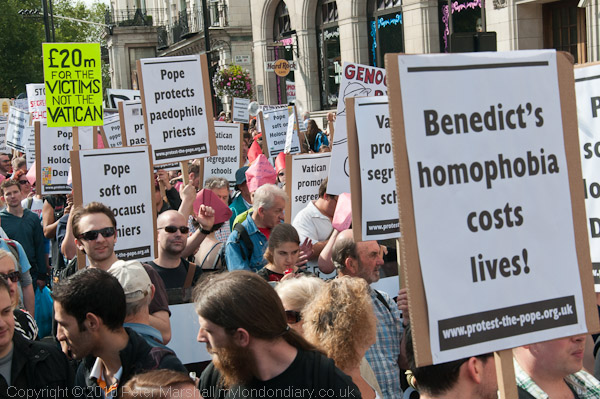
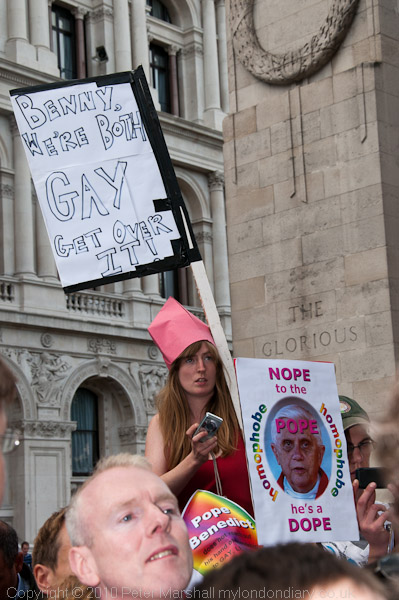
Around 10,000 lined up in Piccadilly to show their opposition to the State Visit by the Pope

Widespread publicity around the Pope’s State Visit clearly swelled the numbers who came to march against his locking away evidence of child abuse by priests and for an end to religious bigotry, and it united many groups who are opposed to the religious fundamentalism of the Catholic church and to its interference in politics.
The Pope & Apprentice Boys of Derry - 2010

Both organisers and police were surprised by the number of marchers and the rally had to be moved further down Whitehall to where there was a larger space and the crowd filled the entire street for some distance on each side.
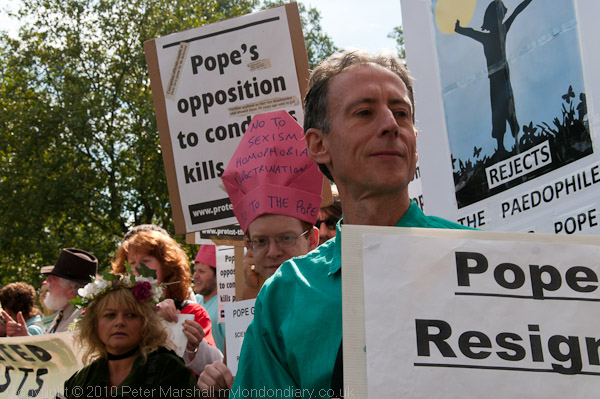
Peter Tatchell at the front of the march

Speakers including some militant atheists, made clear that this was not a march against religion and certainly not against Christmas, but against a particular man and his actions locking away evidence of child abuse and trying to smooth over cases of abuse rather than investigate and bring those concerned to justice.
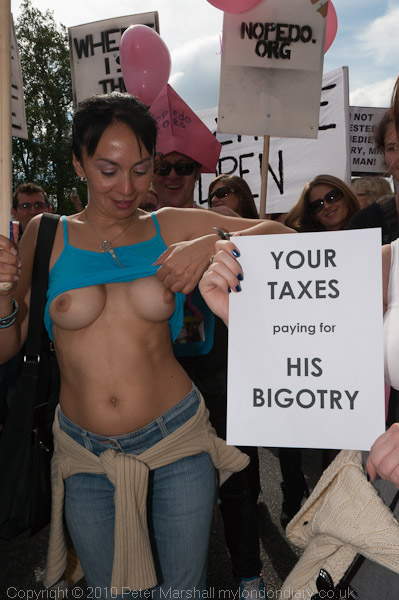
This woman gave me a surprise when I photographed her

“It was also against a church organisation that meddles in politics at the highest level, pretending that the Vatican is a state (and even persuading the UN to treat it as such.) Of course it isn’t really a country but an NGO and should be treated as such.”
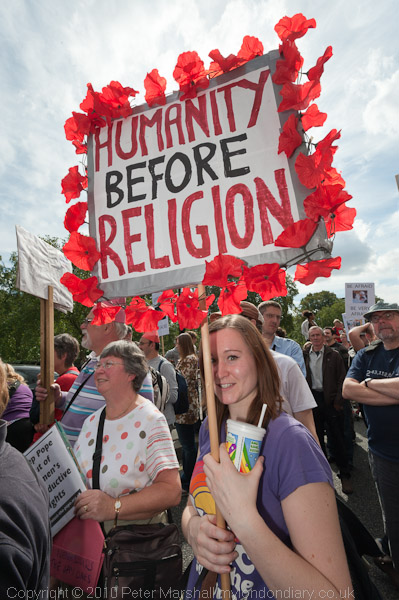
Because of its influence in the UN and on governments around the world, millions have died unnecessarily of AIDs through its opposition to the use of condoms.
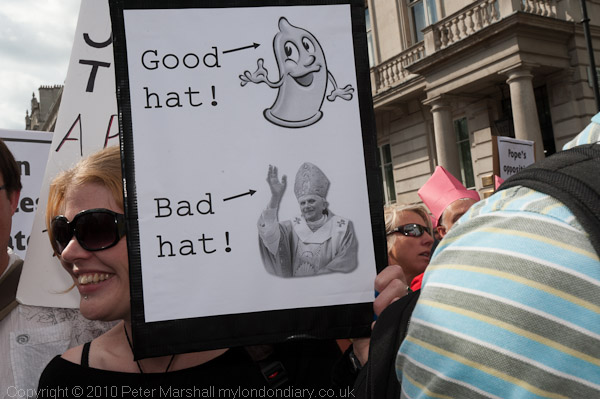
Unlike many other churches, the Catholic Church remains an entirely male hierarchy, still insisting on male celibate priests – with predictable consequences. Among those marching were Catholic women calling for the church to ordain women – as have many other churches for many years – and also gay Catholic clergy. The speakers included one priest whose work caring for Aids victims in New York and London had been condemned by the Catholic Church.
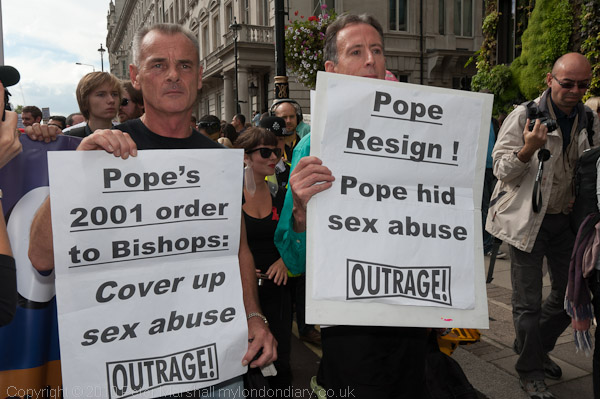
Others were survivors of child abuse by Catholic priests, covered up both by the church and even by their own mothers because of their allegiance to the church.
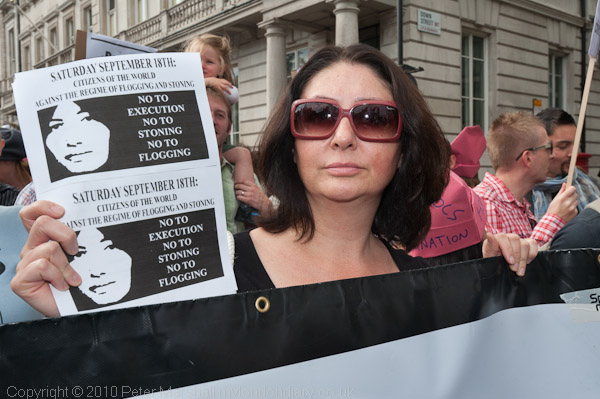
Maryam Namazie

Maryam Namazie reminded the crowd “it isn‘t just the Catholic church that imposes its religious laws on people, but other religions such as Islam.” In Iran under Shariah law stoning is still in use, particularly to keep women in a state of submission.
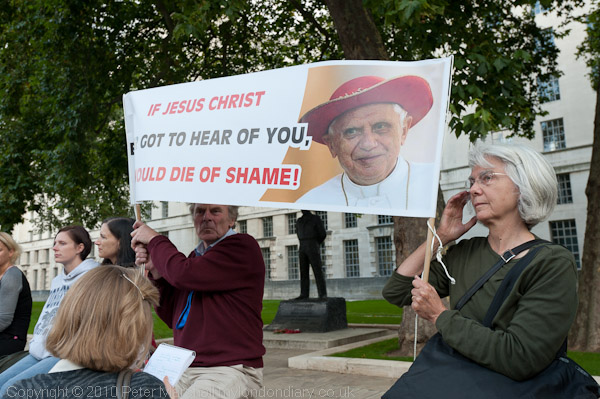
The rally was cut short when police insisted that the PA system had to be turned off as the area was still covered by the ban on amplification in the area around parliament covered by SOCPA (the Serious Organised Crime and Police Act, 2005.)
You can read a longer account of the rally – and far too many more pictures including several of each of the many speakers – on My London Diary:
London Protests Against Pope.


Flickr – Facebook – My London Diary – Hull Photos – Lea Valley – Paris
London’s Industrial Heritage – London Photos

All photographs on this page are copyright © Peter Marshall.
Contact me to buy prints or licence to reproduce.
Protest the Pope – 2010

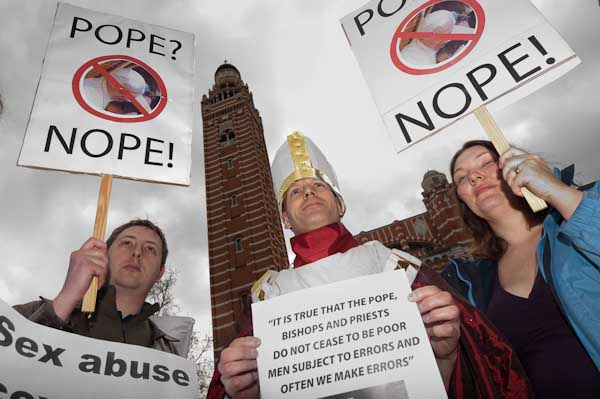
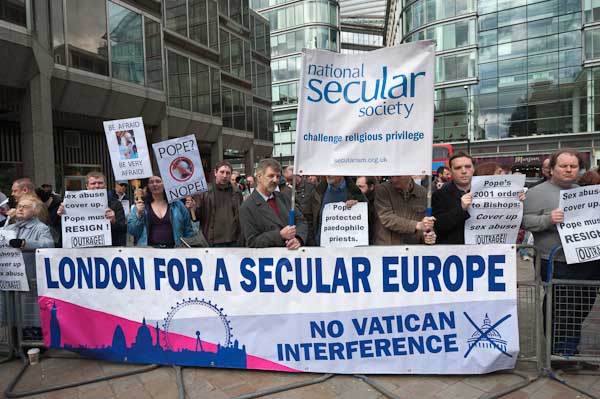
Protest the Pope: Sunday 28th March 2010 saw a large protest by a coalition of organisations against the historic state visit planned for the forthcoming September by Pope Benedict XVI. This was the first official visit ever by a Pope to the UK, although in 1982 Pope John Paul II made a pastoral visit here.

Protest the Pope - 2010

England has had a long tradition of anti-Catholicism dating back to even before Henry VIII, often said to have begun with the martyrdom of Saint Alban, beheaded in St Albans (then Verulanium) at some time in the 3rd or 4th century. But matters certainly came to a head (!) again with the split from Rome on largely political and matrimonial grounds by Henry in 1536 in England and 1538 in Ireland (where Henry also ruled, although only proclaiming himself King in 1541 following several hundred years of Anglo-Norman invasion.) The reformation in Scotland in thanks to John Knox in 1560 was considerably more on religious grounds.

Protest the Pope - 2010

Catholicism became illegal across the British Isles and under Elizabeth I a failure to attend weekly Anglican services became an act of high treason. King James II was actually a Catholic when crowned and tried to remove the restrictions on Catholics and establish greater freedom of religion, but this was a major part of his downfall and replacement by Dutch Calvinist William III. It was under his reign that in 1701 the Act of Settlement prohibited any one who was a Catholic or married one from becoming an heir to the throne. This latter restriction remained in force until 2013 with our PM David Cameron in 2011 still insisting that the monarch must be a card-carrying member of the Church of England but at least they can now marry Catholics.

Protest the Pope - 2010

Every November 5th we still celebrate the foiling of a Papist plot to blow up Parliament by burning effigies of Catholic Guy Fawkes – though at some celebrations now they also burn effigies of various politicians. And in previous centuries we had serious anti-Catholic riots although we now think of these as confined to Northern Ireland and thankfully somewhat diminished in recent years. But Orange Order marches here in England as well as in Ulster remain a reminder of anti-Catholic prejudice.

Protest the Pope - 2010

And of course it hasn’t just been Catholics who have suffered from religious prejudice and persecution over the years, but also non-Conformists, Jews and Muslims. Although most of the legal restrictions have now gone we have seen a considerable rise in antisemitism and Islamophobia particularly in extreme right circles.

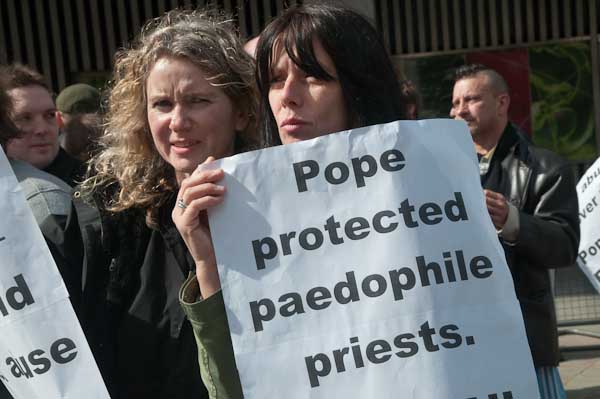
But the protest in 2010 was driven by the continuing revelations of sexual abuse by priests and in Catholic organisations and the evidence that leading Catholic figures were trying to cover these up rather than take effective action. Of course it isn’t just Catholics who abuse, and recent events in the Anglican church have opened up our knowledge of institutional failings there too. And to be fair to religions we are also aware of similar problems in the army and some left and right wing political parties too, as well as Harrods and other private companies.

You can find out more about the event in my account and more pictures on My London Diary but I’ll end with a couple of long quotes from that article, the first a list of the organisations that were involved in the protest and the second about why the objected to the state visit.

The coalition includes eleven organisations: the British Humanist Association, Central London Humanist Group, Council of ex-Muslims of Britain, Gay & Lesbian Humanist Association, International Humanist and Ethical Union, National Secular Society, North London Humanists, One Law for All, OutRage!, Southall Black Sisters and Women Against Fundamentalism. The largest banner was for London for a Secular Europe, though there was also one for the National Secular Society and many Outrage! posters; both Peter Tatchell of Outrage! and Terry Sanderson, President of the NSS were taking part.

And about the Pope and the Catholic Church:

He is the head of a church which, as well as failing to deal with childe abuse, has opposed the distibution of condoms, increasing family sizes and the spread of AIDS in poor countries, denied abortion to women, including the most vulnerable, opposed equal rights for LBGT people, and rehabilitated holocaust deniers.

The Pope is also head of state of the Vatican which has not signed many major human rights treaties and has produced concordats with many states that effectively deny their citizens human rights.

Protest the Pope


Flickr – Facebook – My London Diary – Hull Photos – Lea Valley – Paris
London’s Industrial Heritage – London Photos

All photographs on this page are copyright © Peter Marshall.
Contact me to buy prints or licence to reproduce.