Shut Down Racist Immigration Prisons – 2014

Shut Down Racist Immigration Prisons: On Saturday 8th November 2014 I went to Harmondsworth for a protest by supporters of Movement for Justice calling for immigration detention centres such as the two next door to each other on the Bath Road on the northern edge of Heathrow Airport to be closed down.

Shut Down Racist Immigration Prisons - 2014
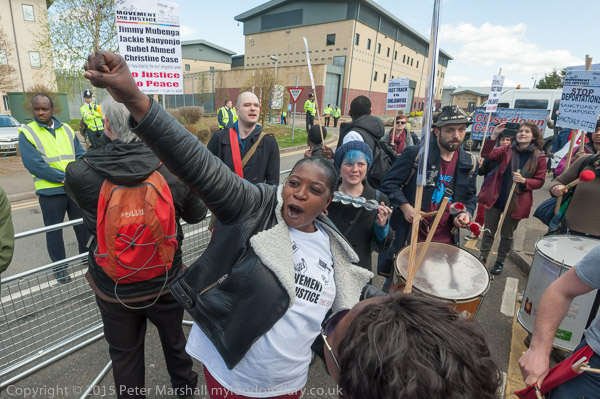
Protesters bring the message ‘You Are Not Alone’ to prisoners in the detention centre
Shut Down Racist Immigration Prisons - 2014
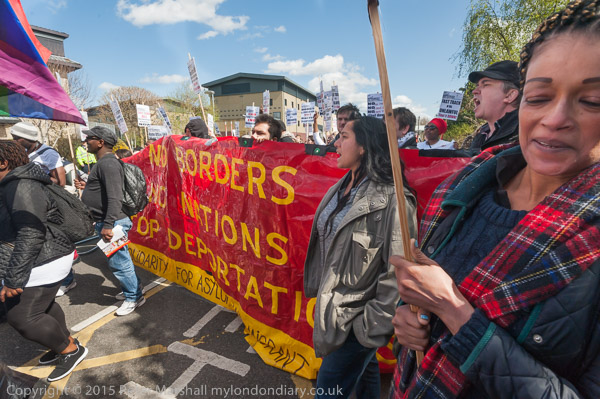
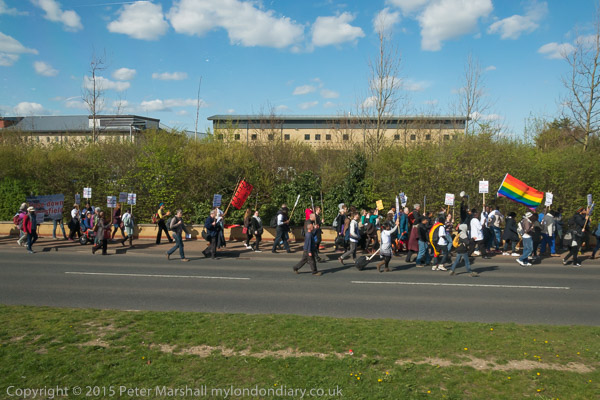
They march to the area where MITIE had allowed them to protest

The hundred or so protesters included quite a few who had at some time been held in Harmondsworth or Colnbrook immigration centres or the others around the country. The two at Harmondsworth had recently been brought under the same management as Heathrow Immigration Removal Centre, run by Mitie.

Shut Down Racist Immigration Prisons - 2014

Although organised by MfJ, this and other protests at detention centres are supported by a wide range of organisations and one of the banners was full of their logos.

Shut Down Racist Immigration Prisons - 2014

Back in 2014 over 30,000 people, 85% men, were held in these prisons. The name is misleading as over the years less than half of detainees who left them were actually deported. Most who leave them are on immigration bail while their claims for asylum are being investigated.

Shut Down Racist Immigration Prisons - 2014

Around a third are imprisoned for relatively short periods of 28 days or less, but this is indefinite detention and at least one person was kept in immigration jail for a day under three years with 2-3% being held longer than 6 months.

Shut Down Racist Immigration Prisons - 2014
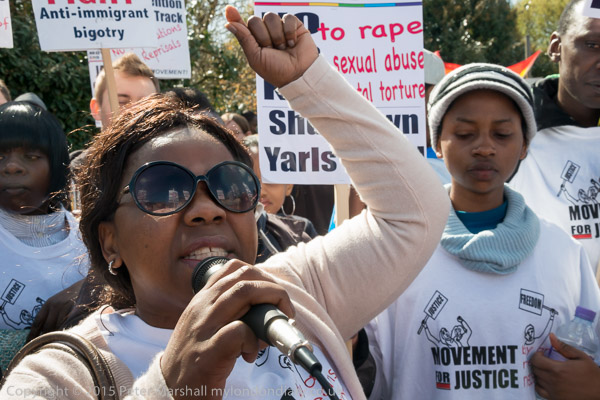
Antonia Bright of MfJ speaking

When Mitie took over the management of these prisons they told police not to allow protests in the the roadway between the two centres and around the side and back of Harmondsworth which are on land owned by the Crown where they could be seen by some held on the upper floors of the centres which are surrounded by 20ft fences with a solid metal lower half.

Instead the protesters were confined to an area in front of the administrative block of the Harmondsworth Centre, out of sight of the detainees, but their noisy protest could be heard inside both blocks. People inside, locked away without a release date, often feel they have been forgotten by the outside world and this gives them some hope.

Many of those who spoke were former detainees

As well as calling for the closure of detention centres, the protesters also expressed shock at the decision by the EU to stop rescuing immigrants crossing the Mediterranean, and a placard read ‘Refusing to Rescue is Murder – End the “Let them Drown” policy’.

Some of those held have mobile phones as they need these to pursue their asylum claims, and the protesters were able to contact some of those held inside and relay their views over the public address system they had brought with them.

The detainees say they are mistreated by staff, given poor and sometimes inappropriate food and suffer from a lack of proper medical care,. But overwhelmingly they complained as I wrote in 2014, “that although they had committed no crime (and in most cases were victims of crimes in their own countries), in the UK they were treated as criminals and locked away. They say Asylum detention is worse than prison for detainees because they have no idea when it may come to an end – some had been held for well over a year – and the detainees feel under a constant threat of being forcibly returned to the country they fled because they feared for their lives or had been tortured.”

Shut Down Racist Immigration Prisons


Flickr – Facebook – My London Diary – Hull Photos – Lea Valley – Paris
London’s Industrial Heritage – London Photos

All photographs on this page are copyright © Peter Marshall.
Contact me to buy prints or licence to reproduce.
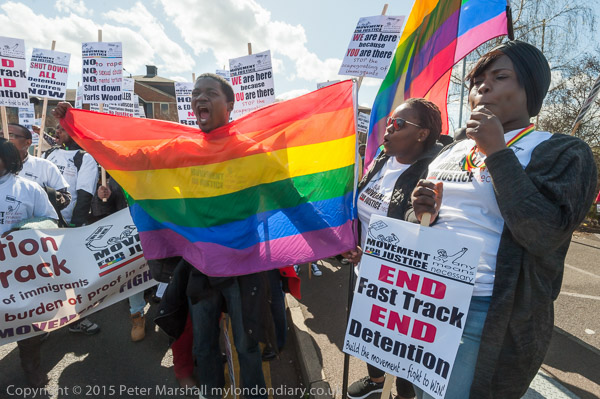
End Immigration Detention – Harmondsworth 2015

End Immigration Detention – Harmondsworth: Saturday 11th April 2015 saw what I think was the largest protest to date outside the Heathrow Immigration Removal Centre on the Bath Road immediately north of Heathrow airport.

End Immigration Detention - Harmondsworth

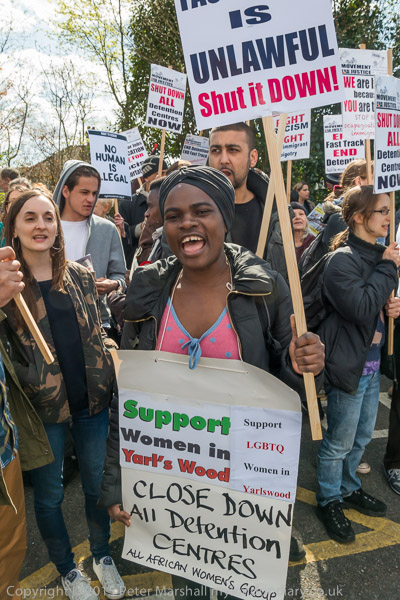
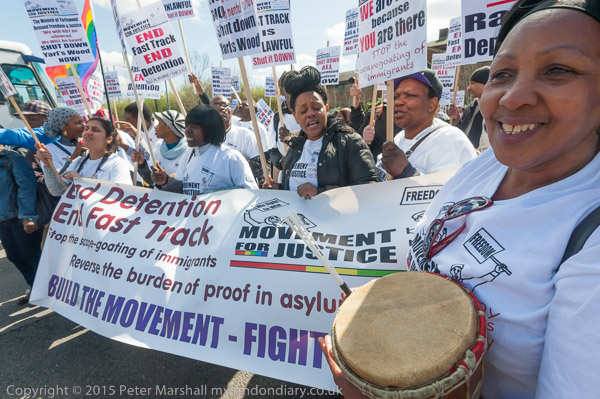
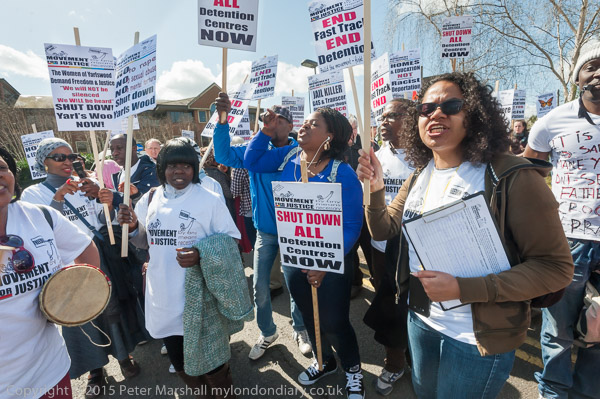
Various organisations had held protests here over the years, but these had grown since Movement for Justice began organising them, bringing a large group of current and former asylum seekers out from London on the tube to Terminal 5 and then on the short bus ride to the prison. They included some who had come from other cities in the country – and even from Glasgow. Other groups at the protest included No Borders, Southall Black Sisters and Shoreditch Sisters W I.

End Immigration Detention - Harmondsworth

There are two detention prisons on the site, both surrounded by 20ft high fences with a private road to a BT site running between them. Called Harmondsworth and Colnbrook, they were in 2015 both run by Mitie’s ‘care+custody’ division, and the overall name for the centre had changed to Heathrow Immigration Removal Centre, which made clear that the government intention was to deport people rather than operate a fair asylum system.

End Immigration Detention - Harmondsworth

The Home Office has long proved itself to be both incompetent and racist, and huge backlogs have built up over the processing of asylum claims. They seem to start from the position that all asylum claims are unfounded and those making them are liars, often despite the evidence. Claims that should be processed in days take months or years – during which time people may be kept in detention centres like these generally quite unnecessarily. We should imprison criminals, not asylum seekers.

End Immigration Detention - Harmondsworth

As I commented in 2015:

“these are prisons, with those inside being unable to leave; they have a few privileges denied those in normal jails, including the use of mobile phones, but some disadvantages, including that they are all on indefinite sentences at the whim of government and subject to a constant threat they will be forcibly bundled onto a plane and taken back to the country from which they have fled, often at fear of their lives. These prisons are also run by staff who often lack the basic training, supervision and accountability of normal jails.”

The majority of those who claim asylum are eventually granted leave to remain in the UK as their claims are well-founded. Some have been deported before they are given time to prove their cases to the Home Office’s satisfaction under “fast track” procedures that have been ruled illegal.

Our laws prevent them from working and contributing to our economy and society, and almost all are keen to do so and have skills which are in short supply. We need a system that gives people the medical treatment they need and gets them back into normal work and life as quickly as possible. Instead far too many are simply parked in prisons like these without proper medical care and largely isolated from those who could help them. Its both inhumane and economically unsound.

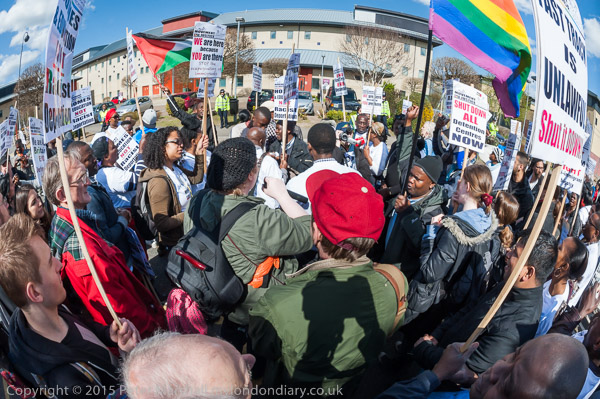
Although police and a large team of security guards stopped the protesters from going down the road toward the prison blocks, forcing them into a pen in front of the administration building at the front of the site, the loud protest could be heard throughout the site. Some of the prisoners were able to use their mobile phones to welcome the protesters and let them known about the poor conditions inside, and their calls were relayed over the public address system the protesters had brought.

Most of those who spoke at the protest had themselves been held inside these or other detention centres often for long periods after escaping from beatings, rape and torture in their home countries, and several spoke about their experiences in the system here. Some said they had been treated as troublemakers because they stood up for their rights – and that inmates who failed to do so, whatever the strength of their cases, were likely to face deportation.

I was tired after a couple of hours of the noisy protest, with chanting, singing and dancing – though mainly I had just been taking photographs, and left to catch a bus home. I could hear the protest continuing from the bus stop several hundred yards away, and when the bus came – ten minutes late – saw the protesters making their way out of the site to a public footpath which runs along the side of the Colnbrook site to continue their protest closer to those prison blocks.

Many more pictures on My London Diary at End Immigration Detention.


Flickr – Facebook – My London Diary – Hull Photos – Lea Valley – Paris
London’s Industrial Heritage – London Photos

All photographs on this page are copyright © Peter Marshall.
Contact me to buy prints or licence to reproduce.