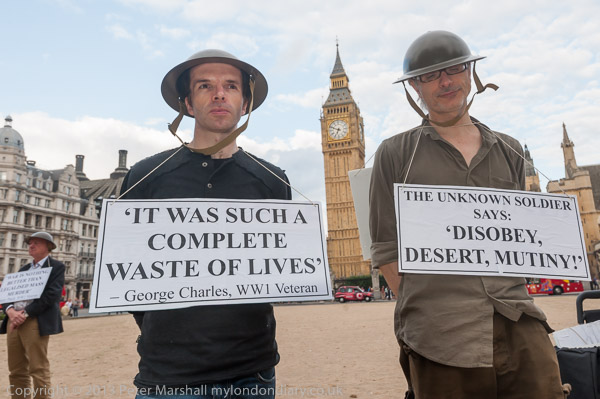
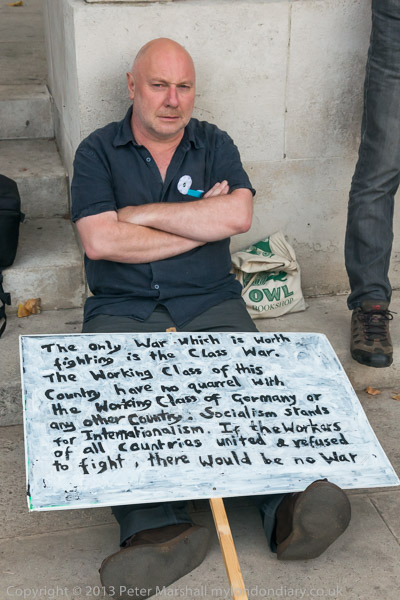
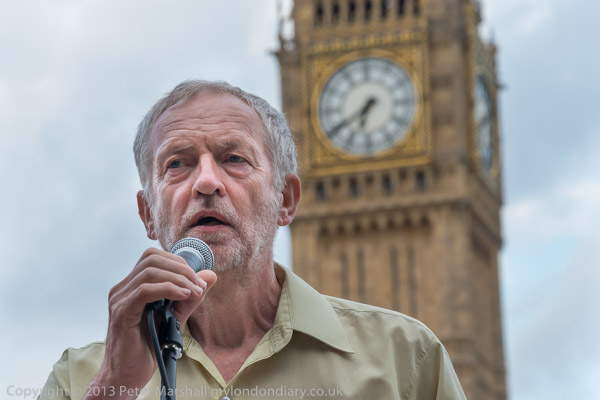
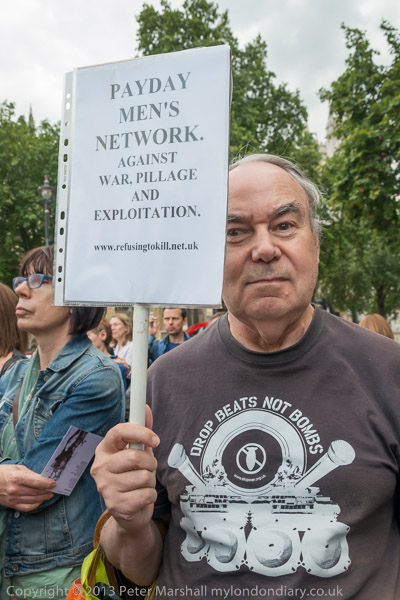
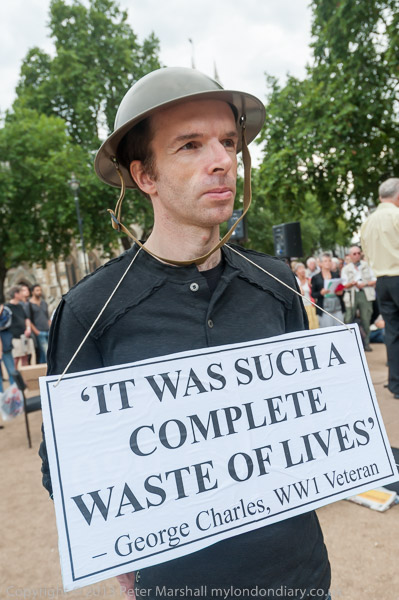
No Glory No More War: Monday 4th August was the 100th anniversary of the start of the First World War – and campaigners marked the anniversary with a ‘No Glory – No More War‘ event in Parliament Square.
My father was 14 when the ‘Great War’ began and had just left school. Soon after was working in a factory making munitions close to Kew Bridge. Although his only formal qualification was his school leaving certificate he worked in the drawing office rather than on the shop floor – though the only work he ever mentioned doing there was sharpening pencils. Years of working with his father in their car-building workshop as a carpenter and wheelwright had made him a dab hand with a chisel.
After some months he was out of a job, and fed up and decided – as he put it – “he might as well join the army” before he was conscripted. He went to join up and had a medical where the officer examining found he was severely deaf in one ear – and told him he could be excused military service. “Do you want to go?” he was asked and he said he did. “Good man!” he was told and signed up to the army.
Then came military training, which he didn’t much like after which he was sent to barracks. At some point when he was ordered to do some particularly time-wasting job he told the officer concerned what he thought of it and was put on a charge. Fortunately his senior officer was a sensible man, and after telling Dad he could be shot for disobeying an order told him not to be stupid again and sent him back to his unit.
Dad’s skills were not being used in the Army and he requested a transfer to the Royal Flying Corps as a mechanic. He went first to France and later to Germany, helping to repair the planes when they came back damaged. The airfields were well behind the front line and relatively safe. On April 1, 2018 the RFC became the RAF but I doubt if it made a lot of difference on the ground. And he was on the ground, and would never say if he ever went up in the air during his service.
After the end of the war Dad was one of the last of his unit to be demobbed, ending up as stores quartermaster, only coming home in 1919, bringing with him some odd iron German coins and fond memories of fraternising with the German people. He had not seen the true horror of the war, though many he knew and served with had died. And of his five sisters, only two ever found men to marry.
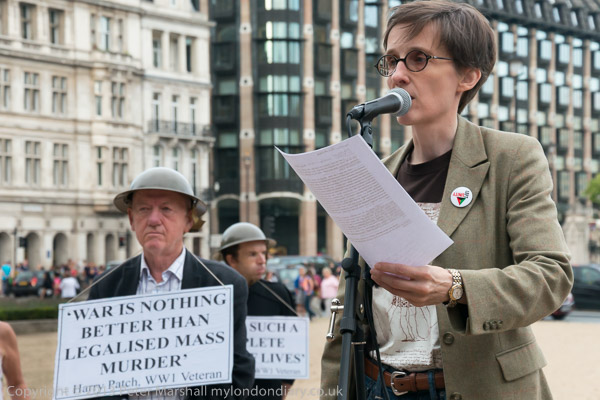
At the event there were much more dramatic stories of the war and the truth about it, with a number of well-known speakers including historians and others. Among them was Neil Faulkner, author of the pamphlet No Glory, which gives a real history of WW1.
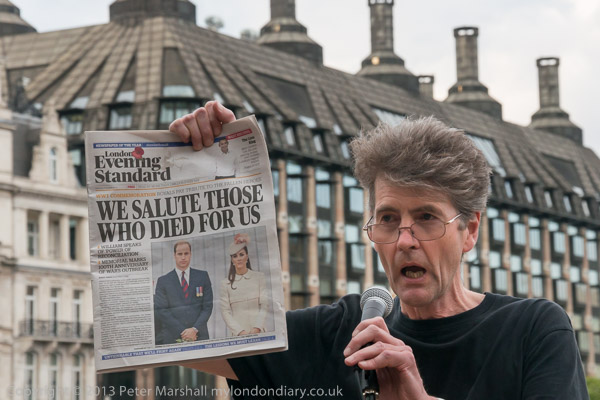
Far from being the “war to end all wars” and a “victory for democracy“, it was a military disaster and a human catastrophe, “driven by big powers’ competition for influence around the globe, and caused a degree of suffering all too clear in the statistical record of 16 million people dead and 20 million wounded.“
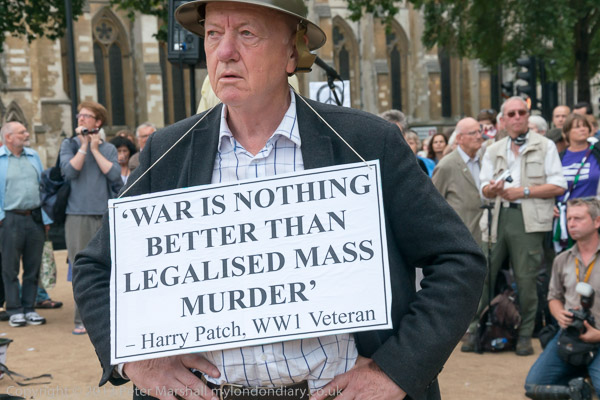
I concluded my account: “While we remember the bravery and sacrifice of those who took part, we should also be aware of the pointlessness of the war and make use of its anniversary to promote peace and international cooperation.”
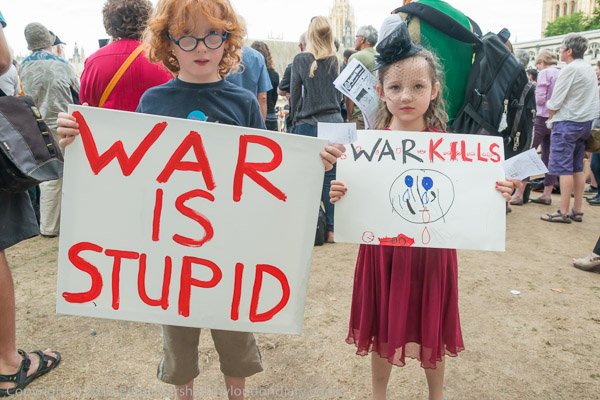
Many more pictures on My London Diary at No Glory No More War.
Flickr – Facebook – My London Diary – Hull Photos – Lea Valley – Paris
London’s Industrial Heritage – London Photos
All photographs on this page are copyright © Peter Marshall.
Contact me to buy prints or licence to reproduce.