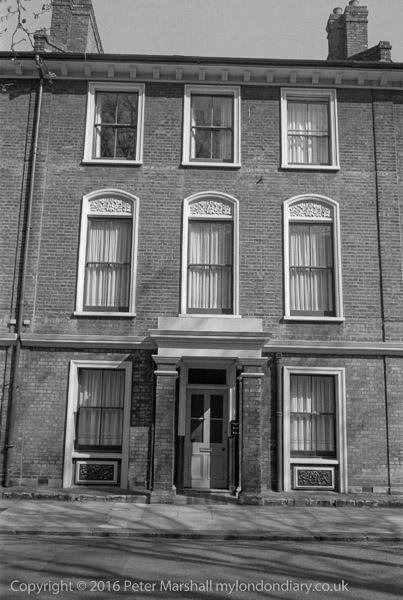
London 1980 (3)

The third set of black and white pictures I took in London in 1980 together with the stories about them first published on Facebook.
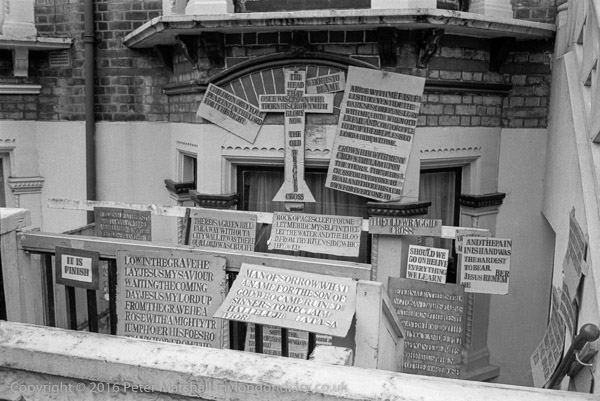

Basement religion, Brixton, Lambeth. 1980
23u-41: house, notices, Christian, basement,

http://londonphotographs.co.uk/london/1980/23u-41.htm

Taken, again on the Minox, on a family outing to Brixton to an Open Day at the windmill which was then being restored. I didn’t take any black and white pictures of the windmill, but I think I may have taken a camera with colour film and made some family pictures with that, though I can’t at the moment find them.

We’d walked around Brixton in a slightly indirect way to get to the windmill, and on the way home I suggested another diversion, coming out from Blenheim Gardens and going across Brixton Hill to one of the roads opposite, perhaps Josephine Avenue.

A few years later I tried to go back and find this basement, but could not locate any properties in the area with similar short steps from the pavement up to the front door and down to a basement below. It may still be there somewhere, perhaps a little further away than I remember, or it may have been demolished.

I’d hoped to find it again, and perhaps to have stepped over the wall and gone down the steps to the door at the right and rung on the bell and found out more about the person who painstakingly created all of these signs with their curious mis-spelling such as ‘THE OLD WRAGGID CROSS’
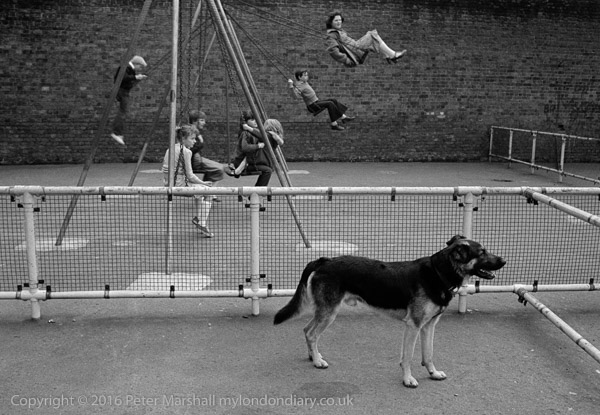

Playground, Brixton, Lambeth. 1980
23u-53: children, swings, dog,

http://londonphotographs.co.uk/london/1980/23u-53.htm
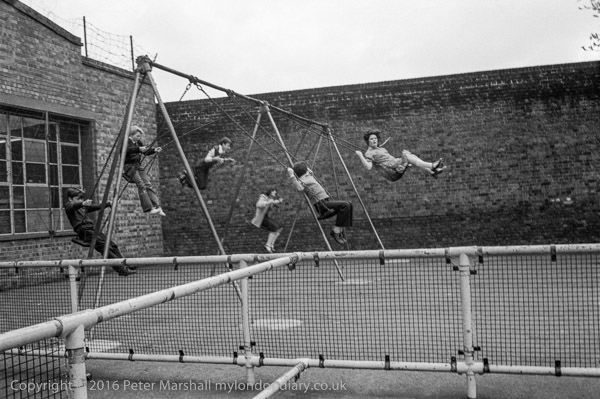
Playground, Brixton, Lambeth. 1980
23u-54: children, swings, dog,

http://londonphotographs.co.uk/london/1980/23u-54.htm

I think this playground was close to Brixton Windmill in Blenheim Gardens. I had come with my family to visit the Windmill. My two young boys were too young to go on these swings even had they not been in used, and the dog didn’t seem too friendly.

It is a typical old-fashioned playground made when kids were made of tougher stuff and minor injuries from falling on tarmac and concrete were taken for granted.
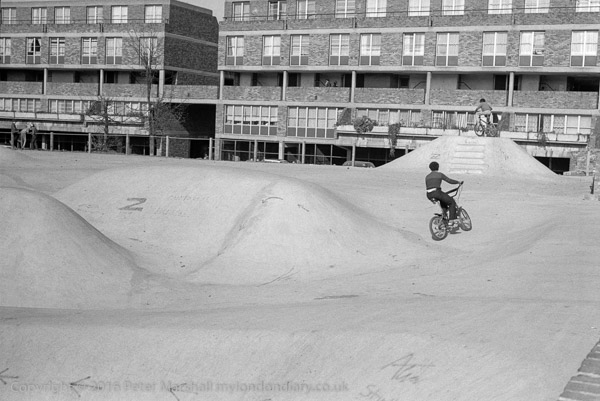

Playground, Stockwell Park, Brixton, Lambeth. 1980
24a-34: children, BMX, track, flats, Stockwell,

http://londonphotographs.co.uk/london/1980/24a-34.htm
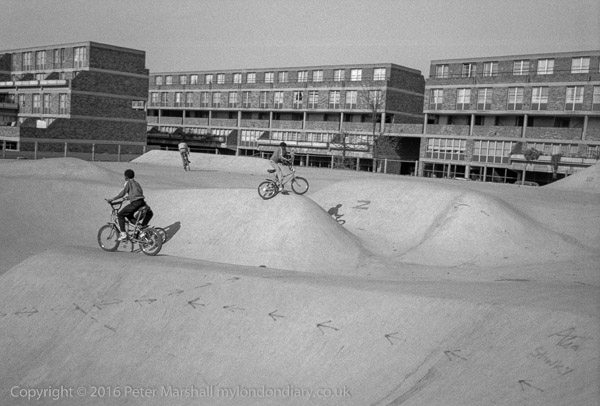
Playground, Stockwell Park, Brixton, Lambeth. 1980
24g-42: children, BMX, bikes, track, flats,

http://londonphotographs.co.uk/london/1980/24g-42.htm

Stockwell Concrete Bowl Skatepark is still there at the corner of Stockwell Rd and Stockwell Park Walk, along with the flats behind on Benedict Rd, Barrett House, part of the Stockwell Park Estate, which was completed in 1976.

The estate got a bad reputation, particularly following the 1981 Brixton riots, though it was one which, despite some crimes which got wide coverage in the scandal sheets, it never really deserved.

These flats were pretty new when I took this and several other pictures, as was the skatepark. The skatepark is now an “Asset of Community Value”, and street art from it was featured on the reverse of a Brixton Pound note commemorating Lenford (Len) Kwesi Garrison (1943 – 2003), co-founder of the Black Cultural Archives. The flats were refurbished in 2014 and considerable attempts have been made to improve the estate, including a very expensive CCTV system and much gardening.
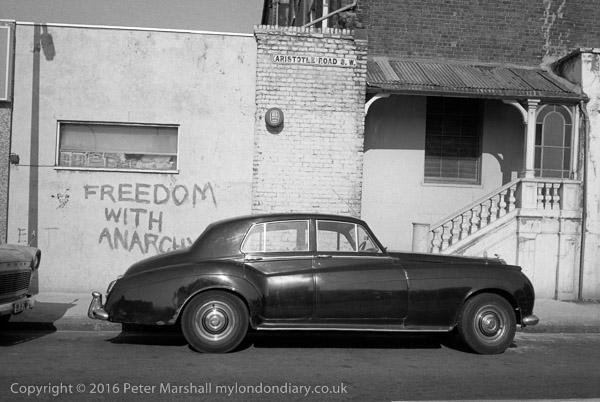

Freedom With Anarchy, Aristotle Rd, Clapham, Lambeth. 1980
24g-14:

http://londonphotographs.co.uk/london/1980/24g-14.htm

Who could resist going to photograph Aristotle Road – and finding there this graffiti ‘Freedom With Anarchy’?

Anarchism has but one infallible, unchangeable motto, “Freedom. Freedom to discover any truth, freedom to develop, to live naturally and fully” according to US anarchist, writer, labour organiser and IWW founder Lucy E Parsons (1853-1942), a remarkable woman who was probably born a slave, though she claimed only Native American and Mexican descent. Chicago police described her as “more dangerous than a thousand rioters…”

Books have been written about Aristotle’s concept of freedom, and according to the Oxford Handbook of Freedom he thought that “a person is free to the extent that he is able to live a life of politics and philosophy, and a polis is free to the extent that its institutions promote such a life for each and every citizen by removing the impediments to its realization“.

You can still recognise the location, just off Clapham High St, at the rear of Pearl Pharmacy though the balustrade, roof and stained glass have gone, the road name with its old S.W. is still on the wall. The car parked there back in 1980 was a little unusual, and is I think a T-Series Bentley. I thought at the time it looked a suitable motor for gangsters.
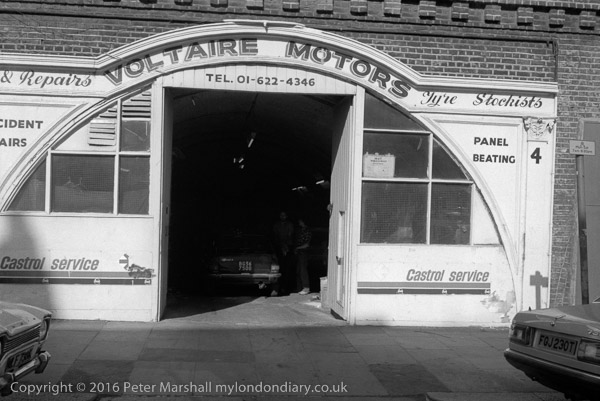

Voltaire Motors, Voltaire Rd, Clapham, Lambeth. 1980
24g-21: railway arch, garage,

http://londonphotographs.co.uk/london/1980/24g-21.htm

Not far from Aristotle Rd is Voltaire Rd, which runs from Clapham High St alongside the railway line and includes Clapham High Street station. Railway arches used to be cheap business properties including many garages such as Voltaire Motors but times are changing. These arches were refurbished around ten years ago and seem now to be largely Artisan Coffee Bars, bars and eateries. I think the arch which used to house this garage became The Bridge Cafe.

Voltaire Motors actually looked considerably better than any of the small row of businesses that now occupy these arches; although the interiors may have been improved by refurbishment the outside has certainly deteriorated since 1980.
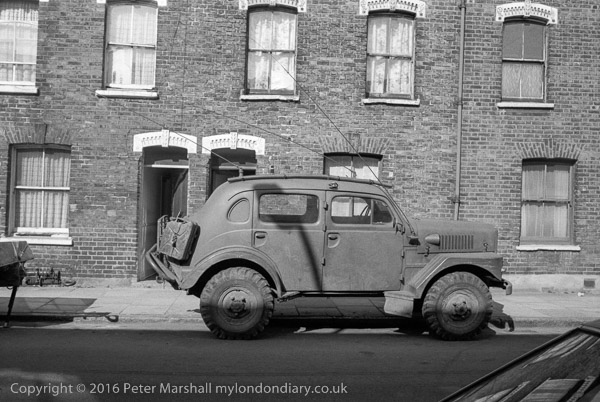

Clapham, Lambeth. 1980
24g-23: houses, terrace, car, military,

From the fairly distinctive decorations above the upper floor windows and doors I think this picture was taken in Lendal Terrace, off Clapham High St, alongside the railway on the other side of road and railway from Voltaire Road.

Experts in military vehicles will probably recognise the vehicle parked here, with a high wheelbase for going off-road. It looks American to me, and vaguely like a Humvee, but I’m almost certainly wrong.


All photographs on this and my other sites, unless otherwise stated, are taken by and copyright of Peter Marshall, and are available for reproduction or can be bought as prints.

There are no adverts on this site and it receives no sponsorship, and I like to keep it that way. But it does take a considerable amount of my time and thought, and if you enjoy reading it, please share on social media.
And small donations via Paypal – perhaps the cost of a beer – would be appreciated.


To be continued…
London 1980 (2)

More black and white images I made in 1980 and which I posted day by day on Facebook a year or so ago, along with comments and stories


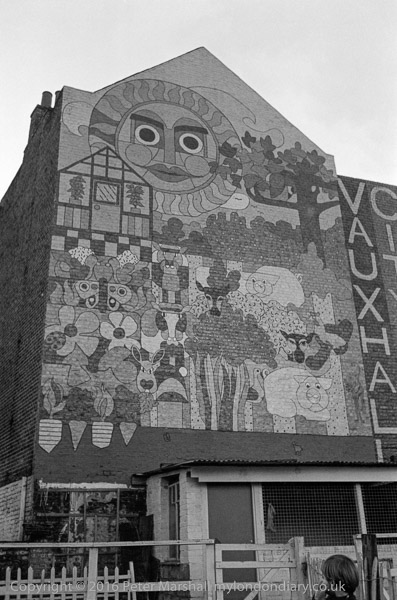
Mural, Vauxhall, Lambeth. 1980
23j-33: mural

http://londonphotographs.co.uk/london/1980/23j-33.htm

The mural announcing the presence of Vauxhall City Farm has I think long gone, and there has been considerable development of the buildings there. It now seems to me obviously to be a picture I should have taken in colour, and possibly I did, though quite likely I had only a single camera with me loaded with black and white film.

This picture was taken on a Minox EL, a tiny 35mm camera hardly large enough to take the film cassette, with plastic case whose front folded down pulling out the lens into position. Said to be the smallest 35mm camera in the world, it had a 35mm f2.8 lens, weighed only 200g and fitted into even a shirt pocket. For over 20 years one of these cameras (I got through 3 or four) went with me more or less everywhere.

They weren’t cheap (they were distributed by Leica in the UK) and were tricky to use, and the auto-exposure was often unreliable – later I found it worked better if you held the camera upside-down. The first one I bought just couldn’t take sharp pictures, and I sent it back to Leica, who wrote a rather snooty letter saying there were no performance specifications for the lens, but did exchange it for one that was tack-sharp. A few years later, that stopped working after it jumped out of my pocket when I was cycling to work and I got it replaced on insurance (and a hefty jump in premiums the following year.) When I had to send that one back to Leitz they said it was beyond economic repair but sold me a replacement at cost.

The Russians liked the Minox 35mm cameras so much they produced their own exact copy, the Kiev 35A, and I expect their spies still carry one on their visits to English cathedrals.


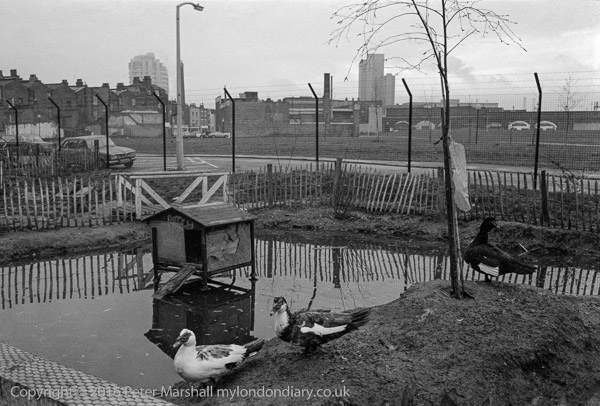
Duck pond, Vauxhall City Farm, Vauxhall, Lambeth. 1980
23j-33: ducks, pond, farm,

http://londonphotographs.co.uk/london/1980/23j-46.htm

Rather more buildings along the riverside are now visible across Vauxhall Pleasure Gardens from Tyers St than when I took this picture, but the backs of the houses on Kennington Lane are still recognisable, and the shops along their front have changed only a little to reflect the increasing gentrification of the area – at had at least last time I walked along there from the station to take a camera in to Fixation. The buildings on the green have also been replaced by a newer block along Glyn St.

The area in the distance, where only two blocks of buildings appear has become one of the fastest growing areas in London. I think the block right of centre might be the Nine Elms Cold Store, closed in 1979 but not demolished until the late 1990s, but cannot identify the block at left. There are now high rise buildings covering almost the whole of Nine Elms with more still being built. Along with expensive flats for foreign investors there is also expensive student housing built to lower standards but equally tall.

I think the duck pond with its duck house (presumably less ornate than MPs can afford on their expenses) has also gone, with new building on the City Farm site and an expansion of the farm estate.


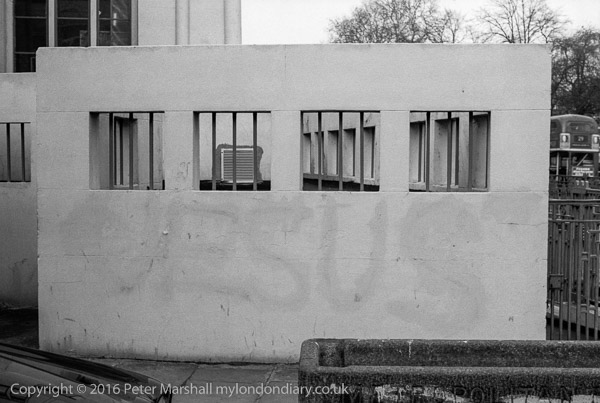
Jesus, Mornington Crescent, Camden, 1980
23l-65: graffiti, horse trough,

http://londonphotographs.co.uk/london/1980/23l-65.htm

Another picture of the faded message on a horse trough which I wrote about in an earlier post.


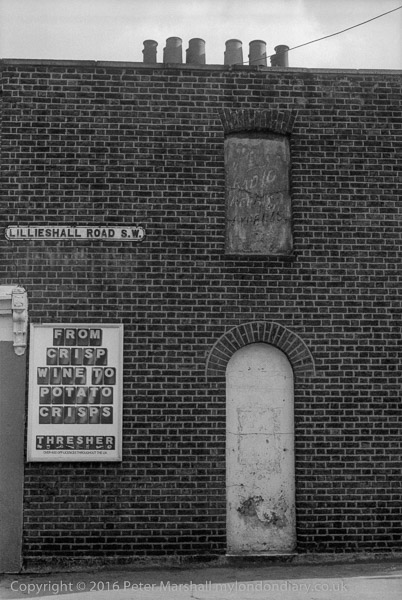
Lillieshall Rd, Clapham, Wandsworth. 1980
23q-56: house,

http://londonphotographs.co.uk/london/1980/23q-56.htm

The house here was clearly a corner shop in use as an off-licence and it can still be seen on the corner with North St, though now simply housing. The adverts, including that covering the window at right, are long gone.

It was that faded upper sign advertising ‘RADIO REPAIRS’, and under it what I think must have once been the word ‘EXPERTS’ above the blanked out doorway that attracted me to take the picture of what was otherwise a very ordinary Victorian working-class building, typical of the area.

I’m surprised I didn’t take a picture of the whole side of the building, which actually has three such doors in a row, only the central one in use, each with a window above. But probably only the window in my picture was covered by advertising, and I suspect that the lens on my Leica simply did not have a wide enough view to show all three.

I also failed to photograph the now listed former “Tim Bobbin” pub, just down Lillieshall road, named after the Lancastrian schoolmaster, caricaturist and dialect poet who called himself the Lancashire Hogarth, and was a schoolmaster and notorious drinker born in Urmston who lived and died in Milnrow on the edges of Rochdale, where he is buried in St Chad’s Churchyard, his gravestone carrying the epitaph “Jack of all trades…left to lie i’th dark” he wrote for himself minutes before his death.

I don’t know why he should be celebrated by a pub in Clapham (there is one in Burnley too) nor why the owners should have decided around ten years ago to change the name to ‘The Bobbin’ and replace his rather pleasant portrait on the pub sign to a rather less interesting silhouette.


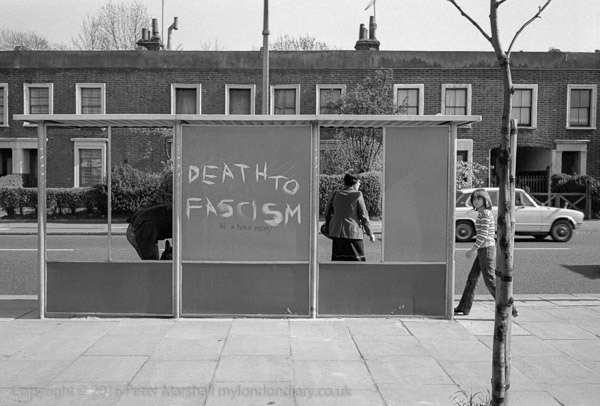
Death to Fascism, Bus Shelter, Battersea, Wandsworth. 1980
23t-32: house, graffiti,

http://londonphotographs.co.uk/london/1980/23t-32.htm

I can’t at this remove remember why I was wandering around South London taking pictures with the Minox on a day in April 1980, but I’m fairly sure I had not gone out with the main intention of taking pictures, otherwise I would have picked up the Leica or possibly my Olympus OM-1.

There must have been some other reason for my being there, and obviously having some time to spare. One possibility is that I had gone early and decided to walk from Queen’s Road Battersea to a meeting or exhibition at the Photo Co-op in Webbs Road in Clapham, which had started the previous year, rather than take the shorter walk from Clapham Junction.

As usual at the time I have no record of exactly where I was, and this street is fairly typical of many of the wider streets in the area, with its late Victorian housing. Only the main roads are this wide and have a pavement where I could get back far enough to make a picture like this with the 35mm lens.

I suspect I will have waited some time, not for the bus, but for people at the bus stop to arrange themselves rather better in the frames provided, but with little luck, and I think made this exposure as the bus the bus was about to arrive, knowing they would board.

Obviously it was the graffiti that attracted my attention. The large white letters of ‘DEATH TO FASCISM’ are easy to read in this small image but the smaller black ‘Kill A BLACK TODAY’ is perhaps harder to read.


House, Battersea, Wandsworth. 1980
23t-51: house,

http://londonphotographs.co.uk/london/1980/23t-51.htm

This is a section of a terrace somewhere in the Park Town estate in Battersea, around Queenstown Road, built up from the 1860s by James Knowles junior, one of London’s early organised and managed estates. Though well conceived it was not a great financial success, as the middle-classes for whom it was intended rather looked down on the pollution from the adjoining railways to north and east, and the estate was then re-purposed towards more working class artisan tenants.

Probably this property – a ‘six-roomed’ house – with external decoration to make it look rather grander than it was – was built as the three flats the doorbells now indicate, one on each floor. Much has been written about the estate, which led down to the rather grander buildings of Cedars Road and the North Side of Clapham Common.


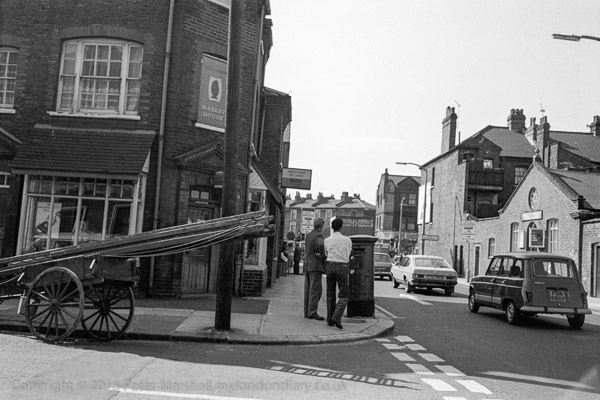
Broughton St, Battersea, Wandsworth. 1980
23t-53: house, pub, church, hall

http://londonphotographs.co.uk/london/1980/23t-53.htm

This corner of Broughton St and St Philip St, looking towards Queenstown Road is still recognisable, though the Market House pub is now a private house and the RIdley Hall at the right of the picture has been rebuilt as Ridley Hall Evangelical Church, though in a similar design.

I took two frames with the Minox, with a fairly similar composition, but while the other was a little more upright, this is sharper. They were obviously taken within a few seconds, though the film wind on the camera was rather difficult to do at any speed, as neither the two men on the street corner or the group further down the street appear to have moved, but the cars are a few yards further down the road in the other image.

The ladders on the handcart reminded me of my father who often used a similar conveyance to take his ladders, paint, tools and occasionally beehives around Hounslow (and sometimes further afield) until his retirement in the late 1960s. By 1979 this was becoming rather less common, though one still saw window cleaners and others who had not yet acquired vans.


To be continued…

Colour or B/W?

I’m trying hard to remember when I last took a black and white picture, and I think it must be more than ten years ago, though I do still have a few rolls waiting to be processed.

I spent around thirty years taking most of my pictures in black and white (though I often also worked in colour) . Many if not most of my favourite images, both my own work and that of other photographers is in black and white, but somehow I no longer feel any urge to work in black and white.

It would of course be easy to do so. A simple click of a mouse would convert the images taken in any of my digital cameras from colour to monochrome, but it’s something I dislike doing. Occasionally I’ve carried out this conversion, in the past using specialised Photoshop plugins (though now Lightroom has some good monochrome profiles built in) but generally only when my colour pictures are going to be reproduced in black and white – when I prefer to make my own conversions rather than leave it to others.

When I made the mistake of buying a Leica M8, there were some occasions where the colour was simply so wrong as to be unusable (though I spent hours trying to put it right with various software programs) and the only way to use pictures were as black and white. And while it was a lousy colour camera, it was actually pretty good as a black and white camera and perhaps I should have kept it for that. Later of course Leica did produce a monochrome model.

With mirrorless cameras you can even view the world in black and white, which might be an interesting way to work, though I’ve yet to try it for more than one or two test exposures. But generally I’m rather averse to converting images taken in colour into black and white and think most people who do so produce work that is unconvincing. You have to think differently to make good monochrome images, try to think tone instead of colour, and pay greater attention to shape, line and form.

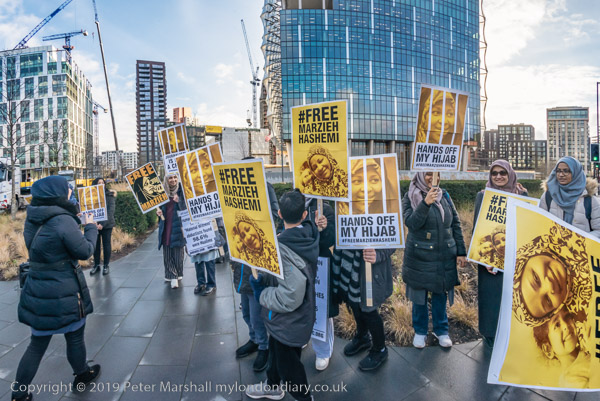
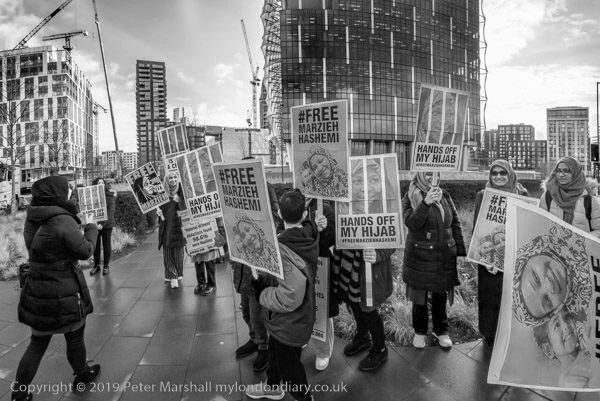
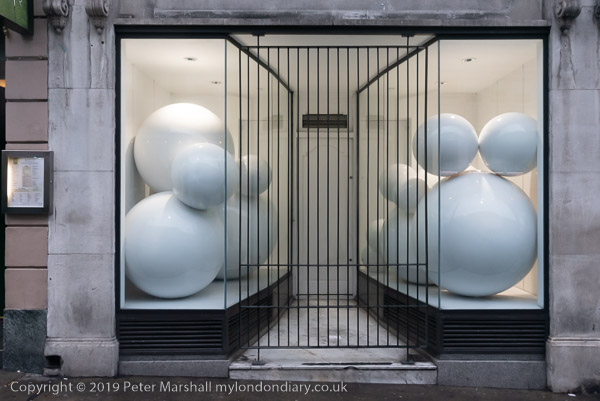
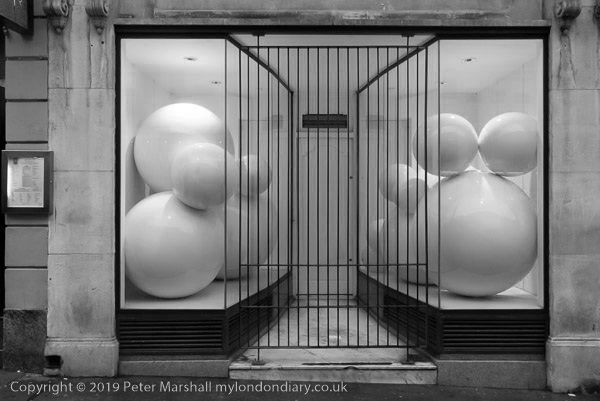
I just spent ten minutes or so looking through some of the more interesting pictures I took earlier this year, looking for images that might possibly have worked in black and white, and coming to the conclusion that colour was essential for almost all. For this post I’ve picked a couple that I thought might work as well or better in black and white and made the conversion. I’ll let you judge – and please feel free to comment if you have a strong preference.

I was prompted to write this post by reading one on PetaPixel, What Shooting Film Taught Me About Black-and-White Photos by Ellie Cotton – I think it looks better on her own web site. I actually think all of the pictures in that article look better in colour, though a couple convert reasonably to black and white.


There are no adverts on this site and it receives no sponsorship, and I like to keep it that way. But it does take a considerable amount of my time and thought, and if you enjoy reading it, please share on social media.
And small donations via Paypal – perhaps the cost of a beer – would be appreciated.

All photographs on this and my other sites, unless otherwise stated, are taken by and copyright of Peter Marshall, and are available for reproduction or can be bought as prints.

To order prints or reproduce images