Protests – May 16th 2015

The purpose of protests is to bring whatever cause they support to the attention of others, particularly those who bear some responsibility for them or who could act in a different way to address the problem that led to the protest.

The current Police, Crime, Sentencing and Courts Bill seeks to make protests entirely ineffectual – allowing police to insist they will only take place where they will not be noticed and banning them from making any noise or causing any inconvenience. Given the Tory majority and the lack of concern for civil rights shown by most MPs it seems likely to come into force, but I think unlikely to actually be enforceable by police, though it will lead to clashes and arguments which will greatly reduce public trust in the force.
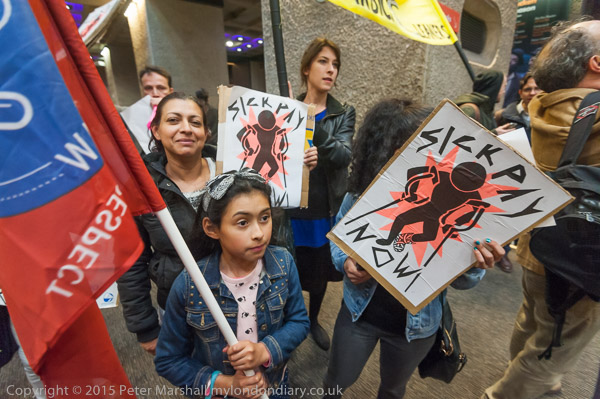
On May 16th 2015 I was privileged to be able to cover a protest by the grass roots trade union United Voices of the World from their meeting before the protest to the end of the event. Most of the members are low-paid migrant workers and most of the business was conducted in Spanish, with some key items translated into English for the benefit of me and the few other non-Spanish speakers.
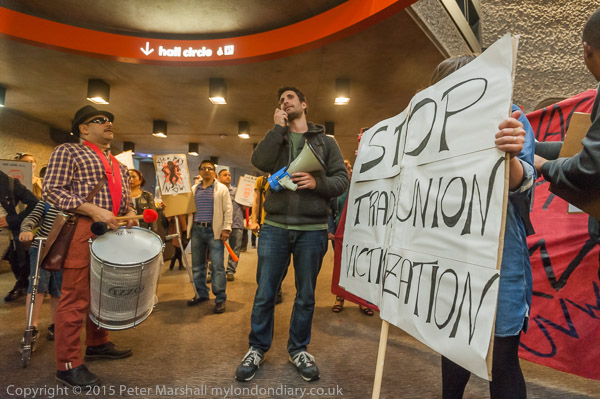
From the meeting in Bethnal Green we travelled by bus to Liverpool St and then walked quietly as a group to meet up with others close to the Barbican. Many were carrying drums, flags and placards as they rushed past the two security guards on the door of the centre who held up a couple of them but couldn’t stop the rest, and the group made its way to the heart of the Barbican Centre, where people were already gathering for evening performances.
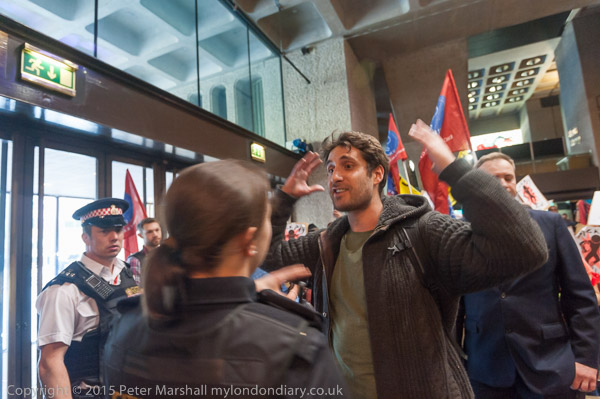
Rather than employ cleaners directly, the Barbican Centre uses a contractor, Mitie. The Barbican is a relatively good employer and offers its employees decent terms and conditions, but MITIE cuts costs to a minimum and has threatened the cleaners with sacking if they protest for a living wage and proper sick pay and other conditions, and the union says they employ bullying managers who disrespect staff and fail to provide proper working conditions. One disabled worker had recently been assaulted by a manager and accused of ‘terrorism’ after posting a short video clip showing his working conditions.
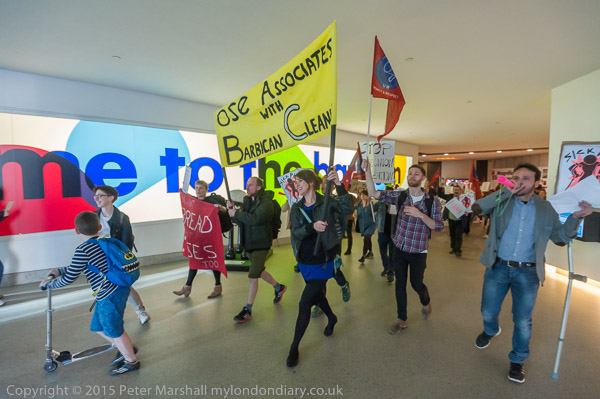
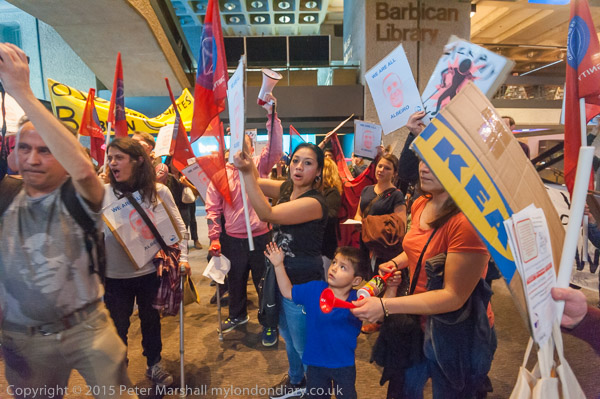
The protesters held a short noisy protest, using a megaphone to let the public know why they were protesting and calling for an end to the victimisation of trade unionists and for negotiations to get satisfactory conditions of work and service and a living wage. They called on the Barbican to meet its obligations to people who work there by insisting that any contracts they make include safeguards to protect the workers – rather than denying any responsibility for those who keep the centre clean.
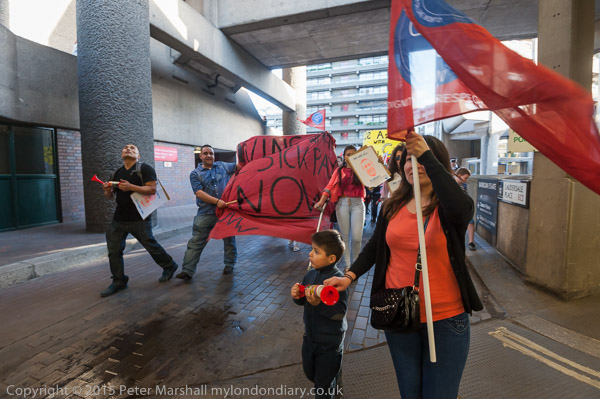
After a few minutes, police arrived and argued with the protest organiser Petros Elia who agreed to move, and the protesters then went on a walk around the centre to make sure all those in it where aware the protest was taking place and why the union was protesting. Finally they agreed with police to leave the centre, going out the way they had come in and rejoining members who worked at the Barbican who had stayed outside to protest. The protesters then walked around some of the public streets around the Barbican before returning to protest in front of the main entrance, where I left them still protesting noisily.
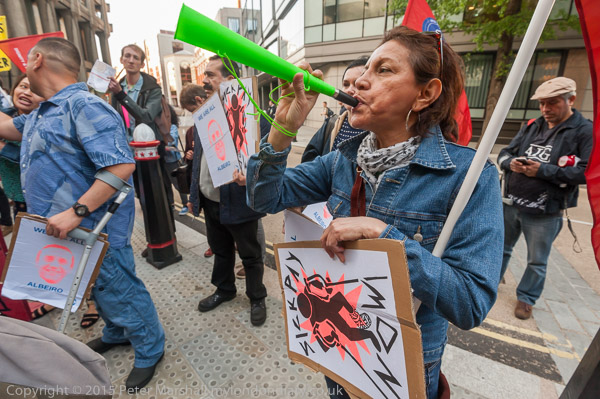
Under the Police, Crime, Sentencing and Courts Bill all of this would have been illegal, and perhaps they might have been allowed just a small and quiet display some distance across the road from the centre, which few would have noticed.
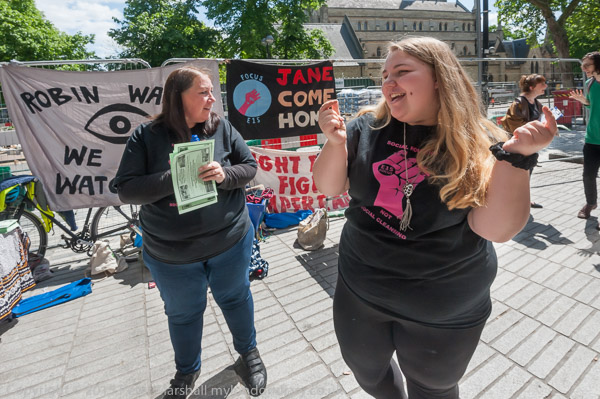
I’d earlier photographed three other protests, two of which I’m sure would have fallen foul of the proposed new law. Newham Council had been trying to get rid of Focus E15’s weekly street stall in Stratford Broadway since it started almost two years earlier, and today’s protest celebrated the dropping of a contrived case against Jasmin Stone, one of the protest leaders. Later in the year the police and council came and ‘arrested’ the Focus E15 table – but had to release it a few days later.
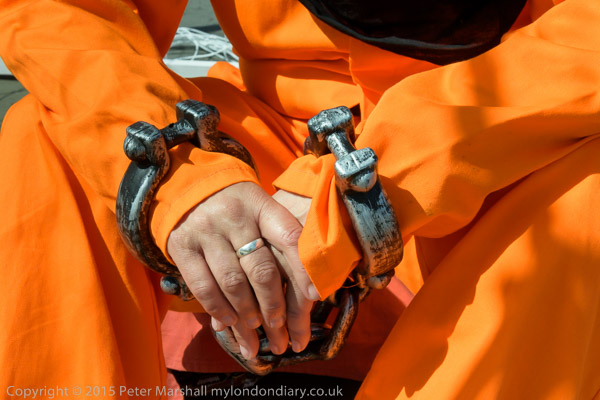
While it might have been possible for the Free Shaker Aamer campaign to get permission for their protest on the North Terrace of Trafalgar Square, I think their activities and use of the megaphone would have been severely curtailed.
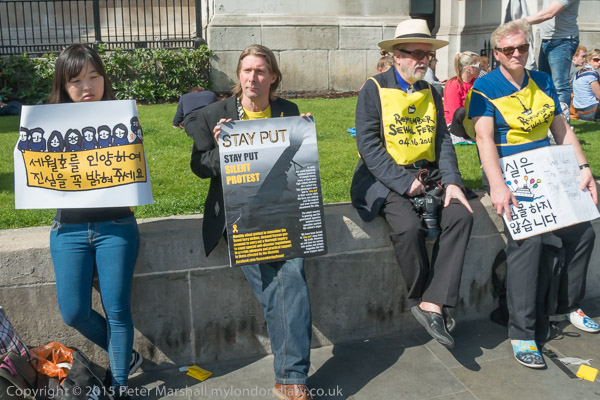
The small, silent ‘Stay Put’ vigil – seven people holding posters in silence by the wall in a corner of the square – is perhaps a model of what Priti Patel considers an acceptable level of protest. Though more probably she would like to go full North Korea.

Cleaners invade Barbican Centre
Silent protest over Sewol ferry disaster
Caged vigil for Shaker Aamer
Victory Rally For Jasmin Stone
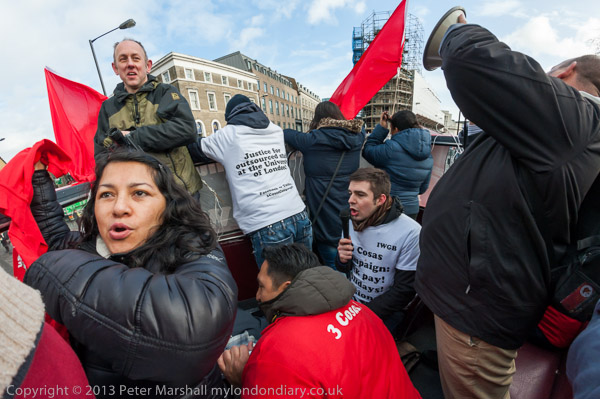
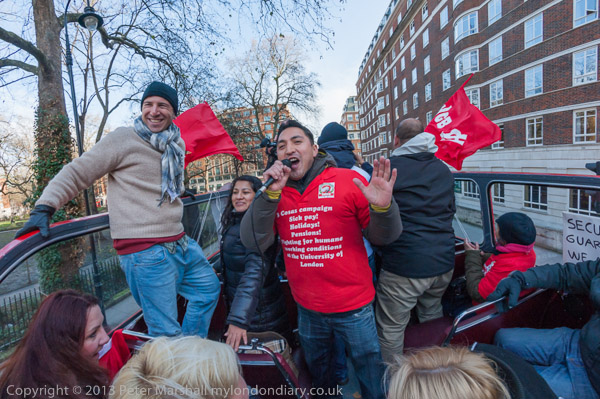
3 Cosas – 28 Jan 2014

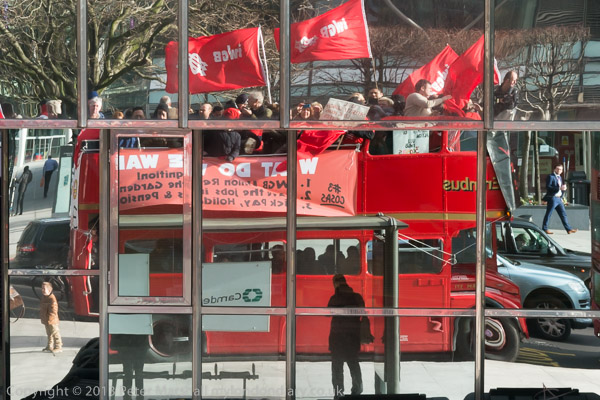
It was the second day of the 3 day strike by the IWGB for union recognition and better conditions for outsourced workers at the University of London, and the union had hired an open-top bus to take their campaigners around London to protest.

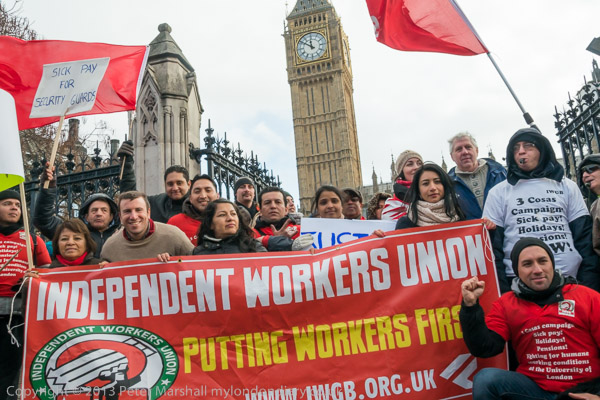
The ‘3 Cosas’ campaign was calling for Sick Pay, Holdidays and Pensions for the workers, who were only getting the minimal statutory provisions from the cost-cutting contracting companies who employed them. They worked alongside people who were employed directly by the University who enjoyed considerably better conditions of service.

Although the majority of the workers were members of the IWGB, the University and the contractors refuse to talk with this union. The University management instead recognises a union that has few if any members, using this as an excuse not to recognise the union the workers belong to.

After a lengthy tour of London, stopping at some of the workplaces and elsewhere for speeches from the top of the bus, we came to Parliament Square, where there was a short rally and MPs John McDonnell, Jeremy Corbyn and Andy Burnham came to show their support.

I’ve written about the day at some length on My London Diary so I won’t go into much detail and repeat myself here. There are of course many more pictures, rather too many, as I got a little carried away and there was so much to photograph.

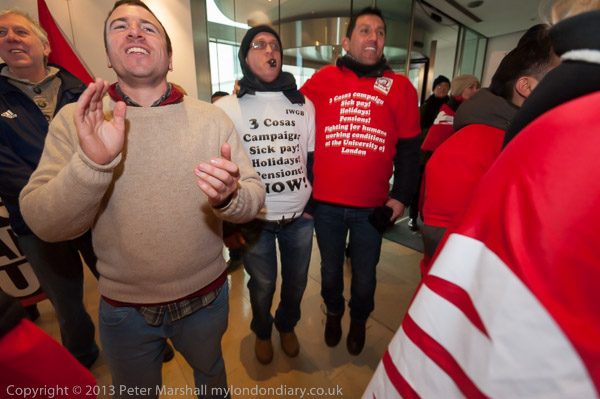
While the idea through the morning had been to draw as much attention to the strike and protest noisily, the next event was a suprise protest at another location where the IWGB were campaigning for union recognition and a living wage, the Royal Opera House. The bus stopped a short distance away and then members rushed into the foyer to hold a noisy protest there.

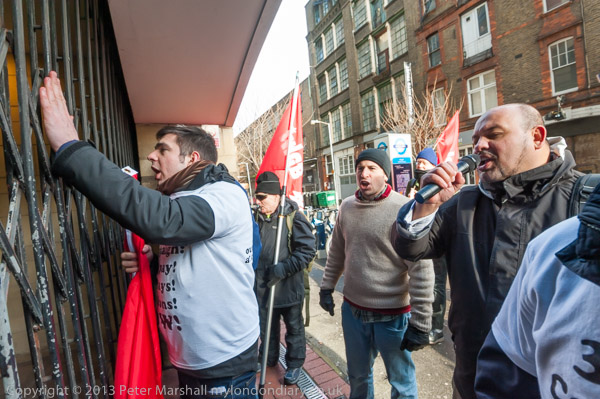
We then left and went for a final protest outside the offices of the contractor who employ many of the workers at the University, Cofely GDF-Suez. There the gates were locked and the protest took place on the street outside.

More pictures and text from the day:
‘3 Cosas’ Strike Picket and Battle Bus
IWGB at Parliament
IWGB in Royal Opera House
IWGB at Cofely GDF-Suez


All photographs on this and my other sites, unless otherwise stated, are taken by and copyright of Peter Marshall, and are available for reproduction or can be bought as prints.


Outsourcing and Covid

One of the reasons why the UK has suffered so badly from the corona virus has been outsourcing. Not of course the major reason, which has been government incompetence and failure to take effective action, always a case of too little too late. A year after the outbreak began it is only now considering the kind of travel restrictions that would have saved many thousands of lives (and which even one government minister has said she was arguing in favour of at the start.) Three weeks before we had the first lock-down I was getting urgent messages from relatives who were in touch with the medical advice that was going to the government that, because of my age and diabetes, I should isolate myself.

And of course there has been the failure to work properly with existing public bodies, instead preferring to give huge payments to cronies to set up an ineffectual systems for testing and tracing, to source inadequate PPE and take large consultancy fees to no particular purpose, wasting billions.

Government has deliberately promoted policies which have increased the spreading of the virus, failing to stop much unnecessary work or ensure that proper protective measures are enforced and giving offers to people to go out for meals largely in indoor settings where the spread of infection was almost inevitable. Although they now deny it, their polices were based on ideas of herd immunity, where infection gives a large proportion of the population some immunity and stops the virus spreading; for this to work, perhaps 80% of us would need to have had it, and a quick back of envelope calculation showed that would mean perhaps 400,000 deaths – and I would have been rather too likely to be one of them. It’s a figure we may still reach, though 200,000 seems more likely now – and we are over half way there.

A couple of days ago on the Today programme on Radio 4 I heard Maria, a cleaner from the IWGB being interviewed. She contracted the virus, probably while travelling to work on crowded public transport, and tested positive. Before the test she had been ill at work and had asked her employer if she could go home, but had been told she had to stay. After the positive result, she had to continue to go to work, as the sick pay she would have received was simply not enough to live on.

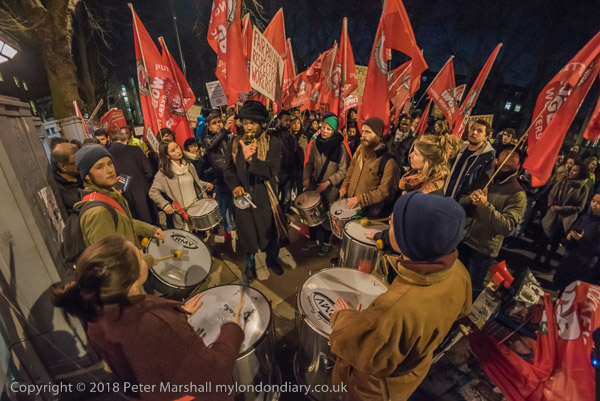
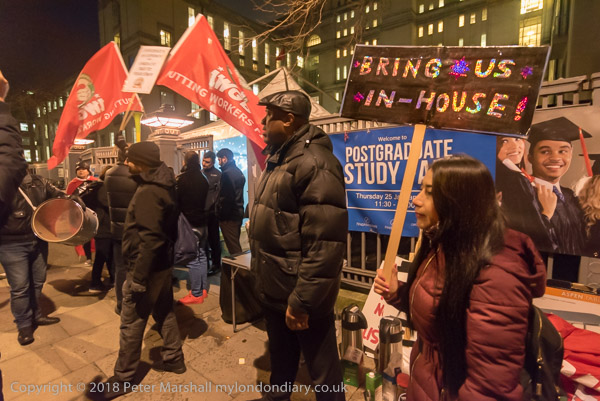
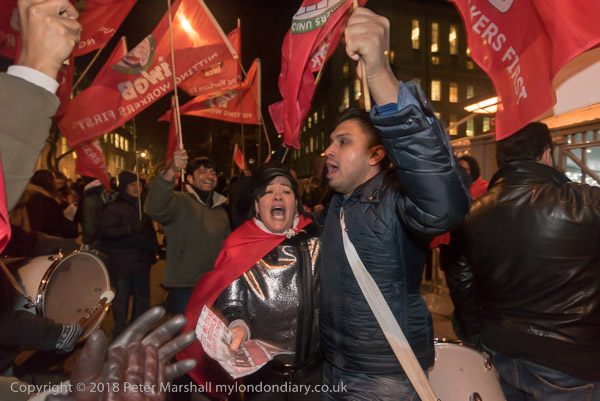
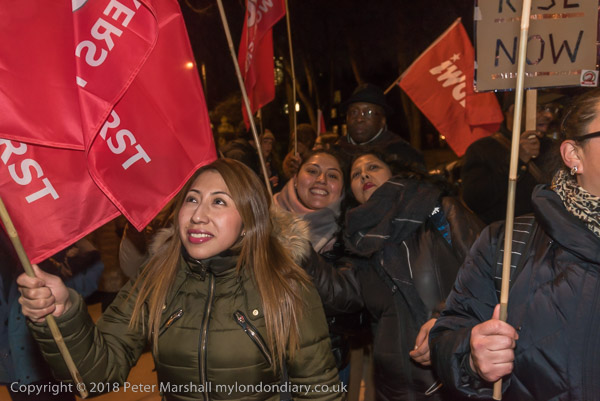
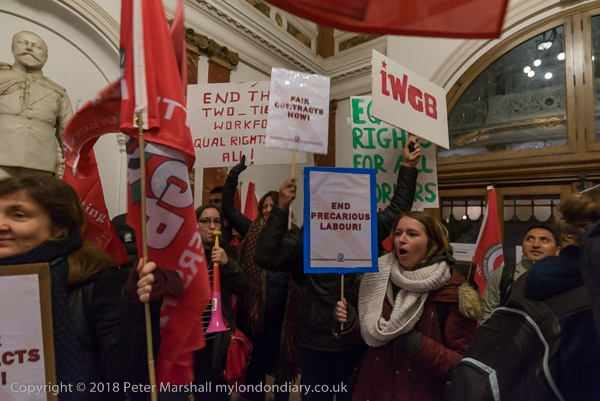
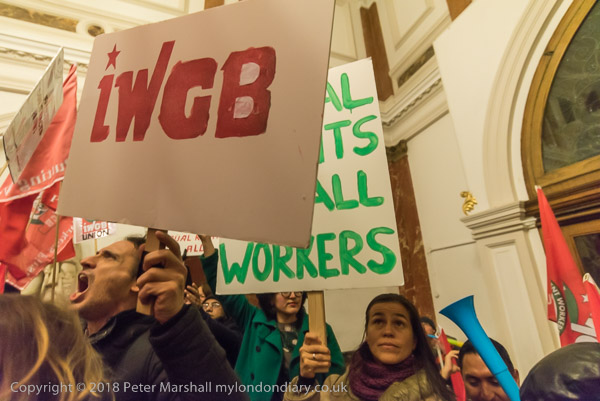
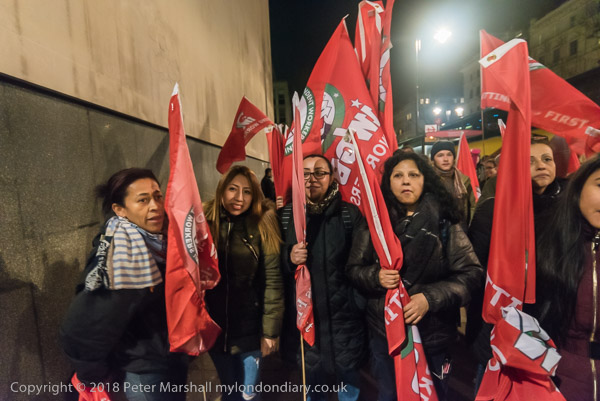
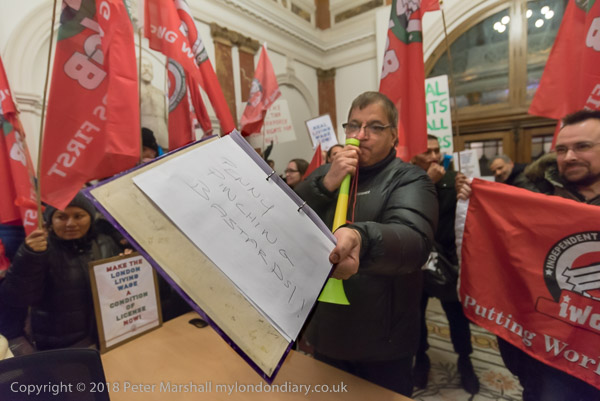
Maria is probably one of those IWGB members in the pictures I took on 25 Jan 2018, and the other pictures I’ve taken at IWGB protests against outsourcing. Outsourced workers are employed not by the company at their work place – on this occasion the University of London – but by a company that is given a contract for the services they provide. Contracts are usually awarded to the lowest bidder, and outsourcing companies cut their costs by paying low wages, giving only the statutory minimum in conditions – including sick pay, holidays, pensions etc – and often bullying the workers, demanding impossible workloads and failing to provide proper safety equipment – so that they can gain contracts and also make a profit for the company owners.

Usually too both the contractors and the workplace management refuse (often illegally) to recognise the trade unions to which the outsourced workers belong – such as the IWGB, and refuse to discuss any of the workplace issues with them. Often union members are disciplined and sacked for their union activities.

Had Maria been one of the cleaners at the various places where the IWGB have been able by organising protests like this and forcing the management to talk with them and to get the workers directly employed she would have got the kind of conditions that other workers at these places take for granted. She would have been able to call in to work when she knew she was ill and have time off, and would have been able to self-isolate after her positive corona test, as she would have been able to rely on proper sick pay.

Outsourcing and other poisonous working arrangements, particularly zero hours contracts, have been a major factor in directly spreading the infection, and are a part of the reason for its increased prevalence among our black and ethnic minority communities. Low pay too has an indirect effect, leading to more crowded housing conditions. Many low paid jobs too are ones that involve considerable contact with others, and often involve travel in crowded public transport to workplaces.

The first protest on that Thursday evening in January was calling for the University of London to directly employ the cleaners, receptionists, security officers, porters and post room staff that work in the premises that are part of the central administration, including offices and halls of residence, and took place outside the University’s Senate House. Earlier protests have persuaded the University to consider direct employment for some of these workers, but the IWGB call for all of them to be brought in-house as soon as possible. Students and some teaching staff from various colleges came to support the protest.

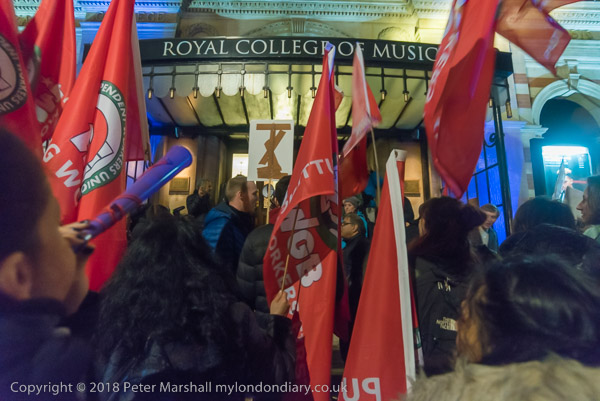
At the end of this protest a double-decker bus hired by the union arrived to take those present to a ‘secret location’ for a further protest and I was invited to go with them. It dropped us off around the corner from the Royal College of Music, and the protesters ran into the building. A new contractor had taken over the RCM cleaning contract and decided to halve the hours worked by cleaners and change shift times. Most of the cleaners have to work on several jobs like this to make ends meet and so were unable to change to the new hours and had been threatened with dismissal. The RCM and the contractor had refused to discuss the changes with the IWGB who had launched a collective grievance; the cleaners have balloted for strike action and the union is also considering a legal challenge under law governing the transfer of undertakings.

It was a short and very noisy protest inside the foyer, and the protesters who had been very careful to avoid any damage left when the police arrived after 12 minutes and continued their protest outside.

More at:
Cleaners rush into Royal College of Music
End Outsourcing at University of London


All photographs on this and my other sites, unless otherwise stated, are taken by and copyright of Peter Marshall, and are available for reproduction or can be bought as prints.