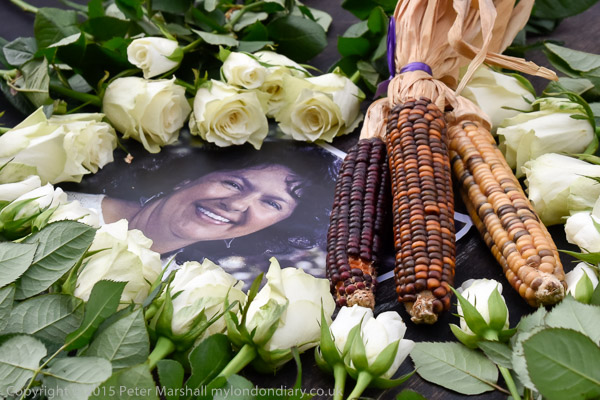
XR Sea of Protest

Back in November 2016 I attended a vigil outside the Honduran Embassy in London for  environmental activist and indigenous leader, Berta Cáceres, assassinated either by forces of the state or by groups encouraged by the state. Before her murder she had  death threats from the Honduran National Police and judicial harassment.
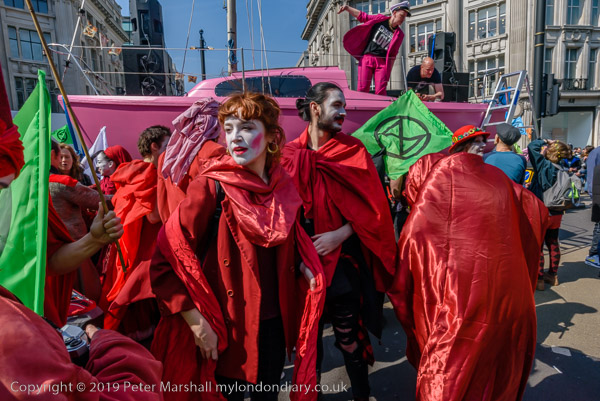
Very much to my surprise, Berta Cáceres returned to London this April in the shape of a large pink yacht named in her memory which Extinction Rebellion (XR) had brought to block Oxford Circus to traffic and create a “sea of protest“.
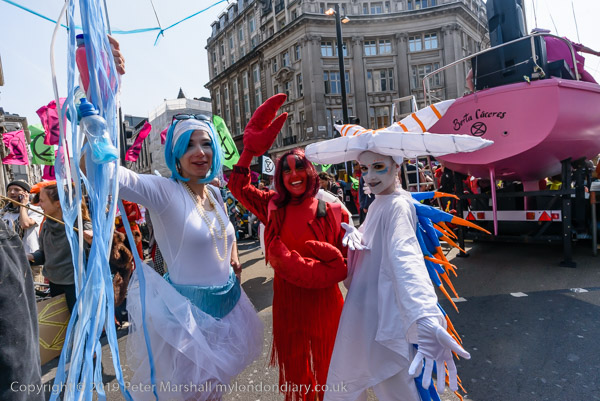
I arrived some hours after the yacht which was by then surrounded by protesters and with various activities taking place, including an induction course for new arrivals and some music. Getting ready to perform were a group of people dressed in red, representing I was told the blood of extinct species and those – like our own – threatened by the Earth’s sixth global extinction event, now getting into full swing thanks to the efforts of the fossil fuel industry and its supporters, particularly President Trump.
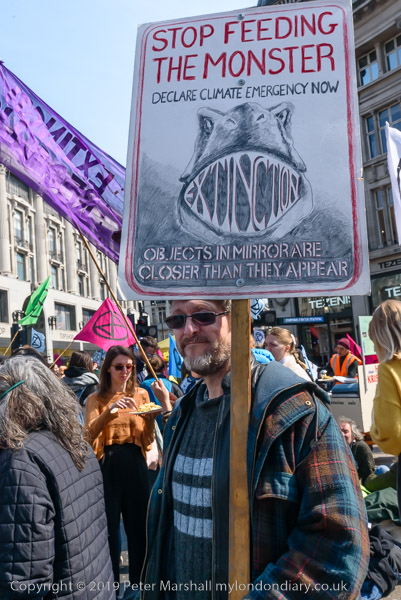
I didn’t stay long on this occasion, as other things were happening elsewhere across London. XR intended to keep the roads closed until the government takes necessary action on the global climate and ecological emergency, and this particular action continued from Monday until Friday, when I returned to photograph the police taking action to clear the junction.
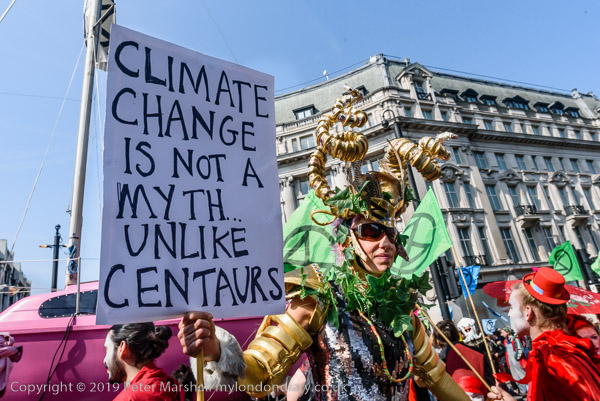
More at: Extinction Rebellion Sea at Oxford Circus.


All photographs on this and my other sites, unless otherwise stated, are taken by and copyright of Peter Marshall, and are available for reproduction or can be bought as prints.

There are no adverts on this site and it receives no sponsorship, and I like to keep it that way. But it does take a considerable amount of my time and thought, and if you enjoy reading it, please share on social media.
And small donations via Paypal – perhaps the cost of a beer – would be appreciated.
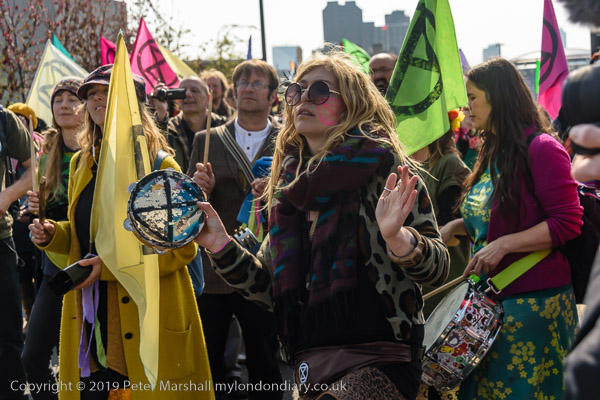
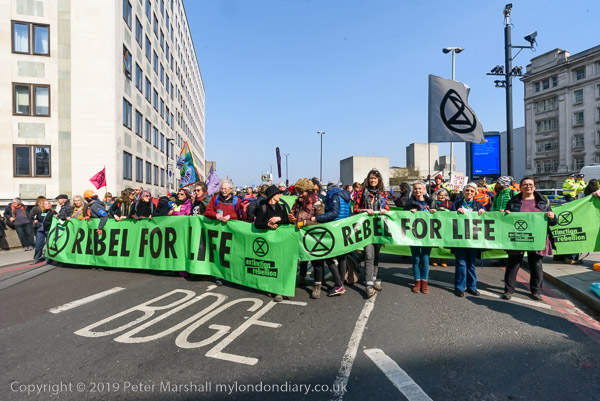
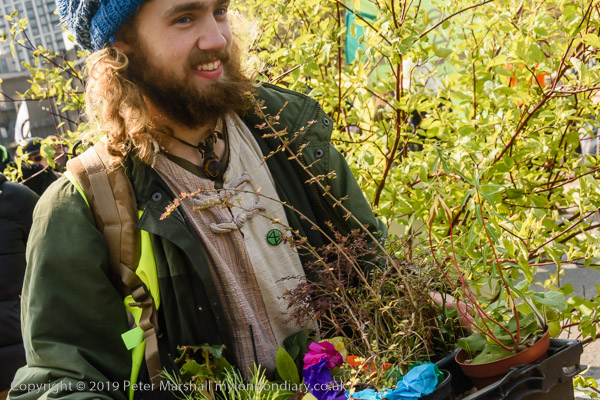
XR’s Garden Bridge

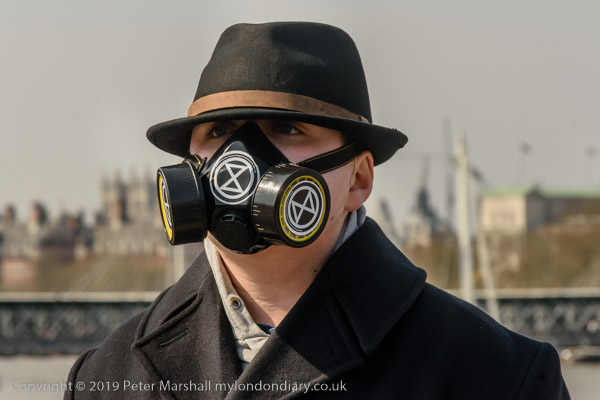
While Boris Johnson wasted many millions of public money as London Mayor on a crazy project for a garden bridge across the Thames where no-one wanted it and it fortunately came to nothing, Extinction Rebellion provided one for free for a few days .

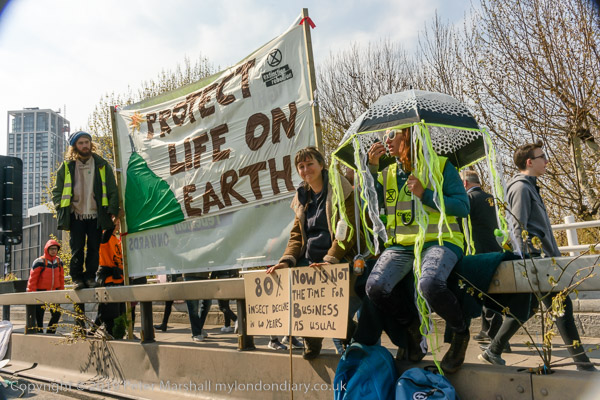
It helped that they didn’t actually have to build a bridge, but just took over an existing one, Waterloo Bridge, closing it to traffic. This did cause a certain amount of disruption, and doubtless inconvenienced some people, but it, together with their other actions around London, did serve to put the issue of climate catastrophe – and the very real threat of human extinction unless people across the world take radical action – into public consciousness.

It was a minor inconvenience for me, as found myself having to walk around London rather than sit on a bus rather often during the week, though fortunately the tube was still working. But were I a transport planner for London, I think that at least one of London’s bridges – though probably not this one – would be permanently pedestrianised. We have far too much traffic in central London, causing far too much pollution – and thousands of early deaths – and the congestion charge hasn’t solved the problem.

It was very pleasant to be able to walk across the bridge past the trees and plants, or to sit for a few minutes in the sun and listen and watch the activities taking place on the bridge. And the air there certainly felt cleaner, once you were on the bridge and away from the traffic jam south of the river.

Many of those on the bridge had travelled up from the country, and had brought a little of it with them. Some had even walked all the way from Cornwall. Extinction Rebellion has certainly gained a great deal of support, if largely from the kind of people who will go to public meetings and listen to their speakers. Most could be labelled middle class, though not mainly the comfortable and affluent high-consuming middle class, but largely those in low-paid occupations; teachers, social workers, health workers were I’m sure all over-represented.

XR has developed from the activities of groups like ‘Stop Killing Londoners’ whose protests against air pollution in the city I’ve photographed from their start, working on the ideas of Roger Hallam on non-violent protests and people being prepared to be arrested (as I photographed him being arrested at the LSE in a protest for the cleaners there.)

There were arrests at the ‘garden bridge’ but on the couple of occasions I visited police just watched and occasionally took notes. XR’s attitude to the police and their policy of encouraging people to be arrested has been much criticised by others, and they appear to have little regard for the problems it may cause and have under-estimated the support needed. But these are desperate times and rather than carping perhaps the critics should be showing an example by launching their own, more effective actions – but there is little sign of that happening. XR certainly isn’t a perfect game, but it has little competition.

More at Extinction Rebellion Garden Bridge


There are no adverts on this site and it receives no sponsorship, and I like to keep it that way. But it does take a considerable amount of my time and thought, and if you enjoy reading it, please share on social media.
And small donations via Paypal – perhaps the cost of a beer – would be appreciated.
All photographs on this and my other sites, unless otherwise stated, are taken by and copyright of Peter Marshall, and are available for reproduction or can be bought as prints.

Up the Elephant

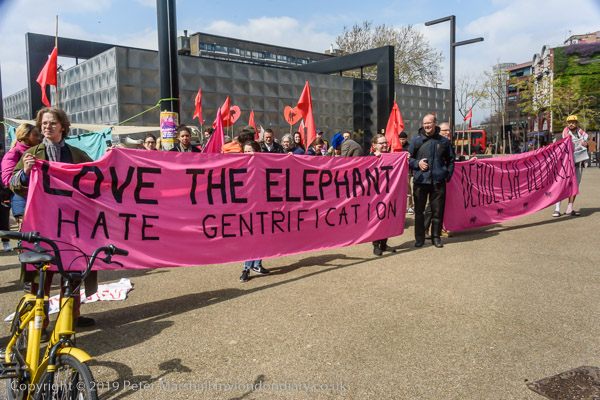
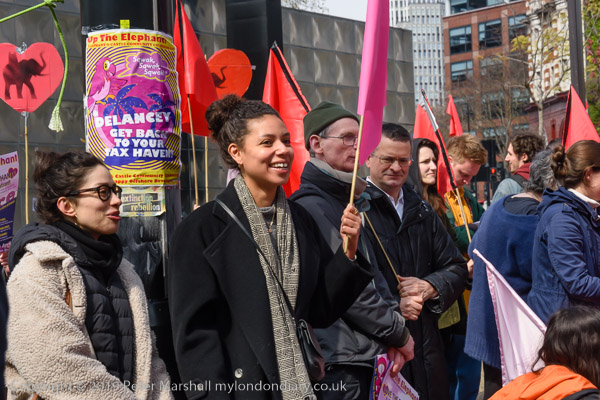
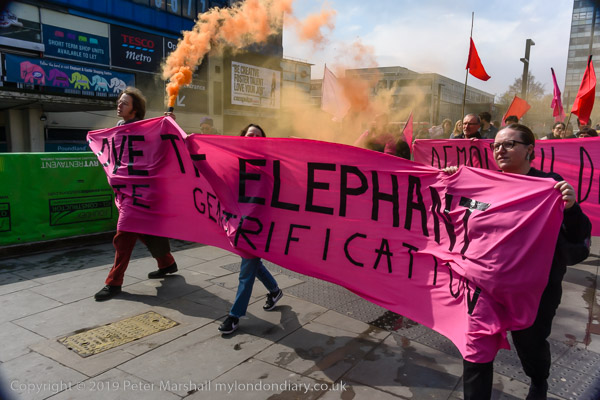
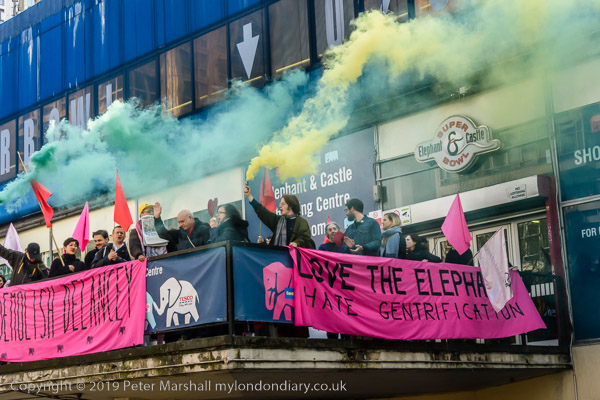
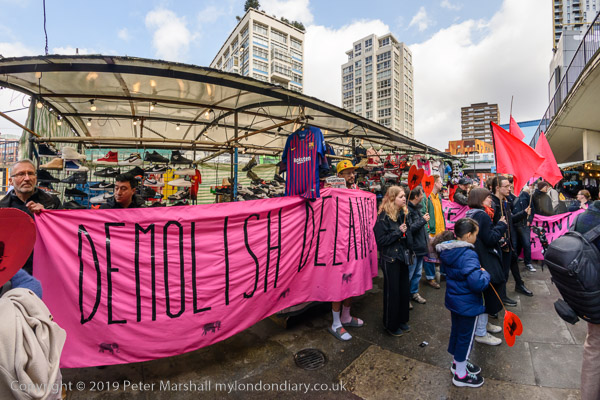
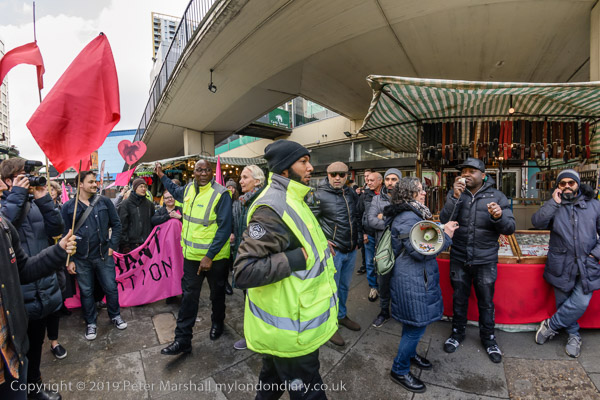
A quick trip on the Bakerloo line took me from elephants in Cavendish Square to the Elephant, where Southwark Notes, Latin Elephant and Up the Elephant were holding their Love the Elephant Street Celebration.

For generations the Elephant & Castle has been a lively South London hub, its nature changing over the years. The country’s first shopping mall was built here in 1955 on the site of a bomb-damaged estate, and while showing its age is still more interesting than most, and one that both reflects and caters for the local community, increasingly Latin-American, as well as largely older bingo-playing local residents.

Shopping malls are generally pretty soulless places, and on going inside you transition from whichever town or city you were into some strange limbo of franchises and chains. The few with a little more character are some of the older ones, usually incorporating market traders and other small local businesses, while the more recent examples have little to offer except the same as every other more recent mall.

Virtually the only reason I ever enter them is to search for the public toilets most offer, which usually involves a long trek following often confusing signage designed to take you past every retail outlet en-route.

Not of course that the Elephant shopping centre is perfect, far from it. It is certainly showing its age and needs improvement, and it has been deliberately run down by its owners to promote the redevelopment.

But campaigners say it should be redeveloped with the local community in mind while the developers Delancey working with Southwark Council and the London College of Communications, seem largely concerned with maximising their profits from the scheme.

Years of campaigning by local community groups has resulted in some minor improvements to the proposals – including more social housing, though it remains to be seen if this will actually happen.

Although the plans were finally approved last December, the campaing goes on, to keep the shopping centre alive until it is demolished and to get fairer treatment of the existing traders. Some have been promised space in the new development, but sometimes only a small fraction of their current area, and the campaign want all to be made offers on a ‘like for like’ basis, with an increase in the relocation fund.

More at Love the Elephant.


There are no adverts on this site and it receives no sponsorship, and I like to keep it that way. But it does take a considerable amount of my time and thought, and if you enjoy reading it, please share on social media.
And small donations via Paypal – perhaps the cost of a beer – would be appreciated.
All photographs on this and my other sites, unless otherwise stated, are taken by and copyright of Peter Marshall, and are available for reproduction or can be bought as prints.


Regents Canal – Bethnal Green

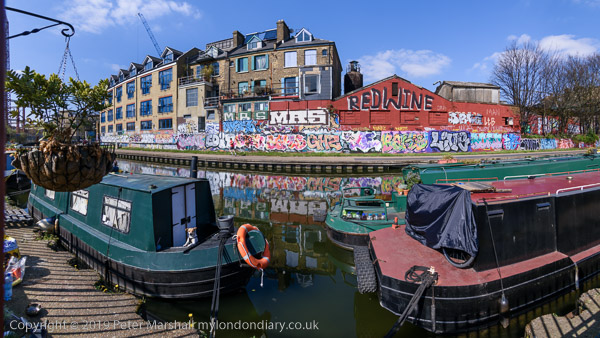
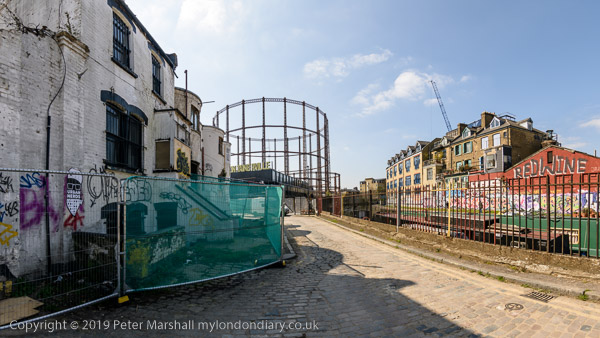
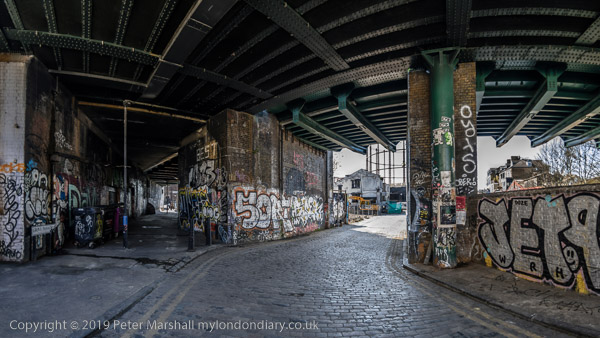
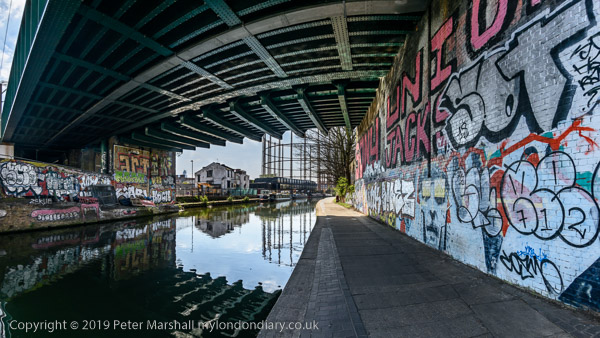
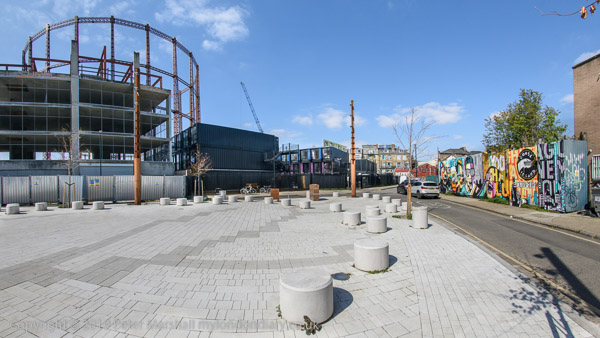
More panoramic images from the Regents Canal and nearby areas in Bethnal Green.

The Oval
From Corbridge Crescent
Corbridge Cresecent
Corbdige Crescent and Grove Passage

This is an area I photographed for the first time around 1980 and that I’ve returned to occasionally over the years. On My London Diary you can see more of these cylindrical perspective panoramic views – each around 147 degrees horizontal field of view, as well as some more normal rectilinear lens views at Regent’s Canal.

I’m hoping to use some pictures from the canal in a small show next year – more later.


There are no adverts on this site and it receives no sponsorship, and I like to keep it that way. But it does take a considerable amount of my time and thought, and if you enjoy reading it, please share on social media.
And small donations via Paypal – perhaps the cost of a beer – would be appreciated.
All photographs on this and my other sites, unless otherwise stated, are taken by and copyright of Peter Marshall, and are available for reproduction or can be bought as prints.

To order prints or reproduce images


Against the Sultan

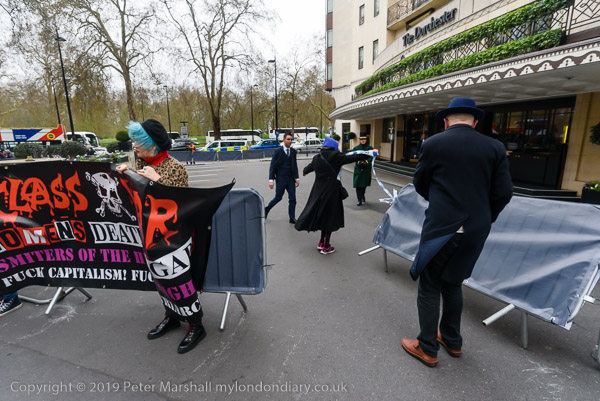
I got to the protest rather late because I stopped on the way to meet the people from Class War who were going to attend the protest. Of course they were in a pub, and the pub they had selected to meet was quite a walk from the Dorchester Hotel outside which the protest was taking place.

It took a while to finish our drinks and to get moving, and eventually I gave up waiting for them, especially when some decided they needed to get a bus., though it was only half a mile to walk. I left with one of the more active members and we hurried, getting there in well under ten minutes.

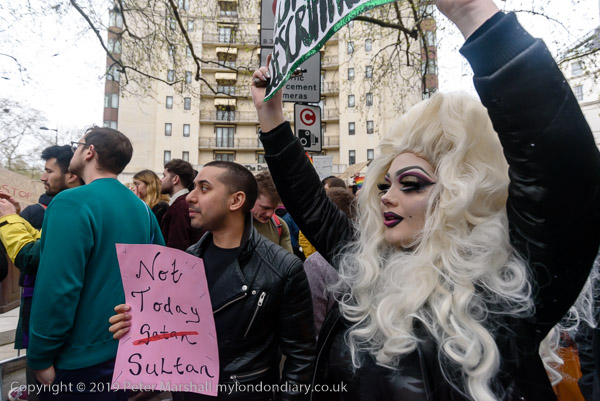
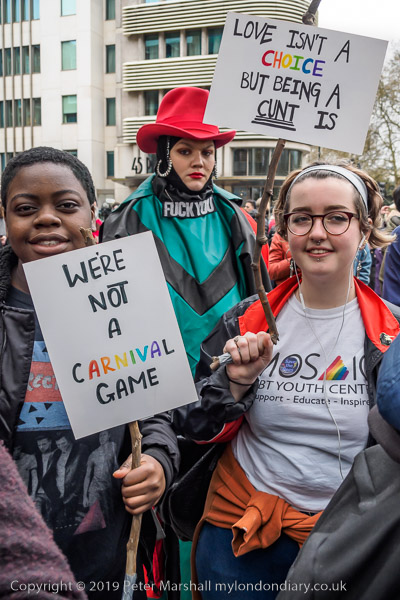
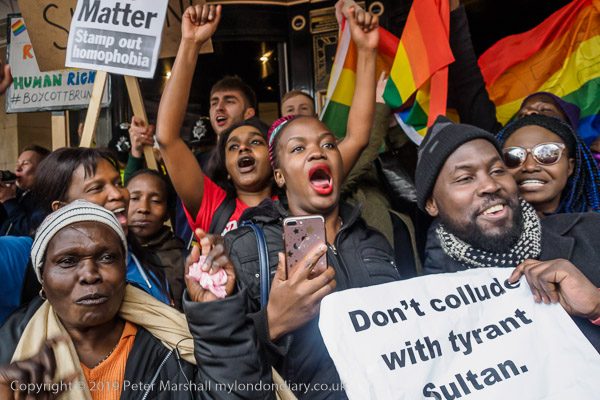
The ruling by the Sultan of Brunei to make stoning to death the sentence for gay sex, adultery and blasphemy had enraged people around the world, and protests were planned in many cities outside the luxury hotels he owns, including the Dorchester Hotel in London’s Mayfair.

There was a large crowd of protesters, but at some distance from the hotel entrance, on the pavements of the minor street that runs around the front of the building and its large yard which allow taxis to drive to its doors. There really wasn’t enough room for protesters on the pavements, but police were trying to keept the roadway clear, arguing with protesters who were reluctant to move.

Although I was over half an hour late for the start, I was still in time to photograph the two major speakers, Shadow Foreign Secretary Emily Thornberry and human rights activist Peter Tatchell, as well of course as many of the protesters and their posters and banners.

Class War turned up with their two banners almost half and hour after me, and for a while stood with them on the roadway (which the police by this time had given up the impossible task of keeping clear.) Their late arrival was probably timed to ensure they missed the speeches.

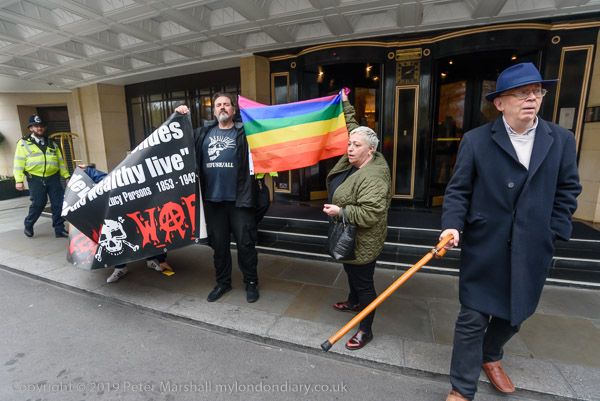
After standing for a few minutes holding the banners, Class War sized up the situation decided it was time for some more definite action. They pushed aside the barriers around the hotel yard and with the ‘Women’s Death Brigade’ banner led a rush past police and security to protest on the steps of the hotel.

They shouted for the others to follow them, and a few came immediately. Eventually most of the rest of the crowd joined them for a long and noisy protest on the steps of the hotel. There were a few arguments with police who came to stand in front of the doors, but no arrests before I left three-quarters of an hour later.

Many more pictures at Brunei Sultan gay sex stoning protest


There are no adverts on this site and it receives no sponsorship, and I like to keep it that way. But it does take a considerable amount of my time and thought, and if you enjoy reading it, please share on social media.
And small donations via Paypal – perhaps the cost of a beer – would be appreciated.
All photographs on this and my other sites, unless otherwise stated, are taken by and copyright of Peter Marshall, and are available for reproduction or can be bought as prints.

To order prints or reproduce images


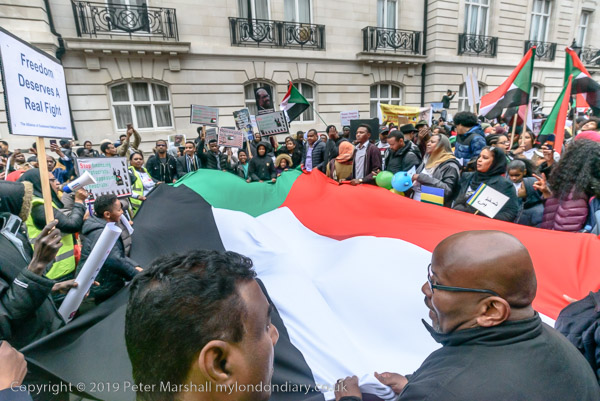
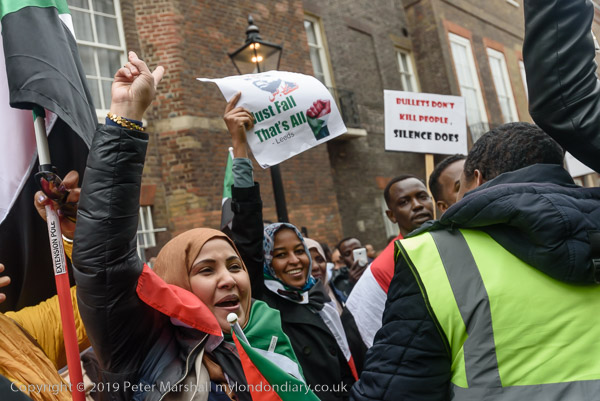
Sudanese celebrate 6th April revolution

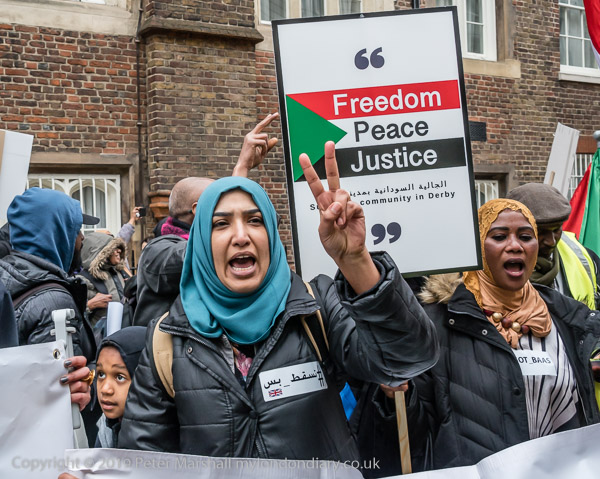
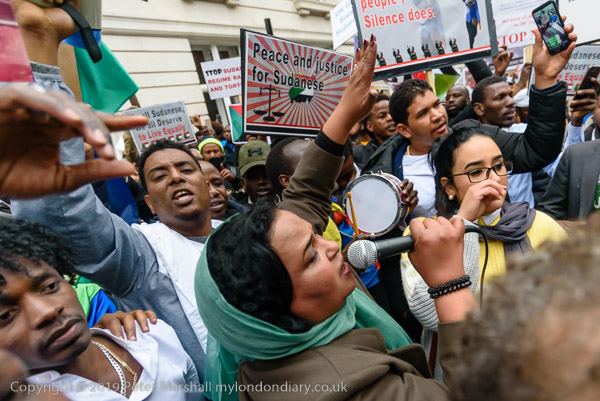
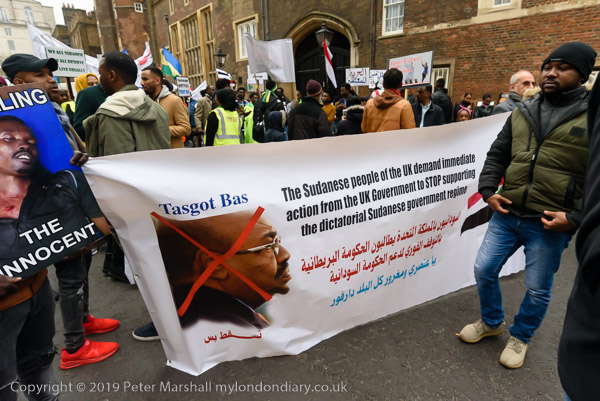
On 6th April 1985, a revolution in Sudan overthrew dictator Jaafar Nimeiri, and on the 34th anniversary of that event, Sudanese came to the London embassy to support the new revolutionary movement in Sudan that had then been protesting for 17 weeks demanding freedom, peace and justice in their country.

Back in 1985 it had been a group of military officers who had taken power, forcing Nimeir to flee to Egypt and setting up a Transitional Military Council (TMC) to rule Sudan. Rather a lot has happened in Sudan since then, including both the seizing of power by Omar al-Bashir in 1989 and the secession of South Sudan in 2011, with the loss of its oil revenues.

It was rises in the price of basic goods including bread and a hugely increasing cost of living that began the protests, which quickly turned into demands for al-Bashir to go and for an end to military rule and for freedom and democracy. Attempts by al-Bashir to use force to end the protests failed, despite the declaration of a state of national emergency.

The protest in London in these pictures took place as there were also large protests in Sudan, particularly in the capital Khartoum, where it became clear that while the security forces were still trying to subdue the protests, the military were moving to back the protesters demands to remove the president. Within five days, al-Bashir was deposed and arrested.

The protests continued – and there was further violent repression by the security forces with well over a hundred deaths on June 3 which led to a 3-day general strike and nationwide civil disobedience campaign. But on 5th July an agreement was reached between the TMC and Forces of Freedom and Change alliance negotiators representing the protesters, and the future for Sudan appears more hopeful.

More pictures at Sudanese for Freedom, Peace and Justice.


There are no adverts on this site and it receives no sponsorship, and I like to keep it that way. But it does take a considerable amount of my time and thought, and if you enjoy reading it, please share on social media.
And small donations via Paypal – perhaps the cost of a beer – would be appreciated.
All photographs on this and my other sites, unless otherwise stated, are taken by and copyright of Peter Marshall, and are available for reproduction or can be bought as prints.

To order prints or reproduce images


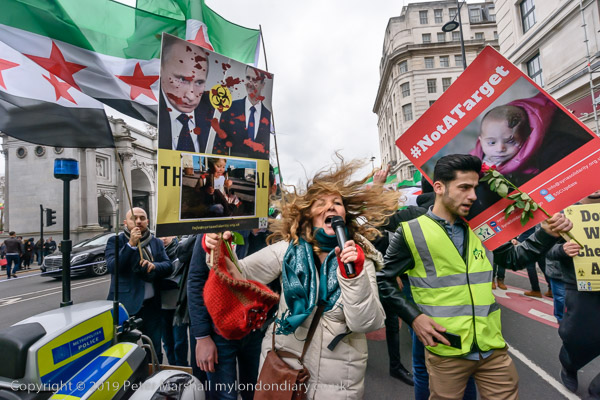
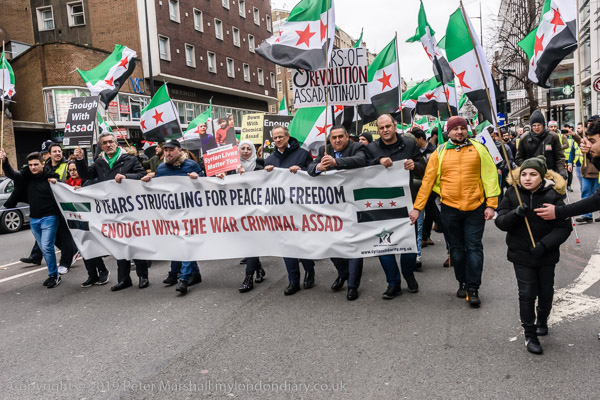
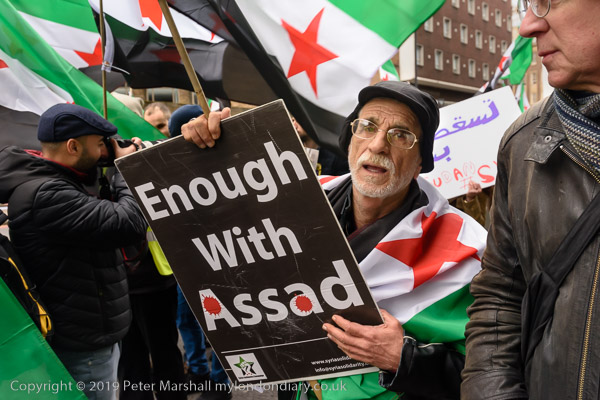
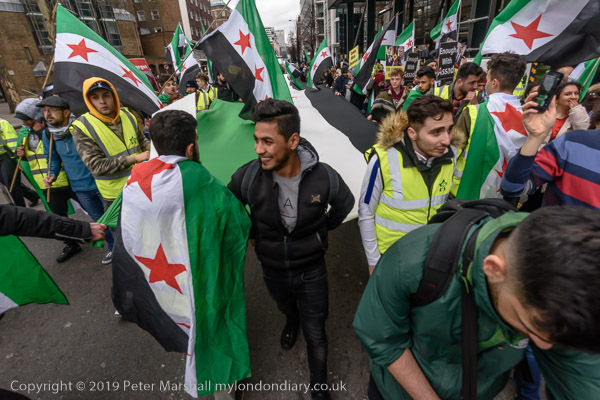
Syria 8 Years On

Syria has certainly been one of the saddest stories of recent history. The optimism of the Arab Spring in 2011, encouraged by Western governments and then totally let down by them, becoming the second deadliest war of the 21st century so far (after the Congo). By 2016 it had seriously wounded or killed 1 in 10 Syrians. It is currently estimated that over 5 million refugees had fled the country and perhaps 8 millions are displaced inside it, from a total 2010 population of 21 million.

As so often around the world, the US had completely misread the situation in the area, not least in its 2003 invasion of Iraq which provided fertile ground for the growth of ISIS, which with covert support from both US allies such as Turkey and enemies such as the Assad regime also became a major player in Syria. At least it had the sense to support the Kurds who became the most effective force in the fight against ISIS thanks to US air power.

But both politically and militarily the US was totally outsmarted by Russia, who came to the defence of the Syrian regime (and also took some decisive action against ISIS.)

It is very hard to see much hope for the future of Syria, even though the civil war appears to be coming to a possibly bloody close in Idlib. What shape will that future take, and what will happen to the currently autonomous region of northeast Syria, the Kurdish area of Rojava, seen by many, but probably not the Syrian regime or its Russian supporter, and certainly not by Turkey as a model for a new federal and democratic Syria.

More about the protest and more pictures on My London Diary: 8th Anniversary of the Syrian Revolution


There are no adverts on this site and it receives no sponsorship, and I like to keep it that way. But it does take a considerable amount of my time and thought, and if you enjoy reading it, please share on social media.
And small donations via Paypal – perhaps the cost of a beer – would be appreciated.
All photographs on this and my other sites, unless otherwise stated, are taken by and copyright of Peter Marshall, and are available for reproduction or can be bought as prints.

To order prints or reproduce images


UN Anti-Racism day

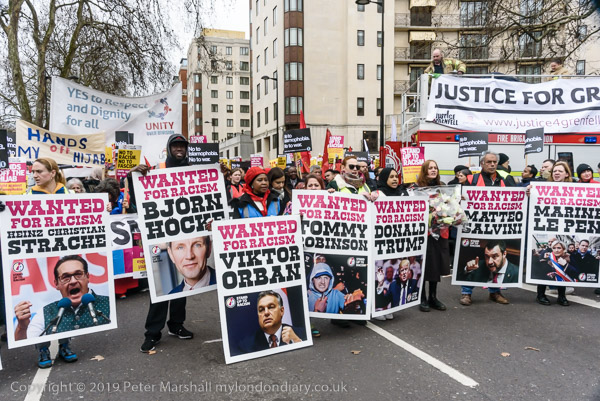
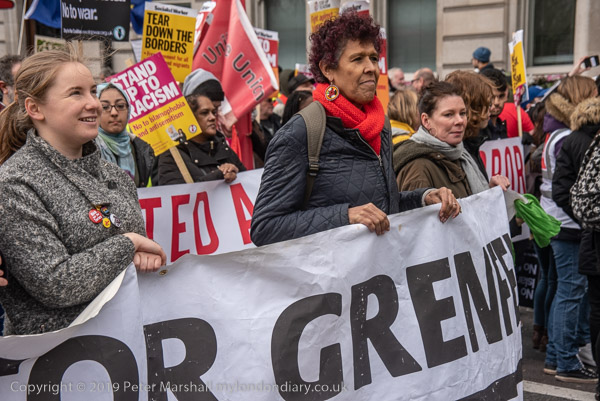
Before the march moved off from Park Lane, a group came to pose at the front carrying posters of politicians from countries across much of the world with the message ‘Wanted for Racism’, including President Bolsonaro from Brazil and the others in the picture above. It seemed rather strange to me to find that the UK representative, next to Donald Trump, was not Theresa May or even Nigel Farage but the unelected Tommy Robinson, who I hope will shortly be serving another jail sentence to add to his three previous terms.

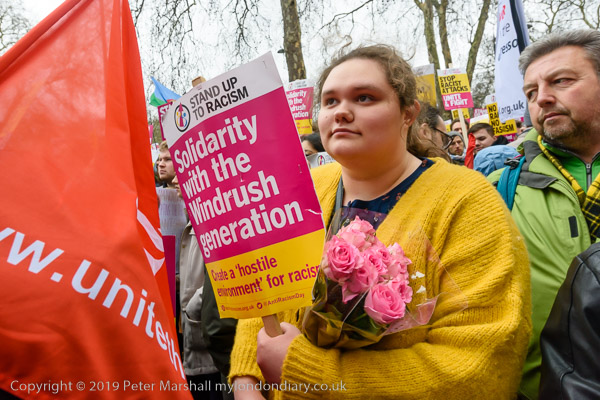
It was of course Theresa May who set up the ‘hostile environment’ in her years at the Home Office, encouraging the demonisation of foreigners in general and sending out vans against them, as well as immigration raids, greatly beefing up the policies which had begun under Straw, Blumkett, Reid and the others. Policies which encouraged racist civil servants and the setting up of barriers including mountains of required paperwork which led to the deportation of many from the WIndrush generation.

Grenfell is another reason for nominating May. Although she made appropriate noises at the time of the fire, actions since then have largely been a way of protecting those responsible rather than seeking to bring them to justice. Her promises to those who survived the fire have not been met – over two years later there are still some who have not been found new homes.

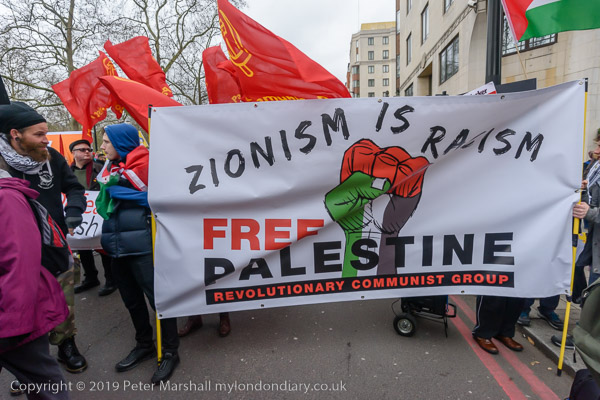
There were many other issues raised by those on the march, particularly over the increasing Islamophobia across the country – for which Robinson must take a great deal of the blame, having inspired some to commit atrocities. He has also allied himself with Zionists groups against those calling for a fair deal for the Palestinians and opposing the ever-increasing take-over of Palestinian and Arab lands by the state of Israel. Among the marchers were several groups representing anti-Zionist Jews.

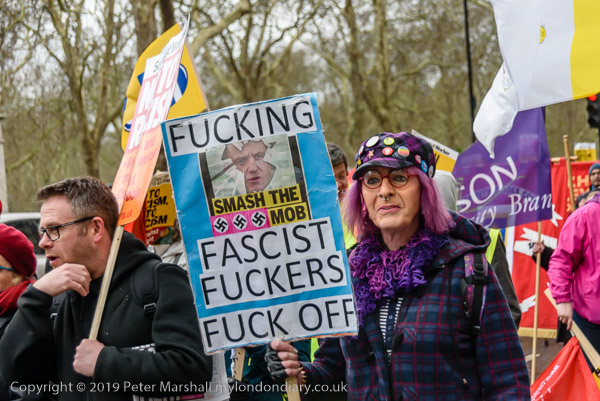
There were also those with more general but sometimes forcefully expressed views against racism and fascism, and you can see a number of these in my report on the march on My London Diary

No to Racism, No to Fascism


There are no adverts on this site and it receives no sponsorship, and I like to keep it that way. But it does take a considerable amount of my time and thought, and if you enjoy reading it, please share on social media.
And small donations via Paypal – perhaps the cost of a beer – would be appreciated.
All photographs on this and my other sites, unless otherwise stated, are taken by and copyright of Peter Marshall, and are available for reproduction or can be bought as prints.

To order prints or reproduce images


Fukushima anniversary

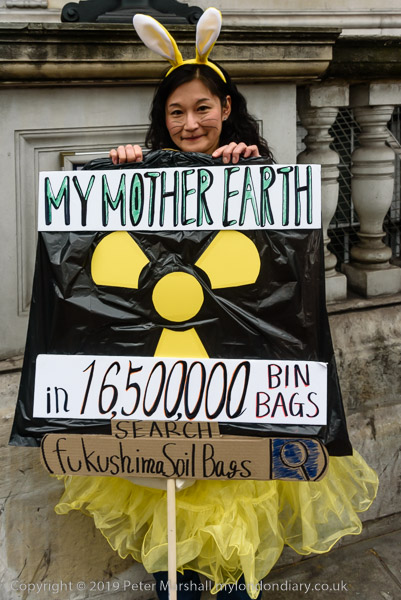
It’s hard to believe that it is 8 years since the nuclear disaster at Fukushima when three reactors went into meltdown on 11 March 2011, but it is a disaster that is still continuing, with high levels of radiation in parts of the plant and clean-up of the site will take many more years, although life is begining to get back to normal in the surrounding area.

It is still far to early to give any definitive figure for the number of deaths th accident and its associated leak of radioactive material will cause, but Fukushima  ranks only second to Chernobyl in the long list of nuclear accidents. One method of estimation suggests it will eventually result in around 130 deaths from cancer.

Nuclear power has never yet lived up to the promises made by its advocates of clean, abundant and cheap energy, and even though the costs of decommisioning nuclear power stations has largely been disregarded, the costs of nuclear energy run high. Nuclear power plants have largely developed around the world because of their production of isotopes for nuclear weapons rather than simply to provide energy. Unless and until it becomes possible to develop nuclear fusion reactors it would make sense to put nuclear on hold, and to concentrate investment on reducing energy use and backing low-cost renewables such as on-shore wind.

Although the health risk from Fukushima may be lower than some activists suggest, it has had huge disruption for those in the surrounding area, with many having to be evacuated. Clearly it was a nuclear facility in the wrong place and with inadequate regard for safety. The operator, Tokyo Electric Power Company (TEPCO), was found to have failed to meet basic safety requirements including risk assessment, preparations for containing collateral damage, and developing evacuation plans. 

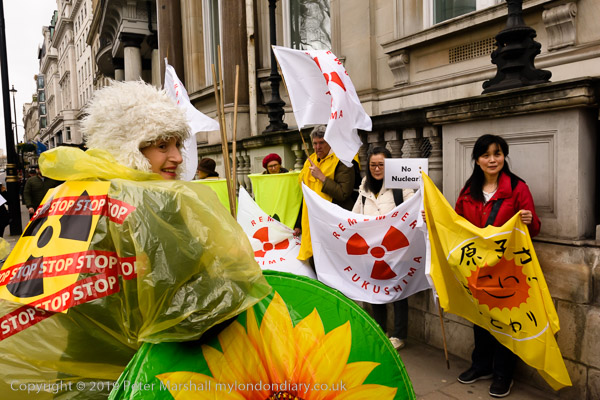
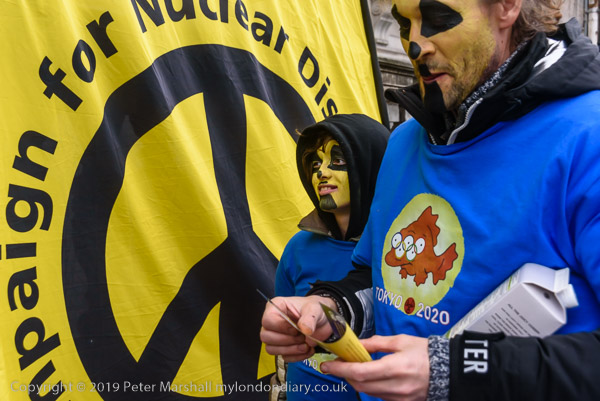
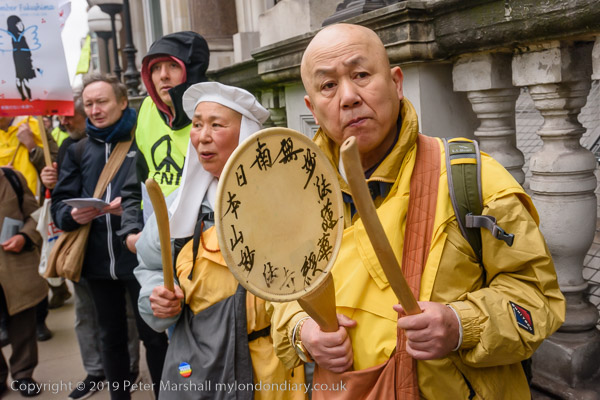
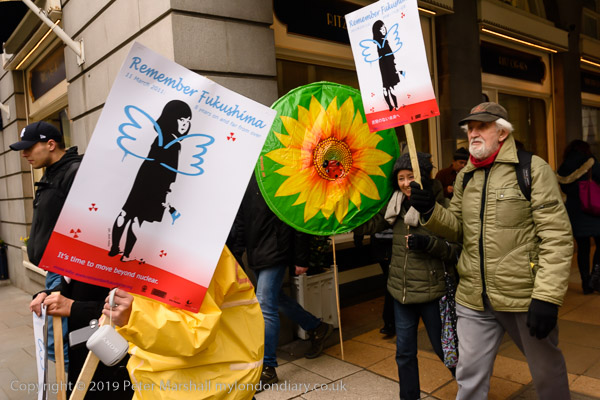
There continue to be regular protests about Fukushima in London, and an annual march on or close to the anniversary. I like to photograph them both because I think it important to end reliance on nuclear energy and becuase they are colourful and slightly surreal events, with people dressing as large bright yellow containers of nuclear waste and carrying large sunflowers, and some fine graphic posters.

Remember Fukushima 8 years On


There are no adverts on this site and it receives no sponsorship, and I like to keep it that way. But it does take a considerable amount of my time and thought, and if you enjoy reading it, please share on social media.
And small donations via Paypal – perhaps the cost of a beer – would be appreciated.
All photographs on this and my other sites, unless otherwise stated, are taken by and copyright of Peter Marshall, and are available for reproduction or can be bought as prints.

To order prints or reproduce images


Big School Strike for the Future

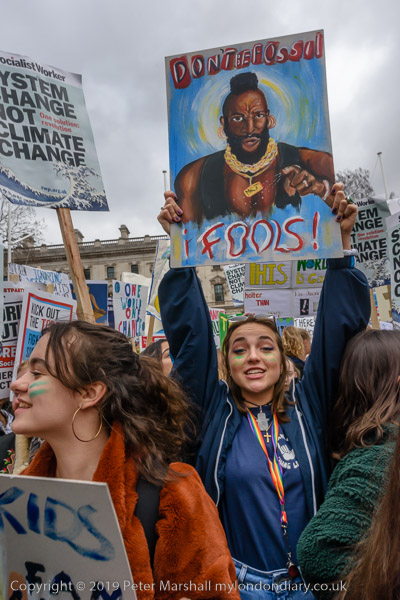
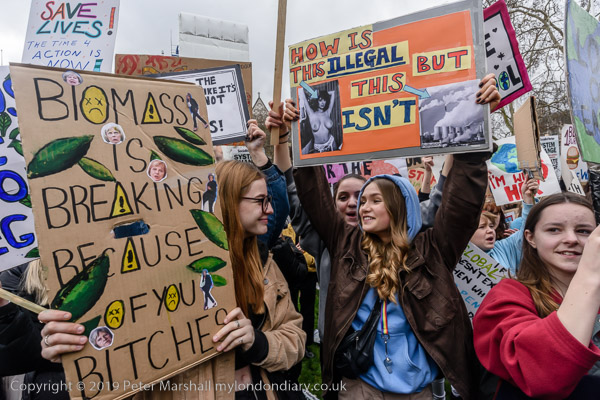
School students can see clearly the threat that faces the planet – especially with some predictions that human life will be extinct on Earth before they reach middle age. I’ve never expected to be still alive in 2050, though it’s just about possible, but these people clearly should be – but quite likely won’t if we continue “business as usual“.

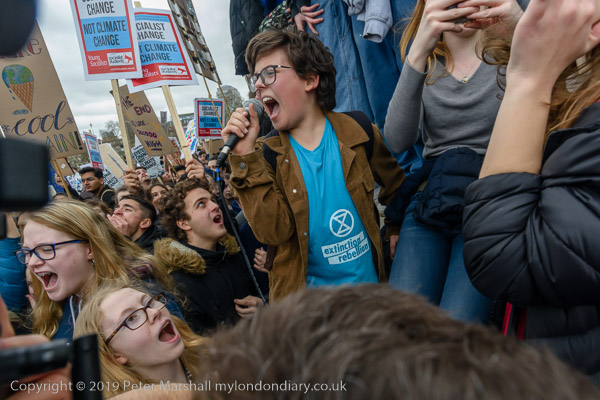
But its also good to be with them and to feel the energy they have, and the enthusiasm they show. As well as in the actions on the day it comes out too in the many placards. There are some mass produced from the usual culprits, Socialist Worker and the Socialist Party, but even the SWP have produced a decent one for the cause, with a nice Wave and the message ‘System Change Not Climate Change’. But clearly there are many schools where the art department is full of people making their placards.

We clearly are at a point where we need drastic change, and are unfortunately stuck with dinosaurs in charge, fiddling about with Brexit and internal party politics (both Tory and Labour) while the planet almost literally burns.

We won’t of course go on like this. It’s a simple choice, change or die, and one that has become far more critical since I first got up in front of a microphone almost 50 years ago and said we can’t go on like this. We now know much more in detail about what is going on.

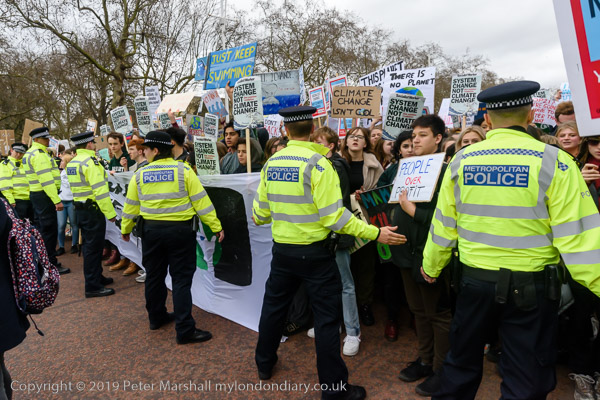
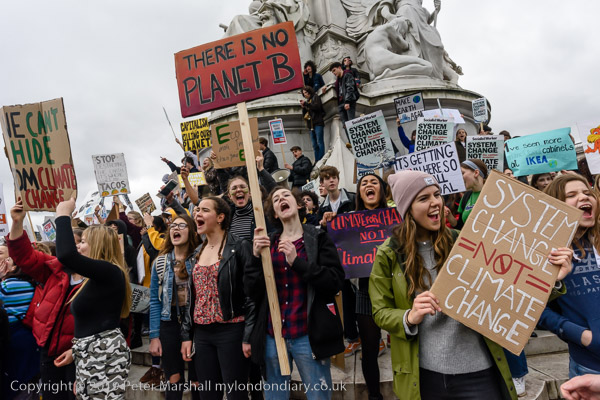
Police tried to stop the protesters at the end of the Mall, but while a crowd gathered in front of their line, others coming up behind simply swarmed around the sides and ran across the grass to get to the Victoria Monument in front of Buckingham Palace.

The police gave up and the others came through to gather around the monument, and their were speeches from several of the protesters to a tightly packed crowd – and I managed to squeeze my way through to take photographs. Mostly I was so close that the fisheye became almost essential, though the one at the head of this post was made with the 18-35mm at 18mm.

After the speeches there was something of a lunch break, with people making their way along various routes back towards Parliament Square – I chose the shortest way – where some protests continued. The largest block made its way over Westminster Bridge and then turned to the east; I left them on Stamford St, deciding I’d walked far enough, but they were still going strong.

London Schools Climate Strike


There are no adverts on this site and it receives no sponsorship, and I like to keep it that way. But it does take a considerable amount of my time and thought, and if you enjoy reading it, please share on social media.
And small donations via Paypal – perhaps the cost of a beer – would be appreciated.
All photographs on this and my other sites, unless otherwise stated, are taken by and copyright of Peter Marshall, and are available for reproduction or can be bought as prints.
To order prints or reproduce images