Women in photojournalism

When I taught photography – which I did, mainly at beginner level to students between 18-20, though my oldest student was in his eighties – for around 30 years – the great majority of my best students were female. Partly this was because generally they worked harder and met the deadlines more often, and perhaps they listened more carefully in my lessons and made better notes, but I think there were also some differences in thinking, perhaps because of peer pressure which made boys reluctant to show sensitivity lest they be thought feminine.

Because many of my students were women I tried hard to show examples of work by women when I could – despite at one time teaching a syllabus with a number of named photographers in the history of photography in which the only woman was Julia Margaret Cameron. And when I wrote a popular photography web site I made sure it featured the work of women who I thought had been neglected in both the history of our medium and in current practice.

I’ve also known many good women photographers and although there are fewer women than men among the photographers I’ve known (and in most areas of the profession) I have the impression that a higher proportion of the women are photographers whose work I particularly admire.

Many women have shown they can do as well as men even in the more hazardous areas of photography including German photographer Anja Niedringhaus who was the only woman on the team of AP photographers awarded the 2005 Pulitzer Prize for Breaking News Photography for their coverage of the Iraq War. That year she also won the International Women’s Media Foundation’s Courage in Journalism award. On the web site ‘Menschen im Krieg: Das Lebenswerk der Anja Niedringhaus‘ buttons link to her work from Afghanistan, Pakistan, Libya, Gaza, Iraq and Bosnia. Her career had begun with a move from a local paper after covering the fall of the Berlin Wall and other events she covered included the aftermath of 9/11 in New York.

Niedringhaus died age 48 in Afghanistan on 4th April 2014, shot by an Afghan policeman while sitting in a car at a checkpoint near Khost while covering the presidential election. The officer walked up to their car, shouted “Allahu Akbar!” and shot killing her and severely injuring a woman journalist sitting beside her. He gave himself up and was later sentenced to death for wounding, murder and treason. The International Women’s Media Foundation founded the Anja Niedringhaus Courage in Photojournalism Award in her honour with the aid of a $1 million gift from the Howard G. Buffett Foundation and it is given out every year to a female photojournalist whose work “follows in the footsteps of Anja Niedringhaus.

A feature in The Week’s ‘Captured’ photo blog shows the work of Niedringhaus together more stunning photography from this year’s winner Heidi Levine, Rebecca Blackwell (honorable mention) and Anastasia Vlasova (first runner up). All of their work is worth exploring.

The Falling Man

Most if not all of us remember what we were doing when we heard about the tragic attack on the World Trade Center in New York on 9/11, the 11th of September 2001.

I was just getting my bicycle ready to leave college after a morning’s teaching – I was then working part-time and had finished for the day – when a distraught colleague rushed up to me to tell me the news. She had grown up in New York, and had just seen pictures on her computer showing a plane flying into one of the towers. We shared our horror at what was happening, and watched for short time together unable to beleive what was happening.

After a few minutes I left her and got on my bike and cycled home. I couldn’t eat lunch but began to search for more information on the web, finding both the pictures on the news channels and also a number of posts of mobile phone pictures and video taken by those close to the events, including some making their way out of the building. It was these pictures, with their rawness, often blurred and indistinct that really brought home the horror to me, and I sat and wrote an article linking to them and to some of the professional imagery.

I don’t know that it was a very good article, but I clearly saw the event not only as a terrible act of terrorism, but also as a clear indication of the power of ‘citizen journalism’, perhaps the first major world event where the story was told and illustrated most immediately and effectively by those caught up in the tragedy rather than profesional journalists. And it was a story that attracted around a million views in the next 24 hours or so.

Of course we soon saw a great deal of fine coverage from the professionals, particulalry of the later stages of the event, but these lacked the rawness and immediacy of those first acounts – which their technical shortcomings emphasized (as does the grain and shakiness of Capas D-Day pictures).

Esquire Magazine has published a long and very interesting feature about the photographs of people who fell from the burning towers, and in particular the ‘Falling Man’ captured in a series of images taken by photographer Richard Drew. Originally published on the front pages, it quickly became the subject of controversy, and disappeared from view except on some insalubrious web sites. As the feature reveals, it caused considerable distress among at least one family of a man who died and was apparently wrongly identified as the man in the picture.

The story by Tom Junod is an interesting one, which also raises many issues about the use of these and other photographs, and about what photographs can tell us about what they depict. He concludes that this image of one of the perhaps 200 men who jumped from the upper stories of the WTC rather than await the death that seemed inevitable is of the man who “became the Unknown Soldier in a war whose end we have not yet seen.

Biennial Thoughts

The Whitney Biennial  according to its web site “is an unmissable event for anyone interested in finding out what’s happening in art today. ” That is in art in the USA, and this years show features “seventy-five artists and collectives working in painting, sculpture, installation, film and video, photography, performance, and sound.”

It’s interesting to look through the list of artists and perhaps explore some of their work on-line, but even where I in New York, I think I might find the whole rather too daunting to contemplate.

My attention was drawn to it by a post on The Online Photographer with the site’s longest ever title:
Open Mike: What Danielle Jackson’s Artnet Review Tells Us About What the Whitney Biennial Tells Us About the Future of Photography—and the Reviewers and Curators and Academicians Who Will Shape the Artists Who Will Shape It

Though it was the content of the post rather than its length that caught my attention. It starts with a short reflection on the idea of ‘political correctness’ and then cites Danielle Jackson’s review as an example “written from the perspective of political correctness about a show that appears to be mainly about political correctness.” I felt I had to go and read it.

Jackson writes she was sent by Artnet with “a brief to consider the photography in the exhibition and left thinking about the power of affiliation.” In a long piece she suggests that the artists “come from nearly every conceivable historically marginalized group” and that they form the new mainstream.

It’s perhaps unsafe to make any conclusions from the installation views and example of work which accompany her post, or from the Whitney web site, but if this is the future then there seems relatively little in it that I find of any great interest.

Michael C Johnston looks at her review in somewhat greater length and I certainly have some sympathy with his views, and in particular with his opinion that “The actual photographs in the show seem to be secondary to the positions they take on various political implications” which appears to be at the base of both the curation and the review of the show.

But perhaps both he and I will be accused of thinking and writing from our own positions of age and race and privilege. And of course I am what I am, though I think I am rather more of an outsider than many of the established artists whose work is featured in the Whitney.

Visa pour l’image

It’s always worth looking at the web site for Visa Pour l’Image, the annual festival of photojournalism which takes place every year around this time in Perpignan. It’s a festival like Arles that I’ve often though about attending but never got around to actually doing so. Back in the days when I would have got more out of both of them I was always still teaching when took place, Arles in early July and Perpignan in September, and now I feel too old.

The festival has a Facebook page and you can read more about Visa Pour l’Image in various sites on-line, many of them in French. In English as you might expect the British Journal of Photography has some coverage with an article with a lengthy title:
Visa pour l’Image returns with a focus on press freedom and fake news

A rather different approach comes from Euronews, whose feature is titled ‘Visa pour l’image: The story of the world from big food to defecation‘.


All photographs on this and my other sites, unless otherwise stated, are taken by and copyright of Peter Marshall, and are available for reproduction or can be bought as prints.

There are no adverts on this site and it receives no sponsorship, and I like to keep it that way. But it does take a considerable amount of my time and thought, and if you enjoy reading it, please share on social media.
And small donations via Paypal – perhaps the cost of a beer – would be appreciated.
Controlling the Image

Two stories I’ve read in the past couple of weeks have illustrated an increasing attempt by organisers of events to control the way they are photographed. It’s something that has happened over many years in some limited areas of photography, particularly around the film and music industries, but which seems now to be widening as PR people become more and more involved.

I’ve only rarely worked in areas where accreditation is vital, and have hardly ever needed to get permission before distributing or publishing images. Occasionally when taking portraits I’ve shown pictures of people to them before sending them off, but generally only as a courtesy; fortunately I’ve never had anyone object to my choices. But then I usually try to show people at their best, and generally delete pictures that show people in an unfairly negative light rather than use them. It’s a decision that has almost certainly cost me considerably with pictures of some politicians.

There have been one or two cases where long after an image has been published on a web site I’ve been asked if I would remove it. Unless there is a legal imperative or a very good reason – for example that it might endanger someone’s safety or even life by enabling a violent offender to trace them – I ignore such requests. Being unflattering isn’t grounds for censorship.

Often I’ve photographed aspects of events which the organisers would prefer were not shown, but I’ve not faced the kind of problems which Manchester-based photographer Joel Goodman describes in his blog post about his experiences in photographing Manchester Pride. Of course people have deliberately got in my way (police and security staff are skilled in this) but I’ve not been threatened with removal and ejection from events, though rather too often with arrest.

One of Goodman’s main complaints is about a PR person who tried to prevent him from taking pictures when “a lesbian gender ideology protest attempted to hijack the front of the parade“. Later the same woman came up to him at a candlelit vigil and told him he had to leave, because of his coverage of the earlier incident and also his photograph of Ariana Grande, taken from a public place after he and other photographers had been banned from photographing the event – for which the singer’s team provided a single image for media use.

Goodman, who I’ve met covering various events in London and whose photographic work is admirable, makes his points about this clearly, stating his legal rights as well as making clear what he feels is his job as a journalist, and his feelings as a gay, HIV+ man in being told by Pride’s PR team he was not “on our side” and would be refused accreditation for Pride in future years.

Clearly Pride’s attitude is totally unacceptable and as Goodman says, it “exposes the ever present danger of the sort of expectations PR operatives have of journalists, in exchange for access.”

At the bottom of the post are links to his photographs of the events, and as you can verify they show a totally professional approach.

The second article I read was by photographer Peter Dench in the Amateur Photographer, in a post I don’t care if my documentary shots are ‘unflattering’ about covering several sporting events. On a press trip to a prestigious horse-racing event for The Sunday Times Magazine he met two people who described themselves as ‘journalists and influencers and vloggers’ who he says seemed ‘to have spent most of their day in the hospitality box making saccharine social media posts of the sponsor’s products.’ I’m sure they were the PR’s delight.

At another sporting event he was asked when leaving by the PR to show the photographs he had taken in the VIP marquee. Dent writes: “‘I can’t do that,’ I said. ‘I haven’t seen them yet and after I’ve seen them, the client will be the next to see them, then I can let you have a look’ ” He was then informed that a photographer ‘the previous year had taken a less-than-flattering photograph of a minor royal and was now excluded from all of their events.

Dench goes on to mention other cases of photographers being warned not to take ‘unflattering’ pictures or have accreditation refused. He concludes with the sentence ‘Photographers shouldn’t stop taking truthful photographs of what they witness. They may not be seen immediately but one day, I hope, they will form an important archive of our time.’

Community Guidelines

Around ten days ago for the first time I got a notification from Facebook that one of my pictures had been reported as being against ‘community standards’ and had been taken off-line.

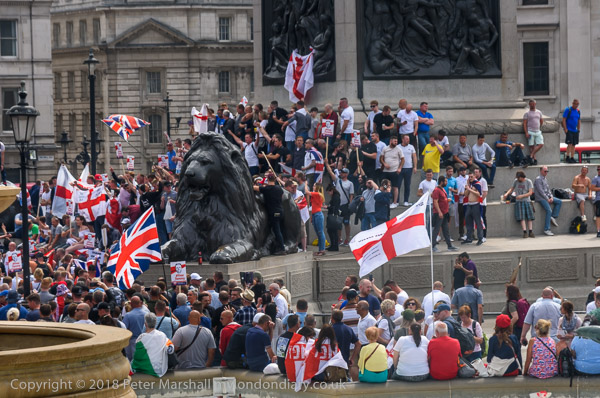
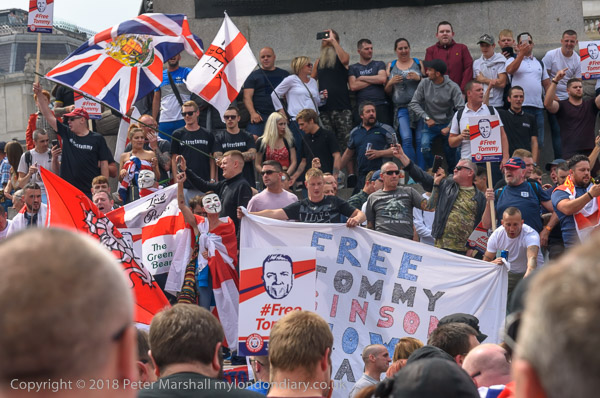
It was a picture in an album of pictures from the June 2018 ‘Free Tommy Robinson’ protest in London, I think this image.

Certainly one of the pictures from when the protesters were gathering in Trafalgar Square before marching down to a rally in Whitehall. This picture was taken from the North Terrace overlooking the square, after which I walked down and took a few more from the edge of the crowd, as well as a few closer pictures.

You can see more of my coverage of the event at Free Tommy Robinson on My London Diary. After the pictures in Trafalgar Square I photographed the protesters as they walked down Whitehall towards the stage for the rally, and was in the crowd close to Downing St when I was attacked by two men who tried to pull my camera out of my hands.

I struggled, pulling away and twisting and moving away through the dense crowd and they followed, one continuing to grab my camera and pull it away, and the other grabbing my other camera which was on a strap at my right side, and at my camera bag on my left shoulder. Fortunately the straps held and though the bag was pulled off my shoulder I had my arm through the strap and was able to drag it behind me along the ground, moving closer to the police at Downing St and the march stewards.

I think a few of the other protesters in the crowd were also telling the pair of thugs to stop, though none actually came to my help. But when they saw the police looking at them they let go of me and my cameras and rushed away. I was shaken but not injured, and the cameras were OK, and managed to take a few more pictures before I decided I really needed to move somewhere safer and recover.

I suspect that what had triggered the complaint to Facebook about the picture – I think the first of the set – was nothing in the picture, but that in the captions I had written about this attack on me. I’ve always tried to report accurately on protests, including those by right-wing groups, both in text and pictures, and this is anathema to many on the right. Some of whom are thugs on-line too.

Of course I requested a review of the removal – as the notification from Facebook had told me I could, and only 70 minutes later got a message thanking me for asking for review and informing me they had decided the image did not breach community standards and was back on line. Good to see the review system can work – but surely the system should look at complaints and see if there is any basis for them before taking action.

I mention this because I’ve just read a post by Jörg M Colberg on his Conscientious blog, Your Post Goes Against Our Community Guidelines: An Algorithmic Rewriting of History about the rather more serious censorship of his and other posts on Instagram, which is owned by Facebook. Like me he contested the removal of a picture he posted – one from the Abu Ghraib archives – and his post was also restored. In the post he points out the problems and dangers of internet censorship:

It doesn’t really matter whether it’s a government that’s censoring photographs or the algorithms of a US corporation — censorship is censorship, and these kinds of developments do not bode well for us.

and gives a number of pertinent links, including one to his own earlier post Your Post Has Been Deleted – Censorship on Instagram which is also well worth reading.

I think there should be some control over content on platforms such as Facebook and Instagram, to remove clearly illegal content. Things like hate speech, terrorist propaganda, threats of violence etc. It’s perhaps difficult to see how this could be applied in content that is shown in many different legislations, but that is a problem for those who profit from these platforms to resolve, and might involve serious changes in the services and their profitablity. But because it’s difficult doesn’t absolve them from their responsibilities, though it may demand different models.


All photographs on this and my other sites, unless otherwise stated, are taken by and copyright of Peter Marshall, and are available for reproduction or can be bought as prints.


Long lenses

Last Friday I was testing out equipment for an event I was hoping to photograph the following day. For the last few months I’ve seldom used the two working Nikon DSLRs I own, working instead with a Fuji XT1 and an Olympus OMD EM5 MKII, and I wasn’t confident that they could cope.

I knew I would need a fairly extreme telephoto lens for some pictures. The longest I own for the Fuji is the 18-135mm F3.5-5.6, equivalent to a 27-203mm, and for the Olympus, the lightweight 14-150mm (28-300mm equiv) f4-5.6. Would either of these be good enough or should I take the larger and heavier Nikon D810 with the 70-300mm Nikkor zoom?

I was worried about the weight as I was expecting to have to walk some distance, so would have preferred not to have to carry the Nikon, as along with another lens to cover the mid-range it would roughly double the weight I was carrying for around four or five hours. But if it really gave better results I’d have to put up with it.

I could get greater magnification from the Nikon, as I don’t need the full image size, but could switch it to DX mode, making it at its long end a 450mm equivalent lens, while still retaining roughly the same pixel count as the Fuji or Olympus, and I thought before looking at the results that this would make a vital difference.

So I got out the gear and took pictures of a subject at roughly the same distance as I would be working – around 200 metres and compared the results. I used more or less the same shutter speed and aperture as I expected to need on the following day, around 1/500 f8 at ISO640, and made sure the image stabilisation was on for the Fuji lens and Olympus body.

I got a couple of surprises from these simple tests. The first was that the two mirrorless systems both focused at least as fast as the DSLR, with the fastest usually being the OM5 (though both the Nikon and the Olympus occasionally went in for a little hunting.)

It took a little fussing around to view the images with the subject roughly the same size on my screen, but the results were interesting. The pictures themselves are pretty boring (and as I was photographing a window in a nearby flat perhaps an invasion of privacy) so I won’t include them here; the differences between the 3 camera/lens setups would in any case probably barely show even on enlarged small sections.

I’d expected the Nikon with its larger sensor and longer (equivalent) focal length to have a distinct advantage, but this wasn’t the case. The clear winner in these tests was Olympus, though the differences were not huge. It seemed a little sharper and to give just a little better gradation. Details in highlight and shadow seemed a little clearer. Even though I had to magnify it more it still more than matched the Nikon. The Fuji lens gave a nice sharp image, but the extra magnification it needed just about showed. But at any size I was likely to need to use the pictures any of the three systems would have done the job.

The D810 in full-frame mode gives images 7360 × 4912 pixels, compared to 4896 x 3264 for the Fuji and 4608 x 3456 for the Olympus. All more than enough for an A4 print – and if the images are sharp you can go considerably larger. Those extra pixels that the Nikon has to offer are very seldom needed.

Of course Nikon has newer and better telephoto lenses than the old model I own, the 70-300mm f/4-5.6D ED AF Nikkor. The Fuji lens weighs 490g, not particularly heavy for its specification, but almost twice as much as the Olympus at 285g. Both essentially replace two of my Nikon lenses, and of course both Olympus and Fuji bodies are considerable lighter than the D810.

My Nikon 70-300 was made for film and is not really up to the demands of high-pixel digital cameras, particularly at its longer focal lengths, so I shouldn’t be too surprised at the result. It weighs 520g, only a few grams more than the Fuji 18-135, but its modern replacement, the AF-P NIKKOR 70-300mm f/4.5-5.6E ED VR is noticeably heavier at 680g – and reviews show it to be a rather better performer. I don’t do a great deal with long focal lengths and got my lens second-hand at a bargain price, around a fifth of the cost of the newer model.

The tests showed me that the Olympus would do the job well and so I packed my bag ready for the following morning. But the following day gale force winds meant I had to cancel my journey. But at least I know for the future that I don’t need to carry the extra weight to use a long lens.

Clearing the ‘Sea of Protest’

Police I think waited until the journalists covering Emma Thompson’s visit to the Extinction Rebellion (XR) ‘Sea of Protest’ around Berta Cáceres, the pink yacht at the centre of Oxford Circus before they closed in.

I’d left with the others, but came back 25 minutes later to find the yacht surrounded by a ring of police, with just those protesters locked on to the boat inside. And sitting on the ground around them was a large crowd of XR supporters, listening to singers and occasionally chanting slogans.

Soon more police arrived and set up a cordon around the whole of Oxford Circus, allowing people to leave but not to enter. There were some heated arguments and one protester tried to urge the crowd by now outside to push their way through the police line, but XR organisers urged them to respect the non-violent principles of Extinction Rebellion and not oppose the police physically, and no-one followed his lead.

Police came and began to persuade  those still sitting down in Oxford Circus to leave, telling them they would be arrested if they stayed, and numbers began to dwindle, although there were many who stayed, having come prepared to be arrested to make XR’s point.

As well as photographing this, I was taking pictures mainly between the legs of police officers, both the ring around the outside of the protest, particularly of the dance group dressed in red that were going around the outside of the cordon, and, through the legs of the much tighter cordon around the yacht, looking through to the protesters who were locked on.

I wasn’t sure how much of the police to include in the frame with these images, and took some with a minimal presence as in the picture above, but also wider views showing the line of police. And of course it was possible to zoom in and exclude the police altogether. But I felt it important to have both police and yacht in the image to locate it.

Eventually the specialist police team turned up to begin to release the protesters from the yacht and its undercarriage – though some were very easily removed, others needed cutting out, and it was a lengthy process. As they were removed they were arrested and rushed to waiting police vans.

Once the numbers sitting on the road had reduced to a more manageable number police began making arrests of them also, taking them away. I hung around and photographed a number of them being carried away, though it was hard to get clear pictures as there were often too many people – police, other photographers and protesters – in the way.

After I’d been there for around two and a half hours watching and photographing I decided I’d taken enough pictures and left. It was several hours later before the area was cleared and the yacht was towed away, having been there for around five days.

Many more pictures at Police clear XR from Oxford Circus.


All photographs on this and my other sites, unless otherwise stated, are taken by and copyright of Peter Marshall, and are available for reproduction or can be bought as prints.

There are no adverts on this site and it receives no sponsorship, and I like to keep it that way. But it does take a considerable amount of my time and thought, and if you enjoy reading it, please share on social media.
And small donations via Paypal – perhaps the cost of a beer – would be appreciated.


XR and Emma Thompson

I don’t go out of my way to photograph celebrities. Often another photographer will point out someone to me and they are people I’ve never heard of, and certainly wouldn’t recognise. One of the delights of not owning a television is that it keeps your mind clear of such clutter, though it has occasionally meant I’ve missed taking pictures that would have sold well.

But of course I do have some idea of who Emma Thompson is and what she looks like, though I hadn’t known she would be arriving to speak at Oxford Circus before I got there on April 19th and a colleague shared this information. I’d gone to Oxford Circus simply to photograph the XR occupation of the area around the large pink yacht, the Berta Cáceres, and the other sites still blocked by the protests,

I saw her arrive before most of the other photographers and was able to take a few pictures before she was surrounded by a crowd of people with cameras, including one of her showing off her ‘There is no planet B’  bag.

Soon other photographers realised she had arrived, but there wasn’t room for them where I was between her and the boat, so there was a ring of photographers all pointing there lenses at her back while I was taking her picture with a member of the crew. I realised she was going to have to wait and then climb up the ladder onto the boat after the singer currently performing came down and moved to where I thought I would be best placed for more pictures – a few of which you can see on My London Diary.

Of course I moved into the crowd in front of the boat as she spoke, to take more pictures of her, but mainly of the people listening. After she had spoken to the crowd, she did speak to a couple of TV crews from the back of the boat and I did take a few more pictures, but I was more interested in the pep[;e who were surrounding the Berta Cáceres, some locked on, to protect the boat from being moved.

I then made the mistake of leaving Oxford Circus to look at something happening elsewhere, but after a brief look I came back to find that police had moved in and began the long process of clearing the road junction. More about that in a later post.

More pictures at Emma Thompson speaks at XR


All photographs on this and my other sites, unless otherwise stated, are taken by and copyright of Peter Marshall, and are available for reproduction or can be bought as prints.

There are no adverts on this site and it receives no sponsorship, and I like to keep it that way. But it does take a considerable amount of my time and thought, and if you enjoy reading it, please share on social media.
And small donations via Paypal – perhaps the cost of a beer – would be appreciated.


Anniversaries

We celebrate many anniversaries, and forget others. Some are personal and others more universal, but you can be sure that any day of the year is being commorated somewhere by someone. This post will go online on August 8th, the 74th anniversary of the dropping of the second atomic bomb, at Nagasaki, two days after the more widely remembered bomb at Hiroshima.

On 6th August this year – as on many past years – I went to a Hiroshima Day commemoration in London, and of course photographed it. It will be a few weeks before I put the pictures on My London Diary, though they went to Alamy and Facebook on the day. The first time I put pictures on-line from one of these annual events was in 2004 but that was perhaps simply because it was the first I attended with a digital camera.

The Nikon D100 was primitive by today’s standards, producing small files, only 6.1Mp on its APS-C sensor, and with a small and rather dim optical viewfinder, but the images – still on line on My London Diary – disappoint largely because of the indifferent raw processing software – and possibly my lack of skill in its use, as you can see from the rather murky examples here.

Under favorable conditions the D100 was capable of producing excellent images – and one image from it of a very different occasion was on exhibition for some years as a 2.3 metre wide print, but it was a pig to use. But I really should hunt out those old RAW files, stored on CDs which are still readable (and possibly also on old hard disks which can also still be read) and make some new conversions.

Of course the conditions in Tavistock Square are usually challenging. It almost always seems to be a sunny day, with the sun coming from the wrong direction for most photographs, and being filtered through the leaves of trees, one the Hiroshima Cherry Tree, grown from a seed from Hiroshima and planted in Tavistock Square in 1967 by the then Camden Mayor Millie Miller, whose son Bernard was one of the speakers this year. In his speech about many remarkable women involved in peace commemorations he did tell us who the other tree commemorated, but I’m afraid I’ve forgotten her name.

The association of the Mayors of Camden with the event continues, and almost every commemoration has been opened with a speech from the Mayor (or Deputy Mayor) who has then gone on to lay a wreath at the Hiroshima Cherry Tree. The only exceptions have been the fortunately rare Conservative mayors of the London borough who declined to take part, presumably not wanting to be in any way associated with peace.

Hiroshima Day in Tavistock Square back in 2004 was something of a historic event in itself, compered by Jeremy Corbyn, with speakers including Tony Wedgewood Benn and with former Labour leader Michael Foot attending. Moredecai Vananu had been invited but was not allowed to leave Israel.