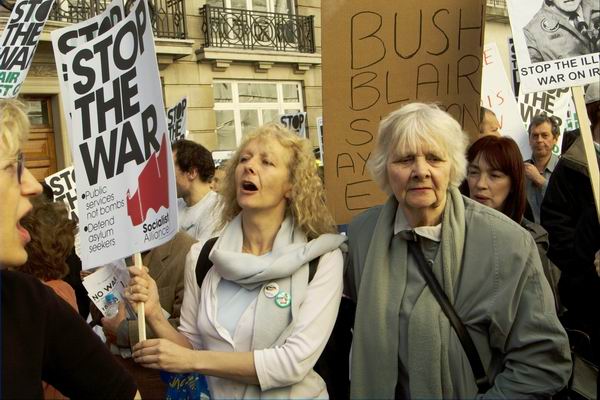
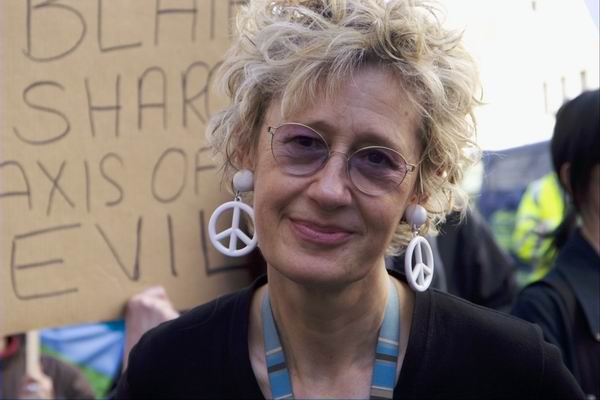
End Iraq Invasion – 2003

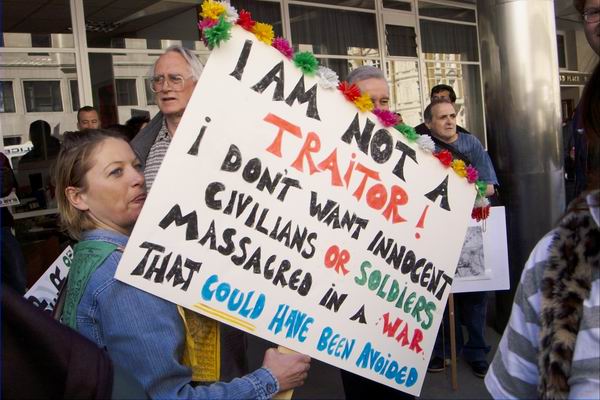
End Iraq Invasion: Saturday 12 April 2003 saw another protest (there had been one a week earlier) against the invasion of Iraq which had begun on 20th March 2003 with US troops supported by those from the UK, Australia and a few from Poland.
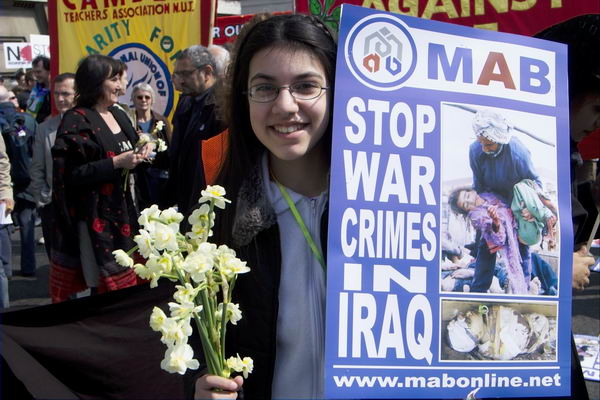
End Iraq Invasion - 2003

Before the invasion UN weapons inspectors had reported that they had found no evidence of ‘weapons of mass destruction’ in Iraq. But US and British politicians still insisted Iraq had these, but had just hidden them well. We now know that there were none. It was an invasion and war fought on known lies.
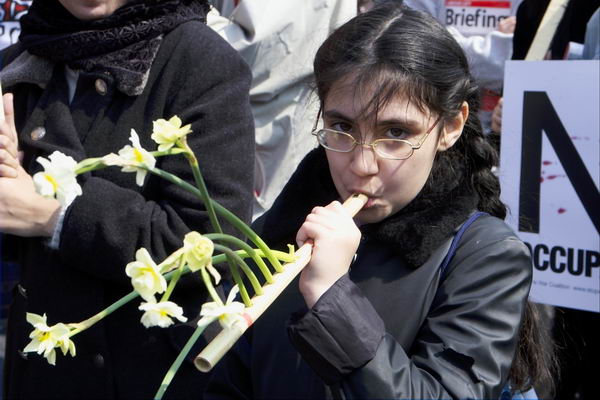
End Iraq Invasion - 2003

Almost certainly both the US and UK authorities at the time of invasion knew that there were no WMDs in Iraq, but the US had been planning and working up to the invasion for several years and were not going to let the facts get in the way of their war. The US had also carried out a long campaign to link Saddam Hussein and the 9/11 attacks although there was no evidence for this and later “assertions of operational links between Iraq and al-Qaeda have largely been discredited by the intelligence community.”
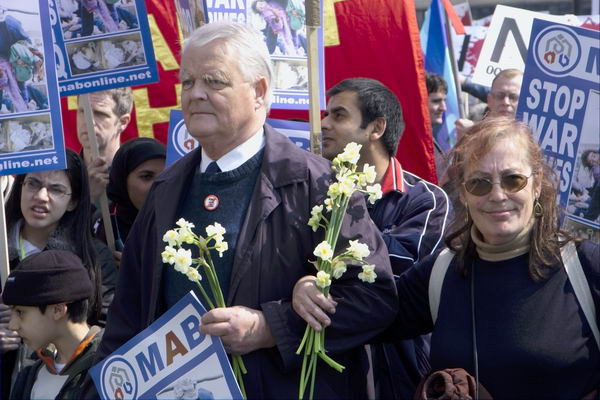
End Iraq Invasion - 2003 Bruce Kent
Bruce Kent

The British public were also clear we should not go to war, with the largest protest ever in London in February 2023 demanding we not not invade Iraq. This had followed a unprecedented long campaign across the country with many local groups out on the streets in protest.
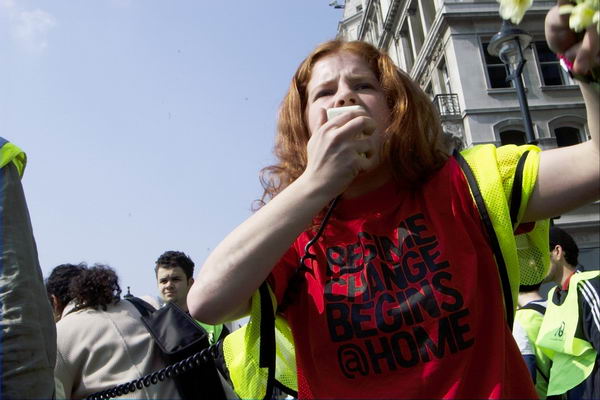
End Iraq Invasion - 2003
Regime Change Begins At Home – a call to get rid of warmonger Tony Blair

There were similar protests in other countries, with the largest of all in Rome where over three million took to the streets – roughly twice as many as in London.

End Iraq Invasion - 2003
This was a protest with flowers for the dead

Many of our allies also came out against the invasion – including France, Germany, Canada and New Zealand, but Prime Minister Tony Blair was determined to support the invasion – using misleading claims and lies to persuade MPs to back it – including that infamous ‘dodgy dossier’.
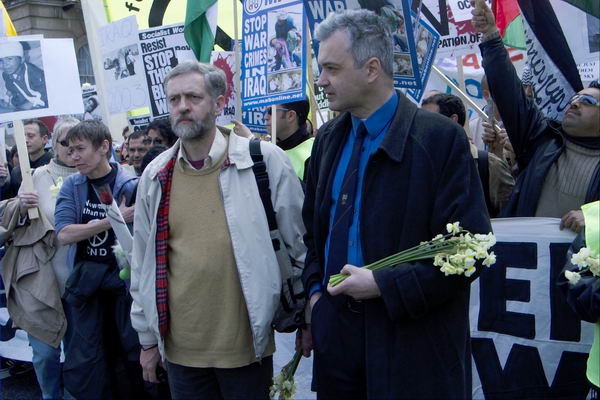
End Iraq Invasion - 2003 Jeremy Corbyn
Labour MP Jeremy Corbyn

By April 12th Baghdad and Kirkuk had been captured, and on May 1st President Bush announced the end of “major combat operations’ although the war continued with an insurgency against the occupying forces and the new US-backed Iranian government.
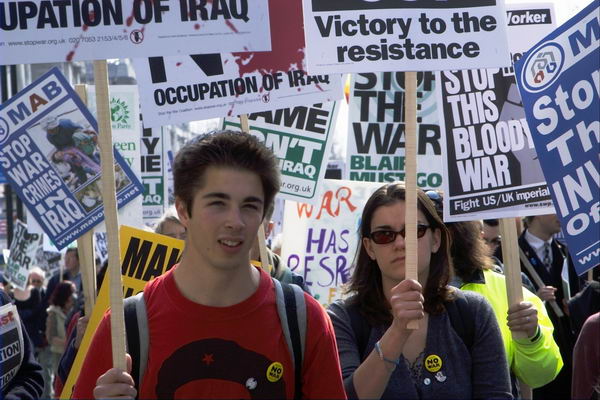
The insurgency continued after the US pulled out of Iraq in 2011, eventually resulting in the rise of ISIS. Various studies and experts conclude that the invasion and occupation resulted in a huge rise in Islamic terrorism and the global Juhadist movement.
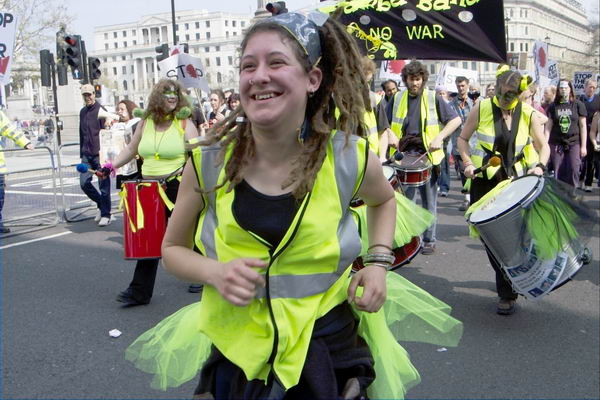
In 2004 “UN Secretary-General Kofi Annan called the invasion illegal under international law, as a breach of the UN Charter.” It was an event that showed the US’s contempt for a rules-based international order or at least their assertion that the rules did not apply to them, operating under the simpler principle that US might is US right.
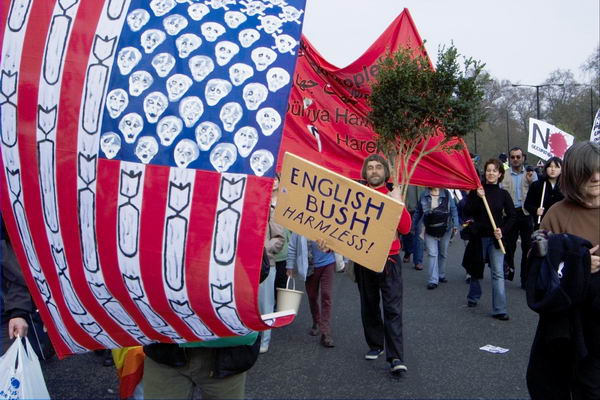
All pictures from Saturday 12 April 2003.

More on My London Diary.


FlickrFacebookMy London DiaryHull PhotosLea ValleyParis
London’s Industrial HeritageLondon Photos

All photographs on this page are copyright © Peter Marshall.
Contact me to buy prints or licence to reproduce.
At War With Iraq – 2003

At War With Iraq

20 years ago we were at war with Iran, despite the largest ever protests in this country. I’d missed the big protest on 15 February when 1.5 million people were on the streets of London – including the rest of my family, as I’d only come out of hospital the previous day and was still very weak following slight complications after a minor operation following a heart attack. But I’d covered all the main protests in London before that, as well as taking part in our local protests every Friday night.

At War With Iraq

Of course it hadn’t just been in London that there had been protests that weekend, and there were others in at least 600 major cities around the world – the largest of all in Rome – combining to make this “the largest protest event in human history” with the BBC estimating around 6-10 million taking part around the world. And in the two and a half months leading up to the invasion on March 20th there are thought to have been 3,000 protests involving 36 million people around the world – though I think even that number fails to include small local protests like our series on Staines Bridge.

At War With Iraq

Of course it had been clear for at least a year that the USA would go ahead with its invasion whatever and had been preparing its military for it. More at stake was whether other countries would join them, and for us whether Britain would. There seems to have been no sensible reason why we should, but Tony Blair had made a promise to George Bush and was prepared to lie and mislead the country and parliament to keep it.

At War With Iraq

The major pretext for the invasion was to disarm Iraq of weapons of mass destruction (WMD), but the UN inspection team led by Hans Blix had found no evidence that Iraq had any – and none were found following the invasion.

The USA also claimed it was to end Saddam Hussein’s support for terrorism, and US Secretary of Defense Donald Rumsfeld had ordered the Pentagon to make plans for the invasion before the dust had settled on September 11th 2001 despite being told that the attack had been carried out by al-Qaeda with no cooperation from Iraq.

Finally the US had claimed they were “going in to free the Iraqi people“, but they appear to have done little or no planning as to what could replace Saddam Hussein to keep the country from descending into chaos, a process they accelerated after their victory by disbanding the Iraqi army and disbarring from public office all of the civil service, teachers and others in public sector jobs for whom membership of the Ba’ath Party had been obligatory.

The US Institute of Peace has a useful timeline of events in Iraq since the war which has an introduction which ends “Iraq suffered through a civil war, political turmoil, widespread corruption, sectarian tensions and an extremist insurgency that seized a third of the country. Iraq has evolved through four rocky phases.”

The coalition forces – three quarters from the USA, a quarter from the UK and a handful of military from Australia and Poland, with a little support from Iraqi Kurds were still busy fighting across Iraq on April 5th, capturing Baghdad on the 9th and the war ended on May 1st, though US forces remained in occupation until 2011. Saddam was only found and captured in December 2003 and was eventually tried, found guilty of crimes against humanity and executed on 30th December 2006.

Of course the Iraq War has also had a great influence on British politics. In particular it has led to a huge distrust for politicians and our political system because both of the fact that our prime minister and other leading politicians in both parties lied to us, but the failure of huge protests over serveral years to have any effect on policy showed a failure to take any notice of the views of the people. Politics needs to be a politics of consensus and the Iraq war showed it was one of disdain.

Here’s the short piece I wrote on My London Diary in April 2003 – with minor correcttions of capitalisation etc:

April started with the country at war, invading Iraq together with the USA.

In Saturday 5th I went to a march to protest against this and to call for proper reporting of the events in the media, especially the BBC.

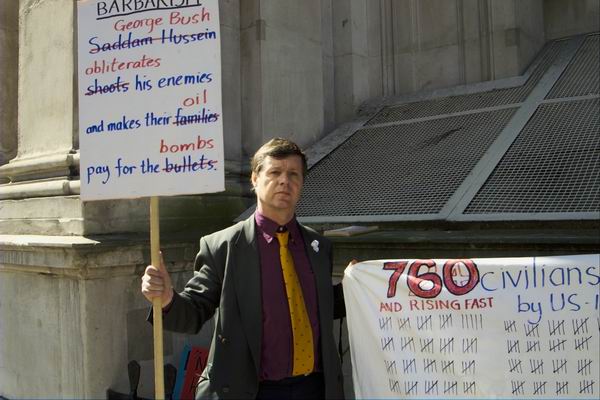
I walked to the march past the Houses of Parliament and a small group of protesters in Whitehall who were pointing out the number of Iraqi civilians already killed by the allied forces.

The main thrust of the demonstration now was that the civilian population of Iraq should be respected. The use of weapons such as depleted uranium shells and cluster bombs will mean the deaths continue for generations after the end of the fighting.

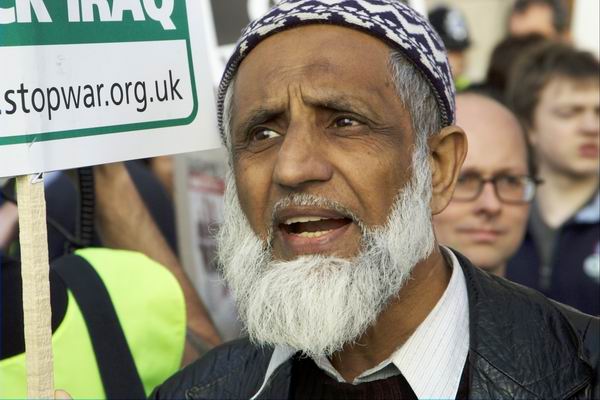
The march started opposite the old BBC building in Portland Place and went to Grosvenor Square, close to the US Embassy. There were perhaps five thousand marchers, and several hundred police surrounding them most of the time. As the speakers pointed out, it was difficult not to see the war as a US takeover of the country when plans were already in place for Americans to run the country after the war.

The killing of Iraqis must stop, and rapid progress should be made to hand control of the country back to its people.