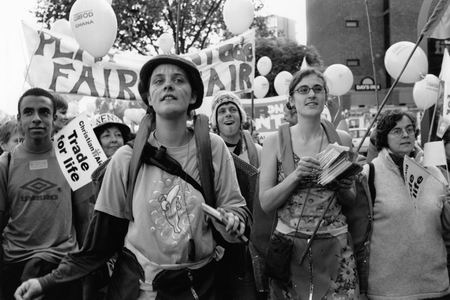
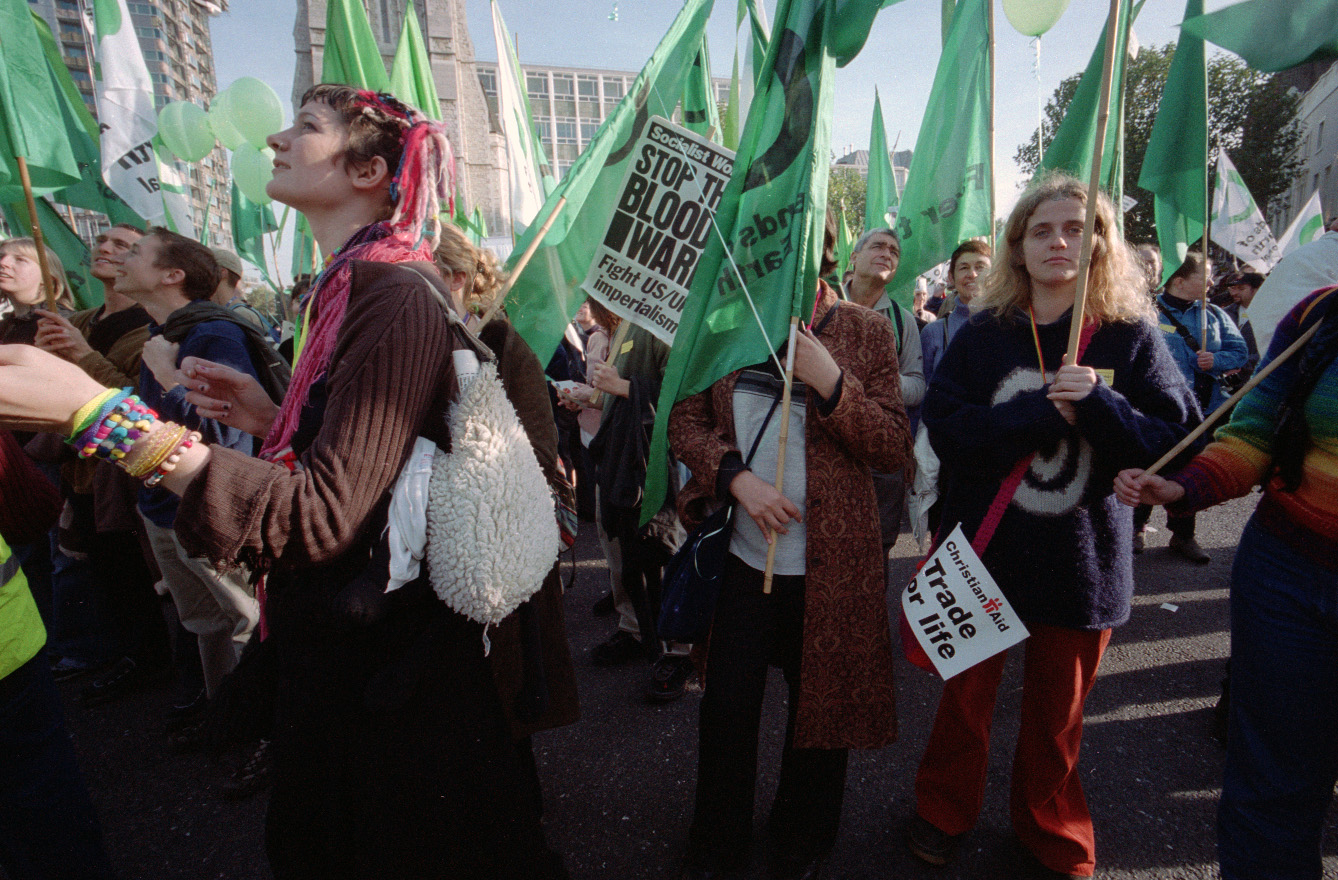
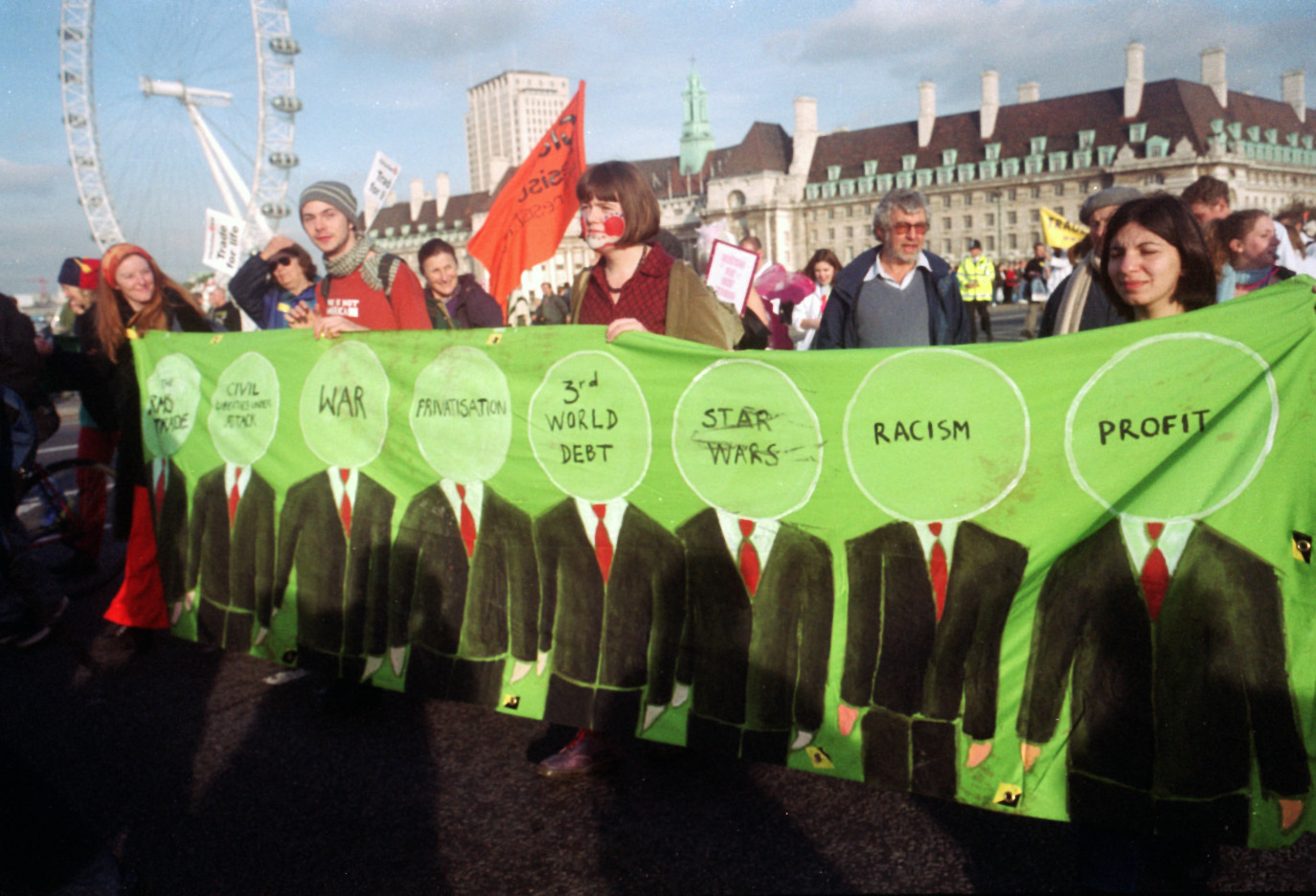
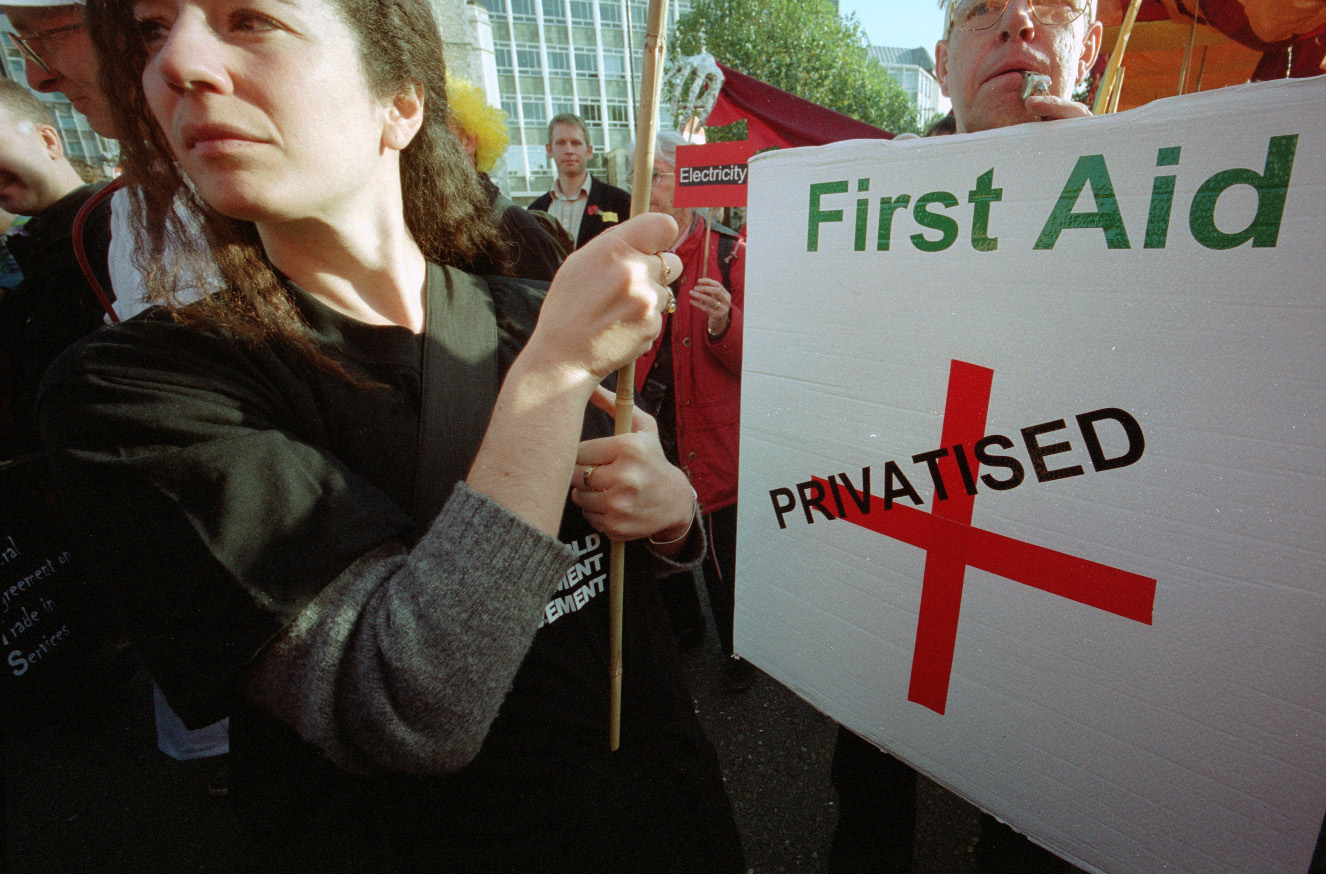
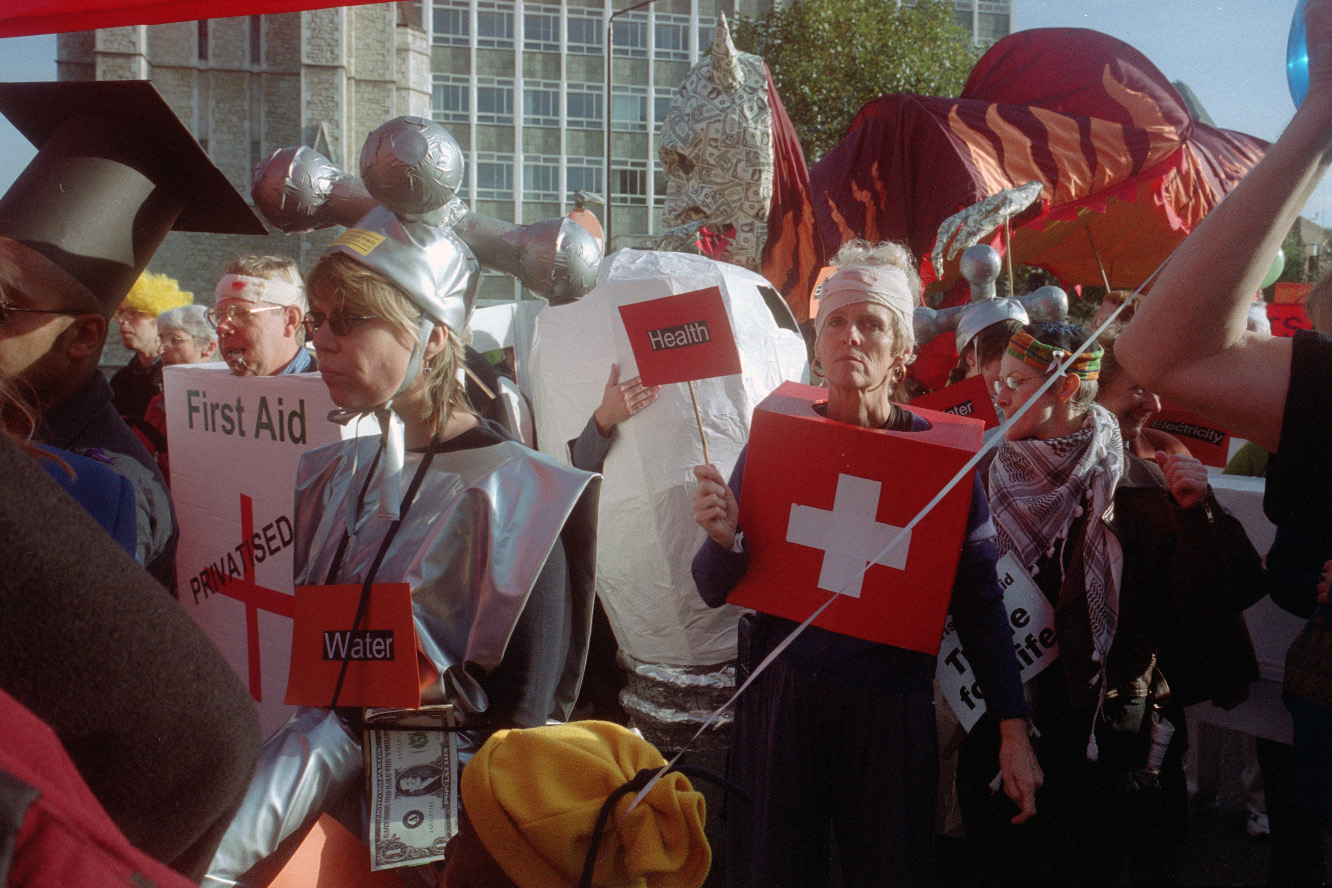
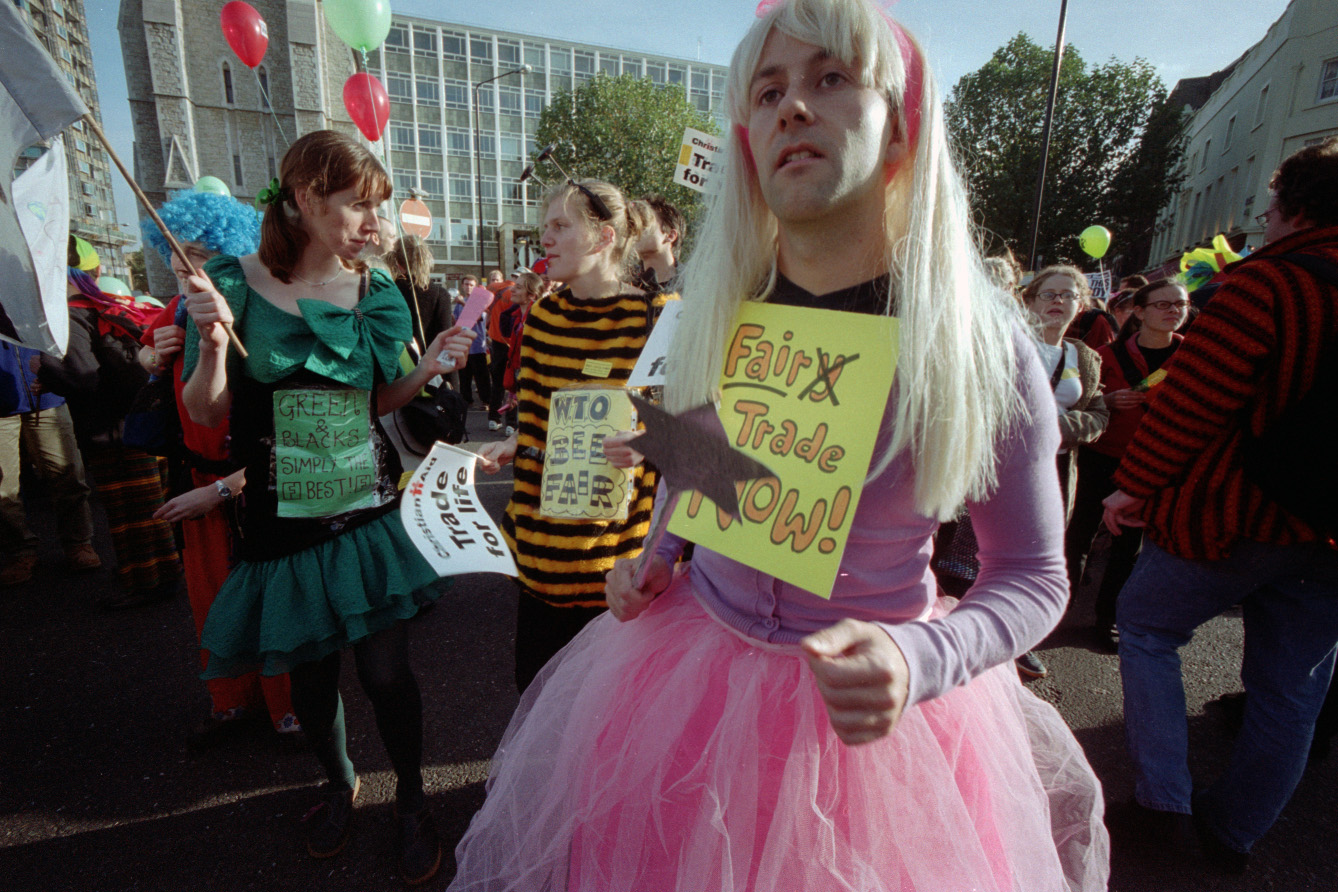
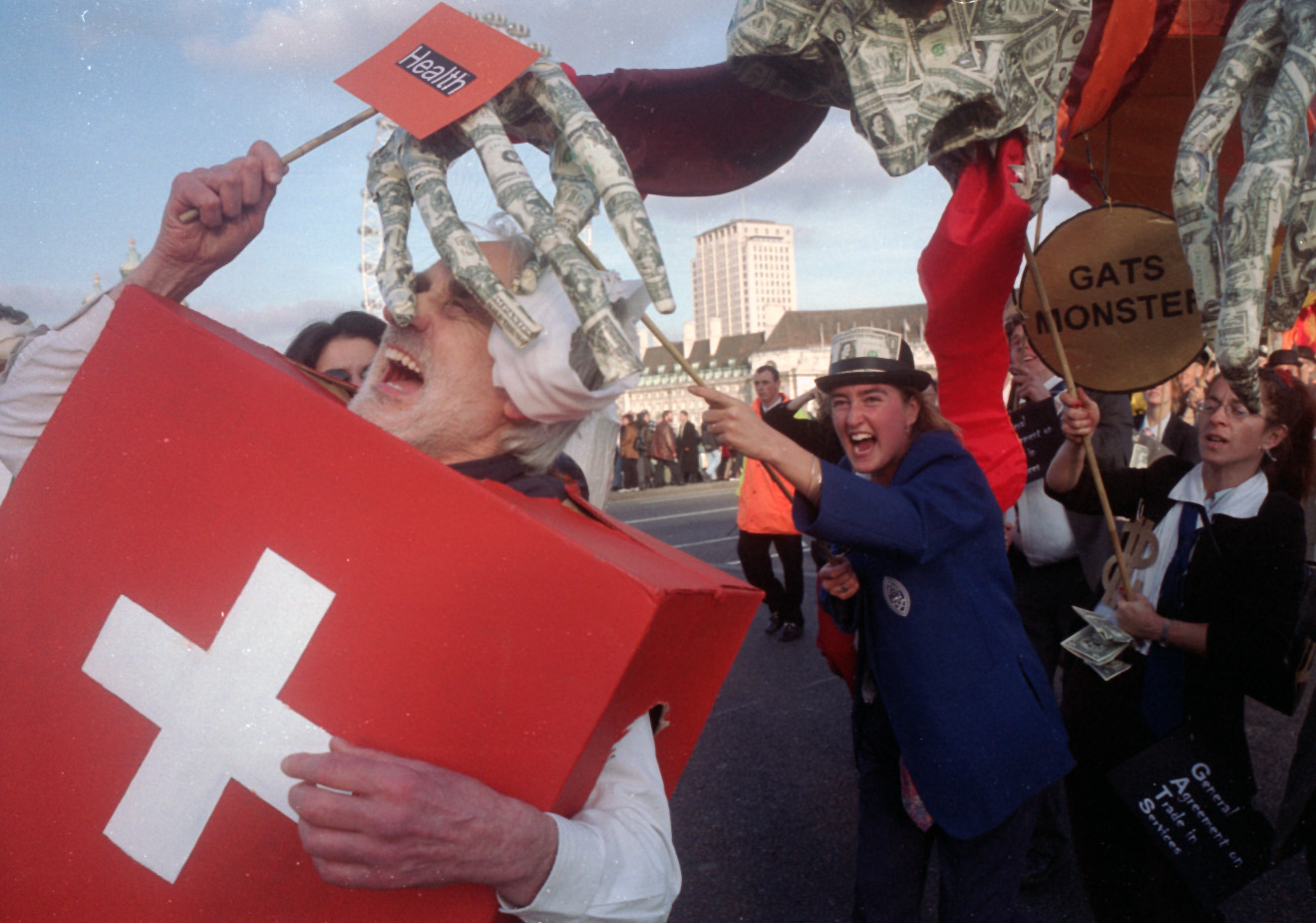
Trade Justice Parade: The Trade Justice Parade on Saturday 3rd November 2001 was one of the early events I put on My London Diary, but then I only posted two photographs from it along with a short text. The pictures there were in black and white although I had taken both in colour.
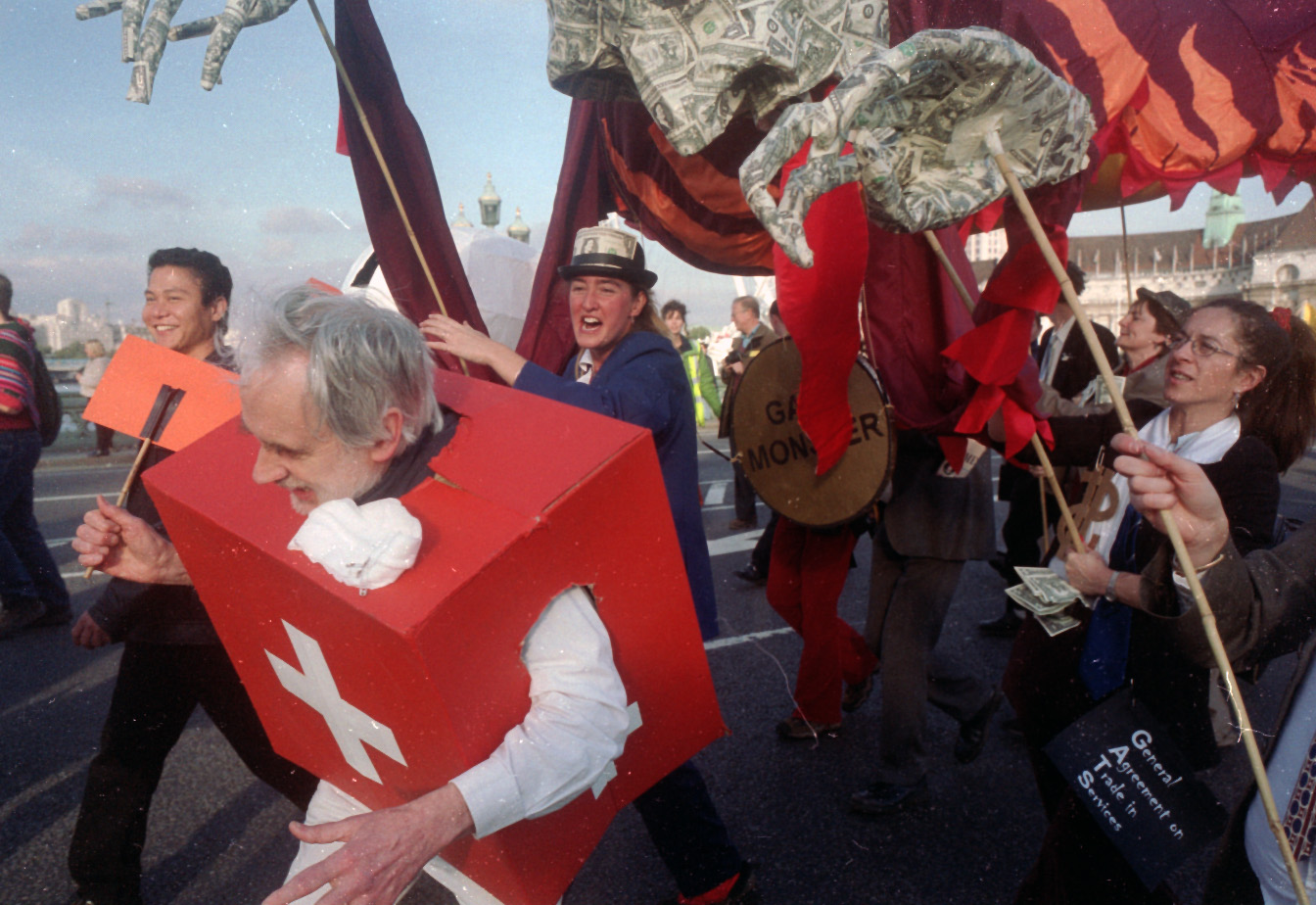
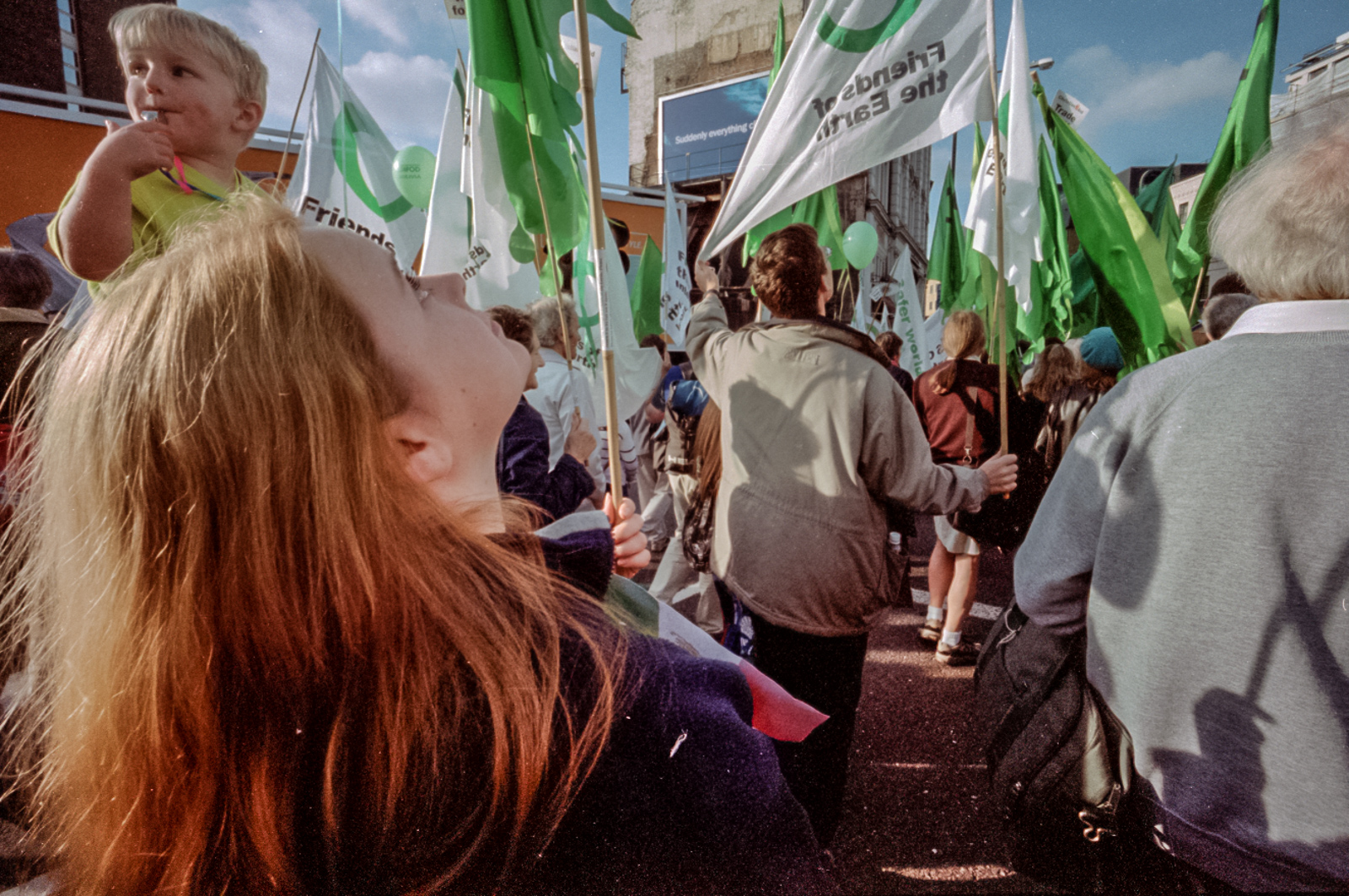
The images were also rather small, and here I’ll upload some larger versions of a few others that I took at the event. A wide range of organisations took part, calling for changes in trading arrangements in the world to make trade fairer for countries in the majority world. Agreements such as GATT, the post-war General Agreement on Tariffs and Trade and the World Trade Organisation had worked well for the richer countries and for multinational companies but had led to a situation where many poorer countries were making huge debt repayments, often greater than the international aid they were getting.
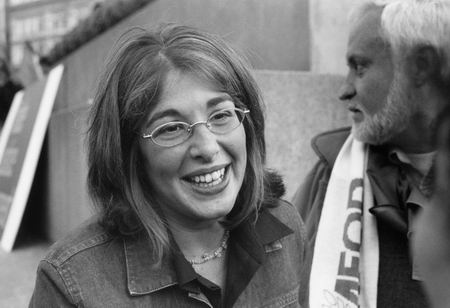
Naomi Klein and Sergio Cobo, Trafalgar Square, 3 Nov 2001
The protest gathered south of the river in Geraldine Mary Harmsworth Park next to the Imperial War Museum and marched across Westminster Bridge and up Whitehall to a rally in Trafalgar Square. Back in 2001 I could only make some rather small and poor colour scans, but I’ve tidied these up a little and will post some here, along with the two black and white images. I hope soon to get around to re-scanning my colour images from the early years of this century at high resolution.
Here is the short piece I wrote on My London Dairy back in 2001:
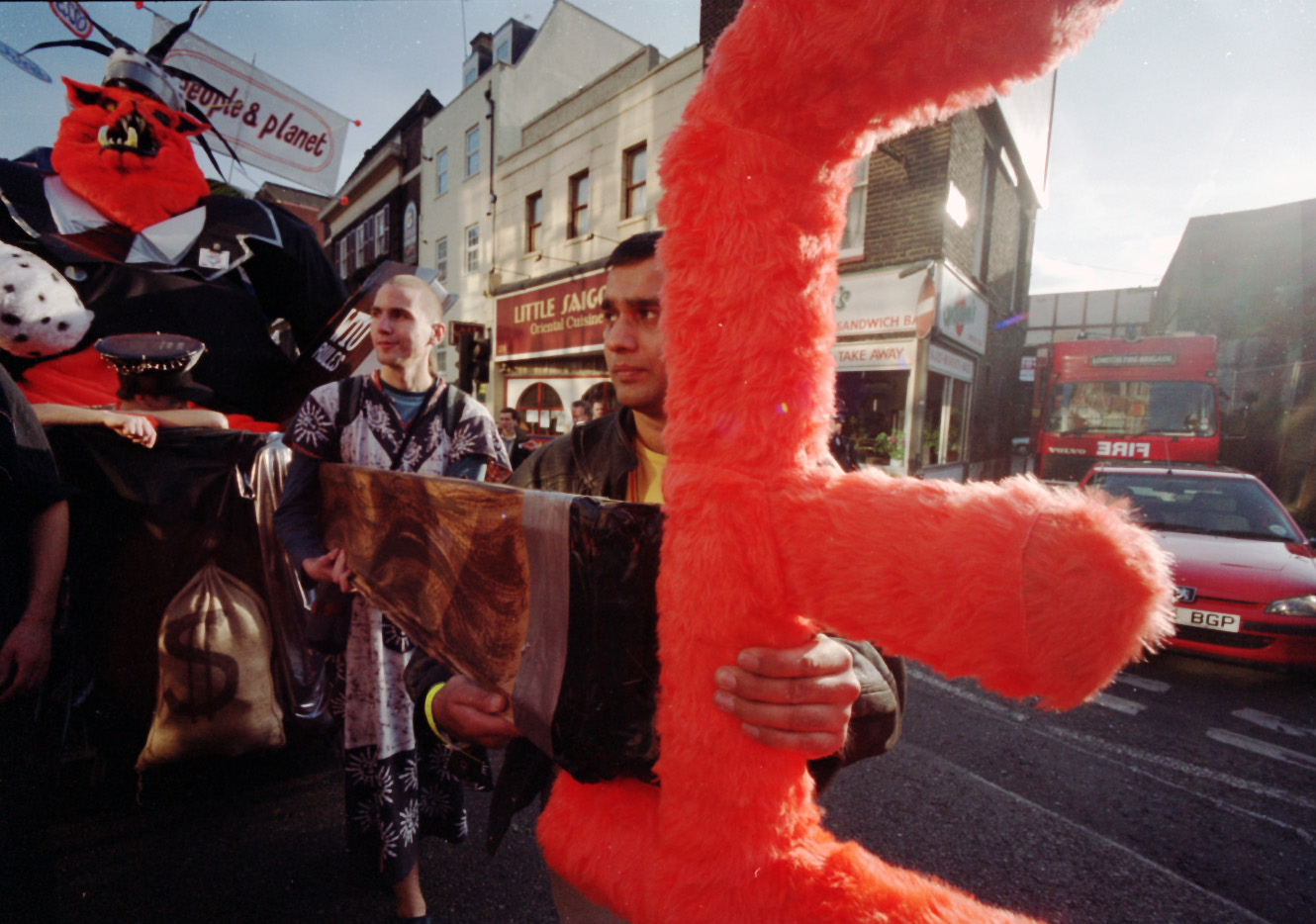
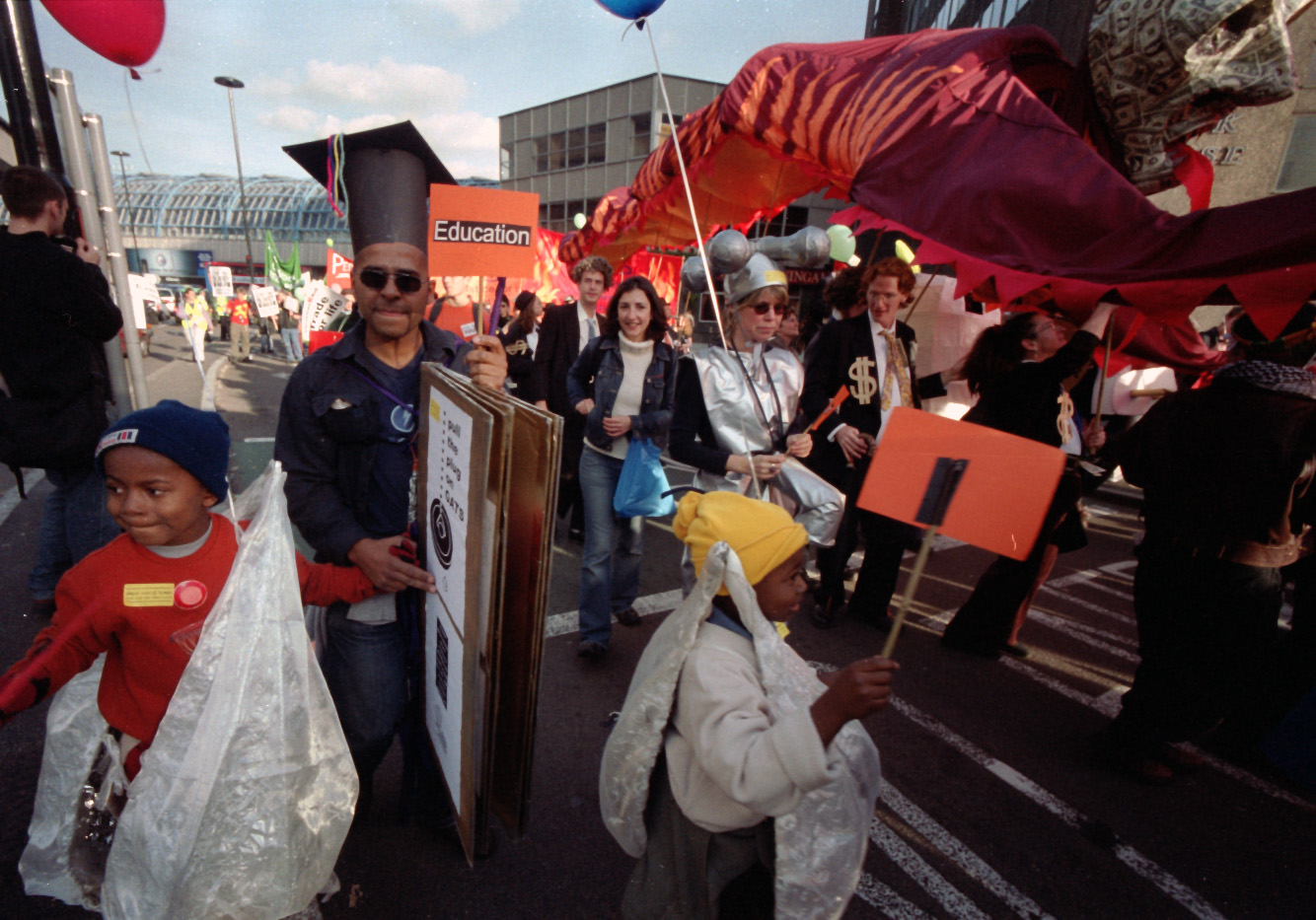
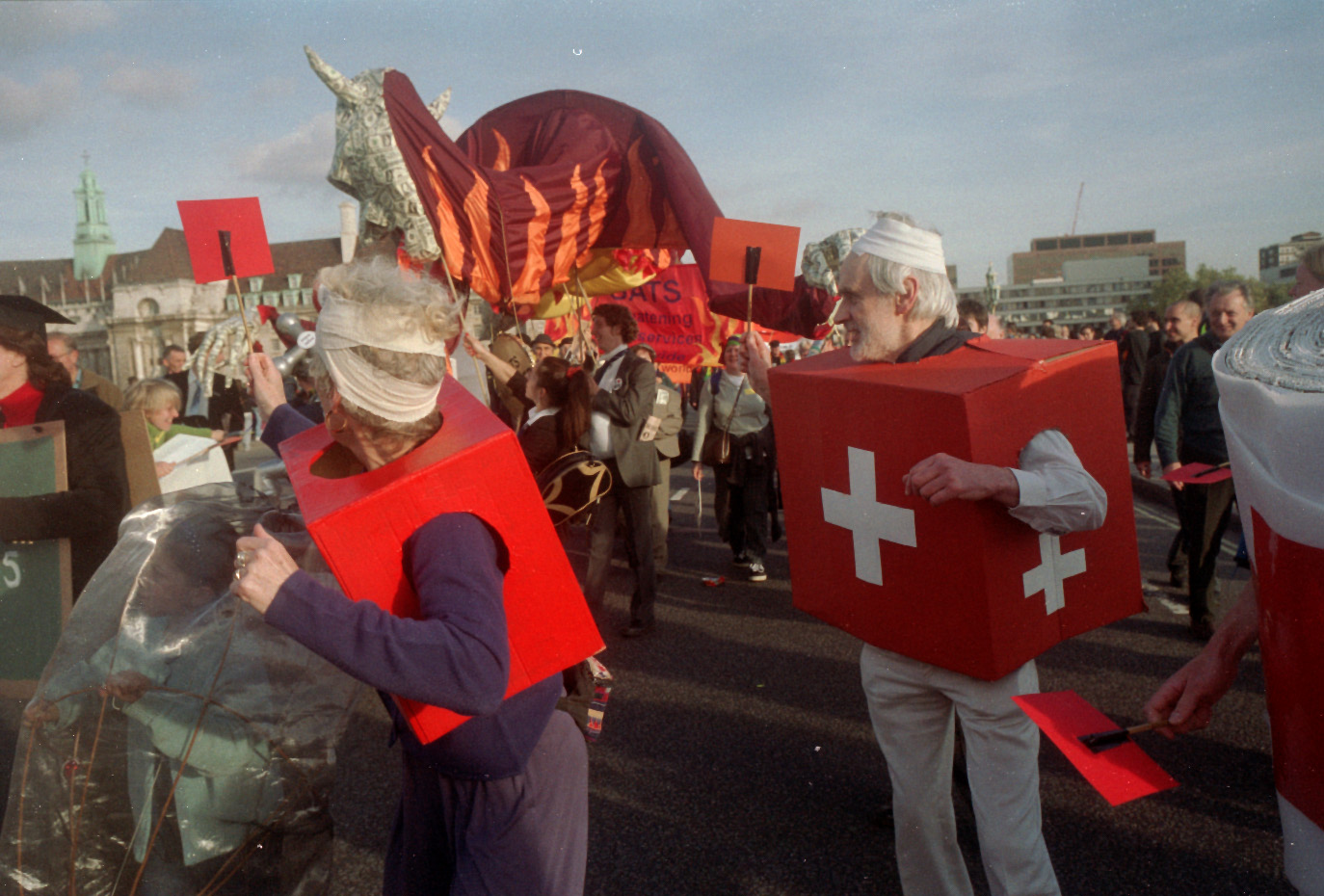
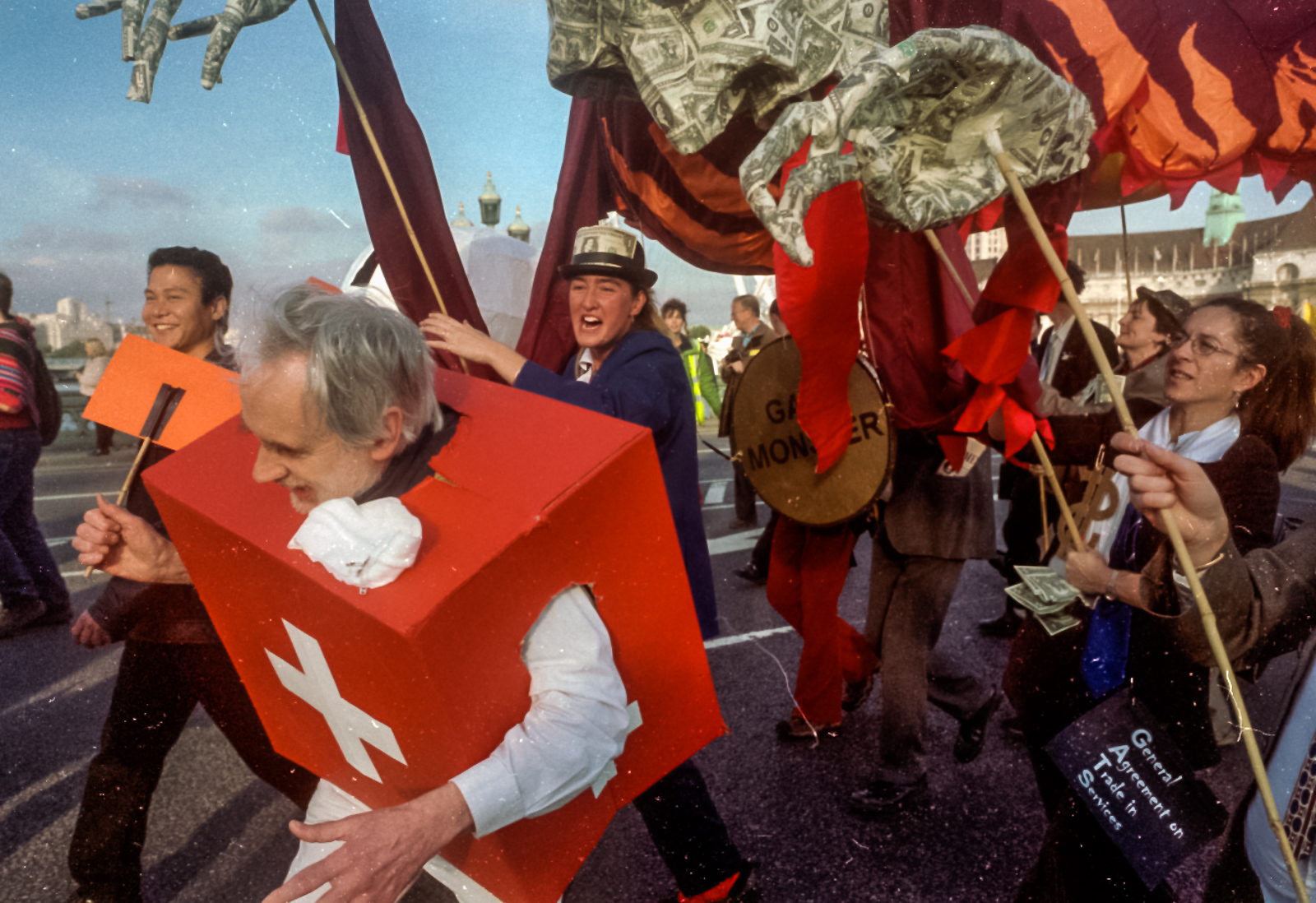
The Trade Justice Parade was a serious event but also we were having some fun. The World Trade Organisation isn’t at all amusing, but i loved the t-shirt that said ‘WTO – unsuitable for anyone with a conscience’.
Giant pound signs, balloons, a huge fat cat, the WTO dragon, pirates and everyone made it an event to remember.
Speakers included Naomi Klein (author of ‘No Logo’) and Sergio Cobo from Mexico
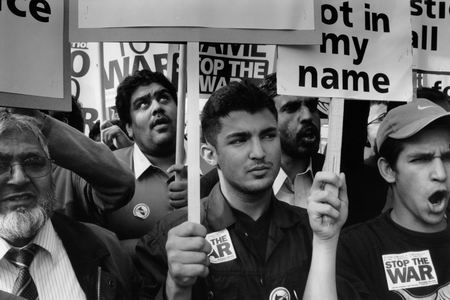
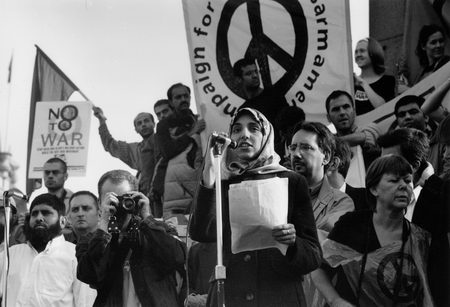
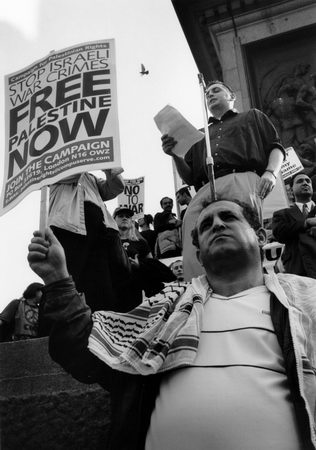
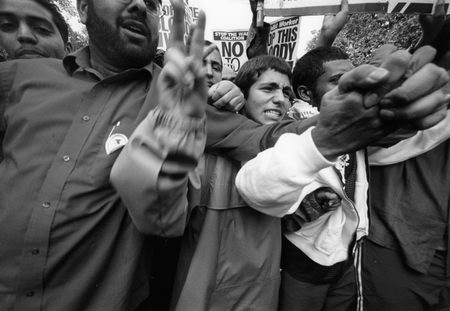
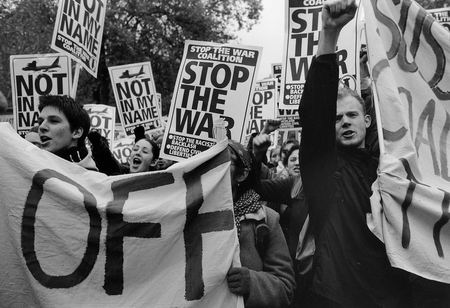
Stop the War March: The Stop the War march in London on Saturday 13th October 2001 was the first protest where I put more than a handful of pictures on My London Diary. They were all black and white, although I took pictures in colour as well I didn’t at the time have any way to produce good quality digital images from the negatives.
Trafalgar Square
I printed some of the black and white images in the darkrom and took 10x8s to a picture library and a few have been published in print since then, but the colour negatives simply went into my files, though I usually made contact sheets or, if the film was trade processed, got enprints.
The black and white pictures I put on My London Diary at the time were usually scanned from prints made in the darkroom, scanned using a black and white flatbed scanner. It was only later that I got a decent film scanner and a colour flatbed. The main commercial demand for work was still black and white – though I made many colour prints in my darkroom. And because most people then still accessed the internet through slow dial-up connections, I posted images on line at small sizes and greatly compressed – these image files are only 20-40 Kb each, while now I might post files 50 times larger.
Free Palestine
A little over a year after taking these pictures I got my first digital camera capable of professional work, though I’d been playing with consumer digitals for several years. The move to being completely digital took me a few years, mainly because I had specialised film cameras that could let me work in ways that were not then possible with digital.
I didn’t in 2001 write anything directly about these pictures, or about the protest which was against invading Iraq, one of a whole series by Stop the War I photographed. The only major London protest against the Iraq invasion I missed was the huge one in February 2023, when I had only come out of hospital the day before and was still too weak to work.
But the US decision to invade Iraq – already actually made when this protest took place although the invasion only took place in March 2003 – was a response to the September 2001 attacks by Al Queda when two planes were flown into and destroyed the Twin Towers in New York.
I was in 2001 working for a New York based web site, though writing my content here in England. I was also teaching part-time and had ended a lesson and was getting ready to leave for home when a distressed colleague in tears called me into her office and we watched together as the attack unfolded on the news on her PC. She had lived and worked in New York not far from where it was taking place.
Just over a month later, with these pictures I posted some of my thoughts. I had earlier written about the photographs of the events in a feature which had attracted over a million views on-line overnight. The pictures and videos taken by people as they fled down the stairways or watched in shock from outside had a raw power that was often enhanced by their flaws. Anyway, here is what I wrote in 2011, which I think is still relevant.
September 11 actually had a serious impact on my work. Most of the people who read my features are in the USA and I had to think carefully about what to do. I was asked to write a piece about the photography of the event and spent a long time looking at the pictures and writing.
Justice is perhaps the most important of concepts to get to grips with. I have a firm belief that in a just society things like the WTC horror would not happen. I’m not a pacifist – I think there are times when non-violence is an effective tactic and other occasions where it just will not work. However I think that there were many more avenues to be explored before anyone could be justified in starting a military attack. Not only is the actual attack likely to be counter-productive, but it will result in the USA and its allies taking their eyes off the real ball.
And that is not in Afghanistan but in the Middle East, in Jerusalem and in Gaza.
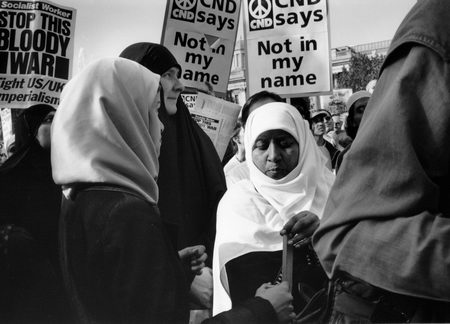
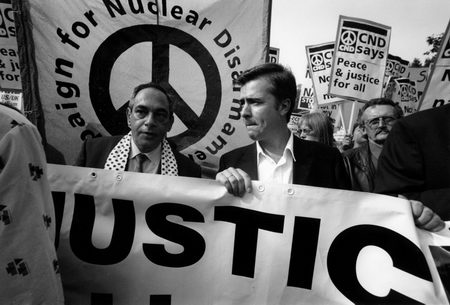
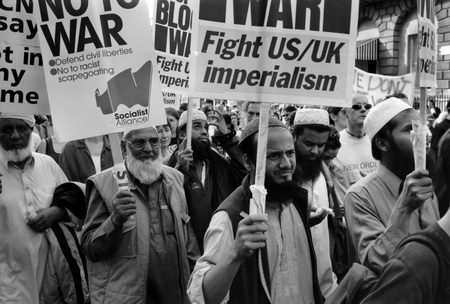
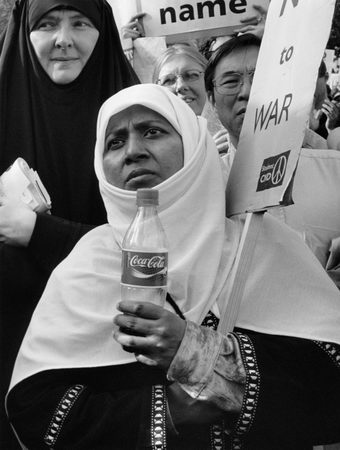
Stop The War March: Although I’ve usually posted events from the past on the actual anniversary, this post comes a day late as by the time I remembered this I had already written a post for yesterday. So although I’m publishing this on 19th November, the march organised by Stop The War took place on November 18th 2001. It was a large one, although as I wrote the reports by police severely under-counted the numbers taking part.
The Stop the War Coalition had been founded in September 2001 in the weeks following 9/11 after George W. Bush had announced the “war on terror”. At first its protests were mainly directed against the war in Afghanistan, but later it opposed the the US-led military invasion of Iraq and since then has campaigned against other wars against Libya, in Syria and elsewhere.
In recent years it has been one of the groups involved in the many protests, small and large against the genocide taking place in Gaza along with CND and the Palestine Solidarity Campaign.
I had covered their first major march by Stop the War in October 2001 and have continue to photograph many of their events to the present day, though for medical reasons had to miss the largest public demonstration in British history on 15th February 2003 shortly before the invasion of Iraq on 20 March 2003.
Back in 2003 the coalition was a huge one. Wikipedia states “Greenpeace, the Liberal Democrats, Plaid Cymru and the Scottish National Party (SNP) were among the 450 organisations which had affiliated to the coalition, and the coalition’s website listed 321 peace groups.”
The Socialist Workers Party has always played a leading role in Stop the War and the Muslim community has been important from the start with the coalition recognising “a war against Afghanistan would be perceived as an attack on Islam and that Muslims, or those perceived as being Muslim, would face racist attacks in the United Kingdom if the government joined the war.” The Muslim Association of Britain was closely involve in organising this and other protests.
In 2001 I was still photographing using film, both black and white and colour, and all of the pictures I contributed to picture libraries were in black and white, as are those on My London Diary. Back then the demand from newspapers and magazines was still mainly for black and white and was still reproduced largely from prints.
Occasionally I would print images taken on colour negative as black and white prints to submit but mainly I had sufficient pictures taken as black and white. There are some people who now convert their colour digital images into black and white, feeling I think that it somehow makes them more ‘authentic’. It does occasionally make images stronger but mostly it simply makes them less descriptive and often confused.
Below is the post I wrote for My London Diary. It says nothing about why the protest was taking place, which would have been obvious to viewers at the time that it was against the war in Afghanistan.
“November 18 we were back again marching to stop the war. Two hours after the march started there were still marchers leaving Hyde Park, and we were getting messages that Trafalgar Square was full. The police estimate of 20,000 was pathetically low and even the organisers’ figure of 50,000 might have been on the low side. It’s always difficult to count such things (I usually give up counting around the one thousand mark when I’m covering demonstrations and make a guess above that, but this was certainly on a similar scale to the countryside march which is the largest event in recent years.
The march was more split up into factions than most, although the start was fairly mixed. There were large organised male and female sections of Muslims for Justice in the middle of the march and a big group of younger marchers, including anarchists, towards the end. Actually I didn’t manage to see the end of the march, and people were still arriving in Trafalgar Square when I left.”
Twenty years ago today on 3rd November 2001 I wrote:
the trade justice parade was a serious event but also we were having some fun. the world trade organisation isn’t at all amusing, but i loved the t-shirt that said ‘wto – unsuitable for anyone with a conscience.
giant pound signs, balloons, a hug fat cat, the wto dragon, pirates and everyone made it an event to remember.
speakers included naomi klein (author of ‘no logo’) and sergio cobo from mexico.
And with the article I posted the two black and white images shown here. But I think most of the pictures I took of the parade were in colour, taken on colour negative film. But the only work I was putting in to a picture library back then was in black and white – and then still 8×10″ prints. There was still greater demand for black and white, and some of the pictures I took in colour I printed as black and white. The library would have taken colour, but mostly they worked with colour transparencies.
But I had recently bought a scanner with which I could scan colour negative film and it had software that could produce positive results with something like the correct colours. The results were not great and seemed to accentuate the faults in the negatives and exaggerate flare. The results were certainly not of professional quality as you can probably see – even after I have improved the pictures in Lightroom.
A year after I made these pictures I bought my first DSLR and things changed, though it took a while for the library and some other outlets to shift to accept digital files, and for a little while I was still taking black and white film for the prints they wanted as well as digital colour. But things changed quite rapidly to an all-digital world.
Going back to the negatives I’m sure I could now make much improved digital versions than these by ‘camera scanning’ – using a DSLR to photograph them and then Negative Lab Pro software to convert them to positives. It’s good news for those of us with archival material on colour negative film. But I can see no reason at all for wanting to take film again when digital produces so much better results with much less hassle.
The issues people were protesting about in the Trade Justice Parade are still very much with us – and in the UK the government last week passed yet another act hastening the privatisation of our NHS, while many of the same issues that were brought up by the protest are behind the failures to deal effectively with climate change. The huge greed for consumption and wealth of a small minority of the ultra-rich underlie both; they are not ‘high net worth’ but ‘high global liability.’
September 11th 2001 was a Tuesday and I had been teaching all morning and was picking up my bike from where I kept it safely in the caretaker’s store to go home just before 2pm when a colleague who had previously lived in New York came in extremely agitated to break the news to me of an attack on the World Trade Center there. I rushed with her to her office a short way along the corridor and watched with her the news unrolling on the screen of her desktop computer, sharing her horror.
American Airlines flight 11 had been piloted into the north tower at 8.46am, and while we were watching news came through of the second plane, United Airlines flight 175 hitting the south tower at 9.03am.
I was then as well as a little part-time teaching working full-time as a freelance providing content about photography for an American web giant and knew that I had to find out more and particularly more pictures and write about the event. I cycled home, switched on my computer and started searching, not the news agencies and papers but for first person accounts and photographs by those who had been inside or close to the twin towers when the planes hit.
Social media was very much in its infancy in 2001, but I knew that people would be posting their experiences and some photographs in various forums on line, and I was soon able to find some. Normally I would have contacted people and asked for permission to use their images and text, but there wasn’t time for this, and I mainly linked to their posts with just short quotes and wrote about the pictures in these.
It was the first major news event where most of the immediate content was posted by the people involved, citizen reporting. Most of the pictures were snatched on phones and their blurred and poorly framed images gave them an authentic quality that more professional results would have lacked, rather like those ten or eleven frames snatched by a shaking Robert Capa lying cold and wet on a Normandy beach.
I don’t think the post I made a few hours later has survived – at least I can’t find a copy of it, but I doubt if it was one of my better written or more interesting pieces. But however ephemeral it did meet the occasion and within 24 hours had been read by over a million viewers, more than ten times my normal viewing figures, and the biggest immediate response of anything I wrote in the seven years I worked on the site.
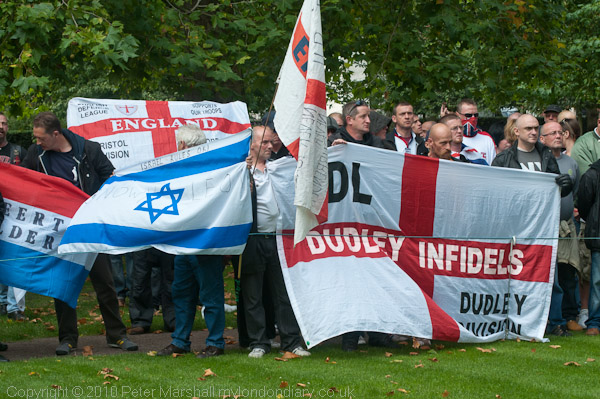
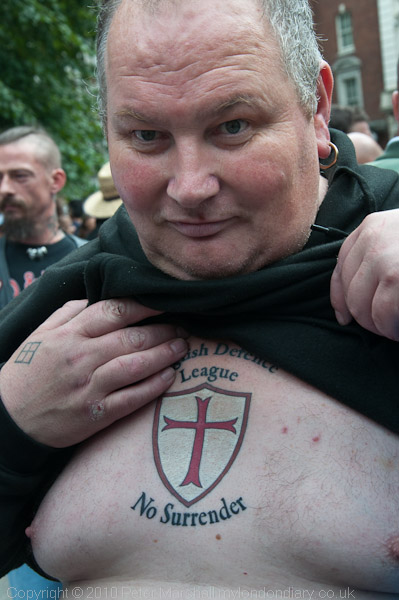
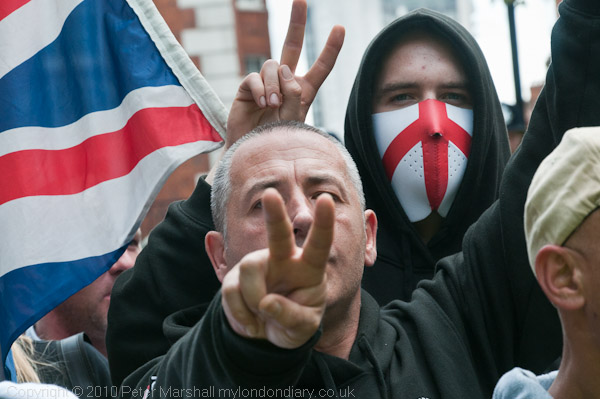
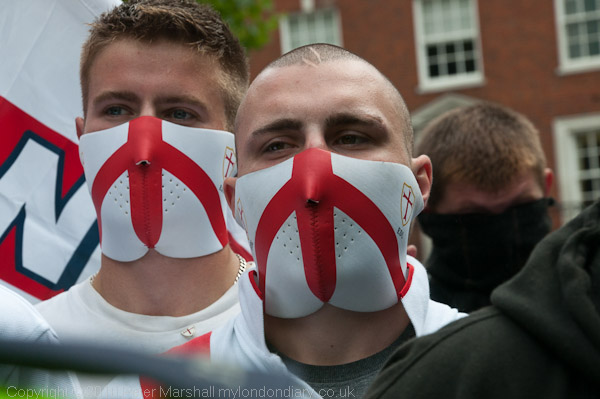
The EDL returned to protest against the Muslims and the press.
This year, 20 years on, there are going to be plenty of films, TV programmes and magazine and newspaper articles about 9/11 and still a few clinging to the discredited conspiracy theories that quickly sprung up around it. But there seem to be few if any live events taking place in London to remember those who died other than a private gathering for families who lost relatives on Saturday 11th.
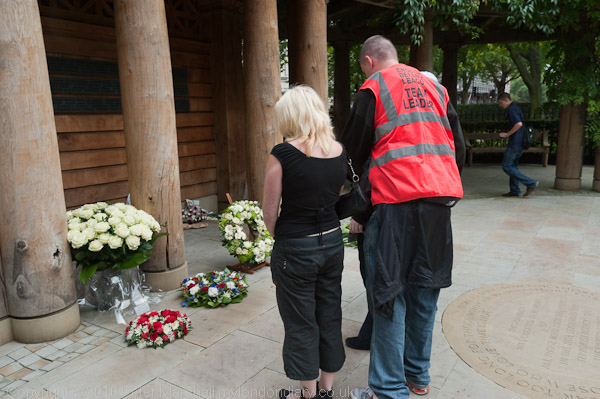
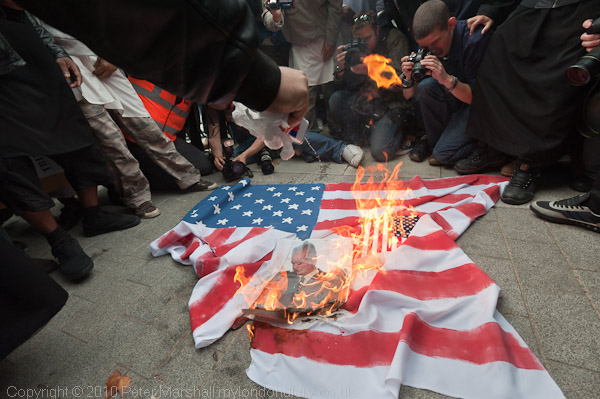
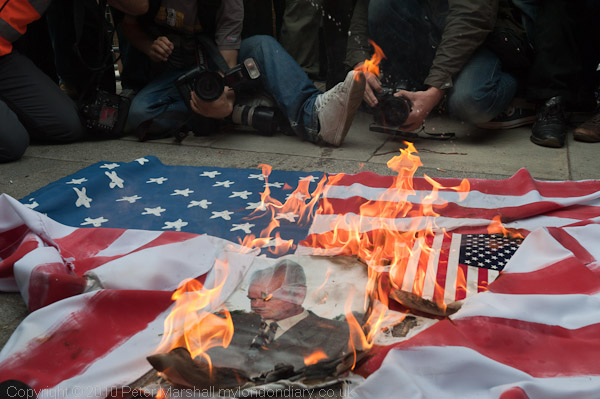
In 2010 the event became controversial when both the EDL and Muslims Against the Crusades decided to remember it. The EDL came first, marching to pay their respects to those killed on 9/11 at the Grosvenor Square memorial, going on for a brief stop at the American Embassy before going on to protest at the Saudi Embassy.
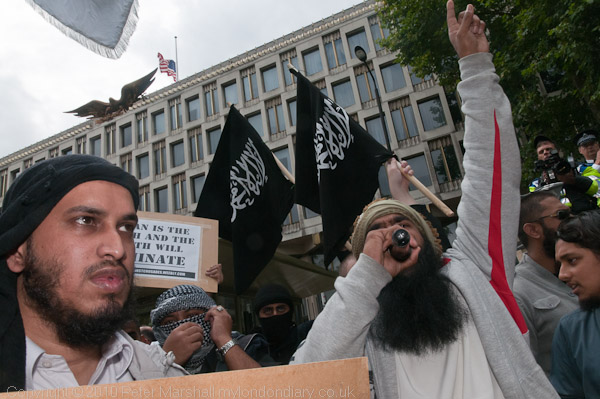
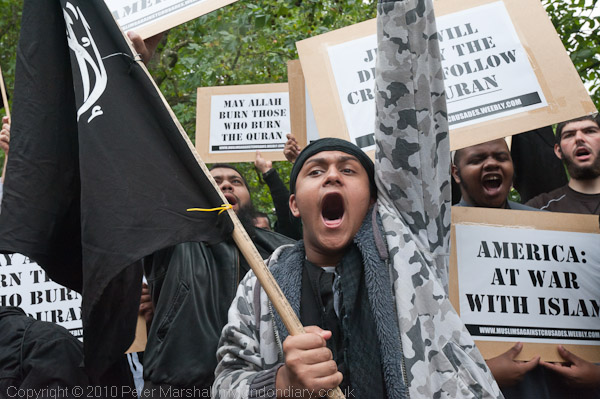
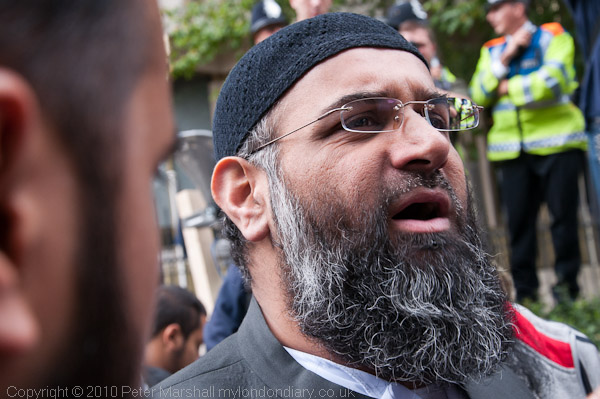
Later in the day around a hundred extremist Muslims from Muslims Against the Crusades, a fringe group led by Anjem Choudary, arrived at the US Embassy. As a response to Florida pastor Terry Jones’s threat to burn the Qur’an on the anniversary of 9/11, they had called for the day to be made ‘International Burn The American Flag Day’ and for groups around the world to burn the US flag, which they see as a symbol of unbelief and of war – military, ideological, social and economic – against the Muslim religion. I don’t think anyone else followed there lead and they found the flag hard to set alight despite lighter fuel being poured on it.
The EDL came back to shout and threaten the Muslims, but fortunately police were able to keep the two groups apart. I’m still unsure why Choudary was allowed to carry on his activities for so long without arrest, but the suggestion that he was used by MI5 to attract Muslim extremists so they could be easily identified seems likely.
All photographs on this and my other sites, unless otherwise stated, are taken by and copyright of Peter Marshall, and are available for reproduction or can be bought as prints.