Netanyahu’s visit – 2015

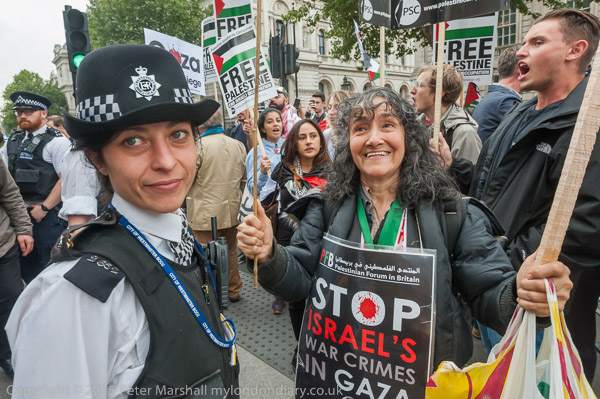
Around a thousand people came to protest against the visit to Downing Street by the then Israeli Prime Minister Benjamin Netanyahu, and several hundred came to oppose the protest and support Israel. Police struggled to keep the two groups apart.
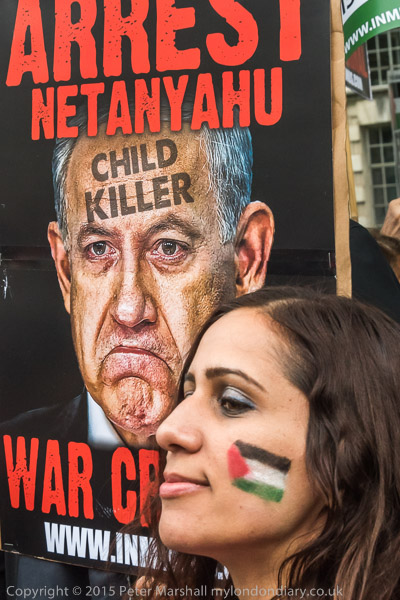
The larger group said the Netanyahu should be arrested for war crimes in the attack on Gaza last year. Many refused to go into the penned area on the opposite side of Whitehall that police had designated and it was probably too small for all of them.
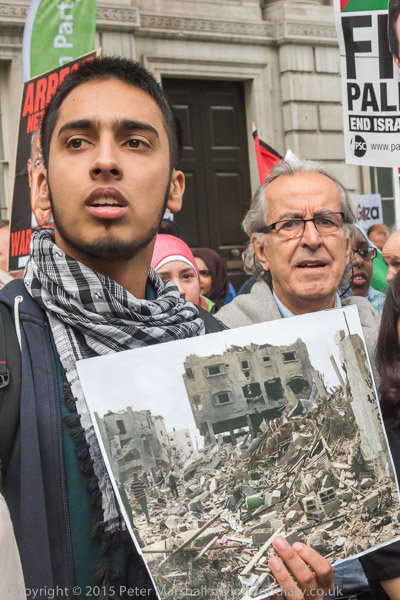
Police tried to persuade them to get off of the roadway and back onto the pavement, but were eventually overwhelmed and the protesters moved across the road to the pavement in front of the Downing St gates.
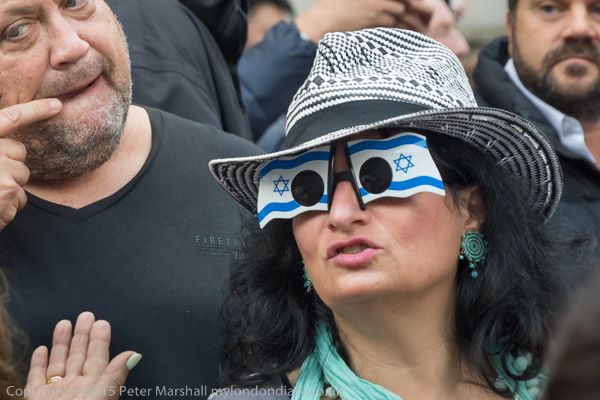
Some of the pro-Israeli protesters then moved out from their pen, and for some time the two groups faced each other across the fairly narrow way into Downing Street that police managed to keep clear. A few protesters from each side were arrested and led away, mainly when they argued aggressively with police or their opponents.
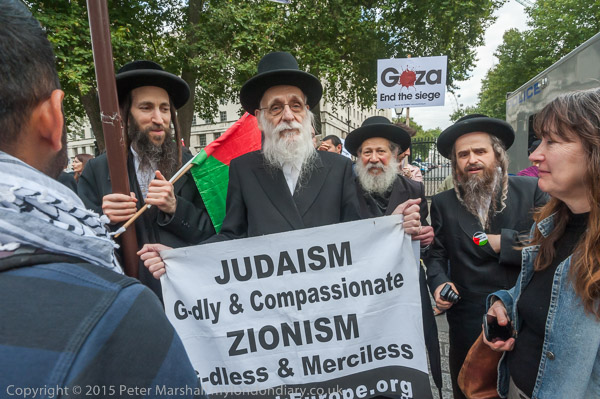
Among the protesters against Netanyahu and calling for freedom for Palestine there were as usual both Palestinians and Jews; later a group of Neturei Karta arrived, having walked from North London to join them. These ultra-orthodox Jews support Palestine and are opposed to any political state of Israel on religious grounds. One of their banners read ‘JUDAISM – G-dly & Compassionate – ZIONISM G-dless & Merciless’.
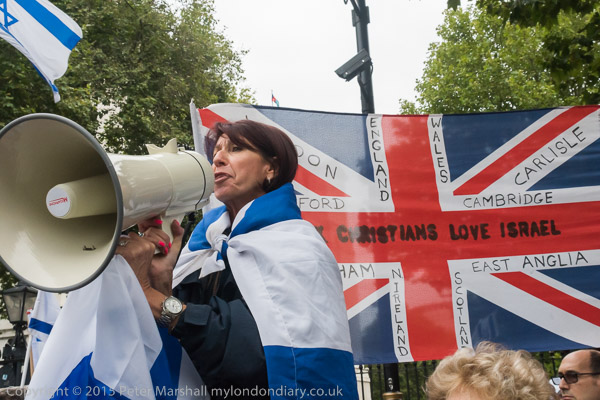
The supporters of the Israeli state included a number of right-wing Christians who came with a Union Flag with ‘UK Christians Love Israel’ on it. Like Neterei Karta they are only a small and unrepresentative group.
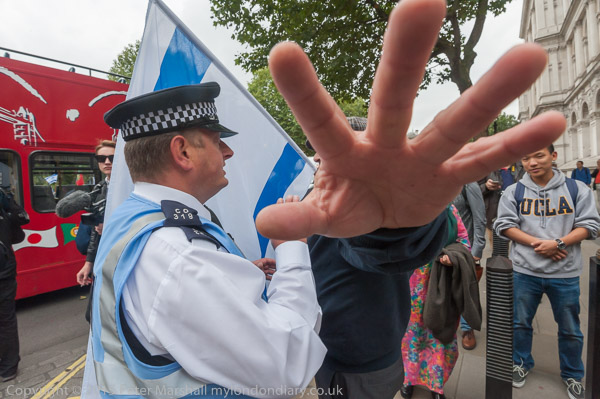
Some of the pro-Israel demonstrators were reluctant to be photographed and complained to police about photographers as well as about the other protesters who they felt police were failing to control. One man stretched out his hand to cover my lens – so of course after photographing that I made sure that I took his picture and you can see him on My London Diary.
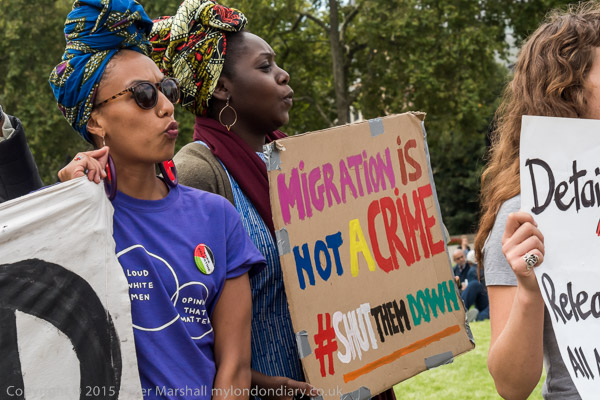
The protest was still continuing as I left to photograph another event nearby, though I suspect that Netanyahu had already arrived and been taken inside by a back entrance. Movement for Justice were in Parliament Square calling on MPs to support the proposals of the detention inquiry. They want an end to detention, fast track and immigration raids, the opening of the Calais border and an amnesty for migrants. Many of those taking part were asylum seekers who had been subjected to indefinite detention in UK detention centres after making their asylum claims.

Fight immigration detention MfJ tells MPs
Support for Israel & Netanyahu
Netanyahu visit protest – Free Palestine
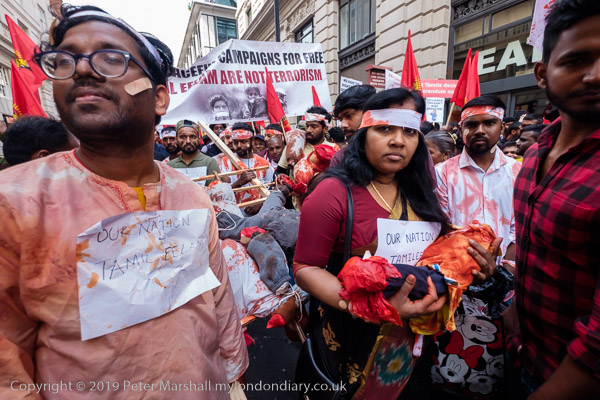
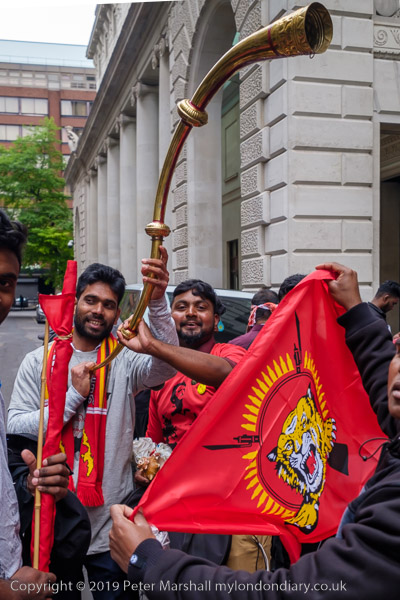
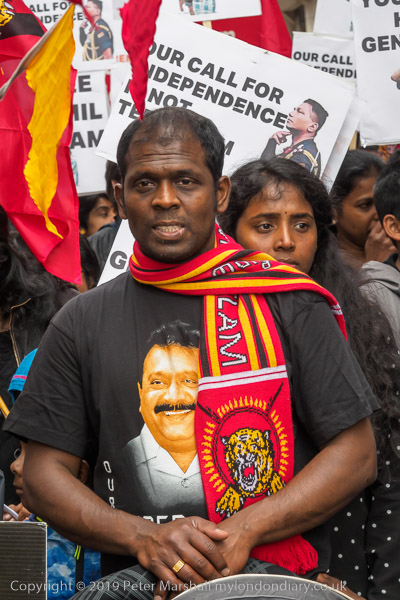
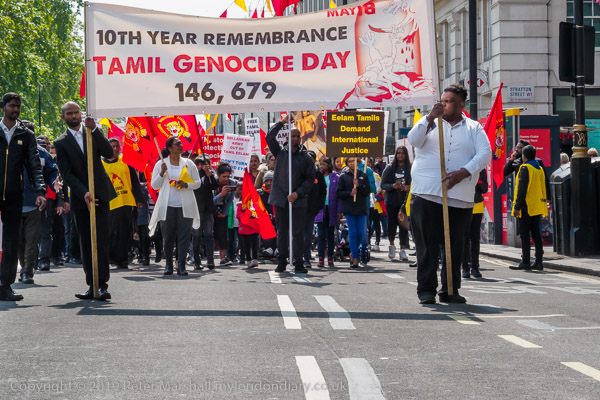
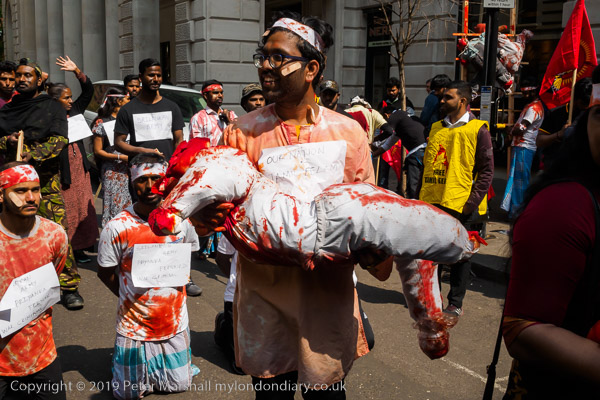
Tamils remember Mullivaikkal massacre

The British colonised Ceylon and in the nineteenth century it was a major source of coffee grown on British owned plantations. When the coffee crops began to fail, efforts were made to replace coffee by tea plants and seeds from Assam in India. Although at first this was unsuccessful, by the end of the nineteenth century tea had replaced coffee as the major export crop.

Sri Lankan Tamils had lived in parts of the island since at least around the 2nd century BC, but the tea plantations imported Indian Tamils to the hill areas in large numbers. Following independence in 1948, the Sinhalese-led government deported large numbers of the Indian Tamils and also made life difficult for the Sri Lankan Tamils, severely limiting employment opportunies, suppressing their culture and encouraging anti-Tamil riots, leading to the start of a civil war in 1983.

One-third of Sri Lankan Tamils now live outside Sri Lanka, the largest group, around 300,000, being in Canada.  There are thought to be between 100,000 and 200,000 British Tamils living in the UK, the figures vague as Tamil was not one of the ethnic groups listed in the UK census, though people could write it in.

Over 70,000 Tamils are thought to have been killed in the earlier phases of the Sri Lankan Civil war, but it came to a particularly disastrous and bloody end in 2009, on a small strip of land at Mullivaikkal, where 40,000 Tamils, around half of them civilians, are thought to have been killed, mainly by shelling by Sri Lankan government forces in what they had designated as a ‘no-fire’ zone, but some by the Liberation Tigers of Tamil Eelam (LTTE). The numbers are highly disputed, with huge variations between government and Tamil sources, but there is no doubt that it was a massacre on a terrible scale. According to the Tamil Guardian:”

After providing an initial death toll of 40,000, the UN found evidence suggesting that 70,000 were killed. Local census records indicate that at least 146,679 people are unaccounted for and presumed to have been killed during the Sri Lankan military offensive. “

May 18th, the date on which this protest took place is widely marked as Mullivaikkal Genocide Remembrance Day

The protest I photographed included some graphic re-enactments of shooting (though only with crude wooden guns) and many people with bandages and fake blood, giving plenty of photographic opportunities. And unsurprisingly, feeling run high. Tamils want Sri Lanka to face prosecutions by the International Criminal Court for war crimes and a referendum in Sri Lanka to lead to the setting up of an independent state, Tamil Eelam.

More on the protest: 10 Years since Mullivaikkal massacre
A week earlier I photographed a group of Tamils at Downing Strike begining a week of hunger strike for their demands:
Tamil Genocide Hunger Strike


All photographs on this and my other sites, unless otherwise stated, are taken by and copyright of Peter Marshall, and are available for reproduction or can be bought as prints.

There are no adverts on this site and it receives no sponsorship, and I like to keep it that way. But it does take a considerable amount of my time and thought, and if you enjoy reading it, please share on social media.
And small donations via Paypal – perhaps the cost of a beer – would be appreciated.


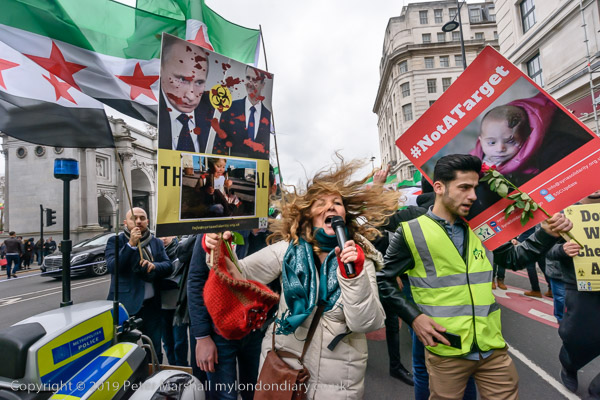
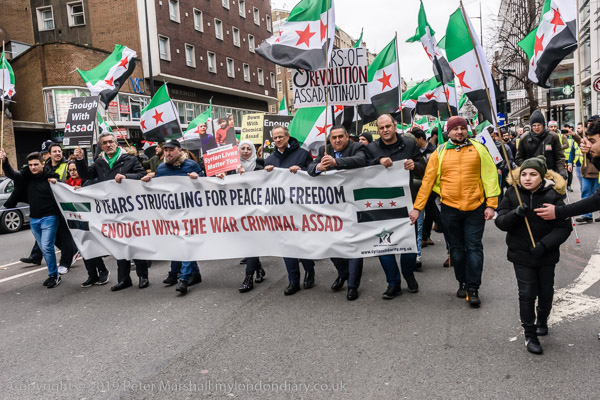
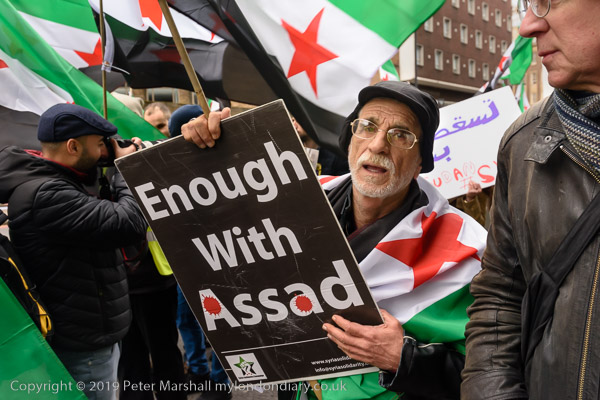
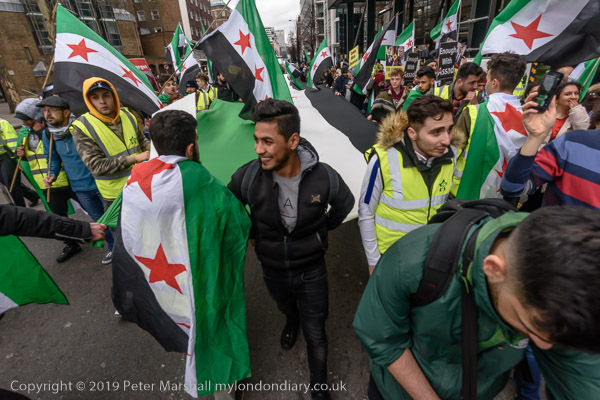
Syria 8 Years On

Syria has certainly been one of the saddest stories of recent history. The optimism of the Arab Spring in 2011, encouraged by Western governments and then totally let down by them, becoming the second deadliest war of the 21st century so far (after the Congo). By 2016 it had seriously wounded or killed 1 in 10 Syrians. It is currently estimated that over 5 million refugees had fled the country and perhaps 8 millions are displaced inside it, from a total 2010 population of 21 million.

As so often around the world, the US had completely misread the situation in the area, not least in its 2003 invasion of Iraq which provided fertile ground for the growth of ISIS, which with covert support from both US allies such as Turkey and enemies such as the Assad regime also became a major player in Syria. At least it had the sense to support the Kurds who became the most effective force in the fight against ISIS thanks to US air power.

But both politically and militarily the US was totally outsmarted by Russia, who came to the defence of the Syrian regime (and also took some decisive action against ISIS.)

It is very hard to see much hope for the future of Syria, even though the civil war appears to be coming to a possibly bloody close in Idlib. What shape will that future take, and what will happen to the currently autonomous region of northeast Syria, the Kurdish area of Rojava, seen by many, but probably not the Syrian regime or its Russian supporter, and certainly not by Turkey as a model for a new federal and democratic Syria.

More about the protest and more pictures on My London Diary: 8th Anniversary of the Syrian Revolution


There are no adverts on this site and it receives no sponsorship, and I like to keep it that way. But it does take a considerable amount of my time and thought, and if you enjoy reading it, please share on social media.
And small donations via Paypal – perhaps the cost of a beer – would be appreciated.

All photographs on this and my other sites, unless otherwise stated, are taken by and copyright of Peter Marshall, and are available for reproduction or can be bought as prints.

To order prints or reproduce images