The details of the life and death of St George (as you can read in Wikipedia) are recorded in accounts dating back to around 1600 years ago, though details vary and the Pope in 494 CE who officially made him a saint called him one of those “whose names are justly reverenced among men, but whose actions are known only to God.“
According to the early texts, George was born in Cappadocia, now a part of Turkey, where his father came from, but his mother was a Palestinian Christian. Cappadocians were generally historically regarded as Syrians, though St George’s family are usually said to be of Greek descent. St George became, like his father, a Roman soldier, becoming a member of the elite Praetorian Guard, and was beheaded in the eastern capital of the Roman Empire on 23 April 303CE, 1718 years ago, during Emperor Diocletian’s purge of Christians who refused to recant the faith.
His behaviour and suffering apparently convinced one prominent Roman woman, Empress Alexandra of Rome, possibly the Emperor’s wife – to become a Christian – and to share his fate. The purge failed to have its intended result, and around 21 years after George’s execution, Christianity became the preferred religion in the Roman Empire under Emperor Constantine.
George’s body was buried in Lydda in Palestine and Christians there soon became to regard him as a martyr. Some legends say that his martyrdom resulted in the conversion of not just the Emperors’s wife but 40,900 other pagans.
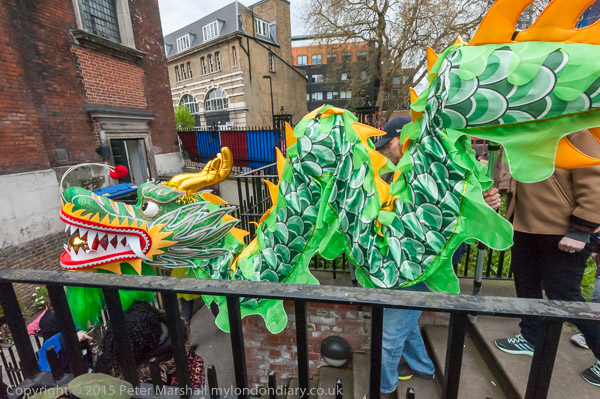
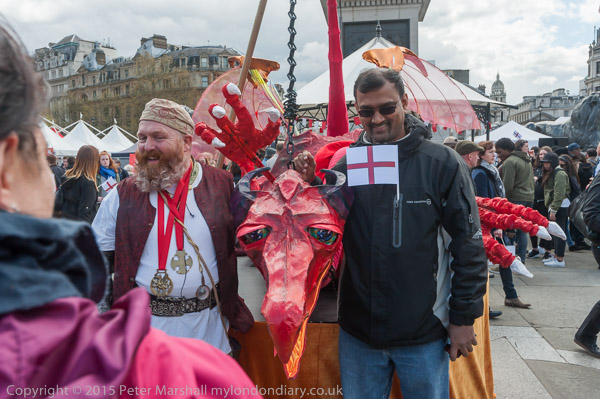
The dragon came along considerably later, only appearing in legends around 700 years after his death, apparently terrorising the city of Silene in Libya, which there is no evidence that St George ever visited. The dragon in my picture above, from a St George’s Day procession in Southwark, seems to have come from Chinatown. But dragons can fly.

The traditional patron saint of England was the last king of Wessex, Edward the Confessor who died in 1066, and it was only in 1552 that as a part of the English Reformation that St George officially became the only saint recognised in England, although along with various other countries English armies adopted him during the crusades and in our battles with the French in the Hundred Years War from 1337-1453. Surprisingly we didn’t drop St George although we lost rather badly.
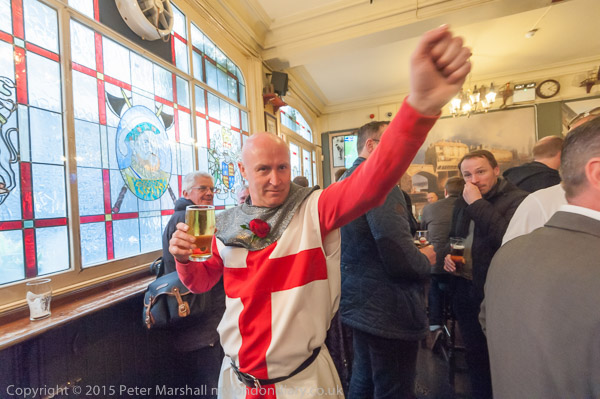
St George’s Day remains an official feast celebrated by the Church of England, usually, though not always, on April 23, as Easter sometimes interferes. Rather more is made of it by some other countries and churches.

The St George’s cross, widely used by football supporters and right-wing extremists in England, comes from the 10th century in the city of Genoa in Italy, becoming used in England in 1348 when Edward III founded the Order of the Garter and made St George its patron saint. It has never been officially adopted as the national flag, though now widely used as such. It is of course a component of many other flags, including the UK’s national flag.

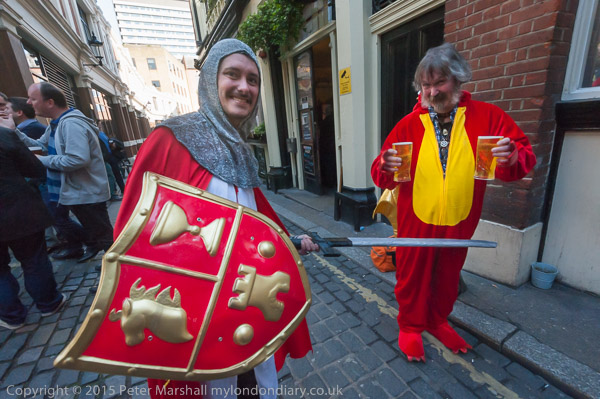
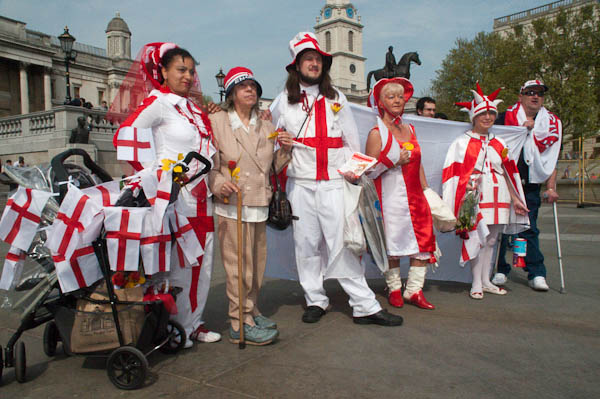
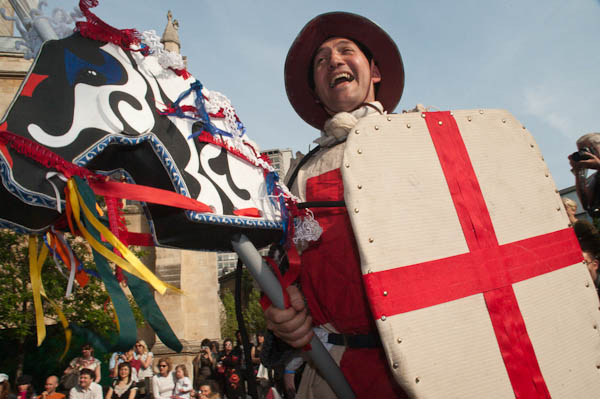
Over the years I’ve photographed many different celebrations of St George’s Day in and around London, and the pictures come from a few of these in 2005, 2009, 2011 and 2016.
2005 St George’s Day
2009 St George & the Dragon
2009 England Supporters,Trafalgar Square
2009 The George Inn, Southwark
2009 The Lions part: St George & the Dragon
2009 St George’s Day – Trafalgar Square
2011 St George’s Day in London
2016 St George in Southwark Procession
2916 St Georges Day in London
All photographs on this and my other sites, unless otherwise stated, are taken by and copyright of Peter Marshall, and are available for reproduction or can be bought as prints.