The Chenies, Pancras Rd, Somers Town, Camden, 1990, 90-2e-41
This 8 storey block was built in a vaguely Art Deco style in the late 1940s as council flats for St Pancras Borough Council, one of two blocks in the Godlington Street Estate. Later it passed to the London Borough of Camden. John Russell, an adviser to Henry VIII was given the title Earl of Bedford in 1551 and the Bedford family later gained other titles including that of Baron Rusell of Chenies. The Bedford estate owns much of Bloomsbury and some other parts of Camden and in the 16th century acquired Chenies Manor in Buckinghamshire by marriage.
The former premises of Pancras Tyres which had moved, though it was now impossible to see where they had moved to, I could still read 56 PEN, but there are a surprising number of streets in London beginning with Pen. The notice obscuring the rest of the address claims that (despite the move) the gates are in constant use, but they were certainly not while I was there.
St Pancras Old Church, St Pancras Old Burial Ground, Pancras Rd, Somers Town, Camden, 1990, 90-2e-43
This Grade II* listed 11-13th Century church was enlarged by A D Gough and R L Roumieu in 1847-8 and later ‘restored’ with Norman remodelling by A W Blomfield, Very little can now be seen of the original Norman building, but there are claims that there are some much older Roman remains in parts of the walls, and that this was a place of worship possibly as long ago as AD 314, A 6th century altar stone was found here.
The church remains in use as “a traditional Anglo-Catholic church that rejects the ordination of women as priests and bishops” and as a music venue.
The Hardy Tree, St Pancras Old Burial Ground, Pancras Rd, Somers Town, Camden, 1990, 90-2e-22
The railway line out of St Pancras Station runs through St Pancras Old Burial Ground and before it could be built in 1865 many of the graves their had to be dug up and moved. Some were piled up in a heap here, with the young Thomas Hardy, then an assistant to architect Arthur Blomfield, delegated to be the overseer for the work. At the centre of the pile of gravestones was an seed or small sapling, which sprouted and grew into the large ash tree whose trunk can just be seen in my picture and which became known and loved as ‘The Hardy Tree’.
Sadly the tree became infected with a fungus in 2014, severely weakening it and on 27th December 2022 it collapsed. A beech sapling was planted in 2024 to replace the original tree.
Tomb, Sir John Soane, St Pancras Old Burial Ground, Pancras Rd, Somers Town, Camden, 1990, 90-2e-26
Sir John Soane (1753 – 1837) was one of Britain’ greatest architects, the son of a bricklayer who rose to became a professor of architecture and was responsible for influential Neo-Classical buildings including the Bank of England and Dulwich Picture Gallery.
He designed this Grade I listed tomb following the death of his wife in 1815 and it was erected here in 1816. His wife, Soane and his son were all buried here. In 1924, Giles Gilbert Scott (son of Sir George Gilbert Scott architect of St Pancras Station and hotel) walked in the burial ground and was inspired by the central part of this tomb for his entry to the comptition to design a telephone box. His winning entry, the K2, produced in 1926 was the iconic telephone box – though it changed a little over the years, developing into the 1935 K6 model.
Gasholders, Goods Way and Midland Road: Continuing with pictures from my walk on Sunday 18th February 1990 – the first post on this was Between Kings Cross & St Pancras – 1990.
Gas Holders, Goods Way, Kings Cross, Camden, 1990, 90-2d-16
I photographed the gasholders here on various occasions and from various places, both in black and white and in colour. The Pancras Gasworks and those at Shoredittch were the first gas works of the Imperial Gas Light Company (later the Imperial Gas Light and Coke Co) were built in 1822 on Battlebridge Road beside the Regent’s Canal. In the 1860s it was still the largest gas works in Britain if not the world, but soon it was eclipsed by others.
Although the gas works closed in 1904 and was dismantled three years later, the gasholders continued in us for gas storage for gas from the company’s vast Beckton gasworks and were only finally decommissioned around 2000 well after town gas had been replaced by natural gas.
These three gasholders were originally built in 1879, replacing an earlier triplet from the 1860s designed by engineer John Clark. He had them built as ‘telescopic’ holders with two interlocking sections or ‘lifts’ around the outside of the ‘bell’ which could rise up inside the guide frames to increase the capacity.
As the Grade II listing text states this involved “replacing the guide frames in their entirety by the contractors Westwood and Wright under the direction of John Clark. The columns of the new guide frames observed classical rules so that the lowest tier was in the Tuscan order, the middle in the Doric and the topmost in a simplified version of Corinthian.”
These small industrial workshops were also demolished in the redevelopment of the area for the building of St Pancras International.
Water Point, St Pancras Station, Goods Way, Somers Town, Camden, 1990, 90-2e-01
This Grade II listed water point is close to the new location of the gasholder frames and also the redeveloped coal drops on the north side of the canal. Built around 1870 for the Midland Railway it was probably designed by Sir George Gilbert Scott’s architects office.
Like the gasholders its original location was in the way of St Pancras International and was moved around 2001 to its new location on Camley St, some 700 yards to the north. When built it was condemned by some architectural critics for being an inappropriate use of Gothic for a functional building, but it well matched the station and hotel.
Together with the Granary building and others in the area according to Historic England it forms “an evocative ensemble of former industrial buildings of considerable urban landscape value.” Having a theme park like this is certainly better than losing these structures completely but it isn’t any real replacement for the original.
Between Kings Cross & St Pancras: A week after my previous walk which began from Kings Cross I was back there again for another walk on Sunday 18th February 1990, beginning with a few pictures close to the station in Kings Cross and Somers Town. This was an area I’d photographed in earlier years but still interested me. Since 1990 it has of course changed dramatically.
Cheney Rd, Kings Cross, Camden, 1990, 90-2d-34
Cheney Road is no longer on the map of London although one of the buildings on it remains. It ran north-east from Pancras Road along the side of Kings Cross Station, then turned north-west towards Battlebridge Road and the gasholders you see here. Of course those gasholders are no longer where they were in 1990, but were moved further north and to the opposite side of the Grand Union Canal as a part of the redevelopment of the area including the addition of the Eurostar lines into St Pancras.
This street was a popular film location, best known for its use in The Ladykillers. In the middle distance at left you can see the roof of the German Gymnasium, with its distinctive windows at its top, I think the only building in my picture that remains (at least in part) in situ.
St Pancras Hotel and stating seen looking south down Pancras Road on a sunny Sunday morning. I think I used the controlled parking zone sign to cut down flare. A taxi is turning into Kings Cross over a short section of cobbles.
The station was completed in 1869 and the Midland Grand Hotel in 1876, though it had its first visitors in 1873. Both were designed by George Gilbert Scott and are Grade I listed. They were built for the Midland Railway whose main lines ran from here to Manchester, Sheffield and Nottingham via Derby. The hotel was expensive to maintain and closed in 1935, then becoming used as railway offices by the London, Midland & Scottish Railway.
My first trip to Manchester in 1962 was from here, but soon after in 1967 the central section of the route – one of England’s most scenic – was closed. Now the line ends at Matlock (with a Couple of miles of preserved railway to the north, and we have change at Derby on our journeys to Matlock.
Pancras Rd, Somers Town, Camden, 1990, 90-2d-21
Looking north up Pancras Road with the arches of the station to the left of the picture and one of the gasholders in the distance. The curved pediment above the door in the middle block at right is the entrance to the German Gymnasium. This end of the Grade II listed building was demolished when St Pancras International was built, and the west end of the building was replaced by modern brickwork in keeping with the other walls of the building.
Turnhalle, German Gymnasium, Pancras Rd, Kings Cross, Camden, 1990, 90-2f-66
This was the original west end of the Turnhalle at 26 Pancras Rd.
Pancras Rd, Somers Town, Camden, 1990, 90-2d-22
Kings Cross Automatic Gearbox Centre at 87-89 Pancras Road, Newport Joinery at 92 and other small businesses along the west side of athe road were all demolished to make room of the new platforms for St Pancras International
Stairs, Stanley Buildings, Stanley Passage, Kings Cross, Camden, 1990, 90-2d-15
A notice at the left of the stairs of Stanley Buildings flats, says NO to the British Rail bill in Parliament which would see the building of the new international station and the demolition of much of the conservation area. Despite much opposition, the Channel Tunnel Rail Link Act was passed in 1996.
Stanley Buildings were built in 1865, designed by Matthew Allen for the Improved Industrial Dwellings Company under the guidance of Sydney Waterlow. Grade II listed in 1994, but that has not enough to save them as they were and one block was entirely demolished and the remaining block incorporated into a modern building, losing much of its character. The listing text ends: “Among the earliest blocks built by Waterlow’s influential and prolific IIDC, Stanley Buildings are in addition an important part of a dramatic Victorian industrial landscape.” Their remnant now sits largely hidden in a modern development.
House, 1A, Cornwallis Rd, Finsbury Park, Islington, 1990, 90-2d-56
This 3 storey detached house on Cornwallis Road, just a few yards down from Tollington Way, attracted my attention for its unusual decoration above what seemed a very ordinary door and window. According to Streets With a Story the street was developed in three periods as Shadwell Road, Esher Villas and Cornwallis Road in 1863, 1879 and 1885. This house probably dates from the latter part of that development but I’ve found nothing about it on-line
Royal Northern Hospital, Tollington Way, Holloway, Islington, 1990, 90-2d-42
The Royal Northern Hospital was founded in York Rd (York Way) in 1856 at his own expense by a surgeon who had been sacked from University College Hospital for smacking a patient’s bottom. The hospital provided free services for North London’s Poor as well as treating railway workers. But the railway bought the house and they had to move, using several properties in the area. Finally it got is own home and the Great Northern Central Hospital opened on Holloway Road in 1888, changing its name to the Royal Northern Hospital in 1921 and expanding to Tollington Way in the 1930s. It merged with the Whittington Hospital in 1963. The facade of the main building has been retained on Holloway Rd and the building is the Northern Medical Centre
Holloway Rd, Holloway, Islington, 1990, 90-2d-43
This picture was made from Tollington Way looking to the rather grand Italianate terraced villas on the opposite side of Holloway Road, Belgrave Terrace. They were locally listed in 1978. At left is The Cock Tavern at 596 Holloway Road. The pub was built in the 1880s and in the 2000s became a live music venue and bar, now Nambucca. Damaged by fire in December 2008 it reopened in 2010 and was refurbished in 2014 only to close in 2022 but unexpectedly reopen in 2024.
VICTORY TO THE IRA, Landseer Rd, Holloway, Islington, 1990, 90-2d-46
Holloway is one of the more densely populated areas of London with a very multicultural population including many Irish among its residents, and among them a significant number who supported the Irish struggle against the English occupiers in Northern Ireland. In 1990 we were in the middle of active attacks by the Provisional Irish Republican Army (IRA) on targets in London – the following year they attacked Downing Street using mortar shells and in 1992 a powerful bomb at the Baltic Exchange destroyed it and other buildings in the City of London, following this in 1993 with another bomb in Bishopsgate.
The street was named after the animal painter and sculptor Sir Edwin Landseer, best known now for the lions at the base of Nelson’s column. He became a ‘national treasure‘ and his death in 1873 gave rise to mourning across the nation and large crowds lined the streets as his funeral cortège made its way to St Paul’s Cathedral. Probably the street dates from around then.
The building is still there on Holloway Road, but sadly is no longer an Egg & Butter Merchant and has a new shopfront – and a bus shelter on the pavement in front of it.
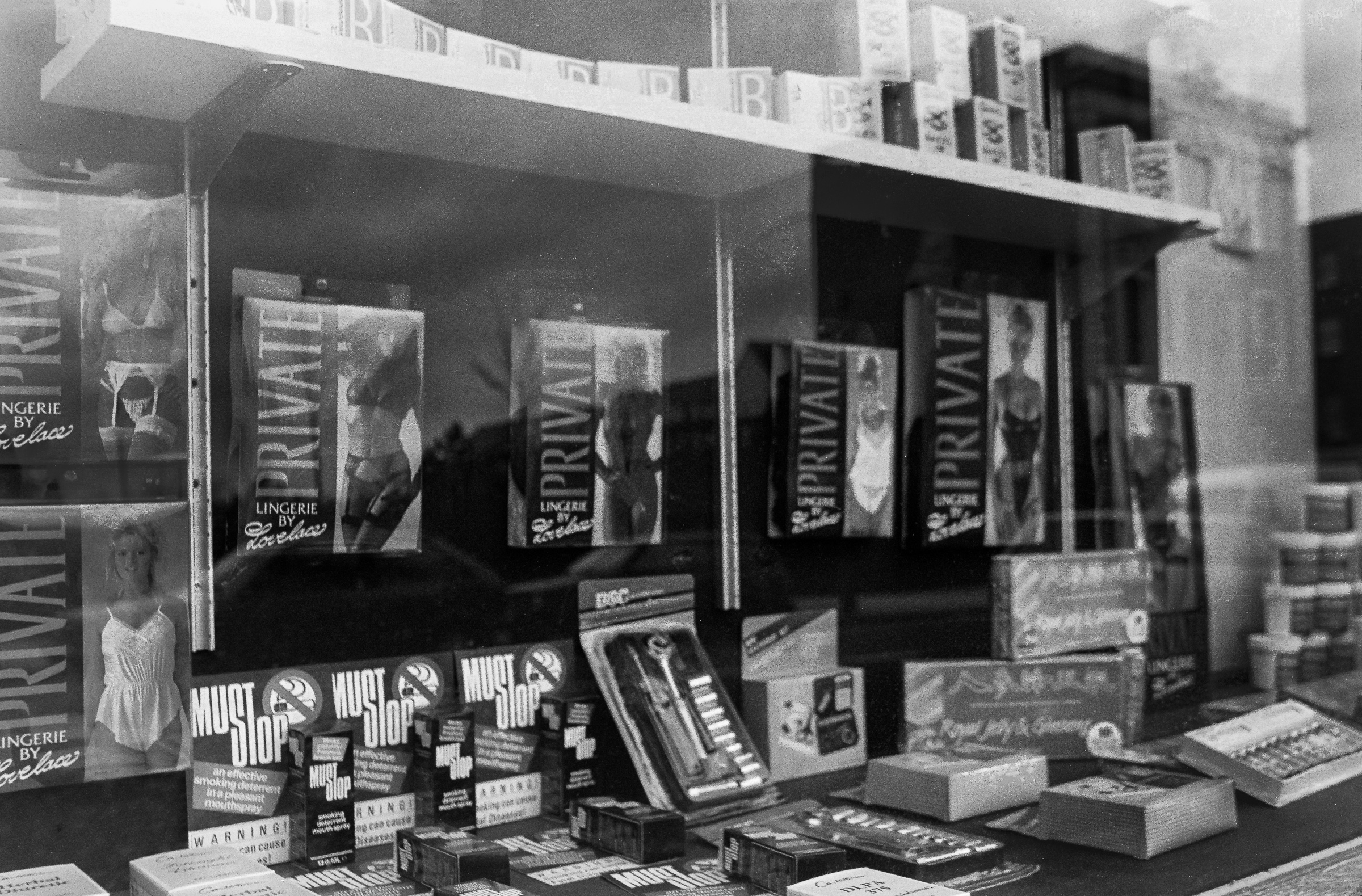
As I made my way to the station at the end of my walk I could not resist this shop window with a rather strange mix of products including those listed and some rather strange health supplements. I only stopped long enough to take a picture and wasn’t tempted to buy anything.
My next walk a week later was also in North London and will be the subject of a later post.
House, Tollington Park, Finsbury Park, Islington, 1990, 90-2c-12
Tollington is a district whose name dates back at lease into Saxon times. According to Eric A Willats’ ‘Streets With A Story‘, from which much of the information in this post comes, “It was spelt ‘Tollandune’ in the Anglo-Saxon Charters meaning the hill or pasture of Tolla. ‘Tolentone’ meant a pannage for hogs, a place of beechwood and mast. This area and Holloway were all then part of the Great Forest of Middlesex. It had various spellings Tolesdone, Tolyndon, Tallingdon and Tallington.”
Modern development of the area, then farmland, began early in the 19th century; “About 1818-1820 ‘a pretty range of villa residences were erected in the Italian style by Mr. Duerdin, with stabling and offices attached, from the designs of Messrs. Gough and Roumieu.’” These are now 96, 102, 106 and 110 Tollington Park.
House, Tollington Park, Finsbury Park, Islington, 1990, 90-2c-13
Like many other early and mid-19th century developments the villas were first given their own distinct subsidiary names and only became numbers in ‘Tollington Park’ in 1871, Willats gives the following details:
After 1871 subsidiary names were abolished, e.g., Belmont Terrace became nos2-6, Birnam Villas 8-10,St Marks Villas 16-22, Claremont Villas 24-36, Duerdin Villas 44-56, Fonthill Villas 60-70, Syddall Villas 59, Syddall Terrace 63-73, Regina Villas 89-101, Shimpling Place by 1882 nos15-155 Upper Tollington Park, Harrington Grove 1848/9 became after 1894 47 to 67 and 52 to 70 CHARTERIS ROAD. Nos96 to 108 have been attributed to Gough & Roumieu, built 1839-40
House, 53, Tollington Park, Finsbury Park, Islington, 1990, 90-2c-14
This corner house has been significantly modernised but retains its tall archway and fits in well with the adjoining houses out of picture to the left. It doesn’t get a mention on the fine map of ‘Historic Tollington’ which was “created by the incredibly vibrant Tollington Park Action Group in 1994.” As well as the plan of the streets this contains informative annotation on 26 sites in the area and would have been very useful to me as a guide to the area which I photographed four years before the map was made.
House, 20A, Turle Rd, Finsbury Park, Islington, 1990, 90-2c-15
Willats suggests the road was “Probably named after a John Turle of no.11 Tollington Park who was at that address in 1830 and in 1833.”
George Orwell School, Turle Rd, Finsbury Park, Islington, 1990, 90-2d-65
The former Tollington Park School first opened in 1886. It gained some new buildings to add to its Victorian main block in 1930 but these were demolished by bombing in 1940. I think my picture shows the new extension built in 1955.
It was renamed by the Inner London Education Authority in 1981 after Eric Arthur Blair, better known as George Orwell, in 1981. He had lived not far away at 27b Canonbury Square from 1944-7. The name of this ‘secondary modern’ school was changed when it was merged with Archway Secondary School and it disappeared in 1999 following a damning Ofsted inspection of all Islington’s schools, re-emerging as Islington Arts and Media School.
The school’s most famous former pupil is photographer Don McCullen who was born and grew up in Finsbury Park nearby.
St Marks, church, Church Hall, Moray Rd, Finsbury Park, Islington, 1990, 90-2d-53
Work began on building the church in 1853; its architect was Alexander Dick Gough (1804-71) who lived at 4 Tollington Park. He was a pupil of Benjamin Dean Wyatt and for some years worked in partnership with Robert Lewis Roumieu; their work together in North London included the Islington Literary and Scientific Institution (now the Almeida Theatre), the rebuilding of the Norman St Pancras Old Church and several Italianate villas in Tollington Park mentioned above.
After their partnership was dissolved in 1848, Gough designed or redesigned over a dozen churches in North London and elsewhere, many now demolished, along with other buildings. St Mark’s required some structural alterations in 1884 and was renovated in 1904.
Tollington Court, Tollington Place, Finsbury Park, Islington, 1990, 90-2d-54
These 1938 flats are on the corner of Tollington Place and Tollington Park and I was standing a few yards down Moray Road to make this picture, with the square and fluted round pillars of St Mark’s Mansions, 60 Tollington Park, at the left. This building is locally listed as a semi-detached Italianate villa dating from around 1850.
St Marks Mansions, Tollington Park, Finsbury Park, Islington, 1990, 90-2d-55
This shows the neighbouring semi-detached villa of St Mark’s Mansions and the poor decorative state of many of the buildings like this long converted into flats in Tollington Park. The area has been considerably gentrified since 1990 and it is hard to believe the state of the properties then when you look at them now.
See what Tollington looked like in the 60’s & 70’s has a collection of pictures by Leslie William Blake taken before the area had begun to receive any real investment following extensive bomb damage in the war. The article states “it wasn’t until the late Sixties that any real investment began” to come into the area, and my pictures from 1990 show that there was still much to do.
Tower House, 149, Fonthill Rd, Finsbury Park, Islington, 1990, 90-2c-32
The Tower House it at the south end of a late Victorian terrace at 141-9 Fonthill Road close to the junction with Seven Sisters Road. This was the factory and showroom for Witton, Witton & Co. In an advertisement in Musical Opinion & Music Trade Review they describe it as ‘BRITAIN’S FINEST FACTORY’ producing ‘”THE IDEAL BRITISH PIANO” Specially made for Variable Climates’. According to the Pianoforte-makers in England web site the company was formed in 1874, although earlier Wittons had made pianos from 1838. They held two patents related to pianos. The name continued in use after production went abroad in the 1930s. Their grand pianos are said to be not well made.
By 1990 the tower had lost its top floor topped by a cupola. Like much of Fonthill Road the building was mainly in use by clothing manufacturers and wholesalers in 1990.
Goodwin St, Finsbury Park, Islington, 1990, 90-2c-35
The 3 storey house in this picture is still present on Goodwin Street, a turning off Fonthill Road which now leads through City North House to Finsbury Park Station. This is 11 Goodwin St, owned by the Trustees of Peace News and the home of CND, the Campaign Against Arms Trade as the hanging sign above the double door indicates, along with various other groups. I think the right hand door was number 13, though the numbering around here seems rather random.
Shops, Fonthill Rd, Finsbury Park, Islington, 1990, 90-2c-36
The rather strangely staggered roofline is still there at 138 Fonthill Road and all the shops are still in the clothing trade, though I think all the names are changed. Photographer Don McCullin grew up in the area in the 1940s and described the area as “a battlefield” and later he was to photograph on many real ones, including in Cyprus.
It was the Cyprus emergency with the UK fighting EOKA in the the late fifties and the later war between Greeks and Turks that led to many Cypriots to come to live in North London – and a number of them set up clothing factories and wholesale businesses here – and others from Turkey, the Caribbean and Africa came too. At first shops here were simply wholesale, but then many began to open on Saturdays for retail sales, and the street was crowded with people – mainly women – buying real bargains.
Fonthill Metal Co, Fonthill Rd, Finsbury Park, Islington, 1990, 90-2c-21
I don’t think any trace remains of the Fonthill Metal Co or the garage next door on Fonthill Road which were almost at the end of Fonthill Road close to Tollington Park. There used to be many similar small scrap metal dealers who would pay cash on the spot for non-ferrous metals – Copper, Brass, Lead, Zinc and Ali – aluminium.
BRAIZERY here means copper pipes and other material which has been soldered and so contains small amounts of other metals, particularly tin and lead. If you have a decent load of this you can probably get around £6 a kilo for it – but no longer on Fonthill Road.
Velvet Touch, Fonthill Rd, Finsbury Park, Islington, 1990, 90-2c-22
Later retail clothes shops elsewhere in the country found they could buy clothing cheaper abroad than garments made in the UK, and manufacturing here started to fall away. Slowly more and more wholesalers welcomed retail customers and many new wholly retail shops opened.
More recently the retail trade has fallen away too as the area becomes increasingly gentrified. Most of the clothes still on sale are now made abroad, particularly in Turkey.
Velvet Touch at 1 Fonthill Road was at the far end to the other clothing manufacturers, wholesalers and importers and although you can still read that line of their shopfront, (rather faded now) their name and the large sign on the side wall are long gone and I think the building is now residential. The very small window on the first floor is still bricked up.
St Mellitus, RC, Church, Tollington Park, Finsbury Park, Islington,, 1990, 90-2c-23
Built as the New Court Chapel in 1871 by Congregationalists from New Court, Carey St, Lincoln’s Inn Field after their chapel had been demolished to build the Royal Courts of Justice.
The Neo-classical church, designed by C G Searle seated 1,340 and in the early years was often full in the early years, but after the war congregations dropped away. It was sold to the Catholic Church in 1959, becoming St Mellitus RC Church. St Mellitus was the first Bishop of London in 604CE and later in 619CE became Archbishop of Canterbury.
House, Tollington Park, Finsbury Park, Islington, 1990, 90-2c-24
Tollington Park was one of the first streets in this northern part of Islington in Finsbury Park (estate agents like to call it Stroud Green, but that seems rather a stretch too far) to be laid out and its grand semi-detached villas date from the 1830’s and 40’s.
Before that cows had grazed its fields to supply milk to London across north Islington which had what was claimed to be the largest dairy farm in the country, run by Welsh dairy farmer Richard Laycock.
By WW2 the area had deteriorated and become a poor working-class area. It was heavily bombed in WW2 and much still remained in a mess twenty years later. By the 1970s it was home to many migrants from across the world, including “Welsh, Irish, Jamaican, and others from all over the world.”
House, Tollington Park, Finsbury Park, Islington, 1990, 90-2c-26
Many of the damaged properties and some others were demolished in 1970 to form a park, Wray Crescent, and gentrification of the area set in. The Friends of Wray Crescent history page contains a number of pictures of Tollington in the 1960s and 1970s, taken by Leslie William Blake when “local campaigners and the Tollington Park Action Group began to fight to preserve some of the buildings, including the creation of the local conservation zone.”
Houses like those in my picture are now all or almost all a number of flats. Only 4 houses in Tollington Park are Grade II listed (along with the two churches) but many are locally listed including these two at 104 and 106, thought to have been built in 1840.
Used furniture, Caledonian Rd, Barnsbury, Islington, 1990, 90-2c-54
From Thornhill Square I returned along Bridgeman Road to Caledonian Road, both sides of which are here lined with shops. Almost immediately on the east side of the road I saw this shop selling used furniture (I think it is now an estate agents) with the pavement in front having some of its stock – stacking tubular chairs – in front of a crude partition, at its left a phone card box and in front of that some cabinets used to support the shop’s sign.
The pavements along here are now cleared of clutter.
Sandwich Bar, Fire Escape Specialists, Caledonian Rd, Barnsbury, Islington, 1990, 90-2c-56
R Bleasdale & Co Ltd, Fire Escape Specialists had a splendid gate advertising their Victorian Metal Design. This was at 394 Caledonian Road where a similar business, The Cast Iron Shop, remained until around 2020, though the gate was long gone, together with the Sandwich Bar.
The sandwich shop also interested me with it with its striped awning and notices, incluind ‘DELICIOUS HOT SALT BEEF’ though I was unable to try it as like most shops then it was closed on Sundays.
Chinese Chef, Restaurant, Caledonian Rd, Lower Holloway, Islington, 1990, 90-2c-42
Another window I found of interest, divided into two halgs one of much had four shleves each with two spider plants and above them a net curtain. The left half mixes the reflection of the buildings opposite with the menu, a light fitting, plants and cans of soft drink under a counter inside.
Chinese Chef was on the corner with Roman Way until around 2019
Romeo Trading Co Ltd, Roman Way, Lower Holloway, Islington, 1990, 90-2c-44
I walked a few yards down Roman Way to photograph Romeo Trading Co Ltd, making several pictures both in black and white and in colour. I think this is the company founded in 1941 specialising in military surplus clothing and now operating online and in “an impressive 85,000 square foot warehouse“, Romeo House, in Tottenham.
Their former site and more of the street is now occupied by a large block of flats, Roman Court.
From Roman Way I photographerd Mallet Porter & Dowd on the west side of Caldedonina Road at 465 made hard-wearing fabric from horse-hair at their premises close to the Metropolitan Cattle Market, used for uniforms and textile products. This building inscribed with their name dates from 1874.
It was disgracefully converted into student housing for University College London by Mortar Developments in 2015, in a development that retained the facade a few feet in front of an unsympathetic modern development to the detriment of both. It was a worthy winner of the 2013 v awarded by Building Design for the year’s worst building. Islington Council had rejected the scheme but this was overturned on appeal.
Salvo C F S Ltd, Wine & Provision Importers occupied the building immediately south of Mallet Porter & Dowd until it was demolished around 2011. The company was set up by Salvatore Cumbo who owned a pizzeria in London to import Italian food and drink as wholesalers. The company moved here in 1975, and moved out in 2011 to larger premises in Hertfordshire.
The doorway between the two buildings had the number 465 and so was to the Mallet Porter & Dowd building; the free-standing ‘facade’ rather oddly retains its right hand edge of this door. It perhaps led to the offices and the building also had the wider doorway at the right of the picture.
At this point I think I decided to take a little rest and got on the tube. I’d planned to get to Finsbury Park and time was running out. The next in this series of posts will begin with tthe next frame I made which was in Finsbury Park.
Battlebridge, Canalside and Barnsbury continues my walk which began at Kings Cross on Sunday February 11th 1990 with the post Kings Cross and Pentonville 1990.
Battlebridge Basin on the Regent’s Canal was opened at the same time as the Camden Town to Limehouse stretch of the canal in 1820, though the buildings around it took a couple of years longer to complete. In 1815 the landowner William Horsefall contracted with the canal company to allow them to dump the soil extracted from the Islington Tunnel a short distance away on his land, and he used this to form the basin.
It seems odd that you should need earth to form a basin, but it was needed to raise the ground level around it as part of the 480ft by 155ft basin is above the level of the streets around. Horsefall got an Act of Parliament to fill the basin with water from the canal and by 1822 it was surrounded by industrial premises, including timber yards. Among later occupants were W J Plaistowe & Co, jam, marmalade and preserve makers, here until 1926, and at Albert Wharf on the northeast corner were Cooper & Sewell (c1847-1880) and J Mowlem & Co (c1880-1922).
The best-known building on the basin was the warehouse built around 1860 by ice-cream maker Carlo Gatti to store ice brought from Norway, which since 1992 houses the London Canal Museum. In a Key Stage 2 teaching resource on their site is an excellent plan showing the uses of the different areas around the basin in the late 19th century.
Unlike other canal basins in London this was privately owned, known first of all as Horsefall Basin, then Maiden Lane Basin before taking its current name – the old name for the Kings Cross area, which had a bridge over the River Fleet. There seems to be no agreement as to which battle this was named after but few beleive the popular legend it was fought by Boudicea. In 1978 a group of boat owners came together so set up moorings here which over the years since have developed into a substantial marina.
Mercantile House, All Saints St, Pentonville, Islington, 1990, 90-2b-14
My previous post on this walk showed an overall picture of Mercantile House and gave a little of its history. In 1990 the whole site was undergoing redevelopment as you can see in pictures below. Mercantile House was retained.
All Saints St, Pentonville, Islington, 1990, 90-2b-13
I photographed Bartlett Ltd, Export Packers in 1979 from the canal towpath and wrote a little about Battlebridge Basin and Bartlett’s works then and wrote:
Although many of the canal-side buildings in the area have been replaced, a warehouse on the basin of Bartlett Export Packers survives in greatly altered form as Albert Dock. The works buildings in this picture, at the end of New Wharf Road, have been replaced by those of Ice Wharf, three blocks with 94 apartments in a highly regulated private development with 24 hour concierge service and a private, gated underground parking space where a 2 bed flat overlooking the canal could be yours for only £1,195,000.
Demolition of the buildings on All Saints Street whichg meets New Wharf Road at its west end provided me this view of part of Bartletts from here.
From Thornhill Bridge on the Caledonian Road over the canal I could see the cleared development site and, in the distance St Pancras Hotel, the Post Office Tower and other buildings. At the left are the back of buildings on Caledonian Rd.
I walked on north up Caledonian Road to Thornhill Crescent at the northern end of Thornhill Square, once of the well-known Barnsbury Squares, though it certainly is not square – together they are more of an oval, narrowing towards the southern end. Wikipedia calls it “an unusual large ovoid ellipse“.
Much of the land around here was owned by the Thornhill family who had come from Yorkshire and let to dairy farmers. George Thornhill began Thornhill Square in 1847, and Samuel Pocock, one of those rich farmers began Thronhill Crescent around 1849.
Lived in at first by prosperous middle class households, the area became run-down by the middle of the last century with many properties in multiple occupation and high levels of street crime. But Islington became fashionable in the 1960 and 70s and gentrification led many of those living to purchase the freeholds and the area went upmarket. Some flats now sell for over a million pounds and entire houses over two million.
More from Barnsbury in the next post in this series.
Kings Cross and Pentonville: Although I took a few pictures in the next few weeks, mainly on my way to or from meetings, it was well into February before I was able to go on another long photographic walk. Of course the weather at that time of year often isn’t too kind and days are short, but winter is the best season for photographing much of London’s buildings, as so much is hidden once trees come into leaf.
Grays Inn Rd, Kings Cross, Camden, 1990, 90-2b-54
I can’t now recall why I decided to return to the Kings Cross area on Sunday February 11th 1990, though I liked to revisit areas periodically, and the journey to the Victoria line station was an easy one, suitable for short days to give me more hours of usable light.
I left the station by the Pentonville Road entrance and walked back towards the main station, taking a couple of pictures on my way before heading down Grays Inn Road. This picture looking back towards Kings Cross Station includes both the station clock tower – I seem to have arrived shortly before 10am – and the well-known “lighthouse” built simply as advertising for Netten’s Oyster Bar. What seems an incredibly long horizontal pole holds one of the many traffic lights in the area .
Posters, Grays Inn Rd, Kings Cross, Camden, 1990, 90-2b-55
In the centre of these fly-posted posters is an advert for ‘THE BEST SHOP IN TOWN’, SHE-AN-ME at 123 Hammersmith Road, West Kensington, London W14. It offers ‘UNUSUAL – BONED DRESSES – 6″ HEEL BOOTS – LATEX RUBBER …’ and much more, a fetish shop specialising in PVC, rubberwear and bondage equipment. Although Yelp still has a listing for the business it is long gone; after some years as ‘Simply Pleasure’ it is now ‘Quick Local Store’ selling snacks, cold drinks, tobacco, souvenirs, toiletries and household items.
One of London’s more photographed signs, though now a little faded and above a Nail Bar and Computer Centre on this nicely curved building. The Greek Restuarant at 325 is now a fast-food place – and is flanked by two others.
I walked back onto Pentonville Road, here the boundary between the London boroughs of Camden and Islington. Modern Jock’s Tattoo Studio on the south side was on the ground floor and Chestnuts Hair Studio for Men and Women through the same door on the first floor, illustrated by arrows for the non-literate. Born around 1920 British tattooing legend Jock Liddel started as a tattoo artist at the age of 16 in Scotland and his famous shop was at 287 Pentonville Road for many years. He died in 1995 but had moved down to Kent a few years earlier. His shop and several adjoining are now an American multinational fast food burger and fries chain.
‘Kings X People Say NO’ to the Chunnel Terminal for Kings X – Chaos for London’ read the array of posters on the back of a road sign, one of four signs in this picture, along with those for the Autodrome, Peacemeal Whole Foods and Loseley Dairy Ice Cream.
I was briefly and peripherally involved with the Kings Cross Railway Lands Group and their ‘Planning for Real’ exercise with local residents which formed a basis for the comprehensive alternative plan published in their Kings Cross Railwaylands Towards a People’s Plan Full Report published in October 1991.
Of course their plans were not adopted but the opposition certainly played a part in the decision to drop the plans for a new Kings Cross and instead to develop St Pancras as the international terminal. As an article on Londonist points out, “The plans would have seen 83 homes and 58 shops demolished. The scale of destruction would have witnessed landmark listed buildings like the Scala pulled down … The entire block between Caledonian Road, York Way and Caledonia Street would have also been lost.”
The Kings X Sauna on the corner of Northdown Street and more useful shops and offices on Caldedonian Road. The sauna at No.70 later became an estate agents.
Mercantile House, All Saints St, Pentonville, Islington, 1990, 90-2b-25
Further north on Caledonian Road I turned west into All Saints St where I photographed Mercantile House which appropriately later became home to global brand consultancy agency Wolff Olins – who have now moved to Southwark.
Work began in 2022 to transform this and other buildings on the site into Regent’s Wharf, “a ground-breaking new campus … created with the next generation of innovators in mind.”
Mercantile House was built in 1891 as the Head Office for Thorley’s Food for Cattle with their mill behind it on the bank of the Regent’s Canal. They had moved onto the site in 1857.
“A family owned business for over 100 years, Joseph Thorley’s Ltd was an iconic player of the industrial age, inventing and distributing ‘spicy aromatic condiments’ that would beef up your cattle, pep up your pigs and ensure your chicken laid the best clutch in the roost.
This MiracleGro for animals was made to a secret recipe and sold around the world even in far flung outposts such as the Falkland Islands, all from the headquarters at Regent’s Wharf in King’s Cross.”
“Thorley’s progressive ideas extended to their charming and playful marketing, with eye-catching advertising and branding that has become collectable today. Animal feeds went by many wonderful names such as Grula for Horses, the famous Thorley’s Cake that reared ‘Champions’, Ovum for chickens and Rabbitum.”
Springfield Grove estate, Charlton Rd, Charlton, Greenwich, 1990, 90-1j-62
This estate was built on what had earlier been the site of the late 17th Century Springfield House, which was demolished just before the Second World War – the LCC had bought Stonefield Farm in 1927 for the Thornhill Estate. During the war there was a pig farm on the site. Springfield House took its name from a spring here which ran down in a valley here when the house was built. and though it is sometimes described as a wooded combe (dry valley) construction of the estate was held up in 1949 by the spring having to be stemmed and the ten blocks date from 1951-2.
The blocks were named with associations to previous Lords of the Manor of Charlton “Bayeaux – Bishop Odo of Bayeaux ; Downe & Ducie – Sir Wm.Ducie created Vise.Downe ; Erskine – Sir John Erskine Games – Wm.Langhorn Games ; Langhorne – Sir Wm.Langhorn, Mar – Earl of Mar (Sir J.Erskine) ; Priory – Priory of Bermondsey and Wilson – Sir Thos. Wilson 6th Bt. who married into the Maryon family, owners of the Manor & Estates.“
These ten brick LCC point blocks in the Sparingfield Grove Estate (also known as Thornill Estate which it adjoined) were built around 1950, and the view between the towers here is described in the conservation area document as the most dramatic of the “number of good panoramic vistas” from the escarpment here, with a view towards the Thames and central London. The estate was built by the LCC but was transferred to the London Borough of Greenwich when that was set up and then in 1999 to a housing association. In 2012 the blocks were clad hiding the brickwork, which although I think is aesthetically poorer will have been much appreciated by residents for increasing their comfort.
I walked along here, but perhaps the best way to appreciate the views is from the upper deck of a bus going along Charlton Road or Charlton Church Lane.
War Memorial, Drinking Fountain, Public Toilets, Charlton House, Charlton Church Lane, The Village, Charlton, Greenwich, 1990, 90-1j-54
The triangle in the middle of the junction between Charlton Church Lane and The Village would, apart from the traffic be a pleasant place to sit and there is now a seat between the war memorial and the drinking fountain, though I think you need to bring your own drink. Most of our old drinking fountains have been disconnected for hygienic reasons, though London does now have some new ones. At least in winter you can see a wide variety of architecture, though trees tend to block some views for the rest of the year.
The cattle trough which replaced the old village stocks must I think have been just out of my picture on the left and like the drinking fountain was erected to commemorate the coronation of King Edward VII in 1902, together costing £247 donated by local residents and Sir Spencer Maryon Wilson, 11th Bart – who gets his name on the side of the trough. The fountain was damaged in 1980 when a driver without tax or licence drove into it; Greenwich Council decided they could not afford the £3,000 needed to repair it, but local residents again reached into their pockets.
Charlton House, The Village, Charlton, Greenwich, 1990, 90-1j-66
Charlton House is said to be the “finest Jacobean mansion in all London”, designed by architect John Thorpe, said to have been the inventor of “humble and now-ubiquitous corridor” which allowed independent entrance to the various rooms of a grand house – previously each room had led through doors to the next in what was know an an enfilade.
The house was first opened to the public in 1909 with the one shilling (5p) entry fee going to provide free lunches for the children of Deptford. Now in public ownership for 100 years it is one of the few things that cost less than then, with house and grounds free to the public.
The large classical arch was once the entrance to the grounds but is now isolate, all on its own in a large area of grass.
Part of the house was badly damaged by wartime bombing in 1944 but has been carefully restored, and perhaps the only visible sign is a slightly lighter colour to the bricks used – and apparently the sundial between the first and second floor windows was fitted upside down.
The house was built by the crown for Prince Henry, the son of James I, and older brother of the future Charles I and his then tutor, Sir Adam Newton who was Dean of Durham, though hardly convenient for him as the 260 mile commute would then have taken several days. But I imagine he could claim his salary while working from home despite there being no internet connection.
The house has a grandly decorated doorway.
Roman Stone, Acorn, Charlton House, Charlton, Greenwich, 1990, 1990, 90-1j-45
Charlton was of course long famous for its Horn Fair, held not at Charlton House on the top of the hill but at Cuckold’s Point on the River Thames. It was described by Daniel Defoe as a “yearly collected rabble of mad-people” which “ought to be suppressed, and indeed in a civiliz’d well govern’d nation, it may well be said to be unsufferable” and at which “the women are especially impudent for that day; as if it was a day that justify’d the giving themselves a loose to all manner of indecency and immodesty, without any reproach“.
And in 1872 it was suppressed but a considerably “tamer version of the fair was re-established in 1973 in the grounds of Charlton House“. I went at least once and was disappointed, particularly by the lack of female impudence.
The ‘Roman Stone’ is not of course Roman, but an artificial stone probably bound together with Portland Cement (invented by Joseph Aspdin in 1824) much used for garden ornaments in the Victorian era and beyond. These materials can be moulded using sand moulds.
Woodland Terrace, from Maryon Park, Charlton, Greenwich, 1990, 90-1j-25
Woodland Terrace is in what was a large wooded area known as Hanging Woods which hung on the side of the slopes rising from the River Thames here. The main Dover Road runs through these woods and Shooters Hill was a popular haunt for highwaymen, though less popular for travellers. Hanging Woods was a wild wooded area good for the gentlemen of the highway to hang out and evade pursuit.
Maryon Park, Charlton, Greenwich, 1990, 90-1j-11
Maryon Park is a former quarry, part of Charlton sandpits on the edge of Hanging Wood, which the Maryon-Wilson family gave to the LCC in 1891. The sandpits were dug in the 18th and 19th centuries for sand in the local foundries and for making glass, and there were also chalk pits nearer to the river. One of the four pits, Charlton Station Pit is now The Valley, home to Charlton Athletic Football Club, and another, Gilbert’s Pit, is part of a nature reserve. The East Pit is Maryon Park, along with an un-quarried ridge on its west side.
Maryon Park, Charlton, Greenwich, 1990, 90-1j-15
On the Charlton Parks Reminiscence Project you can read a great deal about the history of the park which was opened in 1890. Serpentine fenced paths lead down from Woodland Terrace to the floor of the park below. The park’s moment of fame came in 1966 with the filming there in Michelangelo Antonioni’s ‘Blow Up‘ featuring David Hemmings, and Vanessa Redgrave. A YouTube video ‘Blow Up Revisited‘ intercuts scenes from the film with those taken in the same areas of the park in 2010.
I’d photographed the park in 1985 and in 1990 only too a few pictures of some of the fences before rushing to the station to catch a train towards home.