Extinction Rebellion and more

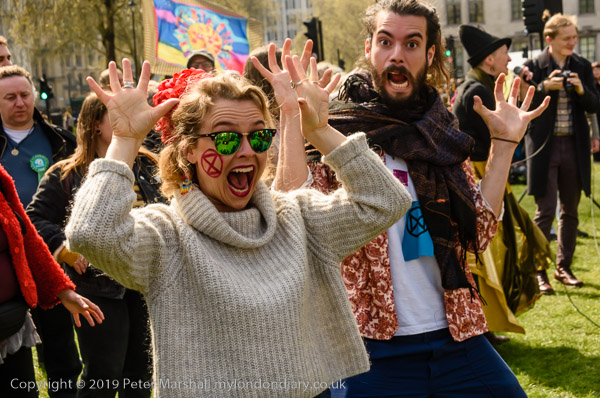
Extinction Rebellion (XR) began 11 days of protest which initially brought most of central London traffic to a halt on Monday 15th April 2019. They didn’t manage to keep up the protest until “the government takes necessary action on the global climate and ecological emergency” as we have yet to see that two years later, but they did considerably raise public and media awareness about the severity of the problem the world faces.

Unfortunately there seems to be little chance that effective action will be taken in time to halt biodiversity loss and reduce greenhouse gas emissions to net zero by 2015 as they demanded, though perhaps the half-hearted measures that will come out of the delayed climate summit later this year will do just a little to slow the rate our our planet’s decline, possibly enough to see my life out, though I worry about the future of my children and despair for that of my grandsons and daughters.
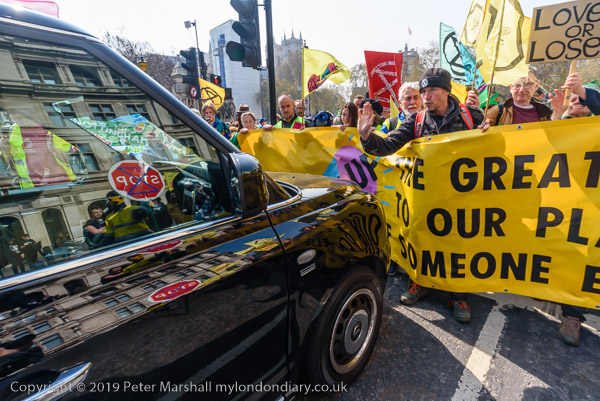
XR have now very much lost the initiative, mainly I think because of internal dissensions, perhaps inevitable because of some of the rather odd characters that they attracted. But some of their ideas, particularly over the police and arrests cut them off from many on the left who attacked them as a movement funded by shady capitalists and led by wacky idealists, more a Glastonbury festival than a political movement. Much of the criticism was ill-founded but not all.

The major effect they had on our government was for them to put pressure on the police to get rid of these pesky protesters – first by more arrests and prosecutions and now by the Police, Crime, Courts and Sentencing Bill to give the police greater powers to control all protests.
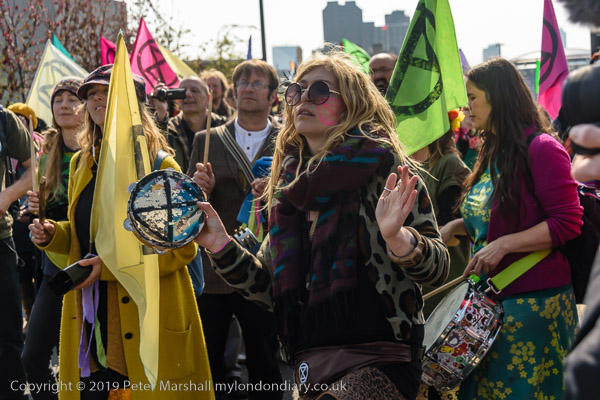
Early on the Monday morning, XR protesters set up camp at a number of key locations in London in a well-planned exercise. I turned up rather later to take photographs, first at Waterloo Bridge, which XR had turned into a ‘garden bridge’, blocking all traffic and bringing flowers and trees. There had been arrests earlier, but police had been unable to stop the protesters and the bridge – despite many further arrests – remained closed for over a week.
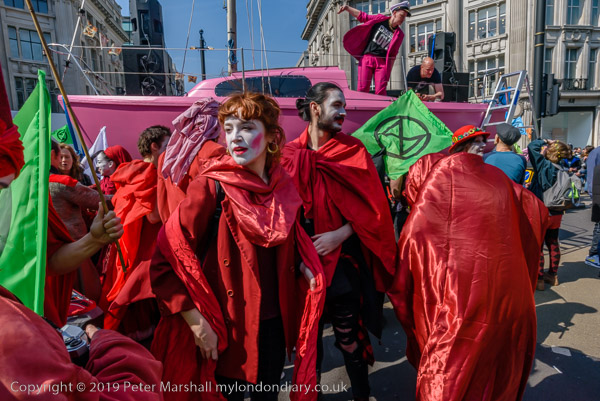
Because of the XR actions traffic all around the centre of London was at a halt, with buses not moving. Fortunately the tube was unaffected and took me to Oxford Circus, which now had a large pink yacht at its centre, named after the Honduran environmental activist and indigenous leader, Berta Cáceres, assassinated for her activism in 2016. It was here that I met the dance troupe dressed in red that were such a visible presence in XR protests.
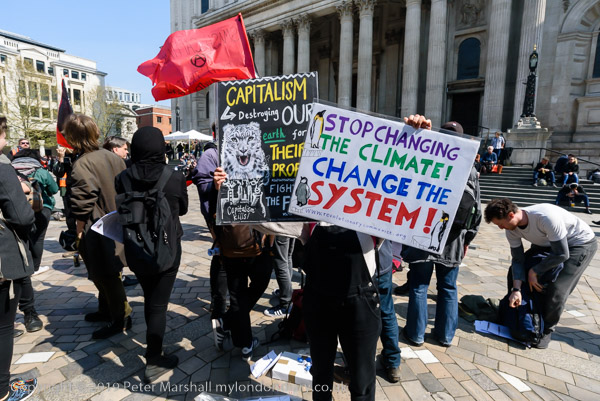
XR were not the only environmental game in town, and I took the Underground to St Paul’s Cathedral for a protest organised by the Green Anti-Capitalist Front, Earth Strike and London Students for Climate Justice. I arrived when there protest was due to start, but there were only a few of them present. I hung around for half an hour or so, and then gave up and left. Later I saw the accounts of their protest which did eventually attract a small crowd and was sorry I’d missed the action.
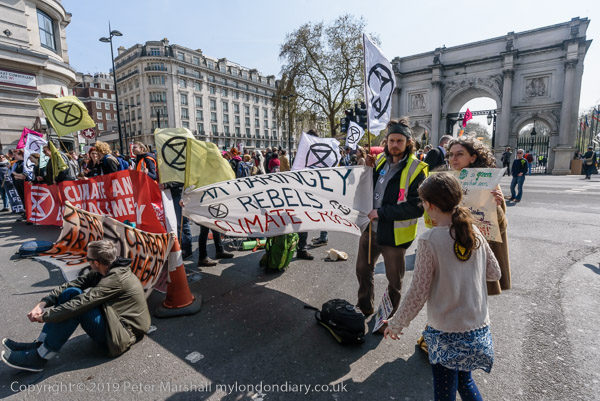
But there was rather more happening at Marble Arch, one of London’s main gyratory systems, where XR had blocked Oxford St, Park Lane, Edgware Road and a couple of other routes and had set up a stage, workshops and a tent village as well as the road blocks.
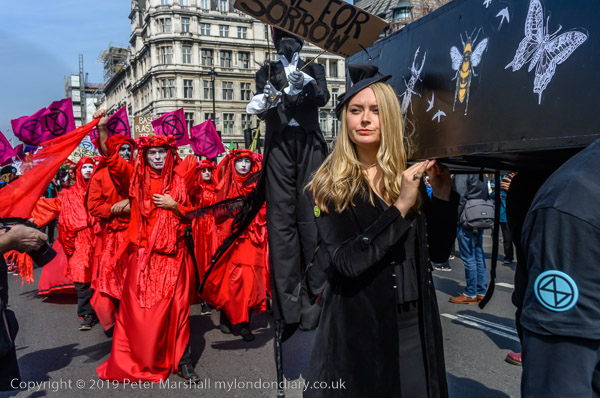
But XR had also planned an event for Parliament Square, where the roads around were blocked for a New Orleans funeral procession with jazz band to make its way around the square.
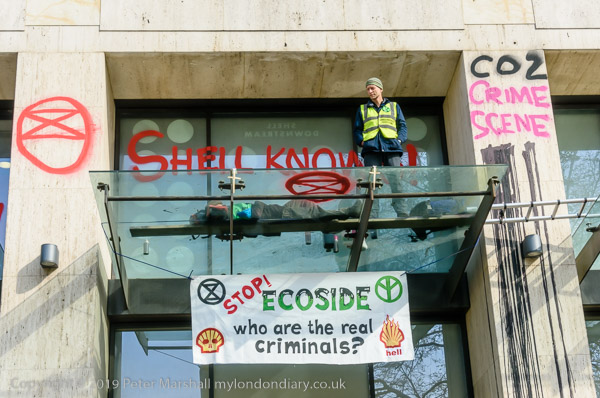
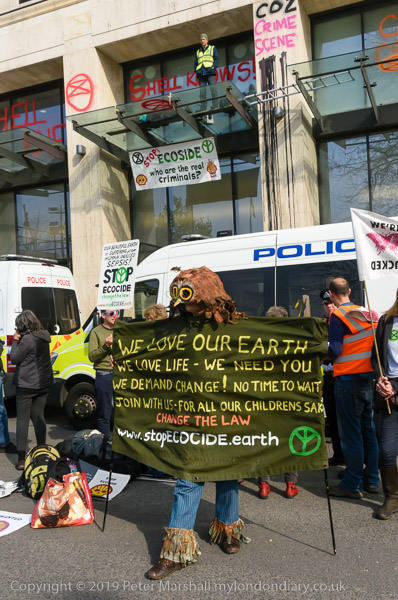
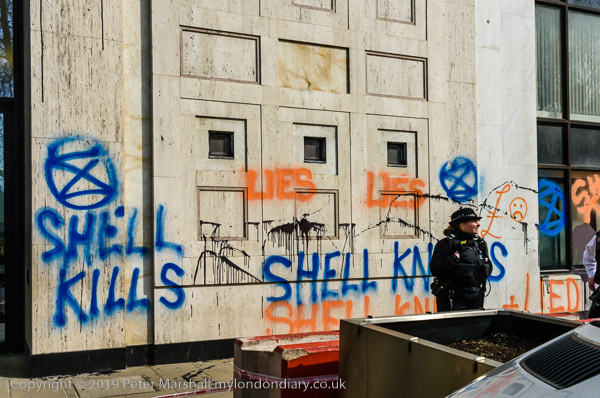
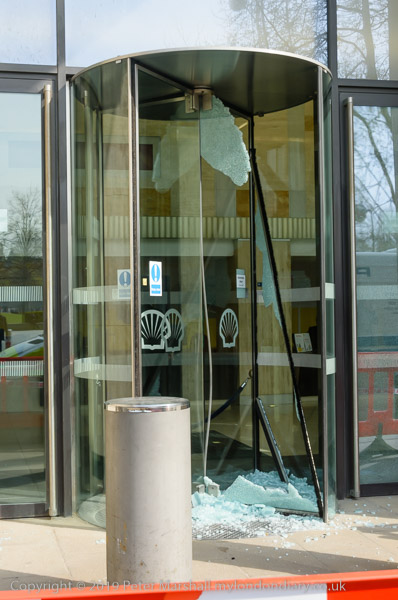
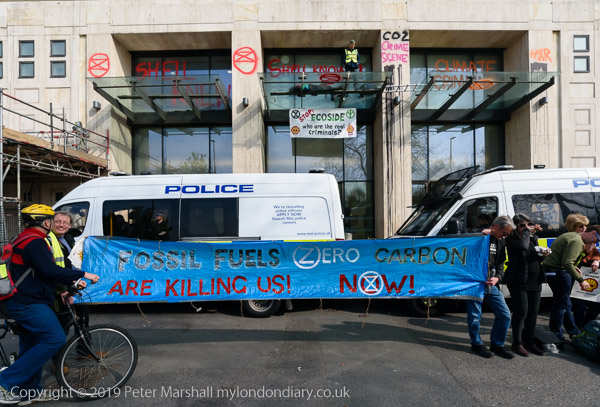
The funeral was perhaps also designed as a diversion for some more direct action, which I again missed at the Shell Centre on the South Bank. A small group of activists daubed slogans across the front of the building and two occupied the glass porch over the door. The activists had deliberately broken the glass in one of the doors, with the intention that this would result in a trial before a jury rather than by magistrates, enabling them to present the reasons for their action, and three had been arrested and taken away by the time I arrived, but the two were still up on the porch and others holding banners on the street in front.
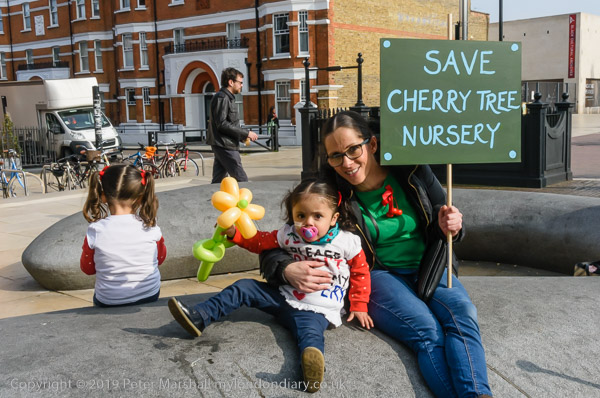
My day had not quite finished as I made a small diversion on my way home to visit Brixton, where staff, families and children from children’s centres were protesting against plans by Lambeth Council to close five centres and make drastic cuts at seven others. The council had recently spent £68 million on refurbishing the Town Hall and building a new Civic Centre.

Save Lambeth Children’s Centres
Extinction Rebellion at Shell
Extinction Rebellion Funeral Procession
Extinction Rebellion Marble Arch
Anti-capitalist environmental action
Extinction Rebellion Sea at Oxford Circus
Extinction Rebellion Garden Bridge


All photographs on this and my other sites, unless otherwise stated, are taken by and copyright of Peter Marshall, and are available for reproduction or can be bought as prints.
Shell Out

If we are to survive as a species we need to stop the climate destroyers, companies like Shell who are still pushing fossil fuels. So it wasn’t surprising that Extinction Rebellion had planned a protest at the Shell offices in London.

Also not surprising that as those taking part were intending to be arrested for taking illegal action and causing damage to the property that they didn’t advertise their protest beforehand. I only heard about it a short while after it happened, when a colleague who had been filming it told me what had happened and said it might still be worth a visit.

I do sometimes get advance information on illegal actions – and have at times been asked to cover them for the organisations taking them, but I usually pass up the opportunities. Sometimes it’s because they are taking place at inconvenient times, often early in the mornings. I’m afraid I don’t like getting up early and living a short journey outside London makes me reluctant to cover anything that starts before around 10.30am.

I also like to keep a certain distance between myself and groups of protesters. It’s a matter of objectivity and of editorial independence. I may support the aims of a protest, but as a photographer and a journalist I want to see and photograph it from my own viewpoint. So while I’m happy to cover events when I can, I don’t normally want to be a part of them.

Sometimes groups who approach me would be happy to pay for my services, though more often there isn’t any money involved. I’ve long been a supporter of trade unions and the idea that the labourer is worthy of his hire, and am opposed to my work being used without payment by anyone else who is making money out of it. I don’t actually need the money any more but there are plenty of younger photographers out there who struggle to make a living, and I’d rather any paid job went to one of them.

While I understand that many organisations want to improve the chances of hasing their protest or other event features in publications by providing free high-quality images, this is something I don’t like to support. If an event is newsworthy, then the media should be prepared to pay for decent pictures – otherwise no news photographers can make a living.

I have two simple rules when I’m asked for permission to use any of my images without payment:
Firstly – and this applies also when people approach me offering to pay – do I approve of the way they want to use the image. Some organisations get a straight refusal, though agencies with whom I place most images are less discerning.
Secondly if any organisation wants to use my work without payment my second question is to ask if the organisation has paid staff. If it can afford to pay workers it can also afford to pay photographers like me. It’s a simple test.

There are of course exceptions. One long-established is for the occasional exhibitions I take part in, where images are provided for free use in publicising and reviewing the show. And there is one or perhaps two magazines worldwide I would allow to use my work without payment in the unlikely event they would want to do so. And my work is made freely available to you all to view on my various web sites, particularly My London Diary, London Photographs, Hull Photos and the River Lea, links to which appear at the bottom of most posts on this site, a total of around 200,000 pictures and still growing.

As well as their general role in promoting climate disaster and ecocide, the protest at the London Shell HQ also highlighted their crimes against the people of the countries of the global south in which they operate, particularly in Nigeria where the company has been responsible for the killing of opponents to its activities, including Nigerian writer, television producer and environmental activist Ken Saro-Wiwa, executed by the military government there in 1995. 

I arrived far too late to see the activists daubing slogans on the Shell building and deliberately causing criminal damage so that they would be able to demand a trial before a jury, enabling them to argue their justification for the action. But there were still two activists occupying the glass porch above the entrance, as well as a group of supporters protesting on the road outside.

You can see a few more pictures at Extinction Rebellion at Shell. I didn’t stay long as I’d missed the main action and little now seemed ot be happening – and I had another protest to visit on my way home.


All photographs on this and my other sites, unless otherwise stated, are taken by and copyright of Peter Marshall, and are available for reproduction or can be bought as prints.
There are no adverts on this site and it receives no sponsorship, and I like to keep it that way. But it does take a considerable amount of my time and thought, and if you enjoy reading it, please share on social media.
And small donations via Paypal – perhaps the cost of a beer – would be appreciated.