Make a fortune from copying

If I were Jim Krantz I’d be talking to a lawyer.

In 2005, of his pictures sold for $1.2 million and he didn’t get a cent. Not even a name check. Trousering the big money is Richard Prince, an acclaimed artist, whose contribution was to copy and enlarge Krantz’s image, taken as a Marlborough ad – and apparently – if the reproductions on Art Knowledge News and the New York Times are reliable (Randy Kennedy’s article appears in both), add a colour cast.

Of course the whole thing is an incredible admission of a total aridity in the art world, and of course the total lack of appreciation of photography – Prince is quoted as once sending an e-mail saying “I never associated advertisements with having an author.” What phenomenal ignorance and arrogance.

Krantz of course is such a successful commercial photographer that he doesn’t need the money, and what he is really concerned about is “attribution and recognition.” But I’d certainly like to see him take Prince to the cleaners.

And I’d like to see all the art critics and increasingly photography critics who for some odd reason feel that Prince’s work is worth writing about to acknowledge that what they are really writing about is work by other people – just blown up large.

I’ve written previously about the importance of moral rights. This is a good example that makes the case.

You can also see Jim Krantz’s ‘art work‘ on line. Not entirely my kind of thing, but more interesting than Prince.

Big Sister

Although it’s the pictures taken in a Prague on-line brothel in ‘Big Sister‘ by Czech photographer Hana Jakrlova that are attracting most attention (my favourite is a polar room set with roofless igloo and large polar bear,  otherwise vacant) I think the best work on her site are the black and white images, particularly in her ‘Europe’ portfolio.

I’ve not previously come across the idea of an on-line brothel, but apparently it is yet another case of de-professionalisation, this time of the porn industry, where male performers now actually pay while punters watch over the internet. At least as yet photographers are only expected to work for nothing rather than pay for the privilege.

Jakrlova was born in Brno 1969, and studied architecture for 7 years in Prague, then two years at the Institute of Creative Photography in Opava. Later she did a year at the ICP in New York. She has lived in London, Paris and New York, and now works from both Prague and New York.

On the website you can also preview her two books, in the meantime: europe (2006) and the rather more conventional ways of communication (2000.) It’s a shame that this actually seems to be the only way that either of these two books are generally available, although a Dutch version  of the later book is listed.

Peter Marshall

Cruel Fur

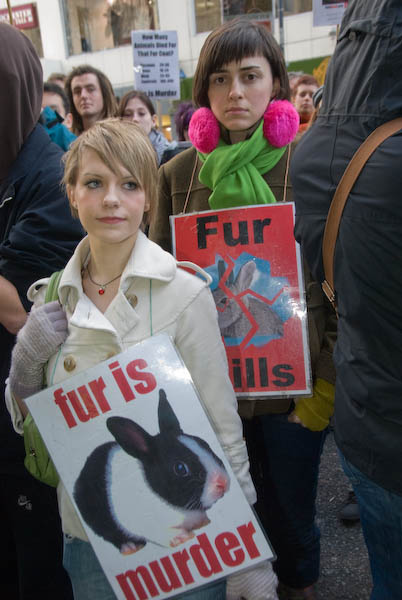
Like many people, I thought fur was a thing of the past, remembering those old ladies who came to admire me in pram and pushchair, moth-bitten foxes around their necks, pungent with lavender and mothballs and worse. Later came the campaigns against fashion furs that meant that only the most thick-skinned of dumb animals would be seen alive in another’s coat because of the extreme cruelty across the whole industry.

It was this well-documented cruelty that led to the closure and banning of fur farms in the UK, but in other countries they remain alive and even more sick. I’m not a veggie but I am opposed to cruelty against animals (and wish that all farm production reached the standards of the best.)

So it disgusts me to hear that the big names in fashion and fashion shops are promoting the use of real fur trimming on their garments, and that these are on sale in shops in this country – and that it is perfectly legal to sell these cruelly-produced products. It’s a particularly stupid and callous trade, particularly stupid because in almost all ways the artificial alternatives look and perform better than animal skins. Anyone buying them is paying to wear a badge of cruelty.

Around 250 people joined a march on Saturday past some of the shops selling these tainted goods in Knightsbridge. The march paused briefly outside several shops before halting outside Harrods, apparently the only department store in the UK that still deals in furs, and where there is a regular picket every Saturday. After a brief address and many shouts of “Shame on Harrods”, there was a minute of silence before the march moved on, and I left them.


Outside Harrods in Brompton Road, Knightsbridge.

Surely it’s time the Government made time to ban this trade. It is one piece of legislation which would gain approval from the great majority of the British public and the kind of measure which would provide a sadly needed increase in their support.

Peter Marshall

Christmas comes early…

Christmas comes early in Surrey and doubtless everywhere else. So far I’ve photographed three Christmas events on the south-west fringes of London (and am wondering whether I can fit another in this evening.)

They switched the Christmas lights on in New Malden on 23 Nov, and it was Winter Wonderland in Wimbledon last Thursday. Friday night it was pouring with rain, but the Hampton Hill Christmas Parade went ahead as usual – if rather wetter.

I don’t much like working in the dark or in the rain, and struggling with an umbrella and a recalcitrant camera and flash made me wish I’d stayed in the pub. But all the performers in the parade were out there, mostly getting soaked, so I felt I ought to stick at it too.

Here’s one that I rather liked, and may get on my Christmas card.

Peter Marshall

Positive Lives

December 1 is World AIDS Day, with thousands of events taking place around the world to encourage leadership at all levels in the fight to get ahead of AIDS.

One of the major photographic projects about HIV/AIDS is Positive Lives, which includes the work of around 30 photographers with stories from around much of the world. One of those stories was by Stuart Freedman, and you can see more work from it on the Panos Pictures site (as well as some other fine essays by him.) Facing the Virus (click on the image there to see two pages of images) shows people in Rwanda working as a part of a programme with the government’s health authority and Concern, an Irish-registered worldwide charity facing up to the problems of living with HIV/AIDS.

Freedman’s work, which won him the prize for photojournalism at the 15th annual Amnesty International Media Awards in 2006, is one of many fine features on the Panos site by some of the best photojournalists currently working. You can also find work by this year’s winner, Andrew Testa, on the site, although his work, on Acid Attacks in Bangladesh, appeared in Foto 8, a magazine that has featured a great deal of fine photography and is currently relaunching.

Photo Histories

Some months ago, Graham Harrison contacted me about a new on-line photography site he was setting up, looking at photography in an intelligent way, and invited me to have a look at the preview site. I was impressed, and offered to write something, though as yet I’ve not got around to it. Perhaps later…

Photo Histories is now up for all to read, and the content so far is impressive, with a great interview with Philip Jones Griffiths, who talks about “why the ideals of the thinking photojournalist forged in the 20th century should not be sacrificed for the dumbed down culture of the 21st.” His ‘Vietnam Inc’ (1971) was one of the most important books of the era, and one that moved me and others powerfully when it came out – and is still a fine example of why photojournalism is important. I also have a great deal of sympathy for his views on the current state of Magnum which you can read in the interview. While others – including myself – have written about his work and its significance, this interview does add some insights into the work and the man who produced it – and has a nice picture of him by Harrison.

Another photographer I’ve also written about previously is Homer Sykes, whose self-published books Hunting with Hounds and On the Road Again I reviewed at some length. (You can download a pdf file of the Autumn 2002 issue of the LIP Journal where my review of On the Road Again appeared in print – and both – along with features on photographers Berenice Abbot and Brassai mentioned below – are probably available on the ‘Wayback Machine‘ or its mirror from About Photography.)

In Photo Histories there is another detailed interview with Sykes, as well as a interesting set of pictures ‘Unknown Homer Sykes : The English 1968 – 78‘.

I met Homer again earlier this year, when he was back photographing Swan Upping on the Thames for the first time for many years. You can see some of my pictures from the event at My London Diary, but surprisingly I don’t seem to have mentioned him. The two of us were the only photographers who ran along the river bank to record the Dyers and Vintners men raising their oars to salute the Royal uppers at the end of the day. I hope he got the exposure better than I did in the wickedly contrasting light. I left the D200 to sort it out and it didn’t.

Other features on Photo Histories include some on key books from the history of photography, including Berenice Abbott‘s ‘Changing New York‘ and ‘Paris de Nuit‘ with pictures by Brassai. Perhaps these were a little disappointing in not really dealing with the images, more with biography and background matters, but still useful introductions. Perhaps it might be a useful addition to have features about key images or sets of images from them as well.

Graham Harrison has of course worked for some of the big names in British publishing, and at the centre of Photo Histories is a section called by that same title, which includes an article (originally published on EPUK) about the first Press Photographer’s Year Expo held this summer. At the end is a footnote:

After the success of the Press Photographer’s Year Expo it was sobering to see Stoddart’s stills used with effect throughout the C4 TV documentary The Rise and Fall of Tony Blair credited to Getty Images only.

Moral rights – including that of attribution – are something that photographers still have to fight for. The Photo Histories section also has a very nice insider story by Brian Harris about working with the late Don McPhee during the 1988 US Presidential campaign.

As well as his main site, you can also see more of Graham Harrison’s work in ‘The Oxford Year,’ though in the two years this has been going he seems so far to have missed those swan uppers!

Nikon D3 or D300?

Yesterday I went along to the Nikon show at Olympia to play with their two new cameras, the D3 and D300. Both seem decent models, though I’m not sure if I will buy either. After all the D200 is still working pretty well. I only bothered to go there because I wanted to go to a London Bloggers meet in the evening, so it was sort of on the way.

There are some nice things about the D300, in particular the even better screen on the back, and the few images I took at high ISO perhaps seemed a little more usable than with the D200. I’d certainly be a little happier with shooting at ISO1600, though I’m not clear whether the difference is really anything more than more aggressive noise reduction in the D300. The test shots I’ve seen – unlike mine, taken under carefully controlled conditions – on Imaging Resource do seem to show less noise on the D300 image at 1600 than at 800, together with reduced noise and sharpness, suggesting a sharp ramp in noise reduction.

However I didn’t shoot on RAW, but only on fine jpeg, and also hadn’t made all the tweaks I would certainly want to do when using the camera. Detailed reviews may appear shortly, at the moment all we really have to go on is the published specs and some fairly ill-informed comment – including that on at least one site where the author has been using a camera for a few days.

Moving from a D200 to a D300 would be relatively simple, with many of the controls in similar places, and the camera has the same feeling of having controls in the right place. As well as the larger screen, I’d certainly welcome the improved focus system, which is the same as in the D3. Possibly the ability to record 14 bits instead of 12 may also help in high contrast situations.

I took a few frames on the D3 too, with the ISO set to 5000, again as jpegs (I wasn’t sure if my raw processing would work with the RAW files from the cameras.) Lousy subject matter, but – at least where I got the focus correct – technically very usable images. I really needed rather longer to get used to the camera, and the menus seemed rather confusing compared to the D200, though I’m sure I’d soon cope.

So would I like one? I’m not sure. It’s a great camera but I think too large and heavy for me. I’m often using a camera more or less all the time for perhaps 5 or 6 hours at a stretch, and I’m not sure my shoulders or right wrist would cope with the extra heft. The Nikon D200 and D300 both weight around 830g while the D3 is 1240g, half as much again. Of course the difference in practice is a little less obvious, as I’d normally have perhaps 600g of lens fitted to any of the bodies.

I’m not going to rush out and buy either – particularly as the D3 in particular is likely to be in very short supply for a while. Despite the cost and size issues, it’s still the one I’m more inclined to seriously consider. And it would cost. As well as D3 itself costing well over twice as much as the D300, I’d also need a new lens to replace the 18-200 which only covers the DX format, as well as possibly wanting to replace my current Sigma 12-24 (which does cover full frame) with the new Nikon 14-24 f2.8….

It might be easier to just go back to using film!

Paris Nudes

I’ve written in the past about the history of nude photography, and Paris was certainly one of the major centres of production of ‘academies‘, those early nude figure studies, ostensibly made for the education of artists, but in fact gratifying a rather wider section of the middle-class male population.

The exhibition ‘Books of Nudes: an anthology‘ at the MEP until 6 Jan, 2008, shows work from the astonishing collection of Alessandro Bertolotti of published nudes gathered over 30 years (and those unable to visit the show may be interested in the catalogue or the book, Books of Nudes, published by Harry Abrams, which is the English version – and rather cheaper.)

It is a splendid collection, and a book that might well go on Christmas lists for photographers – and those with an interest in the subject. But although it is a great source of material – particularly work by lesser-known photographers – I found the organisation and exhibition text less than satisfying.

The work is organised on a chronological basis, and this allows for a reasonably sensible grouping and analysis of work in the early years, but begins to fall apart early in the twentieth century. When it came to the section covering work in the period immediately after 1945, it is clear that it breaks down completely, lumping together work such as Bill Brandt‘s with work that I would dismiss as ‘glamour’ rather than nude. And things can only get worse.

I’ve always refused to write about or feature ‘glamour’ photography. To me it is just a dishonest sibling of pornography. Of course porn covers a very wide range of material, some of which truly disgusts me – and I think it is more than a matter of taste. So-called ‘glamour’ merely saddens me to think that there are some who find it glamorous. It is the artificiality I object to, not any nudity.

We each have our boundaries, and our interests. I’d be quite happy never to see another picture of a ‘celebrity’, with or without clothing. Although there was nothing in the show I’d want to see banned there was certainly some material which I think the show would have been better without.

But there is plenty there of interest, including fine work I’d not seen before, for example by Germaine Krull, as well as much by photographers I’m familiar with and have written about, including Man Ray, (select ‘Nude‘ in the Themes drop-down), Willy Ronis, Jan Saudek, (but not Sara) and many more.

Peter Marshall

The Picture Lady – Martine Barrat

Martine Barrat‘s show “Harlem In My Heart” is at the Maison Européenne de la Photographie in Paris until January 6th, 2008, and I spent quite a while looking at her warm record of her over 30 years in Harlem and the many friends she has photographed.

You can see some of the best of her pictures at Contact Press and more of her work at her own web site, which suffers from a rather odd flash interface (the kind of thing fortunately that seems very dated now, but is worth persisting with.

As well as her work from Harlem, there are also a number of other galleries on her web site, though I got too annoyed with the site to look at them all. There are some nice black and white images from the Goutte d’Or (Paris Voice describes it as “a tiny patch of Africa transported to Paris“) at the eastern edge of the 18e.

Barrat was born in Algeria but grew up in Paris. She moved to New York in 1968, at first to co-ordinate a theatre workshop working with a jazz group, later becoming a photographer and film-maker. One of her early films was on youth gangs in the South Bronx, and was shown at the Whitney Musuem in New York as a part of the exhibition with her still photos, “You Do the Crime, You Do the Time“, later winning a prize for best documentary in Milan.

She became well-known as “the Picture Lady” for the images she took around Harlem in the 1970s and later. Her first book, on young boxers, ‘Do or Die‘ (1993) had an introduction by Gordon Parks and a foreward by Martin Scorcese.

You can read a more detailed resume on her web site, in English or French.

It is certainly a body of work that shows her heart is in Harlem and warms the heart of the viewer. It’s work that comes from being very much a part of the community she is photographing, and includes some displays of pictures pasted up like those that she made on the walls of a Harlem community centre.

Peter Marshall

Streets of London & Paris

Two rather different photographers whose work I’ve enjoyed on the web in the last few days.

Paul Muse was born in England but has lived in Paris for quite a while. On his site you can see a daily image along with a short text (in both English and French,) and the text for 20 Nov:

“Paris rediscovers the fun of getting around on foot.”

certainly got a response from me as I was still recovering from walking around Paris courtesy of the striking transport workers.

Don’t miss some interesting work on the gallery pages, including ‘London Falling‘, street pictures taken during a short visit to the city in August 2006, and much more. If you are in Paris his work is on show at the ‘Galerie du Lucernaire’ until 2 Dec – details on his site.

I met Paul when I was in Paris recently, but unfortunately didn’t get to see the pictures then. Next November I’ll book a longer stay, because there really is so much to see – and of course even more next year, when November will also be the ‘Mois de la Photo‘ along with its incredible ‘Off’ fringe.

Brian David Stevens is a photographer I’ve known for a while, and we sometimes find ourselves standing together at events in London, although the pictures we make are usually very different. He continues to work with black and white film in a Leica (he tells me the latest stuff is ‘digital Tri-X’ using a Ricoh GR-D) while I’ve moved to using digital colour (sometimes with an M8, but more often with a Nikon) but there are even more significant differences.

He describes his profession in his ‘Lightstalkers’ profile as “miserable sod” (I think it comes from the Welsh blood.) And although its a mode I can do pretty well myself (look, my middle name is Gwyn), I like to have fun when making pictures.

But his work is dark and powerful, with lots of empty blacks, and it works well, both with the images using reflections and the very direct images of people on the street, often viewed looking up from hip level. One of his images of two women in particular really jumps off from the screen with forceful menace.

It’s interesting to compare the pictures on Flickr where he now posts work, with those on his older personal web site. There are some of the same images, and clearly the same vision, but presented very differently.

Peter Marshall