Rich despise the poor

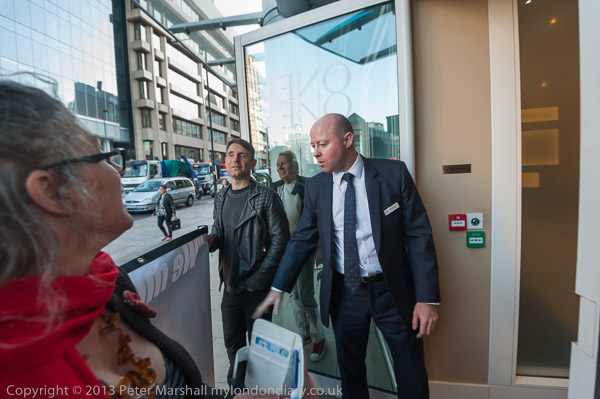
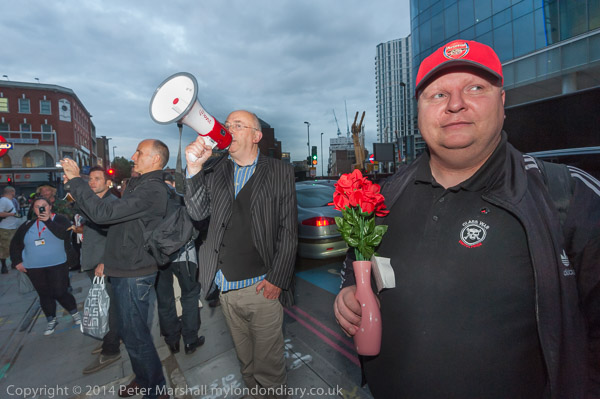
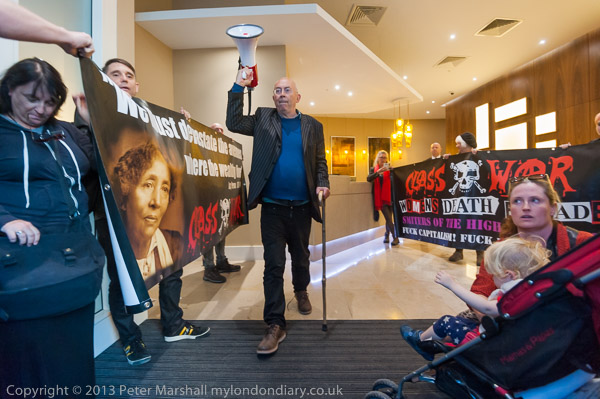
Security escort a member into the club past protesting union members

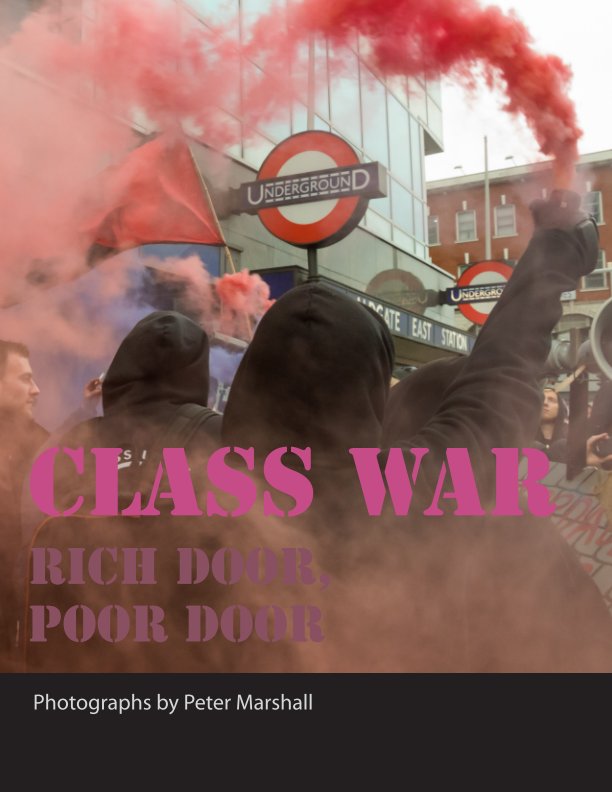
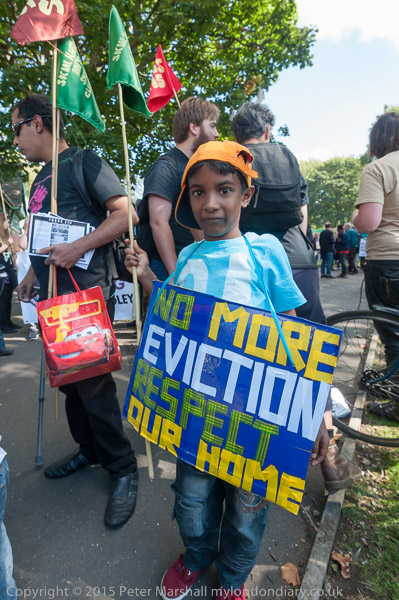
The rich or at least a significant proportion of them are really not very nice people. It’s perhaps why some of them are rich, making deals and evading tax without any concern for others just for their own profit. It was the rich who made millions from the slave trade and the plantations, the rich who are still profiting from exploiting people in mines, from dispossessing people of their lands, polluting their water. The rich who profit from fossil fuels that are killing the planet, the rich who profit from asset-stripping and putting workers out of their jobs.

The street was sealed off by red barriers at both ends with security staff who let club members through

Of course most of us gain a little from such activities, with investments by our pension funds and other similar ways, but its the rich whose naked greed drives the process and who gain most massively. And while the country may lose billions through Brexit, the rich will keep their tax dodges and clever investments to keep and increase their wealth, congratulating themselves on having persuaded over half of the country to vote against their own interests.

Security staff help a club member who had assaulted protesters and tried to walk through the club’s barriers on the street

Inequality – the gap between the rich and the poor – has increased greatly in the UK over my lifetime. Studies of incomes show us becoming more equal until around 1979 and then increasing since then, with a small blip in 2008. According to the Joseph Rowntree Foundation, four million British workers are now living in poverty, half a million more than five years ago. Not only are the rich becoming richer, but policies including Universal Credit and benefit sanctions are making many of the poor destitute. On the streets we see an increasing gap, with more people homeless and reduced to begging, while the wealthy have become more ostentatious, and nowhere is this more evident than in Mayfair.

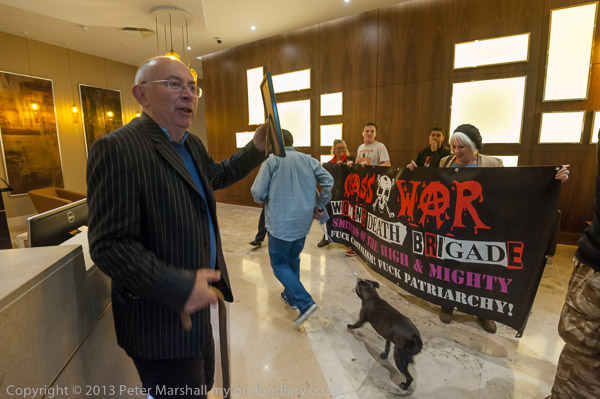
A club member is escorted past the protesters

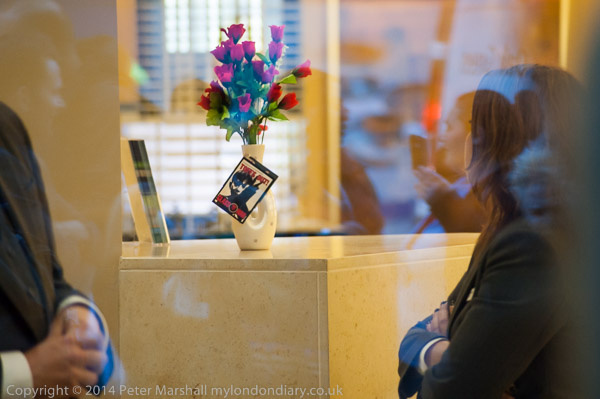
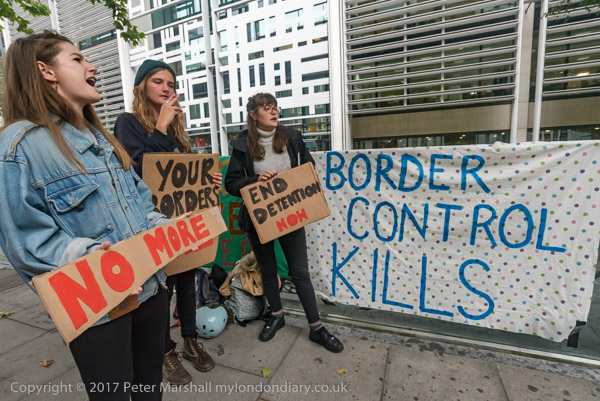
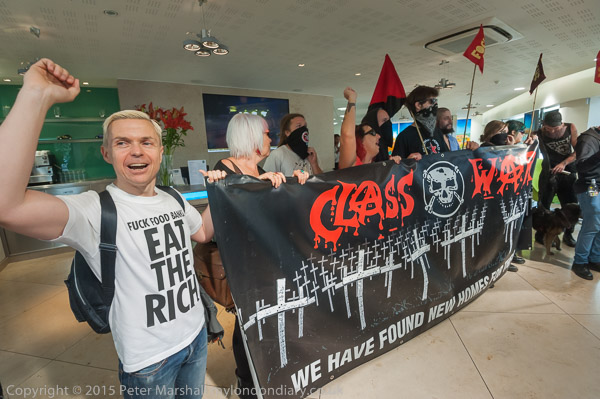
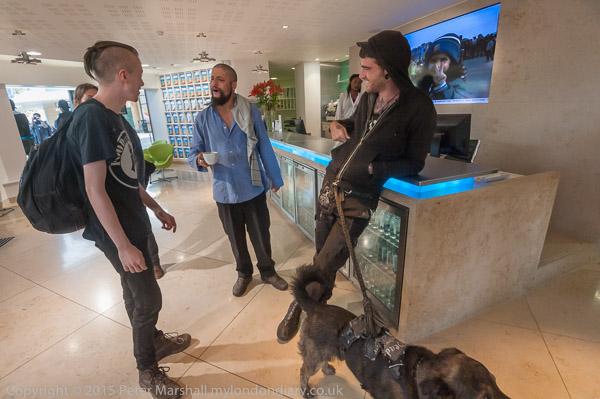
Of course it is inexcusable that an exclusive private club such as LouLou’s which charges high prices for membership and services should pay workers less than the living wage, but what I find even more disgusting is the attitude shown towards the protesting workers and their supporters by some members as they go past the protest, and by the managers and staff of the club. Rather than talk to the union and pay a proper wage they employ extra security to confront the protesters.

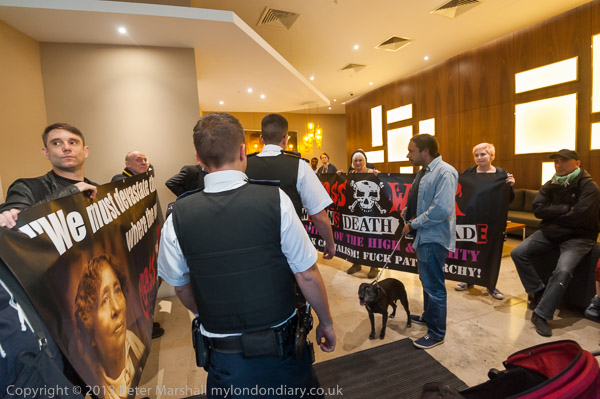
Ian Bone asks a police officer why they are siding with the club owner who is refusing to pay a living wage

A large proportion of those now in poverty in the UK are in work – but also have to claim benefits to keep alive. These benefits are paid for by other tax-payers, essentially a subsidy from us to low-paying organisations and also to landlords, many of whom are extremely rich. Everyone in full-time work deserves a living wage, and we should have minimum wage rates that ensure this. In London that means the ‘London Living Wage’, determined each year and not the much lower government figure.

Police warn a Jane Nicholl she will be arrested if she continues to shout using bad language while a legal observer looks on

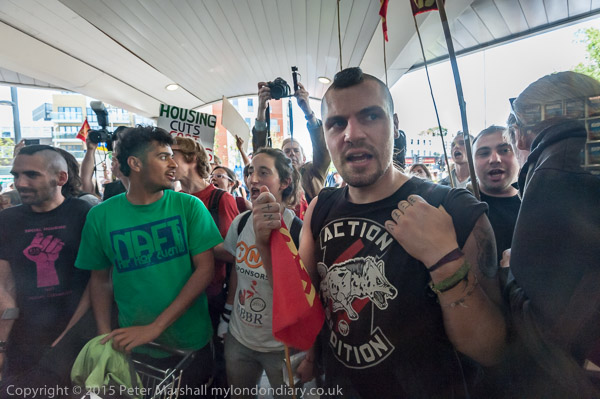
Police at the event seemed to adopt a rather aggresive approach towards the protesters from the IWGB Cleaners and Facilities Branch and supporters, threating some with arrest, while ignoring some rather aggresive action by the security. They also refused to take any action when the protesters pointed out that the security staff were not wearing a visible SIA licence as required by the Private Security Industry Act 2001. The protest was loud and at least one protester was threatened with arrest for shouting at members going into the club because of the language she used.

More at LouLou’s stop exploiting your workers


All photographs on this and my other sites, unless otherwise stated, are taken by and copyright of Peter Marshall, and are available for reproduction or can be bought as prints.
There are no adverts on this site and it receives no sponsorship, and I like to keep it that way. But it does take a considerable amount of my time and thought, and if you enjoy reading it, please share on social media.
And small donations via Paypal – perhaps the cost of a beer – would be appreciated.


Afrikans demand reparations

Time for a little more colour on >Re:PHOTO, and looking back to warmer and sunnier weather at the start of August last year.

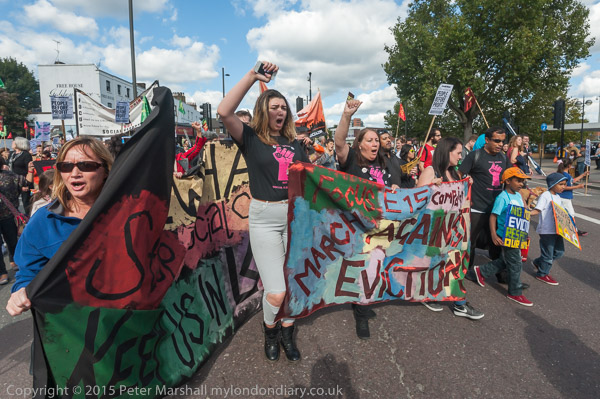
The Afrikan Emancipation Day Reparations March has been an annual event in London http://mylondondiary.co.uk/2014/08/aug.htm#rastafari since 2014, which was the centenary of the foundation by Marcus Garvey of the Universal Negro Improvement Association in Jamaica. Garvey had spent the previous two years working as a journalist and studying in London and founded the UNIA as as a means of uniting all of Africa and its diaspora into “one grand racial hierarchy.” The organisers of that first march intended it as a one-off event, but others took over insisting it should be annual. This was the first time I’d managed to cover it since 2014.

Garvey chose the date as 1 August 1834 was Emancipation day, following the Slavery Abolition Act 1833, when slavery was ended in the British Empire. Claims for reparations for descendants of those enslaved by the Atlantic Slave Trade came to the fore in 1999 when the African World Reparations and Repatriation Truth Commission called for a payment of $777 trillion to Africa within 5 years, and in 2004 a case was brought and lost against Lloyds of London and Jamaican Rastafarians made a claim for £72,5bn for Europe to resettle of 500,000 Jamaicans back in Africa which was rejected. Other claims have been lodged on behalf of Guyana, Antigua, Barbuda and Barbados.

I felt a little apprehensive at photographing this event, and just a few people have shown a little hostility towards me, though many more have been welcoming. Anyone who has grown up white in the UK has obviously benefited from the historic proceeds of slavery (as so do those of any other origin living here) but I’m fairly sure that my ancestors were not among those carrying out and profiting from the trade. They will have been being exploited by that same class that was enslaving Africans; some thrown off their lands by the Highland Clearances to make way for sheep. Others will I think have been at the heart of the emancipation movement. They will have received nothing of the huge financial compensation that was paid to the enslaving class, which created a debt which members of the British public were paying off through taxation until 2015.

This year the march was divided into 9 blocs, although in practice there was a great deal of overlap. One of these was the Ubuntu – Non-Afrikan Allies Bloc which included Extinction Rebellion XR Connecting Communities.

While I think there is a firm moral case for reparations, I think the demands are unlikely to impress European or American governments, certainly not on the scale being claimed. And I wonder if the demand actually deflects from a more important need for decolonisation of Africa and the Caribbean as well as other areas of the majority world, reclaiming national assets from the various multi-nationals that are now continuing the exploitation of the continent.

I left the march as it made its way through Brixton towards Parliament where there was to be another protest rally in Parliament Square.

Afrikans demand reparations


All photographs on this and my other sites, unless otherwise stated, are taken by and copyright of Peter Marshall, and are available for reproduction or can be bought as prints.
There are no adverts on this site and it receives no sponsorship, and I like to keep it that way. But it does take a considerable amount of my time and thought, and if you enjoy reading it, please share on social media.
And small donations via Paypal – perhaps the cost of a beer – would be appreciated.


IWGB welcomes new Vice Chancellor

Although Universities like to present themselves as centres of enlightenment, when it comes to their relationship with workers who provide vital services to them, things are rather different. Unions including the IWGB have a long record of fighting and eventually winning battles against intransigent university managements for the London Living Wage and for better terms and conditions of service.

The IWGB, supported by other unions, after a series of protests and strikes in the ‘3 Cosas’ campaign won improved sick pay and holiday pay for outsourced workers at the University of London (Central Administration). But outsourced workers employed by contracting companies to work for the university are still under far worse conditions than those directly employed by the university, and often subject to poor and bullying managers, and a new campaign began in 2017 to bring them into direct employment.

Actions by IWGB members and its supporters – including many university students and staff – forced to the University to make a committment to bring the workers in-house, but a year later this promise was still to be kept, with only 12 receptionists having been brought back to direct employment

This action followed a failure of the newly appointed University Vice-Chancellor Wendy Thomson to reply to the IWGB’s request for a meeting to discuss the issue. Instead of talking with the IWGB union about their demand for all the workers to be taken into direct employment without delay the University has been spending large amounts on buying in extra security staff.

Although the great majority of the staff involved are now IWGB members, the University continues to take advantage of our immoral trade union laws which enable them to ignore the union and instead only officially talk and negotiate with a union which has no or very few members among the workers involved.

To their great shame our larger established trade unions collude with this practice – and even often claim the credit for concessions which have only been won because of the work of the IWGB and other grass roots unions who similarly remain unrecognised by the employers. Workers have a right to choose who should recognise them, and this is something that the unions once fought for but now too often refuse to support.

The 12 receptionists were given new contracts in May 2019, but these were negotiated with another union “behind their backs and behind the back of their chosen trade union, the IWGB“, and 7 of the 12 have brought grievances against the university, some of which involve a breach of transfer of employment (TUPE) regulations.

Since this protest, the University have also set a timetable to bring the  security officers in-house in May 2020 and cleaners in-house in November 2020, but have refused to bring the gardeners also involved back in house.

The IWGB are continuing to demand that the gardeners are also brought back in house and that any new contracts should be made in consultation with the union to which the workers belong and be approved by them.

More about the protest and more pictures at  IWGB welcome new Vice Chancellor


All photographs on this and my other sites, unless otherwise stated, are taken by and copyright of Peter Marshall, and are available for reproduction or can be bought as prints.
There are no adverts on this site and it receives no sponsorship, and I like to keep it that way. But it does take a considerable amount of my time and thought, and if you enjoy reading it, please share on social media.
And small donations via Paypal – perhaps the cost of a beer – would be appreciated.


Mayfair Mayhem

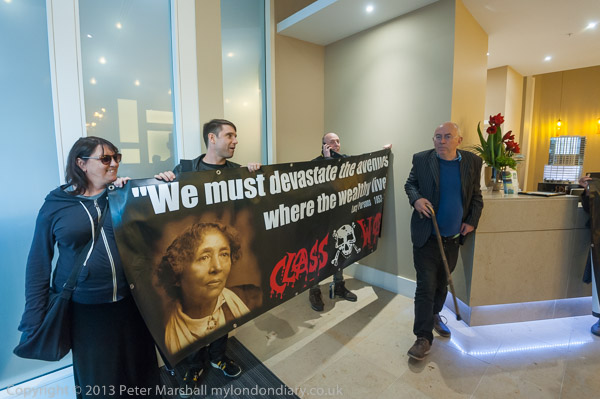
I don’t like going to Mayfair. Too much conspicuous consumption on display, too much affluence and waste. It isn’t envy – mostly I wouldn’t want those excessively expensive things you see in shops and through windows, nor the expensive menus etc. I’m largely a man of simple tastes, and happier to share expensive works of art in the National Gallery rather than hang them on my own private wall.

In part its the people. Though I’ve known and liked some who are wealthy there are too many who are obnoxious, who look on the people who work for them as dirt, or just couldn’t give a jot about others. Of course there are poor people who are obnoxious too, but generally in ways that are less obtrusive.

Clubs like LouLou’s with a ‘exclusive’ tag and a membership (in 2017) of £1,800 and described by a fawning article on the Observer website as “the place to be for royals, billionaires, A-list celebrities and socialites” seems to be a magnet for the uncaring and obnoxious, run by the son of Lady Annabel Goldsmith who has given more than £268,000 to Nigel Farage’s UKIP and donated £20,000 to Boris Johnson’s leadership campaign.

But despite this huge wealth, LouLou’s pays its kitchen porters a pittance, and the IWGB has been supporting their claim for the London Living Wage of £10.55 per hour and for decent terms and conditions of service such as sick pay. Currenly the porters who are mainly migrant workers get only £9 per hour. This was I think their second protest outside the club.

Henry Chango-Lopez, President of the IWGB, said:
“It is unfair that the porters who allow billionaires to wine and dine in luxury and secrecy are left hung out to dry. The porters can see straight through 5 Hertford Street’s bribes and know that outsourcing will only lead to further exploitation. The restaurant needs to give justice to its workers and put them all under the same banner.”

https://iwgb.org.uk/en/post/5cf8f67de9521/iwgb-demands-end-to-poverty

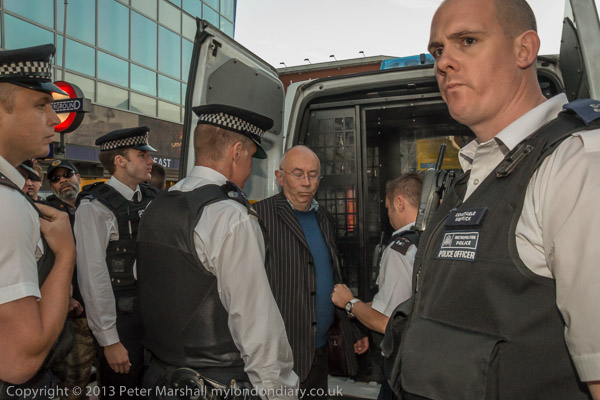
I think it was a genuine accident when police knocked one of the protesters to the ground, an officer walking backward into him. But the whole attitude of the police was deferential to the club owners, their security men and guests but hostile towards the protesters, two of whom were arrested.

More at IWGB demand living wage at LouLou’s .


All photographs on this and my other sites, unless otherwise stated, are taken by and copyright of Peter Marshall, and are available for reproduction or can be bought as prints.
There are no adverts on this site and it receives no sponsorship, and I like to keep it that way. But it does take a considerable amount of my time and thought, and if you enjoy reading it, please share on social media.
And small donations via Paypal – perhaps the cost of a beer – would be appreciated.


Pride should be a Protest

After around 20 years of photographing the annual Pride in London I decided I had had enough. As I’ve written often before, Pride has moved from being a protest for gay rights to becoming a corporate jolly, and this year charging entry fees that have prevented many of the more radical groups from taking part officially.

So this year I didn’t bother to apply for accreditation to cover Pride, something which has become more or less essential in recent years. And later I heard that Pride had tried to refuse accreditation to many press photographers as well as more or less banning those they did accredit from where they would be able to make decent pictures. After a great deal of aggravation and complaints from the NUJ and BPPA there were some compromises, but many colleagues decided to have a day off this year.

Two years ago instead of covering the official march I’d gone with the Migrants Rights and Anti-Racist Bloc who had tried to join in the event and when they were refused had held up Pride and then marched along the route ahead of the official event. And last year I’d gone into the suburbs while Pride was taking place for a march celebrating the 70th anniversary of the NHS and against plans to close acute facilities at Epsom and St Helier Hospitals in south London.

For 2019 I decided that there were two events I wanted to cover, one completely unrelated to Pride, but the other the Queer Liberation March in protest against the increasing corporate nature of Pride which was planning to march at the end of the official parade.

This was meeting in Regent’s Park, where some of those taking part in the official event were also gathering, and at first it was difficult to tell the two groups apart. Gradually as some left to take up their place in Pride things became clearer, and it also became clear that I was in for a very long wait before anything was going to happen as Pride was moving only very slowly.

I’m not good at waiting, and decided to go and join the unrelated event, intending to return later. My journey took me much longer than expected because of the crowds for Pride, and by the time I had finished photographic the second event I was feeling tired and could not be bothered to return to find the group from Regent’s Park.

It was a poor decision, as the Queer Liberation March turned out to be rather interesting. Pride stewards tried to stop them marching along the parade route and there were scuffles with stewards and police, before police decided that they must be allowed to continue. My colleague who had stayed and waited with them got some really interesting pictures and I had missed the fun.

More at Pride is a Protest


All photographs on this and my other sites, unless otherwise stated, are taken by and copyright of Peter Marshall, and are available for reproduction or can be bought as prints.
There are no adverts on this site and it receives no sponsorship, and I like to keep it that way. But it does take a considerable amount of my time and thought, and if you enjoy reading it, please share on social media.
And small donations via Paypal – perhaps the cost of a beer – would be appreciated.

Kids march for more school

Whatever is wrong with modern children? I just cannot imagine myself at primary school protesting at getting an extra half-day off school. We would have cheered.

Of course parents are likely to be upset. Having to find some way to look after their offspring on a Friday afternoon when in most families both parents will be at work. It must be bad enough having to make arrangements for the school holidays without this extra burden,

While I was teaching we did get the occasional day where school closed and we were sent home early, and I think we were generally rather pleased, particularly if it was a day when we were down to teach 3G last period. Though I suppose we might have got a little concerned if it were happening on a regular basis, and particularly for some of the classes who were nearing their GCSE or A level exams – and I think there were some times when these exam classes remained for lessons when others left early.

But now of course we have exams at every level, the dreaded SATs, starting in the May of Year 2, when children are only 7. Some schools add to the training in terror by making them take ‘optional SATs’ at the end of every year there isn’t a real SAT test (the next one comes for 11 year olds in Year 6.)

And teachers, particularly head teachers, are of course concerned about the results, as they place their school in the league tables. So concerned that although they only take place for a short period the SATs have come to dominate the whole year’s work in most of our schools. Schools that want to be seen as successful have had to change their whole ethos to “teach for the tests.” It shouldn’t be so.

It was of course a fiction that children were not tested before the SATs. At secondary level children came to us with the results of properly standarised tests from the NFER, tests that were adminstered with none of the anguish and stress of the SATs, which were used to diagnose a pupil’s needs and not to judge schools and which were considerably more useful and reliable, and were not the tail wagging the dog of the school.

As parents, we sent our children to the local schools. The primary school they both went to was a happy school and well run. It tried to continue that way when the SATs came in (fortunately after our children had gone on to the local secondary) but the results of the first year were miserable compared to the other local schools that had drilled their children for the exams from the start, and they were forced to change.

This protest, though I think driven by exam pressures, was not about getting rid of the exams but about funding. Schools have suffered under austerity, and those in the more difficult areas have suffered more than those with wealthier parents, though even those have problems. Parents associations which used to raise funds for extras are now having to do so for essentials, and parents in many schools are now asked for ‘voluntary contributions’ to our free education system. Though with various reforms by both New Labour and Tories we hardly have a system, more a mess.

This protest, like so many schools, was also funded by voluntary contributions, crowdfunding led by Labour MP Jess Phillips who also led the children along Whitehall to Downing St.

Give Me Five days


All photographs on this and my other sites, unless otherwise stated, are taken by and copyright of Peter Marshall, and are available for reproduction or can be bought as prints.
There are no adverts on this site and it receives no sponsorship, and I like to keep it that way. But it does take a considerable amount of my time and thought, and if you enjoy reading it, please share on social media.
And small donations via Paypal – perhaps the cost of a beer – would be appreciated.


French Police brutality

Unlike many of my colleagues I’ve seldom photographed protests in France, although it’s a relatively short journey to Paris from London on Eurostar. There are several reasons why I’ve not done so, and expense is one of them, as I would be unlikely to cover the fare from the meagre fees that I normally get for use of images, so as a freelance it would make little sense to go. But even where I to be offered a commission I would almost certainly turn it down.

I have on a few occasions when I’ve been in Paris attended protests and photographed them, but I’ve never been happy doing so and have usually found good reason to leave after a short time. All those other photographers dressed in helmets and full battle gear are a little off-putting when your only head protection is a woolly hat.

I decided long ago that I wasn’t going to wear a helmet, or shin pads or kevlar vests or any of the other gear that some photographers sensibly wear to protect themselves from protesters, projectiles and police, and instead to simply keep clear as best I can of situations where these are de rigueur – which more or less rules out covering most French protests. Just occasionally I’ve had to retreat a little from the front line at some London protests too, but fortunately things seldom get so heated.

There have been times when I’ve had to dodge bricks and stones and other projectiles from protesters but most actual violence I’ve suffered has been by police who have knocked me flying, thrown me to the ground, pushed and punched me. But our police are easy-going compared to “les keufs”, who on one notable occasion in 1961 killed a couple of hundred (the exact number is not know) of Algerian protesters, beating many of them before throwing them into the Seine.

Today’s protest in front of the French Embassy was over an incident the previous weekend at a bridge over that same river in Paris. Extinction Rebellion protesters who had sat down in the roadway on the Pont de Sully were pepper-sprayed in their faces at close range causing burns; they pulled the sunglasses from one protester to spray directly into the eyes. Others were injured by being dragged forcefully across the road.

An eye-witness spoke at the protest describing what he had seen and heard, though most of those taking part had already seen and been incensed by videos of the attack posted on social media. They protesters then learnt several of the French chants and songs that the XR protesters had been singing on the Pont de Sully.

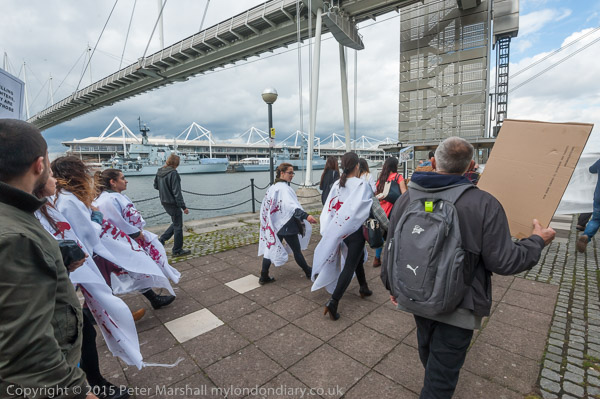
Finally there was a theatrical re-enactment of the incident, with protesters sitting on the roadway being sprayed with water by white-coated ‘police’. It was rather chaotic and difficult to photograph and it proved very tricky to actually capture water being sprayed

More pictures at Protest French police attack on XR.


All photographs on this and my other sites, unless otherwise stated, are taken by and copyright of Peter Marshall, and are available for reproduction or can be bought as prints.
There are no adverts on this site and it receives no sponsorship, and I like to keep it that way. But it does take a considerable amount of my time and thought, and if you enjoy reading it, please share on social media.
And small donations via Paypal – perhaps the cost of a beer – would be appreciated.


Shock treatment

I hadn’t really realised what I was letting myself in for when I went to photograph a protest by the Citizens Commission on Human Rights against the use of Electroconvulsive Therapy (they call it ‘Electroshock treatment’.)

For once I hadn’t done my research, but had just seen the Facebook event page and thought that it might be interesting and the weather was good and I wanted to get out and away from the computer. Had I followed normal practice and done a few seconds of research on the CCHR I might have found something else to do on that Monday afternoon.

Although I’ve never had electrical shock treatment myself, it is something I’ve had some personal involvement with as family members have suffered from it – though now in the distant past, and they are long dead. But I’m convinced they were permanently harmed by it.

Back in the 1950s and 1960s it was carried out rather more crudely (and certainly more cruelly) than now, with larger currents and often if not usually without anaesthetic. I find it hard to understand why such random and often harmful practice was ever allowed to be used on patients with little or no understanding or real research and am convinced that though they survived the treatment it was a factor which led to early deaths of some of my family members.

Here’s something the BMJ wrote in an introduction to a debate in their pages earlier this year (the full article is only available to subscribers)

Electroconvulsive therapy (ECT) involves sending an electric current through the brain to trigger a seizure. The treatment is given under general anaesthetic with muscle relaxants, so the body does not convulse during the seizure.
No-one is entirely sure how it works, but it is thought to change the way brain cells interact in parts of the brain involved in depression. ECT use in the UK continues to fall, but remains controversial.

https://www.bmj.com/company/newsroom/should-we-stop-using-electroconvulsive-therapy/

What a few seconds of research after the event revealed is that the CCHR is a part of the Church of Scientology, an cult that engages in its own form of brainwashing and which I want nothing to do with. An article in The Atlantic describes the CCHR as “a subsidiary (of the Church of Scientology ) whose sole aim is to discredit and dismantle the field of psychiatry” and its author looks at the “classic propaganda techniques” it uses.

[You can read more about Scientology (if you need to) on Wikipedia and in the 1991 Time Magazine exposé, The Thriving Cult of Greed and Power. ]

I had realised there was something rather odd about the event as I sat waiting for the protesters to gather and the protest to begin at Potter’s Fields next to Tower Bridge. And my doubts were reinforced as I listened to Brian Daniels, Executive Director of CCHR, giving out precise instructions for the protest. There was just something entirely corporate about the whole event, even in the firm handshake and confident gaze of Daniels as he welcomed me to the event. It just wasn’t like a normal protest.

Despite my doubts I decided to go ahead and photograph the event as I would any other protest and you can see more pictures at End Inhuman Electroshock treatment.

Whales, Lions (and Wales)

I remember whale meat. Back in the days of rationing after the war several ‘delicacies’ were introduced to the British diet, available ‘off-ration’. These included snoek, spam and whale meat, and women’s magazines carried government propaganda in the form of recipes intended to make them edible.

We got spam fritters in schol dinners well into my youth and they were more than averagely disgusting; many of us carefully removed the pink stuff and ate the batter, hoping to scrape our plates into the pig swill bucket while the dinner lady (school kids back then always said they were trained by the Gestapo) wasn’t looking. We hoped the pigs didn’t object to a little cannibalism.

But whale meat only happened once. My mother cooked it for dinner (what you now probably call lunch) and it was a black day around the table. I don’t think even she took a second mouthful, certainly the rest of us tried this promised delicacy and downed forks – or at least pushed the offending substance to one side of our plates while finishing off the potato and veg. Back then you weren’t allowed to leave anything on your plate, but that day was an exception. Even the cat wouldn’t eat it.

But apparently it is considered a delicacy in Japan, and they have continued fishing for whales under the pretence of ‘research’ but that hasn’t produced enough to meet demand, so they are now proposing to go back to sea, harpoons at the ready to hunt more seriously.

One poster said ‘Eat Kale Not Whale’ and I have some reservations about that. Kale isn’t too bad, but this year it has grown and grown in our garden, doubtless because of our unusual weather (another negative consequence of climate change.) You can have, as I’m finding, too much kale.

The Global March For Whales at least in its London manifestation appeared to be a rather conservative event, with none of the more radical groups who protest against whaling attending, almost as if they had not been informed it was happening. Numbers were low and perhaps it had been deliberately kept quiet to avoid the rowdier elements.

I left before the march – or rather walk along the pavement – to the Japanese Embassy began to photograph another animal event which was supposed to be taking place in Trafalgar Square, and walked around the square without finding it. Then another photographer shouted from across the road and I found a small group in the shade outside a pub.

It was a really sweltering day in the sun, and the organisers had decided it was just too hot to go ahead as planned with a lengthy vigil 4 years after the shooting in Zimbabwe of Cecil the lion by an American trophy hunter using a crossbow.

The man who was wearing a lion costume would have been seriously in danger of heat stroke had they held a long protest in the sun, and was finding it hot even in the shade, so I think their decision was wise.

Instead they were intending to have a much shorter photocall. I took a few pictures as they were getting ready but had to leave before this took place.

More pictures and more about both events:
Global March For Whales
Remember Cecil the magnificent lion


All photographs on this and my other sites, unless otherwise stated, are taken by and copyright of Peter Marshall, and are available for reproduction or can be bought as prints.
There are no adverts on this site and it receives no sponsorship, and I like to keep it that way. But it does take a considerable amount of my time and thought, and if you enjoy reading it, please share on social media.
And small donations via Paypal – perhaps the cost of a beer – would be appreciated.


Don’t attack Iran!

For a few days it really looked as if Trump was about to launch an attack on Iran and he was really being urged to do so by some of his hard-line advisers.

Trump had called off a planned air strike at the last minute which was planned in retaliation for the shooting down of an unmanned US reconaissance drone by Iranian forces. Iran had said it had strayed into Iranian air space while the US claimed it was in international air space.

Despite the US official claim it seems almost certain that the drone was attacked in Iranian air space, when it and an armed Boeing P-8 Poseidon US navy surveillance aircraft with a crew of 35 flying close to the drone had strayed into it over the Gulf or Hormuz.

Iran issued a statement that both aircraft were in their airspace and that they had twice warned the US before deciding to attack the drone, but had decided not to attack the manned aircraft, stating “we could have shot it down, but we did not .”

It was perhaps this statement that caused Trump to call off the US attacks at the last minute, saying he had been told 150 Iranians would be killed, and that this would be disproportionate.

Trump also stated; ” There was a plane with 38 people yesterday, did you see that? I think that’s a big story. They had it in their sights and they didn’t shoot it down. I think they were very wise not to do that. And we appreciate that they didn’t do that. I think that was a very wise decision.

But the US threat remains, with Trump in a later tweet promising “Any attack by Iran on anything American will be met with great and overwhelming force. In some areas, overwhelming will mean obliteration.

Because of the high and continuing threat level of war against Iran, Stop The War had called an emergency protest to demand our government to make it clear to Trump that it did not want and would not support a war against Iran. They protested opposite Downing St and tried to deliver an urgent letter to the Prime Minister, but were refused admission to Downing St by an apologetic police office on the gate as they had not arranged permission some days beforehand.

I had thought that MPs were allowed entry without prior arrangement, but Emma Dent Coad, MP for Kensington, was refused entry. The protesters were told to put the letter in the post.

More pictures: Don’t Attack Iran


All photographs on this and my other sites, unless otherwise stated, are taken by and copyright of Peter Marshall, and are available for reproduction or can be bought as prints.
There are no adverts on this site and it receives no sponsorship, and I like to keep it that way. But it does take a considerable amount of my time and thought, and if you enjoy reading it, please share on social media.
And small donations via Paypal – perhaps the cost of a beer – would be appreciated.