A post by Shahidul Alam, The journalist who got too close, reminded me of the dangers faced by journalists and photographers in some countries of the world, and in Bangladesh in particular, where extra-judicial killings and ‘disappearances’ are now common, despite government protestations there that they show ‘zero tolerance’ to extra-judicial killings, or torture and death in custody.
Alam writes:
On March 10, 2020, the Bangladesh police registered a case against photojournalist Shafiqul Islam Kajol and 31 others under the country’s draconian Digital Security Act for publishing ‘false, offensive and defamatory’ information on Facebook. He has not been seen since.
You can read more about his case at Amnesty International who have released a video showing CCTV footage of unidentified men interfering with his motorbike outside the offices of his Bangla daily Dainik Pokkhokal for which he was both editor and photojournalist shortly before he left the office and rode away on the evening of 10 March 2020. He has not been seen since. Police filed a new case against him three hours after he was last seen.
You can see a few photographs by Shafiqul Islam Kajol on the Majority World agency web site. His disappearance took place after he and 31 others were accused of publishing “false, offensive and defamatory” information on Facebook. He had been publishing about sex scandals by members of the ruling party. He had previously been badly injured in several attacks when covering their political rallies.
I don’t normally publish press releases, but here an exception:
James Hyman Gallery announces the launch of a special fundraising sale.
All profits will go to support the National Health Service.I know that at this time of international crisis, the last thing on people’s minds is looking at art, let alone buying it. In my case, one of my daughter’s has coronavirus (thankfully mildly) and we are under quarantine and waiting to see if we also catch it. All being well my wife, Claire, will return to her job as a surgeon in a major NHS hospital next week.
Unfortunately, NHS Hospital staff, on the front line in the treatment of patients with Covid-19, are still working without the proper PPE (personal protective equipment), and there remains a shortage of testing kits and ventilators.
As everyone pulls together I have been thinking what I can do as an art dealer. I feel very helpless. What I have done is put together a selection of works by some of the major photographers of the nineteenth and twentieth centuries and will donate all profits to the National Health Service.
It would be wonderful if you could take a look and let me know if anything is of interest to you.
Although some of the pictures are at least of some interest to me, the prices are a little out of my league. But wealthier readers of this blog (if there are any) might be interested. Regular readers will also know that I think the fetishisation of of the photographic print rather misses the point of our medium and its infinite possibility of reproduction.
As I’ve pointed out here before, if you want an Atget to hang on your wall you can have one at little or no cost, and it will quite likely be a rather better print than you can buy from an art dealer. The one hanging in my front room certainly is. And I’ve certainly printed better Walker Evans prints than were made of his work back in the 1930s.
But this is a generous response to the crisis, and I hope it that some will buy and enjoy these pictures, mainly but not all photographs, quite a few of which are images I’ve not seen before.
At least one other dealer has made a similar response, with New York based dealer and gallery owner Hans P Kraus Jr putting up a sale of prints by Early British Photographers, with 10% of the sales revenue going to support New York healthcare workers. The works for sale include some by Talbot himself, as well as Hill & Adamson, Anna Atkins, Julia Margaret Cameron, Roger Fenton and others. The print which attracts me most is a later reproduction of Hill & Adamson’s ‘The Bird Cage (the Misses Watson)’, a carbon print made by Jessie Bertram in 1916.
Both these sales were featured in posts by Michael Pritchard in the blog on the British photographic history web site.
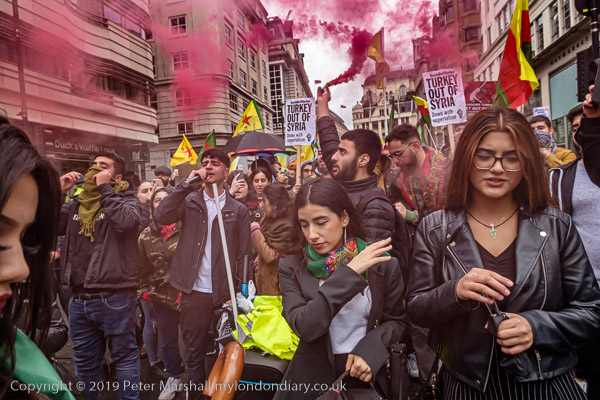
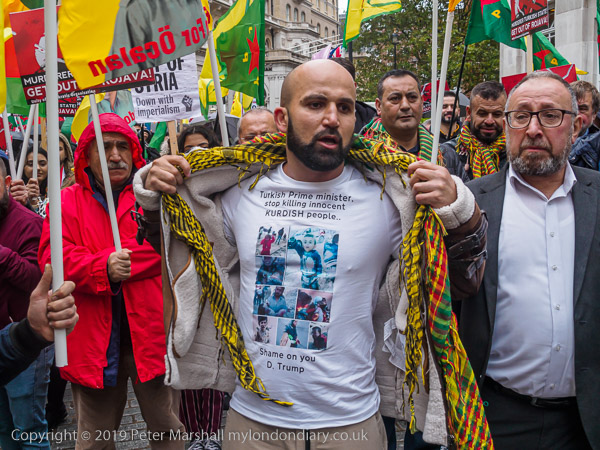
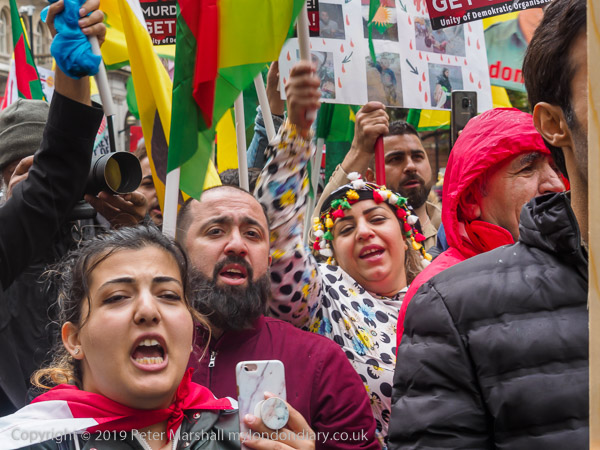
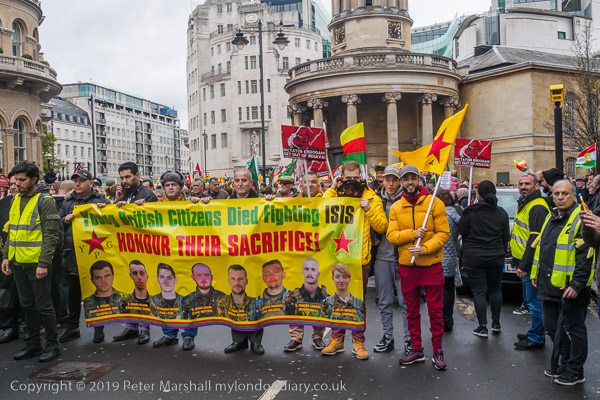
While we may feel cooped up in isolation in the UK, and are mourning the deaths of several thousand from COVID-19, the situation for many around the world is far worse. Particularly at risk are the people of Rojava in North-East Syria, mainly Kurds, at risk both from Turkish invasion forces and from the virus.
Kurds are the largest minority community in Turkey as well as being widespread across the northern parts of Iran, Iraq and Syria. They were promised an independent state at the end of the First World War, but that promise was denied when the boundaries of modern Turkey were defined in 1923.
Since 1923 Turkey has attempted a programme to eliminate Kurdish culture and identity, at times with massive military campaigns as well as repressive legislation. The Kurds, around 20% of the population, have fought back the opposition led since the 1980s by the Kurdistan Workers’ Party or PKK led by Abdullah Öcalan who has been in jail in Turkey since 1999.
In recent years Turkey has been aggressively attacking Kurds outside Turkey and in early 2018 they invaded Afrin canton in northern Syria, part of the territory where Kurds with other minority ethnic groups had established a de-facto autonomous region of Rojava, with a constitution based on decentralisation, gender equality, direct democracy and guaranteeing ethnic minority rights and religious freedom.
Kurdish forces in the People’s Protection Units, the men of the YPG and the women of the YPJ, were the most effective force in fighting the ISIS in Syria, with the help of US air support. But Turkey is second only the the US in military strength in NATO, and has benefited greatly from NATO support and arms supply, and were able to take Afrin from these lightly armed Kurdish forces. Many Kurds were forced out of the area, which had been overwhelmingly Kurdish and they are now a relatively small minority.
President Trump’s announcement of a US withdrawal from Syria gave Turkey’s President Erdogan a green light to continue his country’s invasion of Rojava, and left the Kurds there no alternative but to call on the Syrian government for support, a move which in the longer term seems likely to end their autonomy.
Turkey is now using the coronavirus to threaten Kurds in Turkish prisons for political reasons – including many journalists, excluding them from its plans to release them with other prisoners because of the pandemic. They are also refusing to refer prisoners with COVID-19 symptoms for medical treatment.
For the 4 million inhabitants of North and East Syria, including 600,000 refugees the situation is also dire. The World Health Organisation refuses to support the area directly and little comes to them through the Assad regime. There are no WHO test kits or test machines and only 35 intensive care beds and 40 ventilators.
All photographs on this and my other sites, unless otherwise stated, are taken by and copyright of Peter Marshall, and are available for reproduction or can be bought as prints.
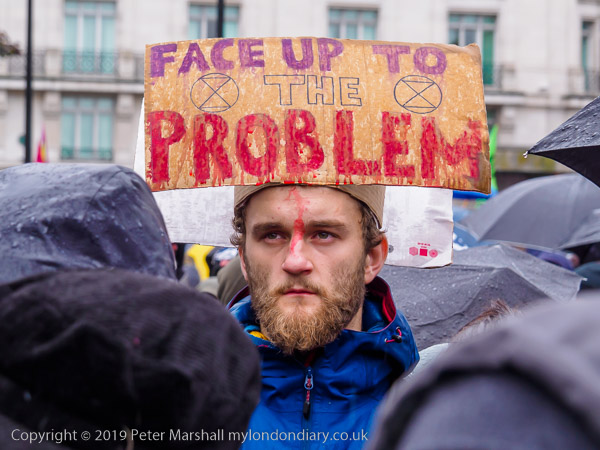
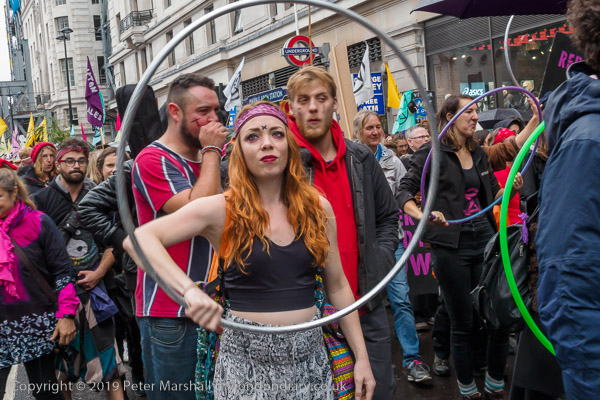
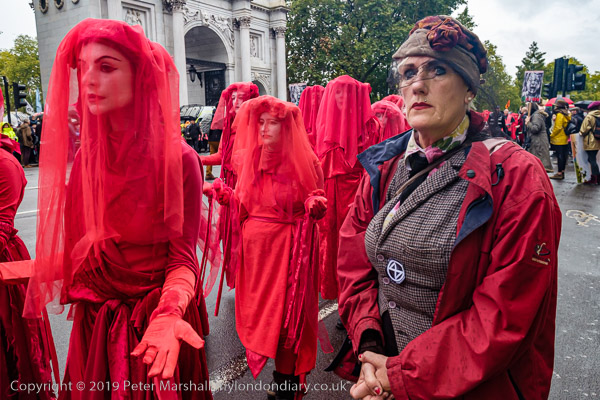
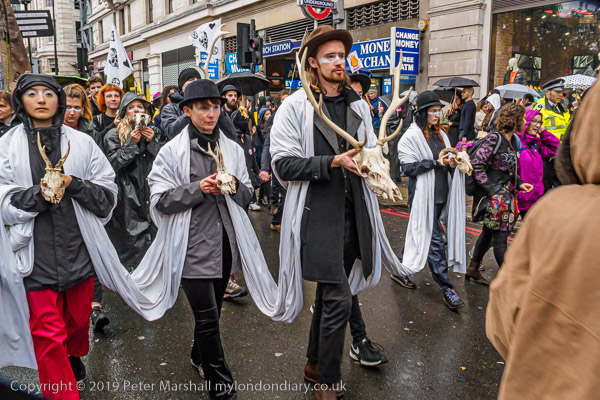
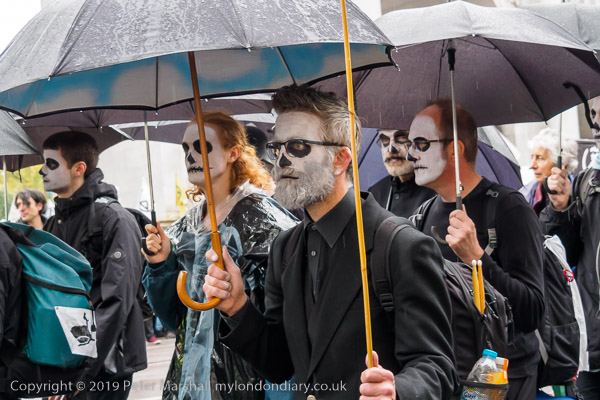
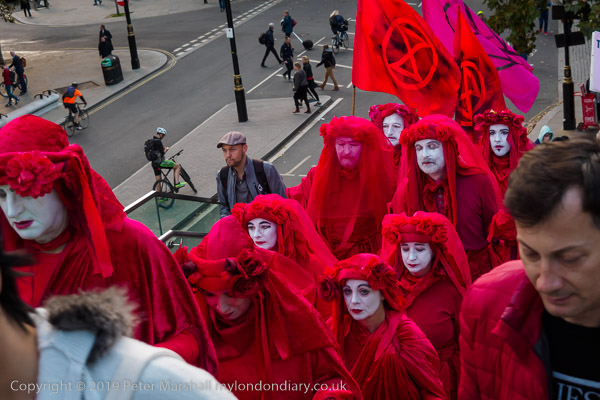
With so much bad news around I hesitate to write about a funeral, but in October Extinction Rebellion held their ‘Strength in Grief’ rally at Marble Arch to express their profound grief at the extinction of species taking place due to global warming and which threatens the future of human life, and followed this with a funeral procession along Oxford St.
We are now facing another great threat to human life, one we are all personally threatened with, and many of us are at particular risk from, some because they are having to work closely with people suffering from coronavirus, others because they are particularly likely to die should they catch it. As someone in the high risk category, though not with governmental ‘extremely vulnerable’ status I’m worried and also isolating myself as much as possible.
The XR rally and march took place on the anniversary of Colombus landing in South America, truly a black day for the population of that continent, bringing disease and exploitation. While some celebrate Columbus Day, for many others the 31st October is the Day of Indigenous Resistance, and a number of the speakers reminded us of this. Climate Change has already killed many in the Global South.
While in the UK the lack of preparation has been a matter of government policy, part of their programme to run down and sell off the NHS through the back door to private health companies and their more general cuts to public services and local authority spending, for many countries it is impoverishment through centuries of colonialism and neo-colonialism that has left them unable to cope with the current pandemic.
The UK is one of the world’s richest nations – thanks in large part to our imperial past which fed our economy and fertilised the inventiveness of which we can still be proud. I grew up in the immediate post-war period when the experience of the war had led to the realisation that we had to work together as a society. From that came secondary education for all, the NHS and the whole welfare state. I hope COVID-19 will have the same galvanising effect as we can’t afford to go back to ‘business as usual’. The world needs to wake up and ‘Face Up to the Problem’. I hope I’ll still be around to see it starting to happen; at least I’ve not yet had a letter from my doctor with a DNR form, though it could still come.
All photographs on this and my other sites, unless otherwise stated, are taken by and copyright of Peter Marshall, and are available for reproduction or can be bought as prints.
There are no adverts on this site and it receives no sponsorship, and I like to keep it that way. But it does take a considerable amount of my time and thought, and if you enjoy reading it, please share on social media. And small donations via Paypal – perhaps the cost of a beer – would be appreciated.
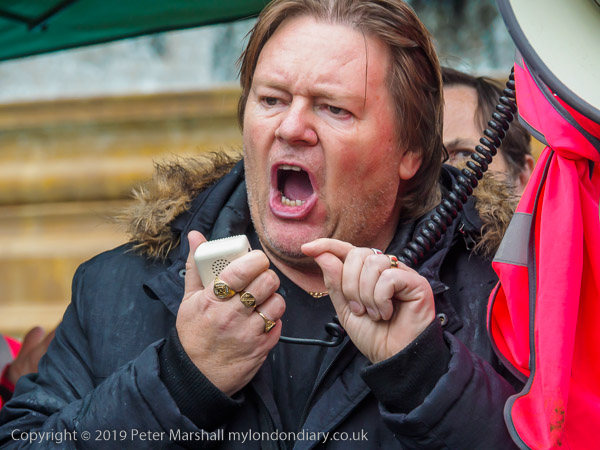
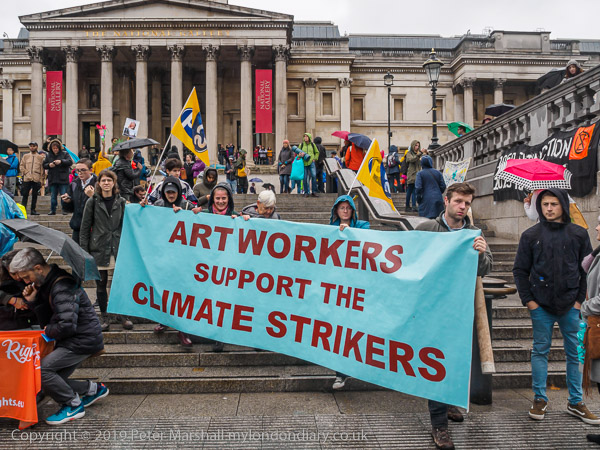
Back on Saturday 12th October there were two protests taking place in Trafalgar Square and it was raining. One was by trade unionists supporting Extinction Rebellion and the school climate strikers, and there was a powerful speech from Ian Hodson, National President of the Baker’s Union BFAWU. His union is one of the older and smaller unions in the TUC, founded in 1847 in Manchester though it has changed its name a couple of times.
The BFAWU is a union that still fights actively for its members and isn’t afraid to take on large organisations, including McDonald’s, Burger King, and KFC in its campaign to unionise and improve pay and conditions for fast food workers.
The rain came on rather more heavily, and I kept my cameras in my camera bag or under my coat, and took rather fewer pictures than I would otherwise. Working in wet conditions is still rather a pain, even though some cameras and some lenses are ‘weatherproof’ this doesn’t really keep them going in the rain.
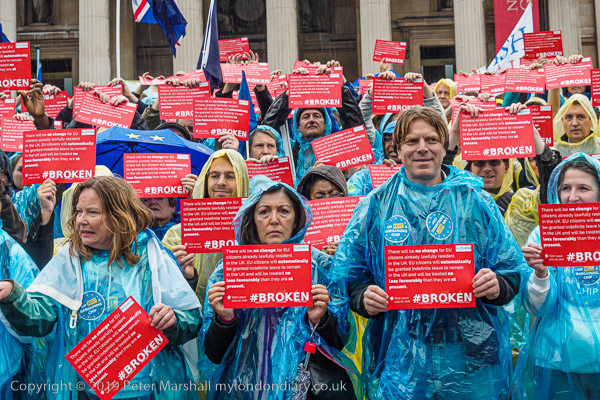
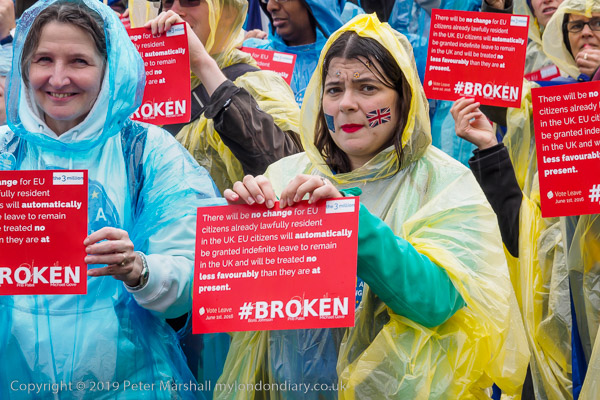
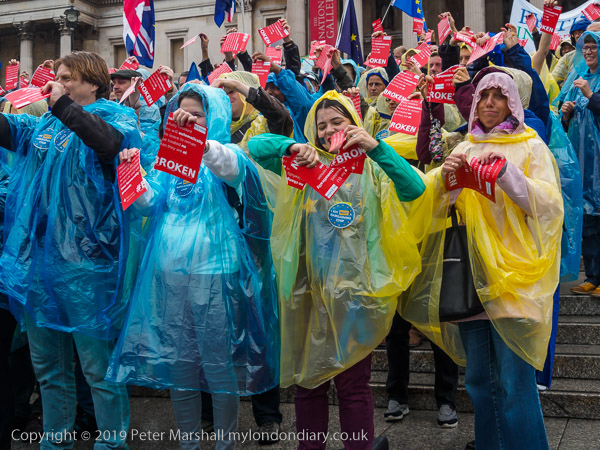
The 3million organisation representing the three million EU citizens who were living in the UK had come prepared, wearing blue and yellow plastic rain capes with a sticker on them also in the colours of the EU flag and the message ‘I am not a bargaining chip’.
They had come to protest at the broken promise made by the Vote Leave campaign, which had clearly stated that EU Citizens currently living in the UK would “automatically be granted indefinite leave to remain in the UK” in the event of Brexit. Instead we have a complex scheme of applications, with many who have applied for leave to remain having their applications rejected. Some who have lived here for over 50 years, and have children who are UK citizens may face deportation.
Together they tore up copies of the promise, though the light had dropped and the pictures I took on a longer lens were rather blurred by their motion – I hadn’t got my camera set to a high enough ISO.
I still can’t decide which is the best way to work with my digital cameras when lighting conditions are likely to change. The different cameras I use – and on this occasion it was an Olympus OMD M5 II and a Fuji XT-1 – have slightly differing implementation of auto-ISO, which would seem to be a good answer, but in practice can mean that you are too often working at full aperture.
Probably the answer is to work in manual mode, setting both aperture and shutter speed when using auto-ISO, but it is then very easy to find that either you have reached your maximum ISO set and the camera then underexposes everything, or, even worse, you are at the minimum ISO in your range and all your images are overexposed with burnt out highlights.
All photographs on this and my other sites, unless otherwise stated, are taken by and copyright of Peter Marshall, and are available for reproduction or can be bought as prints.
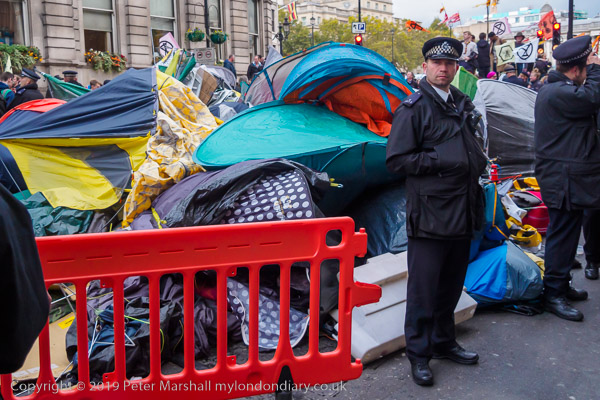
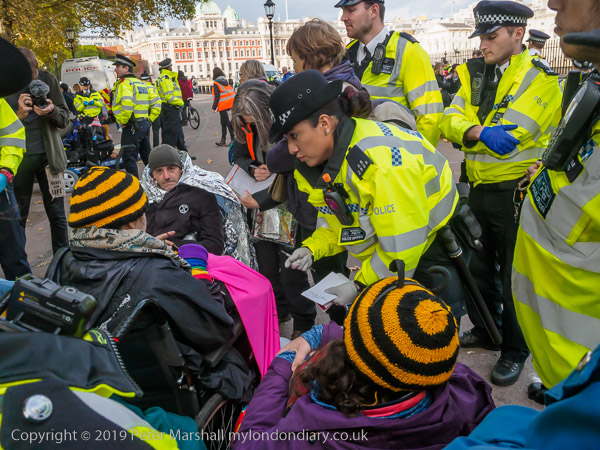
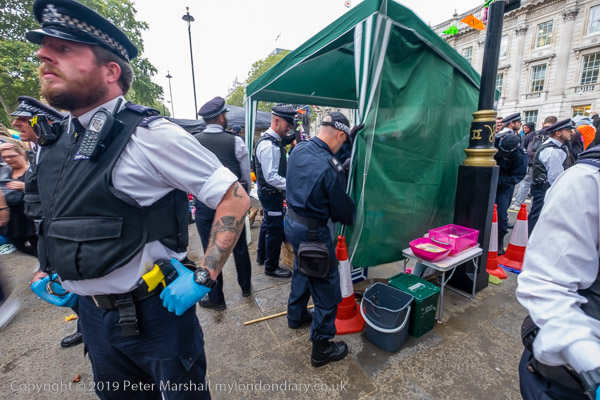
The rather tense stand-off between police and Extinction Rebellion protesters who were still blocking much of Westminster continued, with the police at times adopting rather rougher tactics, including the deliberate destruction of tents and other property as well as making arrests.
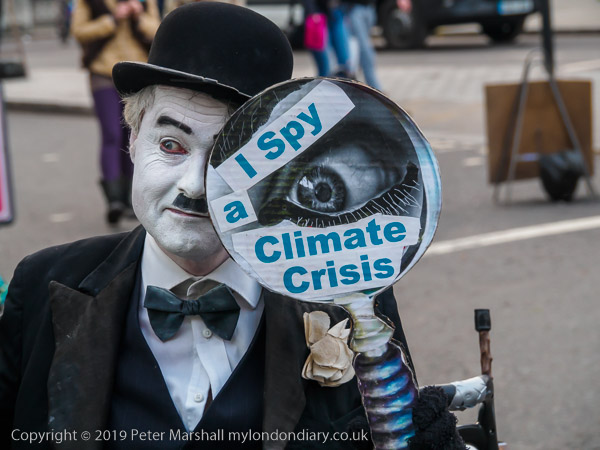
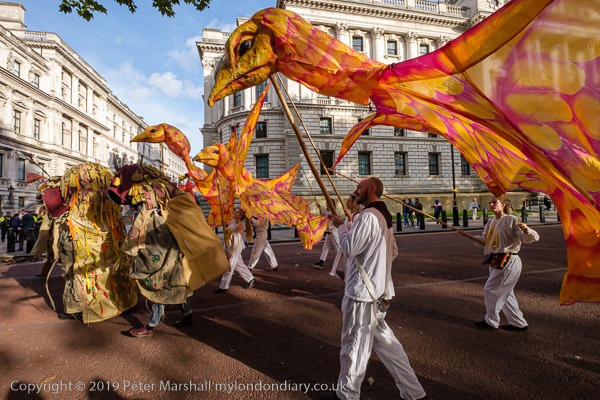
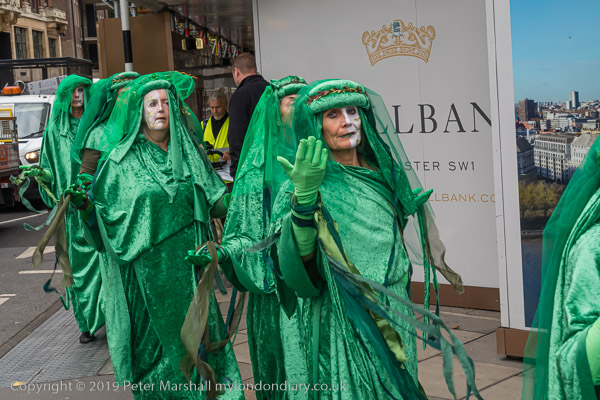
XR’s protest continued to be rather remarkable, with street performers, music and mimes including Charlie X as well as XR’s red and green robed troupes.
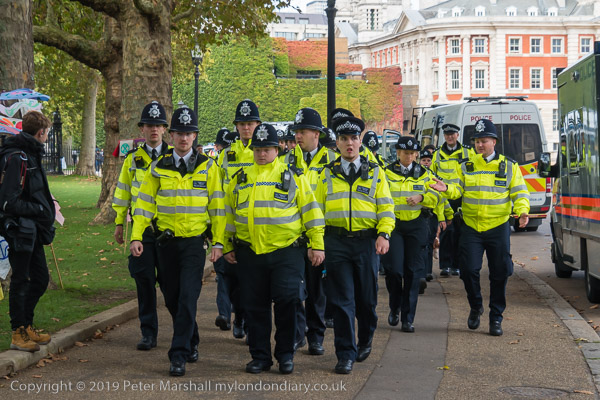
People were still determined to continue their protest and it was clear that the police were coming under increasing political pressure to end them, though quite a few officers seemed rather unhappy at what they were being ordered to do.
Prime Minister Boris Johnson had attacked the protesters, insulting them as ‘crusties’ but was still failing to take any action. XR’s demands remain, calling for the government tell the truth about the climate and ecological emergency, act to halt biodiversity loss, reduced emissions to net zero and create and be led by a Citizens Assembly.
There were many arrests during the day, with XR’s non-violent approach being maintained, and police succeeded in clearing some of the areas.
All photographs on this and my other sites, unless otherwise stated, are taken by and copyright of Peter Marshall, and are available for reproduction or can be bought as prints.
There are no adverts on this site and it receives no sponsorship, and I like to keep it that way. But it does take a considerable amount of my time and thought, and if you enjoy reading it, please share on social media. And small donations via Paypal – perhaps the cost of a beer – would be appreciated.
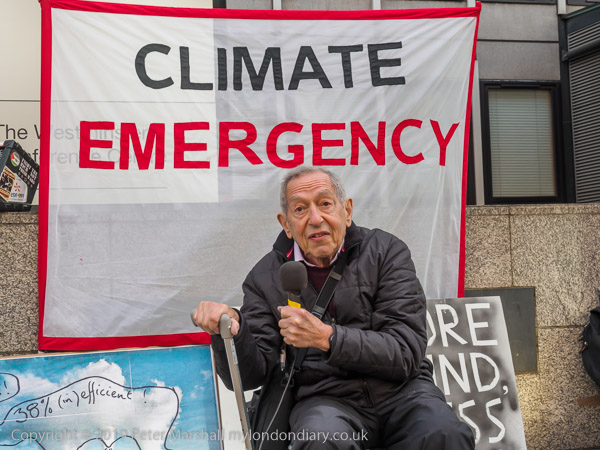
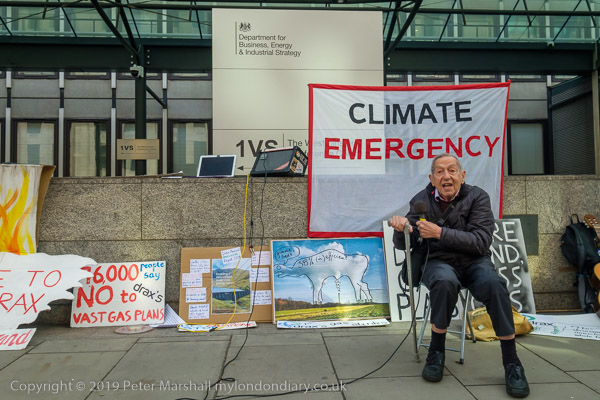
Mayer Hillman, 88 year old Senior Fellow Emeritus at the Policy Studies Institute
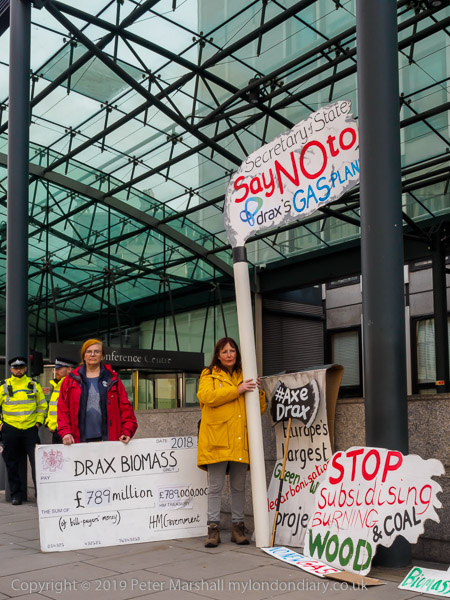
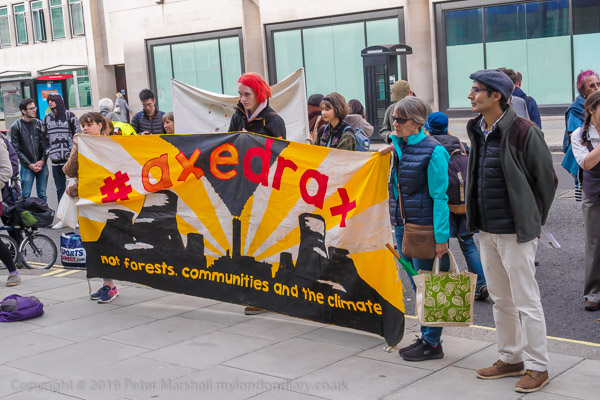
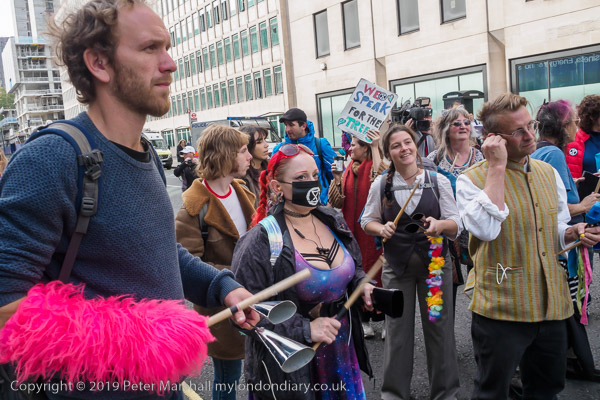
I arrived some time after the start of this protest by Biofuel Watch outside the Department for Business, Energy & Industrial Strategy (BEIS) having been at the Royal Courts of Justice for the XR Lawyers declaration of Rebellion, but was fortunately in time to hear some of the main speakers, including Mayer Hillman who has been writing about environment issues for many years – and whose work has inspired some government actions such as energy standards for housing and 20mph speed limits to reduce road deaths. But his warnings on the need for urgent climate action over many years have so far failed to produce any significant actions.
You can listen to his video “The Last and Most Important Advice I Will Ever Give” on YouTube, which puts the information on Climate Change simply and directly. Over 70% of the greenhouse gases causing global warming come from burning fossil fuels – coal, gas and oil – which are produced by around 100 companies, and we have to stop using fossil fuels. The other main source is deforestation, with the destruction of forests for agricultural land and the burning of wood.
Drax is a major UK source of carbon dioxide, and claims huge ‘environmental subsidies’ for doing so, despite their huge contribution to global warming. Switching to wood burning has made Drax a worse polluter but the UK government gives it £2 million a day for ‘renewable’ subsidies out of our electricity bills for doing so – and Drax has plans for expansion to also become the UK’s largest gas-fired power station.
As Hillman says, if life on the planet is to continue we need urgently to stop both fossil fuel use and deforestation, but our current politicians have failed to take effective action. We need to vote them out and vote in others who will do so.
He urges people to join the global rebellion led by XR and for young people to be inspired by the actions of Greta Thunberg and join the youth climate strike protests.
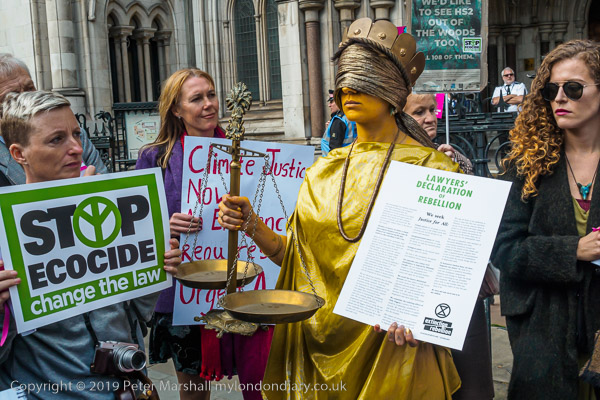
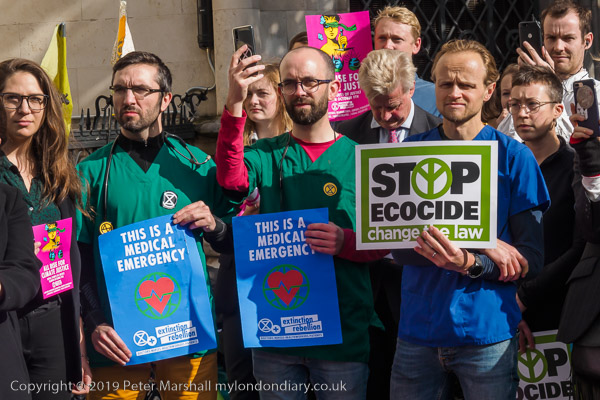
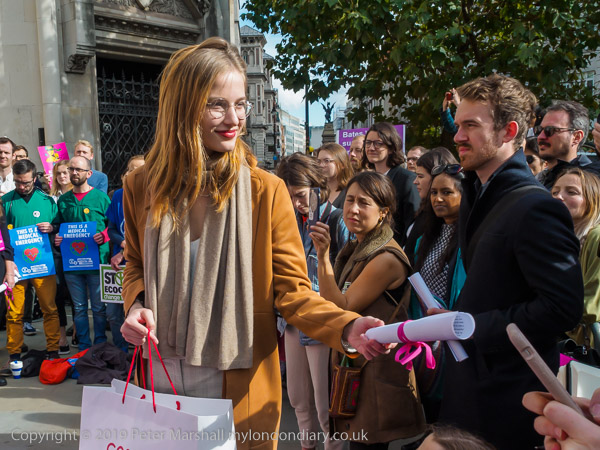
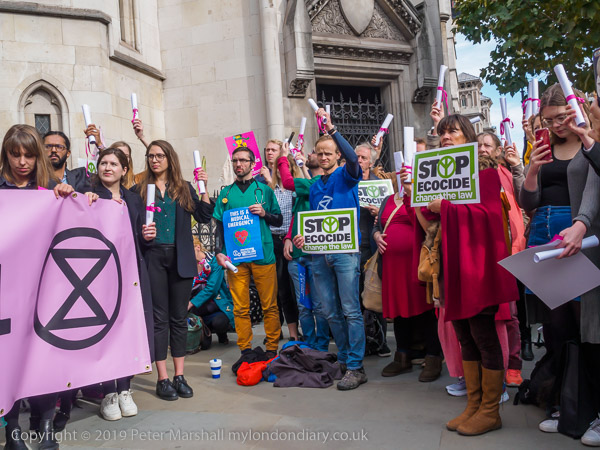
Extinction Rebellion’s October protest continued on its third day with a protest outside the Royal Courts of Justice on the Strand.
It was in some ways an unusual protest, involving a number of figures from the legal world, solicitors, barristers and others, including Richard Lord QC and international climate lawyer and diplomat Farhana Yamin, as well as leading figures in XR, including Gail Bradbrook and Lawyers for XR founders Natalie Barbosa and Paul Powlesland.
Lawyers for XR is one of a number of special interest groups within the organisation, and its formation was inspired by the example of medical workers who had formed their own group.
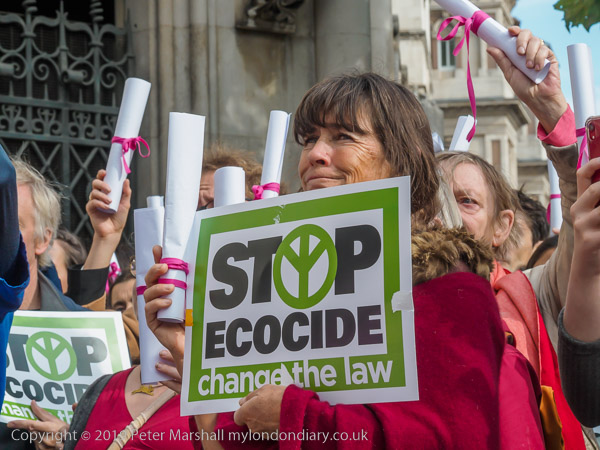
The lawyers had come up with their own ‘Lawyers’ Declaration of Rebellion’ and copies of this, wrapped in the traditional pink ribbon for briefs were handed around, giving the protest its own look.
Lawyers have of course played an important role in the fight to save the planet, and among those remembered at this event were Scottish barrister Polly Higgins who died in April 2019 and had led a long campaign calling for a criminal law of ecocide to impose a legal duty on governments to protect the public from dangerous industrial practices.
All photographs on this and my other sites, unless otherwise stated, are taken by and copyright of Peter Marshall, and are available for reproduction or can be bought as prints.
There are no adverts on this site and it receives no sponsorship, and I like to keep it that way. But it does take a considerable amount of my time and thought, and if you enjoy reading it, please share on social media. And small donations via Paypal – perhaps the cost of a beer – would be appreciated.
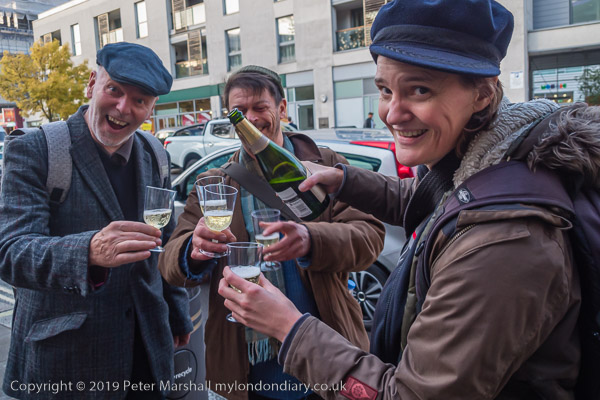
ASH mocks the champagne celebration inside with Cava on the street
I was pleased to get this picture of what was a very difficult event for me to get any worthwhile photographs. I’m a great admirer of the work of Architects for Social Housing, a small group that punches well above its weight in pointing out the crimes, profiteering and failures of current housing policies pursued by local authorities and national government which amount to an attack on the poor.
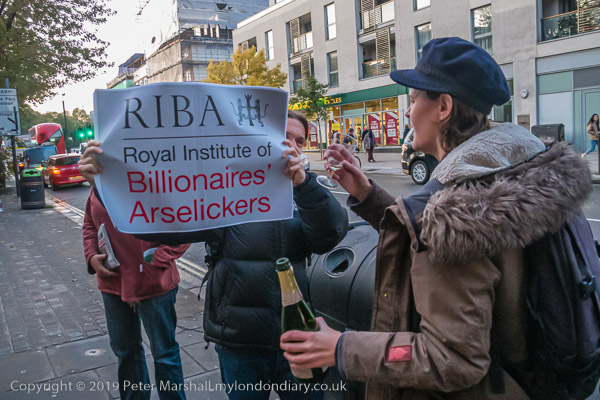
A poster from a Class War supporter
Their detailed studies have laid bare the terrible effects of demolition of council estates, driving those on low incomes out of the central areas of London in a huge exercise of social cleansing and making excessive profits for the developers, as well as providing well-paid jobs for some council staff and ex-staff. Most of those London councils are Labour councils, including Southwark, Lambeth and Newham, though Tory councils are following similar shameful practices, and at the root of all this are the housing policies of Thatcher and New Labour.
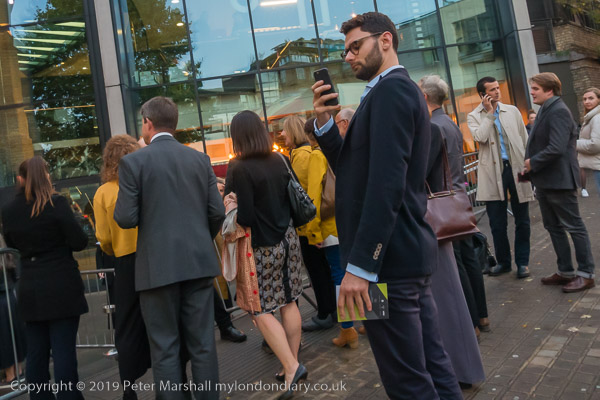
A man holding his Stirling Prize invite stops to photograph the protest
Their reports have shown the financial incentives that result in demolition and new build schemes with little or no low rent social housing replacing large numbers of council homes, as well as the hugely damaging environmental consequences of such large schemes. Their detailed alternative development plans have shown how estates could be renovated and the number of housing units greatly increased without the huge social costs of destroying existing communities and retaining existing low cost housing, without the need to evict existing tenants and leaseholders.
Following the disaster of the Grenfell fire, they published a report within weeks that clearly identified the problems which had made it inevitable. ASH called for those responsible to be brought to justice, pointing out that similar disasters in other countries such as Japan had led to prosecutions within a few weeks – while we have an inquiry that is still proceeding which seems to have as its major aim the deflection of blame from those responsible for the defects and failures to the actions of the emergency services on the night of the fire. It’s right of course that these should be examined and lessons learnt, but it wasn’t the Fire Service which created a fire trap through cost-cutting , avoidance of proper fire safety measures and a sheer disregard for the safety of the people who lived in Grenfell.
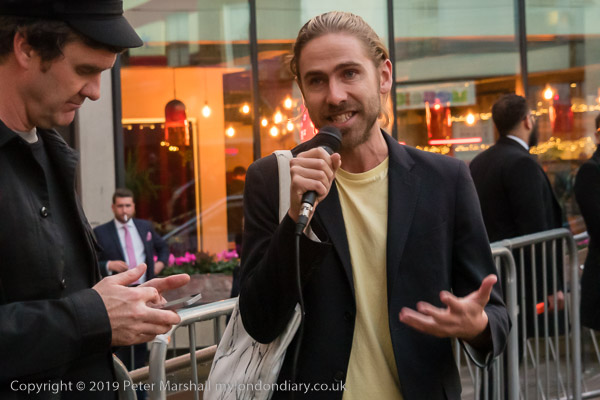
Oliver Wainwright, the Guardian’s architecture and design critic speaks before going into the prize event
ASH were protesting outside the highly prestigious Stirling Awards ceremony condemning architects for social cleansing, council estate demolition and housing privatisation and calling on architects to end wanton environmentally disastrous demolitions and to serve the needs of citizens with socially beneficial, financially viable and environmentally sustainable architecture rather than corporate profits. You can read more on their web site.
In particular they had come to point out that the winning entry, widely lauded in the press as marking a new era in social housing, is actually a a commercial venture owned by Norwich council and will not be offering secure council tenancies and that council homes were demolished to build it. They were particularly incensed that it was also nominated for (and won) the new Neave Brown Award, set up to honour the recently deceased champion and architect of council housing; they see this as an insult to the memory of our great architect of council housing.
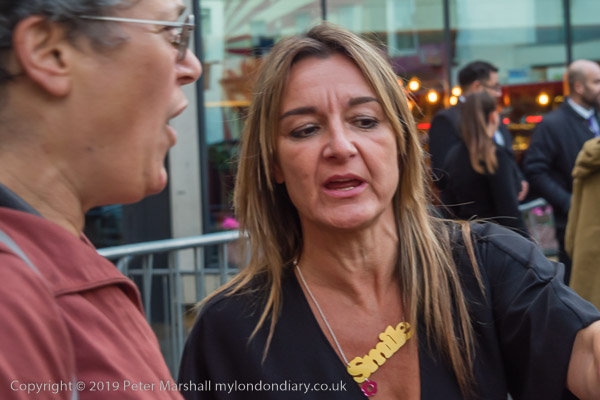
A woman came to shout at Simon Elmer and pushed him
ASH’s approach represents a threat to many architects who rely on the highly lucrative projects of major developers (named for Sir James Stirling (1926-92) whose 1977 major public housing scheme in Runcorn was demolished only 15 years after it was built, it should perhaps be better re-named as the ‘Sterling’ prize) and the protest was not well received by many of them – with one woman going as far as coming to assault Simon Elmer of ASH. But there were also some largely younger architects who expressed support.
It was a small protest and started rather late, when many had already gone inside to enjoy the ‘free’ champagne their very expensive tickets provided. The light was falling fast and it was hard to find an angle which worked to connect the protest and the event. I was pleased when the protesters decided to mock the champagne celebrations inside with a few plastic cups of cheap Cava (and I was holding cup of it myself when I took the picture at the top of this post. I left as it got too dark to photograph without flash, though perhaps I should have stayed, as more people arrived and the protest apparently got livelier later. But I’d been on my feet far too long and needed to get home and eat.
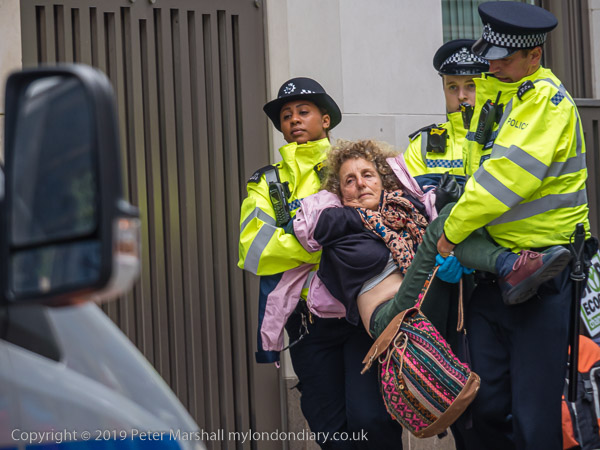
The second day of Extinction Rebellion’s shutdown of Westminster was in some respects a disturbing one for those of us who believe in civil liberties and the rule of law, with the police moving in at times like a group of thugs and deliberately destroying the property of the protesters.
XR have a dedication to non-violence and made no attempt to stop the police or to resist the arrests that took place, and the use of force seemed quite uncalled for. Of course large scale acts of civil disobedience do cause inconvenience and annoyance to others, but the response of a civilised society should be to try and resolve the issues rather than to attack the protesters.
Those who break laws can and in the case of XR do expect to be arrested but should not be assaulted and too many arrests that I saw seemed to involve an unnecessary use of violence and deliberate infliction of pain.
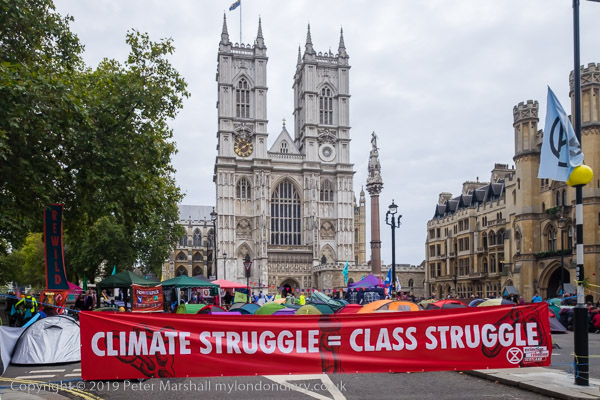
One new banner read ‘CLIMATE STRUGGLE = CLASS STRUGGLE’ and it is perhaps hard not to see the police as a force being used by the small group of those who are rich and powerful to protect their own narrow interests at the expense of the rest of the people. Their more vigorous response on this second day of protest can only have been a result of considerable political pressure on them to subdue the protests. They clearly came not to keep the peace but to try and win a battle.
As you can see from my pictures, the protests were still continuing at various sites around Westminster and the general atmosphere was something of a festival. But a festival with a great deal of commitment by people desperate that our government take effective action against the most serious problem faced by the country and the world. We are just beginning to see a government forced into taking belated action against the threat posed by COVID-19, but we need a similar level of action against climate change that otherwise will be even more catastrophic.
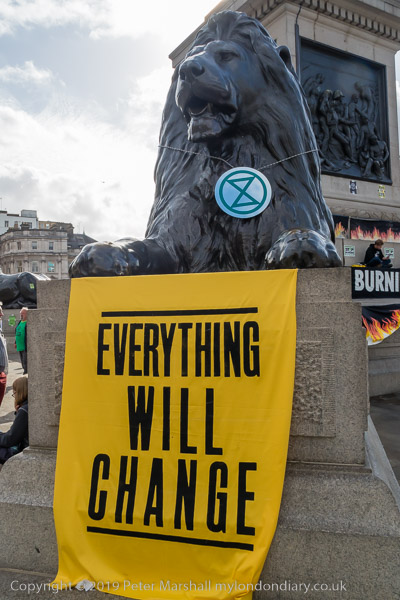
‘Everything Will Change’ whether we like it or not, but we have a choice to make changes which may avert the extinction of our species. But our government continues to fiddle while the planet burns.
All photographs on this and my other sites, unless otherwise stated, are taken by and copyright of Peter Marshall, and are available for reproduction or can be bought as prints.