Photojournalism Ethics

Two stories in the news today relate to photographic ethics. The first seems clear-cut. AP have issued a statement AP severs ties with photographer who altered work about their decision to break all ties with freelance photographer Narciso Contreras who apparently owned up to them that he had removed the video camera of another photographer he was working with from the corner of a dramatic picture of a Syrian fighter he had sent them last September.

Mexican freelance Contreras “was one of five AP journalists who shared in the Pulitzer awarded last April for breaking news photography, cited by judges for “producing memorable images under extreme hazard” and saluted by AP’s VP and Director of Photography Santiago Lyon for their bravery and skill. AP say they have examined all the 494 pictures by him that they have handled and this is the only one that has been altered, but they are still removing all of his work from their publicly available archive.

In their release, they quote Contreras as stating: “I took the wrong decision when I removed the camera … I feel ashamed about that” and he goes on to say that he was working under extreme pressure, and that this was the only time he had done such a thing.

Although one can sympathise with Contreras, I’ve often given my opinion that integrity is paramount in photojournalism and news reporting. Without it our work has no credibility.  It is harsh treatment for what appears to be a single slip, but inevitable for AP to take such decisive action. Though I do feel that people who say that the AP should hand back that Pulitzer are just being silly.

Other cameras getting in the way and messing up our best pictures is an everyday hazard for those of us who photograph news and events. Sometimes we can crop them out, other times burn down to make them less obtrusive, both acceptable, but cloning them out clearly breaks the link between reality and image. The particular camera here seems to have been simply lying on the ground, but often it is the cameras of other photographers using them who get in our way – and our cameras may well be in their pictures too. But still photographers usually try to cooperate with others in taking photographs to avoid such clashes as far as possible. (Videographers are often more of a problem because of their different requirements – which I realise, but some working for particular major media outlets do appear to feel they have a divine right to get in everyone’s way and have sometimes to be politely reminded this is not the case !)

Politica y Sociedad in The First Photo Won a Prize; The Second Made a Controversy Explode look at a pair of photographs taken at the same time of a 14 year old Haitian girl killed by the police for looting a store of two plastic chairs and a framed picture. One, a superbly composed but highly worked on image by photographer Paul Hansen won the Swedish Picture of the Year Award 2011.

The other is far more prosaic, taken from one side gives a much clearer view of the location, and shows the dead girl with a group of photographers in a line taking her picture. It isn’t a great picture and unlikely to win awards, but one that provokes thought.

Hansen’s is almost an abstraction from the event, perhaps more like Andrew Wyeth might have painted the scene than a photograph. The second photograph is by Nathan Weber, and on his web site you can watch his video about the death of Fabienne, which includes several striking and rather more realistic images of the dead girl, as well as putting the images into their context.

Politica y Sociedad comment: “The debate that is arising in Sweden revolves around the question, “Would Sweden have donated less for disaster relief if that photo had not been published?” Or “Would fewer resources and professionals have been sent?”

But I think there should also be a debate about the aestheticisation of reality in the post-production of images like Hansen’s. To me it loses authenticity by the excessive and over-dramatic interpretation, something which as has been pointed out, seems to make everything like a film poster. Let’s see things as life.
Charles Harbutt

One of the daily posts I receive from L’Oeil de la Photographie (The Eye of Photography) was about Charles Harbutt and brought back to me some warm memories of a workshop of his I attended around 15 years ago at Duckspool. It had been a workshop with Harbutt back in the 1970s at Paul Hill’s The Photographers’ Place in Derbyshire which had changed the life of Peter Goldfield, leading him to found Duckspool, and as I wrote (sadly on the occasion of Peter’s death in 2009) “perhaps had I met him 20 years earlier it would have changed my life too.

I’d come across Harbutt in the 1970s, but only through the pages of his book ‘Travelog’, published in 1974 which very much reflects his attitude to photography that he expressed in a lecture you can read in Visura Magazine. The Unconcerned Photographer, delivered in 1970 when he was President of Magnum Photos. It’s perhaps a curious co-incidence that in it he twice quotes from and comments on his Magnum colleage Leonard Freed, the only other photographer whose workshop at Duckspool I attended.

In the article on L’Oeil de la Photographie, Harbutt says how the The Image Gallery Redux show which is at Howard Greenberg’s gallery in New York until Feb 15th 2014 reminds him of his early years in photography, as it includes a picture taken when he was only 17 and “three pictures from a migrant farm workers story I did for a magazine called Jubilee where I worked when I got out of college in 1956.” He tells the story of that job in Cuba, and its a good story that I won’t spoil here when you can read it in his own words.

The best place to see Harbutt’s work online is Visura Magazine, where you can find a slide show of his photographs and a number of articles.

Another article from the same day The Image Gallery Redux 1959-1962 gives some more information about the show, which features work by Harbutt and 21 other photographers, including Duane Michals, Saul Leiter, Sid Grossman, Charles Pratt, David Vestal and Garry Winogrand, who all showed work at the pioneering New York gallery opened by photographer Larry Siegel.  The Howard Greenberg Gallery web site was suffering from ‘technical difficulties’ as I write, but you can still download the PDF of the Image Gallery from the show with thumbnails and titles to see what those of us who are not in New York are missing.

If like me you value the work of L’Oeil de la Photographie you can sign up for its regular daily e-mails and also donate to keep their work going.

Incisive not Decisive?

As a young man I was very flattered when someone who I knew to be knowledgeable about photography came up to me at an exhibition and compared my work on show to that of Henri Cartier-Bresson. Not that I would ever claim to be in the same league, but it was good to be flattered.

Cartier-Bresson was at the time about the only photographer known by name, at least to an educated public, in the UK, and even those who couldn’t have brought his name to their lips would probably have recognised some of his pictures. To be a photographer at least for the general public was to strive to emulate him, though by that time I was one of a tiny minority who had got to know the work of Robert Frank, Lee Friedlander, Gary Winogrand and others.

There were few photographic books on the shelves in libraries or in any but truly specialised book shops (and London had the best of these in the Creative Camera bookshop in Doughty St, to which I made regular pilgrimage.) Cartier-Bresson’s 1952 ‘Images à la sauvette‘, published in the USA as ‘The Decisive Moment‘ still defined photography some twenty years later, a kind of photographic gold standard.

As often pointed out, the ‘decisive moment’ is perhaps a poor replacement suggesting something rather more static than the French, more literally translated as ‘Images on the run’, replacing its slanginess with formality, taking it away the streets and illegal activities and into polite and rather stuffy discourse.

Here is a quote from an article I published on Cartier-Bresson in 1999 (though based on earlier lecture notes):

It was however his next book, Images a la Sauvette, better known by the title chosen by its American publishers, The Decisive Moment that put his photography and ideas to a world-wide public. The French title uses the term for illegal street trading and could perhaps be translated as ‘Images on the Run’ or ‘Stolen Images’ and perhaps more accurately reflects the dynamism of Cartier-Bresson’s better work than the more static suggestion of the ‘decisive moment’ which has however become indelibly linked with his photography.

I’ve never owned the book ‘The Decisive Moment’ (by the time I came to photography it was long out of print and rather expensive), though I had it on ‘permanent loan’ for some years from the library of the school where I worked in the 1970s, and rather regret being honest enough to return it. It’s still perhaps the best single book of his work, although there have been many others.

You can read an interesting discussion of the ‘Decisive Moment‘ in a long article by writer, photographer and psychology professor John Suler, a chapter from his book Photographic Psychology: Image and Psyche, which to my surprise includes a different quotation from my article above (though I have absolutely no connection to the Catholic High School in San Diego on which this short essay is still available.)

You can also watch the 18 minute film nade in 1973 , Henri Cartier-Bresson: The Decisive Moment in which the man himself talks about his work (in English) to a background of some of his best pictures.

But though I admire much of his work, I’ve never really found Cartier-Bresson’s metaphor productive (and it perhaps isn’t one that informs a great deal of his own published work.) And I also don’t share his view that documentary is boring; for me it is at the heart of photography.

When I think about how I work with a camera the image that comes to mind is that of a scalpel, attempting to cut a significant moment out of space and time. I don’t of course mean that I stand there confronting the subject camera in hand and think of myself carving out a picture, but there is something accurate and precise that I strive for in framing and composition and timing – and a delight in using instruments that do the job cleanly and well – like the Leica and Nikon – rather than blunter tools. Its a determination to try to be incisive.

There’s a tautness about a good photograph, and a focus, a wholeness, something that you look at and see as a picture rather than wondering why ever the photographer chose that particular place and time to press the shutter. I may hope I will produce decisive pictures, but the activity that lead to them is incisive.

Kennet & Avon – Fuji 14mm


I can see no distortion in the 14mm images

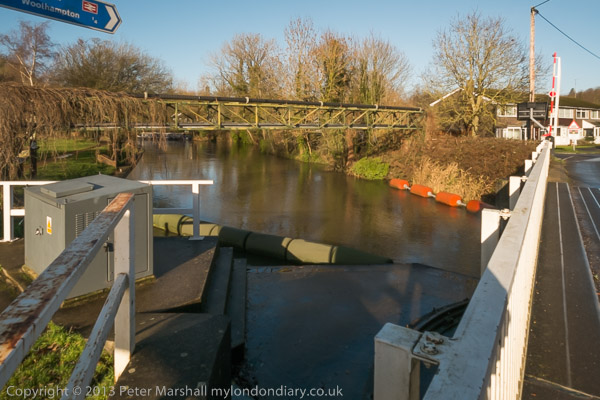
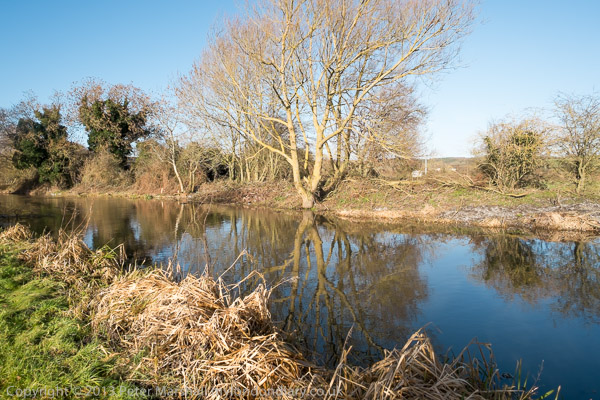
Usually either on New Year’s Eve or New Year’s Day my family – or that part of it which has managed to get together at that season like to go out for a walk. I’m just a little less enthusiastic than my wife or elder son, both of whom seem naturally to walk faster than me, and especially when I keep stopping to take pictures, I find myself spending most of the rest of the day trotting after them to catch up. Their idea of a good walk often seems more like a route march to me, I like to take my time, look around me and enjoy the scene – and take a few pictures. My son takes pictures too, but rather fewer than me, and he travels lighter, with just a Fuji X100. I tried doing the same, but find the 35mm equivalent lens too frustrating, seldom quite wide enough. A 28mm would be much better, I could perhaps live with that, and happily crop a bit where a 35 or a 50mm would have been more suitable. With files almost 5000 pixels wide you can afford to lose quite a bit unless you want seriously large prints.


All images in this post: Fuji X-Pro1, Fuji-x 14mm f2.8

Actually, no I couldn’t really live with that. Because even with the Fuji X-Pro1 and the 18-55mm zoom, equivalent to 27-82mm, I found myself often wanting something wider. And shortly before Christmas I succumbed to the Fuji-X 14mm f2.8, finding I could buy it from Hong Kong at a little over half the recommended price it had launched at here.

It’s been my experience over the years that photo equipment very seldom goes wrong until at least a month after the guarantee expires – even for someone like me who uses rather than mollycoddles equipment. The only exception I can think of, the importer refused to honour the guarantee telling me the lens had been subject to ‘impact damage’. I hadn’t dropped it, just carried it in a camera bag on on a camera around my neck – any impact it had suffered I had too, and it hadn’t gone beyond what I’d consider normal wear and tear. So I’m not too worried that it may be more difficult to claim on the guarantee. If the price difference was only a few pounds I’d probably have bought it from a UK dealer, but it was well over a hundred difference.

It arrived beautifully wrapped and on a Friday only five days after I ordered on-line (and two of those were Christmas and Boxing Day.) Unfortunately I was out, so all I got was a postcard, and the first day I could be in for delivery was the following Monday, when I finally got to unwrap and see it.

It is a lens that really looks and feels good; rather large for a 14mm (21mm equivalent) though not huge, and it makes either the X-Pro1 or the X-E1 into a reasonably compact camera – comparable to a Leica rather than pocketable. Autofocus is fast (with the latest firmware upgrades for camera and lens) though with a 14mm focussing is largely unnecessary. The focus ring pushes forwards for autofocus, but pulls back to reveal a focus scale with depth of field markings for manual focus. The only less than impressive aspect is the removable lens hood, which is identical to that for the 18-55 zoom. The lens works nicely with the X-Pro1 optical viewfinder which is probably the main way I’d use it, and is also good with the electronic viewfinder.

It’s hard to measure or quantify some things, but this lens just feels right on the X-Pro1, just as the Minolta 28mm did on the Minolta CLE (always ny favourite Leica) or the old 35mm Summilux I used for years on the M2 (the later versions are too large and far too expensive.) So I was keen to try it out and this walk was the first real opportunity.


As we walked on it began to get noticeably darker

In general I was very pleased with the results, and the lens was a joy to use. Though I still have some doubts about the camera system as a whole. Although the results are excellent, I’m still unsure that Lightroom gets the best out of the system. The images seem fine, but when you zoom to 100% the images have an odd quality, quite unlike those from a Nikon, looking rather more like paintings than photographs. It may not be important at normal images sizes, but I find it disturbing.

I took both the Fuji X-Pro1 with the 14mm and the X-E1 with the 18-55 zoom and also the Samyang 8mm fisheye, giving me a pretty wide range of possiblities, but even with both bodies weighing altogether less than a Nikon D700 with the 16-35 zoom.


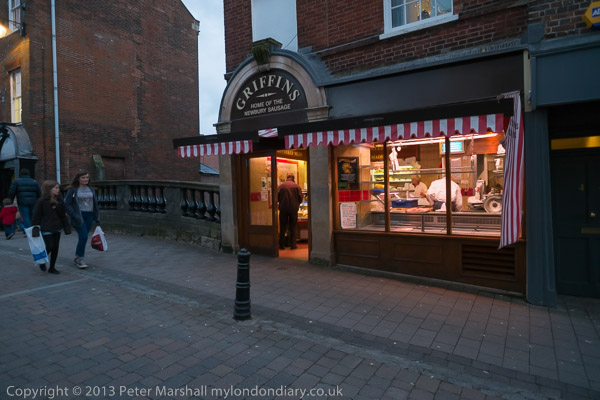
The home of the Newbury Sausage – and we arrived just before it closed.

I can recommend the Newbury sausages, and also the Fuji 14mm f2.8.

More pictures with the 14mm, 18-55mm and a few with the 8mm at Kennett & Avon: Newbury. It’s a lens I’ll be using more of later this year.
Continue reading Kennet & Avon – Fuji 14mm

Ctein & Prints & Slides

Ctein is a printer and photographer whose thoughts on photography I’ve occasionally read and been informed by for many years, once upon a time in print and now on the web where he has a weekly column on The Online Photographer. His latest post there, Fashion and Fad in Fine Photography, is what he calls “a quick, anecdotal look at history” in particular related to prints and photography, and makes some debatable points about prints and the history of photography.

I don’t fully agree with much of what he says. Prints became important from the start of photography, when the in many respects highly inferior Calotype process soon dominated the Daguerreotype largely because it enabled the production of prints, crude though they were compared to the minute detail of the silvered plate. Prints enabled photographs to be shared, to be made into books, stuck onto cards, and in the first 50 or so years of photography artistic concerns were generally hand-in-hand with technical advances such as the albumen print and wet and dry plates which enhanced finer reproduction of detail, better tonality and also ease of use. Even processes such as platinum printing were prized for their ease and convenience, and even photographers with a somewhat cavalier attitude to sharpness and detail in making their artistic negatives printed their work in a straightforward manner.

Contrary to what he suggests it was only after some fifty years of largely straightforward print-making that some photographers, wishing to distinguish themselves as ‘artists’ from the common herd of commercial photographers began to aspire to “prints that emulated, in some fashion or another, painting or drawing.” And for some twenty or thirty years this became the dominant fashion in art photography.

Ctein is I think wrong to suggest about the move back to realism represented by f64 (and of course others), that “Although wrapped in the flag of artistic sensibility, it was at least as much a pragmatic decision.”  Having myself dabbled in some of the darker arts of alternative processes, I think in many ways processes such as gum bichromate are considerably more forgiving than the making of fine ‘straight’ photographic prints. Anyone who thinks otherwise is invited to study the Daybooks of Edward Weston and the Basic Photo Series of Ansel Adams.

But less contentions and more interesting to my mind are his comments about colour printing, and particularly on working for print publication. As he says until some time in the 1950s, “printing houses and press operators swore that you couldn’t get good reproduction from a slide; you had to work from a print.” But by the time I came to photography in the 1970s “most printing houses had forgotten how to deal with prints and slides had become the canon.”

At that time, colour negative film was almost entirely seen as an amateur medium. Anyone serious about colour worked with slide film. I spent 15 years cursing it, and paying good money for bad prints when I wanted to frame work – or struggling myself with the toxic chemistry of Cibachrome and cursing its over-high contrast.  Spending hours making unsharp masks or trying to get sensible results with Agfa reversal print chemistry. Ctein became well-known as a maker of dye-transfer prints, and remains one of very few printers still able to offer these, but that was something out of my price range.

I saw the light in the mid 80’s, largely as a result of the adoption of colour negative by a number of fine-art photographers, but also because I realised that since so little of my work in colour was actually being published it made little sense to sing to the publishers tune when colour negative would give me better prints. It still remained a tricky job to print from colour neg, involving considerable investment in a roller processor and expensive enlarger as well as a lot of cursing to get colour balance right, and there is something in what Ctein says about black and white remaining as the preference for photographers because it was easier to produce. Certainly now it has become easier to produce good colour prints than good black and white, with digital camera and inkjet printing, I can find little reason to want to work in black and white.

One major development for me was the introduction of film scanners. At first an expensive option through a lab, and later with a high quality desktop film scanner of my own, it removed the difference between whether  you worked in negative or transparency (except for the inherent defects of both types of film) or even if you worked in black and white. What publications now wanted was not prints or slides but a digital file.

Now I’ve moved completely to digital cameras. Even the few niches that I used to think I needed film for I’ve now found ways to do them with digital, either as well or better.  I can make prints on my own inkjet printer – black and white or colour – or send the files to a lab on-line and get prints – inkjet or C-types. Though more and more I’m working for the screen rather than paper. Though I’m still working on books of my work I’m intending to publish them as PDFs rather than in print (with perhaps the option of a print version of the PDF for anyone still addicted to paper.)

Ctein is right to conclude that for photography “the sensibilities and pronouncements are likely to continue to change with technology and convenience” but there is more to it than that. It isn’t just about convenience, but that technology enables us to do things better as well as easier, makes new opportunities possible.


Getting Bailey

The first post that I wrote for ‘About Photography’, where for around 8 years I wrote a regular weekly photography column as well as setting up a web site dedicated to photography, was about David Bailey.  Looking back, it wasn’t one of my better articles, but – perhaps because it had a touch of humour as well as a little insight – it got me the job.

Bailey has never really been one of my favourite photographers, but there are certainly things about him and his work that I admire. And clearly he is a guy with a dedication to photography, and a fashion photographer only because that was (according to him) an easy way to make a living so he could take pictures.

While some BBC Radio programmes never make it to iPlayer and others disappear after a week, you have, according to the web site, ‘over a year’ to listen to David Bailey talking to (and photographing) presenter Tim Marlow about how he got started and his attitude to portraiture and fashion. The first of two programmes in the series ‘Getting the Picture’, The Camera Has Attitudes, can be heard now, and the second part of the conversation with Bailey, He Seduces Everybody! will be on-line after it has been broadcast on Monday 20th January.

These programmes come in advance of a new show at London’s National Portrait Gallery, Bailey’s Stardust, which runs from 6th February to 1 June 2014. Meanwhile you can search the gallery’s collection both for pictures taken by him and pictures of him.

There are quite a few sites around the web with articles on Bailey, and more with some of his pictures. But perhaps the most interesting of them is by Francis Hodgson, David Bailey – Still Troubling After All These Years. Writing at the time of the show David Bailey’s East End at the Compressor House in  London’s former Royal Docks in 2012 (a show dedicated to , Hodgson comments:

David Bailey has had insufficient attention. That sounds absurd. One of the most famous photographers we have? Certainly, but he’s almost never had a public show – one big one at the Barbican (and the Barbican is oddly funded, it’s not really a national venue) otherwise scraps. It is impossible to imagine a German photographer of equivalent status, a French or a Dutch, to have received so little public confirmation. Our curators really haven’t been doing their work if Bailey can unearth treasures on this scale in a few months of trawling his own files.

And it is so obviously true, and something the show at the National Portrait Gallery will really do little to correct, because its focus is simply on one very limited aspect of Bailey’s work and perhaps this is not really his strongest suit.  Some of them are excellent for the genre, and certainly head and shoulders (excuse me!) above some of the mediocrity that seems to be the NPG’s forte, but there is much more to the man than these images which are largely about celebrity.

Of course, Hodgson’s complaint is one that could be echoed about many other British photographers and about the British establishment’s attitude to photography in general.  And if our own institutions don’t bat for them it’s hardly surprising that so many have not gained the international reputation they deserve.

Hodgson finishes with the final footnote :

I see that the show is dedicated to the late Claire de Rouen, bookseller of the Charing Cross Road, and a person whose enthusiasm for photography was the engine for an entire generation of UK practitioners.

Many of us were indeed encouraged and stimulated by her enthusiasm at the Photographers’ Gallery where I first got to know her (and in the Porcupine)  and then later at Zwemmers and then her own bookshop further up the Charing Cross Road.  If only there were more like her.

Ponytail Pontifications: The Sayle Twins

I’ve written previously about the blog by an old friend of mine – though our paths seem seldom to cross these days – Derek Ridgers, whose Ponytail Pontifications are always of interest. His latest post about meeting and photographing Alexei Sayle, and his invention of the Sayle Twins is a good example.

Back in the 1980s, Derek and I used to meet up regularly with some other photographers to criticise each other’s work, and Derek pulled no punches, as I mentioned in a post Photo Reviews. As I commented there, these critical gatherings “were about developing ourselves as photographers, photo reviews are all about developing your careers” and I know that they were important for me, and I like to think that some of my comments (though rather more polite and less controversial than his) may have at least encouraged him, and occasionally  I think we both gained from a little mutual advice.

Derek has worked for over 35 years for UK magazines and Newspapers like NME, The Face, The Independent, The Sunday Telegraph, Time Out and Loaded, and has a remarkable archive of work, including much on his web site.  Sabotage Times last month published an interview with him about a book of his pictures from the London Tattoo Convention with a gallery of 13  pictures.

Derek has a new book, Derek Ridgers: 78-87 London Youth, due to be published on March 31, 2014, and you can see and hear him talking about his photography in a promo video. His pictures are on show at Ketchum Pleon at 35-41 Folgate Street in Spitalfields, London E1 6BX in February 2014.

South of the Thames


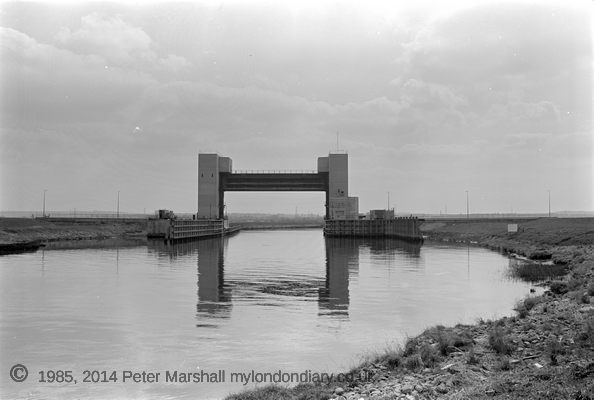
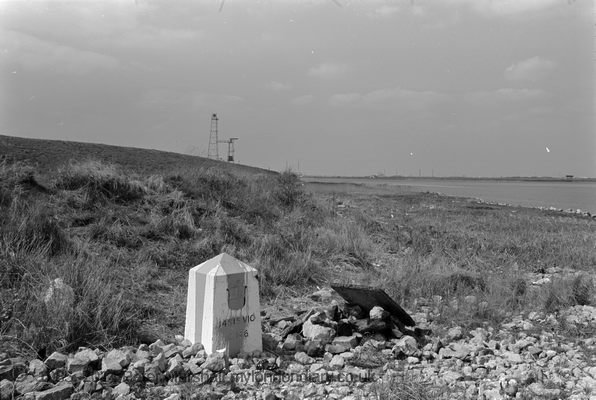
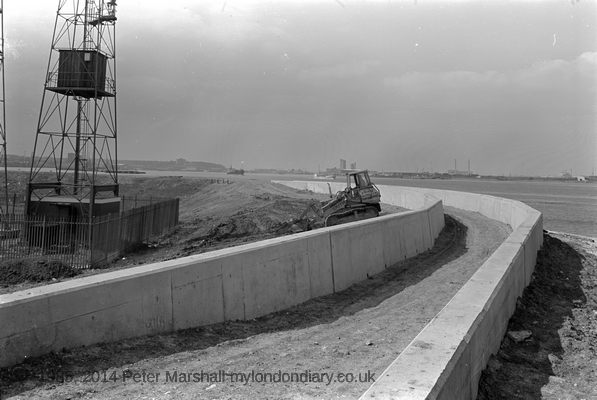
Flood barrier at mouth of River Darent, 1985

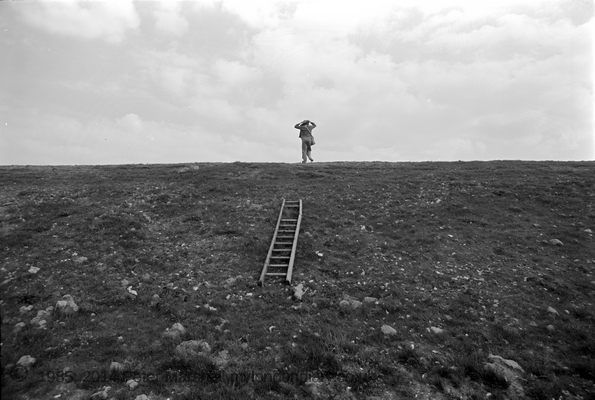
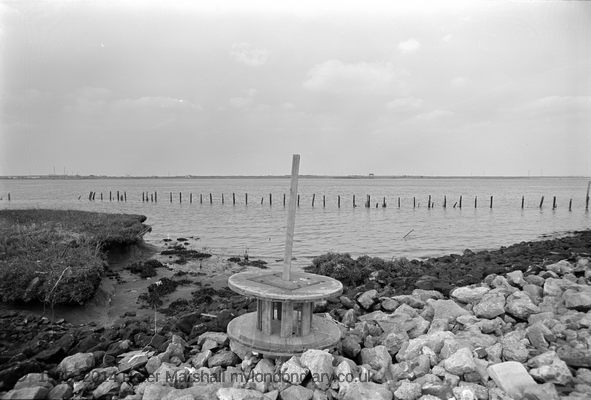
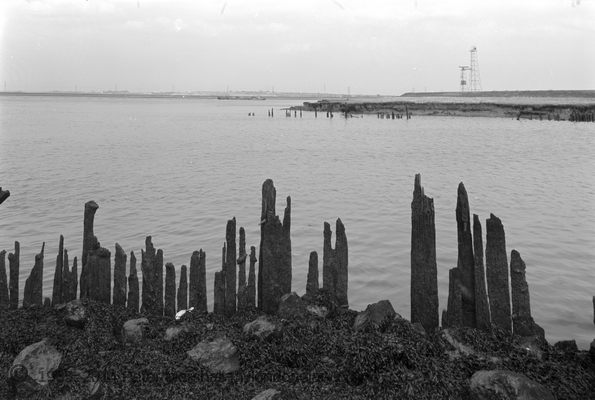
I’ve published or exhibited very few of the images I took along the Thames Estuary in the outer boroughs of Greater London and North Kent in the 1980s. A handful appeared with a couple of articles I wrote in ‘Amateur Photographer’ at the time, and one or two were in various shows. A few are already on the web too, a couple on this site in a post Controversial Landscapes a little over a year ago.

There were various reasons for this, then and now. By the time I’d actually finished the project, working on odd days for a little over a year, I was beginning to work on another larger project on London which was to take up much of my next 15 years.

I was also having some technical problems. Wanting more detail and smoother tonality in particular in the wide-open landscapes I was working much of the time with Kodak’s Technical Pan, discontinued around ten years ago (they stopped making it some years earlier but had a large fridge.)


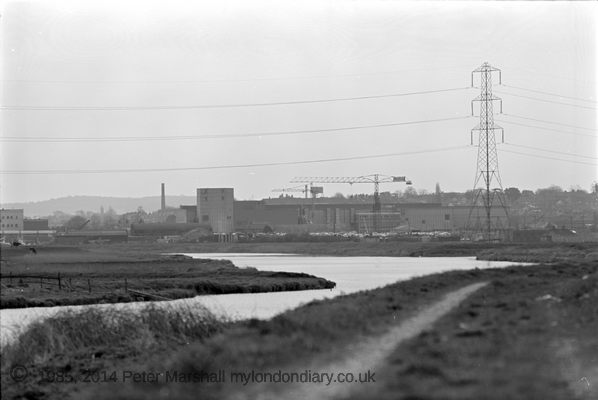
River Darent, 1985

It was a film developed for technical purposes as the name suggests, and was a panchromatic film with extended red sensitivity, rendering reds lighter and blues darker than normal pan films. Kodak described it as a versatile film and their “slowest and finest-grained black-and-white film for pictorial photography (when developed in KODAK TECHNIDOL Liquid Developer).” It had been produced at first for applications such as microfilm and astronomy and normal development gave a contrast that was way too contrasty for printing on any available photographic papers.


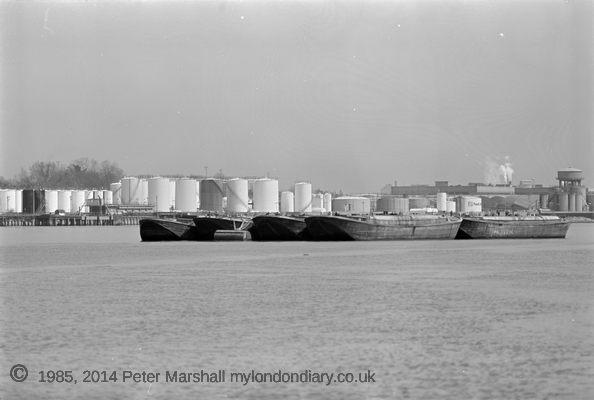
View across the Thames to Purfleet, 1985

For high contrast uses it could be exposed at reasonable ISO, typically ISO 125, but to get normal contrast involved using dilute or modified developers that required several stops more exposure – typically I was exposing it at perhaps ISO 12 or 25, and with some developers even at ISO 6.  Until Kodak’s own Technidol became my developer of choice, the results were often dismal, with contrast either too high or too low and a high risk of both uneven development and underexposure. But when you were fortunate the results were really only limited by your lenses. It was often said it produced ‘5×4’ quality from 35mm and that could be more or less true.


River Thames, 1985

The downside, apart from the many images spoilt by development faults was having to carry and a tripod to avoid any camera shake with these low ISOs. Many of the places I visited were some way from convenient public transport and typically I was walking perhaps ten or twelve miles a day carrying my gear, and the extra 5.5 lbs of the Manfrotto and head was often a literal pain. I tried lighter alternatives, but found nothing sufficiently tall and solid. It perhaps led to my aversion to tripods, which to this day I seldom use outside the house and garden.


River Wall, River Thames, 1985

My interest in this project came in particular from two sources, the first a geography text, South East England, Thameside and the Weald, by Roy Millward and Adrian Robinson (1971), which contained a section ‘The cement industry of Lower Thameside’, and the rather more fanciful and poetic ‘Pilgrimage of the Thames’ by writer and illustrator Donald Maxwell (1932) whose journey began at Gravesend and finished at Oxford. In the preface he writes that in existing books on the river “I realised that no attention whatever had been paid to many matters that I, for one, find thrillingly interesting.” and goes on to give several examples beginning with “Who has written on the cement country with any conviction or attention?” It seemed something of a photographic challenge too as I looked at his drawing of the ‘The Ravine of Greenhithe’.


River Thames, 1985

My first visit was for a simple walk from Slade Green station (the last in Zone 6 on a Travelcard) back along by the Rivers Darenth and Thames to Erith, and then to leave the riverside and make my way down to Belvedere station for the journey home, and the pictures here are from the first half of that day.

River Thames, 1985

I’ve revisited the area occasionally over the years, and some later panoramas are in my book Thamesgate Panoramas where the Blurb preview has a selection of 36 pages. Like most of my books it is available as a PDF, either from Blurb and also in a slightly better version at the same price direct from me.


River Wall, River Thames, 1985

I’ll write more about this work, and how some of the later images were made from the negatives using the D800E in some later posts. But all of this first set – which are displayed here as ‘unspotted’ work images are from high-res scans on the Minolta Dimage Scan Multi-Pro.

Continue reading South of the Thames

Time’s Flow – Adam Magyar

Over the years I’ve seen a number of photographs making use of scanners and photo-finish cameras and various multiple exposure techniques and never found them more than amusing novelties. But there is something rather more compelling about Adam Magyar’s stainless (video).  Perhaps because video is essentially a transient experience, while in still images I want something deeper, that says more than ‘how clever’ or even ‘I wonder how he did it?’

You can see more of his other work – and it is impressive if largely not to my taste on his web site linked above, and learn much about Magyar’s ingenuity and perseverance in a feature  ‘Einstein’s Camera’, which also includes the video along with other work.

I’m rather sceptical about any link with Einstein – and most other such claims made by artists – but that doesn’t detract from the work. Wikipedia has this quote from Arthur Eddington

Let us draw an arrow arbitrarily. If as we follow the arrow we find more and more of the random element in the state of the world, then the arrow is pointing towards the future; if the random element decreases the arrow points towards the past. That is the only distinction known to physics. This follows at once if our fundamental contention is admitted that the introduction of randomness is the only thing which cannot be undone. I shall use the phrase ‘time’s arrow’ to express this one-way property of time which has no analogue in space.

which might be more appropriate, but ‘Eddington’s Camera’ wouldn’t have the same attraction.

The ‘Medium‘ site on which this piece appears has some other articles that may be of interest, though on a quick look through I found no other significant photography. One of the site’s features is to tell you how long each will take to read. For ‘Einstein’s Camera’ it tells you ’22 minutes’.

Thanks to Peggy Sue Amison of the Sirius Arts Centre in Cork, Ireland for bringing this work to my attention by a post on Facebook. Magyar is bow based in Berlin where she is a consultant and curator at Picture Berlin. The video was also shot in Berlin, and reminded me of my visit there a couple of years ago, when I also took the U-Bahn from Rosa Luxemburg Platz to Alexanderplatz, both close to where I stayed, though I took few pictures.


More Raw Files

Pete Brook writing his Raw File blog for Wired magazine often comes up with some interesting work that’s new to me, and a couple of recent posts are worth a look.

I like the long exposure night images of Alnis Stakle in Ghostly Photos Reveal Subzero Shortcuts Through Post-Soviet Cities (that’s almost an essay rather than a title), made with exposures of several minutes on film in a Hassleblad. The lengthy exposures lose much of the feeling of night but produce some strange effects (with the peculiarities of Fuji Reala 100 and Kodak Ektar 100 doubtless adding their contribution.)

It’s also worth looking at Stakle’s own web site and the other projects there, a reminder of the great interest and depth of photography in central and eastern Europe, perhaps rather more vital now than the west.  I was reminded at times of the book ‘Lab East’ whose launch I photographed at Paris Photo in 2010.

Another recent post I enjoyed on Raw File was by German photographer Gesche Würfel, a set of images of the basements of apartment buildings in New York made while hunting for a flat there with her husband with another typically long title, Photographer Finds Cockatiels, Jesus in NYC Basements.  Among the other projects on her web site is a set of pictures by Würfel taken around the London Olympic site, Go for Gold!, covering areas I’ve myself documented over 35 years, some work from which is on my River Lea/Lea Valley site and in my book Before the Olympics.


One of my pictures from Before the Olympics – on Waterden Rd, Hackney Wick in 2005