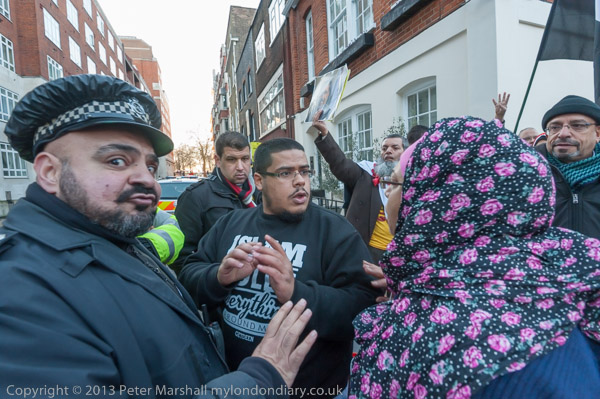
Whither Anonymous?

I first came across ‘Anonymous’ in 2008, at a protest the group organised against the Church of Scientology following attempts by the CoS to censor coverage of their activities on Internet sites, and also their attacks on their critics under a so-called ‘fair game’ policy which allowed them to carry out all sorts of dirty tricks on anyone they saw as an enemy of Scientology. Being anonymous then was important to avoid retaliation.
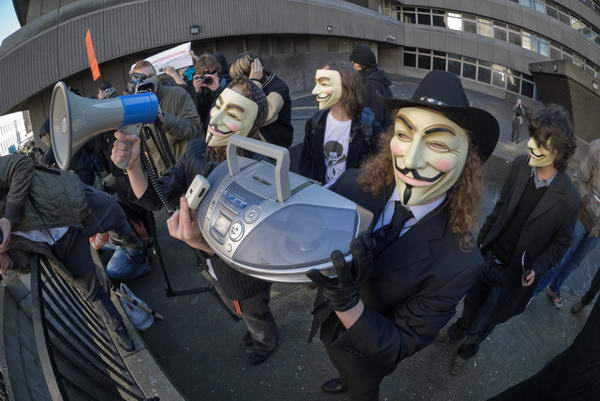
It was perhaps also important for a few to retain anonymity in the ‘Occupy’ movement although some suspect this was more the case for undercover police than the real protesters.  Certainly by then the identities of those who wore the ‘V for Vendetta’ mask as regular protesters were largely well-known to the police.

Although both ‘Occupy’ and ‘Anonymous’ linger on, they do appear to have lost the momentum they once had, and I wasn’t surprised to find only a relatively small crowd – perhaps around a hundred people – gathered in Trafalgar Square for their ‘March for Freedom UK’. Of course it lacked the obvious Guy Fawkes connection of the much larger Bonfire Night protest last November. But among the faces, both masked and unmasked, were many  familiar to me from Occupy London and other protests.
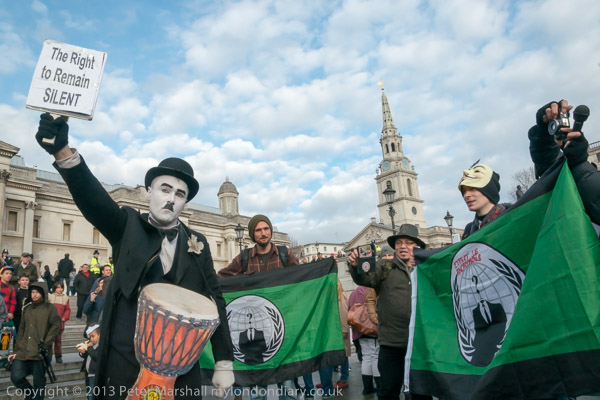
Charlie Chaplin is of course a face familiar to us all, and he was there too!

After a number of short speeches and a mime performance from Mr Chaplin, there was a suggestion it was time to march which was put to a public vote and appeared to be carried. Some set off immediately, while others took longer to organise themselves, but eventually almost everyone was waiting at the traffic lights at the southern edge of the square.
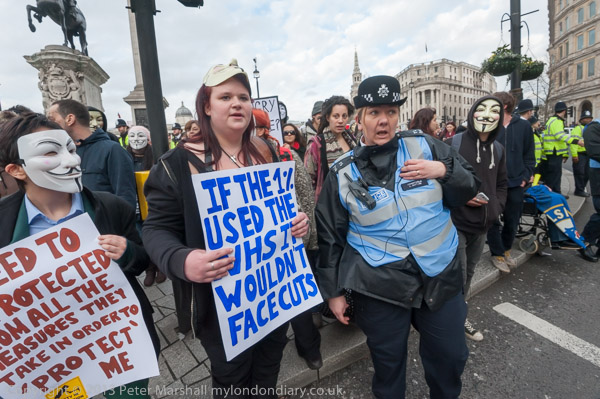
Rather curiously those at the front of the march did not seem very clear on what they were doing, and it was a police liaison officer who told them where to go.
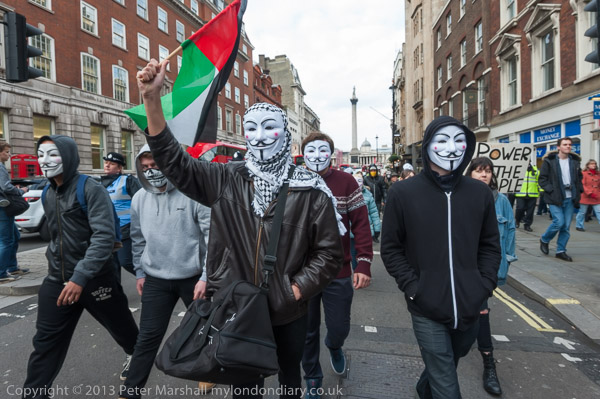
It wasn’t really much like a march, more just a group of people going down the roadway, and it was perhaps only the masks that made it stand out.
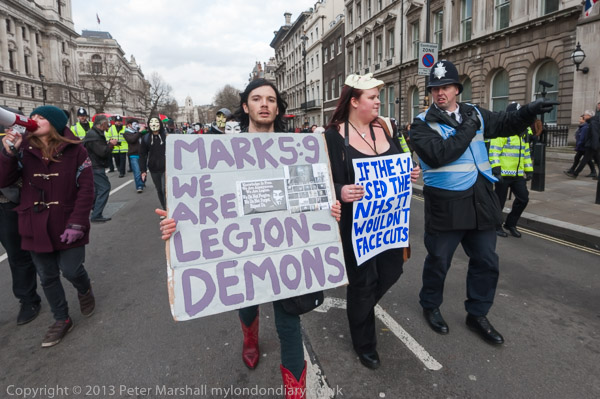
Again as they reached Parliament, the protesters were unsure where to go, though this time they didn’t follow the police advice, but simply walked on and came to a stop outside Parliament where they held a rally.
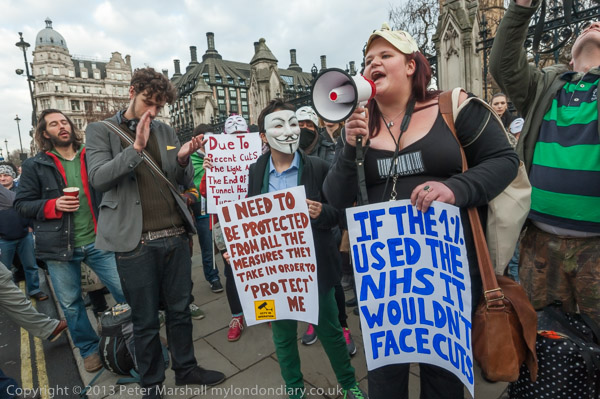
Of course there is a great deal of common-sense in much of what they say. We do need to keep our National Health Service and to improve it rather than simply hand out lucrative contracts to private enterprise. We need reform to make our parliament reflect the needs of the people rather than the greed of a small minority, and so on. I’m not sure that this kind of event contributes much to achieving those aims, but at least it serves just a little to raise awareness of the problems.

More pictures at Anonymous March For Freedom UK.
Continue reading Whither Anonymous?

Gaza Anniversary

I don’t much like photographing protests at the Israeli Embassy. The actual embassy is hidden away down a private side street where photography and protests are forbidden, and protests take place on the busy roadway of High St Kensington. Sometimes there are problems with police not allowing photographers to stand in front of the protest pen, either telling you that you can’t walk along there, or opening up a narrow area for the public to walk through and telling photographers they have to keep moving.  Fortunately on this occasion they were not doing either, but allowing photographers reasonable access, but it still was to a narrow restricted area, with traffic moving past on the other side of a row of cones a couple of feet in front of the protest.

I actually like to work close to people when photographing, but this was at times just a little too close even for my taste, and your presence is always very much felt by the protesters. The actual pen is always fairly narrow too, so it gets very crowded inside, and its often tantalising to see an opportunity for a photograph but not being able to get the the right position to make it.

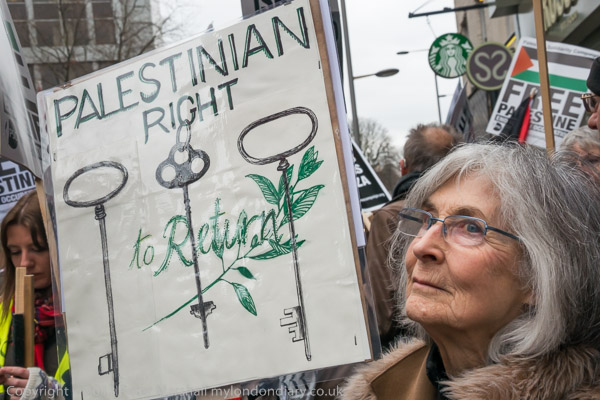
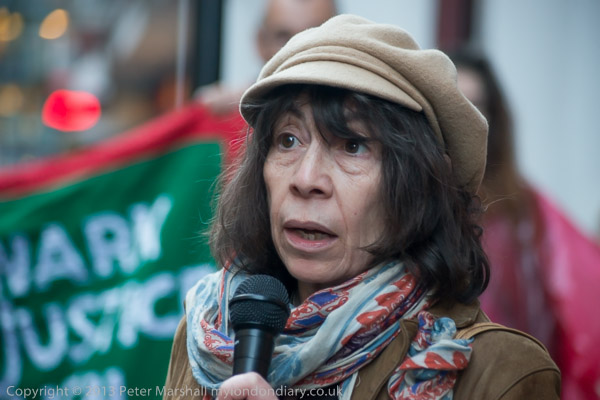
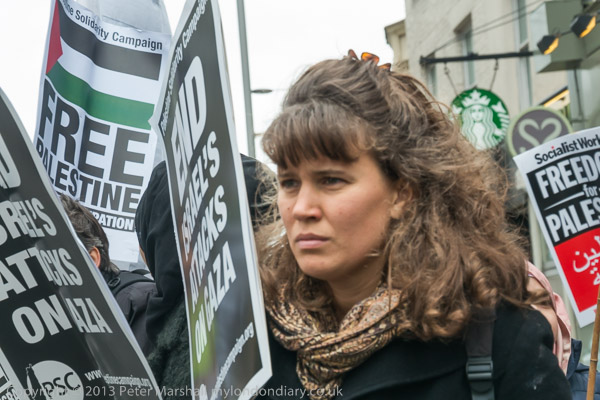
Although mostly I was using the wider end of the 16-35mm zoom (on the D700) there were also some pictures where by working up to the barriers and aiming the camera roughly along them I was able to get a little more distance – as the the picture above of the woman and the placards. Unfortunately it was a dull day and the 18-105mm seems to have been having a few problems with autofocus recently – and this image is not quite sharp on her face. Later I took a few more simiilar images – and there are some in Gaza Massacre 5th Anniversary – but as often happens, the first image was the one that I thought best – apart from its softness. I took it soon after I arrived and there were relatively few photographers (and protesters) present, but soon lots of other photographers were also photographing her and I think she got very concious about being photographed, and was smiling most of the time.

Another woman had a very nicely drawn poster and I wanted to photograph her holding it in the protest, but it was hard to get a picture I liked.  The plastic sheet over the poster was also a problem with reflections. I took a few working close to her, but they didn’t work – as it seldom does if you ask people to hold their poster or placard for a photograph. Later, from a little further back with the 18-105mm I made this one which was more what I wanted.

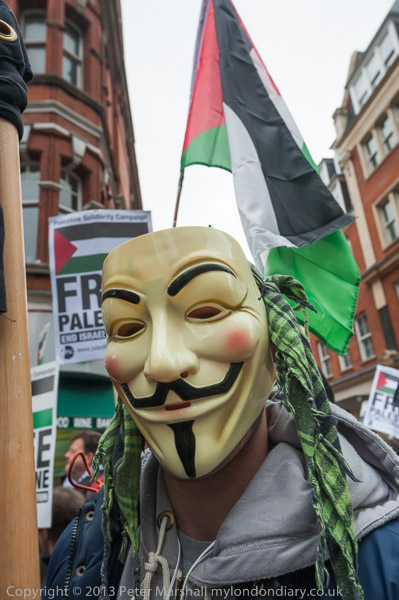
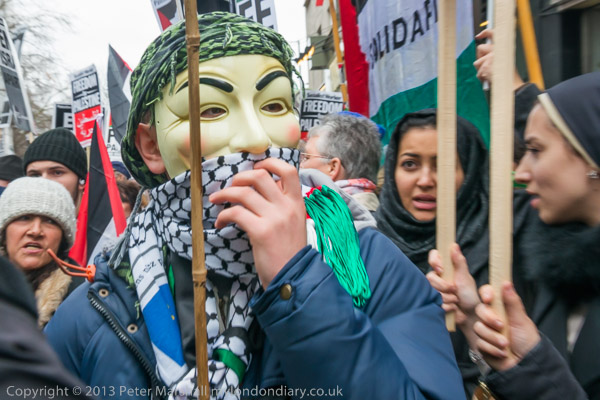
There is rather less of a problem in photographing people wearing ‘Anonymous’ masks in that their expression doesn’t change when they are aware of the camera. But it was still a better picture when I photographed this guy as he walked through the crowd rather than the posed image above.

Of course the scarf makes a difference, but it is mainly the hand up to his mouth which produces something more immediate, and the people and placards around the figure work better.

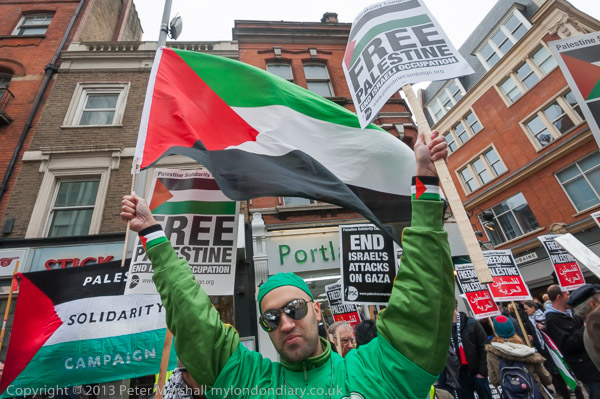
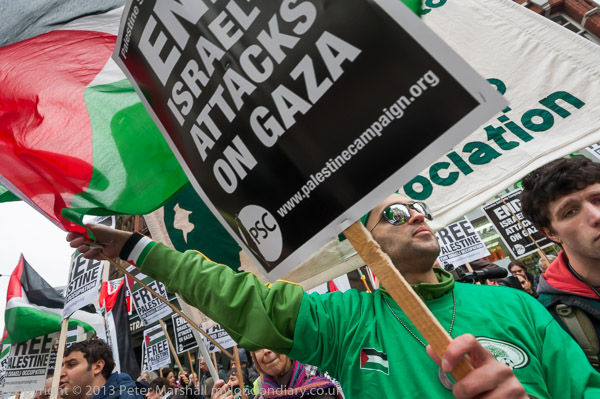
I couldn’t stay for all of the protest, and was anxious to get off to go to another event. but one particular person was worrying me. He was one of the most noticeable of those protesting, and had appeared in more or less the first image I took, as well as several others. But I just wasn’t too happy with pictures like the one above; it wasn’t bad, but I felt there must be more I could do. I’d turned away and walked a few yards towards the tube, then turned back and decided to make one last effort. I took a short series of images ending up with the one below.

It didn’t look quite like that on the camera back – his face was in fairly deep shadow and the flag at top left was rather pale, with light shining through the thin material. But I felt I had essentially captured what I wanted and put my camera away. This really was the final frame I took of the protest.

Continue reading Gaza Anniversary

Jeremy Nicholls interviewed

I’ve often linked here to posts by Jeremy Nicholl on his The Russian Photos blog, for example his excellent coverage of the Morel vs AFP/Getty saga (the agencies have lost twice but are still fighting – perhaps just to benefit the lawyers) and it was interesting to read an interview with him today on the ‘SellNews Blog‘.

The heading to the post there also made me smile a  little.  “A comfortable pair of shoes is one of the most important pieces of photo equipment” is a quotation from Nicholls, but was also almost word for word my reply some years ago when I was being interviewed for some amateur photographic magazine.  There it was the kind of interview that went through a stock series of questions, and one at the end was “What is your most useful photographic accessory?” and my answer “A comfortable pair of shoes” was not really what the interviewer wanted.

A few years later in another similar interview, about my urban landscape work, my answer had changed, and had become my Brompton, a superb British-made folding bicycle that had made my later work in the Thames Gateway possible. The distances there were too much for convenient walking, and the bike took me to places that a car would not have reached (and in any case I’ve given up driving) and let me stop almost anywhere on the roads to photograph. No nonsense about finding somewhere to park and walking miles back to find the light had changes or that what looked interesting at 5o mph didn’t quite look so good when you got back to it. The Brompton has the big advantage that once folded it could also always be taken on trains and the underground across London (and on buses, but usually it’s quicker to ride.)

More recently it’s back to shoes again for me, with much more of my work in central London, and often at events where a bike might be damaged or be very likely to be stolen if locked out of the way.  So it’s back to buses and walking – and sometimes the tube or Overground. My taste in shoes has changed – then I went for lightweight hand-sewn leather, while now I prefer rather heavier, warmer and more expensive and waterproof  models that provide more support.

But Nicholl’s interview isn’t just about shoes and the Morel case, and there is a nice section where he gives his view that photographers have to be not neutral but honest, as well as his views on social media, his problems photographing in Russia, his equipment and his clear advice to those amateur photographers who wish to become professional: “marry into money.” Though he does go on to say more. The whole piece is worth reading.

What is a photograph?

The newly opened show at the ICP in New York is not one I’ll bother to go to. Having looked at their web page about it with a slide show of 15 images, I’d probably not bother with it even if I could hop on a bus outside my front door direct to the show.

According to ICP Curator Carol Squiers, What Is a Photograph?will explore the intense creative experimentation in photography that has occurred since the 1970s“, but I’m afraid it leaves me distinctly unimpressed. A few of the captions seem more interesting than the images, always a bad sign and to me in their attempts to probe photography itself, “the role of light, color, composition, to materiality and the subject” rather than reinventing photography they appear to have deserted it.

Which perhaps would not be important in itself if these works could stand on their own in the world of art, rather than occupying some of the very limited cultural space allowed to photography, but I doubt most can, even if most are selling well in the current art marketplace.

It is in part perhaps a matter of selection – there are many both past and present whose creative experimentation has been of rather more interest, from the earliest days of photography with Talbot and Hippolyte Bayard through people such as Man Ray and Moholy-Nagy and on to guys like Henry Holmes Smith and Ralph Eugene Meatyard and others to the present day.

The issues which this show claims as the prerogative of these conceptual artists are those that every worthwhile photographer addresses each time they make an image, but the question that obsesses them is not ‘What is a photograph?’ but ‘What makes (or how do I make) a worthwhile photograph?’. To me it seems a distinctly more crucial issue.

The Drowned World

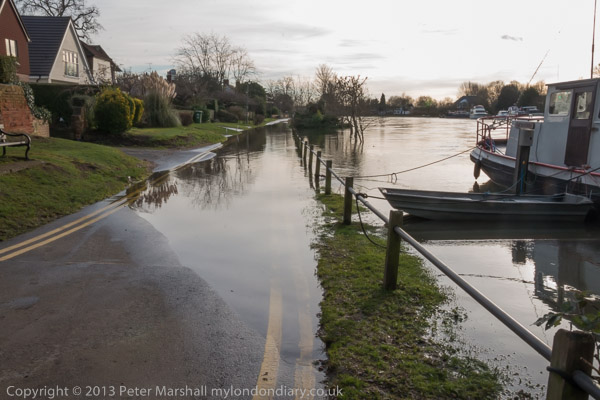
The floods got me thinking again about one of our former local celebrities, whose second book (and the first that he later acknowledged) ‘The Drowned World‘, published in 1962 was set in a post-apocalyptic and largely unrecognisable London of 2145, mostly underwater and tropical thanks to the effects of global warming. Back in the 1960s it seemed far-fetched, though now it seems only too likely.

On one sunny afternoon in January as the Thames was beginning to subside, I got on my bike and took a ride, camera around my neck and decided to make a short pilgrimage to the street where he had lived for many years.


It got deeper further on and I turned down a side road away from the river

I wasn’t in a hurry and decided to try the scenic route, along by the riverside most of the way, though I was fairly sure that the road by the Thames would still be closed and I would have to divert – and this turned out to be so. I could perhaps have pushed on a little further through the flooded tow-path at Laleham, but I would have risked getting my feet (and perhaps more) wet if I had to stop or met an underwater pothole.

Its a rather boring but shorter ride on the main road through Shepperton Green to Shepperton, ending with a little climb on the bridge over the motorway, and then down with the traffic lights at the bottom of the hill almost always wasting your momentum, and cars getting in the way in a queue for them.

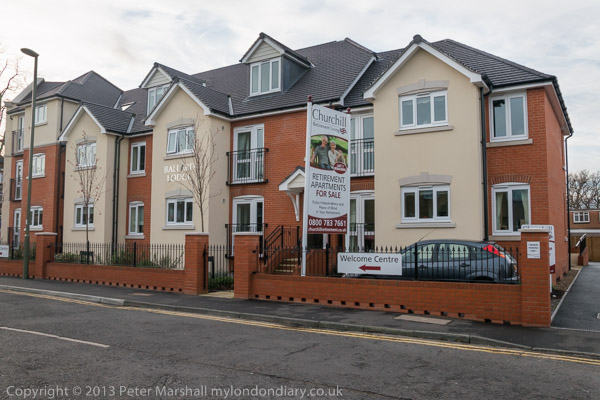
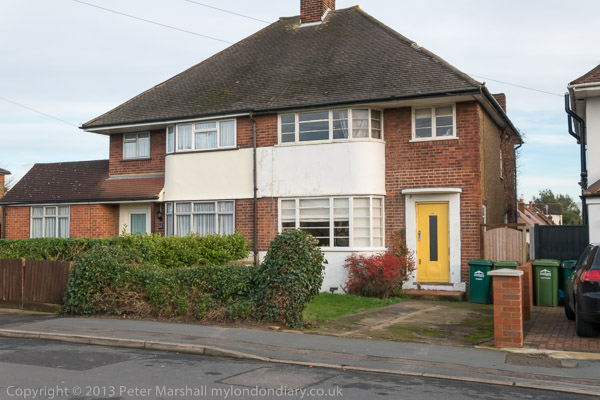
I’m not aware of any blue plaque or other official recognition of J G Ballard in the area, certainly there is nothing on the actual semi-detached house where he lived and which was sold following his death in 2009. But as I moved off from the lights I saw the new and rather ugly new block on the corner, Ballard Lodge retirement apartments.  It would perhaps have amused him slightly, perhaps in a true Ballardian fashion.

I don’t think his house has changed much. Still the 1930s windows and the faintly ridiculous door surround and a dowdy patch of lawn. But I didn’t like to stop and stare too long at what is just an ordinary semi.

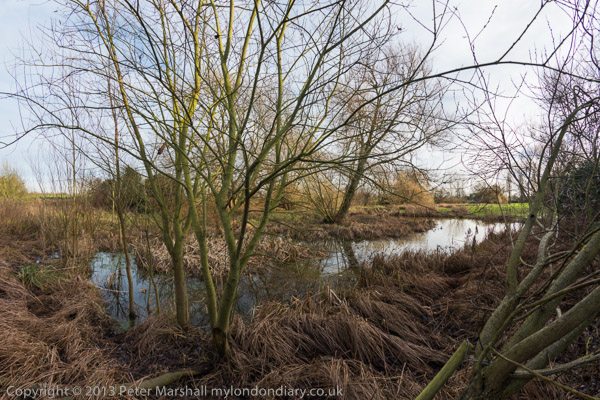
The road now ends short of where it did when he moved there in 1960, but there was still an area of swampy ground where perhaps he sometimes walked and perhaps thought about his work.  The River Ash runs just to one side, quite a small stream, bring water from the Colne at the southern edge of Staines Moor and flowing on into the Thames.

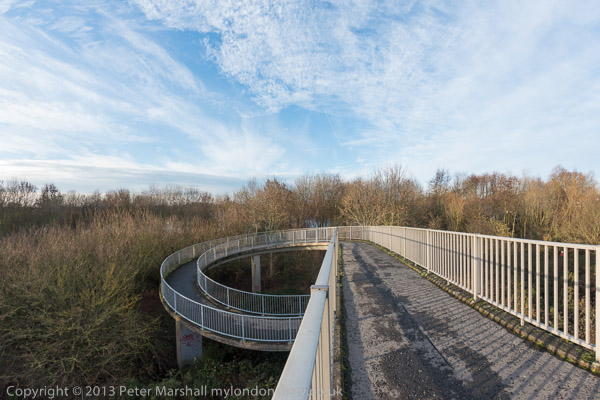
Behind me when I made this picture was the spiral ramp up which he may have sometimes walked, built as the M3 cut across his road, and I pushed my bike up it wondering if he had contemplated the building of the motorway when writing perhaps his best-known work, ‘Crash’. Unlike the film version, much of the book was set in this south-west area of Middlesex, along with some of his other works.

You can see a few more of my images from the area on Shepperton & Ballard, where I also have written a little more about the man who has been described as our most important post-war novelist. Perhaps not, but certainly one worth reading, and one who had some influence on my own project ‘Under the Car’ back in the 1970s.

You can read a little more about that in Under the Car, posted on this site in 2007, based on part of a presentation I gave in Brasilia.

The  ‘The Drowned World‘ is one of a number of Ballard’s novels s that is still available. You can read (and download) the book online.

The pictures from Laleham and Shepperton were taken on the Nikon D800E with either the 18-105mm DX or 16mm Nikon FX fisheye (and with a little help from the Fisheye-Hemi plugin.) The D800E gets a little heavy around the neck when cycling, even though both of the lenses are fairly small and light. The one not on the camera fitted in a jacket pocket.

I’m getting to like the 16mm a lot, perhaps even a better lens than the 10.5mm DX, certainly less chromatic aberration, though Lightroom does a good job of removing that in any case. It’s possibly the only FX lens that is smaller and lighter than its DX equivalent, though there is much in it. It works well on both the D700 and D800E, though I’m more likely to use it on the D700 for most things simply because of the huge files it produces on the D800E. The 32Mp raw files are a not unreasonable 32Mb or so, but to use Fisheye-Hemi, Lightroom has to export a 16 bit Tiff file, and these are around 200Mb a time. With the D700 they are a more reasonable 65Mb or so.

But by the time I got home, even though I’d probably only cycled around ten miles I was beginning to wonder why I hadn’t picked up the Fuji X-Pro1 instead as my neck was beginning to ache. With the 18-55 Fuji X and the 8mm Samyang fisheye the load would have been lighter.

Continue reading The Drowned World

McCullin & Somerset Levels

One of the more famous residents of the flooded areas of the Somerset Levels, and someone who has for some years devoted himself largely to photographing that landscape is Don McCullin, and as I listened to the news some of his black and white landscapes came to mind. There is one at the bottom of an article from the National Gallery of Canada (you’ve just missed his show there) that seems particularly apposite, a deliberately dark and moodily printed image of flooded field and a silhouetted line of winter trees under a heavy sky, The Somerset Levels below Glastonbury, UK (1994).

McCullin hates being described as a war photographer, but many of his most famous images are war photographs but of course he has done so much more. There is a short video of him talking that is worth watching  mentioned recently on fStoppers, and an excellent and well-illustrated recent feature by Gerry Cordon, McCullin: a conscience with a camera.

This includes another of his images from the Levels, as well as a rather hillier Somerset landscape, and also tells the story of what McCullin describes as the only picture that he has ever staged.   Some of the same ground is covered in an article about his photography the McCullin himself wrote for The Guardian in 2012. For a slightly different perspective you may like to read My Husband Don McCullin, written by Catherine Fairweather of Harpers Bazaar where it was published in 2013.

I’m not quite sure what to make of a Canon advertising film, Inspiration, made in mid-2012 in the Languedoc-Roussillon region of the South of France, when Canon sent him with a well-known wedding photographer Jeff Ascough as his guide to “discover more about shooting with Canon digital cameras.” It says “Don McCullin is still shooting with his Canon EOS 5D Mark III DSLR and a variety of Canon EF lenses” and good luck to him, though should I reach his age I think I might prefer something rather lighter. I think the best of these digital images by him are still in monochrome, and there are some nice pictures of him by Ascough.


Benefits Street

I don’t watch television. 45 years ago, when I was first married, we decided there were far too many other things to do in life to waste time on watching TV, and I’ve not owned a TV set since (though the other things have rather changed.) I do occasionally watch programmes after transmission on the computer, where you can select the short sections worth watching and quickly slide through most of the tedium. I seldom watch more than 10% of any programme.

So I’ve not watched a whole episode of Benefits St, let alone all those that have aired, but I have seen a few short clips and read a number of articles and some of the many comments on them. Most interesting were those from people who actually know or even have studied James Turner Street in Winson Green. The programme seems to me a cynical exploitation of the people featured with no attempt to examine the underlying causes or to treat the residents with appropriate respect or honesty.

The Birmingham Mail quoted one of those in the show who helped Love Films in making it, Dee Roberts as saying:

“They said they wanted to film for a TV show about how great community spirit is in the street. I participated in the show on that belief.

“But this programme has nothing to do with community, which you can tell from the title. It’s all about people in the street living off benefits, taking drugs and dossing around all day. It makes people out as complete scum.”

From what I’ve seen and heard, the values behind the programme seem to be entirely those of making ‘”good” – i.e. popular – television; the morality of the viewing figures. It’s perhaps what you would expect from a company noted for The Great British Bake Off, a kind of cultural lobotomy. Truly bread and circuses.

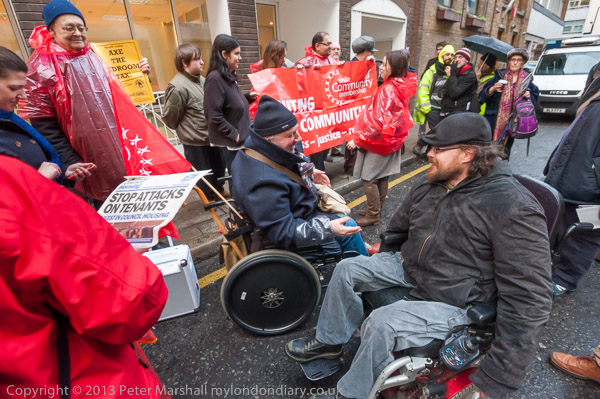
Photographically it wasn’t an easy event to cover as it seemed rather disorganised. Visually the most interesting aspect was perhaps a very short period of shouting slogans towards the Love Film office. But the protesters were standing very close to the front of the building and the photographers were behind them, though I managed to squeeze between protesters and the offices for the top picture (and a few similar) and some of those present didn’t really seem to be getting involved.  It was a protest where those taking part didn’t seem really sure what they were supposed to be doing.

Later things did get a little more organised, with a number of speeches, including those from campaigner Reverend Paul Nicolson of Taxpayers Against Poverty, no stranger to the ways of television as he was for 16 years until his retirement in 1999 the real Vicar of Dibley, or at least the church used in the filming of that series in Turville, Buckinghamshire.

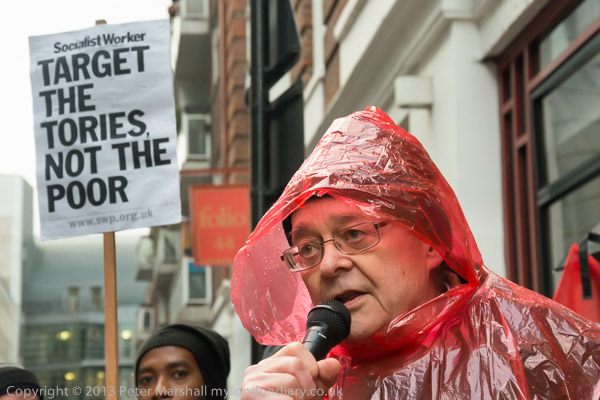
As you can guess from this picture, by the time he was speaking it was raining fairly persistently, and the lighting in the narrow street surrounded by tall buildings had dropped considerably – and it had been dull at the start.

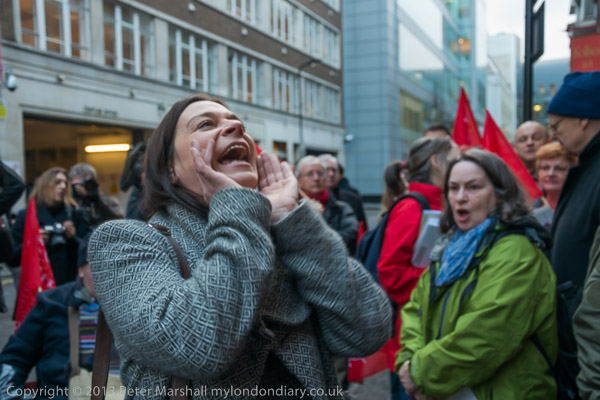
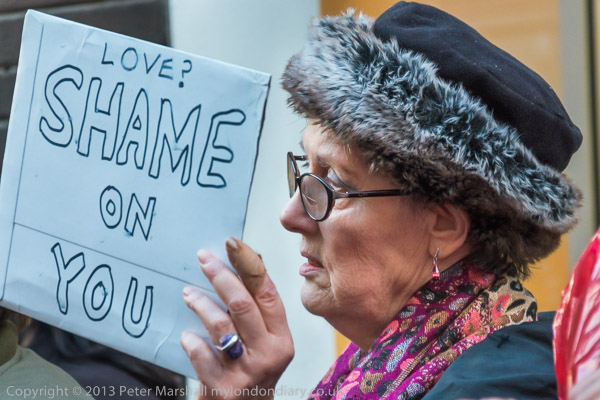
It’s always difficult to know how to adjust the colour balance in such circumstances, and I often find that the auto white balance gets things not quite right. It isn’t easy to know what is right, and it probably isn’t what is technically correct in most cases, but I found myself making more tweaks than usual in these pictures, mainly aiming to get believable skin colours.  The Rev Nicolson is red in parts on his face because of the light through the disposable red Unite Community rainwear, which is fine, but in the top image, I had to do a little brushing of the tint with Lightroom’s Adjustment Brush to bring a more healthy looking face to the woman shouting.

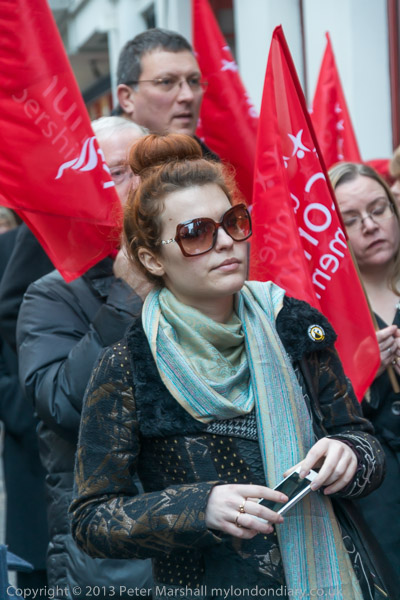
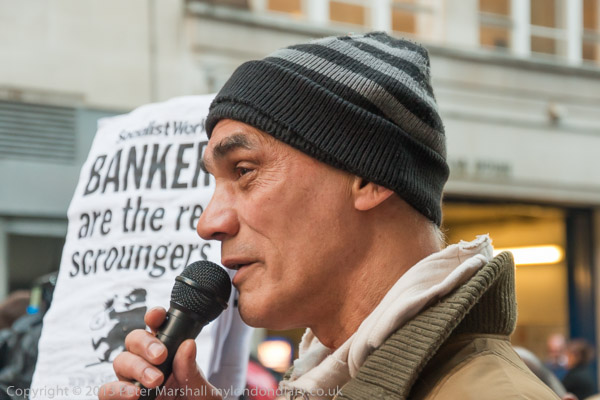
When taking pictures of speakers at event such as this, wherever possible I look for backgrounds which relate to the person and/or the event and provide some context – such as this placard with its message ‘Bankers are the real scroungers’.  Another of the placards read ‘Target the Tories Not the Poor’  and for the woman below, from Barnet Alliance for Public Services I like the out of focus word ‘Justice’ which can be made out from the Southwark Benefit Justice Campaign banner behind her.

Story and pictures at Benefits Street Protest at Love Films and there are a few from a smaller protest a week later at Channel 4’s Victoria offices, No More ‘Benefits Street’ Channel 4.

Continue reading Benefits Street

Busy Saturday

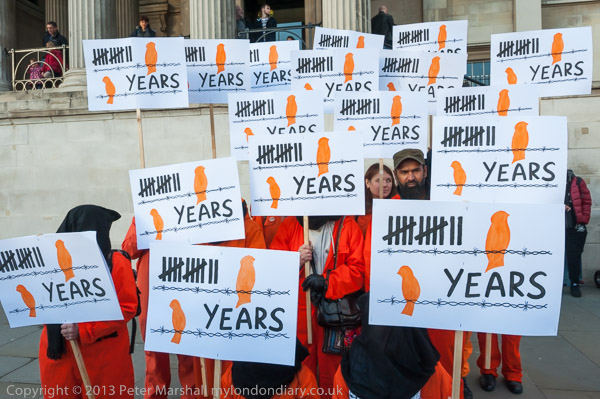
I don’t like photo-calls. They usually end up with lots of photographers taking the same picture that someone else has thought up, and which is seldom of much interest. Like this one:

I took it with photographers to the left of me, photographers to the right of me, all taking more or less the same picture (though perhaps mainly a little wider, though that was even more boring and I couldn’t bring myself to process and publish that.)

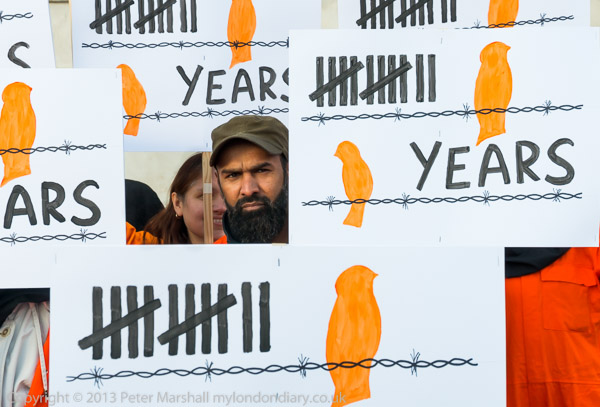
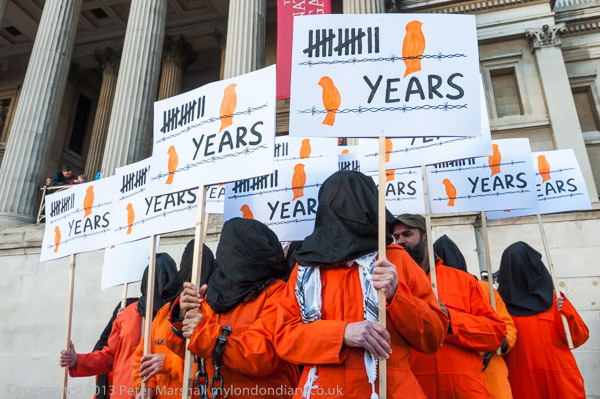
Sometimes you can rescue something from these situations. In this image there was one person who stood out to me, looking out from a gap between the placards, and he looked to me like a man in a prison. It seemed appropriate for a protest about a man held in prisons without trial for 12 years, still in Guantanamo – more pictures and about the protest on 12 Years of Illegal Guantanámo Jail

If I was the kind of photographer who arranges and constructs images I would have moved the woman behind him (and I could easily have Photoshop-ed her out, cloning the wall behind into the space, as well as copying more placards into the areas at bottom left or right. It would have made for a neater and probably better picture. I probably could have arranged the picture rather better by asking people to move or to move their placards, setting up a more perfect view of my idea, but for me that would have taken the picture away from being news and more into publicity or advertising, a direction in which I don’t want to tread.

Setting it up for me would have been unethical, but it would also have meant that the 22 other photographers (no I didn’t really count them, but it was probably around that number) would have taken the same picture too, while perhaps I was the only photographer who saw the picture as I did. Life is full of warts after all.

But I’d already really got my picture, while the person organising the photocall, who had had the idea and got all the placards made, was getting people into position. For a few seconds only, the group in the orange suits and black hoods with their placards were arranged in a triangular formation, and there was my picture. I don’t think anyone else was in the right place to see it and take it,

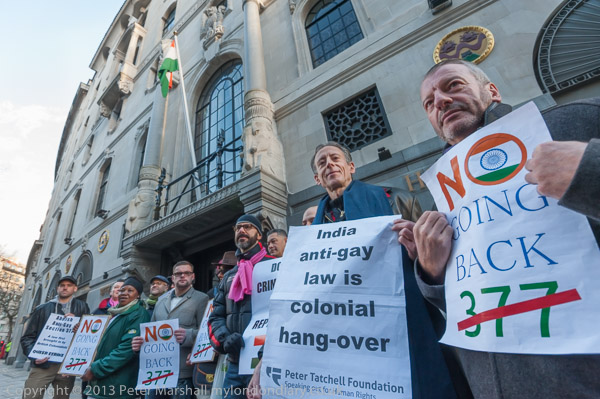
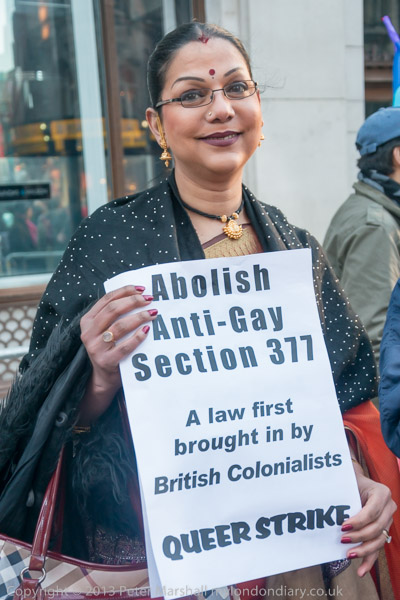
I had to rush off quickly to another protest, Repeal Indian anti-Gay Law, and there nothing was happening, just people just standing around, a few with placards, but doing very little and that with no animation. I was even quite pleased when one of the protesters on seeing me arrive started to organise most of those who had placards into a group for pictures.

It didn’t make too exciting a picture, but it was better than just people standing around chatting with each other. It was a pity that the Indian flag wasn’t a little more cooperative, but there just wasn’t enough wind for it to fly.

But perhaps the better pictures were by picking a few individuals and photographing them with the posters or banners they were holding.

I’d been intending to go on to Tottenham Police Station, where the family of Mark Duggan were leading a vigil a few days after the curious inquest verdict, both apparently internally contradictory and also  to deny the evidence. But it was getting a little late, and I was also worried about the facilities that the press might get, and with good reason. I didn’t go, but friends told me they were corralled into a press area rather out of the way and unable to really get good pictures – and it showed in the work. Not a good way to handle the press.

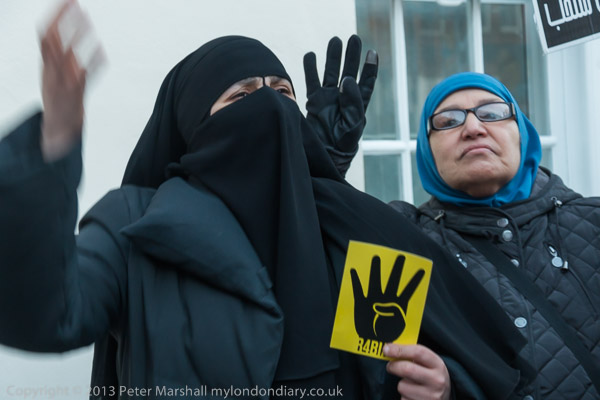
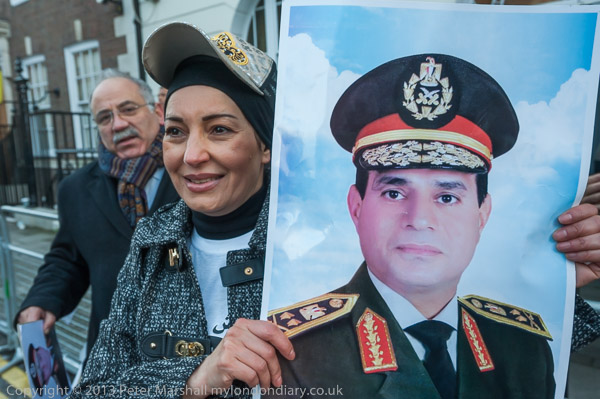
Instead, I made for the Egyptian embassy, where there were two groups of protesters for the Eyptians coming to vote in their country’s constitutional referendum. Immediately outside the embassy on the pavement were supporters of the new constitution and the deoosing of Morsi, many waving pictures of General SiSi, while opposite them across the road was a protest almost entirely composed of Muslims, with posters, banners, balloons and cards with the four-finger ‘rabiaa’ gesture, now a symbol of pro-Morsi protest, calling on Egyptians to boycott the vote.

Both sides were noisy and animated, and although it was generally fairly clear from both the gestures and the posters (or the sweatshirts) who was in which protest, I decided it was easier to separate the two groups into two stories,  Free Egypt Alliance Urge Vote Boycott and  Sisi Supporters Oppose Boycott. 

With four stories to sort out the images for and then write up, it was around midnight or after by the time I got to the text about the two Egyptian groups, and  at first I managed to write up the stories but forgot to mention why both sides were there, and had to log on to both stories later and make things clear.
Continue reading Busy Saturday

Stephen Mayes Interviewed

Image Source is a premium stock photography agency specialising in Royalty Free and Rights Managed Imagery for professional image users.”

And as such I wouldn’t have a great deal of interest in it. It rather seems to look like corporate imagery for corporates, but it does also have the Image Source blog, IMSO, which “provides insight into the images setting agendas in advertising, marketing and culture” which offers among other things “most importantly market knowledge of the wider creative landscape.”

But despite its “carefully curated publication of a wide variety of articles” some things of interest do manage to make their way through the corporate filter, including an interview with Photo Expert Stephen Mayes On Photography’s Futures.

That’s actually something he has very little to say about, as he says “Things are changing so fast and in such unpredictable ways that even a year ahead is a deep mystery.” But its still a feature worth reading and pondering. However, I’m not sure you want to know more about Snapchat which he mentions. According to Wikipedia, two thirds of its users have received images of “inappropriate poses or gestures” and it seems its main use is in sending ‘selfies’.  Unless the future of photography is just ‘sexting’, it seems unlikely that Snapchat has a great role to play in it.

Walking Photography


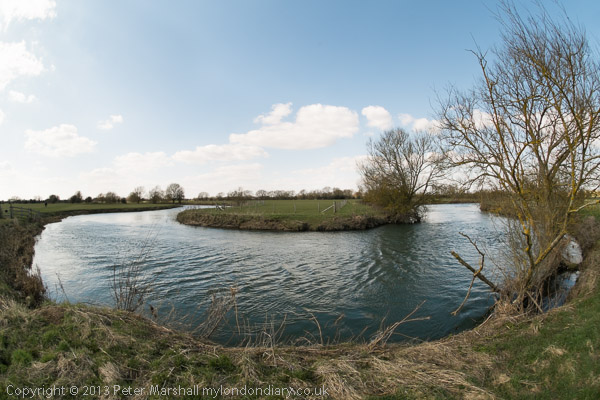
On the Thames Path in Oxfordshire, April 2014

Although I do a lot of walking both as recreation (it’s sometimes enjoyable) and while photographing various events and marches, I’ve never been a ‘walking photographer’. Photographer don’t in general walk; they possibly amble, meander, explore or even dérive. And I’ve occasionally posted pictures taken  on some of my walks, including those along various sections of the Thames Path, here and on My London Diary, as well as producing a book, London Dérives.

But my subject is never really the walk itself, but the places and scenes it takes me to. I didn’t walk the Thames estuary for the exercise but because of a fascination with the area and the landscape. In recent years I’ve tended to take the Brompton and ride where this is possible, though great though this folding bike is (and one of our few remaining British manufacturing companies)  it isn’t suited to rough terrain. But where you can use it, it gets you there in a fifth of the time and with a considerable saving in energy.

I have a problem with most ‘walking photographers’ and ‘walking artists’, at least so far as their photography is concerned. Largely I find it banal or simply a dull document of their concept (which may or not itself have at least a slight interest. While I may like the idea of – for example – Richard Long‘s 1967 ‘Line Made by Walking‘, I’m not sure the photograph has anything real to add; perhaps its point is its lack of interest. You can read more about Long in a Guardian piece.

Some of the most boring large landscape photographs I’ve seen (and there is plenty of competition) were those of Hamish Fulton. I think he is an interesting artist, but not an interesting photographer. His web site Hamish Fulton – Walking Artist—– (open at your own risk) is also one of the most infuriating I’ve come across and I think I would need to be incapacitated by drink or drugs to view it for more than a few seconds, but you can get a better picture visually of his works by a Google Image Search on Hamish Fulton photography (click on ‘Images’.)

But I’m pleased to read a post by Colin Pantall, Photography and Walking: Do they Go Together which looks at the work of Paul Gaffney and Michal Iwanowski shortly to go on show at Ffotogallery in Wales (at Turner House in Penarth.) The show with works by both photographers runs from 7 February – 8 March 2014.

The dozen pictures in ‘We Make the Path by Walking‘ on Irish photographer Paul Gaffney‘s web site are certainly of interest, and Clear of People is one of several interesting projects on Michal Iwanowski‘s web site. Born in Poland in 1977,  he has lived and worked in Cardiff since 2001 and as well as freelancing he teaches photography at Ffotogallery in Cardiff.
Continue reading Walking Photography