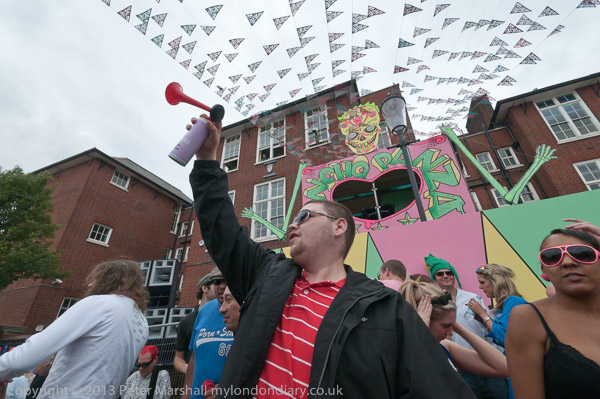
Back to Little Italy

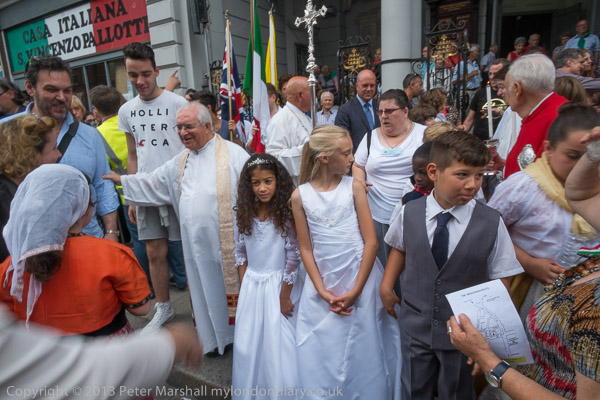
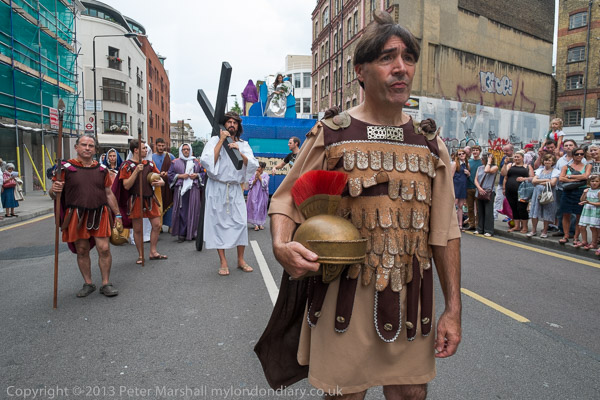
It was I think in 1992 that I first photographed the annual festival of Our Lady of Mount Carmel at the Italian Church in Clerkenwell – certainly those are the earliest pictures I can currently find, though unfortunately they are not yet on-line – and I’ve continued to do so for most years since then, missing the occasional year when I’ve not been in London.
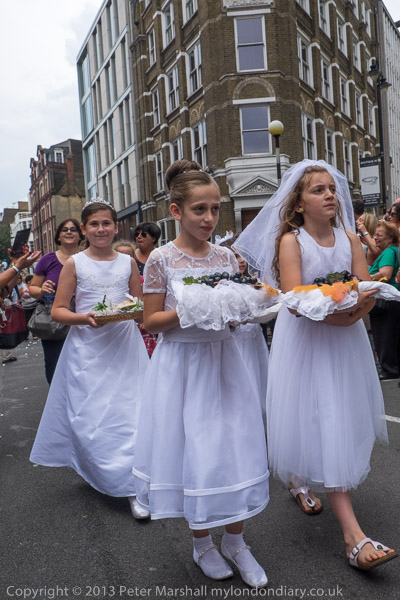
According to my filing sheets, that 1992 event took place in June rather than July, but perhaps that was probably just an error on my part. Otherwise it looks quite similar to this year’s event, except that some of those still taking part look considerably older and greyer. The procession then followed a different route, around the streets to the south of the church and my pictures were black and white, mainly taken with the 28mm Minolta lens on a Minolta CLE – always my favourite Leica.

That lens too was my favourite ‘Leica’ lens, bought because the extensive reviews and lab tests in the US magazines (at at time when UK magazines mainly poked the camera out of the office window and took a snap across the river) showed it to be optically superior to the Leitz equivalent, as well as rather cheaper. I think the difference in price enabled me to buy the Leica 90mm f2.8 as well – which did get deservedly good reviews.

And that Leitz Canada Tele-Elmarit M lens fits well (with a Fuji M adapter) on the Fuji X cameras (where it is a 135mm equivalent) and their electronic viewfinders make it a far more practical proposition than it ever was on a Leica, where the viewfinder frame was laughably small. Being able to focus on a magnified image with focus peaking makes it very usable for reasonably static subjects. Fuji don’t offer any equivalent to this lens, though there are a three zooms that include this focal length, and a fourth on the way. If they did it would be larger and heavier than the Leitz (around 330g with the adapter) but would of course have the advantage of autofocus and offer the option of auto aperture control.

I tried using all my old Leica lenses when I first got the X-Pro1, and several of them – whatever name they had on them – were just a little disappointing compared to Fuji X glass. The 28mm Minolta was one of the worst, suffering from white spots and fungus. I took it to a specialist in lens cleaning, who gave me the unwelcome news that it was permanently damaged and not worth cleaning – though at least that advice came free.
I might have taken some colour pictures of the festival as well back in 1992, and I thought I came across some earlier today while I was looking for the black and white, but I can’t find it now, so perhaps it was just a hallucination. Back in the 1990s, black and white was still king, particularly for the library I put my pictures in, as relatively few books and magazines used much colour, and I only used colour for personal projects where colour itself was an issue, although things were changing. (I’d moved by this time from colour transparency to colour negative, which did simplify things,allowing me to file the work in the same way as black and white, using archival plastic negative filing sheets. But things didn’t always get filed where they should have done.)
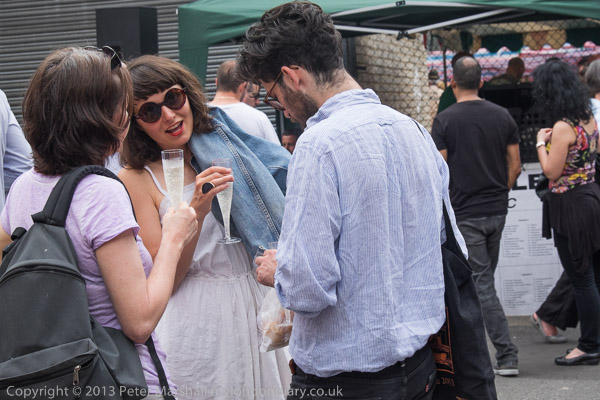
Things at the Italian festival were rather more freer back then, with no barriers or roped off areas, and perhaps just a little more chaotic. It was in some ways a more Italian event back then, although it is still Italian now, and it was also rather more of a local community event. And of course the wine was cheaper, though at the right stall in the Sagra it was still very reasonable and drinkable this year. Most years I meet up there with a friend of Italian descent who can always be relied on to source the cheapest wine and we get through a few together between taking pictures. Whatever wine snobs would say, it seems to taste fine drunk from a disposable plastic tumbler.

Using the Minolta I was also a rather more discreet presence than I am usually now with two large Nikons with hefty lenses around my neck, and my pictures then had more of a ‘street’ feel to them. Though for this occasion I had chosen to work with two Fuji cameras, the X-T1 with the 18-55mm zoom and the X-E1 with the fixed 14mm. It also helped that there were far fewer photographers around than now; apart from a few proud mums and dads taking pictures of their children there were probably only a photographer from a local paper and a couple of friends of mine seriously taking pictures. Things are very different now.
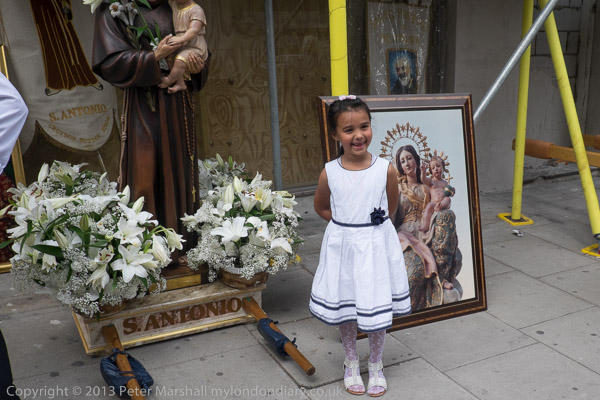
When I have more time I’ll go back and scan some of those images from 1992. But in the meantime you will just have to make to with my pictures from this year – and on the web you can also look at those from When I have more time I’ll go back and scan some of those images from 1992. But in the meantime you will just have to make to with my pictures from this year – and on the web you can also look at those from
2003, 2004, 2005, 2006, 2007, 2008 and 2009. I had 2010 and 2011 off and was back there in 2012 and 2013.

There was one small disappointment this year. Back in those pictures from 1992, there are a couple of frames of people all staring up into the sky and the next frame, pointed up towards the sky shows a dove making its way into the heavens. But this year I saw no doves.

More of this year’s pictures and about the event at Festival of Our Lady of Mount Carmel.
Continue reading Back to Little Italy

Tavakolian versus Carmignac

Iranian photojournalist Newsha Tavakolian (born 1981) gives her reasons for  returning the 50,000 Euro grant and stepping down as the winner of the Carmignac Gestion Award for photojournalism 2014 in an article Newsha Tavakolian versus Carmignac published today on The Eye of Photography (L’Oeil de la Photographie).  In it she makes clear her reasons for doing so, because of the interference of French investment banker Edouard Carmignac in the presentation of her work.  She writes:

from the moment I delivered the work, Mr. Carmignac insisted on personally editing my photographs as well as altering the accompanying texts to the photographs.”

and that his interventions had the effect of changing her work from “a subtle attempt to bring across the realities of life of my generation in Iran to a coarse and horrible clichéd view about Iran.”

Tavakolian states that the Carmignac Foundation has a persistent attitude of erring on the side of controversy, and that their behaviour towards her and her work is at odds with its stated aim of being “committed to champion the personal and, by definition, minority view”, attempting to straitjacket her subtle and nuanced individual perspective into the clichés about Iran. As she points out, even their statement they made about the ‘adjournment’ of her exhibitions and book they state this was due not to her standing up for the integrity of her work but to ‘severe pressure’ applied by the Iranian government on her and her family. She describes this as “absolutely false, and laughable”.

Tavakolian was one of the photographers – others included Azadeh Akhlaghi, Gohar Dashti, Shadi Ghadirian, Babak Kazemi, Abbas Kowsari, Ali and Ramyar, and Sadegh Tirafkan whose work was shown earlier this year at Somerset House in Burnt Generation: Contemporary Iranian Photography, and one of her pictures in a set of images on Iran’s young middle-class from The Observer shows a man sitting at a table with his face covered with shaving foam, ‘to draw attention to her feeling that, “Men in Iranian society are often perceived as angry and bearded in the west”’.

Hers is a principled stand, and one that as a photographer I whole-heartedly applaud. Too often the price of having work published or shown has been to have the views of others imposed on it. Her website  – and those of the other photographers listed above – is worth spending time looking at to understand something about both her own perspective and the realities behind living in Iran.

Gaza Stop the War

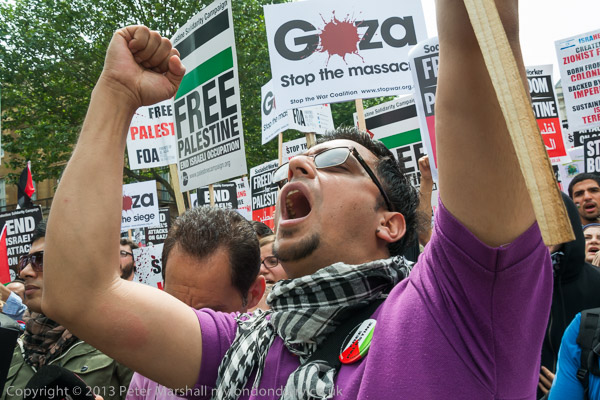
Israel began its 2014 military attack against Gaza, ‘Operation Resolute Cliff ‘ (though they gave it the different, more defensive-sounding title ‘Protective Edge‘ for the English speaking international audience) on 8 July, although the ground invasion only began on the 17th, so ‘Stop the War‘ had some time to prepare its first major national protest in London on the 19th July.  And it was a large protest, with thousands filling Whitehall at the start and more at Kensington High St for the final rally, if not on quite the same scale as the truly huge protests before the invasion of Iraq.

Like most people in this country, I was appalled by the hundreds of innocent civilians who had been killed in Gaza, and the huge imbalance of power and destruction between the two sides. Of course I’m against attacks on Israel, but looking at the coverage by world news channels – and even some reports from BBC reporters, even if the BBC at times seemed to be an Israeli propaganda channel – the attacks seemed entirely disproportionate. If I’d not been at the protest as a photographer and journalist I would have been there as a protester.

I’ve had a long and slightly fraught relationship with Stop the War. Back in 2002, as well as photographing marches and rallies in London, I was also out in my local area most Friday evenings holding a placard or handing out leaflets to workers on their way home. A dozen or so of my images were included in the the book ‘Stop The War: A Graphic History‘ published to mark 10 years of its protests, and some of these are among those I published here in a post when this came out.

But there are some issues over which I’ve disagreed with Stop the War – in particular over Syria, where I felt our government should have given much more support to the Free Syrian Army while their opposition supported the Assad regime with its long and bloody record of oppression of the Syrian people. I’d also felt, back in 2003, that they had lost their nerve – or had been so dominated by outdated political thinking – that having won the arguments and gained such widespread support across the British people, they had failed to take advantage of this. So while I support – and admire much of what they have done, I’m not uncritical.

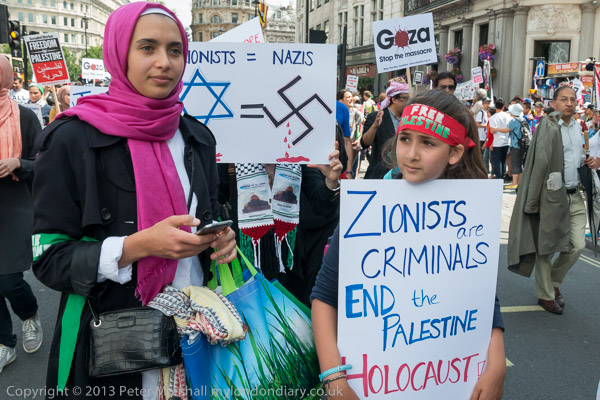
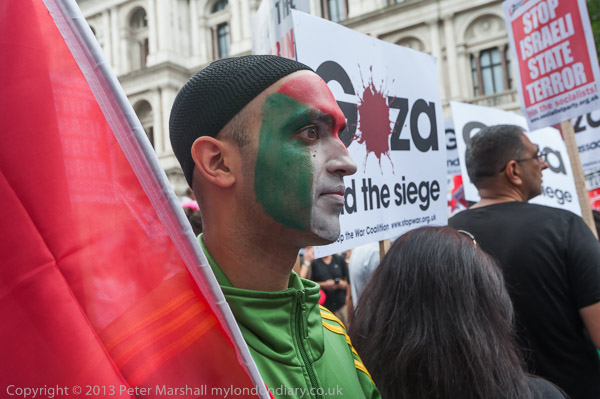
And, as a photographer and journalist, it’s my job to be critical. I’d heard many accusations that those protesting against the Israeli army attacks were anti-Semitic. Was there any evidence of this on this march at at the rally. Plenty of Jewish marchers, some of them, along with many others on the march calling for a boycott of Israeli goods. A few Israeli flags on a painting, on placards. So far as I tell none were being used in an anti-Semitic manner, but were calling for an end to the bombing of children and other war crimes by Israeli forces. Placards and speaker after speaker making clear they were not opposed to the Jewish people or the existence of Israel but against Zionism and the criminal attacks on civilians in Gaza, calls for Israel to respect international law and UN resolutions.

Of course there was considerable support for Hamas, who were elected as the majority party in Gaza in the 2006 elections, taking complete power there later in the year after a misguided US-backed attempt to unseat them. Israel’s response was to impose a blockade on Gaza, a form of collective punishment on the whole population of Gaza which is almost universally considered illegal. And many if not all of those taking part in the protest were calling for the lifting of the blockade.

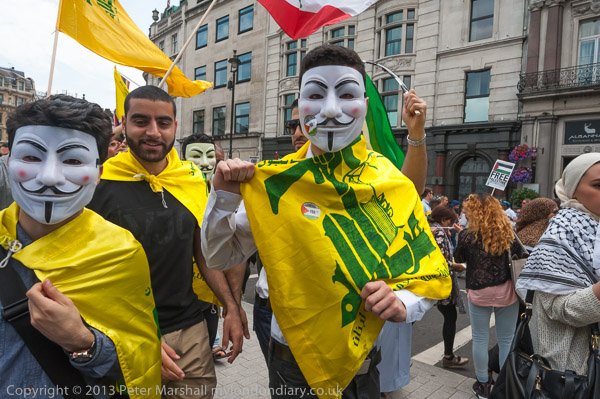
I also saw – and made sure I photographed – four people carrying Hezbollah flags (and one with them a Lebanese flag.) This is a group widely regarded around the world as a terrorist organisation and who consider Israel to be an illegitimate state. Although officially they distinguish between Judaism and Zionism, many leading members are recorded as having made anti-Semitic statements.


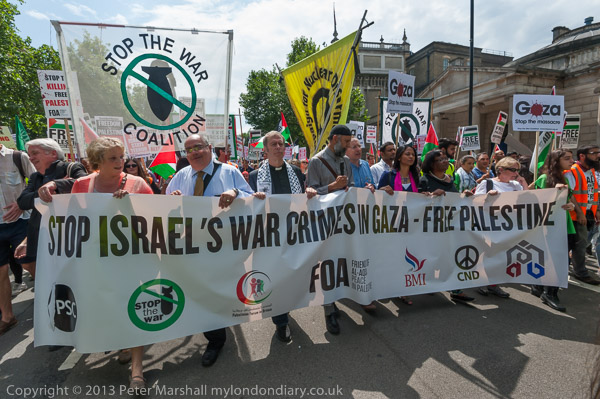
I managed to sneak in and take a picture of Jocelyn Hurndall, Kamel Hawwash, Garth Hewitt, Ismail Patel, Andy Slaughter MP, Rushanara Ali MP , Diane Abbot MP & Lindsey German holding the main banner

As a photographer I’ve often had problems with the stewarding of ‘Stop the War’ organised protests, with some over-officious stewarding.  I’ve on occasion been assaulted by one of their stewards and narrowly avoided possibly serous injury by their disregard for my safety.  At this event the stewards made it very difficult to photograph the people holding the main banner – mainly the speakers – at any stage during the march, and failed to provide any working space for the press at the pre-march rally.

Back at one Stop the War march in 2002, photographers sat down on Park Lane in front of the march bringing it to a halt because we were not allowed access – and negotiated five minutes to take photos before the march continued. Perhaps we should take direct action more often! Though it’s perhaps better to work through the NUJ (see later.)


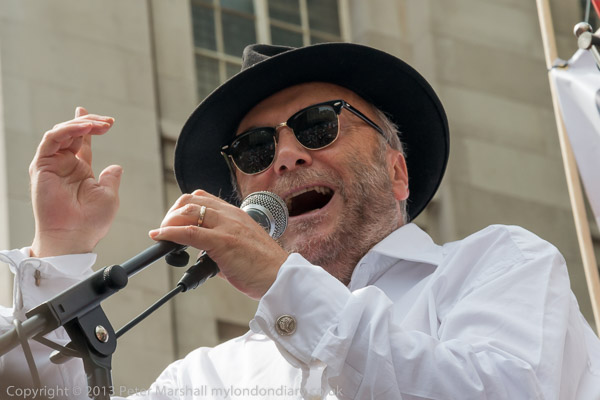
George Galloway MP

Things were a little better at the rally following the march, in the main road close to the Israeli embassy, but failed to give any real space in front of the speakers for photography. A narrow two foot gap between the front of the stage and the crowd barriers was not really enough, and those photographers who managed to get access (myself included) were crowded  at one side, hoping that the speakers would occasionally glance in our direction.

Although there were all sorts of people in this small area – including many taking pictures on their phones – many of the press were refused access. The stewards controlling the entrance asked who people were working for and refused entry to photographers with UK Press Cards who told them they were freelances  – as the great majority of photographers now are, while allowing others without proper press cards in to the area. I  was admitted because I gave the name of the agency I send work to rather than saying ‘freelance’.

Following this protest, representatives from the NUJ London Photographers Branch met with Stop the War, and at the next Gaza protest we got some extra space and the stewards controlling entry recognised the UK Press Card.  Good relations between protesters and press are in everyone’s interest.

See a rather large selection of images from the event at End Gaza Killing Now.

Continue reading Gaza Stop the War

Devon/Dorset Holiday Snaps

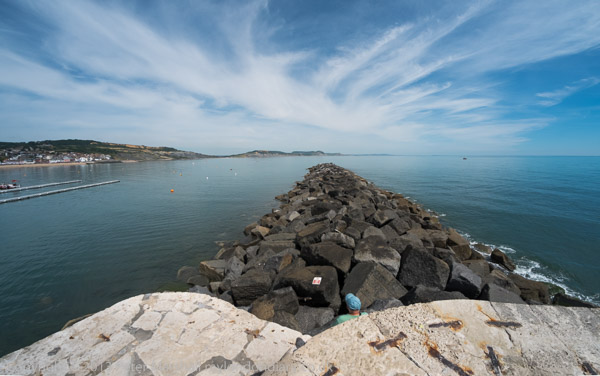
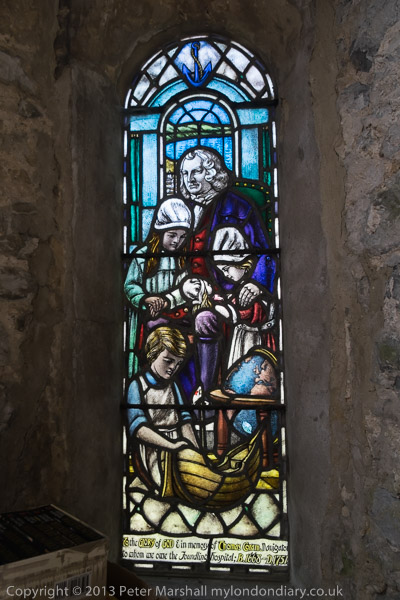
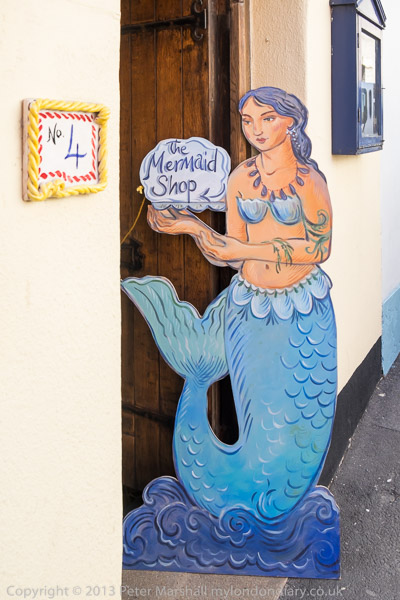
Not London, but its convenient to post my holiday snaps in My London Diary, and there were some London connections. We were staying just a few miles from Lyme Regis, and one of its more famous sons was Thomas Coram, the founder of the Foundling Hospital in London’s Coram’s Fields, and there is a window for him in the parish church.

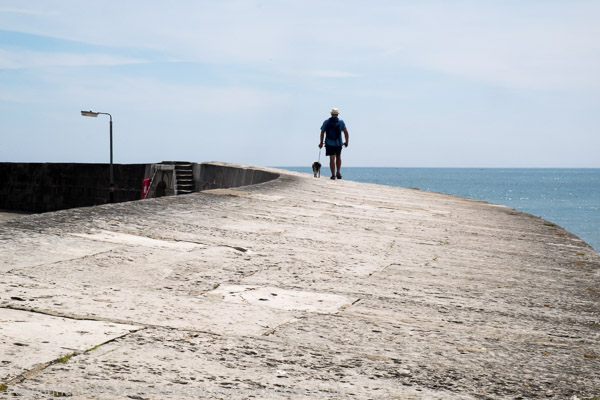
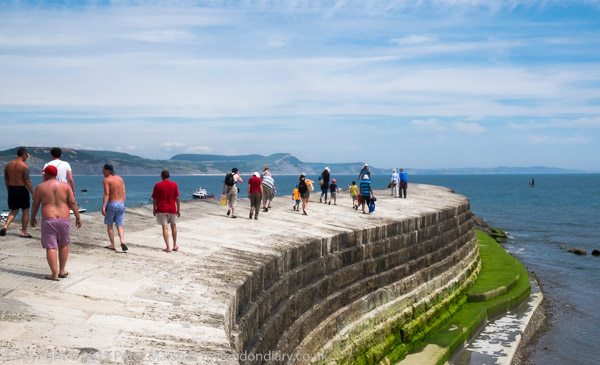
But for most people Lyme Regis means fossils and possibly (largely thanks to the French Lieutenant’s Woman) The Cobb, a slightly odd shaped harbour wall.  We did go looking for fossils – and found quite a few small ammonites – but none were really worth photographing, and the rocks they were on were either far too large to move or too crumbly to keep, though we did take a couple of lumps back to show the friends we were sharing an ex-hotel in the middle of nowhere with.

The slope is handy to allow the waves to run back off, though the sea was pretty flat when we were there, and most of the time there were quite a few people walking along it.

The only really good fossils we saw were in shops and the museum – and the museum also has quite a few interesting local photographs, including some taken by Roger Mayne (1929-2014), best known for his work on children playing in Southam St and elsewhere in North Kensington between 1956 and 1961. When I met him he complained that people never realised he had ever taken anything but these pictures, but looking at the work on his own web site these pictures do seem to me to stand out.

In 1974 he moved together with his wife, playwright Ann Jellicoe to Lyme Regis, where she developed the idea of community plays and became, along with John Fowles, co-curator of the Lyme Regis Museum for some years – and later both Jellicoe and Mayne were patrons of the Town Mill, rescued by volunteer efforts over ten years from dereliction to become both a working watermill and to house various artisanal businesses. You can see a couple of Mayne’s images of Lyme in the Landscapes section of his web site.

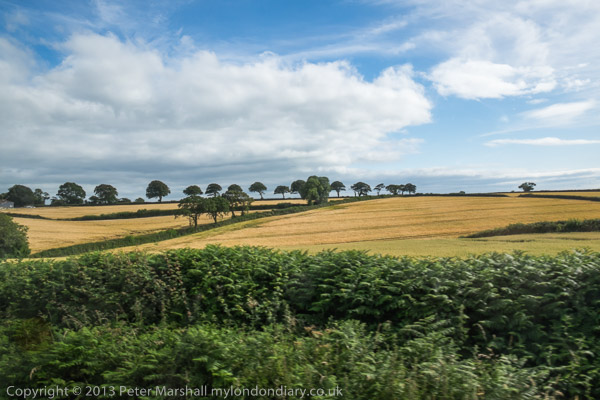
If you look at the pictures in Devon/Dorset Holiday you will find that we did quite a lot of walking – not least because where we were staying was a little over three miles from Lyme and further from anywhere else, and although we were close to a bus stop, the first bus into Lyme came at 10.59 and the last bus back was timetabled for 16.59, though it was always late when we took it.

So I was very pleased to be carrying a couple of Fuji cameras rather than my more usual Nikons. I was going to take just one camera, the Fuji X-T1, but in the end decided the Fuji X-E1 was so light and petite that I might just as well take that along as well to save me having to change lenses so much. I took three lenses, the Fuji 18-55mm zoom and 14mm, and the Samyang 8mm fisheye, which at f2.8 was a stop faster than the others.  All three lenses are fully usable wide open, though like all lenses they improve a little a stop or two down, and both bodies performed well.

Its actually an advantage that the 8mm is a manual lens, as you hardly ever need to focus. Both the click-stopped aperture ring and the focus ring are commendably firm, and even clumsy fingers like mine seldom knock them from position. Set the lens at infinity and f5.6 and you never need to touch it again.  I did miss the level indicators of the Nikon D800E when using this lens, as any up/down tilt in the camera gives you a curved horizon, and while the unusual projection used by this lens is better when using the images uncorrected, correction software doesn’t quite work as well with them. Its a lens I love using, and as you can see I probably used it too much!

I have two problems with the 14mm, though optically it is fine. Firstly it is quite easy to shift from manual to autofocus mode or vice-versa by pushing the focus ring – great when you want to, but can be disastrous if done by accident and not noticed. Of course you should notice, as the viewfinder shows quite clearly when you have autofocus by giving a green square outline. But if you get absorbed in making pictures you can miss this.

More annoying is the very loose aperture ring, turning with only a slight detent on every 1/3 stop. Not so bad if you set the aperture manually, but if you set it to A, that slight touch takes it to f22, which is a disaster. Of course a 14mm lens should not have an f22 setting in any case – far too much diffraction – and it would be better limited to f16.

The 18-55mm has no real problems that I’ve noticed. As with most zooms these days the performance is more or less on a par with fixed focal lengths. I sometimes turned off the optical image stabilisation by accident when changing lenses, but most of the time it makes little difference in any case.

The X-T1 viewfinder is amazingly good and I only notice it is electronic when there is a slight delay moving to an area with very different light intensity. I’ve fitted the accessory larger eye-cup, which perhaps makes it a little better when wearing spectacles, as I now need to.

For the kind of holiday photography I was doing the only real problem with both cameras was battery life. I needed to carry at least one spare battery for each body and to charge both the spare and the one from the camera every night. On at least one fairly long day I had to change the battery in the X-T1 twice. It would doubtless have helped if I kept turning the cameras off after taking a picture, but with Nikons you don’t need to. I can only remember once this year I’ve had to change a Nikon battery I put in the camera fully charged before leaving home before I got back to put it in the charger again. And Fuji batteries seem to take longer to charge too. It’s a problem you can live with, but annoying.

I’m also having a problem with the combined dial on the left of the top-plate of the X-T1, which alters the ISO. You have to press down the centre to change the ISO, which is fine, but this dial is now very stiff, and usually turns the lower surrounding mode dial with it – the lock button unlocks the ISO but seems to lock the ISO to this. Unless I remember to check  and return the mode setting I find myself taking a panorama or bracketing when I want a single shot.

Devon/Dorset Holiday

Continue reading Devon/Dorset Holiday Snaps

Rotherhithe & Surrey Docks


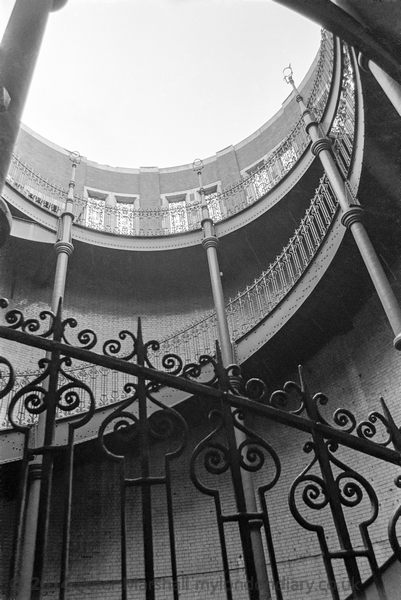
Surrey Docks entrance, Rotherhithe St, 1984

It’s always exciting when I get the first copy of a printed book of my photographs delivered, and I ripped open the parcel and was pleased to find that as usual Blurb had made a decent job of ‘Rotherhithe & Surrey Docks: 1975-85‘, the fourth in my series on London Docklands.

Of course I’d seen it all before, when I’d spent days scanning and retouching the images, and then selecting and putting them in some kind of order (not an easy task) and designing and preparing the book using InDesign. Being the fourth in the series, much of the design had already been done for the previous volumes, though there are some minor tweaks. And, no matter how many times you check, there are always some minor errors that you miss., though in this case nothing that I feel really needs a reprint to correct.

The printing of the black and white images is as usual good, though not perfect, and certainly not as good as with the PDF version, which I recommend. As with my other recent works, this book is published as a digital version, ISBN 978-1-909363-12-0, downloadable from Blurb, with the print version available for those who would like a convenient hard-copy of the PDF. You can also view the whole book in the preview on the Blurb page.  The PDF costs £4.99 and a printed copy will currently cost £31 plus postage. Incidentally buying the PDF also gives you a licence to print out a single copy of any (or all!) of the 90 or so pages of the book, though to print the whole book at comparable quality to the print version on my home printer would cost me around £70.

The scans for the book were mainly made with a Minolta Dimage Scan Multi Pro scanner – one of the best film scanners ever made, particularly when fitted with a purpose made light diffuser and specially machined holders to ensure flatness across the whole negative. Some of the scans needed considerable retouching in Photoshop, mainly because of some insect infestation of the negatives, but also in some cases because of uneven development. The scans were converted to high-quality CMYK files using Photoshop, and saved with the Blurb supplied ICC profile. Black and white images tend to be printed slightly off-neutral and the images were given a slightly warm tone which I’ve always preferred for my work.

The printed copy I have is a good match to my originals (and the PDF), though prints are always a little duller, but seem very close to neutral. But as this is ‘print on demand’ there can be small copy to copy differences. I use Blurb’s premium lustre paper which prints black and white better than the standard, and the print quality is quite acceptable. Of course it doesn’t match the superb quality of the duotones and tritones of some photographic books, but is generally good enough.

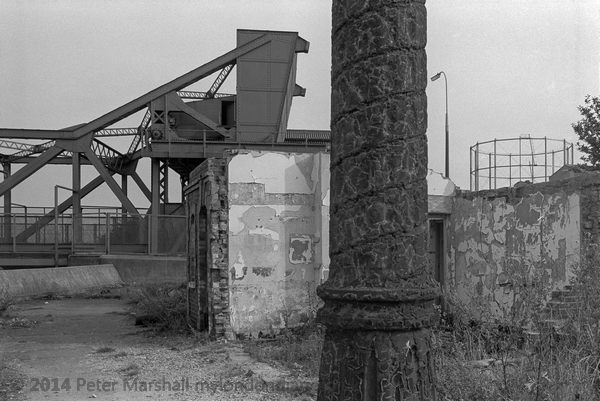
When I first cycled through the area in 1976 I didn’t stop to take many pictures, but then you could walk down the ventilation shafts to go under the river in the Rotherhithe tunnel. By the time I took the photograph at the top of this post in 1984 they were locked, presumably to discourage people using the crossing, though you can still walk or cycle through the tunnel from the vehicle entrances although at some risk to your health.

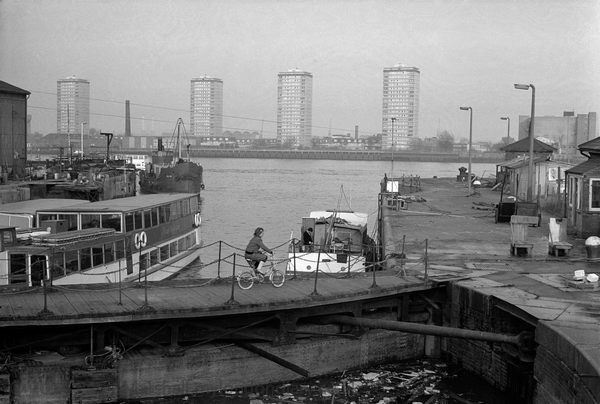
Later I went back on foot, walking over the footbridge across the entrance to South Dock, next to which was then the Surrey Docks Farm, one of several ‘city farms’ across London. I took several pictures of a young girl on a bicycle as she went across the lock gates to the farm. Some years later on another visit to the area I was mystified, as both the farm and the footbridge had moved to different locations in the area.

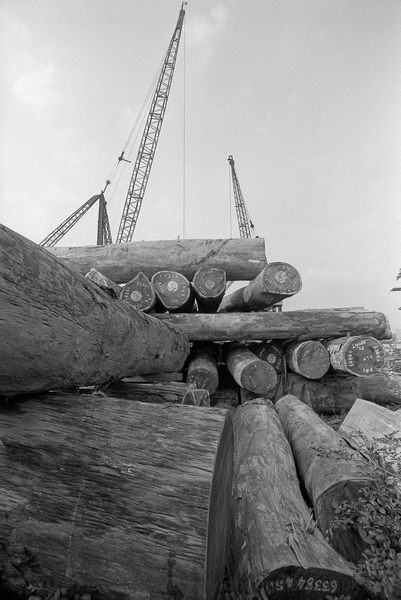
In 1984 I spent a couple of days wandering the area and taking pictures, including a little to my surprise a wharf still handling timber, which used to be the main business in the Surrey Docks, where there were once large ponds in which it was stored, as well as huge open timber sheds, some of which were still around, standing empty. Some of the timber would then be taken on barges up Bow Creek to timber yards on the Lea Navigation to be sawn up.

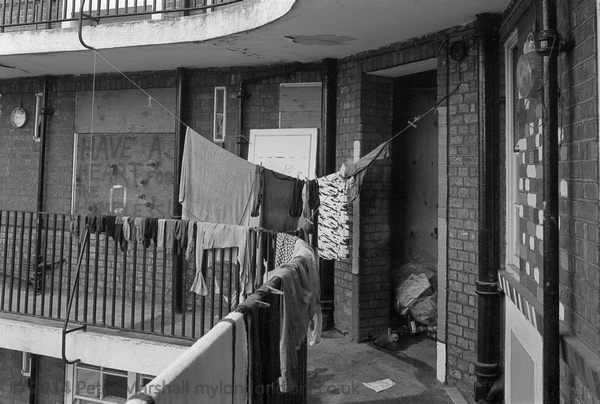
The redevelopment of the area had been started by the London Borough of Southwark and the Greater London Council, but progress had been slow, partly because they were kept short of money. The Conservatives once Mrs Thatcher had come to power saw docklands as a great opportunity for developers (and many Conservatives were developers or invested in them) to make money and set up the London Docklands Development Corporation 1n 1981 to speed up the regeneration and pour public subsidies into private pockets.

While the results have not been entirely disastrous for the area, the developments have not served the people who were living in the area as well as they might.

Continue reading Rotherhithe & Surrey Docks

Fair Pay Now!

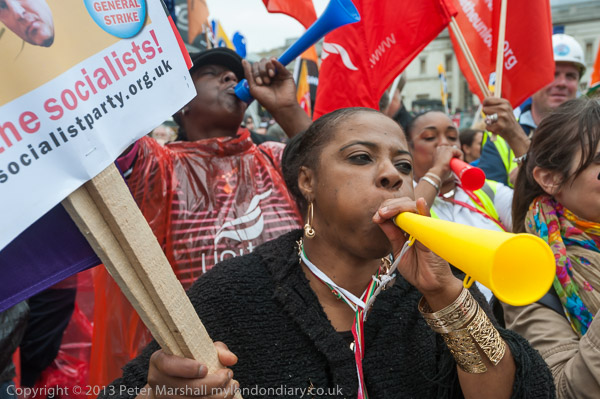
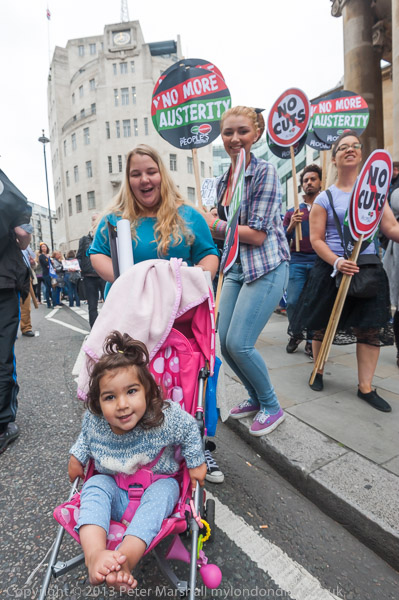
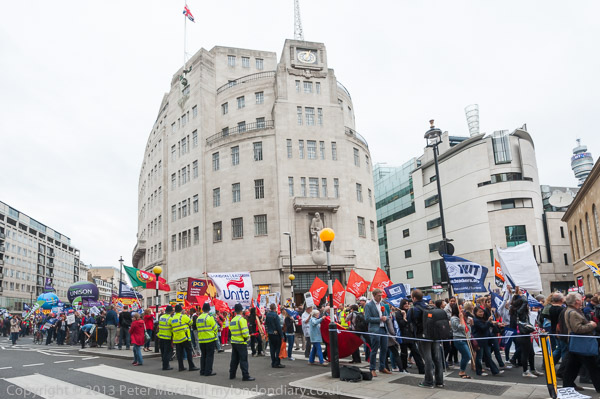
It’s always hard to estimate the numbers taking part in large marches, and this was certainly a large march, with perhaps around 15,000 being a reasonable estimate. At the start, as people gathered outside Broadcasting House – fast becoming a popular starting point for protests as more and more groups get tired of the way that the BBC ignores or marginalises most UK protests, it was certainly very difficult to move around for the crowd in the road and to find the space needed between camera and subject. Most of the pictures from before the start of the march were taken around the edges of the packed crowd, and as usual I was looking for things that would tell the story, as well as meeting people that I knew.

Sometimes the two things came together, as in the picture of Jasmin Stone and her daughter and others from Focus E15 Mums in front of Broadcasting House – and there are other faces in some other pictures that regular visitors to My London Diary will recognise.


Another view of Broadcasting House, where reporters were careful not to really notice what was happening outside

But there were many here who are not regular protesters – and some told me this was their first protest march, and others that they seldom take part in such things. A number of trade unions had called a one day strike, and groups like the teachers are so fed up with being ‘Goved’ that they had turned out in force for the march, though I was surprised that only the NUT were supporting it.


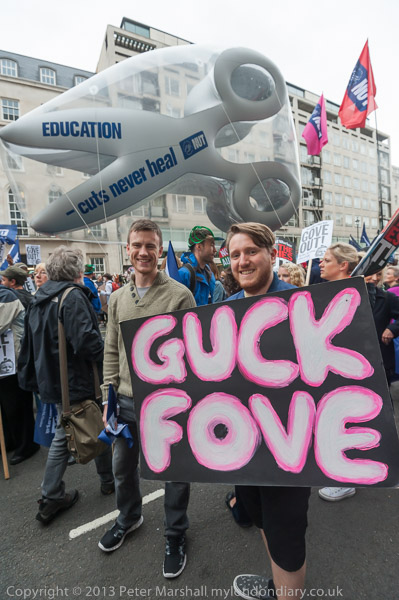
‘Education – cuts never heal’ – ‘Guck Fove’

I always find  the large balloons that some unions like to take on their marches are a problem to photograph,so high that they are difficult to connect with the people on the ground. Designed to be visible from a distance, they aren’t ideal for photographers like me who like to work close, where even with a wide-angle they are hard to include. The NUT Scissors with their message ‘Education – cuts never heal’ are rather more interesting,and I was pleased to be able to combine them with a strong message about Mr Gove, who shortly afterwards lost his job, not because of the havoc he has wreaked destroying what system there is in our education, but because of his silly squabbles with Teresa May.

There was just so much to photograph while the march was forming up, and it was so crowded that although I’d been keeping an eye on my watch, I actually just missed the start of the march, which I’d intended to photograph with Broadcasting House in the background. But by the time I made it back to the start, they had started very  punctually and already moved a couple of hundred yards down the road. It isn’t a great picture, but it does show the flags (and balloons) of some of the main unions involved, GMB (just), NUT, Unite, PCS and Unison. There is also what seems to be a Portuguese flag (and I think I know who would have been carrying it) but more important to me in framing the picture, on top of Broadcasting House, the Union Jack.

This was a fairly short march, only a little over a mile to Trafalgar Square, but marches usually go fairly slowly. I waited until the end had gone past me close to Oxford Circus, around a quarter mile from the start (it took 50 minutes), then rushed along the route to the end, only stopping a couple of times to take more pictures and arriving before most of the marchers more or less as the rally was starting.


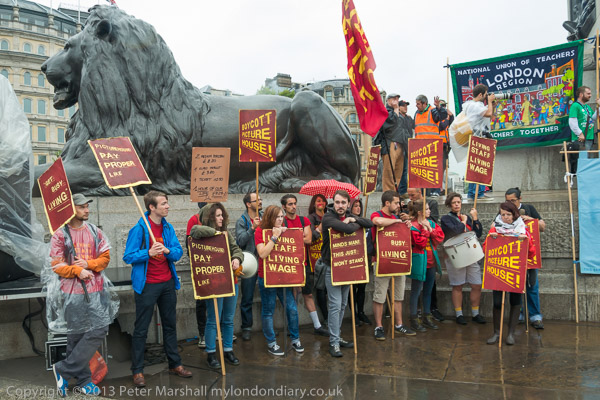
Workers from the Ritzy cinema in Brixton who are striking for the London living wage

As well as photographing the speakers, there were also people in the crowd to photograph, including those responding to the speeches in the picture at the top of this post. I managed to photograph the Ritzy strikers in front of one of the lions just before too many other photographers arrived and started walking in front of them.

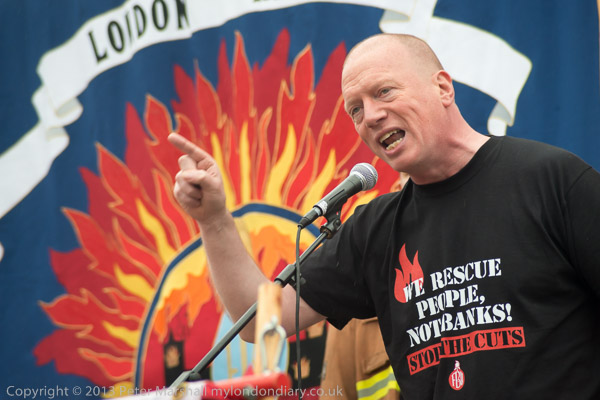
The London Fire Brigade Union banner, standing against the plinth of Nelson’s column to one side behind the speakers made a splendid backdrop for the FBU leader Matt Wrack, although it was perhaps less appropriate for some of the other speakers. I was also careful to frame so as to get the message on his FBU t-shirt ‘We rescue people, not banks – Stop the cuts‘, the first part of which is a quotation from Spanish fire-fighters when asked to assist in the eviction of people unable to keep up with their mortgage payments.

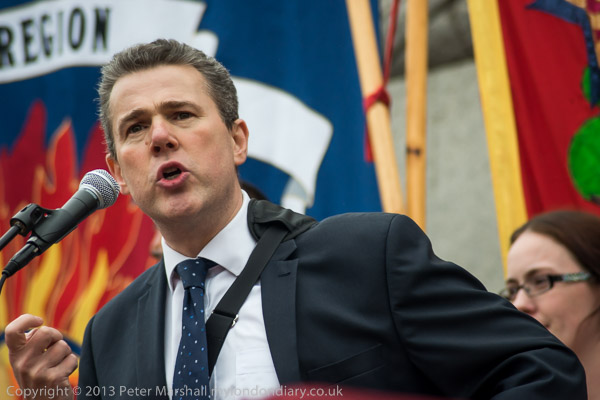
I was also pleased to see and photograph Mark Serwotka of PCS who I knew had been ill, but was certainly in fiery form at this event. It wasn’t until almost two months later that we all heard how great his health problems are, and how remarkable he has been in coping with them.

More pictures from the march and rally at Public Service Workers Strike for Fair Pay.
Continue reading Fair Pay Now!

Save Our Surgeries

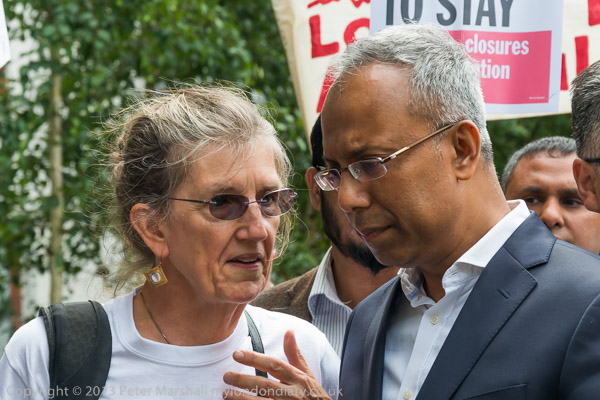
I left the ‘Housing for All‘ march at East Ham station and took the District Line to Aldgate East, in the neighbouring borough of Tower Hamlets. Like Newham, this also has a directly elected mayor, but a very different character. For a couple of years Lutfur Rahman was the leader of the Labour council here, but was replaced by the party when he became controversial over media allegations about his links to the Islamic Forum of Europe, a group with an important place in the Bangladeshi community in Tower Hamlets. IFE supporters say it works actively to oppose extremist groups, while the right-wing press accuses it of extremism.

After much infighting among various groups in the Labour party Rahman was finally elected by Tower Hamlets Labour Party as their candidate for the first elected mayoral elections by a large majority. But the Labour National Executive Committee removed him, replacing him by the man who got the least votes of the three candidates, a decision that, along with the published account of what actually happened in the meeting, puts the party in a very bad light.

Rahman considered legal action to get reinstated, but then decided to stand as an independent candidate instead and got elected – and this year elected again for a second term. But his ‘Tower Hamlets First‘ party are a minority on the council, with around half of all councillors still being Labour. A great deal of ill-feeling still appears to exist between at least some of the Labour group and the Mayor, with non-cooperation and allegations of malpractice being fed liberally to the media, most of which have been only too pleased to report and distort it.

To an outsider, Rahman appears despite the problems to have done a very good job as mayor and to be very open to the people of Tower Hamlets – and indeed to put them first. He has turned up at several events I’ve photographed (and sent along others with his apologies and a message of support when unable to come personally) and seems to have supported projects across the many communities in the borough. I’ve not known another mayor who is as visible and accessible to local people and wish other mayors were more like him at least in this respect.

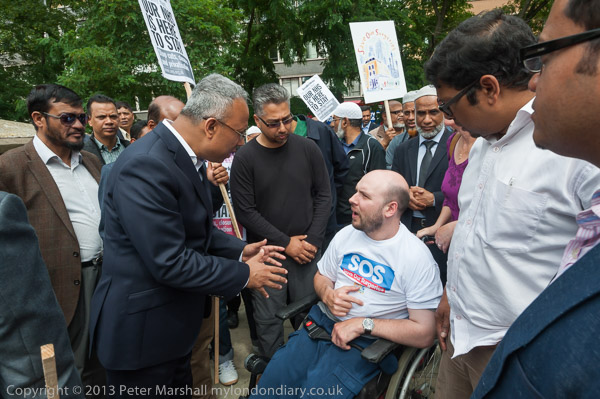
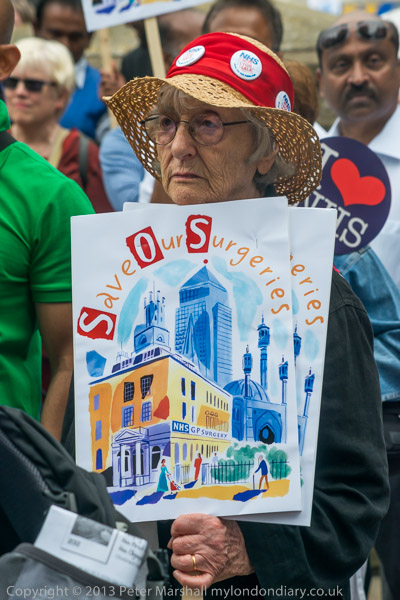
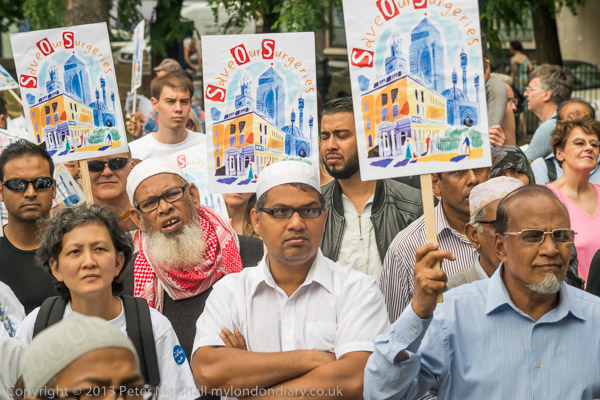
Like most people in Tower Hamlets the Mayor is greatly concerned to the threat to the surgeries in the area (and in other deprived areas) of the withdrawal of the support they currently get because of the extra needs of the area. They fear these will be unable to continue, and will be replaced by cut-price services run by large health companies and providing only a low level of health care. The date chosen for the Save our Surgeries rally and march was the 66th anniversary of the founding of the NHS.

Of course the Mayor was just one of a number of speakers, including the local Labour MP, Rushanara Ali as well as doctors and other health professionals and a patient. I tried to photograph them all, but it mainly their audience that attracted me, very much a reflection of one of London’s multicultural boroughs. The placard too is one of the more decorative I’ve photographed, though rather less graphic than most, and reflects something of the diversity of the area, with its small island of business wealth at Canary Wharf, old buildings and the recent mosque, though it does rather lack the bustle of its streets.

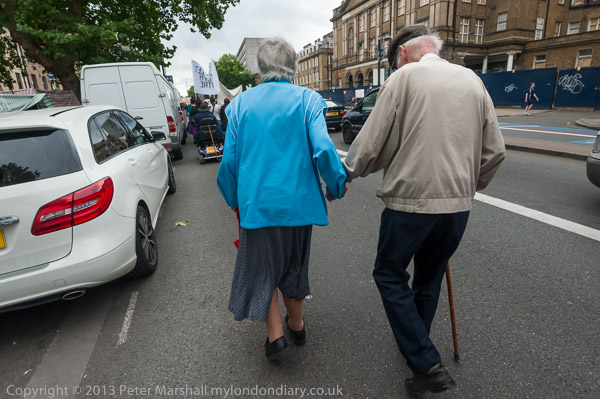
It is perhaps a reminder that when taking photographs we too need to be aware we are creating representations, and we need to be aware of the message that our pictures convey, not just of who or what we see as the subject of our photograph. At the end of the march as it went past the old Royal London Hospital building were an elderly couple, walking slowly and with some obvious difficulty. I took several pictures, including the one above, including some showing their faces, taking care not to disturb them, but this is the one I chose to use. At first I wondered why I had deliberately chosen to include that disturbing red light which to me looks like a distorted mouth sliming its way across the rear of the car so prominently in the frame. But now I’ve grown to rather like it, though I’m not entirely sure why.
Continue reading Save Our Surgeries

25 Years of Drik

Hard to believe it, but there are still people with an interest in photography who haven’t heard of Drik, the innovated photo agency set up by Shahidul Alam in Dhaka, Bangladesh 25 years ago. As he puts it in his blog, “Tired of being pitied for our poverty, and do-gooder attempts to ‘save’ us, we had decided to become our own storytellers.”


Shahidul Alam talking in London in 2011

It has been a difficult journey, starting on shoestring resources, and for which they also had to create much of the infrastructure, including setting up Bangladesh’s first email network using Fidonet. The government did their worst to close them because of their support for human rights, sending police to shut down some of their shows, and they were “stabbed in the street, arrested, and generally persecuted.”

The photographic school set up by Alam and those working with him, Pathshala, the South Asian Media Institute in Dhaka is now widely recognised as one of the leading schools of photojournalism in the world, and many photographers who have studied there have become well-known, and its former students increasingly feature in the major international photojournalism competitions.

On my table downstairs, until now unopened, is the September issue of ‘New Internationalist‘ magazine – which I’ve subscribed to since its inception (and before it became ‘New’ in 1973, when it was the magazine of ‘Third World First, a student group now known as ‘People and Planet’) though I don’t always get around to reading every word – and I’m still reading the previous issue. It’s essential reading if you want to know what is really happening around the world – and why – and not just what Murdoch and his like want you to know. Over the years they have published a number of articles by Alam, including The Majority World looks back in 2007, as well as making use of images from Drik and Majority World, another of his initiatives.

The latest issue of the magazine has a double-page spread, ‘Telling our own stories‘, celebrating 25 years of Drik, which you can see and download from Alam’s post. I’m pleased to add my small voice to the congratulations.

Duckrabbit, Ethics & Sheep

Most days when I’m not out taking pictures I spend at least a few minutes (more often about an hour) before I start on my own work for the day looking through Facebook posts and a number of blogs and web sites on my newsfeed, stopping to read those that really catch my interest. One blog that often does this is duckrabbit, and I’ve often shared posts from there on this blog.

There are a couple of things in the past few weeks that have interested me there, and the latest is a post by John Macpherson The thin blue line reflecting on two posts about Ferguson, one by a black police officer and the second an Al Jazeera Opinion piece by Malcolm Harris: ‘Unethical journalism can make Ferguson more dangerous’. It’s this second post that is particularly pertinent for photographers who cover events – as I occasionally do – where some of those involved may be breaking laws, where Harris suggests that “publishing images with identifiable faces” in situations like this is a “violation of accepted practice“.

Macpherson makes some very sensible comments about this and while there are situations where anonymity should be respected, journalists are not there to decide on who is breaking the law, but to report “the situation as it unfolds, and recording it with professional objectivity.”

Of course there are situations that call for anonymity, and times where journalists can only work on that basis or when we chose to do so by the careful choice of camera angle and framing, but this isn’t something we should do without careful consideration, and not something that would generally apply on protests on the streets. I’m careful at times not to include “innocent bystanders” in my pictures, and have been known to advise people wearing masks to protect their identity to actually cover their faces with them. But I think those acting openly on the street can have little complaint if their actions are reported openly.

There have been a few occasions when I have decided not to take pictures, on the grounds that a particular image would misrepresent the event I was covering. I’m not sure in most cases my decision was right, and it would have been better to take the pictures and decide later whether or not to use them. But for most journalists now there isn’t a ‘later’, with publications and agencies demanding images almost before they are taken, rather than the several hours that allow me to consider and edit my work.

My photographs have never been used in court, but I have on several occasions provided copies to protesters to help in the preparation of their defence (I think as so often the charges were dropped in all these cases) where the pictures showed police acting in an aggressive manner.

Photographs, and particularly still photographs, are in any case rather curious evidence, seldom providing reliable evidence on their own. They need captions, explanations, supporting testimony. Even with information now embedded in digital images they are often not entirely reliable about when and where they were taken, and, as we photographers certainly know, an image taken a fraction before or after, or from a slightly different viewpoint may provide a quite different impression of what was taking place.

The second duckrabbit piece, ‘Cut out the crap‘ is a short link to a blog post by Bartosz Nowicki to the work of a little-known photographer from Wales. Peter Jones grew up in Abwerystwyth and after various night classes studied photography “at Manchester College of Art and Design ’66-’69 where I was influenced by the work of Edward Weston and Tony Ray Jones. Went to London to look for work and found a job as John Thornton’s first assistant.” But then he came home to Wales to visit his sick mother,  got drawn in to the family farm and never touched a camera for 30 years, only becoming involved in photography again when his sister entered him into a Millennium project where people were given disposable cameras and free processing. When ill health forced his retirement from farming he started taking pictures again, buying a Leica M6 and a 35mm and 50mm lenses. The images on the blog are from a project “Welsh Farming Community” which he says “will come to it’s conclusion when my shutter stops blinking.” It’s an interesting story with some fine images and I think should at some point make a fine book.

Notting Hill – better weather in 2009

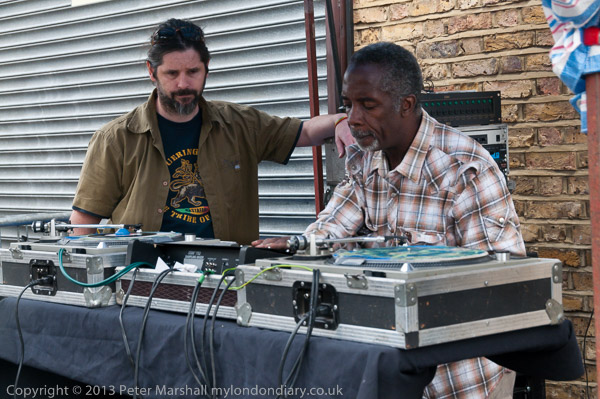
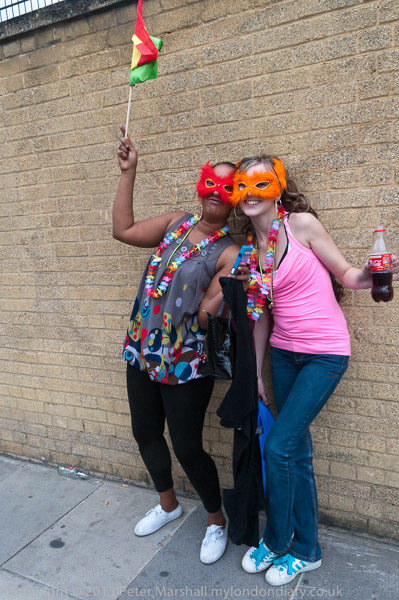
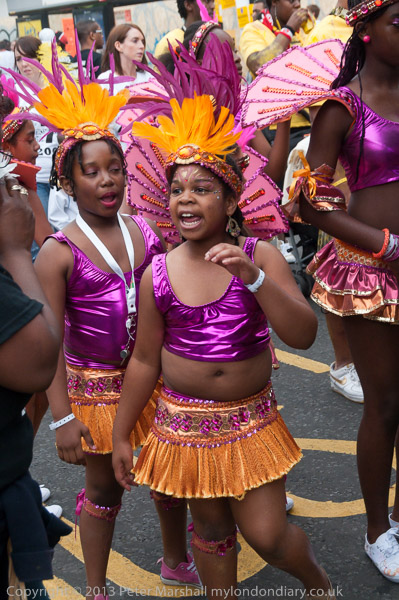
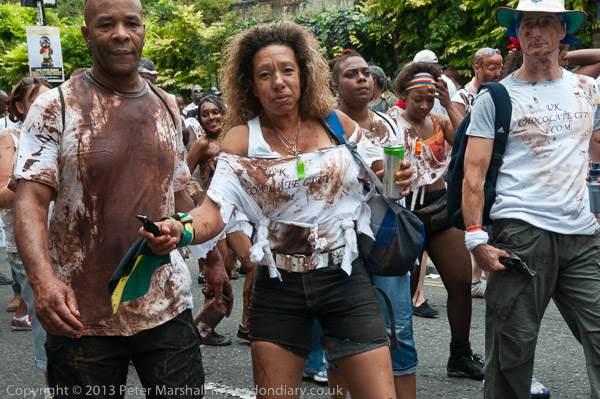
I’ve now put more of my pictures from Notting Hill Carnival in 2009 on-line in Notting Hill – Children’s Day on My London Diary.

Though as you will see there, they are not all of children, though I have concentrated rather more on those of children in selecting images to put on the web.

But carnival is a great event for people of all ages.

I took a great many pictures that day, almost 1500 in around 4 hours in Notting Hill, which works out at around one every ten seconds, though I’ve put less than 50 on the web. They probably include most of the better images I made, though I didn’t go back and look through all of them to make the selection, just the 200 or so I’d developed from the RAW into jpegs at the time.

There may be a few images that I missed when I did that initial edit, but I doubt if there would be anything truly stunning. With digital I ruin far fewer images than I used to on film, but I doubt if I make any more good ones either. So while I still have almost every negative I ever took, it perhaps makes more sense to be at least a little selective about which digital files to keep.

Another forty-something pictures of Notting Hill – Children’s Day from 2009 now (at last) on My London Diary.

Continue reading Notting Hill – better weather in 2009