Fuji in Hull


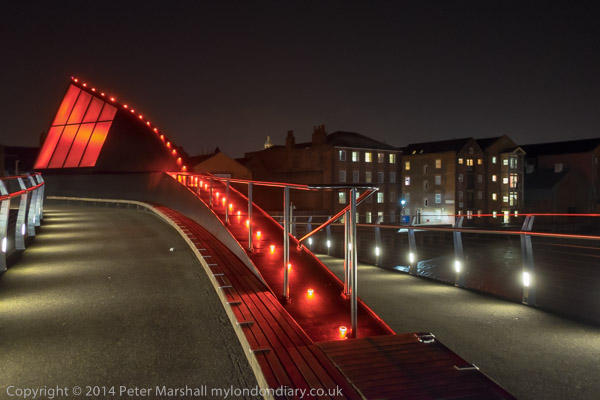
A recently built footbridge across the River Hull

I’d been thinking for a while that while I liked the Fuji X-T1, and in particular the viewfinder, the lenses that I had for it, the 18-50 zoom, the 14mm and the Samyang 8mm fisheye, were all rather large. Not a problem when you are going out to work seriously, but they make it a little bulky when you want a camera to take along when taking pictures isn’t your main intention.
So for those occasions, I was still picking up the Fuji X100, a nice but sometimes frustrating fixed lens camera, with a 35mm equivalent lens. One of the frustrations with using it is that it sometimes just won’t take a picture – and the only way I’ve found to persuade it to function is to turn it off and then back on, wasting a few seconds, usually long enough for people to move or lighting to change and pictures to vanish. But my real problem is that so often its view is not quite wide enough. You can get a supplementary lens that fits on the front and makes it wider, but that seems a rather clunky solution which rather negates the concept.

For some years the main camera I used and carried almost all the time was a Leica M2 with 35mm f1.4 Summilux,. and 35mm became my ‘standard’ focal length. But after around ten years I put it to one side and standardised instead on a Minolta CLE – a more compact camera with an exposure meter – and the Minolta 28mm f2.8 which became my carry everywhere camera. I found the wider lens much more generally useful, and if absolutely necessary you could crop the image a little to give the effect of a 35mm or even a 50mm.
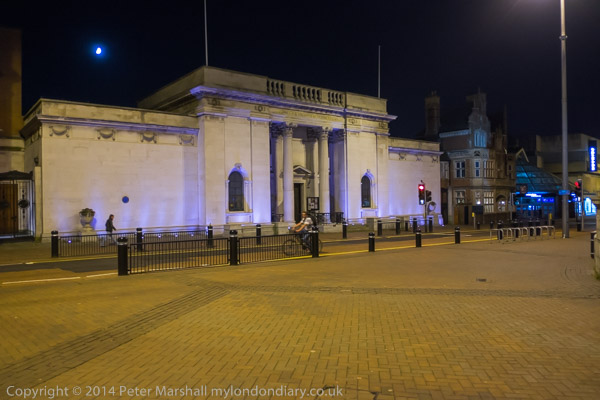

The Ferens Art Gallery – where I had a show in 1983 – you can see many of the pictures in ‘Still Occupied

So I wanted a small lens, and one with approximately the angle of view of a 28mm on a film camera. Taken together these two requirements made the 18mm f2 an obvious choice. But two things put me off. Firstly there are quite a few reviews that knock the performance of this lens, and secondly that I didn’t want to pay the roughly £400 that my usual dealers were then asking.

I left it for a while, then thought about it again when Fuji started a cashback scheme. There is a rather better scheme now – and for around a month longer, but unfortunately it doesn’t include the 18mm.  I turned to Ebay and found that there was a fairly steady stream of secondhand 18mm Fuji lenses coming up for sale – mainly as owners were replacing them with the 10-24 zoom.  That’s a lens I’d rather like too – and will doubtless buy in time – but  that in my mind serves a quite different purpose – and another relatively large and bulky lens, if half the size and weight of its Nikon near equivalent I currently use.
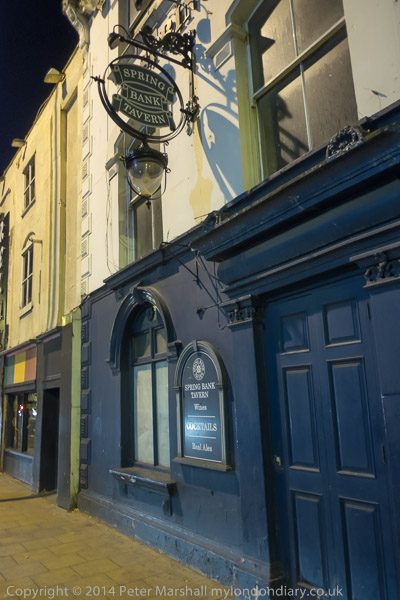

Spring Bank

I bid in a few auctions, gradually increasing the maximum bid I was prepared to pay, kicking myself for missing a real bargain in the first I took part in which went for £165, and eventually getting the lens I wanted for a little under £200 including postage. It arrived just a couple of days before I was leaving for a couple of days in Hull, where I was going to attend a wedding, followed by a brief visit to Derbyshire on the way home.

I thought it likely I would be asked to take some candid pictures at the reception, and knew I would also have some time there to take pictures, but I wanted to travel reasonably light. So I put the 18mm on the X-T1, packed the other three lenses in my shoulder bag and set off for Hull.
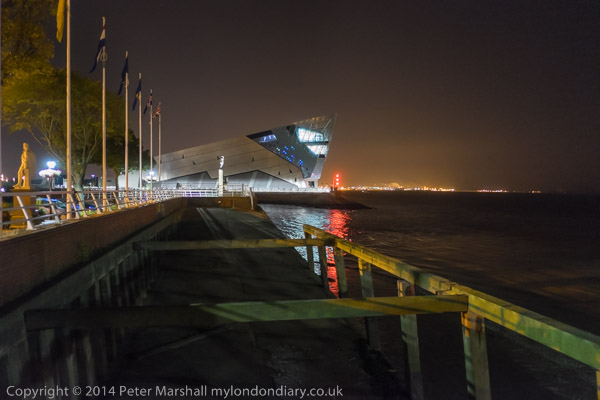

The Deep and the River Humber

In Hull and Derbyshire I took over a thousand pictures over 4 days, though I’ve not kept all of them, including several hundred at the wedding reception, mainly in relatively dim room lighting, and the technical quality of the results from the X-T1 and 18mm surprised me. I took quite a few night images as well, all hand-held, at shutter speeds down to 1/10 s (and one at 1/5.) Of course where possible I leaned on rails or against posts to help keep the camera steady, but often there was nothing to use for support. Not every image was sharp, and I generally took several so as to pick the sharpest.
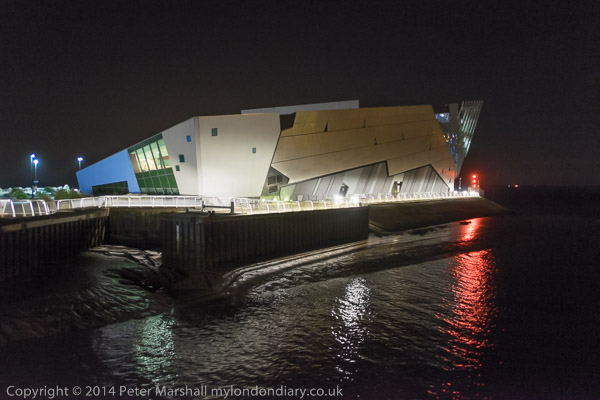

The Deep is on the point where the River Hull flows into the River Humber

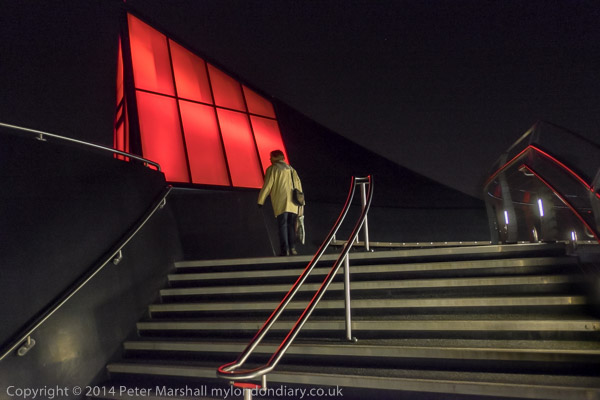
You can see more of the pictures I took in Hull with the 18mm, mainly at night, in Hull at Night and some during the daytime – as well as a few from Hornsea in Hull and Hornsea. And still with the 18mm, Unstone Grange & Chesterfield. 

Although I carried around the three other lenses in my bag throughout my trip, somehow I never felt a need to use anything but that 18mm.
Continue reading Fuji in Hull
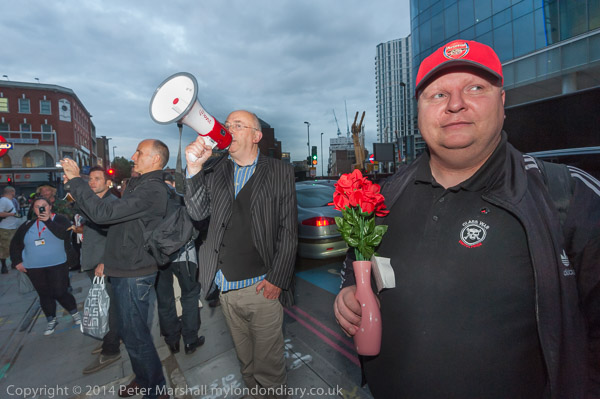
More Vases


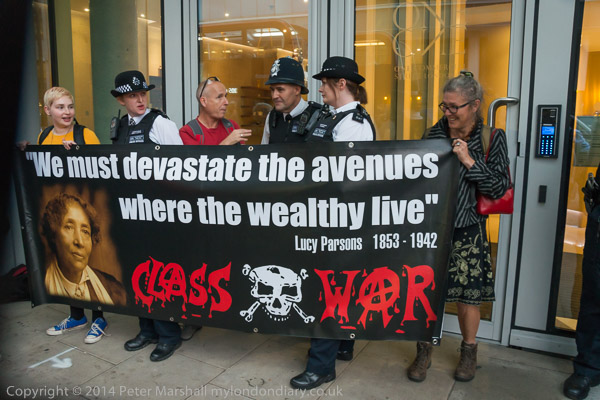
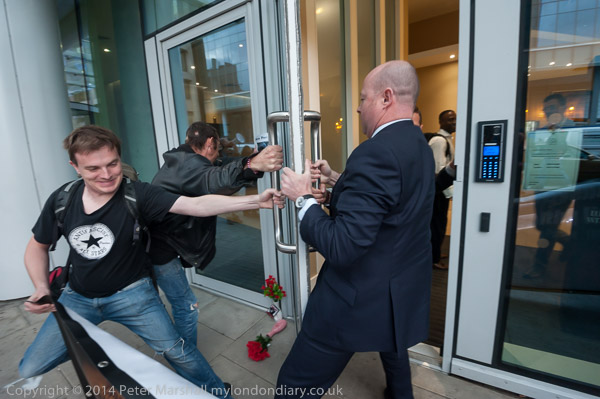
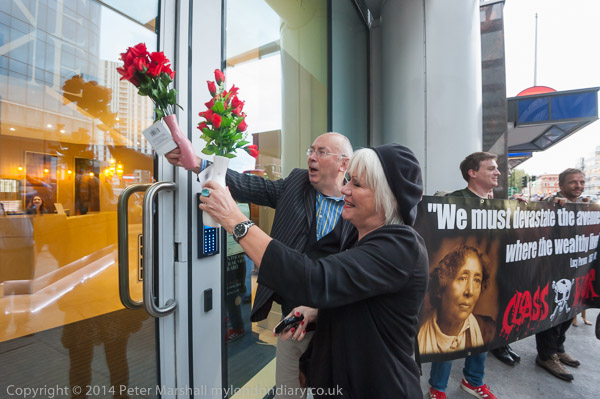
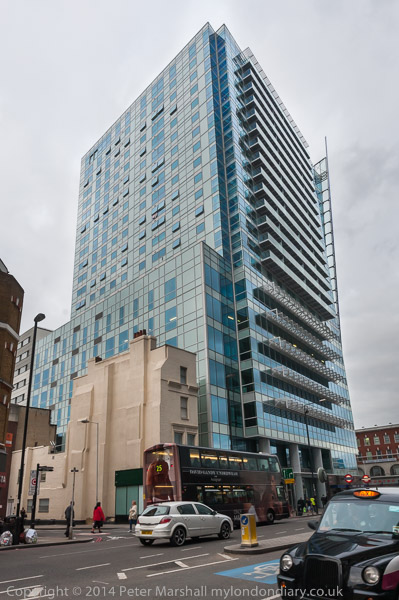
Outside One Commercial St, Aldgate, London. Wed 1 Oct 2014

I’m very aware at the moment that my life is out of sync, with just too many things happening for me to keep up or get on with so many things that I want to do. Its some months since I’ve found the time to scan any more of my old work from the 1980s, and on My London Diary I’m still working with putting stories from the end of October on line.

Here on >Re:PHOTO I‘m event further behind in commenting on my work, only today moving to the start of October, though there are still quite a few September stories I’ve not commented on. Those I post about here are either those that raise some kind of photographic issue, either personal or wider, or sometimes those I particularly like the pictures that I took. Like everyone else, I have good days and bad days, but plenty of so-so days too, days when the pictures I turn in are hopefully professional enough, but where I’ve failed to come up with any interesting idea or just haven’t had any luck. The bad days are often the easiest to write about, when I can share my really stupid mistakes with you guys.

There is seldom any real connection between what is happening and whether I have a good or a bad day, and I’ve often taken some of my better pictures at events which I might have arrived at and thought I was wasting my time. Photography is mainly in the mind, and if too much is happening I tend to jump in and snap, snap, snap, reacting with little thought, anxious not to miss anything. (You can see it on my contact sheets from the days of film, though digital does increase the actual number of images for various reasons.) When seeing pictures is harder, you need to think more.


One Commercial Street has its main frontage on Whitechapel High Street

One particular series that has contributed to my recent overload has of course been ‘Poor Doors’, with its regular weekly protests (and an odd extra too.) Since they started in July I think I’ve photographed at 19 of the 21 Class War protests there – and a couple by them elsewhere that I might otherwise not have gone to.

Part of the reason for going to so many is that I think they are raising an important issue and have helped to force it into general consciousness; the separate doors for rich and poor are an index of the increasing social segregation we are seeing as the gap between rich and poor in our society increases. I’ve long opined that the true driving forces of society are cultural rather than economic – important though economic forces are, they arise from culture. with a culture that legitimises the exploitation of labour producing wealth and poverty. Its perhaps this that made me become a photographer rather than a politician.

And October started with another ‘Poor Doors’ protest – the 10th for those who were counting, and my eighth weekly visit to take photographs at these similar protests, making it hard to try and photograph in a different way. Inevitably some things are pretty much the same every week, though there are also changes. So this week, after an incident involving protesters entering the building and a vase getting broken, there were now police in position half an hour before the protesters arrived and stood by the rich door with their banner. There were of course the usual struggles over the doors, though only when the police had moved a few yards away for some reason.

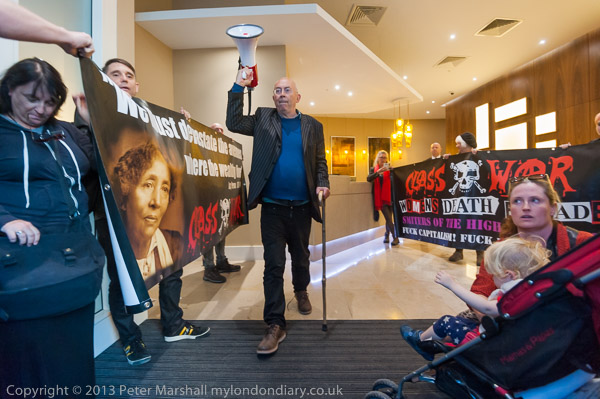
As the ‘Lucy Parsons’ banner and even more the ‘Class War Womens Death Brigade’ banner suggest, Class War’s rhetoric should not be taken literally. They raise serious issues, but in a way that is meant to provoke, and though the humour like the banners may be black they do not incite violence or suicide bombing. When they head for Mayfair next week their most dangerous weapons will be their thoughts and voices.

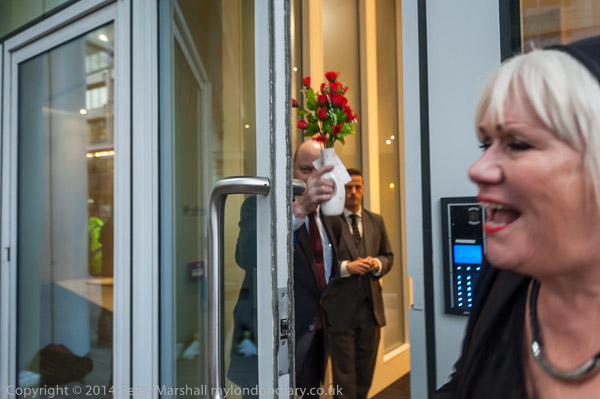
Breaking the vase the previous week had cost Ian Bone £70, but not his sense of humour, and Class War arrived with two replacement vases, by the look of them from a Pound Shop, and offered them to the staff inside the building – who ignored the offer.  Later, when the building manager was closing the door having let a resident in or out, Jane Nicoll thrust a vase in his face and, startled, he grabbed it in a reflex action.

I wasn’t in the right place and wasn’t quite quick enough to catch the moment  – though I managed one frame a second or so later as the he still holds it in front of his face and Jane is exultant. By this time the light was low, I was working at ISO3200 with the 16-35mm wide open at f4, and the focus is on the door frame, perhaps around 4 ft away.  Jane is considerably closer than the near limit of focus, and the building manager slightly beyond the far limit of depth of field. To get them both sharp would probably have required f16 – and a truly astronomical ISO. I was pleased to have got what I did.

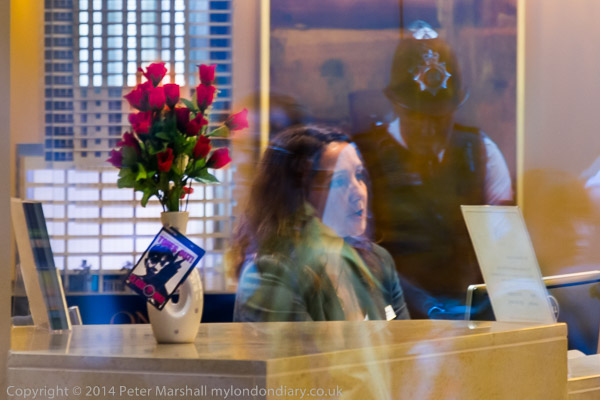
Later I was able to take a picture of it where it had been places, still complete with its Class War label on the Concierge disk occupying the same place that the broken vase had taken. But police had rushed back to surround the door and I wasn’t able to get close to the window, so had to work through it – with all sorts of reflections.  Handheld at 1/20s f5.6 ISO1500 with the 18-105mm at 157mm equiv, a fairly ridiculous exposure. I’m not sure if I had the lens stabilisation turned on or not. On the web site I’ve used a different image, taken at around the same focal length but with a lens without IS, the 70-300mm at f4.5, 1/40s which is rather cleaner looking – as you can see in Class War Poor Doors Week 10.
Continue reading More Vases

Capa Myth Rumbles On

This morning A D Coleman published Episode 18 of his series Alternate History: Robert Capa on D-Day, a series that with the help of others, particularly J. Ross Baughman, has explored what really happened to Robert Capa and the pictures that he took on Omaha Beach during the first day of the D-Day landings in 1944.

There is now no room for doubt that Capa only made 11 exposures on Omaha Beach on June 6 and the question has now moved on to who fabricated the myth of the darkroom accident and why, and the continuing defence of untenable positions by various of those involved – even now they grudgingly admit there were – or at least may have been – only 11 images.

Of course nothing in this whole saga diminishes Capa as a photographer, and we have always known that he was a great storyteller, and while photographs remain fixed, stories surrounding them always have a habit of growing with the telling, and the legend always affects and can sometimes come to overshadow the actual image.

What distinguishes this story is the speed at which it was elaborated (if inconsistently as Coleman demonstrates) and the mythic status it has gained in the history of photography. And those of us who have taught and written about the history of photography feel a certain betrayal at having been duped and a little shame at having passed it on to our students and readers. (Though in mitigation I think I usually put down the actual appearance of the ‘surviving’ images to factors other than darkroom damage while repeating what was the accepted lie of the loss of other pictures from the beach.)

As a journalist and a photographer, I have a strong conviction that truth matters, although of course recognising the subjectivity of my own viewpoint. What has emerged in Coleman’s investigations seems clear evidence of a deliberate construction of falsehood, of lies that don’t affect the actual photographs but have contributed to their status as icons. And lies that materially affected the careers of some of those involved, probably getting Capa the offer of a permanent job with LIFE, and, as Coleman also pointed out in Episode 17:

Were it not for the myth of the melted emulsions (and its potency as a visual image), Morris would be even more obscure as a relevant cultural reference point today than his boss at LIFE, Wilson Hicks, then the chief picture editor at that magazine, or Tom Hopkinson, editor of the British magazine Picture Post — names you rarely hear today outside of courses in the history of photojournalism.  As it stands (or has stood until now), the dramatic emulsion-melt fable functions as the key moment in Morris’s professional life.

There are lies that matter – and lies that don’t. All of us regularly tell plenty of the second type, and most of Capa’s ornamentations in his writing are harmless and amusing – as they were meant to be. This was something different, something deliberately intended to mislead and which succeeded in doing so with such a powerful effect on our perceptions of the history of photography. Even though we now know as a lie, there is no way we can cancel the distortion it has caused.


Ultrawide or Panoramic?

Yesterday I met up with an old friend – both of us are getting quite old, though Mike Seaborne is rather younger than me – and we had a drink before going on a short gallery crawl. But in the pub we talked a little about our current work, and I took along a copy of my last book, Rotherhithe & Surrey Docks, which he had not yet seen.

Both Mike and I take panoramic photographs – and you can see quite a few of his on his web site. Although I like Mike’s work, and admire his panoramas, we have some basic differences in how we work although often we photograph the same subject matter. So one set of pictures on his site is from Swanscombe, which I photographed back in the 1980s, and then in the 1990s and early 2000s returned and made panoramic images. Both of us have photographed extensively elsewhere around the Thames Estuary too, although the work on his web site is not panoramic, although it was made by stitching together a pair of images.

There are I think two things that qualify a photograph as panoramic. One is the format, which has to be significantly more elongated than the standard 1.5:1 of the 35mm frame. Many cameras now also allow you to take 16:9 images (1.78:1) which to me doesn’t quite cut it as panoramic – just ‘widescreen’. As a working definition I’ve arbitrarily decided that panoramic format starts at around 2:1, and currently I mainly actually work at 1.9:1.

The swing lens cameras that I worked with on film generally had an aspect ratio of around 2.4:1 and I chose these when I first bought a specialised camera largely because I thought that this was the optimum format for panoramic images. Mike thinks differently and likes to work with images around 3:1, though has produced at least one 360 degree panoramic which was (from memory) around 9:1, about 18 feet long and 2 foot tall.

Of course there are panoramic images that don’t really have an aspect ratio,  particularly 360 degree spherical images, which you can only see through an on-screen viewing window. Useful for house agents, but not – so far as I’m concerned – for any serious photography.

But a large aspect ratio doesn’t make a photograph a panorama – it makes it panoramic format.For me the other necessary element of a panorama is a wide angle of view. It has to be a very wide angle, and although I liked using my Hasselblad X-Pan with its normal 45 mm lens, I never felt it was producing panoramas. It was only when I added the 30mm lens that I felt the images were truly panoramic. The 30mm gives a horizontal angle of view of around 94 degrees, which is at about the useful working limit of rectilinear perspective – at greater angles the distortion usually becomes unacceptable. A horizontal angle of view of greater than 90 degrees is often taken as the minimum for a true panorama. Swing lens cameras -such as the Widelux and Horizon models I used, generally gave an angle of view of around 120-130 degrees.

The images I’m making now usually have a horizontal angle of view a little greater than this, at around 146 degrees, but they also have a larger vertical angle of view than those from swing lens cameras, and if uncropped have an aspect ration similar to that of a normal 35mm frame rather than anything more panoramic.  The vertical angle of view of a swing lens camera is limited, because a wider vertical view would lead to distortion and unsharpness due to the different film to lens distances away from the middle of the image. The cameras use a curved film (I almost wrote a curved film plane – but of course the film forms a part of a cylinder, with the lens at the centre of the cylinder. Along the centre line of the image there is a constant film to lens centre distance, but as you go up or down from the centre that distance increases, giving greater magnification and also becoming out of focus.

You can avoid these effects by using a fisheye lens – but of course that produces a ‘fisheye’ image. In the pre-digital age there was little you could do but learn to love them, but I seldom did. But thanks to the work of Prof Dr Helmut Dersch and his ‘Panorama Tools‘ and the many free or commercial products that developed from his mathematical insights we can now do almost what we like with them.

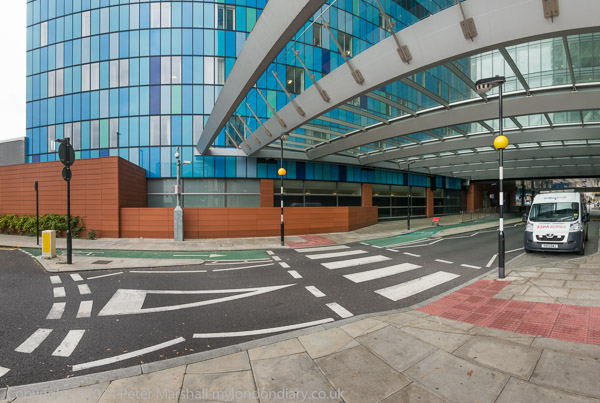
In By the Royal London you can see a number of images, some stitched and others converted from a single fisheye original. I’d gone to Whitechapel to photograph an event, but had time before it got going to take a short walk and to retake an image I’d made as a multi-image panorama around 18 months ago. of the new hospital building. One of several attempts is the top image above, shown in its ‘full-frame’ version.

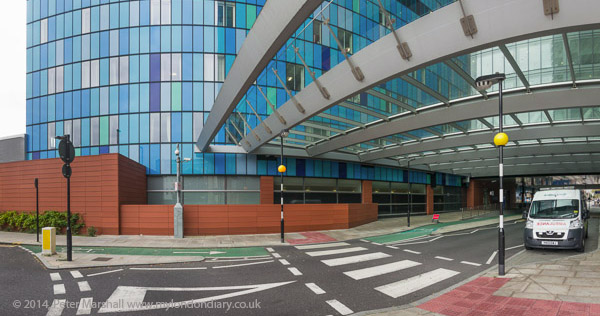
And this is my ‘panoramic crop’ version of that same image. In taking the picture I had to carefully set the left and right boundaries of the frame, and ensure that the camera was level.  In the viewfinder I could see the top and bottom centre of the top image, but not precisely where the four corners would be – and there are different ways of processing the image that would give different results, although I’ve generally standardise on the particular method used here. And as you can see, when cropping to the 1.9:1 format I had considerable choice of where to place the frame – the equivalent when taking an image in the old days on a view camera with a rising/falling front. I think the crop improves the image, but in this case I rather like the uncropped  image too – and I think despite that ration is still is panoramic, though less contentiously I’d simply call it ultrawide. But really the name doesn’t matter.

For this picture I possibly wanted more of the top of the building and the roof, and tried to get this by stitching a series of images taken in vertical format with a 16mm lens. I hadn’t however taken my tripod with me to lean on and stitching the images proved a little tricky.  You can see one attempt on My London Diary, along with around 15 other pictures I took in the area, all shown converted to give straight verticals, but otherwise uncropped. Most aren’t among my best pictures, but most would be improved by a crop to 1.9:1 format.  But if I wanted to use the 3:1 ratio that Mike prefers I would have to work differently.
Continue reading Ultrawide or Panoramic?

Class War and Poor Doors

As I write this post at the end of November, Class War has just suspended its series of protests about separate doors for the rich and poor residents of One Commercial St.  They have in the last week declared a ‘truce’ as the new owners of the  building have expressed a desire to resolve the situation, with a meeting of the interested parties which hopefully will result in all residents being able to enter on the main street, rather than those on the ‘poor’ side having to go down the side alley.

People often tell me that it isn’t worth protesting, that protests never acheive anything, but that simply isn’t true. Of course not all protests are successful, but many do make a difference. If it had not been for the protests over a ‘third runway’ at Heathrow, we would now be fighting against plans for a fourth runway and Terminal 6 or 7; if it hadn’t been for the protests of UK Uncut, tax avoidance would not have become an issue. Protests seldom manage to wave a magic wand, but they often do effect changes in the ways that issues are seen and debated, cultural changes that alter  the course of events.

One Commercial St isn’t in itself that important. One block of many similar blocks springing up across the UK, and of course particularly in London. An exemplar of the trend towards social segregation which is accompanying the increasing financial gulf between rich and poor in this (and many other) countries. Class War’s stand here is one of principle rather than about the particular, and whatever the final outcome in this building, it has put the issue firmly on the political and media agenda.

Housing has become a major issue, and it has largely done so not because of the obvious and often desperate problems many face, not through the dedicated lobbying of charities and the research of academics, certainly not by the largely spineless approach of Her Majesty’s opposition (who through some Labour dominated councils are very much a part of the problem) but because of the work of grass roots activists such as Class War, Focus E15, New Era and others.

At first these kind of activities are only reported in social media and by alternative news media. Posts on Facebook and Twitter, articles in blogs and on campaigning web sites. Gradually they begin to surface in more major media outlets. I’m not a great fan of Russell Brand, but I was pleased to see a few weeks after the events in these pictures to meet John Rogers (who I met some years back when we both featured in the London International Documentary Festival)  filming at a later Poor Doors protest for Russell Brand’s Trews Reports (which have also recently covered  Focus E15 and New Era.   If you have any interest at all in London you will find some fascinating videos on his YouTube page – I particularly recommend his full length documentary The London Perambulator, a full-length documentary film.)

Back to September 24th, and Class War Occupy Rich Door, a night that marked a hotting up in the battle between protesters and the Redrow staff of the building over the rich door. Before there had been tussles with the protesters attempting to  hold the door open  when residents entered or left during the protests, but this week something different happened.

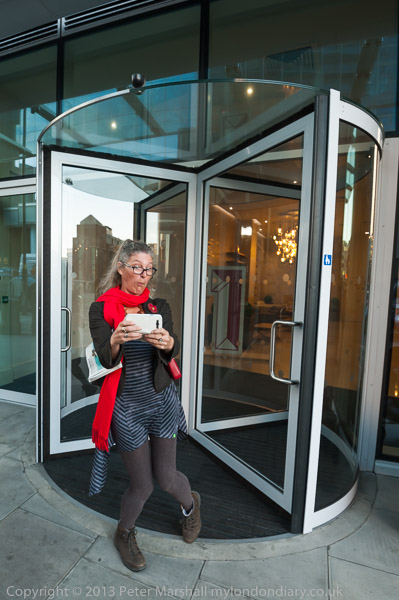
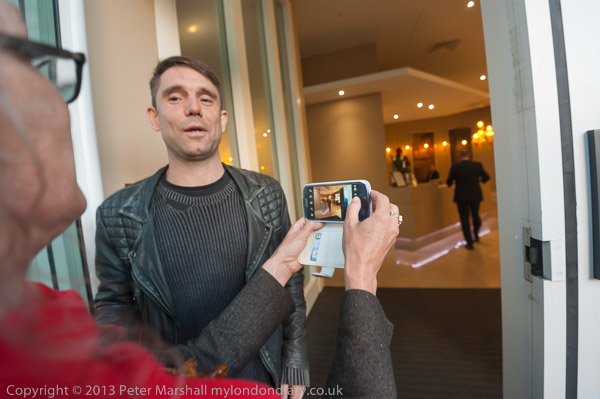
Perhaps it was the presence of Marina Pepper, Class War’s candidate to stand against Iain Duncan Smith in his Chingford Constituency, at the protests for the first time and posing above in the always locked revolving door that led the building manager to simply walk away when a protest put his foot in the door to hold it open. But whatever the reason, the open door seemed an invitation to walk inside, and the protesters, after a few moments shock at seeing it made so easy, simply walked in and made themselves at home.

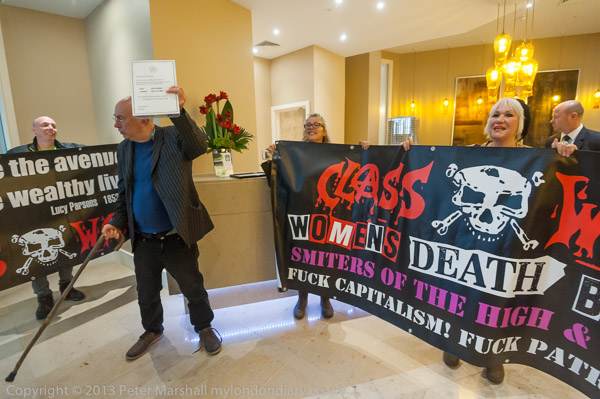
The building manager called the police, but for the moment the protesters were in the foyer and Ian Bone is holding up a framed notice from the desk with details of the 24 hour phone lines to the Concierge in the building – and comparing that with the broken entry system on the poor door in the dimly lit alley. In front of him is the walking stick he now relies on, and behind him on the desk a vase of flowers. As often, while speaking, he was flourishing his stick, sometimes rather wildly.

At some point in the next few minutes, walking stick and vase connected, either by accident or design, and that vase crashed to the floor and shattered. The noise startled me, and it seemed to startle Bone too.

It took eleven minutes for the police to arrive, and they came in and one chatted with the protesters while another went with the building manager into his office. Soon more police arrived, and after I’d gone outside to photograph them at the rich door, prevented me going back inside again. Eventually the police got the building manager to tell the protesters to leave and then the police threatened to arrest them for aggravated trespass if they didn’t go, and after being inside for 20 minutes they left in a jubilant mood.

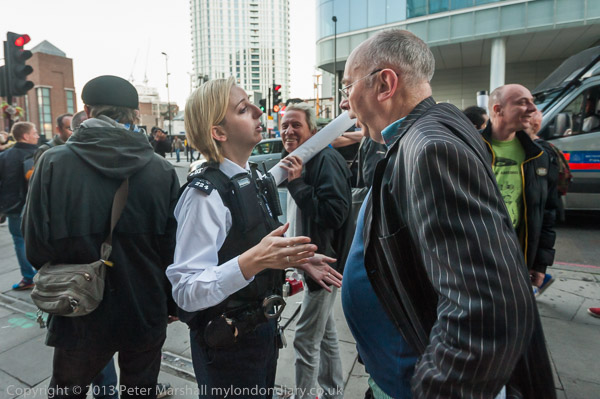
The protest then continued as usual on the pavement outside, with one rather odd incident when a man began to shout loudly that no one was prepared to answer his question, which he had apparently asked some of those holding one of the banners. He continued to shout this loudly for some minutes, while refusing to tell everyone who was asking him what his question was. Police tried to get him stop shouting and leave, but without success, and he ended up arguing with a small group of protesters. It was only at the following week’s protest that I talked to them and found that he felt that people should be protesting about rights for men.

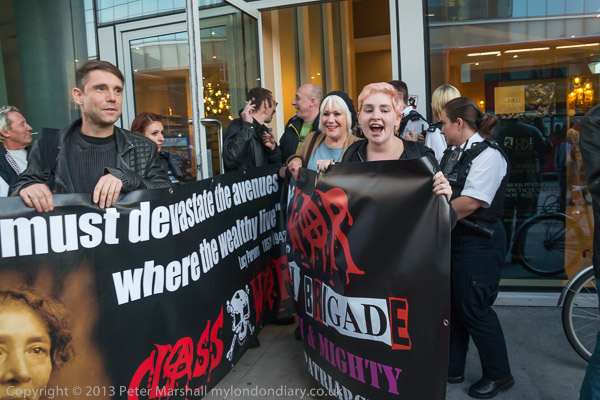
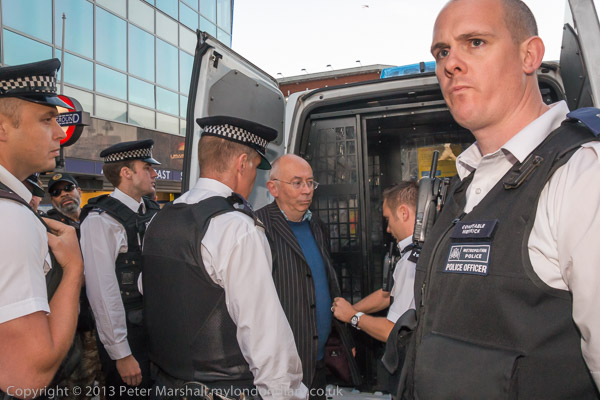
His intervention prolonged the protest for a few minutes, during which more police arrived including a van. As Ian Bone turned to leave, a police officer stood in his path, and soon he was surrounded by others and after a short argument he was told he was going to be arrested for breaking the vase and taken to be searched by the back of the police van before being driven away. The following week he said the vase had cost him seventy quid.

Photographically the light inside the building was a little on the low side, and I had some problems with depth of field and blurring due to subject movement, even working at ISO 2000 and a little above, with typical exposures around 1/80 f4.  In the few minutes I was able to move freely in and out of the building I didn’t always have time or remember to change the settings to cope with the very different lighting. In situations like this, where I’m conscious that at any moment I could be asked to leave, I tend to take too many pictures and not think enough about them.

I wasn’t asked by the building manager to stop photographing, though had I been I would probably have told him that I thought it was in the public interest and continued.  But I do tend not to use flash, as that does remind security people that I am taking pictures, and I didn’t do so. The pictures were almost certainly better for it.

At the end of the protest, when Bone was being stopped and arrested, it was beginning to get dark. But it wasn’t too dark – the image above at ISO2000 was taken at 1/60 f9. I needed to stop down for the depth of field even at 18mm (27mm equiv) on the 18-105mm. The main problem as always in such situations was getting to the right place, with both so many other protesters and also the police getting in my way. My thanks to Constable Merrick on the right of the picture for not interfering with me or trying to stop me getting a picture – too often police officers seem to think it part of their job to prevent photographers working.

More at Class War Occupy Rich Door.
Continue reading Class War and Poor Doors

Dora Maar (1909-1997)

Dora Maar certainly merited a page in the book by Rosalind Krauss, Jane Livingston and Dawn Ades published for the Corcoran Gallery’s 1985 show, L’amour Fou: Photography & Surrealism, a thoroughgoing examination of the role of photography in the Surrealist movement, which I saw the following year in London’s Hayward Gallery.

But the page – a brief biography, ends with the statement “(Dora Maar has declined permission to reproduce her photographs in this book.)” Maar was then 76, and the reasons for her refusal are not known, though she had given up photography over 40 years earlier and turned to painting. She does appear in the book’s pictures, but only as the subject for a well-known solarised portrait by Man Ray.

Should one want to speculate on Maar’s reasons, the biography by Mary Ann Caws, Dora Maar With And Without Picasso: A Biography, published in 2000, three years after Maar’s death aged 89 might offer clues. I’ve not read it, but there is an interesting edited extract online from The Guardian.

Maar’s work undoubtedly would have been a valuable addition to that book and show, certainly rather more central to it than some that was included. You can judge for yourself on the web in Venice : Dora Maar Despite Picasso, and  Dora Maar – Photographer and Muse. There is also a page from Wikipedia worth reading (and states she returned to photography in the 1980s) which has some further links, including to A World History of Art.

The video from the Cleveland Museum of Art,  Artist Spotlight: Dora Maar || Forbidden Games: Surrealist and Modernist Photography which prompted this post is in some respects curious and perhaps unfortunately shows rather little of her work and rather too much of “art collector and filmmaker David Raymond, whose once-beloved photograph are now owned and on view at the Cleveland Museum of Art as part of the exhibition, Forbidden Games: Surrealist and Modernist Photography, “, on view there until 11 Jan 2015,  entry free.

My thanks to Peggy Sue Amison for posting a link to this video on Facebook.

Druids and Viewpoint

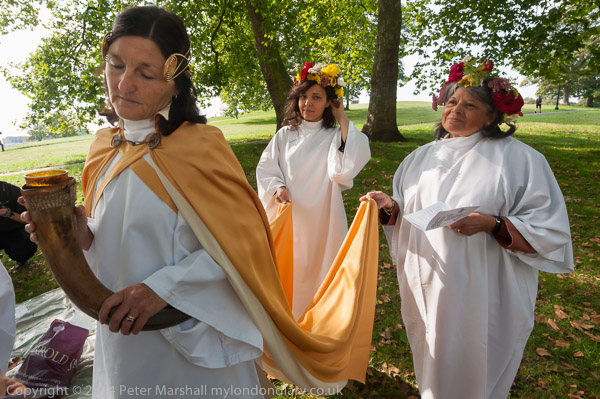
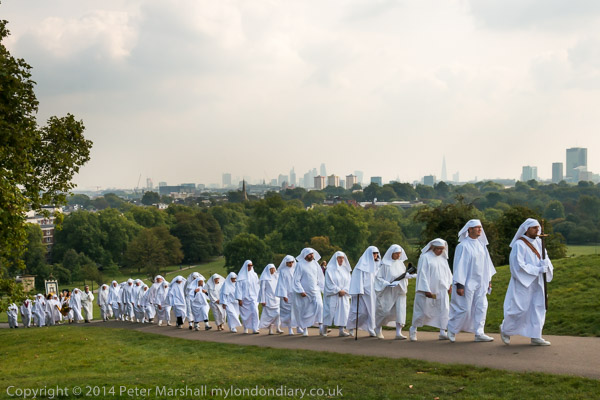
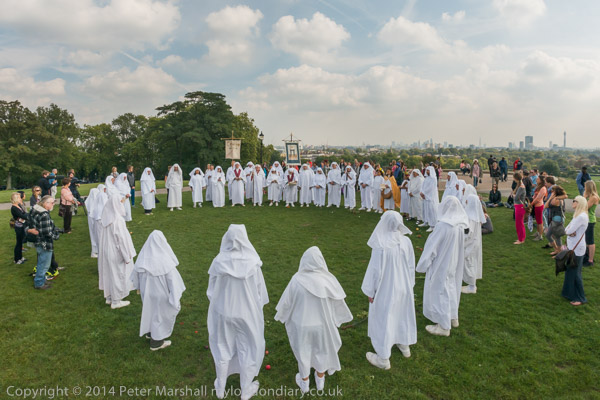
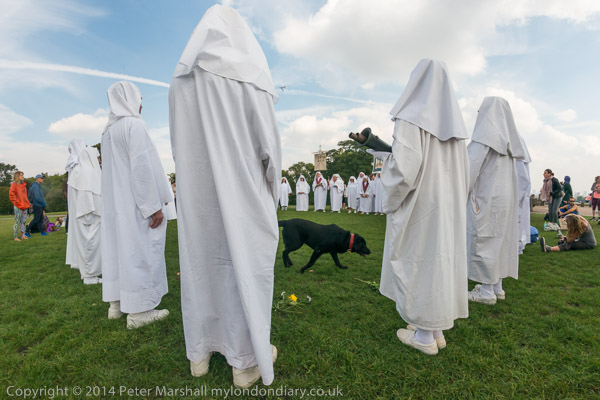
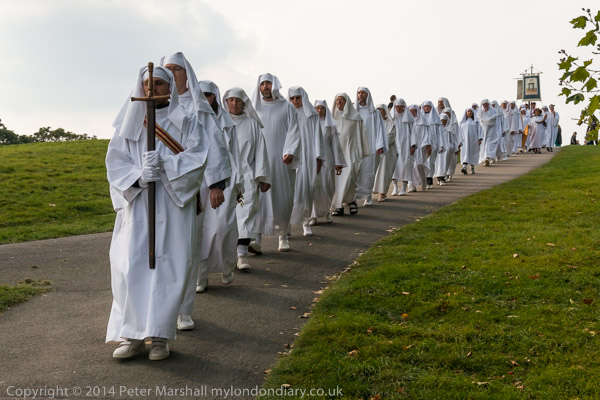
Twice a year I get an invitation from The Druid Order through the post inviting me to their Equinox celebrations, and although I’ve now seen them a number of times both at Tower Hill in Spring and on Primrose Hill in Autumn, I still like to go. Its an interesting spectacle to watch and still presents a challenge to photograph, even more of a challenge to try and produce different photographs of. I’m not sure I succeeded in that second aspect this time.


D700, 16-35mm at 16mm, f9 1/320 ISO 640

Primrose Hill is certainly the more spectacular of the two locations, with the green grass a better surface and the distant view of London. Tower Hill has its historical associations, but the Tower is a little distant and the closer buildings uninspiring. In some past years they used to process some distance through city streets which had some visual possibilities, lessened now as they emerge from the church hall next door.

I also have my suspicions that the ancient druid rites may well have been very different to these rather dry and solemn occasions. Probably a much more bloody and drunken orgy than these carefully scripted routines following the book. But the ceremonies doubtless satisfy those who take part in them and surely encapsulate some truths about the relationship between us and the planet we live on that are essential to the future of the species. We have to respect the earth, not desecrate it, and to be aware of our relationships with nature.


D700, 16-35mm at 16mm, f9 1/320 ISO 640

This is one of the very few occasions on which I screw anything into the tripod socket on any of my cameras. I hate tripods. I’ve never found one that really suited me – either too heavy to carry any distance or too flimsy and short to be of much use. If I could afford an assistant to carry the tripod (and much more usefully in London, the umbrella) I might think differently, but probably not. Tripods get in the way and slow you down. I’d rather lose the imperceptible scintilla of sharpness in the odd image than use one. Most of my images are at least sharp enough.


D800E, 18-105 at 25mm (37mm equiv)  f14 1/800 ISO 800

I had to use one when I photographed the multiple image panoramas for the ‘Secret Gardens of St John’s Wood’ as it was essential to get the lens nodal point in virtually the same place for all of the exposures. Though I messed up the only ones I screwed the camera in place for, and generally worked just by resting my hand supporting the lens at the correct place on the tripod plate. I used one – a solid Manfrotto – for some of my film panoramics too, particularly with the expensive Widelux which had no viewfinder or spirit level, but soon abandoned it with relief once I was working with the cheap Horizon that came with both.

But for this occasion, what I took to Primrose Hill was a monopod. It’s relatively light but still won’t fit into my camera bag, which is a pain. I put it across the top of the contents and close the cover and it stays there until I open the bag to get something out and forget it’s there, and then it isn’t any more. Fortunately I’ve yet to drop it anywhere completely unretrievable.

Also in my camera bag is a long cable release, an electronic thing that fits into the fancy socket on the front left of the camera. I did experiment with a cable-less release, with a little box in the hotshoe plugged into the same socket and another with an aerial in my hand, but it seemed more fuss for this job.

The monopod screws into the tripod socket on the base of the camera, or rather it should, but I have a strap that screws in there, with its socket that I always forget and screw the monopod into instead. What I should do is unscrew the strap – and then use the quick release built into the strap to remove it from the camera – before screwing in the monopod.

In use it makes no difference, but when you come to remove the monopod, it comes off the camera with the strap, leaving the camera hanging from the other end of the strap only, and it takes a mole wrench to separate the monopod from the other end of the strap. Unless your assistant carries a mole wrench (if you have either) your only recourse is to screw the monopod back in and keep working with one attached to you camera. Which I did.


D800E 16mm fisheye, f16 1/1000 ISO 800

The purpose of this is to photograph the circle from a high viewpoint, particularly with the fisheye 16mm lens. But holding the camera high above your head you can’t see through the viewfinder. Live view puts the image on the rear screen, but it’s almost invisible from below with the sky reflected in the glass. The Nikons have a ‘virtual horizon’ feature which is a little more visible and I sometimes try to use, looking for a green line. But it still isn’t easy to see

It really is a problem trying to keep the camera level – and necessary unless you want a curved horizon. What I mean to take with me but always forget is a plumb line which ought to solve that problem. Until I do so I will just have to rely on guess work and taking quite a few exposures in the hope that some will be ok.

It isn’t too easy either to keep the camera pointing in exactly the correct direction, working very close to the circle even with the very wide angle of the fisheye.

Of course there are high-tech solutions to the problem. With the Fuji cameras I have an app that lets me control the camera and see the viewfinder image on my phone, which I might try another time. But I think I would need a cradle of some sort to fix the phone onto the monopod or to grow a third hand (or that assistant again.)  Perhaps better still would be a drone, though I’m unsure how well that would go down with the druids, especially were I to fly over the druids, and it adds another level of complexity. It would probably need to be used at a greater height, and I think the kind of view I’m getting from monopod level is probably the most interesting.


D800E 16mm fisheye, f16 1/1000 ISO 800

But perhaps I’ve already done enough on these druid ceremonies, and if I wanted to take the work further should look at it in some very different way. Though that – like the drone – is probably something I’ll leave to others.


D800E 18-105 at 42mm (63mm equiv) f13 1/640 ISO800

There are more pictures on My London Diary, in Druids on Primrose Hill and as usual the images, apart from the one on the ‘month’ page with the text are posted there in more or less the order in which they were taken, and are my attempt as usual to try and tell the story mainly through images, though some words of explanation are necessary to go with them. There are a few captions, but there just aren’t enough hours in the day for me to do this as well as I would like.  As you may appreciate it  is now less than a month to the winter solstice and I’m only now on this blog writing about the equinox.

I’ve included exposure details, though they don’t have a great deal of meaning. All were probably taken on P setting and with -0.3 stops exposure compensation. All on pattern metering, with probably all on autofocus. Generally the camera does it at least as well as I could, though I occasionally make changes when time allows.
Continue reading Druids and Viewpoint

Focus E15


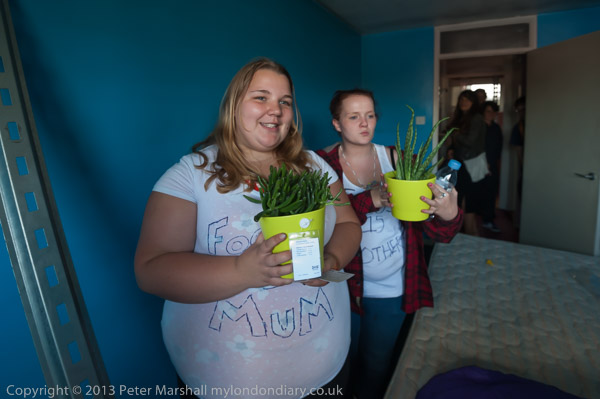
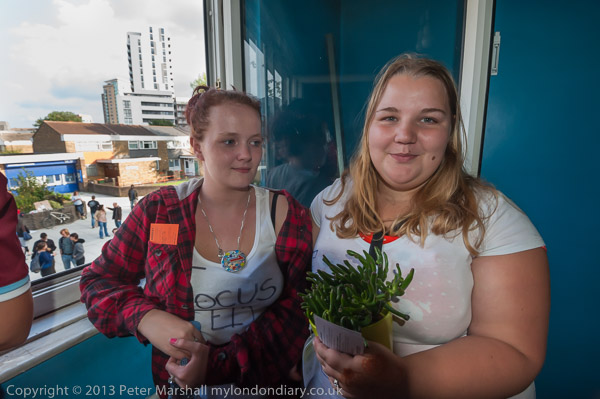
Jasmine and Sam of Focus E15 Mums hold the pot plants they have been given for moving into the Carpenters Estate flats

Housing is fast becoming a really major issue in the UK, and particularly in London, where property prices and market rents have risen so much that most of those who work there can no longer afford to live there. The current minimum wage is £6.50 per hour,  which works out to roughly £1050 per month for a typical worker without overtime. Those who get the London Living Wage are a little better off at around £1400 a month. Newspapers have recently been reporting on the tenants of the New Era Estate, a fairly typical inner London estate, currently paying rents of around £600 per month who are threatened with a rise to ‘market rents’ of around £2400 per month.

People may qualify for the misnamed Housing Benefit, (it’s really more a benefit for landlords), but the benefits cap introduced by the government (including an overall benefits cap of £500) make this totally inadequate in London. The only viable solution to the problem of keeping London running is a crash programme to build low-rent social housing, but neither of the major political parties is seriously proposing this, and while there is considerable building taking place in London, the vast majority of it is high rent private properties, many of which are being bought by overseas investors. Some simply leave them empty while property values soar, others rent them out to companies for employees here on short-term visits or as holiday lets.

Some Labour councils are among the worst offenders in this process, getting rid of social housing and profiting from sales to developers. Some have even made a mess of this, with Southwark Council reported to have lost millions in the costs of emptying the Heygate estate came to more than the bargain deal the developers made. Of course some individuals – both on the council and the developers – do nicely out of these schemes.


Jasmine and Sam in one of the Carpenters Estate flats while the Focus E15 MumsFirst Birthday Party continues outside

Newham Council, 100% Labour and with an elected Mayor have for ten years been trying to empty out and sell the Carpenters Estate, next to the centre of Stratford with its excellent transport links. It is truly a prime site, but unfortunately an earlier Labour council which had the interests of the people of the area in their heart built a well-planned council estate on it.  One that people liked living in, and despite ten years of harassment, that some are still living in.  In a borough with one of the worst housing shortages – and particularly of social housing – some properties there in excellent condition have been boarded up and empty for ten years.

Newham is also where one of the most vital campaigns over housing has been taking place, led by young mothers from a hostel for which the council decided to cut the funding to the housing association for a little over a year ago. The mothers, with some help from political activists, decided to make a stand together and fight, forming the Focus E15 Mums campaign.  They refused to move away from London to be rehoused in Birmingham or Hastings or elsewhere, away from jobs, family and support systems as the council suggested. They set up a weekly protest stall on the high street every Saturday, protested at the housing association, at the council and elsewhere, and turned the insights they developed from their fight into a more general ‘housing for all’ protest against what they had come to realise was a policy of ‘social cleansing.’

I’m pleased that I’ve been able to photograph some of their protests and help through my pictures in gaining public attention to their fight, though I regret not having done more – but there are so many calls on my time. I was sorry, having been there to take these pictures of their re-occupation of a block of four flats at the centre of the Carpenters Estate, not to have found the time in the following couple of weeks to go back and record some of the events they staged there in what was always intended as a short-term occupation of the properties.

Photographically it was a little tricky in that there was little light inside the flats, and not enough for the pictures I took as I first went inside them, in the hall and on the stairs. Most of the metal grilles were still in place, with a little light coming through the pattern of holds in them, but parts were still very dark.

I’d anticipated this, and together with the knowledge that I’d be in a crowded and confined space had switched to the 16mm f2.8 while waiting to go inside – it was a long wait and I’d had plenty of time to think about it.  One thing I often feel the lack of with my Nikon cameras is fast lenses. Back when I was using film one of my favourite Leica lenses was the 35mm f1.4 (it had cost me about a month’s salary when I bought it second-hand around 1980.)  That aperture makes it 8 times as fast (3 stops) as the 16-35mm f4 Nikon lens.

The two fastest Nikon lenses I own are the 16mm f2.8 fisheye and the 20mm f2.8 – and I’d left the latter at home. For many purposes not having fast glass doesn’t matter – particularly when we can know work at ISOs that were not viable in the days of film. You get the same shutter speed with an f4 lens at ISO 3200 and an f1.4 lens at ISO400.  But this was a time when the f1.4 at ISO 3200 would have been rather better.

It doesn’t matter so much when your subjects are static. Even handheld with wide-angle lenses its quite possible to get sharp results at half a second – just not every time. The 16-35mm has image stabilisation, but I’m unconvinced it is of much significance with wide angles, though it certainly helps on longer lenses.

As we went in it was also quite crowded and the physical size of the 16-35mm can be a problem – the 16mm fisheye is a nicely compact lens.  Once we got into the actual rooms things were easier, and I was able to take pictures with both the 16mm and the 16-35mm, and to lower the ISO, even down to ISO800 for some pictures.

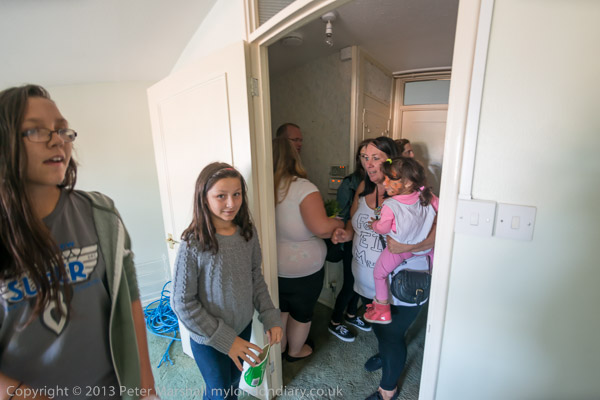
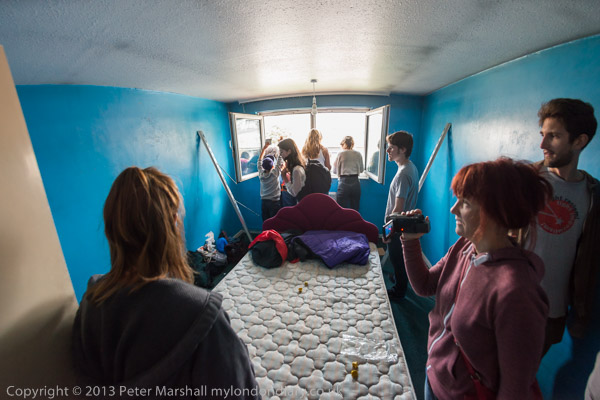
This was one of my favourite interiors, taken with the 16mm fisheye, processed with the Fisheye Hemi plugin to make the vertical and near-verticals more or less straight.  The woman at the left looking into the room is in the darker corridor, but lit be light through the doorway (with a little help from Lightroom.)  Stopped down to f5 makes everything sharp (the near objects at right just slightly less so), and even at ISO 2500 the quality is pretty good. Of course noise reduction, removal of chromatic aberration and fringing in Lightroom help. At 1/100th second there is perhaps just some very slight blurring of parts of the people as they look around, something that I like. On the original it is easy to zoom into the image and read the year 2014 on the calendar on the far wall.

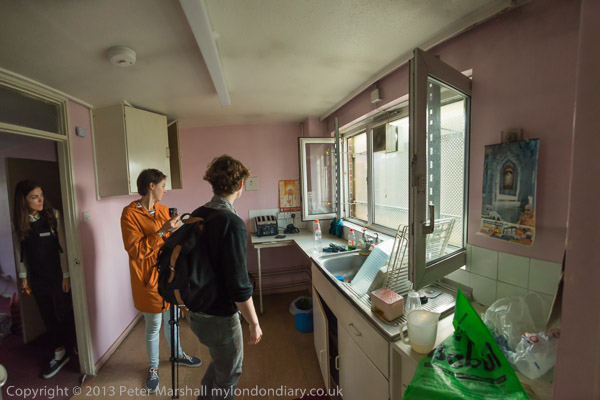
When the protesters moved in they found the flats in good order, and the water was still connected. The council soon turned it off after the occupation began. The picture above shows one of the perils of using the 16mm fisheye – and that large 16-35mm on the camera hanging down from my neck with its lens hood intruding into the image.

September 21st, when I took these pictures, was the second day of the London Open House Weekend (a week later than the rest of this country) so although it hadn’t been listed in the official catalogue, this was of course the Focus E15 Open House Day and there are many more pictures both of the party and the occupation of the flats in My London Diary.

Continue reading Focus E15

Reflections on Paris Photo

I fell a lot better about having missed Paris Photo 2014 since reading 11 Must-See Works at Paris Photo, an editorial in Artsy! If you’ve never heard of this – and it had previously passed me by – it is a New York based site with a mission “to make all the world’s art accessible to anyone with an Internet connection.

But unlike Piaf, I do have regrets, and there are certainly things in Lensculture’s mini-feature Paris Mois de la Photo-OFF 2014 that I’m sorry to have missed, and yet more in the full programme of the fringe festival. Its a festival with a buzz that we just don’t get in London, though photomonth does try. And there is also the Mois de la Photo itself.

I’ve still got until February 8 2015 to get over to see “Garry Winogrand” at the Jeu de Paume and I may just make it, though having spent some time studying the book (a really heavywieght 61/2lbs of it) I’m not sure seeing the actual prints would add much.

It is a show that does raise questions, many of which Arthur Lubow explored a few months back in the New York Times Lens blog in relation both to Winogrand and Vivian Maier, about the idea of posthumous production.

You can watch the video on which Winogrand makes the quotation with which Lubow ends his piece on Lensculture. When asked if he didn’t wish to make choices (I think he is talking about whether or not to take a picture rather than about which of his frames to print) he says “That I never do. All I do is say yes.”

The video is rather painful to watch, a question and answer session with students who had expected a lecture. Winogrand often doesn’t really answer their questions, and at times rather plays with them, sometimes seems to be refusing to examine his process or stone-walling, but he does come out with the occasional insight. In some ways it’s rather like his photography.

At one point he says something relevant to the piece I wrote yesterday:

“Is the photograph more dramatic than what was photographed? It has to be.”

 and later :

“I don’t have anything to do with what I’m photographing, ….I’m not running for mayor, I don’t get to know people when I’m photographing.”

Thinking about Winogrand and the show in one of Paris’s finest art galleries reminds me of Flat, soulless and stupid: why photographs don’t work in art galleries, by Jonathan Jones in the Guardian last week, where although to some extent I agree with him I think Jones perhaps seems to miss the point about photographs. Of course they seldom have the presence of great paintings, but to write:

A photograph, however well lit, however cleverly set it up, only has one layer of content. It is all there on the surface. You see it, you’ve got it.

suggests that he fails to understand the essential mystery of the photograph, a different nature of relation to reality than a painting or drawing. Not to mention my conviction that the best photographs – like those of Winogrand – gain their power essentially from not being set up.

Jones is clearly right about those large empty colour images that have covered most of the wall space at Paris Photo in the years I’ve attended and sell for large sums on the art market because they are trying to do something that photography doesn’t do well. He’s right too that photographs are often better seen in books than on the gallery wall (and possibly about iPads, though I think I’d prefer my larger computer screen), but “A photograph in a gallery” is certainly not always “a flat, soulless, superficial substitute for painting.”  Good shows are are good shows, and poor shows are poor shows whether they are made with paint or photography.

Winogrand is I think a photographer whose work is more suited to books or perhaps a box of prints or a portfolio; he wasn’t concerned with the photograph as object, though his work is better if well printed than if badly done. But for me good printing means that when you look at a photograph you don’t notice the printing, only what is depicted.

Where Jones dives to the extreme depths of silliness is in his last paragraph, where he suggests the experiment of looking at the Taylor Wessing Portrait show and then going around and comparing this rather bland photography with the National Gallery’s Rembrandt exhibition. “If“, he writes, “you can really see even a millionth of the vitality of a Rembrandt portrait in any of the NPG’s photos, we’ll just have to agree to disagree.” But that is a test that would also write off the great majority of the art works in the rest of the National Gallery.

WPP and WPO

The 2014 World Press Photo exhibition is currently showing at the Royal Festival Hall in London until Wednesday 26 November 2014, open every day from 10.00 to 23.00 and free. Perhaps surprisingly it doesn’t get a mention on the front page of their web site, but it isn’t too hard to discover on an inside page. Of course you can also see the entire collection of winning images online at World Press Photo, along with the previous versions.

It’s easy to knock WPP and other similar contests, but in various ways I think this is probably the best of the bunch, and there are some surprising images in the 143 on show, as well as a few others that made me think “oh no, not again.”

Another ‘World’ organisation in a similar area is the WPO, or World Photography Organisation which appears to be largely a Sony marketing exercise, though it does have something to offer to non-Sony users too. I’ve not thought too  highly of their

They have videos on YouTube, some of which are more than disappointing. I watched one, and then saw the second comment on it, “There’s 18 sec of my life I’ll never get back” and could only agree. Except I think it was 21 seconds as there was an advert you had to watch for 3 seconds before you could click to close.

But I did find one that I thought was worth watching (and there may be others), IMPACT: Photographers share the most impactful moments of their photographic careers, though I shudder at the word impactful (see Common Errors in English Usage.) You can find the video here, and it isn’t surprising it is worth watching as the 8 photographers who talk and show pictures are from Panos Pictures,  a “photo agency specialising in global social issues, driven by the vision and commitment of its photographers and staff. Panos is known internationally for its fresh and intelligent approach and respected for its integrity and willingness to pursue stories beyond the contemporary media agenda. ”

It’s all true too, except it should perhaps that second sentence should start “Panos is nothing like as well known internationally as it should be” and that it does a considerably finer job than some of the better-known names in photography. I’m not entirely convinced either that it is a good thing for them to be “proudly partnered with Sony through their new Global Imaging Ambassadors programme” though their participation will undoubtedly raise Sony’s game.  It is actually a very interesting venture and the web site is worth exploring.