Mike Disfarmer (1884-1959)

As promised, here is the piece I wrote in 2003, with just a few typos corrected. Perhaps the most interesting sentence in light of ‘Becoming Disfarmer‘ is: “Images by Disfarmer must be present in many family albums covering a wider range of his work and it would be of interest to discover if these show the same characteristics as the published work.” Of course more is now available on line thanks largely to the Disfarmer Project.

Disfarmer’s Origins

Birth and Family

Mike Meyer’s parents came to America from Germany some time before his birth in Illinois in 1884. When he was young the family moved to Stuttgart, Arkansas, now apparently widely known the “Duck and Rice Capital of the World” and home of the World’s Championship Duck Calling Contest. Stuttgart had been settled by German Lutheran farmers, many of whose descendants still farm the same lands.

He was the sixth born of seven children, and the only unusual thing his relatives remember about him as a child was his musical ability. He had a fine ear for a tune and played several instruments including violin, piano and accordion.

Work

Meyer’s father died when he was around 14, around the time he went out to work. He continued to live with his mother and worked as a night watchman at the rice mill in Stuttgart.

At some time fairly early in his working life he became interested in photography and bought himself a camera; and taught himself how to use it. We can only speculate what books or magazines on the subject he read – at this date or later

Move to Heber Springs

In 1914, his mother decided to move to Heber Springs because of its better climate, and he moved with her. There, he set up his first photography studio, in the open at the back of the house. Before long he was in partnership as a photographer with a studio in the main street.

The Cyclone

The climate was not kind to his mother, as a cyclone (probably the great cyclone of Monday, June 5, 1916, which killed 22 Cleburne County residents, although there was another disastrous one on Thanksgiving Day, 25 November 1927) destroyed the house. Meyer was apparently mentally scarred by its effects, although he soon recovered from any minor physical injuries – none of the Meyers are listed among the 1916 casualties. His mother moved out to live with one of her sisters, and he also left home.

Penrose & Meyer

The Penrose & Meyer studio was on Main Street, in the same building as the Jackson Theatre, one of the earliest movie theatres in Heber Springs, built in 1912. Penrose was perhaps an existing local photographer, but nothing seems to be known about him. Unfortunately the block was destroyed in a fire in 1921, and he had to find new premises.

New Studio

The new studio Meyer built was some 20×30 ft, slightly above the typical size for daylight studios and its design was described as modern, perhaps because of its plain backgrounds. It had a wall with large windows fitted with blinds that could be used to control the north light Meyer favoured for his pictures. In the 1930’s it became a popular place to go and have your picture taken in Heber Springs, one of the few attractions in this small town.

Birth Delusions

At some point after the cyclone, Meyer became convinced that the family in which he had grown up was not his own. He got the idea that there had been a cyclone at the time of his birth, and that during this he had been confused with the Meyer child. His own parents had been of a much higher class, more cultured and intelligent than the Meyers.

Such delusions are perhaps not as uncommon as we might think, and pass idly through the minds of many, perhaps especially those whose behaviour suggests mild autism, as some of the descriptions of Meyer might suggest. Meyer took his thoughts further to the point of an obsession, more or less breaking off relations with his real family and changing his name.

Disfarmer

The German name Meyer comes from the Middle High German meier (or meiger) which means superior or higher, and became used for more more important farmers. In modern German, Meier means ‘dairy farmer’. (The name can also be spelt Mayer or Meier, and is found from a different root in Jewish families – the Hebrew ‘meir’ meaning enlightened.)

Meyer was convinced he was not truly of German stock and was not from a family of farmers. He invented a new name for himself to express this: Disfarmer.

Small Town Studio

Heber Springs

Heber Springs was a small town of around 2000 people, although many of the studio clients will have been from the surrounding country of Cleburne County, Arkansas. The town is at the foot hills of the Ozark Mountains, and virtually the only industries at the time were farming and logging. Cotton was the main crop in the southern part of the county, and throughout the area many farmers were living at subsistence level.

Disfarmer’s Assistant

Julia Scully (see below) was able to interview Mike Disfarmer’s assistant, Bess Utely, who worked for him when the studio was popular in the 1930s and 40s. She not only developed his plates but also often cooked for him.

Utely found him to be a fine man of superior intelligence, with a firm conviction that “he was the only one who could make pictures.” His conviction that he was superior to other people made it hard for them to understand him, and “made the people think he was nutty.”

Studio Sessions

Despite his oddities – or perhaps they increased the attraction – a trip to the photographer’s became one of the attractions on the trips people made into the town. There they stood in front of the plain dark background in the studio while the photographer carefully adjusted the blinds and got the lighting just how he wanted it.

The Sessions

The town’s funeral director, recalled a sitting with Disfarmer, and suggested that it sometimes took him an hour to arrange the lighting. Although he may have worked slowly and thoroughly, it seems unlikely that his clients would have had so long a time to wait. However, it is clear that the photographer took his work very seriously and the results he obtained show this.

Over the years, Disfarmer must have taken many thousands of pictures. As well as the studio work with which we are familiar there were probably pictures taken in peoples homes and elsewhere. Images by Disfarmer must be present in many family albums covering a wider range of his work and it would be of interest to discover if these show the same characteristics as the published work.

Equipment

Disfarmer was said to have used a large homemade studio camera. Like many photographers of the time, he stuck with glass plates rather than changing over to film, at least until around 1945. Joe Albright also suggested that the camera back went through a hole in the back wall of the studio, presumably into a dark area, and that Disfarmer looked at his subjects through a window when setting up the images.

Having the camera back in the darkroom area of the studio would give the advantage of a very clear image on the ground glass screen. If the window through which the photographer viewed his subjects was equipped with a lightproof blind, plates could be loaded or unloaded without a darkslide. However, memories of Disfarmer and the way that he had worked were dim, since over 20 years had passed before the interviews.

A Recluse?

Disfarmer, particularly as he grew older, had had less and less contact with other people apart from taking their photographs, but retained his interest in music. The town barber, John Hendricks, an amateur guitarist, remembered evenings when he and Disfarmer sat in the studio playing together, Disfarmer was still a good fiddle player and enjoyed playing the kind of country music popular in the South.

Perhaps because the war had come to an end, but also possibly because of the photographer’s increasingly offhand and eccentric manner, business dropped off. Disfarmer’s studio remained open until he died at the age of 75 in 1959, but we know nothing of his work in these later years.

Posthumous Fame

Death

Disfarmer became more and more a recluse, avoided by most of the townspeople and he had few visitors, and even fewer customers at the studio. He was there on his own when he died in 1959, and it was two days before his body was discovered.

After Disfarmer’s death, the executors wanted the studio cleared, and a retired army engineer with an interest in photography was living in Heber Springs bought the entire contents of his studio for the token amount of 5 dollars.

Saving the Negatives

Although Joe Albright was disappointed to find no photographic equipment worth saving, he did have the foresight to hang on to the boxes of glass negatives that he found, some 3,000 of them, thinking they might be of some interest to local historians.

The latest of these negatives appears to date from around 1945, possibly suggesting that at this date Disfarmer changed over to using film. Albright kept the negatives in store until around 1974.

Miller and Scully

It was then that photographer Peter Miller and his wife Karen moved from New York to join an Arkansas cooperative corporation ‘The Group, Inc, and found themselves running the weekly Heber Springs newspaper ‘The Arkansas Sun’. They began featuring old photographs supplied by their readers, and Albright got in touch, offering some of Disfarmer’s work.

It was Miller who recognised that these images were possibly of more than local interest. He made some prints from the negatives and sent a few to Julia Scully at ‘Modern Photography’ magazine. She too was impressed, and set to work with Miller and Herschel and Elizabeth Coley to find out more about the man and his work

Modern Photography

Modern Photography‘, edited by Scully since she joined in 1966, was a mass circulation photographic magazine that unusually attempted to take the medium seriously, publishing features by critics including Andy Grundberg as well as a regular column ‘Seeing Pictures’ written by Scully herself.

Many photographers both in the USA and abroad looked to it for a wider view of creative developments, until it was finally swallowed up by its rival ‘Popular Photography’. The texts published by Scully form the basis for all other articles on Disfarmer, including this feature.

Publications

Disfarmer’s work began to be published in magazines and a book appeared in 1976, published by Addison House: ‘Disfarmer: The Heber Springs Portraits, 1939-1946’ with: Disfarmer Photographs from Peter Miller, the Group, Inc. and text by Julia Scully.

Other publications followed, including a feature by Scully in ‘Aperture‘, certainly one of the highest accolades a photographer can achieve. In issue 78 (Fall 1977) the company was august, including Paul Strand’s images from his garden at Orgeval, Hilla and Bernd Becher’s images of preparation plants (“breakers”), colour by Joel Meyorowitz and early pictures by Francis Frith and others from Egypt.

From an unknown and forgotten career in a small town in rural America, Disfarmer had enjoyed a meteoric rise over a couple of years to become regarded by many as a major figure in the photographic pantheon, drawing comparisons to Atget, Arbus and Sander.

Image and Reputation

The Pictures

Disfarmer is said not to have posed his ‘sitters’, and indeed most of them simply stand facing the camera in simple groups. However it is a rare individual who does not look unflinchingly into the eye of the camera, and even rarer one who smiles at at. Whatever he did or did not say to them, Disfarmer clearly imposed a relatively common approach in these matters.

The strength of these images is in part in their simplicity, but their appeal is also very much to do with the character of the people that he photographed. The pictures have a built-in nostalgia, a reference to a time past that for most of us was never present, except in film.

The People

The people here are a past we would perhaps like to think we had, a view of America when the dream was still real, even if those who are shown were not getting much of a share of it.

These are hard-working people, some still in their working clothes, but mainly in their ‘Sunday best’, reserved for going to church or for having your picture taken. Honesty apparently shines through their faces, looking at us from a simpler world where right was right. There is also a fine humanity in them, often most evident in the little imperfections.

Lighting

Disfarmer used soft, overall lighting, probably using reflectors as well as the large north-facing windows which even reduced or eliminated any shadows on the underside of hat brims. Generally the light was slightly directional, coming from the left of camera to produce some slight form shadow which gives the figures their three dimensional quality.

Exposures

His exposures seem to have been quite lengthy – perhaps in seconds – with some faces clearly showing movement blur. The people are clearly concentrating on having their picture taken, staring into the camera with the same kind of intensity that was required for the daguerreotype.

A Collector

I get the feeling that Disfarmer regarded himself more as a scientist than an artist, pinning these people closely against his background and walls almost as if he were making a butterfly collection. But here the subjects respond to his game, some with dour obedience (life was hard and many things just had to be born), some with near terror and others determined to show their individuality through pose or gesture.

For many a trip to the photographers was perhaps similar to a trip to the dentists, something that had to be endured. Young men about to go to war, dragged in by their family to pose with them, and also proud men returning and celebrating.

Although some families will have had their Kodaks, there was still an immense gulf between the kind of small blurred mementos these provided and the carefully composed large format quality of the professional.

Disfarmer and Evans

Although I have no doubt that these are fine portraits of their time, to me the work lacks the complexity of that of Atget and Sander. It is, like its subjects, honest and straightforward.

It has a similar appeal to some of Walker Evans’s work for ‘Fortune’, such as his images of tools, but lacks the complex feelings of those images that he made of share-croppers, articulated both in his photographs and in the text by James Agee that accompanied his work in ‘Let Us Now Praise Famous Men.’

Evans took his pictures as an East coast intellectual coming in to the lives of the sharecroppers; while Disfarmer, despite his own certainty that he was an outsider, had known and shared the circumstances of those who entered his studio for all of his life. It is work from a different viewpoint, equally valid but more limited.

Evans – and his colleagues at the FSA – give us a view from the outside, and at times one that was designed to further the aims of the organisation, although Evans himself clearly worked to his own agenda.

In later years, the work of the photographers was more clearly linked to the war effort. Disfarmer had no such pressures, providing a service directly to those he photographed, if one suspects rather on a take it or leave it basis.

Vintage Prints?

I admire Disfarmer’s work, and was pleased to have the opportunity to view some original prints at a recent exhibition. These were prints made from the original negatives, rather than prints made by the photographer himself, and it would be interesting to be able to compare the two.

Those who have edited and published his work appear to have treated it with commendable respect, although it is not possible to know how clearly their selection of his images would reflect what Disfarmer would have considered to be his most important work.

More Disfarmers?

Disfarmer isn’t a photographer whose work has changed the course of photography, but work that was carried out by someone who remained unknown outside his own small community. It is interesting to speculate on other Disfarmers hidden away in their own small towns around the world, working quietly and diligently cultivating their own gardens.

There have indeed been such claims made for other photographers – including even some from Arkansas – but the evidence that I’ve seen usually fails to support their cases. However, interesting photographers from the past are still being discovered.

It is perhaps less likely in the present that such talent should be overlooked. Had he lived in the present, Disfarmer would probably have been spending a great deal of time on the Internet, creating a web site about his switch at birth and his photographs. Bushels are rarer these days and fewer candles remain hidden.

Louis Clergeau

Of course not all photographers get treated fairly after their death. To judge from John Berger’s review of ‘A Village in France’, Louis Clergeau’s pictures of life in a small town near Blois in central France from 1902-36, his work has been reduced to an almost meaningless nostalgia.

Rephotography

Photographer Toba Pato Tucker was so impressed when she saw Disfarmer’s work that she went to Heber Springs for two years, photographing some of the same people that he had photographed, as well as their descendants and relatives. The differences her work showed between the 1940s and the later work was the subject of a book by her and Alan Trachtenberg, published by the University of Mexico Press in 1996.



Becoming Disfarmer

Back in 2003 I tidied up my notes on a studio photographer who had been unknown outside his home town at the time of his death in 1959 but whose remarkable work had been discovered, published and exhibited in the 1970s. It seemed surprising to me at the time – fairly close to his death when many who had known him were still living – that apparently rather little was known about the man – Mike Disfarmer – and what there was seemed rather strange. Perhaps there was in some an interest in making him out to be a true eccentric – as had been done with Atget until further research gave us more facts. In part it seemed good marketing and it was perhaps getting in the way of many seeing his pictures for what they were.

As usual my own writing wasn’t based on any original research, but on what I could glean from a number of magazine articles and internet sites, and I made no claims to originality other than possibly in my comments on the work. And perhaps I could claim to have looked at the pictures more carefully than many, and with a photographer’s eyes.

It was a piece that at the time led to considerable interest, and I got comments and e-mails from a number of people, including from Julia Scully who, together with Peter Miller had written about and first published his work, and several others closely involved.

In some of the e-mails I was sent other pictures that Disfarmer had produced, that had not at that time been published elsewhere. The pictures we all knew in 2003 had all come from a batch of glass plates that had been saved by a former Mayor of Heber Springs after Disfarmer’s death and were then discovered by Miller and were a relatively small part of his output – a few years from his around 45 years life as town photographer. None of them were actual prints made by the photographer, who had only made prints for the clients he had photographed; his prints were on the walls and in the family albums of people living in Heber Springs and the wider area of Cleburne County.

The Disfarmer Project was launched in 2004 after New York photo collector Michael Mattis was offered a family collection of fifty prints made by Disfarmer by a young couple who had grown up in Heber Springs. He set up the project to find as many vintage prints as he could using people from the community to visit local homes, working with the local Cleburn County Historical Society. They unearthed well over 3000 photographs. A chapter from the book Disfarmer, The Vintage Prints “Disfarmer Rediscovered” on ASX shows some of the range of his work over 40 years.

At times there seemed to be some friction or competition between the Disfarmer Project, Disfarmer.com who market prints from the Miller collection of glass negatives and other collectors of original Disfarmer prints (and it was something I became at one point peripherally involved in, though I write as an outsider), with each laying claim to being concerned with the ‘real’ Disfarmer. But all seem to be cooperating in the new official Facebook Page.

But things are not all sweetness and light, as Chelsea Spengemann, art historian and curator of Becoming Disfarmer, currently showing at the Neuberger Museum of Art in Purchase, New York State until March 22, 2015 found. In a Time Lightbox feature Spengemann talks about how she wanted to go beyond the myths and put the published enlargements into the wider context of the vintage contact prints made by the photographer for his clients. Two collectors who had been working with her withdrew their prints from the show a week after the catalogue was printed as they objected to her choice of lesser known – and in some cases damaged prints. Half the show had to be replaced and the catalogue reprinted. Disfarmer is now big money for some and they don’t want their investment damaged.

According to the museum press release, Becoming Disfarmer includes “examples of his restored and unrestored vintage prints made between between 1925-1950, enlargements made posthumously from 1976-2005 from his glass plate negatives dated 1939-1946, as well as audio clips, historical journals, newspapers, and other ephemera.” The show also features some pictures with inscriptions on fronts and backs showing their function as “intimate family keepsakes“.

I’ll perhaps look out my article on Disfarmer and make it available here again, so long as it doesn’t seem to need much alteration.

Breach of Copyright

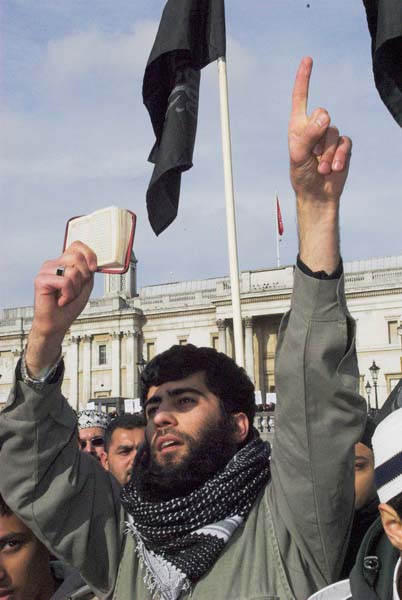
You may have seen this picture recently, as it has appeared over 80 times on the web, many in the last week, at times clearly with a Demotix watermark – indicating it is unlicensed. A few of the instances were probably taken from my own web site, with my discreet watermark cropped off the bottom.

I took this picture in London in July 2011, at a protest organised by Anjem Choudry, apparently MI5’s favourite Muslim honeypot, Muslim Extremists March For Sharia Zones.

Here is the context from my web site:

Around 70 men from Muslims Against Crusades marched from Leyton to Walthamstow calling for the setting up of Sharia Controlled Zones in the UK which ‘Islamic rules’ would be enforced by Muslims.

and the caption on Demotix is:

“Muslim man holds up ‘Sharia Controlled Zone’ poster at protest calling for Britain’s first Islamic Emirate”

and on my own web site: ‘

The controversial ‘Sharia Controlled Zone’ poster that has gone up in several East London boroughs’

I’ve not looked at all of the uses made of it on the web, but those I have seem to be using the image as evidence of ‘no go areas’ in the UK, which clearly it was not. Most also seem to be Islamophobic in tone, some rather rabidly so.

It may be that a few of those sites have licensed the image from Demotix (or Corbis etc) and I will in a few months time get a few pounds for my work – the fees Demotix charge for web use are derisory. I’ll look through the sites and decide if there are any that might be worth chasing up for payment, though I doubt it as few seem to be UK based.

I may also report it to Demotix, but I doubt they will be of any help, and the time I would have to spend on chasing up all these instances would be enormous. Its vital that we have copyright laws, and sometimes photographers can benefit from them (as I’ve done on a few occasions) but much of the time they only benefit the large multinational agencies who have the time and resources to pursue infringers around the world.
Continue reading Breach of Copyright

Slow Recovery

I’m sitting typing at my notebook, and using it to copying my files from 2007-8 from an old external hard disk onto my new Drobo 5N NAS. And rethinking how I intend to backup my work. This is a slow process, as the hard disk is only USB2, and at around 15Mb/s the 500Gb will take around 8 hours.(Later I found the speed roughly doubled if I actually plugged the Ethernet cable into the router, rather than just assuming it was connected and transferring over the wireless link.) I’ve another 9 disks to go through, some larger, though I’ll not transfer everything to the new system.

To my right, my desktop computer is still chuntering through Chkdsk on my drive G:, all 3TB of it. It’s now got on to telling me that there are around 450,000 files that need fixing and is looking at each in turn to tell me it can’t fix them. It says that it is 10% through, but I don’t believe the figures. Probably it will finish some time early next week. Meanwhile I’m doing the best I can with the notebook.

I got all ready to take pictures yesterday when I got a message telling me the event had been cancelled. There was a suggestion I might cover something else, but unfortunately by the time I read the message it seemed to late to get there.  I don’t have Lightroom installed on my notebook – I decided the screen was too small and the keyboard and pad wouldn’t make it worth having. I could install it now – or put it on my smartphone as the licence allows, but instead I’ve decided to work in RAW + Fine jpeg mode until I get back onto the desktop machine. I do have an old copy of Photoshop I can use to do some adjustments.

The Drobo has advantages and disadvantages. It should protect against a hard drive failure, enabling me to replace a failing disk without losing work, and it should also allow me to increase the capacity of the system by installing disks of higher capacity. It also means that should my computer go down I will be able to easily access all my files from any other computer I attach to the network. And it is certainly convenient to have access to so much work in the one place.

Its big disadvantages seem to me to be that it is a proprietary system, and that it is also a single point of failure. So while I’m backing up my files to it, I’m also looking at keeping at least one other copy of all important files elsewhere.

I’ll store the old external hard drives carefully – and hope they remain in working order unused. And I’ll keep another attached to my main computer to store current work, replacing that as it gets full. I suspect that they will remain usuable if stored well – at least so long as we still have hardware with USB ports.
I still have boxes full of CDs and DVDs with most of my digital work (and some scans) on them, going back now in some cases around 20 years. Despite the health warnings many have given over the years, so far these have remained readable – I did always look for disks which were supposedly of good quality. I gave up writing work to these around a year ago when with 32Mp files things really got out of hand. And some of the scans and panoramas come to around 250Mb a time, which makes DVD at 4.7Gb look rather small.

I’m thinking now of going back to them, though only for storing a copy of the jpegs that I develop from Lightroom – a much more manageable proposition. An alternative would be to use USB memory sticks, given the low prices of 64Gb USB3 sticks; again people say these are not suitable for long term storage, but those I wrote when they first came out remain readable. I’ll also consider getting a Blu-Ray – perhaps external – writer which are now available at a reasonable price, and 25Gb media at around a quid a piece, but I’m less sure about them.

Of course I should be using cloud storage, but I trust that less than I do optical media. Who can say which companies will still be in business next year – or whether the promises they make will be kept? And cloud storage for all of my work would be prohibitive in cost. It does provide a valuable safeguard against theft, flood or fire etc, but perhaps I’ll ask a friend to keep a small bag of memory sticks or box of disks instead.


Computer Problems

Today I’m having computer problems. Yesterday while I was working we had a little power glitch; the light and my printer went off for a fraction of a second and then restarted; I don’t have a proper inyterruptible power supply, but the mickey-mouse protection on my fancy socket kept the computer working. People not far away had a power cut that lasted some hours, so we were fortunate. Unfortunately one of my external hard disks although it seemed to keep on working appears to have suffered some damage.

I turned on the computer it’s connected to today and went away to leave it to boot up, returning a minute of so later to find that it was running CHKSDK on my drive G:, with white figures about unreadable files flashing across the screen. Seven hours later it is still doing it, with a message telling me “10% complete”. It isn’t a good idea to interrupt CHKDSK (and I think the only way to do so is to turn off the power), so I’m working today on my notebook.

It isn’t a bad notebook, but the screen is around a third the area of my desktop, and the keyboard isn’t great for typing. But perhaps the main problem is that I can’t easily access the files stored on the desktop machine and its attached external drives.

For years I’ve been meaning to go over to network attached storage, but haven’t managed to persuade myself to pay out the cash for a decent system. Instead I’ve just added more external drives, though not all permanently connected.

I don’t know how much of the data on the disk currently being checked I will be able to recover. I think most or all of it will in any case be stored elsewhere, either on other hard disks or on CD or DVD. So I’m hoping little will be completely lost, though I anticipate it will take me quite a while to sort everything out.

Meanwhile, I’ve finally got around to ordering that NAS system I should have installed years ago, and once everything is up and running will be copying my work onto it. It will be a very long job, but should end up with things being better organised than before. It may mean rather less time for me to write here for a while.

Pegida Problems

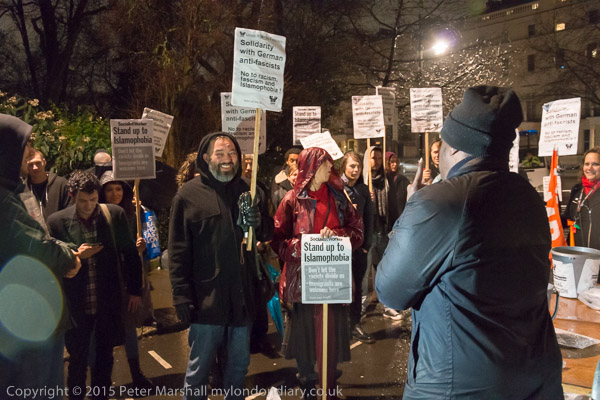
It was a dark, damp night, with fluctuating rain, occasionally slackening to a standstill and at other times almost filling the air with fine drops, so fine it was deceptive, hardly appearing to be raining, but soaking everything and looking down I saw streams of water flowing across the barrel of my lens as it stuck out from my coat.

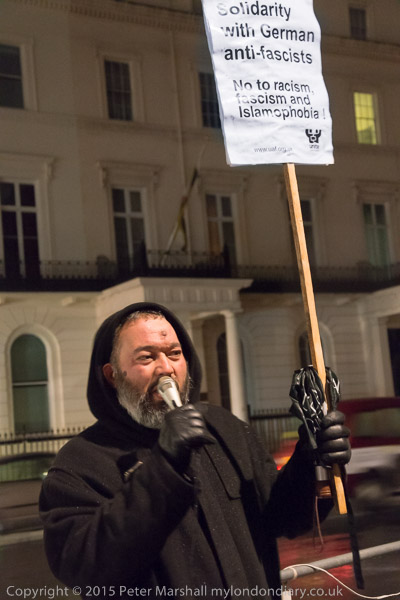
Any sensible person would have taken one look at the weather and decided they had better things to do than hanging around on a street corner as we were on the corner of Belgrave Square, in a dark area penned off by barriers, and most of those who had signed up for the event on Facebook had clearly come to that conclusion.

And it was dark. There were lights across the road, but even the bare winter trees of the square seemed to create an area of shadow. A small group of photographers chattered gloomily, one saying “they don’t tell people about this at media school”; standing in the cold, dark rain certainly is a less glamorous side of being a photographer.

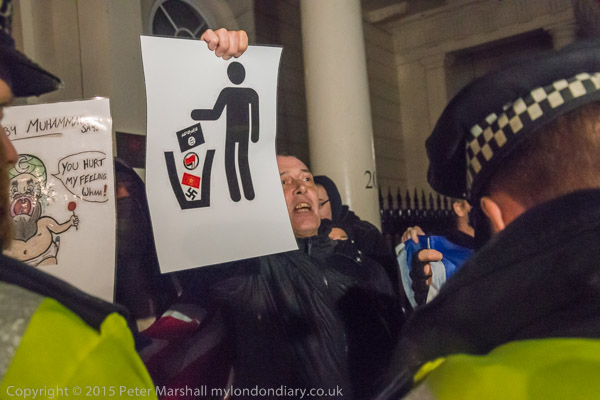
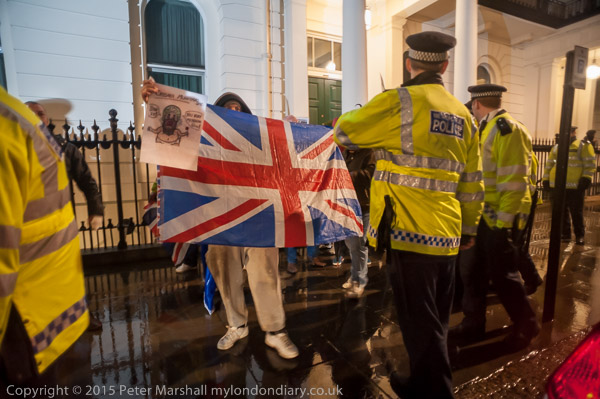
I don’t like working in the dark. I don’t really have the best equipment for it, with no fast lenses for the Nikons, and good though the Nikon flash system can be, in the wide outdoors flash is seldom a good answer. Suddenly there was something to photograph, a man carrying a Union Flag walked past the Unite Against Fascism pen and started shouting insults as police came to move him on.

I rushed to the scene, framed and pressed the shutter release and absolutely nothing. It was too dark for the lens to focus. Just what focus assist is designed for, but Nikon thoughtfully disable it just for those occasions when it’s most necessary. Or at least only let you use it if you are using single-servo (S) focus mode AND you are either using auto-area AF OR have the centre focus point selected in other modes.

I fiddle with the camera in the dark, but before I’m able to solve the problem the guy has been led away to a pen 50 yards down the road where a few other right wing extremists are being looked after by police.

It isn’t the only problem I have with the D700. A few minutes later when I’ve been taking pictures using manual exposure, 1/30s at f2.8, I hear it making a rather more lengthy exposure and find it has altered the ISO to 800 from the 3200 I had set, and changed mode and set the aperture to f32. Clearly it is suffering from mad camera disease. I fiddle with it a bit more and find I do have auto-ISO set, which doesn’t account for the rest of the changes, but the camera begins to work more sensibly when I turn this off. I think it’s probably suffering from old age, I will have been using it for six years next month, and has taken over 370,000 pictures (according to the EXIF data) well over twice the minimum rating of 150,000. Probably it’s due either for an expensive service or replacement. As it has a few other peculiarities perhaps a replacement would make more sense. You can get a D700 in good working order with a reasonably low shutter count but some cosmetic damage for under £500, but probably it’s time to upgrade.

If the camera is now doing its best, with the SB800 attached the system is still playing a few tricks, with seemingly random exposures, and I more or less give up on the flash. There is occasional and rather unpredictable light from several people using video lights on their cameras, often a real nuisance as I have to keep moving as it shines direct into my lens, but at times giving me some dramatic lighting (though of course very flat for those who are supplying it.)

I have the camera set to ISO3200, but also have the exposure compensation at around -2 stops. Working without considerable compensation gives results that are just too bright – and can end up looking as if they are taken in daylight rather than at night. Despite the compensation I think the results are what you would expect at in terms of image noise from ISO3200.

Much of the time, having set the ISO and compensation I actually work using manual exposure in any case, taking no notice of what the camera meter indicates but looking at the image on the camera back and in particular the histogram. I kept wishing I was using the Fuji XT-1 because I think the electronic viewfinder would be better than an optical one; the Nikons do have ‘Live View’, but it’s clunky and you only see it on the camera back, and I find unusable for taking still images of action. The faster lenses for the Fuji would also have been useful. But my XT-1 body is currently in for servicing.

The video lights  of several people working with video let me work without flash when the small group of right wingers (they seem to come from the various overlapping groups I’ve photographed before – EDL, South East Alliance, NF, Casuals United, Golden Dawn… and for this occasion some at least of them have called themselves UK Pegida.

Police led them off from the embassy and took the street leading towards Victoria Station. I thought about following with them and taking more pictures, but decided I’d had enough, and walk off in a different direction to get a bus, while the UAF vigil continued.

The following afternoon a friend of mine showed me a cheap LED light – under £30 –  he has bought that seems considerably more powerful than those I’ve previously tried – as the more expensive models used by the videographers clearly are too. I’ll perhaps give one a try – and report back later.

More about the event at Solidarity with German anti-Pegida – and more pictures.

Continue reading Pegida Problems

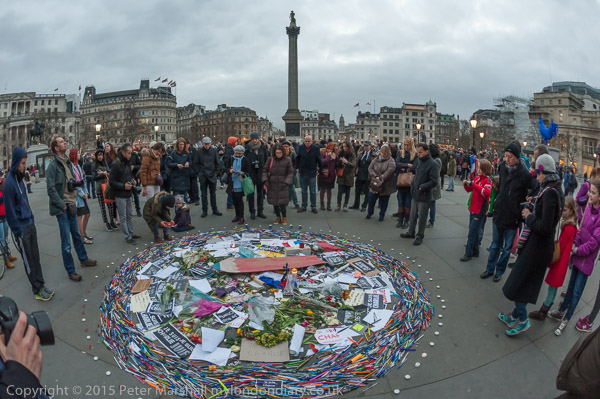
‘Je suis Charlie’ London – Clegg et Sylvie

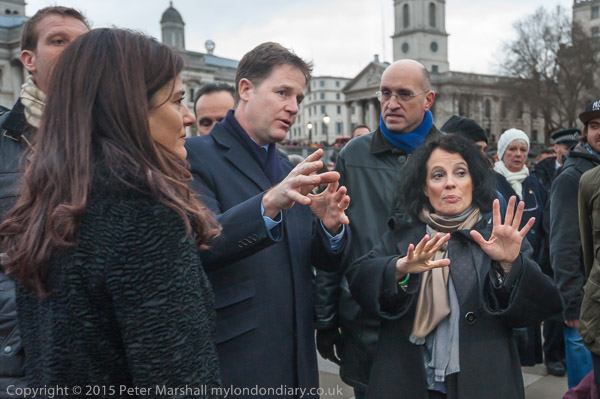
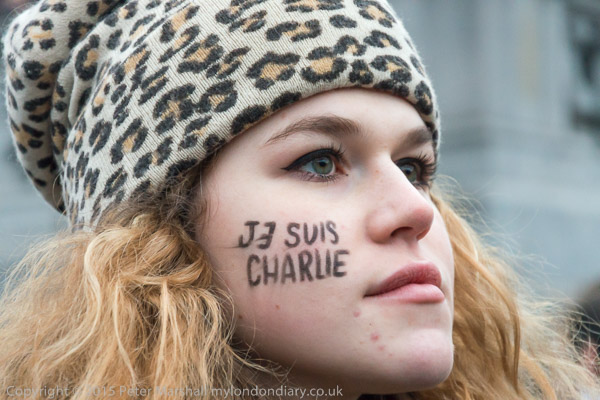
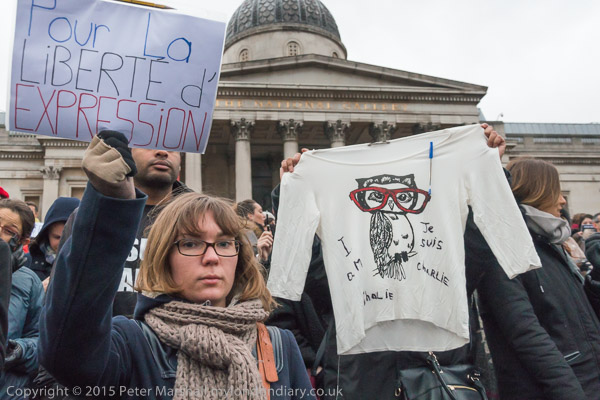
I’d decided some months ago that on Sunday 11th January, as on too many previous January 11ths I would be covering the event to mark the anniversary of the setting up of the illegal Guantanamo Bay prison camp, and decided to stick to that decision even though the major news event in London was the ‘Je suis Charlie’ vigil in Trafalgar Square. So I only arrived there after I’d spent over an hour outside the US embassy, at just after half past three, and had expected to miss the French Ambassador.

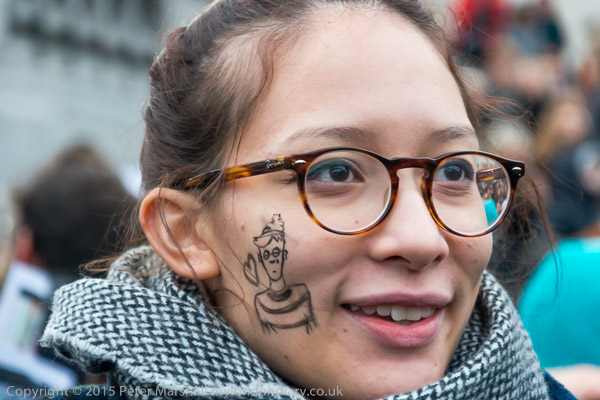
A large crowd filled the square and the steps up to the National Gallery when I arrived but there was nothing obvious going on, so I plunged into the crowd and worked my way across the square taking pictures. I really didn’t feel I was getting a great deal, and knew that many other photographers were doing much the same as me, and had more or less decided to give up.

I’d walked around to the front of the square, in front of an empty and taped off area in front of the plinth and was looking at the crowd, wondering if I could take a good overall picture, when I noticed a commotion in the centre of the crowd, with cameras being raised above photographer’s heads to take pictures. Something was clearly happening, and I made my way in that direction, to meet with security men hustling obviously important guests away through the crowd. There were people at the front I didn’t recognise, then I saw a man being interviewed as he walked along who was vaguely familiar. Could it be Nick Clegg? I walked backwards taking pictures, and he stopped as a French woman grabbed his arm and complimented him on his French accent, asking where he had learnt it. “At school” he told her and after a second or so moved on, by which time I had seen the French Ambassador behind him. The two came together and I took a few pictures as they walked along, not easy as there were people in the way and a horde of press photographers was just catching up with us. After a few yards I decided I’d got my pictures and gave up, leaving the others to chase after them.

I don’t much like working with the kind of press pack you get around celebrities at events such as this. I don’t like being barged and pushed when taking pictures, though at times I try and stand my ground. And I find the pictures that people get in such situations are seldom of much interest to me – if apparently loved by editors.

I decided it was worth trying to take some more interesting pictures to go with the few of Clegg and Syvie and made my way on into the crowd from where they had come, finding a few things I was happier with.

There was supposed to be a projection of the French flag on the National Gallery at 4pm, but they appeared to be having some technical problems, and after 20 minutes of waiting with just one projector apparently working with a test pattern on the wall I saw a 139 bus across the square and decided to get on it.

Back home I tried to get the pictures to Demotix. Their server kept dropping the connection. It wasn’t until after 9.30pm that I managed to get the 25 pictures uploaded. Then they held it up more making a stupid change to the headline…

You can see 25 pictures from the event on Demotix now (I’ve corrected the headline again) – and shortly with the story (which Demotix no longer publishes) on My London Diary.

Continue reading ‘Je suis Charlie’ London – Clegg et Sylvie

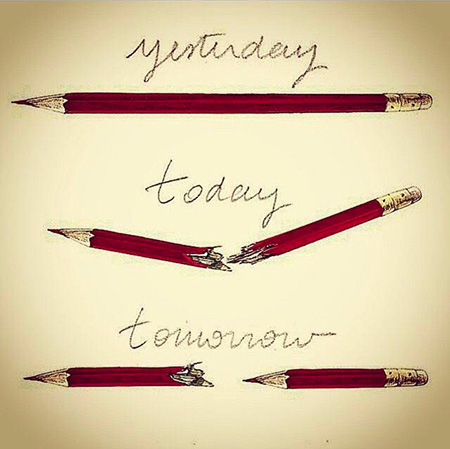
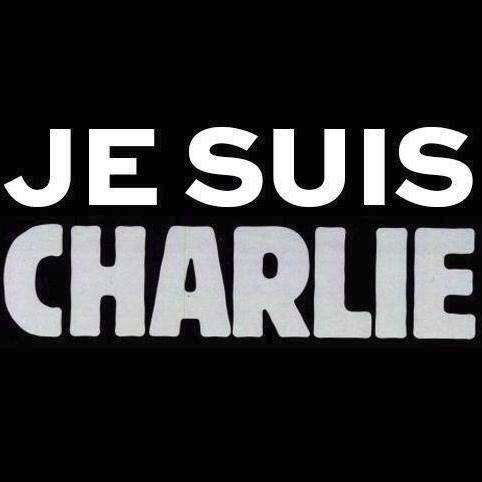
#JeSuisCharlie

charlie-1
Shared from Facebook – image by Lucille Clerc

By the time I heard the details of the protest in Trafalgar Square last night over the shooting at Charlie Hebdo it was a little late for me to drop what I was doing and get there, though this morning I regret my absence. I should have been there, at least with a pen if not with a camera.

It isn’t a matter of religion, but one of humanity. Something that we can all abhor, whether we read the Quran, the Bible or other religious texts, or are agnostics or atheists.  You, like me will probably have read many of the comments about the attack from people around the world, so I’ll only quote two of them. On the radio this morning I heard a leading Muslim scholar Tariq Ramadan being interviewed, and his comment (also on Democracy Now!) was “This is just a pure betrayal of our religion & our principles”  and my own union statement ends “Supporters of free speech and civil liberties must stand together with governments to condemn this act and defend the right of all journalists to do their job without fear of threats, intimidation and brutal murder.

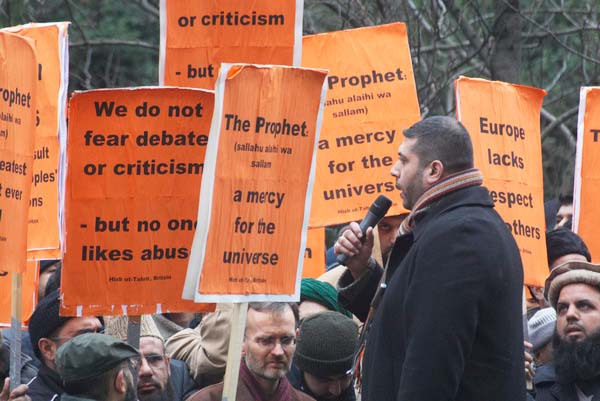
The news of the killing took my mind back to 2006 and the protests then against the publication of cartoons by a Danish magazine.

Of course I respect the right to peaceful demonstration, but the call for ‘global civility’ steps over my right to free speech once there is any suggestion it should be imposed.

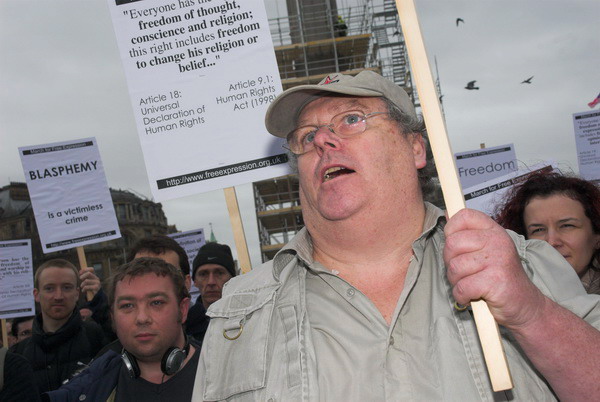
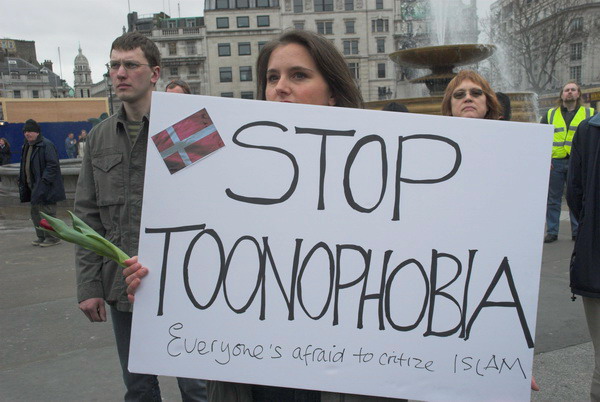
The following month I was back in Trafalgar Square, photographing a protest to ‘protect free expression’ at which some of those present held up placards containing some of the Danish cartoons – which were republished in France by Charlie Hebdo in 2005.

Charlie Hebdo was certainly not afraid to criticize Islam. Or Christianity or any other religion or politicians of all colours or anything else, but I’m sorry to have to admit that I censored some of the images that I took on that day to avoid offending people, blurring the cartoons. I should not have done so and will not do so again.

I hope that all journalists and publications around the world will stand up and be counted on the side of freedom of speech (though I know there are some countries where this is not possible.) Some will be holding a short silence at 11.00 am today (when I’ll join them and post this), and many newspapers have published cartoons about the shooting – including some of those from Charlie Hebdo that offended the killers. Perhaps we should name January 7 ‘Charlie Hebdo Day’ and make it an annual celebration, publishing their work again.

I hope too that Charlie Hebdo will continue, and continue to offend people of all faiths and none. And I certainly have no time at all for those who try to blame the victims rather than the perpetrators.

charlie-2
from Charlie Hebdo

Continue reading #JeSuisCharlie

Decisive Moments

I don’t think I have ever stolen a book from a library, although many do disappear, and I have bought quite a number when libraries have decided to de-accession them. Ex-library books are often found as bargains too in the lists or shelves of second-hand bookshops, and I’ve bought a few this way too, though I’ve found several of them have had pages removed by people who apparently take a razor blade with them when they visit their library – and its often the pages with nude images that disappear. Of course some librarians have felt it their duty to censor such images from the books in their collections too.

But I was severely tempted, back in the 1970s, at the school where I was then working, and setting up an O Level photography course. This 2000+ pupil comprehensive had a large ‘Art’ section to its library, and among the several hundred volumes was I think a single photography book, Cartier-Bresson’s ‘The Decisive Moment‘, with its Matisse cover.

The most senior of the several teachers of Art turned out to be something of a fan of HC-B, and had either got the school to buy a copy back when it was still in print or perhaps had even donated it to the library. I got them to buy a few more photography books to go with it, and took ‘The Decisive Moment’ home with me over the summer holidays. School libraries in those days were not highly protected and staff regularly walked in and out with piles of books for use by their classes, and I could have hung on to it and probably no one would have noticed. But I’m basically an honest guy and I took it back for the start of the Autumn term.

Later, when I moved to a college, as well as the college library we had a shelf or two of books in our photography base, and I’d often leave some of my own books there for use by students. I wish all of them had been honest too – and more careful with books. Much later I found that one of my colleagues was actually encouraging students to cut out pictures from them to put into their scrapbooks and personal studies, and I stopped taking books in, though I still lent many personally to students – and most came back, if some rather dog-eared and a few with broken backs.

What reminded me of this was an article in The Guardian around Christmas by Sean O’Hagan on the republication by Steidl of ‘The Decisive Moment’, which first came out in 1952. He comments – as I and many others have done before – of the difference between the French and English titles and its significance.  ‘Images a la Sauvette‘, often translated as ‘Images on the Run’ has a feeling of illegality, of moments stolen from the flux; there is an edginess about it, something which is appropriate to some of HC-B’s early work. ‘The Decisive Moment‘ is rather more static and monumental (despite HC-B’s definition which O’Hagan quotes), more fitted to what I find the least satisfying of his images, what one well-known American photographer called his ‘waiters’, where the photographer had clearly found a particular location that satisfied his feeling for composition and waited for someone to walk or run into its core.

O’Hagan writes “For me, what is interesting about the republishing of The Decisive Moment is that it has happened too late. The book is now a historical artefact.” For many photographers that became true back in the 1950’s and it was certainly so for those of us who came across it in the 1970s. We might still admire HC-B, but we didn’t take him as a model, and although very flattered I wasn’t entirely happy when someone compared my work to his back in my early years in the medium. The critical watershed was 1958-9, when Robert Frank‘s ‘Les Americains / The Americans‘ was published first in France and then in the UK, calling into question and sometimes deliberately toying with or parodying the work of Cartier-Bresson. By the 1970s we were also looking at the work of photographers like Friedlander, Winogrand, Arbus… Cartier-Bresson was history, if a very illustrious history, and of course still active. Younger French photopgraphers too were redefining photojournalism.

I probably won’t be buying ‘The Decisive Moment’. At € 98.00 it seems a little expensive (currently you can buy it in the UK for around £52, around a third less than the full price) though I think it is likely to be a good investment, as it is already on offer for rather more than this though some on-line photography bookshops.

Photocritic International etc

Another blogger who has been reviewing his year is critic and photo-historian A D Coleman, whose work on-line I’ve often mentioned here, most notably in recent times his epic series dismantling the Capa D-Day legend – and as he reminds us in his 2014: That Was The Year That Was there are still a few loose ends to be cleared up.

There is of course a lot more than this, and he starts the piece – as I also did the other day – by looking at his web site statistics. I can only comment that he deserves a much higher readership, and perhaps the new website on which he is planning to publish more of his work will give him this (and there is some more detail in his December ‘Birthday Musings‘.) He is also asking for support, both financial and “in-kind services from volunteers” and if I wasn’t far too busy I would be tempted to help. There is also a review of the main topics his blog has covered, and it is worth checking if there is anything you have missed.

His previous Year-End Ends and Odds is full of acute observations, some of which may amuse you. I don’t always agree with him (wouldn’t life be dull…), but if you like your thoughts being provoked this is a site worth adding to your favourites. One thing I don’t share is his apparent enthusiasm for the work of William Mortensen (see those ‘Birthday Musings’), though of course he should not be written out of the history of photography. We do need bad examples (a thought I sometimes console myself with.)

Whenever I find myself forgetting how bad a photographer he was I reach down my copy of his ‘The New Projection Control‘ (3rd edition 1945 – a gift, I didn’t buy it) and look at the examples he used there. And it would be hard to find a better guide to how to destroy the integrity of your images. My copy even came with a small print of a kitten between its pages as a bookmark. I doubt it was made by Mortensen but it is bad enough to have been. His “Le Chatte” included in the book is even worse, though it could well be the same animal.

For yet more looking back at the year that was, I’d recommend another site I’ve often mentioned, where you can see The Best of LensCulture in 2014 as selected by the Editors of LensCulture.