Stuck in the right place


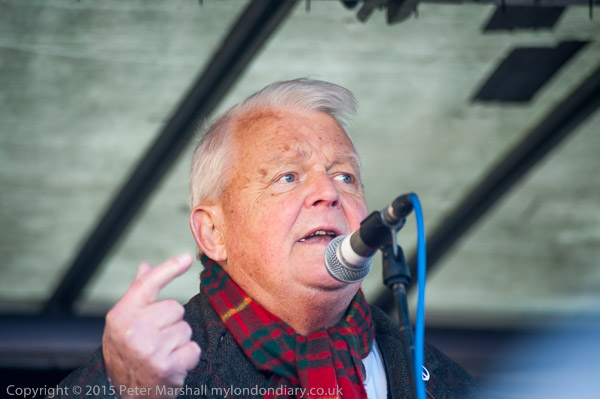
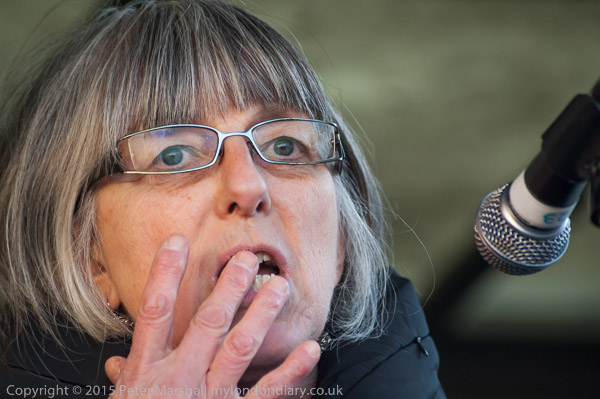
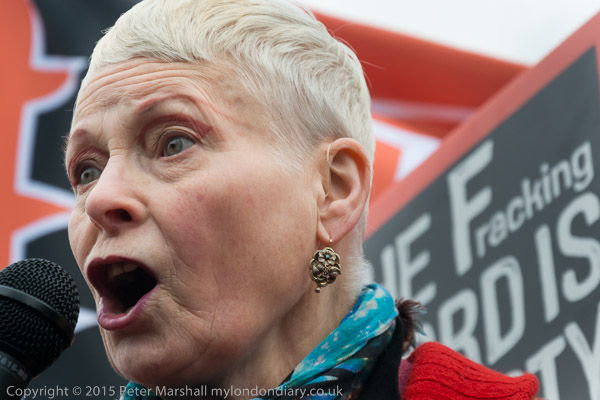
Dame Vivienne Westwood: 18-105mm DX, 105mm (157mmmm)

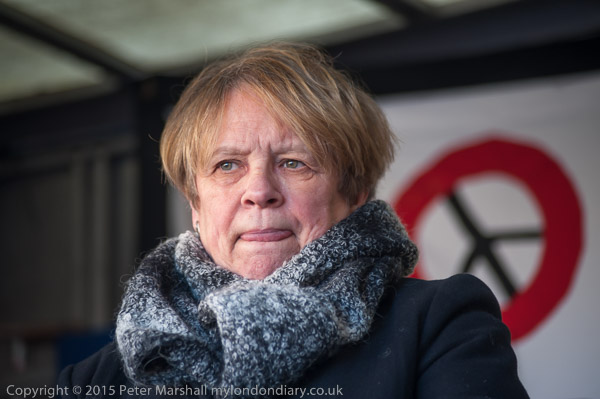
I think I made some good images of the speakers at No Fracking Anywhere! in Old Palace Yard in front of Parliament on Jan 26, but despite this and my support for the issues, it wasn’t an event I really enjoyed covering. And although I’m on good terms with many of the photographers present and like to meet them while covering events, this was one of those times when there were just far, far too many of us.
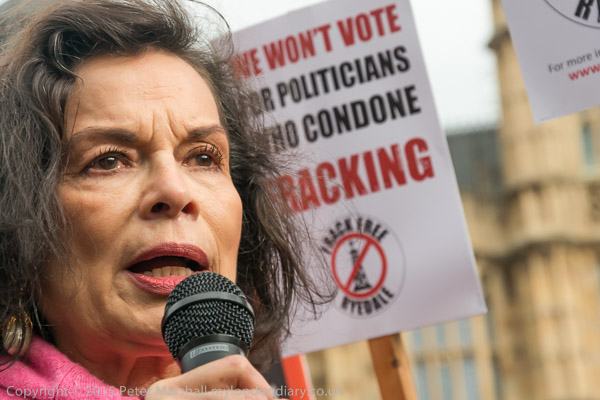

Bianca Jagger: 18-105mm DX, 90mm (135mm)

The reason for the huge interest was undoubtedly the fact that two ‘celebrities’ were among the speakers, Bianca Jagger and Dame Vivienne Westwood, and once they had both spoken the ranks thinned out considerably, making life rather easier.
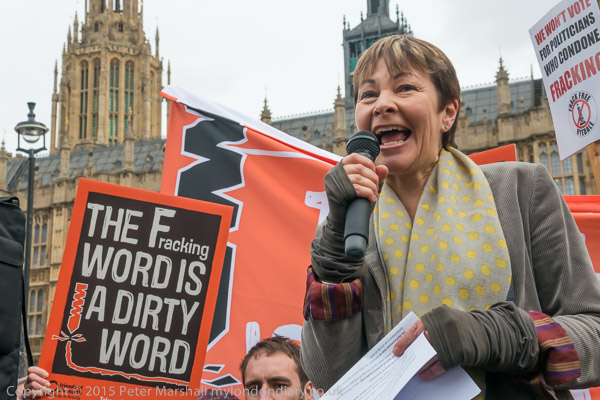

Caroline Lucas MP: 18-105mm DX, 38mm (57mm)

Fortunately when I saw that the speakers were to be using a relatively small trolley as a makeshift stage, along with a few other photographers I realised things were going to be very tight. Two rather large and tall press photographers had stationed themselves rather close to it and bang in the centre in front of the microphone, establishing where the front line of photographers would be, and I went and stood at their side. Ideally I would have liked to be a metre or so further back, but knew that if I moved back others would simply come in front of me.  I  was also glad they had chosen to stand in the middle, as I seldom if ever like to work from dead centre, not least because the microphone is then always in the way.

Soon there was a vidographer pressing on my right shoulder, and several rows of photographers behind. At one guy’s request I put my camera bag on the floor in front of me so he could work through the narrow gap between my thighs and those of the man on my left, whose shoulder I was being pushed into. Other photographers were poking lenses over both my shoulders, and there were others further back trying to take pictures over our heads,  easier over mine than the two six-footers to my left, though at least one photograph was up on his step ladder.
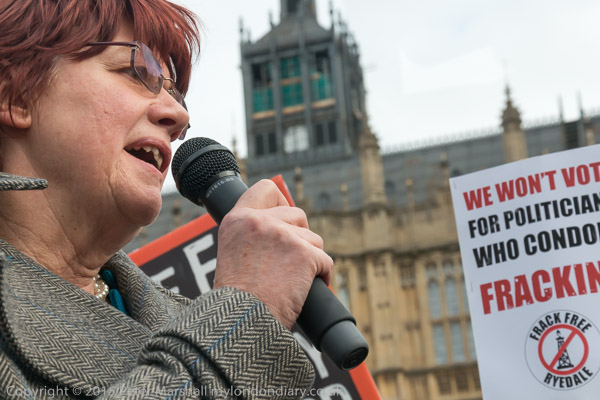

Joan Walley MP: 18-105mm DX, 66mm (99mm)

I don’t find it easy to stand in one place, hardly able to move an inch, difficult at times even to swivel my upper body around, for over an hour. Much of that time there was little or nothing taking place to be photographed, but having got a good position I didn’t want to move and lose it until things were over. But by the end of that time it was getting quite painful, suffering in both legs and my back.
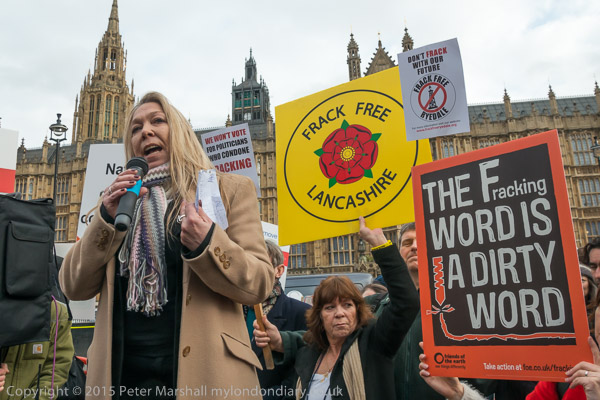

Tina-Louise Rothery: D800e, 18-105mm DX, 18mm (27mm)

There were other photographers to the left of the ‘stage’, some actually sitting on it, though I think they will have had little opportunity to take photographs of the speakers, and would probably have been better off drifting away to photograph the rest of the protesters. But unless I wanted them in my pictures (and generally I didn’t) I couldn’t work with a very wide lens. Most if not all of the pictures I took in that hour and a quarter were with the 18-105mm lens, enabling me to show speakers from the waist up at the wider end to tightly framed heads at the long.
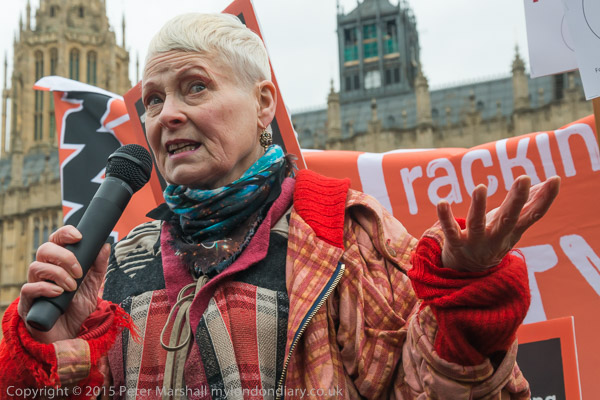
D800e, 18-105mm DX, 42mm (63mm)

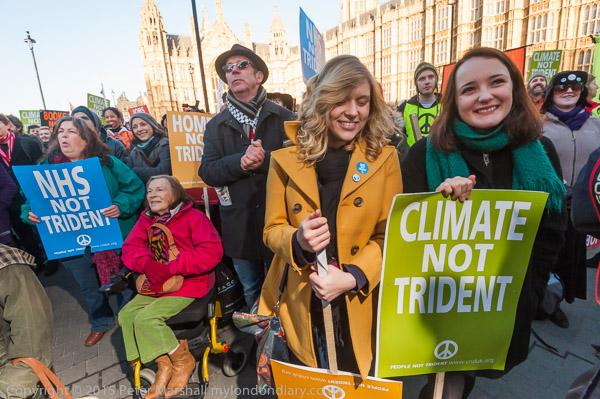
There were fortunately a number of people with placards and banners, as the area of the Houses of Parliament behind the speakers from my position wasn’t really too exciting.
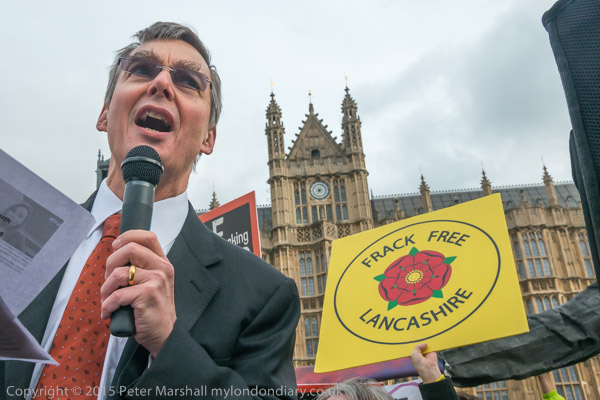

John Ashton, Former UK Government Special Representative for Climate Change: D800e, 18-105mm DX, 28mm (42mm)
There are quite a few more portraits of these and the other speakers, as well as other pictures from  the event at No Fracking Anywhere!


The only picture in this post with the D700 and 16-35mm – at 21mm
Many of the press photographers sped away to file their images of Dame Vivienne as soon as she ended her speech, making it a little easier to photograph the rest of the event – and I could even use my favourite 16-35mm wideangle.  I rather liked this group around the Greenpeace House, with Julian Huppert MP, Norman Baker MP, Bianca Jagger, Caroline Lucas MP and John Ashton, though the hand at the right of the image is perhaps a little annoying.
Continue reading Stuck in the right place
Trident Rally


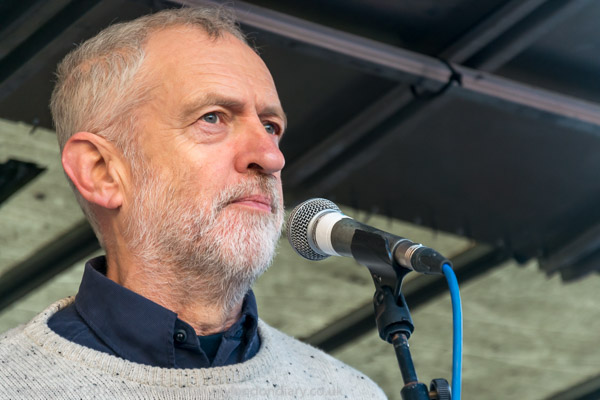
Photographers sometimes complain that Jeremy Corbyn always closes his eyes when speaking. Well, not all the time

After the scarf and the short march (see ) came the rally in a fairly crowded Old Palace Yard opposite Parliament, and again CND had organised things fairly well for the press, with a reasonably uncrowded area between the crowd  and the fairly low stage. It was possible to move fairly freely around – although limited by the presence of other photographers and videographers.

It is mainly videographers that cause a problem for photographers, and on this occasion one that had set up a little way back and perhaps on too low a tripod and was then objecting to any photographers standing in line closer to the stage.  I suspect my bald patch appears in some parts of his video, though I tried hard not to obstruct his view of the speakers – and he could have avoided me by zooming more tightly. Mostly I think it is people who aren’t used to working in crowded areas like this who cause such problems.

In general still photographers cooperate well with each other; most of us try hard not to get in the way of those who get there before us, and work over their shoulder or to one side. One more recent problem is with those who now use backpacks and are often just not aware when these are rudely pushing against others. Shoulder bags can get in the way, but it’s more obvious as they tend to come off your shoulder.

There is a definite advantage to being tall and able to work over the heads of others – and often press photographers will bring step ladders with them. I’ve never bothered with carrying one around, though I have sometimes thought about using a folding stool which would give me a few more inches. There are some very light ones that wouldn’t be a great burden to carry.


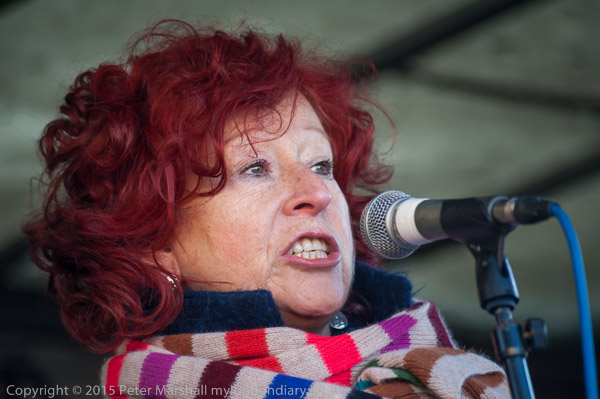
Heather Wakefield, Unison’s Head of Local Government, Police and Justice

On this occasion, apart from that one videographer who was something of a pain, (and perhaps he will learn from the number of photographers who walked across his video)  it was fairly easy to move around and to get in something like the right place for photographing most of the speakers.

For me there are two main aspects to finding the right place, the placement and use of the microphone and the background. There isn’t one right place, as different speakers approach the microphone differently, some almost swallowing it, and others standing back. Usually I prefer to see a face unobstructed by the microphone, or, failing that, to see clearly most or all of the mouth. And eyes are often vital. Some people stand like statues as they speak, while others move and look around. Faces differ, and an angle that works with one speaker will not for others. Taking all your pictures from the same place would in any case be rather boringly repetitive – an easy trap to fall into.


CND veteran Bruce Kent

Backgrounds are often a problem, and this had a rather ugly roof over the stage which features in most of the images as I was working roughly from the level of the speakers feet. Mostly this is a little subdued by being out of focus, working at fairly wide apertures with fairly long lenses (mainly 100-300 mm, with the Nikon 18-105mm DX on the D800E and the Nikon 70-300 FX on the D700.) At the longer end it becomes hard to get enough depth of field on faces, and all too easy to autofocus by mistake on the microphone rather than the eyes. Sometime, when speakers make interesting gestures, you have a choice of whether the focus is on the hand or the eyes, and it’s one that the camera may make for you as you rapidly catch the moment. Some cameras have ‘face detection’ which might help – unless you want the hand sharp.


Julie Ward, Labour MEP for the North West of England

Mostly getting good images is about watching and being prepared to catch the moment. It’s only too easy to get the moment after, perhaps when the speaker’s eyes have closed or the pointing hand dropped half out of frame. Digital makes things easier by letting you know what you have taken – and this is one of the few times I actually sometimes look at the previews when I’m working – and sometimes delete images. The good thing is that most speakers repeat themselves, if not in what they say in what they do. If you fail to catch that glance up the first time you can be ready to do so later.


Lindsey German, Stop the War, waiting to speak

It’s also good to keep an eye on what else is happening on the platform. Sometimes the best pictures come before or after people speak – and on this occasion this was important for the background as well, enabling me to get away from that roof.  The picture of Lindsey German waiting to speak with a clear graphic behind her is far better than any I managed while she was speaking.

And of course the rally is more than the speakers (though pictures of well-known names are more likely to be used) but the audience may well be more interesting.

You can see some of my other attempts to photograph these and other speakers and people in the audience at CND Scrap Trident rally at Parliament.

Continue reading Trident Rally

Wrapping up the MoD


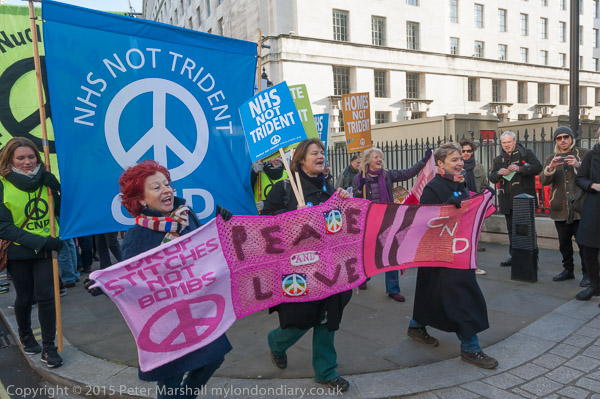
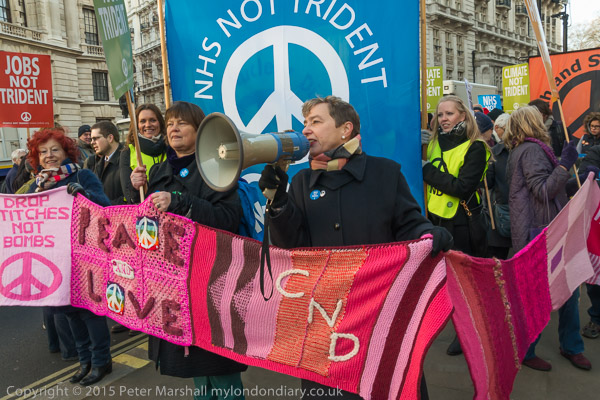
The start of the scarf passes in front of the MoD, held by Heather Wakefield of UNISON, Rebecca Johnson and CND Chair Kate Hudson

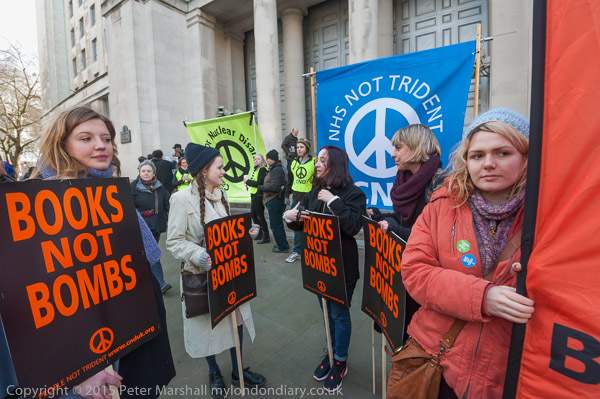
I don’t much like photographing the ‘big’ protests which attract a lot of media interest because things often get too crowded and too organised by stewards and police to make it possible to work as I like to do, and I was pleased to find that although CND’s ‘Scrap Trident’ protest was a decent size, it wasn’t like that at all. True, there were a lot of photographers present, but there weren’t any of the media scrums that make life unpleasant, and the stewards were helpful, doing their job and not getting in the way. Groups like ‘Stop the War‘ could learn a lot!

There were perhaps a couple of thousand protesters, though it wasn’t easy to count, as much of the time they were rather spread out, so it was a decent size for a protest. Perhaps surprising there were not more, since there are few people who aren’t politicians or have shares in companies who might benefit from spending huge amounts on weapons systems that will never be use who don’t feel that the huge sums of money involved in replacing the UK’s Trident missiles is a waste of money – that, as the placards at the protest said, would be better spent on Education, the NHS or, well, almost anything.

Our independent nuclear deterrent has for many years been fictional, a very minor part of the US nuclear deterrent; we maintain the fiction to keep the place in some interenational bodies as a ‘nuclear power’. Other countries which have nuclear weapons – like Israel – prefer to keep quiet about them, so haven’t got invited, and North Korea didn’t get an invite after testing one (perhaps because our intelligence services know it was one of three designed in Israel, assembled in South Africa, shipped to Oman in a covert UK goverment operation supervised by Dr David Kelly and then stolen by a Zimbabwean arms dealer who sold it on the black market – or am I just reading too many conspiracy theories?) Perhaps we should just spread some stories around about Trident having been given a new lease of life and use the money for something useful.


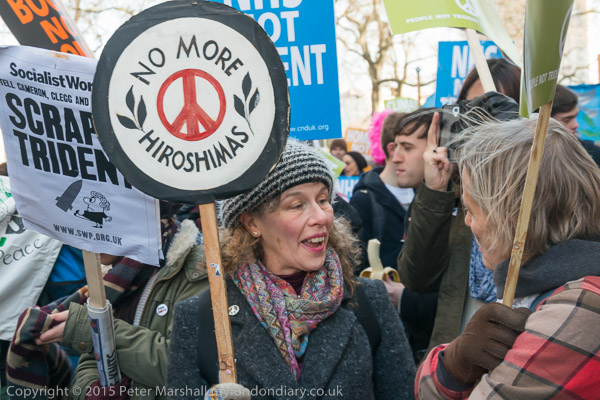
A woman with a vintage ‘No More Hiroshimas’ placard that her mother had carried to Aldermaston on the first march in 1958

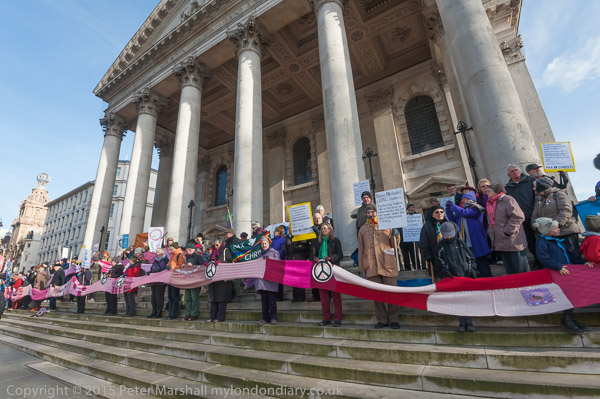
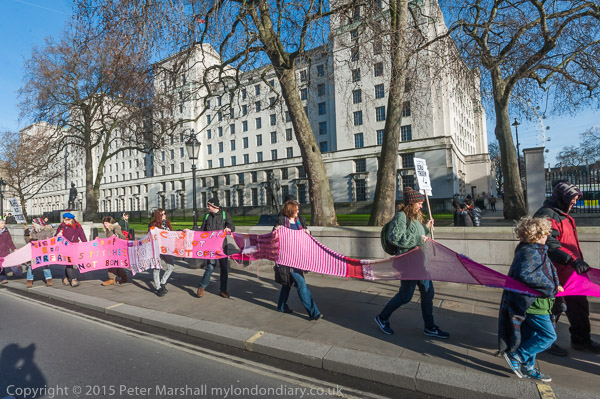
Back to real life, the protest did raise some problems. How does one photograph a scarf wrapping around four sides of the block containing the Ministry of Defence, around 0.7 miles in length? The answer has to be in rather small lengths, as otherwise it just gets too small to see. But you also need a longer view to show it really is a long piece of knitting.

I’d previously photographed a much longer length of this knitted peace scarf, around ten times as long, stretched out between the UK’s two atomic bomb factories in the Berkshire countryside, Aldermaston and Burghfield. I’d gone on a bicycle and ridden along the length and back, taking pictures of the scarf being put into place, and then after it was joined up, run along beside part of it taking picutres for the 15 or 20 minutes that people held it up – and it had worked out quite well.

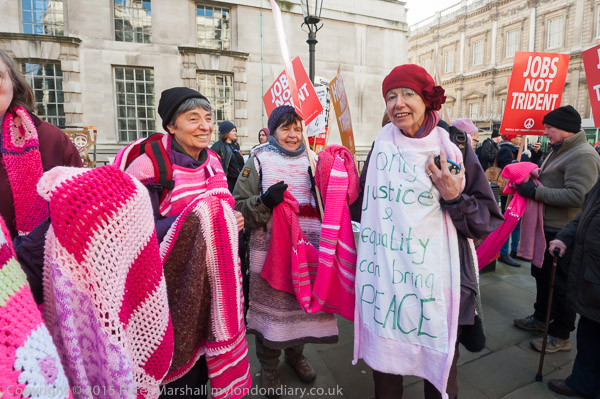
But this was different, with the scarf being carried around by the protesters walking around the block. I started by photographing people as they gathered for the protest, including a faith group who started from a service at St Martin’s in the Fields before marching down Whitehall with a shorter length of scarf to join the rest of the protesters. It wasn’t quite clear what time they would be leaving, so I’d asked my wife who was with them to phone me when they were coming out of the church. She did, but it was fairly noisy where I was photographing and I missed her call, but decided I would go up and take a look and arrived in time for a few pictures before they started off.

For the wrapping of the block, I started with the leaders at the front of the scarf, who walked together with several banners, setting off at a rate that the people joining up lengths of scarf behind them couldn’t catch up. Working at first fairly close to them so that I could show their faces and read the messages in the piece of knitting they had chosen to lead the event, as they passed the Ministry of Defence in Whitehall I drew back a little to get a more general view of the banners in front of the building.

I stayed there to take more pictures as others went past, though it proved impossible to get a good clear view from a distance to show a really long line, as there were so many tourists and others walking along the pavement in front of the scarf. It wasn’t entirely satisfactory as you can see my shadow in every image. Then I ran in the direction the scarf was going, hoping to get some pictures including the Houses of Parliament – and particularly Big Ben – in the background.  There were two problems here. Firstly because of the direction the scarf was being carried around, coming up Bridge St if I could see Big Ben I was looking at the backs of the heads of the protesters, which seldom makes for good pictures.

In the past I’ve sometimes managed to photograph people walking in this direction in front of Big Ben by working close to the corner where they turn into Victoria Embankment, working close to them and with a very wide angle. That didn’t work very well either, partly because most of the marchers were walking between me and the scarf and the scarf wasn’t very visible, partly because of the many tourists in a rather small space with the marchers, but mainly because the sun was shining directly into the camera lens.

I tried working in the realatively small area of shadow thrown by the tower of Big Ben, but still couldnt get what I wanted. I did manage to take a few pictures on or close to the corner with my back towards the Houses of Parliament, but by the time I’d moved a little down the street to where the Houses of Parliament were visible behind the scarf the sun was shining in my lens again.

I rushed on to photograph a part of the long line of marchers going past the long frontage of the Ministry of Defence on this site, managing to find a length of scarf with a decent number of people carrying placards as well as the scarf. When the scarf came to the Ministry it had turned around in the gardens in front and then gone back along the fence at the back of the gardens, just a few feet from the wall of the building so another long row, but less interesting and again the light was causing a little of a problem. Cloudy days often make life easier for photographers.

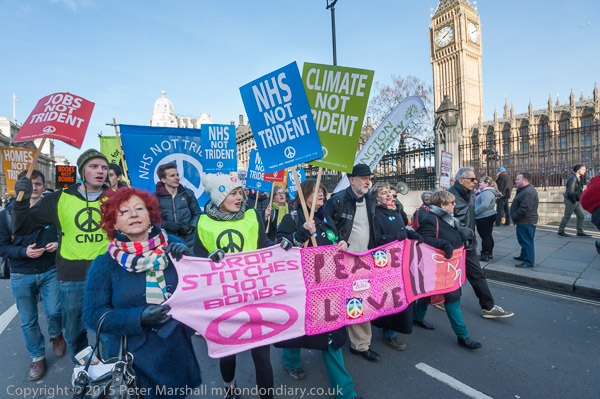
The front of the scarf had stopped where it started, just past the main entrance to the Ministry, and there was then a period of waiting for all those around the block to make their way around and come together again, and for most of the knitting to be rolled up again.  Finally it was time to set up for the short march down Whitehall and past the front of the House of Commons to end up at Old Palace Yard for a rally.

I did get a  picture as they walked past Parliament with Big Ben to show it, though it wasn’t one of my better examples.  You can see more pictures at ‘Wrap Up Trident’ surrounds Defence Ministry and Christian CND against Trident Replacement
Continue reading Wrapping up the MoD

2015 PDN Top 30

If you want to be featured in PDN’s Top 30 your best bet is either to be born in the USA or to go and live there, as do I think all but about six of this year’s crop (and two of that six are in Vancouver, which only around 30 miles over the border.) Having said that, there is still much interesting photography, and, perhaps unsurprisingly some of the more interesting is from those four more distant. Give yourself plenty of time and go and enjoy.

Rather than otherwise influence you on the work of this years pick I thought it would be interesting to revisit the Top 30 of ten years ago, 2005, and begin by asking how many of those featured you have heard of. It’s hard to be entirely sure, but for me I think the answer perhaps five or six, but most seem to be having succesful careers if not becoming household names:

Kevin Cooley
Cig Harvey
Mark Zibert
Andrew Zuckerman
Christa Renee
Matt Stuart
Jesse Chehak
Eri Morita
Farah Nosh
Chris Mueller
Eric Ogden
Joao Canziani
Colby Katz
Dave Anderson
Jehad Nga
Erik Almas
Jessica Todd Harper
Hayley Harrison
Karine Laval
Steve Giralt
Casper Dalhoff
Emily Nathan
Carlos Rios
Matthew Pillsbury
William Mebane
Masood Kamandy
Kareem Black
William Lamson
Gina Levay
Karim Ben Khelifa

I’ve also tried to link them to their current web sites, though there may in some cases be confusion with other photographers of the same name. Two presented a problem – I couldn’t find a site for Hayley Harrison and although there are many links to work by Khalim Ben Khelifa I could not find an actual web site. And be warned that even on a high-speed broadband connection some of these sites are slow to load. Too many still have huge flash downloads.

This year’s crop give a little advice to others on the web site, and I’d like to add another small piece of possible wisdom. If you want to be remembered as a photographer, choose a good and memorable name. If like me you have a very common name it will not help in your career. And simply because you were blessed by your parents with something simple shared by thousands of others there is no reason to use that as your professional name.

I share my name with at least three other photographers (a confusion that has led to me being refused credit by one photography retailer and threats of bodily harm by an extremist right-wing organisation – I’m not sure what it has done for the other guys), a very well known preacher and his son, various sporting heroes (I don’t even swim or squash and gave up footy long since), the author of some great books, a journalist and  acouple of radio and TV personalities, a police chief, several professors, a breeder of ferrets and thousands more.

Somewhat surprisingly if I put my name into Google (I don’t make a habit of vanity searching, but have just done so as ‘research’ for this post) I find I come up in 14th, 17th and 24th position underneath two featured posts and some images, none of which are of me. On going to Google Images and searching well down the page I do find myself twice, as well as 38 taken by me, among the seven or eight hundred featured. They seem to include a couple of copyright violations, though I think neither worth chasing.

Flashing Flashers

I’d missed the post on PetaPixel in January on the development of a novel range of ‘Anti- Papparazzi’ Clothing, but apparently some items – a scarf and a hoodie – will shortly be available.

The idea of highly reflective clothing that will reflect the flash back and thus trick cameras into severely underexposing will perhaps foil a few less experienced photographers, but it is hardly a novel concept, as many of us have been photographing police and others wearing fluorescent jackets with reflective strips for many years.  They are often a pain, but they don’t usually make photography impossible. In most cases you can tame those highlights enough with a little work in Lightroom. And if you do work on auto-exposure the reduction in exposure from the light reflected back is a good thing, as it helps to prevent burnt-out highlights. With cameras like the D800E (or the Fuji XT-1) you can pull an awful lot out of the shadows without problems.

I’m not a ‘pap’, but DJ Chris Holmes’s introductions would probably have little effect on my pictures. Apart from often shooting flash on manual to get more consistent exposures, I’m also using flash less and less for working at night.

Firstly because digital cameras are getting so much better at high ISO, and I often work at ISO3200, but also because to avoid black backgrounds and the flattened look of direct flash I usually work at and aperture and shutter speed where pictures get considerable exposure from ambient light, with flash mainly helping to bring out the subject a little.

But it is perhaps also an idea that has come too late with the increasing use of bright LED light sources. While still more commonly used for movies, increasingly still photographers are making use of them. Tonight – like last night – I’ll be working with one on the D700 and keeping the flash on the D800E. Partly this is because the flash has a longer range, and I’ll be using the 18-105mm on the D800E, often from a longer distance. but its also because my ageing D700 has become rather unreliable with flash.

The Neewer CN 216 LED unit I’m using isn’t perfect, and even though it has a diffuser, doesn’t cover a particularly wide angle of view, and is not really quite as bright as I would like. I could I suppose write a proper review, but if anyone is interested they are cheap enough for you to buy one on eBay and play with it yourself.

Salt Prints


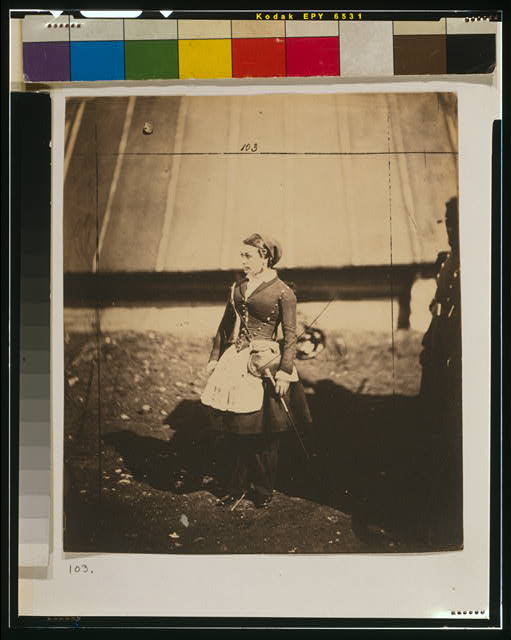
Vivandière (French cantinière)  Library of Congress Prints and Photographs Division Washington, D.C. with Fenton’s crop marks

It was back in the 1980s that I got briefly into salt printing (more on that here), around 140 years after W H F Talbot showed us the way (possibly picking up the idea from Sir Humprey Davy) in 1839, and with his ‘The Pencil of Nature‘ (1844 to 1846) published the first major printed work incorporating a number of them with his ideas.  I wrote briefly about the salt print process back in the 1990s, and published a revised version in the following decade with my own illustrations. I’ll try and find it and republish, but the truly definitive work on the process, Reilly, James M. The Albumen & Salted Paper Book: The history and practice of photographic printing, 1840-1895. Light Impressions Corporation. Rochester, 1980, is available free on-line for those who want full details.

Its a process you can read about in most if not all the histories of photography, and there are many manuals available in print and on-line to tell you how to do it apart from the Reilly book mentioned.  In some it will be called ‘plain paper’ printing or just ‘silver’ printing and it was performed in the 1840s and 50s making use of ordinary writing or drawing paper of the age, which was first coated or soaked in a salt solution (sometime common cooking salt, sodium chloride, though other salts were also used) and then after having been dried, made light sensitive by floating on a bath of silver nitrate solution (or this could be brushed on.) The paper then had to be dried in dim light and exposed with as little delay as possible in contact with the negative in a printing frame in sunlight.

The papers used were only lightly ‘sized’ or coated with a material – usually gelatine or starch – and the solutions soaked into the paper, with the light sensitive silver chloride (or other silver salts) being embedded into the paper. Later photographers began to use more sizing or other materials to keep these salts on the surface which enabled a better tonal range. The most successful of these was albumen (egg white) and as well as making matt surface prints this also enabled prints to be given a glossy finish. It used to be a standard museum practice to label all early matt prints as salted paper and early glossy prints as albumen.

Many photographers continued to make their own salted paper into the early years of the twentieth century, with directions still being published in various manuals of the times, although by then there were many commercial alternatives. You could also buy papers that were ready salted and only needed the photographer to sensitise them, but there were also other alternatives for the photographer. In a 1910 issue of ‘The Photo-Miniature, the author writes “Twenty years ago, when photography was not a popular pastime but a mysterious hobby, a photograph could be only one definite thing, namely – a so-called silver or albumen print.” (This refers to albumen prints only, not to salted paper prints.) The title of the article ‘The Six Printing Processes‘ gives us some idea of how much things had then changed since 1890, although there were many other processes also in use by then, some dating back to the beginnings of photography such as the blueprint (aka cyanotype.)

I was reminded of all this while eating breakfast this morning by the Today programme which featured two people talking about Salt and Silver: Early Photography 1840 – 1860 which opens to the public at Tate Britain tomorrow (25 February – 7 June 2015) with a claim to be the first exhibition in Britain devoted to salted paper prints. While this may be strictly true, many shows have included works from this period, many of which will have been salt prints, and other shows focussing on particular photographers or groups have been entirely of salt prints. But this is the first to be actually built around the process and while the show appears to include some well known works, it also brings out some less familiar.

The text also states “The few salt prints that survive are seldom seen due to their fragility, and so this exhibition, a collaboration with the Wilson Centre for Photography, is a singular opportunity to see the rarest and best early photographs of this type in the world.”  Silver is a fairly reactive metal and much of the early research into different printing methods was aimed at ways to prevent the fading of images, particularly from an age where the necessity for thorough washing of prints was not fully appreciated. I don’t think salt prints are rare, but examples from this early period, and particularly ones in good condition perhaps are. But prints by WHF Talbot regularly appear in auctions and even in recent years some have sold for well under £5000.  My own salt prints, now around 20 years old, are still looking much the same as when I made them, but may well not last 170 years. As to whether these are the best, you will perhaps have to visit the show to find out, although the works selected to display on the web site by Hill & Adamson, Talbot and Fenton are certainly not those I would have chosen.


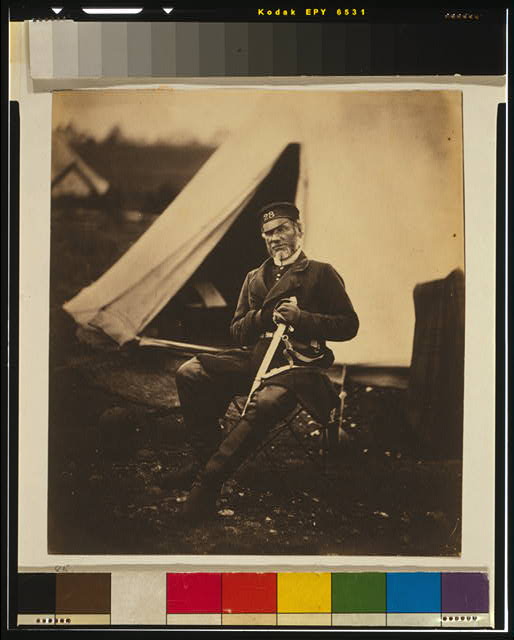
Captain Andrews, 28th Regiment

There are two included in the  on the Tate web site by Talbot, and also two by Roger Fenton, who made both albumen and salted paper prints. There is a marvellous collection of 263 of his Crimean War pictures at the US Library of Congress,  which includes prints of the same two reproduced here. You can if you wish download high resolution TIFF files of these (Vivandière is called Cantiniére on the Tate page) and print out your own copies, either on an inkjet or, if you really wanted, convert to a negative to make your own real salt prints. It really isn’t too difficult!

Prince of Pilfering

I’ve never had a positive response to ‘appropriation art’. It’s always seemed to me parasitic rather than in any way symbiotic. A total lack of respect of the authorship of the work being appropriated combined with a false assertion of authorship by the appropriator.

Of course it’s OK to use work by other people, though if you do so in a direct and recognisable way you should clearly attribute this – and where appropriate pay for a licence for its use. I was quite happy recently when an artist wanted to use some of my pictures on some cushions she was making – and supplied her with files for the purpose. We came to an agreement and my contribution to the work is acknowledge; that’s how it should be, and others who have wanted to use my work in their own paintings and illustrations have made similar agreements over the years.

As for ‘appropriation‘ I think what has to say about it and about Prince’s ‘Instagram’ works is worth reading. Here’s just a couple of sentences from it:

Seen as most people access art today, in their social media feeds, Prince’s appropriations are visually indistinguishable from the original sources. The thing that separates them is celebrity and recognition within the contemporary art world/business framework.

One way that Prince went wrong was to pick as one of his steals from Instagram a work by photographer Donald Graham.  Obviously a very succesful and accomplished photographer (if not particularly to my taste), on his ‘Fine Art’ web site it tells us: “Donald Graham is an internationally recognized photographer with work in the Metropolitan Museum of Art in New York and the International Center of Photography.”

While your average Instagram user might be flattered that Prince would re-use one of their images, someone who is already showing work in a museum context it likely to see it just as a rip-off. Unsurprisingly, as you can read in Hyperallergic‘s Photographer Sends Cease and Desist Letters to Richard Prince and Gagosian, Graham’s response is to go to law.

As the article states, Graham’s picture had been uploaded to Instagram not by the photographer himself, but by a third party,  Jay Kirton, who uploaded it without accreditation (and presumably without permission.) I presume that neither Prince nor his gallery, Gagosian bothered to check – by Google Image Search or other software – on the copyright status and ownership of the image. It appeared Hyperallergic‘s review of the show last October with the name of the poster rather than the photographer “appropriated from @rastajay92.

As I’ve pointed out before, (for example in it just isn’t practicable to prevent the unauthorised use of images on the web. It would take up the whole of any photographer’s life to police the usage of their images, and in most cases prove impossible to acheive any recompense. But where anyone is making large sums of money from your work, things are different.

Graham in October posted to Instagram about it (as you can read on Hyperallergic), and I imagine he may also have contacted the gallery without any satisfaction, but now his lawyer has sent “cease and desist” letters to Prince and the Gagosian Gallery. Perhaps it will go to court.

It isn’t the first time Prince has been taken to court, (and not even the first about images of Rastas) and although in at least one previous case an out of court settlement was finally reached with a photographer, generally Prince has been treated with inappropriate leniency by the courts. If there are people ignorant enough to pay over $40,000 for very large but rather dull reproductions from Instagram, the photographers who produced the original works on which Prince imprinted his own lack of originality deserve at least as much as him from them.

Hope for Linux Users

I’ve always wanted to stop using Windows. Well at least since I first installed it many years ago. At the time, back in the 1980s, Gem seemed to be a rather better system. But by the time Windows 3 came along, around 1990, Windows seemed more or less the only game except for the uber-rich fuelled by advertising who could afford to go the Mac route.

For those with computer science degrees there was of course UNIX, which became affordable in the form of Linux. Over the years I’ve installed Suse and Red Hat on quite a few computers, and my wife’s computer is now running happily on Ubuntu. Or mainly happily, but after it crashed while running an update I had to do a complete reinstall. Which worked fine, but had problems finding the parallel port printer. Not that it couldn’t find it at all, just that it seemed to insist on sending data a bit or two at a time, so it might take half an hour before a page would emerge.

There was a lot of advice on the various support forums, and I tried it, but nothing worked. Clearly too, a lot of other people were having similar problems from all the messages that were posted – and a few did find that the solutions posted worked. Most I think finally gave up and brought a USB printer instead.

Fortunately both my sons are computer science graduates, and when the elder came home he soon solved the problem, editing a few files here and there on the system – and posted his fix on a support forum too, so others may benefit. But if you don’t have a first in Comp Sci, and don’t want to devote most of your life to learning Linux there are still rather a lot of possible hurdles.  We’ll probably have to call Sam in again after the next OS upgrade too.

But if you are running some flavour of Linux, you might be able to install Darktable.  If you are running a Mac, it’s also possible, though looking at the instructions not entirely straightforward. If you are using Windows, you could run it in a virtual machine (likely to be slow)  or should you be a true geek you might just be able to get it to run natively if you have most of your life to spare.

Why should you want to? Well it does seem as if it is almost a alternative to Lightroom for the Linux user.  Here is the start of the description from the web site:

darktable is an open source photography workflow application and RAW developer. A virtual lighttable and darkroom for photographers. It manages your digital negatives in a database, lets you view them through a zoomable lighttable and enables you to develop raw images and enhance them.

And here is most of what the FAQ says about a Windows version:

  • What about a Windows port?

None of the developers use Windows, so a port of darktable to that operating system is very, very unlikely to happen.

That being said, many things should already work, so the actual porting should be relatively straight forward. It’s just that we won’t do it. However, there is the “win” branch which kind of cross compiles using MinGW to generate a Windows version. It’s still really buggy and might crash, kill kittens and eat your baby. You have been warned.

Like much Linux software, Darktable comes free. Of course it isn’t the only alternative, and there are a couple of review articles I quickly found that briefly compare some of them. Best Linux photo editors looks at half a dozen of them, including two I’ve tried, Gimp and Corel’s AfterShot Pro, but this review is a couple of years out of date (and the versions I tried and found a little wanting were older still – when the Corel software was called Bibble.) Top 15 Photo Editors for Linux Distributions is more recent, but also rather less informative.

AfterShotPro (now AftershotPro2) isn’t free, but commercial software, though reasonably priced, and were I seriously going the Linux route would probably be my choice.  But as the writer of the ‘Top 15’ article says at the end of his roundup:

I’m quite happy with how the list turned out, and it also made realize that there is still a quite big gap in the photo editing software market when it comes to Linux. A ton of people I know, and even those that I encountered during my research – still prefer to work with Photoshop through Wine.

For the moment, rather than tangling with Wine (a Windows-like environment which allows some Windows programmes to run in Linux) I’ll continue to whine about Windows, and when necessary drown my sorrows with a glass or two of a decent red. Oh dear!


The Integrity of the Image

With the continuing debate over the disqualification of around 20% of the entries that reached the later stages of World Press Photo for excessive manipulation I think it is well worth reading the WPP’s Photo Research Project ‘The Integrity of the Image‘ by Dr David Campbell.

It’s a subject I’ve written about myself on various occasions, and tried to do so from the perspective of a working photographer, someone who does their own image processing in Lightroom and Photoshop.

I’ve always felt it’s basically a straightforward issue. The key concepts are integrity and intention, and my view can be summed up very briefly:

Correction – Fine; Emphasis – within limits; Alteration – Never.

Of course its a statement that requires interpretation, and back in 2010 I published my views on what was and wasn’t acceptable when processing an image. I think it bears repetition (with some minor changes and additions to clarify) :


Always appropriate (as necessary)

  • dust removal (scratch etc removal from film
  • level correction
  • colour temperature correction
  • exposure correction
  • brightness correction
  • minor contrast correction
  • marginal cropping
  • image rotation
  • highlight removal
  • image resizing
  • image sharpening
  • lens distortion and aberration correction
  • image noise reduction
  • Vignetting reduction/removal

Often appropriate (within limits)

  • Curve adjustment
  • Local dodging
  • Local burning
  • flare removal
  • local contrast adjustment
  • perspective correction
  • saturation / vibrancy adjustment (including conversion to black and white)

Sometimes appropriate

  • Deliberate blurring/pixellation of detail (eg where necessary to hide identity)

Seldom appropriate

  • radical cropping
  • excessive vignetting
  • colour toning
  • graphic effects

Never appropriate

  • Content sensitive fill
  • Removal or addition of important image elements

Of course many of these require judgement as to what level of use is allowable. While it may be appropriate to emphasize some elements of an image and de-emphasize others, dodging or burning certainly shouldn’t eliminate them.

Some photographers attempt to justify excessive manipulation (or colour casts etc) by saying that it was how they saw the image when they made it; its seldom an argument that convinces me; images have to be believable to the audience, and the techniques we use appropriate to the purpose.

One aspect I’m pleased to see included in Campbell’s report, in his list he describes as a  ‘general consensus’:

  • Photos cannot be staged, posed or re-enacted.

As the report states:

“This consensus applies most directly to news and documentary images. Our respondents noted that they generally regarded nature and sports images in the same way as news and documentary images. Fashion and staged portraits were a different matter altogether. In those genres, there were no policies, and in fashion especially the prevailing attitude was that anything goes and all is permitted.”

I’m all in favour of keeping ‘news’ news, of keeping sports real and stuffed squirrels out of nature photography.

March for Social Housing

Back in January I had a very busy Thursday, starting with an event on the other side of London to where I live, Stop Arming Israel picket HP at BETT, a picket by a group I’ve now photographed on quite a number of occasions. Most of their protests against Hewlett Packard’s support of the Israeli war machine have been outside HP’s offices in the middle of the City of London, but this was at ExCel on one of London’s former docks, well to the east of the centre. It’s an area I first photographed in the 1980s – with a few images you can see in my book ‘The Deserted Royals‘, though fortunately now much easier and faster to get to.

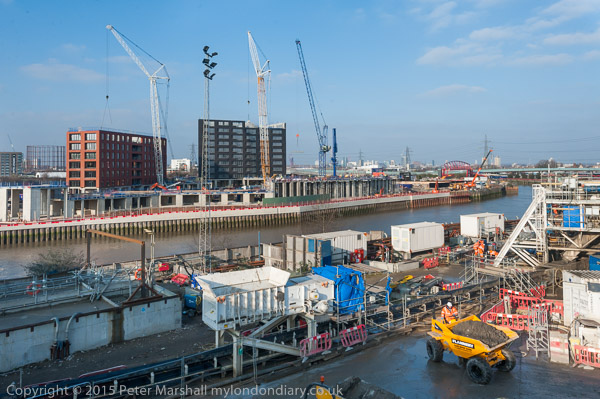
I spent an hour or so there taking pictures, then took a walk across the Lower Lea Crossing, from where I took the picture above of Bow Creek. It was a fine day for January, and decent weather for panoramas, though I would have liked rather more interesting clouds. Thanks to my recent computer problems I’ve not had the opportunity yet to process the panoramic images I made – so I’ll hopefully write about them later. Though I’m always rather loath to put a message on line “<small”>more pictures coming shortly” as I think there are still some such gaps waiting for me to fill as far back as October 2002. Really I will one day!

Next was a trip up west, to the Ritz and Mayfair, where I had expected to meet rather more members of Class War than the three who turned up for Class War visit ‘Rich London’.  It was all just a little tamer than I had hoped for.

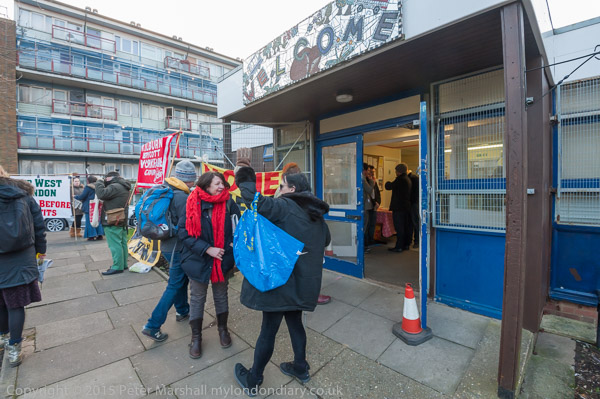
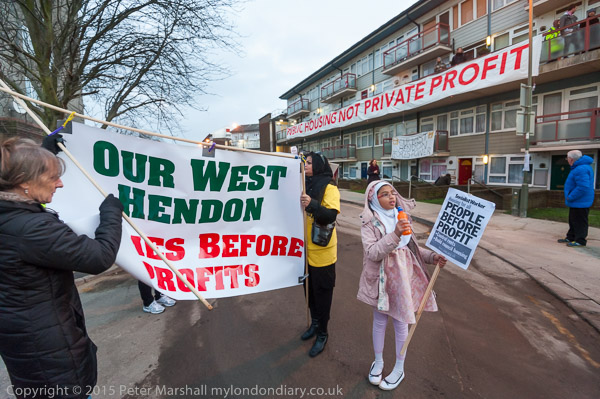
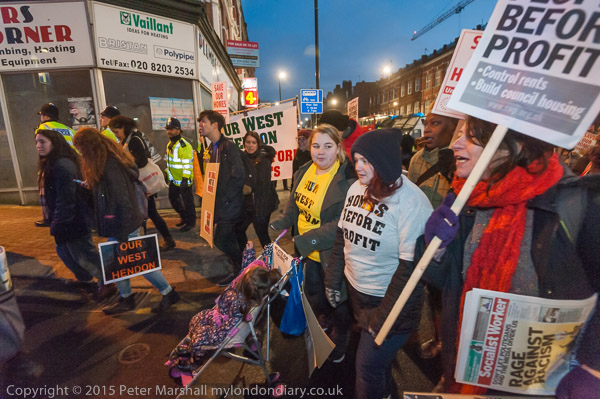
But it did make me late for what was the largest event of the day, the West Hendon march for Social Housing, in one of London’s north-west suburbs. It took just a little finding too, and had me cursing my smartphone as it showed me a black area instead of the map I’d told it to load. Paper maps have the advantage of not needing a signal. I was annoyed to have arrived just a minute or two too late for the photographs outside the community centre where the protesters had been holding a meeting, seeing them dispersing as I rounded the corner a hundred yards or more away.

Fortunately the best was yet to come, though there was around an hour of waiting around with relatively little to photograph. A few groups stood around outside the community centre talking, some with placards and banners, while others sensibly kept in the warm inside. I took a few pictures inside, had a free cup of the hot soup and talked to some of the protesters, many of whom I knew from other events. Finally it was time for the next part of the protest, the promised giant banner drop.

As you can read in West Hendon march for Social Housing there was then a rather long memorial event for a local war hero, the only female Sapper of WW1, who locals are hoping to commemorate in the area.  It was an interesting story, and one which I did a little more Googling on before writing my piece for My London Diary, but I wandered off shortly before the end to take a few pictures of the various posters I’d seen on some of the flats.

It was getting steadily darker and darker, and I was trying out a new toy, a Neewer CN-216 LED light, which has 12 rows of 18 LEDs (which explains the 216 in its name.)  Its a slightly chunky box, about  5.5 inches wide, 3.75″ tall and2.25″ deep with a reasonably sturdy fitting on the bottom to attach it and angle it up and down a bit on a hot shoe. Fitted with 6 AA batteries it weighs in at a smidgeon over a pound (458 grams.)

It doesn’t really produce a great deal of light, though noticeably more than the earlier and cheaper LED lights I’ve tried. Enough to make a difference when fairly close to you subject, but not really an alternative to flash at more than a few metres away, even when working at ISO 3200. When it got really dark I was working with it at 1/30th f2.8 ISO 3200.

In the image above, as the march turned off from the Edgware Rd, the CN-216 provided useful fill on the closer figures, while streetlights gave reasonable overall illumination. When a little later we got to darker streets and the CN-216 became the main light source it was less useful.


D700 16mm 1/15 f4 CN-216 ISO 3200


D800 18mm (27mm equiv), 1/60 f8 ISO 3200

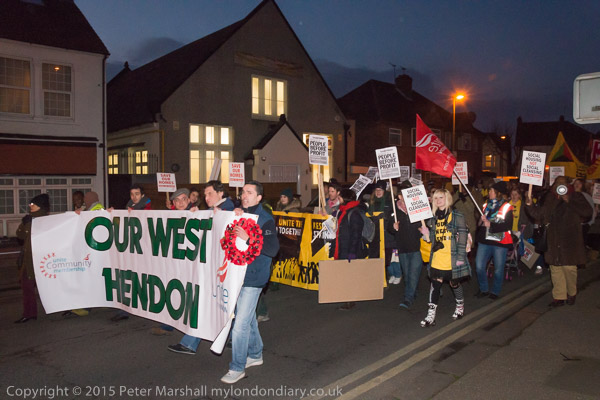
The two pictures above were taken within a few seconds of each other, both in a dark area with inadequate street lighting. Both have had considerable burning and dodging to partly equalise the lighting across the image. The CN-216 is a rather larger light source than the flash, but still the normal inverse square law more or less applies, doubling the distance from the light giving only a quarter of the illumination.

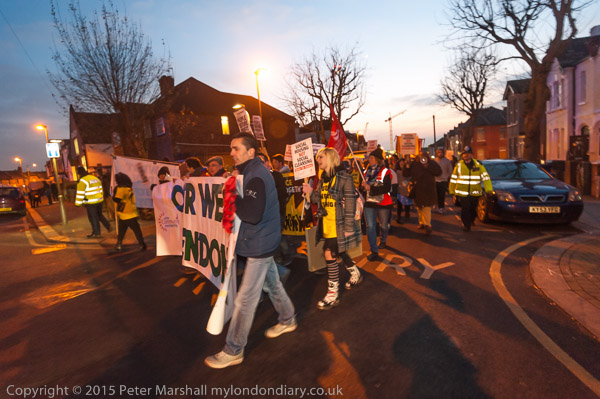
I’d chosen 1/60th for the flash exposure to reduce or eliminate any motion blur and the kind of double image that often results from slow shutter speeds. There is a four stop difference between the two images (two stops in aperture and the same effect as two stops in the different shutter speeds) and it’s this that makes the main difference between the two images.

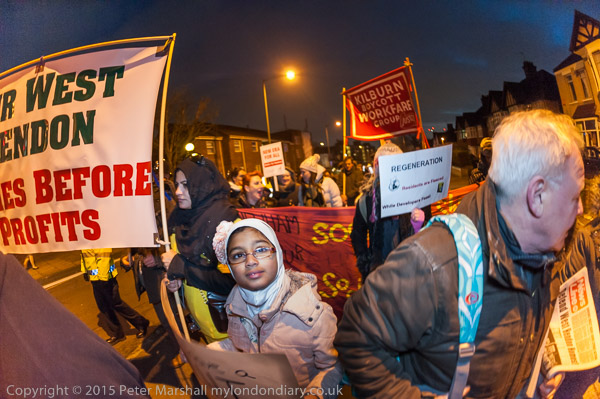
Another image taken with the aid of the CN-216, this time with the 16mm fisheye at 1/30 f2.8 close to the end of the march. Hendon seems to have some pretty dark roads. The LED light doesn’t of course cover the full 180 degree diagonal, and you can see some fall-off in the banner at upper left.  This was an advantage for the figure at the right, as he needed less burning – and was so close that with an even light spread would probably have been to far burnt out.  The girl at the centre, although a little further away was almost at the limit of the highlights.

The lens comes with a pair of diffusers, one plain the other an orange to convert the light from daylight to roughly tungsten. So far I’ve always used it with the daylight diffuser in place. Vignetting is noticeable with any wide-angle lens, but can be corrected with Lightroom, so isn’t a huge problem.

The CN-216 is just about powerful enough to be useful for this kind of work, and working with portraits at close distances you might sometimes even want to use the control wheel which dims the light rather than work as I did always on full.

Ideally I’d like a light with at least twice the output, especially since I have no really fast lenses for the Nikon. Usually the f4 16-35mm is fast enough, but rather limiting for this use. The two faster lenses I have are the 16mm f2.8 fisheye, a 20mm f2.8 and a60mm f2.8  Micro Nikkor.  The CN-216 would be more useful with the Fuji XT-1 where I have a 35mm f1.4, 18mm f2.0 and 14mm f2.8 (52mm, 27mm and 21mm equivalents) as well as a f2.8 fisheye.

And the best thing about the CN-216? The price. If I believe the specifications, the light output is much the same as that from other models costing well over £100. Without batteries it cost me a little under £30 including postage from eBay.

The link for the story and more pictures again: West Hendon march for Social Housing
Continue reading March for Social Housing