Class War in Chingford

It seems a long time now since the General Election on May 7, and the shock of waking up the morning after to find the Conservatives were in power. Not that I have any great faith in Labour, but anything would have been better than a Tory majority.

Of course there was no chance that Class War would sweep to power. They were only standing in seven seats and when party leader Ian Bone talked at the party’s election launch about hoping to get into double figures he was talking about votes, not seats. And even for rather more serious parties – like the Greens – getting more than a million votes doesn’t give you proper representation, still just the one seat won by Caroline Lucas in Brighton. And if Labour had put the kind of effort they put into trying to unseat her into their fight against the Conservatives, the election might well have had a different outcome, though the dirty tricks would have generated considerable negative publicity.

We don’t have a fair electoral system. Attempts to reform it were voted out by the major parties who both thought they would prefer to continue to benefit from its unfairness, though I think Labour made the wrong call, failing to take Scotland into account – and going on to shoot themselves in the foot before and again after the referendum there.

But back to Chingford, the seat of Iain Duncan Smith, IDS, architect of dramatic changes to our welfare system, and a man caught out in lying and failures so many times, truly the man who launched a thousand food banks or more. And truly impregnable as the Conservative candidate in a true blue constituency like Chingford and Woodford Green. Any of the other candidates would have been a better choice, but none stood a chance.
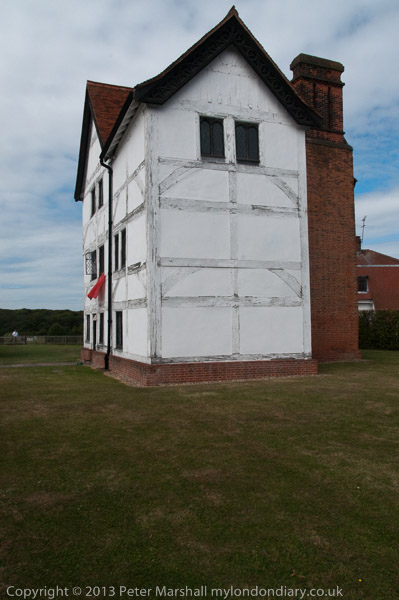

Queen Elizabeth’s Hunting Lodge on a sunnier day in 2009

Chingford is on the end of the line, and not a place that sane Londoners would ever visit, except perhaps as a start or finish point for walks in Epping Forest. I’ve been there when walking the ‘London Loop’ path around the edges of Greater London, and also to Pole Hill, which has an obelisk marking the Greenwich Meridian when I did a project on that virtual line back in pre-Millennium days. I wasn’t surprised to find myself the only photographer who had come to record Class War’s second visit to to the place, along with a couple of people making a video about Class War for Vice.

I arrived half an hour or so early, and took the short walk up the hill in faint drizzle to Queen Elizabeth’s Hunting Lodge, built for Henry VIII in 1543, but given a makeover and a new name by his daughter in 1589, hurrying back down the hill in time to greet the Chingford candidate Lisa Mckenzie as she walked down the platform, wearing a bright red coat, something that has become a trademark of the ‘Class War Womens Death Brigade‘ since Jane Nicholl was picked on by police and arrested while wearing on at the Bonfire Night Poor Doors protest (see Poor Doors Guy Fawkes burn Boris.)
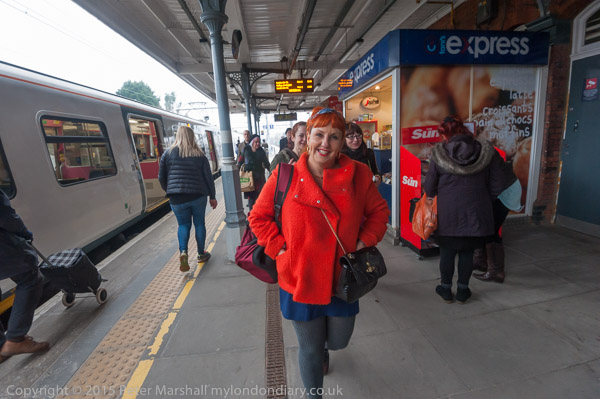

Class War Candidate for Chingford & Woodford Green arrives in the constituency
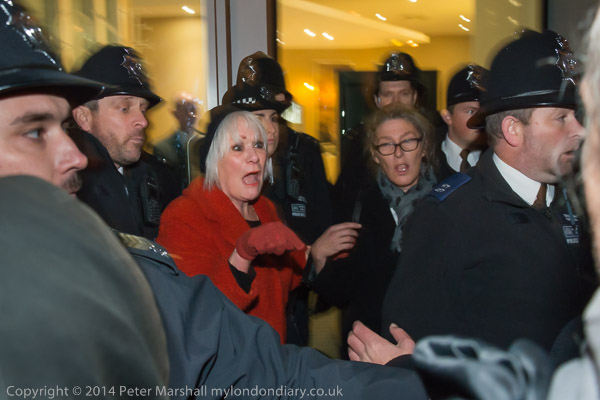

Jane Nicholl is arrested at the bonfire night protest for setting light to an effigy of Boris Johnson

The one piece of good news on Election Day was about Jane’s case, which came to court on that morning. Probably because of political pressure from on high heels in the Conservative Party, the police attempted to raise the seriousness of the charges, to a level where she could have been banged up for life, but almost hilariously failed to come up with any believable evidence. It was yet another case where the police were obviously committing perjury, clearly lying in the efforts to get a conviction, though as usual no action was taken against them.

In the end it became so ridiculous that the prosecution lawyer withdrew the case. The court also was of the opinion that burning an effigy of the London Mayor was a legitimate political protest and it was clear to all who had been present at the event that there was no danger to anyone caused by it. While our policing is often highly politicized, the courts do at least at time stand for a more neutral justice.
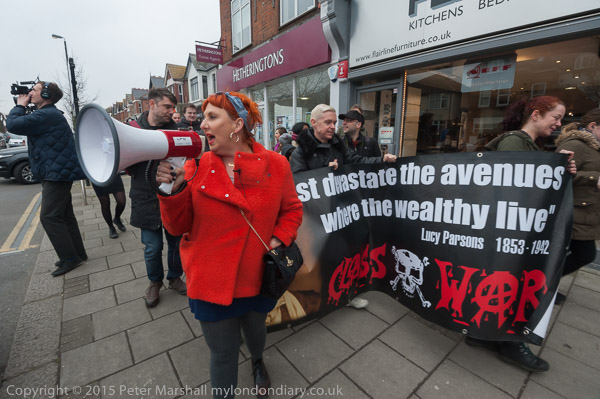

Lisa McKenzie and the Lucy Parsons banner opposite the Conservative HQ

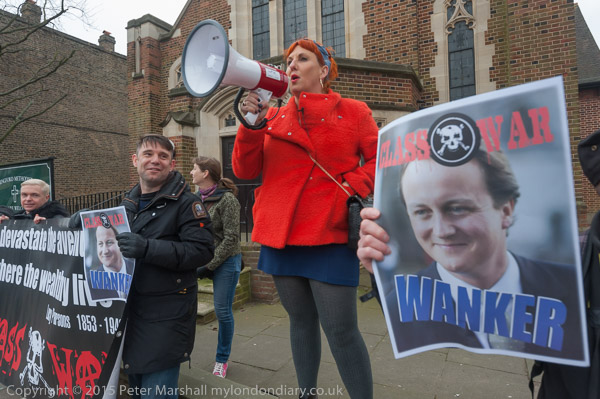
Back in Chingford, it was not the most exciting of events to photograph, a small group of people moving down a fairly empty shopping street with a megaphone and a banner. If Chingford has a centre I’ve yet to find it, and nor did Class War. Some among the few constituents we met took the flyers and shared some very negative views of IDS, while others shrunk away in horror as if the gates of hell had opened.  I tried but failed to capture some of their expressions, but they turned away or fled at the sight of my camera. Though I did just manage to catch one old man on a passing bus scowling and making an angry ‘V’ sign.
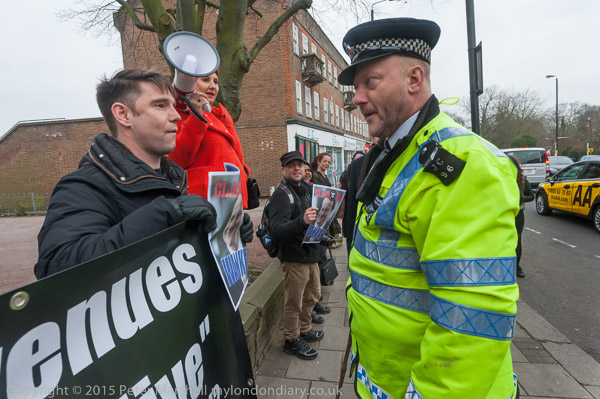
The Metropolitan Police had clearly expected trouble and the group was provided with a police guard, a van following their progress a few yards behind as they walked down the street. Their senior officer provided the major interest in visual terms when he came to threaten one of the protesters with arrest if he continued to display a poster with a photograph of David Cameron and the word ‘Wanker’, which he said was offensive. As he walked back across the road, that protester folded the poster so that the the part he felt was offensive – Cameron’s face – was no longer visible and continued to display it.

The officer continued to stand across the road watching the protesters from beside the van full of police officers, as the rest of the protesters continued to display the Cameron poster and Ian Bone parodied the officer’s action and his stance as he stood sternly watching. The police took no further action, but continued to follow all of the Class War group until they finally got on the train and it pulled out of Chingford station.
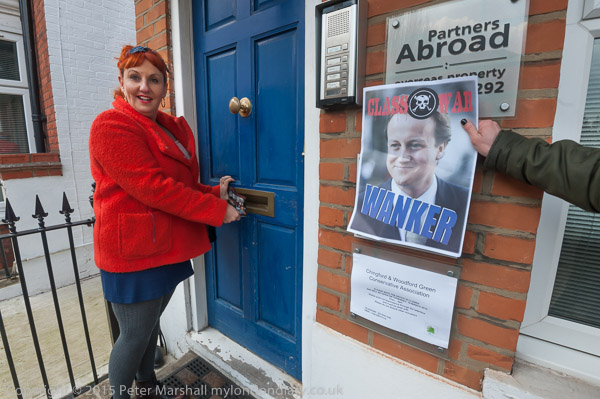

Lisa puts a leaflet through the letterbox at Chingford Conservative HQ

After a number of speeches heard by only a few passing Chingfordians, Class War decided it was time to go to the pub, stopping briefly on the way for a photo opportunity outside the closed office of the Conservative Association.

NIKON D800: 18.0-105.0 mm at 26mm (39mm), 1/60s, f/4.5, ISO 6,400

Class War have serious political views, but believe that politics and protest should be fun as well as making their point. Given that the UK is now the most unequal of Western societies (equal worst with Russia) and that things are getting even worse since the financial crash their class-based analysis makes increasing sense. In part it harks back to the immediate post-war sense of purpose and community that gave us the NHS and the welfare state and opposes the selfishness and greed that Thatcher brought to the centre of politics – and which was perhaps the determining factor in our recent election  – and behind the odd Tory pledge to extend ‘right to buy’ to housing association tenants.  But Class War have no prospect of power, and standing a few candidates in the election isn’t about trying to gain seats, but about trying to raise issues – and in this case the issues around social class, welfare and benefits.

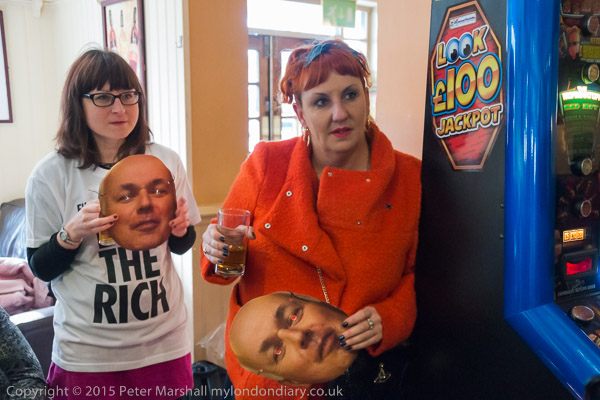
At what I tongue-in-cheek headlined ‘Class War party discuss tactics for Chingford General Election seat‘  and hoped I had made clear in the media summary ‘After a march and street rally in Station Rd, Chingford, Class War cadres adjourned with their candidate Lisa Mckenzie, who is opposing controversial Tory minister Iain Duncan Smith, to discus their forthcoming election campaign in the constituency’ there certainly was some talk of politics, but it was a rather more relaxed occasion, with a deal of hilarity over the Iain Duncan Smith masks that were brought out there.  It would perhaps have made for some more interesting images had some people worn those during the protest.

The picture above is one where I like the ‘red-eye’ effect from the mask held in front of Lisa’s red coat.  Perhaps I should have zoomed in to make it stand out more. Red-eye is of course often a nuisance in flash pictures, but here I was working with available light, though not a great deal was available in the dimly lit pub interior.

It was the first time that I remember using ISO6400. Matrix metering did a reasonable job of exposure despite the window light and the lens is wide open at 1/60s – any slower speed and there would almost certainly have been blurring due to subject movement.  Looked at closely – at 1:1 – the image lacks fine detail but is about as sharp as possible, with a noise (after suitable noise reduction) that has much of the feel of a ‘fast’ ISO400 colour film. The colour quality too is perhaps a little more filmic than when using digital at more moderate speeds.

It wasn’t a posed image. The two women are talking with a third just out of frame to my right, and I made several frames.  It’s the kind of situation where the noisy Nikon might have been a distraction, and the silent Fuji would have made working easier, but they had got used to be using a camera around them and were ignoring my presence.

Standing there, perhaps it was the presence of the gambling machine that made me think of this image as being rather like a fruit machine display, with the ‘Look £100 Jackpot’ standing in for the third result.  It would perhaps have been nice to read the full message on the t-shirt at left, but I rather like the hint of an ‘FU’ at the top left of it, and the ‘THE RICH’ below the IDS mask which blocks out the ‘CK FOOD BANKS’ on the top line and the word ‘EAT’ below.  It’s a very ‘Class War’ statement, and one like most of their slogans not intended to be taken literally.

More pictures from the street rally at Class War Chingford Election Launch, from the pub at Class War celebrate Election Launch, and from my journey from Chingford across London and into the occupation on the Aylesbury Estate with a few people from Class War at Class War go to Aylesbury Estate.
Continue reading Class War in Chingford

Gardeners Delight?

‘The Gardener’ Jan Brykczyński (Dewi Lewis Publishing, 2015)

I have to confess to being a colourist. Someone who seems more affected than the general population and by the art photographic establishment in particular by colour. I had to quickly leave one room in Photo London when confronted by wall-sized images with a particularly nasty thin yellow cast.

My first real job was as a colour chemist, in the research lab of a company making dyestuffs, where small differences in shade were vital. For various reasons I didn’t stay in it long but perhaps something of it stayed with me. When I began as a photographer in the early ’70s, carrying two cameras, one for black and white and another for colour, I was seldom if ever in doubt about what was a colour and what and black and white image and my work in the two was quite different. I was, as a then eminent photographer commented on my work, a colourist.


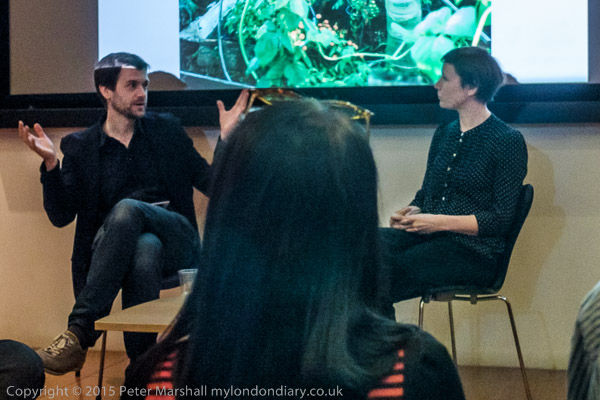
Jan Brykczyński talks to Diane Smyth at Photo London detail- apologies for poor quality

Few photographers now actually work in black and white, and most of those who do seem to think – if they think at all – in colour. Others certainly do think in colour, and Jan Brykczyński is certainly one of them, but his colour is rather different to mine – around R+3 B+7 different from both me and Photoshop, as I find if I put one of his images into that programme and examine the colour of a neutral shade.

It may not seem a great deal, but R+3 B+7 is enough to make me feel a certain nausea when I turn the pages of this book, and it gets in the way of my appreciating his imagery. I have a slightly smaller problem with the rather muted colours and contrast. Brykczyński uses a large camera (4″x5″?) and film, and likes to shoot on dull days, staying in and researching when the sun comes out, to lessen the technical problems of light and shade. Colour film has always been balanced for summer sun (or tungsten); back in the bad old days of transparencies you had to use CC filters when the sun went in to get the colour right, though with the switch to negative we got lazy and made the corrections on the enlarger and it almost worked. But breathed a huge scream of relief when digital gave us more accurate colour with far less hassle. Film has become relegated to a ‘look’, something one can apply to digital with what a less polite than me photographer referred to as ‘f**king up filters’.

I’m not criticising Brykczyński for having chosen a particular aesthetic with its desaturated and slightly unreal colour, just relating my own difficulties in approaching his work though a barrier which for me is hardly mountable but others may take in their stride; from his comments in the presentation at Photo London, the approach may in part derive from having to blend together images taken at different times in four very different areas. But personally I would have liked to have seen a book that represented differences in the conditions under which the images were made rather than attempt to minimise them for the sake of a perhaps spurious unity.


A very different garden image from ‘Secret Gardens of St John’s Wood’ by Peter Marshall’

As a photographer who has also produced a very different book on gardens I appreciate the problem of dealing with all that green. And back to that room I had to leave, some can live with (or at least work with) and pay very silly money for giant images I find nauseating.


Jan Brykczyński talks to Diane Smyth

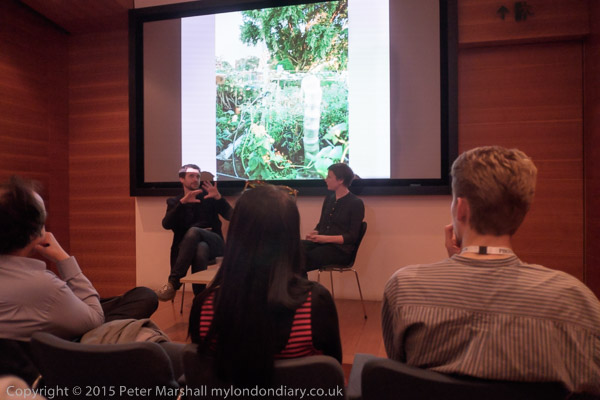
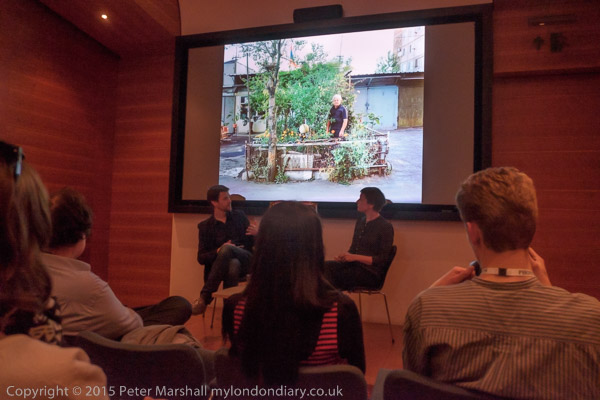
So I struggled to appreciate this book, although the images there are at least clear. I felt for the photographer at the presentation, where his images on screen behind him and Diane Smyth of the BJP asking him questions were projected at a standard that would have disgraced an amateur gardening club in a run down church hall. It seemed a disgraceful contempt to the photographer and his work and the seriousness of his approach as well as to a paying audience. Some images from the position I was sitting, a few rows back from the front, were almost completely burnt out with the screen a glaring white.

I took pictures only when a few images were better projected

The project looks at urban gardeners in 4 cities in very different states of development and with very different histories, Nairobi, New York, Warsaw, and Yerevan in Armenia, and seems to attempt to suggest à la ‘Family of Man‘ that whatever our social arrangements and historical development, at base people around the world are much the same. It’s a thesis undoubtedly close to the heart of a multi-national Swiss-based giant like Syngenta, and behind the singular title ‘The Gardener‘ that the photographs, mixed together as they are in the book, rather triumphantly overcome.
Perhaps behind the book there is a rather more subversive mind than the company hoped for. Perhaps I should make myself a pair of colour-correcting spectacles to enable me to get to grips with it more adequately. But you may well not share my personal problem.

Boiko, Brykczyński’s series on  rural life among the Rusyn people (a small group of farming people who apparently consider the name Boyko derogatory) in the Ukrainian Carpathian Mountains which became his first self-published book is a fascinating series (and  I have no problems with their colour), as too is the group of photographs of the sheep farmers of Árnes in Iceland that won him the Syngenta Award, with a grant to pursue the project and, later, to publish the book ‘The Gardener’.

Born in Poland in 1979, much of Brykczyński’s work has been on rural areas. He is a founding partner of Sputnik Photos, an international collective of photographers that focuses on transformation in Eastern Europe and post-Soviet states.

Continue reading Gardeners Delight?

Photo London

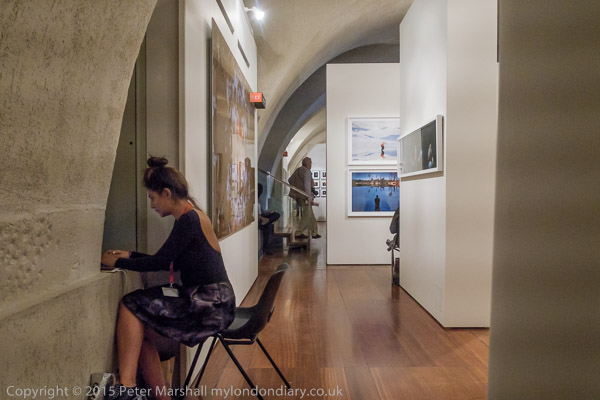
I wasn’t going to bother with Photo London. I’m rather busy and thought there were better things I could do with my time, so hadn’t bothered with accreditation. But a day or two ago I decided I could fit in a few hours there on my way to something else, and took up an invitation to a book launch (more of which in a later post) which included a complimentary day ticket.  If you have to pay, a day ticket costs £20 (concessions £17) and the show continues until Sunday 24 May.

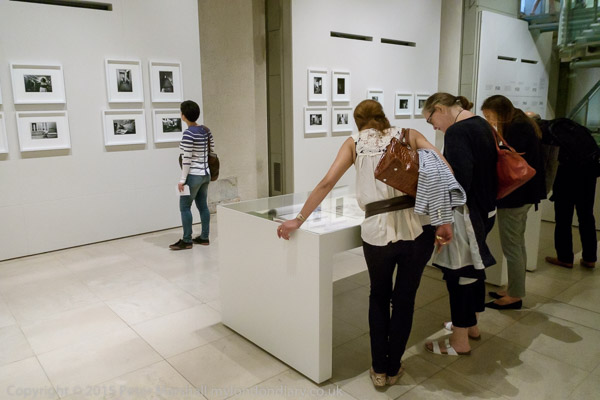
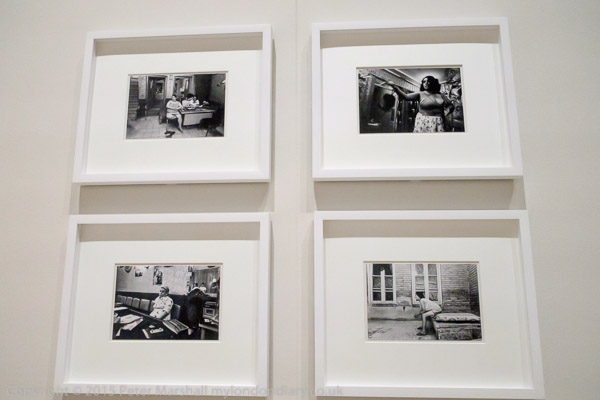
There certainly are things worth seeing, particularly the first UK showing of a remarkable project by the late Iranian documentary photographer Kaveh Golestan in the in the Citadel of Shahr e No (New Town), Tehran’s red light district, a walled ghetto where 1,500 women lived and worked, between 1975–77. With the Iranian revolution the whole area was destroyed, together with many of the women in it.

Beneath the Surface, 200 rarely-shown photographic works from the Victoria & Albert Museum Photographs Collection, features a fine collection of work by William Strudwick (1834-190), an employee of the V&A. The museum purchased around 50 of his cityscapes, ‘Old London: Views by W Strudwick‘ in 1869, and then proceeded to disperse them around their collection, only re3cenly reuniting them for this show. There are some other interesting prints from a century ago or more, but the choice from the last hundred years was rather less interesting, with a number of good but well-known works, and some more contemporary work about which the museum may well feel rather embarrassed in another hundred years.

I was disappointed by the show of Sebastião Salgado’s Genesis series as large-format platinum prints. Frankly many of these images were more convincing on the magazine page. Making platinum prints doesn’t necessarily mean better prints as this exhibit proves. Elsewhere on some of the gallery stands there were rather better prints of his work and I think it is more suited to silver or inkjet.

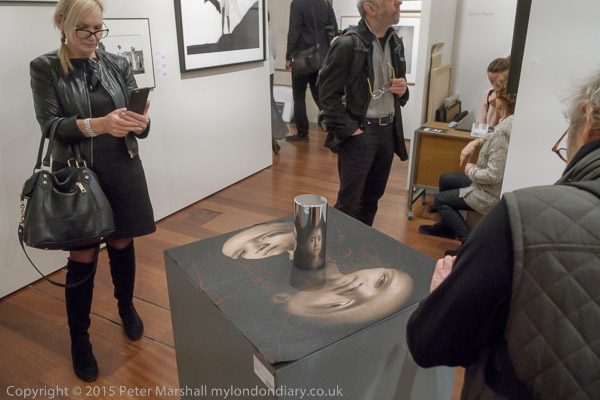
The backbone of Photo London is of course the commercial gallery shows, and in the main I found these a little disappointing. There was an awful lot of large and rather empty images and a dearth of interesting photography, and the range of work didn’t seem to match that which I’ve seen at every Paris Photo I’ve attended. There were things that were good to see, but most of them I’d seen before, and very little that was new.

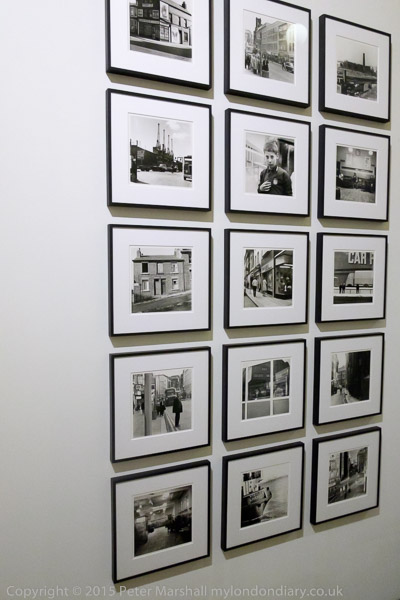
One of the more interesting was the series series Liverpool 1968, by Candida Höfer, black and white images made during a trip there when she was twenty-four years old. If anyone doubts the dire effect of the Dusseldorf school on photography they should go and study these images made long before she studied with the Bechers, whose work I admire but who seem as teachers to have inspired a huge pyramid of boredom, with just the occasional photographer and work of interest. They were I think at Galerie Zander.

Another set of pictures that I really admired was by Anthony Hernandez, Landscape for the Homeless showing at the Galerie Polaris stand. A book of these was published by the Sprengel Museum, Hannover, Germany,in 1996 and there is an article in Unhoused. The book was a relatively small print run and is fairly rare and a little expensive.

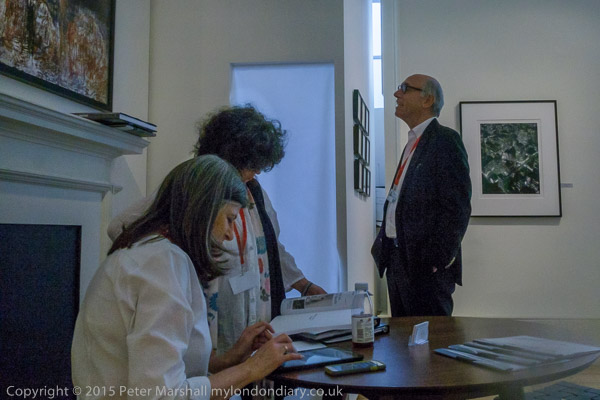
Somerset House is a fantastic building, but a rather confusing layout which wasn’t quite clear to me from the exhibitor map, and I had to ask my way a couple of times but eventually I think I managed to find everything in the show, including the LensCulture area which is all on its own with a separate entrance, and where work by all 31 award-winning photographers of the LensCulture Exposure Awards 2014 was on show.


Raina Stinson, with her winning image ‘Alluring‘ at top left, holds the Lensculture Awards Catalogue

Also on the LensCulture web site you can see their view of Photo London – rather different to mine, but recommended.
Continue reading Photo London

Max Pinckers

Thanks to a Facebook post by photographer George Georgiou for a link to Colin Pantall’s blog post Liverpool Look/15: Don’t Take Boring Pictures, a look at the current Liverpool at Look/15 Festival continuing until Sun 31 May 2015.

Were I in Liverpool I would certainly go and take a look, although the big show, Martin Parr and Tony Ray Jones in Only in England at the Walker Art Gallery is one already seen in London, and which I reviewed here last year as well as posting a link to a review by John Benton-Harris, who knew TRJ well.

While I had huge reservations about the ideas behind the show and some aspects of its presentation and John made very clear his thoughts on the misrepresentation of his friend’s work, I still concluded “It really is one of the most significant shows of photography here in the UK for some years“. In part that is a reflection on the fact that most of the more significant photography shows fail to get a showing in this country. But it is an opportunity to see around 50 vintage images taken by TRJ (if rather fewer of them actually made by him than claimed) but also as a reminder of what a good black and white photographer Martin Parr could be back in the 1970s.

But this is also a show which contains Parr’s selection of work the TRJ rejected, printed in a way he would have felt totally unsuited to his work, contradicting the clear directions he gave to people – like Benton-Harris – he got to make prints for him. It was a travesty that Benton-Harris clearly felt strongly about and makes his feelings abundantly clear in his review, and I think represents a failure to respect the work of Ray Jones by the organisation entrusted with his legacy.

What prompted me to write this post today was however the final section of Pantall’s post, about the apparently rather hard to find show of work by Belgian photographer Max Pinckers, Will They Sing Like Raindrops Or Leave Me Thirsty, a project on “the price of love in India and the stories encountered daily by the Love Commandos, a volunteer group working to prevent honour killings by providing assistance to those who have found love outside their prescribed destiny” which you can explore in greater depth on Pinckers’ own web site.

The work is the fourth self-published book by Pinckers (as well as a self-published book dummy – I’m unclear about the distinction) and copies of it are expensive, with a ‘special edition’ including a signed print still available for 320 Euros and shipping. There is an interesting interview with the photographer about his earlier highly praised book ‘The Fourth Wall’ by Taco Hidde Bakker, though this was a work that failed to arouse much of my interest.

Looking on-line at a selection of pages from the latest book and images on the web site, I find the work far more suited to the web presentation, which animates the series of images of images which on the page – which despite Pantall’s assertion – do sometimes become rather boring.

Poverty College


NIKON D800E: 16mm 1/250s, f/8, ISO 200, -0.3Ev

My photography has only had the most tenuous connection with the Royal College of Art, in that the first photographer I got to know in person had recently studied there and was still on the buzz, and that I’ve occasionally made just a little fun of John Hedgecoe who founded the photography course there in 1965, or rather his enormous output of glossily re-packaged how-to-do-it manuals on photography. You can find hundreds if not thousands of his pictures on Topfoto, but while it would be impossible to knock the professionalism, I find it had to see any personal style. It is perhaps curious that someone who so effectively epitomised photography as a trade should have been the driving force behind the UK’s most prestigious photography course at a college of art, though of course it does much to explain the impact that later courses at Derby and Trent had on photography in the UK.

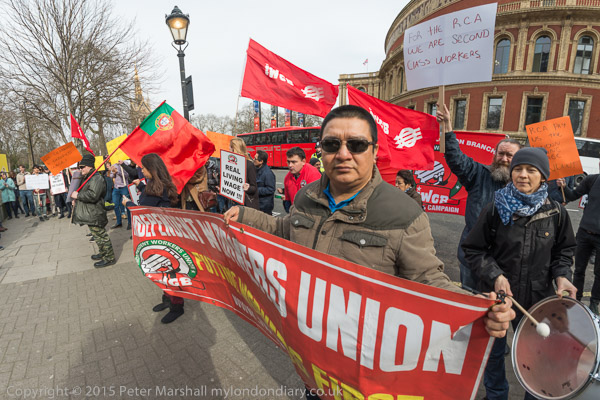
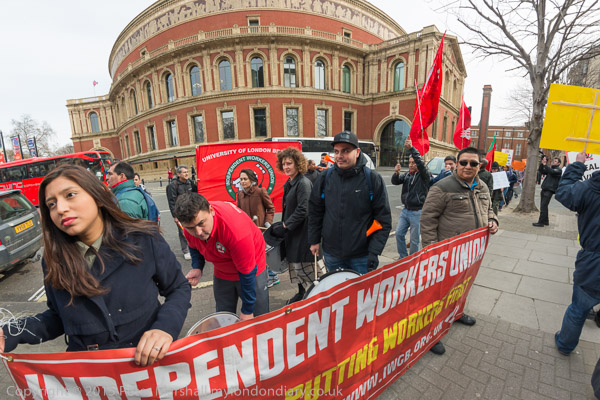
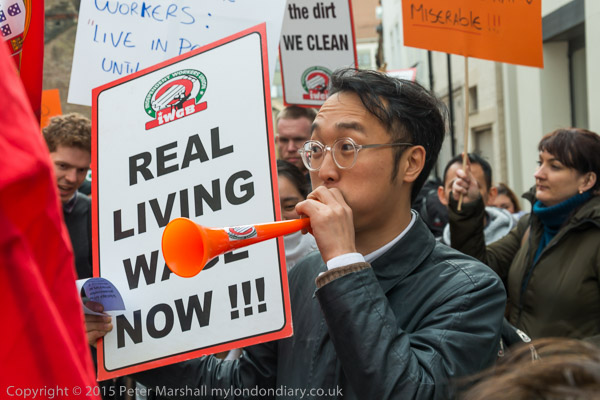
But in the past months I’ve visited the Royal College twice, though not actually going inside, but in the company of cleaners, who have been demanding that they be paid the London Living Wage now, not from September as the college has offered. It may seem a relatively minor issue, but if you are living below the poverty line (and the living wage is the poverty line) then even a small difference is vital. If you can’t afford to take the tube for example, your daily journeys to and from work may add an hour or two to your working day, and not having to choose between eating enough and heating your flat is a great liberation.

The cleaners were joined in their protest by quite a few students from the college and you can read more about what actually happened in Poverty pay at the Royal College of Art.


NIKON D700: 16.0-35.0 mm at 16mm, 1/250s, f/8, ISO 640, +0.7Ev

The protest was at lunchtime, at the light was good, slightly hazy sun that meant the shadows were not too harsh, although the March sun was fairly low in the sky, and despite using a lens hood there were some images with ghosting and flare. With the 16-35mm the lens hood makes a difference but doesn’t work as well as it might at all focal lengths. Lens hoods have their limits in any case, and the ‘petal’ shaped Nikon hood does its best, though at times a carefully placed left hand resting on it can add a little extra shielding (though often it turns out to be slightly less carefully placed than it seemed through the viewfinder and require a little cropping to remove it.)

But it’s impossible to avoid flare and ghosting, and generally zoom lenses suffer more than primes. Optically there is little otherwise to choose between them now, largely a choice between the discipline of working with a single focal length and the versatility of the zoom. With digital giving high quality at high ISO, the wider apertures of primes are of less importance most of the time unless you want to make creative use of limited depth of field (and I seldom do.)

The effect of flare can be reduced by a little local use of the adjustment brush in Lightroom, adding some contrast and clarity, along with a variable change in exposure. If it’s only mild it can be more or less eliminated, but usually I prefer simply to reduce the effect. As lenses age, they usually seem to give more flare, perhaps because their inner glass surfaces become slightly dirty. Certainly the 16-35mm, now getting quite elderly, seems to be giving more flare.

The ghosts can sometimes improve an image, and although in theory they could be retouched, I seldom try. Doing it well is very tricky. I don’t think I touched the green and yellow disks in this image, but sometimes where they grab the eye too much I have been known to desaturate the colour somewhat and sometimes darken them slightly with the adjustment brush. I don’t feel doing so affects the integrity of the image – any more than removing the spots from sensor dust, both are results of defects in the apparatus.


NIKON D800E: 16.0 mm f/2.8, 1/250s, f/8, ISO 200, -0.3Ev

When the protest moved around to the other end of the college, adjoining the Albert Hall I took some images using the 16mm fisheye to let me get close to the protesters and still show that building very recognisably in the background.  Using the Fisheye-Hemi plugin does then eliminate some of the curvature and produce less distortion of people away from the centre – like the woman at the left edge. In the fisheye view she would be rather curved, and in a similar position on the 16mm rectilinear lens she would suffer a sideways stretch.

Tilting the fisheye when taking the picture has however resulted in verticals that diverge fairly dramatically towards the top of the picture. It perhaps helps in this composition. You can correct the divergence in Lightroom, but only at the expense of losing much of the image.


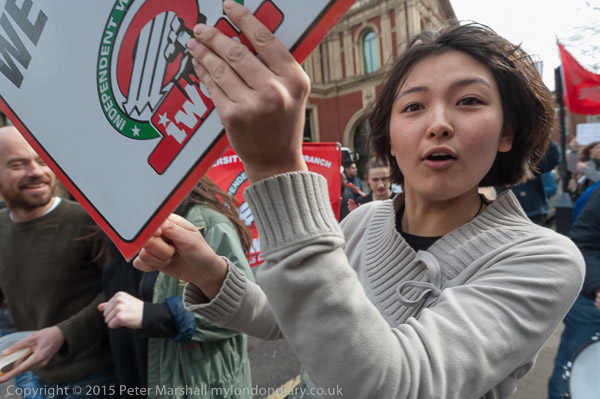
NIKON D700: 16.0-35.0 mm at 19mm, 1/200s, f/7.1, ISO 640, +0.7Ev

You can see some distortion in the face of the woman very close to the 16-35mm lens who was walking past me. Although often called ‘wide-angle distortion’ you can also get it from standard lenses when working very close to the subject. The relative distances from the centre and edges of the subject differ and thus so too does the magnification.


NIKON D800E: 18.0-105.0 mm at 45mm (68 equiv), 1/200s, f/7.1, ISO 200, -0.3Ev

Which is why a longer lens is more suitable when photographing fairly tight images of people, and a short telephoto – around 85mm on 35mm format – is often referred to as a ‘portrait lens‘. But you can of course take portraits with any lens. Hedgecoe’s best work was as a portrait photographer, particularly in black and white, and some of his best images were what is sometimes known as environmental portraiture, showing for example an artist in his studio, made with a wide angle to show the person in their surroundings. Others have made effective tightly cropped parts of faces with very long lenses.
Continue reading Poverty College

Police nick Class War banner

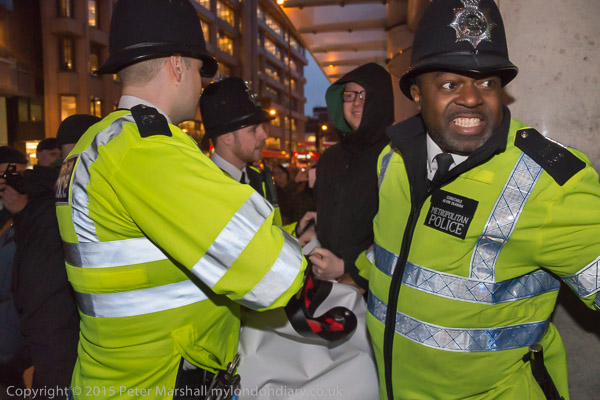
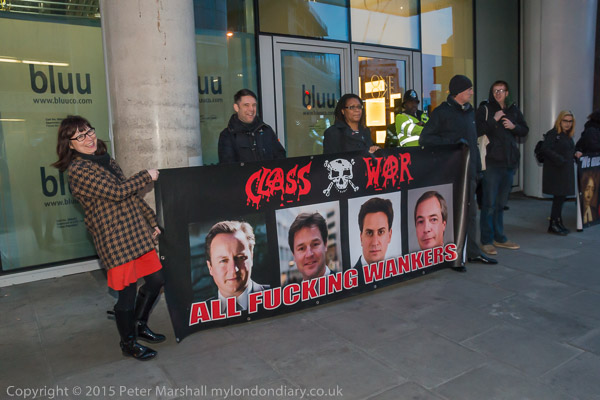
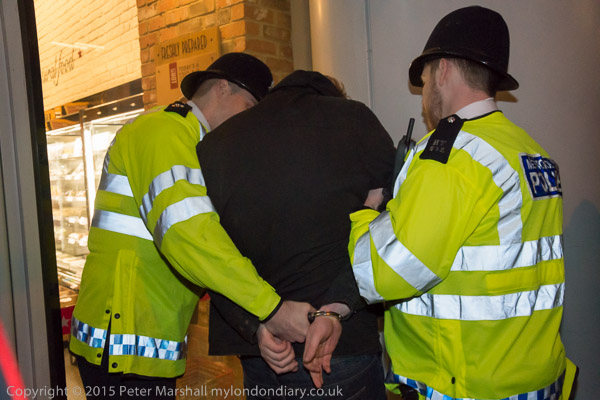
The picture above shows three police officers grabbing a banner from a protester at the protest outside the ‘rich door‘  of the flats at One Commercial St, the door at the front of the building on the main street that the social tenants in the block are banned from using.  As I’ve mentioned in previous posts here and in My London Diary, residents in the social housing and their visitors have to use a less convenient entrance in an often dirty alley at the side of the building – the poor door.

The banner the police are taking is one that has appeared at some of these and other recent protests being carried by Class War, and has been seen by thousands. Many of those who have seen it have been noticeably amused, some clearly expressing agreement, and while some may have felt it unfair or inappropriate, I’m not aware that anyone has been seriously offended by it.

It’s a banner that does cause me some problems, and I usually refer to it euphemistically as the ‘Political Leaders’ banner.  Similar posters with individual images of the party leaders were published by Class War at the time of the last election, and one over-zealous police officer organised a raid on the home of a well-known photographer who had displayed them in his front window.

There are two words that I seldom use in the caption across the bottom of the banner, the ‘f’ word and the ‘w’ word. I can remember the shock expressed in the press when the first of these was first used on live TV in the UK, but now it, like the ‘w’ word is commonplace, though still to some extent controlled.

We don’t often say it in polite middle-class company, but for the great majority of the population it is a part of normal speech; when I first went to work in an engineering factory as a student it accounted for around 50% of the speech of some of the workers on the shop floor, and there would be relatively few sentences without it. Travelling around London on public transport or foot I overhear it in frequent use. We may dislike it or disapprove of it, but it has little power to shock or offend.

After police seized the posters in 2010, the photographer concerned had a surreal exchange with the police, which resulted in him replacing the posters in his window but with the word ‘onanist’ replacing ‘wanker’. Later, a court decided the police action had infringed his right to freedom of speech and expression, and the photographer was awarded compensation for the police actions.

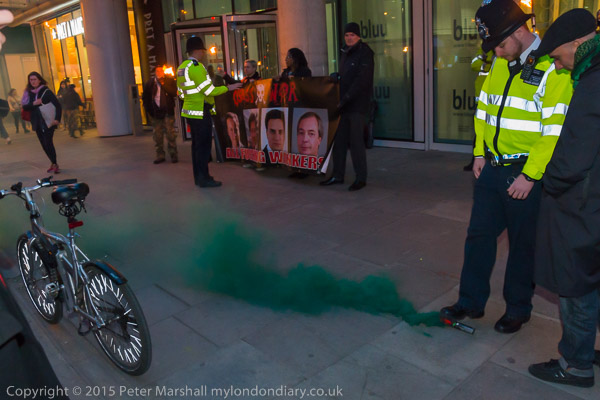
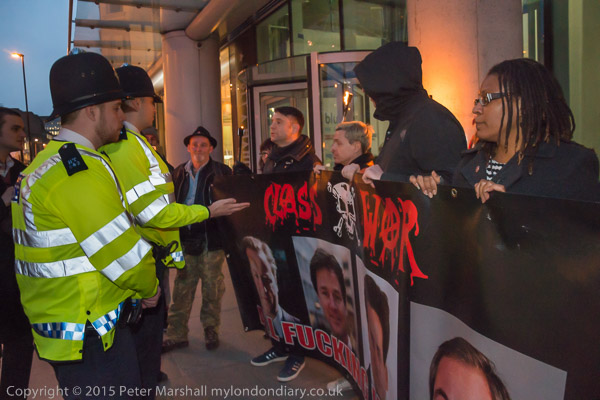
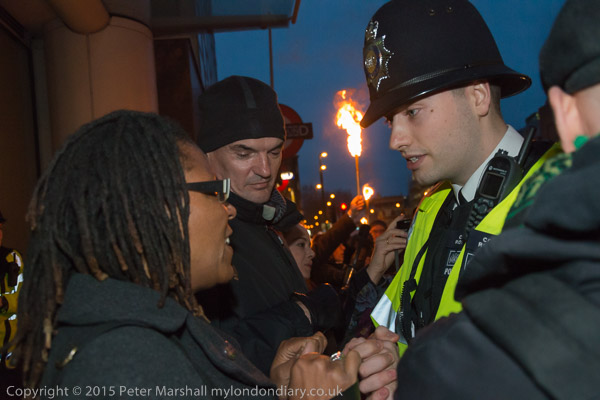
After the protesters had lit flaming torches and a green smoke flare, a police officer decided it was time the police took some action. He went up to the people holding the banner and told them it was offensive and they must put it away.

They asked him if anyone had been offended by it, and fairly clearly no one other than that officer had been, but he and another officer then the officers then warned individually each person holding it that they were committing an offence and might be arrested, and then seized the banner.

One of the people holding the banner continued to hold on to it as the police tried to pull it away, saying they had no right to take it. After they had forced it out of his hands, he was led away, and handcuffed.

Eventually police reinforcements arrived, including a more senior officer, who appeared not to be too pleased at what had happened, but the arrested man was taken away to the police station and the protest continued more or less as usual.

The last I heard of the case was that the police were trying to get the man to accept a fixed penalty so that the case would not go to court, where a conviction might be difficult.

The photographs – as often in other events – make things appear very much more ordered than they were. One thing that is largely missing from my pictures are the half a dozen photographers also trying to photograph them, and the crowd of perhaps twenty protesters also trying to see what was happening and at times to intervene while the banner was being grabbed and during the arrest.

A wide-angle lens lets me get in close, but its also vital to try to anticipate how the scene will develop and where it would be possible to take pictures. It’s also important that while recording the actions of the police photographers don’t impede them. Most of these images were made with the D800E and the 18-105mm DX lens at 18mm – 27mm equivalent. I was working at ISO3200 but on some images there was a couple of stops of exposure compensation, so making it more like ISO12,800. The reflective strips on police clothing give problems with flash, and the exposure compensation stops these burning out, though quite a lot of burning in of them and the fluorescent green jackets was needed.

There is also a high degree of editing. Much of the time it was quite crowded and people were pushing and bumping into me and even though I was using flash some are not sharp. The light was also fairly poor for autofocus. And many pictures were rejected because of people getting in my way as I was taking pictures. Of course I will have got in their way too.

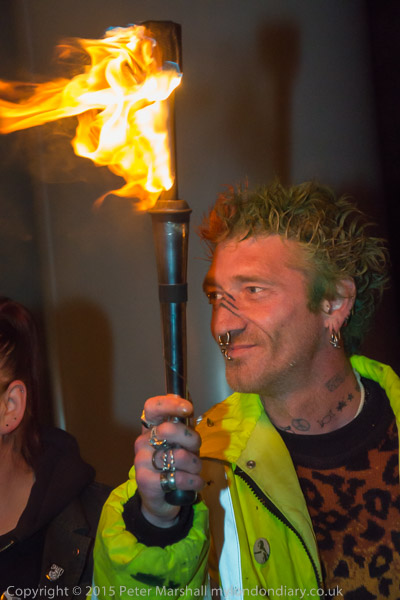
The flaming torches also present something of a challenge so far as exposure is concerned. Getting detail in those flames as well as the rest of the scene isn’t too easy even given the great dynamic range of the D800E, and there are a few pictures where I didn’t quite do it as well as I would have hoped.  But others seem to have held the detail in the flames well – with the help of a little flash and quite a lot of Lightroom.

You can see more at Police seize Class War banner.

Continue reading Police nick Class War banner

Fox Talbot goes on-line

WHF Talbot, one of the inventors of photography, died some 115 years too early to set up his own web site (though I think there is little doubt that had he still been around he would have been at the forefront of that scientific advance too.)

But now the Bodleian Library is about to repair that omission, with “an ambitious project to create a new web-based research tool that will allow scholars and members of the public to view and search the complete photographic works of British photographic pioneer William Henry Fox Talbot.”

There is already some material on-line at the project site, including a blog to provide updates on the development of the William Henry Fox Talbot Catalogue Raisonné” and the project is a large and lengthy one, due to be completed by 2018. It is hoped that the publication of the work in this way will lead to new information and insights into the work of WHF Talbot – and perhaps even the discovery of new images that were made by Talbot and his circle of photographic colleagues.

My only slight quibble over what appears to be a magnificent development is over the statement: “Catalogues raisonnés are common in the world of art, serving as a detailed academic inventory of an artist’s work. However, nothing of this scale has been attempted for photography.”

While the scale of this particular project may be unique, there have been a number of publications which are essentially catalogues raisonnés for the work of the photographers concerned, though bearing in mind the different natures of photography and painting or sculpture. While it may be relatively simple to cover every painting by an artist, every print and every reproduction of a photograph by even a not very prolific photographer is an virtually impossible challenge. Ours is a prolific if not profligate medium.

You can read more about some of these photographic equivalents – including the magnificent two volume edition of Alfred Stieglitz, The Key Set and the 4 volumes of ‘The Work of Atget‘ in a post Photography Catalogues Raisonné by Loring Knoblauch on Collector Daily in 2009 – and the suggestions in the comments on that piece, which include references to a number of other photographic catalogues raisonnés.

Time to Act

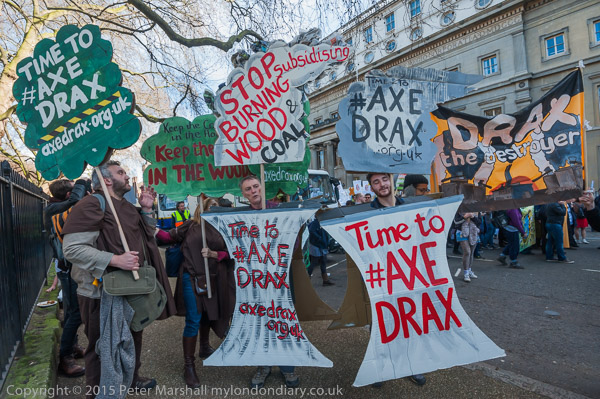
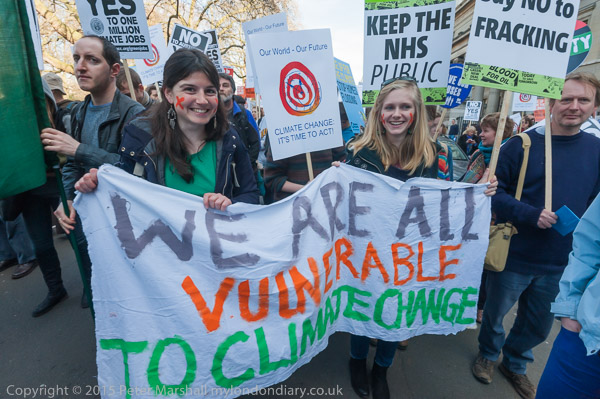
Or rather well past time for some real action on Climate Change was the message of a large and largely unreported protest in London at the start of March. In my account at Time to Act on Climate Change I began “Over 20,000 protesters marched through London” and while it is hard to be definite about the exact figures at such events it was certainly a large protest.


Time to #AxeDrax

Over forty-five years ago, when I first began to think about environmental issues (and even to speak in public on them), climate change was something that would happen in the future, the stuff of post-apocalyptic fiction such as J G Ballard’s ‘The Drowned World‘, first published in 1962 (though I only read it much later.) Now it is very much with us, and among the pile of discarded papers I moved to find my keyboard this morning I came across an article about wine producers buying up estates in Kent and Sussex as the Champagne region is becoming too warm.


Champagne is perhaps the least of worries for most of this, though perhaps not for those in the 1% whose opinions driven by wealth really matter. But unlike many of those associated with global warming, one that is easily overcome by a simple shift of location. Less easy to solve the problems of countries such as the Marshall Islands or Bangladesh already suffering from rising sea levels and global climate instability.

Last September, ahead of the New York Climate summit we had another large march in London, the Peoples Climate March, about which I commented that it seemed to have been “taken over by various slick and rather corporate organisations rather than being a ‘people’s march’ and seemed to lack any real focus.”  Although some of those same organisations were backing this march, they were far less visible, and it was far more a march dominated by climate activists and grass roots organisations.

The important arguments are no longer I think about environmental or scientific details (though of course the detailed matters of ecology remain vital) but of politics – how we get the change we know is vital to save life on this planet, if indeed that is possible.  How are that small and wealthy elite – the 1% or perhaps rather fewer – to be persuaded to abandon their own increasingly insulated lifestyle of extravagance based on planetary exploitation for the sake of a future for the rest of us. Can it be achieved within the institutions – including governments – which they dominate or will it only happen through catastrophe or revolution?

Protests such as those I spend much of my time photographing often don’t acheive their aims, often indeed are asking the impossible, often are doomed to failure, but that doesn’t mean they are unimportant. There are sometimes small victories, but even more vitally they serve to bring issues into the open, to manage to break through the dictatorship of the elite over the public agenda, to slightly rock the government boat. They are the way that many things start to happen. And even in my gloom, especially in it, there is hope that something may happen over climate change. And much of that hope comes from the people that appear in my pictures and what they are doing.

The event began in Lincoln’s Inn Fields, the largest public square in London, including the surrounding roads around 250 yards by 180 yards, enough to make a large crowd look fairly sparse. As the front of the march was leaving from the south-west corner, people were still flooding in to the square from Holborn station and High Holborn. It took around 35 minutes before the last of the march – which at the start was fairly tightly packed – to leave the square.  The “Over 20,000” was the organiser’s estimate, and my own guess would have been a little lower. But where most of the media talk about hundreds when thousands are on the streets a little overestimate helps to balance things.

I stayed taking photographs in Lincoln’s Inn Fields until the end of the march had got fairly close to the start point, and then rushed off to catch up with its front. I had the advantage of being able to take a short cut where the marchers went around the one-way system at Aldwych, and they had been walking rather slowly with frequent stops, and I caught up halfway down the Strand.


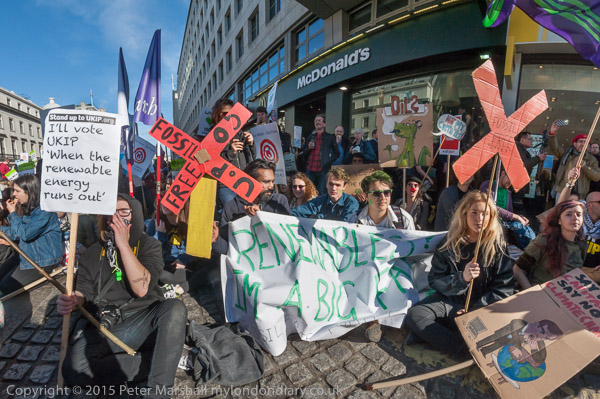
‘Renewables – I’m a Big Fan’. Fossil Free Pompey at McDonald’s

Ahead of us were several places where I thought some of the marchers might decide to make some kind of protest, and I kept close to a group who I thought might be involved in this. And as we approached McDonald’s I was not surprised when things livened up. But the police had also for once anticipated the action too, and McDonald’s had extra security staff on the door. Instead of trying to enter, people sat down in the road, and hundreds of other marchers followed their example, blocking the street and stopping the march.


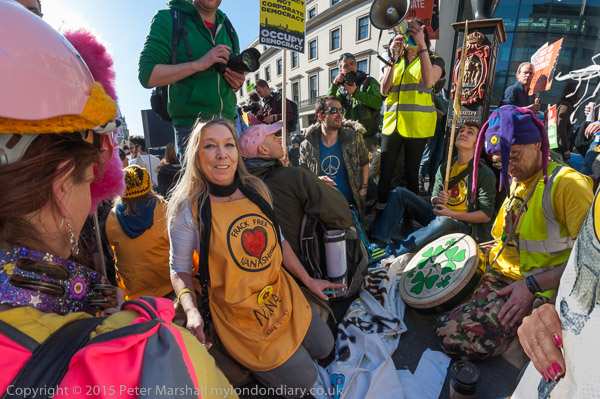
Tina-Louise Rothery and friends on the Strand

The low winter sunlight made photography difficult, with areas of deep shade and bright sun. Working with an extreme wide-angle as I mainly was, using fill-flash was impracticable, and although I tried hard to avoid blown highlights I wasn’t always successful. After  making some pictures close to McDonalds I stepped over protesters who were sitting or lounging on the road to get across to a group of anti-fracking protesters towards the far side of the road and joined them to take pictures.  Among them were several, including Tina-Louise Rothery and some of the other ‘Nanas’ who I’d met at previous protests, who it was good to meet again. It does make working with the 16mm fisheye easier when the people you are photographing know you and are happy to be photographed at close quarters.


Time to Act on Climate Change

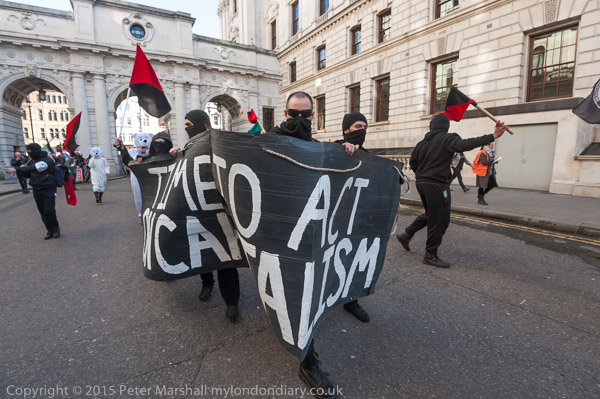
After a few minutes the protesters got up and the march moved on, though the corner of Trafalgar Square and turning down Whitehall.  Here the black bloc came to the front of the march, and I expected some lively scenes at Downing St.  There was a little shouting and they were joined by a small group of polar bears, but soon they were on their way again. On reaching King Charles St  they rushed off down it, followed by a small group of marchers. I ran down with them for a short distance, and then had to decide whether to stay with them or the main march.

Their protest might well have provided some images of clashes with police and of minor damage to property that would be likely to be used by the mass media. Thinking purely in terms of likely use of images and possible sales, I should have stuck with the black bloc. And I think like most photographers I welcome the adrenaline of confrontations. But I’m not happy with the way that such images are used by a press and broadcasting establishment dominated by the 1%, which picks on such things to obscure or denigrate the main issues. I vacillated, then turned around and ran back to photograph the main march as it came into Parliament Square.


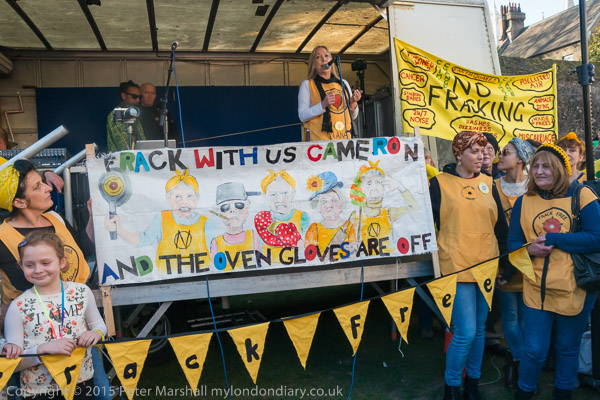
‘Frack With Us Cameron and the Oven Gloves are Off’

I was anxious too not to miss the rally on College Green and the opportunity to photograph the speakers and the crowd there. Though there was relatively little press interest as the only major celebrity input came from a video link with Vivienne Westwood speaking from Paris. But there were some interesting speeches and speakers, including John McDonnell and Caroline Lucas, Matt Wrack and others, with Tina-Louise Rothery bringing Frack Free Lancashire activists with her and John Stewart coming on with some of the polar bears who had protested earlier in the day at Heathrow.


Almost corrected image of the Viking Longship and oil slicks against BP sponsorship of Art by ‘Art Not Oil’

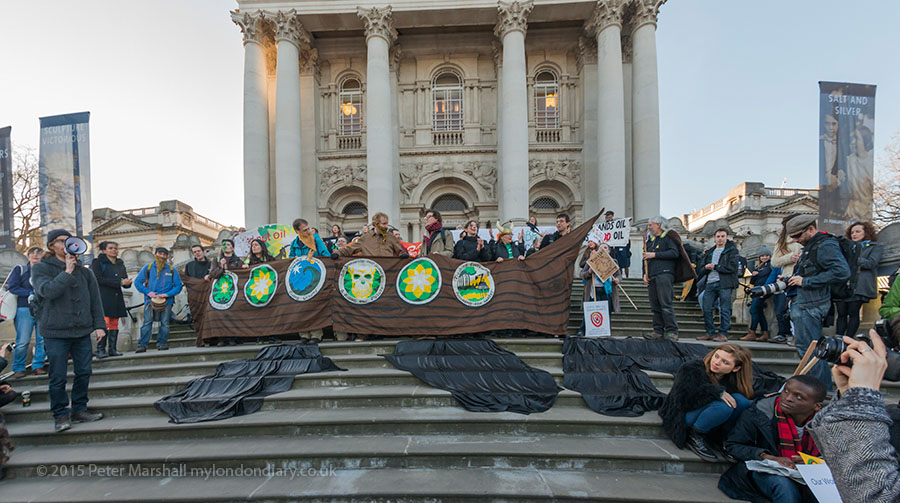
At the end of the rally I had another choice to make. I could either go back north to Parliament Square and Westminster Bridge with activists likely to face confrontation with the police, or go south with Art Not Oil‘s Viking ship to protest on the steps of Tate Britain. Either would have taken me towards a station from which I could catch a train home, something my body was telling me it was time to do. Although Parliament Square would have been more exciting it was also more open-ended with perhaps hours of police kettles and confrontation, I went with the ship simply as a quick and easy option.  I’d done enough and needed a rest and dinner.

More at:
Time to Act on Climate Change
Climate Change Rally
Viking longship invades Tate steps
Continue reading Time to Act

Same Circus, Different Clowns

This isn’t a post about our general election, though I suspect the headline might do for the possible result, which might be a marginal improvement on the equally likely Same Circus, Same Clowns but isn’t I feel going to change things a great deal. Of course I shall still go out to vote, though only to register my opinion, which I think is important to do, however impotent politically.

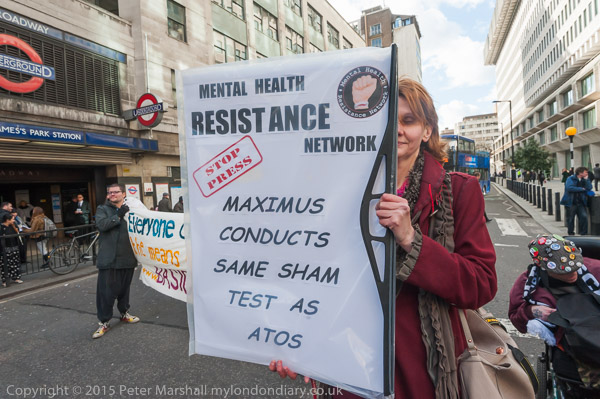
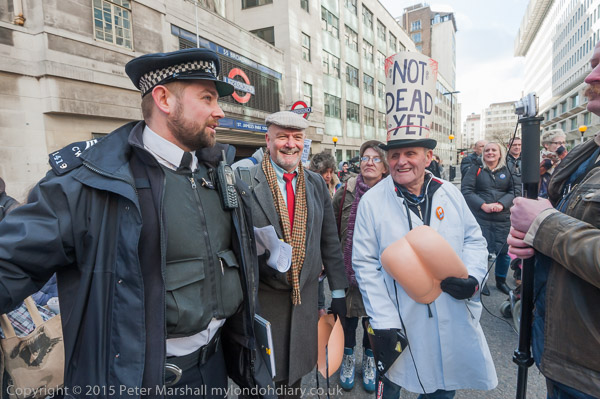
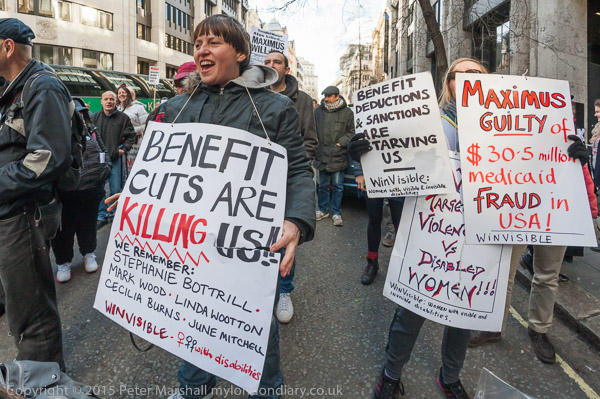
But as Maximus – Same Circus, Different Clowns makes clear, this was an event about a different company taking over the administration of Work Capability Assessments for sickness and disability benefits from Atos, who have been so hounded (and justifiably so) by protesters that they have thrown in the towel.

People didn’t protest because Atos were conducting the tests, but because the tests themselves, based on box-ticking computer questions are generally agreed to be woefully unfair and inadequate, and mainly because of the way that Atos pressured those largely unsuitably skilled people administrating them to do so in a way that was grossly unfair to claimants. It’s possible, though perhaps unlikely that Maximus will do the job better, though they will still presumably have the same financial incentive to fail as many people as possible. No fair system would pay more for failing more or set targets for the number to be failed.

Of course the tests should be scrapped, and replaced by assessments based on medical evidence provided by properly qualified people, and protests will continue until this happens, and this was just the first against the new administrators, Maximus, a US company with a UK office close to the Dept of Work and Pensions.

DPAC (Disabled People Against Cuts) and other disabled groups represent people who have been hardest hit by the coalition government’s welfare reforms, with Minister Iain Duncan Smith cynically seeing them as an easy target. Events have proved him wrong; their disabilities have made them one of the toughest groups of protesters in the country, both on the streets and in the courts, where they have inflicted a number of defeats on the government – though the response has been largely for the DWP to ignore the verdicts.

DPAC are determined because so much is at stake for them – and many know friends who have committed suicide because of losing essential benefits or the continual harassment of regular incorrect assessments and appeals which eventually overturn these.  Their protests also rightly attract a great deal of public sympathy, not least among the police, who also fear the bad image that reports and photographs of them treating the disabled as they sometimes do the general population would give.

There is also a great reserve of often unused and under-appreciated talent among people with disabilities, some of which leads to their protests being more inventive and more visual than most. It’s always a pleasure to photograph their protests, and you are never quite sure what will happen, though it is likely that something interesting will. And the public appreciation of the poor deal they have had from the government does result in greater interest in the media – and my pictures of events involving the disabled have been more widely used than those of other protests.

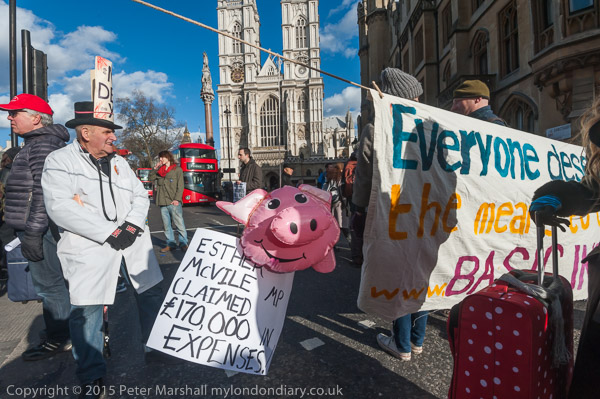
It’s not everyday you get the opportunity to take a rather different image of Westminster Abbey complete with a flying pink pig, and I’m not sure I really made the most of it, though I tried a few times. You can read the account of the event and see more pictures at Maximus – Same Circus, Different Clowns.  As usual I was working with the Nikon D700 with 16-35mm f4 and the D800E with 18-105mm DX, as well as just a few frames with the 16mm fisheye on the D700. The top image in this post was made with the D800E, others all with the D700.
Continue reading Same Circus, Different Clowns

Five Year Growth

Someone asked me yesterday if the only thing I photographed was protests. It was a genuine query, because she had seen me working at every protest she had attended in recent months, but my answer was “not quite”. But I went on to say that there were just so many protests at the moment that they had more or less forced everything else out of my diary – and out of My London Diary.  I used to cover a rather wider range of events.

It’s perhaps partly the election coming on, though I don’t really see a huge decrease in the activity of protesters after May 7, whichever party or parties form our new government. The policies that are behind what seems to be a growing resentment and militancy were many of them begun by Labour although the screw has certainly been tightened by the Conservative-LibDem coalition government. To mix a metaphor, Labour might release a little of the pressure, but it still looks to me as if growing inequality is stoking up a boiler on its way to bursting point.

Other photographers occasionally ask me how I find out about all the protests I cover, but really it isn’t a problem. My problem is more about choosing which of the many going on to decide to attend. Yesterday there were half a dozen things in various parts of London I knew about (and some I only heard about after the event) but I only got to one. And the pressure of work is such that I’ve been getting over-tired, not getting enough sleep and finding that I have to stop work after a few hours -at times I begin to feel my age.

It’s been a few days longer than usual since my last post here, mainly because I’ve been out working every day, and its likely to happen again. Today I’m able to sit here writing this because I didn’t manage to finish yesterday’s work at the computer, simply falling asleep as I tried to write, eventually dragging myself off to bed. So this morning I had work to finish and also still needed to rest. Otherwise there were a couple of protests in the centre of London and another following on from yesterday’s protests in Brixton I might be photographing. But I need a day off. Perhaps when I’ve finished writing this I’ll go for a quiet walk, taking as usual a camera with me, but probably not making and photographs.


X-Pro1, 10-24mm, 20mm

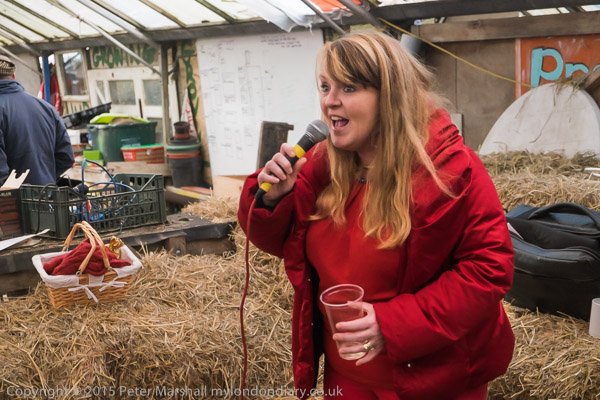
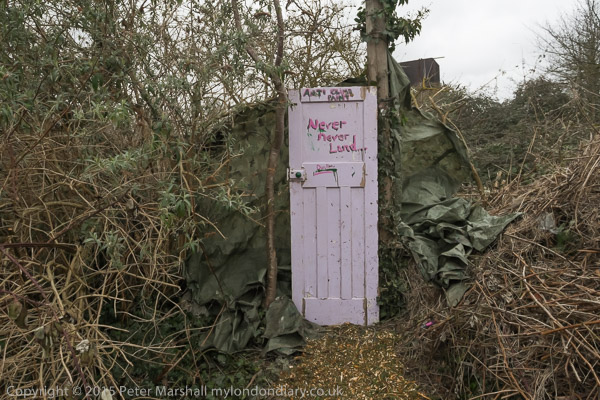
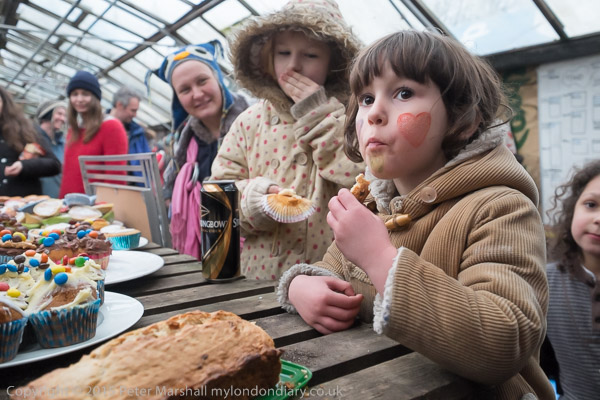
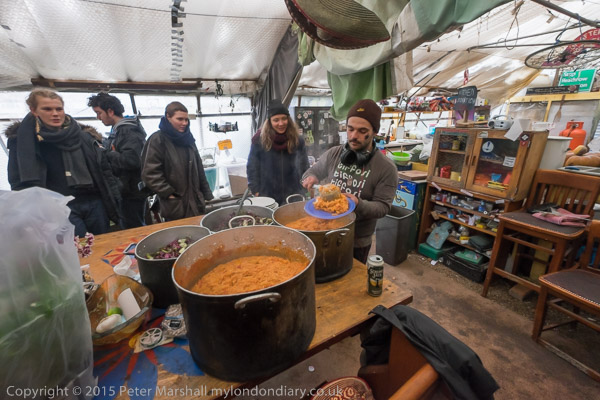
Sometimes I still do manage to photograph things that are really a day off from protests, and there was one such at the end of Febraury, when I went to a party to celebrate five years of Grow Heathrow. I’d first visited the site very briefly shortly after it had opened, just a short walk from an extremely small plot of land I had become a “beneficial owner” of at Heathrow Airplot in Sipson as a part of the campaign against a ‘third runway’ for Heathrow, and had returned for a couple more visits over the years.  Every time I went I thought it would be my last visit, with court cases and evictions always looming, and it was something of a surprise to find they were still there and active after 5 years.


X-T1, 10-20, 10mm

I’d thought a little about taking photographs, and decided it would be an ideal occasion to use the Fuji cameras, taking with me both the Fuji X-T1 and X-Pro1 bodies. I had four lenses, the 10-24mm and 18-55mm zooms, the 18mm f2 and the Samyang 8mm fisheye, though I didn’t use this. I’d taken the 18mm in case I had to work in low light, though it only has a one stop advantage over the 18-55 zoom at the same focal length. It’s also a nicely light and compact lens which is handy to have on a body hung around my neck when travelling, and my favourite focal length, but in the end I only made a few images with it. Eleven out of just over four hundred. Most used was the 18-55mm (266) with just over half as many (142) on the 10-24mm.


X-Pro1, 18-55mm, 55mm

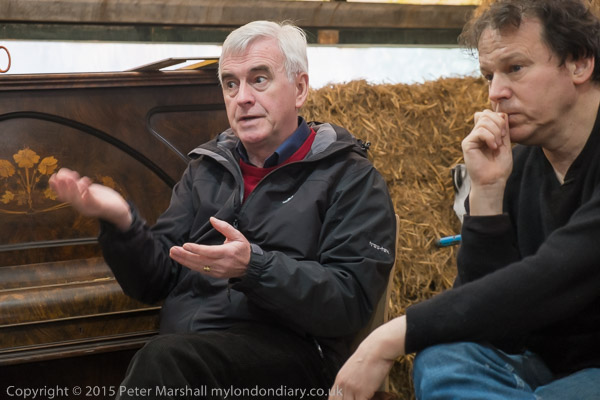
I like the optical viewfinder of the X-Pro1, but ended up taking more pictures with it using the electronic viewfinder and the 10-24 zoom, and wishing that I had two X-T1 bodies. One thing I did miss was a longer lens than the 18-55mm, particularly when photographing the panellists at a discussion where I could not move in closer. I’ve rather got used to using the 18-105mm on the Nikon, and if I ever decide to use the Fujis seriously would certainly buy something longer, perhaps the 18-135mm.


X-T1, 18-55mm, 37.4mm

I had the usual battery problems – I got through four in the four hours I was there, and occasionally the focus was just a little slow, but otherwise things worked fine. I’m getting used to using the exposure compensation dials, though moving the focus point around is still a little tricky. The X-T1 viewfinder is really good in low light too.

There was a huge advantage in using the Fujis in quiet conditions close to other people in that I could take as many pictures as I liked without being a distraction. I often feel intrusive when photographing with the Nikons, although I know the shutter sound is louder to me than to other people, it is still loud enough to be annoying. Almost as annoying as a Canon :-)  though less so than a cannon. With the X-T1 you can use the electronic shutter and all there is to hear is a slight whir as the lens focusses. Usually I leave the shutter in mechanical mode, which is pretty quiet, but does give you some feedback that you have taken a picture. Sometimes I found myself having to review an image to be sure I had really pressed the button.


X-Pro1, 10-24mm, 17.4mm

It was a pleasant afternoon, and good to meet a few old friends as well. Of course you can read more about Grow Heathrow and see more pictures on My London Diary in Grow Heathrow’s 5th Birthday.

Continue reading Five Year Growth