The Palaces of Memory

If you’ve not yet got a copy of Stuart Freedman‘s The Palaces of Memory, pictures from the Indian Coffee Houses, I suggest you do now. It’s one of the most charming publications I’ve seen for a while, and I was pleased I decided to support the Kickstarter campaign – one of the 157 backers who together pledged the £10,496 that made it possible.

You can see 44 images from the Indian Coffee House project at Panos Pictures, and there are also pictures on the BBC web site and elsewhere. I was fortunate to see the photographer talking about and showing this work around six months ago to a crowded meeting of Photo-forum in London, and it was also featured on Lensculture.

Google will now find you a long list of reviews, articles and interviews about the work, but I’ll pick out just a few: Roads and Kingdoms has a nice interview with Freedman talking to their Director of Photography Pauline Eiferman; Slate’s Photo Blog Behold has a well-illustrated feature, and of course Freedman has his own web site including a blog, Umbra sumus – ‘we are but shadows’…, where his occasional posts are always worth reading.

But perhaps the nicest article I’ve so far found is  on The Delhi Walla; City Moment – People of the Book, Indian Coffee House by Mayank Austen Soofi who took Freedman’s book  to the Indian Coffee House in Connaught Place to the obvious delight of the workers whose pictures and those of their customers appear in it.

Tendance Floue at 25

Today’s e-mail from L’Oeil de la Photographie (available here on the web) is devoted to Tendance Floue, currently celebrating its 25 anniversary. As usual there are links to other features about the photographers on L’Oeil as well as the group and show web sites.

You may never have heard of Tendance Floue, particularly if you are not French, as English media in general seem seldom to pay any great attention to photography in France, or at least photography in France by a post-Magnum generation. With a few exceptions it hasn’t really been taken up by the US dealers and museums that tend to dominate the ‘Anglo-Saxon’ photography world.

Tendance Floue is a collective which has had a remarkably stable membership over the years since they were founded in 1991 by Patrick Tourneboeuf and Mat Jacob. Born in or around the 1960s, all of the twelve photographers involved when I first came across them in 2006 are in the 25th anniversary show, and there is just one addition, Alain Willaume, who rejoined them in 2010; Caty Jan is still featured although she had to give up photography after a stroke in 2003. The Paris show continues until October 17, 2015.

When I wrote about their 20th anniversary shows five years ago, I failed to find the earlier piece I had written about them, and got at least one of my facts from memory wrong. I first met them and their work when I went to an opening which was part of the 2006 Mois de la Photo, and wrote the following short note around 4 months later.

Tendance Floue
One of the shows I visited last November during the ‘Mois de la Photo’ in Paris was that of Tendance Floue (site in French*), a French photographers’ co-operative. Literally ‘Fuzzy Tendancy”, the group, founded in 1991, now has 12 members, Pascal Aimar, Thierry Ardouin, Denis Bourges, Gilles Coulon, Olivier Culmann, Mat Jacob, Caty Jan, Philippe Lopparelli, Bertrand Meunier, Meyer, Flore-Aël Surun and Patrick Tournebœuf. Their 2006 book, Sommes-Nous? has been awarded the 2007 Infinity Award for Publications.

The Paris show was held in one of the more atmospheric venues of the month, former storage cellars in the arched space under a road close to the new Bibliothèque National, in the yard of ‘Les Frigos’, where I also saw the impressive nudes of Chilean Photographer Paz Errazuriz. As well as the images on the wall, there was also a projection, allowing the work to be seen at a large scale. Some of the pictures are indeed rather unsharp, and the group as a whole obviously sets more store on producing powerfully personal statements than on technical correctness. In a group such as this there is bound to be work by some photographers that I found more interesting than others, but it is certainly worth looking at them all on the web site. My installation view was shot handheld in the darkened space and gives some idea of the way the work was hung on the curved brick vault.

*I’m pleased to find that their web site now has a full English version.

I’ve spent some time looking for the original of that installation view – and a few other pictures I took in the show, but with no success (though it is probably still on the old CDs I keep in the loft.) The thumbnail above was with the original post, where it was ‘used by permission’ of the group. But I did come across some of my more interesting pictures from that week in Paris, which perhaps I’ll come back to in another post.

But it came to me as a reminder of how photography has moved on. Without the file I can’t exactly recall the exposure but I do know the lighting was something of a challenge for the Nikon D200 I took it on by available light. I think it would have been rather easier with the D810 at higher ISO and with a greater dynamic range. Black cats in coal cellars are now hardly a problem.

Mooning Around

Seriously bad photographs were splashed all over the Internet yesterday, and Petapixel has a good selection of these moonshots in People Just Found Out How Bad Smartphones Are at Photographing the Moon.

I got as far as struggling out of bed in the middle of the night – not an unusual event at my age, and having emptied my bladder did put on a coat and wander into the garden looking for the moon, eventually finding it over the roof of the house and realising I could have seen it just by looking out of the bedroom window. I wasn’t too impressed although the moon was half eclipsed and looking rather orange in the darker segment, and went back to bed.

An hour or so later I woke again, and rolled out and took the few steps to peer through the curtains at the now fully eclipsed circle for a second or so before returning under the covers to sleep soundly until my radio alarm came on at the normal hour. As I listened the the news of the eclipse with a woman astronomer waxing lyrical about the experience, it did occur to me that I might have found it slightly more spectacular had I bothered to put my glasses on in the middle of the night.

Several photographer friends did post their moon images on Facebook in the morning, and they were reasonably impressive, certainly standing out among the amateur efforts, some of which were even worse than those featured on Petapixel. But I hadn’t thought it worthwhile trying to photograph the event myself.

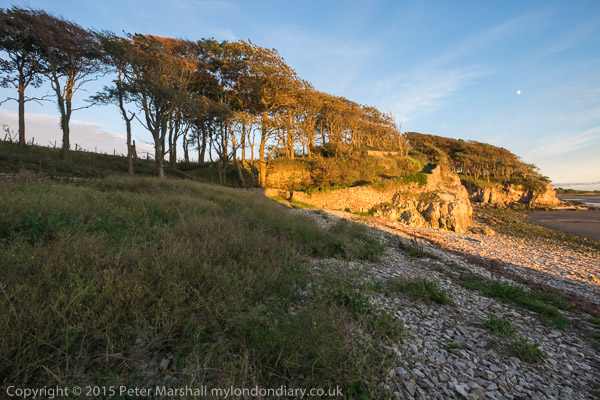
Of course I have photographed the moon on various occasions, but it’s always been disappointing. What looks large and bright always comes out small and dull in my photographs. We seem to always see the moon as much larger than it is, due to some curious feat of mental image processing. That tiny speck in one of my holiday pictures above really did seem quite large in the sky, but on an image this size just looks like some nasty little blob.

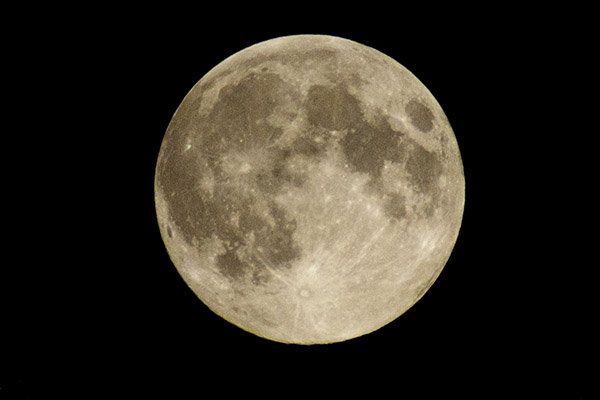
But here is one I took earlier. During one of last year’s three ‘supermoons’ I went out into the back garden and took this hand-held with my 70-300mm lens on the Nikon D800E. The lens isn’t at its best at 300mm, but I stopped down to f8 to give it a chance. Even at ISO 200 I still only needed a shutter speed of 1/1000.  For sunlit scenes, the ‘Sunny 16’ rule says 1/ASA at f16; 1/200 f16 gives the same exposure as 1/800 f8, pretty well spot on in this case. The sky wasn’t as dark as it is in the picture – but was a sodium orange from all of the street lights around, and I cheated by darkening it in post-processing.

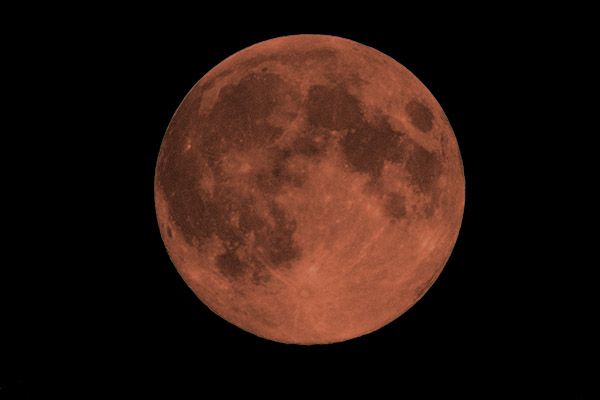
Even at 300mm, the moon isn’t very large on the full frame, but I cropped it drastically for the above image. It’s hardly exciting, but it does show the difference between using a camera and a phone. And if you want it red, you can ask Photoshop:

Of course the interesting photographs of the eclipse show the moon in a landscape or frame of some sort; one friend set up his tripod and tried to track the various phases of the event – and by far the most interesting was as it half disappeared behind the chimneys of the house across the road. I think the more dramatic images were probably taken with lenses in the ultra-long range, perhaps 1000mm, and will often have involved making two exposures, one from the moon and a longer one to get detail in the scene and combining the two. Perhaps you could use the HDR mode that some cameras provide.

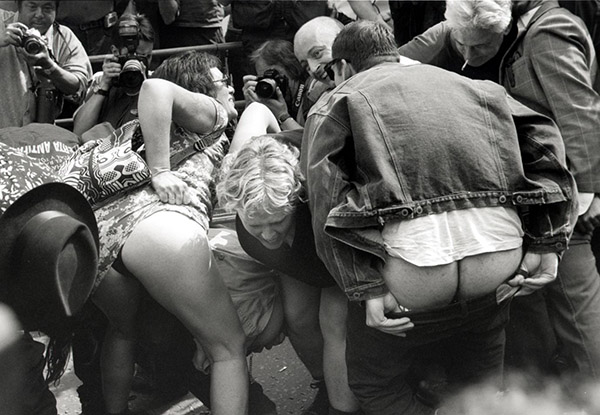
But for a rather more interesting ‘moon’ photograph, here’s one I took 15 years ago outside Buckingham Palace, at a protest by the anarchist Movement Against the Monarchy. They had hoped to have a “2000 bum salute” at their Moon Against the Monarchy in June 2000, but a huge police presence intimidated all but a determined half dozen or so into keeping their backsides covered. Shortly after this picture was taken, a group of police rushed into the crowd and arrested an innocent French tourist, who had the misfortune to be wearing the same style of John Lennon glasses as one of those who had dropped his trousers.

Continue reading Mooning Around

Shaker Aamer to be freed


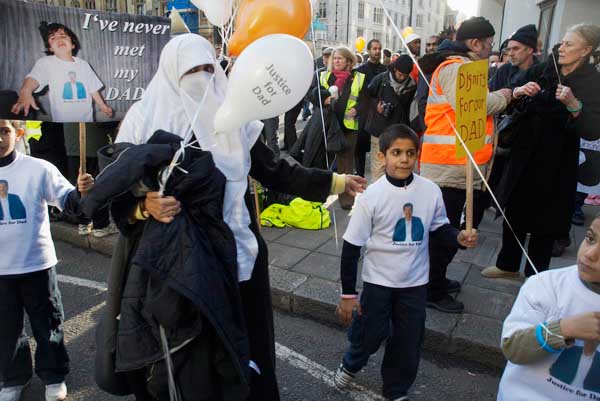
I’ve never met my DAD. London, Jan 2006
Shaker Aamer’s youngest son, now almost 14 was born a few months after his capture

At last, the news we have waited too many years for. Finally, Shaker Aamer, the last UK prisoner in Guantanamo is to be released.


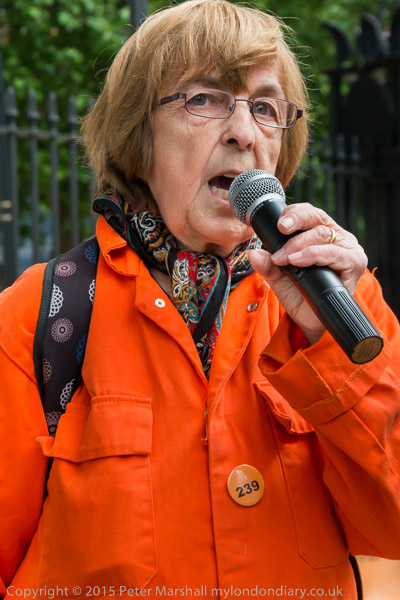
Joy Hurcombe of the Free Shaker Aamer campaign, June 2015

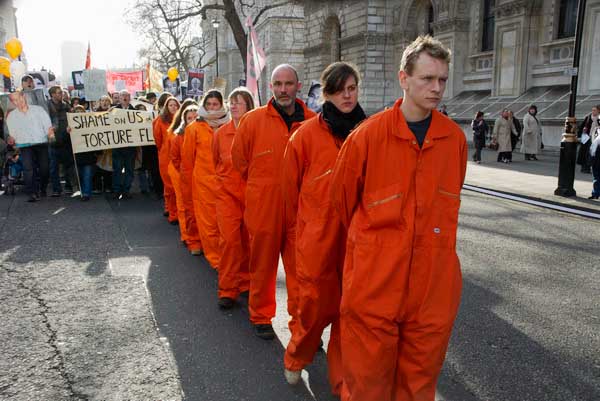
I’ve long lost count of how many times I’ve photographed and written about protests to free Shaker, including many of the regular protests by the London Guantanamo Campaign and the Free Shaker Aamer campaign.  The first I remember covering was in January 2006, when a protest march called for the release of nine people with British citizenship or right to remain where still held there, Shaker Aamer among them.


Those orange jump suits were soon a familiar sight at protests. London, Jan 2006

Those jump suits caused be no end of photographic problems, which I’ve written about over the years, because they were so bright – and often fluorescent – and in an area of the spectrum which often causes difficulties.


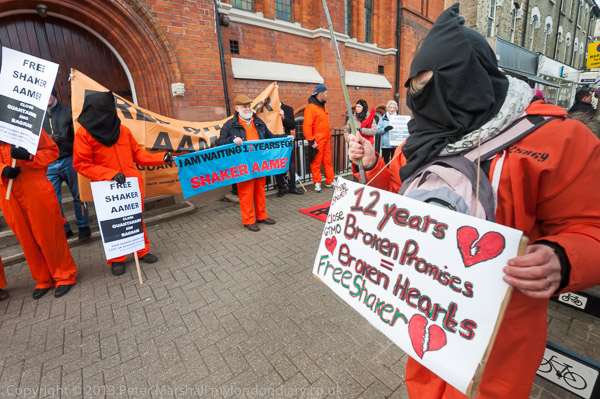
Battersea, Nov 2013

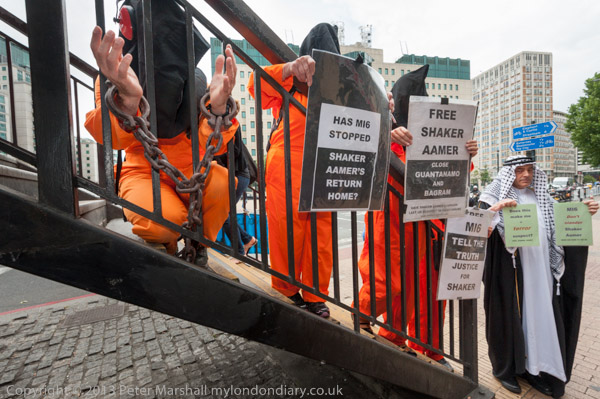
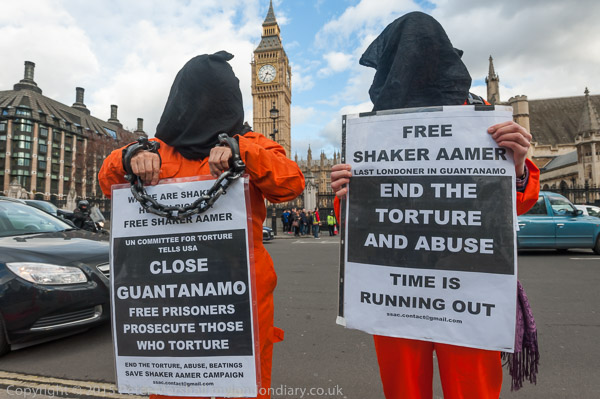
The Free Shaker Aamer campaign has been coming to stand opposite Parliament every week while it is in session for several years, and I’ve photographed them many times, as well as at other protests they have had outside the MI6 headquarters in Vauxhall and in Battersea, close to where his family lives.


Vauxhall, Aug 2013


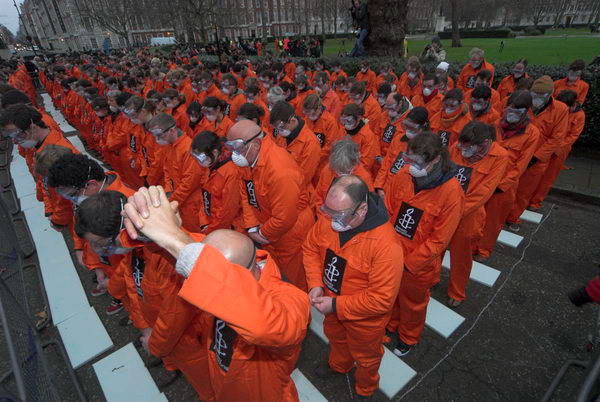
Amnesty International protest at US Embassy, Jan 2007

Every year since 2007 I think I have photographed events to mark the anniversary of the opening of Guantanamo, some outside the US embassy, others elsewhere in London. There have also been protests on the anniversary of Shaker’s illegal rendition to Guantanamo from Bagram, on St Valentines Day, Feb 14th, 2002.


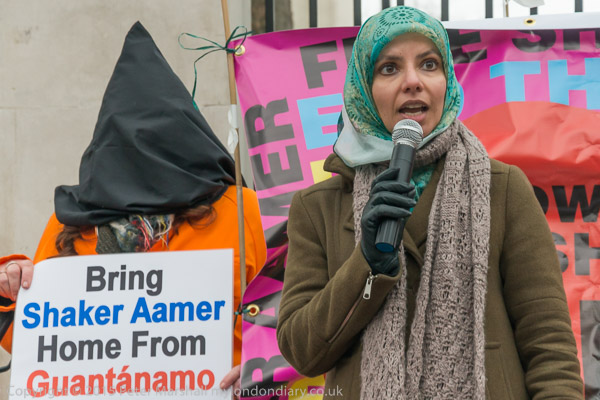
Aisha Maniar, organiser of the London Guantánamo Campaign speaks at Downing St, Feb 2015

It was news that was welcomed by almost everyone, including politicians of all the main political parties who have supported the campaign for his release. Almost everyone, except perhaps someone in the BBC, who invited a spokesperson from the US right wing Henry Jackson Society to come on and spread some unsubstantiated lies about him, telling anonymous rumours that the US authorities were unable to find any evidence for as if they were facts. Had their been any real evidence they would never have cleared him for release, even for Saudi Arabia, as they did first eight years ago in 2007 and again two years later.


One of the many protests by the Free Shaker Aamer campaign every week Parliament was in session. Feb 2015

Its hard to understand why, and it certainly can’t be explained by their usual ideas about balance. Perhaps the only credible explanation is that it was the start of a campaign by MI6 and the US security services to discredit the eye-witness evidence that Shaker may give about torture and their part in it, both at Guantanamo and before that at Bagram. Shaker too when in Guantanamo stood up for the other prisoners; one of few there among detainees and jailers understanding and speaking both English and Arabic, he became both a translator and an advocate. The BBC claims to be above such things, but unfortunately often bows to political pressure, as we have seen in the past week in their failure to cover #piggate.

Two posts on the protests in June:

Magna Carta justice for Shaker Aamer
New MPs Stand with Shaker

And too many more on My London Diary to post them all.

Continue reading Shaker Aamer to be freed

The State of News Photography

World Press Photo, the University of Stirling and the University of Oxford’s Reuters Institute for the Study of Journalism recently surveyed news photographers around the world and have just published the results of the survey.

There is an clear article on Petapixel giving some of the key findings (based on the report’s ‘Executive Summary’), and it also contains a link to the full report – all 76 pages – released by World Press Photo yesterday, so I won’t go into details of the report here, but simply make a few comments.

The photographers sent the survey were  the over 5000 from around the world who submitted work to the 2015 World Press Photo, and about a third of these responded. There were some problems because many of the submissions are made by agencies and the actual photographers were then less likely to get the survey, and non-English speakers were probably less likely to respond as the survey was in English only, but there were still responses from photographers in over a hundred countries; the largest from any country came from Italy with 143 respondents, and just over half came from Europe, with only a perhaps surprisingly low 142 from North America.

Of course only a particular section of working photographers sends in work to WPP, not least because of our perceptions about the kind of work that is successful in these annual competitions. In North America too there are perhaps other annual competitions which attract greater attention than the European-based WPP.

Perhaps the most interesting section of the report for me was on journalistic ethics, where photographers were asked whether they ever staged, manipulate or enhanced their images.

Perhaps surprisingly, only just over a third of news photographers stated they never stage images, with around half saying they sometimes do. As the report comments “This is certainly contrary to codes of practice at most news organisations and indicates an important gap between the codes and what happens in the field”. Unsurprisingly North American photographers were far less likely to do so (56.5% Never) than their European counterparts (29.4%). My own experience in working for a US company in the past certainly suggested a much greater emphasis on journalistic ethics – and not just in photography – than in the UK.

While over three-quarters of photographers agreed that the addition or subtraction of material content (manipulation) in images was a serious issue, only 9.4% stated in this confidential survey that they never did so, with 28.9% claiming they always did! It certainly suggests that such practices are far more routine than I had every suspected, and I think casts serious doubt on the whole practice of our profession.

The whole report contains much more, with a whole section of quotations from the 300 photographers who replied to the open-ended question “so what is important to you?” making particularly interesting reading. The ‘Conclusions’ at the end of the report also make interesting reading, and deserve greater prominence – they seem a little hidden, starting on page 66 of the report. Don’t stop at the ‘Executive Summary’.

Hine and the Empire State

A short note in L’Oeil de la Photographie (The Eye of Photography), one of series by former LIFE picture editor and photographer John Loengard, based on his 1994 book and current touring show Celebrating the Negative, set me thinking about the life and work of Lewis Hine, and in particular his images of steelworkers made during the building in 1931 of New York’s Empire State Building.

At the bottom of the piece in L’Oeil there are links to several other posts in the series by Loengard, on negatives of celebrated images that he photographed by Henri Cartier-Bresson, Wynn Bullock, Edward Weston, Joe Rosenthal, Robert Capa, Man Ray and Richard Avedon.  (It should be noted that the short quote on Capa rather perpetuates the myth around his D-Day images that has been so effectively researched and demolished by A D Coleman and his collaborators in the Robert Capa D-Day Project, though of course their in-depth research does nothing to diminish the power of  Capa’s images.)

Loengard in his note on Hine states that that the new art director of Survey magazine which had used his work over the previous 20 years “found his pictures old-fashioned“, wanting more graphic images.

You can see more of Hine’s work on the Empire State in various collections, including that of George Eastman House. There appears to be more on their older web site than in their new image licensing website (search for Empire State.) There is another good collection online at the New York Public Library.

You can read more about Hine on various sites. I’ve written only fairly briefly about him in various places, including in a longer essay on the New York Photo League, which inherited some of his work as well as his being influenced by his work. This piece, written in 2001, is still available (though slow to load) from the web archive, and includes this paragraph:

Hine occupied a special place in this pantheon of the League. His campaigning work from around the turn of the century, fighting for protection for children in the workplace (and the enforcement of existing laws designed to protect them) was the epitome of the type of photography the League existed to promote.

It goes on to state that “When Hine died in 1940, his collection of pictures and negatives was presented to the League” and gives some further information. You can learn more about what happened to his work in an earlier article by Vicki Goldberg in the New York Times about a show at the Brooklyn Museum of Art. In it, Goldberg writes of Hine’s “daring and daringly designed images of men and steel and sky” which seems to match better what I see in the work than the opinion of the Survey art editor.

Goldberg goes on to write “Hine’s work sharply poses one of the crucial questions about photography: how much does esthetics count in documentary?” It remains a crucial question though my answer has been that aesthetics must be the means rather than the end. It was a conclusion that decisively altered my own work 35 years ago.

And Hine’s own end also perhaps has lessons. Goldberg writes that in his last years no one wanted his work; “he lost his house, stopped photographing and applied for welfare. He died as destitute as anyone who ever sat for his lens” and later in the piece, “Hine could scarcely sell a photograph at any price.”

Apparently at his death, “the Museum of Modern Art was offered his pictures but did not want them; George Eastman House in Rochester did.” Hine’s work wasn’t entirely lost from sight, and I first met him in the pages of the two early popular histories of photography, by the Gernsheims and by Beaumont Newhall, but the attitude of MoMA is still reflected in the art world today.

We saw it recently in the Arts Council England’s treatment of Side Gallery here in the UK, which lost its entire ACE funding in 2011, and Photofusion which lost funding in 2015. Side, like the Brooklyn Museum of Art which Goldberg states “put Hine squarely in the spotlight with a retrospective in 1977 after a nearly 40-year hiatus“, also exhibited his work in 1977.

Swanscombe


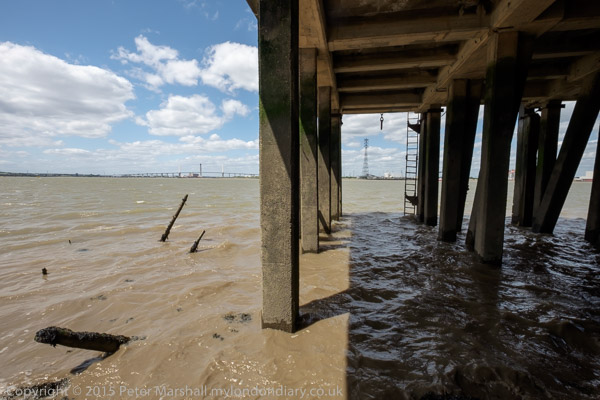
Coal Wharf at Bell Wharf, Swanscombe. A ropeway took coal to the factory

I’m still working on my North Kent book with images from the 1980s that I’ve mentioned here before, and looking at some of the images from back then made me want to go there again, especially since parts of the area are changing.

Of course I have returned occasionally over the years, and published and exhibited some later images, such as those in Estuary and my book Thamesgate Panoramas (as always those with UK addresses can order the print version more cheaply direct from me, though I recommend the PDF from Blurb at £4.99.)
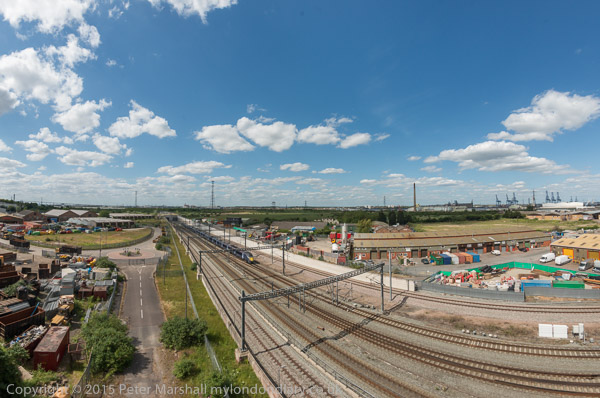

Where the Eurostar emerges from under the River Thames

One particular area under threat is the Swanscombe Peninsula, a triangular area of Kent that juts out towards Essex a little to the west of Gravesend. It’s both an ancient and a modern crossing point, where pilgrims crossed the river on their way to Canterbury, and where enormous pylons, 623 ft high, carry the National Grid across, while the HS1 Eurostars dive into a a tunnel at high speeds close to Ebbsfleet station (where just a few stop) though the more local Javelin services reduce the journey times to central London to 18 minutes for the wealthy. There are plans for what sounds like a particularly tacky theme park based on films and TV programmes which has government backing to cover the whole area.
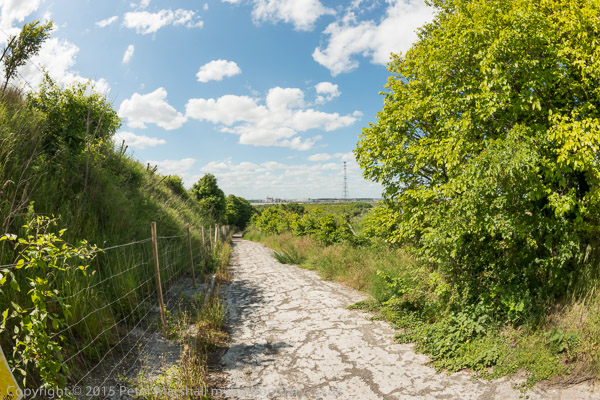

Pilgrims Road – and a giant pylon in the distance on the opposite side of the Thames

I took the slow route to Swanscombe station on a Gravesend train. The time difference for me is minimal, as the fast trains go into St Pancras, to the north of London, and I can catch the slower trains far more conveniently at Waterloo East, and get there about as quickly but with much less climbing up and down and walking in stations. This was important as I was taking my Brompton with me and together with my cameras it adds up to quite a weight. Best not to carry it at all – and I didn’t need to on the marginally slower route.

This kind of consideration makes me wonder about the calculations presented to justify prestige transport projects, such as HS2 against the less sexy options of increasing traffic on existing routes. Shaving a few minutes off the time from Birmingham to London isn’t a big deal if you end up in Old Oak Common – or at the other end you come into Curzon St when your onward journey is from New Street station.  Changing the London terminus for Eurostar from Waterloo to St Pancras might have cut the Eurostar journey times, but had no effect on my overall journey times for that matter.

When I first visited Swanscombe it was in parts a desolate wilderness, with heaps of waste from the former cement works, which was still standing. Disused rails led to fenced off piers. Everything now is rather more overgrown, but otherwise much of the peninsula has a similar feel.
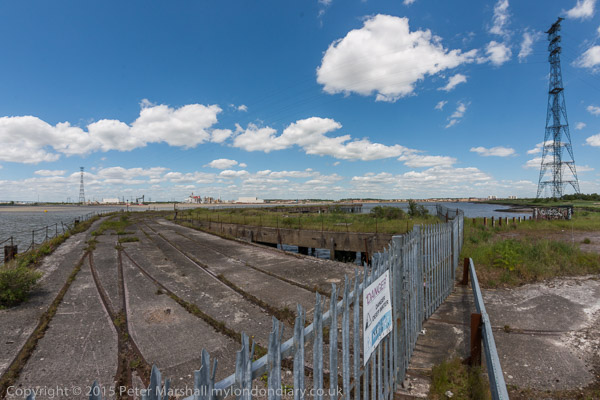

Bell Wharf: coal and clay came in, and cement was sent out. Taken standing on the Brompton

I didn’t find Broadness salt marshes in my early explorations of the area, taking a more inland route and missing it. One of my favourite landscape pictures was taken there in 2006, but I’d never fully explored the area, and this was just one of the things I set out to do.
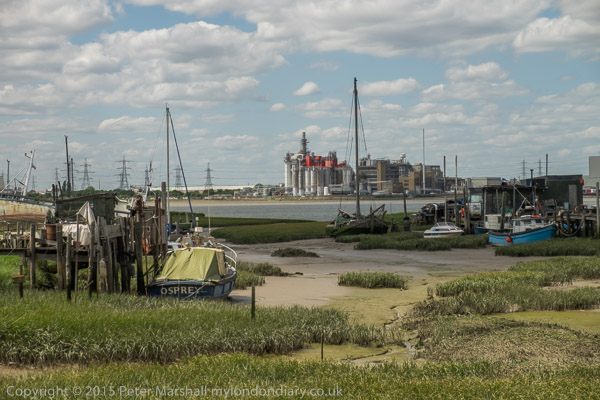
And I took a similar view to the one, that I’d made 9 or so years ago, though then the tide was rather higher, with the creek filled with water.

The creek is at a dead end – probably why I’d not bothered to go to it in the early days. Then I always went on foot, slow, sometimes exhausting, but still the beast way to see the country. Taking a bike enables me to cover more ground and in areas like this can be ridden along footpaths as well as roads, It means I’m happy to go half a mile down a dead end knowing I’ll just have to ride back, whereas on foot I might well decide not to bother. From here I came back and cycled to another dead end, opposite the Tilbury Docks, before returning and going back by Botany marshes, now rather more domesticated as a nature reserve.

The bike is also useful for photographing over walls and fences. Several images in the Swanscombe set were made with the Brompton leaning against a wall or fence and with me standing one foot on the saddle and the other on the handlebars. There is a tendency for it to roll away dangerously but it does add a useful couple of feet to my stature.

Rather than a normal camera bag, I was using a Brompton bag which fits on the front of the bicycle, and working with two cameras, the Nikon D800E with the 16mm full-frame fisheye, and the Fuji X-T1 with Fuji X 10-24mm (15-36mm equiv) and 18-55mm (27-82mm equiv.) The Nikon images have been converted into a cylindrical perspective with horizontal angle of view around 146 degrees.

For most of the day both cameras worked perfectly, but on the way back to the station I stopped briefly to take some pictures looking south from the main road, which runs along the narrow spine of chalk left between two large quarries. I wanted to be sure to get good detail so I turned the ISO dial on the Fuji X-T1 down to 200. Unfortunately the dial below the ISO dial, the Drive dial, turned as well, into the so-called ‘Advanced Filter’ position, with disastrous results.


Fuji’s ‘Advanced’ filter uncorrected. I’m not sure whether this was ‘Toy Camera’, ‘Minature’ or ‘Pop Colour’

The Advanced Filter selection is a clear case where more is less, a capability the camera would be better without, though presumably marketing don’t think so. There are perhaps people who want a setting that destroys your images in camera rather than leaving that to Photoshop, but I’m not one of them.


A near identical frame after considerable general and local work in Lightroom

Worse still, not only do the ‘Advanced filters’ mess up  your pictures with silly effects, they also switch from Raw to jpeg. I was left with garish images, all subtlety of colour lost, and because they are jpegs it is impossible to get back to the original image. I’ve done my best with the image above, but the sky in particular remains impossible, with all cloud detail absent and some vignetting still visible. You can see the difference if you compare it with an image taken at more or less the same place using RAW with the Nikon.


Nikon D800E, 16mm fisheye. From RAW file

The default settings on the X-T1 actually make it very easy to select the filter in error, simply by pressing the Fn1 button to the right of the lens mount.  It’s one of several defaults it makes sense to change to something innocuous.

On My London Diary you can see more of my pictures of Swanscombe and the adjoining areas and also read more about the area, my ride around it and the pictures.

Continue reading Swanscombe
Summer 2015?

Today it really seems summer is over. The rain stopped and I went out in the sun, getting a little hot in my jacket to buy something to bring home for lunch, thinking it would be nice to sit out in the garden and eat it with a glass of wine, but by the time I got home, dark clouds filled the sky and there were a few drops of rain. And it was dark by 8 o’clock.

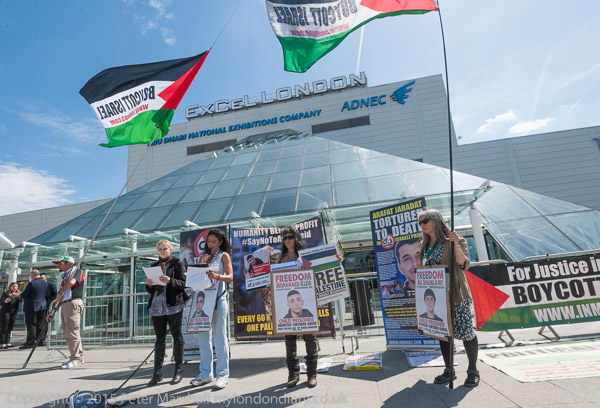
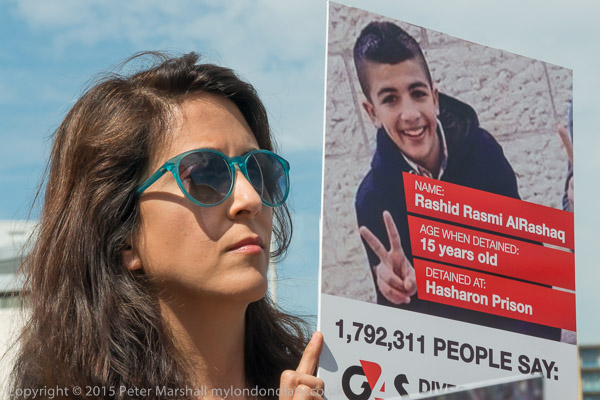
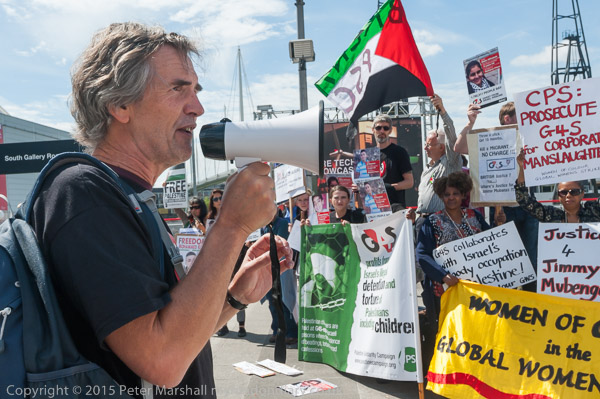
Looking back we hardly seemed to have had a summer at all, but there were a few good days, and one was early in June, when there was a protest in the morning at the Excel Centre in East London, where G4S had chose the UN International Day of Innocent Children Victims of Aggression to hold their AGM. Actually like me they probably didn’t know there was such a day, but it was established back in August 1982. And though it’s an international day and relates to all children around the world, it was established because the UN General Assembly, meeting in a emergency special session on the question of Palestine, was “appalled by the great number of innocent Palestinian and Lebanese children victims of Israel’s acts of aggression“.

Unfortunately the UN General Assembly’s resolution 33 years ago appears to have done little to change the situation for Palestinian children, and the protest was aimed at G4S because of its involvement in running the Israeli prison system in which young Palestinians are held, sometimes in solitary confinement in underground cells, are threatened and sometimes tortured. There are regular protests outside the G4S HQ in Westminster which I’ve occasionally covered, but the AGM brings together a wider range of organisations comprising the StopG4S coalition to protest, not just about their work in Israel but also in this country, where they are best known for their failure to provide security at the London Olympics and the death of Jimmy Mubenga during his forcible deportation. They currently run five UK prisons as well as a young offender institution and secure training centres and “is the main provider of in-country escorting, overseas repatriation services, and the operator of four of the eight of the privately run immigration removal centres in the UK.”

Although there was plenty to photograph outside, with protesters from the various groups, much of the protest takes place inside the AGM, where protesters purchase shares to entitle them to attend. When they ask awkward questions or otherwise protest inside the meeting they are removed, sometimes rather forcefully, by security staff. After the bad publicity following the publication of a mobile phone video taken of this at last year’s AGM, mobile phones were not allowed to be taken inside at this year’s events – and I certainly had no chance of taking pictures there.

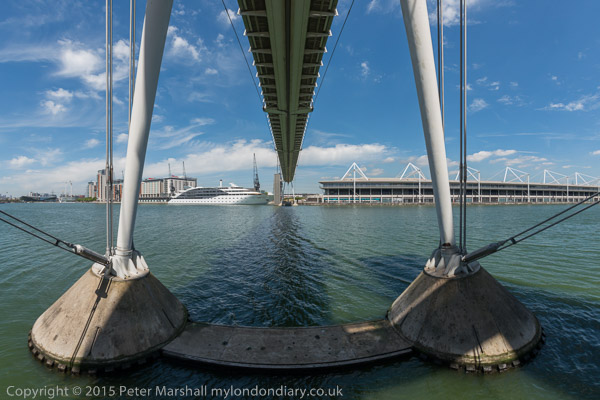
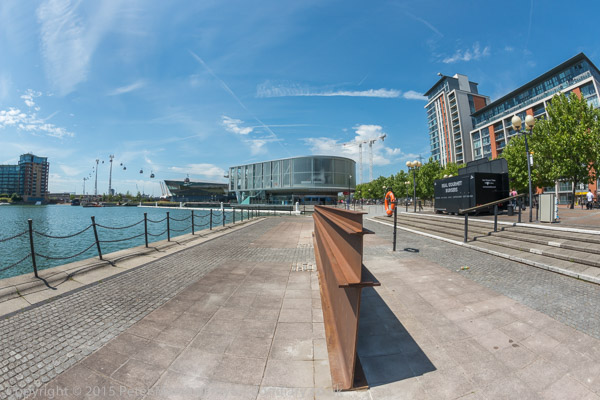
But it was a fine day, and the protests had started early, and by 11.50 I felt I’d taken enough (though looking back at G4S AGM Torture Protest I think I could have done better) and had the rest of the day to myself. I started by going over the high-level bridge across the Victoria Dock next to the Excel Centre, then walked around the dock to photograph the three sculptures there as a part of The Line – Sculpture Trail.

It was an experience that left me under-impressed. The docklands cranes, the high level bridge and the cable car all seemed rather more interesting than the sculptures, with the only work of the three there really having a strong presence being the tall figure of Vulcan, a 30ft-high bronze by the late Scottish artist Eduardo Paolozzi. This proved tricky to photograph, situated on a corner where I wanted to be suspended over the water for what seemed likely to be the best viewpoint. Perhaps it would be easier at a different time of day.


Martin Creed’s ‘Work 700’ perhaps looks better straightened out

I was working to produce very wide angle images, using the 16mm fisheye on the D800E, and transforming these to remove the curvature of vertical lines. The D800E has a big advantage for this in helping you to get the camera level, providing markers at the right and bottom centres of the viewfinder. Get both of them showing as little triangles and you have the camera straight and level. It would be slightly easier with the camera on a tripod, but you can – and I always do – work hand-held.


Barking Barrage

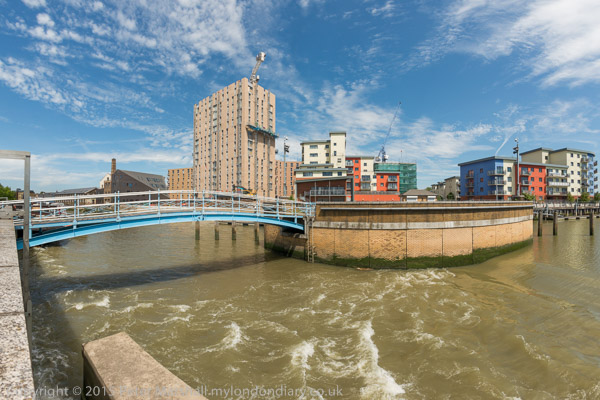
As usual I’d bought a Travelcard, so I could then travel on to anywhere in London, and decided to revisit the River Roding and Barking Creek. I’d tried a few years back to walk along the riverside path there and found it was closed. Unfortunately I found it still was and again had to walk in the other direction and went as far as the Barking Barrage, which I crossed and then returned along the other side of the river to the A13 to catch a bus.

Continue reading Summer 2015?

The New East

Somewhere I picked up a link to an article in the Calvert Journal from July this year, In focus: 29 women photographers picturing the new east written by Anastasiia Fedorova who states:

With cameras in hand, women are leading the way in defining the visual identity of the new east. Reclaiming their gaze from a conservative, male-dominated society, they are exploring gender roles and sexuality, myths and archetypes, the body, landscape and the urban environment. Here’s our pick of the female photographers at the head of the pack in picturing the new east.

Its an interesting selection, with much worth looking at. Quite a few of the photographers are now working mainly in the old west so some names may well be familiar to you.

I wondered about the Calvert Journal, which I’d not come across before and find it is published by the Calvert 22 Foundation, “a non-profit UK registered charity created in 2009 by Russian-born, London-based economist Nonna Materkova” which describes itself as providing: “A guide to the contemporary culture of the new east: the post-Soviet world, the Balkans and the former socialist states of central and eastern Europe” and as well as publishing the on-line Calvert journal established the Calvert 22 Gallery, (currently closed for refurbishment) dedicated to the contemporary art of Russia and Eastern Europe, in two floors of a converted warehouse on Calvert Avenue in Shoreditch, East London.


Arnold Circus, Bethnal Green (C) Peter Marshall, 1986

Calvert Avenue is a street I’ve often walked down, leading to Arnold Circus, at the centre of the Boundary Estate which has a good claim to be the oldest council housing in the world, built starting in 1890 by the Metropolitan Board of Works and completed by the then new London County Council. (That body’s successor, the Greater London Council, was the victim of one of Thatcher’s most malicious and senseless acts, from which London still suffers, with a ridiculous, divided and unsuitable system of government for a major city.)

It was a slum clearance scheme, replacing part of London’s most notorious slum, the ‘Old Nichol’. You can read a little more about it in my post Bethnal Green Blues, and much more about the area as a whole and its people in Cathy Ross’s ‘The Romance of Bethnal Green’ which that post is partly about.

The gallery and other recent developments in Calvert Avenue are a part of the gentrification of the area. One blogger described it in this way: “Just a few years ago it was semi derelict save for the launderette and newsagent, but now the street is a buzzy destination for the style-savvy supporters of the independent retailer revolution.” That semi-derelict street was of course the home to many who now find themselves priced out of the area as it gets taken over by oddly-bearded ‘hipsters’.

One of the events I missed photographing in July was a street party in neighbouring Camden; its event page on Facebook included the following:

The heart of Camden is being ripped out, pubs are being converted to luxury flats no one can afford, venues are under threat, the market is flogged off to be a casino (and yet more unaffordable flats) Rents are rising….fast.

Soon this community will be an unrecognisable, bland, yuppie infested wasteland with no room for normal (and not so normal) people.

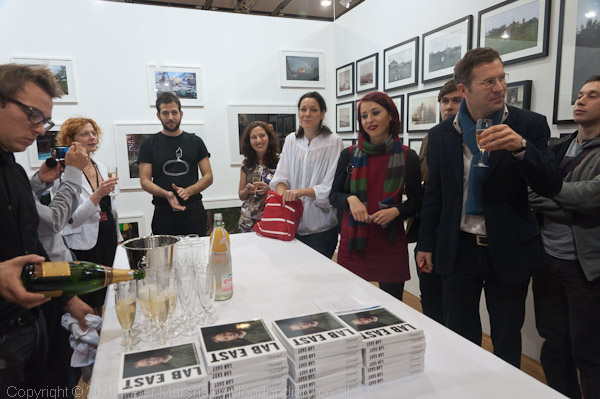
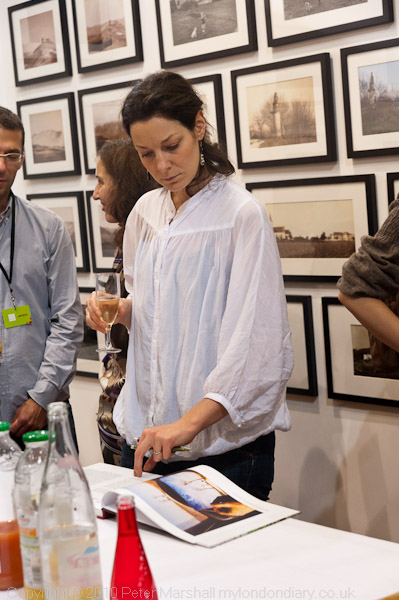
Back in 2010 at Paris Photo I went to the launch of the book ‘Lab East’, featuring 30 young photographers from Central and Eastern Europe, writing about it on this site.

I don’t think any of the women from this book are included in the Calvert Journal feature. Partly this reflects the great number of interesting photographers emerging from Central and Eastern Europe, but also I think that ‘Lab East’ seems to be more at a grass roots level, while the more recent feature is more about those who have already made it in the west.

Eight a Day

I don’t normally do Royal occasions. I think the only sensible approach in British history regarding the monarchy happened back in 1649, with the execution for high treason of Charles I, though I don’t approve of beheadings. Just a shame that the Commonwealth went wrong and the monarchy was restored.  I also don’t like royal occasions because of the gawping and fawning crowds, and also the security that surrounds them. And opportunities for photography, except for a privileged few, are often rather limited.  So May 27th this year was the first time I’ve ever been in London for the State Opening of Parliament.

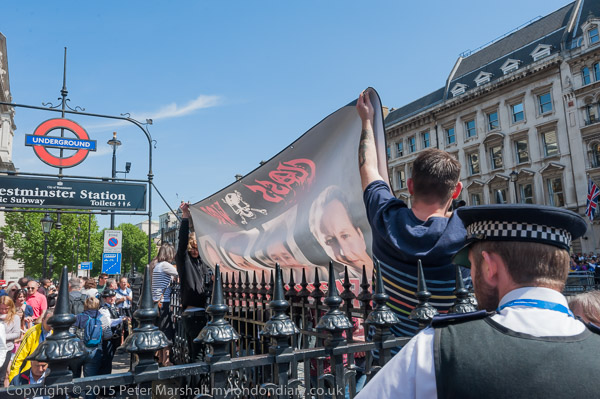
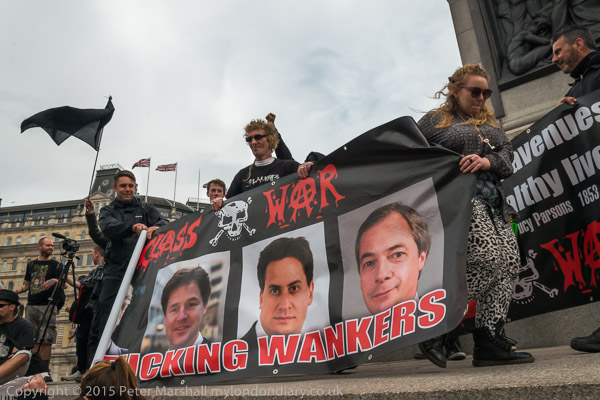
I hadn’t gone to photograph the Queen, but some of the friends I’d made covering the protests against ‘poor doors’. Class War had decided to protest at the event.

It wasn’t the best planned of protests, and they had perhaps not  realised the enormous level of policing that would be applied to ensure that the right to protest was denied to anyone in the area on the day.  Quite why the Queen should be granted this level of immunity from protest isn’t clear.


Nikon D700, 16-35mm

But one group of protesters I was with was stopped around 50 yards from the royal route, and then were escorted away and followed closely by police for the next couple of hours. A couple of others were more successful, managing to display the Class War political leaders banner for perhaps half a minute on the actual route – though a quarter of an hour before she came down it. Police jumped on them rapidly, forced them to take down their banner and made sure the moved away.

After a while Class War decided to make their way to a nearby pub. They were followed by at least twice as many police who stood on the opposite side of the road watching and were still there an hour later when I left to go elsewhere. More about it at Class War protest Queen’s speech.


Nikon D800E, 18-105mm DX

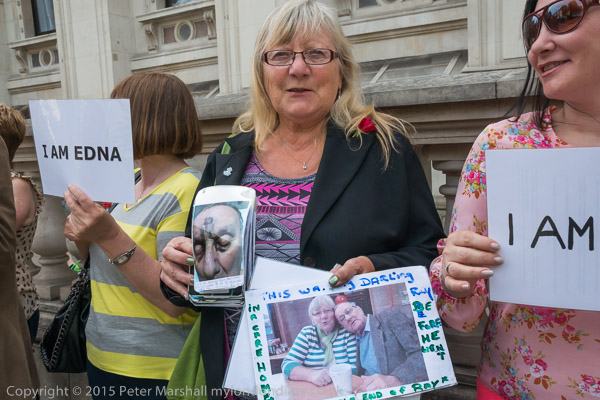
Here, well away from the Queen, a protest was taking place, but very differently. The organisers of ‘I am Edna’ – protect whistle-blowers had applied to the police for permission and had accepted the limits they had set for the protest. I think these included not using amplification of any kind, staying in one place and not handing out leaflets. Most protesters would find these unacceptable.

I continued on my way to Trafalgar Square and sat down to read a book while I waited for the next protest. But soon I looked up and saw that some Class War people had come to the square and were standing close to me. There were now only two police officers watching them from about 20 yards away, even though they were only standing around in the square.


Nikon D800E, 18-105mm DX

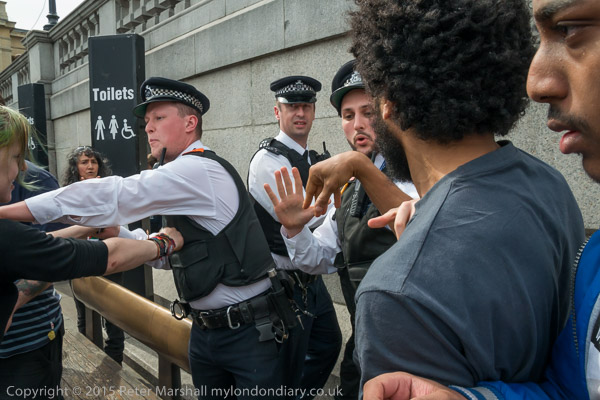
Suddenly we noticed another small group of police had arrived and were surrounding a man, questioning and apparently arresting him, and people rushed across to find out what was happening.  Police pushed those asking questions away and refused to say anything about what was happening, and a larger crowd of those waiting in the square for a further protest soon gathered around.

More police came, and the man was marched away followed by a large group of protesters to one of the many police vans now around the area in Northumberland Avenue. A young man standing there was roughly pushed aside by an officer, and when he objected was arrested as well.

By this time, surrounded by an angry crowd, some of the police realised that they needed to explain their actions, and eventually we found that the man arrested first was not being taken for anything connected with the protest but for an earlier offence elsewhere. Had that been made clear earlier the situation shown in Police arrest man in Trafalgar Square, including the second arrest – could have been avoided.


Nikon D700, 16-35mm

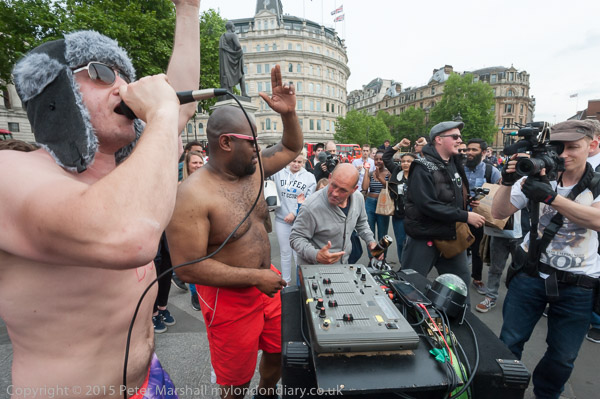
Next we heard loud music, and ran across the square to find a mobile disco and people dancing. Disco Boy had come to play Trafalgar Square as an unsolicited warm-up act for the student protest expected shortly. I followed him and the dancers until he left the square, going on to play in Whitehall and outside Downing St.


Nikon D800E, 18-105mm DX

More noise told us that the student rally organised by the National Campaign Against Fees and Cuts, NCAFC, was beginning, and all those who had been waiting around the square for this hurried towards the plinth of Trafalgar Square. Class War had come to support them and took their place on the plinth with them, getting huge cheers when they unrolled their new political leaders banner, along with several others.

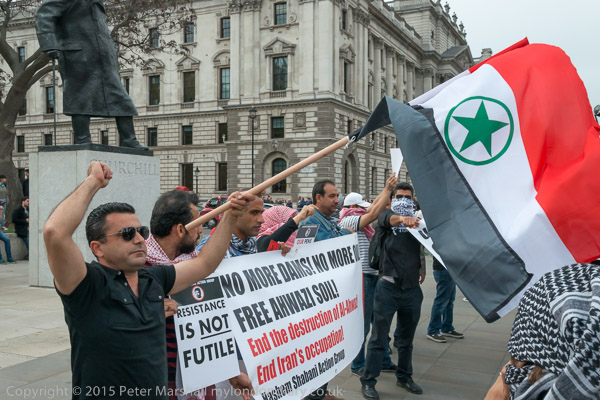
The NCAFC perhaps felt a little upstaged by this, and by others who joined them on the plinth, the Hashem Shabani Ahwazi Arabs, and although there were several speeches by student leaders, it felt a little downbeat.


Nikon D750, 16-35mm

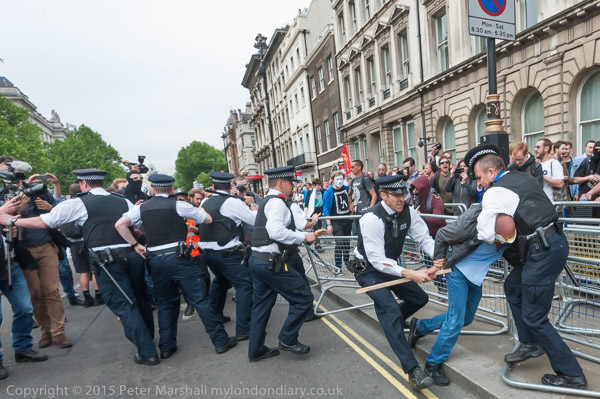
But the rally was only a prelude to the NCAFC March against ‘undemocracy’ which soon started off down Whitehall towards Parliament. Police formed a line across just before Downing St, but officers were too spread out and it would hardly have stopped a Sunday School outing, with students soon pushing past. The police made a more determined effort to stop the marchers lower down in Parliament St where barriers had made the road narrower, with some parked police vans. A few students were pushed to the ground by police and held, but many of the students simply did as I did and walked by on the other side of the barriers.

After a few minutes – and a little posing with batons and some arrests – police realised they had failed and withdrew, continuing to follow the protest as it went through Parliament Square and up Victoria St.


Nikon D800E, 18-105mm DX

I’d more or less loss interest and stopped to record yet another protest as the Ahwazi Arabs had left the march in Parliament Square to call for an end to the Iranian attacks on their heritage and identity in their homeland which was occupied and incorporated into Iran in 1925, mainly because of its rich oil fields.

I ran on to find the NCAFC marchers again, and caught up with some of them marching back towards Westminster along Petty France. They protested briefly outside the DWP in Tothill St but a line of police diverted them from the Conservative HQ around the corner and they came back through Parliament Square to go up Whitehall and protest outside Downing St.


Nikon D800E, 18-105mm DX

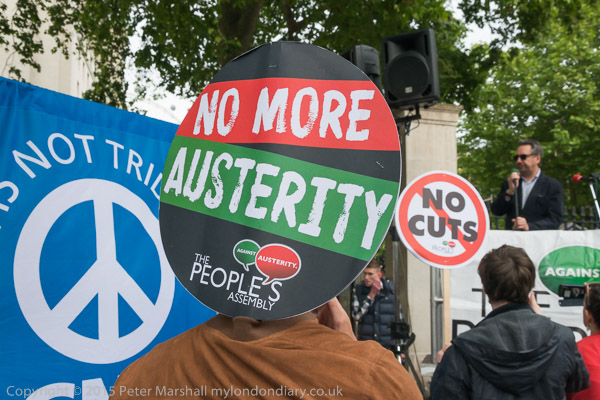
It was unfortunate – though not unexpected – that the People’s Assembly had decided to organise their own End Austerity Now rally at the same time as the NCAFC march.  But when that march stopped outside Downing St, the People’s Assembly rally was still going strong and I went across to take pictures there for a few minutes.

Visually it wasn’t exciting, just people standing around, few of them with placards or posters, listening to speakers. Most of them were saying things we’d all heard many times before, and most of the audience could probably have gone up and made the same speeches. I amused myself a little in the image above lining up the circular symbol and placards like some gear train in a machine, imagining it was generating the speech that John Rees at right was producing.

When I made it back across the road the rest of the NCAFC marchers had arrived, and within a minute or so they started to leave, intending to go up the Mall to Buckingham Palace. I turned in the opposite direction; the light was fading fast and it had been a long day, covering eight stories, and I had much work still to do on them.
Continue reading Eight a Day