As Drik as Possible

I’ve written on a number of occasions here and elsewhere about Shaidul Alam and Drik, most recently on the agency’s 25th anniversary. The idea of people in the majority world telling their own stories is one which has always seemed important to me, and I have a healthy distrust of some of the efforts of celebrity western journalists and photographers who  sometimes work with little real idea of the society and background to the events they are covering. It’s great to read a truly inspirational success story about Bangladesh, and how they have overcome so many problems. Optimism, a strong belief in what they are doing, the willingness to take serious risks and continuing hard work have been rewarded.

It goes a little deeper than that. Even when I look at how life in my own country and city gets represented though the media I’m often aware of a concentration on the froth and the failure to really understand or show the realities of life for the majority of our citizens. Of course there are some notable exceptions, but we really need a grass-roots photography movement too, as well as publishing on-line and in print that supports it.

The story of Drik, told in Alam’s blog post As Drik as Possible, is an introduction to the 2016 Drik Calendar, and tells a little of the storyand there is a little more about it on Flickr. You can also see a larger album of over 600 of Alam’s pictures of Bangladesh.

December 2015 complete


‘BP executives’ ply leaving British Museum director ‘Neil MacGregor’ with food and drink

Christmas and New Year are over and people are getting back to work. Including thank goodness my dentist, and I have an appointment this morning that I hope will put an end to my toothache – Christmas was just too much strain for a couple of my teeth.

I can’t really complain about dentists taking some time off over Christmas. After all I really stopped work on the 20th, and the later posts are really from activities with my family over the holiday season, although they hardly appear in them. I do take pictures of them, particularly of my two grand-daughters, but I don’t like to put them on line. I don’t think they are likely to be of any more interest to those outside the family than anyone else’s family pictures.

Of course I have put family pictures on the web – they were the subject of my very first web site, and I wrote a little about them and the family pictures of some other photographers a few months ago in ‘In the Family Way.’ But most are best kept in the family, along with a few other private events where I share images just with those involved.

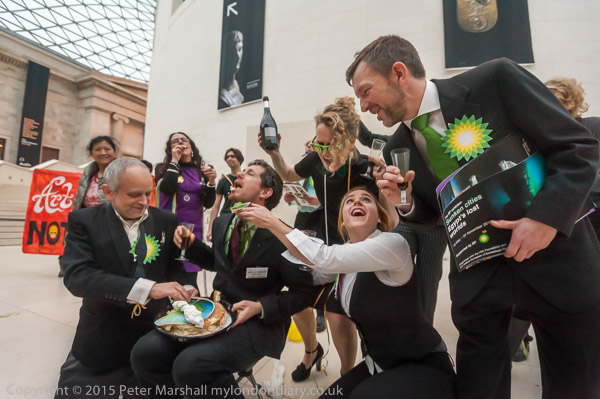
One of the highlights of the month was a commission to photograph the unscheduled performance in the Grand Court of the British Museum by the artist protesters of ‘BP or not BP‘ opposed to the climate-wrecking oil giant’s sponsorship of the museum and other arts venues which they do to improve their image at a relatively low cost rather than clean up their act.

This was in some respects a private event, a ‘flash’ performance with no advance publicity and no permission from the museum on whose premises it took place. Another photographer was there to make a video, and one other had been invited to try to sell work to the press. Of course many of the visitors to the museum who saw the event also stopped to take photographs, but it was still rather easier to work than events where a crowd of other photographers is present.

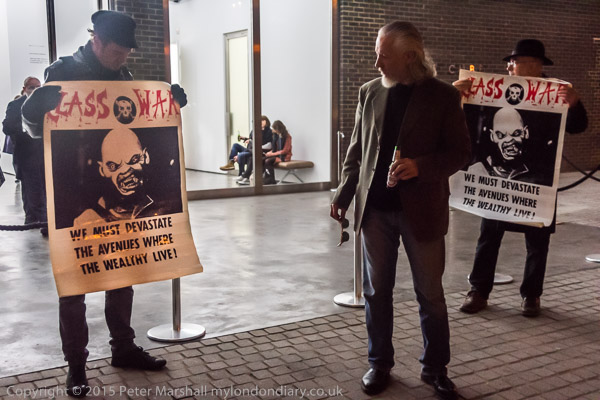
There are other events at which I’m the only photographer present – sometimes like this one because they are kept secret or as least not widely publicised – such the pair of Class War protesters at the White Cube Gallery – and others where photographers and agencies just don’t think they are newsworthy enough to make the effort.

While I can’t get to everything that happens, I started covering protests seriously because so many got no publicity. Things have changed a little since then, with many more photographers now covering protests even though they generally get even less coverage in the media, thanks to the ease of digital and the rise of ‘citizen journalism’, this largely means that ‘popular’ protests attract hordes with cameras while many smaller events are still recorded by only one or two of us.

Dec 2015

Belper – World Heritage Site
Cromford – World Heritage Site
Staines & Wraysbury Walk
Boxing Day Walk
End BP’s British Museum Greenwash
Don’t Buy Tiffany ‘Blood Diamonds’
Solidarity with Sweets Way arrestees
‘One Voice for the Dolphins of Taiji’
Phulbari coal mine protest


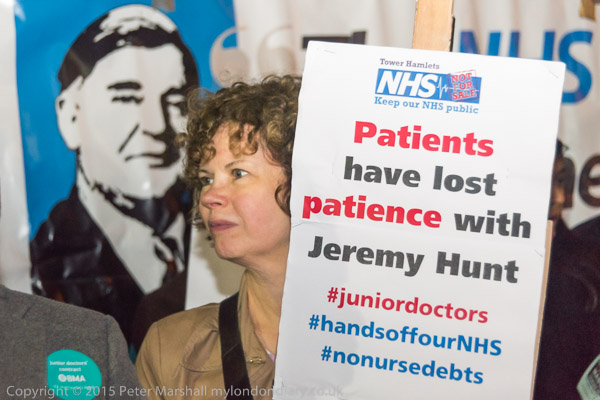
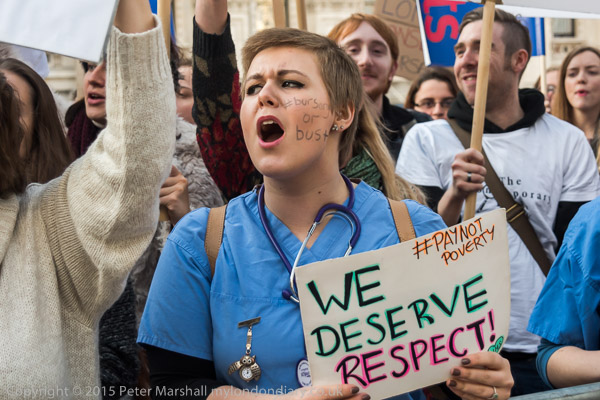
Christmas Rally For The NHS
Santas in London


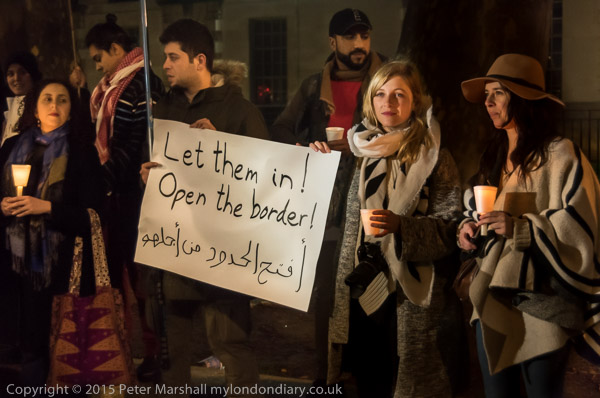
Christmas Solidarity Vigil for Refugees


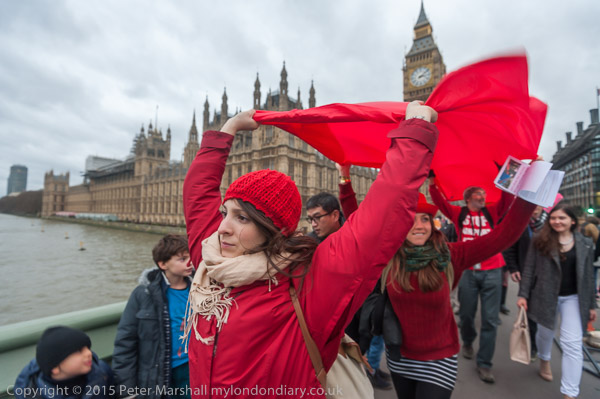
Climate Activists Red Line protest
Free the Focus E15 Table


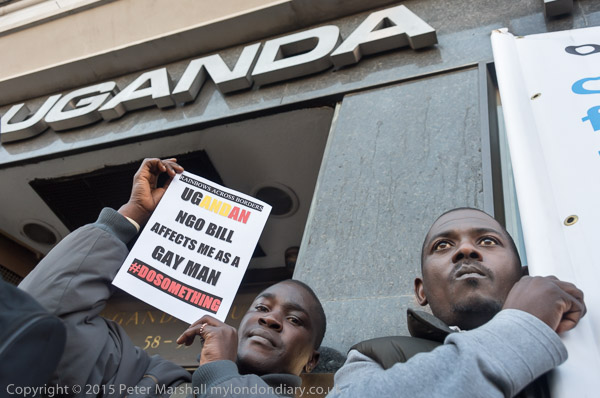
Ugandan President – don’t sign anti-gay bill
No forced medical treatment for unemployed
Class War at Gilbert & George ‘Banners’
Bloody Murder at Ripper ‘museum’
Short Walks in Windsor


Save NHS Student Bursaries


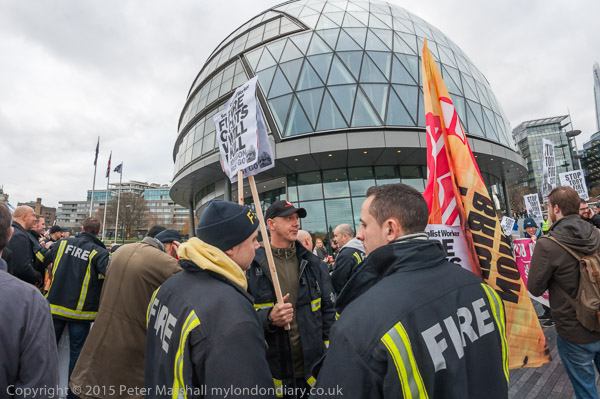
Firefighters say cuts endanger London
Don’t Bomb Syria
London Images

As well as pictures of events etc I’ve also decided to add a monthly section with some of occasional images I take as I travel around London, often from the top deck of a bus or train window.


Some Stats

>RE:PHOTO Dec 2015
Visits: 126,357
Page Views: 361,839
1.12 mins
2.88 pages
Ave Views per day: 11,672
Highest PV per day: 16,264 (Dec 17)

>RE:PHOTO  Year 2015 total
Visits: 1,622,248
Page Views: 3,855,303
1.9 mins
2.39 pages
Ave Views per day: 10,562

All my domains Year 2015 total
Visits: 2,646,880
Page Views: 7,460,850
1.14 mins
2.87 pages
Ave Views per day: 20,440

Continue reading December 2015 complete

Vivian Maier still in hiding?

I’m not a true believer when it comes to Vivian Maier. Not that she was a bad photographer, far from it, but I’ve failed to share the kind of fawning hype that seems to have affected so many. Though I can enjoy looking at her work, to me its rather like the ‘Easy Listening’ section that they used to have in record stores. Obviously she had a great interest in photography and a good eye, and a great appreciation of the tradition, but to say, as curator Anne Morin does in her Lensculture interview with Jim CasperShe has a key place in the history of the medium—right next to Robert Frank and all the other great practitioners” seems just ridiculous nonsense.

As Morin makes clear, Maier was very aware of the history of the medium, and looking through the selection of 120 images on Lensculture it’s impossible not to realise some of the sources that inform her work. As you look at the images, its obvious that this one would not have been made had she not been aware of the work of Lisette Model, others completely predicated on her knowledge of Lee Friedlander or Robert Frank … though perhaps she never quite came to terms with Diane Arbus.

Maier didn’t make history, she depended on it, at least in the images we have seen, and Morin is misguided to think that her exhibition “helps place her work in the history of the field.” Perhaps the main point it and her story makes is that she was outside that history making, a mere – if sometimes enjoyable – footnote.

The fascination is very much in the back story, and it is one that has been carefully cultivated in article and film, with more yet to come to light. Morin mentions the link with the young French woman photographer Jeanne Bertrand with whom Vivian’s mother and the young Vivian were lodging in the Bronx at the 1930 census. Though Vivian was then only four, it seems likely that Bertrand was a friend of the family and they may have kept in touch in later years.

Claus Cyrny in his Artificial blog links to writer Jim Leonhirth who has posted the information he has gathered together about Maier’s family from various sources which often contradicts earlier statements and includes the information above about Bertrand, as well as reproducing a page from the Boston Globe in 1902 with a long article about her becoming well known as a photographer in the region at the age of 21.

Bertrand came from the same commune in rural France as Vivian Maier’s mother, where Vivian and her mother went to live from 1935-8 before returning to the USA, where the 1940 census shows them both living with Vivian’s brother and father (both called Charles) in 1940. Other family members, including an aunt and great-uncle also lived in New York, and it is thought that Vivian’s mother had reverted to her maiden name and died in New York in 1975.

Morin says that so far “somewhere between 120,000-150,000” Maier negatives have been found, including “6,000 rolls of film that Maier didn’t even develop” as well as voice recordings on cassette of her thoughts and ideas. She was only able to make her selection for her exhibition from a selection already made by John Maloof. Perhaps in the larger body of work we have yet to see there will somewhere be the real Vivian Maier?

Boxing Day Walk

Today, Dec 27th, the day after Boxing Day, seems a kind of non-day. Christmas in the UK traditionally lasted two days, Christmas Day itself and the next day, Boxing Day after which we all – or at least most of us – went back to work. Back in the early days when I was a teacher it was good to get another week or so of rest when most were back working. Now it seems to be almost a national holiday until after New Year’s Day, though today few of us will be celebrating the Feast of St. John, apostle and evangelist or National Fruitcake Day, apparently an unofficial US National Holiday, though we will certainly still be eating up our Christmas Cake.


The Hythe next to Staines Bridge

Fortunately I’m in the half of the UK not currently covered by flood water – we had ours in Feb 2014, and the rain here this morning is only half-hearted. But our Christmas has been marked by a little worry about friends up north, who appear to have so far avoided flooding, and concern for the many not so fortunate. Our government appears to have gambled by cancelling or holding up hundreds of flood relief schemes, perhaps in the secure knowledge that they themselves live on higher ground – just as they are on financial heights untroubled by welfare cuts.


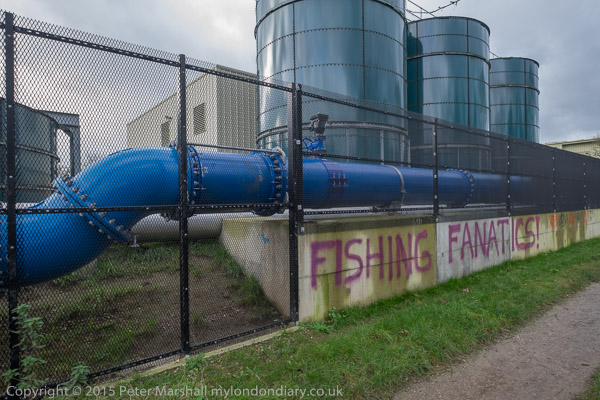
‘Fishing Fanatics!’ on the tow path by the water works, Egham

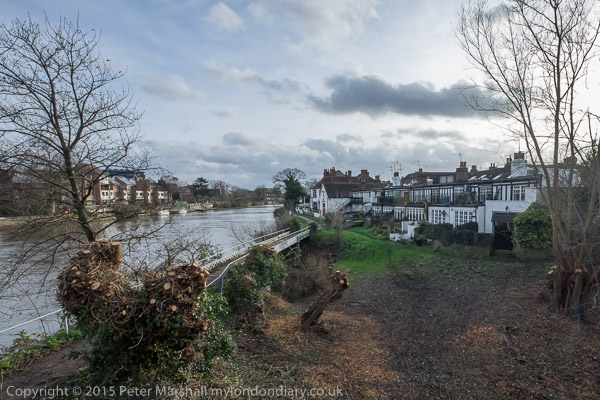
Yesterday, Boxing Day, we walked to my sister’s home for a second Christmas dinner – we needed a good walk to walk off the previous day’s at our home. She and her husband live around five miles away. Both our homes are a few hundred yards from the River Thames, and we can walk most of the way along what used to be the tow path, though towing would now be impossible with trees having grown up and many riverside residents having laid claim to the riverbank in front of their properties, fencing in what was public space and declaring it private.


Runnymede, Egham

But that route was too short and too simple for my wife and son, and we left the riverbank half-way top climb up and down and up and down the wooded hills overlooking the flood plain at Runnymede. Although I was determined not to add to the plethora of reviews of the year that provide respite for journalists to hold their pre-Christmas parties, it inevitably brought back to my mind the events of June, when the UK celebrated the 800th anniversary of Magna Carta by – among other things – a disgraceful and massive police restriction on the freedom of those living closest to the site where it was signed in the Runnymede Eco-village, which a few weeks later was evicted from its woodland site.


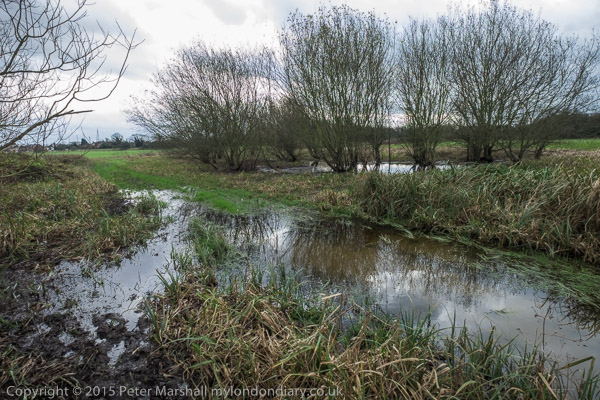
Footpath across the old course of the Thames, Runnymede

Our path took us through one of the old routes of the Thames, close to the bottom of the hill, a muddy wade through a few inches of water that at least in the wetter months of the year still insist on clinging to the old path, and then up and down by the fence around the former eco-village site.


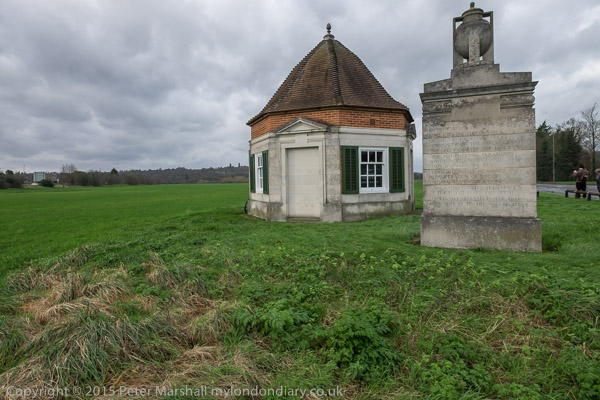
America – Kennedy memorial, Runnymede

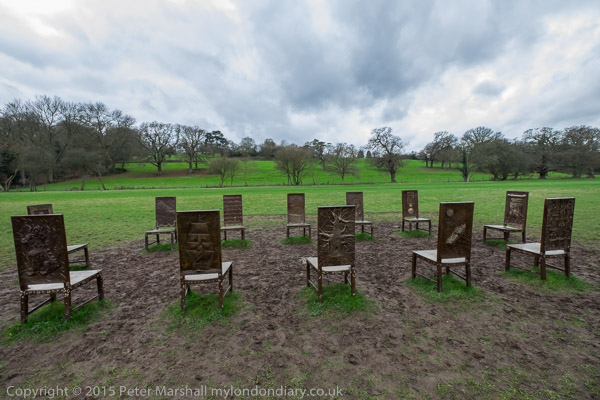
Then came a short visit to America, an acre of which is around the Kennedy memorial, before going down to the plain and the 12 bronze chairs of The Jurors.


The Jurors, Runnymede

From there it was a short walk by the river into Old Windsor, and along the Straight Road, where two red kites circling around took our minds away from the tedium of the traffic as we walked through puddles scraping the worst of the mud from our boots.

All of these pictures were made using the Fuji X-T1 with the 10-24mm lens, a truly excellent lens when there is enough light for its f4 maximum aperture not to be a problem. It isn’t the smallest lens for the camera, but considerably lighter than the full-frame Nikon equivalent.

I still have a problem with the white balance of the X-T1, which seems to be way out on my camera. A typical image from those above is at 5687K and Tint -37, while the ‘As Shot ‘ values were 5000K and Tint -1. The difference in the Kelvin value isn’t huge – and I’ve perhaps preferred a slightly warmer result, but the camera produces noticeably pink images. I’ve checked and double-checked the colour settings, but unless I remember and use a custom white balance setting, it views the world through rose-tinted glasses.

Raw Logic?

I’ve written many times about the ethics of news photography over the years, and most recently in a post World Press Photo sets Ethics Code which also mentioned the Reuter’s dictat that its photographers should only submit pictures that had been made in camera as jpegs.  So I’ve been interested to see the ongoing discussion taking place particularly on-line over both these.

One contribution which I think is worth reading and touches on both of these is a post by Lewis Bush on his ‘Disphotic‘ blog, RAW Logic: On Reuters Change of Format. It makes several good points, not least that RAW files show the image before processing while jpegs are always subject to in-camera processing and thus inherently less verifiable. At least one of my friends is rather addicted to the kind of in-camera settings that make some of his images look as if they came from Instagram. Of course RAW files are also processed, with some cameras applying considerable sharpening, but certainly the processing on jpegs is more extreme and to some extent alterable by the photographer.

Bush also has some interesting thoughts about the motivation behind the decision by Reuters, which I leave you to read for yourself. A week earlier, he wrote another post,
World Press Photo and the Integrity of the Photographer which is again an interesting discussion, though I have some reservations. WPP is essentially a competition for press photography, and its main emphasis is on news photography. The rules for the competition I think reflect this and are an attempt to express in practical terms its code of ethics, which I think are something of an attempt to set down what is widely seen as appropriate for news photography (though perhaps less so in the UK than in many countries.)

Another post I found of interest was on the National Portrait Gallery annual and rather predictable Taylor Wessing Prize. It contains several things I wish I’d said.

I do wonder rather about the title of his blog, Disphotic; perhaps because of my terrible typing (King of the typo!) which made it first appear in this post as Sidphotic I can’t get away from connecting it with dyslexic, which is certainly unfair. But then I always have to explain >Re:PHOTO to everyone.

Place de l’Europe

I’m not a great fan of appropriation, or as a friend once called it, “f**king with other people’s work“, but there are exceptions, and this is one:

via GIPHY

(It’s also worth visiting the original site on which this appears, where there is among other things, Episode #8 Printed Matter,  which tells you exactly how much Vice cares for photographers.)

I’m not sure that Henri Cartier Bresson had much of a sense of humour, though there is certainly and acute wit behind some of his pictures, which doesn’t really come across in the various films about him. I suspect too, that there are some at the Fondation in Paris who won’t approve.

The picture on which it is based is one of the first I wrote about at any length, and I remember making a rather disappointing pilgrimage to the Place de l’Europe – Gare Saint Lazare 40 years after he made this picture in 1932. I won’t today add to the the yards of mainly nonsense that have been written about the ‘Decisive Moment‘ for which this picture is always the prime exhibit since I’ve done so before, but for me it exemplifies a much more important rule, which also has vital implications outside of photography, the rule that ‘Rules are made to be broken‘.  Cartier-Bresson’s dictum that photographers should show their work without cropping as they conceived it in the viewfinder at the point of exposure has influenced generations of photographers, usually for the worse.

I’m not a great fan of cropping. I like to frame precisely (something the Leica that HCB used at least in his early years wasn’t really capable of doing) and I hope incisively. But it isn’t always possible. You may not be able or have time to get into the right position (sorry Mr White, but time only stands still for static photographs.)

This isn’t HCB’s only cropped photograph, though it is perhaps his most drastically cropped image, and certainly his most famous cropped image. Even for him, practicalities sometimes had to overcome theory.


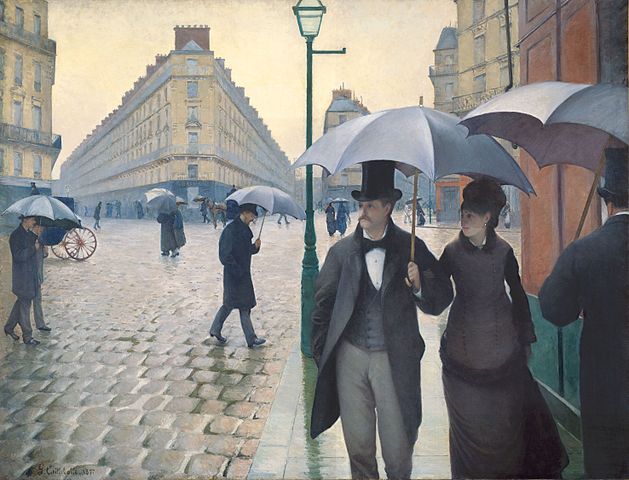
La Place de l’Europe, temps de pluie is also one of my favourite paintings by Gustave Caillebotte, though it isn’t based on the Place de L’Europe but a few yards to the north-east in the rue de Turin, looking towards the Place de Dublin, as Wikipedia details in Paris Street, Rainy Day. Caillebotte did paint La Place de l’Europe, and there are a couple of his pictures, as well as one by another artist on the French page for the Place.

Caillebotte’s image, as the Paris Street article makes very clear, very much based on photographic ways of seeing, perhaps why it appeals to me, with its central division by a lamp post something that many of us have played with over the past years – something I picked up on from both Walker Evans and Lee Friedlander, and that curious space produced by the buildings in the left half. And that cropping is so photographic.

Rex betrays trust

Photo agencies cover a pretty wide range of organisations, and photographers often have less than positive feelings about them. Some are legendary and many are very good, but the best are something most photographers can only aspire to. I’ve only a couple of times tried to join one of the better-known agencies; on the first occasion I read through their contract and walked out of the door before they had they chance to turn me down, and from the second I got a very polite letter of refusal telling me that although they liked my photography they didn’t feel it showed the kind of long-term commitment to particular stories that they felt was a part of their ethos. That time I was a little disappointed.

I’m not a great fan of the agency that now sells most of my work, though they started with good intentions – which attracted me at the time. Since then things have changed, the founders sold the business off and things seemed to have gone rather downhill.

Whenever two or three photographers get together they always seem to bitch about their agency. How it sells pictures at ridiculously low rates, is slow to pay, takes too large a cut, messes up the editing of stories and more. Most of us have our horror stories.

With sales now worldwide it’s impossible also to know if your agency is being honest – you just have to trust them and hope (and perhaps try to check up on what you can check up on.)  I trusted a company I worked with for around seven years, then got a settlement of several thousand pounds after someone else realised we were being cheated and began a class action.  The money was welcome, but I hated having to realise that people I had trusted hadn’t repaid that trust.

I’m pleased I’ve never contributed images to Rex Features. Because yesterday a shocking story broke on the Editorial Photographers UK web site, Rex – a gross betrayal of trust. If you are not a UK photographer or artist you may not know about The Design and Artists Copyright Society (DACS) and its Payback scheme, but each year it gives us a Christmas present in the way of payment from organisations that pay a licence fee to copy books and magazines published in the UK (and also TV use.)

It’s quick and easy for photographers to complete a form each year and get a payment, and I’ve been doing so for years. The amounts we get depend on the number of published images, and range from around a hundred to several thousand pounds – personally a few hundred. But recently agencies have been trying to get in on this, both by setting up a rival organisation to DACS and also offering to process our DACS claims. It might be a good thing for some, as its hard for us to keep track of all the work they sell on our behalf, but like many other photographers I’ve preferred to handle things myself.

I’ve had two requests from agencies this year asking me to let them make a DACS claim on my behalf, and turned both down. But a number of photographers who work with Rex have had forms submitted to DACS despite not having given Rex their permission to do so. And a Rex employee had forged signatures on those forms. It also emerges that Rex took a 15% commission on the monies it got from DACS.

The EPUK article goes into the details and links to a DACS statement on it and if you are a photographer whose work gets published in the UK should be essential reading.


Yunghi Kim

I’m rather surprised – and slightly ashamed – to find that I’ve never mentioned Yunghi Kim in my posts on this site. I’ve been aware of her work as a photographer for a long time, with some powerful images from Rwanda and Kosovo and in particular her remarkable 1996 project on ‘Comfort Women‘, Korean women then grandmothers in their 70s who had been tricked by the Japanese Army and forced to become sex slaves serving Japanese soldiers. Perhaps my only excuse is that these stories – which you can see on her web site – were made before I began seriously writing about photography for a living, but not long enough before to have become a part of photographic history.

Of course Kim has continued to produce great photography, working through Contact Press Images, and winning various awards. Her pictures on her site as ‘Protest in America 2011 & 2012‘ include some of the strongest images of the Occupy movement, and in a very different mood is her highly original and inventive series ‘Coney Island Winter’, also in black and white. It’s great work to see her work and feel how exciting black and white can be, when with so many other photographers now black and white seems more simply just a fashionable ‘look’.

I’ve also come across Kim through being a member of the Facebook group she began and runs, The Photojournalist’s Cooperative,  with its mission “to give freelance photographers a platform where they will exchange ideas and help each other maintain high standards as they navigate the dramatically changing business of photography in the areas of: image licensing, contracts and copyright protection.”  She set up the group after realising the huge extent of unauthorised use of her images on the web, wanting to find out more about how to protect her work and to share what she found with other photographers. Last month she took that sharing to a further stage, giving $10,000 from the fees she has recovered from unauthorized usage to create ten $1,000 grants for members of her Facebook group, who have until next Tuesday (Dec 20, 2015) to make submissions.

Many photographers I know are also members of the group, and it was a post from one of them, Ami Vitale, on my newsfeed today which prompted this short note. It read simply: “Yunghi Kim is a huge inspiration!” and linked to a profile of her on AI-AP (American Illustration-American Photograph) which gives all the information about her that I’ve left out here.  Ami, you are an inspiration too!

Yarl’s Wood

It was a warm sunny day in August when I set out for my first visit to Yarl’s Wood, though I’ve previously attended protests in London calling for its closure at least since 2008. But despite all its problems and many protesters, it remains, one of a number of similar blots of national shame where we lock up and mistreat people who have come to our country for asylum, often fleeing violence and torture. Yarl’s Wood differs from others such as Harmondsworth and Colnbrook closer to where I live in that the great majority of those imprisoned there are women and children.

The continuing protests, along with court actions which have also been a part of the campaign have had some success, but Yarl’s Wood and the other prisons remain. The Home Office have been forced to make some changes, and certainly have been prevented many from deportation back to persecution and possible death.

As many former inmates attest at the protests outside, they are a great morale booster for those still incarcerated who otherwise often feel that they have been locked away and forgotten, with no one caring. It is worse than prison they say, because at least when you are sentenced you know the length of your sentence. When you are taken to Yarl’s Wood your imprisonment is for an indeterminate time, and sometimes it seems it will never end. You could be forced onto a flight back to the country you have fled at any time without notice, or you could be released, but many seem to spend many months in this evil limbo.

The protests outside embolden those inside to stand up for their rights, to resist the bullying and assaults, to organise with fellow inmates against mistreatment or the failures of Serco and the other private companies running these prisons to provide the facilities that are supposed to be available. Management inside them seems often far more concerned with cutting cost than the welfare of the prisoners.

Yarl’s Wood is pretty well in the middle of nowhere, on a commercial estate in a former airport around 5 miles north of Bedford, where doubtless bombers took off to Germany in WW2. There were coaches organised from various cities including five from central London, but this would have made a very long journey for me. Instead I went by train to Bedford, from where the organisers had said there would be a coach from the station – and I found a small group already waiting for it when I arrived.  Soon the coach came and eventually we got to the road outside the business park, where a hundred or two other protesters had already arrived and more were expected.
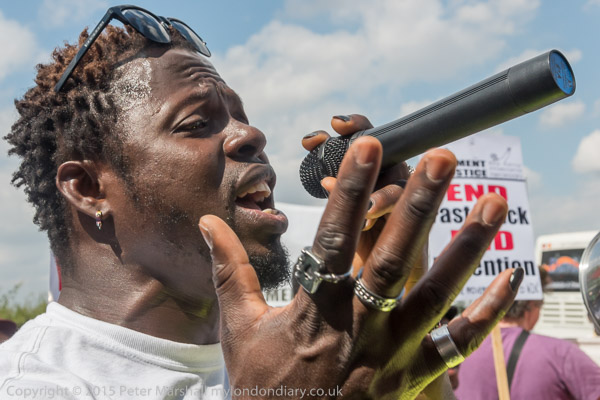
The protest started there and it was a good time to take pictures as everyone was on a fairly small area of grass in front of the fence around the estate. Later people were more spread out. It’s often the case that the best time to take photographs is in the few minutes before an event actually starts as people are getting ready and in the first few mintues, and photographers often miss out by standing around talking with colleagues rather than getting down to work.
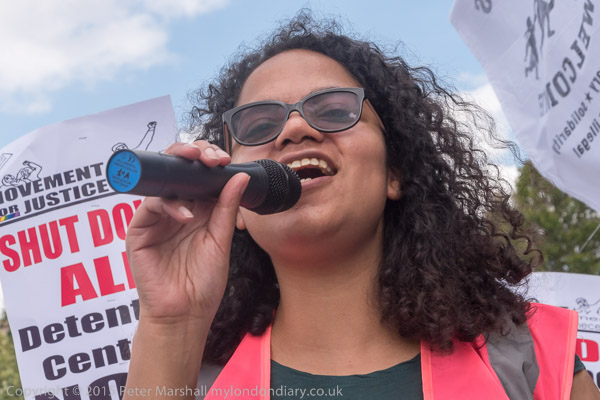
It’s easier too when you know many of  those taking part – or perhaps when they know you and trust you, and having photographed at many Movement for Justice protests both at Harmondsworth and in central London made it easier for me.
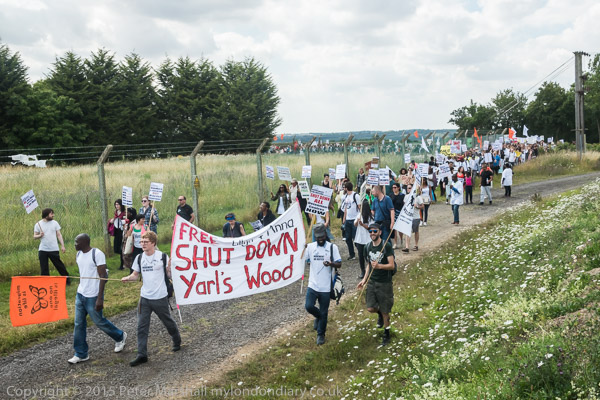
When all the expected coaches had arrived, the protesters – now approaching a thousand – set off to march to the detention centre, around half a mile distant, at first along the road and then on a public bridleway which goes around the boundary of the centre (and then around the actual wood, which I’ve still not visited.) I tried hard to find a way to show the size of the protest , but there was never a position where both ends of the march were visible.
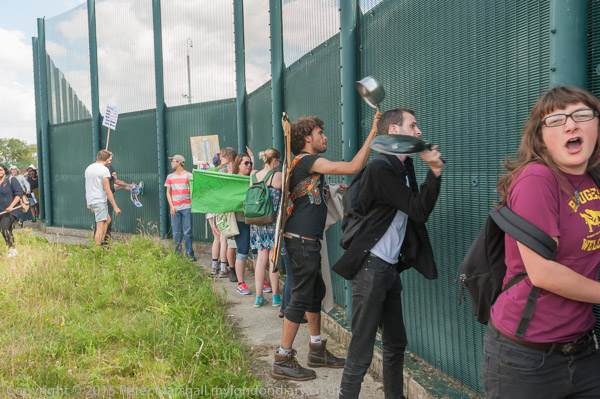
At the previous MfJ protest here a few months earlier which I’d missed, police had attempted to stop the protesters reaching the field beside the prison, but had failed with a length of fencing being pushed down. This time they had agreed to let the protest through and there were relatively few police on duty and we walked unhindered through the gate and up to the tall and substantial fence around the whole site. We could hear they shouts of welcome from the women inside the prison, and they could certainly hear people shouting back to them and making a huge noise beating and kicking the fence.
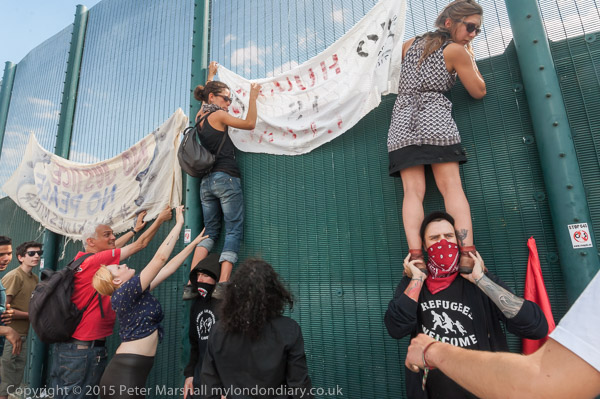
People climbed up on the shoulders of others to show banners and wave flags so that the women inside could see them, and then a group of protesters in masks began to spray paint slogans along the fence.
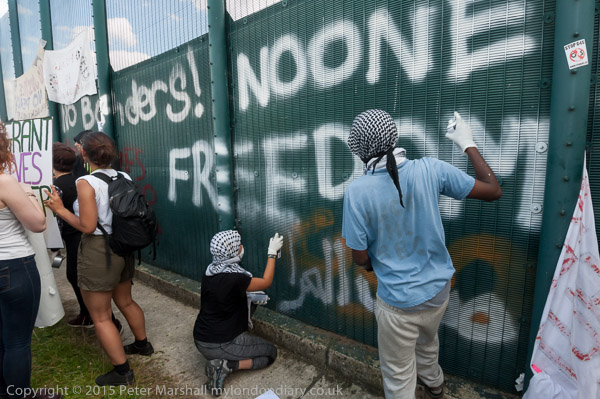
It’s always a slightly difficult situation when photographing protests like this where there is a possibility – though perhaps small – that people could be arrested and face charges and your pictures could be used as evidence. But people were masked and so less readily identifiable, and I mainly photographed from behind.

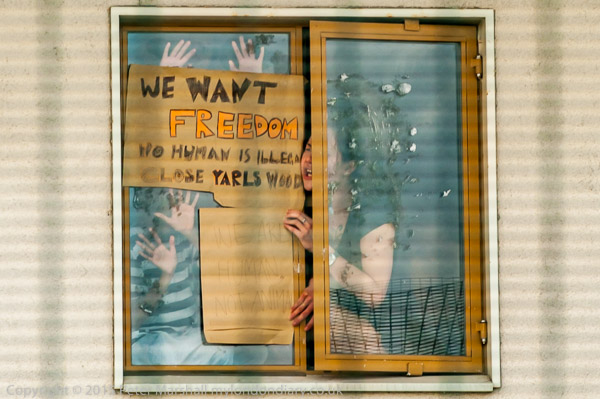
The field slopes up away from the fence, and from some distance back it was possible to see some of the women at the upper floor windows. These have only a very restricted opening, to stop escape or more likely suicide attempts, but the women were able to hold out posters and wave towels and articles of clothing. Others held up notices to the glass so we could read them.
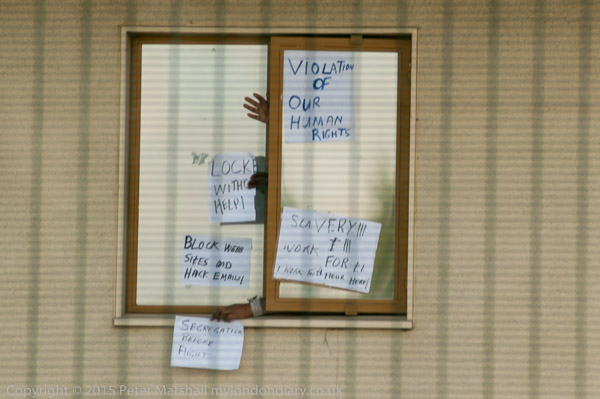
Photographically there were problems. First was the distance, and even with my 70-300mm lens at its most extreme the windows were a little small in the frame. The image above is typical, cropped from 12Mp to 4Mp. I  think I should have taken it with a wider aperture which might have made the grid of the fence through which I had to work less evident, but I didn’t think to do so at the time.

But it was extremely difficult to focus – many of the frames I took were out of focus – and the smaller aperture would have helped here.  Autofocus was pretty useless unless I wanted sharp pictures of the fence and I soon resorted to manual focus. Although the windows were some distance away they were not sharp with the lens at infinity, and working with the 70.0-300.0 mm f/4.0-5.6 with manual focus is not too easy. Old-fashioned long lenses which were made for manual focus along with focussing screens of the day were much easier than with lenses and cameras made for autofocus.

There must also have been a good reason at the time to work with this lens on the D700 rather than the newly acquired Nikon D810, though I can’t now think what it could have been. The 18-105mm stayed on the D810 all day, while on the D700 I made use of the 16-35mm, 16mm fisheye and the 70-300m. On the 810 I could have worked in DX mode, making the 300mm into an effective 450mm and still have had 15Mp to play around with.

But the biggest mistake I made that day wasn’t photographic but was to forget to pack my sandwiches. By around 2.30pm I was feeling hungry and reached into the back of my bag where they should have been to find nothing there.  It was around 5.30pm that I managed to buy a snack at Bedford station raise my blood sugar and keep me going while rushing to catch a train.
Continue reading Yarl’s Wood
Morning Moods – Internet at Risk

I woke up in something of a black mood this morning, to radio coverage of the flooding in Cumbria, where we have friends who I think are fortunately safe. Although I was listening from the comfort of a warm bed, it brought back memories of our own local floods in February 2014, when dirty water was lapping around our street, above the level of our ground floor for anxious days, though we were fortunately saved from flooding by a ditch behind our house. Next time we probably won’t be so lucky, and the next time could come any time with the current climate instability, and I’m increasingly sceptical that the current climate talks in Paris will do much to help.

Other news only added to my unease, along with several concerns closer to home I won’t bother you with. So I was pleased when I sat down at my computer this morning to find Louis Stettner and the Glories of Penn Station, a beautiful set of black and white images from 1958, which really lifted my spirits.

It was also good to read A D Coleman coming out with what he calls an ‘Opening Salvo‘ against attacks on his Capa research by Magnum, who as he says has evolved from “the bohemian collective cum anarcho-syndicalist commune of its origins and first several decades” into “a substantial corporate entity with a multimillion-dollar annual revenue stream, a recognizable and decidedly upscale brand, an extensive and metastasizing product line, and a new executive director committed to aggressive and inventive marketing.”

Magnum has no facts or argument to answer the detailed research on Capa by Coleman and his colleagues but seem determined to try and discredit it to protect their image – now a highly commercial brand. Part of their response appears to be to a TV docudrama Magnum, made by Downton Abbey producer Carnival Films, which Coleman expects to reinforce the Capa myths about the ‘Falling Soldier’ and D Day rather than represent the truth – though he has contacted the company with details of the recent research.

Of course, though Capa was undoubtedly a great photographer, he was also a great raconteur, someone who would never have allowed the facts to get in the way of a good story, so Carnival Films could be said to be truly if cynically following in his tradition.

It’s also – as I’ve had occasion to say several time in the past few days, not least in the highly inaccurate recording of an apparently peaceful vigil in Walthamstow and almost every story about Jeremy Corbyn – very much in the tradition of at least parts of our press (though gutter and broadsheet have been vitriolically united over Corbyn, who I’ve known and photographed for many years and admire as a person even if I don’t always agree with his views.)

Another link in my feed reader this morning was from ‘Stand Up And Spit‘ and links to a BBC radio documentary from 1980 on a Sun newspaper shock horror probe on the Tilbury skinheads, Aggro Britain. It exposes how bad tabloid journalism can be, and how it was done, something that makes me ashamed of some fellow journalists (though the only real UK journalists union, the NUJ, is locked out of The Sun and other News International publications) and also reminds me how necessary it is to support the BBC, despite some of their often ridiculous news stories.

And a final bit of gloom from my e-mail, which could mean the end of the Internet as we know it. The EU Commission’s roadmap for copyright reform “could open the door to absurd new rules that would kill our ability to link freely – copyrighting hyperlinks and charging to link to freely accessible content online.” A ‘Link Tax‘ would make posts like this one impossible. If you click on one link today let it be to Save the Link to fill in your name on a message to Commissioner Oettinger “Link censorship has no place on the open Web. Please listen to users and guarantee our right to link freely.”