Captions & Keywords

I’m currently struggling through the key-wording and adding other information for several hundred images which are moving from ‘news‘ to ‘stock‘. It’s a slow and tedious business, and one that I find rather annoying, partly because of the software I’m forced to use by the particular agency involved, which doesn’t allow any sensible batch processing.

Among other things this means that I have to go into every single one of the several hundred images and click to say how many people are present and that I don’t have model releases, that they have property which would – for advertising use, but these are editorial images – a property release which of course I don’t have any either. Just being able to set a sensible default would save me several thousand mouse clicks today.

I might have taken 30 pictures in the same location, but again I have to load up each image individually and past it in. Often most of that 30 will have very similar keywords, but those too have to be pasted individually.

What might, with well designed software take perhaps 30 minutes, ends up being a day of tedious work – and what seems to me a real expression of contempt by the agency concerned for its photographers.

Most of it would actually be unnecessary, in that all of the images when supplied have captions and keywords. The captions probably contain most of the information that would be most useful in searching, but the agency has decided to give them a very low priority in their search system, and the keywords have to be re-allocated into different groups. Its a total mess, and one which I’m sure doesn’t help sales.

It would help photographers if there were some consistency across the ‘industry’, but of course there isn’t. Back in the day we were taught ‘Who, What, Where, When, Why’ and possibly ‘How’, but that appears to have rather gone out of fashion.

There is a useful brief guide to captions and keywords written by John Smock
which starts its section on captions:

In most photo captions the first sentence identifies the people and place in the photograph and supply the date and location where it was taken. The second (and perhaps third) sentence should provide contextual information to help readers understand what they are looking at.

and he goes on to give quite a lot of useful advice and examples in the five page document (the last of which is blank!) It includes some good advice on keywords too, a great deal of which I find myself ignoring, sometimes intentionally. You do have to think about the system that you are contributing too, and work to its expectations, however nonsensical they may be.
There is a great deal to be said for the use of controlled vocabularies, but I’ve never found a list that suits the kind of work I now do. When I was photographing buildings and industrial sites I made use of a simplified list of terms derived from IRIS, the Index Record For Industrial Sites, which was set up in 1991 to provide a standardised format for reporting in this area.
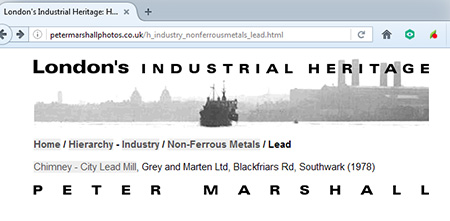
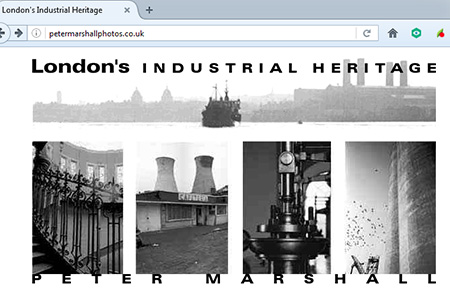
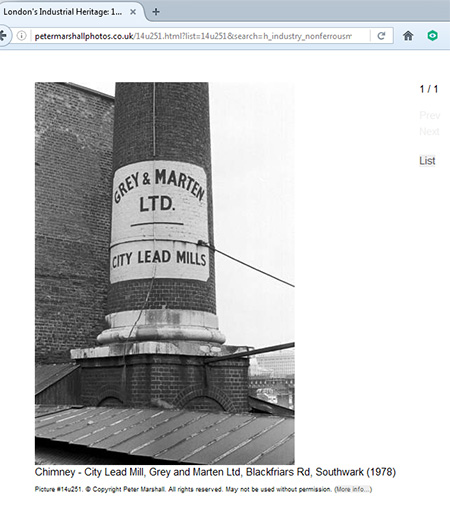
A considerable further simplification provided a basis for my only professionally produced web site, ‘London’s Industrial Heritage‘, written by my elder son. By the standards of the time (it was a birthday present for me in 1999) it was impressive, and is still a rather elegant solution, although the image size and quality now dates it.
Perhaps now we should have some rather more clever solutions, perhaps through the application of AI technology to the searches that picture researchers make and perhaps the keywords that photographers use, as well as image description technologies.

For the moment, its time for me to get back to that tedious business of adding information the slow and hard way.
Strand at the V&A

In the Guardian you can read I posed for Paul Strand, in which 73 year old Angela Secchi recalls the day when she was 9 and the photographer came into her native town of Luzzara  in Italy.

Her portrait was one of many that he made there for his book with writer Cesare Zavattini, Un Paese: Portrait of an Italian Village. It was Zavattini’s home town, but the two worked separately, and Strand’s guide to the town was one of the eight sons of one of the most famous family in photography,  The Lusetti Family, Luzzara, taken in 1953.

It has long been one of my favourite photographs, and Strand certainly one of my favourite photographers, though that doesn’t stop me being criticising some of his pictures. I’m not too enamoured of the portrait of Secchi, which, like quite a few of his others seems a little too contrived, wearing the oversize hat of her farmer father, put on her head by the photographer.

Of course Strand was a very fine portraitist, and doubtless there will be many of his better examples in the show, Paul Strand: Photography and Film for the 20th Century which is at the V&A in London from 19 March to 3 July.

This is a rare example of a great photographic touring show – organized by the Philadelphia Museum of Art in collaboration with Fundación MAPFRE and made possible by the Terra Foundation for American Art – coming to the UK, and is apparently the first major retrospective of his work in the UK since his death in 1976. I do remember the previous retrospective – and unlike the current V&A show – I was invited to the opening in Carlton House Terrace shortly before he died.

Strand was of course a communist, and worked with a number of others who shared his views; as Fraser MacDonald writes in his detailed essay Paul Strand and the Atlanticist Cold War on Strand’s fine book on the Hebrides, Tir a’Mhurain (1962).  You can also read my own far less scholarly account of the New York Photo League originally published in 2001.

Free Speech in the Barbican

I’ve always found London’s Barbican Centre a rather confusing place, in fact the whole Barbican estate, a brutalist conception where painted yellow lines on the pathways were found necessary to guide people from the various Underground stations to performances at the centre.


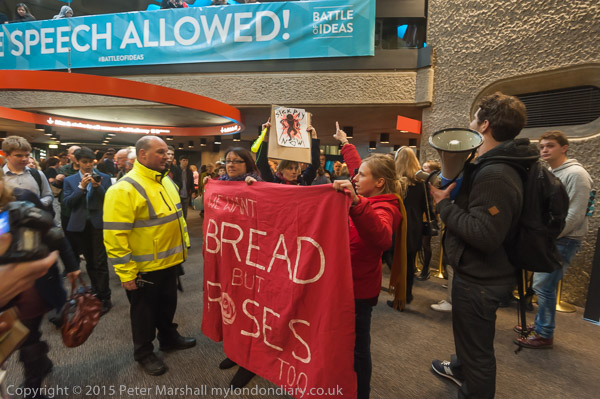
Nikon D700 16-35 mm: 1/25s, f/4, ISO 3,200, -0.3Ev

It’s the different levels that really make it difficult, with the main walkways being well above ground, linking with a grand post-war scheme that saw a future City of London where pedestrians and road traffic would move at different levels. Away from the Barbican itself, only traces of this concept remain, with parts across and along London Wall having been demolished relatively recently, but most was simply never built, impossible without major demolition (which the Luftwaffe had previously carried out on the Barbican) and incredible expense.

But inside the Barbican too is confusing, with different levels and no really clear definition of spaces. Regular visitors and those who work there doubtless soon become used to it, but as an infrequent user I still have problems.


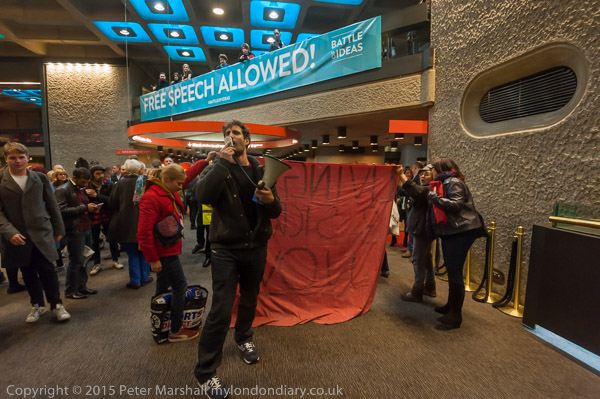
D700, 16mm fisheye: 1/40s, f/3.2, ISO 3,200, -0.3Ev

But on this occasion I didn’t have to worry. The protest by the United Voices of the World, the union representing the cleaners at the centre began at the entrance to the centre on a proper London street shown on the A-Z, and when a small group of cleaners led by UVW General Secretary Petros Elia ran inside, evading the security staff, all I had to do was follow them into those confusing depths.


D810, 28-200mm in DX mode, 28mm (42mm), 1/60s, f/3.5, ISO 3,200, -0.3Ev

Outside it was dark, with relatively little light from street lamps and in some areas where the protesters were standing rather more coming through the glass doors and windows of the Barbican entrance. With the Nikon D810 I was working with the 28-200 mm f/3.5-5.6 in DX mode (42-300mm equiv) at full aperture and ISO 3200, in shutter priority mode at around 1/60th second, augmenting the available light with a little flash from a SB800. The flash wasn’t doing a great deal (though you can see its effect in some images) as I was using the 16mm fisheye on the D700 at similar apertures and ISO, without flash at shutter speeds from 1/15-1/50th.

When we rushed inside, the light levels were not all that different,but I had changed from the 16mm fisheye to the 16-35mm f4. I generally prefer not to use flash when photographing such incursions, as it makes it much more likely that security will take notice and ask you to stop taking photographs or to leave. I did take a few images with the D810 and flash, but generally needed a wider angle of view, and almost all of the better images were made with the 16-35mm.


D700 16-35 mm: 16mm, 1/30s, f/4, ISO 3,200, -0.3Ev

The spot which the UVW chose for its protest inside was in a foyer area of the centre, and overlooking it was a balcony from a higher level, draped over which was a banner for an event taking place on that weekend, ‘Battle of Ideas’ with its message in large capitals ‘FREE SPEECH ALLOWED’. This protest wasn’t what they had in mind, but the banner certainly fitted. Although the security weren’t too happy about the protesters being there and speaking out.


D700 16-35 mm: 16mm, 1/60s, f/4, ISO 3,200, -0.3Ev

It was at first difficult as the protesters were largely facing the banner, but eventually I was able to get the picture I wanted.


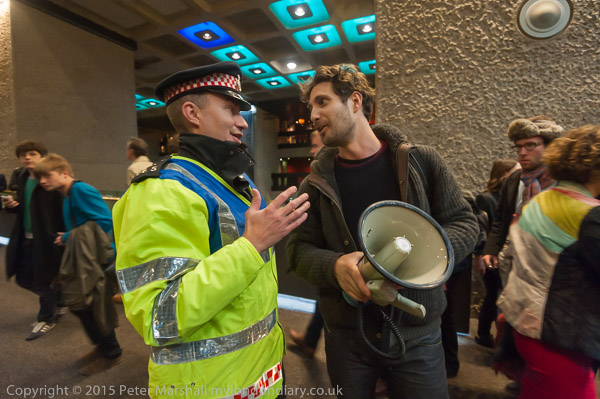
D700 16-35 mm: 16mm, 1/50s, f/4, ISO 3,200, -0.3Ev

The Barbican’s reaction was one of moderation, and when the protesters carried on after being asked to stop and leave, they called in the police, and a very polite conversation ensued, with the protesters agreeing to leave peacefully and continue their protest outside.

More pictures and text about the cleaners demands for a proper living wage and decent conditions of service at Cleaners protest in Barbican.

Continue reading Free Speech in the Barbican

How to Fake a Giant Rat

Good to see a short photography lesson from The Guardian, How to fake a giant rat.  It’s perhaps a pity that they spoil it a little by continuing the title “(and why you shouldn’t trust pictures on the internet)”, as it isn’t really a story about the Internet, but something that illustrates a very basic fact of photography, and one which of course used to feature in photography courses long ago.

he article quotes news agency SWNS as correctly saying “clearly perspective plays a part in it”, and it goes on to comment that the image  was used by everyone “from Sky News to the Daily Mirror to the Evening Standard” without comment or bothering to check whether the rat was really four foot long.  These guys may be publishing on the Internet, but they are major media outlets and employ journalists. They even still employ a few photographers who could have advised them.  Had they asked, but it was a better story without the facts.

It isn’t really a story about the Internet. Or really about photography. But about journalistic standards and competency.

Junior Doctors

There is certainly something very wrong in the state of England at the moment, and the junior doctors dispute with Health Minister Jeremy Hunt epitomises it. When a government minister resorts to misusing statistics and lies on such a grand scale it should inevitably lead to resignation, but Hunt – like Iain Duncan Smith – seems to get away with it, supported by the BBC (over-anxious about its licence) and the rest of the media, whose proprietors, like the government itself, are rubbing their hands at the thoughts of the rich pickings from private health care as they gradually privatise the NHS.

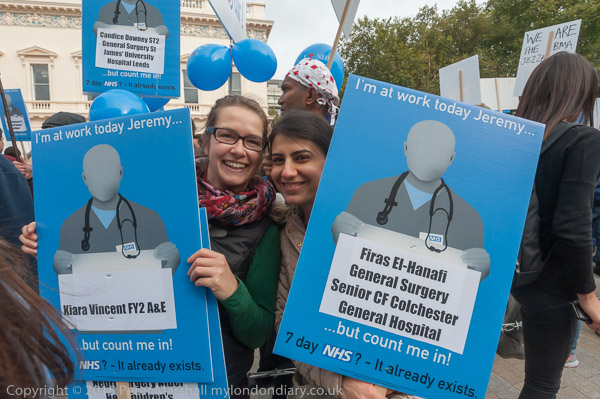
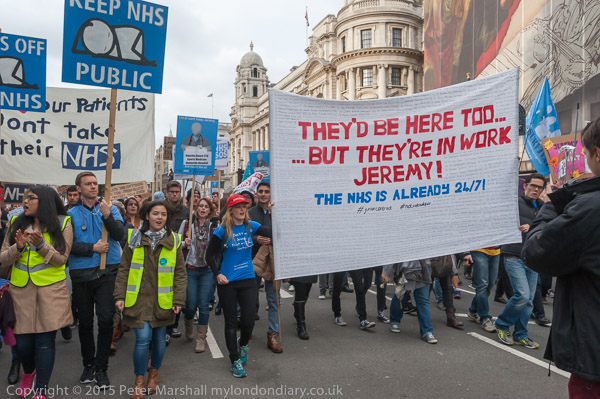
But while I despair at the actions of the Tory government (and Labour don’t have much of a record at the moment, though perhaps things may change) I have been truly heartened at the response of the junior doctors, who almost to a man and woman have taken a stand against the imposition of a new contract. The strength of their opposition isn’t because of the money or even working hours – most already work unsocial hours and  there were many placards to show that colleagues were unable to attend because they were at work on a Saturday – but because doctors working in the NHS want to see it kept as a service dedicated to the public good rather than working for private profit.

Of course money and working hours are important. Already many junior doctors live highly disrupted lives with overnight and weekend working on a regular basis – because the NHS is already a 24/7 service, particularly for the junior doctors. For those whose partners are also working in the NHS it can be something of a nightmare, especially for those who have children.

Junior doctors are not really ‘junior’ and may remain junior doctors for many years after completing their initial medical training, working their way to becoming consultants. It’s a demeaning term, perhaps deliberately so, and one I think they and the BMA should refuse. They are doctors, hospital doctors rather than GPs.

Supporting the junior doctors at the protest consultants, GPs, nurses and other health professionals, all of whom realise that the future of our NHS is at stake. They see the injustice and the lies and realise that many or most of them are going to face similar demands from our corrupt government if it manages to get its way with the junior doctors.

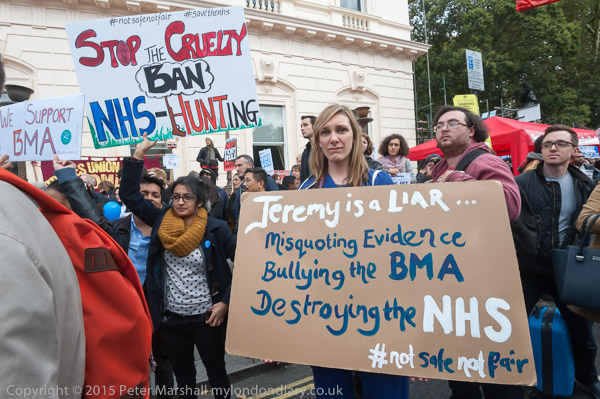
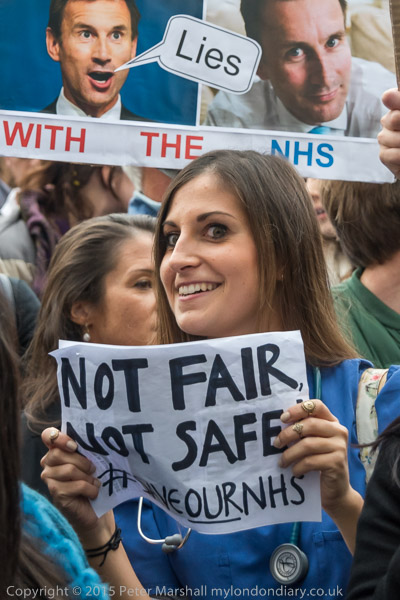
Photographically it was a fairly straightforward event to cover, with most of those taking part being keen to be photographed, and was distinguished by the range and invention of the hand-made placards and posters that some of the doctors and others had brought, as well as those produced by the campaign with details of colleagues supporting but unable to attend. As usual when working in crowds, the 16-35mm was invaluable, and used for all of the pictures above, with the 28.0-200mm being mainly used where I wanted to isolate a single figure – as in the image below of one of the leaders of the protest holding a poster ‘Not Fair, Not Safe. #saveourNHS’, taken at 1/250 f6.3 ISO 1600 at 75mm with the Nikon D810 in DX mode – so a 112mm equivalent.

I focused on her eyes, and tried to be sure that Jeremy Hunt at to top left with a speech bubble saying ‘Lies’ was still clear. It worked better than I expected at f6.3, perhaps with a little help in post-processing, adding a little local contrast, clarity and sharpening. It has to be basically there when you take the picture, but a little dodging and burning etc can help. Though Reuters wouldn’t approve!

More pictures at Junior Doctors protest to save the NHS.

Continue reading Junior Doctors

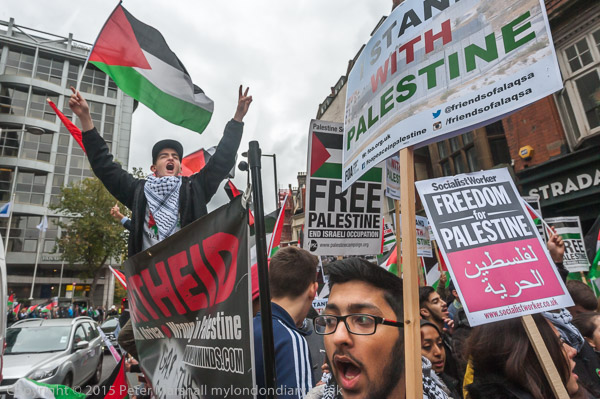
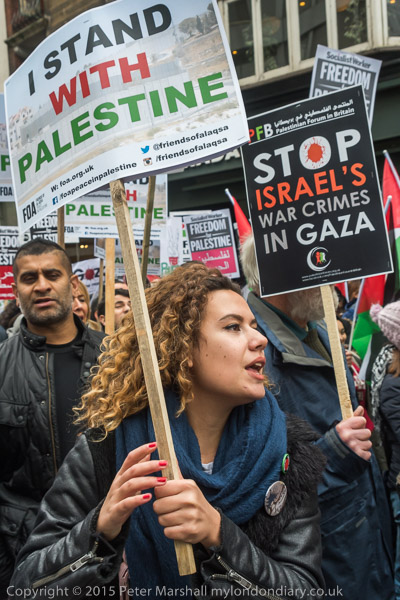
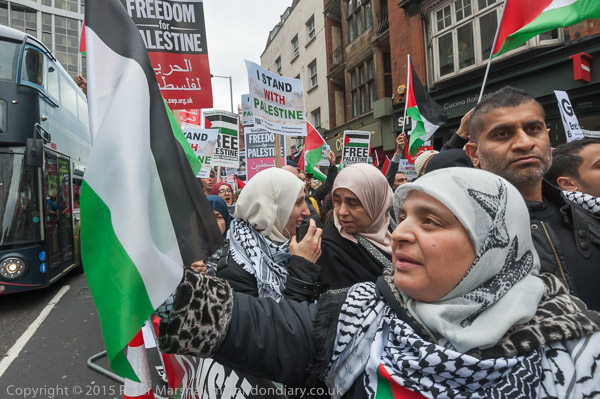
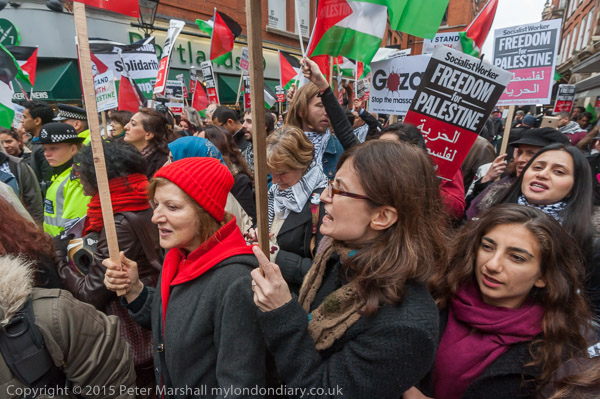
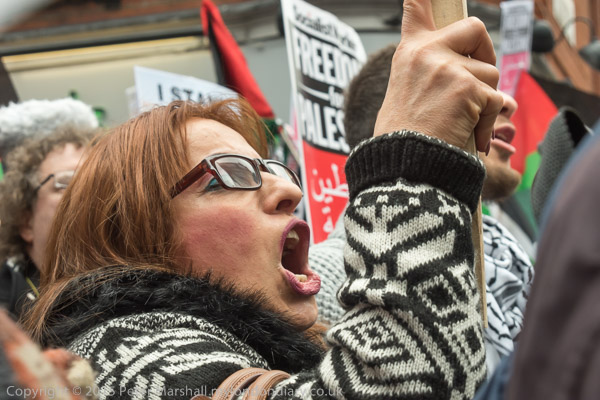
End the killing in Palestine

Protests at the Israeli embassy in London are somewhat frustrating both for protesters and also for photographers. You can’t actually protest at the embassy as it is a short distance down a private road, Palace Green, where protests and photography are both banned. Instead protests take place on the busy High St Kensington, with police attempting to keep the protesters inside a relatively narrow pen surrounded by barriers on the opposite side of the road to the gated entrance to Palace Green.

The Israeli embassy is only a short distance away, so the protests can obviously be heard there, but it isn’t a good location for a protest of any size. Police generally keep traffic running in both directions along the A315, the major route to the west from Hyde Park Corner and the penned area is long and narrow, getting very crowded. A narrow area of pavement in front of the shops behind the pen which police try to keep clear also gets very congested.


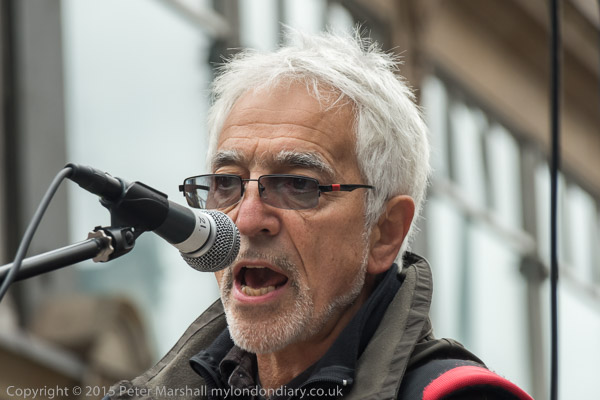
Glyn Secker of Jews for Justice for Palestinians

Police also harass photographers who try to work outside the pen along the front of the protest along the road. It is almost the only place from which to take pictures and if you stop police who are standing in a line along it are likely tell you to move on, though we were suffered in a very narrow space close to the platform from which the speeches were being made. Though the small crowd of photographers and videographers there meant it was often difficult to get a clear view.


Traffic passes very close to the barriers


Inside the pen, the crowd made it hard to work and difficult to move around.

More pictures at End the killing in Palestine.

I didn’t stay long, as I had another event I wanted to photograph, but was rather pleased to leave, having had enough arguments with police already. The location does present them with a difficult job, but it would be possible to make it a little more friendly and safe for press and public with a few more traffic cones and another foot or so of space.

Continue reading End the killing in Palestine

Photographer Trump Thumped

One of America’s best-known photographers made the news for all the wrong reasons when he was beaten up by “Trump’s Secret Service security detail at some ten-cent political rally in Virginia.”  As photographer Nate Thayer goes on to say in his post Trump Beats Up an Iconic American War PhotographerTrump should hang his head in embarrassment and shame. And America should be outraged.”

Thayer puts Christopher Morris into perspective far better than I could, but I strongly recommend taking a good look at his web site. Morris was at the event working for TIME, and you can read their response as well as an article on NBC News. He was attacked and then briefly arrested because he was taking pictures when protesters interrupted Trump’s rally and Trump shouted the order to his goons “Get them out of here!”

While it unfortunately isn’t uncommon for photographers to be assaulted while covering protests, either by police, stewards or by protesters, it seldom makes the news as in this case. This morning I read of an incident in London last night where a photographer was pushed and impeded by protesters, and such things are common, particularly when covering the extreme right.

The London police have usually been well-behaved recently when I’ve been around, but photographers are often jostled and officers deliberately stand in their way to prevent them taking pictures. A few years ago I used to be threatened with arrest frequently, although I haven’t yet been arrested I have several times been held by police for some time. Several photographer friends have received compensation for injuries and unlawful imprisonment from police.

I’ve also been assaulted on several occasions by stewards on a march, and once near the US Embassy was lucky to avoid serious injury when sent flying backwards, narrowly avoiding a concrete obstruction and rolling over with only slight bruising. I’ve been lucky too when pushed into oncoming traffic.

Such things should not happen. And they should certainly not happen at a political rally and at the order of a candidate for the US Presidency.

As Thayer ends his post:

“How dare you desecrate the work of people like Chris Morris who has risked his life to document events far more important than your irrelevant little political campaign, Mr Trump? You should be defending the rights of people like Morris to do his job, not arresting them.

“Even Saddam Hussein didn’t arrest Christopher Morris, but Trump did. What does that say about America in 2016?”

Middle East Problems

London has long been a city which has welcomed people from across the world including political refugees and the protests that I photograph here reflect conflicts from around the world, at the current time particularly the events in the Middle East. It was of course our geopolitical meddling in the era of the British Empire that played a large part in setting up most of these continuing problems, and more recently as poodle to the spectacularly incompetent USA in bringing some of the pots to boil. Along of course with some help from the other Western nations, including Germany, France and Russia, all fighting for a share of the spoils.  Back in the past it was a very profitable business – as the huge late Victorian and Edwardian banks and offices in most of our cities provide solid evidence of the success of our exploitation.

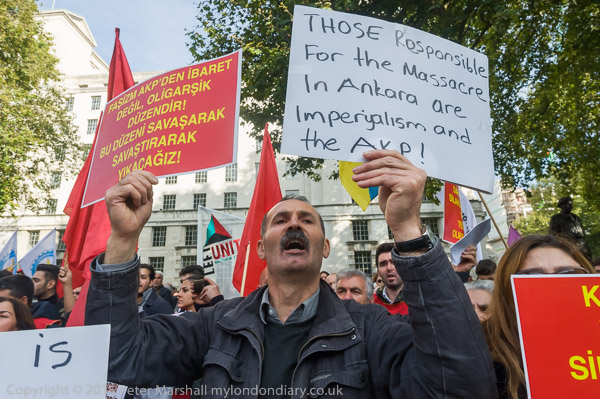
We picked winners and losers; drew straight lines on maps and generally supported despots, overlooking their crimes. Among the losers were the Palestinians and the Kurds, and in October both were out protesting on the streets of London.

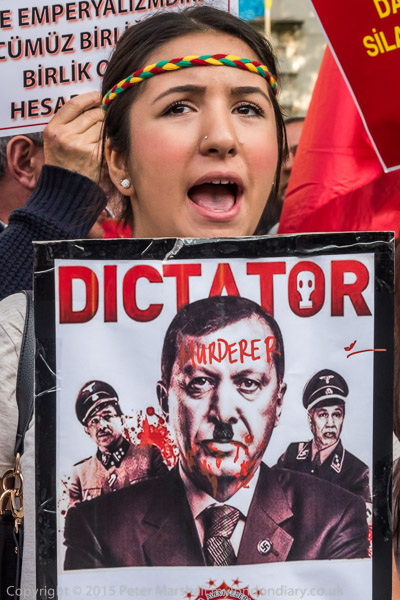
Kurds were protesting against the bombing of a peace protest in Ankara which killed 130 people, mainly young activists, blaming Turkey and President Erdogan for the massacre. Kurds living in Turkey have long been a persecuted minority, with persistent government attempts to eradicate their culture and language.  Many of them want their own nation, Kurdistan, which would also include Kurdish areas of Syria and Iraq, and back the PKK and its leader Abdullah Ocalan, held in a Turkish jail for since his arrest with the help of the CIA in 1999. In recent years the Kurds have been trying to make peace with Turkey, but since Erdogan and his AKP party did well in last year’s elections, they have been clamping down on all opposition in the country. The protesters describe Erdogan as a fascist dictator.

The protest received support from a wide range of groups, including some from the British left.  More at Ankara peace protest bombing.

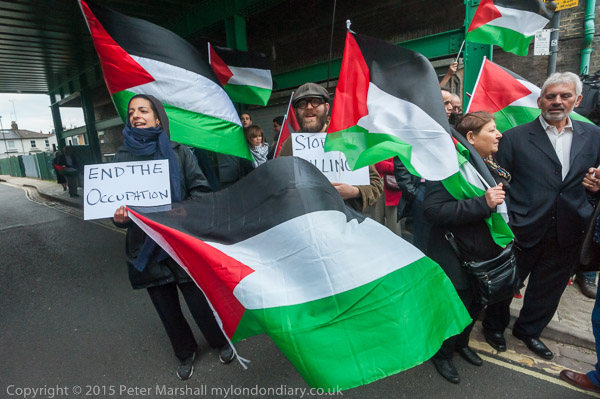
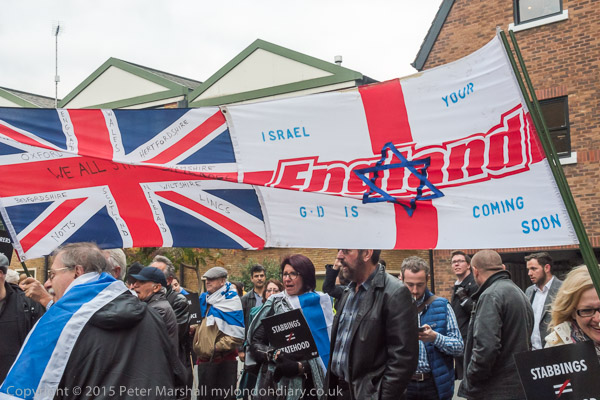
A couple of days later I was outside the Palestinian Authority UK Mission in Hammersmith where the Zionist Federation had come to stage a protest against the stabbings of Jews in Israel and groups supporting Palestinian resistance to Israeli occupation and terror had come for a counter-protest condemning all violence in the country.  Police kept the two groups over a hundred yards apart, though just within sight of each other.  More pictures of both at Zionists and Palestinian protests over killings.

At the time I wrote:

Loud public address systems meant they could at least hear some of what the others were saying. But it was clear that those supporting Israel were deaf to what the Palestinian supporters were saying, with Professor Manuel Hassassian, Palestinian ambassador to the UK quite clearly condemning the violence on both sides and down the road a speaker making as his main point the ‘fact’ that the Palestinians refused to condemn violence against Jews.

Both groups of protesters were predominantly Jewish, and the pro-Palestinian protest had been called by Jews for Boycotting Israeli Goods along with other Jewish groups, while some extremist right-wing Christians had come to support the ZF.

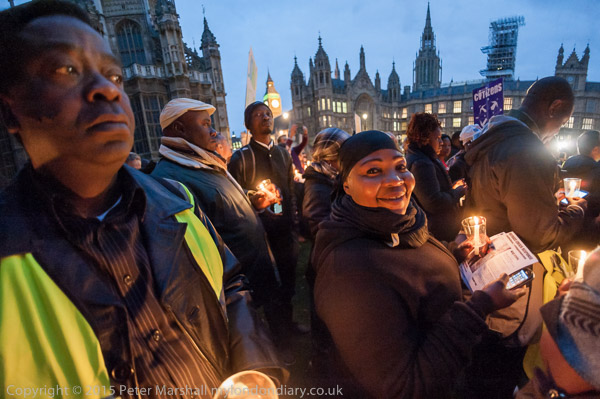
From Hammersmith where the stand-off was continuing, I took the tube to Westminster, for Citizens UK Vigil for more Refugees ,  a candlelit vigil at Parliament calling for 1000 Syrian refugees to be resettled in the UK before Christmas and 10,000 a year for the next 5 years.

The vigil was in Old Palace Yard opposite the Houses of Parliament, and I often find it just a little frustrating that it is almost impossible to see that most obvious and iconic symbol of Parliament, the clock tower of Big Ben from that location. But working in the middle of the crowd I did manage to have it just visible, floodlit at top centre of the image above.

I made the image by available light – almost entirely from the candles. Parts of the protest were lit up by powerful floodlights for video, but these created problems for me with a very different colour temperature to candlelight. Using the D700 at ISO 3200 and 1/40s f2.8 with the 16mm Nikon fisheye gave a rather underexposed result that needed some work in post-processing – along with the use of my usual plugin to ‘defish’ the image to a cylindrical perspective. The ultrawide lens is great for working inside crowds, though it was a little difficult to move around particularly with people holding lighted candles.

Continue reading Middle East Problems

No More Zombies

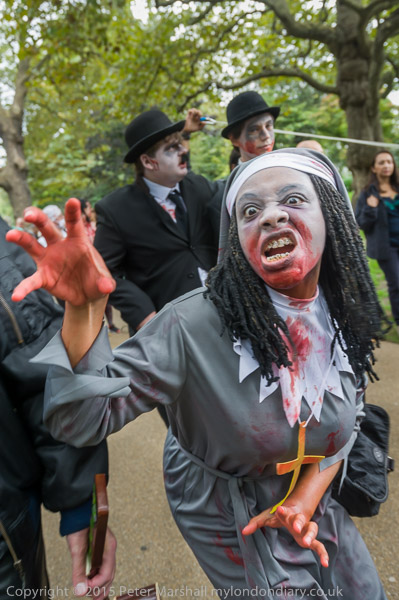
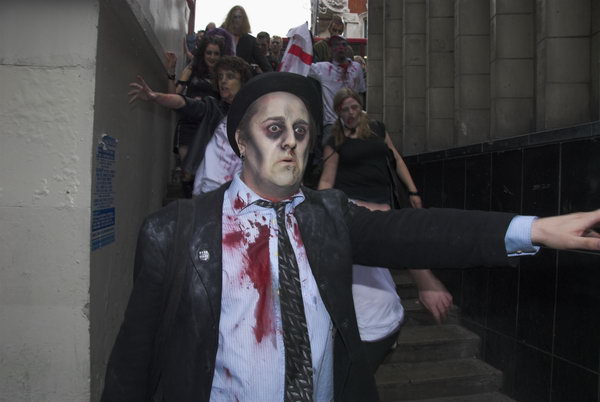
I think I’ve photographed enough zombies. Back when I first came across them it was fun, but now it seems to have lost any freshness – or perhaps I am just getting too old. The first zombie event I photographed was at Halloween in 2006, and was a late afternoon pub-crawl around London’s shopping centre, with the fancy dress zombies being largely ignored by true zombie shoppers on Oxford St (Crawl of the Dead starts well down the page.)

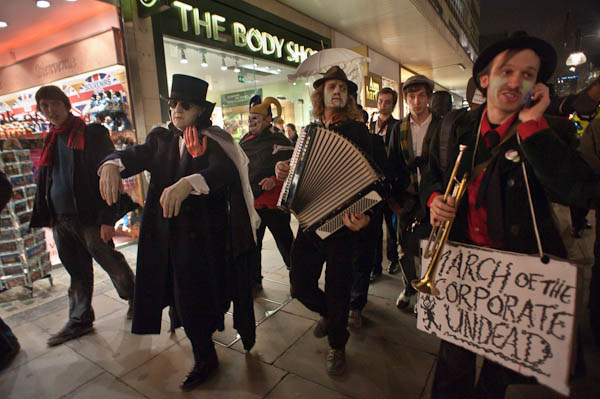
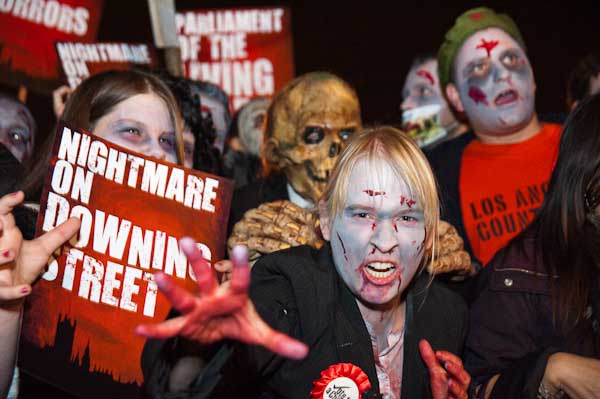
Since then I’ve photographed many more zombie events, including more pub crawls and also several zombie protests including the March of the Corporate Undead and a Halloween protest outside Parliament.

Looking back on them, the main thing that hits me is how much better cameras (and perhaps this photographer too) have got at photographing events in low light, though this year’s zombies were rather cheating in coming out in the early afternoon. And what began as young people having a little seasonal fun was now a charity event, in this case for the very worthwhile charity of St Mungo’s Broadway, a charity which provides the homeless with emergency shelter, housing, healthcare and training. Though it’s a good cause it does mean that the event was rather more organised and lacked the anarchic nature of those early crawls which attracted me.

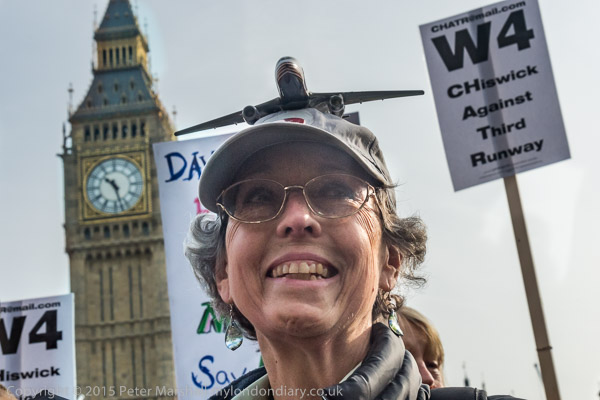
I won’t promise I’ll never photograph a zombie again, but I won’t be going out of my way to photograph them – and I didn’t on this occasion. I’d come up to London to photograph a couple of rather more serious events, beginning with a No Third Runway rally in Parliament Square.

The expansion of Heathrow – as I’ve written here before – would be disastrous for London, where air quality is already cutting our lives short. It’s part of a scenario of increasing air traffic which would be disastrous for climate change across the world too. We need to find sensible ways to cut air traffic, perhaps by ending short-haul flights and imposing a ‘frequent flyer’ tax, as well as removing incentives which encourage flights.

I wasn’t too pleased with the pictures I took at this event, which somehow seemed difficult to work. I had problems too with fill-flash, and the flash circuitry of my Nikon D700 has definitively had it. It’s something of a miracle that the camera is still working at all after now more than 460,000 exposures, more than three times what the shutter is rated for.  I’m actually waiting for it to fail so I can declare it beyond economic repair and buy a nice up-to-date replacement. But it wasn’t really that, either me or the event wasn’t really working. Perhaps it was the way everyone was crowded up to the barriers in front of a small press area in front of the stage, or perhaps airport protests attract a different less photogenic type of protester, less happy than most at being photographed!

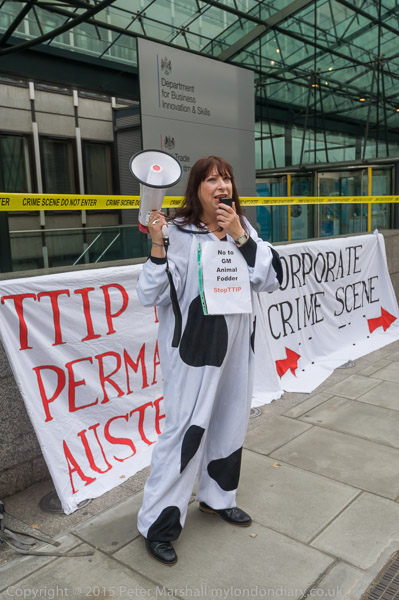
Two minutes away down Victoria St, and I was photographing a cow, or rather a woman in a cow suit at another protest taking place outside the cumbersomely named Department of Business, Innovation and Skills or BIS, against the top secret trade deal which is aimed at giving the major corporations control over our lives. Politicians sometimes accuse campaigners of scaremongering over TTIP, but as we find out more about it, we find it is even more scary than was imagined.  Over 3 million people in Europe have signed a petition against it, but so many of our politicians are in corporate pockets that it seems likely to be approved.  More at TTIP protest at Business Ministry.

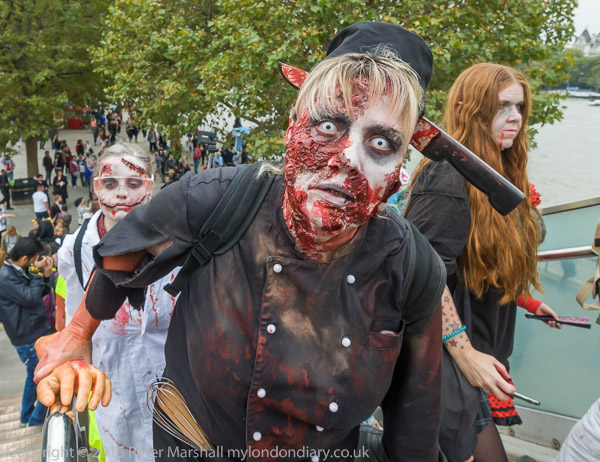
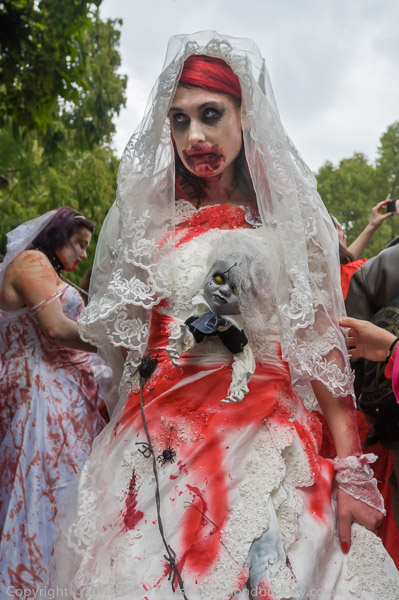
I walked back to Waterloo Station from Westminster, and met the tail end of the zombies as they emerged from Leake St, London’s graffiti HQ under the platforms. I’d known it was taking place, but thought I would have missed it.

But since I hadn’t I went with them,taking a few pictures as they made their way on the footbridge across the Thames and into Jubilee Gardens.

You can see more pictures at Zombies crawl for St Mungo’s, but my heart wasn’t really in it, and as they moved off to continue the crawl around the centre of London I walked away to catch my train.
Continue reading No More Zombies

WPP 2016

You can read about the winners of the 2016 World Press Photo Contest on the Lens Blog at the New York Times – and doubtless elsewhere by the time I finish writing this. I don’ like the title of their article by James Estrin, The World’s Best News Photos, as good though these images may be, they are only one panel’s selection from the 82,951 submitted of the many millions taken in 2015. The NYT did do rather well in the awards – perhaps because there are now rather fewer newspapers with a “serious commitment to quality photojournalism.”

The winning entry, a picture taken by moonlight (24mm, 1/5s, f1.4 ISO 6400) of a baby being passed under the barbed wire border fence as Syrian refugees cross from Serbia into Hungary taken on 28 August 2015 by Australian freelance Warren Richardson certainly catches something of the reality of the refugee crisis, but it also epitomises the problems facing photographers today.

The picture was previously unpublished. Richardson spent several months working and living with the refugees without any paid assignments, enduring himself something of the hardships they faced – including being beaten by police. But although this picture – certainly one of the’ World’s Best News Photos’ was submitted to two agencies, no newspaper or magazine around the world thought it worth publishing until now. If he hadn’t sent it to WPP we would probably never have seen it.

You can read his story Refugee Crisis Hungary on his web site, and see around 40 pictures from it,though the winning WPP entry is not included.

I’ve only had time for a quick glance through the other WPP winners so far – and will certainly go back to look at greater length. It’s good to see the WPP run under stricter rules and I hope there will be none of the controversies we have seen in recent years.