Open Bridges

One of the more interesting projects as a part of Hull’s year as City of Culture in 2017 was ‘Open Bridges‘ , an event unlike some truly based on Hull, a city which has long been split in two by its river. Rivalry between East and West Hull is at its highest in terms of sport, with Hull Football Club on the west formed in 1865 and Hull Kingston Rovers in the east from 1881. The sport is of course Rugby League, though other codes of football are available.

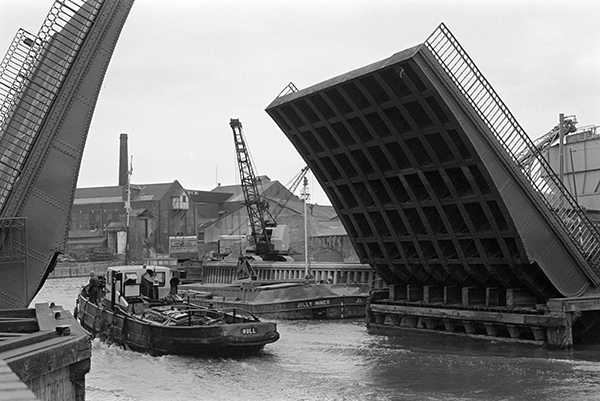
Back when I first began visiting Hull in the 1960s people were always complaining about being late for things because North Bridge or Drypool or one of the other bridges “were up“, disrupting bus or car journeys.  Then the bridges opened frequently with a great deal of traffic moving up and down the tidal river  to various wharves, though now bridge openings are fairly rare (except for Scott St bridge, a listed structure permanently open since some time in the 1990s.)

For Open Bridges, for the first time ever, all the bridges were opened simultaneously at 20:17 hours on the autumn equinox, 22nd September 2017, splitting the city completely in two, although only for a few minutes. Open Bridges also included a film and specially commissioned musical work for the event.

A River Full Of Stories is the follow-up to Open Bridges, and with the support of the Heritage Lottery Fund is producing a film, exhibition, website and a book which will be given to each library and museum in Hull and the East Riding.

I’m very pleased that some of my own work is now included on the web site as one of the Open Bridge Stories,  The River Hull 1977-85 by Peter Marshall, with links to my ‘The River Hull’ and ‘Still Occupied’ books and my Hull web site.

My web site was also produced, but as an entirely unofficial contribution, for Hull’s year as City of Culture and rather to my own surprise I managed to post a new picture on-line every day during 2017 on it, as well as on Facebook, where I also put some short comments.  But I have to admit that I’ve rather neglected it since then, posting only a very few new pictures, and making little progress with adding the text about the images which I’ve written on to the web site.

Recently I’ve begun to scan some more of the colour images I made, at first on colour transparency, and from some time in 1985 using colour negative film. Technical problems in getting the results I wanted from slide film in pictures from Hull were a major motivation in my moving to negative film, and problems in getting the results I wanted from commercial printers led to me setting up my own colour print processing line – and doubtless breathing in lots of harmful fumes. Things are easier in many ways now, though scanning colour negatives still remains rather a dark art.

______________________________________________________

There are no adverts on this site and it receives no sponsorship, and I like to keep it that way. But it does take a considerable amount of my time and thought, and if you enjoy reading it, a small donation – perhaps the cost of a beer – would be appreciated.

My London Diary : London Photos : Hull : River Lea/Lee Valley : London’s Industrial Heritage

All photographs on this and my other sites, unless otherwise stated, are taken by and copyright of Peter Marshall, and are available for reproduction or can be bought as prints.

To order prints or reproduce images

________________________________________________________

Extinction Rebellion Buckingham Palace

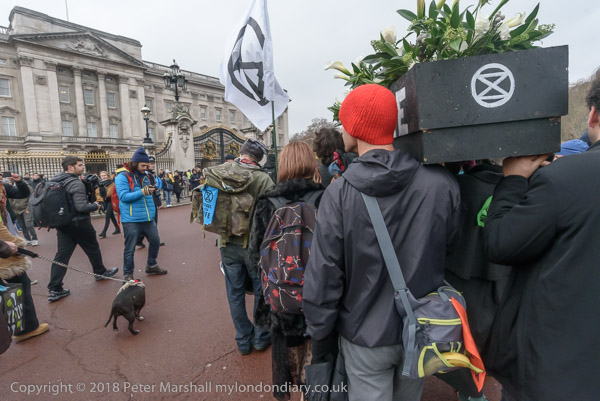
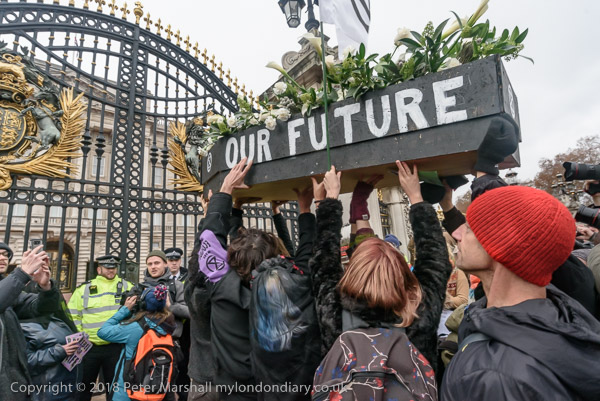
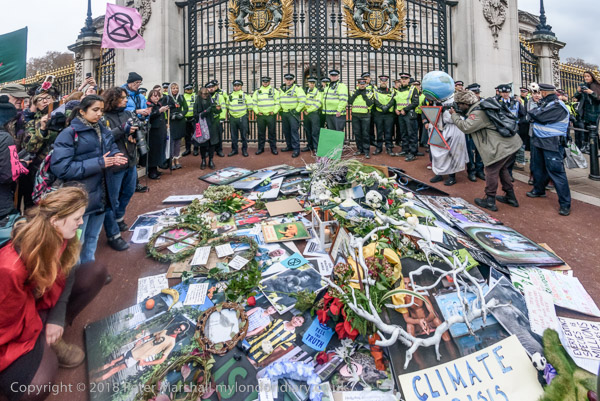
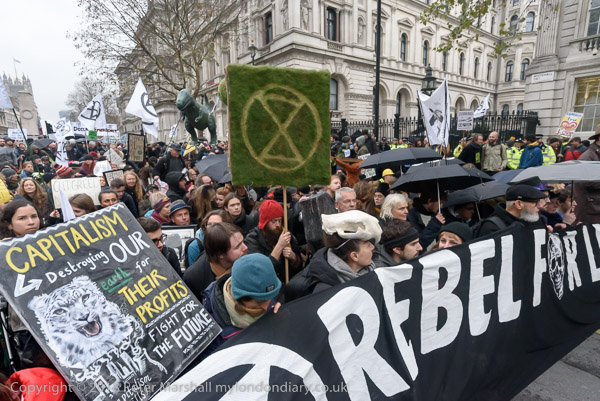
Perhaps the most surprising part of the Extinction Rebellion Day came outside Buckingham Palace, where protesters marched up to the impressive front gates behind teh ‘OUR FUTURE’ coffin, at first raising it up, and then lowering it to the ground in front of them.

I think people didn’t know what to do next, though there was some noisy shouting of slogans and then many of us started to wander away and see what was happening behind us.

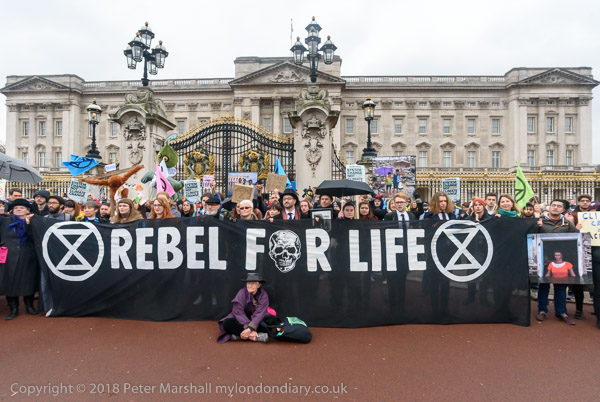
There was a crowd behind the ‘REBEL FOR LIFE’ banner, with an empty space in front so that people could take pictures. This was one of many occasions where the 18-35mm was not quite wide enough, and I really needed the extra 2mm of the 16-35mm, unfortunately broken beyound economic repair.  I do have another, even wider full-frame lens, a Sigma 12-24mm, but the image quality falls short of the Nikon lenses so it gets left at home.

Normally I’d use the 16mm fisheye to get a wider view, but I know this isn’t really satisfactory when looking at rectangular objects – such as the banner and the palace – head on. The banner would be considerably taller in the centre  than at the edges, as the camera to subject distance is further for peripheral objects; while this makes sense in terms of optics, it just doesn’t look right.

I seldom like to photograph banners (or buildings) head  on, but for this image it makes sense, and I was just able to get back far enough to squeeze it all in. I did also move to one side to use a more oblique view – as you can see on My London Diary.

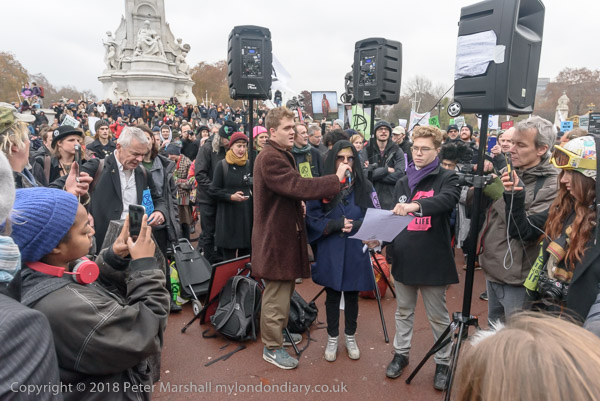
There was some uneasy grumbling in the crowd as Gail Bradbrook of Extinction Rebellion read a very humble address calling on the Queen to get her government to take the urgent action needed to save her country – and the world. Certainly as I noted, some in the crowd would have been happier to bring a guillotine. There was rather more unity behind yet another joint reading of the ‘Declaration of Rebellion’.

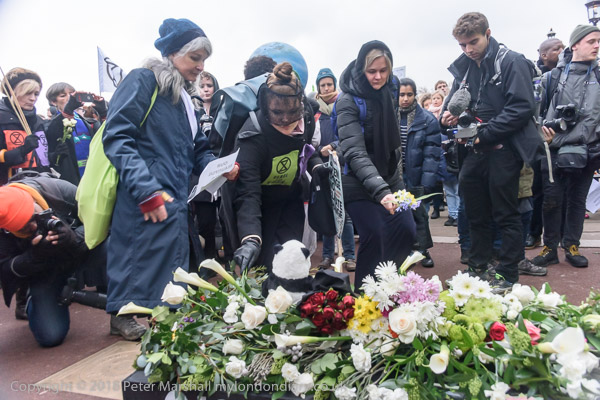
There was then a period of silence in memory of those who have already died because of glabal warming, after which people were invited to bring their wreaths flowers, placards and other objects to lay on top of the coffin, which was soon under a large pile.

The protest ended with dancing, while at least one person superglued herself to the railings by the main gates. Pictures of this and much more are on My London Diary at Extinction Rebellion Buckingham Palace.

______________________________________________________

There are no adverts on this site and it receives no sponsorship, and I like to keep it that way. But it does take a considerable amount of my time and thought, and if you enjoy reading it, a small donation – perhaps the cost of a beer – would be appreciated.

My London Diary : London Photos : Hull : River Lea/Lee Valley : London’s Industrial Heritage

All photographs on this and my other sites, unless otherwise stated, are taken by and copyright of Peter Marshall, and are available for reproduction or can be bought as prints.

To order prints or reproduce images

________________________________________________________

Extinction Rebellion Funeral March

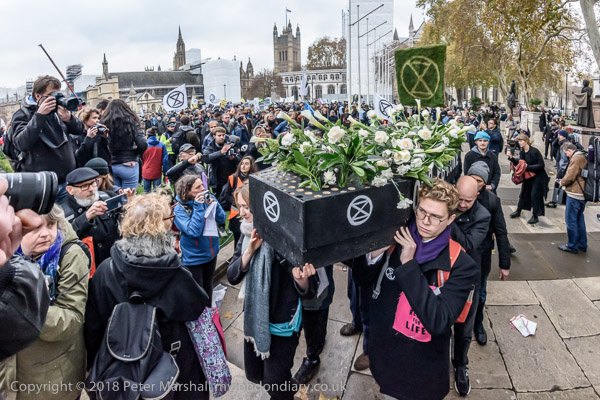
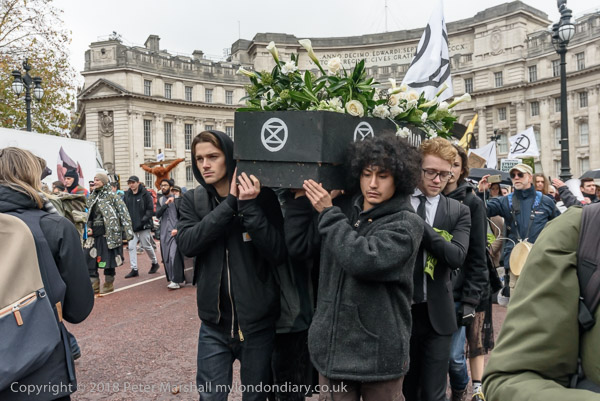
The coffin was carried off of the grass in Parliament Square and to the roadway in front of Parliament, where slowly the protesters formed up behind it. A short flight of steps at the back of Parliament Square enabled me to photograph it looking down and to show the large crowd in the square behind. Using the 16mm fisheye gave me a usefully wide angle of view (about 147 degrees horizontal) which meant including at left the lens of a photographer standing next to me at the top of the steps.

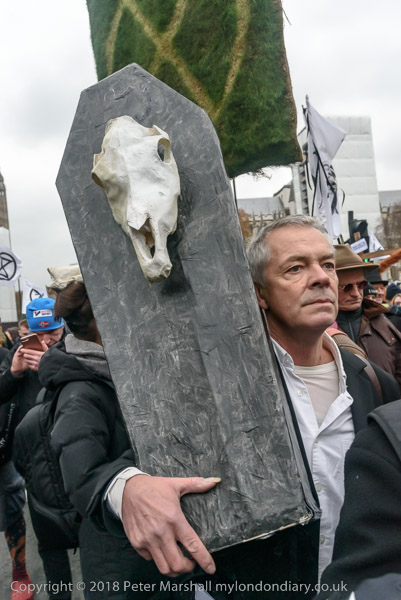
One man had brought a coffin of his own, complete with an animal skull, and another protester had a similar skull on her head, and there were plenty of other creative placards and artifacts. Others carried flowers. It was raining slightly as the march went up Parliament Street into Whitehall and many put up umbrellas, though I found none to photograph with slogans on them.

When the front of the funeral march reached Downing Street, there was a sit in for around 10 minutes, followed by some loud shouting of slogans as they got up and moved on.

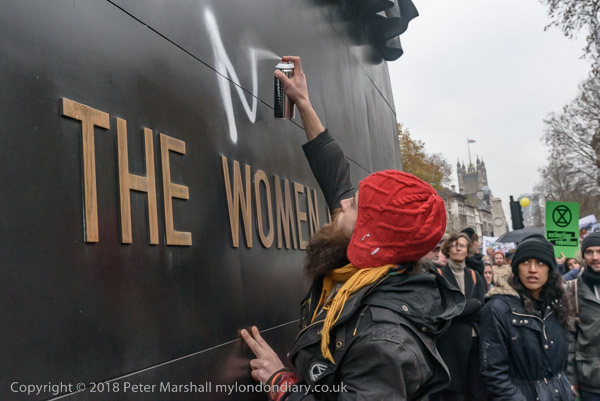
I let the front of the march go on and waited for others to pass, wondering if there might be other actions taking place in Whitehall. As I stood next to the memorial for the Women of World War II, a man got out a paint spray and began painting a slogan across it. He gets as far as ‘MOTHE’ and tries to write an ‘R’ as a police officer grabs him, and he is led away and arrested.

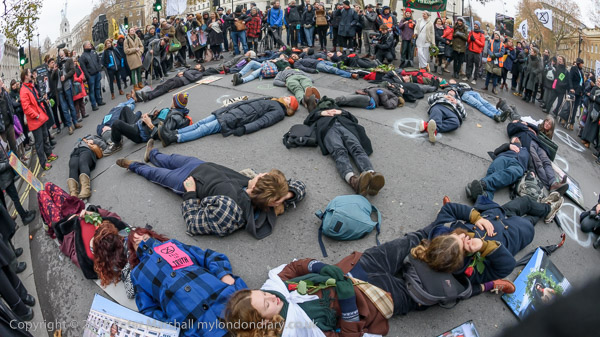
I turned back to the crowd still outside Downing St, and see they are standing around in a large circle round a circle of people lying on the ground. Inside them are other bodies making out the double triangle ‘hourglass’ symbol, completing the XR symbol, which has also been chalked or painted on the roadway in several places.  I held the 16mm fisheye as high as I could above my head and took a number of pictures. By using this on the D750 (rather than the D810 which has a fixed rear screen) and working in Live View I was able to swivel the rear screen and have a good idea of the framing. For once the curved horizon adds to the image. Unfortunately I forget to switch from ‘movie’ to ‘still’ mode in Live View, and so get a 16:9 frame rather than the normal ’35mm’ 1.5:1, an annoying feature of the camera.

Others are writing on the walls in Whitehall – and getting arrested for it. Many of those taking part in Extinction Rebellion are deliberately seeking to be arrested, working on the hope that large numbers of arrest give the protests a higher public profile and may prod the authorities into doing something about the problems.

The front of the protest halted at the top of Whitehall, for me and the other protesters to catch up with them, before setting off under Admiralty Arch (now owned by a hotel company) and along the Mall towards Buckingham Palace. A few police try to stop them, but are ordered back to allow the protest to go through – and on to the next stage in the protest.

Many more pictures at Extinction Rebellion Funeral Procession.

______________________________________________________

There are no adverts on this site and it receives no sponsorship, and I like to keep it that way. But it does take a considerable amount of my time and thought, and if you enjoy reading it, a small donation – perhaps the cost of a beer – would be appreciated.

My London Diary : London Photos : Hull : River Lea/Lee Valley : London’s Industrial Heritage

All photographs on this and my other sites, unless otherwise stated, are taken by and copyright of Peter Marshall, and are available for reproduction or can be bought as prints.

To order prints or reproduce images

________________________________________________________

Founders Day

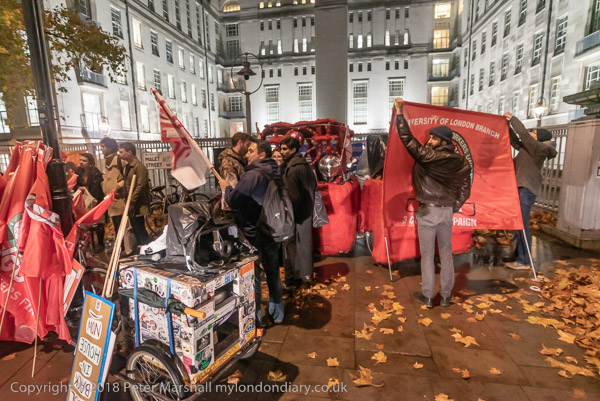
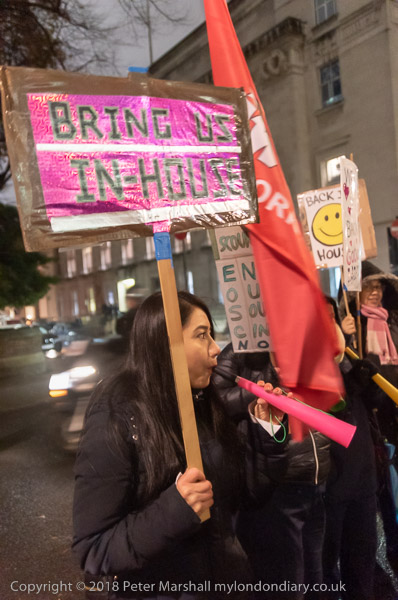
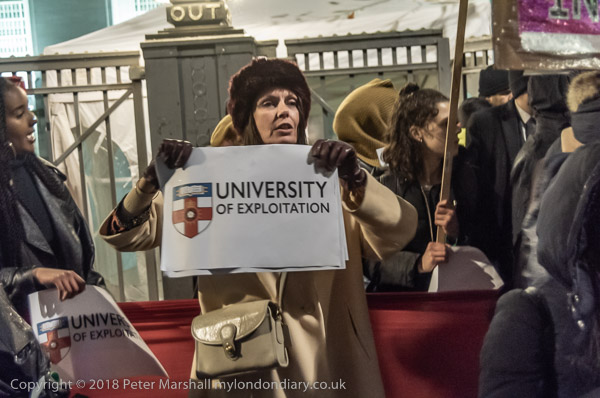
Workers protesting outside the University of London’s Senate House where Founders Day is being celebrated has become something of a tradition, and the IWGB (Independent Workers Union of Great Britain) were there again this November.

Banners and placards make the workers’ demands clear. They work for the university, keeping it running, and demand to be employed by the university, and not, as at present, by contracting companies that offer rock-bottom conditions of service and wages. They work in the university under conditions so poor that the university itself would not dream of being seen to impose – but is happy to turn its back when soemone else does it on the university’s behalf. There is no moral justification for London University’s position.

This is a dispute that has been going on for some years, both in various constituents of London University and in the central university administration, based on the Senate House, which is responsible for the Senate House, Halls of Residence and other aspects of the university. Among the workers who work for them but are employed by other are cleaners, catering staff, porters, receptionists and security staff.

It took over ten years of campaigning by SOAS Unison, along with staff at all levels and students, under the banner ‘One Workplace, One workforce’ to get the cleaners at SOAS University, next to the Senate House to be brought back in house. The campaign at the LSE, led there by the United Voices of the World was much shorter, and more recently, staff and Kings College (also in Unison) have also gained victory and are being brought in-house.

Even the University of London sees that it current position is untenable, but “continues to drag its feet over bringing workers into direct employment. They have announced that although recommending that workers be brought in-house this will be subject to “in-house comparator bids” and that it will not happen until 2020 or 2021. As the IWGB point out this is in great contrast to the response of Kings College and the LSE who have agreed to take their workers back in house.”

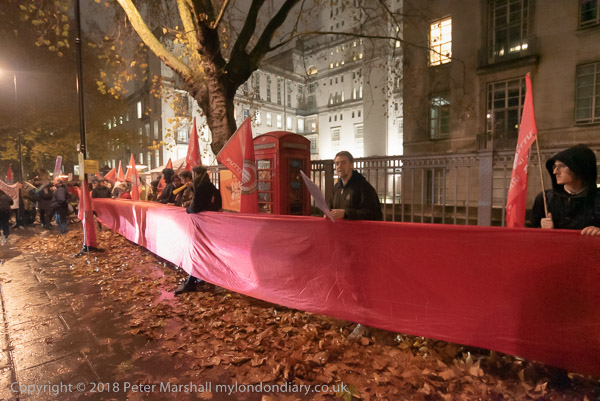
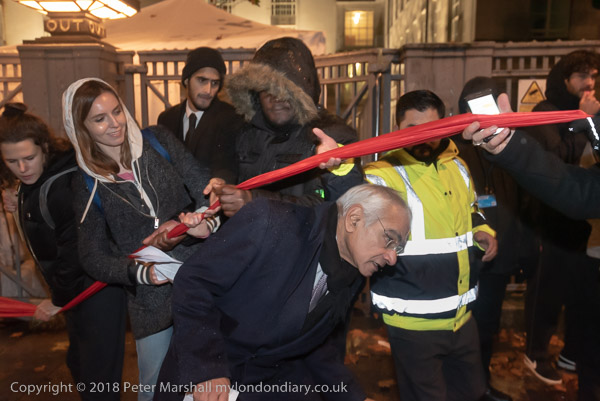
The IWGB brought with them a very long red banner – just a roll of red cloth – which they stretched out in front of the heavily guarded entrance to the Senate House. Police ensured it was possible for guests to walk around behind it to enter, but some iinsisted on a more direct route. There was a little pushing and shoving by security and police, with a little resistance by the protesters, but generally the atmosphere remained fairly calm.

But it was extremely noisy, with a sound system, and rather variable amounts of light, but always fairly low. After a handful of exposures at ISO3200, I change both Nikons to work at ISO 6400. Though this was reasonably satisfactory, with both lenses at full aperture and shutter speeds from 1/20s to 1/80s and mainly around 1/30th, quite a few images were blurred by subject movement even though most of the protest was fairly static. I made sure I took enough to get a reasonable number sharp. But I had to switched to flash when people began to try and get past the red banner and things became a little more active. I kept the camera at ISO6400, working with the camera set at 1/60s and still at full aperture to get a reasonable exposure of the background where the flash didn’t reach.

More at IWGB at London University Founders Day.

______________________________________________________

There are no adverts on this site and it receives no sponsorship, and I like to keep it that way. But it does take a considerable amount of my time and thought, and if you enjoy reading it, a small donation – perhaps the cost of a beer – would be appreciated.

My London Diary : London Photos : Hull : River Lea/Lee Valley : London’s Industrial Heritage

All photographs on this and my other sites, unless otherwise stated, are taken by and copyright of Peter Marshall, and are available for reproduction or can be bought as prints.

To order prints or reproduce images

________________________________________________________

Sardines?

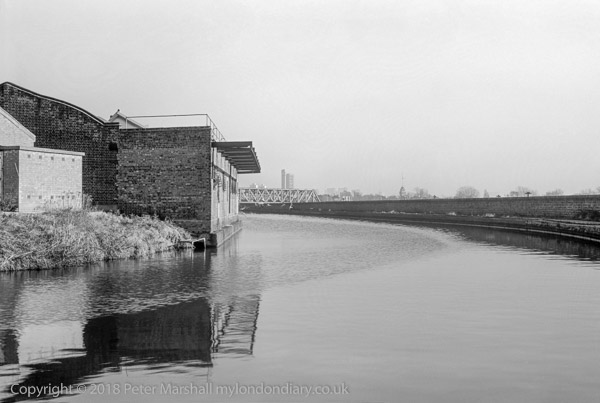
Recently I published the image above of the Grand Union Canal (Paddington Branch) I took in 1981 on Facebook, one of a series of posts I’ve been making most days over the past year or so from my early days of photographing London, and as usual wrote a few sentences about it – as follows:

Grand Union Canal, Willesden, 1981
26w-63: canal, bridge, reflection, towpath

The building at left is I think still there beside the canal, set some way back from Hythe Road in an area now all occupied by Cargiant, “officially the world’s largest used car dealership”. The bridge in the distance is Mitre Bridge, also known as Scrubs Lane Bridge, which carries the Overground line from Clapham Junction to Willesden Junction, as well as goods traffic onto the main West Coast line. The bridge gets its name from the angle at which it crosses the canal.

Just beyond the bridge on the north bank is now a small memorial garden to Mary Seacole, where I’ve sat to eat my lunch in the sun on several occasions, though it wasn’t there when I took this picture, as it was only opened around 2003.

Over the long wall to the right of the canal is a vast area of railway land to the north of Wormwood Scrubs.

I couldn’t at the time remember when I had been to that garden, but by coincidence I found out when thinking about writing a post here.  Checking through recent posts on some other photography sites, a new (and silly) comment to a post by A D Coleman led me to read a piece he had posted on the death of John Berger in 2017, On John Berger on Photography, earlier printed in Hotshoe in 2012. In it Coleman reveals how Finnish photographer Pentti Sammallahti managed to get dogs where he wanted them in his remarkable photographs.

I remember still how, when I first found this out (probably from reading the Hotshoe article, though I
have a memory of it happening when talking about the pictures hung in a corner of Paris Photo, and someone mentioning the two words “sardine oil”, perhaps someone else who had read Coleman rather than the photographer. It doesn’t of course change the photographs, but what had before seemed some magical power did become rather more prosaic.


Double-click to open the image twice the size – backspace to return

I thought of writing a post about this, but couldn’t remember if I had mentioned it before, so searched my posts for the word ‘sardine’, and got as the only result the post ‘Up Willesden Junction‘, written about a walk in February 2014, in which I wrote:

I sat on a bench to eat my sandwiches in the sun (it was surprisingly mild for London in February) in a small memorial park to Mary Seacole, a remarkable Jamaican woman who used the profits from her general store and boarding house in Jamaica to nurse wounded British soldiers in the Crimean war, as well as medical work in Jamaica, Cuba and Panama. The memorial park was created around the time of the bicentenary of her birth a few years ago here, close to where she was buried in St Mary’s Catholic cemetery in 1881. She has become a controversial figure in the debates over the construction and teaching of British history, with many feeling she was largely sidelined because she was black.

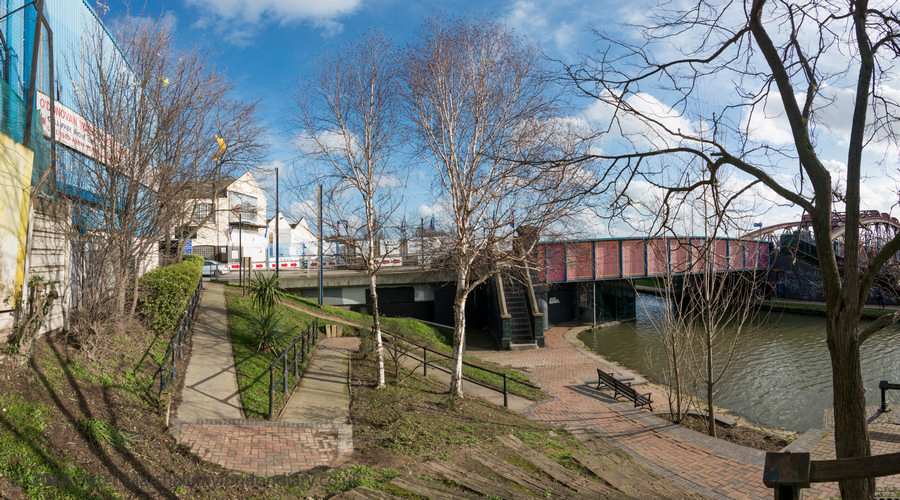
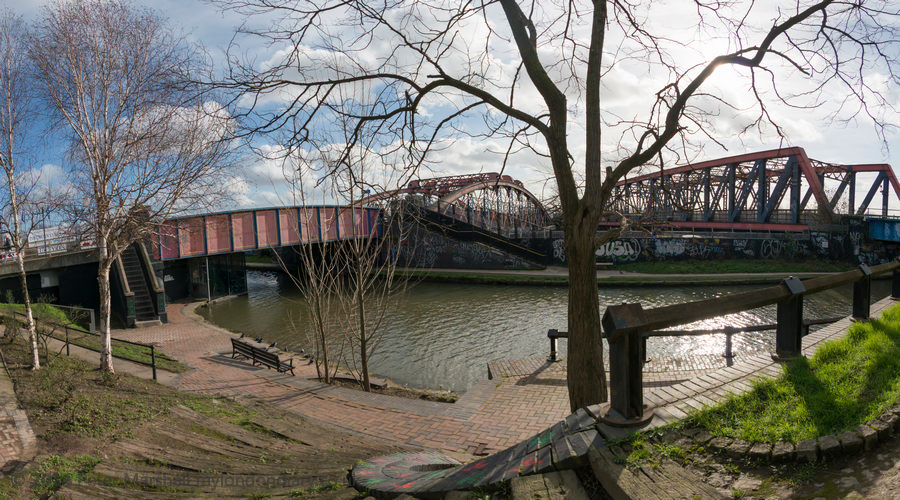
The picture above shows the Mary Seacole Garden, and there are more in the linked article on My London Diary, including this one:

The sardines weren’t in my sandwiches – unlike Sammallahti I stick mainly to cheese – Stilton, Camembert, Jarlsburg, Cheddar, sometimes with a little pickle or chutney, often with raw onions and always with tomato, with just occasionally ham or other cold meat we have in the house, and all I’ve ever managed to attract has been pigeons.

Sardines came into my post only about travelling on rush-hour trains, something I now try hard to avoid as my ageing legs obect painfully to standing, and the trains on my line have got even more packed, less reliable and the fares more expensive. Though the service from Richmond to Willesden Junction has improved greatly since it was taken from private operator Silverlink and became a part of London Overground in 2010.

______________________________________________________

There are no adverts on this site and it receives no sponsorship, and I like to keep it that way. But it does take a considerable amount of my time and thought, and if you enjoy reading it, a small donation – perhaps the cost of a beer – would be appreciated.

My London Diary : London Photos : Hull : River Lea/Lee Valley : London’s Industrial Heritage

All photographs on this and my other sites, unless otherwise stated, are taken by and copyright of Peter Marshall, and are available for reproduction or can be bought as prints.

To order prints or reproduce images

________________________________________________________

Sodden London

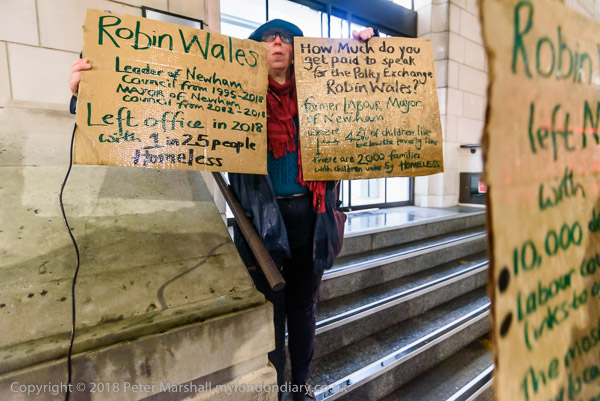
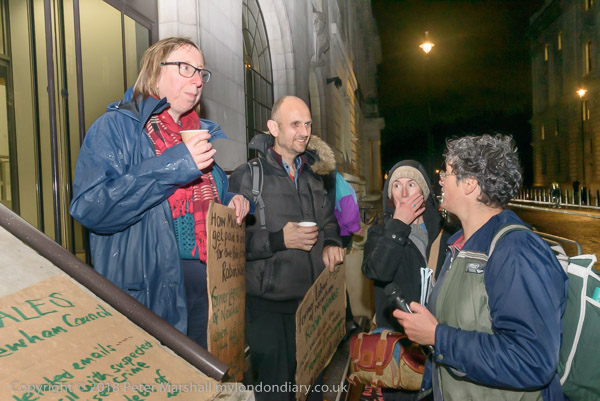
Monday 19th November was a night when rain almost stopped play, at least for me. I’ve seldom been as cold and wet when taking pictures.  Although rain had been forecast it came earlier than expected and was  heavier as I stood with a small group of protesters on a poorly lit central London street.

We were outside an office building which houses the centre-right think tank Policy Exchange where former Newham Mayor Sir Robin Wales now works and was speaking at a housing conference. I was with half a dozen supporters of Focus E15, the Newham-based housing protest group which waged a long battle with the Mayor and his housing policies.

What began with his decision to stop supporting a hostel for single mothers and children, forcing the housing association to give them notice of eviction, when they decided to stand together and fight to get themselves rehoused in London rather than dispersed to far-flung areas of the country in private lettings later turned into a much more widespread campaign for an end to social cleansing and decent treatment for those in social housing and others needing it.

Their fight gained national attention, newpaper articles were written about it, plays were written around it and the young women who led it invited to speak at conferences. The campaign continues, though now with a new Mayor in place and some slight changes in council policy, with its street stall every week in the centre of Stratford, a small community centre for meetings, films etc and occasional protests such as this, along with support for those with housing problems or threatened, as they were, with eviction.

As the pictures show, the protesters looked pretty bedraggled, and like them I was getting wet and cold. For once I put up my umbrella for some of the time while taking pictures, though it really needs a third hand. Though I now rely on autofocus almost all of the time, altering the focal length using the zoom ring really does need two hands and perhaps my framing was a little less good than usual. Because I was able to work close to the protesters, I didn’t feel any need to use a longer lens than the 18-35mm which I had on the D750, and all the pictures were taken with this. It’s also a lot easier to keep one camera dry than two. AL pictures were taken at ISO 6400.

It really was too dark to work without extra lighting, mainly supplied by using my cheap LED light, a 216 LED Neewer unit. It seems to now have a rather lower light output than it should and the AA batteries seem to lose power very fast. I’m wondering whether it just needs a better set of batteries or I should look at a more expensive replacement unit. It’s more flexible than the flash in that I hold it in one hand (on this occasion I had to put the umbrella down to do so) and so have some limited control over the light direction. Flash was more convenient as the Nikon SB800 fits into the hot shoe and I could keep the umbrella up. But it isn’t a great idea to use flash in the rain as it is at its most powerful on raindrops falling close to the camera, and some frames were unusable. About half the pictures were made using the LED and the rest with flash.

The people in the office took pity on us, and a man came out with a tray of hot tea, though a couple of the protesters refused on principle to accept any gifts from them, but I found it very welcome.

Focus E15 protest former Newham Mayor

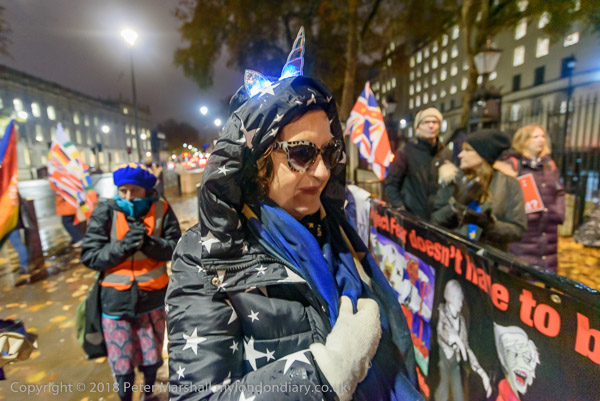
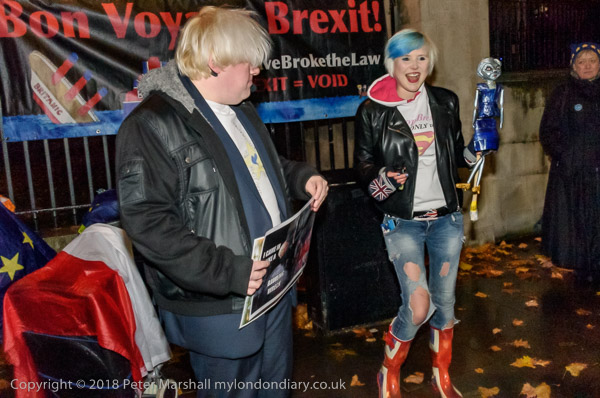
As I left the protesters and made my way the short distance to Downing St the rain eased off, and photographing the Stop Brexit protest there was considerably more pleasant. There was also rather more light, and I was able to take some pictures without any additional lighting uysing the D810.


For the staged performance by Boris impersonator Drew Galdron and EU Supergirl Madelina Kay and a three person chorus, I mainly worked without flash, though subject movement and slow shutter speeds meant rather many were too blurred. I did make just a few exposures with flash to be sure of getting a sharp image, but felt a lot of flashing would have been rather annoying for both audience and performers.

The performance came to an abrupt end when we were told that people were about to leave Downing St after partying about Brexit with Theresa May, and everyone rushed across to protest. It was rather darker in front of the gates, so nearly all the pictures I made there were taken with flash as I rather liked the way it isolated the EU flags and berets against a darker background.

No10 Vigil says stop Brexit
______________________________________________________

There are no adverts on this site and it receives no sponsorship, and I like to keep it that way. But it does take a considerable amount of my time and thought, and if you enjoy reading it, a small donation – perhaps the cost of a beer – would be appreciated.

My London Diary : London Photos : Hull : River Lea/Lee Valley : London’s Industrial Heritage

All photographs on this and my other sites, unless otherwise stated, are taken by and copyright of Peter Marshall, and are available for reproduction or can be bought as prints.

To order prints or reproduce images

________________________________________________________

Notable women in photography

I have a couple of small reservations about the article by Australian photographer and writer Megan Kennedy, “9 Pioneering Women Who Shaped Photographic History” which makes an interesting contribution, particularly in introducing several photographers whose work deserves to be known more widely.

The first is about the phrase “shaped photographic history“, which I think is rather undervalued by its use here. How would photographic history have been different if it were not for the work of some of these women, interesting though it was? While it would be straightforward to make a case for some of the nine, I think it would be something of a problem for others. Of course all of us who publish or work or show it to others in some small way are a part of photographic history, but I think relatively few are pioneers who really shape it.

Putting that to one side, there are I think five in the list that over the years I have written about (unfortunately mainly in articles no longer available for contractual reasons), and about whom there is considerable information both on-line and in print, and the article would have been considerably more useful had it included links to some of these. It was after all published by the Digital Photography School which should be more encouraging to its students to dig further.

Of course for most of them resources are not hard to find (though the quality of some links highly ranked by Google is often poor), but here I’ll give just one link to each of them on Wikipedia which seems generally a good starting point:

Julia Margaret Cameron (1815 – 1879)
Mary Steen (1856 – 1939)
Imogen Cunningham (1883 – 1976)
Gertrude Fehr (1895 – 1996)
Trude Fleischmann (1895 – 1990)
Dorothea Lange (1895 – 1965)
Grete Stern (1904 – 1999)
Ylla (1911 – 1955)
Olive Cotton (1911 – 2003)

As a minor caveat I might perhaps question the choice of these particular nine women, when a good case could be made for so many others. But as Kennedy finishes her article:

“It’s impossible to cover the sheer number of women that have embodied the tenacity and creativity of a photographer’s spirit in a single article. With this piece, however, I hope to have encapsulated some of the resolves of the generations of women who have shaped photographic history. And although we aren’t all the way to achieving equality yet, thanks to the female photographers of the past and present, we’re a lot closer than we used to be.”

When I put together on line a ‘Directory of Notable Photographers‘ around 20 years ago (and highly debatable guide to those for whom further information was then available on the web) it included the following women photographers:

Abbott, Berenice
Arbus, Diane
Becher, Hilla
Bourke-White, Margaret
Cameron, Julia Margaret
Connor, Linda
Cunningham, Imogen
Dahl-Wolfe, Louise
Dater, Judy
Ewald, Wendy
Franck, Martine
Freedman, Jill
Gilpin, Laura
Goldin, Nan
Groover, Jan
Hahn, Betty
Henri, Florence
Heyman, Abigail
Iturbide, Graciela
Jacobi, Lotte
Kasebier, Gertrude
Kruger, Barbara
Lange, Dorothea
Levitt, Helen
Lestido, Adriana
Mann, Sally
Mark, Mary Ellen
Meiselas, Susan
Metzner, Sheila
Miller, Lee
Model, Lisette
Modotti, Tina
Moholy-Nagy, Lucia
Orkin, Ruth
Parker, Olivia
Post Wolcott, Marion
Rheims, Bettina
Sherman, Cindy
Spence, Jo
Stern, Grete
Tenneson, Joyce
Ulmann, Doris

Of course there were many other women I wrote about then and since,;  an updated list would include many more.

______________________________________________________

There are no adverts on this site and it receives no sponsorship, and I like to keep it that way. But it does take a considerable amount of my time and thought, and if you enjoy reading it, a small donation – perhaps the cost of a beer – would be appreciated.

My London Diary : London Photos : Hull : River Lea/Lee Valley : London’s Industrial Heritage

All photographs on this and my other sites, unless otherwise stated, are taken by and copyright of Peter Marshall, and are available for reproduction or can be bought as prints.

To order prints or reproduce images

________________________________________________________

Late Autumn

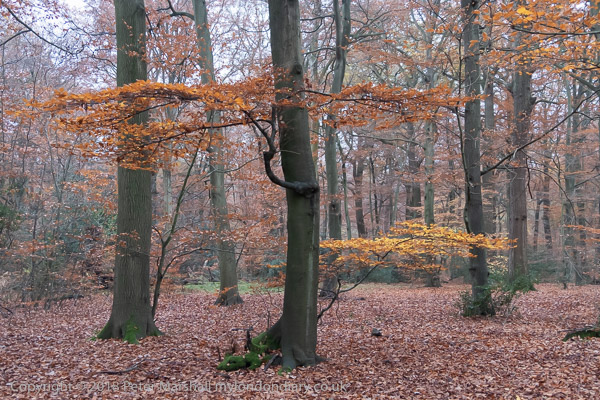
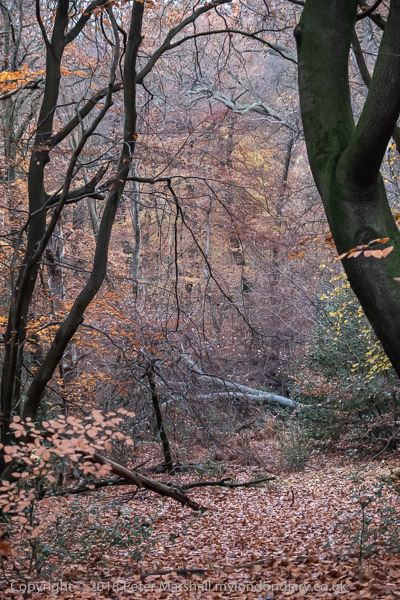
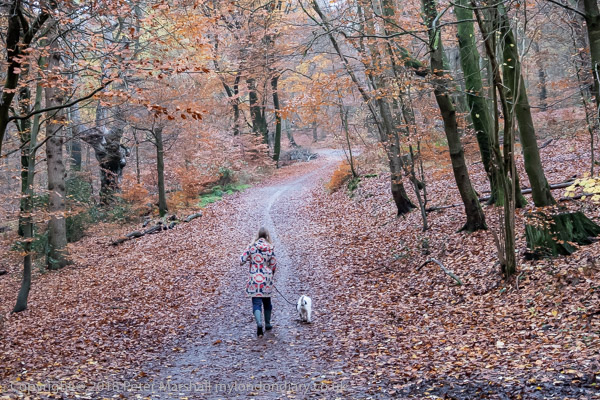
Back in the days of film I used to lock away (if only metaphorically, as the key to the cupboard is even longer lost) colour film in the Autumn months to ensure I didn’t waste it as the leaves changed colour. Though I plead guilty ot have taken pictures of autumn leaves, there didn’t seem to be any good reason to repeat the offence as it was a message I’d already stated.

Film cost money, soemthing which, back then, was usually in short supply, but while the marginal cost per frame of 35mm film was perhaps around 10p, for digital it is virtually zero. We pay up front in terms of camera, computer & software, and almost the only cost per digital image is for the storage medium, and with hard drives now at a few pence per gigabyte that is almost too small to calculate. Of course the total cost has to take into account the hardware and software, but each extra exposure you make reduces the cost per exposure.

Film – except in a few very specialised cases – is now simply an affectation, though people tell me it is making a resurgence. But if people want to waste time and money why should I stand in their way. You are welcome – but just don’t try to tell me there are any advantages. Its a hair shirt I’m happy for you to wear.

So when I went with some of my family to Burnham Beeches there was no real reason not to take pictures (though I certainly didn’t take any film.) Except perhaps that I didn’t find the subject matter particularly inspring in the way that walking down a city street might well be. Though to be honest I did manage to get myself fairly wrapped up in it, so that I didn’t notice the rest of my family wandering off and getting lost while I was taking the first of these pictures.

I’d told them that we needed to go the way I was going, but when I took my eye away from the viewfinder and looked around they had disappeared. I’d photographed the map at the infromation centre as we started our walk, so I knew exactly where I was, but they insisted on following a printed map for a walk that started elsewhere.

I wasn’t worried about them, or about meeting up again, as I knew they would eventually have to find their way back to where the car we had come in was parked, though it would take them rather longer than it would take me. I did try to phone them, but wherever they had gone there was no signal, and it was only half an hour later that we managed to get back in touch – and to go and find a pub for a meal.

There is a little more about the walk and a couple more pictures on My London Diary:
Burnham Beeches

Saturday didn’t start well…

Saturday 10th November didn’t start well. I arrived on time for the start of what should have been a large protest to find nobody there. Of course protests are quite often planned and advertised on social media but never take place, some people get an idea it would be a good idea to have a protest, put up an event but give up when they find nobody shares their enthusiasm; others are cancelled at the last minute when I’m already on the way to them, and others were never really intended to take place. But this was different, a protest by a large group, so something was very clearly wrong.

Fortunately I’d remembered to bring my phone – quite often I come out without it, as I did this morning, though I realised when I was only a few yards down the street and rushed back to  pick it up. But other days I only think about it when my train is approaching the platform, or even when I’m actually at an event in London and put my hand into my pocket to phone someone and find the pocket is empty. But for once I’d remembered it, so took it out and began searching on Facebook for the event. I couldn’t find it.

Clearly something was wrong, and by then I had an idea what it might be. I did another search and found that I had put the event in my diary for the wrong week and was standing there waiting for something not due to happen for another 7 days.  This meant I had an hour and a half to wait for the next event I was hoping to cover (and I checked that this really was on the correct date.)

There were a number of possibilities. I was rather near one of my favourite pubs and it was tempting, but drinking early in the day when I wanted to cover more protests would not be a good idea. I could have gone to one of London’s museums or art galleries – and I often do visit one when I have a little time to spare, but I had long enough to do something else. I did a quick search on my phone for anything else  of interest happening and drew a blank, so instead I decided to go and look for a protest in those London places where protests often occur.
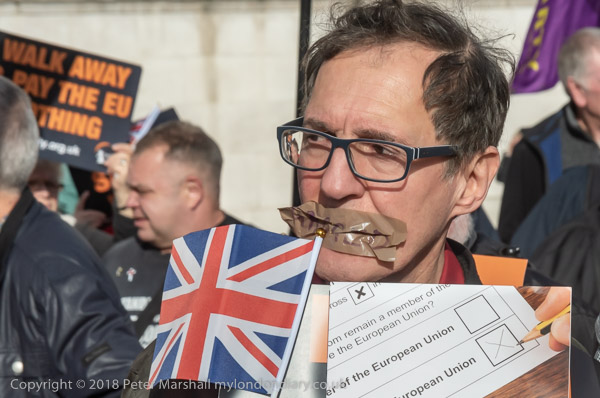
So I got on the tube and I found one in the first place I looked, Trafalgar Sqaure, though not something I would have have normally gone out of my way to photograph. UK Unity is an extreme right organisation which describes itself as “A genuine Grassroots campaign to Leave the EU then rebuild Britain!” and which states it “is entirely opposed to any hate speech, violence or harassment and we firmly believe in the rule of law.” but which publicises the actions of peole like Tommy Robinson and Nigel Farage and is running a petition urging the immediate deportation of all “illegal immigrants” wit the claim “Those crossing the channel from France are not ‘refugees’ or ‘asylum seekers’ but unvetted and illegal migrants in our country.

Their protest in Trafalgar Square about the lack of progress in leaving the EU also called for the resignation of London Mayor Sadiq Khan, and for policies which “Put British Laws, British Culture and British People first“. There were a number of faces in the crowd familiar from photographing groups such as the EDL and the National Front. They favour simply leaving the EU with no agreement, refusing to make any payments and fail to acknowledge the disastrous consequences that would follow.
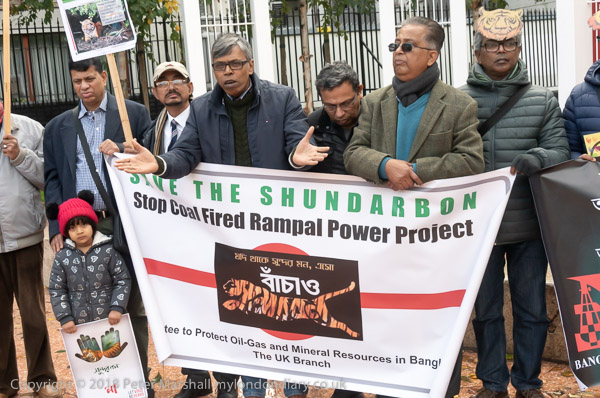
I’d soon had enough of being around them, and wandered off down the road to see if anything was happening at Downing St, or outside Parliament, but there was nothing. However it was now time to get on the District Line from Westminster to Aldgate East and the next event in my diary, a rally by the UK branch of the National Committee to Protect Oil Gas & Mineral Resources, Bangladesh, supported by others including Fossil Free Newham. This was a part of a global day of protest to save the Sunderbans, the world’s largest mangrove forest and a UNESCO World Heritage Site, which was taking place in Altab Ali Park in Whitechapel.
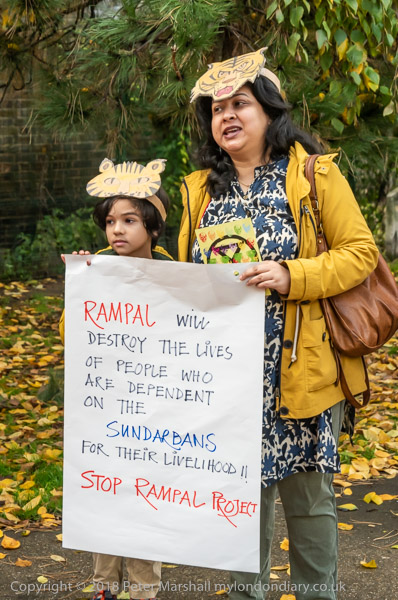
There are some protests which don’t take a great deal of time to photograph, with relatively little happening at least visually. People standing in a line with posters , placards and banners. The odd tiger. Losts of speeches, a few in English. So I was soon leaving and making my way to the pub where I hoped to meet Class War. They were a little late so I had time to drink a pint without rushing.
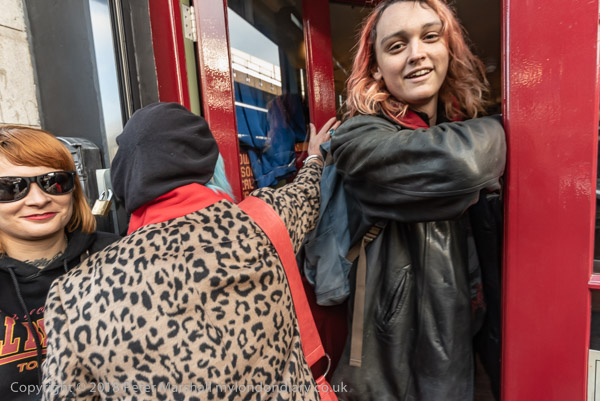
It wasn’t really a full-scale protest by Class War, just a short visit to remind the ‘Jack The Rippe’r tourist venue in Cable St, with its macabre displays profiting from the gory deaths of a few working class women, that it disgusts many and should close.

Police were waiting just around the corner when they arrived and came to harass the protesters, with one women constable making threats about arresting them for their bad language – who had the law pointed out to her. After a short protest Class War rolled up their banner and went in search of another pub. They almost got there when they were diverted into yet another on the way…
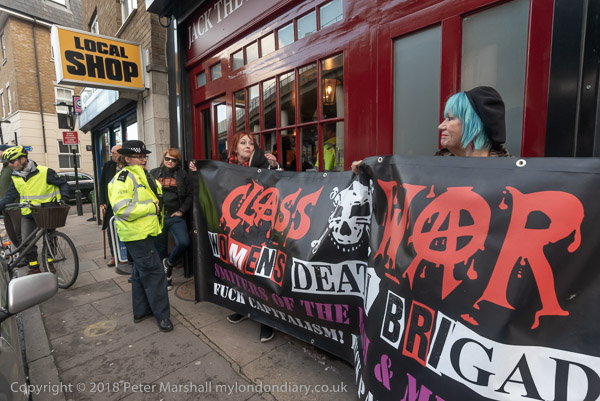
Clas War are very much a group misunderstood in various ways by different people and often deliberately, but whose actions often attract far more publicity than many other groups – and their intention is to provoke. I don’t always share their views – though on the Ripper obscenity I’m 100% with them – but their activities are always interesting. Protest is definitely more fun with Class War, and they do very much raise the profile of important issues.

Where I differ from Class War is that I’m more of a pragmatist and I don’t think the chances of getting revolution on anarchist lines is too probable in the foreseeable future. So while I share many of their opinions about the Labour Party, and in particular about criminal London Labour councils which are demolishing council estates, handing over public assets to private developers and failing to provide council housing for current residents and others who can’t afford high market house prices or rents who Class War are very rightly castigating, I’d like to support those in the party who are campaigning for socialists to take control of the local parties, which could bring about a real change. And while I don’t have particularly high hopes of what a Corbyn government might be able to acheive, I’m convinced that there would be some advantages over the Tories, who have shown themselves cruel, unthinking and quite simply evil beyond previous administrations. Though under our current system, my vote inone of the country’s safer Tory seats is entirely a worthless gesture.

More on all these protests at:
Leave Voters say Leave Now!
Global Day to save the Sunderbans
Class War picket the Ripper ‘Museum’

______________________________________________________

There are no adverts on this site and it receives no sponsorship, and I like to keep it that way. But it does take a considerable amount of my time and thought, and if you enjoy reading it, a small donation – perhaps the cost of a beer – would be appreciated.

My London Diary : London Photos : Hull : River Lea/Lee Valley : London’s Industrial Heritage

All photographs on this and my other sites, unless otherwise stated, are taken by and copyright of Peter Marshall, and are available for reproduction or can be bought as prints.

To order prints or reproduce images

________________________________________________________
Darkest London


Class War had come to support the protesters

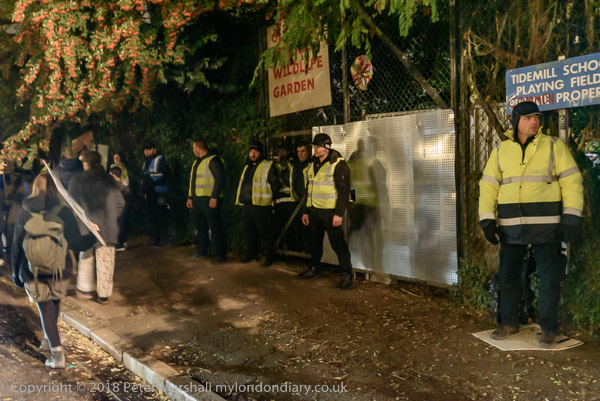
Another protest about London Councils and housing took place in Deptford, one of the literally and metaphorically darkest areas of the capital on that Tuesday evening. Lewisham Council had turned the Old Tidemill Garden, a community garden, into a fortress, surrounded by fences and ringed by security guards 24 hours a day, at considerable cost to the local council tax payers.

After discussions with the council had failed to acheive any meaningful communication, local residents had occupied the garden around the end of August, but two months later were very forcefully evicted at the end of October in a scandalous and illegal action by a large force of bailiffs, while police stood back and watched.

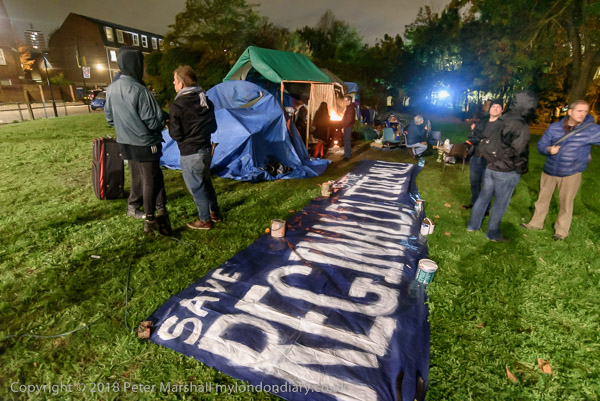
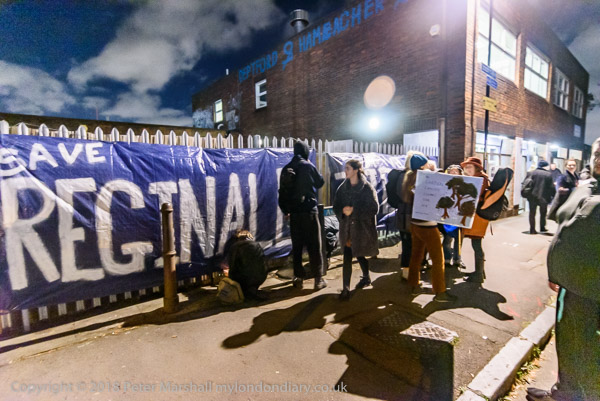
The campaigners set up a camp on an area of open ground just to the east of the garden and in front of Reginald House, council flats that are also to be demolished under the council’s plans, along with a disused school. Campaigners have put forward alternative proposals which would allow the same number of new homes – though with more social housing – on the site but retain the garden and allow all current residents to remain in the area, but the council and developers Peabody have refused to give them any serious consideration.

The area around the camp where people met was in darkness, and most of the pictures I took there at slow shutter speeds were spoilt by subject movement, a few by camera shake. Closer to the road and the roundabout there was a little more light and my efforts were more succesful.

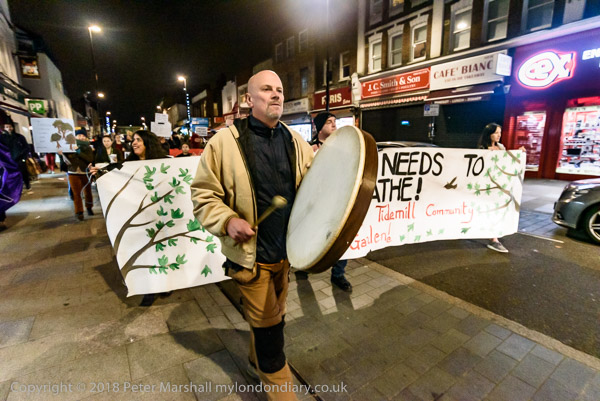
The march set off down a dimly lit road past the heavily guarded garden, and few of the pictures I took at the start were usable. When it turned onto Deptford High St things became much easier, but after a short walk up there it turned off into another dimily lit road and path, on its way to the New Cross Assembly Meeting where the recently elected Mayor was expected to answer questions from the public.

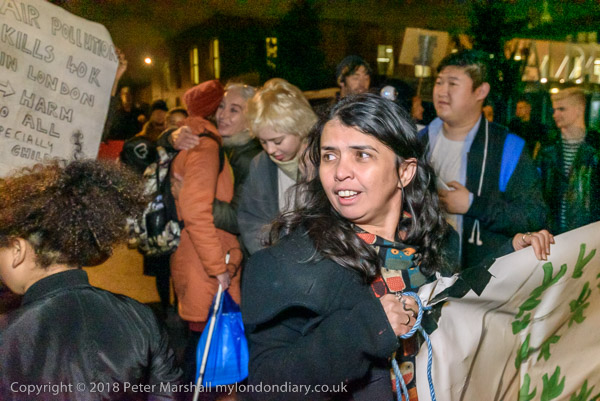
The side street outside the building where this was to be held was also dark,  and working at high ISO and slow shutter speeds was rather hit and miss. I took a few pictures using my LED light, but this only usefully illuminates a fairly small distance from it and doesn’t give a wide enough spread of light for my wider images.

I took a few pictures using flash,  but was unhappy with the results. With so low ambient light it is hard to get any satisfactory balance between people and things close to the flash and the background, and I abandoned the effort. The flash didn’t seem to be working properly in any case – probably some incorrect setting on camera or flash. The Nikon system is great when it works, but there are quite a few silly little things that can prevent it working properly.  A few of the better pictures were made with the help of headlights from cars, stopped briefly by protesters on the road.


Lit by car headlights

We waited and waited for the Mayor, but he didn’t arrive, though a couple of police did. Messages came through that he had been held up, and after it began to seem unlikely he was coming I and some of the other protesters left. It was cold and I’d been standing around too long and was very pleased to be able to sit on a warm bus to take me to the station for a train on my way home.

Later I heard that the Mayor had finally arrived, and there had been a rather unsatisfactory meeting, with most of the protesters being refused entry and few questions being answered. Later, when the Mayor left, their had been some noisy scenes and at least one arrest. I was sorry to have missed the action, but also felt some relief as I was faily sure I wouldn’t have managed any good pictures.

More text and pictures:
Save Old Tidemill Garden & Reginald House

______________________________________________________
There are no adverts on this site and it receives no sponsorship, and I like to keep it that way. But it does take a considerable amount of my time and thought, and if you enjoy reading it, a small donation – perhaps the cost of a beer – would be appreciated.

My London Diary : London Photos : Hull : River Lea/Lee Valley : London’s Industrial Heritage

All photographs on this and my other sites, unless otherwise stated, are taken by and copyright of Peter Marshall, and are available for reproduction or can be bought as prints.

To order prints or reproduce images

________________________________________________________