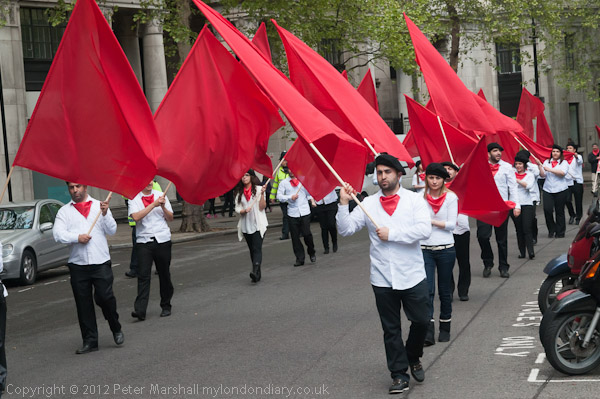
Letter To Nikon

I’m now back on an internet link and busy catching up with things – as well as covering four demonstrations yesterday which got me event further behind. I’ve run out of time writing what was intended to be my next post, but have just come across something I’d like to pass on to you before I next fall asleep on the keyboard, something I’ve already managed several times this evening.

In the last sentence of Nikon Bows To Extreme Right about Nikon cancelling the show of work by South Korean photographer Ahn Sehong I wrote:

Nikon should certainly be ashamed of their part in this affair, and I hope the photography community worldwide will make its views clear to them.

I’m very pleased that UK photographer Si Barber has  put on line the site ‘I Am Censored‘ with information about the case and an open letter to Mr. Yojiro Yamaguchi, Managing Director of Nikon UK, Nikon Japan and the national and international press, urging Nikon to re-instate Sehong’s funding “and most importantly show his work.”

Photographers of all persuasions, pro or amateur are invited to add their signatures to the document which already has the support of at least one Magnum member and “a number of well known veteran photographers.” I’ve just added my own name to the list and urge you to read the letter and do the same.

________________________________________________________

Si Barber was previously so incensed by PM David Cameron’s vapid twittering about ‘The Big Society’ that he published his own book ‘The Big Society – Snapshots of 21st Century Britain‘ as a “visual riposte to Cameron’s imagined nation and a critique of the voodoo economics which took Britain to the edge of moral and financial calamity.” Still available for £12 and you can order on-line using Paypal.

London Festival Opens

Unfortunately I don’t have time to write fully about each of the five shows I attended on the tour before the opening party of this years London Photography Festival which was held in the Dog Eared Gallery where the major show ‘The Great British Public’ is taking place, particularly as I have a rush job to complete before I flee and lie low for a few days as the country suffocates under a sea of red, white and blue. But certainly this years festival is a quantum leap up from last years somewhat tame London Street Photography Festival, and perhaps if this progress continues London will soon have the kind of photography festival it needs, rather than two events – this and the East London Photomonth – that while interesting don’t really create the kind of buzz that London deserves.

One show not to miss is at the Guardian Gallery at King’s Place in York Way from 1-28 June 2012 open 10-6, 7 days a week. I suspect I have seen most or all of the pictures in Steve Bloom’s ‘Beneath the Surface’ before, because when Bloom left his native South Africa in 1977 he took the “small pile of silver-gelatin black and white prints” to the offices of the Anti-Apartheid Movement in London, and they sent him on to the International Defence and Aid Fund for Southern Africa who published and exhibited them, but that now seems an age ago, distant in terms both of time and sensitivity. It is hard now to believe the everyday nature of apartheid that emerges through his pictures perhaps even more than the more dramatic scenes. Accompanying the show is a free limited edition 24 page newsprint publication produced by the LFP together with the Observer, so go soon to get your copy before all 1000 disappear.

Its a short walk from Kings Place in York Road to the Minnie Weisz Studio in Pancras Rd, where her Camera Obscura is showing (Tue-Sun, 10am – 6pm until 29 June 2012), though you may want to allow yourself an hour or two to explore the redevelopment at last taking place to the north of Kings Cross and across the canal in the former goods yard site. It was in 1987 – 25 years ago – that I became involved for a couple of years with the Kings Cross Railway Lands Group after the first rumours of the comprehensive redevelopment emerged.

© 2012, Peter Marshall

Minnie Weisz’s work is particularly concerned about “buildings on the brink of change” and this area has thus provided plenty of scope for her photographs of room interiors. In some she turns the room into a camera obscura so that an upside down image of the outside world is projected on its surfaces, which she then photographs with a normal camera, sometimes choosing to display the room upside down so that the projected image appears the right way up. It was work that reminded me of Abelardo Morell, though the images in Weisz’ show that most appealed to me were her simple straightforward atmospheric images of deserted rooms with peeling paint.

A couple of doors down is the Hardy Tree Gallery, (named for the well-known feature of Old St Pancras Churchyard) showing the results from “a four year research project by London-based, Saudi photographer Wasma Mansour (1-30 June 2012, 10am-6pm, 7 days a week.) I don’t feel competent to evaluate the assumptions behind her work on the generalisations about Saudi women living alone and the effect these have on their “efforts to reconcile with their identities and asserting their sense of individualism” but for me her exploration with “a multidirectional photographic approach” did not seem to have reached the kind of final resolution that I found satisfying. The set of work I found most interesting did not feature the women but showed what I assume were areas of their living accommodation as still life. But perhaps this is a show that needs to be examined in greater depth than I was able to give it in my brief visit.

Next came the two mainline stations, and first was St Pancras, a building whose rebuilt interior I still find depressing at ground level, even more so when entered from the north-west end. The new concourse at Kings Cross is however more impressive – I just hope they will soon sort out the Euston Road frontage.

© 2012, Peter Marshall

The display at St Pancras is a small collection of work from the group show ‘The Great British Public‘ at the Dog Eared Gallery printed large on free-standing panels (until 1 July 2012, 24/7.) Handy if you are in a rush for a train or can’t afford the £6.50 for the gallery, and of course will be seen by many thousands more than the show, and acts as good advertising for the festival, but essentially adds nothing to the show (see below.)

© 2012, Peter Marshall

At Kings Cross there is a large display of panels of Contemporary London Street Photography, which although it will certainly attract much public attention I found disappointing (as too did the group of photographers I met there looking at it.) Although there were a number of good pictures (including several by personal friends), the whole long wall gave me a powerful feeling of deja-vu. Of course some of the pictures I had seen before (and I’m sure there were one or two that were in last year’s festival) but it was more that these were pictures very like pictures I had seen before and largely the kind of image that very soon exhaust themselves, pictures better suited to a digital world where the next image is a mouse click away or quickly changes to the next image in a slide show, sometimes only visible for a fraction of a second. It’s perhaps unfair on at least some of the photographers, but overall this was my feeling. There was something very dated about much of this work, and an over-reliance on graphic effect, a confusion of means as ends. For me photography is essentially about content and too often here it was lacking.

© 2012, Peter Marshall

The Great British Public group show at the Dog Eared Gallery in Field St, a short walk away down the Kings Cross Road (1-24 June 2012, 10am-6pm, 7 days, £6.50) is a ragbag, but at times an engaging one. Oustanding are set of http://chrissteeleperkins.com/personal.php portraits of centenarians, looking extremely young and healthy, and head and shoulders above the rest of the work in the room not least for the sheer professionalism, but also for the sensitivity of the photographer, Chris Steele-Perkins. Another very fine piece of work is Liz Hingley’s Under Gods, pictures from the urban multi-faith communities of Birmingham’s Soho Road, undoubtedly one of the finest recent British documentary projects, although I would have liked to see the prints a little larger (and better lit than some were for the opening.) Martin Parr’s few pictures from his Black Country project that he can still take good pictures when he puts his mind to it, even if sometimes in other work he seems to be coasting on his reputation, and there were a number of other pictures around the room that appealed to me even if I felt rather disappointed at the quality of some of the work on show.

There are of course other shows in the LFP, as well as talks and workshops, and you can find about about everything on the LFP web site.

Flags & Protests

© 2012, Peter Marshall

Flags are often important in photographs, and can be a real pain get how you want them. They tend either to hang limply when you want them to fly out, or to flutter unpredictably out of control. At political demonstrations they are sometimes waved high above the heads of the protesters on long poles, and although these may look good, they are often hard to incorporate into pictures that work.

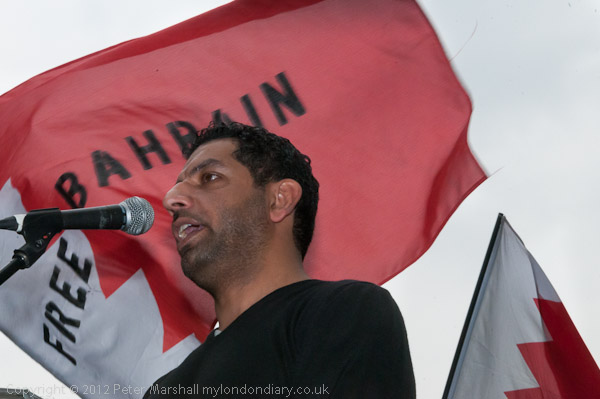
At the No To NATO, Troops Out Of Afghanistan protest outside the US Embassy, I saw the chance to make a picture as Free Bahrein flags were being waved as someone was speaking about the situation there. It took me 15 frames to get a couple that had something of the effect I wanted -the flags were being waved vigorously and it was a gusty day – and there were a few images with no flag at all visible, and was made just a little trickier by working with the 28-105mm on my ailing D300, where I have to free the mirror after every few exposures by ‘locking it for cleaning’ and turning the camera off. I really must replace that soon, particularly as it now sometimes needs doing 2 or 3 times before the mirror will drop down. The image above was taken with the lens at 70mm (105mm equiv) and I particularly like it because the text on the flag is legible. There is also another frame in the feature in My London Diary, which I selected partly because I thought it portrayed the speaker better and there was a third I considered but didn’t use which has a more graphic use of the jagged white-red boundary.

© 2012, Peter Marshall

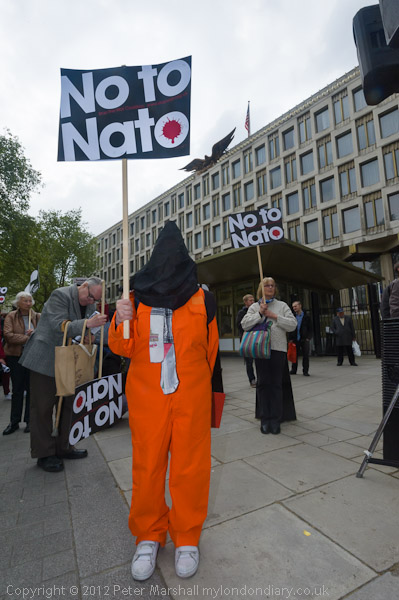
The protest was outside the US Embassy, and as usual I tried to make use of the big ugly eagle and flag on its roof, though there were times when the flag just wasn’t playing, and it isn’t always convenient to wait for it. You can just about see it above this protester in orange, one of a group calling for the release of Shaker Aamer who lived in London with his family before being captured on a visit to Afghanistan, tortured and taken to Guantanamo, where he is still being held, probably because the evidence he would give on release about his torture there would embarrass both British and US governments.

© 2012, Peter Marshall

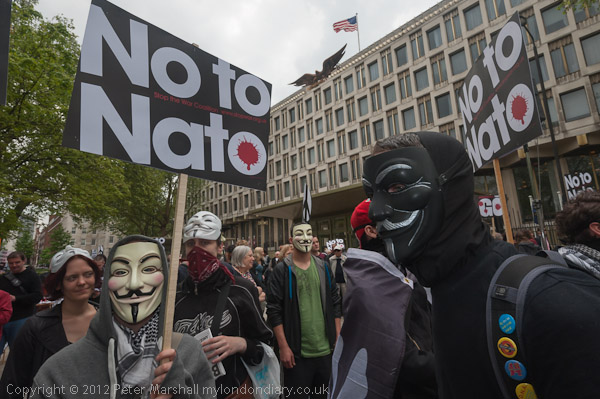
Sometimes the wind was more helpful, though this perhaps wasn’t one of my better pictures.  Those guys in ‘Anonymous’ masks looked better in other images without the flag.

© 2012, Peter Marshall

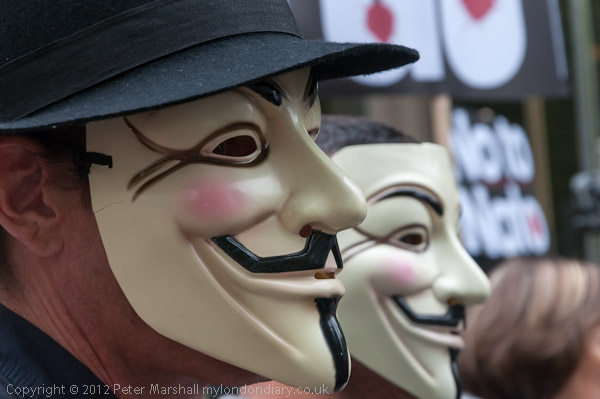
Of course there are always choices and decisions. In the series of 7 frames I took of these two people there are differences in particular in the placards in the background (which again moved around while I was taking the pictures, though rather less so than the flags.) One reason for choosing this particular frame was that the ‘No to Nato’ in the background was more legible than in most of the others, although there are other differences too.

________________________________________________________

My London Diary : Buildings of London : River Lea/Lee Valley : London’s Industrial Heritage

All photographs on this and my other sites, unless otherwise stated are by Peter Marshall and are available for reproduction or can be bought as prints.

To order prints or reproduce images

________________________________________________________

Old Photographs

Not that old, but I’ve recently been spending a lot of time scanning the best of my old negatives from my first years in photography. So far I’m up to around the middle of 1983, and don’t seem to have covered more than a very small fraction of my work – another 20 busy years of film to scan.

Of course I’m trying to be very selective in what I scan, and often there are contact sheets where nothing catches my interest, but on others I’m discovering things I’ve never really noticed before. Here’s one of them:

© 1983, Peter Marshall

You’ll have to take my word that it looks much better when you see it filling the screen and you can see clearly the rods of rain and the pock covered surface of the Lea Navigation where the rain is pounding into it, along with the rather more brooding rain soaked sky and the glistening of the nettles and other weeds alongside the path that this is a picture redolent with atmosphere.  I don’t remember anything about actually taking it, but looking at it I can feel and hear the rain (I do hope I had an umbrella) and smell the wet earth and foliage. In several respects, not least the pylons, it’s a very typical scene from this part of the Lea at that time.

It’s a picture I don’t remember printing before, though probably I did at the time, but it certainly isn’t one that I’ve shown from the lengthy project I carried out on the Lea Valley in the early 80s, revisiting it again in the nineties and more recently to take more work, much of which is in my Lea Valley web site, though this isn’t among them yet, though perhaps next time I update the site I’ll add it.

Generally I am finding that my selection now is a little different from that which I made at the time, with a whole area of work which I now have much less interest in. These are what I might call the more ‘arty’ pictures, where what attracted me were the formal qualities of the scene, perhaps in the water flowing over the edge of a weir or the patterns of light and shade on a wall. Now I want to make use of those formal elements in making a picture about something rather than making them the subject of the picture, I want to see a good picture of the weir or the building the wall was a part of.

Even bad pictures can have some interest. Another from the same year shows an industrial building on Carpenters Road – a road that has now disappeared under the Olympic site.  I’ve photographed it from the other side of the road and have obviously tried very hard (and very nearly successfully) to keep the verticals upright, at the expense of covering nearly half the picture with an empty roadway.

© 1983, Peter Marshall

It certainly is not a great picture, but not without interest, and probably what particularly interested me were the doorway and the window above and just to the right. Above the window are the dates 1870 and 1898 and above the door the device reads ‘ABR & Co Ltd’

A little searching in ‘British History Online’ after Google had drawn a blank found the name of the company as ‘A. Boake, Roberts & Co., manufacturer of perfumery and flavour chemicals’, and armed with that I was able to find more about them than anyone sensible would want to know.

The company is said to have been founded in 1869 by Arthur Boake, an Irishman from Dublin, to produce brewing chemicals, and produced a product to clarify wines that sold well across Europe. In the 1890s it branched out into various flavouring essences and essential oils and the company which had become a partnership with Francis George Adair Roberts in 1876 was incorporated as  A. Boake, Roberts and Co. Ltd in 1897.  The 1898 on its frontage is probably when it moved to this new factory on Carpenters Road.

The company prospered, and in the 1940s and 50s produced a wide range of chemicals from factories in  Walthamstow, Letchworth, Rainham and Widne, joining with two other companies in 1966 as Bush Boake Allen, part of Albright & Wilson Ltd. It was a huge company worldwide, but in 2000 it was acquired by IFF to create “world’s largest flavor and fragrance company.”

Those who lived or worked near the factory, which closed a few years before I took my picture, still remember the various smells it produced, notably a powerful odour of oil of wintergreen.

Photographs, even those like this that have little interest pictorially can be a useful historical record. At the time I think I saw it as a failure because I didn’t have the equipment to record the building more satisfactorily in terms of architectural photography. Taking pictures of buildings like this, before verticals and horizontals could be corrected digitally, required a camera with movements, which were slow to use. I had a couple of 4×5 cameras, a studio monorail and a more portable but less flexible MPP, both of which were too heavy to take on the lengthy walks I was making to take photographs. What I lusted after for use on my 35mm camera was a shift lens – a lens with movements built in, but for me these were impossibly expensive.

But not long afterwards I came across one second-hand in a camera shop in Hull. Even second-hand it cost almost a couple of months wages, but I didn’t hesitate, and it became my most-used lens for the next 25 or so years.

Noorderlicht Under Threat

I was dumbfounded to read that the Cultural Council of The Netherlands advised the Dutch Government to cut the financial support to Noorderlicht after 2012. Particularly when this followed one of the most succesful exhibitions to be held in the Netherlands, certainly in recent memory, Cruel & Unusual (see also my  second post, Cruel & Unusual 2) a show that had prompted me to write the post We Need A Noorderlicht Here.

The cutting of financial support to Noorderlicht would be a disaster not just for the organisation, not just for photography in the Netherlands, but for photography around the world. And as they say on their site, the advice came following a very favourable evaluation by the council:

“A front-ranking national and international position, standing out for its engaged themes and good presentations. Good educational programmes, realistic plans for generating its own incomes, and an engaged attitude with regard to developing new talent. Noorderlicht generates considerable media attention here and in other countries.

On the web site are some suggestions as to ways that you can show your support for Noorderlicht,  including recording your opinion on the Noorderlicht and ‘Noorderlicht Has to Stay‘ Facebook pages. It takes only a few seconds to ‘Like’ the page, and comments are welcome.

Noorderlicht’s work has been ground-breaking in many areas through its festivals and projects, notably for me with Nazar which opened up a whole area of Arab photography (and of course it has also had festivals featuring Latin American, African and Asian work.)

I can’t help wondering if the show Cruel and Unusual, a great popular success, was too much for some of the cultural politicians to take. Perhaps if cultural institutions seem likely to bring about any political change they are likely to lose official funding.

This is a case that reminds me of what happened in England, where last year the Arts Council cut funding for Side Gallery, the only gallery in this country devoted to documentary photography and again with a truly international reputation. That decision was called  “a profoundly stupid, culturally illiterate and illogical decision“,  a description that seems to apply also in the case of Noorderlicht.

Signs & London Festival

Let This Be A Sign

I was pleased to arrive at Swiss Cottage Library last night for the opening of what I think is the first show of the London Festival of Photography, “taking place throughout June with a focus in King’s Cross, Bloomsbury, Euston & Fitzrovia. ”  A little outside this both physically and temporally, ‘Let This Be A Sign‘ by Simon Roberts opened last night.

My journey had not been a good one, thanks to a broken-down train at Acton Wells that shut down the Overground service from Richmond, followed by lengthy delays on the longer alternative route via Clapham Junction with trains too packed for everyone to board and I almost gave up and went home. It was perhaps an appropriate introduction to a show that deals with the political and social effects of our continuing recession here in the UK, with nothing in our lives and economy quite working as it should.

This is an interesting show and it continues until 1 July, open with the library 7 days a week, combining 4×5 images printed large with collages of small digital images of protest placards and closed down shop fronts, text,  graphs, and a collection of actual posters and placards on the floor below (and I’m sure I’ve missed something.)  Although I’ve nothing against such a multifaceted approach, I felt it worked rather better in the free newsprint publication ‘This Is A Sign‘ by Roberts, available free at the library which I read at some length on my rather smoother journey home, than in the showcases and on the gallery wall.

We’ve seen several such newsprint publications in the past couple of years, and this, designed by FUEL and printed in an edition of only 2000 is like some others probably destined to become a collectors’ item, so go there soon and grab your copy.  It’s always difficult to know the constraints in mounting a show such as this, but I didn’t quite feel it gelled, and in particular the separation of the posters and placards, possibly dictated by security considerations, was unfortunate. Perhaps too this collection lacked the strength and diversity that those of use who regularly visited Occupy London or go to protests are accustomed to.

Roberts has taken on a large and important topic, and certainly one which is difficult to do justice to. It is also one which politically presents some problems for the council owned venue, and Camden is one of the Labour councils that last year saw angry protests blocking streets outside the council offices and an occupation of the council chamber as well as a high-profile campaign against cuts in its Library service.

Possibly fortuitously, his pictures of protest were made elsewhere, including a couple in the neighbouring borough of Islington, from Occupy Finsbury Square, where Islington Council, who had for many months supported the Occupy movement’s right to peaceful protest announced earlier this week that they would take legal action to regain possession of the site after many living there had ignored a legal notice ordering them to leave by last Friday.

But what I missed most in the show were people as people. Protesters were largely shown as crowds, and other images had people mainly as co-incidental inclusions, standing for example on a street corner looking – as was the photographer – at the after-effects of the riots. In the newsprint a page digital collage of images ‘Brokers with hands on their faces’ stands out from the rest of the work – not because the photography is better (it isn’t) but because it concentrates on people. Later I read the small print at the back of the publication and found that these pictures were not by Roberts but from the Brokers With Hands On Their Faces blog, images from Wall Street rather than the UK. Perhaps for me the strongest image in this publication/show was the one exception, placed deliberately after the brokers, it showed people queuing outside a Sheffield Credit Union.

Perhaps too the strengths of large format are not best suited to covering protest, and the images on display to some extent reflected its lack of flexibility. There are times when the extra resolution of 4×5 film adds a great deal, but I seldom felt it in these images, and in some the printing didn’t help to make the case. Seeing the work in newsprint works better because we have no expectations of higher quality, but also it helps to unify the various aspects of the show.

But this is a show worth seeing – and go soon and get your copy of ‘This Is A Sign’, complete with a blank placard on the cover for you to supply your own slogan.

————————————————————————-

Memories of Swiss Cottage & the Death of Large Format

Of course like most openings it was perhaps more interesting for the people that I met and talked to, and few of those present seemed to be paying a great deal of attention to the pictures – though perhaps they had done so more before I arrived. Among those there was an old friend, Mike Seaborne with whom I organised a show  in the central space of this same library in 1993 of work by members of London Documentary Photographers, which included couple of dozen of my own pictures of shop-fronts and interiors, some of which are in the web project ‘Café Ideal, Cool Blondes, and Paradise‘, including this example.
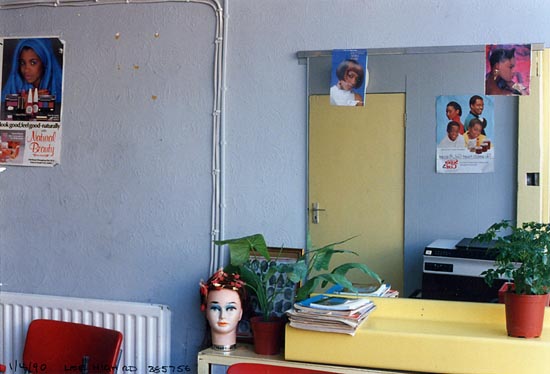
© 1990 Peter Marshall
Lewisham, 1990

Soon after I also helped to organise and took part in two shows in the same venue for London Independent Photography. Apparently it was not possible to put anything from this current show into this larger central space, a shame as this is considerably more visible to the many users of the library who pass by on their way to take out and return books. At least they may see the placards on the ground floor entrance, although I managed to walk past without noticing them on my way in.

Mike and my conversation turned to new cameras, and in particular the Nikon D800E, which we agreed looked likely to make 4×5 totally redundant, so long as it is teamed with the high quality prime lenses which Nikon is now bringing out. Frankly I seldom feel the need for that kind of quality, and have always preferred to work with smaller formats – and if necessary with smaller prints. Curators and photographers I showed the ‘Café Ideal...’ project to in the 80s and 90s often said to me “If only you worked with medium (or large) format …” to which my response was always that for several reasons the work would simply not exist if I had done so, and that the prints were of more than adequate quality for what I needed, particularly as I’ve never been a great fan of large prints – for me part of the essential power of photography has always been that it is an intimate medium, producing objects that one can hold in your hands.

I’m still thinking of getting an 800E, but if I do so I would expect to be using it as a DX rather than an FX format camera for perhaps 99% of my work, and to continue working with my current Nikon zooms. I’ve found the 16-35mm f4 and the DX 28-105mm pretty amazing, at least with a little help from Lightroom’s automatic corrections, and you just don’t need huge files most of the time, though it’s great to be able to make them when you do.

————————————————————————-

Frederick Wilfred

More about the LFP at a later date. Glancing through the festival guide perhaps the most intriguing show is of work from 1956-62 by Frederick Wilfred (1925-2010), who I’d not heard of before despite the fact that we were both at times active members of the same photographic club (though perhaps at different times, and I saw the error of my ways in the early 1980s) which doesn’t open at the Museum of London until 16 June (it runs until 8 July) although you already can see a fine set of his work on line. Probably when I was around he was busy with his commercial work and portraiture.

One thing the two LFP shows have in common is that both include an element of audience participation. In the case of Wilfred, one thing I found annoyingly lacking on his web site were captions, and the museum  which has recently acquired 124 of his pictures is appealing to anyone who recognises the locations (some are of course obvious) or the people in the pictures are being asked to let the museum know.

But it is also a good reminder for us as photographers to make sure that our prints have captions on the back and our digital files include appropriate metadata.

Public Sector Protest

© 2012, Peter Marshall

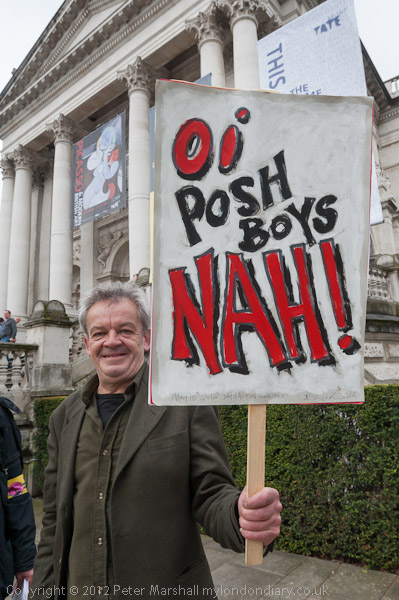
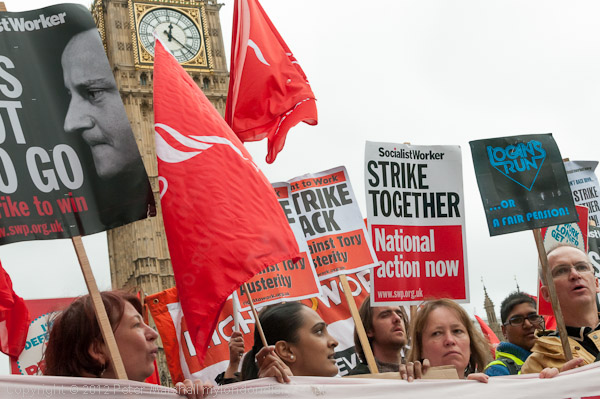
The trouble with photographing pickets at strikes is that they tend to happen rather early in the day and often leave once other workers have arrived and either gone to work or refused to cross the picket line.  Of course I could get up early, and occasionally I do, though I don’t like it. But pickets sometimes happen at silly times like 6.30am, and for me that would mean probably mean leaving home more than an hour earlier, and some days I’m hardly in bed by then, and I feel too old to work without sleep. Early morning travel is also rather expensive, and unless I’m actually commissioned I seldom do anything in central London much before 10.30, so I was pleased to find when I arrived at Tate Britain around that time on the morning of the one day strike against pensions and service cuts by public sector workers that there was still a picket outside the building and I could take some pictures.

Perhaps the best was the image above, where I carefully lined up the placard in front of the Tate’s portico (and the wording TATE at top right) and the poster for its current Picasso show. There was too a certain artistic quality about the placard, and I rather liked its text, ‘Oi Posh Boys Nah!’

© 2012, Peter Marshall

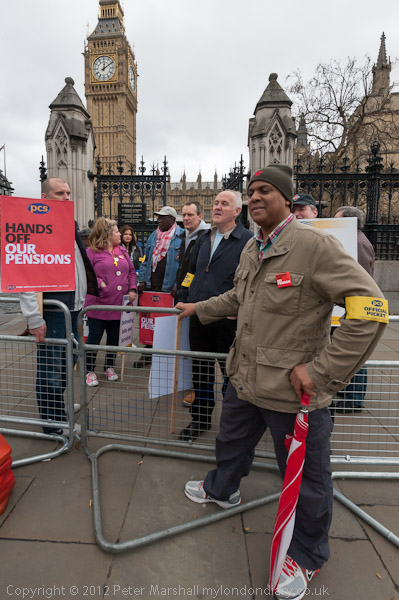
Later, when I walked past the Houses of Parliament around midday I was suprised to find another picket I could photograph, though I didn’t stay long as I was late for a march which was starting around a quarter of a mile away on the other side of Westminster Bridge.

© 2012, Peter Marshall

I met the march just a few yards after its start, marching over the bridge towards Parliament. It’s always a little frustrating when people march across the bridge towards parliament because it’s very difficult to think of a way that works to take a picture with the very recognisable buildings in the background. The building just visible in the above image is actually relevant, since it’s a part of St Thomas’ Hospital – but it is neither memorable nor recognisable.

© 2012, Peter Marshall
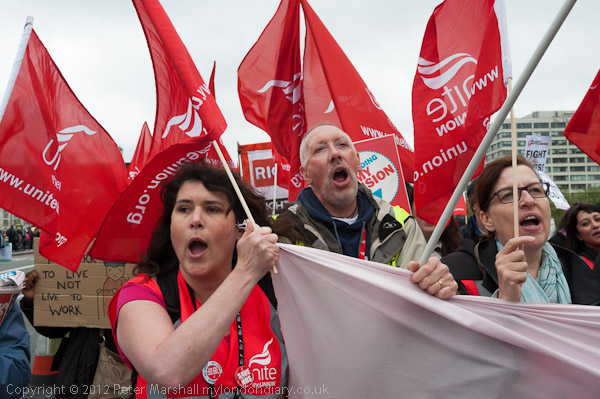
Taken with the 10.5mm semi-fisheye and converted.

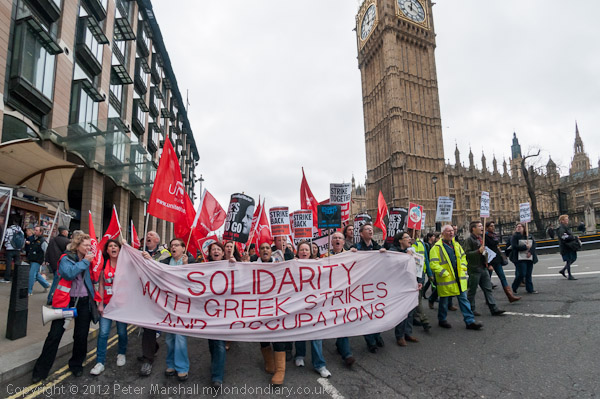
Of course, once the marched moved past Big Ben along Bridge St, it was easy to include Big Ben behind the protest, and there was the usual scrum of photographers competing to do so. The 10.5mm semi-fisheye does give a little advantage in terms of being able to do so from a closer viewpoint, but you have to work very close to the march, which isn’t popular with other photographers as you tend get in their way. I usually work from the side of the march most of the time to avoid this.

© 2012, Peter Marshall

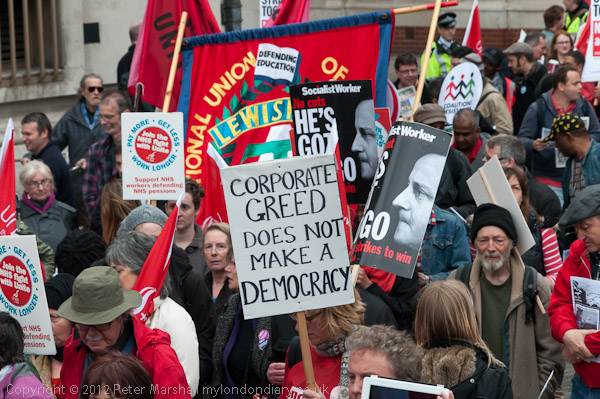
But this time, I think the best images I made were with a rather longer lens,  using the 28-105mm at roughly a standard lens setting (35mm on the D300.)

© 2012, Peter Marshall

I was using the same lens for the final set of pictures that I made of the march, looking down from on top of a wall a few feet above street level as the march came to its destination, Methodist Central Hall. The image above, centred around a placard reading ‘Corporate Greed Does Not Make A Democracy’ was, rather to my surprise, chosen by Demotix for their front page.

More at: Public Sector Pensions Strike and March

________________________________________________________

My London Diary : Buildings of London : River Lea/Lee Valley : London’s Industrial Heritage

All photographs on this and my other sites, unless otherwise stated are by Peter Marshall and are available for reproduction or can be bought as prints.

To order prints or reproduce images

________________________________________________________

Energy Bash

My big problem in covering the ‘Big Six Energy Bash‘ protest outside the UK Climate Summit on 3 May was too many unsharp pictures – mainly a bad case of camera shake. You can see it in this picture:

© 2012, Peter Marshall

but in many images it was much worse, making them unusable.  The picture above was taken at 1/30 f4 with a 16mm lens, and some of the lack of sharpness may be due to subject movement, but most of the ruined images were at faster speeds – 1/50 or 1/60 – and with the 16mm I would normally expect most of them to have been sharp.

Of course in retrospect I should have increased the ISO above the ISO1250 I was working at, but that had served perfectly well for pictures earlier in the event – even when I was photographing people on the move. I just had not realised how dim the light was in the street in front of the hotel where the picture above was taken.

© 2012, Peter Marshall

A little movement blur – as on the figure in white at the left above – I always thinks adds a little life to images like this, taken a little earlier around the adjoining side of the hotel.

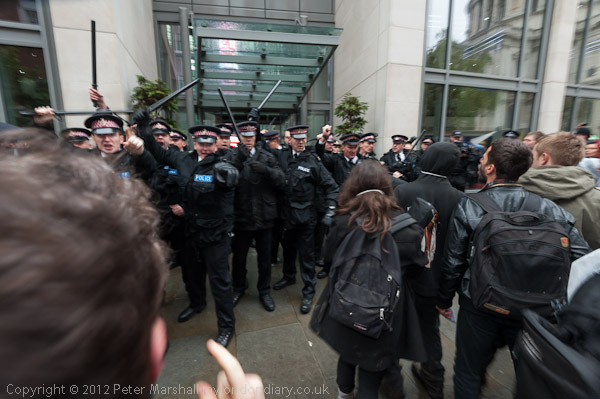
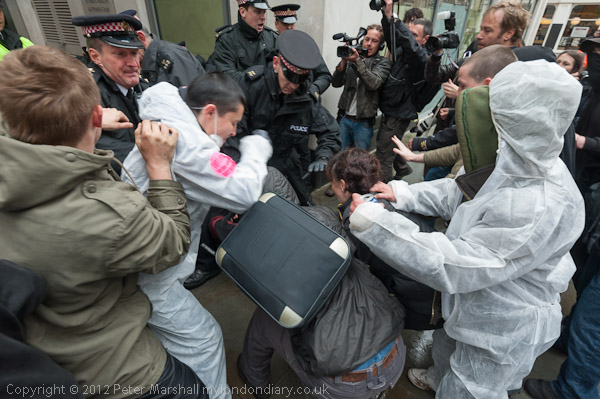
I think the real difference was not in the light but in what had happened to me. Shortly after taking the second picture I was knocked to the ground as people surged back when police rushed into the crowd of protesters, and just a minute or two before taking the top image I’d been hit full on by a protester bodily thrown in my direction by a police officer, again getting knocked to the ground.

Fortunately I wasn’t injured – just the odd bruise – and nor was my equipment, but I was quite shaken, and I picked myself up, said “Don’t worry, not your fault” to the protester who had landed on me and was apologising profusely and kept on working. Although I felt fine, judging by both the blurred pictures and the number of colleagues who came to ask me if I was ok, I was obviously not quite. The adrenaline rush was keeping me at it when really I should have gone and sat down somewhere quiet for a few minutes to recover. And perhaps have had a cup of tea.

© 2012, Peter Marshall

I did get some pictures that were reasonably sharp, although my personal favourite isn’t quite as sharp as I would wish.

© 2012, Peter Marshall

Even with a 16mm there are limits to depth of field when working wide open (1/80 f4) and the woman at the front is very close to me, and was walking past, so may show some subject movement.  I did a little local brushing to sharpen her eyes (increasing sharpness and clarity) and also increased both contrast and exposure a little.

Other pictures were mainly in better light and I had fewer problems, though getting quite the picture you want in fairly fluid circumstances isn’t easy.

© 2012, Peter Marshall

It was a protest with dinosaurs and I did my best to capture some of the rather surreal possibilities. You can see more of the pictures I took in UK Energy Summit – Big 6 Bash on My London Diary.

________________________________________________________

My London Diary : Buildings of London : River Lea/Lee Valley : London’s Industrial Heritage

All photographs on this and my other sites, unless otherwise stated are by Peter Marshall and are available for reproduction or can be bought as prints.

To order prints or reproduce images

________________________________________________________

More On May Day

Between the official London May Day march and photographing some of the Occupy London protesters at last managing to occupy their original target, the London Stock Exchange (although only on a token basis – and there are now more pictures on My London Diary) I photographed two very different protests.

I knew that the protests against workfare – unpaid labour that unemployed people are pressured to carry out at least sometimes under threat of losing their benefits – which had begun earlier in the day and had been continued by some of the marchers supporting UK Uncut and the autonomous bloc during the May Day march were expected to continue after then end of the march. I’d been given a hint that one group might target the company who run the scheme whose offices are in deepest Soho, around 15 minutes walk from Trafalgar Square. I left the rally in Trafalgar Square to check, but nothing was happening in the area – and I suspect the protesters were unable to find the place and turned elsewhere, or had simply changed their mind. It isn’t unusual for protests not to happen, sometimes even when they have been quite widely advertised, though I was sure that workfare protests were going to happen elsewhere later.

© 2012, Peter Marshall
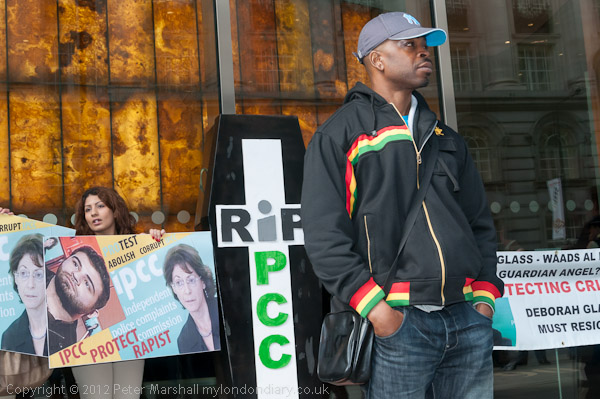
Placards, coffin and Merlin Emmanuel who was one of the organisers

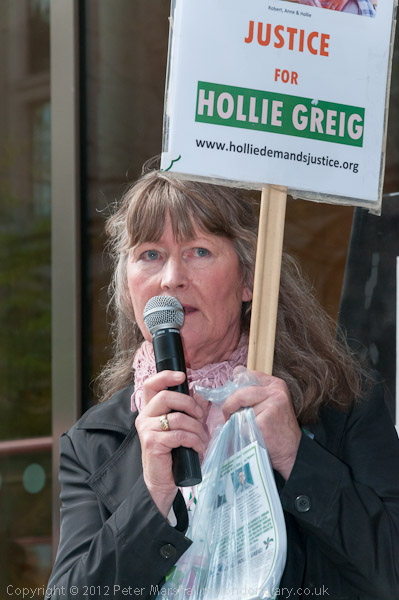
From checking on this I caught a bus to Holborn, where I knew that there was going to be a protest against the so-called ‘Independent Police Complaints Commission’ or IPCC.  Set up in 2004 to replace a discredited body that was widely seen as simply there to deflect public anger without and prevent any real investigation or redress against the police, this replacement body has turned out to be equally lacking in independence or powers. Recently even its boss has admitted it needs reform, when it was not even able to question the 38 officers involved in the fatal shooting of Mark Duggan, whose killing by police sparked off last Summer’s disturbances.

Although in general the British police forces are among the best in the world, they have problems, and have unfortunately failed to deal with them. We can all name high-profile cases where the police have failed, have been shown to be racist, have used inappropriate levels of force, often with fatal consequences, have issued statements known to be false to the press, have lied in court evidence and more and of course there are many more cases that have not received attention in the media. We know that in general police look after their own, and there are few effective investigations of police corruption or abuses, and that prosecutions of police are extremely rare. Cases tend too be neglected, drawn out to excessive length and pushed under legal carpets on into the long grass. And the IPCC, staffed with a high proportion of former police has turned out to be some of the longer grass.

© 2012, Peter Marshall
The Scots also have a system to not investigate complaints such as
those involving the abuse of Hollie Greig in Aberdeen

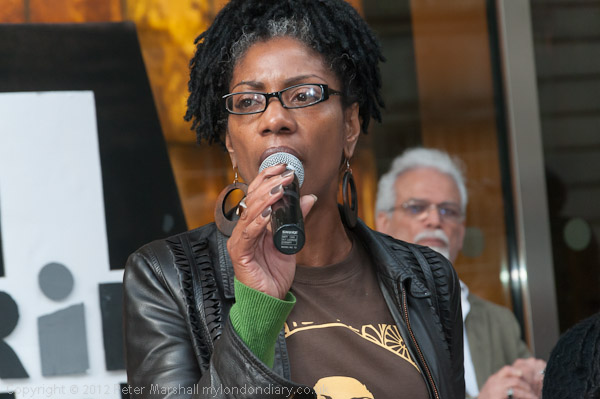
Photographically the main difficulty in covering the event was that little interesting was happening. There were a few posters, placards and banners, and a black coffin with the message RIP IPCC, but it didn’t add up to a great deal to make pictures with. It was just a very static event with people, including a number who were videoing the event well back from the speakers , making it difficult to take pictures without getting in their way.

What interest there was came mainly from the speakers, and some of these were rather undemonstrative, even while some of what they had to say was a powerful indictment of the police and the IPCC. It wasn’t easy to find different angles, and this wasn’t helped by a strong low sun. Things got a little more interesting for me later because of some of the people involved.

© 2012, Peter Marshall
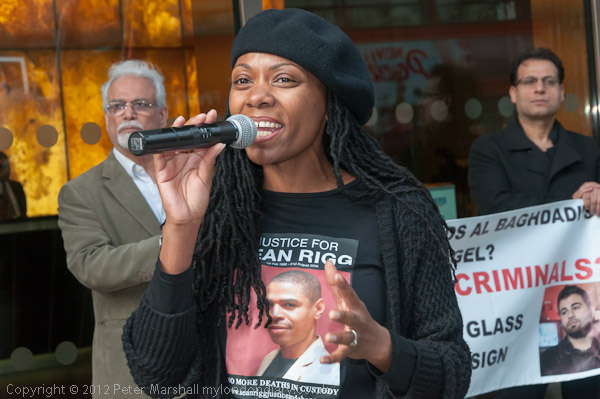
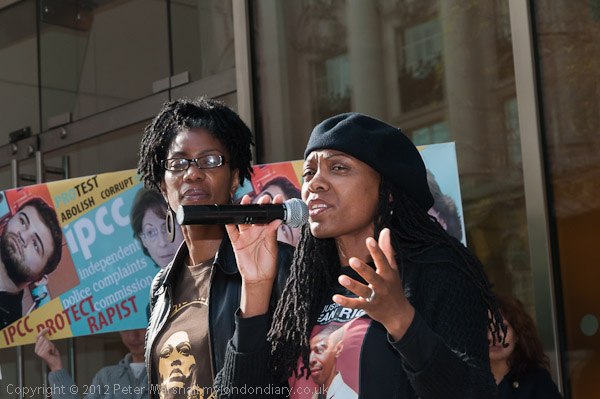
Marcia and Samantha, sisters of Sean Rigg, killed in Brixton Police Station in August 2008
© 2012, Peter Marshall

I’ve photographed Marcia and Samantha Rigg on various occasions over the years since their brother Sean was killed shortly after being taken in to Brixton Police station  in August 2008. As well as campaigning for a proper investigation of his death they have also become leading campaigners for the proper investigation of all deaths in custody and for effective control of police behaviour. Although they were limited in what they could say because of the forthcoming inquest, they gave damning testimony on the total failure and inadequacy of the IPCC.

© 2012, Peter Marshall

Although occasionally the sun went behind a cloud, using flash fill helped improve the lighting in the other images I took of them.  But working from the side the lighting with the sun shining almost directly into my lens was considerably more dramatic.  The kind of result shown here needed considerable work in Lightroom to burn down the sunlit areas as well as adding brightness and contrast to the shadows.

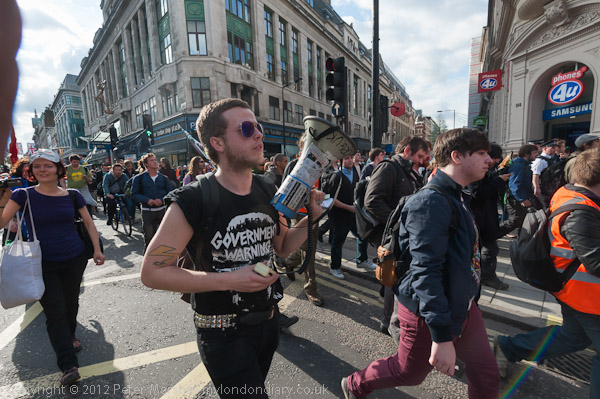
From here I got a bus back to Oxford St with a colleague. Getting on buses on days where extensive protests are taking place is often a mistake, as the traffic can get very badly held up, partly by protesters but often mainly by police blocking off much larger areas than the protest. We got stuck in Oxford St and could tell that something was happening when the police helicopter that we had seen from our seat at the front of the top deck was hovering was more or less directly above us. I spotted a crowd and police a couple of hundred yards away and we rushed downstairs. The traffic was completely at a standstill but the bus was between stops and at first the driver refused to open the doors to let us off, but my colleague and the other passengers persuaded him and we rushed to join the protesters running along Oxford St.

The light was tricky here too, shining low directly behind the protesters.

© 2012, Peter Marshall

That’s my hand at top left – without using it to supplement the ineffectual lens hood the image would have been a mass of flare – you can see a nice ‘rainbow’ effect at bottom right. I could crop it out, but that would lose some of the figure in blue below, which I think would be a shame. Most people don’t realise it is my hand, which after all was there anyway, so why should I remove it?

© 2012, Peter Marshall

A little later, in the Charing Cross Rd there was some nice rim lighting – and again fill flash was essential. One big advantage of modern flashes and cameras is that flash can be used at fast shutter speeds – 1/320th in this case.

© 2012, Peter Marshall

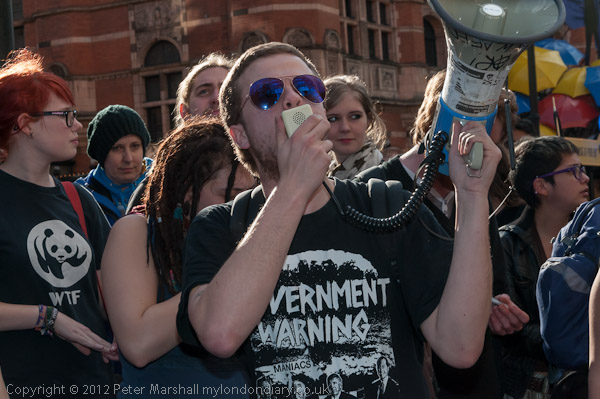
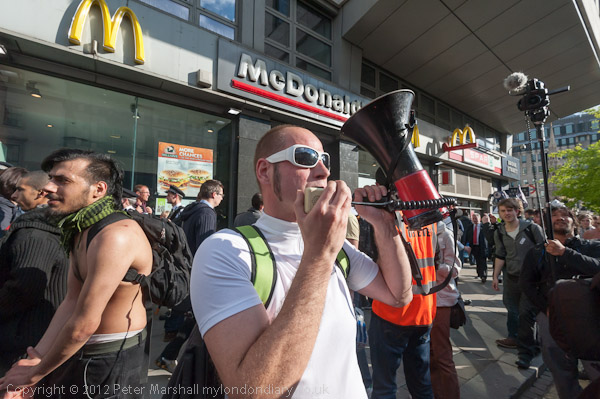
By the time we got to McDonalds on The Strand there was more strong side-lighting which made my picture of a man with a megaphone outside the store more effective – and this time I managed without flash fill, but with quite a lot of work in Lightroom.

You can now see my work from the whole of May Day on My London Diary:

London May Day March
Abolish The Corrupt IPCC
May Day Workfare Protest
Stock Exchange Occupied

________________________________________________________

My London Diary : Buildings of London : River Lea/Lee Valley : London’s Industrial Heritage

All photographs on this and my other sites, unless otherwise stated are by Peter Marshall and are available for reproduction or can be bought as prints.

To order prints or reproduce images

________________________________________________________

May Day – See Red

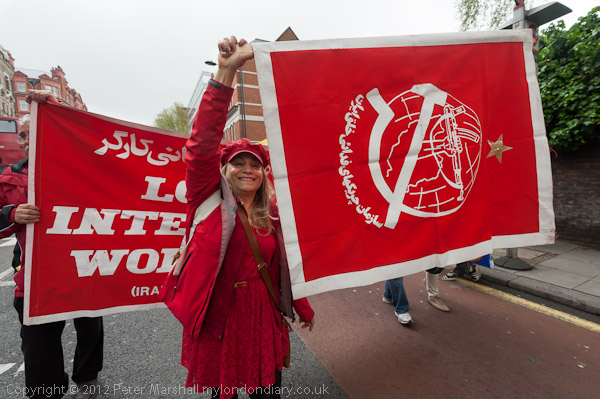
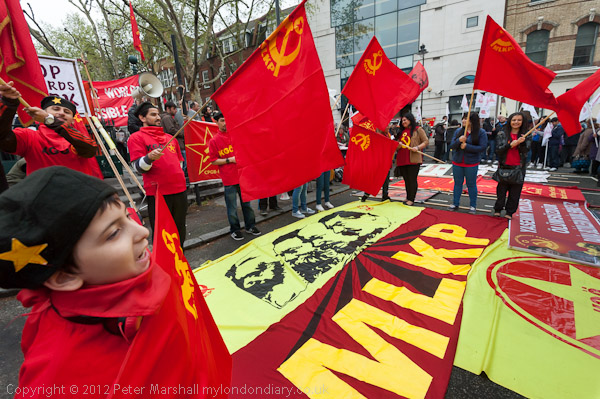
Red isn’t my favourite colour in photography, although it’s sometimes been said that every good picture needs a little bit of it. Nonsense of course, but while a little bit of red is fine, it’s very easy to have too much of it, and neither film nor digital is all that good in coping with large amounts of bright colour in that area of the spectrum. Which can cause something of a problem on May Day.

© 2012, Peter Marshall

With red road,  red bus and red buildings as well as the clothing and banners there isn’t really a great deal that isn’t red in this picture, and getting a truly believable skin tone on the face was something of a challenge with all the reflected red light.

© 2012, Peter Marshall

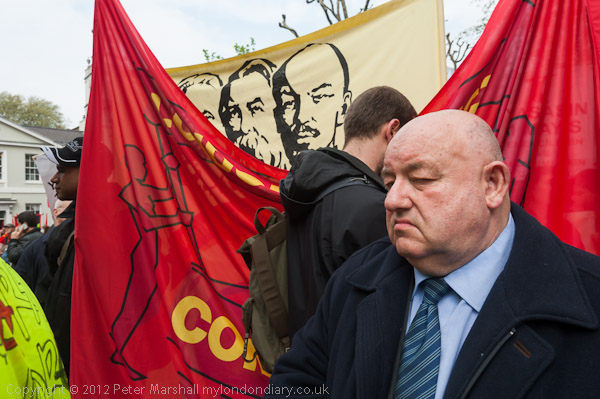
Most of the brighter red areas of these pictures needed some burning in to get some tonality, and the red tends to make other colours – such as the yellows in the above picture – look too wishy-washy and they have to have some attention too.  I think I’ve perhaps overdone it on the flag at the bottom left in the picture above, but it certainly needed some darkening.

© 2012, Peter Marshall

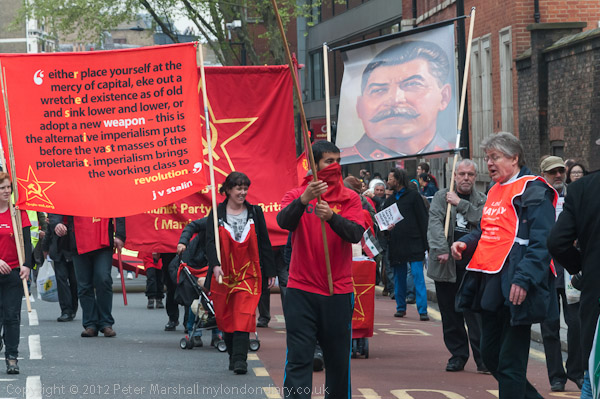
All the big heads made me want to do something with them, and I was attracted by the solidity and the expression of the man in the foreground, and though it might not show his best side I didn’t feel it was too unkind. But one face that truly makes me feel uneasy is the huge portrait of Stalin. Although he was ‘Uncle Joe’ to the press in the days of my childhood, and a vital figure in winning the war against fascism, it’s hard to understand why there are people still prepared to carry his banner or wear his t-shirt.

© 2012, Peter Marshall

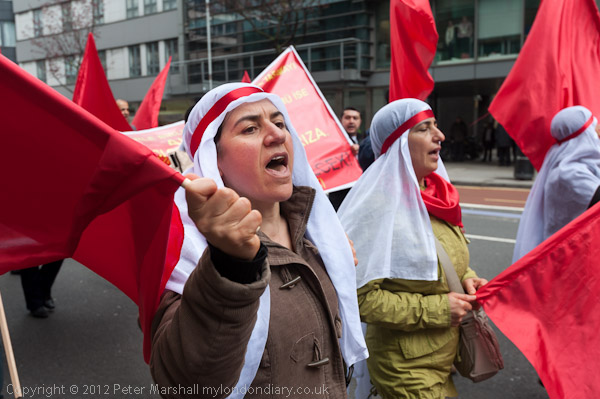
London’s May Day celebrations bring together “trade unionists, workers from the many international communities in London, pensioners, anti-globalisation organisations, students, political bodies and many others in a show of working class unity” and it’s a shame that May Day isn’t a bank holiday so that more people can take part.  This year’s May Bank Holiday came almost a week later.

© 2012, Peter Marshall

© 2012, Peter Marshall

Jim Connell’s word’s, written at the time of the dock strike in 1889 are stirring and for an hour or so a year in London the red flag is flying over at least a small part of the capital. Here is his second verse (in web colour scarlet #FF2400) for any of you who have forgotten it.

Then raise the scarlet standard high
Beneath its fold we’ll live and die
Though cowards flinch and traitors sneer
We’ll keep the red flag flying here

I didn’t hear the words sung in English this May Day, (and its a long time since many in the Labour party sang them with any conviction, and the tune makes most of us think of Christmas trees.) The Internationale which was also getting played certainly has a better tune, but the standard English words are impossible to sing.

Few of the flags and banners in my pictures are scarlet, although I’m not sure that the colours are entirely true to hue, but many seem to be a little bluer shade of red, and, as I’ve deliberately made some darker than they appear to retain some tonality.  In the real world, colours don’t always look the same anyway, and change in different lighting conditions. You can see more of my work from the day on My London Diary in London May Day March.

________________________________________________________

My London Diary : Buildings of London : River Lea/Lee Valley : London’s Industrial Heritage

All photographs on this and my other sites, unless otherwise stated are by Peter Marshall and are available for reproduction or can be bought as prints.

To order prints or reproduce images

________________________________________________________