Shell Out

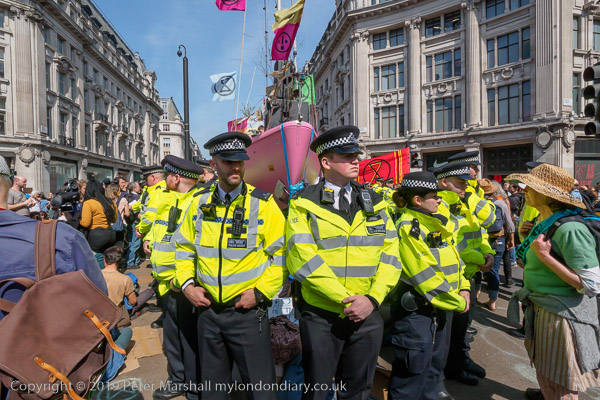
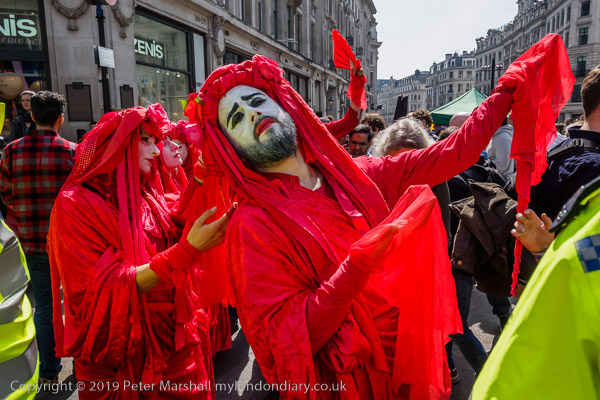
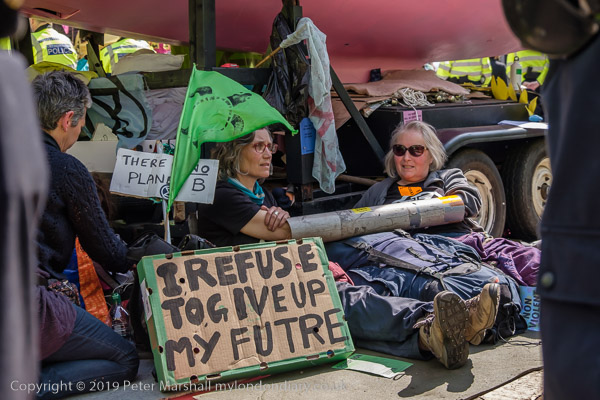
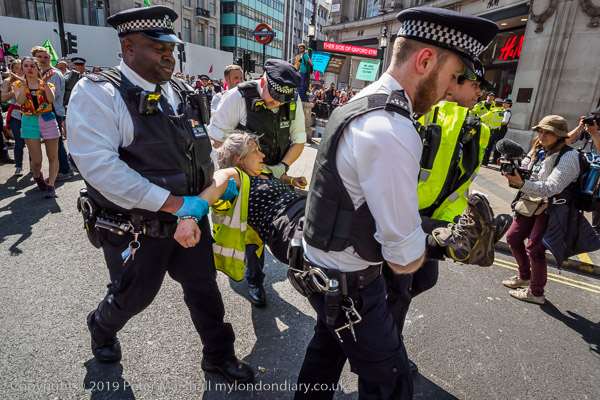
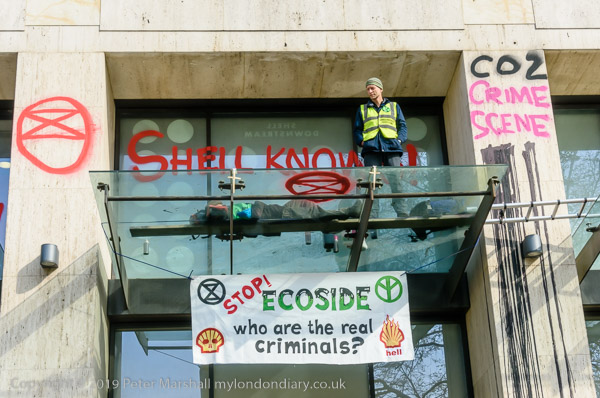
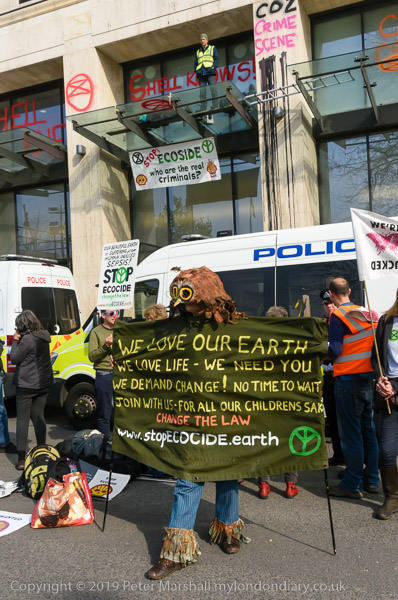
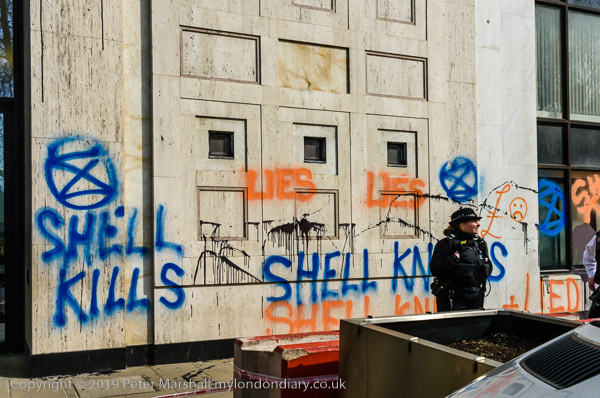
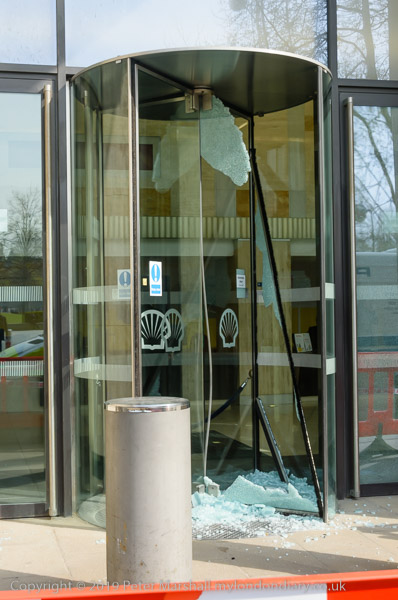
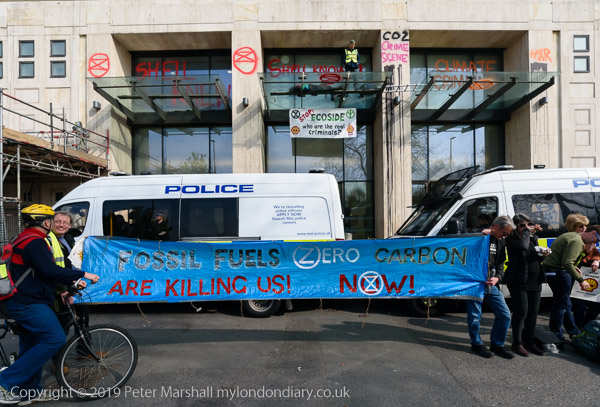
If we are to survive as a species we need to stop the climate destroyers, companies like Shell who are still pushing fossil fuels. So it wasn’t surprising that Extinction Rebellion had planned a protest at the Shell offices in London.

Also not surprising that as those taking part were intending to be arrested for taking illegal action and causing damage to the property that they didn’t advertise their protest beforehand. I only heard about it a short while after it happened, when a colleague who had been filming it told me what had happened and said it might still be worth a visit.

I do sometimes get advance information on illegal actions – and have at times been asked to cover them for the organisations taking them, but I usually pass up the opportunities. Sometimes it’s because they are taking place at inconvenient times, often early in the mornings. I’m afraid I don’t like getting up early and living a short journey outside London makes me reluctant to cover anything that starts before around 10.30am.

I also like to keep a certain distance between myself and groups of protesters. It’s a matter of objectivity and of editorial independence. I may support the aims of a protest, but as a photographer and a journalist I want to see and photograph it from my own viewpoint. So while I’m happy to cover events when I can, I don’t normally want to be a part of them.

Sometimes groups who approach me would be happy to pay for my services, though more often there isn’t any money involved. I’ve long been a supporter of trade unions and the idea that the labourer is worthy of his hire, and am opposed to my work being used without payment by anyone else who is making money out of it. I don’t actually need the money any more but there are plenty of younger photographers out there who struggle to make a living, and I’d rather any paid job went to one of them.

While I understand that many organisations want to improve the chances of hasing their protest or other event features in publications by providing free high-quality images, this is something I don’t like to support. If an event is newsworthy, then the media should be prepared to pay for decent pictures – otherwise no news photographers can make a living.

I have two simple rules when I’m asked for permission to use any of my images without payment:
Firstly – and this applies also when people approach me offering to pay – do I approve of the way they want to use the image. Some organisations get a straight refusal, though agencies with whom I place most images are less discerning.
Secondly if any organisation wants to use my work without payment my second question is to ask if the organisation has paid staff. If it can afford to pay workers it can also afford to pay photographers like me. It’s a simple test.

There are of course exceptions. One long-established is for the occasional exhibitions I take part in, where images are provided for free use in publicising and reviewing the show. And there is one or perhaps two magazines worldwide I would allow to use my work without payment in the unlikely event they would want to do so. And my work is made freely available to you all to view on my various web sites, particularly My London Diary, London Photographs, Hull Photos and the River Lea, links to which appear at the bottom of most posts on this site, a total of around 200,000 pictures and still growing.

As well as their general role in promoting climate disaster and ecocide, the protest at the London Shell HQ also highlighted their crimes against the people of the countries of the global south in which they operate, particularly in Nigeria where the company has been responsible for the killing of opponents to its activities, including Nigerian writer, television producer and environmental activist Ken Saro-Wiwa, executed by the military government there in 1995. 

I arrived far too late to see the activists daubing slogans on the Shell building and deliberately causing criminal damage so that they would be able to demand a trial before a jury, enabling them to argue their justification for the action. But there were still two activists occupying the glass porch above the entrance, as well as a group of supporters protesting on the road outside.

You can see a few more pictures at Extinction Rebellion at Shell. I didn’t stay long as I’d missed the main action and little now seemed ot be happening – and I had another protest to visit on my way home.


All photographs on this and my other sites, unless otherwise stated, are taken by and copyright of Peter Marshall, and are available for reproduction or can be bought as prints.

There are no adverts on this site and it receives no sponsorship, and I like to keep it that way. But it does take a considerable amount of my time and thought, and if you enjoy reading it, please share on social media.
And small donations via Paypal – perhaps the cost of a beer – would be appreciated.
Debunking digital myths

You may like to view the 30 minute video in which Tony & Chelsea Northrup discuss what they say are 12 common myths about digital photography, which was recently posted on Petapixel.

But to be frank, I find their presentation pretty nausea-inducing, and even scrolling through on fast-forward with the occasional pause to listen to the answers seemed like 10 minutes of my life wasted. There are some things video is an appropriate format for, but this was just not one of them.

So, what were the myths? I’ll paraphrase, and give my own answers which sometimes differ slightly from Tony Northrup.

Q: Should you fully discharge batteries to avoid a memory effect?
A: Cameras now use lithium batteries and full discharge should be avoided.

Q: Will your memory card be corrupted by deleting pictures in camera?
A: No.

Q: Will using a UV filter improve image quality?
A: No. Adding extra glass may even very slightly degrade IQ, though seldom noticeably. But it can protect the front lens element in tough conditions.

Q: Do higher megapixels sensors have greater noise?
A: Not necessarily, although very high megapixel small sensors on some phones do.

Q: Do medium format lenses give better “compression”?
A: This is just marketing talk. In general larger formats have more limited depth of field which may give a different look to the image, but at apertures that give similar depth of field the pictures will be identical so far as “compression” is concerned. Of course larger sensors generally have more megapixels and lower noise and their larger pixels can give them greater dynamic range. If you want to make giant prints a MF camera will be at an advantage

Q: Does your PC do a better job of Raw processing that your camera?
A: The PC – and viewing your image larger allows you much more control over how Raw processing is carried out. But modern cameras do a very good job in producing jpegs.

Q: Can you edit jpegs?
A: Well, of course you can, and Lightroom in particular seems to do it very well. But avoid repeated saving and later reloading to re-edit them as every jpeg save loses information.

Q: Do you need to turn off Image Stabilisation when using your camera on a tripod?
A: You don’t need IS when your camera is on a tripod, but it may well not make any difference. But it’s probably best to read what the camera manual says and follow its advice.

Q: Are lenses at their sharpest at f8?
A: Probably not. A better rough guide suggests two stops down from wide open, but a stop or two either way is almost never critical. Never be afraid to stop down more if you need greater depth of field or open up if you need a faster shutter speed. Remember many great pictures are not particularly sharp and the great majority of sharp images are not worth a second look.

Q: Is manual focus more accurate than auto-focus?
A: Manual focus is as sharp as you make it, but it is difficult to get focus more accurate than with modern autofocus systems, though you can match this using ‘focus peaking’. Manual focus does have the advantage that the photographer is aware exactly where in the subject focus is – all too easy for autofocus to be somewhere different.

Q: Do Canon cameras give the best colour?
A: Probably only so far as Canon’s marketing guys are concerned. If you shoot RAW, then you (and your raw processing software) make the choices on colour. I’ve used Fuji, Nikon, Olympus and Canon digital cameras. All can produce great colour from RAW files. I usually prefer Nikon, or, if I want a more vibrant look, Olympus, but the others are fine.

The Northrups have carried out some experiments with large groups of people and colour images from various cameras and you can find more details on their site. But for me it’s only my opinion that matters, and I think that which gives the best colour depends on the subject and its colours – it can be Fuji, Olympus or Nikon, but seldom Canon.

Q: What causes memory card faults?
A: A few years ago counterfeit cards were common, and the packaging was good enough at times to fool even reputable suppliers. I was supplied with some and they immediately gave problems. I’ve also bought cards direct from reputable manufacturers which turned out to be not entirely compatable with my camera – and again this showed up fairly quickly. Both times I got replacements without a problem. I think that both these things are now much less common.

Card faults resulting in image loss are now uncommon. But it makes sense to take care never to remove a card while it is being written to and not to get the card contacts get dirty. But as the video says everything does go wrong sometimes – fortunately not very often.

Reading this will have saved around 25 minutes of your life and imparted probably slightly better advice than that in the Tony & Chelsea Northrup video. But I’m sure their many fans will still want to watch it, though I hope if you are reading this you will find better things to do with your time. Why not go out and take some pictures?


All photographs on this and my other sites, unless otherwise stated, are taken by and copyright of Peter Marshall, and are available for reproduction or can be bought as prints.

There are no adverts on this site and it receives no sponsorship, and I like to keep it that way. But it does take a considerable amount of my time and thought, and if you enjoy reading it, please share on social media.
And small donations via Paypal – perhaps the cost of a beer – would be appreciated.

Tottenham

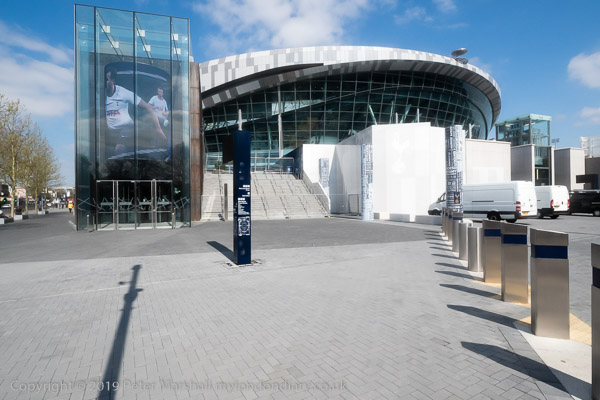
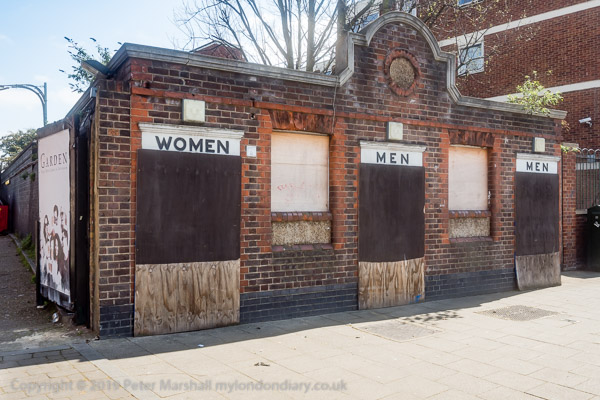
Since I was going to photograph a protest in Tottenham, a part of north London I don’t often get to, I thought I’d take a look at the new stadium there. I’m not a Spurs fan, nor of any other team, though I do still occasionally read the reports on Brentford’s matches in one of our free local papers with a little amusement. Although I was keen on sports when young and played in my areas leading under-11 football team – two of whose members went on to play for Brentford and one for Chelsea – and continued to compete for my school and several teams at football and rugby while a student, I’ve always considered watching sport – either live or on TV – a waste of time.

The new stadium looks fine, though I didn’t have time to investigate it beyond a few quick snaps. But what really gets me annoyed is that the club want to change the name of nearby White Hart Lane station (in White Hart Lane) to Tottenham Hotspur, and that TfL are more than happy to oblige in this annoying piece of corporate branding and pocket £14.7m for doing so. TfL’s job is to run a transport system, not to provide publicity. I will also feel rather disappointed if Spurs fans accept the name change for the ground and stop calling it White Hart Lane.

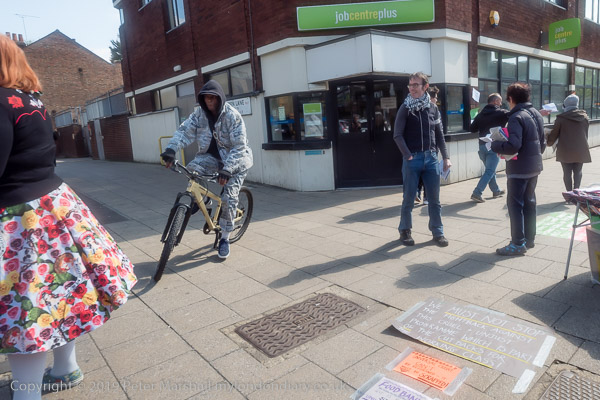
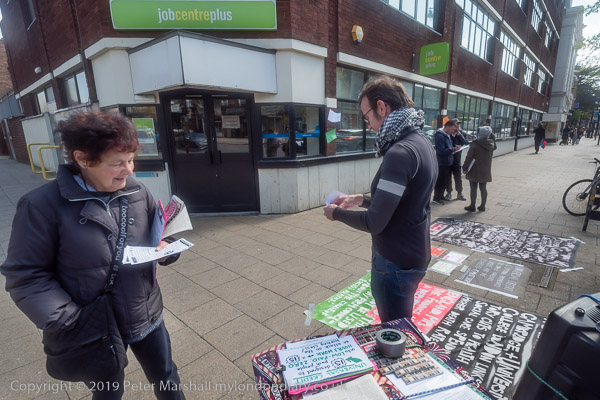
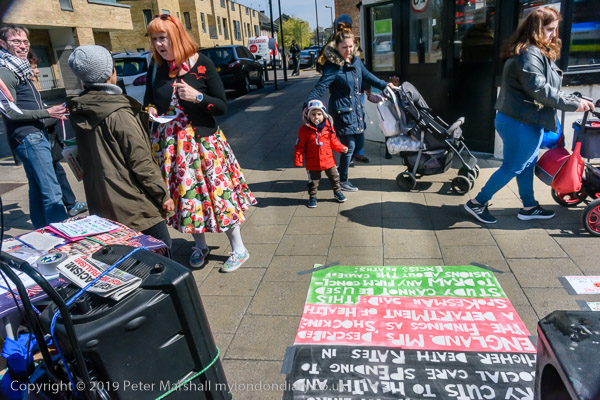
The protest outside the Tottenham Job CentrePlus was a small one, taking place on a Thursday lunchtime, and organised by the Revolutionary Communist Group, a relatively small left-wing organisation, but about a major issue, Universal Credit. Although some of its aims to simplify the benefits system are laudable it has been clear from the start that there were huge problems in the implementation, and that the whole scheme has simply not been properly designed. Add to that some political interference to cut costs and the whole thing is a disaster.

Much of the problem is I think that the scheme was designed by well-off and well-connected people who have little or no appreciation of how those affected live. The kind of people who, if they are a little short of cash at some point can sell a few things (perhaps some of their investments or the second or third house), get a loan at a relatively low interest rate from a bank or ask friends or family to tide them over.

Waiting a five weeks (or rather longer) for their money would not be a problem for them, but for those who are dependent on benefits it can be a disaster. It is a public disgrace that we need food banks, but UC has been a major factor driving the huge increase in people who have to use them – or starve. The other major factor driving people to them has been benefit sanctions, with people losing benefits often for trivial or even made-up reasons so that DWP staff can meet the targets set for them, leaving people with no resources on which to survive for months or even years.

Many too have become homeless for the same reasons, evicted because they cannot pay the rent. And far too many have died. It’s a scandal and one that attempts to draw public attention to and organise opposition I think deserve support, whoever organises them. It’s a pity that the sectional nature of left-wing politics means that the RCG seldom gets much support from people outside its own group for protests such as these.

As a photographer, small protests such as these present something of a challenge to make them newsworthy. As much as possible I try to cover them in a way that brings out the issues, perhaps as reflected in posters and banners, and also to produce images with some visual interest.

Scrap Universal Credit Jobcentre protest
Tottenham and Spurs


There are no adverts on this site and it receives no sponsorship, and I like to keep it that way. But it does take a considerable amount of my time and thought, and if you enjoy reading it, please share on social media.
And small donations via Paypal – perhaps the cost of a beer – would be appreciated.
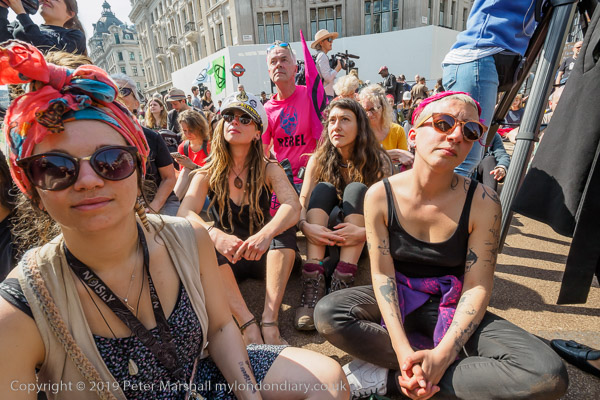
All photographs on this and my other sites, unless otherwise stated, are taken by and copyright of Peter Marshall, and are available for reproduction or can be bought as prints.

To order prints or reproduce images


More staged pictures

London’s stabbings and shootings have generated headlines in the UK media and earned London Mayor Sadiq Khan highly critical tweets from President Trump, as well as allowing Boris Johnson to make seriously incorrect claims about his own time as Mayor. Most of us feel that the current rise in London’s figures owes more to Tory cuts in social and youth services and police numbers than any actions taken by Khan, who has announced some sensible policies which may help in the longer term based on those that have had some success in Glasgow.

Of course any death on our streets is tragic, whether by knife, gun, car or lorry. And while there were 732 homicides recorded in England and Wales in the year to December 2018 (and another 59 in Scotland), the latest annual statistics for road deaths for Great Britain are almost two and half times this, at 1770.

It’s also worth reminding Trump, that while London’s murder rate is around 1.6 per 100,000, this is only half that of New York and that all of the 30 largest US cities had higher rates – with Baltimore, Detroit and Chicago topping the list at 55.8, 39.8 and 24.1 respectively. Figures like that – up to 50 times as many in London – put our crisis in perspective. London is still relatively a very safe city.

But even those huge figures for some US cities are dwarfed by those in San Pedro Sula, Honduras, listed as world’s most dangerous city (outside war zones) with an annual homicide rate of 187 per 100,000 people. And it was photographs from this city, by Swiss/Italian photographer Michele Crameri that got me thinking and writing today, with an article in Fstoppers, Award-Winning Photojournalist Accused of Faking Photos of Assassins.

Looking at the pictures it seems fairly obvious that they were staged for the photographer, but despite this, they are said to have “won 15 awards, including [Crameri] being recognized as a finalist by Lens Culture’s Visual Storytelling Awards 2019.”

When working in Honduras, Crameri worked with local journalist Orlin Castro as his fixer, and was introduced to a number of hit men working for the local gangs who acted out some scenes of threatening to kill people while the two men were present (with Castro playing one of the victims in one of them.) These were captioned as if these were actual events rather than play-acting.

A harrowing film n Youtube, shot for VICE, Crime Reporting in the Murder Capital: San Pedro Sula Nights, shows Orlin Castro at work as a night-time crime reporter, reporting on the killings in the war between the city’s two most notorious gangs. It’s hard at times to watch, and to read the English sub-titles as Castro talks about some of the stories he has covered. Reporting is a highly dangerous job in Honduras, as the notes on the video comment, with “the Honduran National Human Rights Committee, at least 47 journalists and media executives have been murdered between 2003 and 2014.” Had Crameri been photographing the real thing he might well have ended up as another number on this list.

Although it is difficult to look at Crameri’s pictures and not at least have a powerful suspicion that they were staged, the deception was only brought to light by two other photographers who had also worked with Orlin Castro as their fixer and who raised the issue with them. Castro says that Crameri promised him the pictures would only be for his personal archive and “that he specifically told Crameri not to publish the photograph of him being jokingly threatened with the gun.”

Of course there is nothing wrong with the pictures – though clearly the photographer should have respected Castro’s request, and it’s possible that publishing that image may have placed him in some danger. The others are pictures of hit men, and had the captions clearly stated that they were playing for the photographer rather than actually at work they would have still been a viable part of the project. But lying about them not only invalidates those images, it also puts into question the whole of the project – and indeed the photographer’s other work. If you mislead us about these, why should we believe what you say about your other pictures.

The most valuable thing that any photojournalist or documentary photographer has is his or her integrity. Without it the pictures are just pictures, no longer a witness to the world.

Who Are We?

You can now watch the video presentation Who Are We? 2019 – Shahidul Alam played at Tate Modern last month, part of Learning Lab 2: Artists who Risk and Artists at Risk, 25 May 2019. I found it an interesting insight into his work and in thinking about our own work as artists – and he says we are all artists.

Who Are We? is a cross-platform event designed for Tate Exchange (Tate Modern) reflecting on identity, belonging, migration and citizenship, open free to the public, and has been held annually since 2017 and is a partnership with the Tate, Counterpoint Arts and the Open University.

Probably I don’t need to say anything about who Alam his, or about his arrest last year. I’ve written at least a dozen times about his work as a photographer and also about his other incredible activities in Bangladesh, setting up Drik and Majority World agencies, the Bangladesh Photographic Institute, the South Asian Institute of Photography, Pathshala and the Chobi Mela festival. Here is a link to just one of those posts, 25 Years of Drik.

D-Day 75 years on

What else could a photographer post on the 75th anniversary of the D-Day landings in Normandy but a link to Robert Capa on D-Day, the huge series of investigations into what have since become the iconic images of the event, the 10 or 11 severely undexposed frames made by Capa in the few minutes he spent on the beach before rushing to jump on a boat and get his pictures back to England.

The project, launched 5 years ago today on the 70th anniversary of the event “combines elements of photo history, research in journalism, critical thinking, and media literacy” and the team, led by photography critic and historian A D Coleman of photojournalist J Ross Baughman, photo historian Rob McElroy and military historian Charles Herrick have provided us with a remarkably clear and detailed view of what actually happened on that day and later, in the darkroom and to the present day in creating and promulgating the legends around that handful of pictures.

Doubtless there will be articles published today that retell the invented story of the darkroom mishap, or repeat some of the other fabrications around the pictures made by Capa and others. But knowing the real story – or as much of it as can now be verified – doesn’t in any way detract from the power of the couple of truly iconic pictures.

It seems unlikely that we will ever know who was that ‘face in the surf‘ , though we can now be sure it was none of those who have most publically claimed to be him. I’m not sure we would gain were a positive identification possible – isn’t it better that it remains an ‘unknown soldier’ whose face commemorates the event?

If I didn’t have a busy day ahead of me taking pictures (nothing to do with D-Day) today would be a good time to get out those several books of Capa’s pictures on my shelves and look through them, along with some of the investigations and perhaps a glass or two of wine.

Those of you who would prefer a very much shorter and generally accurate account of the the D-Day pictures you can read Wikipedia’s ‘The Magnificent Eleven’, which also reproduces seven of the pictures.

And should you be in London before 29 September 2019 you can go and see the free exhibition Robert Capa: D-Day in 35mm at the Imperial War Museum, which includes prints of 10 of the 11 photographs taken by Capa on Omaha Beach, as well as “personal accounts and objects related to Allied soldiers who landed that fateful day. ”

Soviet photos

I think I should start this post with a health warning. Do not click the link in this post unless you have hours you can afford to spend looking at photographs. You will probably want to rush out and get a bottle of vodka and be glued to your screen forgetting meals, appointments and the rest and come round some time tomorrow with a huge hangover.

It will almost certainly be worse if you can actually make out the Cyrillic characters or actually read Russian, but even without that the pictures are fascinating, with every issue of Советское фото – Soviet Photo magazine – over 400 of them from 1926-1991 now available to read online at Archive.com.

You can read more about the magazine and its history in both Russian and, if you scroll down, in English on the About tab, which also talks about the early controversies in its pages in the late 1920s and early 30s. It was here that the work of Aleksandr Rodchenko was first denounced as plagiarising the work of Western European photographers László Moholy-Nagy and Albert Renger-Patzsch – unfortunately leading the magazine to boycott his work – and later his and similar work politically denounced as formalist; foreign and elitist and not in line with the official party line of Socialist Realism.

Photography developed rather differently in Russia, something that was made clear to me in 1978 when ‘The Russian War 1941-5’, a superb collection of photographs edited by A. J. P. Taylor , Daniela Mrazkova & Vladimir Remes, many of the pictures in which are now well-known.

After the war there was also a disjunct between photography on the two sides of the iron curtain, with relatively little contact between the two. With a few exceptions, the work that we saw came from photographers who had managed to leave the Soviet bloc – though some of those exceptions were notable – such as Czech photographer Josef Sudek (1896-1976), the ‘Poet of Prague’. Things of course began to change with the fall of the Soviet Union in 1991.

This is certainly a site to add to your bookmarks, and one that, like vodka, is best taken in small doses.

Of course there is much more available on the Internet Archive, and a recent post looks at their work and at the problems of preserving Internet content. It’s something I have a definite personal interest in, as over 300 articles that I wrote about photography are now, for copyright reasons, only available among the 330 billion web pages, now stored on the ‘Wayback Machine’.


Catalan evening

It was around a quarter past five by the time the Catalan protest got going on the steps around Eros, and in mid-February this was sunset, though it seemed rather darker than this suggests. Of course with the amount of street lighting and lights in shop windows and traffic it never really gets dark, but the contrast between the brightness of the advertising display on one side of Piccadilly Circus and the opposite side of the monument was pretty huge, and the protesters seemed to be in very deep shadow,

Using the Nikon D750 and D810, with both set to ISO 6400 allowed me exposures of around 1/125 at f5.6 without flash, though these were deliberately underexposed by a stop or so to keep something of a night look.

I didn’t have any fast lenses with me – and don’t own anything faster than f2.8 for the Nikons, finding them too heavy to carry and unsuited to most of the work I do where wide apertures mean the depth of field is too limited, though there are times when a fast telephoto would certainly help. But apart from the cost of the lenses I’d probably find myself needing the services of an osteopath. Although the Nikon lenses are remarkably good wide-open, when possible I like to stop down just a little, and most of these were taken at 1/2 to one stop down from the variable maximum.

I used flash for about half of these pictures, with a Nikon SB800 in the hot-shoe, but still worked at ISO 3200 to avoid getting people looking like cardboard cutouts in front of a black background, making sure that areas too far away to benefit from the flash were still getting enough exposure from ambient light. Although normally I work with the cameras on the ‘P’ setting (but often altering the selected shutter speed) Nikon’s flash system doesn’t really work with this, and when using flash I switch to aperture or shutter priority or sometimes full manual.

Flash on camera is always a problem where important parts of the subject are at different distances from the camera, and sometimes I make use of the fall-off of flash away from the centre, angling the flash head away from the closer parts of the subject. But inevitably some, often considerable, burning and dodging is needed when processing the images. Even in those taken without flash the lighting was pretty uneven and some correction was needed. If I can tell which of the images was taken with flash and which without except by looking at the EXIF data I don’t think I’ve got it right.

More at Against political trial of Catalan leaders


There are no adverts on this site and it receives no sponsorship, and I like to keep it that way. But it does take a considerable amount of my time and thought, and if you enjoy reading it, please share on social media.
And small donations via Paypal – perhaps the cost of a beer – would be appreciated.
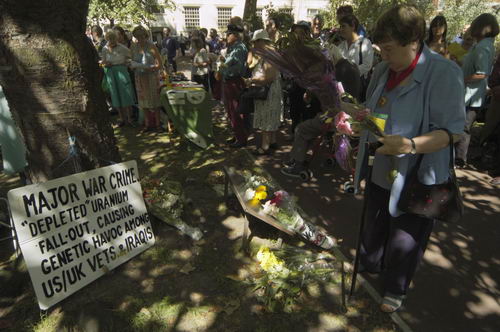
All photographs on this and my other sites, unless otherwise stated, are taken by and copyright of Peter Marshall, and are available for reproduction or can be bought as prints.

To order prints or reproduce images


BP out of the BM

‘BP or not BP’ is a bunch of activists who stage performances of one sort or another at various cultural institutions and events to protest at the way the arts are being used to promote and sanitise companies guitly of destroying the planet and other crimes, ‘greenwashing’ to hide their mucky stains.

BP are a prime example of such a company, responsible for many murky political dealings in countries around the world in search of oil, Extracting oil has destroyed valuable ecosystems though pollution, with huge oil spills threatening large areas of ocean life. Its oil feeds the plastics and artificial fabrics industries, while the use of oil products in heating, air conditioning and transport etc is the cause of the huge increase in grrenhouse gases which is causing disastrous global warming.

BP gives a relatively small financial contribution to the British Museum, for which it gets a incredible return in good publicity, its logo on posters and on labels in the museum.

The protest took place on the 16th anniversary of the invasion of Iraq, conducted as is now clear from documents from many sources largely to ensure access by US companies to Iraqi oil resources rather than anything to do with the WMDs which all knew did not exist. It also took place while the BP-sponsored show I am Ashurbanipal: King of the World, King of Assyria‘ was nearing the end of its run. It’s a show which includes a number of looted objects from the area (which stretched from Egypt to the Persian Gulf), both from historical times when the BM was itself sending archealogists to the area and apparently some more recent acquisitions sold to dealers after Iraq was left in chaos and during the current conflict in Syria, bought with the aid of BP money.

While several hundred protesters gathered at the front of the Great Court, a small performance took place in the Assyrian galleries, and was then repeated in front of the entrance to the Assyrian exhibition. Meanwhile the main protest got under way, amd after an introductory rally people were lead to from a ring all around the Great Court, with posters all round.

The Great Court is a large area around the old former BM Reading Room (where my wife once worked) and is said to be the largest covered public square in Euripe, with an area of 3,692.5 square metres. I think the chain around it holding the banners must have been around 600 feet long, though only relatively small sections were visible from any one point.

This was something of a challenge to still photographers, and I walked around it several times taking pictures. Long banners are always a challenge in terms of the aspect ratio. Even if you frame the people holdina banner from head to toe working in landscape format, this only results in a horizontal field of view of around ten foot. To frame longer banners results in the people and the banner shrinking to a narrower strip across the image.

You can improve matters by photographing the banner from one side, filling the frame height with the nearest person or going in even closer, and this is often my approach. But as the make the viewpoint more oblique, the banner text becomes less and less legible. And legible text is important with banners.

My friend taking video had a simpler task and did it well, filming as he walked around the whole circle. A similar approach using still photography would have resulted in a print with a roughly 100:1 aspect ratio, and while it might have been possible to join up the banner, as you moved from exposure to exposure the backgrounds would change.

I did take a series of pictures from the top of the stairs overlooking the area in front of the Assyrian exhibition, where the banners were brought and people sat on the ground. Possibly taken together they would show the whole string of banners (though I think some were folded before they reached the display), but more than the two on My London Diary make rather tedious viewing.

End BP sponsorship at British Museum

There are no adverts on this site and it receives no sponsorship, and I like to keep it that way. But it does take a considerable amount of my time and thought, and if you enjoy reading it, please share on social media.
And small donations via Paypal – perhaps the cost of a beer – would be appreciated.
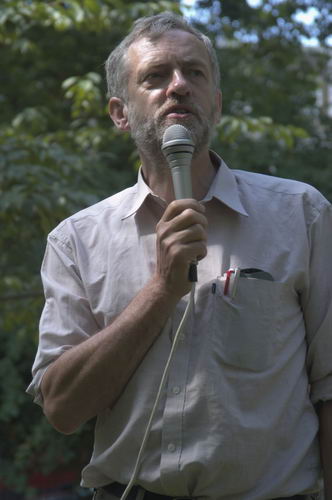
All photographs on this and my other sites, unless otherwise stated, are taken by and copyright of Peter Marshall, and are available for reproduction or can be bought as prints.

To order prints or reproduce images