Heathrow Climate Camp

I grew up under the flightpath into Heathrow, reaching up from my back garden I could almost touch the planes as they went over a couple of miles from touchdown. I still live around the same distance away. Back in the 1950s we resented the airport for having stolen productive orchards and farmland and being a noisy and smelly bad neighbour. In the 1960s I became a climate activist of sorts at a time when ‘Friends of the Earth’ were only Californian weirdos. We understood then about global warming and that human activities were beginning to have often entirely unpredicted effects on ecosystems.

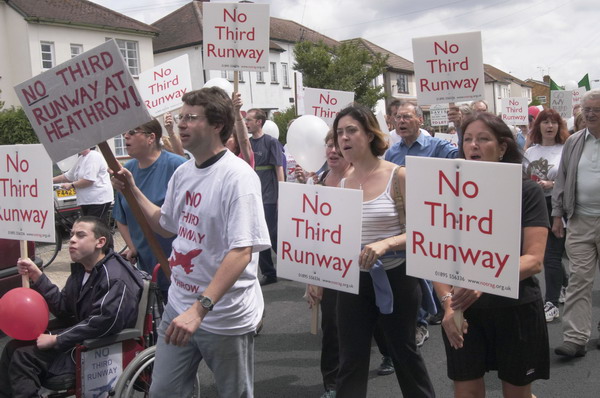
Heathrow from its inception was in the wrong place, too close to built-up areas. Had they been open about the plans it would almost certainly have been turned down as an unsuitable site in the 1940s, but the public – and the authorities – were deceived. Since then, the airport has broken every promise it ever made about expansion, taking over more land, causing more pollution. I supported the efforts to stop T5, marched with the protesters against the third runway in 2003.

No Third Runway (C) 2003, Peter Marshall

Of course it provides a great deal of local employment, but it is still long past the time for a start to be made on running down the activities there, rather than continuing the program of expansion.

So will I be photographing the Heathrow ‘Climate Camp’ set up to the north of the airport yesterday? Regrettably I think not. Despite being entirely in sympathy with the movement’s aims, I can’t stomach the restrictions they have seen fit to impose on photographers and journalists:

Media wanting access to the camp will be invited to come on site between 11 AM and 12 noon. All visits will be over and journalists off site by 1 PM at the latest. Journalists will be given a tour of the site, accompanied at all times by two (or more) members of the media team, who will carry a flag to make the journalists/photographers identifiable. Journalists will be required to stick with the tour and will not be allowed to go into marquees or meetings and workshops unless invited at the agreement of all participants.

These are not conditions I can work under. Such draconian news management isn’t something I want anything to do with. So the camp itself will not get the kind of sympathetic coverage that I might otherwise have provided, and I know many other left photojournalists are equally disappointed. You can read Sion Touhig’s blog and his comments – along with some rather unconvincing attempts to justify the policy. Marc Vallée is there doing his best to cover the event, and I wish him the best of luck. I’ll probably try to cover some of the things happening on the outside later in the week.

The Italian Job

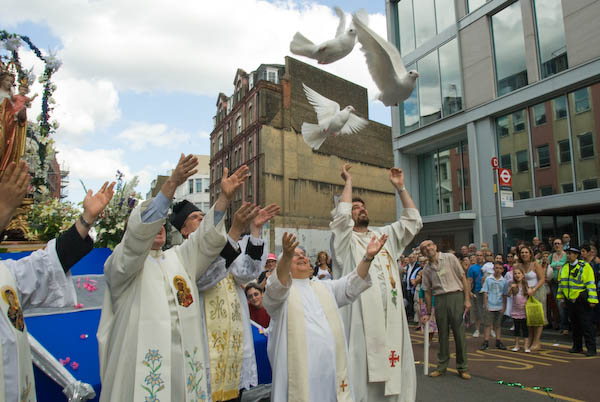
One of the larger community festivals in London takes place every July in Clerkenwell around St Peter’s Italian Church, which holds its Procession in Honour of Our Lady of Mount Carmel, when floats and walkers representing biblical scenes, various associations and banners and the heavy statues from the church are paraded around the neighbourhood, followed by the priests and a large crowd of parishoners.

At the climax of the event, in front of the statue of Our Lady of Mount Carmel, white doves are released and soar up into the air. This year they stopped around long enough to form a rather neat triangle for my image.

(C) 2007, Peter Marshall
Release of the doves, Clerkenwell, July 2007

At extreme left, the statue looks on, while the hands of the priests stretch up into the air, and the crowd behind cranes for a view. I was pleased to get this image, as it’s a tricky and rather unpredictable occasion, with everything happening rather fast.

Saint Veronica is said to be the patron saint of photographers (and laundry workers) as an image of Christ’s face remained on her towel after she wiped him with it as he was on his way to the crucifixion. Her day was a week or so earlier on July 12, but I have to admit I hadn’t prayed to her. But I certainly did a lot of praying on the day, if largely to St Ansel.

Incidentally, despite shooting this on a Nikon D200 which can shoot at 5 fps, I still took this on single shot mode, trusting my reflexes rather than motordrive to catch the precise moment. I’m happier working this way, though I suspect it may be rather less reliable.
It’s actually a great event to photograph, hard not to make some decent portraits, especially of the children. You can see my virtually ball by ball account at My London Diary.

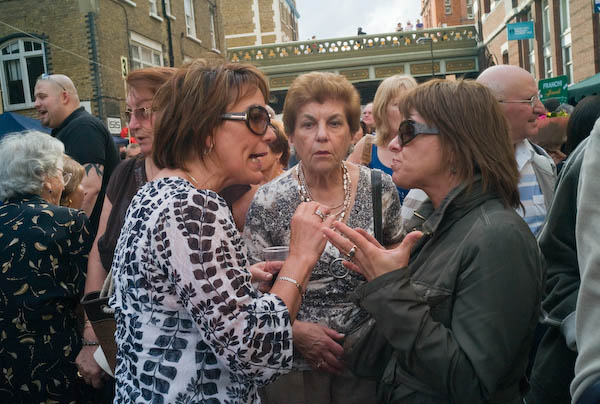
Down in the Sagra or village fair, much Italian wine was being drunk and ice cream and food being eaten and various aspects of Italian culture being celebrated, including the argument. The cheap red wasn’t bad at a pound a cup on what we voted the best stall there.
(C) 2007, Peter Marshall
An animated discussion at the Sagra

Rhubarb Rhubarb: Images now on line

As promised, images from Rhubarb Rhubarb are now on ‘My London Diary‘

(C) 2007, Peter Marshall

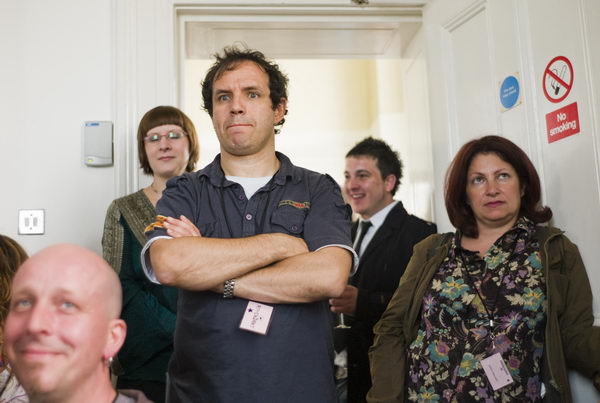
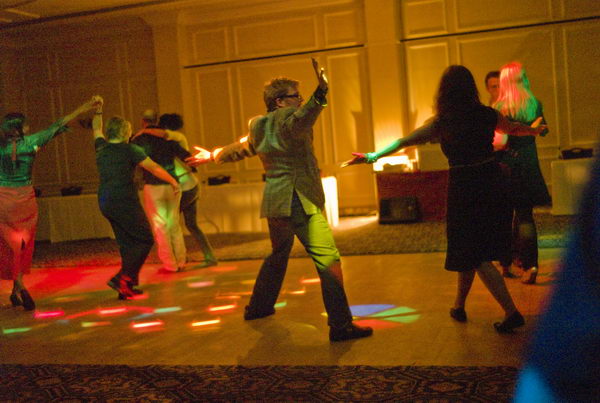
As well as pictures of the main event, from the launch above and the portfolio reviews at Curzon Street Station there are also pictures from the party:

(C) 2007, Peter Marshall

as well as other occasions during the event – such as the mystery trip:

(C) 2007, Peter Marshall

I’ve also included a few images that I took walking around the area.

The pictures were shot on a Leica M8 digital camera, mainly using a 35mm f1.4 lens that Leica say is not compatible with the camera. Equipped with the necessary IR cut filter, and with an appropriate Leica lens code applied to the mount with a black ‘sharpie’ fine point permanent marker, it seems to work perfectly.

The party shots were made wide open working at ISO 2500. Lighting was generally non-existent, with some flashing coloured effect lights, and it would have been pretty impossible to work with film. People were moving quite a lot and with speeds of around 1/30-1/90 I sometimes managed to avoid blur. Thanks to digital I was saved from either having to dance or to go to bed early.

Peter Marshall

England under water

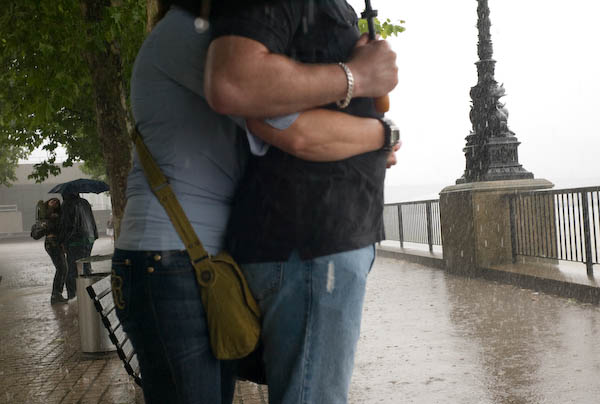
So far I’ve been fortunate to escape the floods that appear to have crippled much of England, though last week I was in Hull and East Yorkshire where around 17,000 homes were damaged in June. In London just over a week ago I sheltered under a tree on the embankment during one of the heaviest rain storms I’ve ever seen; at its worst there was an almost total white-out, with anything further than around 25 metres disappearing from sight.

I’d kept dry under the tree for some time, but when it really came down it offered no protection at all, and the umbrella I put up wasn’t entirely effective either, though it kept the worst off. I was too busy trying to keep dry to take pictures until the worst was over, and even then it was difficult to keep the camera dry.

London (C) 2007, Peter Marshall
I took some pictures when the rain eased off

The floods are moving down river towards where I live at the moment – we have a flood warning in force and its likely we will get flooded. Its 60 years since the house was last flooded, and the levels are said to be a few inches higher than then. So I’m starting moving what I can to the first floor.

28 Seconds

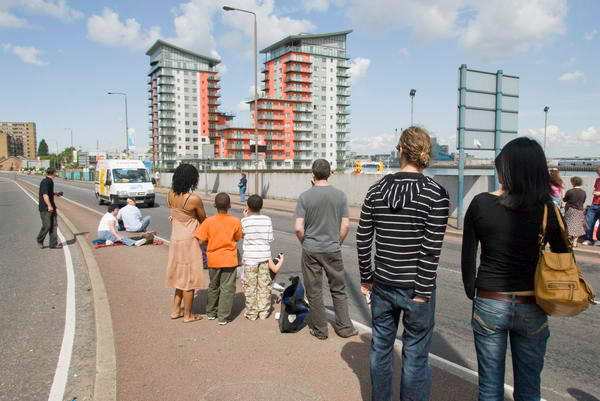
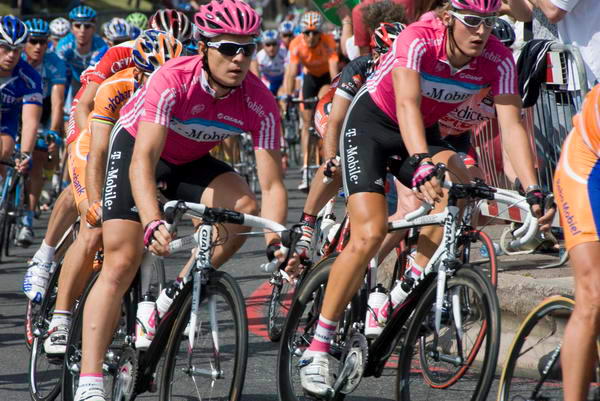
It took 28 seconds from my first view of the cyclists as they rounded the corner some distance down the road until the last of the 189 cyclists had passed me. Last Sunday, the Tour de France started in London, and I thought I shouldn’t entirely miss it. I decided Woolwich would be a good place, just a few miles down the road from the real start of the race in Greenwich.
(C) 2007, Peter Marshall
People had already started to gather along the route when I arrived an hour before the riders. Fortunately it was a fine day and many settled down at the roadside with the Sunday newspapers or a book as the occasional race vehicle drove past.

Finally, along came the pack of riders.

(C) 2007, Peter Marshall
I’m not a sports photographer, and hadn’t really though I’d take more than one or two pictures, but the excitement carried me away a little and I found I’d made around 30 shots – and for the first time ever had managed to fill the 21 shot buffer on the D200. Had I really been intending to take pictures I should have switched from raw to jpeg for the event, and I could have shot many more.

Normally the only time I ever run into buffer problems is when the card is nearly full. The camera won’t allocate more images than it thinks it has space to write to disk, so you can find the buffer will only hold a few images. It usually makes sense to put in a new card whenever you find there are less than 21 shots (the full buffer capacity) left.

Actually it gets a bit silly, as the current Nikon firmware doesn’t attempt to estimate the actual number of shots left if you are using compressed NEF. So it acts like there are only 21 left when in fact you will fit roughly double this number onto the card. It’s a problem that Nikon fixed on the D70 in a firmware upgrade, but which they have left on the later D200.

From the race I went back to the cycling festival in Hyde Park, where there was some more racing (and I took a few more snaps) as well as other related activities.

(C) 2007, Peter Marshall
More pictures coming on My London Dairy

Peter Marshall

Gillian Laub – Testimony

Gillian Laub (b1975, Port Chester, NY) is a New York based photographer who completed a BA in Comparative Literature at the University of Wisconsin before studying photography at the ICP in New York. Her show at the Bonni Benrubi Gallery in New York, An American Life, closes tomorrow, July 7, 2007, and is a series of large colour images that show often intimate moments in the life of her own extended family, in Florida, New York and the suburbs. It’s work that gives an insight into the life of some Americans, and certainly very proficiently done, with several images that I like considerably (Grandpa eating on the beach at Naples, Florida for example) but overall I had a certain feeling of deja-vu, not least because I photographed a very different family some twenty or more years ago with occasionally similar results.

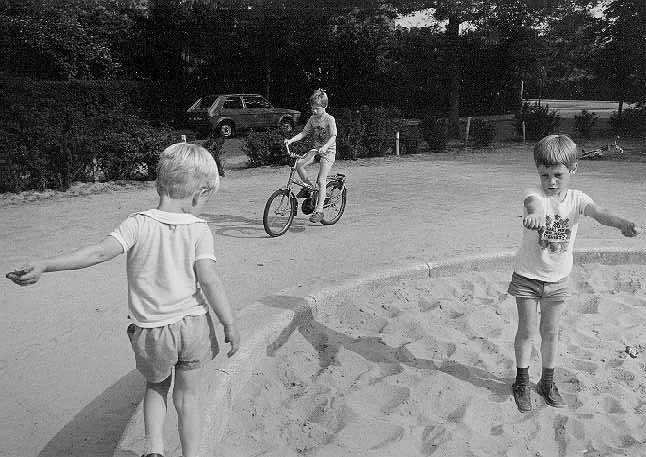
(C) 1982, Peter Marshall
Joseph, Jan Willem & Samuel 1982 © Peter Marshall
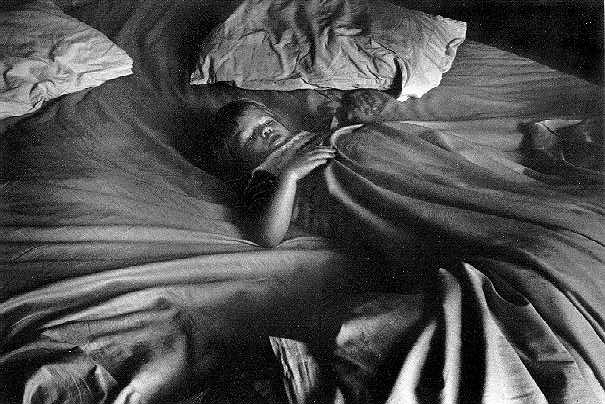
(C) 1977 Peter Marshall
Samuel 1977 © Peter Marshall

Well, families are families, although in some ways it is what is in the background of these pictures that that is of more interest, setting Laub’s particular family in a social context, and perhaps seen most clearly in ‘ Jamie Practicing for the Family, Armonk, NY 2003′.

What I find considerably more interesting than ‘An American Life‘ are Laub’s images from Israel and Palestine, some of which were shown earlier at Bonni Benrubi, and can be seen in the fine PDF portfolio ‘Beyond Wounds‘, as well as on Laub’s own web site. This work, some of which is in her newly published Aperture book, Testimony, seems to be of entirely a different and higher order of magnitude. These images of Israeli Jews, Israeli Arabs, displaced Lebanese families, and Palestinians all caught up in conflict in the region, taken over a four year period have an incredible depth and complexity.

If you are in London next Thursday, 12 July, 2007, you can hear Gillian Laub talking about her book at the Photographers’ Gallery at 6.30pm, followed by a book launch and signing in the Bookshop. It’s a free event, and no booking is needed.

Family Album was the first web site I ever wrote, and is still on the Internet (with some very minor changes to the code.) I also wrote a feature for About.com, Family Pictures at About Photography, which became one of my more popular features on the site. The discussion about the problems of nudity in images of children it contains surprisingly caused some controversy, although only around five years after it was put on line.

Laburnum Street

Even if you’re a Londoner, you probably don’t know Laburnum Street. Haggerston has never been the most glamorous area of Hackney, itself on many measures one of the more deprived areas of the country. Even the artist-led regeneration that has brought Shoreditch, Hoxton, Bethnal Green and elsewhere back onto the map of London hasn’t quite got to Haggerston yet, although there are a few studios around in old industrial buildings.

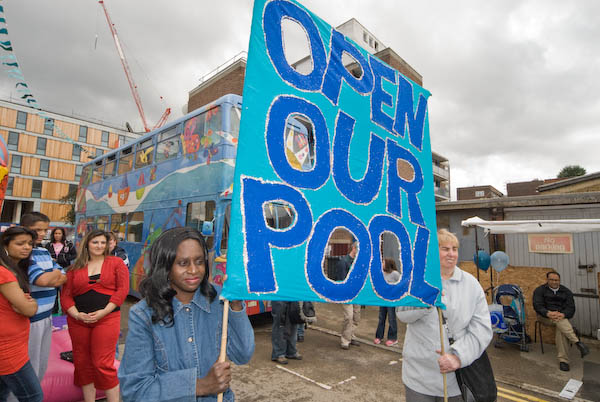
It’s an area with quite a lot going for it. Walking distance from the city. A canal, with an increasing number of desirable waterside properties being built. A new city academy rising. The large Suleymaniye Mosque on the corner. And plenty of other new developments not far away. But for the moment its most interesting features are the lively and very ethnically mixed people who live in the area, and (C) 2007, Peter Marshall, long neglected by Hackney Council, closed without notice in February 2000, and the subject of a lively local campaign to see it re-opened.

(C) 2007, Peter Marshall

The pool is a listed building, and English Heritage want it retained as a pool, as do the locals. Hackney Council have worked on feasibility studies which include a 25 metre pool together with other uses for the west side of the site, and the pool campaign have added their ideas to these proposals through a people’s consultation. The plans for the future are there, but not the £21 million to put them into practice.

(C) 2007, Peter Marshall
This was the only pool open for the street party

The first Laburnum Street Party was organised in 2004 to celebrate the 100th anniversary of the pool, and to raise the profile of the campaign for its re-opening. I went to photograph the third party in 2006, and was pleased to have one of my pictures used as the main image on the flyer, poster and programme for this year’s party.

This year the event was bigger than ever, and attracted more sponsorship. There were around 75 street stalls of various types, including food, bric-a-brac and various informational stands. Two stages with performances of very different types and a childrens street parade, following workshops organised by Lucia Wey of Mush Arts, who I first met photographing the 2004 Shoreditch Parade. Free canal boat trips and various kids activities. So much going on that I could only photograph a small part of it, and was sorry to miss some of the acts I’d been looking forward to.

(C) 2007, Peter Marshall

Of course there were many other photographers there, as well as several film makers, including Dan Edelstyn whose hilarious film (with Hilary Powell) on the Olympics I mentioned here a week or so ago in More than the Olympics.

The weather was fairly kind to us, just a few minutes of heavy showers around lunchtime, and then some sun, and we made hay. Too soon it was time for me to go home.

More pictures from Laburnum Street Party 2007 on My London Diary shortly.

Pride & Climate Change

London carries on, despite the terrorist threat with two car bombs left close to gay nightclubs which fortunately failed to explode early on Friday morning. Saturday’s Pride Parade was much the same as last year, and if there were more police present, it was only noticeable in the several groups of officers actually taking part in the parade.

Despite the publicity and high figures given in the media (which perhaps relate to the whole festival) the Pride parade itself is now a relatively small event, a fraction of the size of the major political marches that make their way through London largely unreported by the press perhaps half a dozen times a year, although considerably more organised and more colourful. It seems to attract considerably fewer marchers than it did a few years back, with many more simply turning up for the events in Trafalgar Square and Soho.

Ten years ago, taking part in the Pride march was an important personal and political statement for many, sometimes marking their going public about their sexuality. Now it’s largely a fun event, although a few individuals and groups still attempt to get a more serious message across.

Much of the event has now settled into a pattern, with many of the same floats and costumes as in previous years, but there are some changes, and I tried to concentrate on these. Its an event where it is hard to get away from the stereotypes, because so many of those taking part embrace them whole-heartedly.
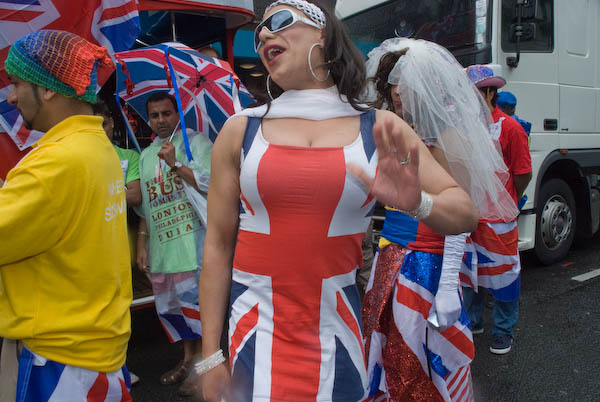
Pride 2007 (C) 2007, Peter Marshall
Many, especially from minority ethnic groups, use Pride as an occasion to stress their British identity as well as their gay identity

I seldom pose people for pictures, but at Pride, everything is a pose. Certainly as soon as people see a camera, most play to it, and its a game you can’t avoid, something you need to work with. Getting below the surface is often a problem, but at least the surface often fascinates.

What was new was ‘Bird Pride’, describing itself as a “Queer Femme Carnival”, organised by the Bird Club, whose aim is to “celebrate femininity on the queer scene”.
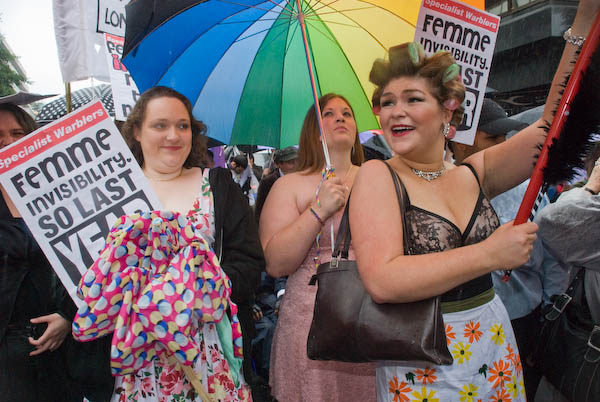
Pride 2007 (C) 2007, Peter Marshall
Bird Club ‘Specialist Warblers – Femme invisibility, so last YEAR’

More pictures from the Pride march on My London Diary shortly.

The two car bombs were on the route of the parade, and there were rumours that it was a badly failed attempt to attack the parade itself, but they didn’t appear to have put the marchers off. The crowds watching the event in Oxford St did seem rather lighter than normal for a Saturday, but this could have been more a matter of the weather, light rain interspersed with heavier downpours, which at times made taking pictures tricky, but some of the best opportunities were in pouring rain.

Photographing in the rain is a problem. In the old days, mechanical cameras such as my old Leica M2 carried on almost whatever hit them, and the standard lens at least had a lenshood that was a fairly effective rain shield. Keeping it under your coat when not in use, and an occasional wipe with a handkerchief kept you going through rain, hail and snow.

Digital cameras are more of a problem. I gave up on the Nikon D70 as unsuitable for London weather, but the D200 is much hardier. My main problems are with lenses. Larger filter sizes, more glass – in zooms in particular – mean more rain drops and more condensation inside lenses with changes in temperature and humidity. Zoom mechanisms pump in damp air, and also draw in moisture from the damp lens barrel. Increasing use of wide angle lenses is also a problem, as their lens hoods offer little or no rain protection – and the same is true of zoom lenses that start at wide angles.

Nikon’s 18-200mm VR lens is a great and very flexible lens, but becomes useless when there is even a hint of moisture in the air. Sensibly, I’d left it at home and was shooting with a Sigma 18-125 which holds up rather better. The Sigma 12-24mm has the problem of a large front element open to raindrops, but if you can keep it clear, also works well in wettish conditions. Handkerchiefs aren’t really a good idea, and in a special, otherwise unused pocket of my jacket I had a large, clean microporous cloth that saw frequent use to wipe both glass and other surfaces of lens and camera.

Sometimes I’ve improvised a plastic cover for camera and lens from a suitable bag, but such things get in the way. But these – or specially made camera rainwear – can keep you shooting in really bad weather. Unfortunately they don’t stop condensation inside the lens, which is often a problem – and all you can really do is wait for it to clear, or change lenses. ‘Pumping’ zoom lenses can sometimes help.

I decided I couldn’t face more rain to photograph the Pride rally in Trafalgar Square or the cabaret performances elsewhere, and in any case I had a mermaid to photograph.
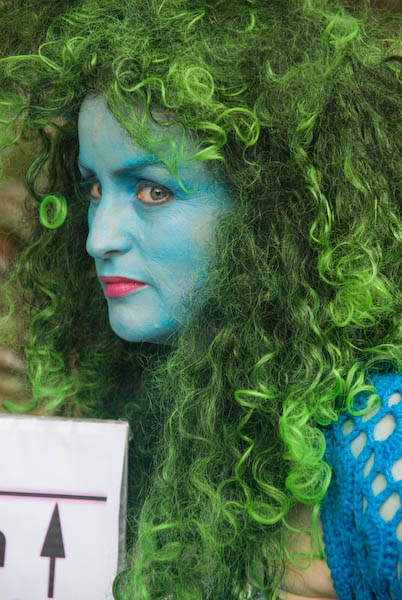
Rising Sea Levels (C) 2007, Peter Marshall
Lucy warns about the perils of global warming – her arrow indicates sea level in 2012

The climate change event was designed as a reminder to Gordon Brown that this is still the most urgent problem we face. Without a planet that is livable on, none of the rest will matter. So far the politicians have largely stayed on the edge of the pool, hanging on to ideas of technology or carbon offsets to avoid taking the real action that is needed, talking about cuts in carbon dioxide emissions while these continue to rise.

Effective action is vital, before it is too late (and we hope it is not yet too late.) Energy saving that means more than turning off the odd light or buying a more fuel-efficient car.

More pictures on My London Diary now for Pride and Climate Change Rally
Peter Marshall
More than the Olympics

Yesterday I was fortunate enough to watch what may well be the best film to be made on the Olympics. ‘The Games‘, a 15 minute colour HDV film from Optimistic Productions by Hilary Powell and Dan Edelstyn is an at times hilarious staging of an alternative and surreal Olympics filmed on the unreconstucted Olympic site, with a hand-picked team of ‘athletes’ taking part in steeplechase, hurdles, synchronised swimming and more. It starts with flaming torches and ends (more or less) with an awards ceremony. Catch it if you can.

We’ve all heard how the London Olympics is to play a vital role in the regeneration of east London, although I don’t think anyone has yet come up with any remotely credible explanation of how shutting off and concreting over large areas of land currently open for recreational use and producing large and largely unwanted sporting facilities is going to help that much.

There may be some limited infrastructure improvements, although much of those were already on board from the Channel Tunnel Rail Link, with its new Stratford International station. Most of the claimed new housing and some other facilities claimed for the Olympic effect were also already on the way as a part of the Stratford City redevelopment, described as “the most ambitious development within the M25.”

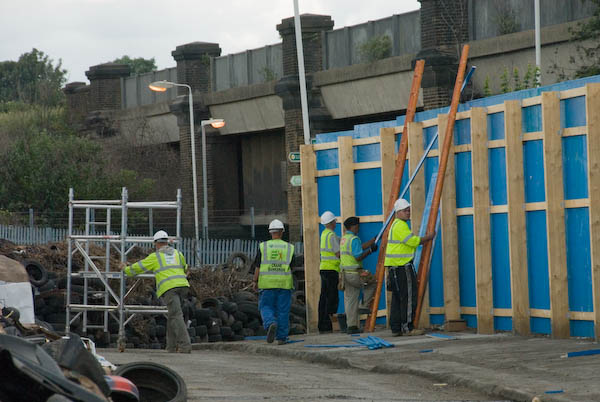
But London 2012 is here and we have to hope for the best, even if it may be madness to expect that to be very much, though we can hope that a few crumbs will fall in appropriate directions. At the moment there is only the pain, as local businesses are forced out of the area and jobs and recreational and sporting facilities are lost, as well as access being restricted. All around the site, high blue fences are being erected to keep us out from July 2. Of course some areas have long been blocked off and well-used paths have already seen lengthy closures for work associated with the games. But the loss of Carpenters Road and Waterden Road in particular will cause considerable local transport problems.


Fences being put up around the Greenway, which should be reopened shortly.

You can see some more pictures from the area taken last Thursday on My London Diary.

Despite all the publicity, the Olympic area is only a small and relatively insignificant part of the regeneration of East London, and a relatively minor contribution to Stratford City. Close by are other large and important projects, in particular at Canning Town and the Royal Docks. The former Pura Foods factory in a loop of the Lea has now been reduced to rubble, and plans for a mixed-use development are close to agreement, with some 1,800 homes, a primary school, shops and more. On the other side of Victoria Dock, planning approval was obtained recently for the Silvertown Quays site, with 5,000 residential units, shops, offices, workspaces, community facilities including a primary school, restaurants and bars and other leisure facilities. This also includes a vast aquarium project, Biota!, in collaboration with London Zoo.

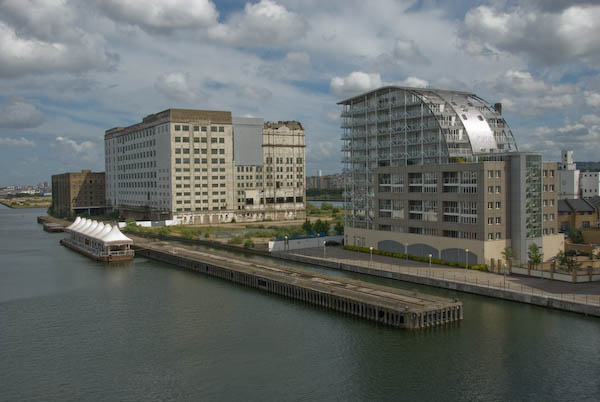
Victoria Dock, SE
Silvertown Quay site and Eastern Quay. The Millenium Mills are to be converted to flats.

West Silvertown already has the Brittania Village development and Eastern Quays, as well as stations on the DLR North Woolwich extension, the Thames Barrier Park and flats at Barrier Point. Two further key sites, Minoco Wharf and Peruvian Wharf are likely to be re-developed before long, although arguments still continue, particularly around the continued industrial use of Peruvian Wharf, and there are more prime riverside sites still to be redeveloped, as well as considerable redevelopment that has already taken place to the east of the Barrier Park, with again more planned.

This afternoon I’m leading a tour around the area, probably in pouring rain. Shortly I’ll post a link to an on-lilne version of this which I hope will encourage others to visit this fast-changing area. It will perhaps take your mind off the Olympics.

Yes, it’s how I saw it

Here is the text of an e-mail I received today, which I will quote anonymously – but otherwise in full:

—————————————————————————–

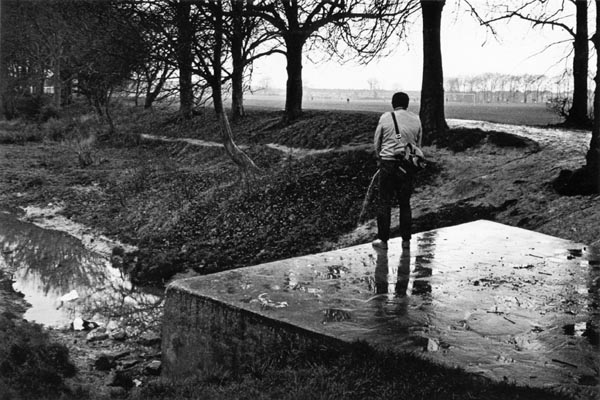
Hi in regard to you site as above, did you realise the pciture of the source of the river has a man who looks like he is relieving himself!! There is an issue of something wet and his arms are held in front, was this deliberate or have you not noticed?! OR is it yourself??

I’m not sure it is appropriate if on purpose, and if not the picture should have been checked!!

Would have been nice if the rubbish was cleared before taking the photograph too!

——————————————————————————

The site in question was named in the subject line. Its full title looks like something like this:

The Lea Valley

London’s Second River – The River Lea (or Lee)

from source to mouth – including the London 2012 Olympic site – photographed by Peter Marshall

and the second picture on the page is:

Source of the River Lea
33d56: The source of the River Lea, Leagrave, near Luton, Bedfordshire.
December 1982.TL 061 248

and is captioned as shown.

What kind of a world does my correspondent live in if he is in any doubt about what this picture shows, or somehow thinks that I might have not noticed what this guy, a few feet from me and the central point of the picture, is doing?

Had Bernard, shown here, informed me of his intentions in advance I might have got the exposure a little better, as the picture is a pig to print, and, before the advent of Photoshop, did need a little ferri to bring out its finer points.

Given the way the stream emerges – or at least did in 1982 – through a grille at the bottom of this concrete block looking far more like a sewage outfall than a sparkling rivulet, his gesture seemed appropriate. As too did the rubbish, which as a matter of good documentary ethics I would not have dreamed of touching,

I don’t often use potassium ferricyanide on prints, but applied on the tip of a fine sable brush here it made the smaller of the two streams stand out more clearly and impressively, leaving I thought no doubt as to what is was. Sometimes our work needs a little help in small ways like this, and so long as what we do is entirely in keeping with the spirit of the event I don’t think it matters.

More often I retouched prints to hide the accidents of photography – dust and scratches, but also occasionally to remove white spots that were actually present in the image. Unless I’m doing a feature on pigeons, then I have no qualms about removing or dulling down the evidence of their existence where it interfered with the reading of the image.

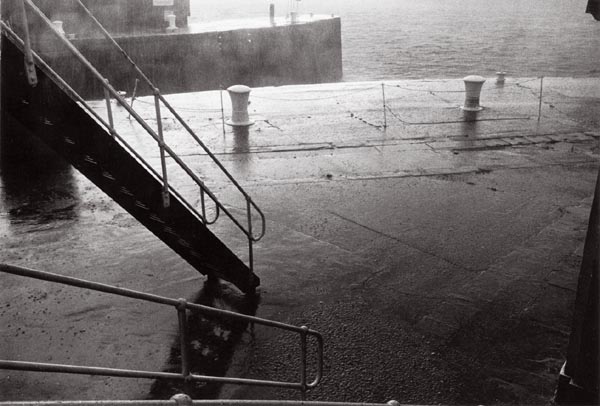
Entirely by fortunate coincidence, it was also pissing down when I started from the Thames at the other end of my journey along the Lea, though this time it was the heavens that had opened rather than Bernard’s fly:

Limehouse
33f33: Regents Canal Dock entrance to River Thames during torrential rain,
October 1982. TQ 363 808

I haven’t finished my Lea Valley web site, although there are a large number of my images on it already, starting from around 1981, and including much of my recent work, but with at the moment around a ten year gap in the middle. At the moment a significant part of the area is about to be radically changed into a giant building site, the location of the London 2012 Olympics, with the loss of significant wildlife habitats (and ironically, sporting facilities including one of London’s largest cycling centres, miles of angling along river and canal and various football and other sports pitches) along with the allotments mentioned here previously.

My pictures do give a good idea of what the area is like and things – both good and bad – that will be lost. I hope to continue photographing the Lea Valley – and my web site – to give an idea of how things have changed in the legacy of the games long after they finish.

Peter Marshall