Climate Change Demo

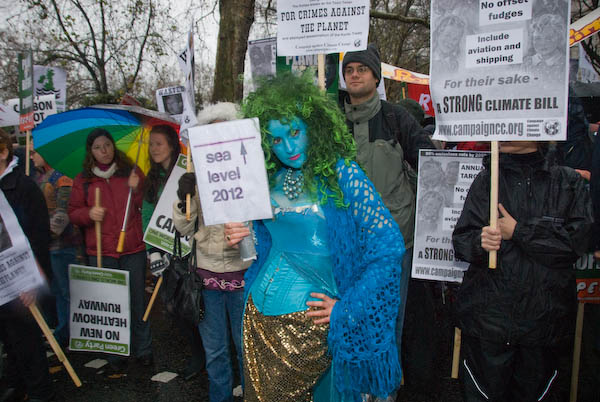
The news from Bali this morning is grim, though there were a couple of glimmers of light, including Kevin Rudd announcing Australia’s acceptance of the Kyoto Protocol. Perhaps there is some hope for those Tasmanian Wedge-Tailed Eagles now, but progress over tackling the bigger issues remains blocked by the USA, Canada and Japan.


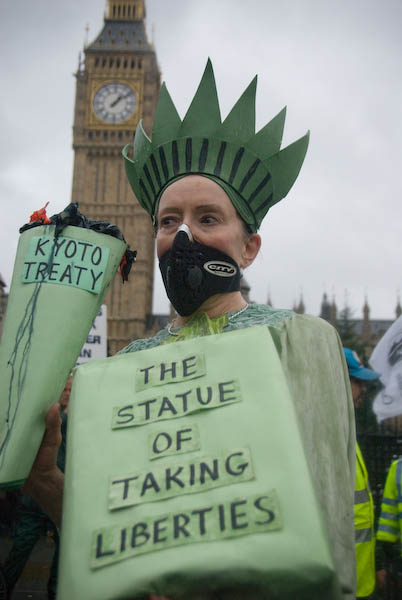
The Statue of Taking Liberties

I’m still wringing out my camera after the London event in the Global Climate Change March on Saturday, which also saw Critical Mass out in force, as well as over 6000 marchers. The guys from Surfers against Sewage, in wet suits and carrying their boards were probably the most appropriately dressed for the occasion, or perhaps Lucy as a mermaid with her warning about rising sea levels.

But, as was emphasized by the number of placards opposing the expansion of Heathrow, our government – like most others around the world – is still sitting  foot firmly down to the floor of the juggernaut, driving hard for extinction even as they start to make noises about the impending doom.

You can see many more pictures of the march, and of critical mass on ‘My London Diary.’  I, and my equipment, got too cold and wet to really do justice to the rally that followed the march in Grosvenor Square.  And of course you can read more about climate change at the Campaign against Climate Change web site.

Demonstrations such as this have a vital role – as I hope to be saying next week in Brasilia, where I will be showing similar images – in bringing environmental problems to public awareness and making it possible for politicians to think what was previously impossible.

And unless they do, it’s increasingly difficult to remain optimistic about the future.

Property Licences – who needs them?

I’ve written several times over the years about property licences.

Basically saying that in general there seems to be no justification for them, either in this country or in the US, although that doesn’t stop some agencies and libraries asking for them, and certainly some clients won’t use your work without one.

I’m not a lawyer, but in the past I’ve read all the legal advice I could find in books and on-line about the issue, and been unable to find anyone suggesting there was a legal basis for the requirement.

One site that I trust more than most is PhotoAttorney, written by Carolyn E. Wright, of Decatur, Georgia and a real expert in US Law as it applies to photography, and this week she has again repeated her position, which goes a little further than mine – and certainly carrys rather more authority – that it is probably “detrimental for photographers to obtain property releases.

Her comment applies to all kinds of property, although where I most often come up against it is photographing buildings. Fortunately I don’t work in the USA, where photographers have to do a little research as architectural historians, since – as it says on the US copyright site, “Copyright protection extends to any architectural work created on or after December 1, 1990.”

In the UK, copyright law specifically exempts buildings, and we can probably photograph almost any building from a public place without worrying about copyright – and generally make use of the images without copyright releases.

There is even apparently no problem when photographing sculptures that can be seen ordinarily from a public place in the UK, although you do need to respect the artist’s moral rights – in terms of attribution and not treating the work in a derogatory fashion, at least if the work is included in more than an incidental fashion.

There are also a few well-recorded pitfalls. If you want to photograph the Eiffel Tower, don’t do it at night, because although the structure can be photographed freely, its lighting is apparently copyright (and copyright is also claimed on some other buildings – including the Louvre and its pyramid.)

However even in France it is likely to be OK to publish pictures so long as your picture is a wider view including other buildings, and copyright laws in some other countries do not recognise the French claim. Well-known properties in London which are claimed to be copyright apparently include the London Eye and the Gherkin . You can read lists including these and other claims on some stock photography sites, such as iStockphoto.

Buildings, particularly in the US, can also be trademarked, which can also put their use off-limits for commercial photography without permission – and examples of these are also given in these lists. At this year’s NUJ Photographers Conference barrister Henry Ward, who specialises in copyright, gave the opinion that this “doesn’t hold water” in the UK (but also gave apparently contradictory advice on the copyright of buildings such as the Gherkin, at least according to the London Freelance feature.)

One problem familiar to UK photographers is the London Transport logo. If this is the point of your picture you may have problems (although probably unless you were actually using the image to promote something transport-related there would be little actual legal case) but it would clearly be unreasonable for any objection to be made if it is incidentally included in your picture taken on a London street.

Back to the PhotoAttorney blog, Wright’s recent posting on property releases is of particular interest, because it recounts a case where the need for these is currently being put to test. The College of Charleston Foundation has taken photographer Benjamin Ham to court over a picture he is offering for sale of some of their trees, accusing him of trespass, invasion of privacy and ‘conversion’ – which appears to mean profiting from the use of college property in his picture.

As Wright points out, some of the claims seem odd, and at least one unsupported by any reference to a specific law, but it does seem as if this may be an important test case for photographers – assuming that it is taken to a conclusion.

However a complication in the case is that the College alleges that the photographer “passed through locked gates” (how?) and ignored signs prohibiting trespass in order to take the picture.

It will be interesting to see whether the case is actually determined by a court, and if so what the decision will be – and I look forward to reading Wright’s comments. However the parties may well come to an agreement out of court.
Bilal Hussein and Press Freedom

If you are a photographer and work in Iraq, you run the risk of being imprisoned by the US military. The Committee to Protect Journalists claim that “dozens of journalists – mostly Iraqis – have been detained by US troops over the last three years.”

They get arrested for photographing or filming things that the US army would prefer not to be recorded. Those we know about were mainly working for major foreign agencies such as Reuters and Agence France-Presse, although I wonder if in fact we only know about these people because they were employed by the agencies. Are there many more we don’t know of?

Most get released without charge after a few days or weeks, but the site lists eight cases of more prolonged detention of up to a year. The details of each case ends with the statement: “Charges Substantiated: None

Of course the best known case is that of Associated Press photographer Bilal Hussein, who has been held for almost 20 months. I’ve previously written about him here (and elsewhere,) and linked to the campaign to free him, urging others to join in the petition to free him.

His case at last came to the Central Criminal Court of Iraq yesterday, 9 Dec 2007, but the magistrate issued an order that everything should be kept secret, so the AP report can only report the bare facts. Although Hussein and his lawyer were allowed to see some of the material presented to the court, they were not allowed to take copies to use to prepare his defence, and no actual charges were made.

Hussein and his lawyer have also not been allowed to talk privately in order to plan a defence; their meetings have been held with a US soldier and military interpreter present.

It is now up to the Iraqi magistrate to decide whether there is any case to answer – and if so, it will be dealt with by a panel of three judges. It isn’t clear how long this will take, and certainly at the moment there are grave doubts about whether if the case does come to trial Hussein and his lawyers will be given the opportunity to prepare a proper defence so that he can get a fair trial.

Here in the UK of course we do things differently, although perhaps not so differently if you read the time-line of the SOCPA antics by police and courts as published on Indymedia. It is news and I think important news that has hardly been covered by the mainstream press.

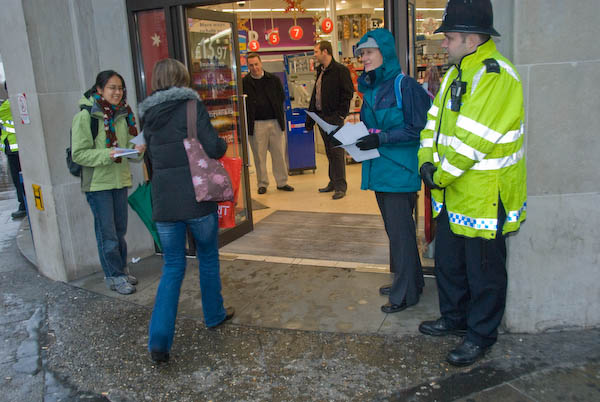
One thing that gives photographers (and videographers) covering events such as these on our streets a little – if limited – protection is the UK Press Card. It isn’t perfect, but it does at least sometimes mean that photographers will get treated as reporters rather than as protesters. This Saturday, photographing a picket at Tesco Metro in Lower Regent Street, I would quite likely have been arrested for refusing to go into a pen when told to do so by a police officer if I hadn’t been able to show my card.


Picket against Tesco support for bio-fuels, London, Dec 8, 2007

Strangely enough, most of the times when I’ve really needed a press card have been at small events – like that picket – where the mainstream press aren’t interested and none of the photographers working for them cover.

I photograph them – as do others – because we think it important in terms of freedom of the individual, freedom of expression and a genuinely free press that such things should be recorded and published – even if only non-commercial media – such as Indymedia – are prepared to do so. Most of us also make some money out of such pictures through their use in small publications and as stock. Not a great deal, but with luck enough to make ends meet, at least along with the occasional more lucrative jobs.

Some news photographers are scheming to severely limit the issue of press cards, basically to guys like them working more or less full-time for the big newspapers. It is a change the police would welcome as making their job considerably easier, but which would severely curtail the wider freedom of the press.

Peter Marshall 

Make a fortune from copying

If I were Jim Krantz I’d be talking to a lawyer.

In 2005, of his pictures sold for $1.2 million and he didn’t get a cent. Not even a name check. Trousering the big money is Richard Prince, an acclaimed artist, whose contribution was to copy and enlarge Krantz’s image, taken as a Marlborough ad – and apparently – if the reproductions on Art Knowledge News and the New York Times are reliable (Randy Kennedy’s article appears in both), add a colour cast.

Of course the whole thing is an incredible admission of a total aridity in the art world, and of course the total lack of appreciation of photography – Prince is quoted as once sending an e-mail saying “I never associated advertisements with having an author.” What phenomenal ignorance and arrogance.

Krantz of course is such a successful commercial photographer that he doesn’t need the money, and what he is really concerned about is “attribution and recognition.” But I’d certainly like to see him take Prince to the cleaners.

And I’d like to see all the art critics and increasingly photography critics who for some odd reason feel that Prince’s work is worth writing about to acknowledge that what they are really writing about is work by other people – just blown up large.

I’ve written previously about the importance of moral rights. This is a good example that makes the case.

You can also see Jim Krantz’s ‘art work‘ on line. Not entirely my kind of thing, but more interesting than Prince.

Big Sister

Although it’s the pictures taken in a Prague on-line brothel in ‘Big Sister‘ by Czech photographer Hana Jakrlova that are attracting most attention (my favourite is a polar room set with roofless igloo and large polar bear,  otherwise vacant) I think the best work on her site are the black and white images, particularly in her ‘Europe’ portfolio.

I’ve not previously come across the idea of an on-line brothel, but apparently it is yet another case of de-professionalisation, this time of the porn industry, where male performers now actually pay while punters watch over the internet. At least as yet photographers are only expected to work for nothing rather than pay for the privilege.

Jakrlova was born in Brno 1969, and studied architecture for 7 years in Prague, then two years at the Institute of Creative Photography in Opava. Later she did a year at the ICP in New York. She has lived in London, Paris and New York, and now works from both Prague and New York.

On the website you can also preview her two books, in the meantime: europe (2006) and the rather more conventional ways of communication (2000.) It’s a shame that this actually seems to be the only way that either of these two books are generally available, although a Dutch version  of the later book is listed.

Peter Marshall

Cruel Fur

Like many people, I thought fur was a thing of the past, remembering those old ladies who came to admire me in pram and pushchair, moth-bitten foxes around their necks, pungent with lavender and mothballs and worse. Later came the campaigns against fashion furs that meant that only the most thick-skinned of dumb animals would be seen alive in another’s coat because of the extreme cruelty across the whole industry.

It was this well-documented cruelty that led to the closure and banning of fur farms in the UK, but in other countries they remain alive and even more sick. I’m not a veggie but I am opposed to cruelty against animals (and wish that all farm production reached the standards of the best.)

So it disgusts me to hear that the big names in fashion and fashion shops are promoting the use of real fur trimming on their garments, and that these are on sale in shops in this country – and that it is perfectly legal to sell these cruelly-produced products. It’s a particularly stupid and callous trade, particularly stupid because in almost all ways the artificial alternatives look and perform better than animal skins. Anyone buying them is paying to wear a badge of cruelty.

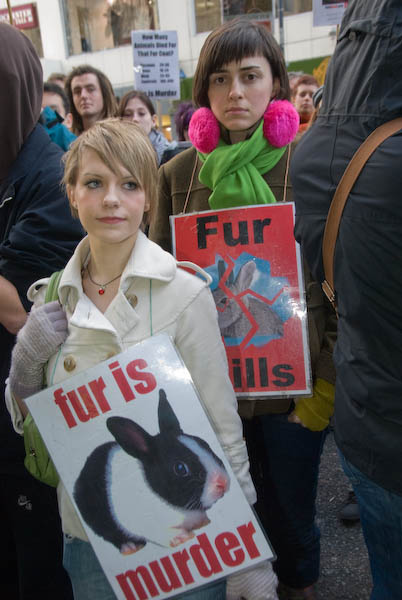
Around 250 people joined a march on Saturday past some of the shops selling these tainted goods in Knightsbridge. The march paused briefly outside several shops before halting outside Harrods, apparently the only department store in the UK that still deals in furs, and where there is a regular picket every Saturday. After a brief address and many shouts of “Shame on Harrods”, there was a minute of silence before the march moved on, and I left them.


Outside Harrods in Brompton Road, Knightsbridge.

Surely it’s time the Government made time to ban this trade. It is one piece of legislation which would gain approval from the great majority of the British public and the kind of measure which would provide a sadly needed increase in their support.

Peter Marshall

Christmas comes early…

Christmas comes early in Surrey and doubtless everywhere else. So far I’ve photographed three Christmas events on the south-west fringes of London (and am wondering whether I can fit another in this evening.)

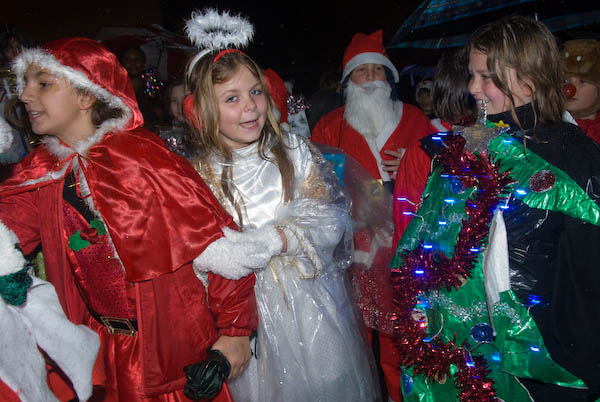
They switched the Christmas lights on in New Malden on 23 Nov, and it was Winter Wonderland in Wimbledon last Thursday. Friday night it was pouring with rain, but the Hampton Hill Christmas Parade went ahead as usual – if rather wetter.

I don’t much like working in the dark or in the rain, and struggling with an umbrella and a recalcitrant camera and flash made me wish I’d stayed in the pub. But all the performers in the parade were out there, mostly getting soaked, so I felt I ought to stick at it too.

Here’s one that I rather liked, and may get on my Christmas card.

Peter Marshall

Positive Lives

December 1 is World AIDS Day, with thousands of events taking place around the world to encourage leadership at all levels in the fight to get ahead of AIDS.

One of the major photographic projects about HIV/AIDS is Positive Lives, which includes the work of around 30 photographers with stories from around much of the world. One of those stories was by Stuart Freedman, and you can see more work from it on the Panos Pictures site (as well as some other fine essays by him.) Facing the Virus (click on the image there to see two pages of images) shows people in Rwanda working as a part of a programme with the government’s health authority and Concern, an Irish-registered worldwide charity facing up to the problems of living with HIV/AIDS.

Freedman’s work, which won him the prize for photojournalism at the 15th annual Amnesty International Media Awards in 2006, is one of many fine features on the Panos site by some of the best photojournalists currently working. You can also find work by this year’s winner, Andrew Testa, on the site, although his work, on Acid Attacks in Bangladesh, appeared in Foto 8, a magazine that has featured a great deal of fine photography and is currently relaunching.

Photo Histories

Some months ago, Graham Harrison contacted me about a new on-line photography site he was setting up, looking at photography in an intelligent way, and invited me to have a look at the preview site. I was impressed, and offered to write something, though as yet I’ve not got around to it. Perhaps later…

Photo Histories is now up for all to read, and the content so far is impressive, with a great interview with Philip Jones Griffiths, who talks about “why the ideals of the thinking photojournalist forged in the 20th century should not be sacrificed for the dumbed down culture of the 21st.” His ‘Vietnam Inc’ (1971) was one of the most important books of the era, and one that moved me and others powerfully when it came out – and is still a fine example of why photojournalism is important. I also have a great deal of sympathy for his views on the current state of Magnum which you can read in the interview. While others – including myself – have written about his work and its significance, this interview does add some insights into the work and the man who produced it – and has a nice picture of him by Harrison.

Another photographer I’ve also written about previously is Homer Sykes, whose self-published books Hunting with Hounds and On the Road Again I reviewed at some length. (You can download a pdf file of the Autumn 2002 issue of the LIP Journal where my review of On the Road Again appeared in print – and both – along with features on photographers Berenice Abbot and Brassai mentioned below – are probably available on the ‘Wayback Machine‘ or its mirror from About Photography.)

In Photo Histories there is another detailed interview with Sykes, as well as a interesting set of pictures ‘Unknown Homer Sykes : The English 1968 – 78‘.

I met Homer again earlier this year, when he was back photographing Swan Upping on the Thames for the first time for many years. You can see some of my pictures from the event at My London Diary, but surprisingly I don’t seem to have mentioned him. The two of us were the only photographers who ran along the river bank to record the Dyers and Vintners men raising their oars to salute the Royal uppers at the end of the day. I hope he got the exposure better than I did in the wickedly contrasting light. I left the D200 to sort it out and it didn’t.

Other features on Photo Histories include some on key books from the history of photography, including Berenice Abbott‘s ‘Changing New York‘ and ‘Paris de Nuit‘ with pictures by Brassai. Perhaps these were a little disappointing in not really dealing with the images, more with biography and background matters, but still useful introductions. Perhaps it might be a useful addition to have features about key images or sets of images from them as well.

Graham Harrison has of course worked for some of the big names in British publishing, and at the centre of Photo Histories is a section called by that same title, which includes an article (originally published on EPUK) about the first Press Photographer’s Year Expo held this summer. At the end is a footnote:

After the success of the Press Photographer’s Year Expo it was sobering to see Stoddart’s stills used with effect throughout the C4 TV documentary The Rise and Fall of Tony Blair credited to Getty Images only.

Moral rights – including that of attribution – are something that photographers still have to fight for. The Photo Histories section also has a very nice insider story by Brian Harris about working with the late Don McPhee during the 1988 US Presidential campaign.

As well as his main site, you can also see more of Graham Harrison’s work in ‘The Oxford Year,’ though in the two years this has been going he seems so far to have missed those swan uppers!

Nikon D3 or D300?

Yesterday I went along to the Nikon show at Olympia to play with their two new cameras, the D3 and D300. Both seem decent models, though I’m not sure if I will buy either. After all the D200 is still working pretty well. I only bothered to go there because I wanted to go to a London Bloggers meet in the evening, so it was sort of on the way.

There are some nice things about the D300, in particular the even better screen on the back, and the few images I took at high ISO perhaps seemed a little more usable than with the D200. I’d certainly be a little happier with shooting at ISO1600, though I’m not clear whether the difference is really anything more than more aggressive noise reduction in the D300. The test shots I’ve seen – unlike mine, taken under carefully controlled conditions – on Imaging Resource do seem to show less noise on the D300 image at 1600 than at 800, together with reduced noise and sharpness, suggesting a sharp ramp in noise reduction.

However I didn’t shoot on RAW, but only on fine jpeg, and also hadn’t made all the tweaks I would certainly want to do when using the camera. Detailed reviews may appear shortly, at the moment all we really have to go on is the published specs and some fairly ill-informed comment – including that on at least one site where the author has been using a camera for a few days.

Moving from a D200 to a D300 would be relatively simple, with many of the controls in similar places, and the camera has the same feeling of having controls in the right place. As well as the larger screen, I’d certainly welcome the improved focus system, which is the same as in the D3. Possibly the ability to record 14 bits instead of 12 may also help in high contrast situations.

I took a few frames on the D3 too, with the ISO set to 5000, again as jpegs (I wasn’t sure if my raw processing would work with the RAW files from the cameras.) Lousy subject matter, but – at least where I got the focus correct – technically very usable images. I really needed rather longer to get used to the camera, and the menus seemed rather confusing compared to the D200, though I’m sure I’d soon cope.

So would I like one? I’m not sure. It’s a great camera but I think too large and heavy for me. I’m often using a camera more or less all the time for perhaps 5 or 6 hours at a stretch, and I’m not sure my shoulders or right wrist would cope with the extra heft. The Nikon D200 and D300 both weight around 830g while the D3 is 1240g, half as much again. Of course the difference in practice is a little less obvious, as I’d normally have perhaps 600g of lens fitted to any of the bodies.

I’m not going to rush out and buy either – particularly as the D3 in particular is likely to be in very short supply for a while. Despite the cost and size issues, it’s still the one I’m more inclined to seriously consider. And it would cost. As well as D3 itself costing well over twice as much as the D300, I’d also need a new lens to replace the 18-200 which only covers the DX format, as well as possibly wanting to replace my current Sigma 12-24 (which does cover full frame) with the new Nikon 14-24 f2.8….

It might be easier to just go back to using film!