Green Fayre at Aylesbury

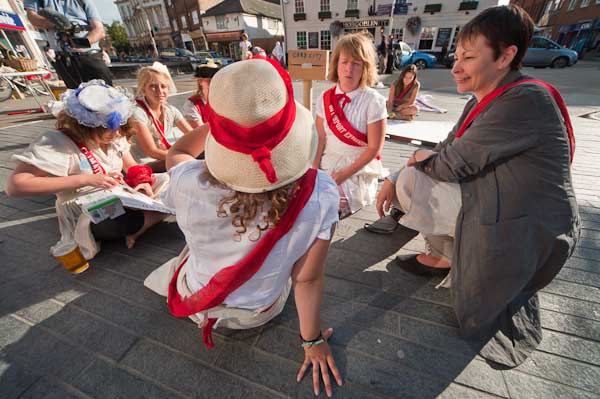
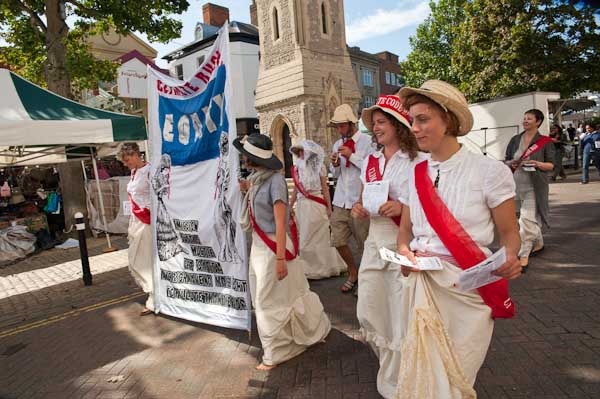
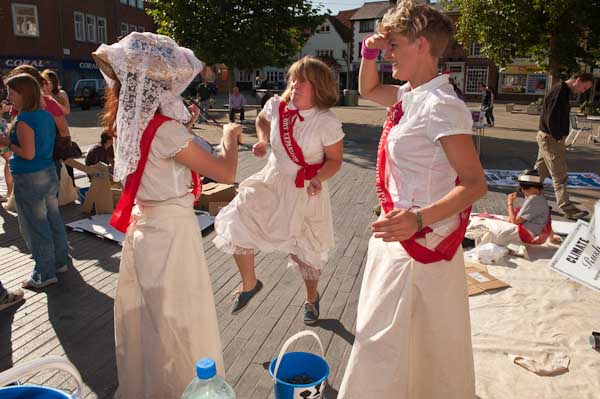
It was a lovely warm late summer afternoon in Aylesbury, quite idyllic and with the young women from the Climate Rush in their long white Edwardian-style dress and a TV personality and a Euro MP thrown in it should have been a good photo opportunity.

© 2009 Peter Marshall.

But somehow it didn’t work out quite as well as I’d hoped, although a few pictures aren’t bad, and they make quite a nice set of images of the event – perhaps with a suitable soundtrack. But no really interesting single images. Perhaps there wasn’t quite enough happening, the lowish sun was a bit too harsh and flare was a problem on quite a few images.

© 2009 Peter Marshall

Plenty of pictures that show the people, show the event, but lack the magic. Perhaps it was the spell of Aylesbury, which seems the kind of small town where not a lot happens (though the plums were nice.)  Or perhaps I was expecting too much.

© 2009 Peter Marshall.

The pictures aren’t bad, just somehow it was such a nice day and I expected more.

Most of the time I was using the 24-70mm Sigma, though the above picture with Caroline Lucas sitting with a group of the Climate Rushers was taken with the 12-24mm Sigma.  Really this is just a little too extreme for most things and something like a 16-35mm would be much more useful. Also having a bit of overlap in focal lengths between lenses would help to cut down on lens changes.

Lots of pictures on My London Diary .

Taken in London

You are invited  to the opening of this show on Thursday  8 Oct, 6.30-8.30pm

Photographs by Paul Baldesare and Peter Marshall

Shoreditch Gallery

The Juggler, 5 Hoxton Market,  London, N1 6HG
3 Oct- 31 Oct 2009, weekdays 8-6 : Sat10-4 : closed Sun

The show is a part of Photomonth 2009,  the East London photography festival and the This Is Not A Gateway Festival 2009

Website:  http://takeninlondon.co.uk/

London still has a claim to be the greatest city in the world and it is still the most photographed of all cities. The key area of all cities is the street, where people walk, congregate, shop and meet, and both Marshall and Baldesare come out of the tradition of street photography and concentrate on the life of ordinary people – who are often extraordinary on those streets.

For Baldesare, trade defines the city, and his work concentrates on the shopping streets – particularly Oxford St, the hub of consumerism – and markets. The people on whom he concentrates are very much surrounded by advertising hoardings, window displays and other blandishments of the consumer society. But it is the people themselves who remain important, retain their individuality and autonomy despite their sometimes overpowering surroundings. Their gestures, body language and expressions are the stuff of these images, which often show a surprising intimacy in these very public places.

Marshall‘s work looks at the city as an arena for politics, reflecting local, national or international issues on the streets of London. His ‘My London Diary’ from which these images are taken is a unique record, published on the Internet, a highly individual cross-section of political and cultural life across the capital. It is a work that owes its existence to the Internet, and an attempt to exploit some of the properties of the medium particularly in presenting the work back to those that he photographs. By May 2009 there were 40,000 images in this on-line archive.

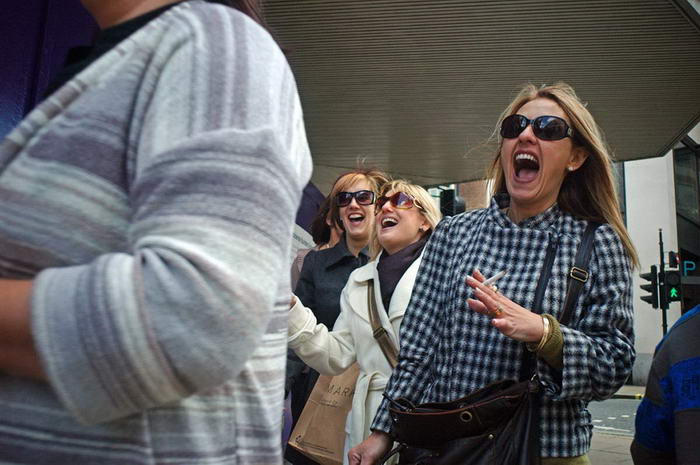
Paul Baldesare: Woman with cigarette, Debenhams

© 2009, Paul Baldesare

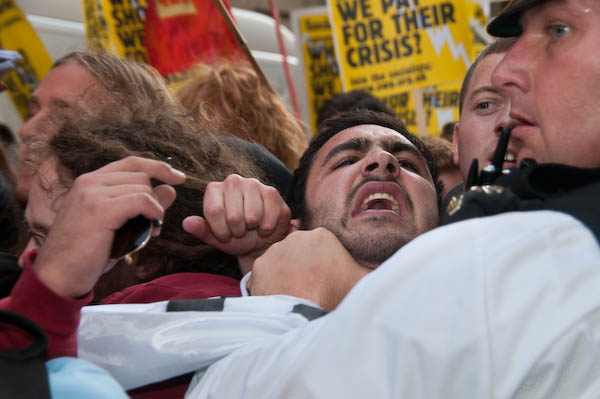
Peter Marshall: March on the City, Oct 2008

© 2008 Peter Marshall

Lightroom 2.5

There don’t appear to be any great differences in the latest release of Lightroom,  available for download as a free upgrade for existing users. And although I took the usual precaution of backing up my Lightroom catalogue (which takes ages) the actual install was pretty fast and trouble-free and so far I’ve experienced no problems.

A few things do seem to be working a little more smoothly and I suspect there have been a number of minor bug-fixes and some tidying up of code. And of course there will be a  number of people with shiny new cameras who will be pleased that these are now supported by the new version.

I’ve finally got round to buying a book on Lightroom, and Seth Resnick’s “The Photoshop Lightroom Workbook: Workflow not Workslow in Lightroom 2” seems to be very good, unlike some other volumes I’ve seen. Lots of good common sense suggestions about using the software and the settings to choose, most of which are similar to what I currently do, but even though I’ve not yet really had time to sit down and make use of it I’ve already picked up a few good hints.

It’s very good for example at reminding you of the useful keyboard hints, that are easy to forget. So in the Develop module, hitting G takes you back to the Library module in Grid mode, and Shift/Tab gets rid of the clutter (or F toggles full-screen.)

I’m sure there will be some things I prefer to do my own way, but this seems really to be a real practical photographers guide while some of the others are definitely more for geeks who like fiddling with software. At £15 (-1p) from Amazon I think it’s well worth it – and I just need the time to go into it in more depth. And I really must get my keywords organised better as it suggests.

It’s only slight fault is that it assumes you have a Mac and although it often gives instructions for PC (and where necessary notes Vista and XP differences)  you do sometimes have to do a little translation for yourself. Of course there are some photographers for whom this will be an advantage. I’ve just looked at the reader reviews on Amazon when I searched for the link above – and one does mention this, and a certain Canon bias – which so far I’ve not really noticed, but all three give it five stars and so far I’d agree.

Lens Culture Latest

It’s always worth a visit when a new edition of Lensculture goes on line and the latest is no exception. Not that I find everything on it of interest, one of its attractions is its eclectic nature.

Among the pieces I think particularly worth looking at are Reinaldo Loureiro‘s precise and often almost symmetric square images of “the social and economic landscape of the Spanish greenhouse plains of Almeria” in his ‘Out of Season‘ and Edmund Clark‘s very different but equally precise ‘If the Light Goes Out: Home from Guantanamo‘ which finds something very new to say about this blot on the conscience of that part of America that still has one. Clark’s work is in three parts in a deliberately disjointed edit which jumps between the home of the American community in the naval basem the camps where the detainees have been held and the homes where former detainees are trying to rebuild their lives. You can see more of Clark’s work on his web site and read my post about his earlier book Still Life: Killing Time.

Another pleasant surprise was the work of Ara Güler (born 1928 in Istanbul, of Armenian descent), the leading Turkish photographer of his generation. After his military service he began work for a Turkish magazine in the early 1950s and began working for Time-Life in 1956 and Paris Match and Stern in 1958. During this period he met Henri Cartier-Bresson and became a member of Magnum. A search under “Ara Guler” on the Magnum web site returns over 500 images by him as well as 4 pictures of him by James A Fox (at the bottom of the last page.)

In 2009 he received the award for lifetime achievement in the Lucie Awards.  Although I remember seeing some of his pictures before, I have to admit that I had forgotten all about this photographer and it was good to see the work again.  There is an 8 minute video of his work on YouTube, and some details of his life on Turkish Culture.

Another Magnum photographer in this issue of Lensculture is considerably better-known to me. There are only  half a dozen images from the latest book,  In Whose Name? by Abbas on Lensculture, but you can of course see more of his work at Magnum.

These for me were among the the highlights, and there are some more great things (including Dana Popa who I’ve already written about) as well as just a few things I found lacked interest, but you may well have different tastes. But as always it’s certainly worth looking at Lensculture.

Dana Popa and Vanessa Winship

You still have just a few days to see Not Natasha – Dana Popa at Photofusion – where it closes September 18.  And you can now read an extended interview with her by on Conscientious.

On the same site yesterday he posted A Conversation with Vanessa Winship, another photographer whose work I’ve written about previously on this site – Sweet Nothings – Vanessa Winship – which appeared here when her work was on show at Host Gallery in London in February.  You can see more of her work on her own site.

Both pieces are worth reading, and it’s good to see these two photographers getting wider coverage.

Willy Ronis Dies Aged 99

I was saddened to learn from Jim Casper of Lensculture that Willy Ronis died today, September 12, 2009, aged 99.

I met Willy Ronis in 2003 when he came to talk about his work in London, but didn’t have time to have more than a short conversation with him. But his talk was a fine introduction to his work, which I’d only really seen in isolated images before, and made me feel that his was a much more important and vital view of everyday life in Paris than that of some better-known photographers.  And in a way I got to know him better last year on my trip to Paris in November, when I picked up a copy of his La Traversée de Belleville at the Bar Floréal and followed in his footsteps only to find that his favourite stroll in Paris covered ground that was very familiar to me from a number of earlier visits.

Of course I knew from my extended essay on him in 2003 that his work centred on Belleville and Menilmontant. For contractual reasons I can’t post that essay as I wrote it, but here is a revised version of the first of five sections.

Willy Ronis was one of a small group of photographers whose pictures gave us an image of post-war Paris in the 1950s that still dominates our imagination of that city. With Doisneau, Izis, Cartier-Bresson, Boubat and others his work created a vision of this city that was very much an image of its people. His particular viewpoint was dominated by ordinary working class men and women and life outside the bright lights and the grand boulevards. Ronis photographed ordinary daily life and found in it the extraordinary.

Paris is a hilly city, with many sets of steps joining streets providing short cuts for pedestrians. In 1949 he stood looking down one of these leading to and across Avenue Simon Bolivar. As he stood there considering the view, behind him he heard the sound of a woman talking to a child, and waited for her to fill the empty space below on the steps in his view. As she came to the main road, a heavy cart pulled by a large white horse came across, as on the other side of the road a workman was climbing a ladder. Two women pushed prams carefully spaced on the opposite side of the street, and in front of one of the small shops to the right, a cobbler in a white apron stands talking to a customer. This is any day in working –class Paris at the time, ordinary people, ordinary lives, but also a magical image, arranged perfectly both in the frame of Ronis’s camera and the shapes of the steps and the street.

Ronis called Bruegel his master of composition, and this picture, perhaps more than any other, shows his debt that great painter, one of many Dutch masters of the the 16th and 17th centuries who Ronis admired in the Louvre on his day off – Sunday – when admission to the museums was free.

The scene he captured in the fleeting fraction of a second of this image has a wonderful precision but is also a miraculous creation of chance. Henri Cartier-Bresson, lauded as the master of ‘the decisive moment’, seldom achieved anything with the grace and complexity of this image. Ronis talked about his being always open to failure, photographing on the thread of chance, and this picture shows how he was open to experience and ready at the instant to attempt to snap up the opportunities it offers.

Like  Cartier-Bresson, many of his moments are the result of anticipation, of identifying a possibly fruitful situation and waiting for events to develop – or not.  Sitting waiting in a café, looking out through a window waiting for someone to come into the frame of street in its bottom right, or standing on the street at the crossing of Rue Sèvres and Rue Babylone in Paris in 1959, the sun setting in a misty distance, a shop awning creating a dramatic silhouette pointing to the street crossing beyond. Ronis waited until a sole figure was making her last-minute dash across the road, a woman in a long coat, and caught her motion just where the sinister shape above her in the picture seems to be pointing.

This sense of a moment caught in motion, a dynamic that enlivens them is common to many of Ronis’s pictures. They have a sense of life caught on the hoof that is not found in the more choreographed images of photographers such as Brassai or Brandt. He worked with similar equipment – the 120 format Rolleiflex he bought by instalments in 1937 – and worked largely on the streets with available light, observing and captureing the life he saw. In contrast, Brassai needed to set up his shots – ‘mise en scène‘ or staging of the action – working as a director as well as a photographer so that he could make use of unsynchronised flash.

I hope to publish a revised version of the rest of this essay at a later date.  One site with a nice collection of 14 of his images – including those mentioned above –  is AfterImage.

Harbutt in Visura

Charles Harbutt has long been one of my favourite photographers – his book Travelog (1973) was one of the first real photography books I bought, and it was truly inspiring. His workshops have altered the lives of many, including the late Peter Goldfield – who was led to set up his place for photographic workshops at Duckspool in the west country, and it was to there that I went in the 1990s and got my own taste of the Harbutt workshop experience. By then it was perhaps a little too late to change my own life, but I could certainly see how it had been such an important experience for Peter.

So it was good to get an e-mail telling me that the latest issue of the on-line magazine Visura featured a portfolio of his work – and for anyone not familiar with it, I think it’s a good place to start, although Harbutt also has his own  web site. One thing definitely not to be missed on that is an interview of him by Joe Cuomo, and of course the pictures!

It’s a shame that the link on his site to the short piece I wrote about him on ‘About.com‘ no longer works, although in truth it wasn’t one of my better efforts. I described him as “one of many leading photojournalists to be a distinguished ex-member of Magnum” (he joined in 1963 and was twice its President) and as “leaving to fulfil his more personal interests in photography when he felt it was abandoning its traditions and becoming too commercial in 1981” as well as giving links to his work then available on the web. One article by him I’d recommend is his I Don’t Take Pictures; Pictures Take Me.

Visura Magazine has plenty of other good things too – well worth exploring this issue and the archive – though some links are a little slow to load.

Climate Rush on the Run

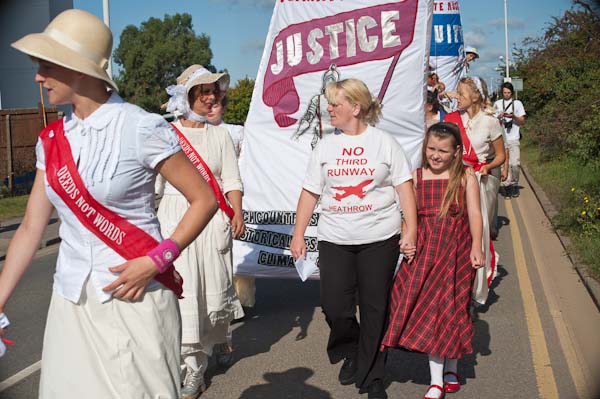
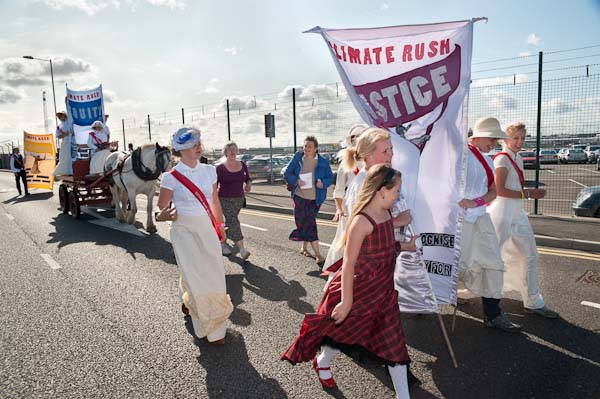
Friday was a beautiful day in London, sun and nice clouds in the sky, but with quite a breeze so it didn’t get hot. I got on my bike around 9 o’clock to cycle to Sipson to meet the Climate Rush who were camping on the Airplot there, for a “photo opportunity” at the start of their month long tour around the South West – which will take them around 250 miles on foot and horse and cart to Totnes, with many stops on the way to educate and campaign through the country.  The Rushers in their white suffragette-style long dresses and red sashes were to take a trip to the perimeter fence of London’s main airport along with local residents from NoTRAG, the action group opposed to expansion of Heathrow – and in particular a third runway that would mean demolishing their homes.

© 2009 Peter Marshall

As expected, there were several other photographers there, mainly from agencies and a couple people making videos, which is rather more than most small demonstrations attract.  The rushers – and Tamsin Omond in particular – have gained a little of the only thing most of the media are interested in now, celebrity. Although I tend to feel it’s unhealthy to pander to the press like this, it is effective, and certainly I find them more interesting to photograph than many demonstrators. It also helps that they want to be photographed – quite a change after some (fortunately not all) Climate Campers.

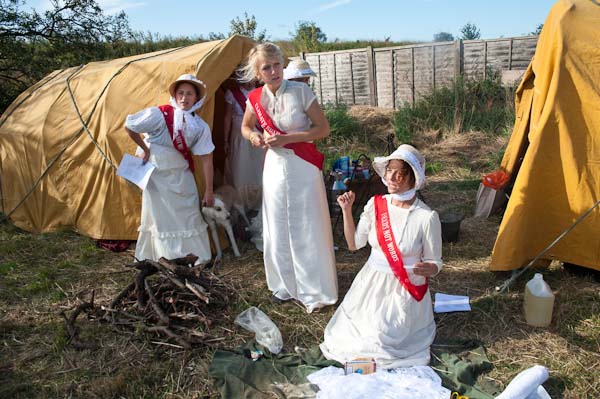
Sipson is pretty rural, and the Airplot, as well as its own small allotment –  raised beds of vegetables – has fruit trees around its edge, the remains of an orchard. Much of the site for Heathrow – the old Middlesex village of Heath Row – was covered with orchards, and the rest with fields of crops. Before the airport it had been one of the most productive agricultural areas of the country since cultivation began here, perhaps 5000 years ago. Add some horse, a couple of wagons, a wood fire with a kettle hanging from a hook above it, some rather ancient looking tents and young women in long white dresses and you have a scene that could come from the novels of Thomas Hardy.

© 2009 Peter Marshall
‘Deeds not Words’ and ‘No Third Runway ‘are clear but…

It wasn’t a huge group that set off down Sipson Road for the mile or so to Heathrow, and at first the pictures of the ‘caravan’ on its way were perhaps a little disappointing. What made the difference for me was the light once it turned west along the northern perimeter fence (by which time some helpful police were holding traffic back.)

My behaviour, moving in close to the protesters and using a fairly wide lens with  flash to balance the powerful back-lighting didn’t endear me to the couple of agency photographers.  Their fixed idea was to stand on the other side of the road with a long lens and try to get pictures with aircraft visible in the background. But we were really at the wrong place in the airport for that to work, and it was in any case a cliché that didn’t appeal to me.

© 2009 Peter Marshall.

If you can cope with the lighting, it does give the pictures rather more interest. I don’t think I could have done this on film, certainly transparency wouldn’t have held the range, and although colour neg might theoretically handle a longer scale than digital, I wouldn’t like to try it in practise. On digital it’s pretty easy. I shot RAW of course, and this was taken at the metered setting with no correction, using aperture priority (ISO 400, 1/800 f9.)  The Nikon D800 did its usual grand job at -2/3 stop to add a little to the closer figures. In Lightroom, parts of the sky needed considerable burning in and subduing of extreme highlights, and the figures also needed a little burning or dodging – it wasn’t the kind of picture I could have sat down and wired off immediately.

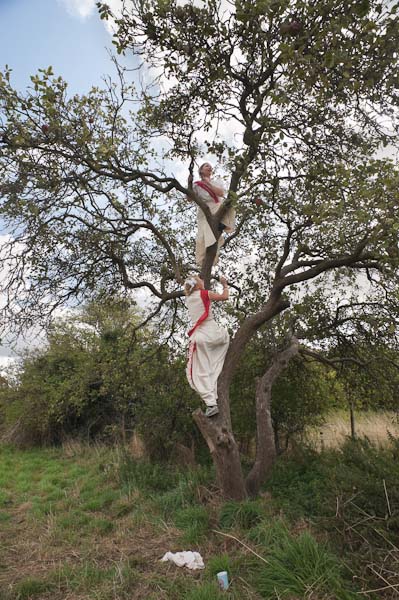
The agency guys had gone as soon as the procession left Heathrow, but I went back with the procession. You may not think that long white dresses are made for climbing trees.

© 2009 Peter Marshall.

The scrumping suffragettes were just a little disappointed, as these apples turned out to be cookers, though I’m sure they made some fine stewed apple for pudding later.

Many more pictures from the morning with the Climate Rush on My London Diary, as well as more about the Climate Rush on the Run tour.

Walking the Lea

Almost certainly the worst thing about ‘diamond geezer‘ is his totally embarrassing name. You know he can’t be a Londoner, though he does seem to love London town, and certainly has one of the most visited blogs on the city. I pop in from time to time, though I’m not entirely a fan (too many pointless lists and twaddle for my taste.)

But, like me, he has visited most of London’s boroughs and taken photographs in a series featuring one at a time – and though he’s not always the greatest of photographers some of them at least do a decent job of showing you what things and places look like.

This August was one of his  better months, as he took time off to walk the length of the River Lea, from it’s sources near Luton down to the Thames at Trinity Buoy Wharf, and giving some useful information about the route and some of the things you see on it. If you want to follow in his footsteps you’d also be wise to consult Lee Hatts who has both a great web site and a very useful book on the Lea Valley Walk with useful directions. The book is handier if you are actually going to make the journey yourself.  Diamond Geezer’s (I’ll call him DG from now on, which sounds rather better) account is even more up to date, and certainly worth reading – and it’s good of him to give my own work in the area, London’s second river,  a very nice mention.
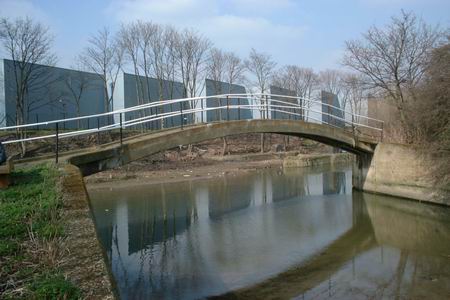
Bow Back Rivers (C) 2001 Peter Marshall
Pudding Mill River and River Lea, 2001

If you want to walk the whole thing, its fairly easy to divide into sensible chunks between railway stations at Leagrave, Harpenden, Hatfield and Hertford, south of which there are handy stations every few miles to Canning Town. Its also pretty easy on a bike, but any of you welded to an automobile will have a slightly more difficult time.

I first walked most of the route in the early 1980s, putting together an unsuccessful grant application to photograph the river and its surroundings. Although I did go back and do some more work even after I’d had my project rejected, I think it was a great shame I didn’t manage to get backing for more extensive work in the area. There are some pictures from those visits on my distinctly unfinished The Lea Valley site, and I’ve shown work from this on a few occasions.

It was an interesting time for the lower Lea Valley in particular, with the traditional industries fast disappearing. I started taking pictures just a little too late, in the last month or so of commercial barge traffic on the river – and it had all but disappeared.
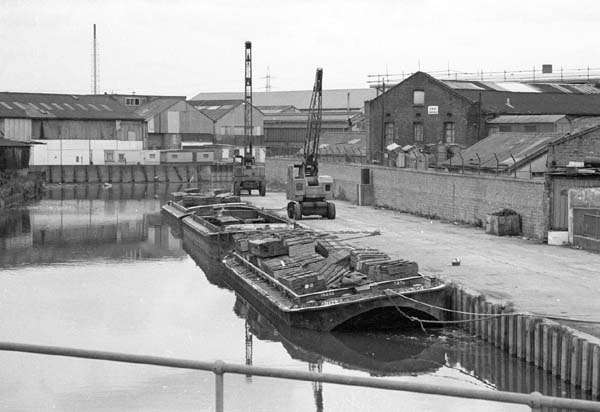
(C) 1983 Peter Marshall

In the 1990s I returned to parts of the area, in particular Stratford Marsh and the Bow Back Rivers, a truly fascinating area and at times it seemed almost remote enough from London to be another continent. Conservation work, mainly by volunteers, cleared waterways and footpaths and made it far more accessible in the later years of the decade. Most of the work I took then, including a number of panoramas,  is only available in my files.
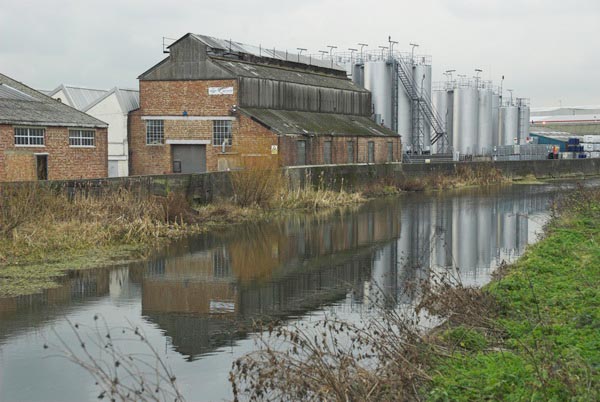
© 2006 Peter Marshall
City Mill River, Stratford Marsh, 2006

I continued to photograph along the Lea Navigation and allied waterways in the early years of this century, and the work was given a new impetus with the announcement of the London 2012 Olympic bid. Unfortunately some clever sleight of hand stole the games from under the nose of Paris (in many ways a far more suitable site) and in the last couple of years much of what I photographed has been obliterated in one of the largest transformations London has ever seen.
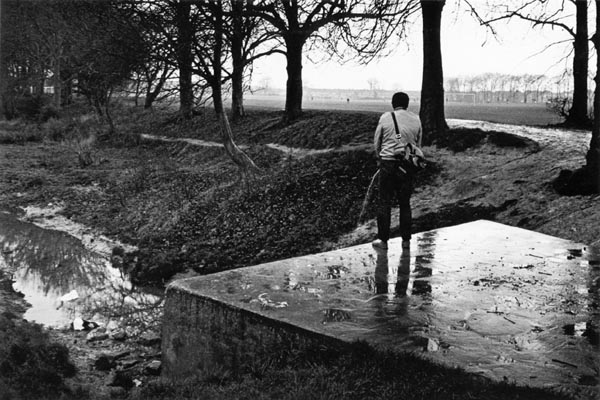
Source of RIver Lea (C) Peter Marshall
The source of the River Lea at Leagrave

As well as the usually quoted source at Leagrave (above), DG also goes the extra mile – or rather two – to Houghton Regis, where the stream emerges from under a sports pavillion. It isn’t clear why Houghton Brook should be regarded as a tributary of the Lea rather than the other way round.
Angry August

It seems to be the open season for physical attacks on photographers. Closest to home, freelances Marc Vallée and Jonathan Warren were attacked just outside the entrance to the Climate Camp on Sunday. A group of people from the camp had gone out to a Socialist Workers Party (SWP) stall outside the entrance and were arguing with the newspaper sellers there.

When the two photographers began to take pictures of the altercation, the climate campers turned on them, shouting aggressively that the photographers had not asked their permission to take photographs.

The bookstall was in a public place and on common land, and so was clearly a situation in which no permission was required to take pictures.  What the group from the Climate Camp were clearly doing was attempting to apply the camp’s ‘media policy‘ – its rules on photography – outside the camp.

The argument between one young man and Vallée continued, with the man insisting that he delete all pictures of him and the photographer refusing on principle to do so.  The man threatened to grab Vallée’s camera and smash it or delete the pictures himself. After a few minutes things appeared to have calmed down enough for the photographers to walk away, but as they did so the man lunged and tried to grab Vallée’s camera. Warren stepped in and shouted at him, and was kicked him violently in the stomach.

Following this, both photographers managed to back away and leave the scene without further blows. Both are photographers who invest considerable time and effort in covering and trying to get publicity for protests and movements such as the Climate Camp. As I know from my own experience, it isn’t an area which provides an easy or even a good living, and those of us who attempt it do so largely from a dedication to the various causes.

Although it happened outside the camp, there does seem to be a clear link with the media policy inside, one that I, like Vallée and Warren, find unacceptable, and I quoted both of them in a feature about it last week, Climate Camp Again.
As I wrote in another feature, “The policy appears to be driven by a few individuals with paranoid ideas about privacy and a totally irrational fear of being photographed. It really does not steal your soul!” Another photographer to write about it is Leon Neal, and the comments on his site are also worth reading. We can only hope that any future Climate Camp events will learn and try to adopt a more constructive approach to photographers and getting positive media coverage

The photographers decided not to go to the police and make a complaint, but instead wrote in an open letter to the Climate Camp “We ask the man who assaulted us to come forward and apologise and that the camp’s organisers unequivocally condemn his actions.” The NUJ has also backed their call for an apology. Presumably it should not be hard to identify him from the photographs they took.

Unless the camp can in some way deal with this incident and take action to prevent similar problems in future, it would seem to call into doubt their camp’s insistence on taking responsibility for its own policing and the agreement of the police to keep off site –  and more or less out of sight.

And on PDN last Friday, links to videos of three rather more serious attacks on journalists in the USA this month.

In Doylestown, Pennsylvania, the father of a woman who had just entered a guilty plea to faking her own abduction attacked several members of the press outside the court.   While an angry woman in Cocoa Beach, Florida attached 2 TV crews with a garden hoe, damaging a video camera while they were covering a story about teenage girls charged with dancing at a strip club. The final case was in  Norfolk, Virginia where a reporter and two photographers investigating a scam got into an argument with the the owners of an employment services company and both sides are suing for assault.

Let’s hope things quieten down in September.