Essential Books?

Somewhere on line recently – and I can’t remember where – I came across a note about the list by Lindsay Adler published on PopPhoto in June, “26 Books Every Photographer Should Own.”

It could be where I’ve been going wrong all these years, because I only have about five of them. ‘About’ because the first three on the list are Ansel Adams‘s ‘The Camera‘, ‘The Negative’ and ‘The Print‘, and I only have the older versions of two of these before they were somewhat ‘dumbed down’ and brought up to date for the 1970s in 1981.  Given the somewhat dramatic changes in technology over the last 30 years I’d hesitate to recommend any of them now, although some of what Adams has to say about printmaking remains relevant in this digital age – and he probably said it better in the 1968 edition.

Perhaps the only book of those listed I would personally recommend would be Beaumont Newhall’s ‘The History of Photography’. My copy fell to bits through years of use in the classroom and is now in loose-leaf random format, though hardly any the worse for that. I think there are other histories which cover considerably more or give a different perspective, but Newhall for all his faults was a better writer than most (and perhaps Nancy helped.) Several of the more modern histories have their strong points, and if I pick Naomi Rosemblum‘s ‘A World History of Photography‘ it would partly be for its attempt to be more inclusive, but more because I so much enjoyed spending some time with her and her daughter at a Polish photo festival a couple of years ago.

As to the rest, it’s hard to agree with any of the choices, though I do have books by several of the photographers included – such as Henri Cartier-Bresson, Robert Capa, Eugene Smith – and those suggested are not bad.  I also have books by or about another half dozen of the photographers listed, but wouldn’t consider them essential. If their work appeals, then buy them.

Unlike Adler, I don’t feel any need to recommend volumes currently in print where better older publications are still available at reasonable price. Of course some out of print photographic books now sell for silly prices, although it is sometimes worth remembering that first editions were sometimes improved on in later publications.

The only other actual book on the list I own is Susan Sontag’s On Photography. It made a good TV programme, and if that is available it would be worth seeing, but perhaps there are other writers about photography that deserve greater attention.

Of course, any list is bound to be to some extent a personal one. I’ve never been a great fan of either Avedon or Penn, and probably wouldn’t include either in my 26 essentials (and certainly not Annie Leibovitz, Helmut Newton and several others that Adler mentions.)

Among various glaring omissions from any list of ‘must haves’, I’d begin with what are for me beyond argument the two most influential photo books of the twentieth century, Walker Evans: ‘American Photographs‘  and Robert Frank: ‘The Americans’, both reprinted various times.

John Szarkowski wrote a several interesting books and catalogues which could qualify, for example ‘The Photographer’s Eye‘, in some ways the best introduction to photographic grammar, but for me the absolute gem in his output and in some respects my favourite photographic book, is his ‘Looking at Photographs.’

I’d also include something by Cartier-Bresson, though I wouldn’t know which to recommend from those currently available. Given that the 1968 ‘The World of Henri Cartier Bresson‘ is still available second-hand at reasonable prices (at least from the USA) I might still go for that.

Another French photographer my shelves would feel empty without is Atget. Which of the many books available new or second-hand depends rather on the depth of your pocket. The four volume set from MoMA on my bookshelves is now terribly expensive, but perhaps better than the many considerably cheaper volumes.

I’d also include Bill Brandt in my essential collection, probably his ‘Shadow of Light‘. The 1976/7 edition is still reasonably cheap. Another European photographer I’d like to include is Josef Sudek, and the 1990 ‘Poet of Prague‘ is a good choice, though I prefer Sonja Bullaty‘s 1978 ‘Sudek.’

Back to the USA, I’d have to include something by both Freidlander and Winogrand. It may suprise some that I’d also add Nan Goldin‘s ‘The Ballad of Sexual Dependency‘ (though it’s better seen as a slide show.)

Personally there are certainly other works I wouldn’t like to be without, but I think after a few essentials it becomes very much a matter of your interests. It’s a list you can complete yourself – and I’d welcome any suggestions. I’m sure that as soon as I publish this and go to make myself a coffee I’ll think of volumes that I really should have included.
Documenting the Climate Camp

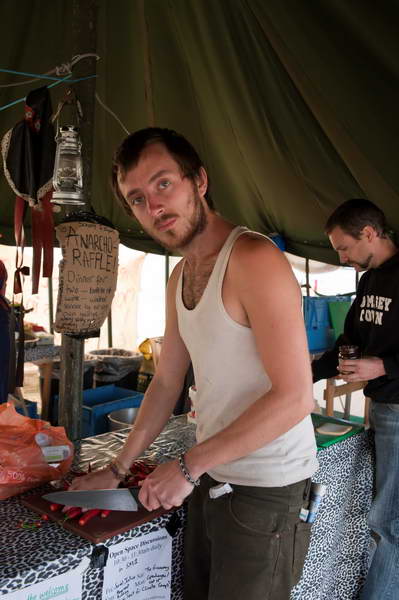
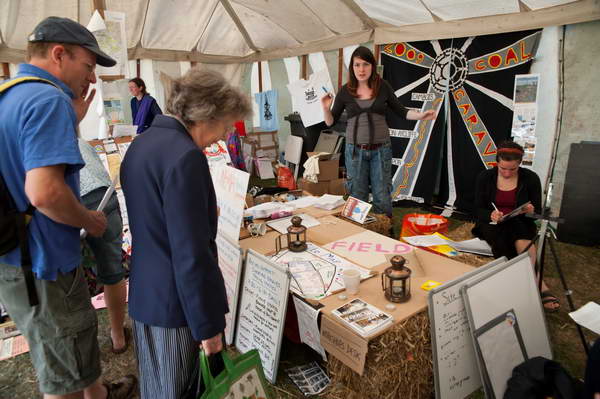
Although the Climate Camp has always had problems with how to deal with photography and with the press – and things were a little better this year than in previous years – it has tried to create some proper documentation of its work through photography and film.

Although for various reasons I’ve not actually become a climate camper, I was invited to come and take part in this, although I was only able to do so for one day of the camp.

Members of the team were identified by wearing blue sashes and the camp handbook asked people both to tell them if they don’t want to be filmed and also if there is anything happening which should be documented. It says “These are highly trusted individuals accountable to the Camp as a whole, and we hope that campers feel cool and relaxed around them.”

Although wearing a sash did make it rather easier to work around the camp I still found a little hostility at times, and I wasn’t able to work as freely as normal. Much of my work relies on capturing a fleeting instant, and if I’m having to think whether I need to ask permission before I take the picture it means that I’ll miss the moment. You can see the pictures I did manage to make on My London Diary.

Of course there were photographers working inside the camp without permission, including several that I know who had simply come in with the rest of the public as visitors. I didn’t see anyone who had accepted the media guidelines and was wearing press badges and accompanied by minders.

© 2009 Peter Marshall.

What I was photographing was the normal daily life of the camp, hopefully giving some idea about how it works and what it was like to be there. I also spent a little time following (with her permission) one woman who had heard about the camp and had made a short trip across South London to come and see for herself.

© 2009 Peter Marshall

I think she was both confused and impressed by her first impressions of the camp, and so perhaps was I.

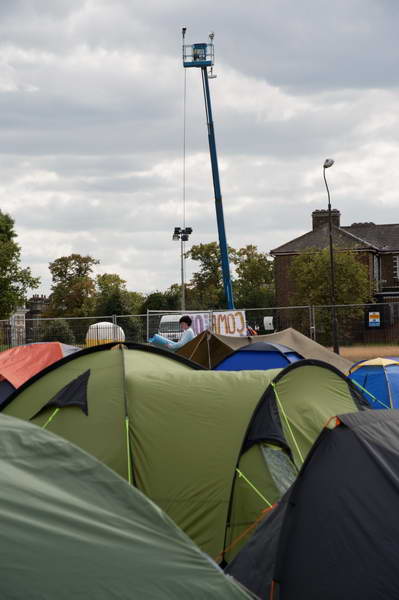
As I walked out of the camp and across the heath I noticed a small group of Climate Campers gathered at the fence below the police cherry picker with its video cameras trained on the camp day and night.  A small group of police was talking to them and they all dispersed as I drew near. I stopped and took a few pictures of the cameras, still rather distant on their high platform, then turned around and walked on a few yards to photograph the banners on the Climate Camp fence.

© 2009 Peter Marshall.
The cherry-picker and cameras from inside the Climate Camp

I became aware of a black man in his mid-twenties around twenty yards away from me. I turned down a path and he too turned down it, and again at the next meeting of paths.  I stopped to put my camera away in my camera bag. He stopped too. I took out a sandwich and stopped to eat it.  I’m a slow eater, but when I’d finished I turned my head and the guy was still there, writing in a notebook. I made my way down the hill and he continued to follow me.

Of course I was behaving suspiciously. After all, I’d been taking photographs.

Climate Camp – Why Blackheath?

You can see a few pictures from Wednesday afternoon as the Climate Camp was being set up, as well as the reasons for choosing Blackheath-  in terribly gory detail – on My London Diary.

© 2009 Peter Marshall.
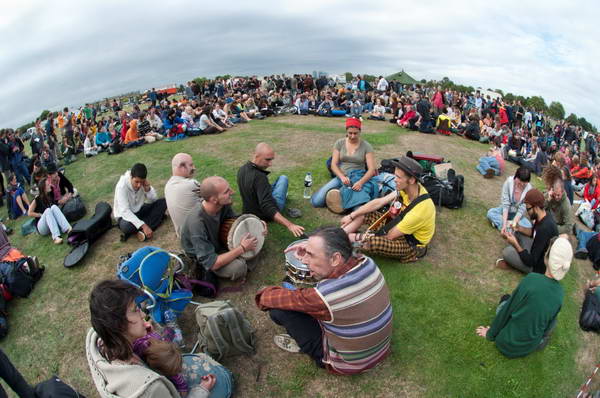
Most of the people at the Climate Camp meeting

I won’t repeat all the details – I’ve already posted them on Indymedia and Demotix as well as some on My London Diary.

© 2009 Peter Marshall.

Some of the pictures I found most interesting were of the Whitechapel Anarchist Group who were making themselves comfortable and getting down to a little partying in the centre of the site.

As I left the site, a police van drove up. An hour or so later two officers, including the Met’s ‘silver commander’ for the protest, Julia Pendry, came on the site, and after a short while were taken into a tent to have tea with the Camp’s legal team. Their presence sent some campers wild, particularly those from the Whitechapel Anarchist Group who had already come into some conflict with the Camp organisers, and the two officers soon had to leave. The action by the WAG and other sympathisers apparently caused considerable argument, and most of the WAG left the Climate Camp.

More recent reports mention further problems with the police who are trying to insist on having an actual physical presence on the site. It is already under surveillance, with a cherry-picker apparently supplementing the helicopter and vans and cars on the ground.

Blue Swoop

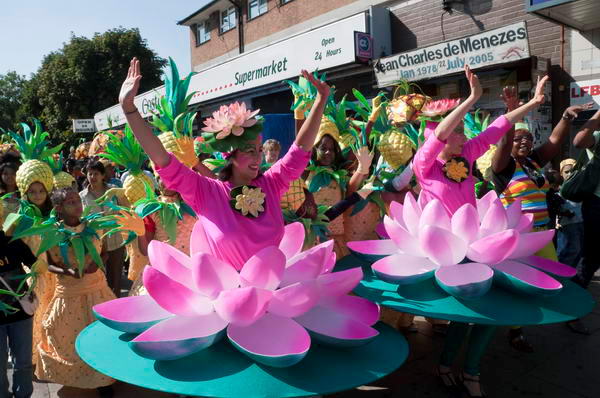
The Climate Camp Swoop ended up as more of a long perch followed by a fairly short couple of rides.  You can read my story about it on Demotix, Indymedia or My London Diary, which is the best version as it has most pictures.  We hung around for a while at Stockwell station (and this time there were no pineapples walking along the streets)

© 2008 Peter Marshall
Pineapple parade at Stockwell Station, Sept 2008

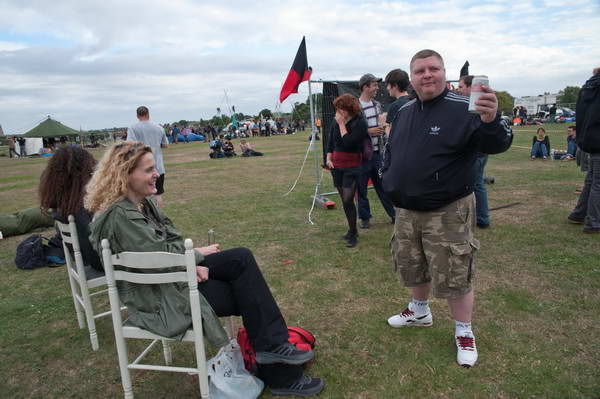
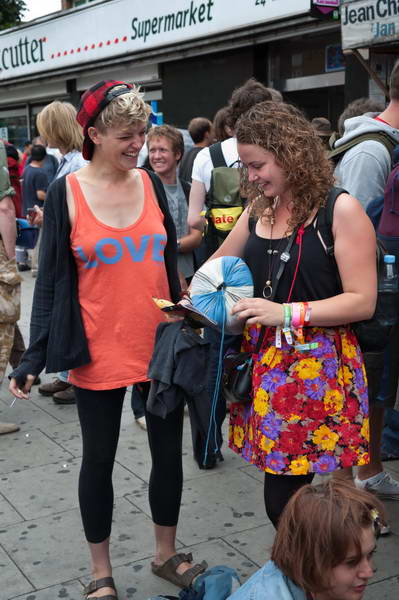
but there were some interesting people waiting for something to happen.

© 2009 Peter Marshall

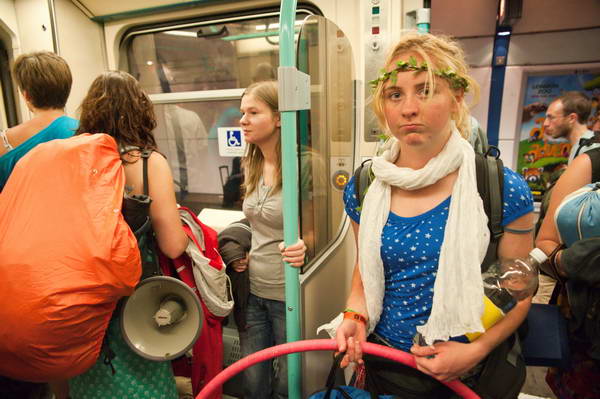
Two hours later we were on a train and going towards the Climate Camp site which turned out to be at Blackheath.

© 2009 Peter Marshall.

And on My London Diary you can read the details and some more pictures from the day, including at least one more of the person the papers describe as an ‘eco-starlet’ who seemed to be travelling with her own media team.

And it was nice to see my version of that report published on London Indymedia made the front page of the Climate Camp web site shortly after I posted it. But My London Diary has more pictures.

SOCPA Again

Britain is still in many ways a free country, but some parts are less free than others. One of those parts is Whitehall and the whole area around the Houses of Parliament, where laws about protests were a last-minute addition to the Serious Organised Crimes and Police Bill when it was going before parliament – and passed as SOCPA.

© 2005 Peter Marshall
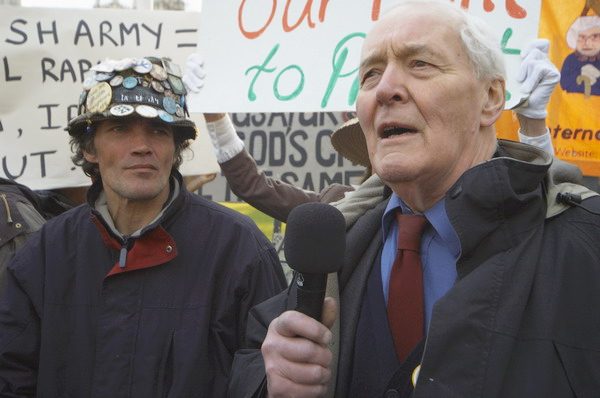
Brian Haw and Tony Been at rally against SOCP Bill, March 2005

Blair and his mates were getting really fed up with Brian Haw’s presence on the grass opposite the Houses of Parliament with a large display reminding them what a mess they had made over Iraq. Caught out misleading the public with a dodgy dossier, and then the incredible mistakes made by our allies in dismantling the country, leading to years of bloodshed, chaos and overspend, with little prospect of a real end in sight.

Hardly surprising they didn’t want a noisy reminder in the neighbourhood, and a few attempts at getting their mates in the police and elsewhere to try a few underhand moves had failed. They couldn’t really come out in the open and draft a Brian Haw Removal Bill, so they tacked it on to what became SOCPA.

But for various reasons they didn’t get it quite right, and Brian Haw remained. Even a rather dodgy judgement in their favour didn’t quite sort the matter out, and he is still there, if in a somewhat reduced format, over 3000 days since his protest started.

SOCPA as it relates to demonstrations does seem more or less discredited now, and we were promised new legislation, but for the moment it’s still a stick the police can wave, if not much more.

One place that many want to demonstrate, other than the Houses of Parliament, is Downing St,  the home and office of our Prime Minister, but of course this is no longer open to the public.  As I mentioned in a piece about Philip Jones Griffiths,  it isn’t so long since anyone could walk down it, and nannies would stop to chat up the police on duty outside its famous door. Now tourists need binoculars to see it through tall gates.

Protesters are not even allowed to stand on the same side of Whitehall as the tourists, but must make their protest from the far side of Whitehall, around 85 yards away from the door to No 10 (according to Google maps, though it actually looks further on the ground.)

© 2009 Peter Marshall.
Illegal protest at Downing St

SOCPA also led to a ban on the use of any megaphone or other electrical amplification, so people have to shout, often over the noise of the sometimes heavy traffic along a busy road with several lanes in each direction.

Those in No 10 can’t of course see the demonstrations either. Their windows either look out in completely the wrong direction or into the narrow street banned to the public in front – where all they can see is the press waiting in their pen to take photographs.

Occasionally some of the civil servants do come out into the road and walk down and stand near the fence so they can see and hear the protests, but I should imagine that otherwise those in the building remain totally unaware. While I don’t think that protests should be able to completely disrupt the business there, I think we need a balance where protests can be noticed, and that seems to no longer be the case.

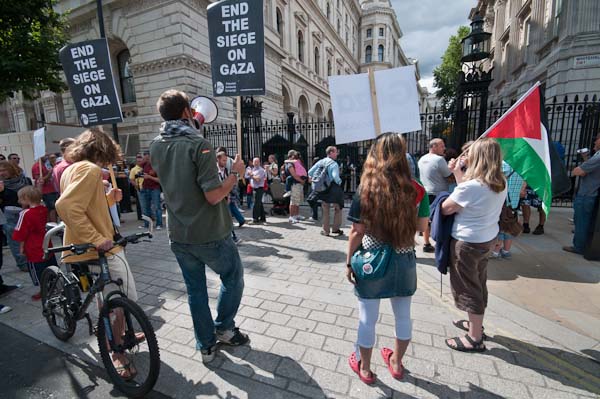
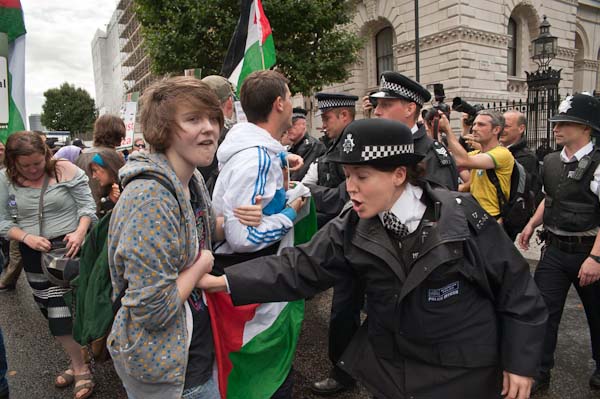
On Tuesday, protesters against the talkes between Gordon Brown and Benjamin Netanyahu decided to cross the road and carry out an illegal protest on the pavement immediately in front of the gates. They moved obediently to one side for a couple of vehicles to come in and out of the gates; given the group of armed police hanging around behind them they obviously made no attempt to enter Downing St itself.

Also they decided to make illegal use a megaphone. After around  20 minutes the police decided to come and warn them that what they were doing  was illegal and that they would be arrested if they continued. More protesters came across from the ‘legal’ side of the road and joined them. Police formed a loose line to clear a token few yards of pavement in front of the gates and the demonstration continued.

© 2009 Peter Marshall

An hour later, reinforcements arrived and the demonstration organisers (who were not those who had decided to come across the road) were I think told that people would be moved by force if necessary. Someone from ‘Stop The War‘ made a short speech about the demonstration including a plea for people to move (again I think he was probably told by police he could use a megaphone to do so.)  I think he was about the only person that took his advice, but police (we were told they were TSG but they were wearing normal police uniforms rather than their rioting kit) pushed the demonstrators back. Mostly this was done with reasonable force, though I did see (but was unable to photograph) one momentary loss of temper.

In the confusion while this was being done, three people who had been warned earlier were taken into custody. After I left, close to the scheduled end of the event, two further arrests were made.

Police appear to be making use of their powers to hold people as a kind of minor punishment system. The five were kept at Belgravia police station until some time after 11pm before being released. I was told that it’s unlikely they will be taken to court.

More about the protest and more pictures on My London Diary.

Climate Camp Again

If  you are are in the right circles in the police, you will by now know exactly where tomorrow’s Climate Camp will be. If you are just an ordinary protester, you will will going to one of the published assembly points at noon tomorrow and will then – in time find out.

The police can’t be too up front about knowing, because it could risk compromising their sources. Tomorrow they will probably be making some kind of  pretence of being surprised, but you shouldn’t take that too seriously.

However, if you are a photographer, you are not very welcome in any case.

On Jonathan Warren’s blog you can read a nice piece that I think sums up what most photographers think about the Climate Camp’s attitude to the media.

It still seems rather like photographing in some Eastern European country at the height of the cold war, with a minder on your shoulder.

You will be accompanied by an assigned camper during that time, who will ensure that both campers and journalists are kept happy, and can ensure that consent is obtained from people being filmed and photographed. “

On his blog, Marc Vallée says:

“The camp is trying to write its own narrative – pretty much in the same way that New Scotland Yard is spinning its media strategy as fact. As Vidal wrote in 2007, “It’s an easy step from trying to manipulate the press to manipulate information.”

Two years ago I read what the campers said and decided there was no way I could cover the Heathrow camp under those conditions. Last year I photographed the march to the camp on the Sunday and then went up to Glasgow to do other things rather than waste my time. This year things are a little better, but I’m still not sure I want to attend the actual camp once it is up and running. Perhaps I’ll give it a try, though if they really enforce their media policy I can’t see many photographers with any self-respect lasting many minutes before being ejected.

Yet I’m someone who very much believes in all that the Climate Camp stands for.  Someone who sold their last car in the sixties, joined Friends of the Earth before it existed here, has never bough an airline ticket, gave talks and demonstrated on the environment before most people had heard of it and more.

In the end, for all of us as photographers, what matters is integrity. And that doesn’t rely on doing what other people tell us but on doing what we think is right.

There are sometimes legitimate reasons why organisations should control the nuisance of over-intrusive photographers – or just too many photographers wanting to take pictures at some events.  But I don’t find it acceptable to try to control when and how and what press photographers may photograph in the way that the Climate Camp does.

Most of the campers will have their own cameras – if only on their phones – and be taking pictures. Including of course all those undercover police who will be taking part this year as in previous years.  But it will be rather a shame if we have to rely on them and the FIT for a proper document of the event.

So if you don’t see good press coverage about the Climate Camp, or decent photographs, don’t blame us.  They’ve chosen not to allow it, or even to make it so we don’t feel it’s worth going.  In a comment, Warren says “At any other event being an accredited journalist affords you more access, not less.” I’d settle for the same.

Some Good News for Photographers?

One piece of what I think it good news for photographers, particularly those who post images on line, was reported a few days back by PDN Pulse under the headline Twitter Photographer Asks Sky News to Pay Up, though the good news came in a later Twitter update.

Joe Neale only found out from friends that Sky News had used a picture he had posted on Twitter using Twitpic about a shooting at Waterloo Station without asking him.  PDN links to a fuller account on Online Journalism Blog, which gives all the details, including that Neale sent Sky an invoice for £300 plus 5% per week for the time the image remains on the Sky site.

Sky didn’t contest that the image was copyright – perhaps because fortunately Twitpic’s terms on this are crystal clear:

By uploading your photos to Twitpic you give Twitpic permission to use or distribute your photos on Twitpic.com or affiliated sites

All images uploaded are copyright © their respective owners

and the update on 19th August from Neale, reported on both sites, was that Sky had agreed to pay up.

A second piece of possibly good news reported by Marc Vallée on the Guardian web site last Friday (and by others elsewhere) is that the UK Government Home Office have sent out a circular 012 / 2009 Photography and Counter-Terrorism legislation to the Association of Chief Police Officers in Scotland, HM Inspector of Constabulary and the Association of Chief Police Officers (England, Wales and Northern Ireland) clarifying that anti-terrorism legislation should not be used to stop people taking photographs in public places – even where these are covered by an authorisation under Section 44 of the Terrorism Act (such as London!)

It makes clear that police should not specifically target photographers, that they should only use the power to stop and search when they reasonably suspect someone to be a terrorist – not just because they are taking photographs.

Perhaps the weakest part of the advice is on the use of Section 58a which relates to gathering information (for example by taking pictures) of “persons who are or have been at the front line of counter-terrorism operations, namely the police, the armed forces and members of the security and intelligence agencies.”

It does point out that officers must have reasonable suspicion that the information is likely to be useful to a person committing or preparing an act of terrorism – such as might be gathering information about the person’s house, car, routes to work and other movements, but this still seems rather vague and far too open to interpretation.

I’m also unhappy about  the comment it makes about the statutory defence of reasonable excuse:

Important:Legitimate journalistic activity (such as covering a demonstration for a newspaper) is likely to constitute such an excuse. Similarly an innocent tourist or other sight-seer taking a photograph of a police officer is likely to have a reasonable excuse.

So far as journalists are concerned this appears to give police the impression that freelances are somehow less legitimate than photographers actually working for a newspaper. I also also see the phrase “eliciting, publishing or communicating” as covering a much wider range of legitimate practice – including citizen journalism and blogging.

Whether or not the circular will lead to changes on the ground is also a matter of question. When a leading police commander who has been in charge of many public order situations can show such a woeful ignorance about the UK Press Card as we saw at the NUJ Photographers Conference earlier this year – see Can Anyone Apply for an NUJ Card who has a Camera ? – I don’t hold out great hopes.

Knives & Guns

Last Saturday and Sunday I photographed two very different events, both marches concerned largely with gun and knife crimes on the streets. I didn’t get to Manchester, where Mothers Against Violence were celebrating 10 years of success in reducing the street killings there, but there were very different marches in London on Saturday and Sunday around the issue.

I’ve photographed several related events over the years around London,  Not Another Drop in Brent in September 2007, Communities Against Gun and Knife Crime in Clapton in October 2007, the Seventh Day Adventist Youth March against Knives, Guns & Violence in June 2008 and  ‘The Peoples March’ against gun and knife crime in September 2008.

© 2008 Peter Marshall
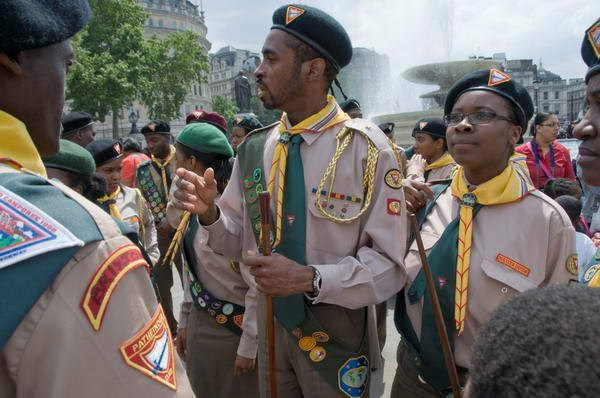
Pathfinders gathered for the 2008 Adventist Youth march

As Saturday’s march was again organised by the Seventh Day Adventists, I expected it to be similar to the previous Adventist event, but it turned out to have a very different atmosphere. Last year’s was considerably larger and dominated by the presence of the Pathfinders, the Adventist uniformed youth movement similar in appearance to the Scouts and Guides though seeming rather more disciplined and military; this year there were few if any uniforms on display, apart from the leaders in dark suits.

© 2009 Peter Marshall.
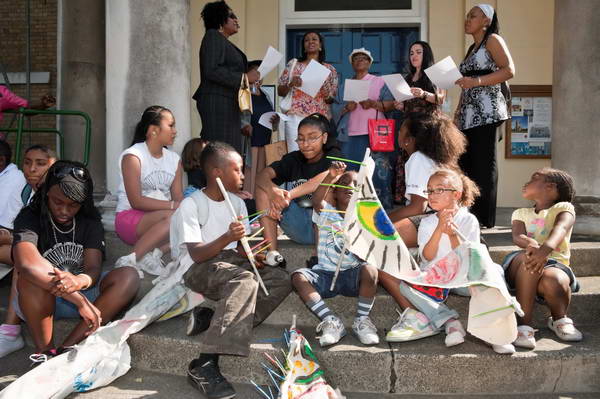
LIVE marchers waiting on the steps of the DECC, Aug 2009

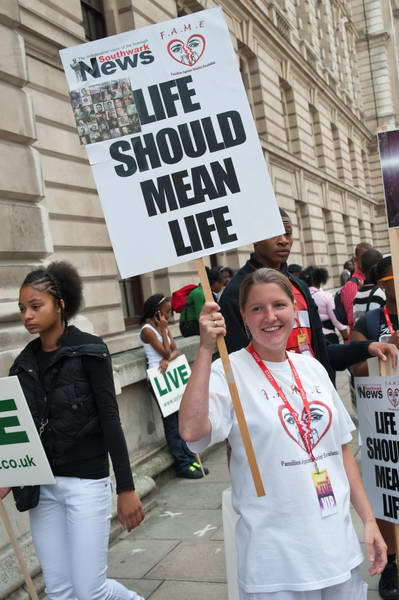
Their ‘LIVE’ (Living Intentionally Versus just (merely) Existing) youth movement had joined forces with South London based ‘FAME’ (Families Against Murders Escalating) who marched with placards ‘Life Should Mean Life‘.

© 2009 Peter Marshall.
A relative holds a FAME placard with 36 pictures of victims, Aug 2009

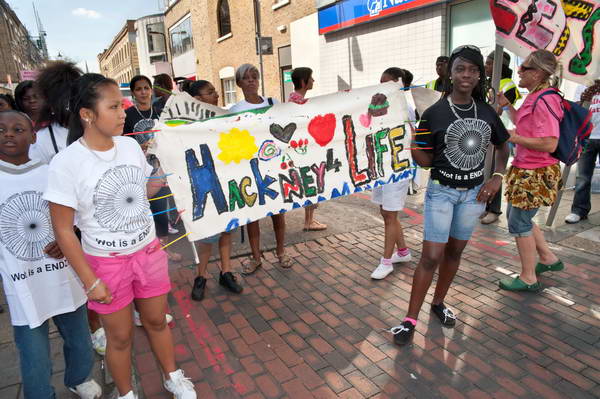
Hackney’s rather smaller Million Mothers March event on Sunday had a very different feel and emphasis, and one I felt rather more comfortable with.

© 2009 Peter Marshall

Here the main banner read ‘Peace On Our Streets‘ and there were other colourful banners and t-shirts printed in a local workshop, as well as people from a lively local youth project, and the event ended with some fine gospel singing that had me wanting to join in.

© 2009 Peter Marshall

As its title implies, this community-based event was in support of the wider movement and the marches in Manchester and elsewhere on the same day.

More pictures from both events and more about them and my thoughts on My London Diary. FAME in Saturday’s march highlighted some serious issues around justice some of which I mention there, but Hackney’s Million Mothers seemed to me to have a much more positive message about tackling the problem.

East Ham Chariot Festival

Like many of our inner city areas, East Ham is a strongly religious area and I’ve walked around its streets in both Sikh and Hindu processions. There are plenty of Muslims too, but I’ve yet to find any major public events by them in that area, or by the other religions.

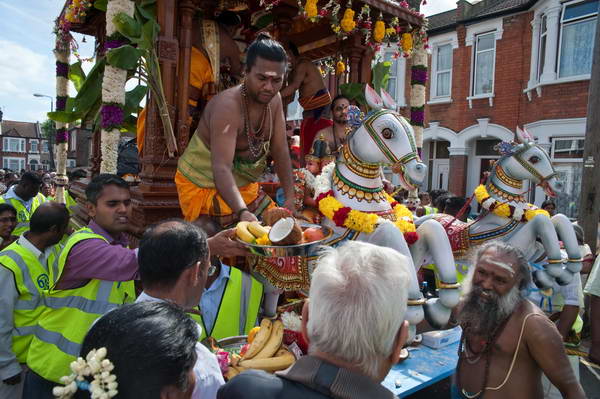
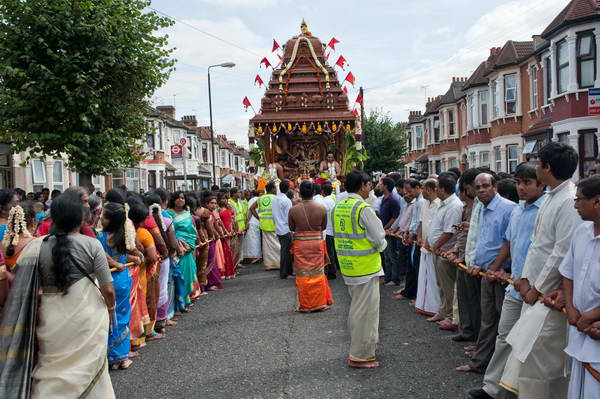
The  Sri Murugan Temple in Manor Park is impressive, but I arrived there to find that the chariot procession had left around an hour earlier than the time I’d been given. Stewards I asked were rather vague about its route, but I set off in roughly the right direction and it wasn’t too difficult tohunt down given that it had a rather large chariot and a few thousand people following it.

© 2009 Peter Marshall

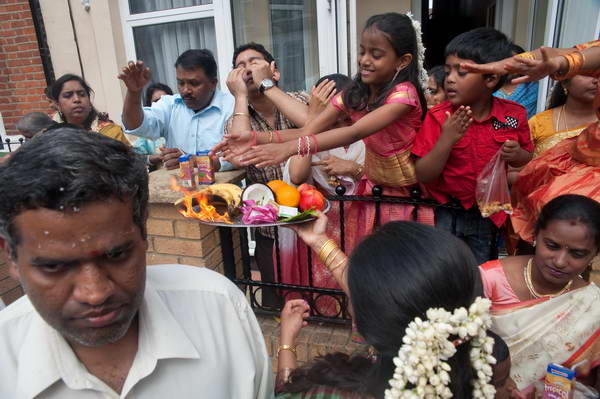
Although it was a very good-natured crowd, mainly of Tamils, getting through the spaces between cars parked on both sides of the narrow side streets was a little tricky, and I found myself getting pushed and stumbled, just catching myself.  But a woman told me “you’ve dropped your glasses“, she had seen them come out of my pocket and fall, but by the time I looked there was no trace of them.  They weren’t a very expensive pair, but they were a new pair that I’d only got the previous day, and it was a bad start to the event.

© 2009 Peter Marshall

I’d expected it to get pretty hot, and had decided to cut down on the kit I was carrying, so I took only one camera body (Nikon D700) though with several lenses. In fact almost everything I took on the Sigma 24-70mm HSM f2.8 which really does cover almost everything you need for such an event.

But there were one or two times when I needed something wider, but there just wasn’t time to make a lens change, or, at one point where too much coconut juice was flying around to make it possible.  And when later  in the procession I forced myself to switch to the 55-200 for a while to pick out  a few faces from the crowd and details I kept seeing things I needed the 24-70 for.  Really for fast-changing and crowded events such as this two bodies are considerably better than one.

And perhaps I need to start using a back pack to carry the stuff. It’s something I’ve resisted, largely because I find other photographer’s backpacks keep getting in my way when I’m working – and it happend a few times during this event.

There weren’t that many photographers, but  much of the action takes place in fairly limited areas and it was so crowded there was in any case very little space to stand.

© 2009 Peter Marshall.

Quite a few pictures on My London Diary.

East Surrey Volcano

As someone who taught photography for 30 years, largely to 16-18 year old female students (though there were males and many considerably older including a number in their seventies rather than seventeen) I feel very strongly in support of Simon Burgess, the lecturer at East Surrey College who faces a disciplinary hearing for suggesting one of his students looks at the photography of Del LaGrace Volcano.

I didn’t write about it earlier as I understood that those involved wanted to keep it private in the hope that the issue might be resolved.But since it has been aired in the BJP and everywhere else there seems no point in refraining comment any longer.

According to Brendan Montague on  the-sauce.org, the disciplinary hearing which was to have been on Monday has been postponed, and Burgess has further been charged with gross misconduct “for speaking to the media – despite his refusal to take calls from journalists.” Which I imagine is just the kind of thing that those involved wanted to avoid.

The context in which Burgess suggested a student look at this work isn’t entirely clear, with some reports stating that it was as a part of “gender and sexuality component to a HND photography course” and others suggesting that the student concerned was doing a project on gender and sexuality. Whichever was the case, the suggestion seems entirely sensible and apposite – it would be hard to find photography which was more relevant to such a study.

But if the course does actually contain a component on gender and sexuality, it is very hard to understand why the college managers should feel there is any basis at all for proceeding against a lecturer for teaching it. If there is any culpability it lies with the college managers for approving the existence of this module, for resourcing it with materials such as the Love Bites collection and for allowing a student who appears to lack the emotional maturity to  work with such material to register for the course.  Clearly it would seem that Burgess is being made a scapegoat for their deficiencies.

Of course if it was a project chosen by the student concerned – who apparently was the source of the complaint – the action by Burgess in suggesting the work was simply pertinent advice a a useful resource in the area. It is hard to understand why a student who had elected to make a study in the area should then make a complaint – unless as a result of external pressure. It would seem to be a case where management should be supporting the tutor rather than attempting to discipline him.

I hope that the matter will soon reach a satisfactory conclusion with the charges against the lecturer being dropped, but one of the reasons why I left teaching was the kind of new management that has come into education in the past few years.

– – – – –

I was fortunate never to face similar charges during my career, largely because of a supportive head of department, but there were occasional problems. Even at my interview for the post at a sixth form college in 1980, the Principal was obviously very keen to clarify exactly what kind of pictures I was taking, and obviously very relieved to find there was no nudity involved.

It isn’t possible to teach the history of photography properly without paying a sensible degree of attention to the nude and issues of gender and sexuality are bound to arise.  With students in their late teens, gender issues are very much at the forefront of many of their lives, and some of my students chose to explore them through their photographs. At least one student’s work for an end of year public show, involving apparently nude models in chains got censored by management as not representing the image of the college they wanted to portray, but I was never criticised for allowing or encouraging students to investigate such issues.

Of course there are issues about showing possibly controversial material to students, and I think teachers need to be clear about the reasons for using particular images. Some of my students were from home backgrounds where any nudity was quite unacceptable, while at least one came from a family of nudists.

When I worked on the web, writing a web site about photography I used to get occasional complaints about material that I had written about or linked to, for example in features on Nan Golding, Jo Spence, Robert Mapplethorpe and Joel-Peter Witkin as well as in historical surveys of nude photography. Some were from educators, regretting the fact that because of such material on my site they could not recommend it to their students. At least once I sent a sympathetic reply expressing regret that the conditions under which they worked were so repressive that they were unable to teach the subject fully.

Of course I had no interest in putting pornography on the site. Although it might have boosted site visitors and thus my remuneration, it might also have got the the sack!  But the main reason I avoided it – and in particular that peculiarly seedy corner of so-called “glamour photography” was that in general I find it tedious.  Or in the case of “glamour”, gratuitously offensive.