Hanging Day at the Juggler

Yesterday we hung our show, Taken in London, at the Shoreditch Gallery, part of The Juggler, a café in Hoxton Market – which, rather confusingly is not where Hoxton Market actually takes place. The street Hoxton Market with the Juggler is just north of Old Street, behind the Holiday Inn and on foot you get to it by turning right about ten yards up Pitfield Street, then first left. It’s an open pedestrian square and a very pleasant place to sit at the tables outside the Juggler on a sunny day with a tuna mayo roll and a bottle of Budvar or a coffee. The weather was right for it yesterday, but we were too busy for sitting around, though we did pause briefly for refreshment.
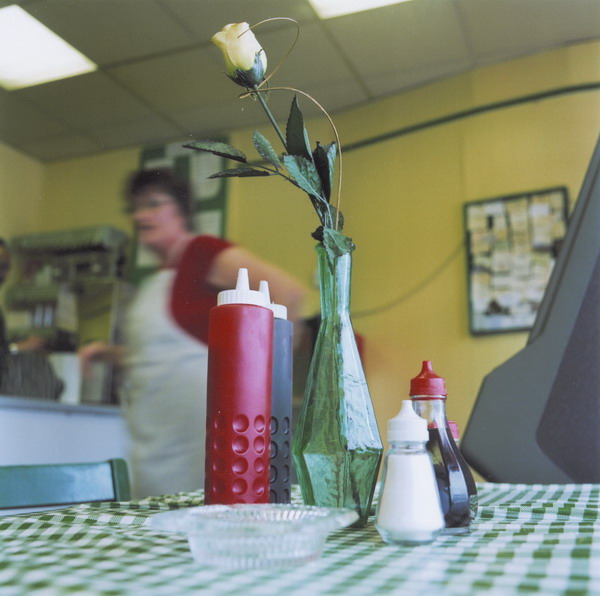
© Paul Baldesare
One of Paul Baldesare’s pictures for the 2005 show Café Life

The gallery has got a little smaller since I first hung a show there, the appropriately sited Café Life in 2005 – prints,paintings, drawings and photographs on that theme – with one end of the room being taken for storage, but it’s still a nice space, now basically two walls, each with enough space for around 20 double-hung 20×16″ frames, so ideal for a show by two photographers – myself and Paul Baldesare, though this time there were very few cafés in the pictures.
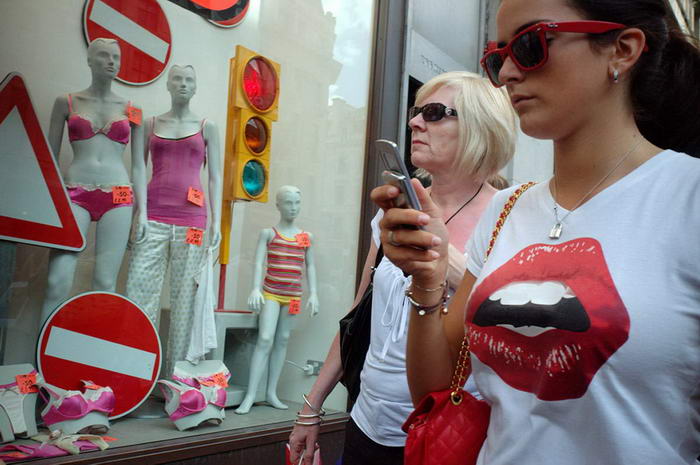
© Paul Baldesare
Oxford Circus, Paul Baldesare

Hanging  where you, as here you have to drill holes and screw the frames to the wall with mirror plates, is really a job that calls for three people, and we had another photographer, Dave Trainer, to lend his professional expertise (as he told us during the day, he was once covered with Picasso’s paint while hanging one of his works.) Dave showed with us last year, again at the Juggler, in our show English Carnival.
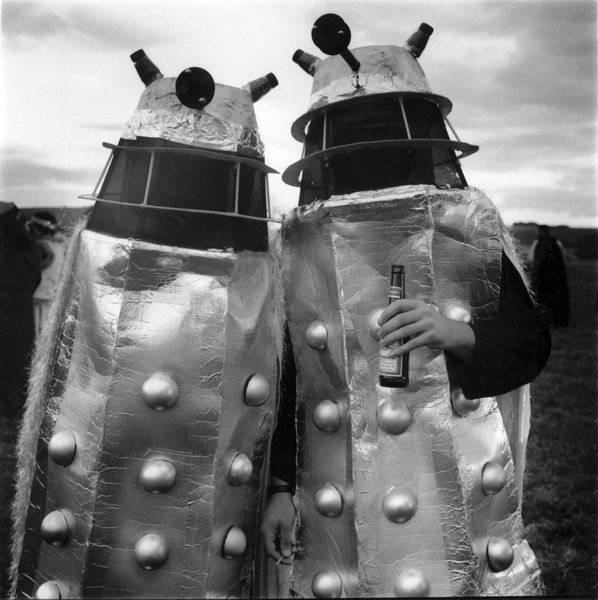
© Dave Trainer
From the series ‘Today I’m Someone Else’  by David Trainer in the show ‘English Carnival’

Getting forty or so pictures fixed in the right places wasn’t entirely plain sailing (the walls could be described as distinctly choppy to continue the metaphor) but eventually we were able to stick up the text and captions that I’d printed a couple of days earlier and stand back, and it didn’t look bad.

Although some of the work is shown on the exhibition web site,  I’d decided that I wanted to include quite a few more recent pictures, and roughly two thirds of my pictures are now from 2009, including a couple from August.
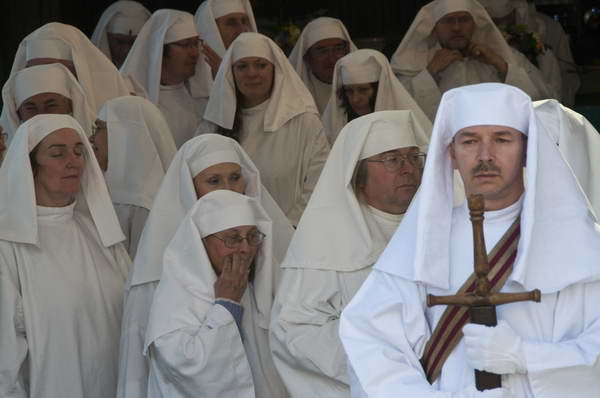
© 2009 Peter Marshall.
Druids gather to celebrate the Spring Equinox, March 2009
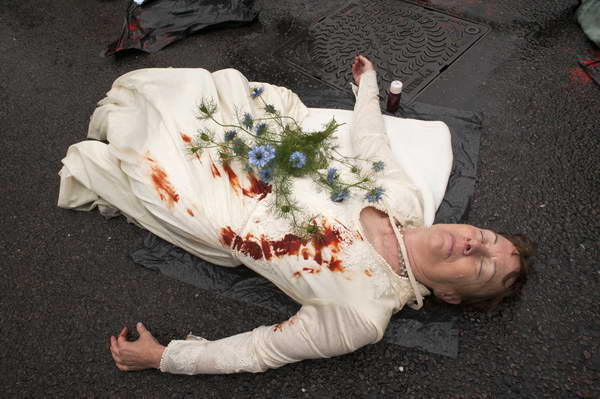
© 2009 Peter Marshall.
Wedding die-in at Northwood Against War in Afghanistan, May 2009

The show continues until 31 Oct and the private view is on Thursday  8 Oct, 6.30-8.30pm – it would be good to meet some of you there.
East London Photography Festival
Taken in London is a part of Photomonth 2009 The East London Photography Festival, and of the This Is Not A Gateway Festival 2009.
Paul Trevor – Photomonth2009 Opening

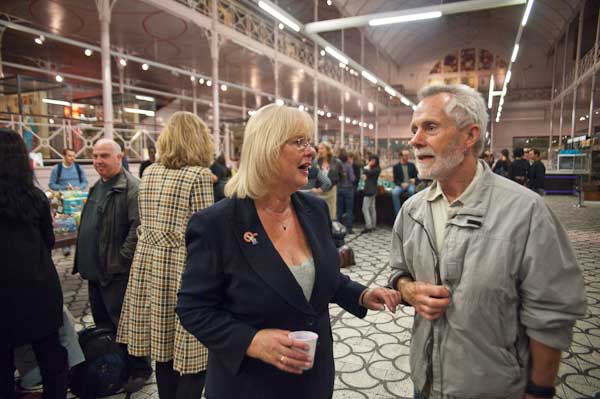
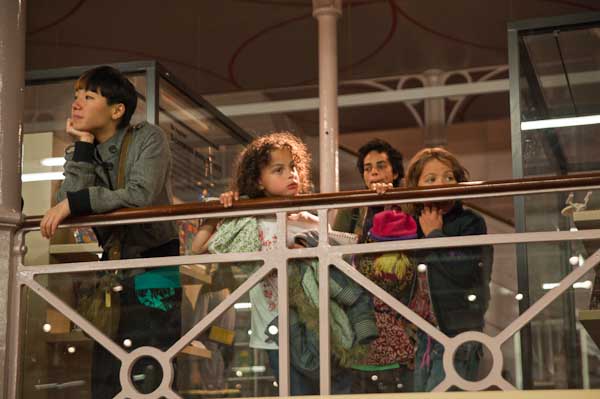
Last night Photomonth2009 was officially opened at the Museum of Childhood, part of the V&A Museum in Bethnal Green. It was an appropriate venue for several reasons. The V&A – at its South Kensington site – was one of the first museums to collect and buy photography, starting around 150 years ago,  and has one of the finest collections around which is accessible to visitors through their Print Room, as well as various exhibitions. It is a great experience to go there and handle vintage prints by great photographers such as Eugene Atget, Edward Weston and so many more there.


Festival director Maggie Pinhorn and Mick Williamson

The buildings that make up most of the Museum of Childhood were actually physically transported from South Ken into East London and opened in 1872, very much as a part of a mission to bring culture to the masses (a massive failure which you can read more about in Cathy Ross’s ‘The Romance of Bethnal Green‘ – the feature includes a few of the photos I supplied for the book.)

Photomonth, based in an East London which has now become the artistic centre of the capital,  is a rather more successful attempt, including a huge number of photographic shows and events as I mentioned previously.  It is very much the largest photographic event in this country, and I think the most important and most vital, though I’d like to see it even bigger and better as a London photo festival.

If you read my several postings last November on the events in Paris – the dealer trade show ‘Paris Photo‘, the ‘Mois de la Photo‘ and the ‘Photo-Off‘ fringe festival (see the >Re:PHOTO archive for November 2008 and  MyLondonDiary for the same month) I think you are likely to share my feelings that some of the most exciting things on show were in the fringe (and there were some on the fringe of the fringe too.)

While Paris becomes an inclusive festival by the presence of these different strands, Photomonth sets out to be so from the start – open to all photographers who want to participate, through major museums and arts centres, small galleries or any other spaces they can find to hang work. The Photomonth Photo-open at the Old Truman Brewery provides an even wider opportunity for taking part.

What is perhaps most important is that it is largely a photographers festival rather than a curators festival. Photography in this country suffered a near-fatal blow around 40  years ago when the Arts Council decided to concentrate funding on galleries and curators rather than on artists and photographers which almost halted the immature but developing photographic culture of this country in its tracks.


Paul Trevor

Photomonth opened with a photographer who first became known in those few years of opportunity in the 1970s, Paul Trevor, who I wrote about a little for last year’s Photomonth.  His show ‘Childhood‘ in the Museum of Childhood is a small selection of 20 pictures featuring children from the many thousands of pictures in his ‘Eastender Archive.’ Most were taken in the 1970s and 80s around where he was living in the Brick Lane area, and they include several of his justifiably best-known pictures, some of which I first saw in ‘Camerawork’ soon after they were taken. Although the printing is adequate in letting you see his images, it perhaps lacks the kind of depth and dimensionality his work really needs to be seen at its best.

Also on display at the V&A Museum of Childhood was a small series of large (3 times life-size and 105×134 cm)  head and shoulder profile views of one-year-old children by Bettina von Zwehl. The catalogue note says “With her distinctively precise and patient approach, von Zwehl creates images which challenge traditional expectations of how young children are portrayed” but I found them rather boring.  You can make up your own mind, at least from small reproductions of ‘Profiles Three, 2005’ on her web site The size on the web or on in the Photomonth catalogue, which you can pick up free at any of the participating venues, is really at least as much as I feel a need to see.

It was a well-attended opening, with many well-known photographers, including of course Paul Trevor. A temporary exhibition showcase of dolls very much attracted the attention of both Martin Parr (and myself.) Jenny Matthews is one of the festival patrons (I didn’t see the two others, Tom Hunter and Stephen Gill, but they may have been there.)  Far too many other photographers were there to name them all.

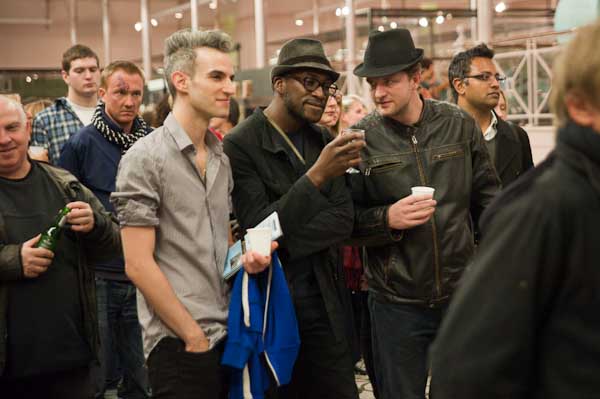
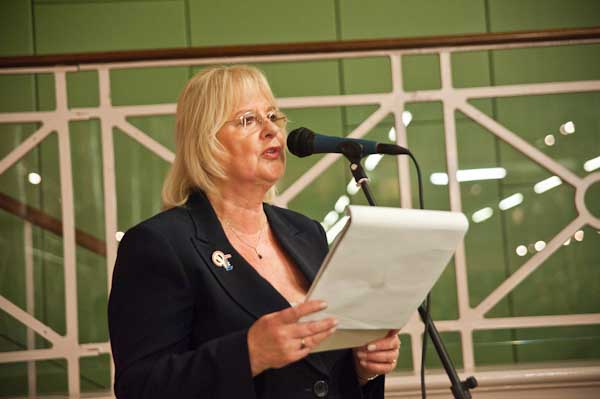
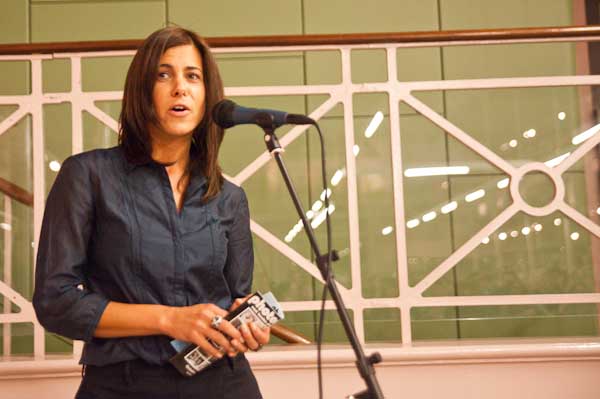
There were just three short speeches,  one welcoming us to the museum and a second by Festival Director, Maggie Pinhorn of Alternative Arts, who had the idea for the festival a few years ago and got it running with little or no support from the arts establishment. It’s still a festival that runs on a shoestring with the support of a few sponsors. The third and final speech was by someone from the World Photography Organisation which is sponsoring the new Youth Photography Award as a part of the festival.

Photomonth 2009

Photomonth 2009 opens officially later this week on 1 October with a preview of Childhood from Paul Trevor‘s East Ender Archive at the Museum of Childhood (part of the V&A)  just a few yards up the road from Bethnal Green tube, as well as the launch of the photomonth youth photography award.

Photomonth is the UK’s largest photography festival, with over 150 exhibitions and events in 85 venues in East London, which is perhaps why it lasts two months – until the end of November.  It actually spread out rather more, as some of the shows included – such as the Amnesty’s exhibition of the winning entries by Eugene Richards, Jim Goldberg and Lefteris Pitarakis shortlisted for the 2009 Amnesty International Media Awards opened at The Human Rights Action Centre, 17-25 New Inn Yard, London, EC2A 3EA on 20 Oct and continues until 5 Nov 2009 – another show surely not to be missed.

Photomonth is a very inclusive show, with a very wide range of both genres and experience, aiming to show the diversity of contemporary photography. As well as exhibitions, here are also various events including a photofair in Spitalfields Market, an open show, portfolio reviews, a photomonth lecture, talks, debates, workshops and seminars. Details of everything on the photomonth web site.

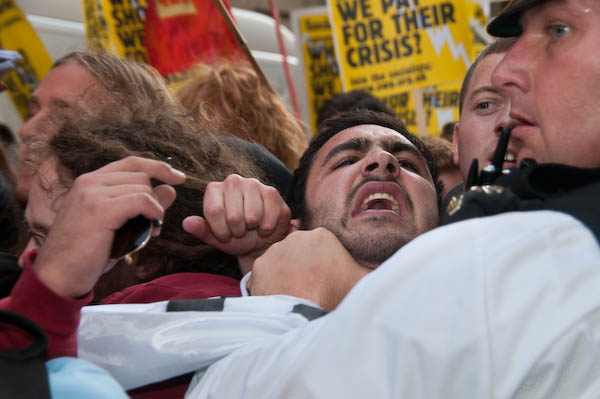
The front page of the site also has a grid of images which can be viewed larger as a slide show. Clicking on any of the pictures loads a larger version (in a few cases too large) and moving your mouse close to the top right or left causes ‘Next’ and ‘Previous’ tabs to appear. It gives some idea of the range of work on show in the festival, with the oldest image by “William Henry” being a W H F Talbot calotype from the first years of our medium. Among other photographers who are included are Martin Parr, Yousuf Karsh and several other well known names I leave you to discover. And then there’s this picture:

© 2008 Peter Marshall
March on the City © 2008, Peter Marshall

And of course, Taken in London, with work by myself and Paul Baldesare, part of photomonth 2009 opens on Saturday 3 Oct at the Shoreditch Gallery in The Juggler in Hoxton Market.  You’re invited to the private view on October 8th.

Soth in Bogota: Dog Days

Alec Soth went to Bogotá, Colombia in 2002-3 with his wife to adopt a young girl, Carmen, whose birth mother gave her a scrapbook in which she had written “When I think about you I hope that your life is full of beautiful things.’’ It led Soth to try to make a book of beautiful images for his daughter of the city of her birth, ‘Dog Days Bogotá by Alec Soth‘, and in the Boston Globe you can read more about it in a short piece by Mark Feeney. It’s there in the Globe because a show of work from it opened on September 9 and runs until November 28, 2009 at the Stephen D. Paine Gallery of the Massachusetts College of Art & Design (or MassArt.)

Both the paper and the gallery use the same single picture – of a dog looking towards camera on the tip of a hill overlooking the city bathed in bright sunlight, but you can see 49 pictures from the book (half as many again as in the show)  on the Magnum site as thumbnails or as a slide album.

Although the Magnum copyright overprinted watermark appearing five times on each image is less obtrusive than some, it is occasionally rather annoying, but even so these images are worth looking at.  There are five without this on the Magnum page for the exhibition.

Nachtwey in Indonesia

The National Geographic has a set of colour pictures by James Nachtwey that I find interesting, not just for the pictures themselves, but also for the questions they raise.

Indonesia: Facing Down the Fanatics  has on its opening page the statement “A more tolerant Islam is confronting extremism in the world’s most populous Muslim country“, but some aspects of what these images show are chilling.

A white hooded member of the ‘Front Pembela Islam’ points a finger to his head, imitating a gun.  The caption tells us that the red-letter motto on the hood reads “Live respected or die as a martyr“, and that this group intimidates bar owners, prostitutes and other “purveyors of vice” (and photographers are probably included among them) before and during Ramadan. It is perhaps little comfort that it also says that last year the leader of the group was jailed for inciting violence.

The next picture shows women from a Sharia Patrol issuing “citations” to men who failed to attend mosque, and although another caption comments that a “trend toward a stricter Islam hasn’t translated into support for militants, even among fervent believers”  it seems clear that it also hasn’t translated into the kind of free society that I would feel comfortable living in.

Artists & Illustrators and a photographer

It may be just a small picture and a hundred or so words in total, but I think I’m the only photographer featured in the October issue of ‘Artists & Illustrators‘ magazine.

They asked me if I would send one of my photos of the Thames Gateway, “an industrial site rather than greenery” and 50 words on what attracts me to photograph the city, along with a portrait of myself.

© 2003 Peter Marshall
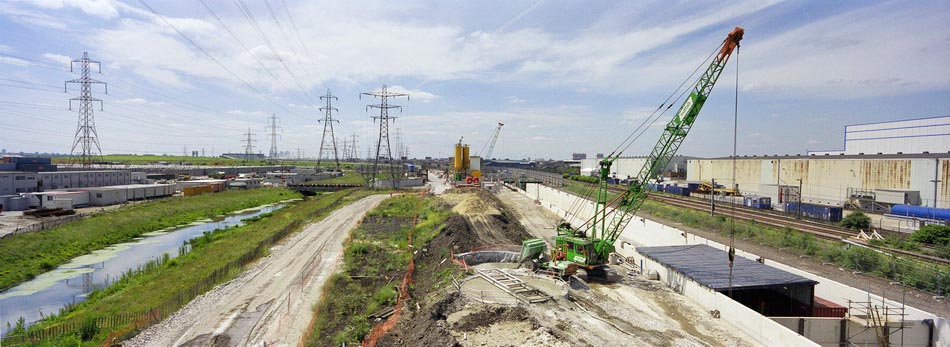
The Channel Tunnel Rail Link construction and Fenchurch St – Grays railway looking West, Dagenham. June 2003

The image I sent them of Dagenham did have some greenery, indeed it contains a Site of Special Scientific Interest in the ditch at the left (the Gores Brook) but also has an industrial quality and shows the Channel Tunnel Rail link under construction in 2003, as well as the railway line from Fenchurch Street to Grays.  If Boris hadn’t cancelled the DLR extension to Dagenham Dock last year (see London gets what it deserves. Unfortunately) that would have changed the view a little when it was built, and if common sense eventually prevails may still do so at some later date. Like quite a few from this series it was taken using the Hassleblad Xpan with the 30mm wide-angle lens using ISO 200 Fuji colour negative film.

I think I can now get similar results with digital, using the Sigma 12-24mm at around 18mm and cropping down to the same format, which results in about a 7.5 Mp image,  4256 pixels wide, which can give excellent prints up to around 20 inches wide, and certainly on the A3 or A3+  sheets on which I normally now print the Xpan files.  One made with a longer focal length hangs behind me and technically it’s hard to fault.

© 2006 Peter Marshall

You can see the Dagenham picture rather larger (though I think I made a slightly better scan for the magazine)  along with some others images in my Thames Gateway project on the Urban Landscapes site (it is of course in the ‘Essex’ section.) You might even be able to see Canary Wharf on the horizon.

And the 50 words I sent? Well, they didn’t really relate to this picture, but to my interest in the city in general, and it was really impossible to say all I wanted to say in such a limited space. But here they are:

Involvement in grass-roots planning campaigns in Moss Side in the 60’s led me to document urban realities and processes when I went into community photography in the next decade. My first major urban project was in Hull, where a similar vast clearance was under way. Since then London’s post-industrial landscape and new developments have provided plenty of material.

The magazine also mentions a couple of my web sites and my forthcoming show with Paul Baldesare, ‘Taken in London‘.

Stone Hole

Photofusion, Brixton: 25 Sept – 5 Nov 2009

Stone Hole is a new collaborative exhibition of large digital photographs by Crispin Hughes and a time-lapse film by Susi Arnott, made in tidal sea-caves along the shoreline of North Cornwall. 

© 2009 Peter Marshall
Crispin and Susi at the opening

Crispin and me go back a long way, to a ‘Men’s Group’ he ran back in the Webbs Road days of the Photo-Coop, founded in 1984, and a short walk from Clapham Junction station. I’d forgotten until tonight that photo publisher Chris Boot, also at the opening, was also a member; it was a very long time ago.

© 2009 Peter Marshall

The Photo-Coop moved to more extensive premises in Brixton and became Photofusion, but it was a longer and more complex journey for me, and although I’ve kept in touch – and still contribute pictures to the Picture Library there, run by Liz Somerville – otherwise it perhaps became more peripheral to my own view of photography.

© 2009 Peter Marshall
Hi Liz!

But it was good to go back there yet again tonight and there were certainly a sprinkling of people I knew from the old days as well as some newer friends.

© 2009 Peter Marshall

Crispin’s previous show, ‘Unquiet Thames’ at the Museum of London in Docklands in 2006 was a stunning panoramic exploration of enclosed spaces under bridges, piers and tunnels on the Thames in London, and its large prints and soundtrack created an impressive environment in the gallery space.

Stone Hole develops from this, working in sea caves in North Cornwall with Susi Arnott. The metaphor that underlies this work is that of the eye, with several images that strongly suggest biological structures and diagrams of the eye, and the cave mouth as an aperture admitting light.

© 2009 Peter Marshall

Reading the notes when I arrive home I found that Hughes’s work was carried out at a time of various medical crises, including at one point the loss of sight in one eye.

© 2009 Peter Marshall

Susi Arnott‘s film using time-lapse images explores the dangers of the rising tide in these sea-caves to a degree that made me feel uncomfortable. If you too have had the experience of thinking that you are about to drown and looking up through the greenish blur of water you may share this. But it is an interesting work and complements the still images by Hughes.

© 2009 Peter Marshall

Though I’m seldom a fan of videos in art shows this does add to the the overall effect, though it was hard to appreciate the sound track (which I think is a vital element) above the hubbub  of the opening.

Also in the gallery display is some detailed information about the geology of the area that led to the incredible caves and rock formations, which I soon gave up trying to understand. If you have a particular interest in such matters there is an exhibition talk with geologist Dr Jon King on 10 Oct, while two other events involve a clinical psychologist and an architect.

The splendid large prints were made at Photofusion, are are certainly an excellent advert for the services of Richard their printer.

One rather nice small touch at the opening were the several dishes of small pebbles – just like many of those in the photographs – around the gallery. Except that unlike those in the image, much to my surprise, these turned out to be chocolate.

Victims of the Arms Trade

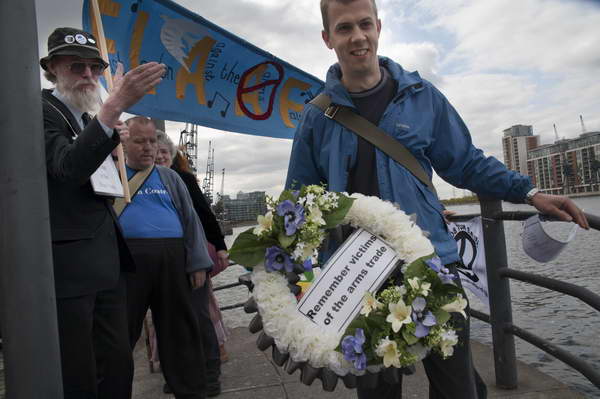
While every other photographer was heading to Harrow a couple of weeks ago to try to photograph and expected clash between racist demonstrators and Muslims, I took the tube out to Canning Town instead. Partly because I thought there would be plenty of other photographers at Harrow and there were, but also because I wanted to make sure that someone at least was there to photograph the ‘Memorial Procession for Victims of the Arms Trade’ organised by ‘East London Against the Arms Fair’ (ELAAF) on the final day of the government-sponsored Defence Systems & Equipment International (DSEi), the world’s largest arms fair, taking place at the ExCeL centre.

© 2009 Peter MarshallPreparing to launch the wreath on to the water opposite the arms fair
ELAAF is a small group that holds regular demonstrations to oppose holding the arms fair in its local area, and I didn’t expect a huge crowd. But it was a dignified if small protest and I was pleased to be able to record it and get it some publicity on independent media sites.

More about it – and more pictures on My London Diary.

Capitolio – Christopher Anderson

Anyone who doubts the relevance of black and white in photography now that almost all of us shoot in digital colour should take a look at the selection of pictures on the New York Times ‘Lens’ blog by Magnum photographer Christopher Anderson from his new book on Venezuela,  Capitolio. You can see more of his fine work, both in black and white and colour, on the Magnum site.

The feature on ‘Lens’ by Simon Romero tells you more about the streets of Caracas, surely one of the more difficult places in the world to work, and also about the photographer, so I won’t write more here. Just don’t miss it.

However, as well as great work like this, I do see rather too much black and white photography that I look at and think that it was shot in colour and surely would have been better shown in colour. These days almost all photographers do start with colour – on digital compacts and phones – before taking up photography seriously,  and although may take courses that force them to do at least some work in black and white, few get the kind of experience with working with it that we used to back in the days before digital and when newspapers and many magazines were largely or entirely monochrome.

City Panoramic

I’m not quite sure what happened to me in March 2008, because I lost a web site. It was only quite a small site, with a dozen or so pictures, but I wrote it and then just forgot about it. Completely.

This morning by chance looking for another set of files I came across the folder it was in, though from the name it wasn’t obvious, but curiosity made me take a quick look and see a list of files mainly starting with 92-city, which meant nothing to me, so I double-clicked on the default.html file with them and got a surprise.

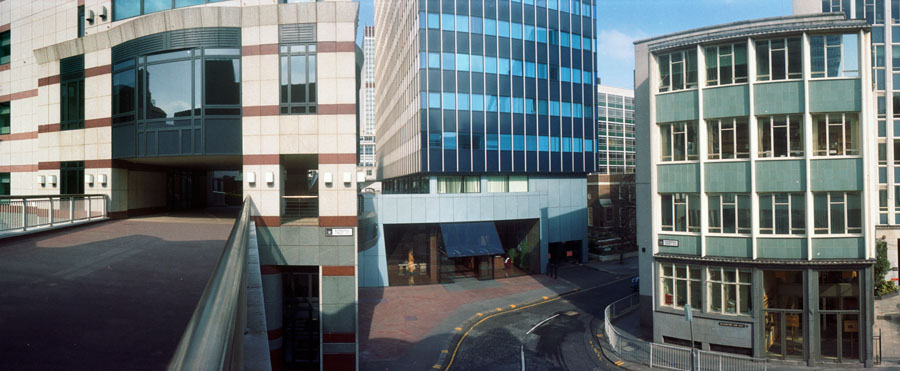
© 1992, Peter Marshall

It says on the site:

These pictures were taken when I was a part of London Documentary Photographers in 1992 and were a part of a documentary project on the City of London. The ‘square mile‘ is one of the major financial centres of the world. These images were first shown at the Museum of London in 1992.

I think I was probably intending to put together a larger site including many more of my panoramic images, but since that’s unlikely to happen in the near future I decided to link them in to one of my existing sites, The Buildings of London, which is long overdue for a makeover. But you can jump directly to them here, though you may need to make your browser window wider; the images on the site are exactly twice the width of the one in this blog at 900 pixels and the site was written to fit a page around a thousand pixels or wider.

All of these images were taken on a panoramic camera with a lens that rotates through around 120 degrees during the exposure. At the time I was using a Japanese Widelux camera, but later I preferred the much cheaper Ukranian Horizon which has a considerably better viewfinder.

Although the Widelux does have a viewfinder, the most accurate indication of what you are going to take is provided by a couple of arrows on the top plate. For best results, at least with architectural subjects, you needed a tripod and a good spirit level, while the Horizon was easily usable hand-held and had a level visible in the viewfinder.

There are several different models of Horizon, but all except the oldest, which had a metal body share a similar rounded plastic body. It would be great to have a digital camera that worked in the same way, but I think very unlikely that making one would ever be financially viable. So if you want to do this kind of photography the Horizon is still a good choice, despite being clockwork and using film.

My second Horizon came direct from the Ukraine in a brown-paper parcel and was cheap -under half the price the similarly specified Horizon Perfekt sells for at Lomography. But their price does include “a 2-year warranty against manufacturer defects, a premium case, and a gorgeous panoramic book.”

You can of course take panoramas using digital cameras and image stitching, but the results have a different perspective and it can be tricky if part of your subject is moving. Another approach that gives something rather more similar to the swing-lens result is to use a semi-fisheye lens and then remap the image using a Photoshop filter such as Image Trend‘s Fisheye Hemi. You can also get some different but also interesting results with remapping using the free Panorama Tools.

You can see an interesting discussion by the author of Panorama Tools, Helmut Dersch, comparing rectilinear, fisheye and swing lens results.