My London Diary by the Sea

I didn’t go to Brighton clutching my bucket and spade, or even for the traditional dirty weekend – the hotels were in any case pretty much fully booked for the Labour Party conference, which explained my visit, though I had no intention of entering the boredom zone inside the conference centre itself. Coming from the western edge of London it didn’t make sense for me to travel on the specially chartered “Rage Train” from London Victoria, and I arrived an hour or two before this, avoiding the welcome by a large contingent of police at Brighton station when the demonstrators arrived, and strolled down to the conference centre and the pier with a Brighton-based photographer.
© 2009 Peter Marshall

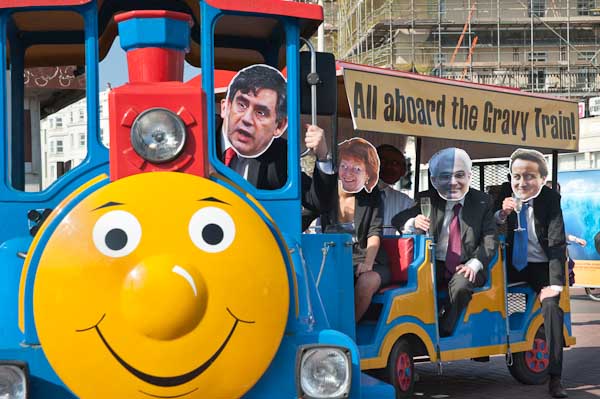
There we found another train, driven by Gordon Brown, but with David Cameron waiting his turn on the back seat. The ‘Westminster Gravy Train’ was provided by the ‘Vote for a Change’ campaign, calling for a referendum on electoral reform and a break with the “voting system that has left parliament unaccountable and unrepresentative.” There were other protests too, including a reminder that there is still unfinished business at Guantanamo Bay, with Shaker Aamer, whose family live in Battersea still detained and former Bournemouth resident Ahmed Belbacha  who is free to leave but has nowhere safe to go, permission not having been granted for him to return to the UK.

Meanwhile, protesters were gathering on the promenade for the main demonstration for ‘Jobs, Education, Peace‘ organised by six trade unions and several campaigning groups.  Protesting against job losses and unemployment – and arguing that instead of allowing industries like Vestas who make wind turbine blades to move production out of the UK the government should be taking a positive lead in creating green jobs; against cuts in education provision, especially those in deprived areas such as Tower Hamlets, and against essentially imperialist wars such as those in Iraq and Afghanistan.
© 2009 Peter Marshall

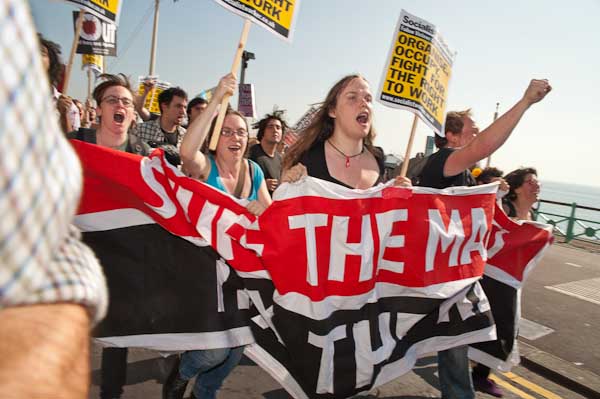
‘Stuff the Market, Tax the Rich’ was the uncompromising message of the banner carried by a large group of students among the several thousand demonstrators, intermittently halting to chant slogans and work up some energy before charging forwards into the gap of 50 or more yards they had allowed to develop, scattering the media who had gathered in front of them.

That’s my arm at the left of the picture above, running at some speed to keep ahead as I pointed the camera held in my other hand back towards the banner. The 24mm end of the 24-70mm was around the right focal length for the job on the full-frame D700, and the fill flash adds the necessary sharpness to the central figures, while a slight degree of blurring helps with the feeling of movement. It is only slight blurring because the flash synchronizes at 1/320th, rather different from just a few years ago when sync speeds of 1/60 were normal and 1/100 fast.

It was a nice sunny day, and working at ISO400 was plenty fast enough, with f14 eliminating any depth of field problems – the hairs on my arm are out of focus but then they are closer than the near end of the focus range – and better soft in any case. The sea and promenade railings are blurred slightly from the camera movement – and this helps the picture. As I now do most of the time, I was using the camera in P (program) mode (though I often use the dial under my thumb to increase or decrease shutter speed while keeping exposure constant) and the exposure was made using the 3D Matrix metering with no compensation. The camera was also set to autofocus in auto-area mode – in which it is supposed to recognise and choose faces to focus on. In other words I left the technical stuff to the camera – and it seems to have worked

Back in the old days, when I was working with manual cameras such as the Leica I would have only managed a single exposure, at most two, during this few seconds of rush; with the Konica which added autowind, perhaps three. In both cases I would have have been lucky to get anything at all from the pictures – though I did occasionally manage in similar situations.

I can’t say it’s easy or comfortable shooting back over your shoulder while running fairly fast, but modern technology does make it a lot more reliable!

More pictures and text (both stories were on the front page at Demotix)  on My London Diary:
Gordon on the Gravy Train etc

Jobs, Education, Peace March & Rally

Taryn Simon TED Talk

Taryn Simon was for me the outstanding finalist among those shortlisted for the 2009 Deutsche Börse prize at the Photographers’ Gallery, for her work ‘An American Index of the Hidden and Unfamiliar‘ which gained the 2008 Infinity Award for publishing from the ICP, and was one of the best shows to grace the Photographers Gallery in recent years. But of course the judges though otherwise.

However TED shares my opinion. On their web site they say “TED is a small nonprofit devoted to Ideas Worth Spreading. It started out (in 1984) as a conference bringing together people from three worlds: Technology, Entertainment, Design. Since then its scope has become ever broader.” And of course quite a lot more. Put simply, TED gets the best ideas over a very wide range of fields from around the world and presents them. It’s a great honour to be invited to take part.

The best of the 18 minute presentations by those invited to speak are made freely available on their web site –  under a Creative Commons license, so they can be freely shared and reposted.  Taryn Simon‘s is one of these, and you can watch her on the TED site as she talks about two of her projects. One is on the hidden sites, a number of which were in the Photographers’ Gallery show, and she adds some interesting comments on how she did the work and why. (You can see some with the accompanying texts from the link near the bottom of her web site page.)

Her earlier project, ‘The Innocents‘ (2003),  has a particular photographic interest as she has photographed men wrongly committed to long jail sentences for crimes they did not commit on the basis of photographic evidence.  She talks about how showing photographs to crime witnesses can produce unreliable results; often people remember photographs they have seen before and identify these rather than actually remembering the criminal and finding them in the pictures, and gives at least one case where police deliberately mislead a witness. The men were all cleared when further evidence – often DNA – became available and Simon has photographed them in locations with a particular significance to them – their alibi locations (some were convicted despite having many witnesses to testify they were elsewhere) , place of arrest or the scene of the alleged crime.

Simon’s portraits (and the hidden places) are interesting even if you do not know the story behind them, but the stories provide an added dimension which both anchors and intensifies their meaning. They give us some ideas about what we mean by truth in photographs, showing how misleading photographic evidence can be – and what a critical effect this can have on some lives. There are five images from this series on the Gagosian gallery site, and five with an essay and questions at MoCP.

Apprentice Boys March in London

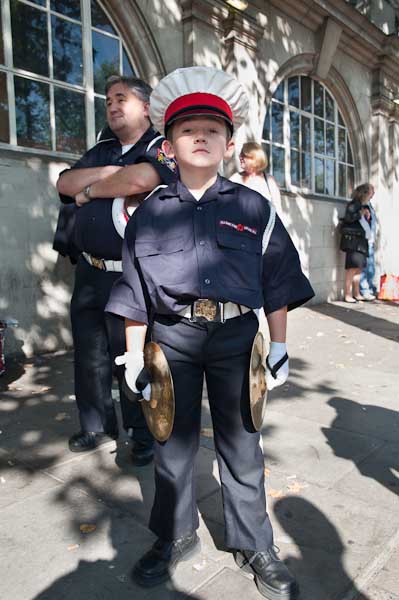
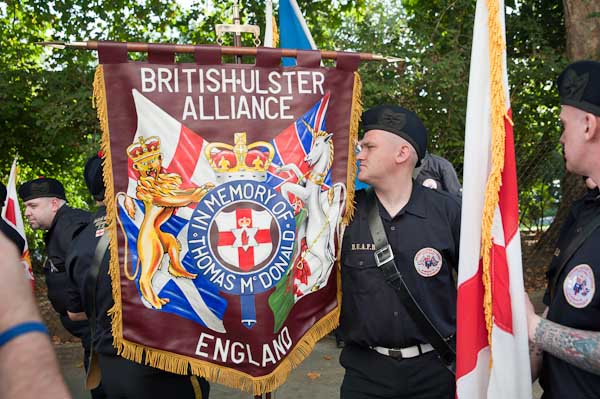
If I lived in Northern Ireland, marches by the Apprentice Boys would worry me, even though I’m at least nominally a Protestant,  and the Parades Commission there has an important role in its guidelines and code of conduct for processions so they avoid as far as possible creating disorder.

© 2009 Peter Marshall

Here in the UK, such marches are different, and there are very few “contentious areas” in any case. The main purpose of the annual Lord Carson memorial march in London is to lay wreaths at the Cenotaph in memory of the many men from Ulster who served in the 36th Ulster Division of the British Army, made up of men from the paramilitary Ulster Volunteer Force.

© 2009 Peter Marshall

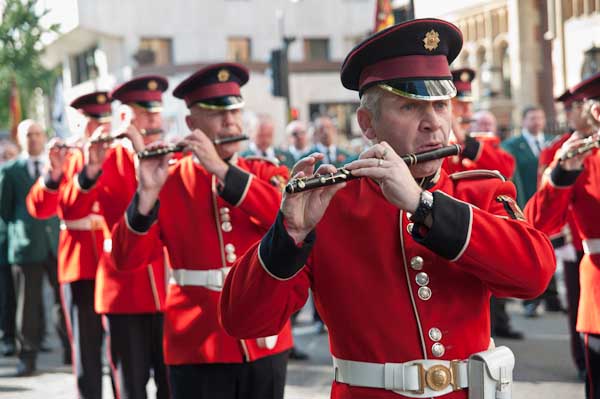
Families come from Glasgow, Liverpool, Belfast and elsewhere to take part in and watch the parade along with those from London. Of course there are still cases of sectarian violence in Northern Ireland and elsewhere in the UK, and last year I was threatened and mildly assaulted when I was mistaken for another photographer (who was actually a short distance down the road, but of course I didn’t tell on him.)  Of course such behaviour is simply unacceptable. Fortunately this year everyone was friendly.

© 2009 Peter Marshall

Carson himself was a great figure in English and Irish law and government – and one of a small number of non-royals to be given a state funeral here. Unfortunately he was unable to convince the Orange Order and those who came to power in Northern Ireland of the need to accord fair and reasonable treatment to the minority Catholic population, and instead left the country for London in 1921.

More about the event and pictures in ABoD Lord Carson Memorial March.

Serbian Pride and Camp Ashraf

A week or so on ago on Friday afternoon I photographed two demonstrations that haven’t otherwise got a lot of media coverage. And perhaps if I had not been coming to London for a couple of other things I would not have made it to them. I’m pleased that I did, as it meant both got some publicity through Indymedia and Demotix, but neither is likely to do a lot for my bottom line.

LGBT Solidarity at Serbian Embassy

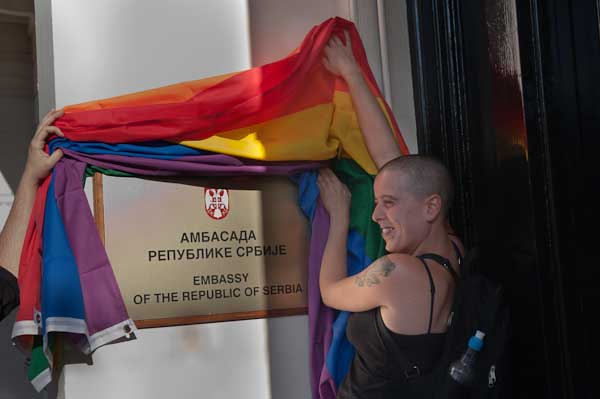
The first was a LGBT demonstration outside the Serbian Embassy in Belgrave Square to protest at the last-minute cancellation of the Serbian government of Belgrade Pride. There is a strong homophobic right-wing there, and a previous attempt in 2001 to hold a procession there ended in violence with the parade having to be abandoned.

This time the government had promised to ensure it could happen, but at the last minute backed down to the right-wing pressure and cancelled it just hours before it was due to take place.

© 2009 Peter Marshall

There wasn’t really a lot to photograph, some rather straightforward pictures of people standing on the steps, handing over a letter… It was really an occasion where I start to understand why press photographers so often set things up. But that just isn’t how I work.

Perhaps the best opportunity was with the picture above (and a few variations of it of course) but here the difficulty was in the lighting contrast between the very bright sunlight coming in low on the left of picture and the deep shadow at the right. Of course I had my flash, the Nikon SB800, but for once it simply refused to work properly, and wouldn’t go into BL (balanced light) mode at all.  I made a few exposures, trying several ways to get the balance I wanted, but couldn’t really make it.

I still don’t know why it wasn’t working, but I think it was the camera rather than the flash that wasn’t playing ball, as when I got home and tried with my second SB800 I had exactly the same problem. I cleaned the flash contacts on camera and flash, fiddled with the menus on both flash and camera with no luck. Then finally it did start to work again, but I’ve no idea why. Modern automatic systems are great when they work, but can be so frustrating when something goes wrong.

More at: LGBT Solidarity at Serbian Embassy

Camp Ashraf Hunger Strike – Day 60

Camp Ashraf is in Iraq. After the 1979 Iranian revolution a number of camps were set up in Iraq for Iranian refugees, and some of them were also armed to continue resistance. The main Iranian opposition group, the People’s Mujahedin of Iran, was housed in Camp Ashraf. After the US led invasion, the US took over responsibility for refugees in Iraq, and after a short while decided to disarm the PMOI.

At the start of the year, the US handed over control of the camp to Iraq, giving promises that those living in it would be treated humanely and not deported to any country where they had a “well-founded fear of persecution“. The Iraqi government apparently has other ideas, as it wants to improve relations with Iran it wants to send the PMOI back there, possibly as a part of a prisoner exchange. Iraqi forces came into the camp, attacked the residents, killing 11 and injuring hundreds and took 36 men into detention. They are still detained despite a court ruling they must be released.

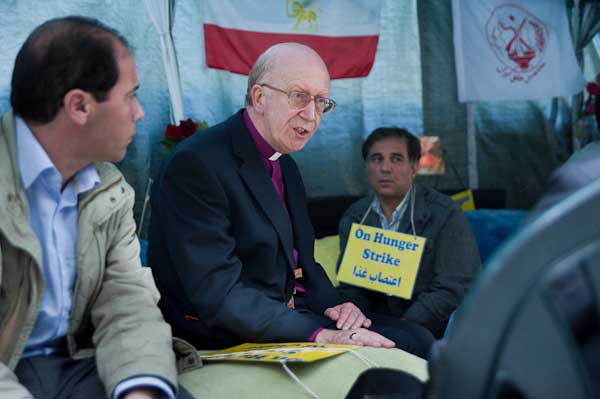
The detainees started a hunger strike in Iraq, and 12 Iranians in Britain also gone on hunger strike as a protest outside the US embassy in London, as the US is still thought to be responsible under the Geneva Conventions for the safety of the men in Iraq. When I was there they were on their 60th day and several had already been taken into hospital but had returned to continue their protest.

© 2009 Peter Marshall

Although the awnings under which the hunger strikers were sitting or lying on beds were fairly dim, the lighting under them was reasonably even and I could work at ISO 1600-3200 without great problems.

My problem was how to dramatise the story to make it more likely to be taken up by the media, and I couldn’t find a solution. I’m not sure if I was having a bad day or there really wasn’t anything there, or perhaps I just didn’t spend long enough or work hard enough at it.

Of course the story and picture did get out on Indymedia and Demotix, but I would have like it to get more publicity. The failure of the US and our governments to do anything at all about it is truly shameful.

More at: Camp Ashraf Hunger Strike – Day 60

Druids at Primose Hill

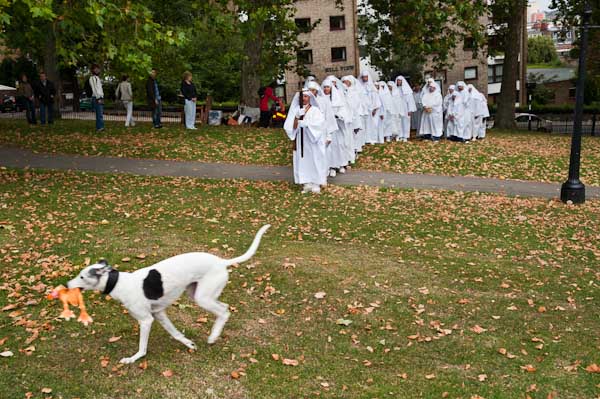
Primrose Hill, just to the north of Regent’s Park and the zoo, has a wide view over the centre of London and is a pleasant place to sit on a warm sunny day. When I got there, a few people were marking out the grass next to the summit ready for the Autumn Equinox celebration by the Druid Order.

© 2009 Peter Marshall
The dog and stolen rubber chicken are not a normal part of the celebration

I was interested to find a new memorial stone in the ground, perhaps 4 feet across, made of a grey cricle of slate set into a concrete base, with a brass circle in the centre carrying a bas-relief head and shoulders. Around it were twelve symbols, something like this: ‘/| \’, the three rays of the ‘druidic’ Awen, and in the next circle the name of ‘Iolo Morganwg’  who invented it, along with his date of birth and death, 1747-1826 and the text ‘THE TRUTH AGAINST THE WORLD’ together with what I assume is the same in Welsh. An outer ring carries the message (again in both English and Welsh) ‘This is the site of the first meeting of the Gorsedd of the Bards of the Isle of Britain 22.6.1792‘. Perhaps surprisingly this appears to be historically accurate.

© 2009 Peter Marshall

The Gorsedd still meets, but now at the National Eisteddfod of Wales, but it was good to see a memorial to “Glamorgan Eddie” who started it, even if we now know that much of the history he claimed to have translated from the ancient Welsh manuscripts that created a cultural image for the Welsh nation was his own complete invention. 

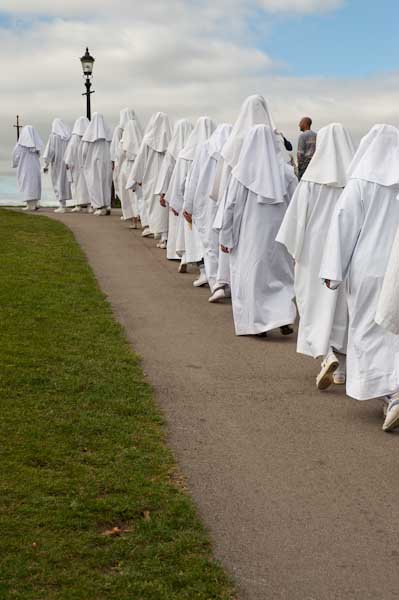
Like many of our ‘ancient traditions’, The Druid Order who I had come to photograph also has a mythic history, tracing a lineage back to 1717 and even earlier, but actually began just around a hundred years ago. Perhaps fortunately so, because the ancient druids appear to have been a much more bloodthirsty lot. I don’t know when they began their celebrations at Primrose Hill (or Tower Hill in the Spring) but they first appear rather similarly dressed but under a different name at the Summer Solstice at Stonehenge in 1913.

The white robes and head dresses appear to have been derived initially from a fanciful description written in Germany around the middle of the last millennium rather than from the actual druids, who I suspect wore mainly animal skins and woad, but the robes are more photogenic. I think it would be hard not to take some interesting pictures of the celebration.

You can read more about the history of the druids (and if you want even more, a there is a lecture by historian and author Professor Ronald Hutton which you can download) in my feature on My London Diary, with of course many more pictures.

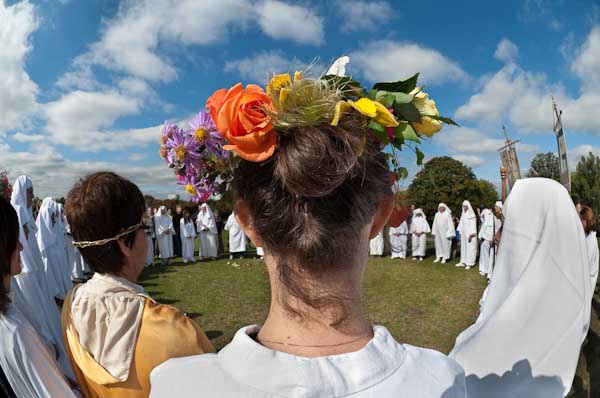
As usual, I found the fisheye rather useful.

© 2009 Peter Marshall

It was another occasion when two bodies would have been useful, although the 24-70 covered most of what I wanted. It would have been better to have had a second body that I could have had equipped either with something shorter or longer as the situation changes. Perhaps I might try keeping the24-70 permanently on the D700 but also carrying the D300 with 10.5mm fisheye, 10-20mm and 55-200mm.  Only another 7-800 grams but I really need a bigger bag!

More here: Autumn Equinox: Druids at Primrose Hill

Bermondsey Birthday

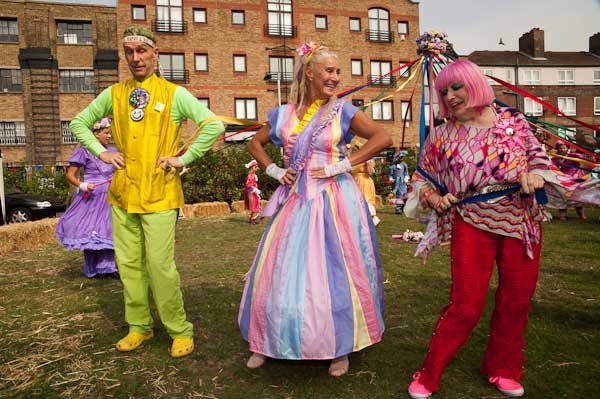
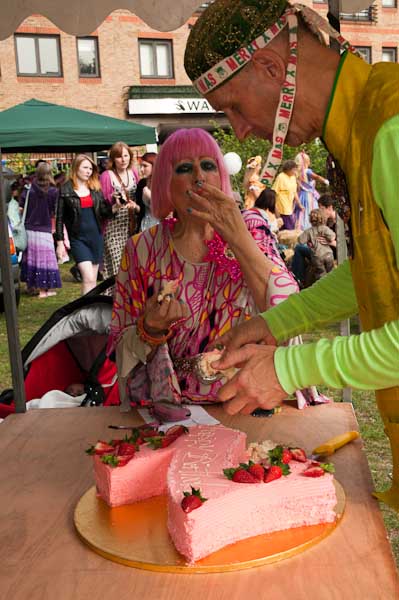
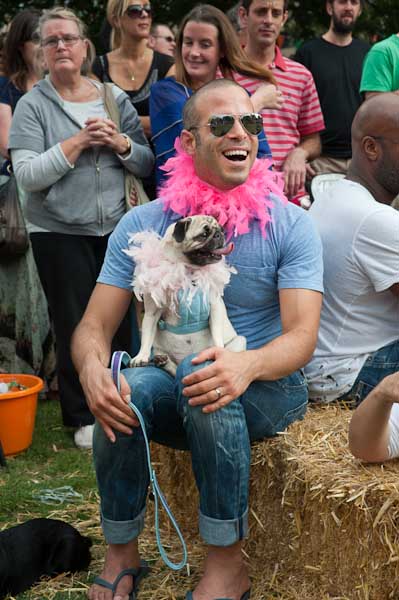
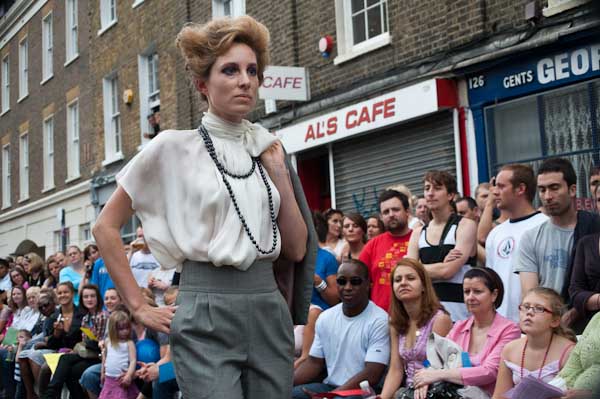
I don’t get to photograph that many birthday parties, and this one had an internationally renowned designer and an artist, a maypole with the irrepressible Donna Maria and a real live fashion show. And of course more. It’s all in the pictures really:

© 2009 Peter Marshall
Andrew Logan, Donna Maria and Zandra Rhodes

© 2009 Peter Marshall
Andrew Logan, Zandra Rhodes and more cake

© 2009 Peter Marshall
Dog not fashion show

© 2009 Peter Marshall
Fashion show (no dogs)

© 2009 Peter Marshall
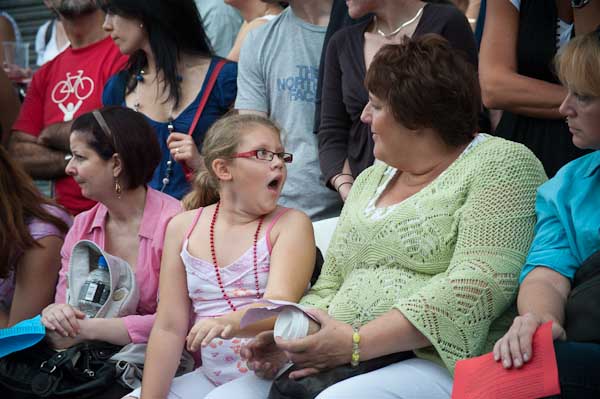
I thought so too
!

Again it made the Demotix front page. Story and more pictures including Adam and particularly Eve on My London Diary.

Climate Chaos

I’m getting to know the Department of Energy and Climate Change pretty well, but two demonstrations outside there in a week was perhaps a little too much. The first on Monday evening was timed to try to influence the decision that Ed Miliband has to make on the building of a new coal-fired power station at Kingsnorth, following the end of a public consultation.

The decision, expected in the next couple of months, will give a clear indication of whether our government is serious about climate change or has bowed to the intense lobbying and financial clout of the energy industry. We don’t need Kingsnorth, and an alternative programme of investment in wind power has long term advantages as well as avoiding “climate-wrecking dirty coal power.” Nobody seriously believes that we will get 100% carbon capture and storage – or that it would in any case be a serious long term solution; all the technical solutions exist for wind power as a major power source for the UK (and for its export potential. Perhaps even more seriously, if the plant is built it is very hard to believe it would not be used even if, as seems likely, only marginal carbon removal proved economic.

Organising the demonstration were the Climate Chaos Coalition (CCC) representing virtually all the major environmentally concerned groups in the UK, including Friends of the Earth, Greenpeace and the Campaign Against Climate Change, as well as faith groups, aid agencies and many others – a total of over 100 organisations with a total membership of more than 11 million. There are probably few other organisations that unite the RSPB, the World Development Movement, Unison and Viva!

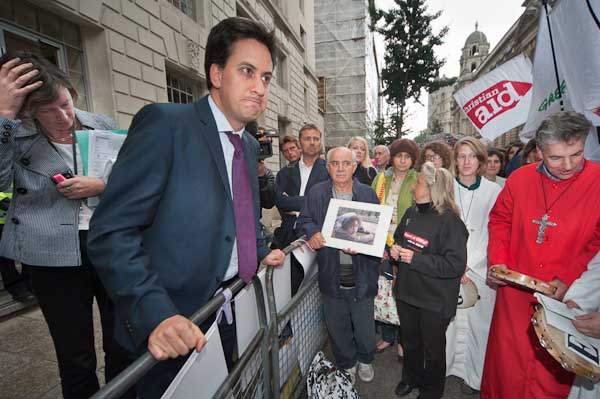
Christian Aid provided a choir in white surplices (and with one in a cardinal’s bright red)  and tambourines which livened the proceedings considerably but the big surprise was when Ed Miliband came out of the ministry to talk to the demonstration and answer some very aggressive questioning.   I took a few pictures from one side as he leaned over into the pen, shaking hands, but obviously the best place would be in front of him, in with the demonstrators. So I ran around to the back and made my way inside. It was a very crowded area, but I soon changed to a 12-24mm lens which let me work in the confined space.

© 2009 Peter Marshall
Ed bites his lip, his aide tears her hair

I was sorry I’d only brought a single body, as it was so crowded it was hard to change lenses, and I knew Miliband would not stay long and wanted to make the most of it so anyway didn’t want to waste more time with lens changes.  12mm is really too wide to be useful and I would have liked something a little longer than 24mm, perhaps something like a 17-35mm would have been ideal.  The 24-70mm just wasn’t wide enough most of the time.

Fortunately the other photographers present and the video guys didn’t follow my lead as there really wasn’t room for me let alone others there.  It was yet another story that made the front page on Demotix and I also put it on Indymedia,  but found no other takers. You can read the story and see rather more pictures on My London Diary.

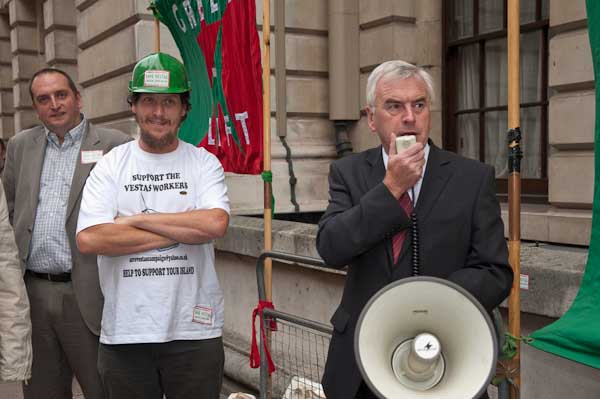
Thursday evening I was back more or less in the same place – the pen was on the opposite side of Whitehall Place for the  Vestas  ‘Day of Action for Jobs and the Planet’ demonstration there organised by the Campaign Against Climate Change, with speakers including John McDonnell, MP, Darren Johnson, Green Party spokesman on trade and industry and chair of the London Assembly, trade union organisers and Mark Flowers, one of the sacked Vestas workers.

© 2009 Peter Marshall
Darren Johnson, Mark Flowers and John McDonnell

The other acid test of the Government’s seriousness over climate change is of course their reaction to the closure of Vestas Blades. Unfortunately they have completely failed rather than take the opportunity of setting up a vital UK industry in the manufacture of wind turbines that could be important both in meeting our energy needs and investing in green technology with great future opportunities for export of both electricity and plant.

More on My London Diary.

Jerusalem Day March

© 2009 Peter Marshall

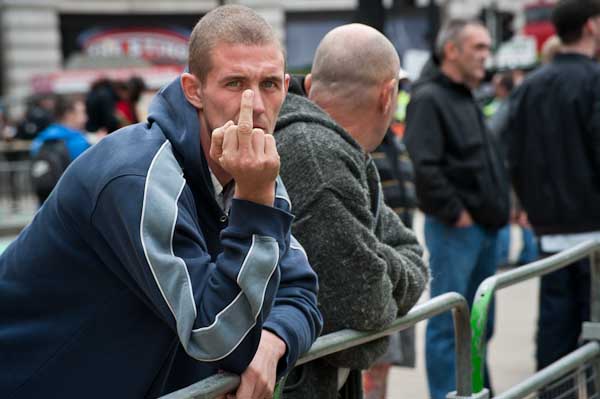
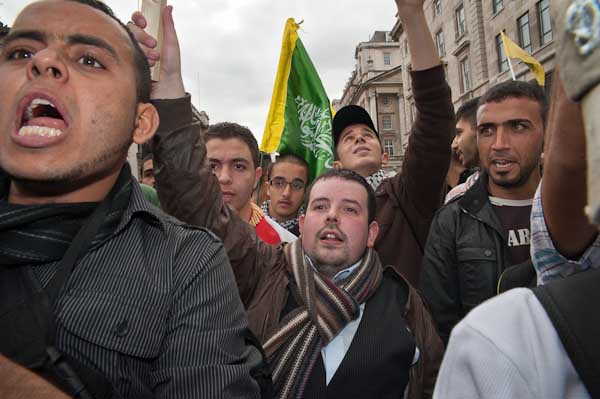
After I’d taken this picture of a demonstrator waiting to scream insults at the AlQuds day march as it passed the pen at Piccadilly Circus, he complained loudly to a policeman about  being photographed. The policeman, who had been watching me take the picture smiled at me and told him that I was perfectly within my rights to photograph people in public, adding the “Sir” at the end of his reply with more than usual ironic emphasis.

It is a curiously strongly held belief among many of the general public (perhaps mainly the less-educated) that they have some kind of right over their image when they appear (perform might be more accurate) in public, shared by some demonstrators on the extreme right and left. Fortunately the law thinks otherwise, or photography as we know it would be extremely limited. Of course there is the law about defamation, that sometimes rightly restricts how you many use an image, but in general if people are in public, unless they are in situations where they have a genuine expectation of privacy, they can be photographed, at least so long as you don’t continually harass them in a way that could be interpreted as stalking, or they are very rich and famous and can employ extremely expensive briefs to bamboozle judges.

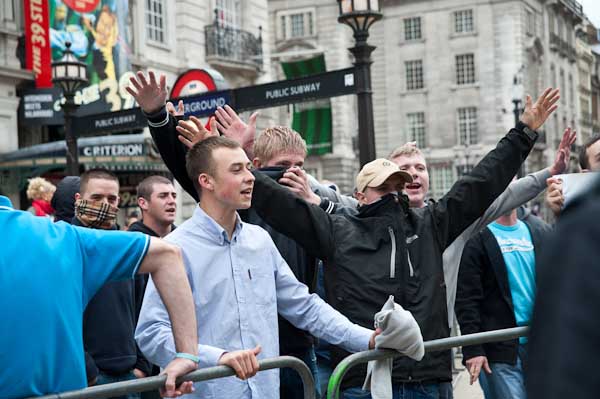
Of course people are free to cover their faces – though the police may force them to remove masks to be photographed. And some of the English Defence League or March for England supporters did so, though not very effectively, having failed to think sufficiently in advance to bring masks.

© 2009 Peter Marshall

Photographers to a person like masks. Not just because we’re fans of Ralph Eugene Meatyard, though some of us undoubtedly are (and some of Saul Steinberg) but because they make for more interesting pictures. But on those occasions when I’ve taken a decision to demonstrate – even where that meant breaking the law – I’ve always wanted to do so openly.

While the demonstrators in the pen made me feel ashamed of my fellow countrymen (and there was also one woman among the football supporters) I felt among brothers and sisters in the march itself, as it made its noisy way along Piccadilly, chanting slogans and carrying banners including “We are all Palestinians” in a display of solidarity with the Palestinian people.

© 2009 Peter Marshall

The text on My London Diary is more or less the same as that I posted on the day to Demotix (where my story made the front page as fairly often) and Indymedia, but there are many more pictures.

Photographers Flash-Mob

The response from the PM’s office to a recent petition on the restrictions on photography was of course bland in the extreme, but the petition itself was perhaps an over-reaction to a measure which perhaps clarified rather than intensified the existing  restrictions on photography. When the Counter-Terrorism Act 2008 came into effect I attended and recorded on the demonstration by photographers outside New Scotland Yard. Since then I’ve also mentioned the Home Office circular Photography and Counter-Terrorism Legislation which gave police  some generally welcome advice to police about how they should be using the legislation. A description of two sections of the legislation is in each case followed by something the circular designates as Important,  that they do “not prohibit the taking of photographs, film or digital images  … and members of the public and the press should not be prevented from doing so

It was perhaps a shame that in relation to Section 58 – the photography of police etc – the note concerning the statutory defence of reasonable excuse read:

Important:Legitimate journalistic activity (such as covering a demonstration for a newspaper) is likely to constitute such an excuse. Similarly an innocent tourist or other sight-seer taking a photograph of a police officer is likely to have a reasonable excuse.

Although of course the note should not be taken as excluding other activities from having reasonable excuse, it does seem unduly limited. The circular should have stressed more the need for their to be a reasonable presumption that the photographs would be “likely to be useful to a person committing or preparing an act of terrorism” and that it would not cover photography of police carrying out normal activities such as the policing of demonstrations, directing traffic or giving directions to tourists. Or even less normal activities such as beating up demonstrators and damaging property.

Most of the problems that we have with police on the street (and anyone who photographs on the street and claims to never have problems must surely be in police employ) have to do not with the law but with police who like to make their own laws or fail to know or respect the law. Certainly a few police do have it in for photographers,  but perhaps rather more fail to appreciate the problems that we face. And of course the police often have plenty of problems at some of the events that we photograph, even if some of them are of their own (or their superior officers) making. It can be instructive to read some of the blogs written by police.

But photographers are definitely finding the job harder, not just because of police, but also because more and more public areas are now controlled by security guards.  Increasingly parts of our cities that are spaces open to the public have been privatised, and if you raise a camera to your eye or erect a tripod you are likely to find your view blocked by a large man telling you that you cannot take pictures. And if you are on private land – such as that of Canary Wharf Estates – although it’s very much public, with underground and DLR stations, buses, shops and more where the public are free to pass and spend their money, you have no right to take photographs.

(Security guards do often appear to be trained to be hostile to photographers.  Over the years I’ve carried out an education programme, telling them what the law is and asking them to contact their supervisor to check, or to phone for the police.  But if the land you are standing on is private, you don’t have a leg to stand on, though I’m a fast worker and have often taken the picture I want before they get to me.)

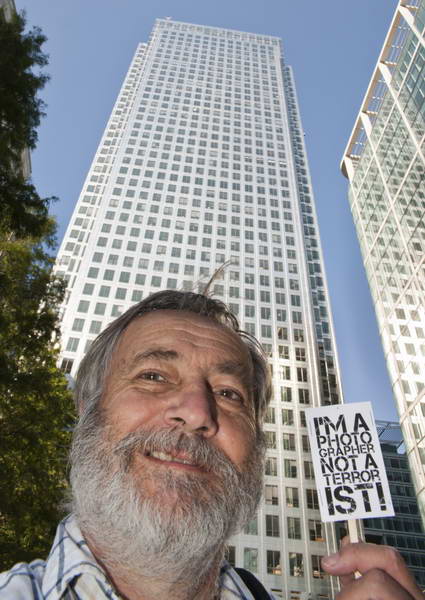
A couple of weeks ago, the I’m a Photographer not a Terrorist! campaign organised a flash-mob protest at Canary Wharf and around a hundred photographers including many of London’s better editorial photographers turned up on the dot of 3pm to defy the ban and take pictures. Security men watched from a distance but otherwise ignored the protest.

© 2009 Peter Marshall

So we photographed ourselves (above) and the other photographers, talked to a few members of the public about the issue and then went for a pint, before I went home to post the story to Indymedia and Demotix. You can read more about it and see pictures of some of the more attractive participants on My London Diary.

Spiritual America Meets Puritanical Britain?

In 1975 the perhaps aptly named Gary Gross, who had been taking pictures for Teri Shields, made a series of images of her 10 year old daughter. Teri had been managing her daughter Brooke’s career as a model more or less since her birth (she first appeared in an advert aged 11 months) and Gross had photographed for her regularly. This particular series of pictures was made for a project of his with Playboy Press, The Woman in the Child, which set out to explore the femininity of young girls, and Teri signed a comprehensive model release in return for a fee of $450.

It’s a set of images that has several times caused controversy. In 1981 Brooke tried to buy back the negatives from the photographer and then took a million dollar lawsuit against him. But the contract signed by her mother stood the test, even after a lengthy appeal. Her lawyers then tried to get the pictures banned as a violation of her privacy, but the court threw this out, probably taking into consideration what the StyleList blog describes as her “sordid history of being sexualized as a child. There was her portrayal of a 12-year-old prostitute in 1978’s “Pretty Baby,” the nude scenes of a 14-year-old Shields in “The Blue Lagoon,” and the notorious “What comes between me and my Calvins?” Calvin Klein ads a year later.”

In throwing out the case – which more or less ruined Gross, despite his victory – the court stated “these photographs are not sexually suggestive, provocative or pornographic, nor do they imply sexual promiscuity. They are pictures of a prepubescent girl posing innocently in her bath”, but it’s a verdict that many, apparently including the ‘Vice’ at the Metropolitan Police, disagree with.

Richard Prince is not one of my favourite photographers, largely because in my opinion he is not a photographer at all, but an artist who uses – and often abuses – photographers, failing in a number of cases either to give them proper attribution or a decent share of the loot. But in this case he appears in the end to have done the decent thing so far as Gross was concerned in getting his agreement for the use of one of these images in his piece ‘Spiritual America’, which appeared in what David Deitcher described in a 2004 feature in Artforum as “a now all-but-forgotten exhibition: works by Sarah Charlesworth, Louise Lawler, Cindy Sherman, Jeff Koons, Allan McCollum, and Richard Prince; opening on the evening of February 1, 1984, at a place called Spiritual America, 5 Rivington Street, on Manhattan’s Lower East Side.”

In his surprisingly readable and informative piece (neither truly native to Artforum) he reminds us that the title of the work is also a lift – from Alfred Stieglitz who gave the title in 1923 to an image of the rear flank of a gelded harness horse, an image and titling that impressed Prince greatly. You can also read about the image in a 1993 feature by Carol Squiers and Brian Wallis from Art in America, Is Richard Prince a Feminist (which includes an interview withPrince) which says that there was yet another legal controversy, this time over Prince’s plans to publish a limited edition of 1000 copies of ‘his’ image at $999, undercutting a planned 1000 copy edition of the picture by a poster company and Gross by a dollar a print. Apparently an acceptable settlement was reached.

According to the Guardian, Tate Modern had taken legal advice before deciding to put Prince’s version on display as a part of their Pop Life exhibition which opened on 1 Oct. But it opened without ‘SpiritualAmerica’  as the Met, having read about the forthcoming show in Scotland Yard’s copy of the Daily Mail, raided the gallery and persuaded them to remove the picture from the show. The catalogue in which it was listed has also been withdrawn. (The Daily Mail story has since been updated on-line to reflect the vice squad’s action.)

In writing this piece, I’ve been careful – for legal reasons – to not to link to sites which contain the full controversial image. If you want to see it, it has been published here many times in books and magazines and Google will enable you to find it in a couple of clicks, along with other images of Brooke taken by Gross, although the main site on which they were apparently housed is unobtainable, probably because of the intense demand fuelled by the story.  It does seem yet another occasion on which our law is making an ass of itself.