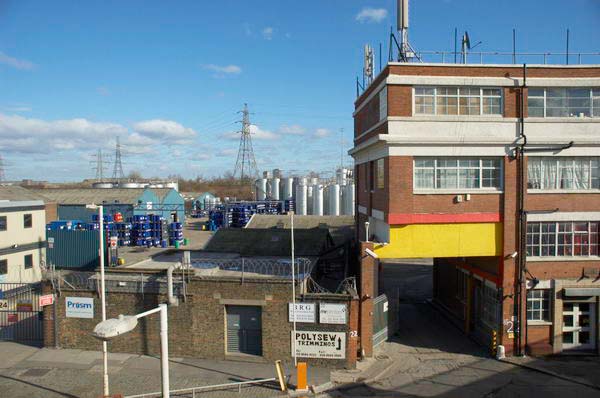
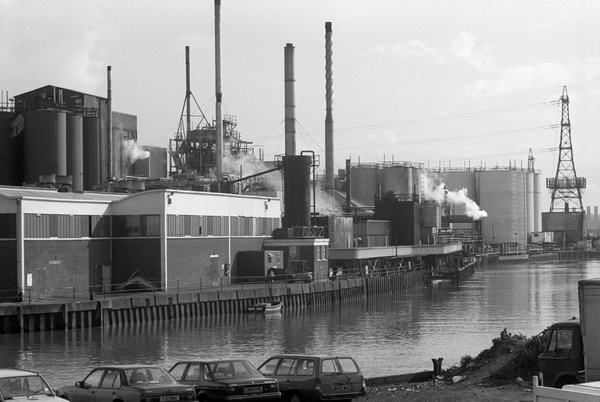
Ravishing Ravilious

Thanks once again to Brian David Stevens for pointing me to James Ravilious; a world in photographs, a fine 30 minute film about his incredible 17 year project photographing the disappearing world of rural North Devon.

Ravilious (1939-99), whose father was the artist Eric Ravilious,  was inspired by seeing the work of Henri Cartier-Bresson in 1969 to become a photographer. In 1972 he had to move to Devon in there started to work at the Beaford Centre, who wanted a record of the area.

I first saw Ravilious’s pictures for real on a rare visit to the Royal Photographic Society with a friend who was a member, I think around 1990. I’d seen them before in magazines, but they were much more impressive as prints. I’ve written before about his work, as have others, but it’s still true to say that his work is not as well known as it should be. His is a view that is both real and bucolic; he refused to to photograph things that he didn’t find beauty in and was apparently easily horrified. I’ll perhaps write more about him later, particularly his views on ‘green’ which very much fit with my own.

Disabled Paralympics Protest

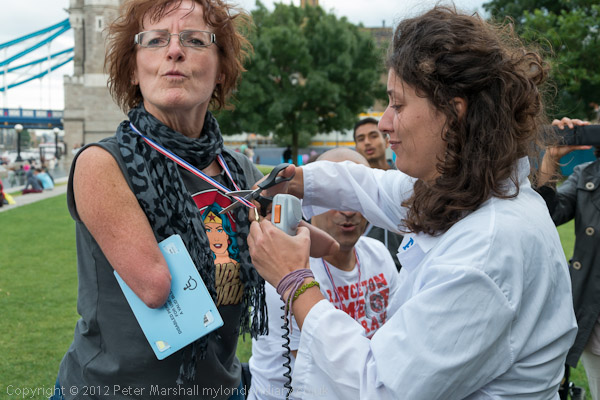
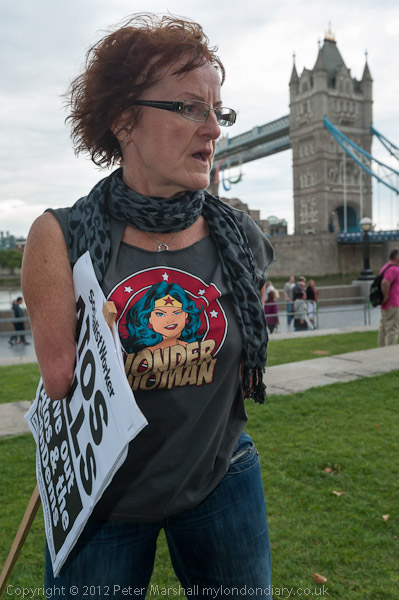
As the Paralympic Games were about to start, disabled activists staged the ‘Atos Games Opening Ceremony‘ the start of a national week of action against Paralympics sponsor Atos, whose computer based ‘fitness for work’ tests have led to stress, hardship deaths and suicides among the disabled.

© 2012, Peter Marshall

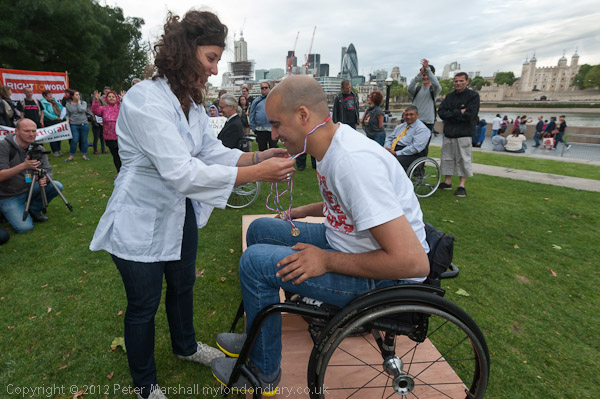
It was a nice idea and made more newsworthy by the participation of one Paralympic gold medallist Tara Flood (she also gained 2 silver medals, 4 bronze and set a world record for her swimming event at Barcelona in 1992.) But there seems to have been a conspiracy among our media to say no ill about the Olympics and Paralympics, and this certainly wasn’t a story they wanted to hear, or let their audiences know about.

© 2012, Peter Marshall

Photographically the main problem I had was in trying to photograph the actual medal ceremony where the person awarding the medal stands in front of the medal winner and lifts the ribbon holding the medal over their head.  In doing so they get in the way of the face of the winner. It’s a problem that might be soluble if you were the only photographer, but here there were a dozen still photographers and around half that number videoing.

But taken from the side it isn’t entirely satisfactory. I did a little better when a few minutes later, after a stringent medical test in best Atos tradition, the winners were all found fit to work, and thus not entitled to compete and lost their medals. It’s easier because when wielding the scissors, rather than bending in and over the medallist, only the arm with the scissors stretches out towards them, and I was able to move to the right place before it happened while almost everyone else was still filming from in front of the podium. So here was Tara Flood having her Atos Games Gold Medal cut from around her neck.

© 2012, Peter Marshall

But this is a picture than only one or two photographers can be in the right position for, while a few dozen could photograph from in front of the podium.

More pictures Opening Ceremony for the Atos Games

________________________________________________________

My London Diary : Buildings of London : River Lea/Lee Valley : London’s Industrial Heritage

All photographs on this and my other sites, unless otherwise stated are by Peter Marshall and are available for reproduction or can be bought as prints.

To order prints or reproduce images

________________________________________________________

@thexavius

If you’ve ever wondered what Instagram was about, let Olde Payphone from LA show you in @thexavius: Portrait of an Instagram Artist. Having looked at a few of the other clips by this “sketch comedy group” I think this is one of the few that I appreciate, but this, as iphone photography says, is “spot on parody.”  But I found it hard to watch some of the videos on that site intended to be serious without thinking they must also be parodies, or perhaps the whole site is. Certainly not photography as I know it.

And you can see all 33 of Xavius’s instagrams online.

Perhaps this viral video will have the entirely beneficial effect of cutting down the number of Instagram images some friends of mine post on Facebook. But I doubt it.

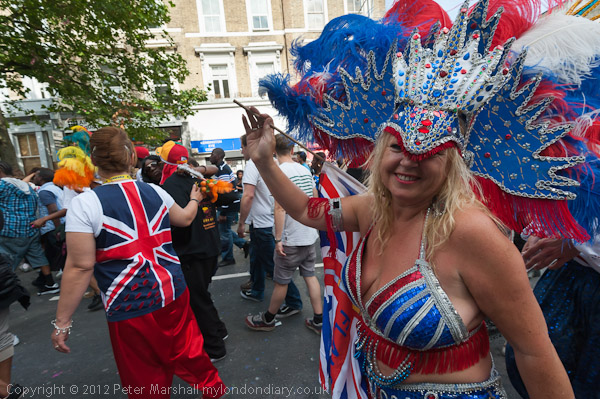
Carnival 2012

© 2012, Peter Marshall
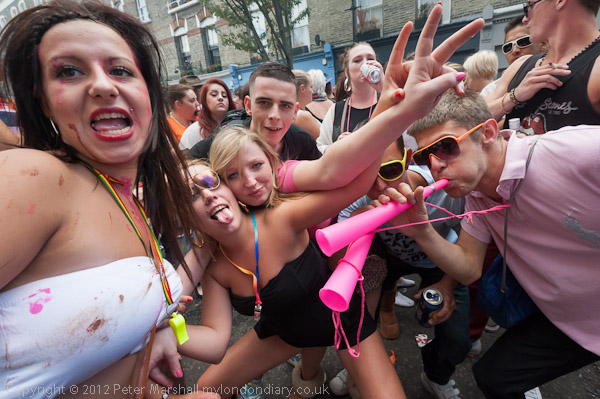
Dancers at Notting Hill Carnival act up for the camera, 2012

I’m not quite sure how many times I’ve photographed the Notting Hill Carnival. I didn’t go for many years perhaps because back in the 70s and 80s it had something of a bad reputation. But around the end of that decade I told myself that I was missing out on one of the major festivals in London, and it was time to go there and to take pictures.

Then I travelled light and rather in disguise, packing a couple of Leica bodies (well, one was a Minolta CLE, one of my favourite cameras of all) along with a spare lens or two, a water bottle and film into an old khaki army surplus webbing haversack (you can still get them for around a fiver.) It was the film that took up most room, with perhaps a dozen cassettes of Ilford XP1 and half a dozen of colour neg. To save space I took them out of their plastic pots and packed them in bulk in plastic bags.

I did find myself in a lot of densely packed crowds, where I hung the bag around my neck in front of me to keep it safe.  Back then I made sure not to take anything with me that I would really miss – no wallet, no credit card etc, just a few pounds in cash. There was a lot of pushing and shoving at some points, and some people did lose bags.

One year I was in a crowd were we were all pressed together close to one of the sound systems, when I suddenly realised that there was a hand in my trouser pocket and it wasn’t mine. I grabbed the guy by the wrist and slowly pulled it out of my pocket to find it clutching a wallet – but it wasn’t mine, and it was empty. In the middle of a crowd where many around me were possibly mates of his I decided it wasn’t a good time to make too much of a fuss.

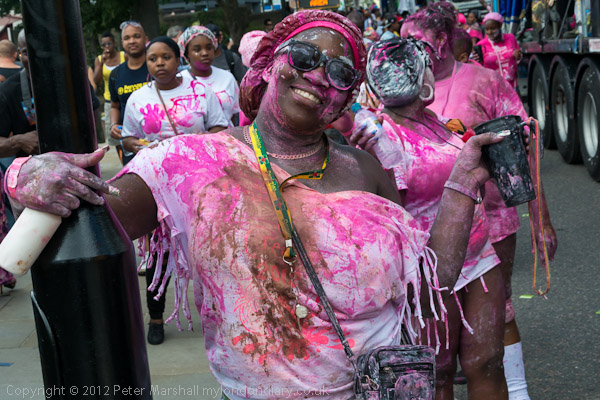
Now, more than 20 years on, most of the time carnival seems rather less dangerous, although things sometimes get a little ragged later on – but I’ve always gone home by them. This year I only went on the Sunday – Childrens’ Day – which is less crowded. And I went with my normal photographic bag and didn’t feel at all unsafe. Except from being smeared with chocolate or other materials that people on the carnival throw at each other. I did have to spend ten minutes when I got home using a damp cloth on my trousers.

But somehow, carnival doesn’t quite see the same to me. Perhaps I’m getting older, but after a couple of hours I really felt I’d had enough.

© 2012, Peter Marshall

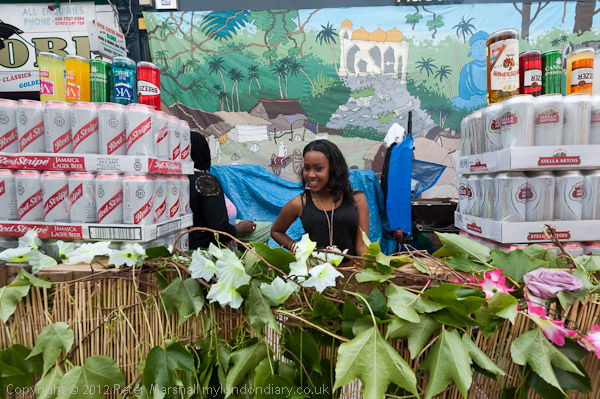
Probably I should have had a Red Stripe and taken a rest. It really is a great event, and this year the weather was fine, and not too hot, but I think I get tired rather faster than I used to.

© 2012, Peter Marshall

I was using both the D700 with the 16-35mm and the D800 with the 18-105mm. But perhaps I should have gone with a lighter bag and cameras more like the Leicas that I first went with – but I’ve still not really become fond of either the Leica M8 or the Fuji X100. Perhaps I should try using the M8 simply as a black and white camera – which it does pretty well. The X100 can work well, though too often I find myself trying to work out why it isn’t doing what I want it to do, even though I’ve updated the firmware which has improved it a lot. Somehow nothing is quite intuitive with it.

© 2012, Peter Marshall

You can see more of my pictures from the afternoon in  Notting Hill – Children’s Day on My London Diary.

________________________________________________________

My London Diary : Buildings of London : River Lea/Lee Valley : London’s Industrial Heritage

All photographs on this and my other sites, unless otherwise stated are by Peter Marshall and are available for reproduction or can be bought as prints.

To order prints or reproduce images

________________________________________________________

Night and Day

Thanks to the Online Photographer for a 9/11 post  last week that links to some interesting issues raised in a post on another blog, BagNewsNotes, James Nachtwey’s 9/11: Eleven Years Later, Like Night and Day, which in turn links to a post from 9/11/2011 by Max Hodges on Google+, in which he writes about the differences between the versions of images from Ground Zero as they were originally released in 2001 and in the re-worked versions from ten years later.

It’s an interesting piece and worth going and looking at the pairs of pictures to see the changes that have been made, which as Hodges makes clear in some cases go well beyond what many would see as acceptable for documentary images.

What kind of post-processing is allowable on news and documentary images is a topic I’ve discussed in the past, and I don’t think the detailed prescriptions of AP and Reuters mentioned by Hodges are particularly helpful  – what really matters are the intentions behind processing, which should be to report clearly and accurately on the events as you saw them.

There are some changes in the images that I think reflect the speed at which the original images were sent out, poorly colour corrected and with incorrect contrast levels etc. Agencies now want pictures almost before the events even take place, and many pictures now reflect a lack of necessary thought and editing which would make them more effective. But mostly the effect of the processing in these images seems to be a misguided over-dramatisation, which to me cheapens the work.

There isn’t really some original uninflected state of a digital image that somehow is more authentic than any other. The camera and processing software puts its own interpretation onto what we saw – often in a rather arbitrary way – and we have to work – just as we did in the darkroom – to get the picture to show our particular view.

While I don’t in principle object to Nachtwey processing his images, the way that he has done so I think reduces their credibility, and more importantly, throws doubt upon his integrity as a photographer. And integrity, as I’ve argued before is in the end what we all have to rely on.

9/11 was an iconic event, one of those times that most of us can remember where we were and what we were doing when we learnt of it (I was outside the college boiler room just getting on my bike to go home for a late lunch when a distraught colleague who had grown up in New York rushed up to tell me.) Although that particular memory isn’t one which needs to be known or remembered, I think that we do need to keep the memory of the actual event clear and accurate – and not play around with the pictures.

It’s perhaps also important to remember that this was not the only event in American history that took place on September 11.  It shouldn’t completely overshadow the events of 1973.

Sean Rigg

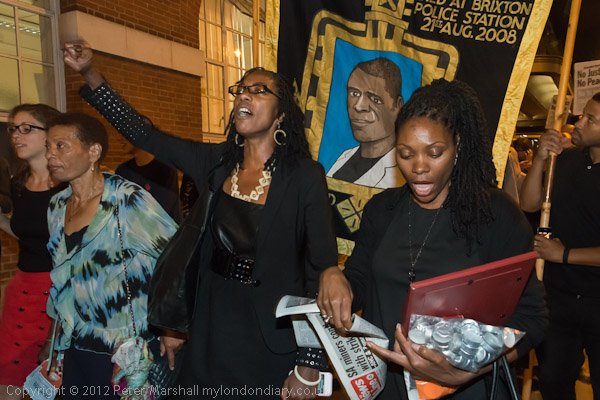
Sean Rigg was killed by police in Brixton Police Station on 21 August 2008. It took almost 4 years for the inquest into his death to be held, and they jury were then denied the possibility of giving the verdict that they would have otherwise reached. Instead they gave a lengthy narrative verdict which made clear exactly how police actions led to his death, and also condemned the NHS for their failures before his arrest and killing. The Rigg family immediately called for the Crown Prosecution Service to bring criminal charges and for a public inquiry into deaths in custody, not just that of Sean Rigg, but of the many others who die as a result of police action – including many that for various reasons don’t make the official statistics,

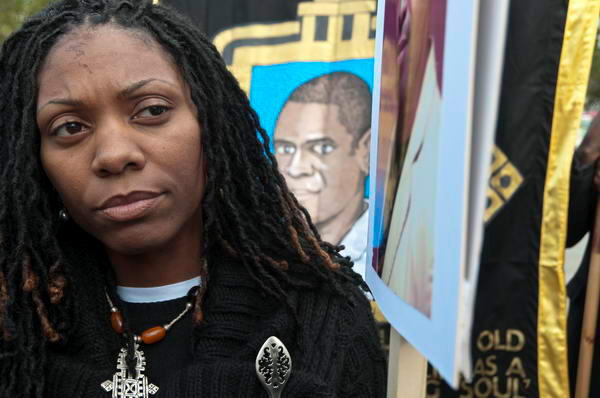
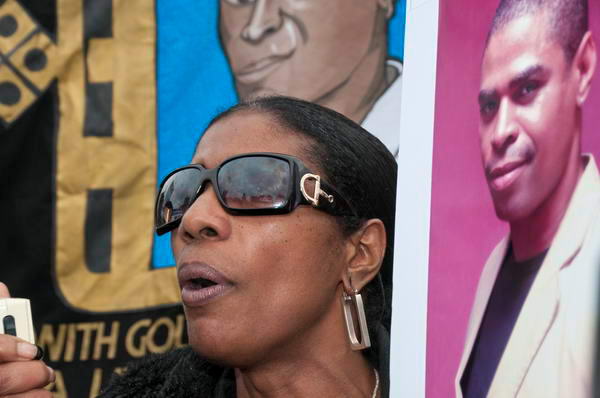
I first met Sean’s sisters at the annual United Friends and Families Protest march along Whitehall to Downing St in October 2008, and was impressed by their determination to fight to find what really happened to their brother and to get justice. Their tenacity has resulted in an inquest that made clear the crimes that were committed, the cover-up by the police and the the complete failure of the IPCC to investigate what took place. But they – and the other families of the several thousand people who have died in suspicious circumstances by police actions or in police custody, in prisons or in other secure facilities have yet to see justice.

© 2008 Peter Marshall
Samantha Rigg-David, 2008
© 2008, Peter Marshall
Marcia Rigg-Samuel, 2008

From the start, the ‘Justice & Change’ campaign’ the family set up has been concerned not just with their brother’s death, but with the wider issues of justice and accountability of the police and our judicial system.

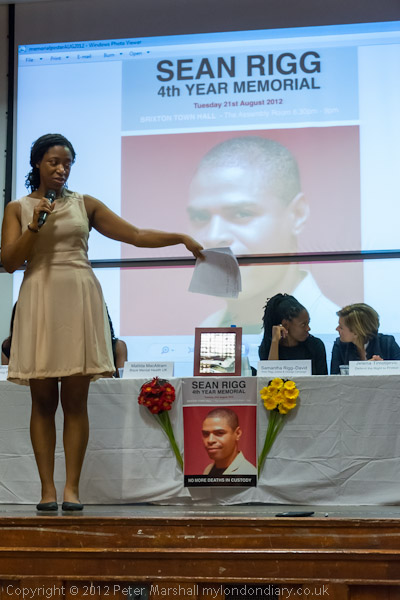
© 2012, Peter Marshall

I’d arrived at the  Sean Rigg 4th Year Memorial in the large assembly hall inside Lambeth Town Hall on 21 August around 20 minutes before the start of the event and was in time to take a seat with several other photographers close to the middle aisle in the second row of the hall. I’d missed an official photocall a few minutes earlier with the family and the banner, but that isn’t the kind of thing I usually bother with. I had plenty of time to make a few test shots, hoping that the same main lights would be on for the meeting, and found I could just about get usable results without flash on the D800, working at around ISO 3200 with the Nikon 28-105mm wide open. It isn’t a fast lens, only f5.6 at the long end, and I probably should have brought the Sigma 24-70 f2.8, but I’d had to rush back from an outing, grab my bag and run out of the door to get to the event, and just hadn’t had time to think.  But I think the Nikon is sharper.

I did take some pictures with flash, but I don’t like to use it more than I have to, as when I’m attending meetings I find a lot of flash photography is disturbing. But for some pictures there just wasn’t enough light  without.

It was an interesting meeting, but perhaps went on a little too long  – over two hours, and some of the ‘questions’ from the floor turned out to be lengthy speeches. But I was really waiting for the march through Brixton that was to follow. It did eventually, but I think was held up by a number of people with video cameras stopping the leading figures and interviewing them.

© 2012, Peter Marshall

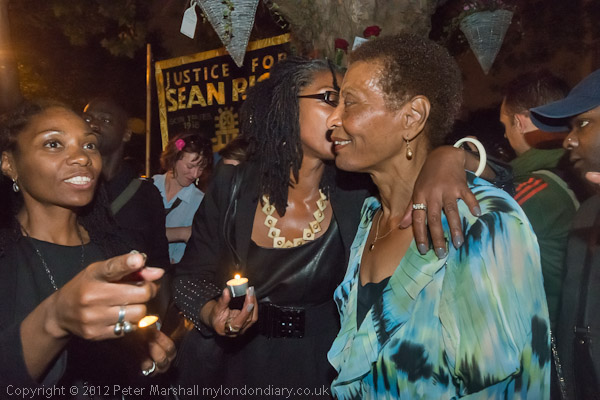
Eventually everyone was lined up outside and the march started, going just a quarter of a mile down the road to the police station. It got very crowded around the memorial tree, and I got into an argument with a man with a camcorder who came and stood right in front of me after I put my hand on his shoulder to ask him to move. He became very angry, but fortunately everyone was keen to calm things down.

Unfortunately at this point my SB700 flash started refusing to work at all on the D700, and it was very dark. I couldn’t see any reason why, and it worked fine when I switched it over to the D800.  It’s the kind of annoying thing that can happen, and often the reason is simple and obvious once you sit down and take a look at things in good light, but is impossible to solve when you are frantically trying to work in darkness, as I was.

I swapped the 16-35mm to the SB-800 – it’s just a bit wider than the 18-105 – and continued working with flash. I was working at 1/60 at f6.3 with the flash, and it was so dark that to get any real contribution from ambient light and avoid an almost black background I needed to use ISO 6400.

© 2012, Peter Marshall

This picture was taken at 17mm (around 25mm equiv) and the flash was I think set to underexpose by around 2/3 stop. I think I’m actually too close for flash to be reliable, but the main problems I was having were actually subject movement and focus.

© 2012, Peter Marshall
Using the 16-35 at 16mm on the D800 (24mm equiv)

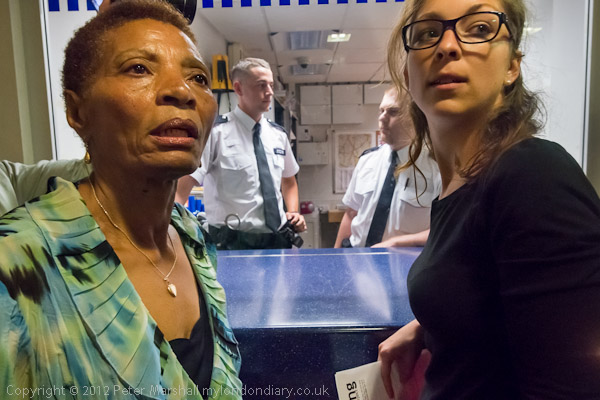
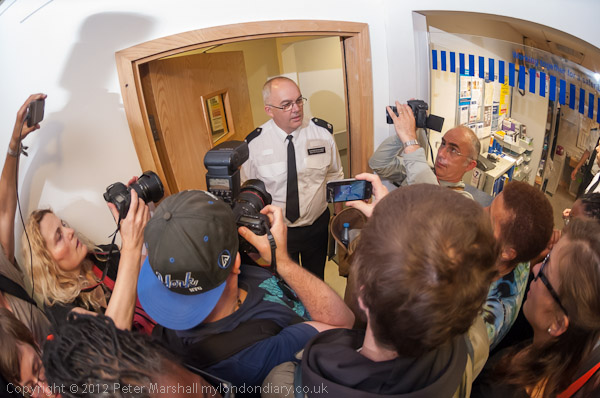
I was a little reluctant to follow the group who went inside the police station to photograph there, but soon realised that I needed to as everyone else pushed in. Inside the lobby there was a decent light level and I could work without flash, but it was so squashed there wasn’t really room to change lenses. I had the the 10.5mm onto the D700, so was only getting the 5Mp or so files that DX lenses give on that camera. I had the DX body set on ISO 3200, and once processed in Lightroom 4, the quality isn’t bad.  When the Superintendent came to a side door to talk to the crowd I was on the other side of the lobby, but with the camera held as high as I could reach I managed to get a picture that I thought worked OK.

© 2012, Peter Marshall

The lighting for this is helped by someone using a video light, though I’ve  not quite got the colour balance optimised. But LED lighting is now feasible with still cameras too, working at fairly close distances and high ISO, and I’m thinking of buying a powerful and portable unit. I do have a very cheap unit, but it hasn’t enough power to be useful, except perhaps for reading in bed.

________________________________________________________

My London Diary : Buildings of London : River Lea/Lee Valley : London’s Industrial Heritage

All photographs on this and my other sites, unless otherwise stated are by Peter Marshall and are available for reproduction or can be bought as prints.

To order prints or reproduce images

________________________________________________________

Twisted Images

Thanks to Twisted Sifter for a page with 15 Photo Manipulations Before the Digital Age published in advance of  Faking It: Manipulated Photography Before Photoshop at The Metropolitan Museum of Art in New York which claims to be the first major exhibition devoted to the history of manipulated photography before digital and will feature “200 visually captivating photographs created between the 1840s and 1990s in the service of art, politics, news, entertainment, and commerce“. The show runs  from 11 October  2012 to January 27, 2013, and there is currently a short text about the show on the Met Site but not much more unless you have a press login, when I think you would be able to see the same 15 images as on Twisted Sifter.

Some of these are well-known – for example Henry P Robinson‘s very Victorian deathbed scene, Fading Away, Toulouse Lautrec as artist and model (by Maurice Guibert) and others by Maurice Tabard, Barbara Morgan, Grete Stern, a decidedly odd (aren’t they all) F Holland Day and one of Gustave Le Gray‘s cloud studies, but perhaps the more interesting are some of the commercial and anonymous images, including a ‘Man on Rooftop with Eleven Men in Formation on His Shoulders’, Saint Thomas D’Aquin’s ‘Man Juggling His Own Head’ and a daguerreotype of a man with two heads.

From the text I’m not sure how much this show will add to previous exhibitions and books which have featured such images – which I think have always got more than their just share of attention. They are an interesting side line, and often amuse, which is what some of them were meant to do. But some of those that amuse, their authors meant to be taken seriously.

A Short Walk in Spitalfields

I’m not sure I will go to see the pictures by C A Mathew which will be on show at the Sandys Row Synagogue in Spitalfields from 20th September 2012, although it looks as if a visit to this synagogue, the oldest Ashkenazi synagogue in London, and the last remaining synagogue in Spitalfields would be very interesting. But I think you can see the photographs well enough on-line.

Like the nearby mosque in Brick Lane, the synagogue has moved through several religious re-orientations. It was built on the site of an older chapel, l’Eglise de l’Artillerie, and opened on 23 November 1766 under the same title, serving the French Huguenot community of the area. A few years later they combined with other churches in the area and leased this building. From 1792 it was home to a Baptist congregation, most of whom left in 1801 when their minister made it Unitarian. When the Unitarians moved to Finsbury in 1824 it was leased to Scottish Baptists. In 1867 it was leased to Dutch Ashkenazi Jews, who were allowed to block up the previous entrance on Parliament Court and build the current entrance on Sandys Row and it was consecrated as a synagogue on 6 November 1870. The congregation bought the freehold of the building in 1923 and continues to worship there.

I first saw these pictures published on Spitalfields Life in 2010, and they have since been republished there on the 100th anniversary of their taking, along with a set of ‘then and now’ pictures, taken by the author of Spitalfields Life, who goes under the soubriquet ‘the gentle author‘ (TGA). The pictures are in the collection of the Bishopsgate Institute, which in 1974 published a bound 28 page pamphlet, The Eastern Fringe of the City, described as A Photographic Tour of the Bishopsgate Area in 1912 with around 20 photographs taken by Mathew on Saturday April 20 1912, his only known visit to the area.

C A Mathew began as a photographer in 1911, setting up a studio in in Tower St, Brightlingsea, Essex and is thought to have died shortly after his wife at the end of 1916. There doesn’t seem to be a great deal more known about him and the only other picture by him I’ve seen is a routine image by him included in a history of the town.

One theory, which I doubt, is that these pictures are the result of a delayed or cancelled train from Liverpool St back to his home in Brightlingsea on the Essex coast, just over 50 miles away (the station fell under Beeching’s axe in 1964.) TGA writes that perhaps he “simply walked out of the station, taking these pictures to pass the time.”

I think this is more than unlikely. While we might do such a thing now, photography back in 1911 was a rather more serious business, and although I can’t know exactly what equipment Mathew was using, I think it likely that it was rather cumbersome and heavy – not the kind of thing you would just take a walk while you were waiting with.

From the pictures I think the camera he used had a rising front and will have been used on a substantial tripod. Almost certainly it will have been a camera that used either sheet film or glass plates rather than roll film. So as well as the camera he will have needed a number of plate or film holders loaded with unexposed material. And of course a large dark-cloth and loupe.

I suppose it is just possible to envisage circumstances where a photographer travelling home would have all these things available – perhaps a commission elsewhere that for some reason he had been unable to carry out. Though it is hard to think why anyone would commission a photographer from Brightlingsea to do a job in London.

Normally on the way home the plates would have all have been exposed. Had their just been one or two pictures, it might perhaps be possible that Mathew, on his way back from a job in the city might have paused on his way to expose a couple of unused plates, but the number of pictures rules that out. It seems almost certain that he had travelled up to Bishopsgate with the express purpose of making a set of pictures of the area.

Since he was a professional photographer the most likely reason for this is that he was being paid to do so. Since his studio was in Brightlingsea, his client was most likely to be there also, although possibly a visitor to the town; perhaps one of those wealthy gentlemen who came for the yachting at Brightlingsea Sailing Club had started his life in the area.

One of the most intriguing things about the pictures are the captions on the original mounts, which I think could also be a clue to the actual reasons for the pictures, although it isn’t a mystery I can solve. Not only does Mathew carefully describe the locations but he also gives the widths of most of the streets in feet and inches. Brushfield St (width 29′.3″) is the caption on one mount – either the photographer has taken measurements with some  precision or has gone to the trouble of looking them up somewhere. Why?

Possibly also the choice a Saturday is significant, a day when businesses in this Jewish area were closed. As the Bishopsgate curator noted, it meant the children were all in their Sabbath best, but it also made it possible for the photographer to place his tripod in places where heavy horse drawn traffic would have made it difficult on a working day.

Although working with a digital camera, or even a 35mm or 120 film camera we might now make similar images in perhaps an hour, probably the pictures here represent the best part of a day’s work. Since a number of the images include shadows, it would be possible for a more dedicated sleuth than myself to work out the exact time of day these were taken.

I’ve walked into Spitalfields a few times over the years, and taken a few pictures there, and once published a little article on the area. They don’t have the same interest that Mathew’s have, partly because the times had changed when I first went there in the late 1970s, and particularly because there were far fewer children on the streets. Here is a street corner from my first visit there in 1978.

© 1978, Peter Marshall
Samuel Stores, 1978, Peter Marshall

Spitalfields Life has quite a few other articles about the photographers of the area, and among the most recent is John Claridge’s Cafe Society. I have also photographed several of the cafés featured here, in particular the Victory Café, though it was on the Hackney Road in Bethnal Green rather than in Whitechapel when I found it, 23 years after him.

© 1986, Peter Marshall
Victory Café, 431 Hackney Rd, Bethnal Green, Peter Marshall

Although I admire many Claridge’s images, I find the style of his printing, with its high-contrast lith effect, annoying. There are a few of his images it really suits, but more of the time I think it detracts from his work.

You can see more of my café pictures – in colour – in Café Ideal, Cool Blondes, & Paradise, a work I first put together as a book dummy in the mid-1990s and which I intend to revise again and publish as a book before too long.

________________________________________________________

My London Diary : Buildings of London : River Lea/Lee Valley : London’s Industrial Heritage

All photographs on this and my other sites, unless otherwise stated are by Peter Marshall and are available for reproduction or can be bought as prints.

To order prints or reproduce images

________________________________________________________
Before the Olympics goes ISBN

Today I published my first book to have an ISBN, though I hope it won’t be my last and I have another 99 numbers waiting to find a home, and hope to begin work on my rather monumental ‘London Series’ shortly – a little of the work from which is on my ageing Buildings of London site (though web sites don’t really age, just get to look rather dated.)

It isn’t really a new book, but a revised edition of my book first published in 2010 and is now ‘Before The OlympicsThe Lea Valley 1981-2010: Peter Marshall ISBN 978-1-909363-00-7

© 1990, Peter Marshall
The Olympic site in 1990

Those few of you who have a copy of the first edition needn’t rush out to buy a copy – available direct from Blurb (and at their US site) – as the changes are relatively minor. The new edition has no new pictures – and actually one small image less, and I’ve slightly revised some of the captions and text. But probably the main changes are in tidying up the design and also slightly but noticeably increasing the size of many of the smaller images.

© 2005, Peter Marshall
The Olympic site in 2005,  from a few yards northwest of the view above

Publishing with an ISBN makes books easier to find, and also means that I have to send a copy to the British Library under the Legal Deposit Libraries Act 2003, though the requirement to deposit a copy goes back several hundred years longer.

There is a preview on Blurb which shows over a third of the book. At £26.99 for an 80 page paperback it isn’t cheap, roughly twice the price I would like to be able to sell it at, and unfortunately I can’t offer the kind of discounts that would enable it to be sold through the shops. At the moment this new edition isn’t included in my book sale, though I do still have just a few copies of the first edition available.

© 1989, Peter Marshall
Pura Foods on Bow Creek in 1989- now demolished

It does include (if I counted right) 246 of my pictures taken around the Lea, though some are still unfortunately small. It was put together using Blurb’s free Booksmart software, which does impose a few annoying restrictions on design and has some problems with handling text, but generally does the job fairly well, although I’m considering using proper DTP software for future books. I chose Blurb’s Premium paper with a lustre finish, which does well with both the black and white and colour images, but does increase the cost a few pounds. But reproduction is important, and this was the first paper from Blurb that I felt was good enough for black and white.

________________________________________________________

My London Diary : Buildings of London : River Lea/Lee Valley : London’s Industrial Heritage

All photographs on this and my other sites, unless otherwise stated are by Peter Marshall and are available for reproduction or can be bought as prints.

To order prints or reproduce images

________________________________________________________
Non-photographer Wins Photography Prize

I’ve nothing against photo-montage. I’ve written about it and admire many of the classic works by photomonteurs such as the Dada artist John Heartfield as well as more recent work. I’ve even allowed my own pictures to be used in photomontage, but it isn’t photography. There have been photographers who have worked with photomontage, and again there are some I admire – such as Misha Gordin, as well as a few who I think are mildly interesting, including Jerry Uelsmann, and a few whose work I find simply sick.

John Stezaker, the winner of this year’s  £30,000 Deutsche Börse prize at the London Photographers’ Gallery is not a photographer, but that doesn’t seem to matter, and the 2007 prize went to Walid Raad who also didn’t take the pictures he used.

Writing in The Guardian, Sean O’Hagan commented:

Does that matter? Evidently not – except to other practitioners who may think photography still has something to do with deep seeing, and then capturing that moment of deep seeing, in a split second. That is now in danger of fast becoming an irredeemably old-fashioned idea, both in the teaching of photography and in the market-driven curating of photography.

I’m one of those old-fashioned practitioners, and rather resent a photography prize being awarded to a non-photographer. I quite like some of Stezaker’s work – the prize was for his Whitechapel Gallery show – and although it reminds me very much of the kind of thing that other artists have been doing almost since the start of photography (well before Dada and the Surrealists), he certainly sometimes does it very well. But it ain’t photography!

You can also read about it on PDN, BJP and again in The Guardian in a piece by arts correspondent Mark Brown among other places.