Breaking Down the Beast

I was rather rude about street photography a few days ago, so it’s nice to be able to point you at some street photography I find really interesting as opposed to the mush. There are street photographers working now whose work I find interesting – just as some years ago I found Trent Parke‘s 1999 book Dream/Life worth ordering a copy from Australia, and wrote about both that and his Minutes to Midnight (2002-4).

One I don’t remember seeing before is Joseph Michael Lopez, featured on the Lens blog a couple of days ago in a feature Breaking Down the Beast by Peter Moskowitz, which has a set of 16 pictures from his street photography project, Dear New Yorker, which you can find along with other work on his web site. And that a picture or two did make me think of Parke is no bad thing, although Lopez’s work has many other aspects.

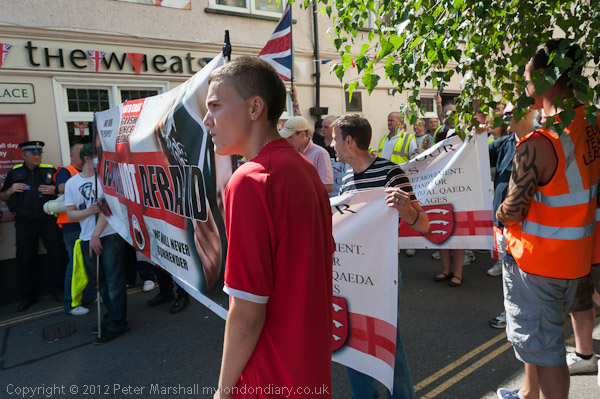
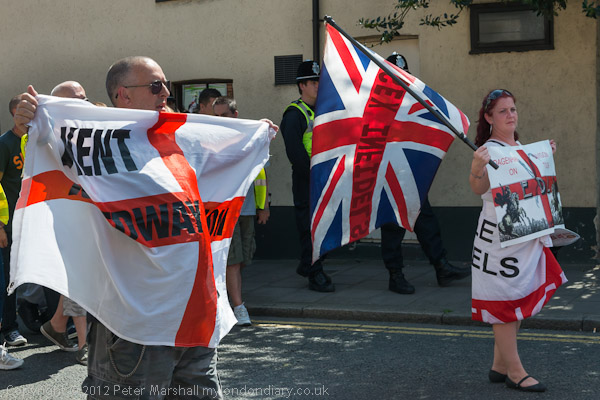
Photographing the EDL

I don’t like photographing the EDL, and they certainly don’t like being photographed, but I think it is important that their activities are recorded, and I try to do so with care and accuracy. If they emerge from my pictures or text looking bad, it isn’t because of how I photograph them, but because of what they say and do.

© 2012, Peter Marshall

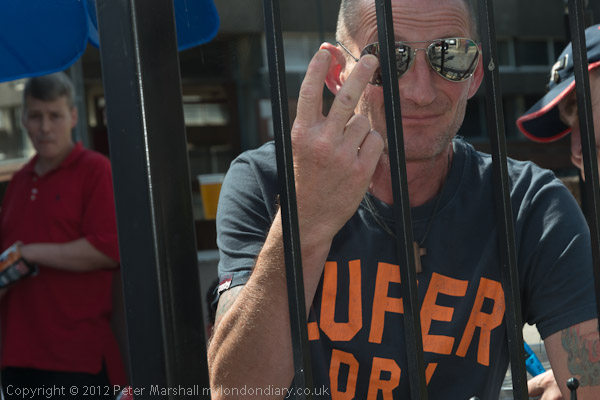
I didn’t set this picture up, but just started taking pictures of the group drinking in the beer garden of the pub in Chelmsford a couple of weeks ago from the street outside. When one of the other people I was taking pictures of complained to a police officer about me photographing him without his consent, I was pleased that the officer told him that I have every right to photograph, whether he wanted to have his picture taken or not. Though after I had taken a few pictures he did ask me very politely if I would mind moving away as it was getting them worked up (I could be wrong when I remember him saying I was disturbing the animals.)  I’d taken several pictures like the above, and didn’t think I would get anything more so I was happy to oblige.

As I walked past the small group of EDL around the pub door, one of them pointed me out to the others and said “He’s OK” while pointing out another photographer walking with me as someone who should be chased away. It isn’t up to them to decide who should and shouldn’t be allowed to photograph them.

© 2012, Peter Marshall

But perhaps because of this, later, when I moved close to the banner at the front of the march I wasn’t asked to move away, although other photographers had been cleared across the road by the police. Though I think it was really more my ability to merge with the background and be unobtrusive when I want to.

Eventually the march moved off, and I photographed as it went past me. One rather large man walked towards me, though I wasn’t too worried as there were several police within a couple of yards. He moved in close and said  “I hope all your family die of cancer.”

I stopped to note down his exact words and then continued to photograph. Unlike most marches where I like to get in the middle of things, I had to work largely from the pavement, as I was getting some pretty hostile comments as I was working.  Fortunately their was some good lighting and I think some of the pictures work well.

© 2012, Peter Marshall

I didn’t have my voice recorder running during the event, but what I heard from many on the protest seemed to me to be full of hate against Muslims (and photographers!)

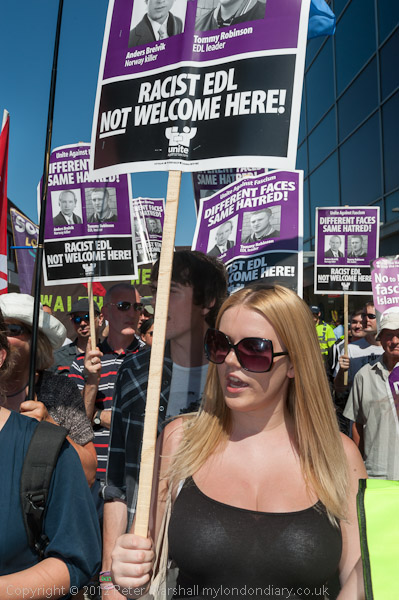
As the front of the march reached the turning for their rally outside the town hall I went back to the centre of the shopping district where ‘Essex Unite Against Fascism’ had been holding their rally, noticing on my way that the police had sealed off the area with some high fencing and large cordons.  The counter-march was all ready to go, but was being held until the EDL were safely surrounded by police.

There were just over three times as many people, and a huge difference in atmosphere. Rather than hate it was a welcome that came out from the crowd, with everyone pleased to talk and be photographed and looking so much happier. And everyone was entirely sober. It was a pleasure to photograph them rather than a duty.

© 2012, Peter Marshall

Of course there was some anger expressed in some of the Essex UAF’s chants, such as  “E-D-L go to hell! Take your Nazi mates as well!” and “Follow your leader, shoot yourself like Adolf Hitler!” but the second at least was shouted with a certain  humour, with some breaking into laughter afterwards. Other chants were more affirmative, such as “We’re black, white, Asian and we’re Jew!”

© 2012, Peter Marshall

I think my text and pictures on EDL Outnumbered in Chelmsford portray both groups accurately, although the view of the EDL is perhaps too kind to them, and I perhaps did a better job of making good images. Sometimes a little of a challenge helps.

________________________________________________________

My London Diary : Buildings of London : River Lea/Lee Valley : London’s Industrial Heritage

All photographs on this and my other sites, unless otherwise stated are by Peter Marshall and are available for reproduction or can be bought as prints.

To order prints or reproduce images

________________________________________________________

Al Quds Day

Quds is Jerusalem, and the day was inaugurated by Ayotollah Khomeini in the year of the Iranian Islamic Revolution, 1979, but in 1980 received the backing of the Jerusalem Committee of the Organisation of Islamic Cooperation, representing Muslim states around the world (including some officially secular Muslim states.)  It has been celebrated in the UK with a march in London for at least 20 years, possibly longer, and for many years there was little or no controversy surrounding it.

© 2012, Peter Marshall

The UK-based organisation that organises it is the IHRC, the Islamic Human Rights Commission, which describes itself as “an independent, not-for-profit, campaign, research and advocacy organization based in London, UK.”  The IHRC has been criticising human rights abuses against Muslims in non-Islamic countries but largely failing to do so in countries such as Iran, Syria, Libya, or Saudi Arabia, although it has submitted reports to the UN on Iraq, China, Egypt, Saudi Arabia, France, Sri Lanka, The Philippines, Tunisia, Morocco, India, Bahrain, United Kingdom. It is also alleged to receive funding from the Iranian regime.

Criticism of the IHRC in the right-wing press has increased after it organised a number of international conferences, including those on Liberation Theology in Palestine, Human Rights and Israel at 60, and one involving leading Jewish anti-Zionists, as well as supporting various sanctions and boycotts against Israel. As well as attacks by leading supporters of of the Israeli state, its critics also include Iranian Royalists and the democratic Iranian Green movement.

In previous years I’ve had some minor problems in photographing the event, sometimes having arguments with stewards to remain close to those taking part. One year when I was photographing Yvonne Ridley in the march I had to ask her to support me being there – I’d photographed her at many previous events – and last year I was supported by people in the organisation who knew me to remain when most other photographers were being kept away. Last year there had been protests against the march by both the Iranian Greens and the EDL, and in the previous year there were also Iranian Communists, Iranian Royalists, a Jewish group and March For England all making their protest.

This year the whole atmosphere was far more relaxed, perhaps because there were no signs of any of the counter-demonstrations of previous years at any point on the march.  I didn’t see the incident, but I later heard that one pro-Israeli blogger had been discovered videoing the speeches at the rally and the stewards had insisted he leave.  I think that was unfortunate – there is really no reason to restrict the recording of such events even by those who oppose them.

I think some of my best pictures from the event came from working with the 10.5mm from in the middle of the crowded march. The curvy perspective of the images often helps by emphasizing the centre of the image, which seems to come out of the page at you.

© 2012, Peter Marshall

© 2012, Peter Marshall

In the upper image of this pair, the uncorrected full-frame fisheye has the effect of wrapping around the image and drawing you in to the centre. When I correct this – as in the lower image – because the lens, held up high above my head was pointing down into the crowd, the buildings around and the placards have a strong divergence, taking the eye away from the centre.

It would be possible to correct this divergence – a simple job in Lightroom, but doing so would lose more of the image, as well a lowering the quality in some areas. But I think it really doesn’t look particularly odd and it improves the image.

I saw the possibility of this picture when I was a few yards away and had to push through the crowd calling out “Excuse me, excuse me” to take it. Fortunately I had switched the 18-105mm for the 10.5 mm just before and was looking for opportunities inside the fairly dense crowd just before the march started. It was something that lasted only a few seconds and I had to rush to grab it. Of course I could have asked the woman to repeat it, but I don’t like to set such things up. It doesn’t work and it is an intervention which I think is unacceptable in photographing news.

© 2012, Peter Marshall

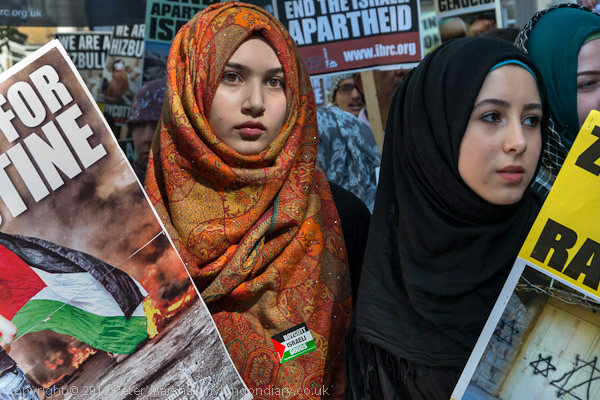
Rectilinear perspective can often I think be slightly more disturbing in pictures with an extreme wide-angle – such as the wide end of the 16-35mm. I couldn’t get further away as they were in a crowd and other people were close  behind – and had I been able to stand further away, others would have come in to fill the gap – or I would have had to direct the scene, which would have changed it completely.

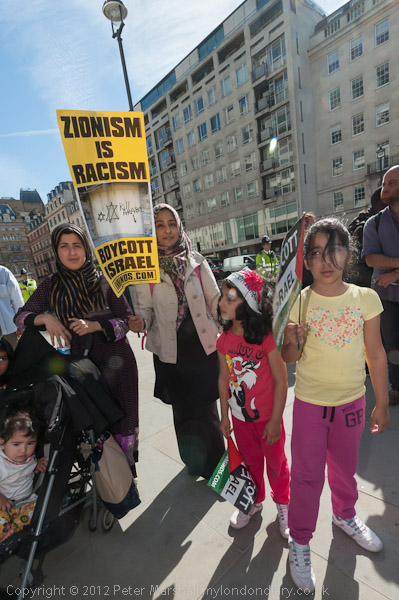
Working into the sun I’ve got a little flare in a couple of places, unfortunately in both girls’ faces, though hardly visible in the one at the right, as well as on the buildings in the background. While it might have been nicer to avoid it, I don’t find it particularly disturbing, perhaps because the shadows at the bottm make it clear that the sun is shining directly at me. I didn’t have time to try a few pictures using my left hand held resting on the end of the lens, using it as a flexible and positionable lens hood as I often do.

Of course both in this image and the one at the top of the page I had to work with Lightroom to get the shadow detail in the people, and particularly in their faces, increasing both exposure and contrast in the shadow areas.

As usual, more pictures on My London Diary – at Al Quds Day March.

________________________________________________________

My London Diary : Buildings of London : River Lea/Lee Valley : London’s Industrial Heritage

All photographs on this and my other sites, unless otherwise stated are by Peter Marshall and are available for reproduction or can be bought as prints.

To order prints or reproduce images

________________________________________________________

Pussy Riot Jailed

© 2012, Peter Marshall

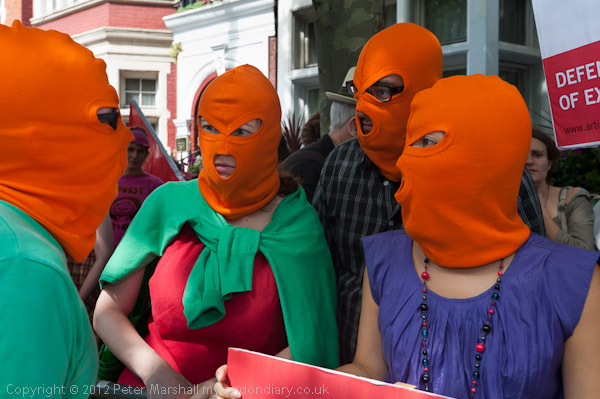
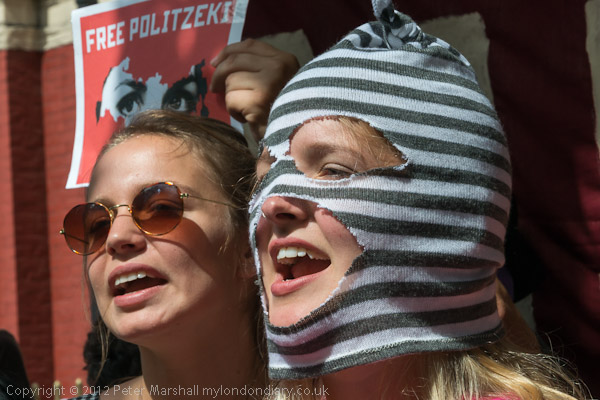
Pussy Riot‘s performance in a Moscow cathedral certainly brought them a great deal of publicity around the world, though rather more attention was given to their outlandish dress than their anti-Putin political views. Given their performance over the Occupy movement on their steps, I’m not sure that the reaction of St Paul’s to such an interruption would be greatly different from that of the Russian Orthodox Church. Though the  Criminal Justice and Immigration Act 2008 did get rid of our common law offence of blasphemy, I’m sure there are plenty more offences that similar activists here could be charged with.

© 2012, Peter Marshall

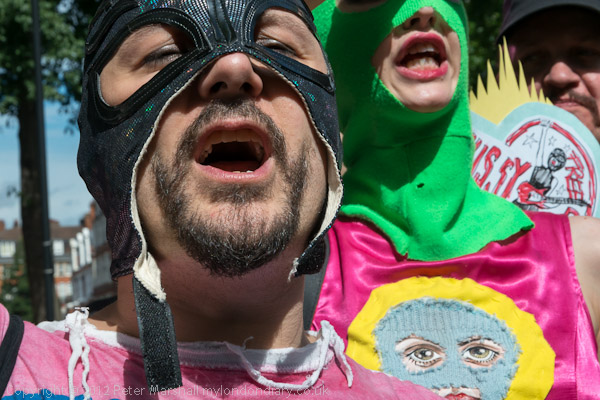
And while all these masks can be rather fun and occasionally dramatic, I really do prefer to photograph faces.

© 2012, Peter Marshall

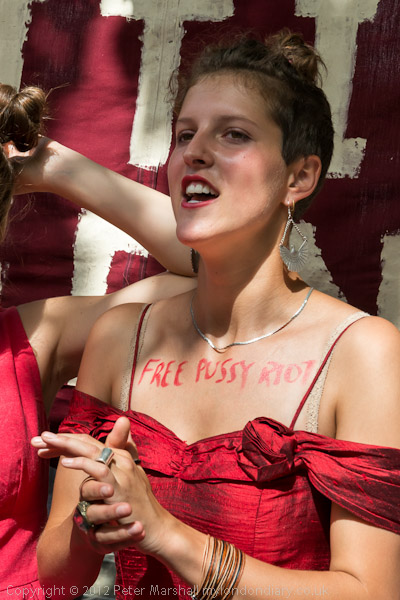
Though sometimes you can do both.

© 2012, Peter Marshall

Many more pictures at Free Pussy Riot on My London Diary.

________________________________________________________

My London Diary : Buildings of London : River Lea/Lee Valley : London’s Industrial Heritage

All photographs on this and my other sites, unless otherwise stated are by Peter Marshall and are available for reproduction or can be bought as prints.

To order prints or reproduce images

________________________________________________________

Thank Heaven For Clouds

I hadn’t actually meant to go for a walk by the Thames when I left the house, but was hoping to photograph some protests about increases in rail fares and proposed cuts in jobs and services on the railways.

I should have gone earlier, when I knew a larger protest would be happening, but travelling in the morning rush hour is just so expensive, and I’d been sent details about a later protest. I can get a ticket to visit my son almost 200 miles away for roughly the same price as it costs for the 19 miles each way into London if I catch an early train. So I caught the first train I can get at the still expensive off-peak rate, and arrived to find nothing much worth photographing still happening. So little that I took no pictures.

The train operators say they have improved the service, and the trains do rattle less, but when I first moved to where I live there were six rather than four trains an hour to London and the fast trains did the journey in 29 rather than 35 minutes. And without keeping to that special railway operators time which means that any train can close its doors and leave half a minute early.

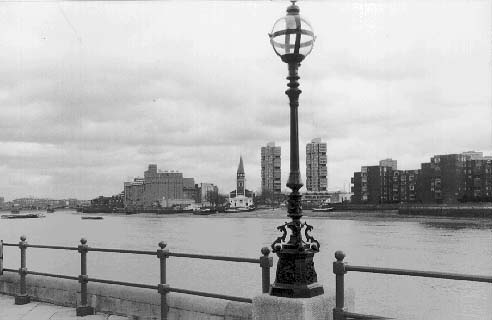
It was a fine day, sunny but with some nice clouds, so it seemed a pity not to take some pictures, and I decided to walk along a little of the Thames path in London once more, starting from Battersea Bridge as I’d been assured there would be something to photograph at Clapham Junction latter (wrongly as it turned out.)62 This area of London used to have industry along much of the riverside, including a large factory and lots of wharves, and I’d recently scanned some black and white images from around 40 years ago when I first came here. Now almost all of that has gone, replaced mainly by expensive flats, with the odd hotel and some offices.

© Peter Marshall
St Mary’s Battersea from across the river – the factory is no longer there

One gain from these changes is that you can now walk beside the river virtually all the way, and there are also one or two decent buildings among the largely profit-oriented poor quality developments.  Changing attitudes to health and safety do unfortunately mean that you can no longer walk on a high-level path through the waste-transfer station next to the mouth of the Wandle, and I’m sorry I never did when it was open.

© 2012, Peter Marshall

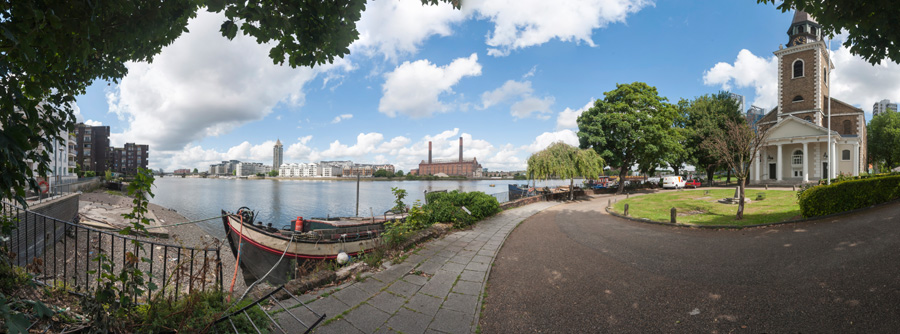
When taking largely open landscapes like some of the views across the Thames, I was pleased to have plenty of clouds in the sky.  Having a clear blue sky is about as welcome as a uniformly grey one so far as I’m concerned. One of the buildings I passed on my walk is St Mary’s Battersea, where I’ve on previous occasions photographed the stained glass windows commemorating two of my favourite artists, William Blake who was married here and JMW Turner, whose mother was a Marshall, though so far as I’m aware not related. Turner was rowed across the river from his home in Cheyne Walk to paint the skies from the porch of the church. I don’t think he would have bothered on a blue sky day either!

© 2012, Peter Marshall

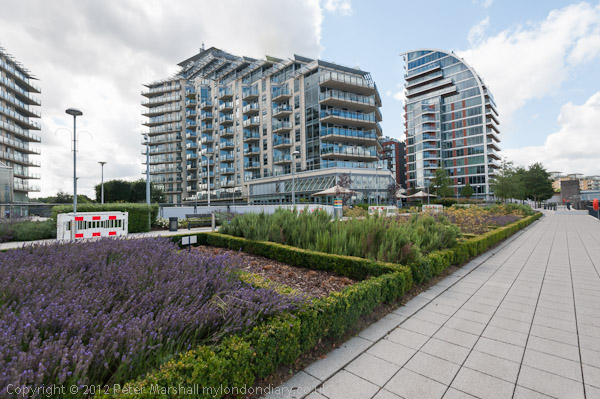
The flats above are on the ‘Pure Genius‘ site that was occupied by ‘The Land is Ours’ in 1996; they were evicted after five and a half months but the site remained derelict and empty for seven or eight years afterwards. In May 1997 I photographed the march on the first anniversary of the occupation, and two weeks later put on-line what now seems a very curious web page,  Pure Genius – One Year On, with some weird scans of my pictures.

© 2012, Peter Marshall

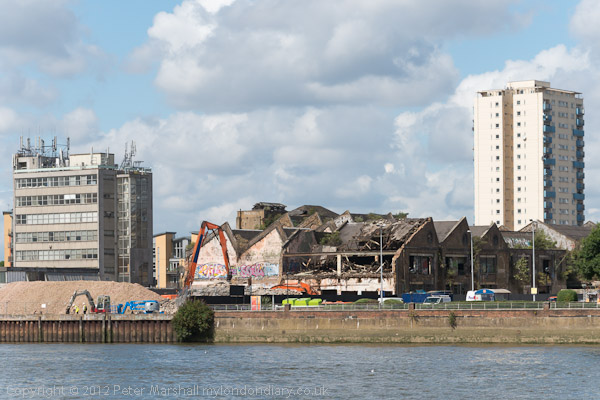
On the opposite side of the river, demolition seemed to be taking place at Fulham Wharf, but the sand and gravel site there and on the south bank immediately upstream of Wandsworth Bridge was still working, and I made another panorama from the bridge as well as taking a few more pictures. You can see more at Battersea Riverside on My London Diary.

________________________________________________________

My London Diary : Buildings of London : River Lea/Lee Valley : London’s Industrial Heritage

All photographs on this and my other sites, unless otherwise stated are by Peter Marshall and are available for reproduction or can be bought as prints.

To order prints or reproduce images

________________________________________________________

10 Things from Anders Petersen

A beautiful post on Eric Kim’s Street Photography site, 10 Things Anders Petersen Can Teach You About Street Photography in which Kim explores the thoughts and pictures of Petersen. I’m not sure that you can teach most street photographers anything- its a genre that seems to attract and encourage the unthinking, and one which I think is generally long past its sell-by date – but most of it is great advice for most photographers.

Not necessarily what you should do, because you need to find ways of working that suit you, and there are many who his won’t fit, but there are things which we can all learn from even if we decide on a different path. My thanks to Peggy Sue Amison, artistic director of the Sirius Arts Centre in East Cork, a place I often wish I lived closer to, and whose Facebook posts often light up my mornings, as this one did, for sharing this.

Back in the days when I was at least a part-time street photographer (before I saw the light?) I followed at least some of the 10 precepts from Petersen, although in my case the inspiration came from the work of guys like Winogrand and some of Cartier-Bresson’s images on the run (rather than his ‘waiters’). Perhaps the most important is the first:

1. Shoot with your heart, not your brain

and something that disappoints me about much recent street photography is that it seems to be more about clever design exercises than working from the heart.  Another that struck a real chord with me is Kim’s number 8, ‘Focus on content, not form‘, but it is really an article you need to read and digest for yourself. And when you have done so, like me you will probably want to go on to read more by Kim, and in particular his 10 Things Garry Winogrand Can Teach You About Street Photography.

Kim and Petersen also comment on equipment, basically the need to keep things simple. My favourite street cameras were the Minolta CLE with a 28mm and the 35mm f2 fixed lens Konica Hexar. With both I worked with the exposure manually set for the lighting conditions, usually at an aperture of f5.6 and manual focus set usually at 1.8 metres, which gave me a reasonable zone of focus. The only thing I had to think about was being at around the right distance and pressing the release. Nothing digital I’ve tried quite comes up to these cameras – perhaps the nearest – apart from size, noise and bulk – is the Nikon D800 with a 20mm lens set to DX crop (a 30mm equivalent.)

For most work now I need a more flexible approach, but the idea of reducing thought about anything technical to a minimum still holds. Almost every exposure I make is with the camera on ‘P’ (photographers joke it stands for Professional), although I often use of the thumb wheel to modify the shutter/aperture combination when I can see a need for a faster shutter speed or greater depth of field, as well as usually having some exposure compensation – my default is to give an extra 1/3 stop.

Thanks perhaps to some curious thinking by Nikon, P doesn’t give sensible results with flash at night, unless you like your subject with a black background. Usually I switch to A so I can choose the aperture or S if I want to use slow shutter speeds.

Working fast with longer focal lengths is really only possible with good autofocus, and modern camera viewfinders are generally pretty poor for manual focus. Although I often know I don’t need to focus when I’m working wide-angle, most of the time I leave it on, as otherwise I forget to turn it back on when I really need it.

Tribute to Martine Franck

I didn’t know Martine Franck, and although I have occasionally seen and admired her photographs, had never really formed any clear views about her and her work. So when she died on 16 August, aged 74, I didn’t feel I had anything to say about her, though I did read the obituary in The Guardian and look at her work on Magnum.

Today Le Journal de la Photographie (in English) devotes itself to a collection of short tributes about her written by nine people who did know her, and it makes interesting reading, as well as three comments by Franck on her own images, which include probably the only one that most people in photography would instantly know as by her, a man in a hammock watching women at a pool in Le Brusc, Provence in 1976.

I hadn’t realised before that she was Belgian – born in Antwerp – and had an English mother. And while on the subject of places, I can tell Magnum that Newcastle upon Tyne is how they should spell it, and that it isn’t in Yorkshire! But I do like the photograph Franck took there, along with many others by her on the Magnum pages. 

Memories of Auntie Mabel

© 1977, Peter Marshall

There really is probably little reason why most of you reading this should have much interest in my Auntie Mabel, though she was one of my favourite aunts. But I think these pictures have a wider appeal than simply being about a particular person. They were made in 1977 a few weeks before her 85th birthday, using available light and Tri-X or HP4 film, probably pushed a stop or two.

© 1977, Peter Marshall

Mabel Marshall was born (as I’m often reminded) on the day that the last train in England ran on the broad gauge lines out of Paddington. The train pulled into Swindon on Friday 20 May 1892 and immediately the engineers got to work on replacing the track with standard gauge, completing the job over the weekend. Meanwhile elsewhere, my grandmother was giving birth. She may well have been aware of the changes taking place to our rail system, as she herself had travelled down those wider lines some years earlier from Wales, where much of her family still lived. And even when I was small, they still used to send a bird – usually a goose –  down ready for the table at Christmas, to be collected by one of my uncles from Paddington station.

Mabel had four sisters and two brothers, all younger than her. The girls were all of the age whose possible husbands were men killed in the First World War, creating a great shortage of men, and only one of her sisters ever married.  Mabel, seven and a half when my father was born, as the eldest of the children will have taken much of the responsibility for looking after him and the other young ones, but she never had children of her own – almost 40 when she was married, she was probably by that time too old.

© 1977, Peter Marshall

She and my father actually got married within a year or two, not of course to each other, but their partners were also brother and sister, she becoming a Tabor while my own mother, a dozen years younger than Mabel became a Marshall. Her husband had taught the classes at the Richmond and Twickenham Bee-Keeping Association when my father went to learn bee-keeping (later my father was to look after the assopciation’s hives and teach others there.) The two men got on well and introduced each other to their sisters and that I suppose is where my story really starts, though it was perhaps 20 years before I came into it.

© 1977, Peter Marshall

Mabel and Alf were married around 1931, and moved into a rather gloomy late Victorian semi-detached in Sunnycroft Road, a large house for two, but it was often rather crowded on the family occasions when we visited. Around 45 years later when I took these pictures, Mabel had been a widow for some years, living there alone.

© 1977, Peter Marshall

Even when I was a child  in the 1950s it had seemed an old-fashioned house, still lit by gas, when most of the rest of us had long moved to electric. Little if anything had changed by 1977 except that there were now rather more photographs on the stand in the rarely used front room, which include one of my own wedding pictures (fortunately largely hidden) as well as one of my own first son who was with us on our visit.

© 1977, Peter Marshall

I knew as I took the pictures that this was probably the last time we would visit the house; life on her own was becoming difficult and before long Mabel would be moving out into sheltered accommodation. The next time we visited she was living in a single room, still with some of the same photographs on display, but otherwise very different (and about 15 degrees Celsius warmer.) I gave her one or two of the pictures, but I think by then her sight had almost gone.

© 1977, Peter Marshall
Aunt Mabel makes us a pot of tea

________________________________________________________

My London Diary : Buildings of London : River Lea/Lee Valley : London’s Industrial Heritage

All photographs on this and my other sites, unless otherwise stated are by Peter Marshall and are available for reproduction or can be bought as prints.

To order prints or reproduce images

________________________________________________________

Hizb ut-Tahrir Supports Rohingya

© 2004, Peter Marshall
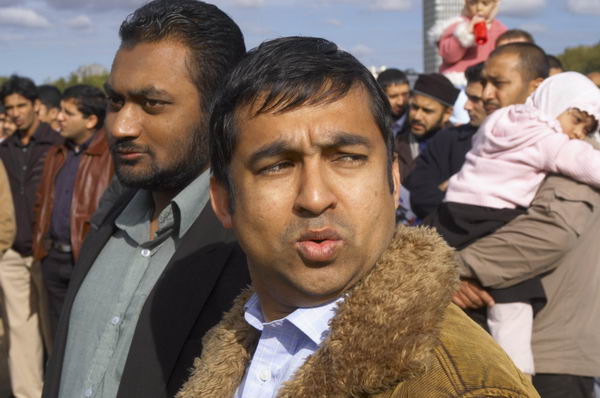
Men at at Hizb ut-Tahrir Britain rally in Hyde Park in 2004

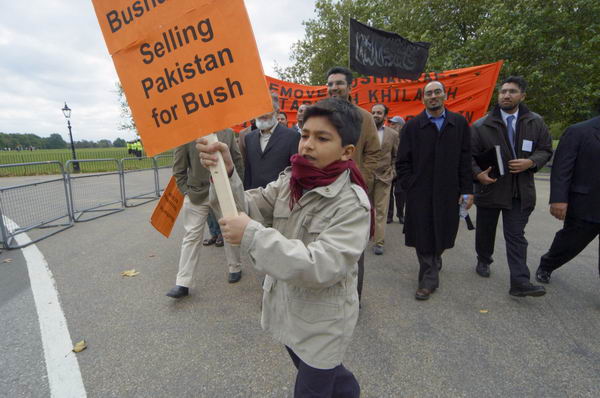
It was back in 2004 that I first came across Hizb ut-Tahrir Britain, which I described then as “an independent Islamic political party dedicated to re-establishing the Islamic way of life under an Islamic caliphate (Khilifah.) The repetition of the word ‘Islamic’ was of course deliberate and intended to mirror the relentess and repetitive approach of the speeches and the visual effect, with its large banners, black characters on intense orange.
© 2004, Peter Marshall
Hizb ut-Tahrir march against ‘Busharraf’, 2004
There were very few journalists and photographers at that event, and I remember talking to one of them, a man who had been researching and following the movement for some time and who considered it to be a dangerous and influential fundamentalist movement which governments would be wise to proscribe.
© 2012, Peter Marshall
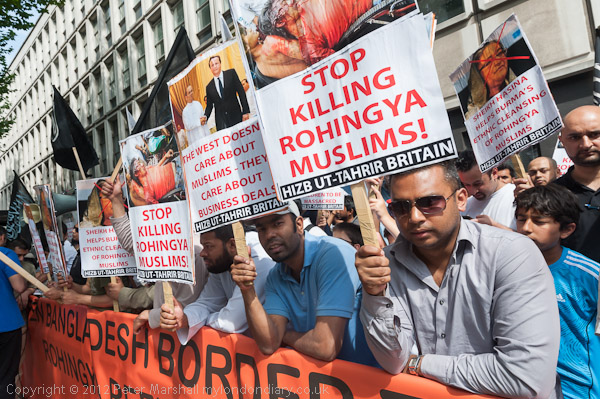
Protest opposite Bangladesh High Commission supporting Rohingya, 2012

There have I think been a few minor changes over the past 8 years, at least presentationally, although the protests still look much the same, but I think the speakers are a little less strident (though I only understand those who speak in English) and some have been careful to point out that they are not aiming at the overthrow and replacement of the British state and that their ambition is for the Khilfah to replace the current corrupt and largely dictatorial rulers of the Muslim states. Although their removal seems an excellent idea, I’m certainly not convinced that I would want to live under the rule of Hizb ut-Tahrir, and I still find some aspects of their protests unsettling.
© 2010, Peter Marshall
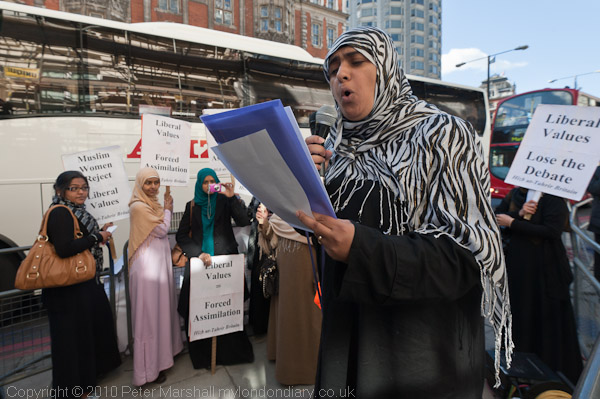
One of a number of women speaking as Hizb ut-Tahrir women protested the French veil ban, 2010

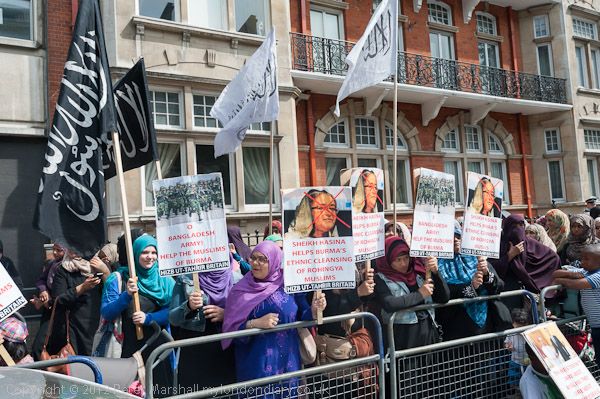
One is the separation between men and women at their protests; it isn’t the actual segregation I find so disturbing but that women seem often to be treated as second-class citizens, off to one side of where the real action (in this case the speeches and the loudspeakers relaying them) was taking place, with none of the speakers being women.  Many of them were so far away along the road that they could not see or even hear properly what was going on. The only time I’ve seen the women of Hizb ut-Tahir ever fully taking part in a protest was at a ‘women only’ protest over the French ban on Islamic face veils.
© 2012, Peter Marshall
Women protest separately at one side of the protest in support of Rohingya, 2012

The protest on 11th August was at the Bangladeshi High Commission in a wide and fairly empty street in Kensington, not far from the Natural History Museum and the Albert Hall.  Although some of their protests over the years have attracted the attention of many photographers, again this was not one of them, and when I arrived a few minutes after the time the protest was to start, I seemed to be almost the only journalist or photographer present other than the organisation’s own people (and of course many in the protest were taking pictures with their phones.)

I like to get to events on time, if not at least a few minutes early. Often the most interesting situations happen as people are arriving and things are being set up, though I also generally stay on as long as I can. Years ago, when I first went to photograph a number of carnivals with a few friends, I was surprised that as soon as the actual procession started they would put their cameras away and go to the pub, but usually they were right, many events are essentially over for the photographer once they have started. Others – and perhaps this protest was one – never really begin.

My lateness was simply a result of London traffic and my decision to take a bus to the protest. Buses are my favourite method of travel around London, giving a great view of the city from the upper deck, but like cars and taxis they are unreliable. On this occasion I’d had far too long to enjoy the view of Fulham Broadway on my way to Kensington.

The only really reliable way to get around London is on a bike, or for shorter distances, feet. But I don’t like taking my bike to protests, as finding a good place to use my heavyweight lock can be difficult, and even the best locks only deter the more casual thieves and don’t protect against vandalism. They are also a nuisance with marches, when you have to go back to the start to collect them. But had I thought, I would have ridden to this static protest in a posh area on a sunny day when traffic was likely to be bad, especially with various large sporting events in the city. But I’m getting old and lazy and have a free bus pass I like to use!
© 2012, Peter Marshall
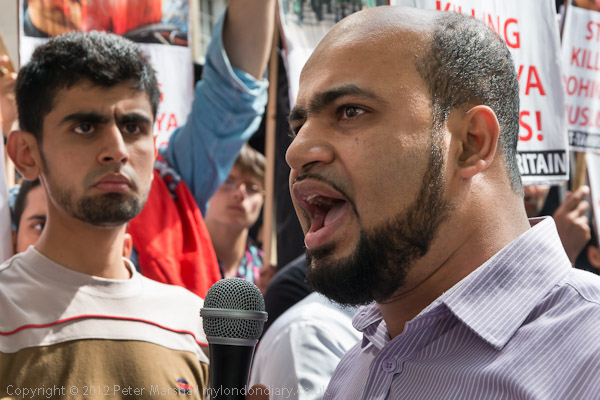
Hizb ut-Tahrir Supports Rohingya, 2012

The still photograph can’t convey the actual words that people say, but it can show something of the mood and I concentrate on the expressions and gestures of the protesters and in particular the speakers. Words and images may come from placards and banners, which are also very important in photographing protests.
© 2012, Peter Marshall
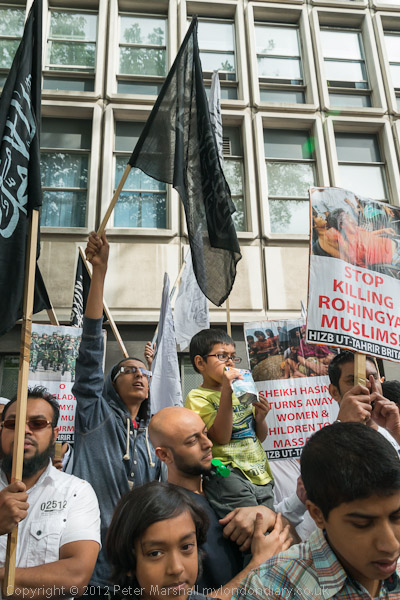
Hizb ut-Tahrir Supports Rohingya, 2012

Photographers are very attracted by sounds at protests, whether those of people chanting, shouting or speaking or (absent from this event) music or drumming etc. If you are working with video, the sounds are often the most important part of the event, but as a still photographer you need to keep reminding yourself that they don’t record in your images. You have to work to try and catch the feeling of the moment. It’s a start to be seeing and hearing the excitement – it suggests you are somewhere near the right place – but you have to work hard to make it show in your images.

Of course it’s important to be honest about the event you are photographing, while obviously your photographs will also present your own point of view. I’m often unhappy about the way that single images are used in the press which often give a very distorted view of events, and I’m far happier presenting my own work through sites like Demotix or My London Dairy where I can tell a story in some depth, both in pictures and text.
© 2012, Peter Marshall
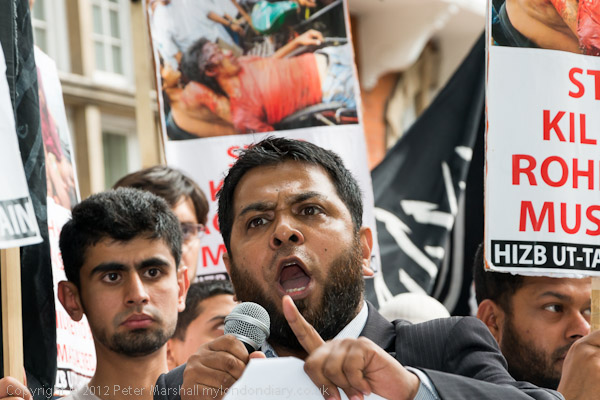
Hizb ut-Tahrir Supports Rohingya, 2012

Although I often share the concerns of Hizb ut-Tahrir which they express in protests – as in this case over the terrible oppression of the Rohingya people in Burma, caught up in the long-running dispute between Burma and neighbouring Bangladesh, with its origins going back into the British rule of India (more on this – and more pictures – in Hizb ut-Tahrir Supports Rohingya on My London Diary), like that journalist I talked to I find the movement disturbing. It seems to represents an extremism which I find chilling, just as I do that of the extremist Christian and political groups I’ve photographed.  But unlike many extremist groups, Hizb ut-Tahrir welcome media attention and are always attentive (sometimes perhaps a little too attentive) to journalists and photographers. I don’t think they should be banned but I do wish that more mainstream and moderate Muslim organisations were more vocal both about them and the wider issues that they address.

________________________________________________________

My London Diary : Buildings of London : River Lea/Lee Valley : London’s Industrial Heritage

All photographs on this and my other sites, unless otherwise stated are by Peter Marshall and are available for reproduction or can be bought as prints.

To order prints or reproduce images

________________________________________________________
Raoul Wallenberg

One of the bonuses of walking around London as I do quite often is that you often come across places and events you were unaware of, or at least that let you see them in a different way.

© 2004, Peter Marshall
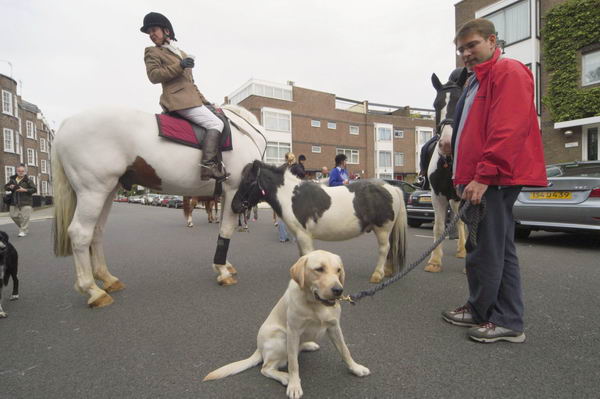
Horsemens’ Sunday, 2004

In September 2004, I’d gone to Hyde Park Crescent to take pictures of ‘Horsemen’s Sunday‘, an event I’d read about but never seen, and where most of the men apart from the vicar turned out to be women or children. I was staggered to find that the Hyde Park Pony Club had so many members, but it was an event that once seen I’ve not felt the need to revisit – and I think Thelwell would have done it more justice. I find horses tricky to photograph and I think they look at their best from a distance, like bicycles they don’t respond too well to my usual ultra-wide approach, though the 12-24mm Sigma I was using then on an DX camera was rather less extreme than either the 10.5mm DX semi fisheye or the 16-35mm FX I now prefer.

London when my father was a boy a hundred years ago was still a largely horse-powered city – and he helped his father making horse-drawn carts, later graduating after a period working in munitions and a trip to France patching up biplanes for the Royal Flying Corps (and on to Germany in the RAF to fraternize with the Fräuleins returned to find the internal combustion engine had taken over and for a while he built wooden fire engines and charabancs. London’s pollution became rather less obvious (the horses mainly moved out to the Home Counties as expensive toys for the wealthier commuters and their families) and needed much less shovelling but rather than being good for the roses and veg now poisoned us, first mainly with lead, but now with nitrogen oxides and respirable suspended particles. I’m always a little worried by the abbreviation PM, as in PM10 or PM2.5, because those letters are my initials. Of course the also stand for Prime Minister, and I could certainly do a better job than the present incumbent, though I’ve no wish to volunteer.

But, back to real life, as I wandered away from the wealthy horse riders of London, I came across another event taking place a short distance away, a group of people standing around a piece of sculpture that had not been there the last time I’d wandered down Great Cumberland Place perhaps ten years earlier, and I stopped to investigate and take a few pictures, and a couple of them ended up in My London Diary too.

© 2012, Peter Marshall
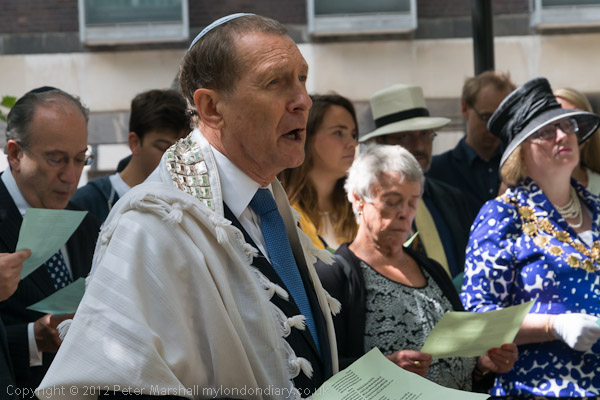
Chanting a Psalm of Thanksgiving for the life of Raoul Wallenberg, 2012

But this year I went to the same place on purpose, and did I think a little better with the pictures of the Raoul Wallenberg 100th Anniversary.

© 2012, Peter Marshall
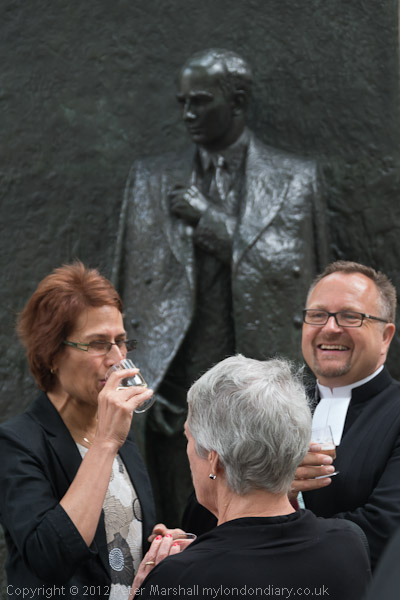
After the ceremony I was pleased to drink a toast to a great man too.

It was commemorating one of the great heroes of the twentieth century, a man who put his own life at risk by going to Budapest as a Swedish diplomat during the Nazi occupation to issue the Jewish population there with false ‘protective passports’ which identified them as Swedish subjects awaiting repatriation saved probably 100,000 from the death camps. (Surprisingly he survived the Nazis only to be imprisoned and killed by the Russians – and a new inquiry into the date and manner of his death was announced by Sweden recently.)  The anniversary wasn’t entirely unnoticed in the media, with similar events taking place elsewhere around the world, but I think I was the only professional photographer and journalist present at the London event.