Graffitti

It’s been a while since I’ve bumped into Brian David Stevens on the streets of London, and now I know why. He has been hiding in a tunnel under Waterloo station, and you can see the results in a fine set of images on his web site, Graffiti.

© Brian David Stevens
From ‘Graffitti’ by Brian David Stevens

I have to admit that my heart sank when I saw that title, with everyone in the world now uploading even the merest lick of paint on a wall onto Flickr in their millions, but as I expected, his work is very different. And yes, I have occasionally photographed the odd Banksy or even rather better work on the wall, but I seldom inflict many of them on others. And one aspect of the Olympic sanitisation I found most disturbing was the fairly wholesale remove of the graffiti that have some areas of London much of their character.

Even more disturbing is the council’s vandalism on the Heygate estate at the Elephant, where they came and painted over the Heygate Community Garden paintings and murals. They appear to have “singled out for painting over the large and thoughtful pieces around the Community Gardens and pond” while leaving the pointless tags, nonsense and occasionally obscene scrawls on buildings over the rest of the estate.

But worse even than that is their decision to serve compulsory purchase orders on the small number of remaining owners living on Heygate. A statement by the Heygate Leaseholder’s Group begins:

Despite being situated just a few hundred yards from a zone 1 tube station, we are currently only being offered around half the Borough average price per sq. ft for our homes. The Compulsory Purchase Order will result in us being dispossessed of our homes and permanently priced out of central London.”

But of course as well as being particularly shoddy treatment for the owners – which they intend to fight – the whole saga of closing down the estate and its proposed redevelopment  is terrible news for Londoners, a real kick in the teeth for those on the huge housing lists, with thousands of habitable properties being kept empty for years. I’m told the graffiti had improved considerably since my visit in April

© 2012, Peter Marshall
Community pond on Heygate Estate

You can see some of my pictures and more of the story about the Heygate estate – and next on the Council’s hit list the nearby and larger Aylesbury estate in Heygate Estate ScandalHeygate Panoramas and Walking the Rip-Off – Heygate & Aylesbury.

Back to Brian David Stevens, don’t miss the other fine work on his site – I particularly like his stark black and white in Doggerland.

Eye Plus

© 2012, Peter Marshall

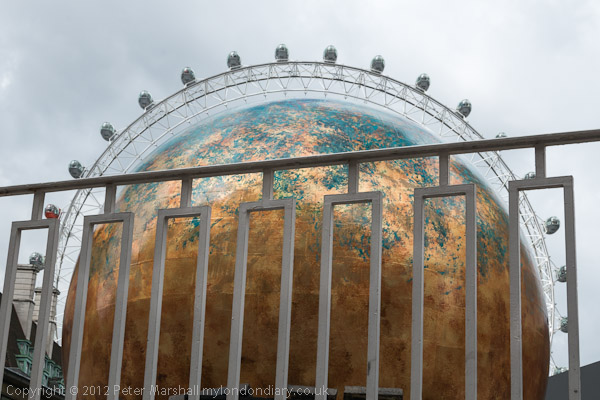
A few weeks ago I saw the large sphere in this image being installed on the pavement by the Shell Centre in York Road and immediately thought of a picture rather like this, but there was too much clutter around it at the time. But a week or so ago, as I was rushing to catch a train home from Waterloo, I took a few seconds to take it.

In my haste, I didn’t quite get it right, though it looked pretty accurate in the viewfinder. It was actually very difficult to find exactly the right position, and even slight movements of the camera got the two arcs out of alignment. It’s one of the very few pictures I’ve taken this year where a tripod would possibly have helped, although I’m not sure I could have got one in the right place.

It isn’t a great picture, but I thought just a little different view of the London Eye, and one that perhaps amused me more for the intellectual property issues more than as an image. The London Eye is a protected design and although this doesn’t stop you from photographing it, places restrictions on the uses to which images can be put. Fortunately editorial use – such as the above is not affected.You can also  freely use images which contain the Eye but are not actually pictures of it, for example the view of the Thames downstream from Westminster Bridge where it is only a part of a wider panorama.  However because the design is intrinsic to the picture above, this might be a difficult picture to argue that point.

There is also the spherical object, which I suspect is an art work of some kind,  and is likely to be covered by Section 62 of the Copyright, Designs and Patents Act 1988 (which had a few minor amendments in 2003.)

62 Representation of certain artistic works on public display

(1) This section applies to—
(a) buildings, and
(b) sculptures, models for buildings and works of artistic craftsmanship, if permanently situated in a public place or in premises open to the public.

(2) The copyright in such a work is not infringed by—
(a) making a graphic work representing it,
(b) making a photograph or film of it…

So on that the image is probably in the clear. One important exception is that this generally does not apply to 2D works. So all those photographs you and I have taken with graffiti, murals, advertising hoardings, posters and so on in them could be in breach of copyright, though you only need to worry about such things if you are thinking of supplying them for commercial use (generally meaning for use in adverts, packaging etc.)  For editorial usage – and that includes fine art (and pretty coarse art like this site) – there are few things you need to worry about.

American Photographs

I’ve long been a fan of Walker Evans, and in particular his 1938 book ‘American Photographs’ and there is a well-thumbed copy of the 50th anniversary edition published by the Museum of Modern Art (who published the first edition) in 1988. That edition “with new duotone plates from the original prints” aimed to recreate the design and typography of the original “as precisely as possible”, and was I think rather an improvement on the original in terms of the quality of the printed images.

25 years on, we have the “75th anniversary edition of American Photographs, reissued by the Museum of Modern Art in an edition that recaptures, for the first time since its original release, what might be called the book’s radical purity.” I’m not sure that it differs in this respect from the edition I have .

The original was printed in 5000 copies, with an elegant cloth binding (Evans called it ‘Bible cloth’) and with various small touches that are no longer possibly in a reasonably priced edition. Printing technology has of course changed completely from the 1930s letterpress, also used for the second and rather different edition of 1962.

You can read more about the book and see 18 of the 87 images from the book (the MoMA show the original accompanied had 100 pictures) in a piece on the TIME LightBox by Ben Cosgrove.  Many of the best-known images by Evans were taken when he was working for the FSA, and you can see them on the Library of Congress web site, including the two albums of prints made when working with James Agee on another book, Let Us Now Praise Famous Men.  Many of his images on the LoC site now seem to be very poorly scanned from ‘intermediary roll film’ reproductions, but there are still over 40 decent high res scans available from the original negatives, so you can try making your own prints of his images.

Over At Last

I breathed a sigh of relief late on Sunday evening as the closing ceremony for the London 2012 Olympics lumbered to its end. Not of course that I was watching or even listening to it – Radio 3 has one of its rare jazz programmes late on Sunday nights – but the posts had been rolling into Facebook, mainly rather negative comments about the various groups involved. But perhaps now we can have our city back. Though of course we now have the Paralympics to look forward to, with disabled protesters promising to play a better game than their able-bodied counterparts.

If I’d lived in the east of London, I might even have ventured out for the fireworks, perhaps finding a good viewpoint, but it was all happening too late for me to easily make my way home. Unlike many I’d not got caught up by the ‘Olympic Spirit’, and had hardly seen more than the odd second or two (not having a TV in the house helps) though I’d been pleased to hear some of the stories of success of some of the athletes, even if the repeated playing of commentators shouting hoarsely about British successes soon got rather wearing. But I was genuinely pleased to see British cyclists doing well (even if I still think the Keirin is a ridiculous event) though rather more pleased over their success earlier in the Tour de France, after which the Olympics seemed slightly small beer. But there are certainly some events I can’t take seriously as sport (like synchronised swimming and the one somebody described our medal winner as being rewarded for ‘looking slightly royal on a horse’) and others such as boxing I’d like to see banned.

But there are other aspects of the Olympics – not the sport – that  worried me. Seeing British police strolling through crowds carrying sub-machine guns still makes me feel I’m in the wrong country, and the truly unnecessary ‘security’ – like the closing of the canal towpath for a couple of months.
© 2004 Peter Marshall
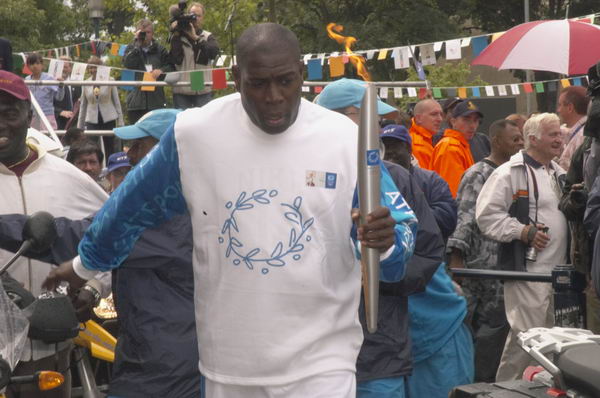
Frank Bruno carries the Olympic torch in Brixton, 2004

I photographed the Olympic torch relay through Brixton in 2004, where Frank Bruno and Davina McCall were running with it through the streets. Everyone with them was local and was having a good time. Security was virtually non-existent and certainly unobtrusive, as was the corporate presence – Samsung were there and handing out corporate flags and other stuff to the kids, but that was about it.
© 2004 Peter Marshall
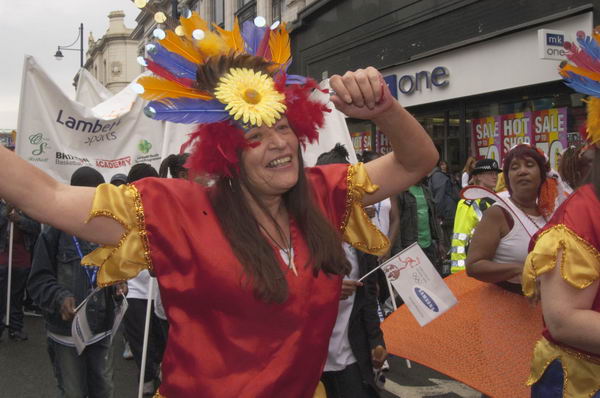
Brixton celebrates the Olympic torch relay in 2004

Various local music and carnival groups followed the torch along the High Street and it was bright and colourful and fun for those taking part and watching.

This year it seemed to have a very different atmosphere, and where I saw it local participation seemed limited to standing on the pavement at the side of the road as corporate floats rolled past in front of the torch bearer who was flanked with what looked like a dozen or so plain clothes police.

So many stories seem to be about the control of people by corporate interests and the branding police. Long established businesses with Greek connections trading for years under the name ‘Olympic’ being forced to change their names, butchers, bakers and florists being told to remove window displays using the 5 rings, and so many more. I was also saddened by the removal of much of the graffiti that characterised some of the areas surrounding the site, and by some of the stories I heard about rough sleepers and others being ‘tidied up’ in central London.

Various arrests of people, often who had not actually committed an offence, so that the police could impose bail conditions which included staying out of the Olympic boroughs during the games and after. Probably most of them will find any charges against them dropped – because there never really was a case. It will be interesting to see exactly how many of the 182 cyclists arrested on the night of the opening ceremony actually end up in court. Wide-ranging restrictions were imposed on freedom of association in the area around the Olympics, and in particular against the local youth.

But there were some good aspects apart from the sport. G4S showed that it isn’t a good idea to rely on companies like them to provide services – and the military who came to take their place seemed to have done the job far better than they would have done. (And their uniforms cost considerably less than the average of £6,250 per uniform the government had negotiated with G4S – a figure which shows just how using private companies like this saves money!) The Olympics did at least give an opportunity for the spotlight to be turned on the activities – away from the games – of some of the sponsors, and I’ve previously written about some of the actions against Dow, BP and others.  Although the restrictions in place prevented much actually happening in Stratford.

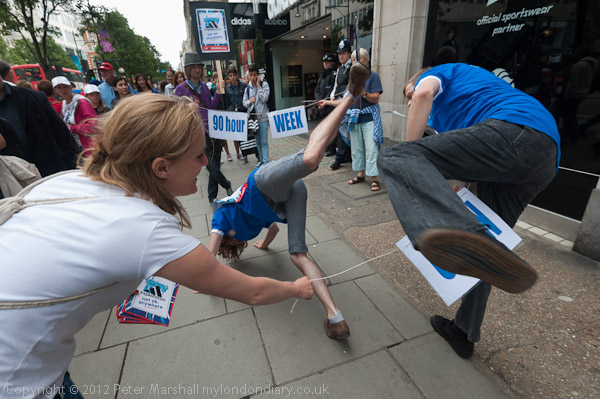
On Saturday 4 August, War on Want took advantage of the games to highlight the corporate malpractices of the official sportswear partner of London 2012, Adidas, holding their own games in a protest outside the company’s main Oxford St store.
© 2012, Peter Marshall
War on Want athletes face the Adidas hurdles of poverty wages, union busting and 90 hour week

The hurdles race was perhaps the most spectacular, highlighting the allegations that some workers producing Adidas clothing in China are forced to work 90 hour weeks, and that workers in Indonesia and Sri Lanka are paid poverty wages – some as low as 34p an hour – and many are told they will be sacked if they complain or try to join a union. A PR company working for Adidas came to talk to me and sent me their statement denying this, but this seemed only to relate to their workers in Bangladesh and War on Want’s evidence came from reliable sources.

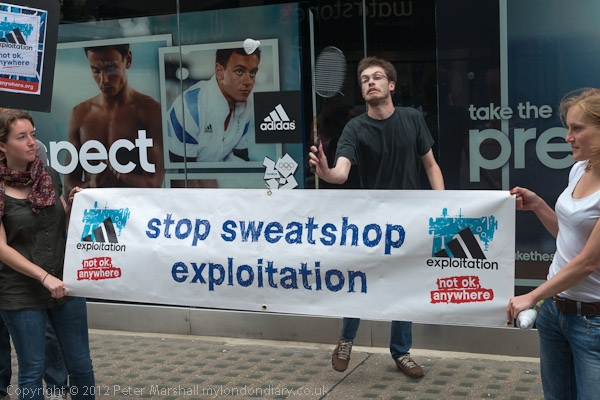
Badminton was another sport involved in the protest, having got some bad publicity earlier in the week when some of the players deliberately played to lose – and when both sides were doing so it became obvious. War on Want’s playing perhaps reflected this, although the women did rather better than the men.
© 2012, Peter Marshall
Trying to lose at Badminton with the ‘stop sweatshop exploitation’ banner as net

More about the protest and more pictures in Adidas Stop Your Olympic Exploitation on My London Diary.

________________________________________________________

My London Diary : Buildings of London : River Lea/Lee Valley : London’s Industrial Heritage

All photographs on this and my other sites, unless otherwise stated are by Peter Marshall and are available for reproduction or can be bought as prints.

To order prints or reproduce images

________________________________________________________

Hipsters Stunned…

Or to give it the full title Hipsters stunned as vintage cameras fail to make them professional photographers on Hayibo made me laugh a little, because it contains some rather astute observations on several things that annoy me.

Like the guys who routinely convert their colour digital images of protests before posting them on the web, presumably because they think that this somehow make them more authentically ‘documentary’.  Or even those who think that using film somehow makes them better photographers. On one digital printing forum the other day there was a guy who posted (or rather boasted) about how he was going to take all his pictures on film and set up a wet darkroom to print them onto photographic paper because that would somehow make them real photographs rather than the digital crap the rest of us make.

I’ve nothing against black and white. I spent years mainly taking black and white images, using Tri-X, FP4 and the rest. Got good enough at printing to be asked by other photographers on various occasions if I would print their stuff. Took loads of colour film too.

If you want to work in black and white  – and just occasionally I think there are good reasons to do so – you need to learn to think in black and white. Not enough to own a camera that will convert your images to black and white or even a great Photoshop plugin which will do it even better. There are photographers who do it well, and some of them will be rich enough to afford Leica’s  M Monochrom digital camera.  (Of course their M8 (I made the mistake of buying one) is actually a decent monochrome digital, just had problems with colour. But the M Monochrom looks great for those who want to work in black and white and have around £6,000 to spare.  I’d love one.

There really was nothing special about film. I’m currently spending several hours a day scanning it and cursing it for its many faults. Too many frames that have bits of fogging from loading in bright light, or where I tried to squeeze in another exposure on the end of the roll. Scratches from dirty cameras or cassettes or careless handling by darkroom technicians (myself included.) Some have even suffered damage from abrasion while inside ‘archival’ storage sheets. Dust, dust, dust, both embedded during the drying or picked up later and held by powerful static electrical forces. Not to mention those that have had coffee, beer, wine, spit and various other liquids spattered across them in later life. Most of my negatives were at least properly washed, unlike some trade processed material, though I’m told that a small residue of chemicals can actually help to preserve them. Perhaps they also would help protect them from the insects who have made some of my files their homes over the years, who I’m sure like their gelatin additive-free.

Of course I exaggerate – if only slightly. But for working in black and white, digital has many advantages, and for working in colour, one over-riding one. Colour is simply so much better. Film gave you colours from the manufacturer’s tin rather than the real world.  Of course colour differs between different camera manufacturers and can be altered in processing, but the overall colour quality from both the Nikon and Fuji cameras I use is superb. There are still a few tricky areas, for example in the handling of bright oranges and reds. For some of the Guantanamo protests where those taking place wear bright orange jump suits I sometimes find I need to change to a different camera profile, but for normal subjects everything works fine.

And as for the printing, a good scan with the Minolta Dimage Scan Multi Pro (fitted with a diffuser) gives a better result than my Apo-Rodagon or other expensive enlarging lenses, and printing with the Epson R2400 allows me to work in Photoshop with a subtlety that was simply unattainable in the darkroom. It’s a bonus that the prints are likely to last longer too.

London 1976

© 1976, Peter Marshall
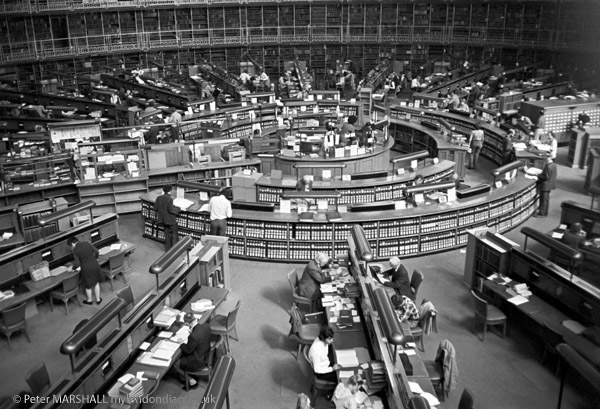
The Reading Room at the British Library (British Museum)

1976 was another lean year for my pictures of London, partly because I was still busy on house and garden. But there were other family reasons too, with my first son arriving within hours of my finishing work for the summer holiday in July. He began to make his presence felt as midnight approached, and an ambulance, blue lights flashing, sped us the couple of miles to the maternity unit at Ashford. But after a couple of hours they sent me home, deciding there would be nothing happening until the morning, and it was late the next day when I noticed some unusual activity on the monitor and called the nurse into the room and things really got moving. Soon I was banished as things started to get clinical, and a fainting husband would only have complicated matters.

© 1976, Peter Marshall
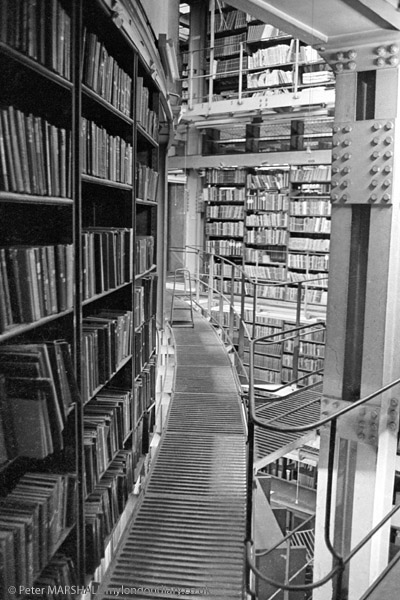
The stacks where the books were stored

But before that we’d made a few trips, including a visit to Hull and a week in Amsterdam. In London, one was on Linda’s last day working at the British Museum, and I went up at lunchtime for a quick tour of the place -including that famous Reading Room, still in use and sneaked a couple of pictures in there, and in the stacks where the books were kept. The 35mm f2.8 Minox was a nicely inconspicuous little camera, though the results were a little variable, even after I’d persuaded Leitz (it took some persistence and a trip to Luton) to swap my initial purchase for one with a properly assembled lens. I was doubtless in breach of the Official Secrets Act, but I think these can now be shown.

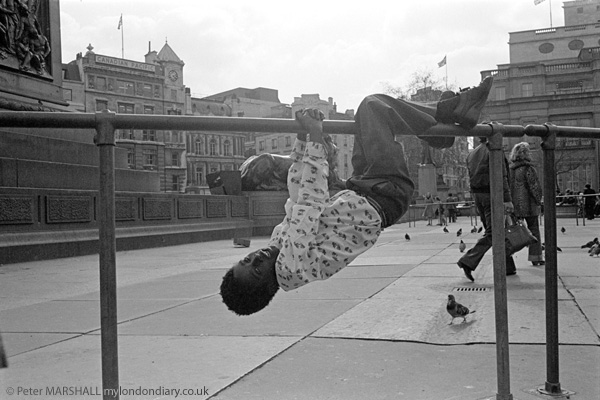
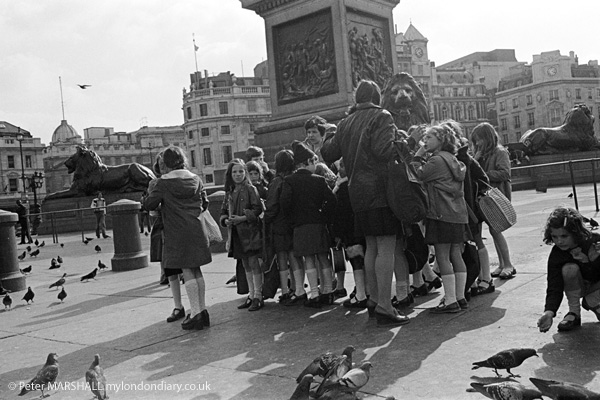
Linda’s boss at the museum had invited us to go out to lunch, and we walked to a rather expensive Greek restaurant in Fitzrovia. The lunch was pleasant and we got through several bottles of wine too, before Linda and her boss had to go back to put in a token appearance at work. I strolled down to Trafalgar Square and spent half an hour or so taking candid pictures of the tourists with the Minox, which, with a few jokey captions and a bit of a story made a nice article in Amateur Photographer.

© 1976, Peter Marshall
I always travel by tube

Looking at the contact sheet, the wine certainly shows, with some very odd horizons, though there were some pictures where I was ‘shooting from the hip’ to work close and unseen to the subjects.

© 1976, Peter Marshall
I still make it only 15 Brown Owl, and I don’t like the smile on that lion’s face…

Going to anywhere in London away from the centre or the tube was not so easy back in the 1970s, before the advent of the Travelcard. Even on the Tube things were trickier than now as tickets were simply from place A to place B (either single or return) and bus fares depended on how far you were going. Some journeys I might need to buy 3 or 4 separate tickets for, and it was hard to plan journeys. Bus, train and tube route plans or timetables were not widely available (although the tube plan was at least in street atlases) and there were no web sites on which to look things up. But about the only way to get any information about buses was to look on their route boards, ask the conductor or go along to the enquiries office at the bus garage.

Piper’s Companion Guide to London has one of its longer sections on transport in London, much of it now rather like the misleading advice to tourists on ‘I’m sorry I haven’t a Clue’.

Using a bike was one way round this, but again in some ways it was much harder. You could put a bike on some trains, but had to rush along the platform to find the guard and the luggage area where they were allowed – if there were space.

© 1976, Peter Marshall
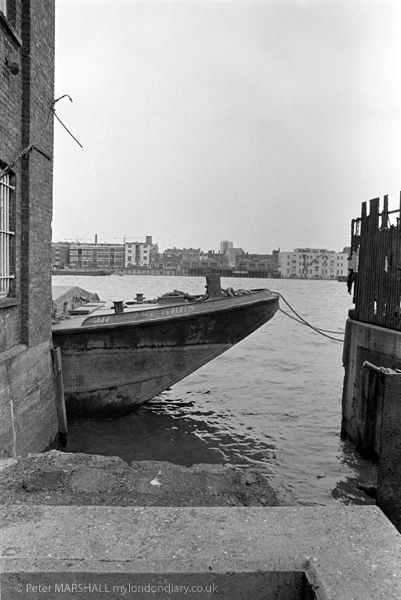
Our route took us to the Thames at Rotherhithe

© 1976, Peter Marshall
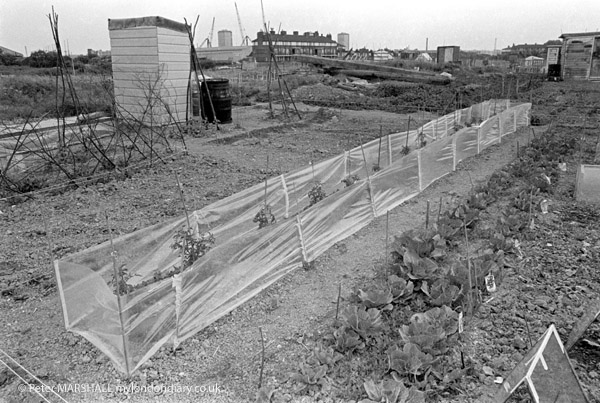
Crops were growing on the dockland at Rotherhithe

We lived a little too far out of London for it to be easy to ride in, though one weekend we made our way from Staines to a green event in the Surrey Docks, at the Surrey Docks Farm which had started the previous year on a 1.5 acre site of derelict dockland between the entrance to Greenland Dock and the River Thames (it moved a short distance from there to a slightly larger site in 1986.)  It was a ride of around 25 miles each way across South London.

© 1976, Peter Marshall
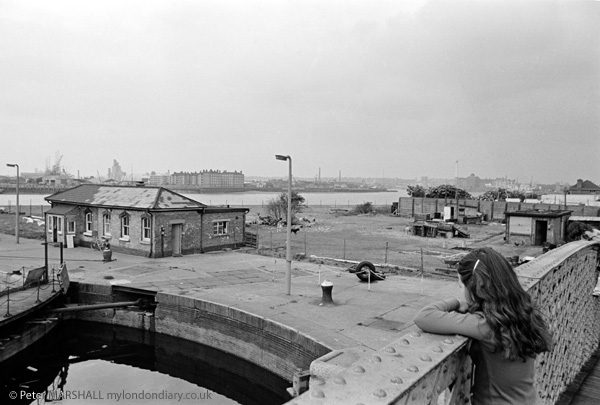
Surrey Docks City Farm was at the entrance to the former South Dock

I think I took a total of 35 frames on the ride and at the farm, with one hopelessly underexposed. Film was still a rather expensive luxury for a young man with a large mortgage expecting soon to become a father.

© 1976, Peter Marshall
Our route back took us along County Way past the waterworks at Hanworth

It was the hottest summer on record, and by the beginning of July we – and particularly a heavily pregnant Linda – were finding it rather a strain, so we didn’t get out a great deal. I had a day out looking at exhibitions in London, taking some rather random street photography, and we enjoyed a trip out to Chiswick House, but I took few pictures. And I’d found a new interest in Family Pictures.

London 1975

Although I kept reading David Piper’s Companion Guide to London (see My First London Pictures), it was a while before I got the chance to take another walk from it, not until the following year, 1975. Of course I was doing a demanding full-time job – around 70 hours a week with preparation and marking – as Head of Dept in a large (2000+ students) comprehensive, but I’d also bought a house that was almost a hundred years old and wasn’t in the best of condition.

It had been condemned around 20 years earlier, but then they’d built on a bathroom extension (breeze block and asbestos) and given it a reprieve. And at some point it had gas put in, then rather later electricity. The gas light fittings had been pulled off, leaving bare pipes sticking out of the walls, and the electric didn’t include any light fittings on the first floor – the previous occupiers had relied on the street lamp outside.

The decoration was interesting, with a few nastily ‘modern’ features imposed on top of the old. And of course back around 1880 there were no such thing as cavity walls, and the builders had dug a hole in the back garden for the sand, leaving some rather large stones in the render which made drilling holes in the wall interesting.

I’ve never been a great fan of DIY, but spent most of the next year – when I wasn’t busy excavating the garden – stripping doors, putting battens, glass fibre and plasterboard on external walls, stripping off layer upon layer of wallpaper and then the rather nasty distemper underneath, painting or wallpapering etc. It put me off moving ever again, and we are still in the same house 38 years later.

The garden was in an interesting condition too. Carefully planted with lots of border plants to attract buyers near the house twenty yards down it was a bed of nettles. A foot lower under them was a partly broken layer of concrete, a yard around which there had once been pig sties. It took rather a lot of clearing that sent me to the doctor with back problems.


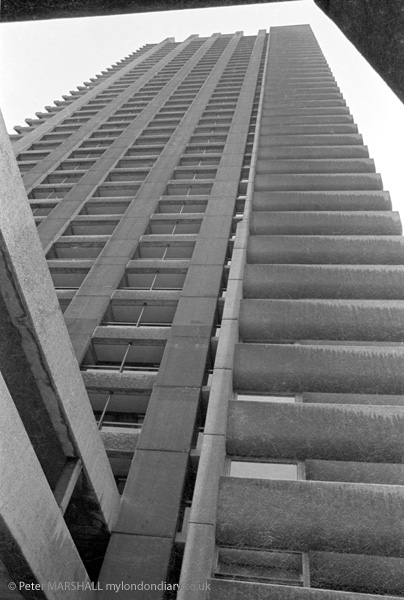
The Barbican gets a brief mention in Chapter 26

So my photo files for the next year or so are very thin, with most of the pictures being taken when I was away from home, as I made a start on the work that in 1983 became ‘Still Occupied – A View of Hull‘, and London got almost left out of the picture.

© 1975, Peter Marshall
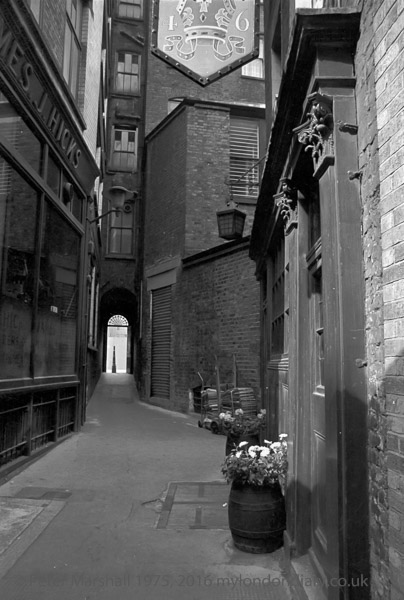
Ely Court off Ely Place also in Chapter 26

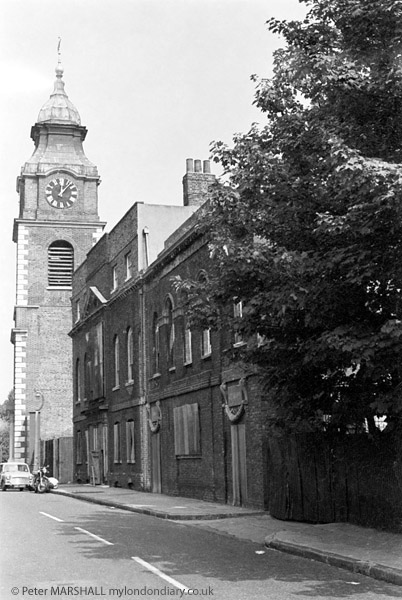
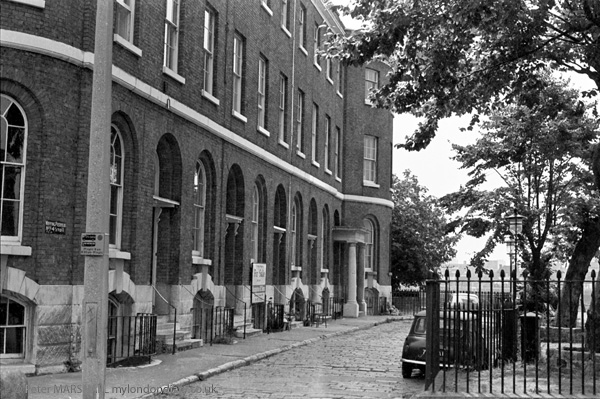
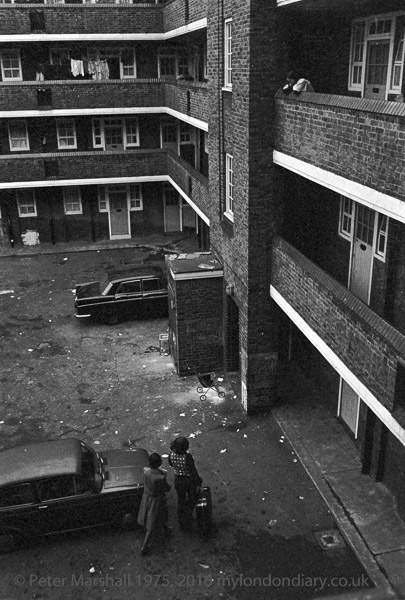
Finally I did manage a few more of the walks from the book, around St Paul’s, Bank, the Barbican and Piccadilly Circus, but the pictures were nothing special. It was only when I took a brief walk to follow up from my pictures the previous year in Wapping that things began to get just a little more interesting.

© 1975, Peter Marshall
Wapping High St just gets a mention in a final ‘Points of Interest Beyond’

© 1975, Peter Marshall
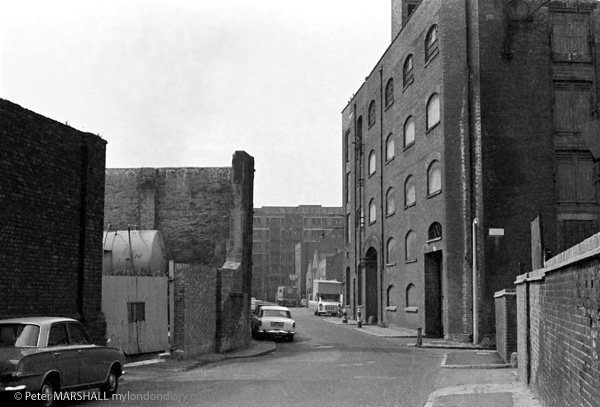
Scandrett St,Wapping

© 1975, Peter Marshall
Pierhead, Wapping

© 1975, Peter Marshall
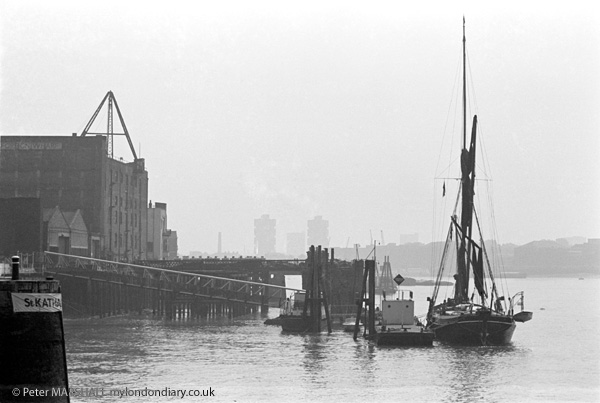
Downriver view from St Katherine’s Dock entrance

Piper’s book was a good introduction, full of sometimes interesting anecodote, and the walks in it helped to get me to see London, but as a photographer I needed something different. Perhaps a map of the Berlin Underground would have helped, but I didn’t have one, but what I really needed to do was to simply follow my own path, wandering where things looked interesting. Books – and the Piper was the first of what is now a large collection – were often useful after the event to tell me what some of the buildings I had photographed were, but were not going to tell me what was worth me photographing.

© 1975, Peter Marshall
A new arrival at Key House, Vauxhall

Piper’s book is still worth reading, in part as a reminder of so much that has been lost. The photographs in it are generally workmanlike, but some have a little more to them, and I wasn’t surprised on turning to the credits to find quite a few by Edwin Smith and Eric de Maré, two of the better British photographers of the era in which it was written. I’ve written about both of them in the past, but those features are no longer available on-line.

My First London Pictures

 © 1974, Peter Marshall
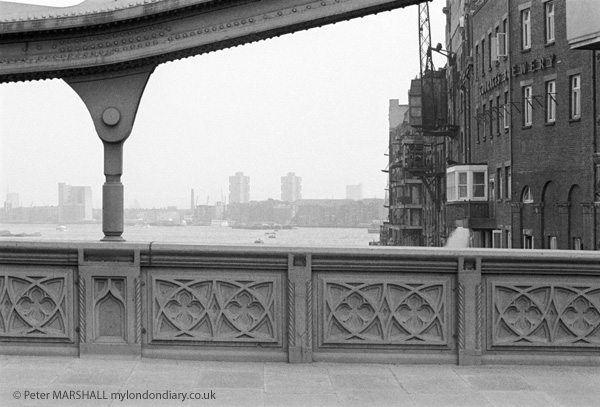
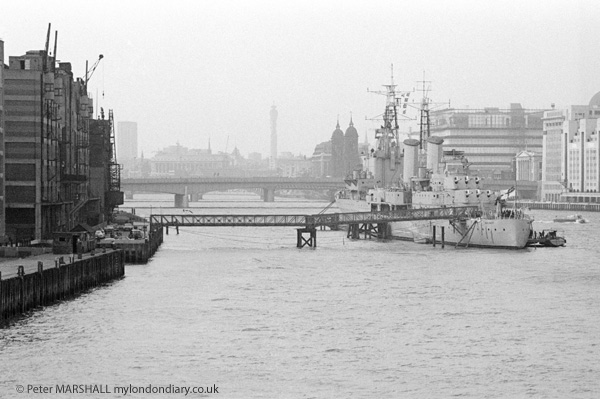
Looking downriver from Tower Bridge, 1974

It was in 1974 that I almost moved back to London, to Staines, which should have become a part of Greater London when that was formed in the 1960s and Middlesex (who had been kind enough to pay me a student grant  in their final years) was abolished.  Of course, for those of us who live there, Middlesex lives on – in my postal address, and I believe we still have a cricket team, though the ground where it plays, Lords, in St John’s Wood, was stolen by London many years earlier, and Middlesex Guildhall is now our country’s Supreme Court.

But rabid Tory backwoodsmen from Sunbury and Shepperton baulked at the idea of being a part of the London Borough of Hounslow, and since then we’ve been in limbo. Officially part of Surrey, but generally Surrey denies we belong, being on the wrong side of the Thames, and I live in the curious borough of Spelthorne, wherever that is. And wherever it is it is a pretty hopeless borough, certainly as far as Staines is concerned. One that thinks trying to rename Staines as Staines upon Thames makes sense, and that Ali G, who has done more to put Staines on the map than anyone else has given it an unsavoury reputation.

© 1974, Peter Marshall
View upriver from Tower Bridge

I grew up in Hounslow, but had lived away from London for a little over 10 years, and coming back to Staines, then a mere 26 minutes by train from Waterloo (its slid around 9 minutes further west since) I’d decided I should get to know my natal city, about which, like most Londoners I was almost totally ignorant. So I bought a copy of art-historian David Piper‘s Companion Guide to London which had just been issued in a revised version in 1974 and started on Chapter 1: The Tower and Tower Hill, going on from there to explore a little around St Katherine’s Dock and Tower Bridge, where I took these pictures on a day in the summer. Although Sir David Piper died at the end of 1990, his guide, first published in the 1960s when he was director of the National Portrait Gallery in London and last revised in 2000, is apparently still available.

© 1974, Peter Marshall
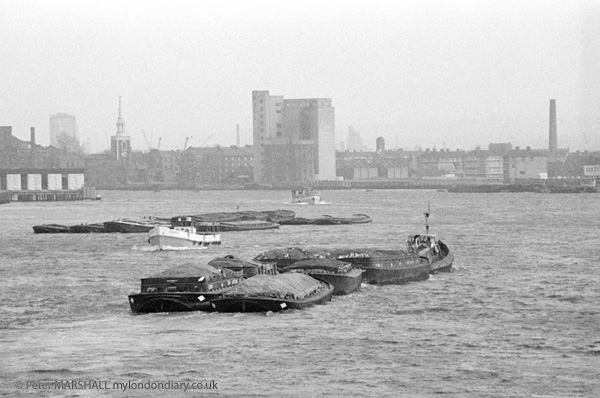
Downriver from Tower Bridge towards Rotherhithe Church and Bermondsey

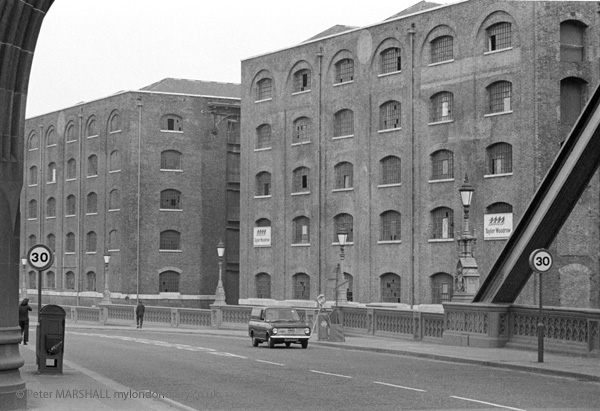
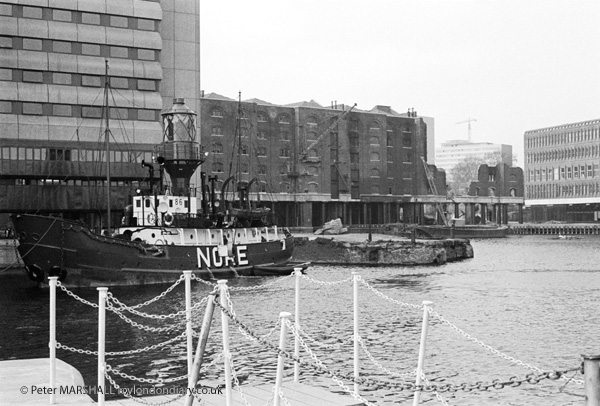
The views, still recognisable, are of a London far more  dependent on the river, with mills, warehouses and wharfs, and more noticeably, missing many of today’s tall buildings. The pictures that I took of the Tower itself are of less interest, as it has changed little over the years. But St Katherine’s Dock was disappearing in front of my camera, with Telford’s tall and well-proportioned warehouses being demolished to make room for inferior new developments.

© 1974, Peter Marshall
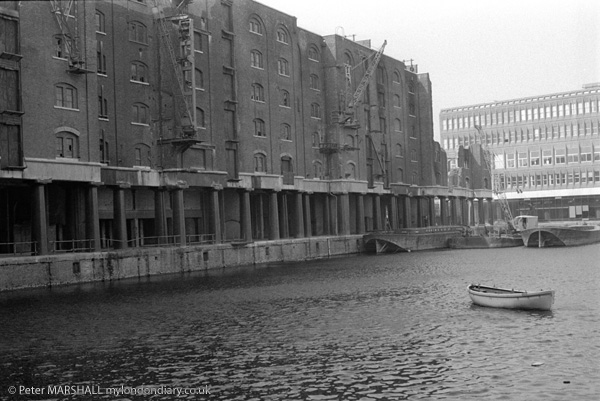
St Katherine’s Dock Warehouses by Philip Hardwick from the 1820s from Tower Bridge
© 1974, Peter Marshall
The warehouses have been replaced by a misleading modern pastiche
© 1974, Peter Marshall
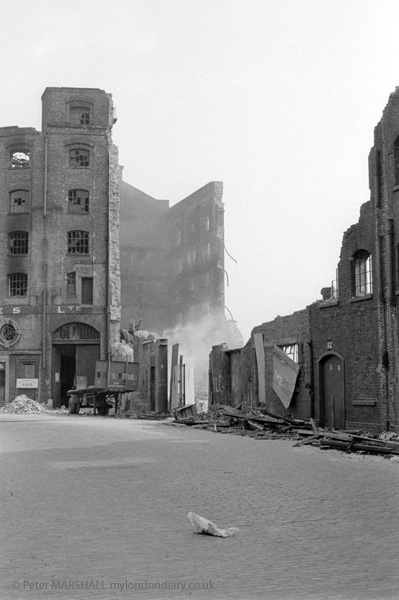
St Katherine’s Dock – demolition seen from the inside

I ventured just a short way east of St Katherine’s on to St Katherine’s Way, where more demolition of warehouses was taking place,
© 1974, Peter Marshall

before making my way back into the City,

© 1974, Peter Marshall

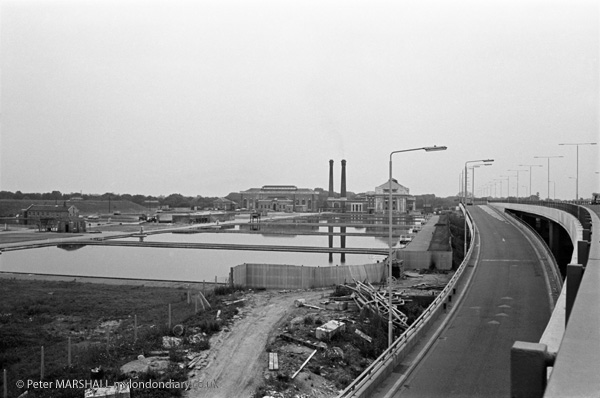
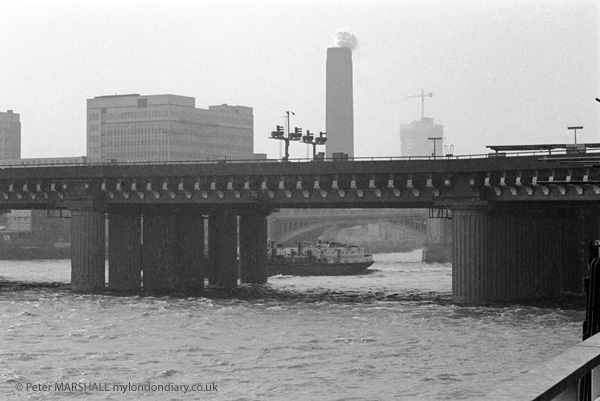
where I made my way along the riverside past Cannon St station. The smoking chimney in the centre of the picture is the Bankside Power Station, now enjoying a new lease of life as the art gallery Tate Modern.

© 1974, Peter Marshall

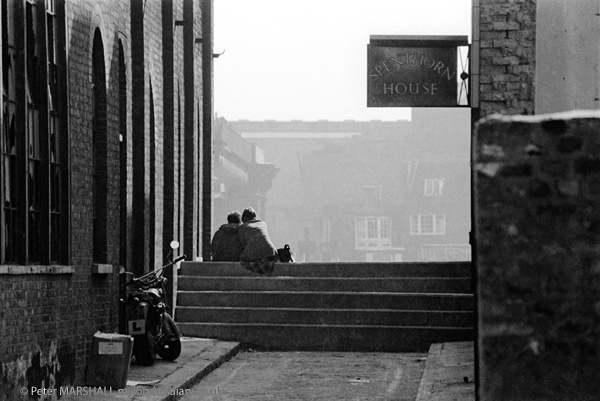
A couple sit looking out over the Thames at the end of Cousin Lane. It looks rather different now. The Spenthorn Service Company had been wound up the previous year and Spenthorn House is now long demolished and on the left of the lane there is now a pub under the bridge. What has a little romantic dereliction has been replaced by commercial tat.  Across the river you can still see the Anchor pub. There are now more areas and paths opened up by the river than in 1974.

Technically these pictures, taken on 35mm film were not always great, and like much of my older work require considerable retouching using Photoshop and a Wacom graphics tablet after an infestation of minute gelatine loving insects who have left their tracks and the occasional body part across the negative.   I think they give an interesting view of a city that was beginning to change rapidly.

Trope

I’ve been enjoying a series of posts this summer by A D Coleman, Trope: The Well-Made Photograph, in which he has explored at some length  “the stupefying similarity of much contemporary photography, especially certain endlessly reiterated image structures and project formats.” It is a series of posts that explores in detail how a particular approach to photographic image-making has dominated much of the published and exhibited photography in recent years.

This is a subject that I’ve touched upon myself, though never in the detail and thoroughness  that Coleman brings as always to his work. There is a good summary of what he means by the ‘well-made photograph’ in the first few lines of the sixth article in the series, Defining the Trope, and the previous link has a list and brief synopsis of all the articles.

Occasionally I might disagree with some of the detail in his analysis, and certainly among the photographers he lists are those I (and I think he) admires, as well as much I find rather ordinary and tedious. There are photographers who manage to produce work that is visually exciting and new while to some extent working within the confines of the  ‘well-made photograph’, and I think what usually distinguished them is their subject matter.

I first met a primitive example of this trope many years ago, in one of the few classes that I ever attended when beginning in photography, an evening class run by my local authority. I think I’d worked out before the end of the first lesson that I was likely to learn little from it, but I’d paid up front for the 10 week course and it was occasionally amusing, often unintentionally so.  Our teacher one evening gave a slide show of his work, mainly close-up images of flowers, technically fine, but by the time we had seen the 50th rose, admittedly of different colours, gradually appear as the previous faded, every one with the subject dead central I was unable to keep a straight face and had to make a desperate rush out of the lecture room to collapse in giggles on the corridor around the corner.

Minutes later, after a visit to the loo to calm myself and as an alibi, I returned to the class to find the show still in progress  – but at least it had moved on to other species of flower even if the composition had not changed.  Mercifully it was almost at a close, and afterwards we were invited to ask questions, though I think not the kind of questions I had in mind. I tried to raise the question of composition tactfully, but was met with incomprehension – the idea of placing the main subject anywhere else other than in the central focussing aid helpfully provided in the SLR viewfinder was just too weird to contemplate.

I went home and read the copy of ‘Notations in Passing‘ by Nathan Lyons (b1930) that I’d just bought, and thought for just a moment about taking it to the class next week. In the end I didn’t bother. I’ve never thought of Lyons as a great photographer, but certainly it was a book I learnt a lot from, particularly about composition. He was certainly an important figure in photographic education, and I took quite a few bad pictures under his influence. (And there is probably always more to learn from making bad pictures than good ones.)  It seems strange that photographic education would appear to have turned away from the path he set and  bowed to worship the false god that Coleman has recognised and described.

You can see a continuation of his work in Riding 1st Class on the Titanic! on the ICP web site (and there are also pictures on the Silverstein site. In his introduction to the recently published Nathan LyonsSelected Essays, Lectures, and Interviews, edited by Jessica S. McDonald, (which I’ve yet to read) another Coleman, David Coleman starts by writing “Few people have had as much impact on American photography in the latter half of the twentieth century as Nathan Lyons. As a photographer, curator, theorist, and educator, Lyons has influenced generations of professionals in these fields” and near the end of his piece comments, “Lyons’s name is now generally familiar only to specialists in the field.” Perhaps contemporary photography still has something to learn from him.

Bolt Takes Some Snaps

If you are one of the few yet to see them, you can see the pictures taken by Usain Bolt immediately after his 200m victory after he borrowed a Nikon D4 from Danish sports photographer Jimmy Wixtröm on his newspaper’s website. It was good news for Nikon, whose D4 camera got a lot of coverage, as well as the lens which is I think the Nikon 14-24mm f/2.8, and does a pretty good job with all those bright lights around.

As someone who used to be pretty exhausted after finishing a 200m (or more usually 220 yards back in those days) several seconds slower than Bolt, his performance behind the camera strikes me as impressive under the circumstances. Though had any of the photographers stuck in their pit wearing silly vests been able to work with the freedom he enjoyed on the track I think we would have seen rather better images.

Recently when asked to talk to bloggers about taking better pictures, the first point I made was that you needed to get in the right place before you did anything else. Of course it isn’t always possible, and to work as a photographer at the Olympics you have to make the most of where you are put. But if you are a world-beating athlete who has just clinched his place in Olympic history, you can get away with almost anything. Though in a couple of them there is a rather worried looking Olympic official.

For the photographers of course it provided a good photo-opportunity, adding something a little unpredicted into what can be a rather dreary shift. And some of them certainly did a good job, producing some very polished and professional images.

I tried the 14-24mm when it first came out, and didn’t much like it. 14mm is just a little too wide to be useful much of the time, and having used a Sigma 12-24mm I’d become annoyed at the 24mm upper limit; it gave a much more useful focal length range on a DX camera than with full-frame for me. It was also a heavy lens – more than 2lbs in weight and pretty large.  Having had the Sigma I was also put off by its large bulbous front element, which again doesn’t let you use a filter – and the bill for replacing the Sigma front element after it had collected a few defects was pretty large.

Nikon’s 16-35mm is 2/3 the weight and takes a 77mm filter. I’ve broken 3 of these without damaging the lens front element. Of course it is a stop slower, but that is seldom a problem, and probably the VR in the 16-35mm makes up for the difference. It’s also slightly less sharp than the 14-24 in the corners, especially when wide open, though a couple of stops down the difference is marginal. In any case the lens is razor sharp by any normal standards.

To my eye, most of Bolt’s shots are too wide. Perhaps he would have been better off with the 16-35 too!