July Summary

July 2012

© 2012, Peter Marshall

March for a People’s Olympics
Cycling the Grand Union
Austerity Games on Hackney Marshes
Cyclists Protest Olympic Towpath Closure
Cody Dock Open Day
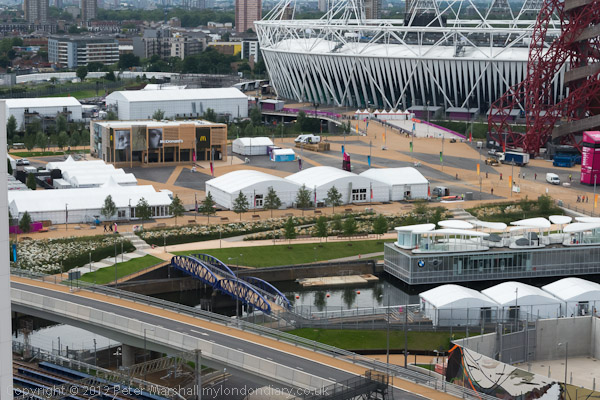
Olympic Views

© 2012, Peter Marshall
Police Deny Olympic Residents Access
Newham’s Shame – Carpenters Estate
Olympic Flame at Stratford 6 Days Early

© 2012, Peter Marshall
Stop Military Brutality against Nasa People
No To Minas Conga in Peru
Cleaners Continue Fight at John Lewis
What the Dickens Mr Cameron?
Cabbies Zil Lane Protest Halts Traffic
Our Lady of Mount Carmel

© 2012, Peter Marshall
John Lewis cleaners step up protest
Solidarity with the Bahraini prisoners

© 2012, Peter Marshall
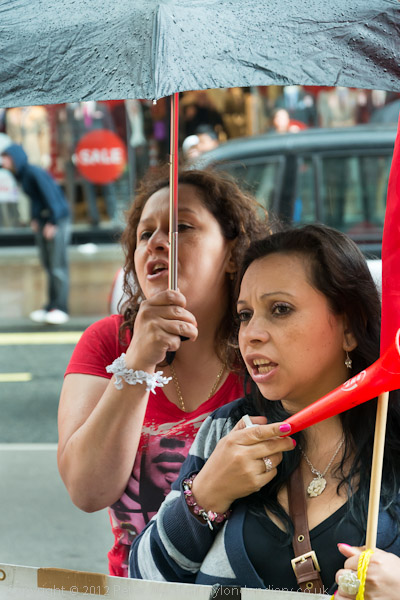
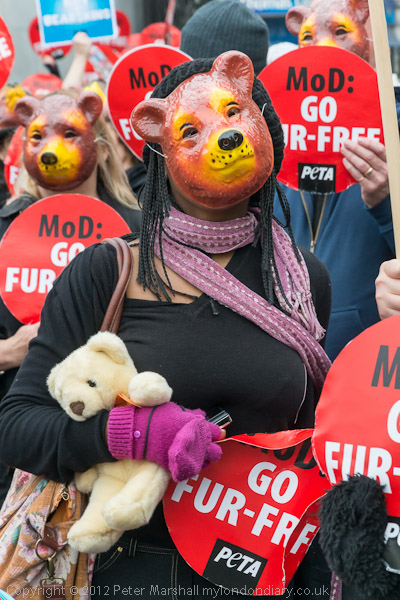
PETA ‘Spare the Bears’ March
Tenants Protest Letting Agents Scam
Cleaners Strike at John Lewis
Sacrifice For Spain Remembered

© 2012, Peter Marshall
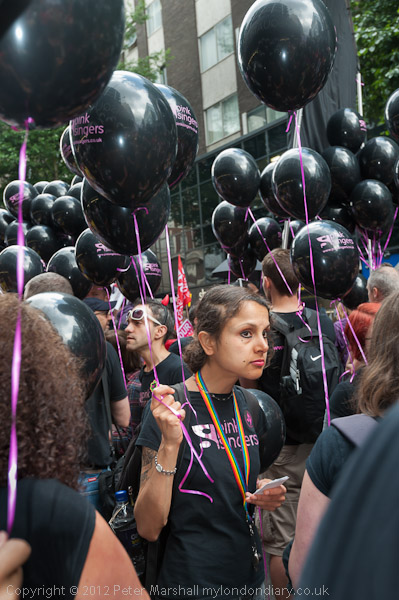
WorldPride London
Wet Walk in Bucks
London Walk
Pensioners Protest at Westminster
Right To Work: Downing St & Barclays
Strengthen Not Cut Safety Rules

July was a busy month for various reasons, one of the the Olympics, although I decided against getting accreditation to photograph that – not really my kind of thing. I’d intended to take a holiday at the end of the month, but somehow that didn’t happen. It didn’t help that I wasn’t sure if Linda would get her passport renewed in time, but she did, then decided to go to Sheffield for which I don’t think she needed it. Though my son and his family took theirs to go to Eton Dorney, as ID was needed to watch the Olympic canoeing. The security there was all carried out by soldiers and they say it was very relaxed, and they enjoyed the sport.

As a cyclist, I’m pleased that cyclists, particularly Mr Wiggins, has done well – even if is is ill-informed about helmets and making cyclists wear them would result in more deaths, not less, though they are probably good for kids who fall off their bikes at low speed. I would have liked to have been there on the Champs Elysée when he won the Tour de France, rather more of an event than anything in the Olympics. But more people on bikes will mean – at least in the longer term – safer roads, and also healthier people who live longer.

Agent Orange

A news item on the BBC this evening mentioned that the US was (at last) starting to clear up the terrible contamination of Vietnam caused by its use of millions of gallons of the defoliant ‘Agent Orange’ on Vietnam during the Vietnam war. The idea of fighting a war by attempting to starve the population seems rather to fly in the face of the Geneva Convention and all the ideas about not attacking civilians, and Agent Orange was designed to try to stop food production. But its effects were much worse, as the large-scale production of it by Dow and Monsanto produced a product that as well as the defoliant was contaminated with one of the most toxic chemical known to man, dioxin.

As Philip Jones Griffiths (1936-2008), arguably the photographer whose work as a whole did most to bring the reality of Vietnam home to the US and the West, particularly through his book ‘Vietnam Inc’, later wrote, “Dioxin acts like a hormone. It gets to the receptors in the cells of a developing foetus before the normal hormones and directs the cells to do crazy things. The end result has been tens of thousands of deformed children and an even greater number of miscarriages and stillbirths.” His work on the effects of Agent Orange shows the spraying and its effects both on the land and on the people. The spraying ended in 1975, and the effects are still felt in Vietnam. Although there has been some compensation for US soldiers who were effected by it, the US has never compensated the people of Vietnam, and the programme to de-contaminate some small areas is the first direct US involvement in cleaning up the terrible legacy they left in Vietnam.

You can see more of the work of Jones Griffiths on his Magnum pages, and find out more about the book Vietnam Inc on Musariam.

Vietnam is not of course the only place that Dow has been linked with contamination by dioxins. They inherited the Bhopal disaster when they merged with Union Carbide, and residents near their home in Michigan have also ” filed suit against Dow for health risks and loss of property value due to dioxin contamination.” There are also other toxic chemicals which have blotted the record of this Olympic sponsor,  including of course napalm used in vast quantities in Vietnam, DDT and asbestos. But according to the US site ‘Solidarity‘, Dow plants account for 97% of all water and 96% of all soil emissions of dioxin in Michigan, with levels on their sites up to around 100 times the safe limit, and in playgrounds and schools off the site up to around 9 times the normally accepted safe limit.

What was in a way surprising, at a time when the country is gripped by Olympic fever, was that there was no mention of the obvious Olympic link in the BBC report. Dow are of course one of the major Olympic sponsors, although the publicity around the company’s terrible environmental record meant that not even LOCOG could go ahead with them putting a wrap extolling their virtues around the stadium – it would have resulted in an avalanche of negative publicity.

© 2012, Peter Marshall
The ‘naked’ stadium with artificial landscape – but I’d advise soil samples and a Geiger counter before eating anything grown here.

There is perhaps a certain logic in one of the world’s major polluters being a sponsor of the games. Much of the derelict land, as well as that from which working industries were displaced for the Olympic site was heavily contaminated. Some areas, such as much of the cycle circuit, had been dumping grounds for all sorts of toxic waste, and had been capped to contain this material, and there were also disused sites of various rather nasty industries that had never been properly dealt with. In the vast terra-forming exercise of destroying the existing landscape to build the Olympic facilities, there wasn’t time to properly decontaminate much of the site, and almost certainly there are parts of the area that are now hazardous.

More Olympics

© 2012, Peter Marshall
Youth Fight for Jobs Austerity Games on Hackney Marshes

Two final events for me in July had an Olympic theme. The first was the ‘Austerity Games‘ on Hackney Marshes, and its name harks back to 1948, when London was host to the games for the second time shortly after the Second World War, when everything all around the world was in short supply. I don’t remember 1948, but certainly I remember something of Britain only a very little later, when sweets, like most other things, were on ration and we had pig bins in the street outside to make sure that any waste food wasn’t entirely wasted. Not that there was much in the way of waste, because where I lived there wasn’t that much to put on the plates, but the pigs got our potato peelings and suchlike. We probably did better than most, as our garden and allotment supplied large crops of fruit and veg, the bees did us proud for honey and my Aunt Grace kept chickens in the back yard, next to Dad’s work shed.

But the Olympics in 1948 was on a shoe-string, using existing facilities and with truly amateur athletes from around the world roughing it to compete – and some near to starving when they were here. The total budget for the games would have paid for a second or two of this year’s opening ceremony, and unlike 2012, I think the games actually managed to make a profit.

But in 2012, although austerity isn’t a word you can apply to our corporate Olympics, but it is what we are having so suffer through cuts in public services, and for young people, difficulty in finding appropriate work – or for many, any work at all.

Youth Fight For Jobs, who last year carried out a march from Jarrow to London to publicize the desperate situation of so many young school and college leavers who want jobs but can’t find them, this year organised an ‘Austerity Olympics’, held a few hundred yards to the north of the main Olympic site on Hackney Marshes.   Hackney, one of the ‘Olympic boroughs, refused them permission to have an event in this public open space, but the organisers went ahead anyway, with police apparently telling the council that unless they saw some particular offence being committed they had no powers to stop it. The best the Hackney could think to do was to close the toilet block in the park for the afternoon.

© 2012, Peter Marshall
Teams warm up for the Austerity Games on Hackney Marshes

My main problem was not the lack of toilets but the hot sun blazing down. It was one of the few days this year when London has felt uncomfortably hot, in some ways a nice change, but harsh sun high in the sky and an empty blue sky isn’t generally good news for photographers. Clouds add a little variation to the top bit of many pictures, but importantly they also reflect light into those deep shadows. Blue sky and sun means harsh black shadows. Digital is actually more flexible that film every was – with transparency there was virtually no shadow detail, while on colour neg it might be there but printing it was often a problem. The D700 and D800E do a pretty good job on shadow detail, and Lightroom makes it so much easier to bring out. Both digital cameras and software seem to improve at this year on year, and it now makes sense to think in terms of ‘digital fill’ in post-processing. Though I still find things a lot easier if you use fill flash.

© 2012, Peter Marshall
Medal winners on the podium

But using flash makes people much more aware of you photographing them, banging home the fact each time the flash fires. In fast-moving, crowded situations it’s seldom a problem (except where you might come under attack) but at small events like this it can completely change the dynamic. Almost all of the time I worked without it and cursed myself later when I had to work on the images. You can see the results in Austerity Games on Hackney Marshes.

Saturday’s  ‘Whose Games? Whose City?’ march was organised by the Counter Olympics Network, CON, whose name is perhaps slightly misleading. CON isn’t against sport, or the Olympic athletes, but against what the games have become, not just a sporting event but a huge commercial festival, involving corporate sponsors which include “companies which seriously damage the environment and which wreck or take lives” such as  “Coca Cola, Rio Tinto, BP, Dow Chemical, others such as “”G4S, Cisco, and Atos” which “deny people their human rights in a variety of situations” and  Macdonalds which helps to fuel the obesity epidemic.”

They were also protesting at the huge disruption to life in East London, the draconian powers taken to enforce branding, the positioning of missiles on residential buildings and the massive tax breaks given to sponsors. They sayLondon2012 provides benefits at taxpayers’ expense while receiving little in return.”

Initially the Olympic powers and Transport for London worked together to try and ban the march, but eventually it was allowed. Then Tower Hamlets council (another Olympic borough) attempted to impose unacceptable demands on the march, trying to ban political t-shirts and speeches. In the event the march went ahead as the organisers planned, as you can see in March for a People’s Olympics.

© 2012, Peter Marshall
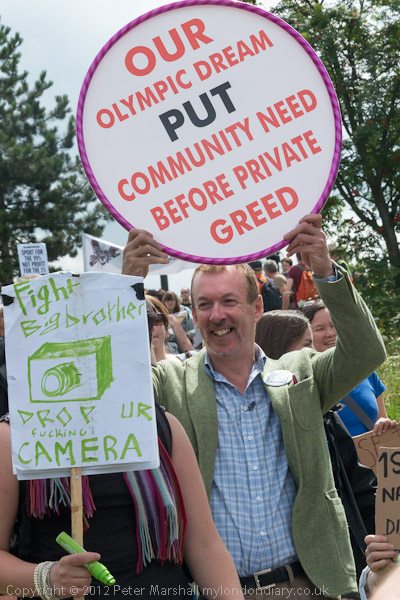
Perhaps the silliest placard on the march

Photographically there were few problems, but there was at least one rather curious placard carried by one woman, with the message ‘Fight Big Brother Drop Ur F**king Camera’, who didn’t see to want to be photographed.  But ‘Big Brother’ isn’t the photographers with cameras on the march, but the many CCTV cameras in London, some of which we passed, from which doubtless police were tracking out moves. Much of the time too we had a police helicopter overhead  recording us, though I didn’t notice the blimp that had hovered over the Austerity Games – and these also attracted a couple of police helicopters  – like the one flying overhead when I took these images.

© 2012, Peter Marshall

There’s a police helicopter too in this image I took later, and I deliberately too it with it against the white cloud just above the tower with the soldiers looking out at the protest, though their missiles are probably pointing in the other direction. But the problem is it ust looks like a bit of dirt on the sensor in this wide-angle image – and those soldiers are tricky to see as well.

© 2012, Peter Marshall

The row of soldiers showed up better when I switched to a longer lens, but but by that time the helicopter was well out of shot – just the two on the banner remaining.

________________________________________________________

My London Diary : Buildings of London : River Lea/Lee Valley : London’s Industrial Heritage

All photographs on this and my other sites, unless otherwise stated are by Peter Marshall and are available for reproduction or can be bought as prints.

To order prints or reproduce images

________________________________________________________

Around the Olympics

Although I’m not photographing the Olympics that doesn’t mean these things entirely pass me by. It would be impossible not to notice them, especially when I went to Stratford to take a tour of the Carpenters Estate with the residents association, CARP, Carpenters Against Regeneration Plan.

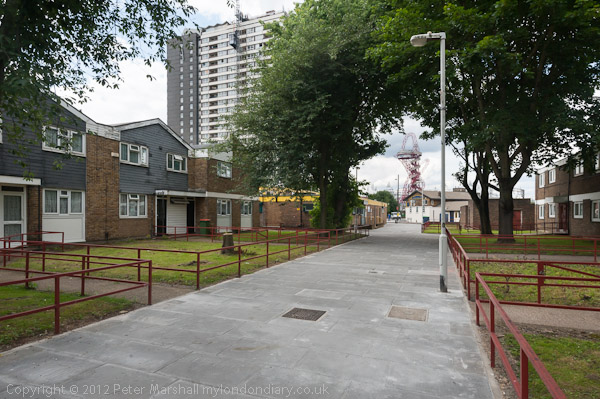
This is an estate right next door to the Olympic site, and parts of it are still owned by the Worshipful Company of Carpenters who first developed it in the Victorian era with a mixture of industrial sites and workers housing, though the area was reworked in the 1940s by the Luftwaffe and in the 1960s by Newham Council. It’s actually one of the better developments of that area, showing that the architects and planners had learnt at least a little from their earlier mistakes, and the 3 tower blocks in among the low rise terraces and maisonettes were rather better built than Ronan Point which was a mile or so south-east.
© 2012, Peter Marshall
Carpenters Estate with the Orbit – rather lower than the tower blocks

But it’s an estate that doesn’t fit with Newham’s plans for Stratford to become London’s third city, and a bit of a drain on their resources which could do a lot for the council’s finances if sold off. Already a prime site close to excellent transport connections and with some sites  on its edges along the High St and riverbank already becoming largely unaffordable private developments, the development of the Olympic Park on its third side makes it even more desirable.

Newham started moving out tenants in 2006, and many perfectly decent and desirable council-owned properties have now been empty there for six years in an area  with probably the worst housing problems in the country – they made the national news a few months back for trying to get some of their tenants rehoused in areas across the country – including Stoke-on-Trent.
© 2012, Peter Marshall
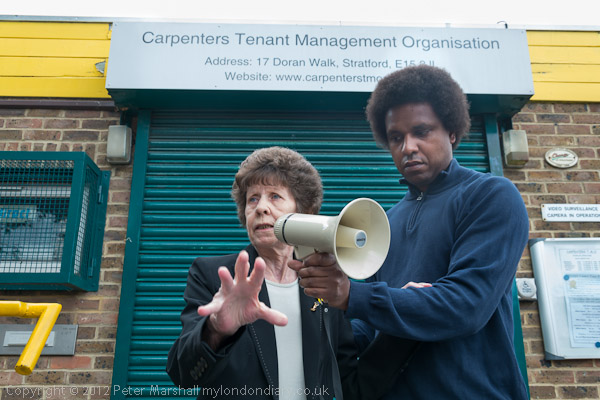
A Carpenters Estate resident talks about her determination to stay in her home

But most people didn’t want to move from Carpenters, as it was a relatively quiet and popular place with a strong settled community, including many who had lived there since it was built and in a very convenient location. Tenants are easily bullied by the council, but owner occupiers or leaseholders can put up more of a fight. Like many estates it had an official residents organisation, a TMO (Tenant Management Organisation) which also included owner occupiers and leaseholders, which wasn’t sympathetic to the plans to get rid of the estate, so the council apparently organised a takeover, denying owner occupiers and leaseholders standing for office and losing the nomination papers of five candidates so that the right people got elected.

Which led to residents of the estate setting up CARP, which has tried to publicise what is happening to the estate and keep on living there. One of the things they have done is to organise tours of the area to show people what is happening, and I was invited to go one one of these a couple of weeks ago.

Although part of the impetus for redevelopment of the estate has come from the Olympics, this was not an anti-Olympic protest. CARP isn’t against the Olympics, just for keeping their homes.  One of the highlights of the several previous tours that they have run – all without any problems – has been a visit to the flats of two residents on one of the three tower blocks, Lund Point.
© 2012, Peter Marshall
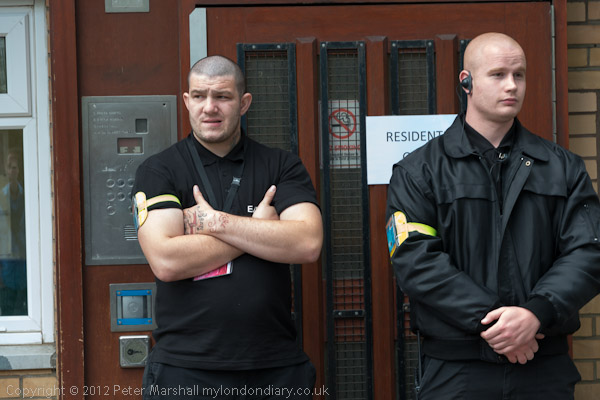
BBC employed security men block our entrance to Lund Point

This time, things were different. Our entrance to the flats was blocked by two burly security men working for the BBC who refused us entry. The BBC have their studios in the top 5 floors of the tower and wanted to keep everyone out of the block. We argued briefly and told them we would return in half an hour after we had seen the rest of the estate to go in.
© 2012, Peter Marshall
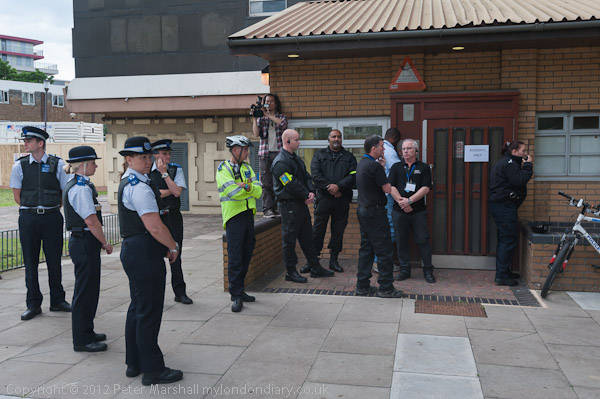
PCSOs and a police officer join the BBC in refusing us access

When we got back, as well as the BBC  men (and there were a few more of them around) there were also half a dozen PCSOs (Police Community Support Officers) and a police officer. She told us that we could not enter, and she was phoning a colleague to find out more. We argued that they had no right to stop us as we were with a resident who had invited us to visit his home, but the police and PCSOs stopped even him and his family from entering.

A further officer arrived a few minutes later and insisted he talk only with one of the residents, and we had the same argument with him. A couple more police vans arrived, and the police held a small conference on the pavement outside.  After another 10 minutes or so it was clear that the police had realised that the BBC attitude was unreasonable and that residents of the flats had to be allowed to entertain guests, and with police and security escorting us we were allowed up to the flat on the 4th floor.
© 2012, Peter Marshall
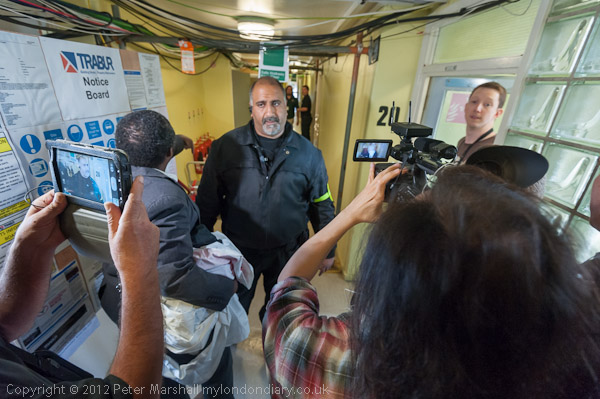
Journalists film as the BBC security block our route to visit a resident on the 20th floor

But we also had an invitation to visit another resident on the 20th floor, and with a view over the Olympic site. This is one of the floors that the BBC is actually working in, despite at least one flat on it being owned and still occupied by residents. Again the BBC security told us we couldn’t go there.

We got in the lift, pressed 20. When the doors opened there were BBC security stopping us getting out. It was pretty uncomfortable, with too many people crammed in a lift, most holding big video cameras up above their heads to squeeze in. Someone said “Anyone with medical conditions?” and I shouted “Diabetes!”. The BBC security relented a little, moved back a couple of feet so I had enough space to get my own camera up in the air, then squeezed round one of the other guys low down to get a better view.

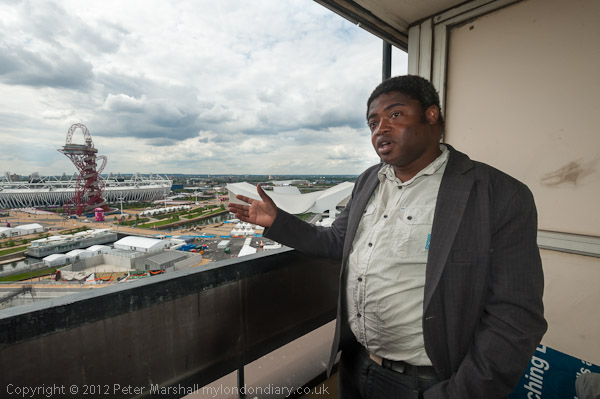
Someone phoned the guy we had an invite from and he came to meet us and then the security realised they had to let us through. So we got to walk along a cable-strewn corridor to his flat to talk to him about the disruption of having the BBC working all around his flat, and to see the view of the Olympic site from his balcony, where our tour leader talked about the Olympic site and the problems it caused for the estate.
© 2012, Peter Marshall
The 3 Carpenters Estate point blocks have a better viewpoint than the Orbit

Police and BBC security followed us too on our way out, and I was pleased to leave the building and cross the road to the Carpenters Arms. I needed a drink. More pictures and information about what has been happening there in Newham’s Shame – Carpenters Estate and more on the illegal actions of the BBC security and police in Police Deny Olympic Residents Access. And you can also see more of that view from Lund Point in Olympic Views.
© 2011, Peter Marshall
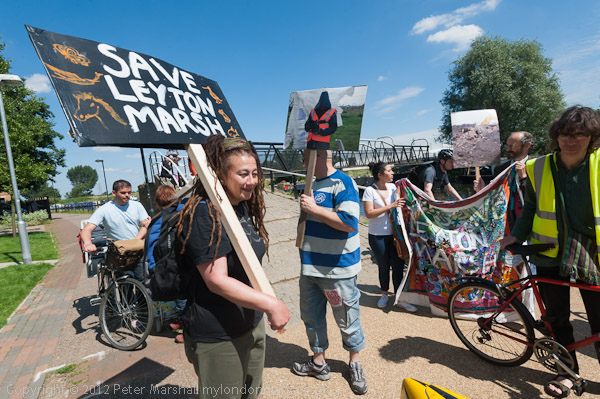
Marching along the towpath from Leyton Marsh to the closure at Eastway

The following day I covered a protest against the closure of the canal tow-path, the only safe route remaining for cyclists between Hackney Wick and Stratford. It wasn’t a big protest, but the closure effects many people cycling to work, as well as those cycling for leisure – and group  after group of these came along and stopped at the security fence across the path while the protest was taking place. More about it in Cyclists Protest Olympic Towpath Closure.

The Olympic lanes and diversions clearly put cyclists (and pedestrians) at greater risk, and clearly their safety has nowhere been allowed to stand in the way of making Olympic traffic run smoothly. But the tow-path ban is just unreasonable.  There is a 10 ft high electrified fence with frequent security cameras all along the side of it, and cyclists and pedestrians pose no real security risk to the Olympics.

The death of cyclist Daniel Harris, dragged under an Olympic double-decker bus while cycling along the northern edge of the Olympic site would appear to have been contributed to by poor temporary road marking and poor planning of the junction for the Olympic traffic, although perhaps more on this will emerge at the inquest. Possibly too, like many cyclists he was only on that particular road because of the closure of the cycle-safe Greenway which passes through the centre of the Olympic site and was shut to through traffic in May.

The protest was a family-friendly affair with a barbecue and has become a weekly event, incorporating a cycle ride, accompanied by a number of police cyclists, which probably makes this the only really safe time to ride around the area. Last Sunday the rode as closely as possible around the edge of the Olympic site and left flowers at the roadside memorial to Daniel Harris.

The attitude of the police to this protest contrasts strongly with their attitude to Critical Mass on the evening of the opening ceremony, when 182 of those taking part – more than a third – were kettled and then arrested in what was a new Olympic record for arrests, under a rather doubtful use of section 12 of the Public Order Act 1986.  Given the long and largely peaceful record of Critical Mass in promoting cycling in London (and the House of Lords ruling in 2008 that their rides were not unlawful) it seemed both unnecessary and in completely at odds with the Olympic legacy claims to be promoting sport – including cycling – for all.

________________________________________________________

My London Diary : Buildings of London : River Lea/Lee Valley : London’s Industrial Heritage

All photographs on this and my other sites, unless otherwise stated are by Peter Marshall and are available for reproduction or can be bought as prints.

To order prints or reproduce images

________________________________________________________
Hiroshima Day

I was saddened but not surprised to hear no mention on this morning’s news that today was the 67th anniversary of one of the most important events of the twentieth century and one that has shaped our world since. I could have put up with hearing Usain Bolt’s ten seconds one less time to make room for it.

The atomic bombs that fell on Hiroshima on August 6, 1945 and three days later on Aug 9 at Nagasaki market the beginning of a new age that continues to affect political events to this day.

© 2011, Peter Marshall

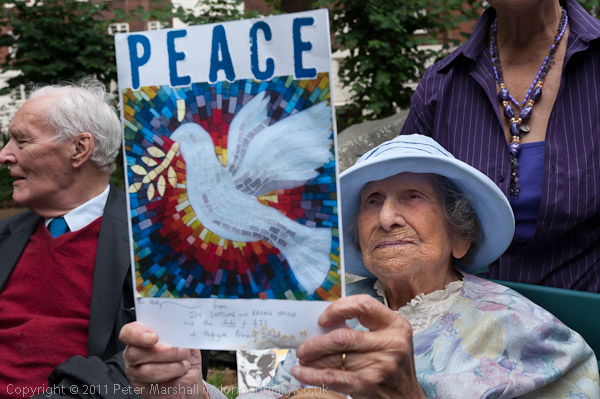
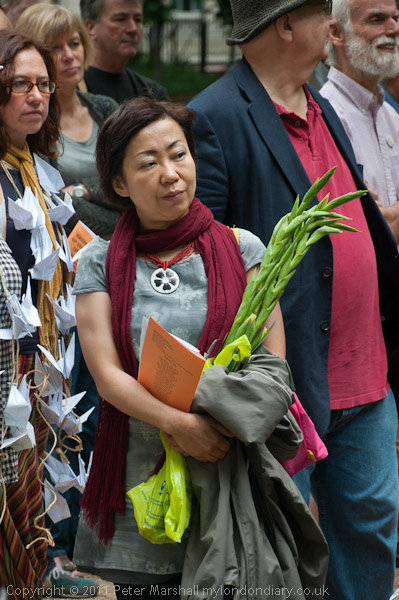
I’m sorry this year that I have to miss the annual commemoration at the Hiroshima cherry tree in Tavistock Square, not least to miss the inspiring example of Hetty Bower, now 106.

© 2011, Peter Marshall

It is hard to understand why this anniversary is not more widely remembered. There are of course other events both in London, at Westminster Cathedral and in Kingston, and in other towns and cities across the UK, including Milton Keynes, Norwich, Liverpool and Coventry, but it has always been largely ignored and downplayed by the media. This year of course, anything not involving those five rings stands little chance of getting a mention, and you can feel the palpable annoyance of the newsreaders at having to interrupt their Sportathon even for skeletal reports from Syria or of NASA’s Curiosity (will it find its Cat?)

© 2011, Peter Marshall
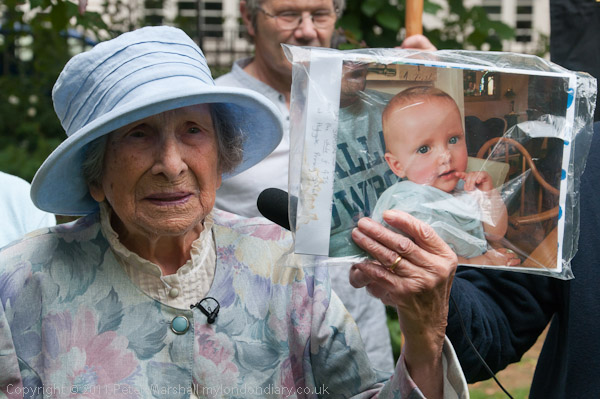
Hetty Bower holds up a picture of her grandson, born on Nagasaki Day 2010 who shoe hopes will grow up in a world of peace.

Hiroshima Day was a victim of the Cold War and was relegated to outer darkness and became the sole property of peace groups – the Tavistock Square event at noon – 1pm is organised by London Region CND, and non-members are welcome.

You can read a fuller account of last year’s event in Hiroshima Day in London on My London Diary. I’ve written before more about the photographs of the two cities after the event, and you can read one of these posts that I wrote when I was unable to attend the 2010 commemoration in Hiroshima 65 Years On.

Sports and Me

I made a decision a month or so back to boycott the London Olympics.

So I didn’t apply for accreditation, though it could have saved me some money doing the normal things I do, as I would have  got a decent amount of free travel around London thrown in. Though perhaps it wouldn’t have been fair to use it since many of the things I was likely to cover are protests around the event. Financially it probably wasn’t a good decision as there has been a virtual media blackout on anything that might suggest not every Londoner loves the games, but then far too many photographers are covering the games for those without big agency connections to get much from them.

I don’t have much interest in watching sport, though I got a medal for football when I was 11 and later used to enjoy playing rugby. I was even a half-decent middle distance runner in my time, holding a few local records, and had I given up smoking and done some training might have gone further. I still enjoy cycling (despite recent painful experiences from which I’m still suffering.) But watching other people compete has never greatly interested me. When I see spectators at events or in front of their TV I always feel they should get off their backsides and go and do something. Far better to do it badly yourself than watch.

When I came of age I did give up smoking, but never took seriously to sport, though I was playing football and rugby regularly as a student it was more a social event than anything sporting, something you did with your mates before going to the bar which was the real point of the thing.

When I started in photography, like most people I didn’t know what to photograph, and in the amateur magazines I read at the time, sport was one of the major subjects, and I had a go at it. Some of my earliest published pictures were sports photos, and I won a couple of magazine prizes with them, but I  didn’t really find making them of great interest.

I had a problem even finding those images now, though certainly back in the early days I kept every tear-sheet, and I’ve got rid of very few negatives. Probably somewhere at the bottom of a large pile I’ve even got the 20×16 exhibition print I remember making of one of them.  But then I remembered I’d used them in a post here a couple of years ago.

© 1974, Peter Marshall

© 1974, Peter Marshall

These were the first successful sporting pictures I took, and I soon gave up.

Both were taken at the same event, shortly after I’d bought an Olympus OM1 camera (A truly revolutionary redesign of the SLR that had just come out) and something pretty unusual at the time,  a Tamron 70-220mm Adaptall zoom lens. This was one of the first zoom lenses to become popular with the ordinary photographer – previously there had been TV and movie zoom lenses – and I’d cut my photographic teeth using one of  these on a  college TV system a couple of years earlier – with a few fabulously expensive versions produced for 35mm. I’m not sure of the exact date, but it was around June 1974.

It was a rather important event in the world of canoe slalom, some kind of championship, but back then I was able to cycle up to the site were it was being held and walk onto the weir without any accreditation at all to take pictures.  It wasn’t hard to find space to work, there were probably around a hundred people watching the event, mainly the other competitors and their friends and spouses. Things are very different at the Olympics or any other major event now. Then my only problem was being careful I didn’t fall in the water.

A couple of years later I sold off the zoom and went back to using fixed focal lengths for the next 25 years or so. Zooms then were heavy and slow and not quite of the same optical quality of the fixed lenses. Now zooms have improved greatly and I seldom photograph with fixed focal lengths. When I do it’s because I need a macro lens (60mm) or a small and inconspicuous lens  (20mm f2.8) or an extreme wide-angle (10.5mm semi-fisheye) rather than for a possible slight difference in quality, though perhasp that may change with the higher pixel density of the Nikon D800E.

I photographed a few other sporting events around that time, including go-karting and got arm-twisted into photographing sports days at the school where I was then teaching. My next real sports photography came over 25 years later when I was commissioned to photograph the work of a local sports club, which was one of the best ladies cricket teams in the country and had a very strong training program with young girls.

© 2001, Peter Marshall

Mostly I wanted to photograph these training sessions, and the big problem then was lighting. I were still using film and  the indoor sessions in a sports hall were impossibly gloomy without flash. Fortunately they moved outside as soon as it was light enough in the evenings, so I was able to work in an hour or so before it got too gloomy.  During training I could stand right up close, and  most of the time the girls used a tennis ball and as long as I kept at least out of their reach with the bat I was reasonably safe, but they had to get used to using a proper cricket ball as well, when things got dangerous. With the actual ladies team they used a real ball all of the time, which wasn’t a great problem during fielding practice, but I had a few close shaves when they started batting, as they could really belt that ball as hard as any men.

© 2001, Peter Marshall

During the few actual matches I attended things were also safer as I had to keep off the pitch and my main problem was not having a long fast lens. I made do with a 200mm Zuiko f4 with a 2x converter on my Olympus OM4, but action images were pretty tricky, especially as the weather was fairly uniformly dull. But in any case I soon learnt that the most interesting things happened around the pavillion and off the pitch, where I was working with a Mamiya 7 and 65mm wideangle.

© 2001, Peter Marshall

The scans here from medium format film were made on an old flatbed scanner and I could make better now. But certainly the pictures away from the play show far more individuality than the action images – one person hitting a ball with a bat seems to look fairly like another to me, though I did my best to provide a few for them. Probably the most interesting part of the afternoon at these events were the teas, but they weren’t really what I was expected to photograph.

Although I’ve not signed up for the Olympics, quite a few of the things I’ve been photographing over the past couple of weeks have a connection with that event, and had I not been having to rest this week I would have done more,

A Landscape In Motion


Image © Arnau Oriol Sanchez

If you are in Shoreditch – and who isn’t these days, when it’s become a very trendy area of London, you might like to visit this show on at the Hoxton Hotel in Great Eastern St. Curated by David Boulogne, A Landscape In Motion:  The East End and the Games features contributors to his 2012 pics blog started in 2010 and featuring images around the Olympic area.

For those of you who know Shoreditch, the Hoxton Hotel is on Great Eastern St, on the south side just a few doors down from the junction with Old St. On the corner used to be another great venue, the Foundry, but although the two sites are perhaps only 50 yards apart they are miles distant.

The exhibition space is on the ground floor – walk to the left of reception and turn right past the glass box of the eating area and the pictures are along both sides of a corridor leading off to the right. This is the first show in the space, and I hope there will be many more. Tons of buses stop nearby – I get a 453 or 55 to Great Eastern St, or its 5 minutes from Old St Tube. We will have some kind of event at the show probably towards the end of the month, and I’ll try to remember to post an invitation here as well as e-mailing contacts. But the show is open all hours until 9 Sept, though if you visit at dead of night you may have to ask at reception for the lights to be turned on!

As David says on his blog, we put this show together at the last minute, and my work in it is five of the pictures that I showed last year at the Shoreditch gallery a short walk away in ‘East of the City‘. Not all of the five pictures are on that web site as I altered the selection for that show after writing the site. Here are a couple of my images from it:

© 1982, Peter Marshall
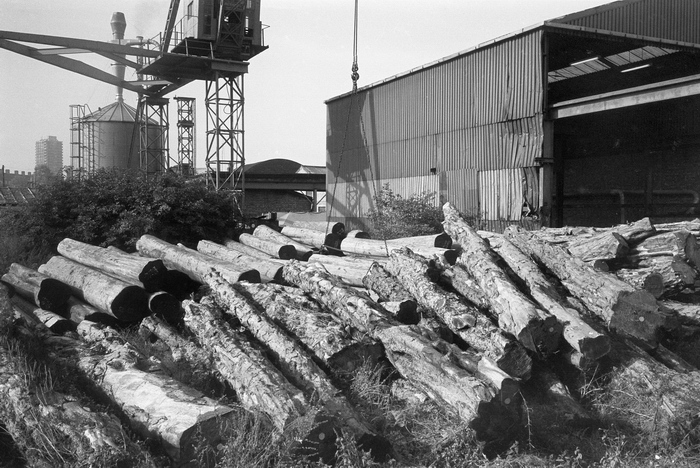
Timber Yard, Stratford, 1982

© 1983, Peter Marshall
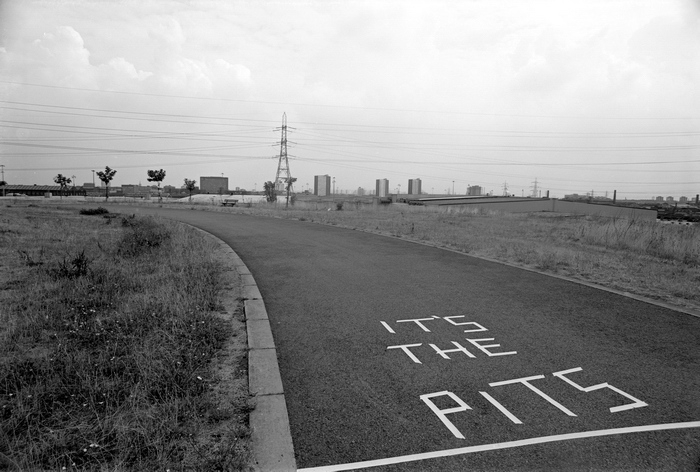
Lee Valley Cycle Circuit, 1983

Of course when I took these pictures I had no idea that this would be the Olympic site around 30 years later. But I was sure that the area was going to change. The timber industry, which had relied on the Surrey Docks across the river was fading fast, and other large factories in the area were closing down, being replaced by smaller industries. Acres and acres of railway land used for marshalling yards were now redundant, as were the engineering shops that had built so many locomotives. There were still cold stores and a Freightliner depot, but I was doubtful of their long-term future.

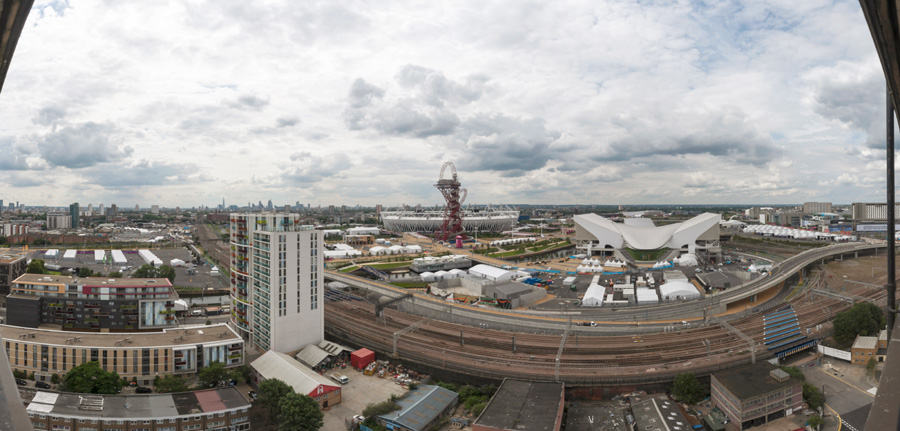
The future for the area came slower than I expected, and has turned out rather different. I suspect too that the games legacy will be very different to the ‘aspirations’ aired in the London 2012 bid document, a typical conspiracy of half-truths. I’ve kept recording the area at intervals over the years since I first went there in 1982, most recently a couple of weeks ago, when I photographed from the 20th floor of the tower block housing the BBC studios. The story about that deserves another post, but here is the site as it was a few days before the start of the Olympics.


170 degree view from 20th floor of Lund Point, 21/7/2012

Once Upon a Time

I was sorry to read in Raw File about the demise of Once, “an innovative photojournalism magazine that launched its pilot issue last summer with big hopes of capitalizing on the iPad as a new publishing tool.” Not that I was a reader, because I don’t own an iPad. And that was perhaps the main reason for its demise – there were simply too few potential readers who did.

Once didn’t manage to convert successfully to other platforms such as iPhone and an on-line version because of a poor original choice of software, which might have been great for iPad but lacked cross-platform support.  The Wired article mentions another similar recently launched digital photojournalism magazine Auto de Fe, which came out first on the iPad, and is “currently being tested on Android, Kindle, Smartphone and Blackberry devices and will soon be available on those too.” The on-line magazine will come out every 6 weeks (later they hope to go monthly) and there are plans for a ‘collectors’ print edition four times a year.

I don’t have any of these devices, just an old-fashioned PC with a nice large colour-corrected display, which is fine for looking at web sites. Perhaps when e-Reader devices have gone through another generation or two and can display high res images in colour I’ll get one of these as well. I think that this will be the future for the photographic magazine and the photographic book – with just a very few still being produced in expensive collector’s editions – the kind of thing that now costs several hundred pounds a copy.

One success story in digital photographic magazines is the British Journal of Photography, where the digital version is expected to be earning more than the print version by the end of the year. BJP went from being a weekly magazine to a monthly a few years back, before it launched the digital version (print subscribers had for some time enjoyed access to the same material on the web) and really lost its usefulness to me as a news magazine when it went monthly. But the sales of the weekly had dropped off to a very low level, and I don’t think it could have continued.  I’ve never quite found it worth subscribing since, though I do subscribe to several rather expensive photo magazines. The thing that I miss most from the weekly version is the old ‘What’s On’ listing page, which gave brief details of a wide range of photo exhibitions in London and around the country. It’s the kind of job that ought to be very easy to do on line, and over the years a few sites have attempted it, but none very well or very comprehensively, even for London. If I had an iPad, I would probably subscribe – it costs around a quarter of the print subscription.

We may too still have ‘print on demand’ books, hopefully with somewhat improved printing, though the current Blurb volumes aren’t bad. Perhaps the cost of these may come down too, at the moment they are too expensive for normal distribution. Though my ‘Book Sale‘ is still on – and on a slightly topical note,  Before The Olympics (paperback version) is still available direct from me, post free in the UK for £25. (Blurb price is £27.29 + post and packing – which adds an unreasonable amount for single copies.) There are limited stocks of all the others too.

Here are a couple of the 270 or so images from Before the Olympics – you can view the whole book on Blurb. Both are from close to the site of the Olympic stadium on what used to be Stratford Marsh.

© 2005, Peter Marshall
Marshgate Lane, Stratford 2005

© 1990, Peter Marshall
Marshgate Lane, Stratford, 1990

London’s Italian Festival

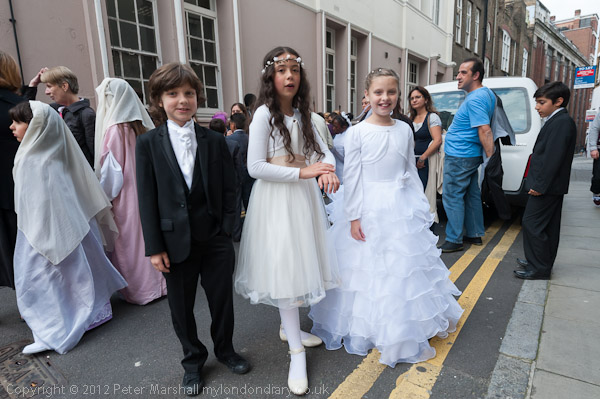
It always surprises me how few Londoners seem to know about one of the capital’s largest religious events, and one that has been taking place since 1883. I think I only discovered it in the 1990s; certainly the first time I photographed it I did so mainly on black and white film, despite it being a very colourful event.

© 2012, Peter Marshall

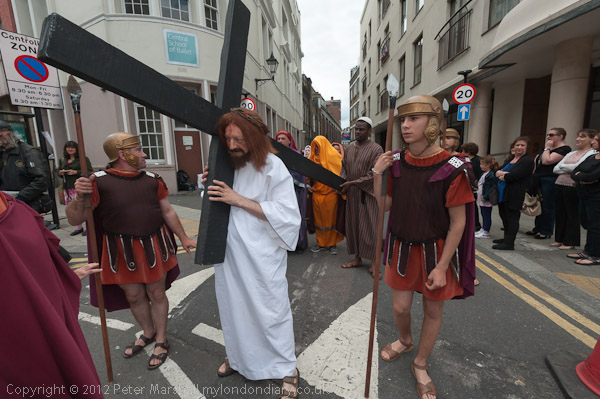
It has changed a little over the years. The first processions  I photographed went to the south of the Italian Church on Clerkenwell Rd, going through the narrower streets around Hatton Garden. Now the route sticks to the major roads in a triangular route to the north. When this started – and as a Catholic procession it had to get a special dispensation from Queen Victoria, and was the first Catholic procession in England since the reformation – this area of London was ‘Little Italy’, packed with small slum streets, homes and workshops for the many Italians in the city, most of whom had fled from Italy in the political upheavals of the early and mid-nineteenth century. These Italian patriots were welcomed in London – Garabaldi got a hero’s welcome when he visited in 1864, and Giuseppe Mazzini, the ‘Beating Heart of Italy’ and one of the first true Europeans spent several periods of exile in the city.

Pathe News filmed the event in 1927, and the streets were much more crowded then, but the event looks quite similar, although of course then it was ‘in’ black and white and without sound. I did think of using the movie facility on my new D800, but I was just too busy taking still images, and you can’t really do both at the same time. The clip only shows some statues being carried around and also a very large phalanx of first communicants in white dresses.  I think the floats with the bibilical tableaux are probably a rather more recent addition.

© 2012, Peter Marshall

Now the Italians have largely moved out of the area, and the new arrivals from Italy in the twentieth century went were there was better housing and work. Many of the streets of Little Italy were cleared and replaced by social housing around the start of the 20th century, and others now house large and mainly modern offices. But St Peter’s Italian Catholic Church, consecrated in 1863, remains, serving an Italian-speaking community that mainly comes in from the suburbs. For a period during the war, when Italians in this country were interned it became an Irish church, but in 1963 went back to its Italian past.

© 2012, Peter Marshall

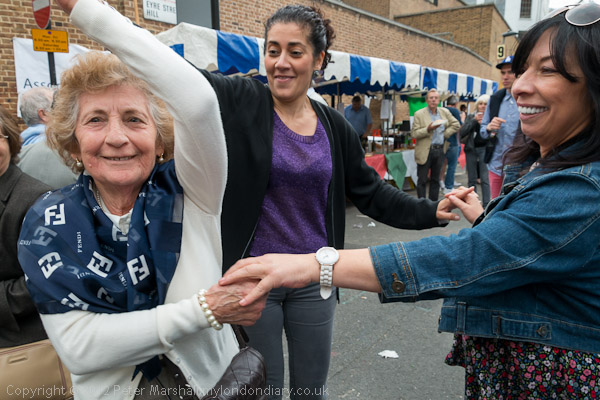
As well as the procession there are also services going on in the church beforehand, but more interesting to me, a great deal of excellent Italian food and wine down the hill behind the church in the Sagra (local fair or festival) and I took a few pictures there, particularly of the dancing, though working with two cameras while holding a plastic cup of red wine proved tricky. It’s really the kind of event where a small, unobtrusive camera such as a Leica would be more useful; I’d thought of bringing the Fuji X100, but my bag was already heavy enough.

© 2012, Peter Marshall

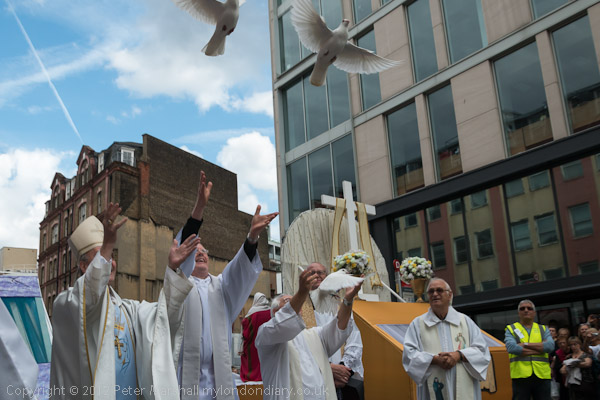
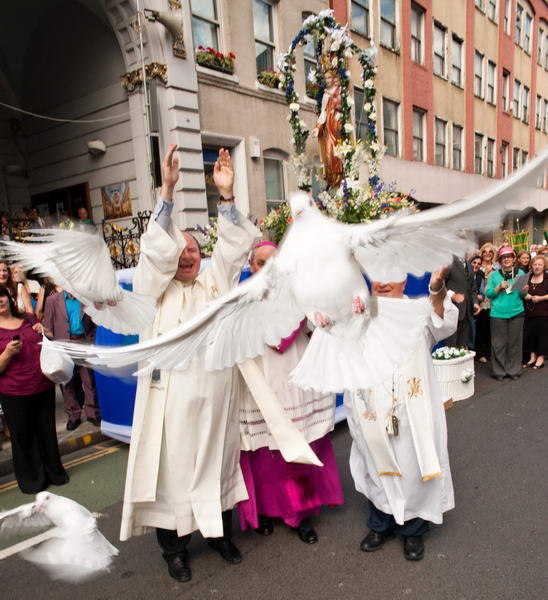
One of the highlights of the event is the release of doves. Apparently this happens at both the start and the finish of the procession, with 3 white doves at each. The doves are well-trained by the White Dove Company and fly back home to Loughton, but they could be better trained for the benefit of photographers. This year two flew up faster than a Lockheed SR-21 while the third declined to leave Padre Carmelo di Giovanni’s hands. But this isn’t the kind of thing you can plan much for, and this year I was taken slightly by surprise – I think Apostolic Nuncio Archbishop Antonio Mennini rather jumped the gun.

© 2012, Peter Marshall

I did rather better in 2009 and you can see the release there in my post The Unpredictability of Doves (and more pictures from the 2009 procession have really been on-line for some time) but 2007 was my best year of all, when the doves performed with much greater precision as the crop below shows – more about this, the entire image and another not so good example in Pigeons Post.

© 2007, Peter Marshall

________________________________________________________

My London Diary : Buildings of London : River Lea/Lee Valley : London’s Industrial Heritage

All photographs on this and my other sites, unless otherwise stated are by Peter Marshall and are available for reproduction or can be bought as prints.

To order prints or reproduce images

________________________________________________________
Sebastián Liste

I first heard of Spanish photographer Sebastián Liste (b1985) when he won the Ian Parry Scholarship in 2010 for his long term project “Urban Quilombo”, which looks at the the extreme living conditions faced by the dozens of families who made their home in an abandoned chocolate factory in Salvador de Bahia, Brazil. In the factory, which they had occupied illegally, they lived together as a community creating a safer environment than the streets outside, but one from which they were being evicted by the government.

Since then he has own a whole string of awards for this and other work, the latest of which is the City of Perpignan Rémi Ochlik Award., renamed in honour of the young French photographer, born in 1983 and best known for his work on Haiti who was killed in Homs, Syria on 22 Feb 2012 (it was formerly called the Young Reporter of Perpignan award.)

Urban Quilimbo is a powerful and intimate series of black and white images – 52 on the web site – which give a great insight into the lives of those he is photographing, showing both their deprivation and scenes of joy. A photographer with a degree in Sociology and an MA in Photojournalism, he has a great interest in  “the culture of resistance, examining how human beings transform their immediate environment to survive.

Also on his web site are two smaller projects, Bahia and Istanbul. The pictures from Istanbul are perhaps more controlled, reflecting the very different enviroment, but include one of the more striking black and white images I’ve seen a quite a while.  The site gives a choice of three image sizes, thumbnail, normal and larger versions which are seen by clicking on a thumbnail, but I think are just a little too big for the underlying files, which look better on normal view.

You can see more of Liste’s work on Reportage by Getty, which as well as Urban Quilimbo also includes some of his colour work from Brazil. This site also allows you to turn on the captions for the pictures, which are important. The pictures tell the story but sometimes need the text to clarify what that story is.

You can see a selected group of 11 images of Rémi Ochlik‘s pictures at The Guardian, which includes ‘Battle for Libya’ which won the first prize for stories in the general news section of the 2012 World Press Photo awards.