Walthamstow Wins

I’ve got a little behind putting my work on My London Diary and today it was work that I took on 1st September in Walthamstow. Although it was a good day for Walthamstow, it wasn’t one of my best occasions. I really didn’t feel at my best and at the critical moment went the wrong way and found myself in the wrong place. And I let myself get upset by being sworn at, threatened and generally harassed.
© 2012, Peter Marshall

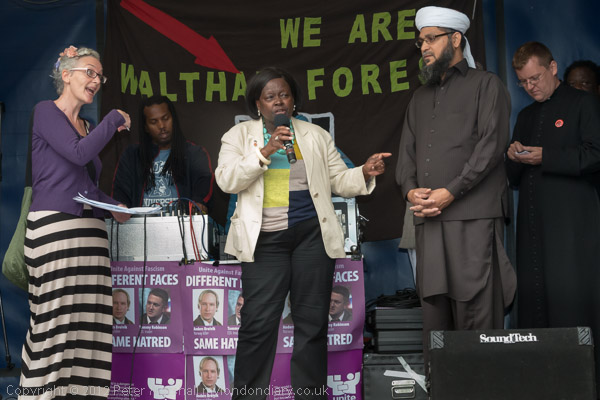
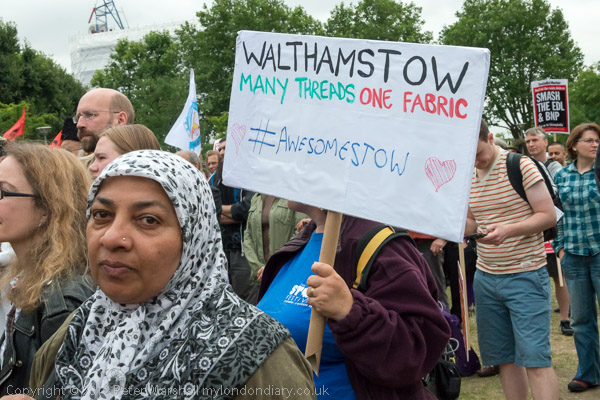
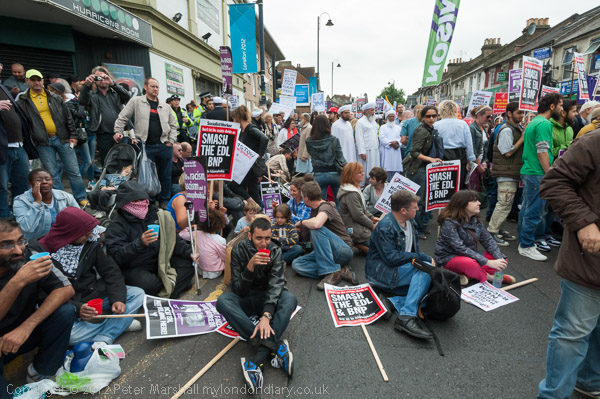
Things started well enough, at the rally before the march by ‘We Are Waltham Forest’, a group of local people and organisations put together to oppose a march and rally by the English Defence League into their community supposedly to ‘take back their streets’ in Walthamstow.  Walthamstow is a place with a strong identity and radical tradition, where one of the great English socialists lived – and it’s William Morris Gallery has just had something of a facelift, and it is now one of London’s more mixed multicultural communities – as the image above perhaps shows.
© 2012, Peter Marshall

The audience too included people from all communities, and the event was next door to perhaps London’s largest street market and a short walk along this would also show people from many diverse backgrounds getting on with each other.
© 2012, Peter Marshall

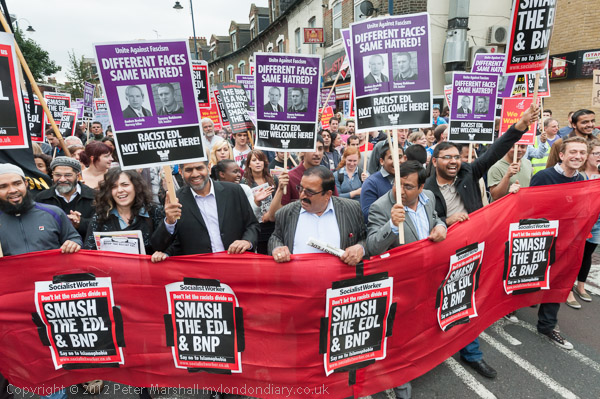
It was an impressive march, and people in the shops and houses along the route came out to watch and greet it, obviously giving it wholehearted support. I’m not sure what the police expected to happen – they were present in large numbers – but it seemed unlikely to me that they would have been able to stop it reaching its destination had they tried.

In fact it stopped itself, on the junction with Forest Road, along which the EDL were expecting to march to the civic centre for a rally, with large numbers of people sitting down on the road. Others just stood around, and a few danced to a samba band. Walthamstow was clearly not about to be moved.
© 2012, Peter Marshall

I walked down to where the EDL where expected to arrive, although they had been held up when RMT members had refused to let them on the train they had intended to take.
© 2012, Peter Marshall

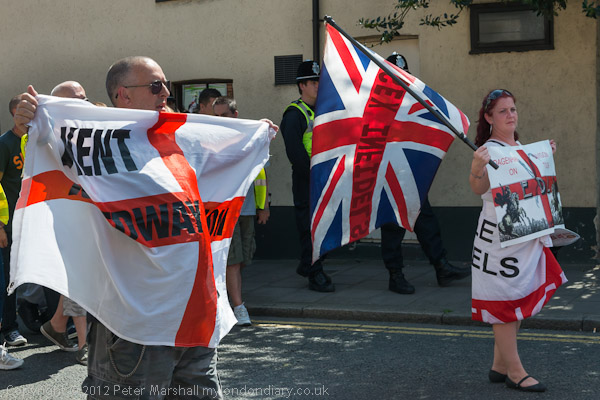
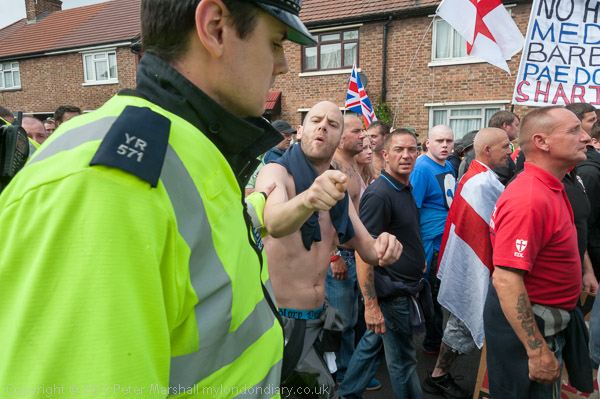
As usual, the EDL were mainly not happy to be photographed, and I was sworn at, threatened and the target of various gestures as I took pictures – as you can see on My London Diary. It was just as well that there was a tight line of police surrounding them, although at one point a man did push through to put his hand across the front of my lens before police pushed him back. But working with a wide-angle – the 16-35mm -between the closely packed police wasn’t easy.
© 2012, Peter Marshall

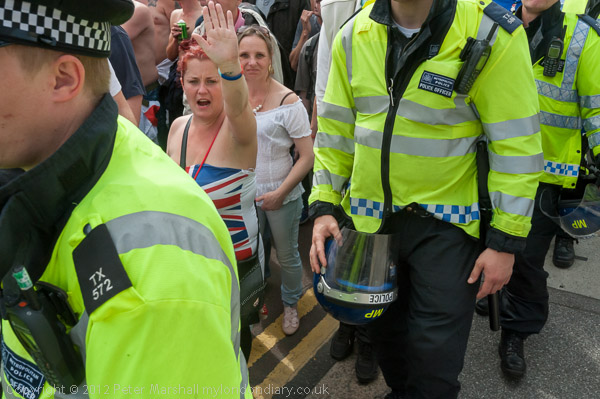
I think this woman was trying to hold her hand up between my camera and her face rather than give a salute, but I’m not sure. There were some rather strange things in the march – for example one man carrying a a Serbia Montenegro flag (perhaps a fan of war criminal Slobodan Miloševic?) and another wearing a military cap was carrying a copy of an English translation and interpretation of the Koran.  But at times the 18-105mm (27-157mm equiv) DX lens wasn’t long enough for what I wanted, and I wasn’t particularly happy with what I had managed.

In contrast to the other march, few people came out onto the streets as it passed, and those who did either made clear their opposition – and got a great deal of abuse in return – or turned their backs on it.  If they were in Muslim dress or black they got abuse anyway. The EDL claim not to be racist, but clearly there were many among the couple of hundred on the march who were not toeing that party line.

I only saw one person show support, an old man who came out of his house and raised his hands in support – at which the marchers went wild, shouting, whistling and raising their arms in return with gestures of approval.

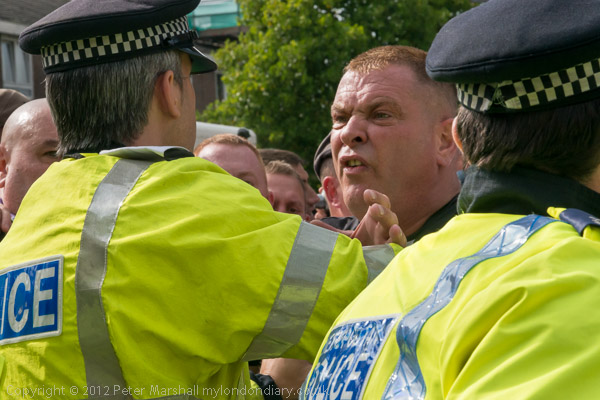
As the march approached the blocked junction it was clear that the police were going to divert them down a side street. There were a few hundred counter-demonstrators on the road, but I thought that they would actually try to stop the march a little further on where it would have to cross the Chingford Road to get to the Council offices, and went a little ahead. By the time I realised that things were happening on the corner I had missed much of it, and the police were blocking the way. I guess I was trying to be too clever and so missed the obvious.
© 2012, Peter Marshall
EDL supporter argues with police

I think the police had also probably prevented the protesters from going up the Chingford Rd from the junction they had blocked, as there were only a few protesters as the EDL escorted by a large police presence, made their way across without incident.

Outside the civic centre there was a small group of EDL, including both ‘Tommy Robinson’ and Kevin Carroll who was speaking. A few yards back, police were holding a large crowd of angry counter-demonstrators from ‘We Are Waltham Forest.’ Although their counter-protest had set out to be peaceful, things were now getting rather heated, and plastic bottles and parts of placards were beginning to be thrown towards Carroll at the microphone. When a half-brick came over I decided that it was no longer healthy to be standing in the middle. I was tired and a bit fed up at having missed the main action so far.

The main group of the EDL were being kettled where I had parted company with them in a side street a few hundred yards away, and it was fairly clear it would not have  been safe to let them approach. Attacking the police, as many of the EDL had earlier, had clearly not been a smart move, particularly as they were already clearly seen as troublemakers by wanting to march into the area. I didn’t think the police were likely to allow them continue, and decided the event was more or less over and it was time for me to go home.

I don’t think there would have been much more to photograph, although the police did rather rub the EDL’s noses in it, making their failure rather more of a humiliation than it would otherwise have been.  But the people of Walthamstow had made it very clear that the EDL were not welcome on their streets.

I had taken a number of decent pictures – as you can see in Waltham Forest Defeats the EDL on My London Diary – but I hadn’t been feeling too well and I hadn’t really had a good day.
Continue reading Walthamstow Wins

Apologies For Nonsense – Again

Unfortunately someone has hacked into this blog, and added long lists of counterfeit/pirate software offers on the bottom of some recent posts. You will only have seen them on the RSS feed rather than if you read the blog directly because they have a tag in the code which hides them when you actually read the pages from my own site.

I don’t know how this has happened. I’ve deleted the rubbish from the pages where I found it, and will try to stop it happening again. But if you have suffered please accept my apologies.

I will slightly change the format of the posts which I hope will make this a little more difficult. It will mean that some posts on the RSS feed will end with

(more…)

even when there really isn’t any more.

Continue reading Apologies For Nonsense – Again

London’s Pubs

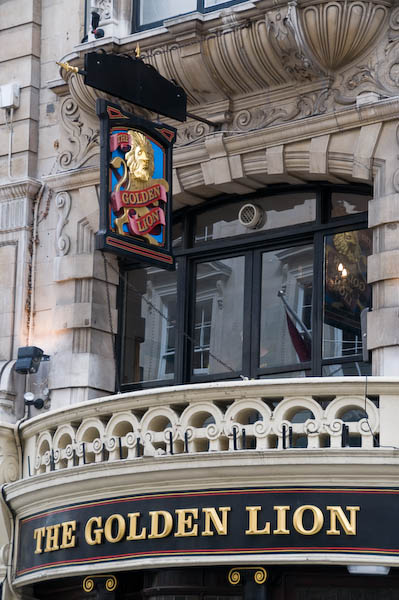
Some of the pictures of London pubs in The Pubs Of Old London on Spitalfields Life seem familiar, and while it was good to see these images, from “glass slides – many dating from a century ago – left over from the days of the magic lantern shows given by the London & Middlesex Archaeological Society at the Bishopsgate Institute“, it would certainly be nice to know the actual dates of the pictures as well something more about the people who took them.

The pictures have an added interest for me in that over the years I’ve visited quite a few of them, and have photographed some, along with quite a few other pubs. Those that I recognise are still well-known London  pubs, although some now look rather different.

One that has changed less than most it ‘Ye Olde Cheshire Cheese‘, in Wine Office Court, an alley off Fleet St. Back before the national press moved out from the street, this was a favoured haunt of many journalists, and I’ve met and talked with a few of them there. Inside it still seems much the same, except that the beer recently jumped up rather in price and smoking isn’t allowed, though the roaring open fire still smokes out my favourite bar. If you see any journos there now, they are returning on a nostalgia trip.

The restaurant there used to be a good place for roast beef served in the traditional English style with roast potatoes, Yorkshire pudding, thick gravy and overcooked vegetables, and it was delicious. Best to go with a handful of friends to fill the benches along one of the long tables – and cheaper to bring in your own beer from the bar opposite.  But last time I went, just a couple of years back, the beef was stringier and the portions smaller and although the place looked the same the atmosphere didn’t seem as warm. Presumably like other Sam Smith‘s pubs it now has to serve Sarah Brownridge frozen food – and you’d actually do better eating at most Wetherspoons (Penderel’s Oak on Holborn seems ok.)

Now too the price of beer there has shot up. Until Nov 2011, Sam Smith’s had a policy of only increasing their beer prices in line with increases in duty, and a pint of bitter was around £2.10 – considerably cheaper than most in London. That policy went out of the window, and now its around £3 a pint.

The George & Vulture in Castle Court is another Sam Smith’s pub, and there has been a pub on its site since 1268, though the present building only dates from 1748, and was later a favourite haunt of Mr Pickwick. I thought it had probably changed remarkably little when I photographed it in the 1980s. Like most of London it’s now been tidied up a bit, though I’ve not been there lately.

Ye Olde Mitre in Ely Place is a Fuller’s Pub, and the passage shown on Spitalfields Life looks very similar to that I photographed, though the last time I went that way it had also been tidied up. The George in Borough High St is of course very famous, and owned by the National Trust.

But the picture that caught my particular attention was of the London Apprentice on the river-front at Isleworth. At 16 I became a sea scout, and perhaps the main attraction was that after the meetings we would adjourn to a local pub. Then it was occasionally the London Apprentice, though they were a bit of a posh joint even then, and sometimes disinclined to serve unruly under-age youths.  I think the smaller pub a few yards down the road we used to prefer has now closed.

© 2008, Peter Marshall

I’ve photographed quite a few London pubs, and been photographed in them, but finding the pictures is a bit tricky and random. Doggett’s Coat and Badge is perhaps  most notable for its view over the Thames, perhaps best in the evening.

© 2008, Peter Marshall

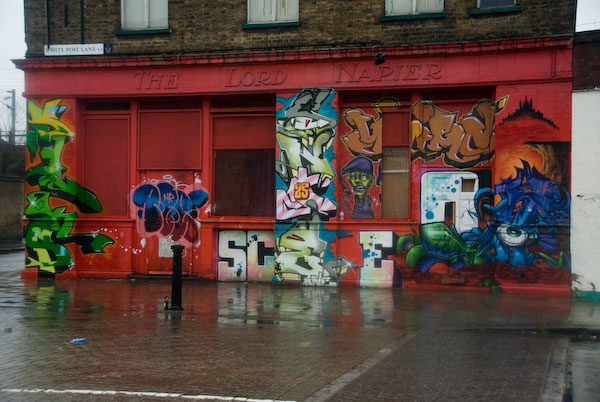
Another pub I’ve photographed a few times is the Lord Napier in Hackney Wick, noted for its graffiti:

© 2007 Peter Marshall

I’ve photographed pubs in many places and for different reasons – and perhaps one day I’ll seriously put together a collection of them.

But one of the ways that pubs have perhaps changed most doesn’t come over in the pictures. Some time in the late 70s we had a visitor and decided we’d like a bottle of wine with our meal. The off-licence across the road had unfortunately closed down, so we took the short walk to our local, the Beehive, which had an ‘Off-Sales’ department with its own door, its title etched into glass, walked in and rang the bell for service.

“I’d like a bottle of wine”, I said to the man who had emerged behind the counter.  “Wine, wine…?”, he scratched his balding head, “I think we have a bottle” and he walked away to search, returning a couple of minutes later triumphantly holding up the entire two bottle stock of the cellar. “Red or white?” We took the red, and I still wonder if they ever sold the white. But at least the price was sensible, unlike some pubs today (mentioning no names where they like to charge a few pence short of £18 for a bottle that would cost around four quid in the off-licence down the road.

Continue reading London’s Pubs

March for Justice 2012 Starts Today

You almost certainly won’t have heard about the March for Justice 2012, not if you rely on the newspapers and TV for news. Because although it is an event on a large scale which could have some fairly major consequences in various countries around the world, this Jan Satyagraha is taking place in India, and its start today, Gandhi’s birthday, is at Gwalior, over 200 miles away from Delhi. Over a hundred thousand people are expected to be on the march by the time it does arrive in Delhi at the end of the month, and it might then get a small mention. Otherwise we will only hear about this non-violent march should it meet with some catastrophe. Protests about land rights by the dispossessed rural poor aren’t news to our media organisations, although it’s an issue world-wide and one that is growing.

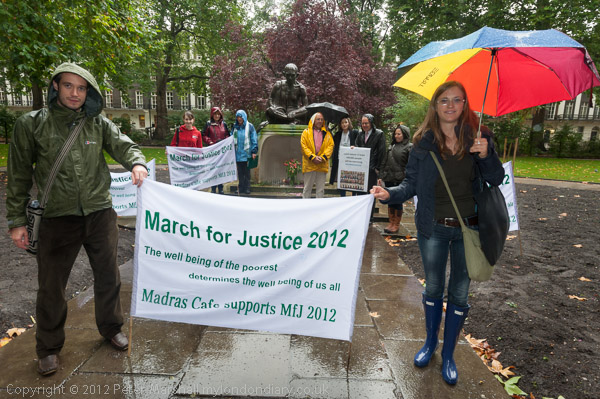
I won’t be going to India to photograph it, not least because I think it should and probably will be done better by Indian photographers (although we are unlikely to see their images)  who have a more profound understanding of the conditions and cultural issues involved. But I was pleased yesterday to photograph a small event showing solidarity with the marchers and the movement, Ekta Parishad, which is organising it. Rather less pleased that the event at lunchtime took place in pouring rain.

© 2012, Peter Marshall

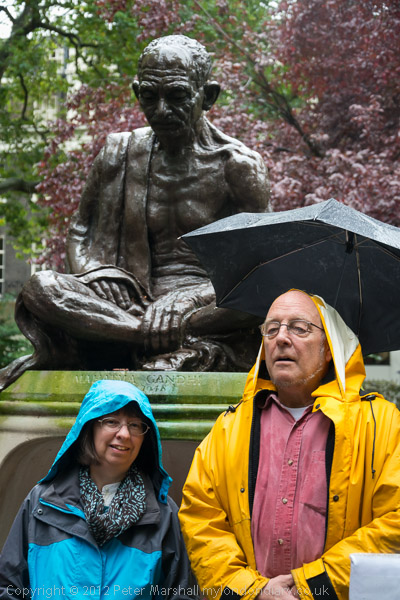
It wasn’t a very visual event, and the weather didn’t make any of us want to hang around outside. It was good to have the statue of Mahatma Gandhi (a fine work by Fredda Brilliant unveiled by Harold Wilson in 1968) watching over the event, but I found it difficult to really make much use of it, and close to the light from the sky was giving some troublesome flare over the dark metal head unless I made sure there were trees behind.

© 2012, Peter Marshall

I put these and a more few pictures on Demotix,  along with an article which as so little is likely to appear elsewhere outside the Indian press I’ll repost here.

Supporters of the land rights movement Ekta Parishad in India met at the Gandhi memorial in London in a show of support for Jan Satyagraha – March for Justice 2012 from Gwalior to Delhi which starts on Gandhi’s birthday, 2 October.

The just over a dozen people who met at the memorial to Mahatma Gandhi in the middle of Tavistock Square came from a number of charities which work with groups in India, including Christian Aid, War on Want, Action Village India and others. Because of heavy rain the speeches and discussion which had been scheduled for the square were abandoned and the discussion continued in nearby Friends Meeting House.

The march in India, organised by Gandhi-inspired grassroots land-rights movement Ekta Parishad, and attracting support from over 200 Indian organisations will have 100,000 marchers who will take 30 days to cover the almost 220 mile from Gwalior in Madhya Pradesh to Delhi, eating just one meal a day. They are determined to make their voice heard by the Indian government, and both the government and the opposition BJP are now taking an interest in land issues.

According to recent studies, almost half of Indian children are malnourished. Economic development has not benefited they poor, but has allowed large firms to establish legal claims to land on which many of them have lived for generations. The displaced people lose any chance of growing their own food, and have to move to the towns where they try to scrape a living, often with little success.

The march by Ekta is being supported by groups throughout Europe, including Action Village India (AVI) who organised today’s event and other UK charities. Last Saturday the Swiss section of the International Human Rights Society dedicated the 2012 Human Rights Award to P V Rajagopal, President and founding member of Ekta and Vice Chair of the Gandhi Peace Foundation, “in recognition of his dedicated engagement and the non-violent action in favour of the most disadvantaged people in India.”

AVI delivered a letter in support of the land rights movement to the Indian High Commission in Aldwych for Indian Prime Minister Manmohan Singh before coming the event at the statue of Mahatama Gandhi, who was born Oct 2, 1869 and assassinated in 1948 shortly after independence.

In a phone link with the march organisers in Gwalior we heard of the plans being made for the march with many thousands already having arrived at the Mela Ground for its start tomorrow, and also of talks with several Indian government ministers who were telling Ekta that there was no need for the march as the government was committed to taking action. The Indian Minister for Rural Development, Mr Jairam Ramesh, has promised to come and talk to the marchers in Gwalior tomorrow and give some specific answers to the people’s claims. The marchers can now celebrate these official promises and the march will provide the government with the support they will need to carry reforms through as well as the pressure to ensure that this time they will keep their promises.

Five years ago, in 2007, Ekta organised a march of 25,000 people to Delhi, and Rajagopal met the minister for rural development and government officials who set up a Committee on Land Reform and a Council chaired by the Prime Minister to take things forward. But although this led to a Forest Rights Act which gave more rights to the adivasis, India’s traditional forest-dwelling communities, little has been done to implement this and the promises have not been delivered.

Action Village India is a charity started by people who had lived or worked in India which supports six locally-based partner organisations in which work with marginalised and disadvantaged rural people in the Gandhian tradition of non-violent change. It isn’t a rich charity, but a hard-working one, and one source of their income is the Madras café run by AVI volunteers at WOMAD and some other events. Ekta have been one of the organisations they have supported since 2001.

Continue reading March for Justice 2012 Starts Today

Spanish Civil War Veteran Dies

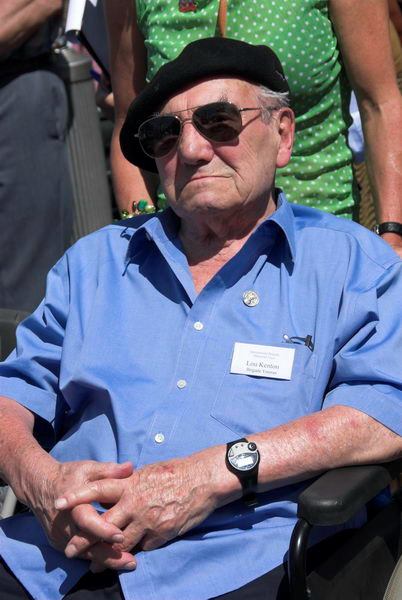
© 2006, Peter Marshall
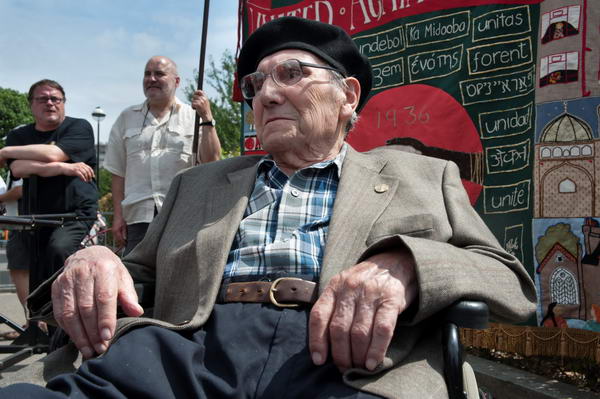
Lou Kenton in 2006

Lou Kenton, an ambulance driver for the Attlee Battalion of the International Brigade thought to be the oldest surviving veteran of the Spanish Civil War, died last week in Acton, aged 104.  He had been in the Battle of Cable Street in 1936 before hitching to Spain.

© 2009, Peter Marshall
Lou Kenton at the International Brigade Commemoration in 2009

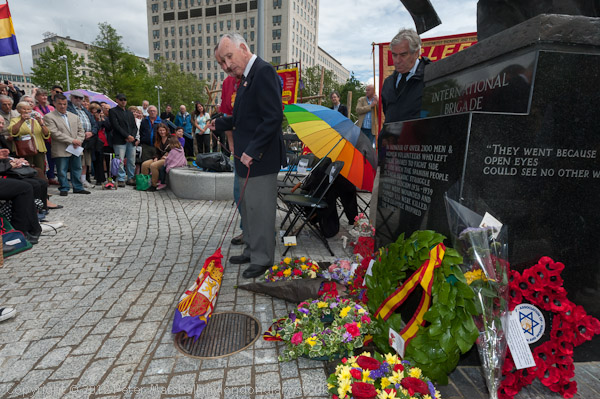
I photographed him at several of the annual commemorations of the International Brigade, held every July at the memorial  to the Brigade in Jubilee Gardens on the South Bank, along with the annually decreasing number of those who fought in Spain.

© 2012, Peter Marshall
David Loman unveils the new plaque next to the memorial, July 2012

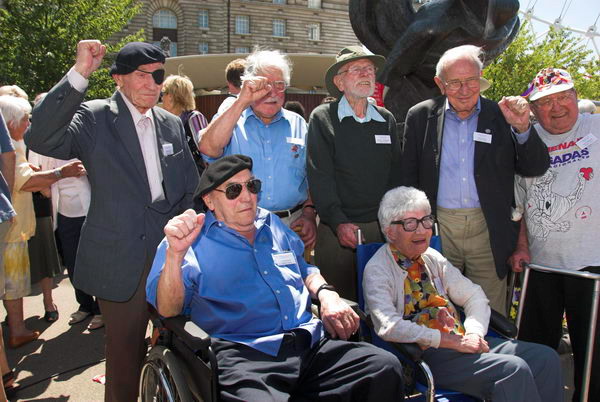
His death leaves David Loman who unveiled a  new plaque beside the memorial sculpture at this year’s event as the only remaining British veteran. You can read more about that event and see more pictures in Sacrifice For Spain Remembered on My London Diary, and there are more pictures of Lou Kenton and other veterans in accounts from some earlier years, particularly in 2006, where my account of the event some way down the page includes a link to quite a few pictures including this group portrait of seven of the many brave young volunteers – more than two thousand from Britain, Ireland and the commonwealth – who went to Spain because their “open eyes could see no other way.” .

© 2006, Peter Marshall
Bob Doyle, Sam Lesser, Paddy Cochrane, Jack Jones, Jack Edwards,
Lou Kenton & Penny Feiwel at the 2006 event

Continue reading Spanish Civil War Veteran Dies

Photomonth 2012

Photomonth, the East London International Photography Festival officially starts on 1 October and seems to grow each year. There are I think more than a hundred venues involved, with around 150 shows, and it has spread a bit beyond East London, with outposts in the West End and even Brighton as well as on-line. It’s also spread in terms of time, with the month now extending from 1 October to 30 November!

This year’s core theme was Radical London, though it’s perhaps disappointing that so few of the shows in the festival appear to relate to it – and of course my own ‘In Protest’ is one that does – and one that was devised especially with the theme in mind. Although one of the attractions of Photomonth is it’s diversity, it would have been good to see more on the core.

Photomonth is an interesting festival in part because it is so open, and as well as the shows there are also other events taking place including the talks, workshops and other events – all listed in the brochure which can be collected from any of the galleries taking part and on the web site.

Continue reading Photomonth 2012

Finally August is Complete

August was a busy month for me, partly due to the Olympics. Although I decided not to go to any of the actual events, there were half a dozen protests connected with it among the events I photographed.

Putting work on My London Diary has taken longer than usual, mainly because I’ve been occupied in September with other things, particularly with getting work ready for the show ‘In Protest‘ which is officially open from 1 October.  For the black and white work I had to review contact sheets from around 15 years of work – around 30 A4 folders crammed full of them.  There are still a few pictures I know that I took that I haven’t managed to locate. Possibly although I used them as black and white I may actually have taken them on colour negative film – there are another large bank of folders of colour work on film I just did not have time to approach – perhaps enough for another show at a later date.

Looking through the digital colour was much easier, although there may still be things that I missed as I had to rush. But you can page through images on a digital ‘lightbox’ considerably faster than looking through physical sheets housed in files, and ‘My London Diary’ actually serves as a useful index to my digital work.

The big problem was that there were so many pictures I would have liked to have included in the show, but space is limited, and I decided from the start to limit myself to around 25 framed images.  A larger number actually feature in the show as  smaller images on five sheets of work.

The show went up on the wall Friday, and I breathed a large sigh of relief, and got down to  producing and sending out the invites for the private view. Mostly that is now done and I decided I had to finish getting my work from August on line before September was up, and I made it with a few hours to spare.

© 2012, Peter Marshall

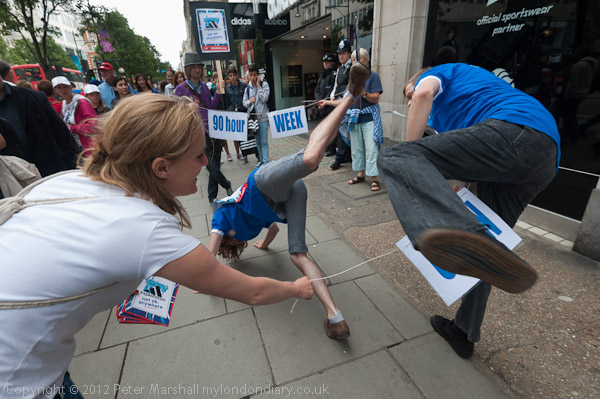
The month started on an Olympic note, with War on Want protesting against the official sportswear partner of London 201, Adidas, with some games outside their Oxford St store.

August 2012

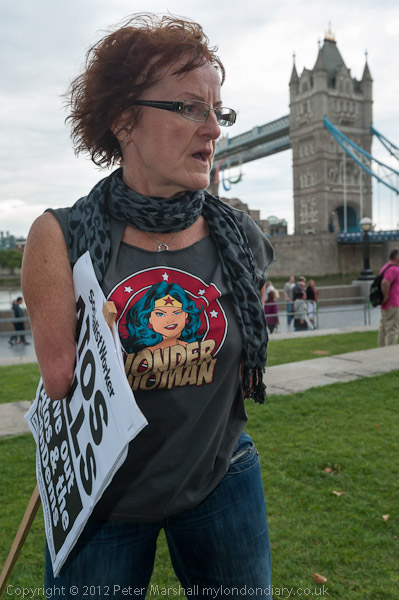
DPAC Occupy Dept of Work & Pensions
Closing Atos Ceremony
Disabled Pay Respect to Atos Victims
Remploy Protest at Stratford
Vedanta AGM Protest
Regrade GCSE English

© 2012, Peter Marshall
Opening Ceremony for the Atos Games
Notting Hill – Children’s Day
Shoreditch Art
March Against Gangs, Guns and Knifes

© 2012, Peter Marshall
Sean Rigg Memorial – 4 Years
Solidarity with Marikana Miners

© 2012, Peter Marshall
EDL Outnumbered in Chelmsford

© 2012, Peter Marshall
Al Quds Day March
Ecuador’s Embassy & John Massey
Free Pussy Riot
Battersea Riverside

© 2012, Peter Marshall
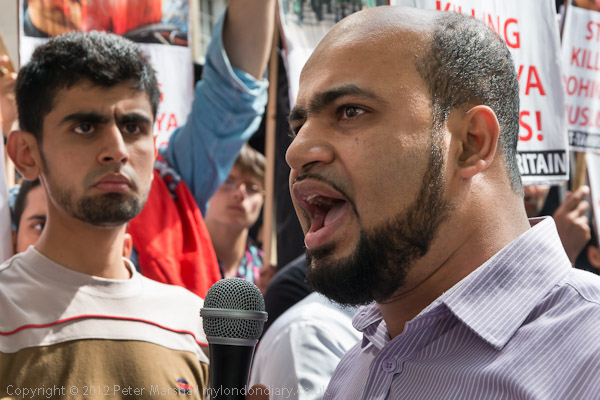
Hizb ut-Tahrir Supports Rohingya
London Eye
Unions Continue Fight For Remploy Workers
Iraq Day Festival
Raoul Wallenberg 100th Anniversary
Adidas Stop Your Olympic Exploitation

Continue reading Finally August is Complete

In Protest

You are invited to the opening of my new show, ‘In Protest’ at the Shoreditch Gallery in the Juggler at 5 Hoxton Market on Tuesday 9th October from 6.30-8.30 pm.

© 2012, Peter Marshall

I’ve been busy for the last two or three weeks getting ready my show for this year’s East London Photomonth. This is the first year when I’ve shown work for it on my own – previously I’ve organised shows with one or more other photographers, including last year’s East of the CityParis, New York, London and Taken in London and The English Carnival.

Back in last December when I first heard that this year’s theme was to be Radical London, I was told by my friends that this show had to be of my work alone, and so later I put in an application for a show under the title ‘In Protest’.

It may well turn out the be the last show at the Shoreditch Gallery, as with the area being on the up rents are increasing, and the space will probably soon become something rather less interesting but more profitable. It was only a few weeks ago that I could be sure that the exhibition would take place physically rather than being simply an on-line show.

In the show are a selection of black and white images from 1990 to the early 2000s, including some never before exhibited or put on line. The colour pictures, from 2004-2012 have all appeared on My London Diary – and some have also been published in various newspapers and magazines around the world.  There are around 24 framed prints at roughly 36x24cm and also 5 sheets with smaller images – around another 30, and of course some fairly extensive captions.

The show is advertised as being from Oct 1-26, but we actually put it up today, so it was available to the public from around 3pm this afternoon.  I hope some of you will manage to see it, along with the other shows from the East London Photomonth which continues throughout October – and with just a few events in November.

There are quite a few events in the first week of October, so I decided it was best to have the opening party for the show the following week. If you are in London it would be good to see you. The gallery is in Hoxton Market, which is between Coronet St and Boot St, just to the north of Old St – behind the Holiday Inn, and just a few steps from Hoxton Square.  It’s easy to get to by public transport, just a few minutes from Old St tube, and even closer to the Great Eastern St stop of bus routes 55 and 243.  And many other buses also serve Shoreditch Church or Old St, both just a few minutes walk away.  Putting the postcode N1 6HG into Google or Streetmap etc will also show you the location, though for some unaccountable reason Google only tells you it is the Alexander Fleming hall of residence – proof it isn’t only Apple that gets things wrong on maps. But be warned that not all street maps have Hoxton Market shown on them, and local street signs pointing to ‘Hoxton Market’ lead to to the wrong place.

Continue reading In Protest

Vedanta – My Back Was Turned

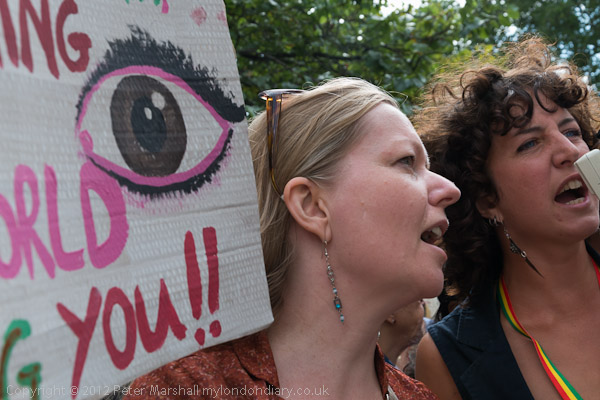
Vedanta, the whole world is watching you‘ said one of the posters at the protest outside their AGM

© 2012, Peter Marshall

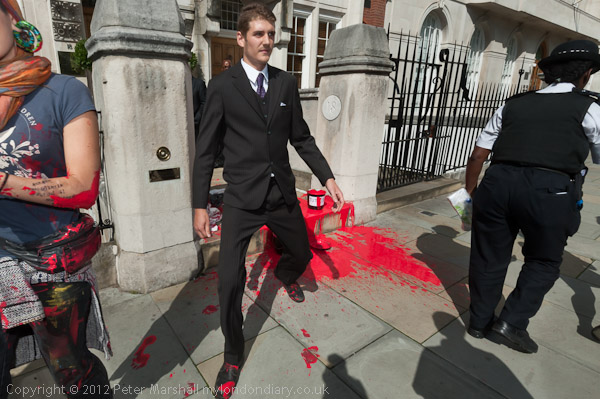
but my own back was turned at the critical moment when protesters threw fake blood over another protesters covered with a white sheet on the steps leading to the AGM, and by the time I realised something was happening and had run the 20 yards or so to the scene those who had spilt it were fleeing stage left and stage right. They included two men dressed in suits who I assumed were Vedanta security men.

© 2012, Peter Marshall

Even with the 16-35mm I couldn’t include all of the scene, and by the time I’d really realised what was happening it was over.  I was just a little annoyed that I hadn’t been warned something was about to take place.

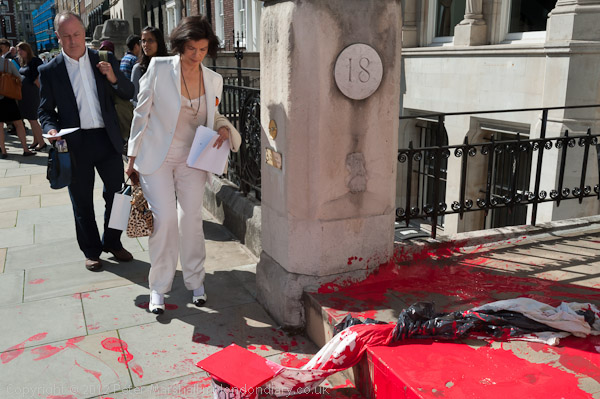
I’d been busy photographing Bianca Jagger who was one of the protesters who have bought shares in the mining company so that they can attend the AGM and ask questions about the activities of this company ‘owned by billionaire Anil Agarwal, backed by the UK government but opposed by groups in India, Goa, Liberia, Namibia, South Africa and Ireland, Zambia and Sri Lanka for the environmental damage, pollution and human rights abuses caused by its mining of bauxite and other minerals.’

© 2012, Peter Marshall

Wearing her white suit she had to pick her way very cautiously over the Kensington Gore on the steps; it is supposed to be non-staining, but I wouldn’t entirely rely on it.

© 2012, Peter Marshall

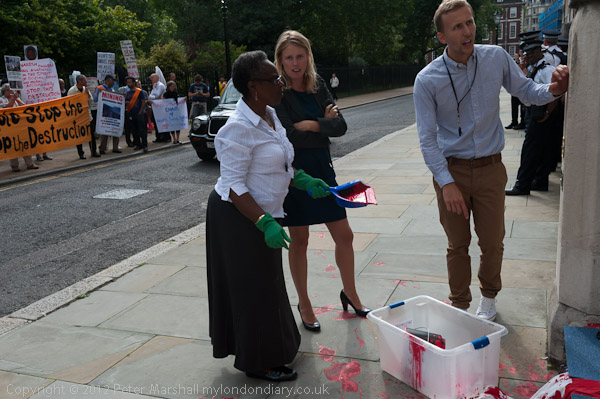
What was needed was a hose to wash the theatrical blood away, but instead they sent out an inappropriately equipped black woman cleaner. I felt sorry for her as she tried to deal with the mess, supervised by a young woman in a smart black dress and heels in what seemed like a colonial parody.

The charges against Vedanta are horrendous and you can read more about them on My London Diary in Vedanta AGM Protest, and of course on web sites such as Foil Vedanta, where you can read a more accurate account, complete with pictures of the bloody incident.

© 2012, Peter Marshall

But had the organisers thought to make sure the couple of press photographers present were watching when the event was going to happen, it would have got them rather more publicity.
Continue reading Vedanta – My Back Was Turned

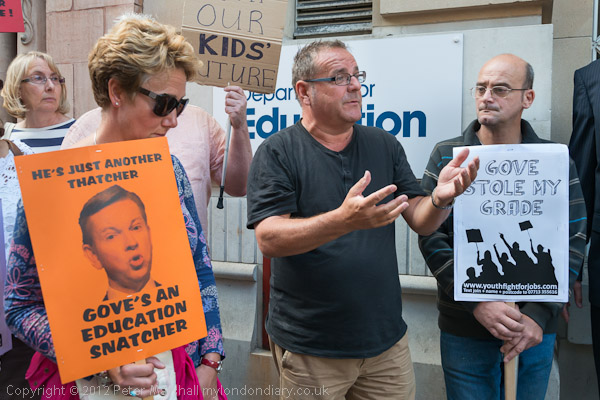
Teachers Protest

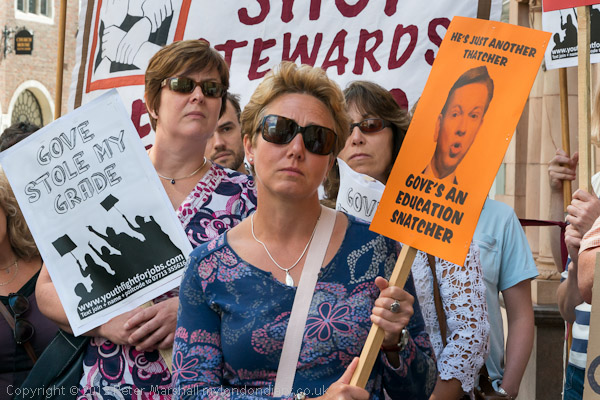
As a former teacher I still have some interest in matters of education, and like many last month was appalled to hear that some exam boards, under pressure from the government and their regulatory body, had decided to change the marks needed to get a C grade for GCSE English between the January and June exams.

© 2012, Peter Marshall

This meant that many students who got a mark that would have given them a ‘C’ grade in January were downgraded to a ‘D’, which is just unfair. A ‘C’ in English is a basic qualification for many further courses and something many employers insist on. Although not originally intended to be used in this way, a ‘C’ is a pass and a ‘D’ a de-facto fail, and the decision by the exam boards will blight the lives of many for years.

I’m not actually a great believer in examinations. Or more precisely I think that getting a good grade in examinations shows you are good at taking examinations rather than very much else. Because of the pressure that schools face with inspections and targets, teachers have become very good at getting pupils to do well in examinations, largely to the neglect of education. And unfortunately most of our examinations are very poor instruments for grading anything useful.

I taught quite a range of subjects over my teaching career covering various aspects of science, art and photography, business studies and computing. Two courses stood out for me. One was an intensely practical and vocational computer-based course, with on-screen learning and assessment coupled with various lab exercises, the Cisco Networking Academy programme. But although our educational establishment showed some interest in this initiative, it wasn’t really possible to integrate this into our education system. Even students who wanted to go on to study computer science could get no credit from the universities from following these courses.

But what I most enjoyed teaching was on the Art and Design courses we ran using photography as the medium. Although there were things called exams, basically the courses involved students in producing a portfolio of work. We worked to a fairly well structured course, making sure we taught the basics, but students showed their ability by their research and development of their own ideas in photographic projects to meet the briefs we wrote. The only difference for the exam was that the brief came from the exam board, and there were rather notional time limits.  Essentially this was a course where the portfolio that each student assembled was what mattered and the grades given by the board (based on our teacher assessment and external moderation) were simply a reflection of this.

The protest happened because of the anger of teachers at the way students they had taught had been penalised unfairly by the exam boards, and the disastrous consequences this would have for these individuals and also for many schools. The lower pass rate will give the government the excuse to take over many schools and impose their policies of increasing privatisation of education.

One young teacher in south London had decided on the Friday evening before the bank holiday weekend that teachers should take some action to show their outrage and had contacted others on Facebook. It wasn’t a good time to organise, with most teachers making the most of the last week of their summer vacation, and it was perhaps surprising to find almost 30 of them outside the Department of Education.

What I could have done without was another photographer who arrived a short time after me and decided he needed to organise them for a photograph. Fortunately after he had spent a few minutes doing so, things more or less returned to normal and the protest continued.

© 2012, Peter Marshall

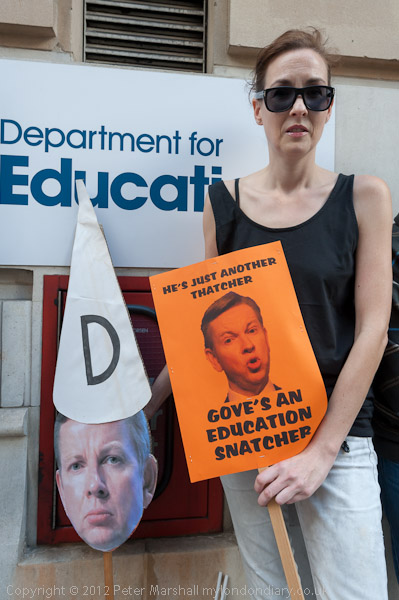
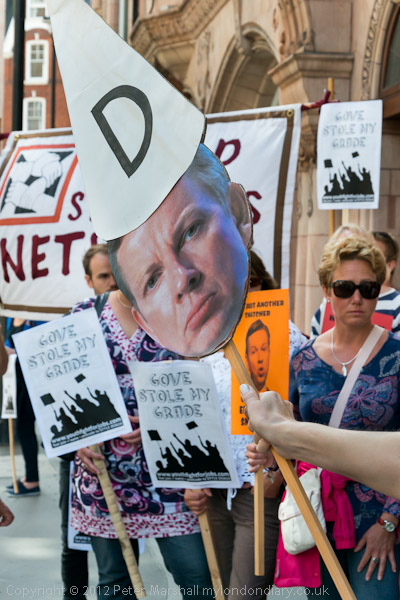
Of course I am sometimes guilty of just a little arrangement myself. I did suggest to this woman she stand in front of the sign, and she is looking at me because I’ve just previously taken a picture using flash. And I did take advantage later of her waving the head and dunce’s cap around in front of the other protesters for that other photographer – who by that time had become a part of the situation I was photographing.

© 2012, Peter Marshall

But the pictures I find more interesting are not to do with organising people (which should get any real news photographer fired) but those that simply happen and I manage to be in the right place at the right time.

© 2012, Peter Marshall

It’s sometimes a thin line, but I try to stay on what I think is the right side of it. More pictures at Regrade GCSE English.

________________________________________________________

My London Diary : Buildings of London : River Lea/Lee Valley : London’s Industrial Heritage

All photographs on this and my other sites, unless otherwise stated are by Peter Marshall and are available for reproduction or can be bought as prints.

To order prints or reproduce images

________________________________________________________