Housing protest – Focus E15

It’s cold and wet in London today, and I’m suffering a little from a chest infection which means I can’t walk around carrying my camera bag – but otherwise I would be photographing a housing protest. Instead I’m writing about one I did cover on a much nicer day last September.
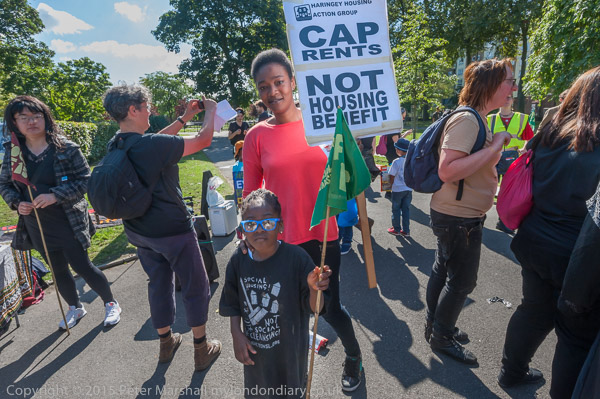

D700 16-35mm at 20mm, 1/400s, f/10, ISO 640,

Housing is an issue that has become vital in the UK and in London in particular, where overseas investment in property has caused house prices to rocket. Of course houses have long been too expensive here for most people to own, at least in the posher areas of the city, but now that has become true even in what were the most run-down and cheapest areas.

Back in Victorian times, the wealthier parts of the society realised that the poor had to have homes, and set up various companies and charities to provide accommodation for the ‘working poor’, some on a commercial basis and others charitable, but all genuinely philanthropic in design. Later, the London County Council and local borough councils built large estates of council housing, again at rents which the poor could afford, and a huge expansion of London between the wars provided affordable housing to rent or buy for the growing middle classes.

Slum clearance continued after the second war, with councils still managing to build large areas of council housing, and with the establishment of a ring of new towns outside London, one of which I began work in as a teacher in 1970, living in what was then for me a grand new flat at a reasonable rent from the development authority.
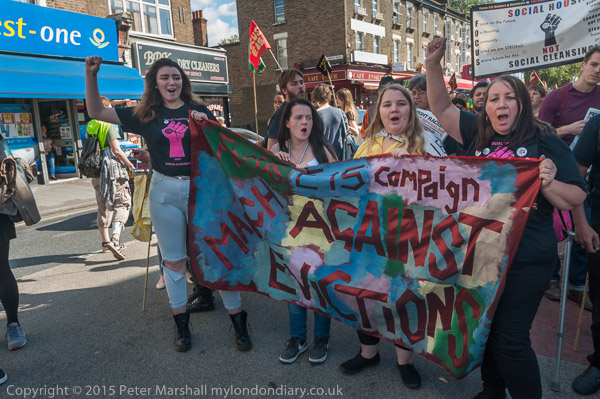

D700, 16-35 at 29mm 1/320s, f/9, ISO 640

Since then, things have gone downhill. Successive governments have prevented the building of council housing in different ways, but the real blow to social housing was the ‘right to buy’ introduced by the Thatcher government.  In itself the encouragement of people to own the property they lived in was perhaps not a mistake, and was certainly popular with many who took the generous discounts, but as a housing policy without an accompanying commitment to replace the loss of social housing it has been disastrous.

It was too both a symptom and a cause of a growing polarisation in society, an ‘I’m alright Jack’ policy which reflected an end to empathy for the poor and feelings of community. Politicians – whether Tory of New Labour – were in it for what they could make and now longer to serve.

In recent years things have become even worse, with local authorities increasingly finding it impossible to meet even their statutory responsibilities for housing. One of the places where this came to a head was in Newham, where the council decided to stop funding for a hostel for young women with children, threatening eviction and offering them rehousing in distant areas of the country, away from jobs, families and other support. Unlike others, the residents of the Focus E15 hostel in Stratford decided to fight.

Their campaign is one I’ve followed and been impressed by, not just for what they have achieved for themselves, but more for the effect it has had on other groups also fighting for housing justice, bringing together a large number of them from around the capital and helping to raise a much greater awareness of the problems faced by so many. Their ‘Housing for All’ campaign is out on the street in Stratford every Saturday.

Saturday 19th September was the second anniversary of their campaign. They had marked their first birthday by an occupation of a block of four flats on the nearby Carpenters Estate, which Newham council have been emptying of tenants and leaseholders over the last ten years. One of the flats – all well-built and in good condition – still had the 2004 calendar left on the wall when the previous residents left.
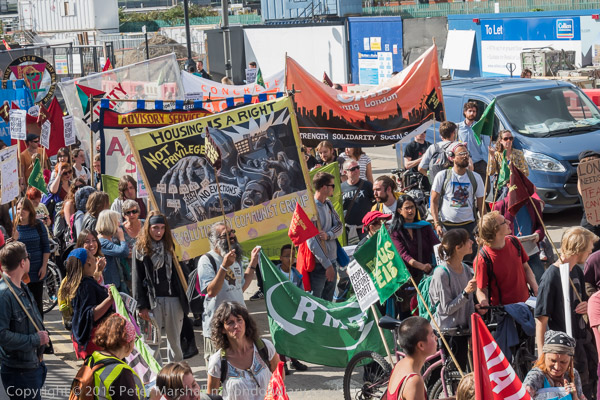

D810, 28-200 DX at 50mm(75mm) 1/500s, f/11, ISO 800,

Like many council estates, the Carpenters was well-designed and well-built – London councils employed many of the country’s leading architects and planners. It had probably been kept up better than most though like most post-war estates was in need of a little refurbishment to meet changing standards. It was popular with tenants – and still is with those who have managed to remain.

But it occupies a relatively large area of land that is now worth a fortune. Council planners generally worked to relatively low densities, whereas new private developments (often now by housing associations) can cram in several times the number of ‘units’ for sale or rent at high prices. And while most such developments start off with a promise to provide a small proportion of ‘affordable’ properties, they often manage to cut that dramatically before completion.

‘Affordable’ properties are of course not affordable for the great many Londoners who are on the minimum wage or even the London Living Wage. Few are even affordable to, for example, the teachers that London needs, paid at several times that.

The latest housing bill takes this idea to heart and all council and former council sites are likely to be listed as ‘brownfield’ sites ripe for development. It can only be seen as a deliberate attack on all remaining social housing for the benefit of wealthy property developers.

The day’s events began with a rally in Stratford Park, with an open mike for speakers for groups from all over London to talk. At Focus E15: Rally before March there are some pictures and a list of over 40 groups supporting the march – and I’m sure I will have missed some.

The Focus E15: ‘March Against Evictions’ set off and walked around the centre of Stratford, along the large one-way system around the large shopping centre, past the bus station, rail station and entrance to Westfield. One of the groups opposed to the increasing gentrification of London is of course Class War, and as the march got to a large branch of estate agents Foxtons, they peeled off and rushed inside with their banner, and I followed them.
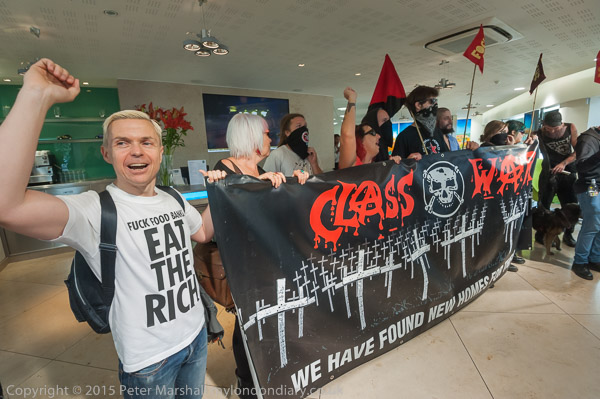

D700, 16-35mm at 16mm, 1/250s, f/8, ISO 2,500

Class War Occupy Stratford Foxtons: Police soon blocked entry to the shop, keeping most of the marchers on the street outside. Those inside were well-behaved, careful to cause no damage, and after around ten minutes left voluntarily to continue the march.
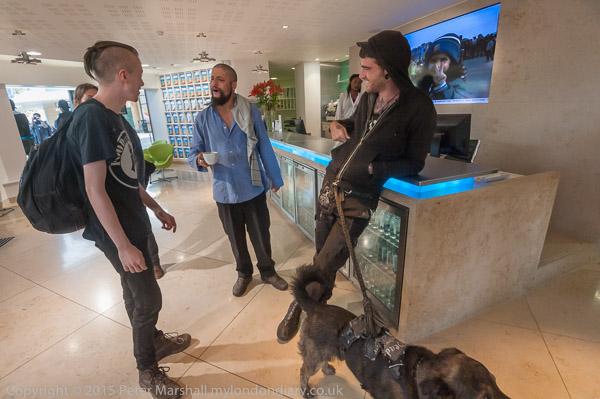

D700, 16-35mm at 16mm, 1/250s, f/8, ISO 2,500

The march stopped briefly outside Newham’s Housing Office, Bridge House on Stratford High St to put up banners and talk to marchers. The Housing for All campaign have supported a number of people at interviews here, often managing to get the authority to find housing in or close to the borough after they have been told they would have to go to Hastings, Birmingham or elsewhere.

From there it was a short walk to the Carpenters Estate and the Focus E15: Anniversary of Carpenters Occupation party in front of the block that they occupied for a couple of weeks a year ago. Those four flats now have new tenants, but only 28 of around 400 empty properties have been relet, and Newham is still trying to clear the estate.
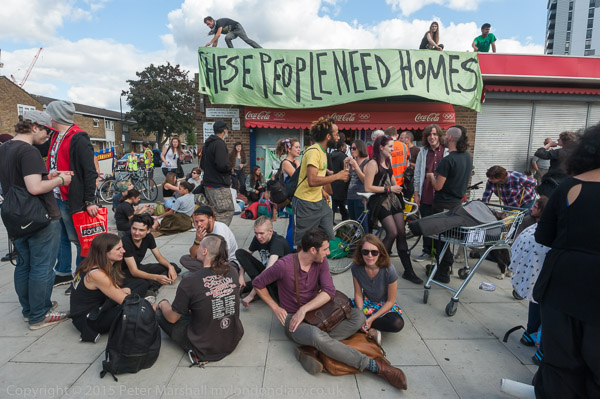

D700, 16-35mm at 19mm, 1/400s, f/10, ISO 640

It was a good afternoon for a party and there were speeches and music and a release of grey balloons representing the many homeless and evicted people across London.

But I didn’t stay long, as I’d been on my feet too long and my legs were beginning to ache and I left as soon as the balloons had been released.
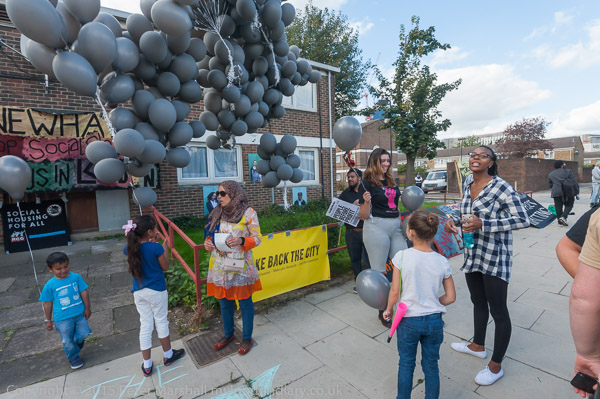

D700, 16-35mm at 16mm, 1/320s, f/9, ISO 640
Continue reading Housing protest – Focus E15

FullBleed

Thanks to L’Oeil de la Photographie for a story FullBleed, the channel exploring photographic stories which is a new YouTube channel showcasing films about photographers and their projects.

The one of the four short films featured in the story that caught my attention was of Glaswegian photographer Dougie Wallace photographed at work on his ‘Harrodsburg’ project (which I wrote about last October) and talking about it. It’s better not to rely on the subtitles which I think had a little problem with his accent on things like ‘grey imports’, ‘bit of flash’ and ‘go to import it’. Photographers just don’t ‘teleport’ even from outside Harrods.

Also on the page are videos of Paddy Summerfield and his project ‘Mother & Father‘ on dementia and Bob Mazzer talking about the pictures he would take into a bunker at the end of the world, the latest of a series called ‘Apocalypse Pictures‘ which earlier featured the choices of Summerfield and James Fry, as well as the first in a series ‘The Show’ which reports on a variety of photographic exhibitions.

The full set of FullBleed videos is on their You Tube channel, and they also have a Facebook page, the top item of which today is about the forthcoming Photo London but which also has some interesting links to items of photographic interest. Photo London for me is on the wrong side of a line about making money from photography rather than making money for photographers.

My own union branch began a series of videos, ‘Working Lives‘ a couple of years ago with an interview with Anne-Marie Sanderson, chief photographer at North London and Herts News, followed up last year with one on Freelance photographer John Sturrock who worked on social and political issues for the renowned Report agency in the mid-1970s and now photographs major regeneration and construction projects. I was filmed for the series last year, but it seems unlikely for various reasons that this video will ever be completed.

My First Colour Negs


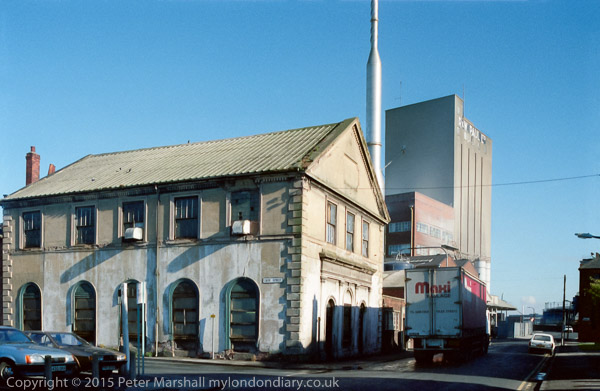
Scott St Chapel, a Weslyan Methodist chapel built in 1804 and probably the first in the area. It became home to printers Mason & Jackson around 1910 until they ceased trading in 1997. Attempts to list it failed, and it was demolished in 2001.

As I’ve mentioned here several times before, 1985 was the year I finally was able to give up transparency film and move in my colour work to using colour negative. Since then I only used slide film on a very few occasions, mainly for copy work to make slides for teaching before we got digital projectors and film scanners. Perhaps a job or two where a client insisted on it – but I didn’t often work for clients, as until the film scanner came around I was still working full-time in education. But most of the work in those days that went into libraries and agencies was black and white prints, and most publications were black and white too. Things have changed completely in the past 20 years or so.

I did have a little colour work with one agency, but sales were poor. I don’t think I even recovered the cost of making the medium-format transparencies they demanded, which were actually photographs of 15×10″ exhibition quality prints, the originals of which were taken on 35mm colour negative film.


The River Hull

My switch to colour neg wasn’t really just a technical matter, but also reflected a change in direction of my photography, analogous to one that I had already taken around 8 years earlier in my black and white. There the emphasis had altered from being interested in picture-making and form – shape, line, light, composition to one on using these elements to say something about the real world, from form to content. With colour, transparency film had not been a problem when my pictures were largely about light and colour – and indeed its exaggerations had contributed to the images, but became a source of frustration when my concern became the subject.

I had decided that my photography was no longer about photography, about creating images, but about making images that said something – I had become a documentary photographer. I wasn’t throwing shape, line, colour, light, composition out of the window, but recognising them as simply means rather than the end.


The River Hull

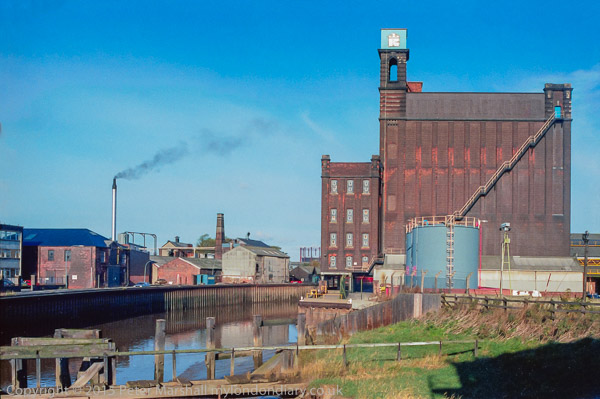
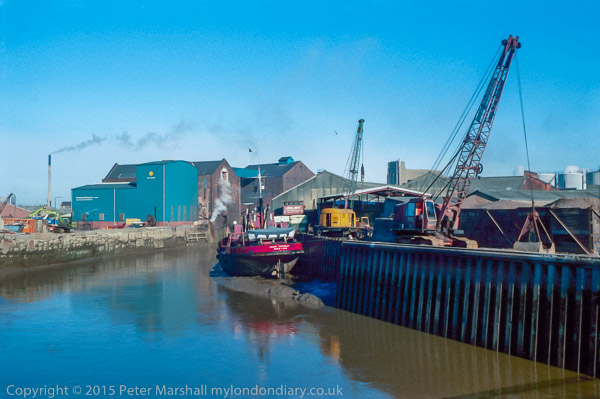
I took only a couple of colour neg films in 1985, during the October half-term when I was continuing the project I had started a few years earlier on the city of Hull and shown there in 1983. A few of the pictures were of places I’d earlier photographed on slide. Later I would develop separate projects to work on in colour and black and white, though usually ones that I could easily work on together.


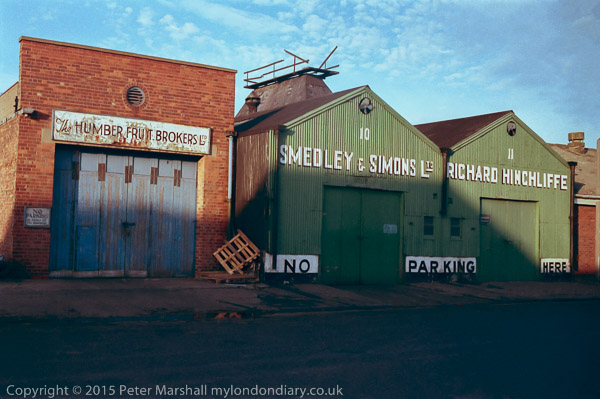
A smoking shed in the Old Town – with details visible in the shadow area

I didn’t take any great pictures on those first two rolls, but the differences were enough to know I was on the right track. Working in low winter sun I could now see detail in shadows and was less likely to lose highlight detail. Another advantage was the ability to easily see to the edge of the frame without having to demount a slide. The OM viewfinders showed about 95% of the frame – very close to the edge, and slide mounts usually had a 22x34mm aperture, showing only around 87% of the image – and more was often lost by the printers.


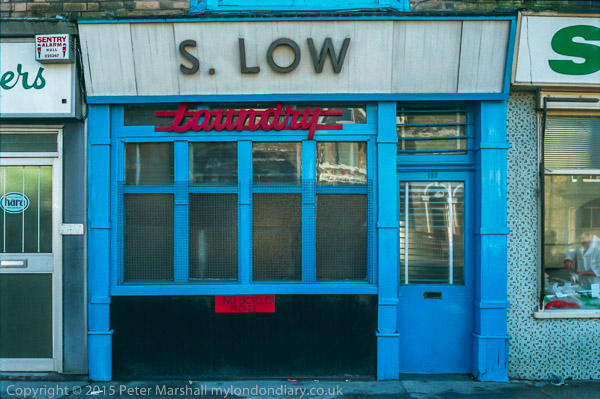
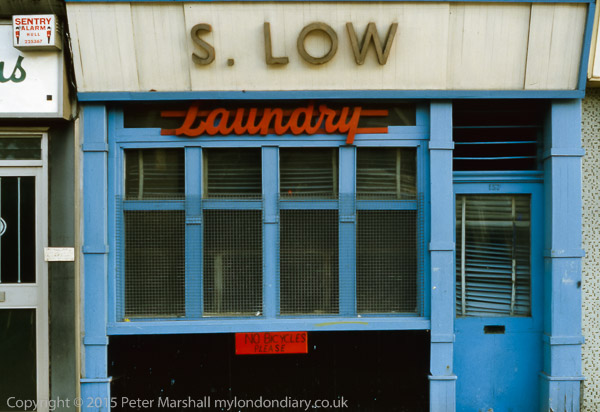
S Low, laundry. Spring Bank – negative


S Low, laundry. Spring Bank – transparency

This was one of my favourite shop fronts on Spring Bank, partly because of the name – and I think it was a Chinese Laundry. It is still basically there on Street View but no longer a business, with no name and no Laundry sign and the street numbering has changed. Gone to is the very Hull touch ‘No Bicycles please’ and the Sentry Alarm with its Hull phone number. I’m not sure which is the truer colour (and I’ve only done a fairly rough balance on these images), but they have similar sharpness, and as a bonus the negative version has a fishmonger handling fish seen through the shop window at the right. I hvent gone too find the slide and checked, but I suspect it would show I had carefully framed the bottom of the shop at the bottom edge of the image, and it has been cut off by the slide mount in which this images was scanned.

I had a lot to learn, not least how to make my own colour prints. It took me a while, and eventually I had to buy a roller processor for my darkroom. Things became so much easier when we could print digitally.

Refugees Welcome

September 12 was an important day in British politics, possibly a turning point we will look back on, the start of a new era on honesty and straightforwardness, though we still have a while to wait to see if a decent and principled man can survive as leader of his won party for long enough for the electorate to be allowed to pass their judgement. It certainly won’t be easy, with not only the Tories and most Labour MPs keen to preserve the status quo, along with the entire mass media baying against him. But even though our newspapers have recently been judged as the most right-wing in Europe, if he begins to look as if he may win, some will change their tone. Its always more profitable to be on the winning side, even if it rather sticks in your throat to be so.

My main concern on September 12 was not however with the Labour Party leadership – in which I didn’t have a vote, never having got over being thrown out of the party as a member of a Labour student organisation that was ‘proscribed’ back in the 1960’s, although I did briefly photograph one of the victory parties – and wrote about it here earlier.


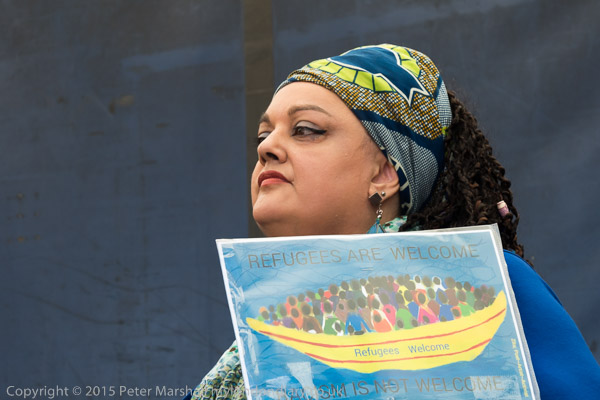
Zita Holbourne of BARAC with one of her artworks showing a boat full of refugees

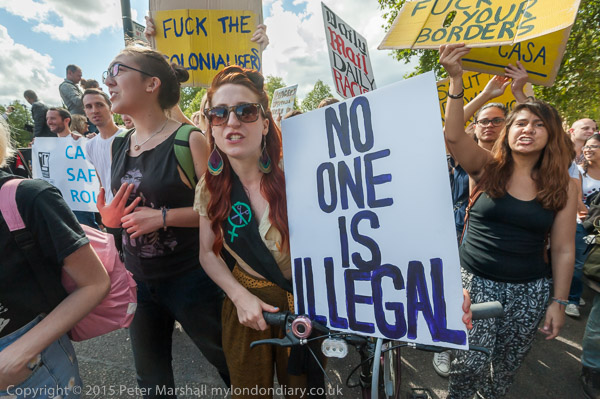
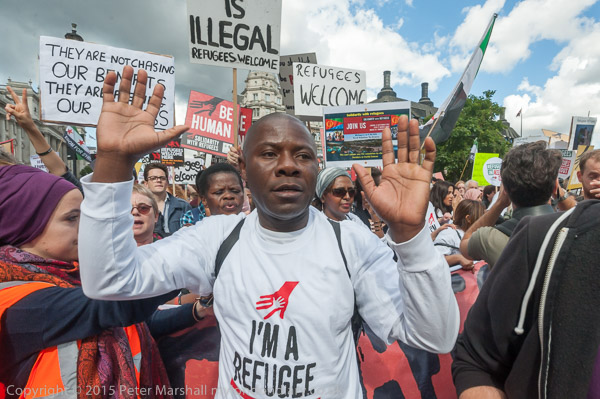
Also taking place was one of the larger protests that London has seen for a while, the Refugees Welcome Here national march. The plight of refugees, mainly fleeing from war-torn Syria and other areas of conflict and making their way across the Mediterranean, facing hardship and death had captured the attention of the British people.

It was of course the pictures and videos and stories on TV in particular, but also on the press that had made us aware and awakened our concern. The stories were dramatic and shocking enough to gain extensive coverage, enough to overcome the continual drip-feed of anti-refugee propaganda which usually fills our media. The continued and systematic use of the words ‘migrants‘ and ‘immigrants‘ rather than ‘refugees’ or ‘asylum seeker’s, the ridiculous, sloppy and inaccurate use of the term ‘illegal immigrant‘ (or even the shorter ‘illegals‘) and the hysteria whipped up over migration statistics and stories which should be about the failure of our government to provide support for local authorities where these people settle rather than blaming them.

Then we have a whole raft of racist legislation – the setting up of prison camps like Yarl’s Wood and Harmondsworth – and raids on shops, offices, restuarants, stations and streets by ‘border police‘.

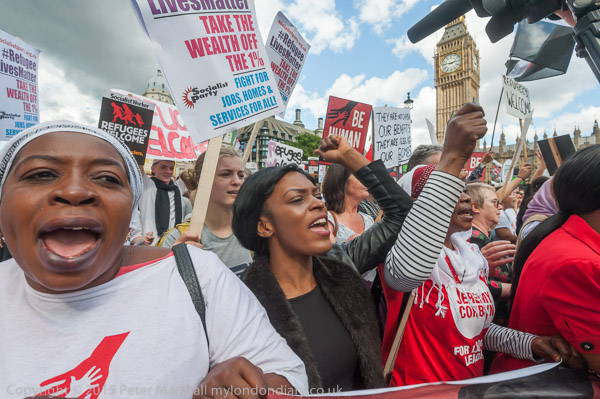
Although tragedies reported by the media brought a positive response from the British people, our government was largely unmoved. As I wrote “More than 50,000 people of all ages from across the UK marched through London to show their support for refugees facing death and hardship and their disgust at the lack of compassion and inadequate response of the British government.”


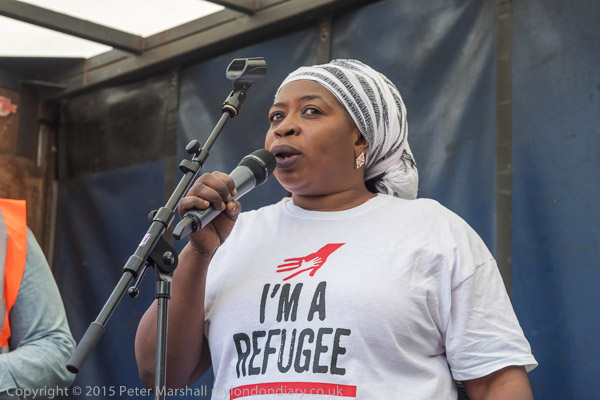
Maimuna Jawo a refugee from Gambia and from Women for Refugee Women wearing an ‘I’m a Refugee’ t-shirt left Gambia to avoid having to take over when her mother, the local FGM ‘cutter’, died.

Before the march there was a rally and I photographed all of the speakers – including the Liberal Democrat leader, London’s MEPs for the Green Party and Labour, and representatives from various groups concerned with refugees. Two of the speakers, Zrinka Bralo of Citizens UK a
and Maimuna Jawo of Women for Refugee Women had come to this country as refugees.

I photographed the front of the march, and walked with it for a few hundred yards before stopping an photographing others as the march streamed past, filling the wide carriageway of Piccadilly. It took an hour to pass me by and then I rushed to the tube to get to Westminster, one stop away, where the march was heading. I arrived just before the front of the march, which must have been around a mile long.

I took a few pictures as the front of the march went in front of the Houses of Parliament, and a friendly steward let me in to the area in front of the banner, but I had to work very close to it as otherwise there were too many people in the way. I’d have liked to have the banner clear to read, but it wasn’t possible.

Another rally was starting, along with some celebrity speakers, but I decided I was too tired to cover it and sat down for a few minutes to eat a late lunch on a wall on the other side of Parliament Square as the square filled up. By the time I left it was pretty full, with people still coming in – and many others like me deciding it was time to go home.

Rally Says Refugees Welcome Here
Refugees are welcome here march
Refugees Welcome march reaches Parliament

Continue reading Refugees Welcome

East from Gravesend

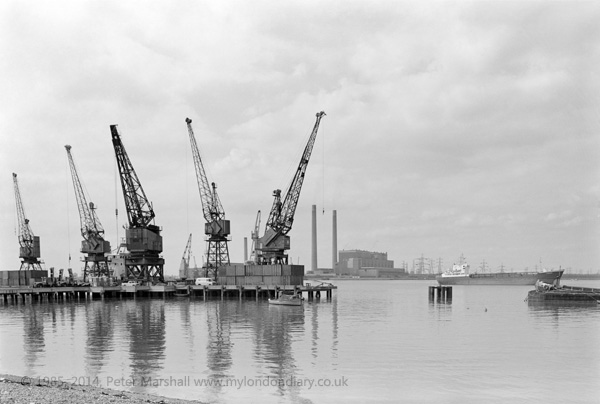
The third new book I’ve produced this year is the final volume of the series along the lower Thames in the 1980s, East from Gravesend.  As well as my own walks out from Gravesend to Cliffe, it also has pictures from a couple of earlier visits with a small group of photographers further into the Hoo Peninsula and on to the Medway and the Swale.

All of these pictures are taken on the south side of the Estuary in Kent, and it was a few years later that I ventured much to the east of Barking along the Essex coast, with the exception of another outing with the same group to Canvey Island. So for the moment there are three volumes of my Lower Thameside series, but perhaps as I work through my many folders of contact sheets and negatives there will be more than cover the north bank.

As with most of my recent publications, this is published as a PDF and the digital version has ISBN 978-1-909363-18-2 . Blurb will also print you out a copy if you are feeling rich. The PDF gives you an instant download for £4.99 while the print copy is a ridiculous £29.95 plus post. I have a few copies available for my UK friends, and will hand one over for £25 or post it to any UK address for £27.00* – faster and cheaper than ordering via Blurb and their courier delivery.

There are several great advantages to publishing as a PDF. Most important to me is image quality. Assuming you have a decent screen these pictures are more detailed and have better contrast and density range. Blurb do a decent job of printing, at least on the premium paper that I specify, and while it is better than some of the photographic books on my shelves (particularly some of the older ones) it certainly doesn’t compare with good duotone or quadtone printing.

Cost is an obvious advantage, and publishing digitally cuts my costs considerably. If you assign a print publication a UK ISBN, then you are obliged legally to deposit a copy with the British Library – UK National Library. I’d be happy to do that, but if they request it, you also have to send free copies to the Scottish and Welsh National Libraries, and also Oxford and Cambridge universities and Trinity College Dublin.

When I started producing books, these other libraries didn’t get round to asking for their copies, but they now appear to be more organised, and after I spent around £250 on their copies and carriage for a couple of books I decided to go digital.

Its perhaps surprising that our national library doesn’t appear interested in digital publications, although they do have these in their collection. But they have never responded when I’ve sent them copies of the PDFs and have not added them to their collection.

As usual there is a preview of the book available, including over half the pictures in the book. Click on the icon to make it full-screen and enjoy:

I’ve written two previous posts about my own walks from Gravesend to Cliffe while I was preparing the images for this book – quite a while ago,
North Kent 2 and To Cliffe which have more information about the work.


*Contact me from this page to be sent the further details needed to place an order, which can then be made either by post including a cheque or by email and bank transfer.

Continue reading East from Gravesend

Arms Fair

Looking back on a busy few days in September when activists protested against the DSEi arms fair held in East London.  When you see reports of wars, atrocities and killing around the world, there is a very good chance that at least some of the weapons involved will have been sold at this event, which is said to be the largest arms fair in the world which takes place here every two years.

In the week before the arms fair took place, activists held a number of protests and tried to stop lorries bringing exhibits to the arms fair. The first day of protests. DSEi Arms Fair protest Israeli Arms Sales, concentrated on the sale of arms to Israel, and the sale of arms by Israeli companies who trade on the fact that these arms have been ‘battle tested’ in the various attacks on Gaza.  In my picture police talk with protesters who have stopped a lorry carrying a military vehicle and climbed on to it. Eventually police persuaded the protesters to allow the lorry to continue.

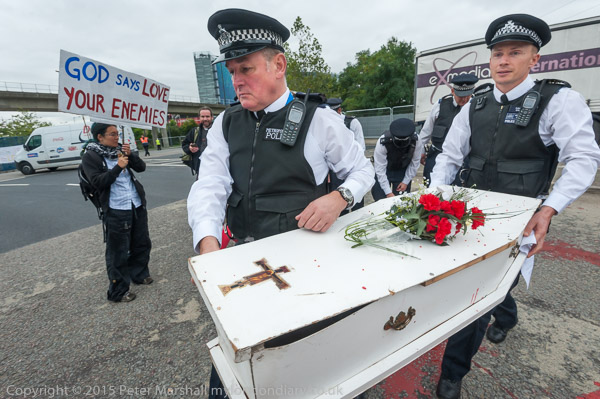
The following day was a day led by faith protesters with a DSEi: Pax Christi Vigil which was followed by a Catholic Workers Funeral

procession and service, which ended with them occupying the road to stop traffic. They continued to block the road for quite a while until police finally forced them to the pavement, with officers picking up and carrying the mock coffin.

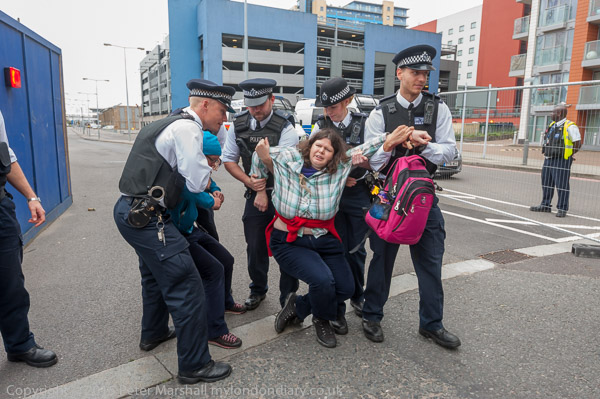
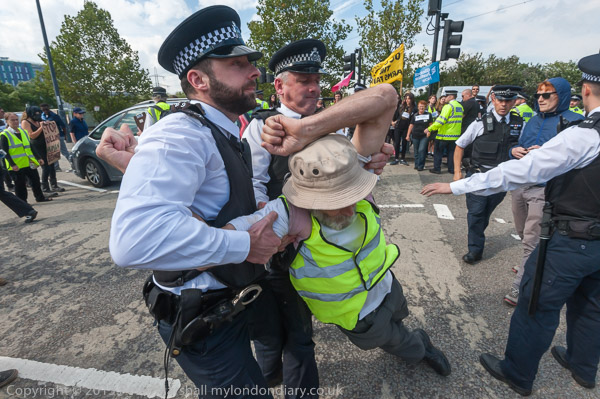
Later that day a small group of Christian campaigners, Put Down the Sword, made their way to the other entrance to the former dock site including the centre where the arms fair was being held and blocked all traffic for around an hour before police finally dragged them away.

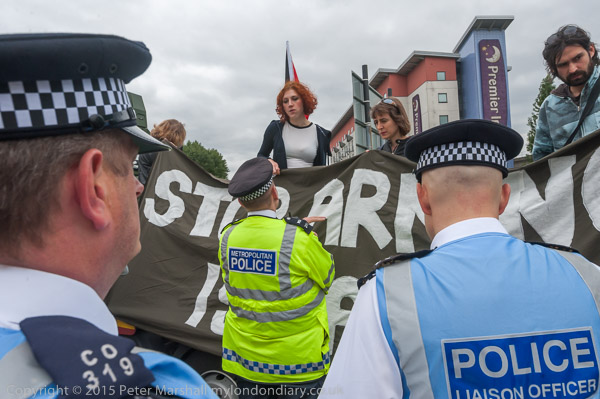
I couldn’t attend every day of the protests at DSEi, as other things were also happening that week in London, but three days later returned for Refugees Welcome, Arms Dealers NOT, where protesters dressed as and alternative Border Force again moved onto the road and stopped traffic going into the arms fair, moving back to the road a number of times after police dragged them off.

Of course, these actions didn’t prevent the arms fair, and attracted very little attention in the mass media – arms sales are big business and big businesses fund much of our media through advertising for their less lethal products. But they did make clear the opposition many feel to the arms trade and the way it profits from the conflicts that it fuels around the globe.

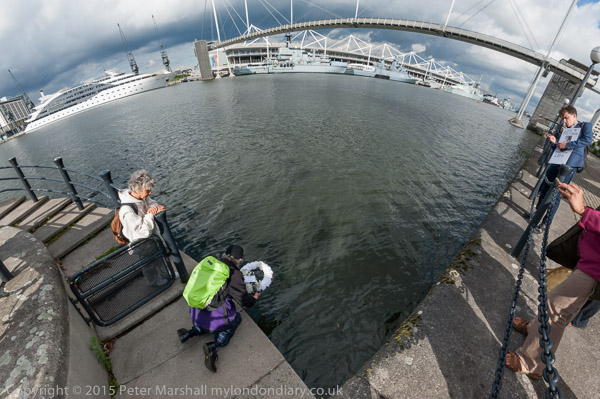
While the arms fair was taking place there were further protests. As on previous occasions local people opposed to it organised a procession to lay a Wreath for Victims of the Arms Trade. There is high security around the actual event, and the bridge across the dock is closed and the group walks in procession around to a point on the opposite side of the Royal Victoria Dock to lay the wreath on the water.

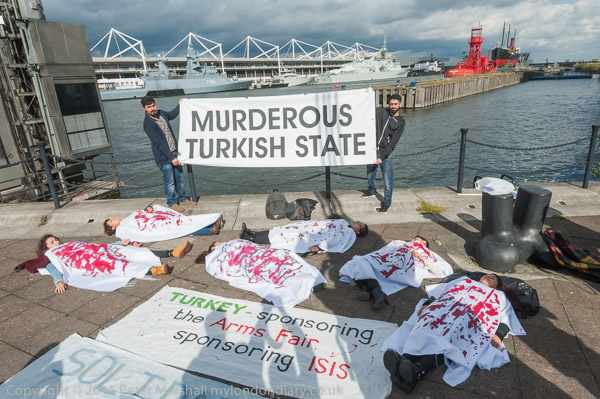
Also on the same afternoon, a group of Kurds came on the same route to say Stop arms sales to Turkey and some dressed in fake blood-stained white shrouds staged a die-in on the dockside opposite the fair, in view of those attending and visiting the naval display in the dock.

The Kurds say that Turkey sponsors ISIS both by turning a blind eye to its military operations against the Kurds and active support in supplying arms and refining and smuggling large exports of oil from ISIS held oil-fields that bring millions in to fund them.

Continue reading Arms Fair

Woolwich to Darent

I’ve been taking something of a rest from photography for a few days, partly on health grounds, with some minor issues meaning I don’t feel up to carrying a heavy camera bag around or standing around for hours, and that’s given me a chance to get a few projects finished.  Included among this are three books, the first of which, German Indications, I posted about  a few days ago.

Also now completed is Woolwich to the Darent, the first of three books on an extensive project which I mainly worked on in 1985-6 in Greater London and North Kent in the industrial areas along the shore of the River Thames and the estuary. You can see a limited preview above which shows around half the book.

As usual I recommend the PDF version, both for its better reproduction and rather more sensible price. You can also download and view it more or less instantly, while print orders take a week or two to be produced and dispatched by Blurb.

When I talked with some of the management of Blurb a few years back, I suggested they should look up more cost-effective delivery for their books, particularly for small orders, but they don’t seem to have done so. I don’t yet have any print copies, but I will be selling them later for those in the UK at £25 plus £2.00 for postage.

Those with long memories may remember some posts here where I shared a few of the pictures from this back in 2014, Around Erith, 1985South of the Thames, North Kent 1985: Rosherville, and Gravesend & Rosherville 1985.

The title has turned out to be a little misleading. There are no pictures actually taken in the town of Woolwich, though there were a couple in the original set, which got eliminated from the final version. Back when I took the pictures a large area of the riverside east of the town centre was still occupied by the Ministry of Defence and not accessible to the public – and I think there were still notices prohibiting photography around it.

But Woolwich – since 1965 a part of the London Borough of Greenwich – used to include the whole of the Royal Arsenal site, the eastern part of which by the time I went there was Thamesmead, already a large estate for London’s overspill. On some of the older maps that I looked at, the whole area was still left blank in a rather pointless attempt at official secrecy as  German maps in WW2 and cold war Russian maps showed considerable detail! But even the modern maps for parts of the area open to the public were not too reliable, with some paths not shown and others on the maps fenced off.

Today things are different, with the Thames Path Extension now going all the way to Crayford Ness. It makes a pleasant walk or cycle in good weather, although there have been quite a few changes, and I’ve been back a few times taking pictures – including some in my Thamesgate Panoramas, which really does start at Woolwich, but goes on rather further east to Gravesend.
Continue reading Woolwich to Darent

Transparency Woes

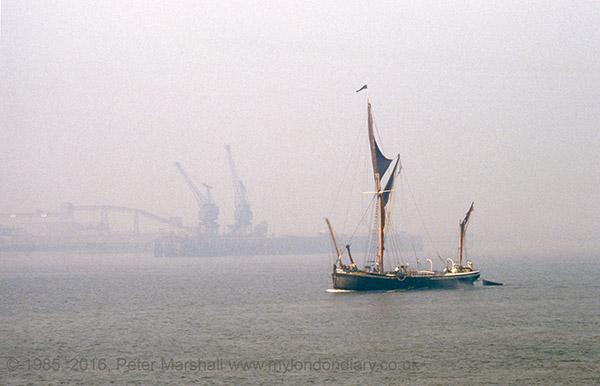
My trans-hate is directed solely at colour transparencies – such as this one which I took – I think – in 1984. I’ve almost always hated colour reversal film, though my earliest experiences with it, photographing an attractive young lady in a blossom-filled peach tree in my back garden were positive (though I rather hope none of the images survives) but, like that early romance, my romance with Agfachrome and Kodachrome was brief.

I wasn’t then a photographer. I had a camera and could afford to put perhaps one or at most two films a year through it – enough for a few holiday snaps, though sometimes one film would stretch to a couple of years. I didn’t have a projector, but my stepmother did and produced various out of focus and arbitrarily framed images largely of ageing relatives in their back gardens as well as a few or my father in the middle distance in front of a beach or cliffs (and he was handed the camera for a few similar if slightly sharper images of her) which would be projected as ‘entertainment’ at some family events.

The technical quality of the images wasn’t entirely her fault, as the Boot’s camera she used wasn’t the most capable of instruments. My own, a Halina 35X, long admired nose to glass at the local pawnbrokers (it made it there a year or two  before the 1959 given as the date of introduction in the web article),  and which had been bought with several years of saved pennies from my inadequate pocket money, was far more advanced, and did quite well until I dropped it in the lake at Versailles.


Paris image after pre-soak in the lake at Versailles before processing

Ten years later, when I finally dragged myself away from being an impecunious student and got a full-time job, one of my early purchases was a cheap Russian camera, a Zenith B. The B I think stood for ‘brick’, but while it was crude and chunky, at least (unlike their rangefinder I also tried) it had a reasonably accurate viewfinder, and most of the Russian lenses were decent copies of the German lenses whose designs had been a part of post-war reparations. Along with the camera I also bought a cheap Russian enlarger that folded up into a large box, some black plastic sheeting, plastic seed trays without holes in the bottom and a Paterson developing tank and converted first our spare bedroom and later the kitchen into a makeshift darkroom.

Black and white was then what serious photographers used and I spent much of my non-working time immersed in its chemistry, mainly keeping the colour transparencies for my holiday snaps. Before I set up my own darkroom, black and white had been an expensive option, but with 100 ft rolls of bulk film and box upon box of outdated paper it was now almost free (if not always in perfect condition.)

I’d retained an interest in colour, but now that seemed rather expensive although I fortunately won a decent-size block of Kodachrome in a competition – and that included processing. But otherwise the costs seemed high. I flirted briefly with Orwo – East German colour film based on the 1930s Afga patents at its orginal Wolfen plant, but found its strange purplish shadows and uncontrollable repulsive.

Also rather cheaper than Agfa or Kodak films were those produced in Italy by 3M/Ferrania and sold under various other names as well as the makers. When this also became available in bulk lengths I found that Paterson tank could process it (if not always quite perfectly with the aid of cheap third-party chemicals) and began to take more colour transparencies.

But apart from the vagaries of processing (and cheap commercial processing wasn’t always too reliable either) the limited ability of the transparency film to cope with anything other than flat lighting often disappointed. By then I’d move onto and Olympus OM1 and that had reliable through the lens metering, but it was still too easy to get over or under exposure, and with high contrast subjects empty black shadows were inevitable.

Colour print film was more forgiving in terms of exposure, but the cost of printing was high and it was considered unsuitable for reproduction. Outside of social photography, few serious photographers used it – clients demanded transparencies. It was largely an amateur medium for snaps of family and friends (though too expensive for cats and meals to feature much at that time – they had to wait for digital to take over) and the products available reflected this, not least in their relatively rapid fading and discolouration.

It was Fuji who changed this – at least so far as I was concerned. Their research led to longer-lasting dyes and purer colour in their negative films, which Kodak had rather neglected. Perhaps because they failed to give me a job when I went to Harrow for an interview when I first graduated as a chemist. They told me it was because they didn’t think I was interested enough in photography, but I felt it was more my working class background – photography back in the mid-1960s was still largely a middle-class hobby and Kodak management in the UK certainly reflected that.

Photographers of some note in the 1980s began to produce colour prints that excited me, and I found many were working with colour negative film. So in October 1985 I changed to Fuji colour negative films and paper for my personal colour work. After that date if I took a colour transparency it was because I was paid specifically to do so. Fuji’s lead also prodded Kodak into action, and later I found Kodak negative films I could use, though mainly I stayed with Fuji, and when I set up a colour paper processor in my darkroom it fed exclusively on their paper.

A little over 10 years later came another development that changed things for me, when I bought my first film scanner. With the possibility of supplying digital images from colour neg there seemed to be no reason ever to use transparency film again.

My problems with slides don’t stop there. Good filing systems for slides were expensive to set up, and whereas with negative materials you could label them on the negative filing sheet or contact sheet, slides required individual labelling. For projection they had to be in slide mounts (and at best in behind glass) but the mounts covered the edges of the images and usually they had to be removed for printing.

I never had the space, the money or the time to set up a good filing system for my slides. Only a minority ever got labelled, and over time some of that labelling on the slide mount got lost as slides were unmounted and remounted – sometimes in the wrong mount. Slides removed for projection didn’t always get back into the right filing pages. Although not completely chaotic, my slide filing system is certainly a mess.

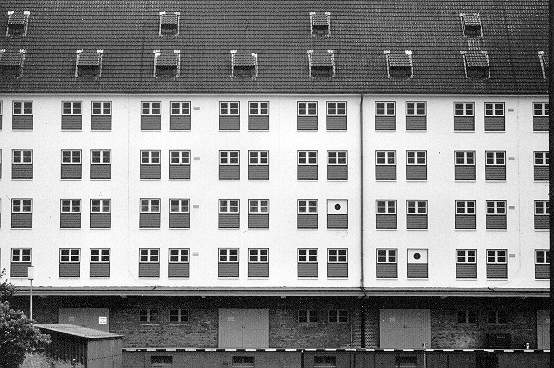
In making German Indications I spent several days searching through for one particular image of a German factory building, but without success. I made a low-res black and white scan of it from the print (which is also now missing) in 1997 but that print was made in 1986 and I think the slide has been lost since then.


You’ll have to imagine the colour as I only owned a black and white scanner in 1997

Having to send slides – the original image – out to clients or for processing was always a slightly risky business. If they were to be reproduced in print they were often returned with fingerprints across them – print technicians were often rather careless especially I think with 35mm transparencies which they rather looked down on. Sometimes slides did get lost or badly damaged, and although I did get some compensation it was never more than nominal.

The image at the top of this piece certainly shows a barge in sail on the River Thames, but where or when I can’t now be sure. The folder the slide was in says 1984 and that seems likely, but the background could be a sand and gravel wharf almost anywhere on the lower Thames. I suspect from the width of the river (I think I was probably standing on the riverbank rather than in a boat) it may be at Greenwich, but despite this I’ve used it as the frontispiece – and the only colour image – in my other new book completed this week, Woolwich to the Darent – more about which in another post. It just seemed a picture that seemed to fit with the atmosphere and mood of the river and the book.

German Indications

One of the reasons I’ve not posted here for a few days is that I’ve been busy finishing a couple of books, though there have been other issues. But the preview above shows you about half of one of the new books, best viewed at full screen by clicking the symbol, so that you can actually read the several pages of text.

When I showed this work in 1986 it had around 30 images, 11 in colour, and the same set of nine texts that are now in the finished work. In 1997 I posted a version of it on the web, but as I only had a black and white scanner, the images were all black and white, though some I later replaced with colour versions.

The book now has 29 images in black and white and 39 in colour, and contains all except one of the original set – one transparency has been lost. The images were a similar size to that at which they appear in the printed book, and those in colour were made on an Agfa direct reversal paper which I used to try and match what I saw as the Germanic mood of the original scenes. All have been re-scanned for the current publication and are closer to the original transparencies.

Like much of what I photographed, that paper was past its best-before date and gave the images a rather gloomy and melodramatic character. The black and white images were also printed on a German paper, Agfa Record Rapid, then my favourite black and white paper, though in later years after it was reformulated to remove Cadmium it was never the same.

Now it would be easy to print out the texts in high quality at a suitable size, but back then home computers only knew dot-matrix printers. I typed out the stories using an electric typewriter for clarity, but they were really a little small for the exhibition wall. I found a few typing errors and other minor errors when getting them ready for this version.

As usual, I recommend the PDF version of German Indications, ISBN 978-1-909363-16-8, which you can download from Blurb immediately for £4.99. There is also a print version available from Blurb – and I will shortly have copies available for UK addresses at a little less than the Blurb prices, probably at £27 inc postage.

Take a walk with me

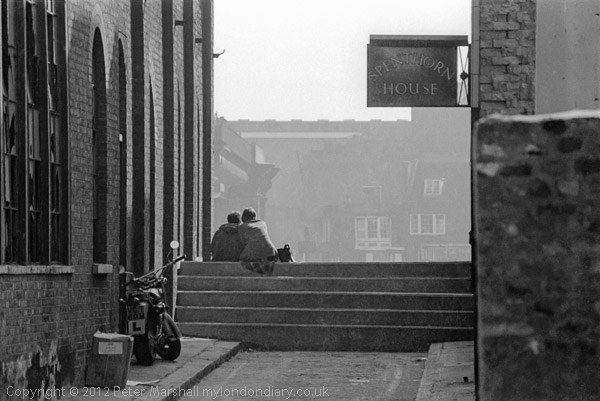
Take a walk with me through a London, much of which has disappeared or changed dramatically” it says in the introduction to my set of pictures in the web site London Dérives, and the walk starts at Cousin Lane in the City of London in 1974 with an L plate and a couple snuggling together on the steps overlooking the Thames, and ends around 190 pictures later in Rectory Gardens, Clapham in 1983.

Some of the images from this set were published in my book, London Dérives – London 1975-83 and still available on Blurb (or direct from me to UK addresses only.)  On Blurb can also download a PDF of the book, which has the advantage of being considerably cheaper at £4.50 and having better quality images and being on your computer within minutes.

The blurb on Blurb states:

London Dérives
ISBN 978-1-909363-08-3

“People well know that there are gloomy quarters and others that are pleasant. But they generally convince themselves that the smart streets give a sense of pleasure and that the poor streets depress, without any nuance. In fact, the the variety of possible combinations of ambiances, like the solution of chemical substances into an infinite number of mixtures leads to feelings as different and as complex as arise from any other form of spectacle. “

Pictures from numerous walks “without goal” through London in the mid 1970s and early 1980s which aimed to capture some of the nuances of that city.