Mario Cravo Neto

One of the minor disadvantages of living just outside London is the time and expense of getting to events taking place there. I have to make an effort to go to events such as tonight’s opening at Autograph of photographs by the late Brazilian photographer Mario Cravo Neto (1947-2009), and I just don’t have the time – and unless I’m up in London for other reasons its often hard to persuade myself to do so for openings. But I will certainly find time when I’m in London before the show ends on 2nd April 2016 to pay a visit to Rivington Place in Shoreditch, London.

One of the things I most enjoyed doing and which I thought was most important when I was employed to write about photography on the web was a series of articles of photography in various countries around the world, in part to get away from what appeared to be the assumption of many that the only important things happening in photography – at least since the start of the 20th century – were made in the USA. (Not that I neglected the USA, and I also wrote extensively about American photographers, particularly those involved in the New York Photo League, some of whom I felt were being forgotten.)

And although I wrote about photography in various countries around the world, in Europe, Asia, Africa and Australasia, the backbone of my series was the countries of Central and Southern America, which I tackled in alphabetical order. Brazil thus came fairly early in the series, which followed a fairly standard pattern, beginning with and introduction to the country and what I could glean about the early history of photography there (French-born inventor Hercules Florence living in the Sao Paulo region was apparently using a camera before that Mr Talbot at Lacock) and continuing on into the 20th century and ending with a short text about post-war and contemporary photographers. I wrote about around a dozen from Brazil, including this paragraph:

Mário Cravo Neto comes from Bahia, and his work incorporates references to the voodoo religion of that region, using indigenous people as actors holding objects often of ritual significance. He trained a sculptor like his father before turning to photography and his work shows a strong, tactile appreciation of texture.

It’s rather brief but to the point, though I might also have commented on the richness of both his black and white and colour work, but I did also make links to any web sites where his work could be seen, though in 2000 these were few. Things are rather easier now. There is a set on  Lensculture for the Autograph show, and an extensive web site on the Project ‘Black Gods in Exile’ with work by him and Pierre Verger, another photographer who featured in my article.
D5 or not D5?

We can get some idea of the quality of the extreme ISO pictures on the new Nikon D5 from some sample image by Leon Ostrom of Randorn in a post on PetaPixel.

Not able to take away any images on a memory card, he photographed a series of test shots on the Nikon stand at CES 2016, then photographed the results displayed on the LCD screen on the back of the camera, both showing the full frame and a magnified detail, at Hi-1 (ISO 204,800) to Hi-5 (ISO 3,280,000).

Although these are only pictures of the image on the LCD screen.they give a very good impression of the possibilities of the camera, although the actual images could be greatly improved by appropriate noise reduction in post. Most impressive is the quality at Hi-1, which of course drops off as amplification increases. Hi-2 (IS0 409,600) looks to be usable for many purposes after noise reduction, while higher ISOs are distinctly emergency only.

Its a remarkable achievement, and one that makes me lust after the D5, though it isn’t a feeling I can sustain for long given the price and weight of the camera. But certainly it does make me hope for better high ISO and more affordable and lighter new models from Nikon. Even going back to DX with the D500 might be an option.

It also is a stark reminder of the ridiculous nature of the arithmetic ASA system. which was incorporated into ISO along with the much more sensible logarithmic DIN scale, where a one stop difference is an increase in 3, which makes it much easier especially when the ASA numbers get astronomical.

Back in the days of Tri-X, it was a 400/27 film (though we actually often rated it differently depending on which developer we were using and how we liked our negatives.) But its a good starting point for thinking about film speeds, and my starting point for this little table (more about film speeds for geeks on Wikipedia):

ASA	Din
400	27
800	30
1600	33
3200	36
6400	39
12800	42
25600	45
51200	48
102400	51
204800	54
409600	57
819200	60
1638400	63
3280000	66

Either using this little table (or being able to divide by three) you can see that Hi-2 gives us a 10 stop advantage over Tri-X (or 8 stops over Tri-X pushed a couple of stops) which is certainly not to be sneezed at.

With the D700 and D810 I’m now working with, the practical limit I find is around ISO 6400 – so the D5 is performing at around 5 or 6 stops down the scale better. The D4 and Sony A7SII both claimed 409600 in 2014, so the D5 claims 3 stops more than them. It does seem pretty remarkable.

Vivian Maier – Digging Deeper

I was about to post this as a comment to my post last week, Vivian Maier Still in Hiding, but then I thought people often miss the comments, so instead this short post.

On yesterday’s Lens Blog I read a summary the first part of Digging Deeper Into Vivian Maier’s Past with the second instalment promised for today and probably there by now. Its a summary of a longer feature on the Vivian Maier Developed blog, where you can also read Part 2 – A Life in Pictures.

The researcher, Ann Markswho has no background in photography and started researching Maier only after seeing a documentary about her life — has learned a great deal about Maier’s family history“, some of which had also been uncovered by the sources in my previous piece.

It amplifies what was already known about her background, and the confirms the speculations about the closeness of her link with a photographer: “From early childhood, Maier spent a significant amount of time with a woman named Jeanne Bertrand, who worked as a professional photographer, as well as other positive female role models” and throws a great deal of light on what was a rather disturbed life. And I await today’s second part with interest.

What it won’t do is tell us any more about her as a photographer, and for that we will have to await detailed studies of the whole of her work – which appears to have been kept together by her tenaciously while she was able to do so – rather than the selected examples that we have so far seen. The second part does give some insight into how her photography developed, although unfortunately at least some of the illustrations there appear to be reproduced at the incorrect aspect ratio.

So far I remain unconvinced that she was anything more than a very capable and talented photographer able to imitate the styles of others. My question if there was a real photographic ‘Vivian Maier’ who had something distinctive to say remains unanswered.

Mendelsohn’s Balsall Heath

An article in The Guardian brought to my attention the work of American photographer Janet Mendelsohn, a Harvard graduate who in 1967 came to study with Stuart Hall and Richard Hoggart at the ground-breaking Birmingham Centre for Contemporary Cultural Studies. Forgotten for years, her work which she made use of photography as “a tool for cultural analysis” in a multi-racial area undergoing a radical transformation through immigration and dire poverty, was rediscovered when Kieran Connell, who was curating a show for the 50th anniversary of the centre, became obsessed by a photograph of hers on the cover of its 1969 annual report.

It took considerable detective work by Connell to find out more about the photographer, but when he finally managed to contact her sent back the request “Please take these photographs off my hands” and sent him a large box with several hundred prints and 3,000 negatives.

Some of these were from a project in the red-light area of Varna Road in Balsall Heath, and it is this series which is the basis of the newspaper article, as well as a forthcoming show at the Ikon Gallery in Birmingham (PDF press release here) and a free symposium at the end of January at Birmingham University with speakers including Magnum photographer Susan Meiselas, artist Mishka Henner, UCL History Professor Catherine Hall and curator and photographic historian Pete James.

One classmate of Mendelsohn’s at Harvard was film-maker Dick Rogers, (1944-2002) who also went to study in Birmingham with Hall and Hoggart for two years, after which he returned to Harvard to study on a Visual Education programme where he met his future wife Susan Meiselas.

Mendelsohn worked with Rogers on his first film, Quarry (1970). His best-known work, Pictures from a Revolution (1991) retraces Meiselas’s work on her photo essay ‘Nicaragua: June 1978-July 1979‘. In an earlier film, 226-1690 (1994) he used recordings left on his phone answering machine from her when there including one with a gunshot in the background.

Some of Mendelsohn’s work was shown last July in ‘The Ghost Streets of Balsall Heath‘ at The Old Print Works, Moseley Road, Balsall Heath as a part of the Flat Pack Festival.

Marathon Day

Saturday August 15th last year was something of a marathon day for me, with nine of the roughly 20 stories from the month. I’d left home that morning with a fairly ambitious schedule, five events spread out across the day from 10am until around 8pm, and came across a few more things to add as I travelled around.

My day started outside the National Gallery where there was a rally by the PCS strikers at the end of the morning picket on the 61st day of their strike against privatisation and calling for the reinstatement of victimised union rep Candy Udwin.

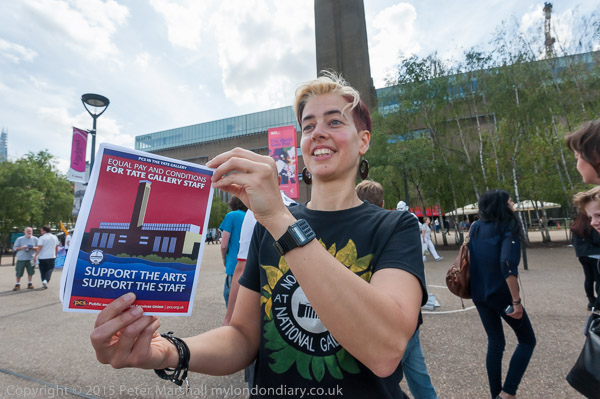
Joining in the protest there had been people from the Tate Gallery, where some privatisation has already taken place, with privatised gallery assistants getting paid £3 an hour less than their directly employed colleagues doing the same job, as well as minimal conditions of employment and zero hours contracts that fail to give them predictable hours or income.

I went on to photograph their protest outside of Tate Modern, where Equalitate were handing out leaflets to the busy crowds walking past there, before leaving and taking the bus back to Aldwych and the Indian embassy.

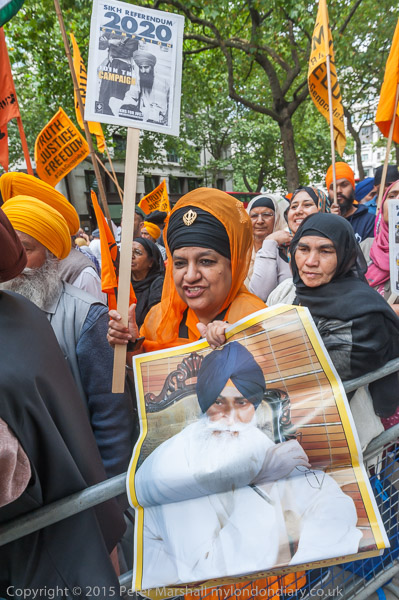
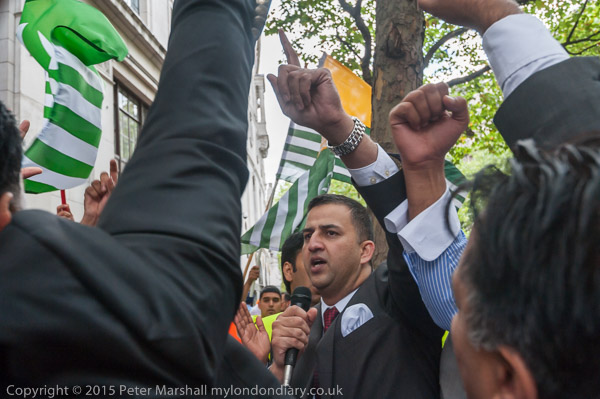
I’d come here for a protest by Sikhs on Indian Independence Day supporting the call by hunger striker Bapu Surat Singh for the release of Sikh political prisoners, but found that there was also a protest by Kashmiris.

Kashmir is a disputed territory with areas occupied by India, Pakistan and China., and Independence Day is observed as ‘black day’ in Indian military occupied Kashmir. The Kashmiris want freedom for their country and the protest became quite heated at times.

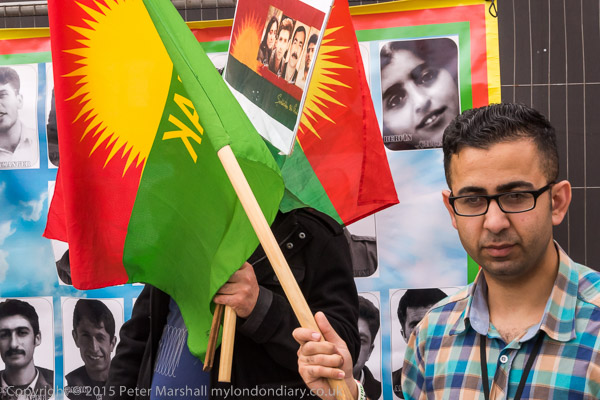
Back in Trafalgar Square there were also two events taking place. The  Party of Free Life of Kurdistan (PJAK),  an Iranian Kurdish group formed to fight against the Iranian regime for self-determination for Kurds in Iran and based close to the Iranian border in Iraq were celebrating their martyrs with flags, banners and posters showing their faces.

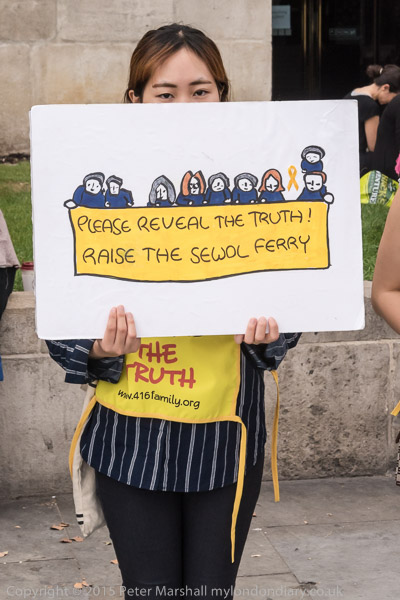
A short distance away was the regular monthly protest mainly by Koreans over the Sewol Ferry disaster, calling for changes in the Korean law and a full inquiry into the disaster which killed so many schoolchildren who were told to ‘stay put’ on the lower decks as the ship went down.

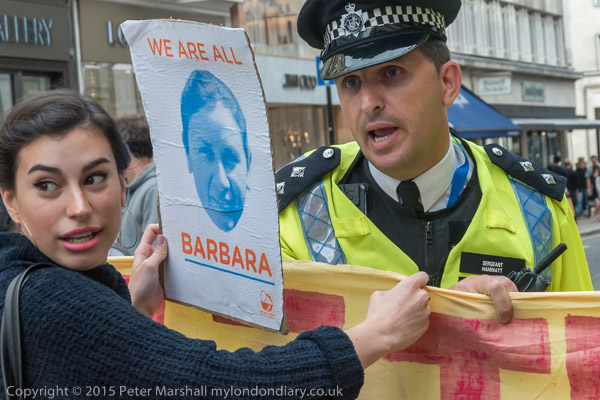
Next was another in the series of protests by United Voices of the World at Sothebys in New Bond St, where two workers remained sacked following an earlier protest calling for better conditions of service – sick pay, holidays and pensions – for the outsourced workers who clean Sothebys.  As usual there was a certain amount of friction between the protesters and police who tried to limit their protest.

But on this occasion there were fewer police than previously, and they were less forceful in their intervention, largely trying to persuade rather than using force. By the time this protest ended I was tired and ready for home, but there was one last event I wanted to cover.

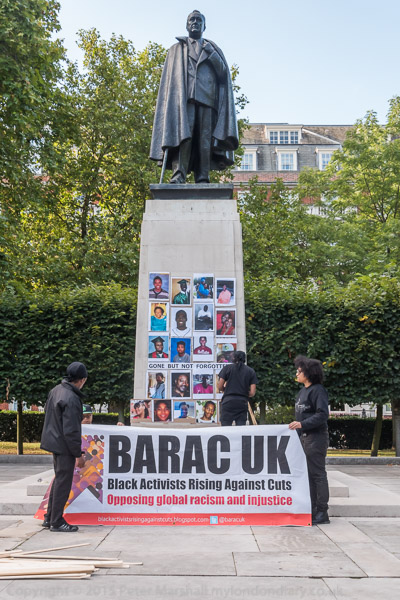
BlackoutLDN solidarity with Black US victims took place not as I had expected outside the US Embassy, but a short distance away inside the garden in Grosvenor Square, where there is a statue commemoration President Franklin D Roosevelt. It was an unusual event with contributions from a number of individuals and groups including BARAC and the Nation of Islam, and as well as speeches there were songs and poems. But I was getting tired and had to leave before the final lighting of the candles as it began to get dark.

I had been on my feet too long, and my legs were suffering. I had to rest for a few days after this to get fit for the week’s holiday that was coming up.  During the day I’d also taken a few pictures as I travelled around London, which are in London Views. Altogether I’d taken a ridiculous number of pictures – after deleting those which were obviously unusable I was still left with around 1,600 – around 25Gb of RAW files. Far too many!

It’s good to be able to report that all three of the industrial disputes that I photographed on that day have since then been successfully resolved.
Continue reading Marathon Day

As Drik as Possible

I’ve written on a number of occasions here and elsewhere about Shaidul Alam and Drik, most recently on the agency’s 25th anniversary. The idea of people in the majority world telling their own stories is one which has always seemed important to me, and I have a healthy distrust of some of the efforts of celebrity western journalists and photographers who  sometimes work with little real idea of the society and background to the events they are covering. It’s great to read a truly inspirational success story about Bangladesh, and how they have overcome so many problems. Optimism, a strong belief in what they are doing, the willingness to take serious risks and continuing hard work have been rewarded.

It goes a little deeper than that. Even when I look at how life in my own country and city gets represented though the media I’m often aware of a concentration on the froth and the failure to really understand or show the realities of life for the majority of our citizens. Of course there are some notable exceptions, but we really need a grass-roots photography movement too, as well as publishing on-line and in print that supports it.

The story of Drik, told in Alam’s blog post As Drik as Possible, is an introduction to the 2016 Drik Calendar, and tells a little of the storyand there is a little more about it on Flickr. You can also see a larger album of over 600 of Alam’s pictures of Bangladesh.

My London Diary update

A new year has also dawned for ‘My London Diary‘ with a slight re-design of the main monthly page. It’s a slightly cleaner look but also fixed a couple of little niggles which had begun to worry me with the earlier design – here’s the top of the  Jan 2015 page to illustrate some of the difference:

The site title, ‘my london diary‘ is now more prominent, and importantly it will remain visible when users scroll down the page as the left panel is fixed – at least in Firefox, the browser I use and design the site for, though it usually works with slight differences in others as well. I should really test it in other browsers, but I’m a photographer not a web designer and life is too short. The site isn’t ‘mobile friendly’ but it does seem to work quite well when I look at it on my smartphone using Chrome.

When I add more stories from January, there should also be a difference in how the scroll bar appears.

I’ve moved the ‘my london diary index’ link down to the bottom of the left panel and also moved the site search slightly to make it stand out a little more. Basically I gave up with the ‘site index’ back in 2007, because there were just too many stories to make a sensible index, and went over to simply copying the story lists onto a page. But that got out of hand too, and unless you know the date of a story, the only sensible thing to do is to use the site search – as I always do.

Perhaps one day I’ll come up with a better idea for an index – which is why I’ve left the link there, but I’m not sure it’s going to happen. It’s quite a task, as of today there are now apparently 128,162 images on the site from around 16 years of work.
Continue reading My London Diary update

December 2015 complete


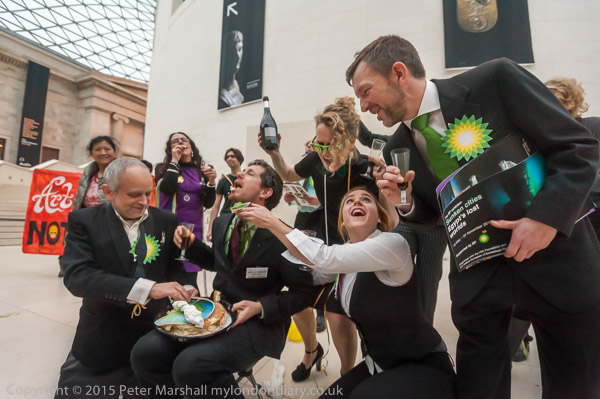
‘BP executives’ ply leaving British Museum director ‘Neil MacGregor’ with food and drink

Christmas and New Year are over and people are getting back to work. Including thank goodness my dentist, and I have an appointment this morning that I hope will put an end to my toothache – Christmas was just too much strain for a couple of my teeth.

I can’t really complain about dentists taking some time off over Christmas. After all I really stopped work on the 20th, and the later posts are really from activities with my family over the holiday season, although they hardly appear in them. I do take pictures of them, particularly of my two grand-daughters, but I don’t like to put them on line. I don’t think they are likely to be of any more interest to those outside the family than anyone else’s family pictures.

Of course I have put family pictures on the web – they were the subject of my very first web site, and I wrote a little about them and the family pictures of some other photographers a few months ago in ‘In the Family Way.’ But most are best kept in the family, along with a few other private events where I share images just with those involved.

One of the highlights of the month was a commission to photograph the unscheduled performance in the Grand Court of the British Museum by the artist protesters of ‘BP or not BP‘ opposed to the climate-wrecking oil giant’s sponsorship of the museum and other arts venues which they do to improve their image at a relatively low cost rather than clean up their act.

This was in some respects a private event, a ‘flash’ performance with no advance publicity and no permission from the museum on whose premises it took place. Another photographer was there to make a video, and one other had been invited to try to sell work to the press. Of course many of the visitors to the museum who saw the event also stopped to take photographs, but it was still rather easier to work than events where a crowd of other photographers is present.

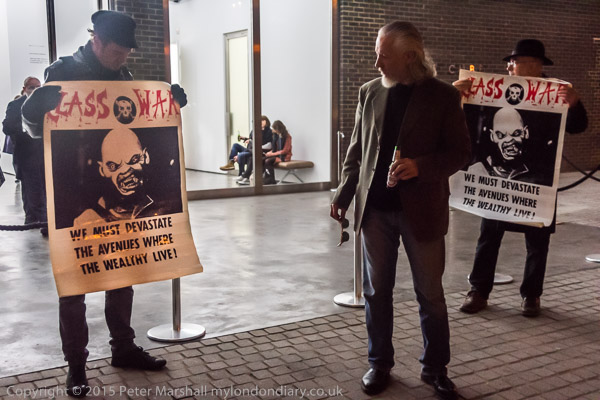
There are other events at which I’m the only photographer present – sometimes like this one because they are kept secret or as least not widely publicised – such the pair of Class War protesters at the White Cube Gallery – and others where photographers and agencies just don’t think they are newsworthy enough to make the effort.

While I can’t get to everything that happens, I started covering protests seriously because so many got no publicity. Things have changed a little since then, with many more photographers now covering protests even though they generally get even less coverage in the media, thanks to the ease of digital and the rise of ‘citizen journalism’, this largely means that ‘popular’ protests attract hordes with cameras while many smaller events are still recorded by only one or two of us.

Dec 2015

Belper – World Heritage Site
Cromford – World Heritage Site
Staines & Wraysbury Walk
Boxing Day Walk
End BP’s British Museum Greenwash
Don’t Buy Tiffany ‘Blood Diamonds’
Solidarity with Sweets Way arrestees
‘One Voice for the Dolphins of Taiji’
Phulbari coal mine protest


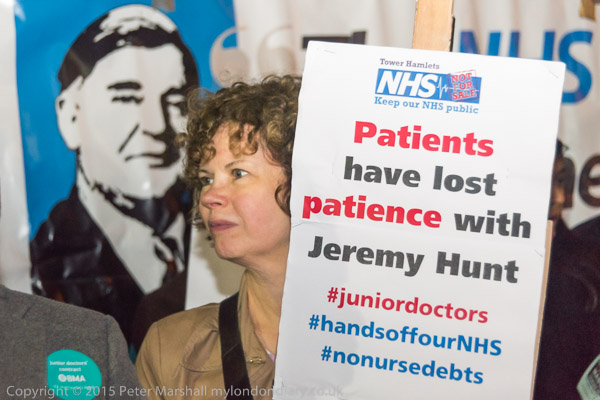
Christmas Rally For The NHS
Santas in London


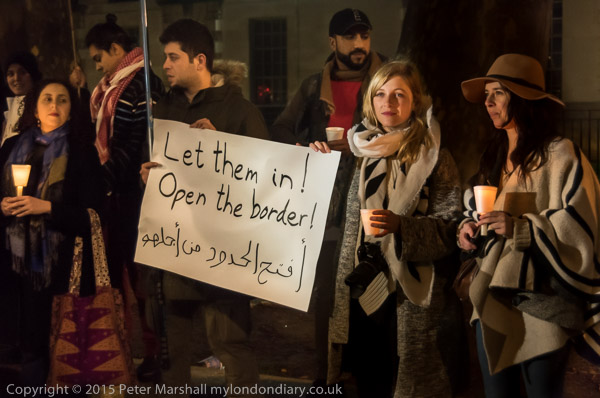
Christmas Solidarity Vigil for Refugees


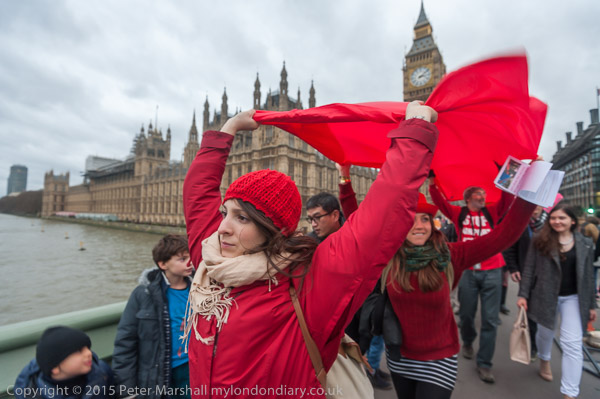
Climate Activists Red Line protest
Free the Focus E15 Table


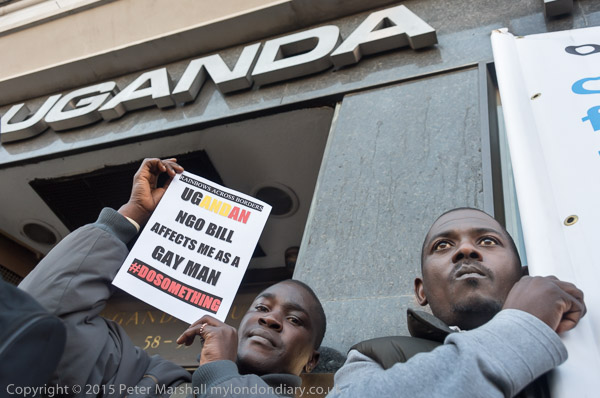
Ugandan President – don’t sign anti-gay bill
No forced medical treatment for unemployed
Class War at Gilbert & George ‘Banners’
Bloody Murder at Ripper ‘museum’
Short Walks in Windsor


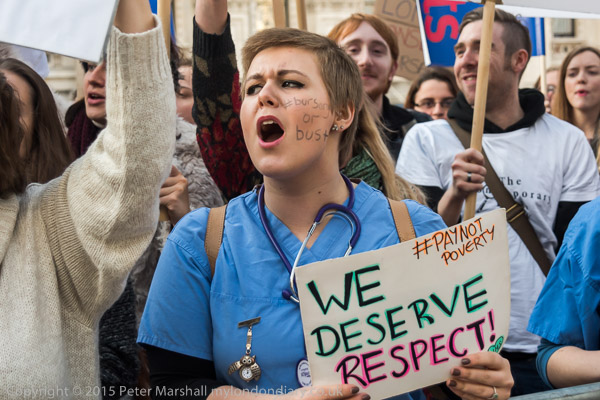
Save NHS Student Bursaries


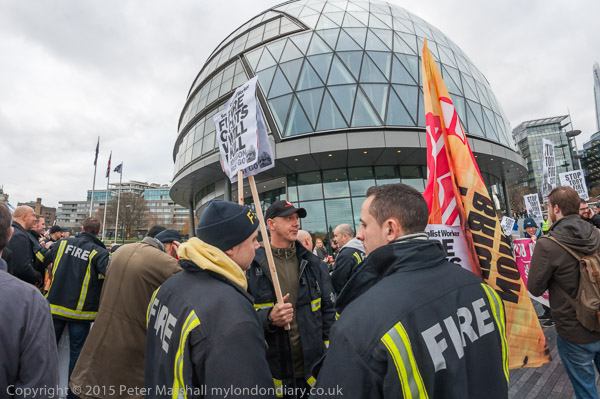
Firefighters say cuts endanger London
Don’t Bomb Syria
London Images

As well as pictures of events etc I’ve also decided to add a monthly section with some of occasional images I take as I travel around London, often from the top deck of a bus or train window.


Some Stats

>RE:PHOTO Dec 2015
Visits: 126,357
Page Views: 361,839
1.12 mins
2.88 pages
Ave Views per day: 11,672
Highest PV per day: 16,264 (Dec 17)

>RE:PHOTO  Year 2015 total
Visits: 1,622,248
Page Views: 3,855,303
1.9 mins
2.39 pages
Ave Views per day: 10,562

All my domains Year 2015 total
Visits: 2,646,880
Page Views: 7,460,850
1.14 mins
2.87 pages
Ave Views per day: 20,440

Continue reading December 2015 complete

New Year thoughts

I’ve tried hard not to add significantly to the barrow-loads of reviews of the year 2015, lists of the best photographs of the past year etc, as well as resolutions for 2016. Mostly they are excuses for writers having a week or two off over Christmas and the New Year and ignoring as much of what is happening as they can as they enjoy eating an drinking immoderately. And I have to admit that it’s something I’ve enjoyed taking advantage of in the past, and we all do need a rest from time to time.

I even sneaked a look at one or two of those compilations of the ‘best images of 2015’, though I found them in the main disappointing; too many pictures of politicians, sometimes obscure to those of us not the the USA doing nothing very interesting, and relatively few images that will stand the test of time.

It all makes for a good time for politicians to sneak out controversial announcements on the day when most MPs have already left for the Christmas break, knowing that the papers will mainly have their minds fixed on different things. But this year the Christmas break for many UK journalists and photographers was rudely interrupted by torrential rain causing flooding in cities, towns and villages in the northern half of England and parts of Scotland.

Terrible though this was for those who were flooded out – and having been an inch or two from the water coming into my own home for several weeks in 2014 and knowing others close by flooded I felt for them, as did most of the rest of the nation, though we didn’t let it spoil our celebrations. And even if a lost filling and some painful toothache hadn’t been making my own life something of a misery I wouldn’t have felt I could have contributed anything by travelling a couple of hundred miles to photograph other people’s troubles which were already being covered by so many photographers.

Possibly something good may come out of the floods. Perhaps they will have finally silenced the climate change deniers and several articles have appeared in newspapers suggesting a need to adopt sensible policies to lower the risk of further flooding. We may now see measures to slow run-off from agricultural land (including re-afforestation, semi-permeable barriers and reductions in sheep grazing and maize growing) and any new building in flood plains being designed with flooding in mind.

As for new year, I’d like it to be moved back to March 25th, where it was celebrated in England up to 1751. Perhaps then we could avoid the ridiculous almost two weeks of shutdown that we now get in midwinter that has me waiting so long for my dentist to come back to work. The Feast of the Annunciation, or ‘Lady Day’ marked the beginning of the agricultural year, and was when it changed from being one year to the next – so the day after March 25th 1715 was March 26th 1716.

Photographic new year jobs

But we do differently now, and I’ve just been performing some of the photographic rituals (yes, eventually this post gets around to photography) for the change in the year to 2016. If you, like me, file images by date, now is the time to set up folders for the new year 2016.

Lightroom too needs attention – as an e-mail from the Lightroom Queen Victoria Bampton reminded me. I’ve decided now to change to a new Lightroom catalogue each year, labelled with the year. I’ve found LR works much better if you don’t grow your catalogues too large. Yesterday I finished processing the images from 31st Dec 2015 and backed up the 2015 catalogue, then created a new catalogue for 2016.

It’s also worth deleting some of the old catalogue backups, though I like to keep a couple as well as the most recent, just in case one is corrupted.

Lightroom presets also need updating, in particular the import preset that I use to write copyright and contact information into every image I add to Lightroom. You do this from the import dialogue by selecting the preset, then choosing to edit it – and saving it, preferably under a name that reminds you it is for 2016.

I usually get around to altering the discrete copyright message that I add when writing images for the web from Lightroom by some time in April, but yesterday I managed to do it before importing any 2016 images. You do this from the ‘Edit’ menu, which rather to my surprise has the choice ‘Edit watermarks’. I selected my 2015 watermark, made a few changes, then saved it as pm2016 – it now puts ‘Copyright © 2016 Peter Marshall mylondondiary.co.uk‘ in a slightly different place and a little darker than before.

My web site, ‘My London Diary’ is also chronologically arranged, and I will need to set up a new page for the year, along with new versions of the monthly page and the individual pages. It’s getting to be something of a squeeze to get another year along the top of the monthly page for the top menu. I also have to change the copyright text on the pages and other library items that are on the pages. Fortunately this isn’t yet urgent, as I still have to finish adding my text and images for the last week of December 2015.

It might be slightly less simple to do all this on ‘Lady Day‘, but I’d happily make the changes then, listening perhaps to Billie Holiday with Prez.

Vivian Maier still in hiding?

I’m not a true believer when it comes to Vivian Maier. Not that she was a bad photographer, far from it, but I’ve failed to share the kind of fawning hype that seems to have affected so many. Though I can enjoy looking at her work, to me its rather like the ‘Easy Listening’ section that they used to have in record stores. Obviously she had a great interest in photography and a good eye, and a great appreciation of the tradition, but to say, as curator Anne Morin does in her Lensculture interview with Jim CasperShe has a key place in the history of the medium—right next to Robert Frank and all the other great practitioners” seems just ridiculous nonsense.

As Morin makes clear, Maier was very aware of the history of the medium, and looking through the selection of 120 images on Lensculture it’s impossible not to realise some of the sources that inform her work. As you look at the images, its obvious that this one would not have been made had she not been aware of the work of Lisette Model, others completely predicated on her knowledge of Lee Friedlander or Robert Frank … though perhaps she never quite came to terms with Diane Arbus.

Maier didn’t make history, she depended on it, at least in the images we have seen, and Morin is misguided to think that her exhibition “helps place her work in the history of the field.” Perhaps the main point it and her story makes is that she was outside that history making, a mere – if sometimes enjoyable – footnote.

The fascination is very much in the back story, and it is one that has been carefully cultivated in article and film, with more yet to come to light. Morin mentions the link with the young French woman photographer Jeanne Bertrand with whom Vivian’s mother and the young Vivian were lodging in the Bronx at the 1930 census. Though Vivian was then only four, it seems likely that Bertrand was a friend of the family and they may have kept in touch in later years.

Claus Cyrny in his Artificial blog links to writer Jim Leonhirth who has posted the information he has gathered together about Maier’s family from various sources which often contradicts earlier statements and includes the information above about Bertrand, as well as reproducing a page from the Boston Globe in 1902 with a long article about her becoming well known as a photographer in the region at the age of 21.

Bertrand came from the same commune in rural France as Vivian Maier’s mother, where Vivian and her mother went to live from 1935-8 before returning to the USA, where the 1940 census shows them both living with Vivian’s brother and father (both called Charles) in 1940. Other family members, including an aunt and great-uncle also lived in New York, and it is thought that Vivian’s mother had reverted to her maiden name and died in New York in 1975.

Morin says that so far “somewhere between 120,000-150,000” Maier negatives have been found, including “6,000 rolls of film that Maier didn’t even develop” as well as voice recordings on cassette of her thoughts and ideas. She was only able to make her selection for her exhibition from a selection already made by John Maloof. Perhaps in the larger body of work we have yet to see there will somewhere be the real Vivian Maier?