The New York Photo League

Like many of my articles, the piece on the Photo League I published in 2001 was based on work I had done earlier, either for teaching or for articles in a small magazine that I edited for some years, later reworking and adding material to them for publication.

And rather than relying on the images in books and magazines, and on slides I made from these as well as commercial film-strips and a few videos mainly recorded from TV, I had to find images and articles I could link to on the web.

Many of those links no longer work, but there is now far more material on the web and it is much easier to find than in the days before Google. So I’ve removed any links from this piece, and leave it to the reader to research those aspects that they find of interest. Anyway, here’s the piece from 2001 without those links:


The New York Photo League

Origins

The Photo League was one of the most important movements in twentieth century photography, its influence spreading wide from New York. Yet it remains one of the least well known areas of photography, with many half truths and some downright fiction in the history books and on web sites. In this feature I hope to state some of the main points about it, and also to state why I believe it to be so important. Along the way I hope to blow away some of the myths.

Of course, there are long scholarly and no doubt more accurate accounts than this, although some historians perhaps lose sight of the wood as they concentrate on the leaves. This is an outline only. In future features I’ll look in more depth at some of the photographers who were members or otherwise associated with the organisation.

Anne W Tucker, Clare Cass & Stephen Daiter’s book ‘This Was The photo League: Compassion and the Camera from the Depression to the Cold War’, published by the Stephen Daiter Gallery, Chicago in 2001 is probably a good – if expensive – reference for those who want more detail. Anne Tucker also contributed a chapter, ‘Strand as Mentor’, to the book ‘Paul Strand: Essays on his life and Work’ edited by Maren Strange, Aperture, 1990. Some information in this feature was taken from her and other essays in this book, including one by Walter Rosenblum.

The ‘Film and Photo League’ was founded in 1930, but its origins lay in the earlier Workers’ Camera Club of New York which had been active for some years. As the name suggests, this was a communist inspired organisation. Workers’ International Relief , which was the American chapter of the Internationale Arbeiterhilfe, part of the Communist International, sponsored the merger of the Workers’ Camera Club with an organisation of similar nature, the Labor Defender Photo Group, into the New York Film and Photo League.(FPL)

The object of the League was to make film and photographs that supported workers in their struggles against the bosses, that stood for the rights of the working people and fought for a better life for them. These movements drew their inspiration from the German worker-photographer movement organised by Will Munzenberg. They aimed to awaken the working class and train them in the use of film and photography in the production of politically committed pictures.

Film occupied an important place in Russian culture of the era, and the FPL also aimed to project a positive picture of Soviet cultural achievements in this area as well as producing it s on films. Although still photography was seen as important and the majority of members were still photographers, the movement in the early years was dominated by the film-makers, some, including Paul Strand were also well known as still photographers.

The late 1920s and 1930s were a period when intellectual life in the Western world was dominantly left wing. Capitalism was seen as having led to the carnage of the First World War and later the failures of the Depression. Following the Russian Revolution in 1919, a new society was being created in the Soviet Union that would lead to a freer and more equal society. Of course it didn’t quite work out like that in practice. At the time however, many if not most photographers in the USA shared the at least broadly socialist or left wing sympathies and hopes of their generation.

In 1935, various arguments within the FPL led to a three-way split; the film-makers who stuck more closely to party lines keeping in the FPL (it faded away a couple of years later) while those who wanted to make more ambitious documentary films formed a production company, Frontier Films. The still photographers, who largely took the side of Frontier Films, formed a new organisation, the Photo League. Frontier Films was closely allied to the Photo League throughout its existence. Paul Strand, the President of Frontier, was a member of the Advisory Board of the Photo League and played an important role in its activities until he left for France in 1949.

Activities

Although the split from the Film and Photo League marked a certain degree of distancing from the Communist Party, there is no doubt that a number of its leading members – almost certainly including Strand – were also party members. However many others were simply people who shared the general left wing views of the times.

After the split, the League had no support from outside bodies and was entirely dependent on membership fees and the charges for courses and lectures. It was open to all photographers, and had a bold belief in the true purpose of photography. In the document ‘For A League Of American Photographers‘, its executive board stated:

Photography has tremendous social value. Upon the photographer rests the responsibility and duty of recording a true image of the world as it is today. Moreover, he must not only show us how we live, but indicate the logical development of our lives.

The major figure in keeping the activities running over the years was Sid Grossman, described as an organisational genius as well as a fine photographer, but many others, including Walter Rosenblum (president for many years), Dan Weiner and Sol Libsohn played vital roles. Paul Strand was always on hand for advice and also taught and lectured (Rosenblum describes a class by him in his essay mentioned earlier). Aaron Siskind led the Harlem project for four years, and there were many others. All those involved in the League’s programs gave their time without charge.

Most of those who belonged to the Photo League, at least before the late 1940s, were working class New Yorkers, from the lower east side, from Brooklyn and from the Bronx. Most were in their teens and twenties when they joined; many were the sons and daughters of first generation immigrants living in these working class areas, and they were predominantly of Jewish origin. Few were professional photographers, most were working in low paid jobs

The League set up in a second floor loft – the former FPL premises in East Twenty-first Street. This small base became exhibition hall, meeting room, darkroom and school for the members.

They were attracted in particular by the low cost (the teaching staff were not paid) and high standard of the photographic tuition on offer. The League school, directed by Sid Grossman, offered courses in the techniques, history, aesthetics and practice of photography. As well as Grossman, a gifted teacher, and Libsohn who together ran the documentary class, there were also courses and guest appearances by many well-known photographers. Teaching in the photography classes was very much based on practice, with the students being sent out to record life in the various communities of Manhattan, taking photographs that were then criticised – at times extremely forcefully – and discussed in class.

The Photo League School was, at the time as Hal Greenwood noted in 1947, the ‘only non-commercial photo school in America‘, and in the years it was open, trained over 1500 photographers. It used a ‘progressive educational method: the student learns by doing’ which was unusual for its time and aimed ‘to help the student ‘discover the world; to develop a personal, philosophic, and visual perception which would load to an individual direction in photography’. Its success can be seen in the work of those who passed through it, and also by the later adoption of similar methods by many courses in photography in our schools of art. Unfortunately few of them did it anything like as well.

Hine and recent scandal

As well as Strand, other notable photographers, including Berenice Abbot and Margaret Bourke-White – sat on the advisory board and persuaded other well known figures to come and talk and also to exhibit their work, including Edward Weston, Ansel Adams, Henri Cartier-Bresson and Lewis Hine. Weegee had his first exhibition at the Photo League and became an enthusiastic member.

Hine, occupied a special place in the pantheon of the League. His campaigning around the turn of the century, fighting for better protection for children in the workplace (and the enforcement of existing laws designed to protect them) was the epitome of the type of photography they existed to promote, although their interests did range much wider to cover the whole range of what might be called expressive photography, and included almost anything but outright commercialism and the pictorialism of the amateur club movement. Their list of heroes very much derived from Strand’s views on straight photography, expressed forcefully in the 1920s in opposition to pictorialism. A typical list would include Stieglitz, Strand, Hine, Jacob Riis (the first photographer to record the conditions of the poor in New York), the FSA photographers, Atget, and Edward Weston, all photographers who used the camera without manipulation.

When Hine died in 1940, his collection of pictures and negatives was presented to the League; when the League was wound up, this collection ended up with the former president, Walter Rosenblum, eventually becoming a part of the George Eastman House collection. The provenance of some prints apparently signed by Hine but made on paper which was not produced until the 1950s has been a recent cause célèbre among gallerists and collectors, involving an out of court settlement and possible continuing legal action.

(‘Vintage prints’, generally accepted as those made by the photographer within a couple of years of the date of the negative, sell for a considerable premium over those made at a later date by other hands. Although later prints are often both better printed and in better condition, they never have the same rarity as vintage prints.)

Photo Notes

One of the other vital activities of the League was the publication of a monthly bulletin, ‘Photo Notes‘. By today’s standards this was very crudely reproduced, poor quality type from a stencil duplicator. Despite the lack of photographs, it became the most important photographic magazine of its times. Edited for four years by Rosalie Gwathmey, (other editors included Lou Stoumen) it gave details of the League’s events, published reviews of current photographic shows, and published both new writing on photography and also reprints of some of the classic articles.* Among those who wrote for it was perhaps the best-known critic of documentary photography, Elizabeth McCausland. Photo Notes was distributed free to museums and galleries and reached a large audience, attracting them to League events. Although the league’s actual membership was never high, many other photographers participated in its activities

The War

The USA entered the war in 1941, and most of the men in the League were of fighting age. For many of them the war provided an opportunity for photography. Among League members who served in the military were Walter Rosenblum (he was among those to land first on D-Day), Morris Engel, Sid Grossman, Morris Huberland, Theodore Gumbs, Sam Solomon, Bess Maslow (with the Red Cross), Louis Clyde-Stoumen, Maz Zobel, Sam Dinin, Kenneth Miller, Albert Fenn, George Gelberg, J P Connolly and Dan Weiner.

Those left at home photographed in various ways to support the war effort; a Photo Notes editorial urged members ‘to make photographs for the defense project which the League is working on. To make photographs of the people of America as they organize themselves to defeat fascism’ and to help the League ‘to utilize all the resources of the League, our exhibitions, our project, our school, our relationship with other organizations; with the aim of doing the most that we can towards the successful prosecution of this war.’

Subversive Activities

Editorial!

In the immediate post-war period the future looked bright for the League. Many old members had returned and there was an influx in new members, so much so that the League had got together the money for a move into new, larger premises, when a bombshell fell. The first the League knew about it was when they received a phone call from a newspaper, asking if they would like to comment on their listing by the Attorney General as an organisation subversive to the United States.

The group called an emergency meeting, at which Strand spoke eloquently about the need to defend democracy and our rights. You can read his speech in the ‘Special Number’ of Photo Notes, together with contributions by Walter Rosenblum, Ansel Adams, Barbara Morgan and others. Strand and Nancy Newhall drafted a protest telegram that was sent by the meeting to the Attorney General, congressmen and the papers, while Gene Smith was working on the draft of a more detailed letter. A petition was started. Following a suggestion by Barbara Morgan, Beaumont Newhall was appointed to produce a historical article to submit to magazines showing the League in the context of documentary photography, and work began on an exhibition, ‘This is the Photo League’ which included work by both Richard Avedon and Ansel Adams.

Special Number

The immediate result of the blacklisting was an increase in membership, with many noted photographers from across the USA joining in support of the organisation, seeing it as being a fight for photography and against political interference. However, as the years went on the cold war hysteria intensified. In 1949 there were further allegations made against the League and Sid Grossman was named in a trial by a former League member who claimed to have been recruited by him into the Communist party. Grossman was blacklisted and had to resign from his position in the League and abandon his teaching career.

Although the accusations against the League were clearly unfounded, in that its activities were photographic rather than political, in the paranoia of the McCarthy era, any well-founded suspicion that some of its prominent members were Communists was enough to prove guilt by association.

Paul Strand left to live in France as things started to become difficult for him, others found difficulties in getting work or passports because of their League membership, and so left. The school had to close; newspapers would no longer mention League events and so audiences for events dropped dramatically. Finally in 1951 it could no longer pay the rent and had to close.

For 15 years the League had provided a vital support mechanism for photographers in New York. It had educated them, given them encouragement and new ideas. It was a place to go to meet and talk with other photographers It had made an important contribution to the growth of photography and public awareness of photography in New York at a time when that city was becoming the world centre for photography. It was a movement in which others – notably pioneers such as Steiglitz, Steichen and others at the Museum of Modern Art – played a part, but it was the Photo League that brought photography to the heart of the city.

How the League would have developed, and the consequences for photography if it were not for the accusation is a matter of pure conjecture. In some ways it was very much a product of the 1930s and the spirit of brotherhood and selfless generosity and idealism of the times. Those involved still- in the main – look back in their eighties and nineties with justified pride at what they achieved, and their work is a legacy we can still enjoy.

Peter Marshall, 2001.


* Photo Notes was something I had in mind when I was editor of the magazine of London Independent Photography, LipService, in the 1990a. It did include images, but only as rather diagrammatic photocopies of photographic prints.

More Liebling

Exactly a year ago I wrote a post Liebling Revisited, prompted by an article that had appeared in the New York Times Lens blog.  And today I find myself writing again, urging you not to miss another feature, this time in Slate, How One Photographer Captured a Changing New York City Over 50 Years in connection with a show at the Steven Kasher Gallery in New York until June 6, 2015 and which includes some previously unseen work.

I wrote a whole series of articles about the New York Photo League and a number of the individual photographers who were a part of it at a time when it was little talked about either here on in the US.

At more or less the same time Anne W Tucker, Clare Cass, & Stephen Daiter’s book ‘This Was The photo League: Compassion and the Camera from the Depression to the Cold War, was published by the Stephen Daiter Gallery, Chicago in 2001, I wrote five page introduction to the Photo League, with a long list of web links to the few articles then on the web about it and a rather longer list to individual photographers who had been associated with it, some better known than others: Morris Engel, Sid Grossman, Arthur Leipzig, Rebecca Lepkoff, Sol Libsohn, Jerome Liebling, Marion Palfi, Rae Russel, Larry Silver, Erika Stone and Dan Weiner. I had by that time already written about some others including Paul Strand, Lewis Hine, Walter Rosenblum, Gene Smith, Berenice Abbott and Aaron Siskind, and promised to write more about some of the others in later posts.

And for some of them I did, though I think I never got around to writing about Jerome Liebling at any length. I’m not sure why, for ‘The People, Yes‘ was certainly a fine book and one I got when it came out in the 1990’s  and it is still available secondhand at a reasonable price. You can find out more about him on the Jerome Liebling web site.

Terry King (1938-2015)

I was shocked last night to hear that an old friend of mine, well known to many photographers in the UK and around the world with an interest in alternative processes, had died yesterday afternoon of a heart attack.


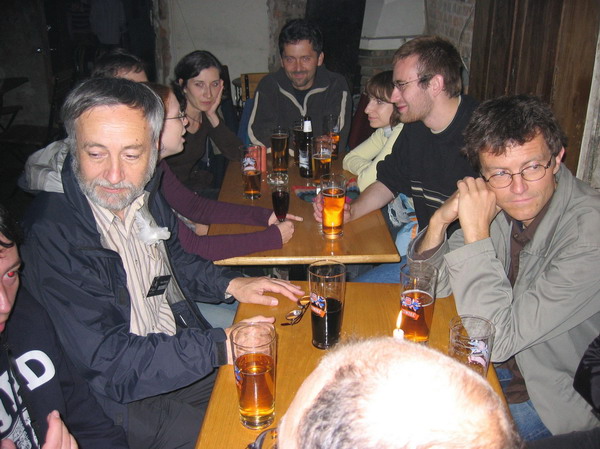
Terry King reads one of his poems at his 70th birthday party

I wrote a post here in August 2008, Terry King at 70, which went into some of my personal involvement with him, and I won’t repeat those stories here. Terry was one of the first in the UK to kick-start interest in the potential of many historic processes with his lectures and workshops, and founded the international APIS (Alternative Processes International Symposium) meetings as well as paying an important role in keeping the Historical Group of the RPS going over the years when closure seemed inevitable.

When I first met him, I found his work using colour transparency film beautifully romantic, and a number of these images were later transformed into the fine gum bichromate images which gained his FRPS. His work and his approach were quite different to my more classical approach, but we shared many views about photography, not least about the dead end of academic theory that was beginning to blight photography – and particularly photographic education – at the time.

Terry’s was always a no-nonsense approach, seeking to cut through mystification. He read the historical accounts as well as the more recent publications, revelling in such details as the ‘raspberry syrup process’ and names like Mungo Ponton, with his magnificent beard,  the Scottish grandfather of the gum bichromate. And his sometimes chemically illiterate hands-on investigations of alternative methods led him to develop new and interesting variants on old processes such as the chrysotype rex and cyanotype rex. The latter provided a way of relieving what we both considered the great weakness of they cyanotype process, that the prints were always blue.

Terry’s company was always stimulating, and his Hands On Pictures web site is an good reflection of his character if a rather messy piece of web design.  One of the links on it is to his 2009 Blurb book, Beware of the Oxymoron, which the preview allows you to view in full with fine images matched by his sonnets and other poems.

My own photographic interests diverged fairly completely from Terry’s in the 1990s, and I saw him relatively infrequently after that time, but it was always a pleasure to meet him – as I last did in September last year, when he had a fine show of his work at the new studios he had just moved to in Kingston. And I have many happy memories of our outings together, sometimes with an 8×10″ camera lent to Terry by a photographer who lived down the road from me. It had it’s first outing with us at the bottom of my garden, photographing (badly) Sweeps Ditch with a lens that didn’t quite cover the format. Later I took pictures with it in Richmond, and helped Terry make some good exposures of the stones at Avebury. At the time I wrote one or two articles for Amateur Photographer about some of our outings along with other photographers to places like Bedlams Bottom. Perhaps one day I’ll dust off those memories and republish them.


Terry King with red umbrella at Pewsey, 1980
Continue reading Terry King (1938-2015)

Another Family

Back in the 1970s, one of the first photographic books I bought, well certainly one of the first hundred or so, was the Aperture Monograph on Ralph Eugene Meatyard. Never a photographer I’ve felt much inclination to deliberately ape, I did find his work of interest at a time I was searching for direction, even if his was not a direction I ever took.

Inside the front cover is an introduction by James Baker Hall, an American poet, novelist, photographer and teacher who came from Kentucky, where Meatyard moved at the age of 25 in 1950 to work as an optician and bought his first camera on the birth of his first child to take pictures of him.

Four years later Meatyard joined the Lexington Camera Club and took a photography class with F Van Deren Coke who was also a member and who became his first mentor; Van Deren Coke included his work in a major group show and the two later exhibited together. He also bought a Leica, and the following year a Rolleiflex – and most of his well-known work was with the square format. In 1956 he attended a summer workshop where his teachers were Minor White and Henry Holmes Smith

But as Hall makes clear, Meatyard was a part of a wider cultural scene – influenced by literature and painting and “Many of his friends were writers – Wendell Berry, Guy Davenport, Jonathan Greene, Thomas Merton, Jonathan Williams; through them , and through his own steadily increasing reputation he came to know poets, publishers, filmakers, and photographers from all over the country.”

His reputation was widened after his early death from terminal cancer at the age of 46 in 1972. In his last two years, knowing he was dying, he worked on the Aperture Monograph and on a new set of images, The Family Album of Lucybelle Crater, both published in 1974. I remember looking through both of them and only being able to afford one.

I was reminded of Meatyard, who I wrote about some years ago, but I think only published a short note, by a feature in Lens, Meatyard at Home in Kentucky’s Cultural Scene, by

There is a good selection of images by Meatyard on the web at George Eastman House, and a nicely reproduced set at Masters of Photography.  The Fraenkel Gallery has a good page with links to articles and other exhibitions as well as its own. There is an article in the Smithsonian magazine, and American Suburb X has a page with links to half a dozen features, of which I found that by Guy Davenport particularly interesting. One particular quote struck me: “he developed his film only once a year; he didn’t want to be tyrannized by impatience.

Hoppé Birthday

Thanks to Luminous Lint, a great web site run by Alan Griffiths dedicated to “Building multiple Histories of Photography for those with passion…” for reminding me again on the site’s Facebook page of the work of Emil Otto Hoppé; yesterday, April 14th was the 137th anniversary of the birth in Munich of the man who became one of the best-known British photographers of the first half of the last century.

On Luminous Lint you can see a good selection of his later work, in the USA and Australia, together with examples of the kind of portraiture that made him become the most fashionable photographer in London, Mrs Lavery from 1914 and some examples from the 1920s. Perhaps surprisingly for a photographer who was probably the most prolific photographer of his age of London, there are no examples of this work.

Hoppé lived into his nineties, dying in 1972, so much of his work remains in copyright until 2042, seventy years from his death.  [Copyright law is complicated, and differs country to country; the photographer may not have retained copyright on some of his work, and some published work may by now be in the public domain.]  A great deal of previously unpublished work, along with better-known images was acquired in the 1990s by the Pasadena, California, based museum services company, Curatorial Assistance, Inc., who have invested a great deal of effort into publishing and promoting it throught the E O Hoppé Estate Collection., where you can see an interesting collection of his London images, as well as much else.

There is also an interesting page Hoppé’s Peers, which looks at some of his pictures beside some by Charles Sheeler, Edward Steichen, August Sander, Paul StrandAlbert Renger-Patzsch, Walker Evans and others.  It’s a page that confirms what I wrote in a post here, Hoppé Mad, about Hoppé and the Hoppé industry in 2009, and still worth reading in its entirety (I’ve here removed two now unnecessary links to Hoppé and Sheeler images  no longer active):

It is interesting that both Hoppé and Sheeler photographed the Ford plant in 1926/7, and you can compare the their images. Then go back and look at a similar subject photographed four years earlier by Edward Weston, Armco Steel, 1922.  If you can’t see the difference, then you certainly shouldn’t be writing about photography.

Ten years before that, in 1999, I had included a short section about the photographer in an article on War Photography, despite noting that “Hoppé, so far I know, never took a war photograph” but pointing out that he “was one of the pioneers of the ‘miniature’ cameras, taking his Leica, Contax and Super Ikonta around the world to photograph.”

Here is the rest of what I wrote about him in a very widely read piece 16 years ago:


E O Hoppé is one of those photographers whose name has almost been lost from view in the concentration on the development of the medium in the USA that has dominated photographic history in the last 60 years. His work and career can in some ways be compared to that of his contemporary Edward Steichen, (1879-1973). Both in earlier years were very much a part of the turn of the century pictorialism shown in such movements as the ‘Linked Ring‘. Hoppé became the best known portraitist of his time, photographing the rich and famous of the age, including many of the early stars of film, including Gladys Cooper, Mary Pickford and Marlene Dietrich.

Both Hoppé and Edward Steichen moved away from pictorialism and both turned commercial. Hoppé’s mastery of the new European modernism in photography was perhaps deeper in such works as his ‘Crane Land’ (1926) which frames one of London’s docks through a complex mesh of wires and rods of foreground cranes. Another interesting series was made from the top of a London bus – probably the first of projects of this type.

Hoppé became a photojournalist in the 1930s, travelling Europe and the World, although possibly his best known work is in his several books on London, including ‘The Image of London‘ (1935) and ‘A Camera on Unknown London‘ (1936). He also produced two books and the USA in the 1920s, one on Germany in 1930, ‘Round the World with a Camera‘, (1934), several books of portraits and his autobiography ‘Hundred Thousand Exposures: The Success of a Photographer‘ (1945) which remains an interesting read. It combines a great deal of advice – much of which is still apposite – including the advice ‘economy in films is unwise’ – and some interesting anecdotes, although sometimes its style grates.


Lars Tunbjork (1956-2015)

I was shocked to hear of the death of Lars Tunbjork at the age of 59, reported on April 11th. I met him briefly in 2005 and found his work of great interest, later buying two of his books ‘Home‘ and ‘Office / Kontor‘.


Me at left, Lars Tunbjork at right with others  in Belsko-Biala, Poland, 2005. Photographer unknown (on my camera.)

You can read obituaries at PDNOnline, L’Oeil de la Photographie and doubtless elsewhere. Death was the subject of one of his projects from 2013, when TIME “sent Tunbjörk deep into the American heartland to chronicle the goings-on at three separate crematories” for the photo essay, published with 15 of his images as “Cremation: The New American Way of Death“.

I wrote a short piece on him and some of his pictures in 2005, only publishing it here several years later (it stayed on my pending file in another place, waiting for image permissions that somehow never arrived.) I’ll repeat it below. The links to the images mentioned are from his  essay A country beside itself- pictures from Sweden on Zone Zero, one of the first web sites to seriously publish photography. You can also see his work elsewhere on the web, including at Norderlicht and Vu. His was a body of work that made him one of the most interesting of a generation of colour photographers (what might be insularly called the post-Parr generation), and one that deserved to be far better known, particularly in the UK.


Lars Tunbjork

Lars Tunbjörk was born in Boras, a small city in southern Sweden in 1956, in an area that was an exemplar of the Swedish ‘Folkhemmet’ (the ‘people’s home’ or welfare state envisaged by the ruling Social Democratic Party). When he was at school in 1971 at the age of 15 he went on work experience to the ‘Boras Tidning‘ newspaper and was introduced to photography. He went on to become a freelance before getting a staff job with the ‘Stockholms-Tidningen‘, a leading daily in the Swedish capital. His work there from 1981-4, distinguished by its subtlety, established him as a leading Swedish photojournalist. He also worked for Metallarbetaren, the magazine of the Swedish Metal Workers Union, Manadsjournalen, a Swedish monthly cultural review which ceased publication in 2002, and the Scandinavian Airlines magazine Upp&Ner (Up & Down.)

It was the work published in the book ‘Country Beside Itself’ in 1993 (Swedish title: Landet Utom Sig) with text by Thomas Tidholm and Göran Greider that brought Tunbjörk’s colour photography to the attention of the photographic audience world-wide. His pictures (and you can see a good selection of his work from 1989-99 including some from this book on Zone Zero) show a strong sense of colour and design as well as a taste for the amusing, ridiculous and occasionally surreal.

The images as well as showing his personal vision, also comment on the political and social malaise felt in the country, where much of the aims of the ‘Swedish Model’ welfare state had been acheived, and the consensus that this common aim had generated was being replaced by increasing feelings of alienation, emptiness and lack of purpose, and a movement away from social idealism towards a free-market individualism.

So in Olandi, 1991, a man and a woman recline in their swim suits on almost invisible supports, oddly suspended above a large area of grass, apparently floating as if on some invisible lake or by the yellow umbrellas that seem to emerge from their heads.

Far behind them along the edge of the grass across the centre of the whole frame is a series of buildings, black roofs above offwhite wood or plaster walls, a fairytale like faux-heritage development, stressed by the fake antique black metal lamp post which rises from beside the empty grey tarmac path at left of the picture into the white sky. Even the distant trees are drained of their colour. An image flickers into my mind of bathers floating in the high density of the Dead Sea, but this dead sea is marked as clearly Swedish by the colour – the yellow umbrellas and the complemenatry blue of the woman’s costume are those of the national flag, “a blue cloth with a yellow cross”.

An interior, Oland, 1991 is a simple scene. A room is seen in a wide-angle view square on to a wall, with white ceiling with glowing fluorescent fitting, a rather vivid green floor and pale orange-yellow walls, both facing the camera and to the right. The facing wall has a blue door at right, and in the corner of the room to the right of this a red plastic chair. High towards the left of the wall a TV is fixed, and below it stands a man, dressed only in trunks, socks and sandals, heavily sun-tanned, hands down at his sides. Seen from behind he betrays no thought or gesture through his pose, and appears to be staring at the wall in front of him (again the blue and yellow of Sweden) rather than looking up at the screen. Its a strangely empty room, nothing else except the white skirting board, a white light switch and socket by the door, a picture of loneliness emphasized by the colours. On the screen in cold blue light a couple embrace, the colour contradicting their contact.

In Flemingsberg 1989, a businessman or doctor or politician in an off-white raincoat, grey trousers, black shoes, walks along an empty tarmac road beside a fence past the grounds of some institutional building (presumably a hospital), striding out, head bowed, clutching his bulging briefcase. Perhaps representing the middle-class with all the plans of the ‘Swedish Model’, looking down and not thinking about the future, oblivious to the lamp post that has fallen down apparently towards him, about to pierce his heart with the sign attached. It reads ‘Diagnosv‘(Diagnosis) 13,15,17.

Peter Marshall, 2005. (minor later revisions)

Linnaeus Tripe

I can’t now remember when I first became interested in the history of photography in India, but it was something that fitted in with my desire when writing about photography to see the medium from a wider viewpoint than the typically European or US histories. And when looking at the photography of the Indian sub-continent I wanted also to place it in the context of colonialism.

Writing a dozen years ago in 2003, it was hard to find on-line resources to use to research the work of Linnaeus Tripe (1822-1902), and harder still to find well reproduced examples of his images.  The web has developed considerably since then.

I was reminded of this by a post on British photographic history by Michael Pritchard of a link to the US National Gallery of Art on-line resource Captain Linnaeus Tripe: Photographer of India and Burma, 1852–1860, on their exhibition which is coming to London later this year, at the V&A from 24 June to 11 October.

It seems to give an excellent account of  his life and the context of his pictures, but if the online exhibition is a proper representation of the actual show to have avoided the inclusion of many if not most of his best pictures. I hope this is not actually the case, but looking at it on-line it would appear to be rather disappointing in this respect.

Of course curators often have problems in loaning the material they would like to show, but with the backing of the NGA I would be surprised if this was the reason in this case.  Any summative exhibition about a photographer should start by trying to show his work at its best, not to illustrate a particular thesis.

Some of the details of what I wrote about Tripe back then are corrected and clarified by the research since 2003 and behind this show, and my article spent some time discussing published information that has been shown to be in error. Like most of my articles it incorporated little or no actual first hand research, though after publication I think I made a few changes from information supplied to me by descendents of the photographer who contacted me. Rather than rewrite it to bring it up to date, I present it here with only very minor corrections and omissions.


Linnaeus Tripe (1822-1902)

Photography in India 3

Biography

The Tripe Family

The Tripe family was apparently well known in Devon, particularly around Dawlish and Devonport, where Cornelius Tripe, Linnaeus’s father, was mayor in 1838/9. Cornelius was a surgeon, and his son Lorenzo went on to be a doctor in the area. Linnaeus was one of a large family, many of them with unusual names, some of which were handed down in the family, such as another Cornelius and Theophilus. That two of Linnaeus’s brothers were called Septimus and Octavius does however suggest a certain desperation in thinking as the family grew.

Linnaeus was probably named after the great eighteenth century Swedish scientist, Karl von Linne, better known by the Latinised name of Linnaeus (1707-1778), who first developed the modern hierarchical system of plant and animal classification.

Tripe in India

Tripe apparently first left for India in 1839 when he was only seventeen, but by the 1850s he was Captain Linnaeus Tripe, officer in charge of one of the battalions of the 12th Madras Native Infantry, a regiment founded in 1824 and stationed in Madras.

In 1854, the East India Company had suggested to the Bombay government that photography could help in the work of recording and cataloguing cave paintings and other antiquities, and offered to supply materials and equipment. Possibly at the request of the Governor General, Lord Canning, the British Army made available some of its officers in India. It is unclear if Tripe was selected because he had earlier learnt photography during one of his periods of extended leave in Britain in 1851-4, or if he was ‘volunteered’ in true army tradition and sent on a crash course. Certainly by the time he began work as an official photographer in 1855 he had gained an excellent command of the calotype process and the making of prints.

It was perhaps coincidence that the decision to appoint government photographers coincided with the setting up of the first photographic course in India by Dr. Alexander Hunter at the Madras Government School of Industrial Arts in 1855. Tripe’s later links with the school are well known, since C Iyahswamy, a photography instructor there, acted as his assistant, as is noted in the Frontline feature on Tripe.

First Photography in Burma

Tripe’s first assignment for the government was as official photographer to the British mission in the court at the city of Ava, where the Irrawaddy and the Myitnge rivers meet in upper Burma. In several months there he managed to take hundreds of large calotypes, roughly 14×10″ paper negatives, which were apparently the first photographs to be taken in Burma. They were mainly of temples, monasteries and views of city buildings. Two years later, in 1857, around three hundred of them were shown and published at the Madras Photographic Society, his first publication.

Work in India

Back in Madras later in 1855, Tripe was commissioned to take further photographs for the British East India Company and the Madras Presidency over the next few years, resulting in the publication of 6 albums of pictures entitled ‘Photographic Views of Indian Scenery: Madura, Tanjore and Trivady, Ryakotta, Seringham, Poodoocottah and Trichinopoly.’ Each contained around 50-70 pictures, together with a suitably scholarly introduction by a British expert on the area.

The scenes that he showed in the over 400 pictures he took were largely of temples, forts and other buildings, as well as images of sculptures and engravings, including a 21 print panorama of the engravings around the base of the 11th century Rajarajesvara temple in Thanjavur.

Later Life

Tripe, along with the other official photographers, was soon recalled to more military duties, taking his last official photographs in 1857 or 8. Possibly the end of the government project was connected with the Indian Mutiny of 1857-8, or simply reflected a desire to save money, perhaps because of the the short-term financial problems of the revolt. He continued a military career, taking photographs as an amateur, retiring to his home town of Devonport in 1875 having reached the rank of Major-General.

Part 2: Tripe’s Pictures

Architecture

Tripe had a very good eye for architectural form, and his pictures show a very careful choice of viewpoint so as to bring out the qualities of the buildings. He was careful to choose the time of day to give good, sometimes quite dramatic, lighting on them. Many of his pictures would serve as textbook examples of good architectural photography.

Equipment

Photography at that time involved a great deal of organisation. Tripe travelled with his assistant on horseback, with 4 bullock carts to carry the equipment needed, including tents and camping equipment so they could make themselves at home near to the monuments they were to photograph.

As well as the large 15×12″ camera he used for the main photographs, Tripe also made use of a smaller twin lens camera to take stereoscopic views. This produced two small images roughly the same distance apart as the human eyes on a single sheet of calotype paper. When viewed with the appropriate viewer it gave the impression of a three-dimensional view.

Invented just before the invention of photography, the stereoscope was a sensation in Victorian parlours once it was possible to publish relatively cheap stereo views on paper rather than the expensive daguerreotypes of early years.

Entrance to Temple of Minakshi in the Great Pagoda

In this picture, Tripe has taken the entrance from a rather more oblique viewpoint than normal. The reason for this is clear, enabling us to see past the imposing temple entrance to the giant structure in the background. The lighting is carefully chosen to bring out the details in the front of the gateway while obscuring as little as possible in the delicately handled shadows.

Madura. The Great Pagoda, Mootoo Alaghur and East Gopurum from Tank

This view across the water has been framed so as to make the most of the reflection of the arcade in the water, blurred perhaps by a little breeze to produce a simplified result. The angle of view is carefully chosen so that the effect of the angle of the two sides opposite is reduced.

The picture appears to have been taken from the same level as the bottom of the arcade, keeping the camera back level and using a rising front (or a cropped negative) to retain verticality in the towering structures in the background. The picture hints at symmetry, with the two rows of arches, the two towers and the two groups of trees, but avoids it.

Aisle on the South side of the Puthu Mundapum, Madura

This dramatic view along the aisle is dominated by what are apparently deep shadows of the row of pillars falling from the right across the stone flags of the floor. At the right are the pillars themselves, half burnt out by the strong light. It is a powerful effect, but also one that I find it impossible to understand.

Why are the top halves of the pillars and the wall at the left of the aisle apparently in shadow? Why do the shadows stop at they do, more or less at the base of the left-hand wall? Are the row of pillars to the right of the picture simply free-standing columns, with their tops disappearing in the darkness at the top of the picture? Why are the lower parts of the pillars on the right, so clearly in the shade from the direction of the shadows, so bright on the image? I keep looking at this picture and failing to understand how it could be produced.

Some of the effect might be explained by the use of two exposures, at different times of day or using different lighting, perhaps one during a period of cloud and the other in bright sun. Its also possible that some of the apparent exposure differences shown could be due to parts of the structure being painted in darker colour than the light stone. At this point I begin to wonder if the ‘shadows’ are really shadows at all.

Great Pagoda, Great Bull, Front View, Tanjore, India

Even in this small reproduction we get an powerful impression of the scale of this temple, bursting out of the very frame before our eyes. Taken from a low viewpoint, the camera kept vertical to keep the pillars upright, the roof is cut off by the edge of the frame at the top right, and we see clearly a view with the camera straining, looking up towards the ceiling. At the left, one of the pillars is mainly cropped away by the edge of the frame, and to its right another reaches up and beyond the top.

Careful camera placing gives a procession of vertical elements clearly separated across the frame, clear areas of sky between them. Again we can see how a careful choice of the time of day has created powerfully effective lighting.

Part 3: Tripe’s Techniques

Calotype or collodion?

There are differing reports of the technical basis of Tripe’s photography. Although his pictures are generally described as being made from waxed paper calotype negatives, there are some sources that suggest Tripe claimed to have used a dry collodion. Some of his negatives are in the collection of the Royal Photographic Society, and are definitely waxed paper, but later work, particularly as an amateur, could have used a dry collodion plate.

However a more likely explanation is simply that Tripe when asked if he used a wet plate stated that he used a dry process, and that this has been misunderstood. Although technically it is just possible, Tripe was recalled from his photographic duties to more military exploits around 1858, before dry collodion processes became widely established.

Taupenot Process

The earliest successful dry collodion process was the Taupenot process, details of which were first reported by Dr J M Taupenot in September 1855. This used a collodio-albumen plate.

The glass was first carefully cleaned, then coated with an iodised collodion solution thinned by the addition of more than the normal amount of ether, sensitised in the normal silver bath as soon as it has congealed sufficiently on the surface. After several minutes in the silver bath, it was washed with distilled water, and while still wet, treated with an iodised albumen solution containing sugar. This was made to flow across the surface in all directions before the plate was drained off and left to dry.

The plates were not very light sensitive following this treatment, but required a second immersion in a weak silver bath containing acetic acid. After this they could be dried and kept for weeks or even months before use, although they lost sensitivity on extended storage. Exposures needed to be several times those on normal wet plates, typically requiring perhaps 10-60 seconds in good light with a reasonably fast lens for the time with an aperture around f11. Processing after exposure was as normal.

Such collodio-albumen plates could give results with greater detail than a calotype negative, and greater delicacy of tone. There were later improvements of the basic Taupenot process – such as the Fothergill process – which made the preparation of plates easier, but did not alter the results obtained.

The results in a contact print from any of these dry processes would not be greatly different to those from the best waxed paper calotypes. Without access to Tripe’s negatives or a very detailed analysis of his prints, probably with a magnifier to look for the presence of residual paper texture, it would be difficult or impossible to decide.

His earliest pictures, dating from the middle of 1855 could not have made use the Taupenot process, but certainly the details would have reached India in time for some of his later work.

Albumen or Salt Prints?

Similarly, Tripe’s prints are sometimes stated to be albumen prints, sometimes salted paper prints, while some hedge their bets with statements such as ‘lightly albumenised salt prints’. The pictures are clearly not the high gloss double coated albumen prints that dominated photography in later years of the nineteenth century. They have the matt surface of a typical salt print, although some have a tonal richness that might suggest the presence of albumen.

Few people – curators, gallerists or photographers – have seen good modern salt prints, let alone made their own. There are many more examples, both contemporary and vintage, of poor quality salt prints, often flat and low density. Making good salt prints needs negatives with a full tonal range, high contrast and low fog levels; this combination, together with a well coated paper can give prints similar to those of Tripe.

From the early 1850s, photographers often added albumen to the salting solution used in making printing paper, giving what are sometimes known as matt albumen papers. Although we tend to think in terms of separate categories – salt prints and albumen prints – in reality there are a whole range of possibilities, and without detailed process notes from the photographer it is difficult or impossible to distinguish one from the other.

It’s a difference that is largely academic, although the presence of albumen results in a less stable print. James M Reilly in his classic work ‘The Albumen and Salted Paper Book’ (available on line) states “it is probably safe to say that not a single albumen print survives from the 19th century without some degree of staining in non-image areas.” The absence of this yellowing is probably the best simple test to distinguish albumen from salt prints.

Later Photography

Although Tripe’s work as a government photographer probably ended in 1857, he was still making portraits in 1858, including one of Sir Alexander Arbuthnot, founder of the Madras Cricket Club – as well as its university.

He continued to photograph as an amateur in later life, taking pictures around Devonport, possibly while on extended leave, as well as after his final return there on retirement in 1875.

Back in Devonport, Major-General Tripe, who was unmarried, took an active interest in local affairs, serving for example as secretary to the committee of management of Stoke Public School there, and living in the town until his death in 1902.

A ‘Catalogue Raisonné’ containing illustrations of all of Tripe’s work in India and Burma was published by the Art Gallery of Ontario in 2003.

 Peter Marshall 2003
Feeling Blue

Anna Atkins was born 216 years ago on 16 March 1799 and the anniversary was celebrated by Google this year with a doodle.  Her Photographs of British Algae: Cyanotype Impressions in October 1843 is generally thought to be the first book to have been produced – if only in a very limited edition – with photographic images.  These were ‘cyanotype impressions’, photograms of handwritten pages and of the algae specimens.

The cyanotype process had been invented by Sir John Herschel the previous year, and is a simple process to use for making prints, and is now often used in children’s workshops as well as for some more serious work. There were later adaptions and improvements to it (most recently by Mike Ware who thoroughly investigated the process and came up with a technically improved ‘New Cyanotype ‘.)

I’m not aware of any evidence that Atkins ever used a camera, though she has sometimes been cited as the first woman photographer. Certainly no camera produced images made by her have survived, nor are they any by another woman also awarded the title, Constance Talbot, the wife of the inventor of photogenic drawing and the calotype. Possibly one or other of them was the first woman to print a photograph.

I would describe the pages of ‘British Algae‘ as photograms rather than photographs, in a distinction I feel useful, though certainly not one that has always been present in photography. Until the 1930s it was common to use the term photogram interchangeably with photograph, and I have a number of copies of the annual publication ‘Photograms of the Year’, none of which contain what we would now call a photogram.

I have to admit that I’m not in general a great fan of cyanotypes, and have only kept a few of those that I have made. Several of them are from a session photographing a nude female artists model, something I’ve done very rarely, and were taken on 5×4″ during a workshop session where it was important to have a suitable subject on hand to produce images in a fairly limited time.

The problem I have with cyanotypes is that they are blue, and often not a very pleasant shade of blue – certainly one that does nothing for the model in this image.

It doesn’t really suit this street image either, but it illustrates one of the common problems of the traditional cyanotype – it is very easy to lose highlight detail. The problem here is partly that the negative was made for salted paper printing and has a very high contrast, too high for a good cyanotype print. Much better as a salt print.

It is possible to moderate the blue colour, and there are various ways to tone cyanotype images, though the results are not always permanent. In this case I started with a slightly weak salt print, and rather than throw it away (good quality watercolour paper costs as much as bromide paper) I overprinted it in register using cyanotype. The result was mildly interesting and I made a few more prints that way. Most but not all of the salt print disappears during the overprinting butas the image above shows, the blue is considerably altered.

And for the final image, I carefully avoided painting the cyanotype solution over the poster at right in the initial salt print.

But then I came to my senses and realised that I spending far too much time playing with chemicals and not spending enough of it on taking pictures. And a few years later I found that inkjet printing was a far more flexible way to produce images.

POYi 72

I’ve not yet had time to look at all the pictures from the winning entries in the University of Missouri School of Journalism‘s 72nd annual Pictures of the Year International competition, though I can say that there are some fine images among those I have viewed on the POYi web site.

One photographer who gets a number of mentions is Brad Vest, 2011 Alexia award winner, with a portfolio of 40 images from Memphis local newspaper The Commercial Appeal winning the Newspaper Photographer of the Year award, as well as two mentions in the Newspaper Issue Reporting Picture Story category with first place for “Last One Standing” about the last public housing project in Memphis and an Award of Excellence for “Paul Joseph Oliver” on the lives of the family and friends of a Marine after his death.

The competition has its roots in 1944, when

the Missouri School of Journalism sponsored its “First Annual Fifty-Print Exhibition” contest. Its stated purpose was, “to pay tribute to those press photographers and newspapers which, despite tremendous war-time difficulties, are doing a splendid job; to provide an opportunity for photographers of the nation to meet in open competition; and to compile and preserve…a collection of the best in current, home-front press pictures.”

For many years it was a USA only contest, and was run jointly with the NPPA, but since 2001 it has again become solely the responsibility of the Missouri School of Journalism, and an international competition (POY became POYi), and has slowly become less dominated by US photographers and organisations, though still keeping a very US flavour and not quite yet POYI. Funding for it comes from endowments and also sponsors Fujjifilm, US cable and satellite company MSNBC, National Geographic as well as the entrance fees to the yearly competition.

There is also an archive with many thousands of winning images (either 41,766 or over 60,000 depending on where you look) over the years, starting from 1943. It gives an interesting overview of the changes in news photography over the years.

The Missouri School of Journalism has always had a clear view of photographic ethics, and the USA generally has a rather more clear view on news photography than pertains in the UK. It was something I was made very aware of when I spent 7 years working for a US company from London, and which I applauded. Although there may be disagreement about whether the best work won in some categories, there is unlikely to be the kind of controversy that the WPP has recently attracted. The staging in Je Suis Chaleroi? would certainly never have been thought acceptable here.

Salted Paper Prints


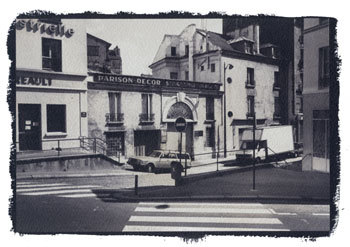
Paris Xe, 1988 Salt Print – Peter Marshall

To coincide with the opening of Salt and Silver: Early Photography 1840 – 1860  at Tate Britain, here is a slightly updated version of a piece I wrote some years ago on salt prints, including step-by-step instructions on making them and four examples of my own efforts from the late 1980s.

Key Facts

  • ‘Photogenic drawing’ used ordinary paper which had been given a coating of silver chloride or similar light-sensitive silver salt.
  • Prints were made by placing objects on this paper and exposing to light. In the 20th century this way of working was named as a ‘photogram’.
  • Photogenic drawing was a printing out process – the image actually appeared during the exposure to light.
  • Photogenic drawing can also be used as a method for contact printing from negatives – prints made in this way are known as salted paper prints or salt prints.
  • Contact printing requires the negative to be held in close contact with the printing paper, usually in a special printing frame, while being exposed to light through the negative.
  • Exposure times in salt printing vary from around 10 minutes to 8 hours depending on the strength of the light source and how transparent (or translucent) the negative material is.
  • As with all contact processes, the print is obviously the same size as the negative.
  • Talbot fixed his images by using strong salt (sodium chloride) solution, or a weak potassium iodide solution. Neither was totally effective.
  • Later, Herschel’s suggestion of hypo (sodium thiosulphate) as fixer was adopted. This was fast and totally effective.
  • By repeating the sensitising process several times, Talbot found he could increase the speed of the salted paper sufficiently to use in a camera obscura.
  • Typical exposure times in the ‘camera obscura’ were around 30 minutes, with apertures probably around f8 in modern terms.
  • The paper negatives were fixed and then often made translucent by treatment with wax or oil before being placed on top of a fresh sheet of sensitised paper and contact printed using sunlight as the light source. Typical printing times would be around 30 minutes to an hour.
  • Although rapidly superseded for use in the camera by the Calotype process, the basic salted paper print was the normal process for photographic prints on paper until replaced by the albumen print around 1850.
  • After 1855, salted paper remained in use mainly as a proofing medium and by a few who preferred its matte image. It saw a revival in the 1980s and 1990s as a part of a growing interest in historical and alternative processes

Talbot’s method

  1. Talbot started with a sheet of best quality writing paper ‘with a good firm quality and smooth surface’.
  2. This was dipped it into a weak solution of common salt and then wiped dry
  3. The sheet was then coated on one side with a weak solution of silver nitrate (a saturated solution diluted with six to eight times the amount of water) and dried in front of a fire.

The paper was then ready for use for making photogenic drawings or as Talbot more poetically wrote ‘nothing can be more perfect than the images it gives of leaves and flowers, especially with a summer sun : the light passing through the leaves delineates every ramification of their nerves.’

A more modern version of this procedure is still used by those photographers today who wish to make salted paper prints – also known as salt prints – see below for directions.

For use in the camera, the speed of the material needed to be increased. Talbot found he could do this basically by repeating the treatment. He first washed the prepared paper with a saturated solution of salt, and dried it. Tested at this stage it was more or less insensitive to light, but if re-brushed with ‘a liberal quantity of the solution of silver’, it became more sensitive than before.

By repeating the coating several times, it would become fast enough for use in the camera (though his exposures might be 30 minutes.) Talbot obviously found the process rather unpredictable, noting that sometimes the paper would begin to darken without any exposure to light, showing the process had been taken too far.

After each coating with silver, he clipped a small part from each of the sheets he was working with, numbering them carefully to correspond to the sheet, and ‘placed (them) side by side in a very weak diffused light for about a quarter of an hour.’ If one of them darkened considerably, the corresponding sheet was ready to be exposed in the camera obscura. It was a crude but effective system of control for a process where there were too many variables to guarantee success by simply following a given procedure.

Talbot’s results

Looking at Talbot’s early results from the camera – or rather at reproductions of them – it is not surprising that they were generally not regarded highly compared to the splendidly sharp and detailed daguerreotypes. In some cases it is hard to see any image at all, others are more weak splodges than detailed pictures. His first existing negative shows a window made of small panes, and on the back he notes that it was possible to count them all when it was first made. Presumably it was no longer possible when he made the note. The image is certainly not now highly detailed and the shadows in particular are completely empty.

Although the photogenic drawings – made as what we now call ‘photograms’, by placing objects such as leaves and lace on the paper – have considerable elegance and are finely delineated, his early camera attempts can only be seen as suggestions that it might be possible to get the process to work rather than as a successful solution. It was a problem that Talbot was to solve himself in the following years with the Calotype process.

The major problem was of inadequate sensitivity to light. These first photographic materials relied entirely on the printing out of the image, which is slow. In the Calotype, Talbot made use of what became to be called a developer to amplify the effect of the light, bringing out the ‘latent image’ from the apparently unchanged paper. It was this discovery that was really to lead to the domination of the next 160 years of photography by silver based materials.

Another aspect of the problem that Talbot faced was inadequate fixation. After exposure he either washed the paper with a dilute solution of potassium iodide or a strong solution of common salt before ‘wiping off the superfluous moisture, and drying it.’ The potassium iodide solution formed silver iodide that was largely insensitive to light, but too strong a solution would dissolve parts of the image. As he had found in his repeated coating, using a large excess of salt solution produces a very low light sensitivity. However images fixed in these ways still faded in light – and certainly the bright sun needed to expose through the paper negative will have also caused fading of the negative.

When Talbot visited Herschel at Slough on 1 February 1839, he received a solution to the problem. Herschel’s wife, Margaret, noted in a letter to a friend that ‘when something was said about the difficulty of fixing the pictures, Herschel said “Let me have this one for a few minutes” and after a short time he returned and gave the picture to Mr Fox Talbot saying “I think you’ll find that fixed” – this was the beginning of the hyposulphite plan of fixing.’

It was also Herschel who provided a clue – in the shape of gallic acid – that was to be the key to Talbot’s discovery of the latent image and development in the Calotype. There are many of us who have made prints using salted paper and even a handful of photographers currently using the Calotype process – some have used actors to recreate Talbot’s later pictures at Lacock Abbey. The recreation of images in camera obscura using his methods, and making prints from these again following his directions would perhaps be an interesting project. It is the only way any of us can possibly see these kind of images in the same condition as when Talbot made them.

Make your own Salt Prints


Montreuil, Paris, 1988 © Peter Marshall, 1988.
Gold toned salt print on Georgian Watercolor Paper.

Ordinary writing paper is now factory produced and no longer of suitable quality for any of the alternative processes. Machine made papers generally have shorter fibres and fall to pieces readily when wet, and you need to use a suitable hand or mould-made paper, usually sold for use in watercolour painting.

Silver nitrate needs to be handled with care – you should use gloves and wear safety glasses. When handling any finely ground chemical powder a mask should be worn. Silver nitrate is a poison that can build up in the body and it can both burn and stain skin. It produces stains and marks that are often very difficult to remove from some surfaces.

Like all chemicals, both solid and solutions should be kept in a secure place, locked away from possible reach of children. Silver nitrate solutions are sensitive to light and are normally stored in brown bottles, but it also helps to keep them in a cupboard.

Procedures normally give precise quantities required for solutions measured in grams. However, there is seldom any real need for great accuracy, and many people have made salt prints without using any weighing equipment. Chemicals such as silver nitrate will generally be bought in fairly small quantities and you can make up the full amount into an appropriate solution.

  • You can use ordinary table salt or sea salt, making up a solution of roughly 1-2 ounces (25-50g) per litre of water.

Other salts, which some people prefer, include ammonium chloride, potassium citrate, potassium tartrate and potassium bromide. You will often get small differences in image colour and paper speed using the different salts or mixtures of them.

  • The silver nitrate solution is generally around 10-12% by weight – so you can dissolve 7g (1/4 oz) in around 60ml of water.

I’ve used a range of watercolour papers, including Waterford Hot Pressed which was possibly my favourite, along with Rowney’s Georgian. Some other papers give better results if coated with a dilute gelatin solution and left to dry before use – this is called ‘sizing’ – but Waterford works well without. Most watercolour papers are already sized when you buy them, and extra sizing is often not needed. You will get good results with most papers.

You also need a brush to coat the paper with – a wide, thin brush is best. Japanese hake brushes which do not have metal ferrules are probably the best, as the silver solution corrodes metal.

Salt printing is a contact printing process and you need a negative the same size as your print is to be. Unless you have a large format camera you may like to follow Talbot’s examples and start work with photograms, using materials such as leaves or lace etc. If you do have a large format camera, take a picture specially and try doubling your normal development time as you need a much higher maximum density than normal for salt prints. You can also work by printing large negatives with an inkjet printer, preferably on to acetate film designed for inkjet use. Prints on paper do work – better on thin paper – but exposure times are much longer. You can also work with negative prints made on photographic paper.

Talbot used the sun for his exposures, which meant the times he could work in England were limited. Unless you are blessed with a sunnier climate you may want to find another light source. You need something which is strong in ultraviolet, such as a tanning bed – or you can buy or make special light sources using mercury lamps or UV fluorescent tubes similar to those in sunbeds.

A printing frame is needed to hold the negative in contact with the paper. You can buy or make these, but a sheet of plate glass and a card or ply backing board with some rubber bands round will do (for large prints the weight of the glass is enough to ensure contact.) These were once cheap photo accessories, and small sizes (such as 5″x4″) can still be found cheap in junk shops. I had a good look at an expensive hand-made version, particularly the price-tag, took out a pencil and designed my own, which took about an hour to make. Precision freaks will want a vacuum frame!


St Denis, 1988, © Peter Marshall, 1988. Gold toned salted paper print.

Step by Step Instructions

Making a salt print

      1. Tear or cut the sheets of paper to the size required – you need at least a one-inch margin around your negative. Mark the top side of the paper on each piece.
      2. Make up the salt solution, soak the paper in it for 2-3 minutes at room temperature or slightly above, gently brushing each side while under the solution to remove any air bubbles. Lift out, drain and hang to dry, putting down newspaper if necessary to catch the drips. Paper treated in this way can be used as soon as it has stopped dripping or dried and used weeks or months later.
      3. Tape the salted paper top side up to a board. Put the negative on top and mark the position of its corners lightly with pencil.
      4. In dim room lighting (away from sun and fluorescent lights), pour a few ml of silver nitrate into a small beaker or dish. Dip the tip of the brush in, and spread left to right across the paper making sure to cover the marked area. Keep the brush wet. Repeat using a series of top to bottom strokes. Try to get the surface of the paper evenly wet all over, but without any pools of solution. Don’t return any excess the solution to the bottle; add a little more to it to coat the next sheet. Leave horizontal until any liquid on the surface has been absorbed, then hang to dry in a dark place. Use gentle heat from a hair-dryer if you are in a hurry to get on.
      5. Put your negative on top of the dry prepared paper, matching its corners to your pencil marks. Unless you have a proper hinged-back printing frame, secure it to the paper down one edge using crystal clear transparent tape, making sure this does not go over any of the image area. Check you have the negative the correct way up. Put under the glass or in your printing frame.
      6. Typical exposure time needed is 10 minutes in bright sun, but you can remove it from the light and peel back the negative slightly to inspect the image. Take care not to move the negative – this is where a proper hinged-back printing frame is a great advantage. Expose until the highlight detail is slightly darker than you want it – the shadow areas will normally seem too dark, but will lose some density on processing. Paper negatives may take several hours, particularly in winter.
      7. In dim light, remove the paper from the printing frame and put into a tray of water – preferably use distilled or purified water for the first rinse. Use gloves and be careful how you dispose of this first rinse in particular as it will contain most of the silver nitrate. If possible it should be added to your normal waste fixer for recycling. Later rinses will have much lower silver content. Agitate for about a minute before pouring off, and repeat several times (using tap water for these later rinses.)


Paris XIIe, © Peter Marshall, 1988. Gold toned salt print.

      1. If your image is successful, you may wish to gold tone at this stage. Prints with developed edges are often trimmed to avoid waste of gold toner. You will find instructions for gold toning in books dealing with alternative photographic processes. As you may expect, it adds considerable expense. Gold toning was a later development not use by Talbot. I’d suggest you leave it until you have gained some experience in the process. Gold toning changes the image colour (not always for the better) and improves image stability.
      2. For prints that can be displayed and last, you should fix using hypo.If you are interested in following Talbot’s methods, you will find his instructions in various sources, including Beaumont Newhall’s ‘Photography: Essays and Images‘. Talbot does not appear to have washed his early prints either before or after ‘fixing’. For prints that will last longer, fix using a solution of 25 gm (1 ounce) of hypo crystals in 500ml of water with a pinch of soda (sodium carbonate) added. You can also use normal print fixer, diluted perhaps twice as much as usual, but this will alter image colour more and also remove more of the highlights. Fix for up to 5 minutes, keeping a careful watch on the highlights and remove the print and wash immediately if these start to disappear.
      3. Wash for around an hour in occasional changes of water and then hang to dry.

Resources

Various books have been written with methods for making salted paper prints in the more than one hundred and sixty years since they were introduced.

Henry H. Snelling‘s 1849 volume ‘The History And Practice Of The Art Of Photography‘ is subtitled ‘The Production Of Pictures Through The Agency Of Light’ and claims to contain ‘all the instructions necessary for the complete practice of the Daguerrean and Photogenic Art, both on metalic, plates and on paper’ (sic), and is well worth downloading from the web if you want to experiment further. Snelling more or less copies the details given by Talbot for making salted paper, but does add a number of further details.

The year after this was published saw the publication by Louis Desire Blanquart-Evrard of his work using albumen. This was an idea first proposed by an anonymous contributor to ‘The Athenaeum’ in May 1839 but Blanquart-Evrard was the first to put forward a practical method that contained the chlorides in the albumen. Albumen rapidly replaced salt printing as the normal photographic print because of its greater brilliance and depth of tone, and remained the dominant print medium until 1895 (finally going out of production in 1929.)

All paper prints in the first ten years of photography were salted paper prints, but after around 1855 it was probably mainly used for proofing. However, modern salted paper prints that I have made are a good match in terms of colour and tonal range to many matte prints from the 1850s (and later) identified in collections as ‘albumen prints’ and although it is possible to make matte albumen prints I suspect these are relatively scarce. If a print is matte, made before 1885, and does not have yellowed highlights it is highly probably that it is a salted paper print, whatever the curator’s label.

Many later photographic books also had instructions for salt printing and other early printing methods, but they were dropped out of most photographic textbooks by the 1930s. One of the best known from this period, ‘Photography, Theory and Practice‘ the English edition of ‘La Technique Photographique’ by L P Clerc, contains details of this and other by then obsolete processes such as albumen printing.

If you are interested in older processes and practices, you will find books such as the 1911 ‘Cassell’s Cyclopaedia of Photography‘ enthralling. I find it a useful source of information particularly for its many line drawings and learn something new every time I pick it up. However the older chemical nomenclature and weights and measures do make life a little trying at times, and there are some procedures suggested which bear no relation to common sense let alone health and safety procedures. Almost every page deserves a health warning. It lists salted paper under one of its alternative names, Plain Paper.

The best modern source of information on the whole area is ‘The Albumen & Salted Paper Book’ by James M Reilly mentioned above. First published in 1979 and long out of print it is now available in full on line – a generous gesture from the author. It really tells you everything you could wish to know.

The same year saw the publication of William Morgan’s ‘The Keepers of Light’, which remains a key text for those interested in older processes and is available secondhand. Since then a number of other books have also appeared which cover alternative processes in detail. Although some of these have excellent articles and illustrations on salt printing, there is nothing essential in them that is not available in the earlier works.

There are also a number of on-line resources, including the alternative processes mailing list and a number of fine web sites – too many for me to list or spend the time reviewing – just search on Google.

Materials for the processes can be hard to come by in but can be found online at specialist dealers, including Bostick & Sullivan and Photographers Formulary in the USA and Silverprint in the UK. Many articles on alternative processes have appeared over the years in various photographic magazines, and there have been independently produced magazines dedicated to alternative processes in both the UK (now defunct) and the USA.