The New Panopticon

Photosynth from Microsoft Live Labs is amazing. Currently only available as a free technology preview, it gives a glimpse into a future that could completely re-draw our map of publishing and imaging and perhaps more.

If your system is up to it (Windows XP and Vista only, a fast web connection and decent graphics card), it only takes a few minutes to download and install this 5Mb ActiveX control, and although the preview is currently limited to supplied image collections, it does give some idea of the power of this technology in connecting images into truly “breathtaking multidimensional spaces with zoom and navigation features that outstrip all expectation.”

Microsoft acquired the technology by buying the Seattle company Seadragon in February. The team have also been working with the BBC for the series ‘How We Built Britain’. You can see some of the work from this country in the Your Britain in Pictures demonstration (which will also install the Photosynth control if it is not already present.) The Trafalgar Square collection is interesting as it includes archive images from the Royal Institute of British Architects and the National Media Museum, although it is perhaps a little short of images to show the full potential of the system.

You can get a better idea of its potential by watching its ‘architect’, Blaise Aguera y Arcas, demonstrating a more advanced version at TED (Technology, Entertainment, Design), a high-level annual conference sponsored by BMW, which also makes clearer some of the issues involved as well as demonstrating the incredible power of the application.

One image set was produced by searching photo-sharing site Flickr for images of Notre Dame in Paris, aggregating this incredibly disparate set of images (many typical tourist snaps) to produce a detailed highly-zoomable 3D model of the building, which also incorporates any captioning and keywording from the originals. As Blaise remarks at one point, their use of images has severe implications about copyright. Both the small print of photo-sharing sites and also proposed legislation on ‘orphan works’ are perhaps to some extent driven by the possibilities of software such as this.

At one point, Blaise throws the whole of an issue of ‘The Guardian’ on the screen, laid out page by page, then effortlessly scrolls and zooms around it, zooming at one point down to single character level to show the high resolution the system supports. Of course it needn’t just be a picture that already can provide rather superior quality to the printed version as well as being in some respects easier to browse; it would be simple to make it searchable text and to add text hotlinks to the existing image links.

This is a part of technology that can and will change the future of publishing – and lead to the end of print except as a niche fine-art medium. I think it will also change the whole economic and social structure of the industry. Probably not for the better, and almost certainly not for the benefit of those currently working in it.

Among many print journalists there still seems to be something of a head in the sand mentality. Citizen journalism, blogs, interactive web technologies and more are not going to go away. If we don’t learn more about the future we have no chance of influencing it.

At the moment, the Internet is still largely in the ‘Black and Decker’ age, where anyone can set up a site – like this one – and get their ideas out. A click of the mouse takes you from one site to another. Developments like this make the idea of huge and largely if not entirely isolated seamless commercial content conglomerations, rather more likely as the future.

Photosynth is also a glimpse of an Orwellian nightmare, linked to our increasing coverage of security cameras. This week a judge was acquitted in an indecent exposure trial because it could neither be proved nor disproved that he was the person involved. Had the CCTV images from the train been available they could have proved his innocence (or guilt), but apparently the British Transport Police had been too busy to collect them before the storage was overwritten.

The camera on the station, in the carriage, on the platform, the underground passage way, the street corner, in the bus, the workplace entry will doubtless soon all be wifi linked to network storage. Rather than tailing suspects, computers will recognise them by clothing and facial features, pulling out a collection from the giant image base, aggregating it with information from mobile phone locations and conversations. Little need for the house arrest that has got our government into trouble with the judges.

Modern technology enables us to spread Bentham’s Panopticon, with its control over minds by both the actual surveillance of individuals and the fear of the individual that they may be watched to the whole city. Photosynth and related software for handling and processing huge collections of data isn’t just going to revolutionise how we view and use images.

Peter Marshall
Kash, Afghanistan and the Threat to Journalists

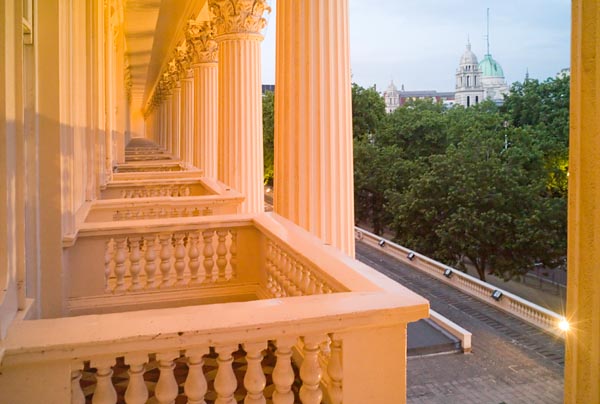
11 Carlton House Terrace is an impressive Nash building from around 1830, designed as a scenic backdrop to St James Park and grand enough to have been home for two prime ministers, Lord Stanley and William Gladstone as well as William Crockford and the Guiness family. Inside it has an impressive double staircase and some formidable public rooms. The Foreign Press Association has been here since 1946, and in 2006 Gabriele ‘Kash’ Torsello was awarded the FPA’s Premier Award, the ‘Dialogue of Cultures’. After his release (see below), Kash was at a low ebb, and this recognition of his work was important in giving him the will to continue with his Afghan project. The interior of the building is hung with large banner prints of some of his powerfully empathetic images, in the first of a series of exhibitions to be announced shortly at the venue. Kash’s show is the launch of a larger exhibition in southern Italy, where as ‘Staramasce’ 30 huge photographs will be hung throughout the summer, one in each of 30 public squares in Lecce province, together with an exhibition of all 30 in the Lamarque Museum.


The balconies of Carlton House terrace overlook The Mall

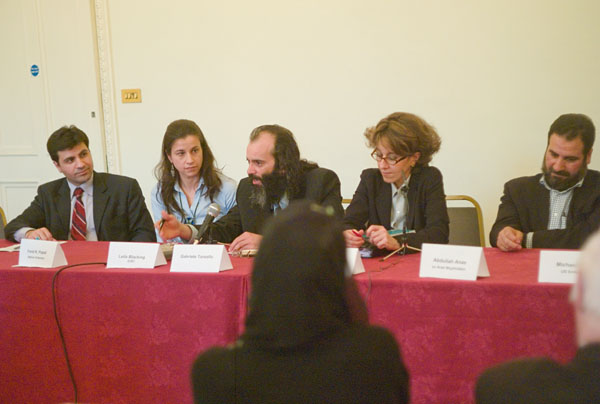
It was a beautiful evening, an unforgettable venue and there was good Italian wine and very likeable Afghan-style food, and I met and talked with many interesting people – including most of those in the panel of speakers, half of which is shown below.

I first met Kash at an NUJ party last year, unmissable with his beard, dark clothing, warm and intense manner and a battered film Nikon, and talked to him about his work in Kashmir. A few days later, the book he promised to send me, his ‘The Heart of Kashmir’ (2003) arrived; I was impressed and published a short note on him and his work on About.com in July 2006. Heart seemed a very appropriate word, for this was work full of passion by a man whose heart was very much into his photography and his closeness to the people he lived with and photographed. As well as the pictures, its short texts gave a very real insight into the problems of working in such situations.

It came as a shock to read last October of his kidnap in Afghanistan. More so because he was someone who lived among and worked for the people, and worshipped with them as a fellow Muslim. I was pleased to be a small part of the worldwide campaign for his release, both through About Photography and also with links to the note I’d written previously from other sites, including the NUJ.

And of course we were delighted with the news of his release after being held for 23 days. But it’s important to remember that he was only one of many journalists and photographers who has suffered, and many die recording events around the world. According to Reporters Without Borders, one of several organisations that keeps such grim records, 84 journalists were killed in 2006, and halfway through 2007 over 50 journalists and media assistants have been killed, and 130 imprisoned.

Half the panel
From Left: Farid Popal (Afghan Embassy), Leila Blacking (ICRC) Gabrlele Torsello, Nazenin Ansari (FPA President), Abdullah Annas (ex Arab Mujahidden)

The panel of speakers included Leila Blacking of the ICRC, which had the same day released its press release, ‘Afghanistan: Insecurity spreads amid escalating conflict’ giving a bleak view of the situation there. The Red Cross’s view was largely dismissed by Farid Popal of the Afghan Embassy, and an equally complacent view came from the US Embassy representative.

Reporting here from Afghanistan is limited – despite the determined and hazardous efforts of many of our colleagues, including Kash and a number of his friends also at the opening. The ICRC views are based on their 20 years continuous working in the country and note the deteriorating military situation and the problems this creates for development work and the increased need for emergency assistance. Almost two and a half thousand people were detained by Afghan authorities last year in connection with the armed conflict over the past year, and there is a general lack of security in the south of the country leading thousands to abandon their homes in both rural and urban areas.

Blacking spoke impressively and responded openly to questions from the floor as well as in private conversations later. Listening to the diplomats, both very likable men, it was impossible not to remember Sir Henry Wooton’s comment (made in Latin almost 400 years ago) that “an ambassador was an honest man, sent to lie abroad for the good of his country.” Unlike English, Latin allows no ambiguity about the meaning of the phrase.

I also thought about events of the nineteenth century, and the great images brought back by Baker and Burke as they travelled with the British Army, whose opinion of the campagn there is encapsulated in rhyming slang. To Kipling the Khyber Pass might have been “a sword cut through the mountains“, but the troops saw it differently. Perhaps after some 200 years, ‘The Great Game’ is now coming towards its end game.

Journalists are coming under increasing pressure, and both Afghan and US responses where chilling, with the clear implication that those who went into certain areas were just asking for trouble – and deserved what they got. Why, asked the guy from the US, only slightly more circumspectly, won’t journalists go and write nice success stories from the places in Afghanistan where we would like them to go?

From the ICA
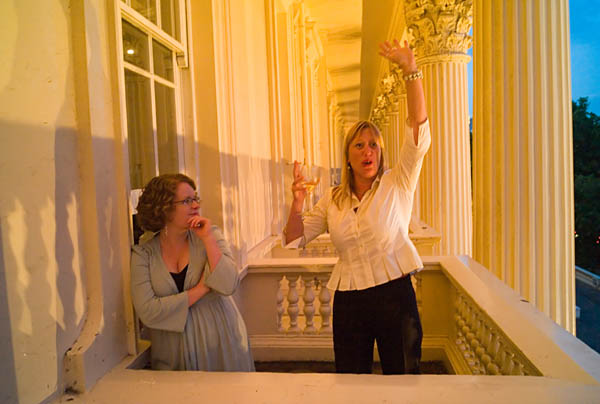
We were joined on the neighbouring balcony by people from the ICA.