Sikhs and More

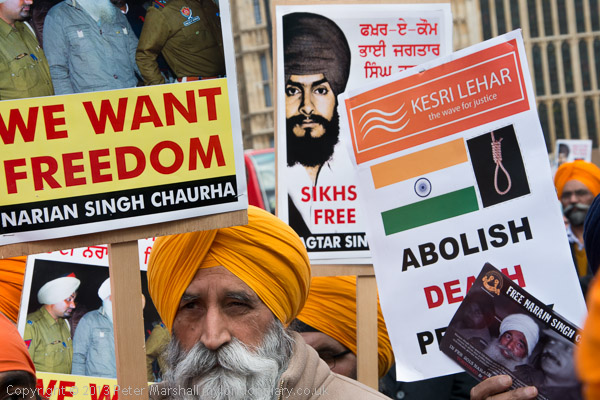
April seems to be going very fast, and it’s just over two weeks since I had a busy Saturday afternoon in London. It started with the Sikhs, who had come to protest outside Parliament asking our government to put pressure on India to drop the death penalty, and in particular not to hang a number of Sikhs, some of whom have been on death row for many years.

It wasn’t a particularly visual event, and I had to work hard to find pictures. The platform  at the front was surrounded by scaffolding, making it hard to photograph the people on it except as head and shoulders images, and although they had an effigy of a hanging man, even that was made difficult to use by the scaffolding poles.  Of course there were some fine faces and beards in the crowd, who were simply sitting or standing listening to the speeches, but I didn’t want simply to photograph characters.

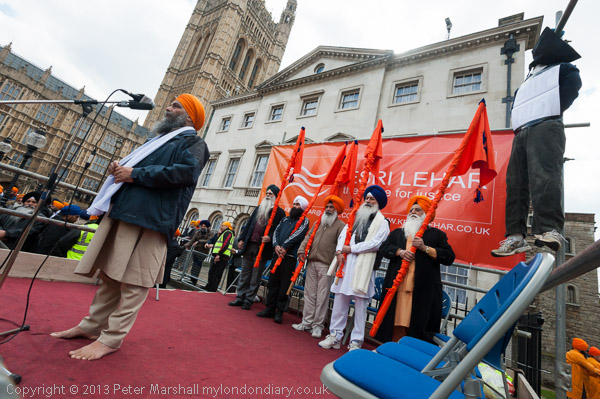
I was back to using the Nikons again, and this image shows the set up on the stage – I was poking the 16mm between scaffold poles at the front of it, and needed the tilt to get it all in with some of St Stephen’s tower behind. As I went up to take it, I reached in my bag for the 10.5mm, which might have done a better job, and found it wasn’t there. After a second or two of panic that I’d lost it, I realised that it was still in my toy camera bag with the Fuji body I’d been using it on earlier in the week, and I’d simply forgotten to put it back.  All I could do was curse, and remind myself that I should always find the time to check my gear properly before I rush out and run for the train.

This was I think my best pictures of the event, including a great beard and turban and with careful position and framing to make use of the various placards – as well as just a little of the Houses of Parliament peeping through.

I had put the 70-300mm in my bag – its a lens I don’t always bother to carry, and it did come in useful in a few pictures, as you can see in Vaisakhi “Save a Live” Vigil.
Continue reading Sikhs and More

Deutsche Börse Anti-Photography prize

I’ve more or less refrained from comment in public on this year’s prize competition at the London Photographers’ Gallery, and I ignored the invitation to spend yesterday evening at a considerably more interesting opening elsewhere. It has become very much a case of kicking a dead dog when it’s down.

The Guardian has I think got it about right, both in Sean O’Hagan’s initial comments when the shortlist was announced and in Wednesday’s piece on the show by Adrian Searle.  There are some salient points too in the comments.

Chris Killip is the only photographer with work of any real stature in the show, and as Searle concludes “He should win because his work is still valuable. Much of the other work here won’t be, in 30 years’ time.” Though probably he won’t.

Although I rather liked Cristina de Middel’s The Afronauts, a nicely done spoof space programme, it does seem to me rather familiar territory, a rather less complex version of Joan Fontcuberta’s 1997 Sputnik,  itself perhaps an unnecessary duplication in ideas of his earlier Fauna. Of course Killip’s early work in Isle of Man was also a reworking of Paul Strand, but the work for which he has been nominated shows more varied ideas. There is a nice presentation of his 2011 show 4 & 20 Photographs from the Howard Yezerski Gallery, which I think makes clear that Strand was not his only influence.  It’s perhaps interesting to read the comment by ‘answerback‘ (scroll down from here) which in part deals with this, but also makes some other adverse comments on his practice, though I wonder how much he really knows about Killip and his work. Perhaps he’ll read this and comment more!

Killip, so far as we know, has done little photography since the publication of ‘In Flagrante’ in 1988. There was a slightly botched commission photographing a Pirelli factory, and one longer term project on Irish pilgrimages, published as Here Comes Everybody. It is more than questionable whether his work “significantly contributed to photography in Europe between 1 October 2011 and 30 September 2012” in any way that would make him eligible for this award.

But at lease Killip and de Middel are actually photographers and the work for which they were shortlisted was photography. I think it most likely that, as last year, the prize will go to a non-photographer.


Sean Smith – Iraq

I’ve been privileged to hear Guardian photographer Sean Smith show and talk about his work in person, and you can do so on as a part of the French Cultural TV network Arte’s IRAK – 10 years, 100 viewpoints available on-line in French, German and English.

This is a incredibly impressive and wide-ranging web documentary project on the 10 years since the invasion of Iraq in 2003, and I’ve only so far had time to look at a little of it. It aims to let the people of Iraq speak, and “The goal is to get the facts straight from the source and home in on an undeniably less “West-centred” perspective than usual.”

Smith’s contribution has some stunning images along with his own low-key dead-pan commentary, which puts the work into context, and avoids the kind of glamorisation of horror which I’ve sometimes felt – for example – in World Press Photo exhibitions. His is a view from the position of the ordinary people – both the people of Iraq and also of the US soldiers he got to know as he shared their experience, walking “a mile in their shoes” on patrol and in camp.

Also from the Guardian is cartoonist Steve Bell, and talking and showing how his work laid bare the lies told by Bush and Blair. His is powerful work, memorable and unfortunately only too true, but although I respond to it warmly, there is something about the ordinariness of photography that for me at least leaves a more lasting residue.

But there is so much more on the site to explore and appreciate (enjoy is perhaps not an appropriate word), and although I’ve peeked at a few other sections I haven’t yet had time to look properly. Feel free to comment about both the parts of the site I’ve mentioned and those I’ve so far missed. And thanks to David Hoffman for sharing Sean Smith’s  “masterpiece of photography, courage and endurance” on Facebook.

Thames Path


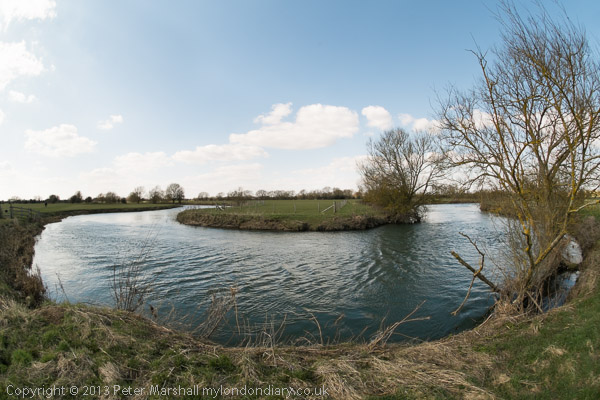
Near Radcot Lock, Fuji X-Pro with Nikon 10.5mm, corrected with Fisheye-Hemi plugin

We would chose about the coldest days of the year to spend three days walking the Thames Path. Not of course the whole of it, but the upper reaches to the source, starting in the middle of nowhere west of Oxford and ending up at the stone placed in a rather dry field by the Thames Conservators to mark the spring from which, at least sometimes, the Thames is said to flow, before retracing our steps a mile or so and diverting to a conveniently placed station.
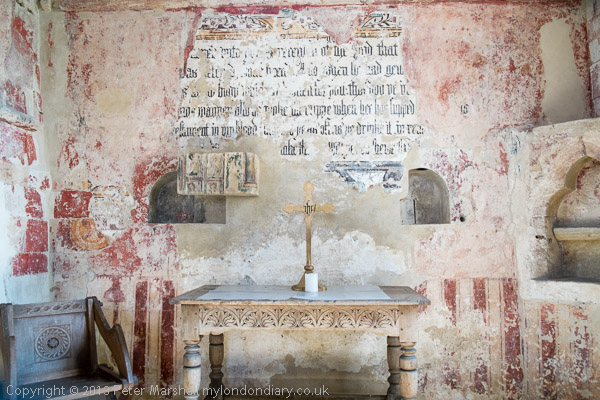

St John the Baptist at Inglesham, saved by William Morris from the threat of Gothicist ‘restoration’

Of course I’d walked parts of the Thames path well before it existed as a national trail, opened only 17 years ago, and somewhere have a copy of the proposal put out for consultation a few years before that, though I can’t remember if I made any contribution to that. But before then I’d walked and cycled most of the places one could walk along the river in and around London, as well as most as far as Reading. And in the last few years, I’ve walked along most of the rest in days out from home. But beyond Eynsham, a few miles upstream of Oxford, the river avoids most places readily accessible to public transport until it reaches its source, a mile or so from Kemble station, one of the few stations left after Beeching’s over-drastic pruning of our rail network.

Kemble itself lost two of the three lines that served it, a much more important railway junction than would be expected from the village – and it serves a rather greater area, particularly the town of Cirencester, just four or five miles north-east.
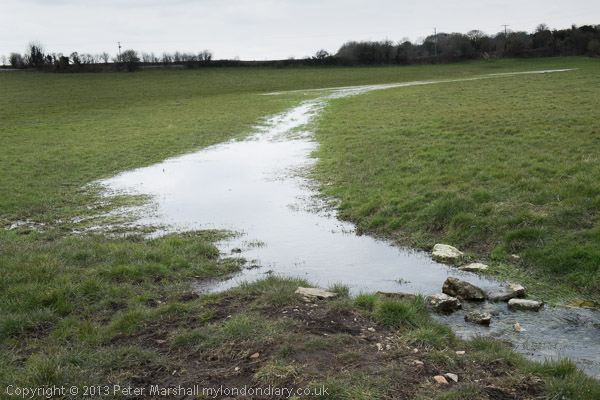

Thames Head, where the Thames first becomes visible

My son who had worked out all the details had thought that April would be in the spring rather than the near-Siberian weather we found. Cold weather isn’t necessarily bad for walking, and popular paths are less crowded than in summer, and we were at least lucky there had been little rain for a week or so, as parts of the path are often flooded, particularly in winter. Apart from one major and well-marked diversion the paths were fairly dry and we met relatively little deep mud.

We were carrying the essentials – spare clothing, medicines etc – on our backs, and I didn’t want a heavy camera bag. I packed my stuff into a cheap photographic backpack, bought a year ago but never used for its purpose. I found I could just fit my two Nikons, flash, extra lenses etc in it, but it was a pain to get the kit out when I needed it or wanted to change a lens. Although carrying the weight is easier on your back, I also find backpacks get in the way rather more than a shoulder bag, both your own way and that of others when you are in a crowd.
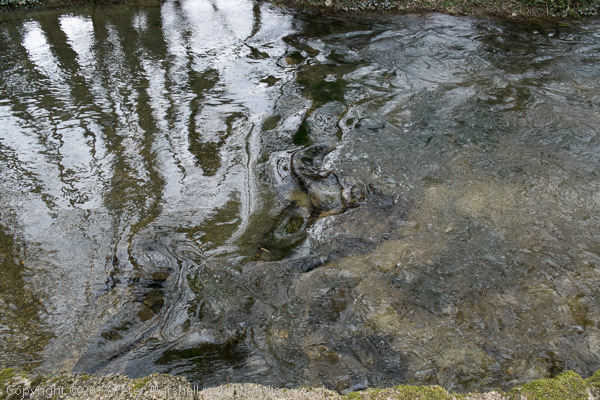

Thames near Ashton Keynes

So I pulled out the removable dividers and in went the spare clothes, sponge bag, spare shoes etc, leaving no space for a camera. I could still have fitted in a notebook computer, but decided I could prefer to be without electronic communications for the three day trip. No point getting away from it all if you don’t get away from it all.

In what I call a toy camera bag (it came as a free gift) I put the Fuji X Pro1 with the 18-55mm zoom, the Nikon 10.5mm with its adapter fitted, and a couple of Leica fitting lenses again with an adapter, the 15mm Voigtlander and the 90mm Elmarit, a few spare batteries (the charger went in my back pack.) It was a reasonably comprehensive kit, weighing less than 5 lb and there was still room in the bag for sandwiches and a bottle of water.

Some of the more interesting pictures to me were made with the 10.5 semi-fisheye, though it is a little inconvenient in use, with no aperture markings and infinity focus at around 0.3m on the scale. You can focus accurately by setting the camera body to manual focus and pressing the main command dial, which zooms into a digital view of a small enlarged central area. Of course the lens gives a far too wide view for the optical finder to be of much use, but the digital finder is fine.

Were I to redesign the XPro, I’d either leave out the screen on the back of the camera, or if I left it on, make it swivel and tilt. As it is I’ve yet to come across any situation where I would use it for taking pictures, when either the optical or digital viewfinder view are both so much superior. It’s only real use is for showing other people the pictures you have taken or for close-up pictures of your feet or things close to them, when it saves your knees a little. And of course I’d get them to take a look at battery life, and to get an instant response to a half press on the shutter button whatever else the camera was doing.

In use, the gear all performed well if sometimes rather slowly, though I don’t think I got around to using the Leica fit lenses, certainly very little. I still don’t know why sometimes the bright line frame in the optical viewfinder seems to take around 10s to appear, and I saw rather more of the backs of my two companions than I would have liked as I struggled to catch up with them after stopping to take photographs. The heavyweight Nikon is faster in use, but certainly would have been a lot harder to carry.

But of course you can judge for yourself how well it worked from the pictures I took over 3 days on and around the Thames path:

Thames Path: Shifford to Buscot
Thames Path: Buscot to Cricklade
Thames Path: Cricklade to the Source

________________________________________________________

My London Diary : Buildings of London : River Lea/Lee Valley : London’s Industrial Heritage

All photographs on this and my other sites, unless otherwise stated are by Peter Marshall and are available for reproduction or can be bought as prints.

To order prints or reproduce images

________________________________________________________
Thurston Hopkins reaches Century

Few photographers in the UK get the attention they deserve, and it is only as Thurston Hopkins turns 100 that we get a little – but only a little – media interest in his work. He was one of the English photographers I included in my listing of notable photographers which I compiled on-line around the start of the century, and the subject of a fairly lengthy essay I published in 2005, when he was only 92!

I’d thought that essay had disappeared into the bit-bucket of history, though of course I have my own original copy (but not the rights to publish it) but was surprised to find it still came up in the top 10 on my Google search in a pirated version on a gallery site.  Should I be flattered? Or sue?

Hopkin’s best known work was for Picture Post, and it is now the property of Getty Images where you can search the Hulton Archive and find around a thousand of his images on line  – or only three if you specify ‘creative’ rather than ‘editorial’. Though I’d classify his editorial work – with a few exceptions – to be unusually creative.

Possibly his best work for PP remained unpublished. Here’s a paragraph of my piece:

The decline of Picture Post was clearly indicated by the fate of the story by Hopkins on Liverpool, arguably his finest work. Taken in 1956, it showed the people of the city living in slum properties with few possessions, through a series of powerful images.

A child peers from the corner of a broken window; a woman washes her face sitting crouched over a bowl of water on a newspaper covered kitchen table, her breakfast cup and plate still on it, an older woman stands among scattered sheets of newspaper in the desolate infinity of an alleyway between the walled yards of back to back streets, clutching a few packets to her breast., desolate and desperate. A child tries to sleep on a sparse bed below a dirty blanket. Covering this are sheets of newspaper, probably more to protect the blanket from falling plaster and drips of water than to keep her warm.

and I continued with the story of what became of it:

The city fathers protested to the proprietor, Edward Hulton about this indictment of conditions in their city. He put pressure on the editor (no longer Tom Hopkinson, who had left the magazine several years earlier following the dispute with Hulton over his printing of a report by Bert Hardy and journalist James Cameron on the mistreatment of prisoners in the war in Korea) and the story was dropped. Twenty years later, other photographers, including Paul Trevor, went back to Liverpool and found little had changed.

The Guardian published a nice blog about him by Observer Picture Editor Greg Whitmore entitled ‘Unsung hero of photography Thurston Hopkins turns 100‘ although as I’ve pointed out he was not entirely unsung – and my essay was probably read by millions around the world. On Friday they published a gallery of 17 of his finest images, almost half from the Liverpool piece, and you can see a more eclectic selection from the Photographers’ Gallery, largely illustrating a curious obsession with autombile fins. Getty’s gallery, which starts off with a curious travesty does improve if you scroll down, but one of the most interesting posts I’ve found on the web was written by the man himself.

Blood on the Street

No, this isn’t going to be a post about Thatcher or the Miner’s Strike. I’m pleased that I avoided photographing the former – except in effigy – and a little ashamed that I was too busy with other things in other places to cover the latter. But since everything else published today seems to be about her I felt obliged to start with a reference. To me she represented the triumph of the politics of personal greed that has led with a certain inevitability to our current financial sickness and Victorian or worse levels of inequality (but without any of the Victorian virtues), but perhaps even more basically that she managed to stigmatise all ideas of social conscience as the politics of envy. But enough of Thatcher, more than enough. If only it was Thatcherism that was going to its grave.

Of course my politics and my photography are inextricably linked in my life, as I think they have been for virtually all if not all those photographers I admire. Even Ansel Adams, who came to photography through the Sierra Club.

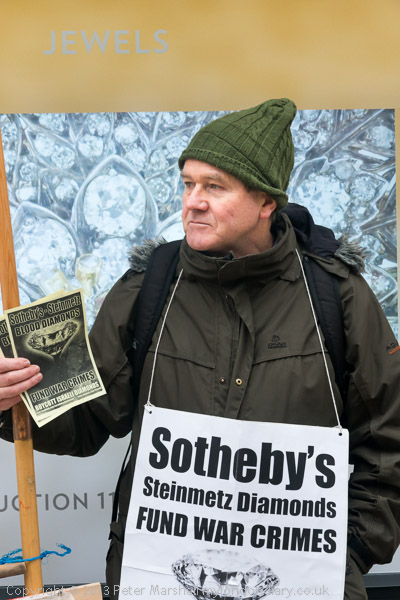
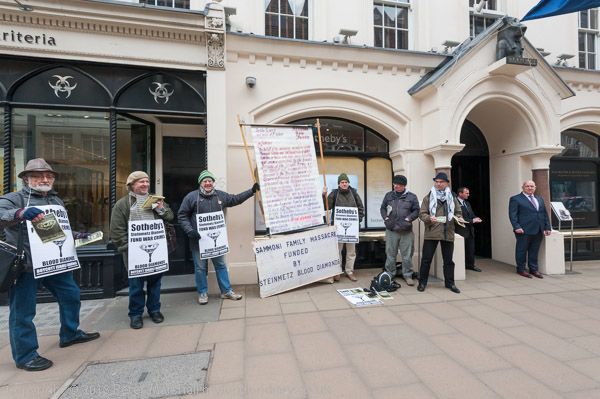
The blood in the title is for ‘blood diamonds’ and around the end of march I was outside Sotheby’s in New Bond St because as well as selling old jewels they also are in business to sell diamonds from the Steinmetz Diamond Group which sponsors the Israeli Givati Brigade which is accused of war crimes in Gaza. Although this and the “about $1 billion (the Israeli diamond industry contributes) annually to the Israeli military and security industries” was the reason for the protest, one of those present who has researched the Israeli diamond industry also told me that Israel exports more cut and polished diamonds (and they are around 30% of its exports) than can be accounted for by its imports of raw stones, and alleged that Israel secretly imports illegal rough diamonds from war-torn countries such as the Congo, and cuts and polishes them so they can then be legally sold, despite being one of the leading players in the ‘Kimberley Process’ against the use of blood diamonds. I was in no position to assess the truth of this claim, so should I report the allegation or not? As you can see in Blood Diamonds at Sotheby’s I did.

Photographically my problem was that there was really little to make interesting pictures. A few people – about a dozen protesters, not all present at the same time were all the protest needed to make its point, and there were a few members of Sotheby’s staff standing in the doorway and occasionally coming out onto the street, and the public walking past, some stopping to read the banners or taking a leaflet. But really rather little to work with, though I tried my best.

Both of the windows at Sotheby’s had a video display, and one was on their sales of antique jewellery, including a image that filled the screen with diamonds. They weren’t the diamonds the protest was about, but it was a good enough background for a photograph. The usual pictures of the protesters and placards and banners. The staff and protesters…

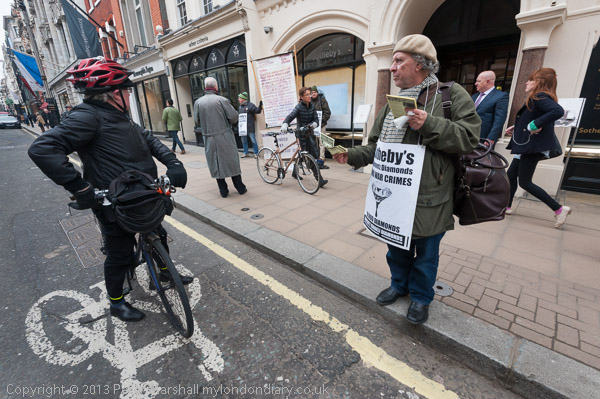
Then came what I saw at the time as a little gift from the photographic gods. A passing cyclist paused to look at the display, stopping his bicycle on a painted bicycle symbol on the street outside the shop, next to one of the protesters. I saw a possibility and moved to take a picture, then saw that another cyclist was walking down the street, and took a second frame just before he walked behind the hand of the protester holding out a leaflet.

It may not be the greatest picture I’ve ever taken, but it was certainly a little less pedestrian (sorry) than the rest! And to continue my thoughts from yesterday, perhaps had just a little touch of Winogrand?

Writing Through One’s Hat

I wasn’t quite sure why A D Coleman was writing about the as yet unpublished  ‘How to Talk About Books You Haven’t Read’, by Pierre Bayard in his Nearby Café Photocritic International post How to Talk Through Your Hat (1) and making the connection between the author’s name and one of the pioneers of photography, Hippolyte Bayard seemed rather a weak link – especially as Coleman says “I’ve yet to determine whether he’s related“. But of course I knew and trusted that he would at some point get to the point.

And of course he does, if only in his later post, How to Talk Through Your Hat (2), where he talks about the development of his own critical practice, where he increasingly realised the need to make “careful description and formal analysis” central to his reviews, although as he says, “it’s hard to make description and formal analysis interesting to read, more so certainly than interpretation and evaluation.”

It’s an approach that I’ve also very much tried to take in the best of my attempts at critical writing about photography – and forced students to take in their critical studies of photographers when I was teaching, giving them a formal structure which started with these aspects, even though it was anathema to academic practice at the time. As I wrote long ago, most writers on photography would rather do anything than actually look at the pictures.

And this, rather more elegantly, is what Bayard and Coleman are saying. Coleman of course has pointed it out long before, as he says:

As I pointed out back in 1997, you can peruse the entire English-language “discourse” around Cindy Sherman’s “Untitled Film Stills” without encountering any substantive engagement with the particulars of any one image of hers.

He goes on to say that most theoretical writing about images tends not to discus its actual content, but “the literal subject matter, and their personal response thereto ― equivalent to assessing a Cézanne still life according to your preferences in fruit.

But you need to read his posts, rather than mine, and I gather from the bottom of the second post that we can expect a third on this series.

I read rather a clear example of writing about photographs without any real attempt to look at the actual content the other day in a review of the current Winogrand retrospective at SFMOMA. Caille Millner‘s review in the San Francisco Chronicle was drawn to my attention in a post by Joerg Colberg on The Ethics of Street Photography (his link to it may work if mine hits the paywall) and seems to me a near perfect example of someone writing about images without actually seeing the actual content, producing a diatribe based on her reaction to his literal subject – or one of them – women.

Millner seems to have little idea of who Winogrand was or what he was doing – or with how it changed what other photographers do, and to be completely unprepared to engage with them. She could have looked at a Picasso show and come out with the same response (probably with more justification) about his attitudes to women.

I think Winogrands attitudes and images were considerably more complex than she imagines, and although when I wrote a lengthy essay on him some years ago I wasn’t entirely uncritical of his approach to women, I didn’t mistake this as the point of his work. But unlike her I knew his work, and looked at the pictures, including those in my copy of his ‘Women Are Beautiful‘ (I got it reduced to £4.50 and it now sells at $450 upwards) and didn’t have the same axe to grind.

With the Midwives

Long ago, when I became a parent, we did it on the NHS. Linda I think liked the idea of a relatively clean ward with medical services to hand being looked after compared to the mess and confusion of our own home, and didn’t entertain the idea of a home birth. Back then our local hospital was clean, in a newly opened purpose built maternity unit, and seemed well and efficiently run and there appeared to be no shortage of midwives. The hospital and the ante-natal classes were a short bike ride away, though for the birth we travelled by ambulance. It was a long and tricky business and we were pleased there was a doctor to hand when needed.  Linda went back there a couple of years later for our second child.

Now, that unit has long been demolished, and most of our local hospital services have moved away elsewhere. When I had a week or two in a couple of the remaining wards around 10 years ago I was horrified at the failure of the contract cleaners to clean and it was often impossible for patients to find a nurse when one was needed.  But perhaps the replacement maternity unit at the hospital an hour away by public transport is still well run – I’ve had no occasion to visit.

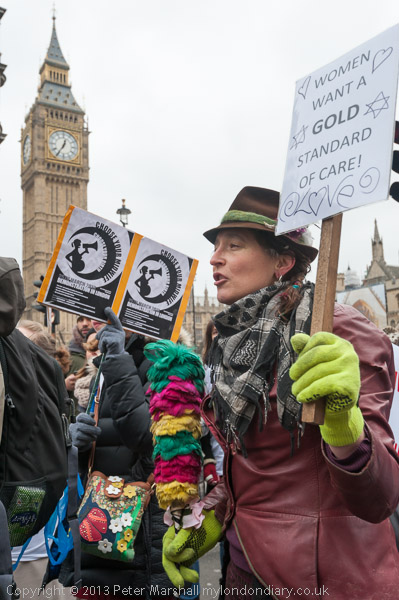
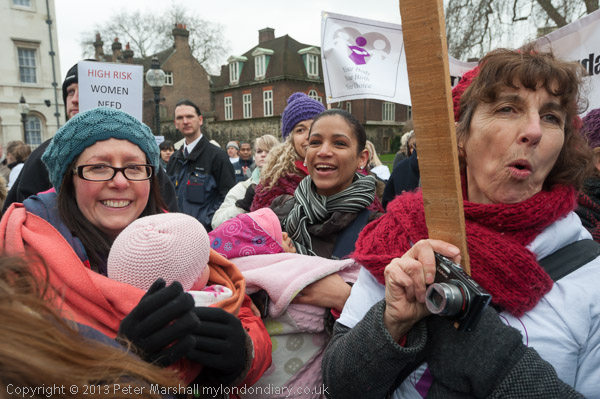
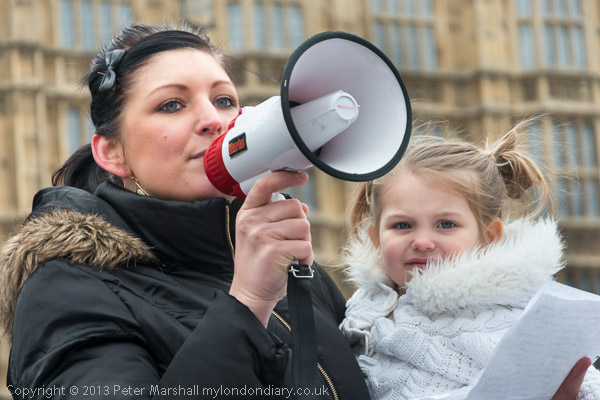
But many mothers want the more personal service that independent midwives can provide, although it is only available through the NHS in a few areas, and in some respects it provides a model that the NHS could and should learn from.  David Cameron probably regrets having called the service they offer a ‘gold standard’ of care, but it is, and one that the NHS should aspire to, but unfortunately often appears to put unnecessary hurdles against cooperating with. But this protest was more about the European Union regulations and the failure of our government as yet to provide an affordable professional indemnity insurance scheme – something private enterprise has failed to come up with for over 10 years.  It doesn’t make a great slogan:

What do we want?
An affordable professional indemnity insurance scheme!
When do we want it?
Now!

but it really is vital for the future mothers of this country.

Photographically the main problem was keeping warm, though I had wrapped up well. Though I think the Nikon D700 and D800E I use are ridiculously large – probably twice the volume of my old OM bodies – you can at least use them wearing pretty thick gloves.

I wanted to avoid the stereotype that using an independent midwife or wanting a home delivery were the prerogative of rather cranky middle-class mothers, but there were quite a few present who perhaps fitted. But one speaker introduced herself as an “ordinary mother”, making it clear that she wasn’t wealthy or middle class, not someone who could normally afford private medical care.  She told of having to scrimp and save and of her good fortune in finding an independent midwife who would take her on at less than the normal rate.

One of the clichés about photojournalists is that their response to human misery is simply to photograph it rather than give help; something that is often untrue, although often the most positive thing photographers can do is to show what is happening to the world through their pictures. But we all know the story about the photographer describing the terrible condition and need of a beggar, near to death on an Indian street. “And what did you give him?” he was asked. “1/125 at f8. ”

I found myself having to make a decision in a rather less critical situation when photographing the large group picture of mothers and children which one of the gentlemen of the press had asked the event organisers to set up. Not my kind of thing, but if it happens I take advantage of it, and I’d moved in close to take pictures of a small group of mothers and children. As I did so one called out to me for help, saying she felt she was about to faint. Fortunately she didn’t hand me the baby that was rather securely strapped to her, but needed me to look after her things while she struggled to release the child.

For a couple of minutes I was no longer a photographer, simply someone giving assistance to a fellow human being. She didn’t faint, and thanked me for my help and I went back to taking pictures. I’d probably missed some opportunities, but it didn’t seem important; I was pleased to be able to help.

More about the event and more pictures in Independent Midwives Need Insurance on My London Diary.

Continue reading With the Midwives

Wintry Barnet Spring

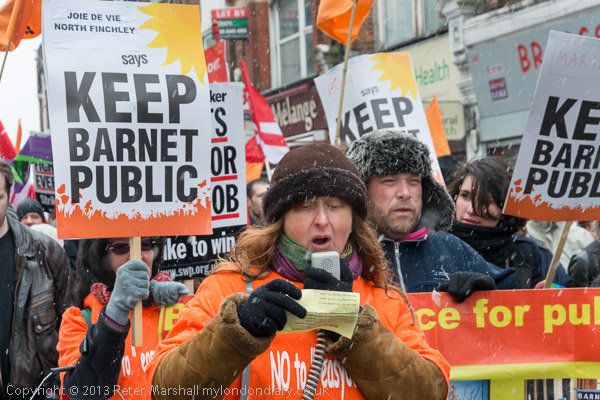
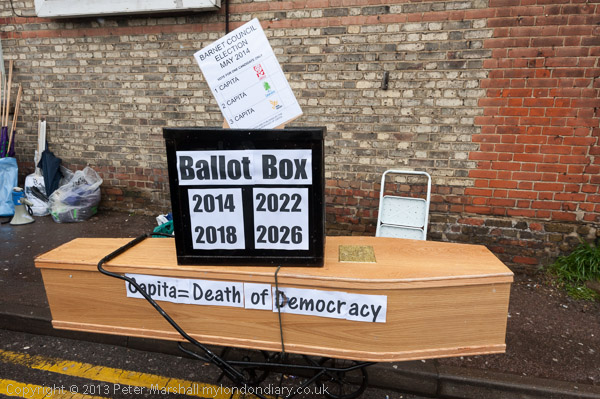
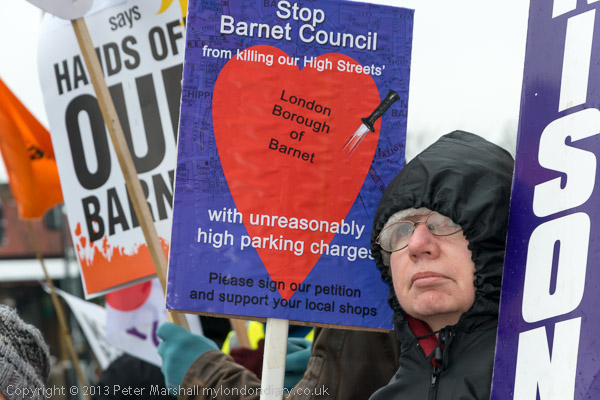
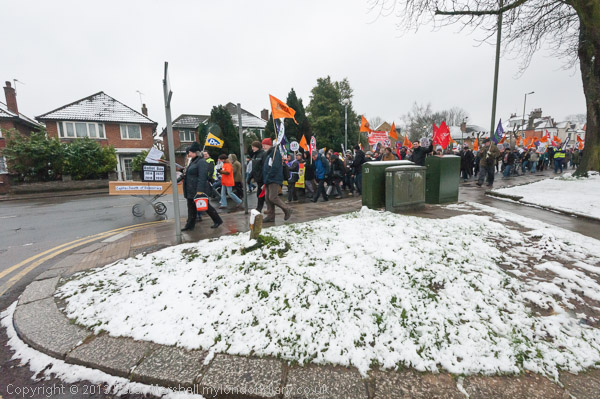
The Barnet Spring march had met at the oddly named Finchley Central station (it always seems to me to be in the middle of nowhere very much) with snow falling lightly and the temperature stuck around zero with a cold East wind bringing a little Siberia to England. The weather truly seemed determined to provide a pathetic fallacy for our economic and social conditions, with austerity and a whole raft of anti-social measures coming in to aid the cold in killing off the disabled and the poor. And in Barnet to freeze out local democracy in favour of the Orwellian-named ‘One Barnet‘, selling off local services to be provided though contracts with commercial providers, leaving little role for those elected once the contracts have been signed.

Surprisingly it was the council themselves and not protesters who compared the approach to Ryanair and easyJet, producing the epithet ‘easyCouncil‘ as if offering a low-quality service on the cheap was something to be proud of.  More about Barnet and more pictures from the event at Barnet Spring – Save Local Democracy.

Of course I’d read the weather forecast and like most of the marchers had gone prepared, in my case adding a thermal long-sleeved vest and long-johns and an extra pair of socks to my normal winter gear. And I’ve found I can still use the Nikons with slightly thicker Polartec gloves, so I wasn’t too frozen, though hanging around waiting for the march to start wasn’t pleasant.

But having a couple of cameras hanging around my neck at least provides a reason to keep on the move which helps to stop me getting too cold, though I do tend to have my jacket open a little when its actually snowing – as it was fairly slightly – so I can slip the camera not in use inside it to keep dry. One big advantage of fitting your camera strap to the bottom of the camera is that lenses hang down  and don’t usually attract raindrops or snowflakes as they do on a normal neck strap, but the big filter and minimal lens-hood of the 16-35mm  make that a real magnet for them.

I’m just a little worried about taking my D800E out in the wet, as I still haven’t had the cracked window of the top-plate display replaced – when I took it into my normal repair company shortly after the small accident they told me they hadn’t been trained on these cameras and couldn’t handle it themselves, it would have to go back to Nikon.  So it’s still just covered with some by now rather worn waterproof transparent tape, which I suspect is no longer that waterproof, and certainly rather less transparent in places. But I’ve also discovered that it’s rather easier to read the things I need to see on the rear panel by pressing the ‘Info’ button.

Once the march started the snow had eased off and I actually began to warm up a little, until we’d gone about a mile. I’d just started to try and take a few images to illustrate the winter conditions, stepping back a little to photograph over car roofs with an inch or two of snowy icing and the odd tree and patch of grass, when it really started to snow. And when the march turned around  in North Finchley to head for Friern Barnet, it was really marching into a small blizzard.

Soon I couldn’t keep the lenses clear for long enough to take pictures, and so I did what any sensible photographer in the situation would have done, and as we were passing a bar I took shelter, a glass of beer and a short rest until the worst of the snow shower was over.

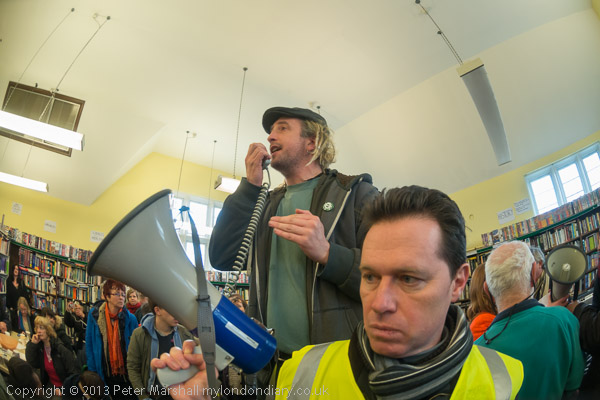
When I came out it was still snowing, but rather less, and I could still see the bus at the back of the march in the distance. I jumped on a local bus going in the same direction, and let it take me most of the distance – it was soon stuck in a queue of traffic a couple of hundred yards behind, and I sat on it eating a sandwich or two. Getting off a couple of stops before it reached its destination, the newly re-opened Friern Barnet Community Library – I’d been at the Victory Celebration a month earlier – I was able to run and get there just before the protesters arrived.

It was inside the library in the warm and with the breath of  more than a hundred people adding to the humidity that one of the real problems of hefty glass like the Nikon lenses came to the fore. Having been thoroughly chilled to zero degrees for several hours, they soon began to steam up, quickly becoming more or less unusable.  While the miniature optics of compact cameras and phones quickly adjust and warm up, the large elements in big lenses take literally hours to see clearly again.

Soon the only usable lens I had was the 10.5 semi-fisheye, and then that began to mist over as well. Probably the only solution is to take a compact camera as well and keep it warm in an inside pocket ready for interior use. Perhaps it’s time to update my ancient phone to one that can take pictures as well as make phone calls.

________________________________________________________

My London Diary : Buildings of London : River Lea/Lee Valley : London’s Industrial Heritage

All photographs on this and my other sites, unless otherwise stated are by Peter Marshall and are available for reproduction or can be bought as prints.

To order prints or reproduce images

________________________________________________________
Kim on Koudelka

While I think that Eric Kim in his blog post 10 Lessons Josef Koudelka Has Taught Me About Street Photography considerably overstates the obvious, most of it is good advice, and what shines through is his enthusiasm about photography and Koudelka’s work.

Although I’m also a fan of Koudelka, and have several of his books, including Gypsies and Chaos which I think are perhaps his most important works, I think Kim goes rather over the top about him – as he also does in his features on Lee Friedlander and Daido Moriyama among others. But there are some nice links to a couple of videos and his Magnum page, as well as to his books.

Incidentally I paid £14.50 for my copy of his Gypsies, the 1975 UK edition which I find is now offered on-line at over £200. The more recent version had more images and is better printed and available second-hand for around $50. Photographic books can be a decent investment, though mine tend to become rather worn, which cuts their value. But many others I bought are probably worth less than I paid for them.

Although it’s nice to be able to hold a book and leaf through it, I think you can learn just as much from Koudelka’s work on line. There are photo books that really work well as books and are not just collections of images, where the sequence and the ability to look back and forward really matter, or where the print quality of the images is vital, but I don’t think this is so with Koudelka’s work. In general I think it works as well on screen – for example at Magnum – as it does in print or even in actual photographic prints, perhaps with the exception of his panoramic work, which really needs to be seen on a greater scale. Some in the Chaos book are reproduced as 22×9 inch double page spreads.