Too Much Control?

Perhaps there are good reasons why a photographer should sometimes want to limit the flash sync speed of their camera to – for example 1/60s – but I can’t for the moment think of a single one. Any suggestions are welcome.

Of course using slow shutter speeds with synch is at times a useful technique, but something quite different. There is no problem in using flash with a synch setting of 1/250 on an exposure of 30s – and the results would be identical to those with any other synch setting.

Back in the old days, slow sync speeds were often a problem when using flash, particularly once we moved away from flash bulbs to electronic flash. Back in the 1970s, the cameras I was using – Leica M and Olympus – had horizontal travel cloth shutter blinds in its focal plane shutter that could only manage 1/50 and 1/60 respectively. This slow X-sync speed was one of the limitations of the OM series (including the OM4 – my favourite 35mm film SLR – and I still own two, though it’s now probably ten years since I used them) despite its revolutionary (at the time) off the film through the lens flash metering which made flash so much more usable.

Cameras using vertical metal FP shutters had a shorter travel for the blinds and could also manage a faster movement, allowing higher flash sync speeds – often 1/125 in the 1980s, though at the expense of louder and more noticeable shutter noise.

The Nikon D700 (and D800E) offers flash sync in normal X-synch mode at up to 1/250, with special FP modes of 1/250 and 1/320. But custom setting e1 lets you select synch speeds – down to 1/60th. It shouldn’t be confused with CS e2, which sets flash shutter speeds from 1/60s to 30s, as the slowest shutter speed that will be used in P or A modes when using flash.

For normal use on my camera I set e1 at 1/320(FP) and e2 at 1/60. I can’t see any point in using a lower synch speed than the maximum, and I’d like to be able to set a faster slowest speed than Nikon allows to avoid blurring in some images rather than have to remember to do this manually. For most purposes we can simply forget sync speeds now, as these cameras will also synch at higher speeds using ‘Auto FP high speed sync” with the SB800 and other units that implement this though the manual seems very confusing on this. But it just works, even at silly fast speeds like 1/2000. So why have a custom setting at all?

The last few of times I’ve been out working, I’ve been unable to get fill flash to work with the D700, getting over-exposure all the time. It’s taken me quite a while to work out why, though the answer was simple and obvious once I took the time to sit down and think about it. But in the middle of a fast-changing situation you don’t have time to think, and it wasn’t obvious that things were going badly wrong on the kind of occasional quick glimpse at the images on the back of the camera.

When I got home, I’d take a few test images and find that the camera and flash were both performing perfectly, and forget about it. Fortunately it hadn’t been vital to use fill, and I’d got by without it. But this morning I decided I really had to sort it out.

My first thought was that it was a problem with the flash (and I’ve had a lot of problems with flash units, with two needing expensive repairs and a third being being beyond economic repair in the past year.) So I started by resetting all settings on that. I made a few test exposures indoors and things seemed to be fine, so then I went outside where the light was considerably brighter. And noticed that when I turned the flash on the shutter speed dropped right down to 1/60. I couldn’t understand why, nor why their was a ‘HI’ in the control panel – and then I realised.

Most of the time I’ve used flash in recent weeks, a shutter speed of 1/60 has been more or less what I might have chosen if I’d been making manual settings. Possibly 1/125 or even 1/250. But the camera was still set at a high ISO and I was now in pretty bright light – the kind of conditions where I might want to use fill.

I’m sure I didn’t deliberately choose to set 1/60 as my flash sync speed, but possibly did so by mistake, thinking I was setting CS e2. Or just perhaps a load of electrons ganged up on me and decided to change it behind my back. It’s something that often seems to happen when I use the computer, and modern cameras are just computers with a few analogue bits tacked on.

But  I do wonder if the choice of sync settings is one that is there simply because it is easy for Nikon to implement and adds yet another ‘feature’ – even though it makes the manual fatter and understanding and using the camera tougher – or is there really some point to it?
ICP Infinity – David Guttenfelder

I’m not a great fan of awards ceremonies – and the nonsense over things like the Oscars, BAFTA and the rest really turns me off, but perhaps I’d make an exception for the ICP Infinity Awards, which don’t seem to suffer from the same kind of sycophancy, in-breeding and embarrassing acceptance speeches.

There are certainly a number of worthy winners each year (and sometimes one or two I find hard to understand) and this year is no exception. You can see a video presentation on each of the winners on Mediastorm, and I’d particularly recommend watching the video on David Guttenfelder  who won the Photojournalism Award – scroll down from that for the others. His isn’t a household name, even among photographers, but as a photographer for AP he has “spent the past 20 years of his life in some of the worst places in the world. He spent his 20s photographing bloodshed in Africa and his 30s reporting on the war in Afghanistan. Now the chief photographer for Asia, where he is primarily based in North Korea” and there are some fascinating images from there as well as a few which are perhaps more like we would expect from an AP correspondent covering official visits. As he says on the video, “the most mundane pictures sometimes are the ones that are the most powerful.”

I’ve not watched all of the other videos the whole way through, but I was also particularly impressed by Kitra Cahana, winner of the Young Photographer Award, and of course who could argue with the Cornell Capa Lifetime Achievement Award going to David Goldblatt – I’m only surprised he hadn’t already won it. His classic ‘On The Mines‘ has been on my bookshelves since it was first published in 1973, and I was pleased to see a revised version published last year by Steidl as the first in series on his work they are bringing out.

These videos were shown to the audience at the awards ceremony on May 1, and if you were disappointed not to get an invitation to be there in New York, console yourself that it’s probably better be able to watch them in the comfort of your own home, without any of the razzmatazz.

And thanks to one of my favourite photographers, Ami Vitale, who shared the link on Facebook with the message “David Guttenfelder is amazing. Beautiful story.”

The Marquis of Lansdowne

The Marquis of Lansdowne is not my name-dropping of a personal friend, but a former London pub, fortunately still standing in Hoxton, but not in ale since around 2000 (and possibly not a place I would have cared to frequent since it had a make-over as ‘Partners’ around ten years earlier.) Recently it has been threatened with demolition by plans for a  £13.2m expansion of the neighbouring Geffrye Museum.

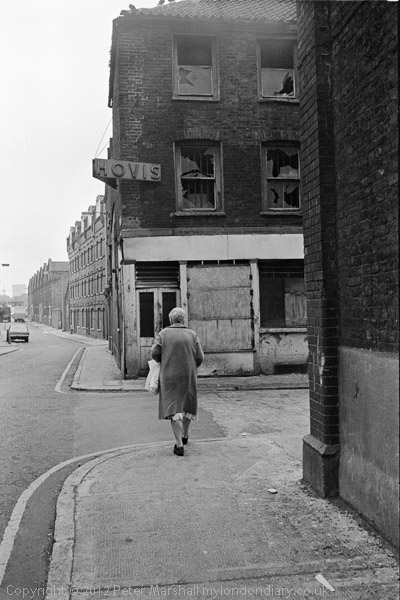
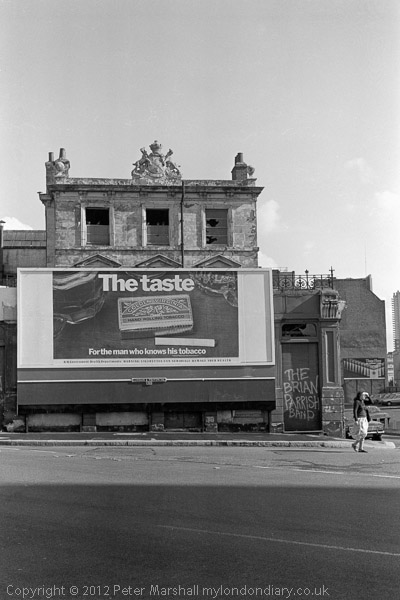
Back in the 1980s I began over a project to photograph the whole fabric of London, wandering in a fairly systematic manner through the capital rather than the rather freer approach of earlier years that you can see in my recently published ‘London Dérives‘, (and the images on this post come from it and the accompanying web site.) Most if not all of the pubs and many of the shops in this earlier work were derelict.

But my ‘Buildings of London‘ project, which began long before Google’s ‘Streetview’ made it somewhat redundant, was more conceptual than literal. Although I intended to look at most of London and went about it in a fairly systematic way, I had a clear focus on photographing not everything, but the interesting and the typical.  You can still see a few images from it in the web site I built in 1996, itself now a rather decrepit relic – seventeen years is a long time on the web (though I had to make a few changes to keep it working, and added a few pictures, it still retains the essentials of its 1996 design.)

I’m not sure if I ever photographed The Marquis of Lansdowne, though I will have looked at it, and at the now demolished ‘The Flying Scud‘ nearby on my walks in the area.  It would probably take an hour or two of searching through my files to be sure. It isn’t an outstanding building, but one that is very much typical of its age and certainly that I would be sorry to see demolished. You can see what it looks like now in an article in Building.co.uk by William Palin, a trustee of the Spitalfields Historic Buildings Trust and former Secretary of SAVE Britain’s Heritage.

So I was very pleased to see in Spitalfields Life that a long campaign which has included a feature in ‘Country Life’ (not a publication usually concerned with Hoxton) as well as a series of articles in Spitalfields Life and work by the Spitalfields Trust and others has resulted in the building being saved, with Hackney Council Planning Committee telling the Geffrye Museum to rethink their development plans to include this building.

I hope the Museum will see it as an opportunity to enhance its display of period rooms (well worth a visit) to include that of a genuine neighbourhood Victorian (though the building is a little older) pub, truly a part of the living room of many among the working class of the era in overcrowded neighbourhoods such as these.  Hopefully too it will be realistic enough to have some genuine beer on tap, although the current London price per pint is at least a month’s Victorian wage.

Indian Protests in Westminster

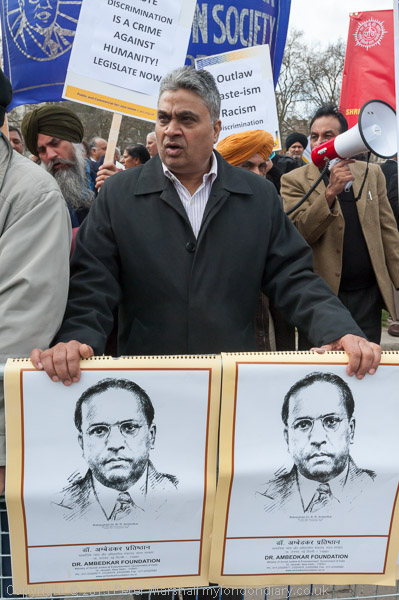
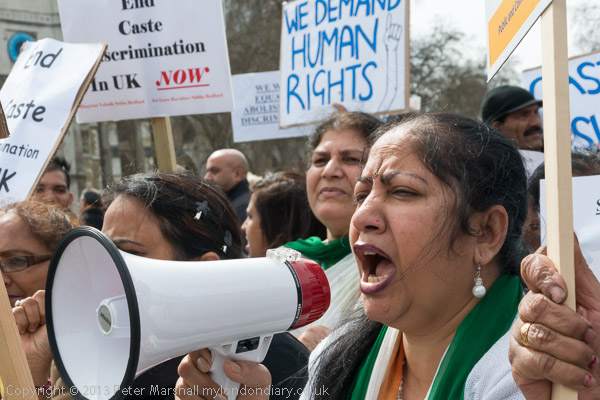
One of the great things about photography is that you meet people and learn things, and at the protest by CasteWatchUK and the Dalit Solidarity Network I learnt a little about Dr B R Ambedkar (1891-1956) which led me when I got home to find out more about him on the web – and you can read a little of what I found in Outlaw Caste Discrimination on My London Diary, with quite a few pictures from the event.

Through several friends over the years I’ve known something of the problems faced by Dalits in India, and it was good to be able to cover the protest about caste discrimination here in the UK, something I know has been strongly felt by some communities here, particularly the Ravidass, whose March against Caste Discrimination I photographed in 2009.

The government policy – perhaps based on advice from groups dominated by those in higher castes – to reject legislation and simply have an education programme called ‘Talk For A Change’ was overturned for the second time by the House of Lords, who on the day of the protest again voted for caste to be treated legally as an aspect of race. Around ten days later the government finally accepted defeat and tabled an amendment accepting this – good news for the 400,000 or so (though estimates differ widely) Dalits or ‘untouchables’ living in the UK who will soon be protected.

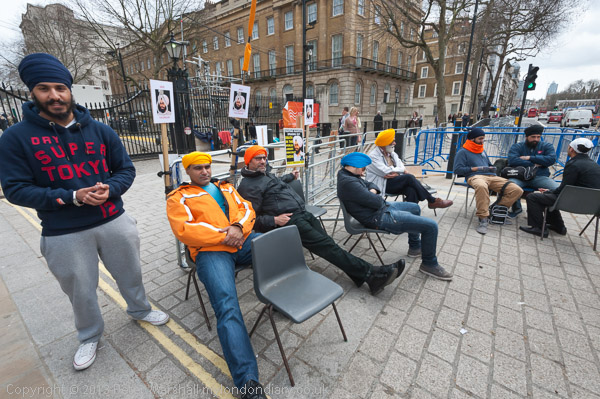
After photographing this protest, I walked up Whitehall to a group of Sikhs protesting opposite Downing St in a vigil calling for justice in India and an end to the death penalty and in particular to get the UK Prime Minister to argue the human rights case with Indian Prime Minister Manmohan Singh and to put pressure on him both to stop capital punishment completely in India and to prevent the hanging of Professor Bhullar, on death row in India for 18 years, whose execution is thought likely to be imminent.

Talking to the people there they told me that the police had expressed concerns about their presence there for the funeral of former PM Thatcher whose hearse was to pass along Whitehall the following morning. Later I was please to find that the police had not attempted to clear the protest, which was still continuing when I went past ten days later.

While it was easy to photograph the large and active protest by Dalits in Parliament Square it was harder to find a strong image with the Sikh vigil, and I wasn’t very happy with my images – in Don’t Hang Prof Bhullar. Without setting something up there seemed nothing much I could do, and setting something up would I think compromise the whole basis of my work. This is a vigil where nothing much happens most of the time, and my record of it shows nothing much happening. Though it doesn’t make good ‘news’.
Continue reading Indian Protests in Westminster

We Didn’t Evict a Millionaire


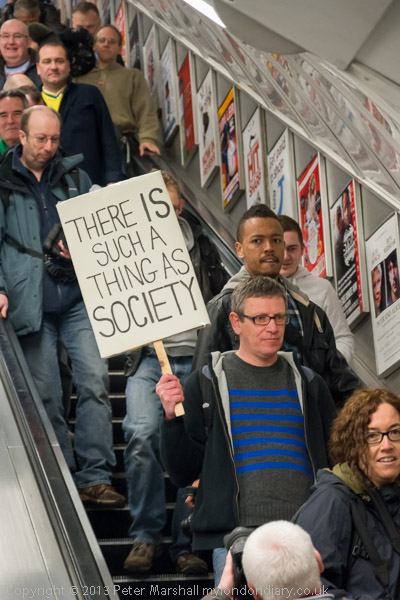
Going down the escalator at King’s Cross

Lord Freud’s house – in a pleasant a leafy estate in Highgate – was perhaps a little disappointing for a millionaire. It reminded me of the house in a rather less salubrious outer London suburb that my family had until my father retired to the south coast the 1970s. Though location is important and it would probably sell for around 5 times as much.  But property prices in parts at least of London are now so silly that almost anyone who owns a house there is a millionaire.

Lord Freud is, I suspect, very much richer than that. And the gap between those like him and the kind of people who will be hit harshly by his Bedroom Tax is now so immense that it is hardly surprising that he has no conception at all of what it is actually like to live on low pay or on benefits. Only a person with no idea of what it is like to be poor could have come up with an idea like this. Or some of the other attacks on the poor from the coalition.

I’m not rich, and there are many things I can’t afford, but fortunately seldom have to think much about money now. But I can remember when I had to count every penny. I remember my mother writing down every small amount she spent into a red covered notebook, adding up the bills every week, hoping that there might be a few pence to go into the Post Office towards the next pair of shoes I’d soon need when my feet outgrew the ones I was wearing. I remember too when my total wealth in the world amounted to £4-14s7d and a few pennies in my pocket, but I was lucky and was about to get a job -and in those days almost a fiver was worth a great deal more than it is today. I’ve always had enough to pay the rent and to eat and -apart from buying cameras – have never developed expensive tastes. So I completely lack the qualifications to be a member of the cabinet, even apart from not having been to Eton and Oxford.

And of course, Lord Freud was not in (I imagine he has several other homes to go to), and this house was surrounded by police, who despite all the ‘secrecy’ from UK Uncut had obviously put together ‘Bedroom Tax’ and ‘Millionaire’ and come up with the names of those whose homes you could reach easily from Kings Cross on a Travelcard. The only people who were in the dark were most of the protesters, and I suspect a few got lost on the way.


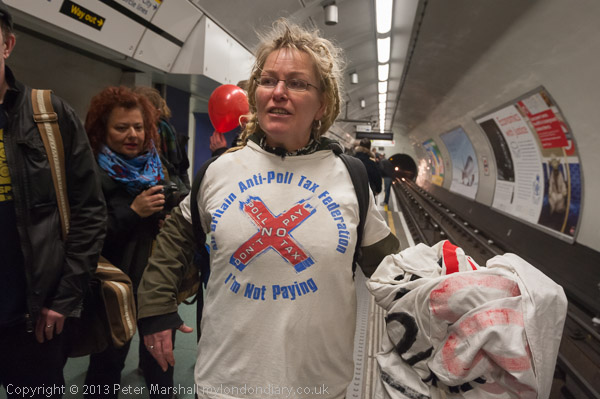
Platform at Kings Cross -A woman proudly wearing the t-shirt she still had from the Poll Tax protests

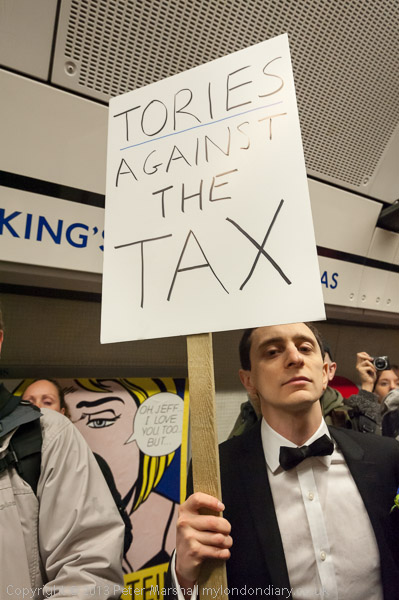
Photographically the most interesting part of the event was the tube journey, and fortunately the Nikons give great results in the relatively low light of tube stations. The escalator and platforms were fairly dim, but I was still able to work at 1/125 at f5.6 at ISO3200. Flash isn’t allowed in the underground, but I didn’t need it.

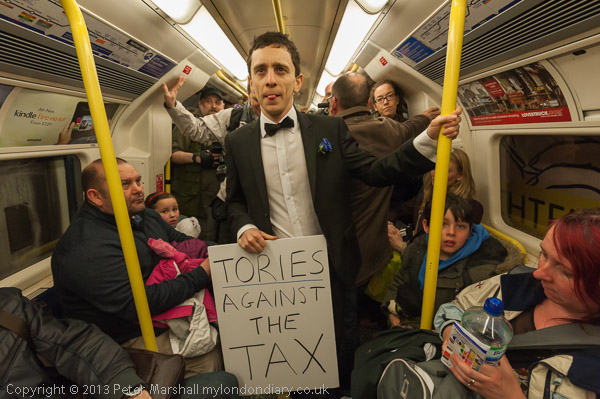
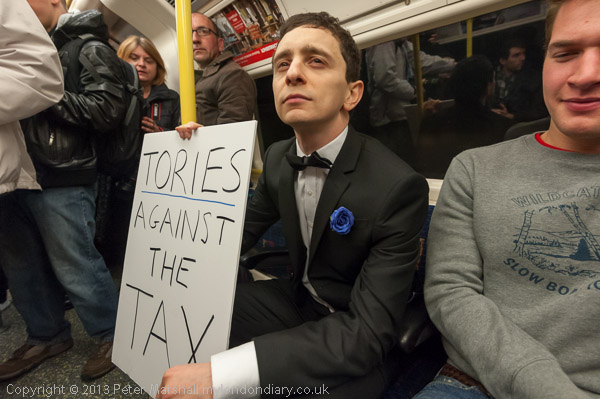
I’d been photographing the man with the ‘Tories Against the Tax’ placard on the platform, and when the train came in rather than follow him through the same door took a gamble and went through the next, hoping he would then turn and be facing me in the middle of the carriage. He did, and I got what I thought was my best picture (the five photographers visible behind him blended in well with the other passengers and don’t really spoil it) and was also in a good position for a further image when he got a seat.

Although the quantity of light was fine, the colour isn’t, with some bad fluorescent tubes. Flash might have given a better result but only if I could have used enough to completely light the scene with it. I didn’t think I could or I might have tried it at least inside the carriage. I think it still isn’t allowed, but I don’t think would present a safety hazard, which is the case on platforms, where it can temporarily blind the drivers.

There were a few other pictures, both at Kings Cross and at our destination that I was quite pleased with, and you can see in Who wants to evict a Millionaire?

I spent several hours covering the event and produced what I thought were some good pictures but I don’t think any of them have been used outside of Demotix and My London Diary (and now these on >Re:PHOTO.) It isn’t always the good pictures that make the news, and of course there were many other photographers at the UK Uncut protest, and mine were not available until perhaps four hours after the first images of it arrived. There were few if any arrests, no real ‘celebrities’ present and no violence – so nothing that would make it an important story for most of the mass media.

From the bus on my way home I saw a few people with placards just before it stopped at Kentish Town station, and decided to go and see who they were and what they were protesting about. I spent about ten minutes talking with the group, and wasn’t at all happy with the few pictures that I was able to make (the steadily falling rain didn’t help) but I thought there was enough interest in the story that despite the rather ordinary pictures it was worth putting on line – and you can see the longer version as Release Palestinian Prisoners. To my surprise one of the images was used by a national newspaper a few days later.
Continue reading We Didn’t Evict a Millionaire

UK Government Gives Our Work Away


One of the first batch of my on-line images to carry a visible watermark

On 19 June 2010 I came to an important decision for me about posting images on the web. Previous to that date for some years I had been ensuring that the images that I had posted carried metadata stating my copyright and contact information, and posting the images almost entirely on sites where that information remained intact. But I’d found some were appearing without my permission on blogs and other sites with that information removed (but unfortunately never on sites that seemed worth suing, though most did respond to my requests for removal or in some cases attribution.) Even on sites that had asked and/or attributed and/or linked, the images themselves had often lost its metadata when images had been resized for use.

So, almost 3 years ago, I started routinely adding my copyright and contact details fairly discretely along the bottom edge of every image I uploaded onto my own web sites (those in commercial libraries have a more obvious overprint from the library.) People told me I should put it across the middle so it won’t be cropped off, but I wanted to avoid unduly diminishing people’s enjoyment of the work. And clearly if anyone cropped the image to remove the copyright they would be breaking the law.

The message ‘Copyright © 2010 Peter Marshall mylondondiary.co.uk‘ isn’t always too clear to read, but it is always (with a few rare exceptions) present on images posted since then – and occasionally I’ve got around to changing the year to match the current date. Usually by around March the following year. It isn’t perfect, but it would be very hard for anyone to claim ‘due diligence’ and use the work without payment given its presence. And of course I can be contacted through a link on the front page of the listed web site.

But that is what is now likely to happen in the UK, thanks to a sneaky bit of legislation by the government who tacked it onto the end of an unrelated bill, the Enterprise and Regulatory Reform Act which received royal assent last week. You can read the details in The Register’s article UK.Gov passes Instagram Act: All your pics belong to everyone now. And as Andrew Orlowski’s subhead makes clear, ‘Everyone = Silicon Valley ad platforms tech companies.’

I’m not sure that his conclusion

“In practice, you’ll have two stark choices to prevent being ripped off: remove your work from the internet entirely, or opt-out by registering it. And registration will be on a work-by-work basis.”

is entirely true, though I am a little worried about the many images I still have on-line without a visible watermark – probably at least 30,000. I haven’t yet found a simple piece of software that will enable me to batch process them simply and add visible information in a way that it isn’t easily removed, though I suspect it wouldn’t be too difficult to write.

I’ve also made sure that my name, which appears visibly on the images is available through the only current registry, PLUS, still in Beta. Becoming listed is free, but “The PLUS Registry operates on a co-op model, funded by optional contributions from “Supporting Memberswho are able to make a small annual contribution. As a Supporting Member, you will receive a unique PLUS Member ID for your business, for use in images, licenses and documents of all kinds.”  It’s free and easy to set up a basic account, and there is a video tutorial on the Help page which takes you step by step through it if you need it.

Including your unique PLUS Member ID appropriately in the metadata of your images should protect images where the metadata is intact without individual image registration, although PLUS also hopes to offer additional by image search and other services for registered images. Otherwise if metadata has been stripped (and doubtless the Silicon Valley skimmers will do so themselves even if companies like Facebook, Instagram or Flickr can be persuaded to stop) then a visible watermark should perhaps also include either your PLUS ID or the fact that you are registered with PLUS. It would be good to have a standard visible method of indicating that images have been made by a PLUS listed creator, but I don’t think there is one. I’m thinking of adding the word ‘PLUS’ to my watermark, so it would now look like:

Copyright © 2013 Peter Marshall mylondondiary.co.uk – PLUS

The UK law is only a skeleton, which will be fleshed out by statutory instruments which will be issued later this year, which I hope will explicitly include the need for those wanting to make use of images to look at metadata and visible information and search PLUS and other registries that may be established.

It seems fairly likely that the legislation will be challenged legally as in breach of various international treaties including the Berne Convention, as well as becoming the subject of protests by photographers and other interested parties.
Continue reading UK Government Gives Our Work Away

3 Cosas


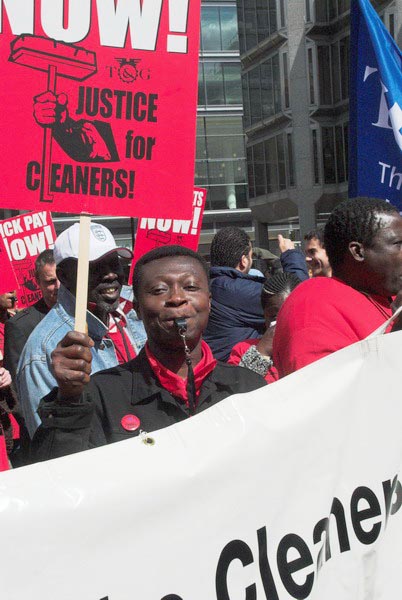
Justice for Cleaners, May 2006

I think the first time I photographed London’s cleaners was at the launch of the London Citizen Workers’ Association, very nearly seven years ago on the ‘Feast of St Joseph the Worker’, better known to the rest of us as May Day. London Workers was, I wrote “a new organisation to support low-wage and migrant workers across London, backed by faith organisations, trade unions and social justice organisations” and a major part of their campaign was to get all workers in London paid at least the ‘London Living Wage.’

Although low paid workers have managed to get some employers to pay the living wage, mostly as a result of  very public noise protests outside workplaces, there is still a long way to go, and even where workers have managed to get the living wage, the terms and conditions of many low paid staff are still grossly inferior to those of others who work in the same places.

I was at the University of London to photograph a protest by low paid workers there in what they have called the ‘3 Cosas‘ campaign. While some of those working in the university buildings are employed directly by London University, most of the low paid workers are employed by other companies – they are outsourced. And outsourcing saves the University money not by employing other people to manage their staff, not by more efficient working, but by cutting down on things like pensions, sick pay and holidays. These are the three areas, the three causes of the campaign.

While the university itself would not dream of treating its employees badly like this, somehow it is quite happy to pay other people to treat its workers badly, to exploit them. In fact not only are the conditions bad, but many also experience bullying, racism and other forms of disrespect from the managers employed by the outsourced companies.

The first protests by low paid workers that I photographed were supported by traditional unions like the T&GWU (Transport and General Workers Union – now a part of Unite) but sometimes it seemed to the workers that the these unions were not too keen to fight for their cause, often seeming too ready to concede and bargain with employers rather than to really push the claim for justice, and to allow companies to victimise some of the more militant workers.  Many of the cleaners joined the IWW (Industrial Workers of the World), and later broke away from the other English branches of that to form a new union – though with an old name – the IWGB.

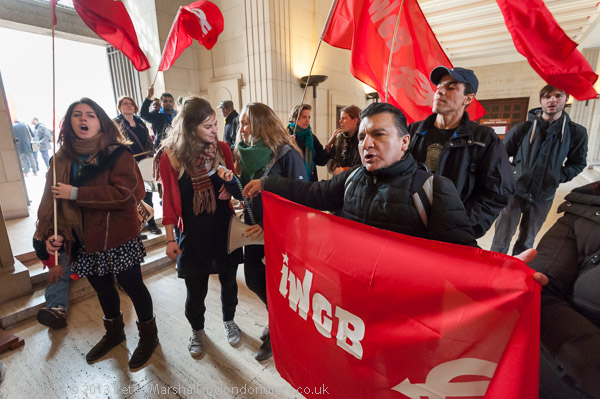
So one of the things I’ve been keen to show when photographing their protests are the flags, placards and banners  with the union insignia, although of course in a way that seems organic to the action – I don’t want to pose these any more than I pose people.  The banner here is fine, though the flags illustrate that these are tricky to photograph, often fluttering madly or hanging limp.

One other problem can also be seen in the image above is that of lighting contrast. The protesters are in a ground floor area below the building which, although it has large open doorways, is still considerably darker than outside. As you can see above, to maintain detail in the shadows inside means that the highlight areas through the doorway at left are largely blank. I’ve had to burn them in considerably to darken the figures outside as well as bringing down the ‘white’ slider in Lightroom down to bring the white area just within range.

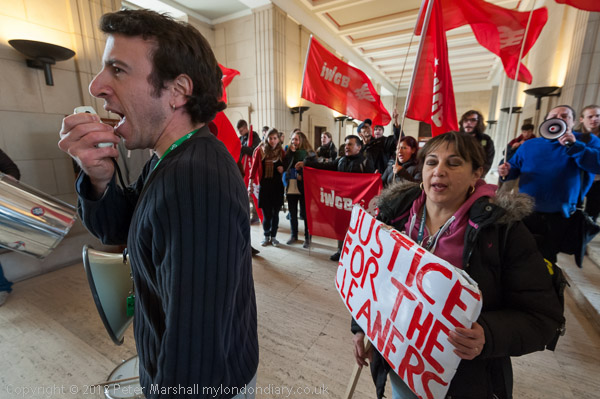
Where possible I avoided the problem, as in the second image where I deliberately made the image from a position where the speaker effectively blocks the doorway behind. It seemed too that it was an image that summed up much of what the protest was about, both in the attitude of the speaker – helped by some nice rim lighting as well as that open mouth, but with the text of the placard and the solidarity of the people with their red flags and banner in the background, backing up  the demand.

More pictures from the event, inside and outside the lobby and more details of the situation and the campaign demands at ‘3 Cosas’ -Sick Pay, Holidays & Pensions.

Continue reading 3 Cosas

Feathers Everywhere

Although I’d felt in my bag for the 10.5mm earlier in the day and found it wasn’t there, it was really at the last event of the day that I missed it.

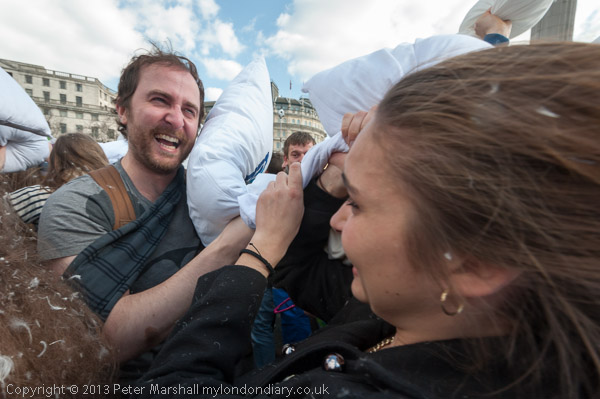
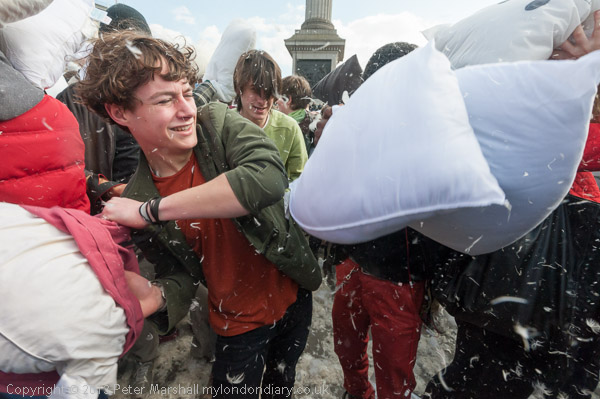
It would be easy to dismiss World Pillow Fight Day as a bit of fluff, and probably correct to do so, but it is rather a fun event, and it’s good to get stuck in there whether with a pillow or a camera. One of the few rules is that those taking part are not to hit photographers, but given the chaos that erupts, this is impossible, though some people did apologise after having realised they had attacked me. But if you don’t want to get hit you really need to keep our of the crowd, and where’s the fun in that whether you are wielding camera or pillow.

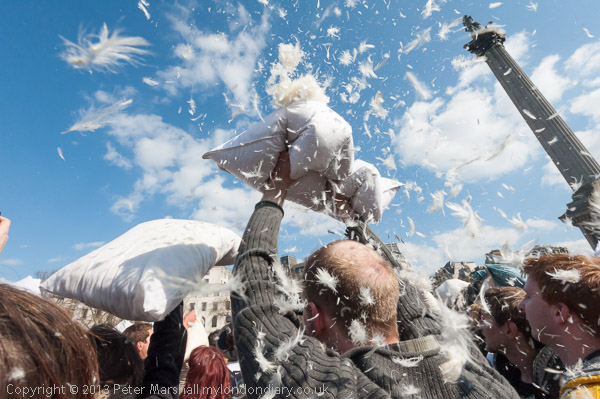
Certainly in some earlier years there was also a rule that feather pillows were not allowed, but this too is one that has never been adhered to, and the air was soon thick with feathers and dust, as many of the pillows split, and we were dragging our feet through a few inches of pillow fillings across much of the centre of Trafalgar Square.

It was a close and personal occasion, and although I had both Nikons around my neck, the only one I used was the D700 with the 16-35mm, and almost all taken at its widest. There really was very little time to think or to frame, let alone to zoom as the action got going, and despite the sunny afternoon I was using a fairly high ISO 1250 to to get both sufficient depth of field at close working distances and also to stop the fairly extreme motion. Typically the pictures were taken at around 1/1000 at f11, but I was using both autofocus and auto-exposure.

I put my flash away inside my bag – it wasn’t needed and would be rather vulnerable to damage by pillows when sitting on the hot shoe. Flash isn’t too useful at very short range although there might be some nice effects with it lighting up the feathers in the air, the sun was doing quite a good job.

I did lose the lens hood from the 18-105mm in the melée, but fortunately replacements come cheap on eBay, and are at least as good as the genuine Nikon item that costs around ten times as much. You can find them advertised at from a little under £2 post free to almost £40, and I think there is no difference between them.  They are all fairly flimsy plastic and all fit the poorly designed bayonet on the Nikon lens.

More than two weeks later, I’m still finding feathers in the pockets of the clothes I wore and in odd places in my camera bag. You can see a few more too in the pictures of the event at Feathers Fly in Trafalgar Square.

After half an hour or so, the dust from the feathers and kapok was making my throat very dry and I felt I’d taken enough pictures. It was a good excuse to make my way to a nearby pub along with a photographer friend and relax a little before going home.
Continue reading Feathers Everywhere

I Don’t Shoot

Last night I had a dream. Not I suppose unusual, but I seldom remember my dreams, and few of them relate to photography, but this one contained two very clear photographic images, and it is those that I remembered when I woke up in the middle of it at around 5am. I can’t recall more than the small incident that involved them, but I do know that they were taken with the 70-300mm Nikon lens, and that somehow at the same time as looking through the camera I was also looking through the sight of a rifle at the man I was photographing in the first of the two images.

This showed a man, a native inhabitant of some jungle in his tribal regalia, taking aim with a blow pipe and a poison dart, but it wasn’t in the jungle but at some kind of organised event, and I swung the camera around and took the second picture, which showed the dart passing within millimetres of my daughter and embedding in the wall or fence behind her. And I don’t have a daughter except in this dream (and perhaps others I don’t recall.)

The images were bright and colourful, although the details have rather faded from my mind now, but I was seeing these, and a slightly less clear wide-angle view of the scene, and thinking thank goodness I hadn’t pulled the trigger and shot the man, which had been my initial reaction. Looking back on the pictures in my dream I realised he couldn’t really have been using a poison dart at an event like that, and was clearly aiming to miss – as he did. I also remember thinking, before I woke up enough to swing my legs out of bed and go to empty my bladder, how surprising it was that both of the telephoto pictures were sharp, though I can’t now recall the aperture and shutter speed! It was only as I got on to my feet that I realised that these pictures were not real.  No doubt my analyst – if I had one – would have something to say about all this.

I’m not a pacifist, though I’m generally against war, but had I been born 20 years earlier than I was I think I would have gone to fight fascism though perhaps my skills would have more useful away from the front line. I’ve never owned a gun or rifle – and the only guns I’ve ever shot have been air-guns and air rifles, mainly at targets in friend’s back gardens when I was a teenager, or at the fair. But I don’t shoot pictures with my camera.

‘Shooting’ pictures is a metaphor that I try hard to avoid. It doesn’t reflect the way I think when I’m working with a camera and I find it disturbing, though it has become so much a part of our normal language of photography that it’s hard to avoid – and sometimes I find myself slipping into it. I never hunt for pictures either. I don’t even like to think of myself as ‘taking’ pictures – it still rather sounds like I’m stealing souls.  I’m rather happier to ‘make’ pictures, and often to make them with other people who are in front of my camera.

Contrasting Events

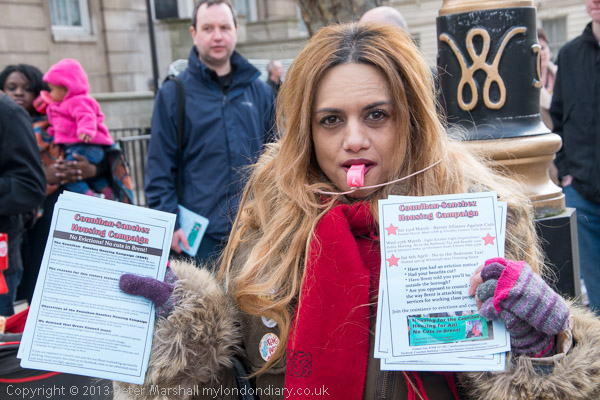
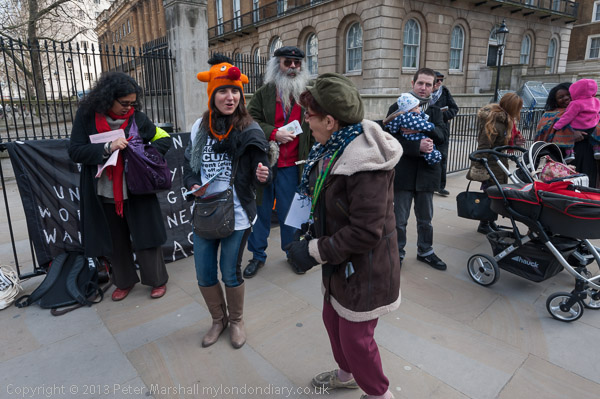
From the Sikh protest against the death penalty I walked the short distance up Parliament St and Whitehall to where the Counihan-Sanchez Family Housing Campaign were holding a protest against the bedroom tax and other tax and benefit changes that impact unfairly on the poor and disabled.

No to Bedroom Tax & Benefit Caps was a relatively small protest over issues that affect many, and one in particular that seems to those affected to be a particularly vicious and vindictive attack on those at the bottom of our society. Homelessness and the housing problem isn’t caused by poor people who have a little space in their homes (something the better off in our society take for granted), but by policies that have failed to build social housing, have rocketed house prices and private rents, in part through vast subsidies to private landlords through ‘housing benefit’, by the increased growth in second home ownership and the buying up of houses and flats as investment properties, and by the many properties left empty as their value increases. It’s a problem that Tory, New Labour and Coalition governments at least since Thatcher have not just failed to tackle but have actually contributed to.

Most of those present were from Kilburn, where the Counihan family has waged a high profile campaign against its own unfair treatment by the local authority, the London Borough of Brent, and encouraged and inspired others to stand up for their rights. One of those, a young woman and her daughter who had managed to get Harrow council to fulfil their legal obligations to her spoke at the event, as did a number of others. But though the various addresses were interesting, it was had to find much of great visual interest, and my pictures were just a little ordinary.

As I was photographing this event, another began to start alongside. As so often in London I had something else to photograph that I’d not known about when I left home (they almost make up for the times when I go to advertised events to find nothing at all happening.) Students often write to me asking where there are lists of protests or how I found out what is happening in London, or asking me to send them a list of events they can photograph. There really are no overall lists, although there are a number of web sites worth looking at to find what is happening, but many groups remain curiously secretive about their activities.

Amateur photography magazines sometimes publish lists of events to photograph, but that has always seemed to me to be the wrong way round, as if there are certain aspects of life, certain events that are photogenic, and that if you want to be a photographer you go to these and take photographs.  As if the aim of photography is to photograph the photogenic. My advice is always for people to get interested and involved in things and then to photograph them. Photography, as I’ve so often said isn’t about making pictures.

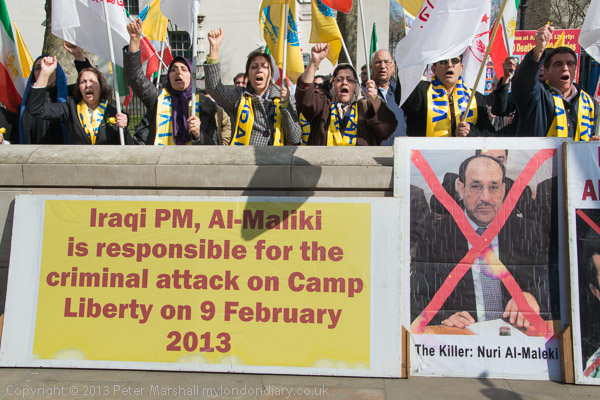
The group appearing alongside was the People’s Mujahedin of Iran, one of the military groups which combined to overthrow the Iranian regime in 1965, but which then lost out to the Islamic regime and had to take refuge in Saddam Hussein’s Iraq. After the US invasion they gave up their arms and were confined to their camp by US troops while they were allowed to become a leading part of the Iranian parliament in exile, the Paris-based National Council of Resistance of Iran.

But in 2009, control of their camp was transferred to Iraq, and since then they have been moved and subjected to attacks, regarded as a terrorist group by both Iraq and Iran, although the EU removed them from its list of terrorists in 2009. The London protest was to get support from the UK government for the appeals they have made to the UN Secretary General and the US for the protection they are entitled to under the Geneva convention as recognised by the US in 2003.

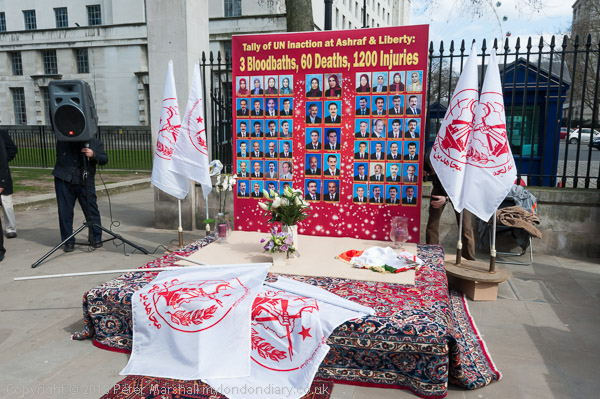
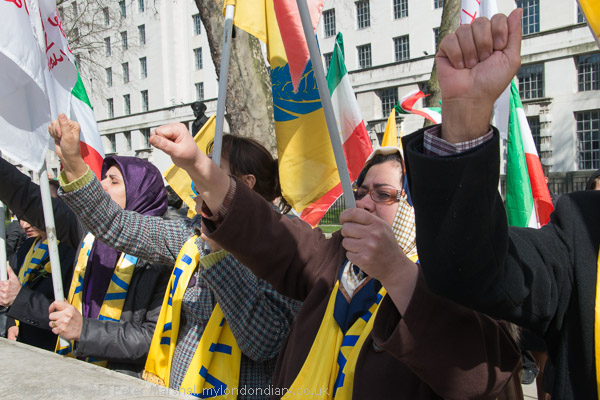
The protest was quite a contrast to the open and somewhat chaotic freedom of the event I had just been photographing, which had little form and where everyone present was invited to make use of the megaphone – and ‘open mike’ event. Behind the protesters was a platform that was a shrine to the many PMOI members who had been killed in the attacks, with rows of their photographs, and the protest itself had the precision of a military exercise, carried out to the beat of a drum and under clear direction, with the protesters responding in remarkable precision to the call if their leader. I mean no disrespect – it was just a very different way to organise, and I tried to show this in my pictures, as I hope you can see in PMOI Protest Iraqi killings.

Continue reading Contrasting Events